Electronics and
Communication
Engineering (ECE)
Electronics and Communication Engineering (ECE) is a branch of engineering
that focuses on the design, development, and application of electronic devices
and communication systems. It combines principles from both electronics
engineering and communication engineering to create and improve
technologies used in a wide range of applications.
What To Choose ?
TNEA (Tamil Nadu Engineering
Admission) Cut-off Trends for
ECE
1 2020
The cut-off for ECE in top Tamil Nadu colleges ranged from 190 to
195 marks out of 200.
2 2021
The cut-off increased to 195-198 marks, reflecting the growing
competition and popularity of the ECE program.
3 2022
The cut-off had been rose with the top colleges requiring 197-199
marks for ECE admissions.
4 2023
For top institutions, the cut-off for ECE was around 199.5 for
the open category.
Top Colleges for ECE under TNEA
Anna University
Anna University, one of the most
prestigious institutions in Tamil Nadu,
offers an excellent ECE program with
state-of-the-art facilities.
Madras Institute of
Technology
Madras Institute of Technology (MIT),
a constituent college of Anna
University, is renowned for its ECE
department and cutting-edge
research.
SSN College of Engineering
SSN College of Engineering, located
in Chennai, is a top-ranked institution
that provides a strong foundation in
ECE and hands-on experience.
Aspects Of ECE:
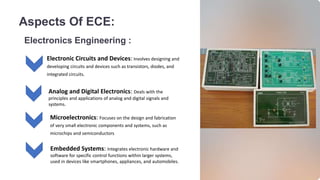
Electronic Circuits and Devices: Involves designing and
developing circuits and devices such as transistors, diodes, and
integrated circuits.
Analog and Digital Electronics: Deals with the
principles and applications of analog and digital signals and
systems.
Embedded Systems: Integrates electronic hardware and
software for specific control functions within larger systems,
used in devices like smartphones, appliances, and automobiles.
Electronics Engineering :
Microelectronics: Focuses on the design and fabrication
of very small electronic components and systems, such as
microchips and semiconductors
Aspects Of ECE:
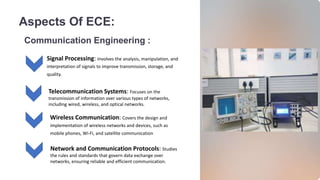
Signal Processing: Involves the analysis, manipulation, and
interpretation of signals to improve transmission, storage, and
quality.
Telecommunication Systems: Focuses on the
transmission of information over various types of networks,
including wired, wireless, and optical networks.
Network and Communication Protocols: Studies
the rules and standards that govern data exchange over
networks, ensuring reliable and efficient communication.
Communication Engineering :
Wireless Communication: Covers the design and
implementation of wireless networks and devices, such as
mobile phones, Wi-Fi, and satellite communication
Applications and
Industries:
Telecommunications: Development of
communication infrastructure, such as mobile networks,
broadband, and satellite systems.
Consumer Electronics: Design and
manufacturing of electronic devices like smartphones,
tablets, and televisions.
Automotive Industry: Development of
electronic control systems and communication networks
within vehicles.
Healthcare: Design of medical devices and systems
for diagnostics, monitoring, and treatment.
Aerospace and Defense: Development of
communication systems, navigation, and control
systems for aircraft, spacecraft, and defense
applications
Career Opportunities:
1 Core Electronics:
Design and Development:
Roles in designing circuits,
systems, and components.
Manufacturing: Involvement
in the production and quality
control of electronic devices.
Testing and Maintenance:
Ensuring devices work
correctly and are maintained
properly.
2 Telecommunications:
Network Engineer: Designing,
implementing, and
maintaining
telecommunications
networks.
RF Engineer: Working on radio
frequency technology used in
mobile networks.
Signal Processing: Roles in
enhancing and manipulating
communication signals.
3 Automations and Control Systems:
Control Engineer:
Designing and managing automated systems.
Robotics Engineer:
Developing robots and automated systems.
Career Opportunities:
4 IT and Software:
Software Developer: Writing
and testing code for
applications.
System Analyst: Analyzing and
designing technology
solutions.
Embedded Systems:
Developing software for
embedded systems in various
devices.
5 Research and
Development:
Academic Research:
Conducting research in
universities or research
institutions.
Industrial R&D: Working on
new technologies and
innovations in companies.
6 Government and Public Sector:
Public Sector Units (PSUs): Working in companies like Bharat Electronics
Limited (BEL), Bharat Heavy Electricals Limited (BHEL), and Indian Space
Research Organisation (ISRO).
Civil Services: Preparing for exams like UPSC to join various government
departments
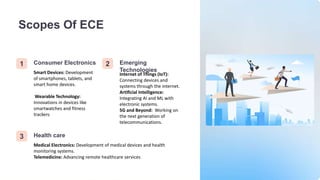
Scopes Of ECE
1 Consumer Electronics
Smart Devices: Development
of smartphones, tablets, and
smart home devices.
Wearable Technology:
Innovations in devices like
smartwatches and fitness
trackers
2 Emerging
Technologies
Internet of Things (IoT):
Connecting devices and
systems through the internet.
Artificial Intelligence:
Integrating AI and ML with
electronic systems.
5G and Beyond: Working on
the next generation of
telecommunications.
3 Health care
Medical Electronics: Development of medical devices and health
monitoring systems.
Telemedicine: Advancing remote healthcare services
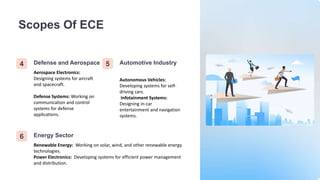
Scopes Of ECE
4 Defense and Aerospace
Aerospace Electronics:
Designing systems for aircraft
and spacecraft.
Defense Systems: Working on
communication and control
systems for defense
applications.
5 Automotive Industry
Autonomous Vehicles:
Developing systems for self-
driving cars.
Infotainment Systems:
Designing in-car
entertainment and navigation
systems.
6 Energy Sector
Renewable Energy: Working on solar, wind, and other renewable energy
technologies.
Power Electronics: Developing systems for efficient power management
and distribution.
Future Studies:
Higher Education:
Master's Degrees: Specialize in fields like VLSI design,
embedded systems, communication systems, etc.
PhD: Pursue research in advanced areas of electronics and
communication.
Certifications:
Professional Courses: Certifications in areas like networking
(Cisco certifications), embedded systems, and IoT can enhance
job prospects.
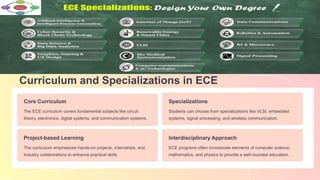
Curriculum and Specializations in ECE
Core Curriculum
The ECE curriculum covers fundamental subjects like circuit
theory, electronics, digital systems, and communication systems.
Specializations
Students can choose from specializations like VLSI, embedded
systems, signal processing, and wireless communication.
Project-based Learning
The curriculum emphasizes hands-on projects, internships, and
industry collaborations to enhance practical skills.
Interdisciplinary Approach
ECE programs often incorporate elements of computer science,
mathematics, and physics to provide a well-rounded education.
Job Prospects and
Employment Trends for ECE
Graduates
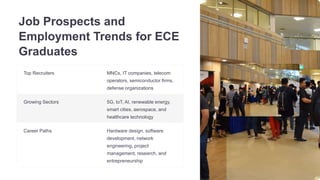
Top Recruiters MNCs, IT companies, telecom
operators, semiconductor firms,
defense organizations
Growing Sectors 5G, IoT, AI, renewable energy,
smart cities, aerospace, and
healthcare technology
Career Paths Hardware design, software
development, network
engineering, project
management, research, and
entrepreneurship
Government Employment
Trends for ECE Graduates
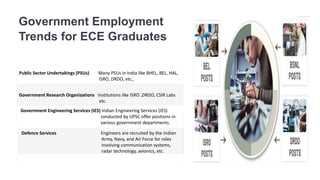
Public Sector Undertakings (PSUs) Many PSUs in India like BHEL, BEL, HAL,
ISRO, DRDO, etc.,
Government Research Organizations Institutions like ISRO ,DRDO, CSIR Labs
etc.
Government Engineering Services (IES) Indian Engineering Services (IES)
conducted by UPSC offer positions in
various government departments.
Defence Services Engineers are recruited by the Indian
Army, Navy, and Air Force for roles
involving communication systems,
radar technology, avionics, etc.
Entrepreneurial Opportunities for
ECE Professionals
1 Hardware Startups
ECE graduates can leverage their
technical expertise to launch
innovative hardware products and
solutions.
2 Deep Tech
Fields like AI, robotics, and
renewable energy offer immense
potential for ECE-based technology
startups.
3 IoT and Smart Systems
The growing demand for connected
devices and intelligent systems
creates opportunities for ECE
entrepreneurs.
4 Consulting and Services
ECE professionals can provide
specialized consulting, system
integration, and maintenance
services to various industries.
Work Pressure and Stress
Management in ECE
Time Management
Effective time management skills are crucial to handle deadlines, project deliverables, and
multiple tasks.
Teamwork
Collaborative problem-solving and communication skills help ECE professionals navigate
complex challenges.
Self-care
Maintaining a healthy work-life balance, practicing stress-management techniques, and seeking
support are essential.
Conclusion and Key
Takeaways
Electronics and Communication Engineering (ECE) is a dynamic and
versatile field that offers a wide range of career opportunities, from
hardware design to cutting-edge technology development. With its strong
emphasis on hands-on training, project-based learning, and exposure to
emerging trends, an ECE degree prepares students for success in both
corporate and entrepreneurial spheres.
ECE Presentation For Career Guidance.pptx

ECE Presentation For Career Guidance.pptx

  • 2.
    Electronics and Communication Engineering (ECE) Electronicsand Communication Engineering (ECE) is a branch of engineering that focuses on the design, development, and application of electronic devices and communication systems. It combines principles from both electronics engineering and communication engineering to create and improve technologies used in a wide range of applications.
  • 3.
  • 4.
    TNEA (Tamil NaduEngineering Admission) Cut-off Trends for ECE 1 2020 The cut-off for ECE in top Tamil Nadu colleges ranged from 190 to 195 marks out of 200. 2 2021 The cut-off increased to 195-198 marks, reflecting the growing competition and popularity of the ECE program. 3 2022 The cut-off had been rose with the top colleges requiring 197-199 marks for ECE admissions. 4 2023 For top institutions, the cut-off for ECE was around 199.5 for the open category.
  • 5.
    Top Colleges forECE under TNEA Anna University Anna University, one of the most prestigious institutions in Tamil Nadu, offers an excellent ECE program with state-of-the-art facilities. Madras Institute of Technology Madras Institute of Technology (MIT), a constituent college of Anna University, is renowned for its ECE department and cutting-edge research. SSN College of Engineering SSN College of Engineering, located in Chennai, is a top-ranked institution that provides a strong foundation in ECE and hands-on experience.
  • 6.
    Aspects Of ECE: ElectronicCircuits and Devices: Involves designing and developing circuits and devices such as transistors, diodes, and integrated circuits. Analog and Digital Electronics: Deals with the principles and applications of analog and digital signals and systems. Embedded Systems: Integrates electronic hardware and software for specific control functions within larger systems, used in devices like smartphones, appliances, and automobiles. Electronics Engineering : Microelectronics: Focuses on the design and fabrication of very small electronic components and systems, such as microchips and semiconductors
  • 7.
    Aspects Of ECE: SignalProcessing: Involves the analysis, manipulation, and interpretation of signals to improve transmission, storage, and quality. Telecommunication Systems: Focuses on the transmission of information over various types of networks, including wired, wireless, and optical networks. Network and Communication Protocols: Studies the rules and standards that govern data exchange over networks, ensuring reliable and efficient communication. Communication Engineering : Wireless Communication: Covers the design and implementation of wireless networks and devices, such as mobile phones, Wi-Fi, and satellite communication
  • 8.
    Applications and Industries: Telecommunications: Developmentof communication infrastructure, such as mobile networks, broadband, and satellite systems. Consumer Electronics: Design and manufacturing of electronic devices like smartphones, tablets, and televisions. Automotive Industry: Development of electronic control systems and communication networks within vehicles. Healthcare: Design of medical devices and systems for diagnostics, monitoring, and treatment. Aerospace and Defense: Development of communication systems, navigation, and control systems for aircraft, spacecraft, and defense applications
  • 9.
    Career Opportunities: 1 CoreElectronics: Design and Development: Roles in designing circuits, systems, and components. Manufacturing: Involvement in the production and quality control of electronic devices. Testing and Maintenance: Ensuring devices work correctly and are maintained properly. 2 Telecommunications: Network Engineer: Designing, implementing, and maintaining telecommunications networks. RF Engineer: Working on radio frequency technology used in mobile networks. Signal Processing: Roles in enhancing and manipulating communication signals. 3 Automations and Control Systems: Control Engineer: Designing and managing automated systems. Robotics Engineer: Developing robots and automated systems.
  • 10.
    Career Opportunities: 4 ITand Software: Software Developer: Writing and testing code for applications. System Analyst: Analyzing and designing technology solutions. Embedded Systems: Developing software for embedded systems in various devices. 5 Research and Development: Academic Research: Conducting research in universities or research institutions. Industrial R&D: Working on new technologies and innovations in companies. 6 Government and Public Sector: Public Sector Units (PSUs): Working in companies like Bharat Electronics Limited (BEL), Bharat Heavy Electricals Limited (BHEL), and Indian Space Research Organisation (ISRO). Civil Services: Preparing for exams like UPSC to join various government departments
  • 11.
    Scopes Of ECE 1Consumer Electronics Smart Devices: Development of smartphones, tablets, and smart home devices. Wearable Technology: Innovations in devices like smartwatches and fitness trackers 2 Emerging Technologies Internet of Things (IoT): Connecting devices and systems through the internet. Artificial Intelligence: Integrating AI and ML with electronic systems. 5G and Beyond: Working on the next generation of telecommunications. 3 Health care Medical Electronics: Development of medical devices and health monitoring systems. Telemedicine: Advancing remote healthcare services
  • 12.
    Scopes Of ECE 4Defense and Aerospace Aerospace Electronics: Designing systems for aircraft and spacecraft. Defense Systems: Working on communication and control systems for defense applications. 5 Automotive Industry Autonomous Vehicles: Developing systems for self- driving cars. Infotainment Systems: Designing in-car entertainment and navigation systems. 6 Energy Sector Renewable Energy: Working on solar, wind, and other renewable energy technologies. Power Electronics: Developing systems for efficient power management and distribution.
  • 13.
    Future Studies: Higher Education: Master'sDegrees: Specialize in fields like VLSI design, embedded systems, communication systems, etc. PhD: Pursue research in advanced areas of electronics and communication. Certifications: Professional Courses: Certifications in areas like networking (Cisco certifications), embedded systems, and IoT can enhance job prospects.
  • 14.
    Curriculum and Specializationsin ECE Core Curriculum The ECE curriculum covers fundamental subjects like circuit theory, electronics, digital systems, and communication systems. Specializations Students can choose from specializations like VLSI, embedded systems, signal processing, and wireless communication. Project-based Learning The curriculum emphasizes hands-on projects, internships, and industry collaborations to enhance practical skills. Interdisciplinary Approach ECE programs often incorporate elements of computer science, mathematics, and physics to provide a well-rounded education.
  • 15.
    Job Prospects and EmploymentTrends for ECE Graduates Top Recruiters MNCs, IT companies, telecom operators, semiconductor firms, defense organizations Growing Sectors 5G, IoT, AI, renewable energy, smart cities, aerospace, and healthcare technology Career Paths Hardware design, software development, network engineering, project management, research, and entrepreneurship
  • 16.
    Government Employment Trends forECE Graduates Public Sector Undertakings (PSUs) Many PSUs in India like BHEL, BEL, HAL, ISRO, DRDO, etc., Government Research Organizations Institutions like ISRO ,DRDO, CSIR Labs etc. Government Engineering Services (IES) Indian Engineering Services (IES) conducted by UPSC offer positions in various government departments. Defence Services Engineers are recruited by the Indian Army, Navy, and Air Force for roles involving communication systems, radar technology, avionics, etc.
  • 17.
    Entrepreneurial Opportunities for ECEProfessionals 1 Hardware Startups ECE graduates can leverage their technical expertise to launch innovative hardware products and solutions. 2 Deep Tech Fields like AI, robotics, and renewable energy offer immense potential for ECE-based technology startups. 3 IoT and Smart Systems The growing demand for connected devices and intelligent systems creates opportunities for ECE entrepreneurs. 4 Consulting and Services ECE professionals can provide specialized consulting, system integration, and maintenance services to various industries.
  • 18.
    Work Pressure andStress Management in ECE Time Management Effective time management skills are crucial to handle deadlines, project deliverables, and multiple tasks. Teamwork Collaborative problem-solving and communication skills help ECE professionals navigate complex challenges. Self-care Maintaining a healthy work-life balance, practicing stress-management techniques, and seeking support are essential.
  • 19.
    Conclusion and Key Takeaways Electronicsand Communication Engineering (ECE) is a dynamic and versatile field that offers a wide range of career opportunities, from hardware design to cutting-edge technology development. With its strong emphasis on hands-on training, project-based learning, and exposure to emerging trends, an ECE degree prepares students for success in both corporate and entrepreneurial spheres.