BIBLIOGRAPHY
HIS
THEORY
 Focuses on learners’ background knowledge.
 Students have to relate the new experiences
they obtain to their own previous knowledge
 Interest in the material to be learned is the best
stimulus to learning, rather than competitive
advantage.
 Language serves to mediate between
environmental stimuli and the individual's
response.
THREE MODES OF
REPRESENTATION:
Enactive representation.
Iconic representation.
Symbolic representation.

These are the
way in which
information or
knowledge are
stored and
encoded in
memory.
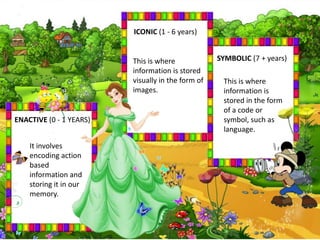
ICONIC (1 - 6 years)

This is where
information is stored
visually in the form of
images.

ENACTIVE (0 - 1 YEARS)
It involves
encoding action
based
information and
storing it in our
memory.

SYMBOLIC (7 + years)
This is where
information is
stored in the form
of a code or
symbol, such as
language.
THE IMPORTANCE OF
LANGUAGE
Language is
important for the
increased ability to
deal with abstract
concepts.

Bruner argues that
language can code
stimuli and free an
individual from the
constraints to
provide
flexible cognition.
EDUCATIONAL IMPLICATIONS
It is to facilitate a
child's thinking and
problem solving
skills which can
then be
transferred to a
range of
situations.

Bruner
proposes
that learners’
construct
their own
knowledge.
BRUNER AND VYGOTSKY

Both emphasize
a child's social
environment

They agree
that adults
should play
an active role
in assisting
the child's
learning.
BRUNER AND PIAGET
Bruner states that
what determines the
level of intellectual
development is the
extent to which the
child has been given
appropriate
instruction together
with practice or
experience

Although Bruner
proposes stages of
cognitive
development, he doesn’t
see them as
representing different
separate modes of
thought at different
points of development
(like Piaget)
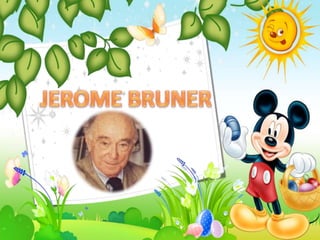
Jerome bruner
Jerome bruner

Jerome bruner

  • 2.
  • 4.
    HIS THEORY  Focuses onlearners’ background knowledge.  Students have to relate the new experiences they obtain to their own previous knowledge  Interest in the material to be learned is the best stimulus to learning, rather than competitive advantage.  Language serves to mediate between environmental stimuli and the individual's response.
  • 5.
    THREE MODES OF REPRESENTATION: Enactiverepresentation. Iconic representation. Symbolic representation. These are the way in which information or knowledge are stored and encoded in memory.
  • 6.
    ICONIC (1 -6 years) This is where information is stored visually in the form of images. ENACTIVE (0 - 1 YEARS) It involves encoding action based information and storing it in our memory. SYMBOLIC (7 + years) This is where information is stored in the form of a code or symbol, such as language.
  • 7.
    THE IMPORTANCE OF LANGUAGE Languageis important for the increased ability to deal with abstract concepts. Bruner argues that language can code stimuli and free an individual from the constraints to provide flexible cognition.
  • 8.
    EDUCATIONAL IMPLICATIONS It isto facilitate a child's thinking and problem solving skills which can then be transferred to a range of situations. Bruner proposes that learners’ construct their own knowledge.
  • 9.
    BRUNER AND VYGOTSKY Bothemphasize a child's social environment They agree that adults should play an active role in assisting the child's learning.
  • 10.
    BRUNER AND PIAGET Brunerstates that what determines the level of intellectual development is the extent to which the child has been given appropriate instruction together with practice or experience Although Bruner proposes stages of cognitive development, he doesn’t see them as representing different separate modes of thought at different points of development (like Piaget)