 Models of teaching is a plan or pattern that can be used to shape
curriculum, to design instructional material and to guide instruction in the
class room and other settings. (Joyce and Weil1980)
 “Teaching models are just instructional designs . They describe the process of
specifying and producing particular environmental situations which cause
the student interact in such a way that specific changes occur in his
behaviour”
 A model of teaching in the book is a description of a learning
environment by presenting several scenarios and examples
 Uses for the teacher
planning curriculums
planning courses, units, and lessons
designing instructional materials like books and work-books,
multimedia programs, and computer-assisted learning programs
 accomplish most of the common goals of schools
 Research based , scientific and reliable
 Conforms to major philosophical and psychological orientations
toward teaching and learning
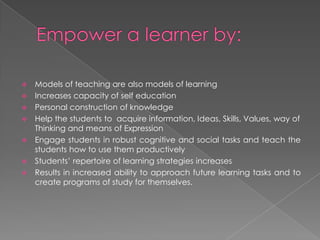
 Models of teaching are also models of learning
 Increases capacity of self education
 Personal construction of knowledge
 Help the students to acquire information, Ideas, Skills, Values, way of
Thinking and means of Expression
 Engage students in robust cognitive and social tasks and teach the
students how to use them productively
 Students’ repertoire of learning strategies increases
 Results in increased ability to approach future learning tasks and to
create programs of study for themselves.
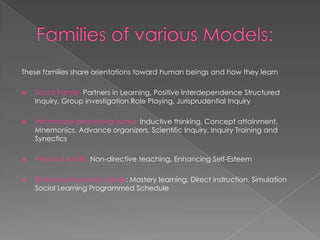
These families share orientations toward human beings and how they learn
 Social Family: Partners in Learning, Positive Interdependence Structured
Inquiry, Group investigation Role Playing, Jurisprudential Inquiry
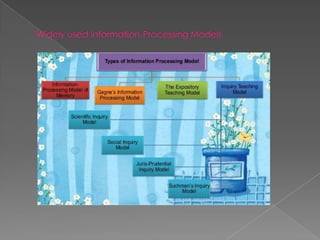
 Information-processing family: Inductive thinking, Concept attainment,
Mnemonics, Advance organizers, Scientific Inquiry, Inquiry Training and
Synectics
 Personal family: Non-directive teaching, Enhancing Self-Esteem
 Behavioural systems family: Mastery learning, Direct instruction, Simulation
Social Learning Programmed Schedule
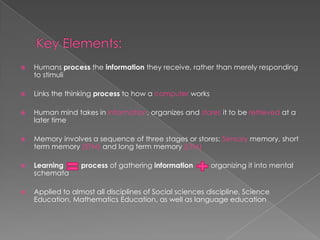
 Humans process the information they receive, rather than merely responding
to stimuli
 Links the thinking process to how a computer works
 Human mind takes in information, organizes and stores it to be retrieved at a
later time
 Memory involves a sequence of three stages or stores: Sensory memory, short
term memory (STM) and long term memory (LTM)
 Learning process of gathering information organizing it into mental
schemata
 Applied to almost all disciplines of Social sciences discipline, Science
Education, Mathematics Education, as well as language education
 A primary weakness is that there is no guarantee that flow diagrams
or computer programs that predict behaviour actually represent
the way human cognitive processes really work
 The differences between computers and the human mind far
outweigh the similarities
 Information processing studies are conducted in highly controlled
laboratory settings, such findings may be unequal to results that
would result from studying children in their natural environments
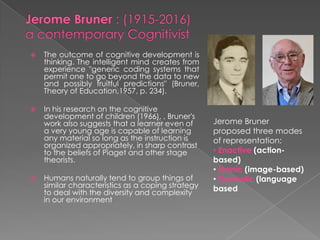
 The outcome of cognitive development is
thinking. The intelligent mind creates from
experience "generic coding systems that
permit one to go beyond the data to new
and possibly fruitful predictions" (Bruner,
Theory of Education,1957, p. 234).
 In his research on the cognitive
development of children (1966), , Bruner's
work also suggests that a learner even of
a very young age is capable of learning
any material so long as the instruction is
organized appropriately, in sharp contrast
to the beliefs of Piaget and other stage
theorists.
 Humans naturally tend to group things of
similar characteristics as a coping strategy
to deal with the diversity and complexity
in our environment
Jerome Bruner
proposed three modes
of representation:
• Enactive (action-
based)
• Iconic (image-based)
• Symbolic (language
based
An indirect instruction strategy that uses a structured inquiry process.
Concept attainment is "the search for and listing of attributes that can
be used to distinguish exemplars from non exemplars of various
categories"(Bruner, Goodnow, and Austin, 1967, p. 233).
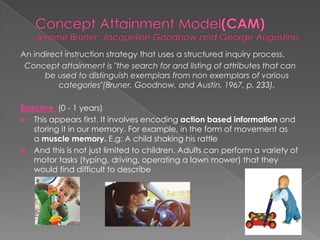
Enactive (0 - 1 years)
 This appears first. It involves encoding action based information and
storing it in our memory. For example, in the form of movement as
a muscle memory. E.g: A child shaking his rattle
 And this is not just limited to children. Adults can perform a variety of
motor tasks (typing, driving, operating a lawn mower) that they
would find difficult to describe
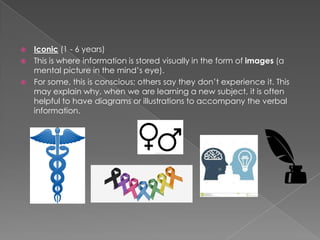
 Iconic (1 - 6 years)
 This is where information is stored visually in the form of images (a
mental picture in the mind’s eye).
 For some, this is conscious; others say they don’t experience it. This
may explain why, when we are learning a new subject, it is often
helpful to have diagrams or illustrations to accompany the verbal
information.
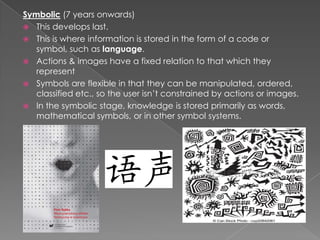
Symbolic (7 years onwards)
 This develops last.
 This is where information is stored in the form of a code or
symbol, such as language.
 Actions & images have a fixed relation to that which they
represent
 Symbols are flexible in that they can be manipulated, ordered,
classified etc., so the user isn’t constrained by actions or images.
 In the symbolic stage, knowledge is stored primarily as words,
mathematical symbols, or in other symbol systems.
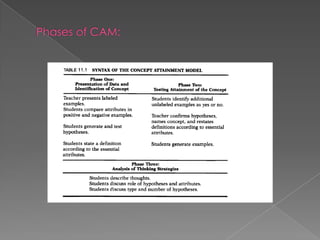
 Syntax (a) presentation of the exemplars (b) testing and
naming hypothesis (c ) description and discussion of the
concept (d) application and synthesis
 Social System
The teacher controls the sequence, but open dialogue occurs in
the latter phases. Student interaction is encouraged. The model
is relatively structured, with students assuming more initiative
 Principles of Reaction
1. Give support by recording, prompting and presenting more
examples
2. Help students balance one hypothesis against another
3. Focus attention on specific features of examples
4. Assist students in discussing and evaluating their thinking
strategies
 Support System
Support consists of carefully selected and organized materials
and data in the form of discrete units to serve as examples.
Sequencing of exemplars are also crucial.
 For Bruner (1961), the purpose of education is not to impart
knowledge, but instead to facilitate a child's thinking and problem-
solving skills which can then be transferred to a range of situations.
Specifically, education should also develop symbolic thinking in
children.
 Symbolic representation: crucial for cognitive development, and
since language is our primary means of symbolizing the world, he
attaches great importance to language in determining cognitive
development
 Language Acquisition Support System (LASS): In his book “The
Culture of Education”, Bruner states that ”A crucial phase in the
child's development comes with its acquisition of language and his
theory of cognitive development’s last stage i.e. symbolic
representation essentially requires language development and thus
constructs of knowledge based on child’s own symbols and codes.
 Spiral curriculum: information being structured so that complex
ideas can be taught at a simplified level first, and then re-
visited at more complex levels later on
 Discovery learning: Bruner believed that the most effective
way to develop a coding system is to discover it rather than
being told it by the teacher.
The use of the spiral curriculum can aid the process of discovery
learning.
 Scaffolding: refers to the steps taken to reduce the degrees of
freedom in carrying out some task so that the child can
concentrate on the difficult skill she is in the process of acquiring'
(Bruner, 1978, p. 19). involves helpful, structured interaction
between an adult and a child with the aim of helping the child
achieve a specific goal.
 Emphasis on Adult facilitator /Teacher:
The involvement of ADULTS and MORE KNOWLEDGEABLE PEERS
makes a big difference in the cognitive development of Child
even though his active participation is essential for the process of
learning to happen.
 In 1960 Bruner's text, The Process of Education was published. The
main premise of Bruner's text was that students are active
learners who construct their own knowledge.
 Bruner (1960) adopts a different view and believes a child (of
any age) is capable of understanding complex information: 'We
begin with the hypothesis that any subject can be taught
effectively in some intellectually honest form to any child at any
stage of development.' (p. 33)
 Constructivism: Bruner (1961) proposes that learners’ construct
their own knowledge and do this by organizing and categorizing
information using a coding system. Learning is an active process
in which learners construct new ideas or concepts based upon
their current/past knowledge.
 Bruner, J. (1960). The Process of Education. Cambridge, MA:
Harvard University Press.
 Bruner, J. (1966). Toward a Theory of Instruction. Cambridge, MA:
Harvard University Press.
 Bruner, J. (1973). Going Beyond the Information Given. New York:
Norton.
 Bruner, J. (1983). Child’s Talk: Learning to Use Language. New
York: Norton.
 Bruner, J. (1986). Actual Minds, Possible Worlds. Cambridge, MA:
Harvard University Press.
 Bruner, J. (1990). Acts of Meaning. Cambridge, MA: Harvard
University Press.
 Bruner, J. (1996). The Culture of Education, Cambridge, MA:
Harvard University Press.
 Bruner, J., Goodnow, J., & Austin, A. (1956). A Study of
Thinking. New York: Wiley.
 Models of Teaching, Bruce Joyce and Marsha Weils ,2003
 www.psychology.iresearchnet.com
 https://www.jstor.org/
 www.simplypsychology.org
 www.sagepub.com
 http://www.infed.org/thinkers/bruner.htm

Models of teaching

  • 2.
     Models ofteaching is a plan or pattern that can be used to shape curriculum, to design instructional material and to guide instruction in the class room and other settings. (Joyce and Weil1980)  “Teaching models are just instructional designs . They describe the process of specifying and producing particular environmental situations which cause the student interact in such a way that specific changes occur in his behaviour”
  • 3.
     A modelof teaching in the book is a description of a learning environment by presenting several scenarios and examples  Uses for the teacher planning curriculums planning courses, units, and lessons designing instructional materials like books and work-books, multimedia programs, and computer-assisted learning programs  accomplish most of the common goals of schools  Research based , scientific and reliable  Conforms to major philosophical and psychological orientations toward teaching and learning
  • 4.
     Models ofteaching are also models of learning  Increases capacity of self education  Personal construction of knowledge  Help the students to acquire information, Ideas, Skills, Values, way of Thinking and means of Expression  Engage students in robust cognitive and social tasks and teach the students how to use them productively  Students’ repertoire of learning strategies increases  Results in increased ability to approach future learning tasks and to create programs of study for themselves.
  • 5.
    These families shareorientations toward human beings and how they learn  Social Family: Partners in Learning, Positive Interdependence Structured Inquiry, Group investigation Role Playing, Jurisprudential Inquiry  Information-processing family: Inductive thinking, Concept attainment, Mnemonics, Advance organizers, Scientific Inquiry, Inquiry Training and Synectics  Personal family: Non-directive teaching, Enhancing Self-Esteem  Behavioural systems family: Mastery learning, Direct instruction, Simulation Social Learning Programmed Schedule
  • 7.
     Humans processthe information they receive, rather than merely responding to stimuli  Links the thinking process to how a computer works  Human mind takes in information, organizes and stores it to be retrieved at a later time  Memory involves a sequence of three stages or stores: Sensory memory, short term memory (STM) and long term memory (LTM)  Learning process of gathering information organizing it into mental schemata  Applied to almost all disciplines of Social sciences discipline, Science Education, Mathematics Education, as well as language education
  • 8.
     A primaryweakness is that there is no guarantee that flow diagrams or computer programs that predict behaviour actually represent the way human cognitive processes really work  The differences between computers and the human mind far outweigh the similarities  Information processing studies are conducted in highly controlled laboratory settings, such findings may be unequal to results that would result from studying children in their natural environments
  • 9.
     The outcomeof cognitive development is thinking. The intelligent mind creates from experience "generic coding systems that permit one to go beyond the data to new and possibly fruitful predictions" (Bruner, Theory of Education,1957, p. 234).  In his research on the cognitive development of children (1966), , Bruner's work also suggests that a learner even of a very young age is capable of learning any material so long as the instruction is organized appropriately, in sharp contrast to the beliefs of Piaget and other stage theorists.  Humans naturally tend to group things of similar characteristics as a coping strategy to deal with the diversity and complexity in our environment Jerome Bruner proposed three modes of representation: • Enactive (action- based) • Iconic (image-based) • Symbolic (language based
  • 10.
    An indirect instructionstrategy that uses a structured inquiry process. Concept attainment is "the search for and listing of attributes that can be used to distinguish exemplars from non exemplars of various categories"(Bruner, Goodnow, and Austin, 1967, p. 233). Enactive (0 - 1 years)  This appears first. It involves encoding action based information and storing it in our memory. For example, in the form of movement as a muscle memory. E.g: A child shaking his rattle  And this is not just limited to children. Adults can perform a variety of motor tasks (typing, driving, operating a lawn mower) that they would find difficult to describe
  • 11.
     Iconic (1- 6 years)  This is where information is stored visually in the form of images (a mental picture in the mind’s eye).  For some, this is conscious; others say they don’t experience it. This may explain why, when we are learning a new subject, it is often helpful to have diagrams or illustrations to accompany the verbal information.
  • 12.
    Symbolic (7 yearsonwards)  This develops last.  This is where information is stored in the form of a code or symbol, such as language.  Actions & images have a fixed relation to that which they represent  Symbols are flexible in that they can be manipulated, ordered, classified etc., so the user isn’t constrained by actions or images.  In the symbolic stage, knowledge is stored primarily as words, mathematical symbols, or in other symbol systems.
  • 14.
     Syntax (a)presentation of the exemplars (b) testing and naming hypothesis (c ) description and discussion of the concept (d) application and synthesis  Social System The teacher controls the sequence, but open dialogue occurs in the latter phases. Student interaction is encouraged. The model is relatively structured, with students assuming more initiative  Principles of Reaction 1. Give support by recording, prompting and presenting more examples 2. Help students balance one hypothesis against another 3. Focus attention on specific features of examples 4. Assist students in discussing and evaluating their thinking strategies  Support System Support consists of carefully selected and organized materials and data in the form of discrete units to serve as examples. Sequencing of exemplars are also crucial.
  • 15.
     For Bruner(1961), the purpose of education is not to impart knowledge, but instead to facilitate a child's thinking and problem- solving skills which can then be transferred to a range of situations. Specifically, education should also develop symbolic thinking in children.  Symbolic representation: crucial for cognitive development, and since language is our primary means of symbolizing the world, he attaches great importance to language in determining cognitive development  Language Acquisition Support System (LASS): In his book “The Culture of Education”, Bruner states that ”A crucial phase in the child's development comes with its acquisition of language and his theory of cognitive development’s last stage i.e. symbolic representation essentially requires language development and thus constructs of knowledge based on child’s own symbols and codes.
  • 16.
     Spiral curriculum:information being structured so that complex ideas can be taught at a simplified level first, and then re- visited at more complex levels later on  Discovery learning: Bruner believed that the most effective way to develop a coding system is to discover it rather than being told it by the teacher. The use of the spiral curriculum can aid the process of discovery learning.  Scaffolding: refers to the steps taken to reduce the degrees of freedom in carrying out some task so that the child can concentrate on the difficult skill she is in the process of acquiring' (Bruner, 1978, p. 19). involves helpful, structured interaction between an adult and a child with the aim of helping the child achieve a specific goal.  Emphasis on Adult facilitator /Teacher: The involvement of ADULTS and MORE KNOWLEDGEABLE PEERS makes a big difference in the cognitive development of Child even though his active participation is essential for the process of learning to happen.
  • 17.
     In 1960Bruner's text, The Process of Education was published. The main premise of Bruner's text was that students are active learners who construct their own knowledge.  Bruner (1960) adopts a different view and believes a child (of any age) is capable of understanding complex information: 'We begin with the hypothesis that any subject can be taught effectively in some intellectually honest form to any child at any stage of development.' (p. 33)  Constructivism: Bruner (1961) proposes that learners’ construct their own knowledge and do this by organizing and categorizing information using a coding system. Learning is an active process in which learners construct new ideas or concepts based upon their current/past knowledge.
  • 18.
     Bruner, J.(1960). The Process of Education. Cambridge, MA: Harvard University Press.  Bruner, J. (1966). Toward a Theory of Instruction. Cambridge, MA: Harvard University Press.  Bruner, J. (1973). Going Beyond the Information Given. New York: Norton.  Bruner, J. (1983). Child’s Talk: Learning to Use Language. New York: Norton.  Bruner, J. (1986). Actual Minds, Possible Worlds. Cambridge, MA: Harvard University Press.  Bruner, J. (1990). Acts of Meaning. Cambridge, MA: Harvard University Press.  Bruner, J. (1996). The Culture of Education, Cambridge, MA: Harvard University Press.  Bruner, J., Goodnow, J., & Austin, A. (1956). A Study of Thinking. New York: Wiley.
  • 19.
     Models ofTeaching, Bruce Joyce and Marsha Weils ,2003  www.psychology.iresearchnet.com  https://www.jstor.org/  www.simplypsychology.org  www.sagepub.com  http://www.infed.org/thinkers/bruner.htm