cOGNITIVIsTS
THEORY
Group 3
THINK TO YOURSELVES
You’re trying to explain
something to a child,
and even though it
seems so obvious to
you, the child just
doesn’t seem to
understand.
Have you ever experienced
the following?
WELL, GUESS WHAT?
• The child is not naughty.
• And their lack of
understanding is not
our fault either.
Their cognitive
development limits
their understanding of
certain concepts.
• They’re also not stupid.
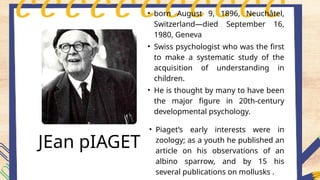
JEan pIAGET
• born August 9, 1896, Neuchâtel,
Switzerland—died September 16,
1980, Geneva
• Swiss psychologist who was the first
to make a systematic study of the
acquisition of understanding in
children.
• He is thought by many to have been
the major figure in 20th-century
developmental psychology.
• Piaget’s early interests were in
zoology; as a youth he published an
article on his observations of an
albino sparrow, and by 15 his
several publications on mollusks .
h
Jean Piaget's theory of cognitive
development explains how
knowledge is constructed. The
assumptions of the theory describe
how and why knowledge is created.
The stages of the theory describe
when specific cognitive abilities are
composed.
PIAGET’S COGNITIVE DEVELOPMENT
THEORY
Key features of piaget's theory
KEY FEATURES OF PIAGET’S THEORY
• Piaget believed that children actively construct their own
understanding of the world, rather than simply absorbing
information from their environment.
STAGES OF DEVELOPMENT
• Cognitive Development occurs in distinct stages, each
characterized by different ways of thinking.
• All children go through these stages in the same order,
although the rate may vary.
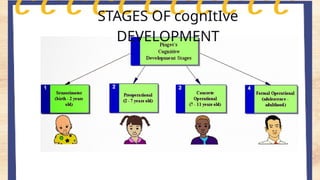
STAGES OF cognItIve
DEVELOPMENT
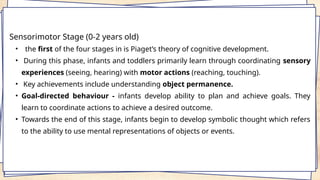
Sensorimotor Stage (0-2 years old)
• the first of the four stages in is Piaget’s theory of cognitive development.
• During this phase, infants and toddlers primarily learn through coordinating sensory
experiences (seeing, hearing) with motor actions (reaching, touching).
• Key achievements include understanding object permanence.
• Goal-directed behaviour - infants develop ability to plan and achieve goals. They
learn to coordinate actions to achieve a desired outcome.
• Towards the end of this stage, infants begin to develop symbolic thought which refers
to the ability to use mental representations of objects or events.
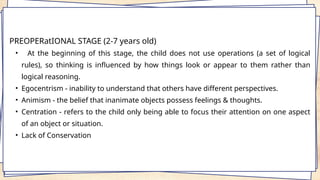
PREOPERatIONAL STAGE (2-7 years old)
• At the beginning of this stage, the child does not use operations (a set of logical
rules), so thinking is influenced by how things look or appear to them rather than
logical reasoning.
• Egocentrism - inability to understand that others have different perspectives.
• Animism - the belief that inanimate objects possess feelings & thoughts.
• Centration - refers to the child only being able to focus their attention on one aspect
of an object or situation.
• Lack of Conservation
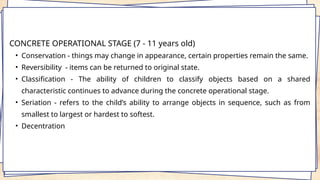
CONCRETE OPERATIONAL STAGE (7 - 11 years old)
• Conservation - things may change in appearance, certain properties remain the same.
• Reversibility - items can be returned to original state.
• Classification - The ability of children to classify objects based on a shared
characteristic continues to advance during the concrete operational stage.
• Seriation - refers to the child’s ability to arrange objects in sequence, such as from
smallest to largest or hardest to softest.
• Decentration
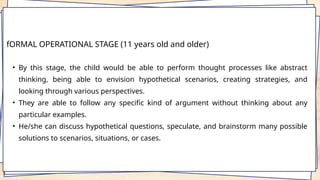
fORMAL OPERATIONAL STAGE (11 years old and older)
• By this stage, the child would be able to perform thought processes like abstract
thinking, being able to envision hypothetical scenarios, creating strategies, and
looking through various perspectives.
• They are able to follow any specific kind of argument without thinking about any
particular examples.
• He/she can discuss hypothetical questions, speculate, and brainstorm many possible
solutions to scenarios, situations, or cases.
Key features of piaget's theory
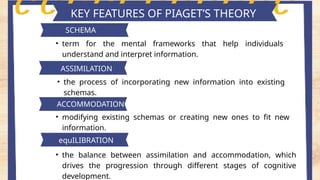
KEY FEATURES OF PIAGET’S THEORY
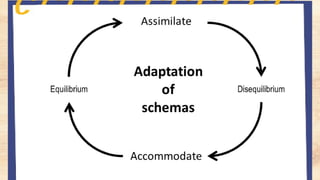
SCHEMA
• term for the mental frameworks that help individuals
understand and interpret information.
ASSIMILATION
• the process of incorporating new information into existing
schemas.
ACCOMMODATION
• modifying existing schemas or creating new ones to fit new
information.
equILIBRATION
• the balance between assimilation and accommodation, which
drives the progression through different stages of cognitive
development.
TeacHING STRATEGIES/TECHNIQUES
• Learning should be student-centered and accomplished through active
discovery in the classroom. The teacher’s role is to facilitate learning
rather than direct tuition.
• Encourage active learning: Learning must be active (discovery
learning). Children should be encouraged to discover for themselves
and to interact with the material instead of being given ready-made
knowledge. Using active methods that require rediscovering or
reconstructing “truths.”
• Foster social interaction: Using collaborative, as well as individual
activities (so children can learn from each other). Implement
cooperative learning activities, such as group problem-solving tasks or
role-playing scenarios.
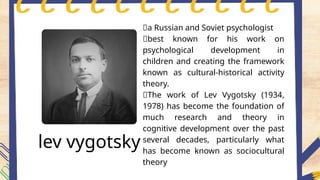
lev vygotsky
📍a Russian and Soviet psychologist
📍best known for his work on
psychological development in
children and creating the framework
known as cultural-historical activity
theory.
📍The work of Lev Vygotsky (1934,
1978) has become the foundation of
much research and theory in
cognitive development over the past
several decades, particularly what
has become known as sociocultural
theory
h
VYGOTSKY’S SOCIOCULTURAL THEORY
📍it is mainly about child development says
that cognitive development occurs as a result
of social and cultural interactions.
📍social negotiation was essential for building
knowledge and understanding concepts.
📍According to Vygotsky, adults in society
foster children’s cognitive development by
engaging them in challenging and
meaningful activities.
h
vgotsky’S SOCIOCULTURAL THEORY
📍community plays a central role in the process
of “making meaning.”
📍 learning is innately collaborative and
cooperative
📍Scaffolding and reciprocal teaching are
effective educational strategies based on
Vygotsky’s ideas.
Key features of piaget's theory
KEY FEATURES OF VYGOTSKY'S THEORY
CULTURE - SPECIFIC TOOLS
📍 emphasized that children’s cognitive development is shaped by
the cultural tools and symbols available in their society.
📍These tools includes:
✔️
language,
✔️
writing,
✔️
number systems,
✔️
and technology.
Key features of piaget's theory
KEY FEATURES OF Vygotsky’S THEORY
PRIVATE SPEECH
📍refers to the self-directed speech that children use to guide their
own actions and thoughts.
📍this was important because it helps children control their actions
and thought.
Zone proximal development
📍This is the space between what a child can do on their own and
what they can do with help from someone more experienced.
Key features of piaget's theory
SAMPLE SCENARIOS
CULTURE - SPECIFIC TOOLS
- A child in school is learning how to count. In one country, the
teacher uses an abacus (a counting tool with beads). In another
country, the teacher uses a calculator. The different tools help the
child learn in ways that fit their culture.
PrIVATE SPEECH
-A little child is doing a puzzle. As they try to fit the pieces together,
they say out loud, “This piece goes here… no, maybe over there.”
Talking to themselves helps them figure out where the pieces
should go.
PRIVATE SPEECH
Key features of piaget's theory
SAMPLE SCENARIOS
Zone proximal development
A child is learning to ride a bike. They can almost balance on their
own, but they need help. When their parent holds the bike and tells
them when to pedal, the child can ride better.
PrIVATE SPEECH
Key features of piaget's theory
1. Scaffolding
2. Collaborative Learning
3. Use of Cultural Tools
4. Private Speech Encouragement
5. Dynamic Assessment
📎teaching strategies/ techniques for the relation of theory
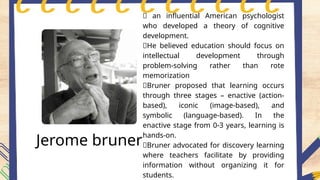
Jerome bruner
📍 an influential American psychologist
who developed a theory of cognitive
development.
📍He believed education should focus on
intellectual development through
problem-solving rather than rote
memorization
📍Bruner proposed that learning occurs
through three stages – enactive (action-
based), iconic (image-based), and
symbolic (language-based). In the
enactive stage from 0-3 years, learning is
hands-on.
📍Bruner advocated for discovery learning
where teachers facilitate by providing
information without organizing it for
students.
h
BRUNER’S THEORY OF COGNITIVE
DEVELOPMENT
⚕️
He believed curriculum should foster the development of problem-
solving skills through the processes of inquiry and discovery.
⚕️
He believed that subject matter should be represented in terms of
the child’s way of viewing the world.
⚕️
That curriculum should be designed so that the mastery of skills
leads to the mastery of still more powerful ones.
He also advocated teaching by organizing concepts and learning by
discovery.
⚕️
Finally, he believed culture should shape notions through which
people organize their views of themselves and others and the world
in which they live.
h
BRUNER’S THEORY OF COGNITIVE
DEVELOPMENT
🌳Discovery Learning
The concept of discovery learning implies that a learner constructs
his or her own knowledge for themselves by discovering as opposed
to being told about something.
According to Bruner, the teacher should facilitate the learning
process by developing lessons that provide the learner with
information they need without organizing it for them.
This idea of discovery learning is often referred to as constructivism,
which emphasizes the active role of the learner in building
understanding and making sense of information.
h
BRUNER’S THEORY OF COGNITIVE
DEVELOPMENT
Jerome Bruner theorized that learning occurs by going through
three stages of representations. Each stage is a “way in which
information or knowledge are stored and encoded in a
The stages are more-or-less sequential, although they are not
necessarily age-related like Piaget-based theories.
🌳Bruner’s Stages of Representation
1. Enactive (action-based) (0-3 years)
2. Iconic (image-based) (3-7 years)
3. symbolic (language-based) (7 years onwards)
Key features of piaget's theory
KEY FEATURES OF BRUNER'S THEORY
Inactive (action-based) (0-3 years)
📍Sometimes called the concrete stage, this first stage involves a
tangible hi method of learning. Bruner believed that “learning
begins with an action – touching. Feeling, and manipulating”
📍In this stage, learning is primarily based on physical actions and
experiences. Children learn through direct manipulation of objects
and exploration of their environment. This stage is crucial for
developing early language skills as children begin to associate words
with actions and objects. For example, a child might learn the word
“ball” by repeatedly throwing and catching a ball.
Key features of piaget's theory
KEY FEATURES OF BRUNER'S THEORY
Iconic (image-based) (3-7 years)
📍Sometimes called the pictoral stage, this second stage involves
images or other visuals to represent the concrete situation
enacted in the first stage. One way of doing this is to simply draw
images of the objects on paper or to picture them in one’s head.
Other ways could be through the use of shapes, diagrams, and
graphs.
📍This stage builds upon the enactive stage, incorporating visual
representations and imagery. Children begin to use images and
symbols to represent their experiences. This stage is essential for
developing vocabulary and understanding concepts. For instance, a
child might learn the word “dog” by associating it with a picture of a
Key features of piaget's theory
KEY FEATURES OF BRUNER'S THEORY
Symbolic (language-based) (7 years onwards)
📍Sometimes called the abstract stage, the last stage takes the
images from the second stage and represents them using words
and symbols. The use of words and symbols “allows a student to
organize information in the mind by relating concepts together.
📍This final stage involves the use of language and abstract symbols
to represent concepts. Children develop the ability to think and
communicate using words, sentences, and complex grammatical
structures. This stage is crucial for developing higher-order
language skills such as reading, writing, and critical thinking.
Key features of piaget's theory
🌸Teaching strategies/ techniques for the relation of theory
📍Active Learning
📍Discovery Learning
📍Spiral Curriculum
📍Scaffolding
🌸Teaching Techniques Based on Bruner’s Theory
📍Inquiry -Based Learning
📍Project-Based Learning
📍Concept Mapping
📍Role-Playing and Simulations
📍Differentiated Instruction
📎teaching strategies/ techniques for the relation of theory
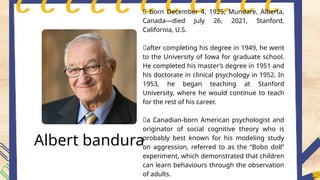
Albert bandura
📍 born December 4, 1925, Mundare, Alberta,
Canada—died July 26, 2021, Stanford,
California, U.S.
📍after completing his degree in 1949, he went
to the University of Iowa for graduate school.
He completed his master’s degree in 1951 and
his doctorate in clinical psychology in 1952. In
1953, he began teaching at Stanford
University, where he would continue to teach
for the rest of his career.
📍a Canadian-born American psychologist and
originator of social cognitive theory who is
probably best known for his modeling study
on aggression, referred to as the “Bobo doll”
experiment, which demonstrated that children
can learn behaviours through the observation
of adults.
h
THE BOBO DOLL EXPERIMENT
h
Bandura’S SOCIAL COGNITIVE THEORY
🔰The Social Cognitive Theory
📍Social Cognitive Theory (SCT) started as the Social Learning
Theory (SLT) in the 1960s by Albert Bandura.
📍It developed into the SCT in 1986 and posits that learning
occurs in a social context with a dynamic and reciprocal
interaction of the person, environment, and behavior.
📍Bandura proposes learning from others, not with words, but by
imitation and modeling.
h
BANDURA’S socIAL COGNITIVE THEORY
Reciprocal Determinism
📍This is the central concept of SCT.
📍refers to the dynamic and reciprocal interaction of person (individual with
a set of learned experiences), environment (external social context), and
behavior (responses to stimuli to achieve goals).
Behavioral Capability
📍refers to a person's actual ability to perform a behavior through essential
knowledge and skills.
📍In order to successfully perform a behavior, a person must know what to
do and how to do it.
📍People learn from the consequences of their behavior, which also affects
the environment in which they live.
h
BANDURA’S socIAL COGNITIVE THEORY
Observational Learning
📍 This asserts that people can witness and observe a behavior conducted
by others, and then reproduce those actions.
📍This is often exhibited through "modeling" of behaviors.
📍If individuals see successful demonstration of a behavior, they can also
complete the behavior successfully.
Reinforcements
📍 This refers to the internal or external responses to a person's behavior
that affect the likelihood of continuing or discontinuing the behavior
📍 Reinforcements can be self-initiated or in the environment, and
reinforcements can be positive or negative.
h
BANDURA’S socIAL COGNITIVE THEORY
Outcome Expectations
📍 This asserts that people can witness and observe a behavior
conducted by others, and then reproduce those actions.
📍This is often exhibited through "modeling" of behaviors.
📍If individuals see successful demonstration of a behavior, they can
also complete the behavior successfully
Self efficacy
📍 This refers to the level of a person's confidence in his or her
ability to successfully perform a behavior.
h
PROCESSES OF OBSERVATIONAL
LEARNING
Attention: In order for learning to occur, a person must be paying
attention. If distracted or inattentive to the model’s behavior, then
learning will not occur.
Retention: the information must be retained and stored in memory
Reproduction: Next, the observer must be capable of performing the
behavior. An individual may, or may not, have the skills or knowledge
to reproduce the model’s action
Motivation: Finally, the observer must want to reproduce the model’s
behavior. Motivation can come from wanting to attain a reward or
avoid a punishment.
Key features of piaget's theory
Reciprocal Determinism: Fostering a Collaborative Learning
Environment
🌸 TEACHING TECHNIQUES
📍Project-Based Learning
📍Peer Tutoring
📍Class Discussions
Observational Learning: Modeling Success and Promoting Positive
Behaviors
🌸 TEACHING TECHNIQUES
📍Expert Guest Speakers
📍Peer Mentorship
📎teaching strategies/ techniques for the relation of theory
Key features of piaget's theory
THIS HAS BEEN GROUP 3,
THANK YOU!
Key features of piaget's theory
REFERENCES
The Editors of Encyclopaedia Britannica. (2024, August 5). Jean Piaget | Biography, Theory, & Facts. Encyclopedia Britannica.
https://www.britannica.com/biography/Jean-Piaget
Nortje, A., PhD. (2024, September 2). Piaget’s Stages: 4 Stages of Cognitive Development & Theory. PositivePsychology.com.
https://positivepsychology.com/piaget-stages-theory/#hero-single
Simply Psychology. (2024, August 5). Piaget’s Stages: 4 Stages of Cognitive Development & Theory.
https://www.simplypsychology.org/piaget.html
Learner Development In the Classroom | Who Exactly Was Jean Piaget (structural-learning.com)
2.1 Cognitive Development: The Theory of Jean Piaget – Foundations of Educational Technology (okstate.edu)
Simply Psychology. (2024b, August 9). Vygotsky's Sociocultural Theory Of Cognitive Development.
https://www.simplypsychology.org/vygotsky.html
The Social Cognitive Theory. (n.d.). https://sphweb.bumc.bu.edu/otlt/mph-modules/sb/behavioralchangetheories/
BehavioralChangeTheories5.html#:~:text=Social%20Cognitive%20Theory%20(SCT)%20started,person%2C%20environment%2C
%20and%20behavior
https://www.britannica.com/biography/Albert-Bandura
https://www.explorepsychology.com/albert-bandura/

Cognitivist Theory for Foundation in BAEL Program.pptx

  • 1.
  • 2.
    THINK TO YOURSELVES You’retrying to explain something to a child, and even though it seems so obvious to you, the child just doesn’t seem to understand. Have you ever experienced the following?
  • 3.
    WELL, GUESS WHAT? •The child is not naughty. • And their lack of understanding is not our fault either. Their cognitive development limits their understanding of certain concepts. • They’re also not stupid.
  • 4.
    JEan pIAGET • bornAugust 9, 1896, Neuchâtel, Switzerland—died September 16, 1980, Geneva • Swiss psychologist who was the first to make a systematic study of the acquisition of understanding in children. • He is thought by many to have been the major figure in 20th-century developmental psychology. • Piaget’s early interests were in zoology; as a youth he published an article on his observations of an albino sparrow, and by 15 his several publications on mollusks .
  • 5.
    h Jean Piaget's theoryof cognitive development explains how knowledge is constructed. The assumptions of the theory describe how and why knowledge is created. The stages of the theory describe when specific cognitive abilities are composed. PIAGET’S COGNITIVE DEVELOPMENT THEORY
  • 6.
    Key features ofpiaget's theory KEY FEATURES OF PIAGET’S THEORY • Piaget believed that children actively construct their own understanding of the world, rather than simply absorbing information from their environment. STAGES OF DEVELOPMENT • Cognitive Development occurs in distinct stages, each characterized by different ways of thinking. • All children go through these stages in the same order, although the rate may vary.
  • 7.
  • 8.
    Sensorimotor Stage (0-2years old) • the first of the four stages in is Piaget’s theory of cognitive development. • During this phase, infants and toddlers primarily learn through coordinating sensory experiences (seeing, hearing) with motor actions (reaching, touching). • Key achievements include understanding object permanence. • Goal-directed behaviour - infants develop ability to plan and achieve goals. They learn to coordinate actions to achieve a desired outcome. • Towards the end of this stage, infants begin to develop symbolic thought which refers to the ability to use mental representations of objects or events.
  • 9.
    PREOPERatIONAL STAGE (2-7years old) • At the beginning of this stage, the child does not use operations (a set of logical rules), so thinking is influenced by how things look or appear to them rather than logical reasoning. • Egocentrism - inability to understand that others have different perspectives. • Animism - the belief that inanimate objects possess feelings & thoughts. • Centration - refers to the child only being able to focus their attention on one aspect of an object or situation. • Lack of Conservation
  • 11.
    CONCRETE OPERATIONAL STAGE(7 - 11 years old) • Conservation - things may change in appearance, certain properties remain the same. • Reversibility - items can be returned to original state. • Classification - The ability of children to classify objects based on a shared characteristic continues to advance during the concrete operational stage. • Seriation - refers to the child’s ability to arrange objects in sequence, such as from smallest to largest or hardest to softest. • Decentration
  • 12.
    fORMAL OPERATIONAL STAGE(11 years old and older) • By this stage, the child would be able to perform thought processes like abstract thinking, being able to envision hypothetical scenarios, creating strategies, and looking through various perspectives. • They are able to follow any specific kind of argument without thinking about any particular examples. • He/she can discuss hypothetical questions, speculate, and brainstorm many possible solutions to scenarios, situations, or cases.
  • 13.
    Key features ofpiaget's theory KEY FEATURES OF PIAGET’S THEORY SCHEMA • term for the mental frameworks that help individuals understand and interpret information. ASSIMILATION • the process of incorporating new information into existing schemas. ACCOMMODATION • modifying existing schemas or creating new ones to fit new information. equILIBRATION • the balance between assimilation and accommodation, which drives the progression through different stages of cognitive development.
  • 15.
    TeacHING STRATEGIES/TECHNIQUES • Learningshould be student-centered and accomplished through active discovery in the classroom. The teacher’s role is to facilitate learning rather than direct tuition. • Encourage active learning: Learning must be active (discovery learning). Children should be encouraged to discover for themselves and to interact with the material instead of being given ready-made knowledge. Using active methods that require rediscovering or reconstructing “truths.” • Foster social interaction: Using collaborative, as well as individual activities (so children can learn from each other). Implement cooperative learning activities, such as group problem-solving tasks or role-playing scenarios.
  • 16.
    lev vygotsky 📍a Russianand Soviet psychologist 📍best known for his work on psychological development in children and creating the framework known as cultural-historical activity theory. 📍The work of Lev Vygotsky (1934, 1978) has become the foundation of much research and theory in cognitive development over the past several decades, particularly what has become known as sociocultural theory
  • 17.
    h VYGOTSKY’S SOCIOCULTURAL THEORY 📍itis mainly about child development says that cognitive development occurs as a result of social and cultural interactions. 📍social negotiation was essential for building knowledge and understanding concepts. 📍According to Vygotsky, adults in society foster children’s cognitive development by engaging them in challenging and meaningful activities.
  • 18.
    h vgotsky’S SOCIOCULTURAL THEORY 📍communityplays a central role in the process of “making meaning.” 📍 learning is innately collaborative and cooperative 📍Scaffolding and reciprocal teaching are effective educational strategies based on Vygotsky’s ideas.
  • 19.
    Key features ofpiaget's theory KEY FEATURES OF VYGOTSKY'S THEORY CULTURE - SPECIFIC TOOLS 📍 emphasized that children’s cognitive development is shaped by the cultural tools and symbols available in their society. 📍These tools includes: ✔️ language, ✔️ writing, ✔️ number systems, ✔️ and technology.
  • 20.
    Key features ofpiaget's theory KEY FEATURES OF Vygotsky’S THEORY PRIVATE SPEECH 📍refers to the self-directed speech that children use to guide their own actions and thoughts. 📍this was important because it helps children control their actions and thought. Zone proximal development 📍This is the space between what a child can do on their own and what they can do with help from someone more experienced.
  • 21.
    Key features ofpiaget's theory SAMPLE SCENARIOS CULTURE - SPECIFIC TOOLS - A child in school is learning how to count. In one country, the teacher uses an abacus (a counting tool with beads). In another country, the teacher uses a calculator. The different tools help the child learn in ways that fit their culture. PrIVATE SPEECH -A little child is doing a puzzle. As they try to fit the pieces together, they say out loud, “This piece goes here… no, maybe over there.” Talking to themselves helps them figure out where the pieces should go. PRIVATE SPEECH
  • 22.
    Key features ofpiaget's theory SAMPLE SCENARIOS Zone proximal development A child is learning to ride a bike. They can almost balance on their own, but they need help. When their parent holds the bike and tells them when to pedal, the child can ride better. PrIVATE SPEECH
  • 23.
    Key features ofpiaget's theory 1. Scaffolding 2. Collaborative Learning 3. Use of Cultural Tools 4. Private Speech Encouragement 5. Dynamic Assessment 📎teaching strategies/ techniques for the relation of theory
  • 24.
    Jerome bruner 📍 aninfluential American psychologist who developed a theory of cognitive development. 📍He believed education should focus on intellectual development through problem-solving rather than rote memorization 📍Bruner proposed that learning occurs through three stages – enactive (action- based), iconic (image-based), and symbolic (language-based). In the enactive stage from 0-3 years, learning is hands-on. 📍Bruner advocated for discovery learning where teachers facilitate by providing information without organizing it for students.
  • 25.
    h BRUNER’S THEORY OFCOGNITIVE DEVELOPMENT ⚕️ He believed curriculum should foster the development of problem- solving skills through the processes of inquiry and discovery. ⚕️ He believed that subject matter should be represented in terms of the child’s way of viewing the world. ⚕️ That curriculum should be designed so that the mastery of skills leads to the mastery of still more powerful ones. He also advocated teaching by organizing concepts and learning by discovery. ⚕️ Finally, he believed culture should shape notions through which people organize their views of themselves and others and the world in which they live.
  • 26.
    h BRUNER’S THEORY OFCOGNITIVE DEVELOPMENT 🌳Discovery Learning The concept of discovery learning implies that a learner constructs his or her own knowledge for themselves by discovering as opposed to being told about something. According to Bruner, the teacher should facilitate the learning process by developing lessons that provide the learner with information they need without organizing it for them. This idea of discovery learning is often referred to as constructivism, which emphasizes the active role of the learner in building understanding and making sense of information.
  • 27.
    h BRUNER’S THEORY OFCOGNITIVE DEVELOPMENT Jerome Bruner theorized that learning occurs by going through three stages of representations. Each stage is a “way in which information or knowledge are stored and encoded in a The stages are more-or-less sequential, although they are not necessarily age-related like Piaget-based theories. 🌳Bruner’s Stages of Representation 1. Enactive (action-based) (0-3 years) 2. Iconic (image-based) (3-7 years) 3. symbolic (language-based) (7 years onwards)
  • 28.
    Key features ofpiaget's theory KEY FEATURES OF BRUNER'S THEORY Inactive (action-based) (0-3 years) 📍Sometimes called the concrete stage, this first stage involves a tangible hi method of learning. Bruner believed that “learning begins with an action – touching. Feeling, and manipulating” 📍In this stage, learning is primarily based on physical actions and experiences. Children learn through direct manipulation of objects and exploration of their environment. This stage is crucial for developing early language skills as children begin to associate words with actions and objects. For example, a child might learn the word “ball” by repeatedly throwing and catching a ball.
  • 29.
    Key features ofpiaget's theory KEY FEATURES OF BRUNER'S THEORY Iconic (image-based) (3-7 years) 📍Sometimes called the pictoral stage, this second stage involves images or other visuals to represent the concrete situation enacted in the first stage. One way of doing this is to simply draw images of the objects on paper or to picture them in one’s head. Other ways could be through the use of shapes, diagrams, and graphs. 📍This stage builds upon the enactive stage, incorporating visual representations and imagery. Children begin to use images and symbols to represent their experiences. This stage is essential for developing vocabulary and understanding concepts. For instance, a child might learn the word “dog” by associating it with a picture of a
  • 30.
    Key features ofpiaget's theory KEY FEATURES OF BRUNER'S THEORY Symbolic (language-based) (7 years onwards) 📍Sometimes called the abstract stage, the last stage takes the images from the second stage and represents them using words and symbols. The use of words and symbols “allows a student to organize information in the mind by relating concepts together. 📍This final stage involves the use of language and abstract symbols to represent concepts. Children develop the ability to think and communicate using words, sentences, and complex grammatical structures. This stage is crucial for developing higher-order language skills such as reading, writing, and critical thinking.
  • 31.
    Key features ofpiaget's theory 🌸Teaching strategies/ techniques for the relation of theory 📍Active Learning 📍Discovery Learning 📍Spiral Curriculum 📍Scaffolding 🌸Teaching Techniques Based on Bruner’s Theory 📍Inquiry -Based Learning 📍Project-Based Learning 📍Concept Mapping 📍Role-Playing and Simulations 📍Differentiated Instruction 📎teaching strategies/ techniques for the relation of theory
  • 32.
    Albert bandura 📍 bornDecember 4, 1925, Mundare, Alberta, Canada—died July 26, 2021, Stanford, California, U.S. 📍after completing his degree in 1949, he went to the University of Iowa for graduate school. He completed his master’s degree in 1951 and his doctorate in clinical psychology in 1952. In 1953, he began teaching at Stanford University, where he would continue to teach for the rest of his career. 📍a Canadian-born American psychologist and originator of social cognitive theory who is probably best known for his modeling study on aggression, referred to as the “Bobo doll” experiment, which demonstrated that children can learn behaviours through the observation of adults.
  • 33.
    h THE BOBO DOLLEXPERIMENT
  • 34.
    h Bandura’S SOCIAL COGNITIVETHEORY 🔰The Social Cognitive Theory 📍Social Cognitive Theory (SCT) started as the Social Learning Theory (SLT) in the 1960s by Albert Bandura. 📍It developed into the SCT in 1986 and posits that learning occurs in a social context with a dynamic and reciprocal interaction of the person, environment, and behavior. 📍Bandura proposes learning from others, not with words, but by imitation and modeling.
  • 35.
    h BANDURA’S socIAL COGNITIVETHEORY Reciprocal Determinism 📍This is the central concept of SCT. 📍refers to the dynamic and reciprocal interaction of person (individual with a set of learned experiences), environment (external social context), and behavior (responses to stimuli to achieve goals). Behavioral Capability 📍refers to a person's actual ability to perform a behavior through essential knowledge and skills. 📍In order to successfully perform a behavior, a person must know what to do and how to do it. 📍People learn from the consequences of their behavior, which also affects the environment in which they live.
  • 36.
    h BANDURA’S socIAL COGNITIVETHEORY Observational Learning 📍 This asserts that people can witness and observe a behavior conducted by others, and then reproduce those actions. 📍This is often exhibited through "modeling" of behaviors. 📍If individuals see successful demonstration of a behavior, they can also complete the behavior successfully. Reinforcements 📍 This refers to the internal or external responses to a person's behavior that affect the likelihood of continuing or discontinuing the behavior 📍 Reinforcements can be self-initiated or in the environment, and reinforcements can be positive or negative.
  • 37.
    h BANDURA’S socIAL COGNITIVETHEORY Outcome Expectations 📍 This asserts that people can witness and observe a behavior conducted by others, and then reproduce those actions. 📍This is often exhibited through "modeling" of behaviors. 📍If individuals see successful demonstration of a behavior, they can also complete the behavior successfully Self efficacy 📍 This refers to the level of a person's confidence in his or her ability to successfully perform a behavior.
  • 38.
    h PROCESSES OF OBSERVATIONAL LEARNING Attention:In order for learning to occur, a person must be paying attention. If distracted or inattentive to the model’s behavior, then learning will not occur. Retention: the information must be retained and stored in memory Reproduction: Next, the observer must be capable of performing the behavior. An individual may, or may not, have the skills or knowledge to reproduce the model’s action Motivation: Finally, the observer must want to reproduce the model’s behavior. Motivation can come from wanting to attain a reward or avoid a punishment.
  • 39.
    Key features ofpiaget's theory Reciprocal Determinism: Fostering a Collaborative Learning Environment 🌸 TEACHING TECHNIQUES 📍Project-Based Learning 📍Peer Tutoring 📍Class Discussions Observational Learning: Modeling Success and Promoting Positive Behaviors 🌸 TEACHING TECHNIQUES 📍Expert Guest Speakers 📍Peer Mentorship 📎teaching strategies/ techniques for the relation of theory
  • 40.
    Key features ofpiaget's theory THIS HAS BEEN GROUP 3, THANK YOU!
  • 41.
    Key features ofpiaget's theory REFERENCES The Editors of Encyclopaedia Britannica. (2024, August 5). Jean Piaget | Biography, Theory, & Facts. Encyclopedia Britannica. https://www.britannica.com/biography/Jean-Piaget Nortje, A., PhD. (2024, September 2). Piaget’s Stages: 4 Stages of Cognitive Development & Theory. PositivePsychology.com. https://positivepsychology.com/piaget-stages-theory/#hero-single Simply Psychology. (2024, August 5). Piaget’s Stages: 4 Stages of Cognitive Development & Theory. https://www.simplypsychology.org/piaget.html Learner Development In the Classroom | Who Exactly Was Jean Piaget (structural-learning.com) 2.1 Cognitive Development: The Theory of Jean Piaget – Foundations of Educational Technology (okstate.edu) Simply Psychology. (2024b, August 9). Vygotsky's Sociocultural Theory Of Cognitive Development. https://www.simplypsychology.org/vygotsky.html The Social Cognitive Theory. (n.d.). https://sphweb.bumc.bu.edu/otlt/mph-modules/sb/behavioralchangetheories/ BehavioralChangeTheories5.html#:~:text=Social%20Cognitive%20Theory%20(SCT)%20started,person%2C%20environment%2C %20and%20behavior https://www.britannica.com/biography/Albert-Bandura https://www.explorepsychology.com/albert-bandura/