
The theory of meaningful
learning
Presenter:
Ma. Sonia Calderon Cruz
David P. Ausubel was born in 1918
Grew up in Brooklyn, NY
Attended the University of Pennsylvania, taking
the pre-medical course and majoring in
Psychology
In 1973 he retired from academic life to devote full time to his
psychiatric practice
In 1976 he received the Thorndike Award from the American
Psychological Association for "Distinguished Psychological
Contributions to Education".
Introduction
-Supported the theory that pupils form & organise
knowledge by themselves
-Emphasized the importance of verbal learning /
language-related learning which he consider to be very
effective for pupils of the age 11 or 12 & above
-Pupils gradually learn to associate new knowledge with
existing concepts in their mental structures
-To ensure meaningful teaching, necessary to avoid rote
memorising of facts. Pupils need to manipulate ideas
actively
Advance Organizer
-Presents an overview of the information to be
covered in detail during the exposition that follows
-Can be classified : exposition or comparison type
Advance Organizer of the
Exposition Type
-While presenting new material
-Use beginning of lesson
-Presents several encompassing generalizations
where detailed contents will be added later
Advance Organizer of the Comparison
Type
-Useful when the knowledge to be presented is new
to pupils
-Compares new material with knowledge already
known by emphasising the similarities between 2
types of material & showing the information that
is to be learnt
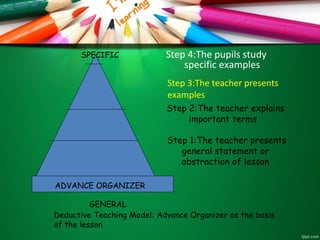
-Ausubel’s teaching approach is deductive in nature
Step 3:The teacher presents
examples
Step 4:The pupils study
specific examples
ADVANCE ORGANIZER
GENERAL
SPECIFIC
Step 2:The teacher explains
important terms
Step 1:The teacher presents
general statement or
abstraction of lesson
Deductive Teaching Model: Advance Organizer as the basis
of the lesson
Ausubel’s Meaningful Learning
Meaningful
Reception Learning
Theory
Meaningful
Reception Learning
Theory
A concerned with how students
learn large amounts of
meaningful material from
verbal/textual presentations in
a learning activities
Learning is based on the
representational,
superordinate and
combinatorial processes that
occur during the reception of
information.
A primary process in learning is
subsumption in which new
material is related to relevant
ideas in the existing cognitive
structure on a non-verbatim
basis (previous knowledge)
Meaningful learning results
when new information is
acquired by linking the new
information in the learner's own
cognitive structure
The processes of meaningful
learning
Ausubel proposed four processes by which
meaningful learning can occur :
Derivative subsumption
Correlative subsumption
Superordinate learning
Combinatorial learning
Derivative subsumption
• Describes the situation in which the new information pupils learn is
an instance or example of a concept that pupils have already learned
Example (Stage 1) :
PREVIOUS KNOWLEDGE : Let's suppose Ali have
acquired a basic concept such as "tree” – have green
leave, branch, fruits
Ali learn about a kind of tree that he have
never seen before “persimmon tree” - conforms
to his previous understanding of “tree’’
His new knowledge of persimmon trees is
attached to the concept of tree, without
substantially altering that concept in any way
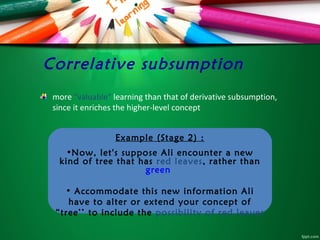
Correlative subsumption
more "valuable" learning than that of derivative subsumption,
since it enriches the higher-level concept
Example (Stage 2) :
•Now, let's suppose Ali encounter a new
kind of tree that has red leaves, rather than
green
• Accommodate this new information Ali
have to alter or extend your concept of
“tree’’ to include the possibility of red leaves
Superordinate learning
In this case, you already knew a lot of examples of the concept,
but you did not know the concept itself until it was taught to
pupils.
Example (Stage 3) :
• Ali was well acquainted with maples, oaks,
apple trees etc., but pupils still did not know,
until they were taught that these were all
examples of deciduous trees
Combinatorial learning
• It describes a process by which the new idea is derived from another
idea that is comes from his previous knowledge (in a different, but
related, "branch")
• Students could think of this as learning by analogy
Example (Stage 3) :
•Ali learn about modification on the plants
part, Ali might relate it to previously acquired
knowledge of how papyrus tree used to
produce paper
• General ideas of a subject (general statement):
– Must be presented first
– then progressively differentiated in terms of detail and
specificity.
• Instructional materials :
– should attempt to integrate new material with previously
presented information
– Using comparisons and cross-referencing of new and
old ideas.
Principles of Ausubel's
Meaningful Reception
Learning Theory within a
classroom setting
Principles of Ausubel's
Meaningful Reception
Learning Theory within a
classroom setting
• Advance organizers :
– Instructors should incorporate advance organizers
when teaching a new concept
• Examples :
– Instructors should use a number of examples and focus
on both similarities and differences.
Principles of Ausubel's
Meaningful Reception
Learning Theory within a
classroom setting
Principles of Ausubel's
Meaningful Reception
Learning Theory within a
classroom setting
The most important single factor
influencing learning is what the
learner already knows..

Ausubel meaninful learning

  • 1.
    The theory ofmeaningful learning Presenter: Ma. Sonia Calderon Cruz
  • 3.
    David P. Ausubelwas born in 1918 Grew up in Brooklyn, NY Attended the University of Pennsylvania, taking the pre-medical course and majoring in Psychology In 1973 he retired from academic life to devote full time to his psychiatric practice In 1976 he received the Thorndike Award from the American Psychological Association for "Distinguished Psychological Contributions to Education".
  • 4.
    Introduction -Supported the theorythat pupils form & organise knowledge by themselves -Emphasized the importance of verbal learning / language-related learning which he consider to be very effective for pupils of the age 11 or 12 & above
  • 5.
    -Pupils gradually learnto associate new knowledge with existing concepts in their mental structures -To ensure meaningful teaching, necessary to avoid rote memorising of facts. Pupils need to manipulate ideas actively
  • 6.
    Advance Organizer -Presents anoverview of the information to be covered in detail during the exposition that follows -Can be classified : exposition or comparison type
  • 7.
    Advance Organizer ofthe Exposition Type -While presenting new material -Use beginning of lesson -Presents several encompassing generalizations where detailed contents will be added later
  • 8.
    Advance Organizer ofthe Comparison Type -Useful when the knowledge to be presented is new to pupils -Compares new material with knowledge already known by emphasising the similarities between 2 types of material & showing the information that is to be learnt -Ausubel’s teaching approach is deductive in nature
  • 9.
    Step 3:The teacherpresents examples Step 4:The pupils study specific examples ADVANCE ORGANIZER GENERAL SPECIFIC Step 2:The teacher explains important terms Step 1:The teacher presents general statement or abstraction of lesson Deductive Teaching Model: Advance Organizer as the basis of the lesson
  • 10.
  • 11.
    Meaningful Reception Learning Theory Meaningful Reception Learning Theory Aconcerned with how students learn large amounts of meaningful material from verbal/textual presentations in a learning activities Learning is based on the representational, superordinate and combinatorial processes that occur during the reception of information. A primary process in learning is subsumption in which new material is related to relevant ideas in the existing cognitive structure on a non-verbatim basis (previous knowledge) Meaningful learning results when new information is acquired by linking the new information in the learner's own cognitive structure
  • 13.
    The processes ofmeaningful learning Ausubel proposed four processes by which meaningful learning can occur : Derivative subsumption Correlative subsumption Superordinate learning Combinatorial learning
  • 14.
    Derivative subsumption • Describesthe situation in which the new information pupils learn is an instance or example of a concept that pupils have already learned Example (Stage 1) : PREVIOUS KNOWLEDGE : Let's suppose Ali have acquired a basic concept such as "tree” – have green leave, branch, fruits Ali learn about a kind of tree that he have never seen before “persimmon tree” - conforms to his previous understanding of “tree’’ His new knowledge of persimmon trees is attached to the concept of tree, without substantially altering that concept in any way
  • 15.
    Correlative subsumption more "valuable"learning than that of derivative subsumption, since it enriches the higher-level concept Example (Stage 2) : •Now, let's suppose Ali encounter a new kind of tree that has red leaves, rather than green • Accommodate this new information Ali have to alter or extend your concept of “tree’’ to include the possibility of red leaves
  • 16.
    Superordinate learning In thiscase, you already knew a lot of examples of the concept, but you did not know the concept itself until it was taught to pupils. Example (Stage 3) : • Ali was well acquainted with maples, oaks, apple trees etc., but pupils still did not know, until they were taught that these were all examples of deciduous trees
  • 17.
    Combinatorial learning • Itdescribes a process by which the new idea is derived from another idea that is comes from his previous knowledge (in a different, but related, "branch") • Students could think of this as learning by analogy Example (Stage 3) : •Ali learn about modification on the plants part, Ali might relate it to previously acquired knowledge of how papyrus tree used to produce paper
  • 18.
    • General ideasof a subject (general statement): – Must be presented first – then progressively differentiated in terms of detail and specificity. • Instructional materials : – should attempt to integrate new material with previously presented information – Using comparisons and cross-referencing of new and old ideas. Principles of Ausubel's Meaningful Reception Learning Theory within a classroom setting Principles of Ausubel's Meaningful Reception Learning Theory within a classroom setting
  • 19.
    • Advance organizers: – Instructors should incorporate advance organizers when teaching a new concept • Examples : – Instructors should use a number of examples and focus on both similarities and differences. Principles of Ausubel's Meaningful Reception Learning Theory within a classroom setting Principles of Ausubel's Meaningful Reception Learning Theory within a classroom setting
  • 20.
    The most importantsingle factor influencing learning is what the learner already knows..