Ingrida Breidaka, MA phil
Zita Auziņa-Gora, MA phil
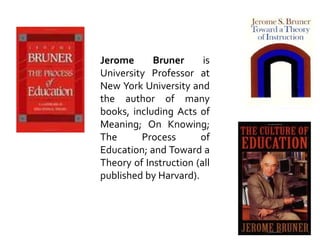
Jerome Bruner is
University Professor at
New York University and
the author of many
books, including Acts of
Meaning; On Knowing;
The Process of
Education; and Toward a
Theory of Instruction (all
published by Harvard).
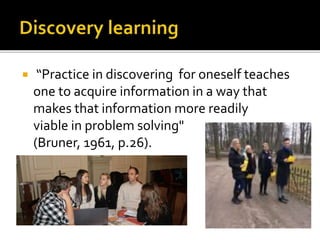
 “Practice in discovering for oneself teaches
one to acquire information in a way that
makes that information more readily
viable in problem solving"
(Bruner, 1961, p.26).
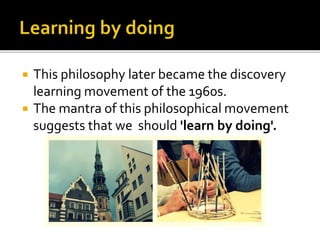
 This philosophy later became the discovery
learning movement of the 1960s.
 The mantra of this philosophical movement
suggests that we should 'learn by doing'.
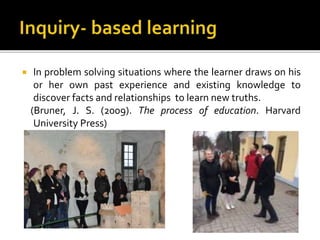
 In problem solving situations where the learner draws on his
or her own past experience and existing knowledge to
discover facts and relationships to learn new truths.
(Bruner, J. S. (2009). The process of education. Harvard
University Press)
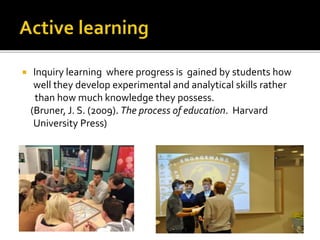
 Inquiry learning where progress is gained by students how
well they develop experimental and analytical skills rather
than how much knowledge they possess.
(Bruner, J. S. (2009). The process of education. Harvard
University Press)
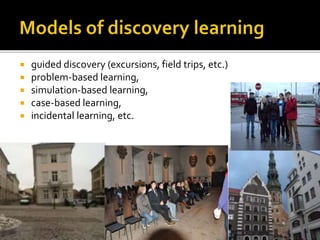
 guided discovery (excursions, field trips, etc.)
 problem-based learning,
 simulation-based learning,
 case-based learning,
 incidental learning, etc.
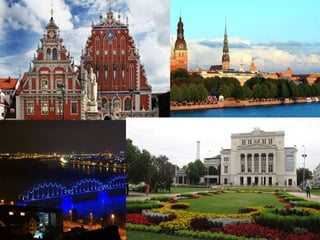
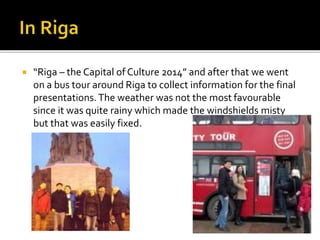
 “Riga – the Capital of Culture 2014” and after that we went
on a bus tour around Riga to collect information for the final
presentations.The weather was not the most favourable
since it was quite rainy which made the windshields misty
but that was easily fixed.
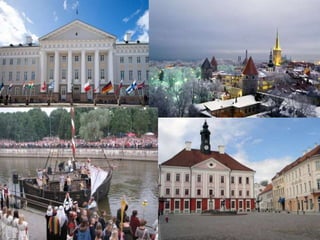
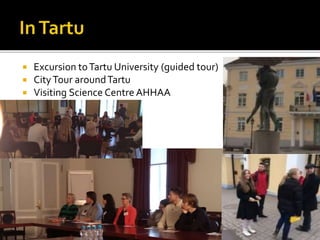
 Excursion toTartu University (guided tour)
 CityTour aroundTartu
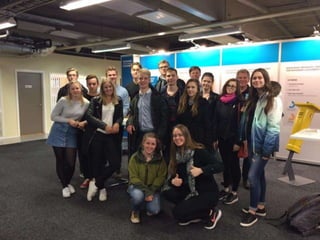
 Visiting Science Centre AHHAA
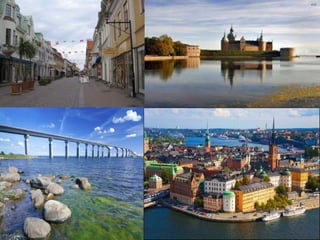
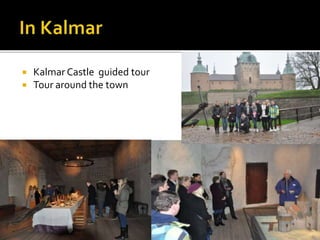
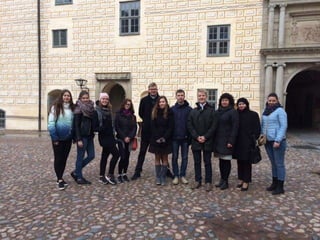
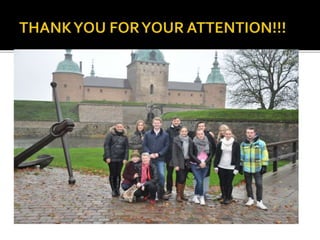
 Kalmar Castle guided tour
 Tour around the town
 Excursions require teachers to use teaching
methods that are not the "norm" or regularly
practised. It is an opportunity for teachers to
go out of their comfort zone, learn and
become confident in new and different
teaching strategies (Michie, 1998).
 Observe for educational purposes, carry out non-
experimental research.
 Observe the subject in its natural state.
 Learn to appreciate culture and the arts.
 Provide alternative educational opportunities for students.
 Can benefit the community if they include some type of
community service.
 Provide students the opportunity to take a break from
their normal routine and experience more hands on
learning.
 Provide students with first hand experiences in which they
can develop further in language and literacy, gaining new
vocabulary and problem-solving skills.
 It may encourage teachers to use alternative
novel approaches for other subject areas in
the future. This in turn can only improve
classroom lessons and make learning more
interesting and engaging for their
students. Therefore, excursions add variety
that is beneficial to both students and
teachers.
Bruner, J. S. (2009). The process of education.
Harvard University Press.
 Discovery learning include promoting a “deep”
understanding; developing meta-cognitive skills; and
encouraging a high level of student engagement.
 First, learners identify variables, collect data, and interpret
data.
 Then learners generate hypotheses in order to better
describe and understand relationships between concepts.
 Finally, the continuous cyclical process of learning requires
learners to interpret the data, reject hypotheses, and make
conclusions about information.
(Saab, N., van Joolingen,W., & van Hout-Wolters, B. (2005).
"Communication in Collaborative Discovery Learning."
BritishJournal of Educational Psychology. 75, pp. 603-621)
Working with findings during and after excursions:
 Critical thinking, problem solving, analysis,
interpretation, synthesizing information.
 Research skills and practices, interrogative
questioning.
 Creativity, curiosity, imagination.
 Planning, adaptability, initiative.
 Oral and written communication,listening and
presenting.
 Leadership, collaboration.
 Information and communication technology (ITC)
literacy, data interpretation and analysis.
 Bruner, J. S. (1961). "The act of discovery". Harvard Educational Review 31 (1):
21–32.
 Bruner, J. S. (2009).The process of education. Harvard University Press
 "Discovery Learning (Bruner)." Retrieved: 20 May 2009 from Learning-
Theories.com: Knowledge Base andWebliography.Website:
http://www.learning-theories.com/discovery-learning-bruner.html.
 Saab, N., van Joolingen, W., & van Hout-Wolters, B. (2005). "Communication
in Collaborative Discovery Learning." BritishJournal of Educational
Psychology. 75, pp. 603-621.
 Photos: Retrieved: 10th July 2016 from http://www.citytour.lv/lv/
 Pictures of Riga,Tartu, Kalmar: Retrieved: 11th July 2016 from
https://www.google.lv/search?q=pictures
 Links on Discovery Learning:
http://coe.sdsu.edu/eet/Articles/discoverylearn/index.htm
http://www.nwlink.com/~donclark/hrd/history/discovery.html
http://udel.edu/~jconway/EDST666.htm
Developing sustainable skills using discovery method

Developing sustainable skills using discovery method

  • 1.
    Ingrida Breidaka, MAphil Zita Auziņa-Gora, MA phil
  • 2.
    Jerome Bruner is UniversityProfessor at New York University and the author of many books, including Acts of Meaning; On Knowing; The Process of Education; and Toward a Theory of Instruction (all published by Harvard).
  • 3.
     “Practice indiscovering for oneself teaches one to acquire information in a way that makes that information more readily viable in problem solving" (Bruner, 1961, p.26).
  • 4.
     This philosophylater became the discovery learning movement of the 1960s.  The mantra of this philosophical movement suggests that we should 'learn by doing'.
  • 5.
     In problemsolving situations where the learner draws on his or her own past experience and existing knowledge to discover facts and relationships to learn new truths. (Bruner, J. S. (2009). The process of education. Harvard University Press)
  • 6.
     Inquiry learningwhere progress is gained by students how well they develop experimental and analytical skills rather than how much knowledge they possess. (Bruner, J. S. (2009). The process of education. Harvard University Press)
  • 7.
     guided discovery(excursions, field trips, etc.)  problem-based learning,  simulation-based learning,  case-based learning,  incidental learning, etc.
  • 9.
     “Riga –the Capital of Culture 2014” and after that we went on a bus tour around Riga to collect information for the final presentations.The weather was not the most favourable since it was quite rainy which made the windshields misty but that was easily fixed.
  • 11.
     Excursion toTartuUniversity (guided tour)  CityTour aroundTartu  Visiting Science Centre AHHAA
  • 13.
     Kalmar Castleguided tour  Tour around the town
  • 16.
     Excursions requireteachers to use teaching methods that are not the "norm" or regularly practised. It is an opportunity for teachers to go out of their comfort zone, learn and become confident in new and different teaching strategies (Michie, 1998).
  • 17.
     Observe foreducational purposes, carry out non- experimental research.  Observe the subject in its natural state.  Learn to appreciate culture and the arts.  Provide alternative educational opportunities for students.  Can benefit the community if they include some type of community service.  Provide students the opportunity to take a break from their normal routine and experience more hands on learning.  Provide students with first hand experiences in which they can develop further in language and literacy, gaining new vocabulary and problem-solving skills.
  • 18.
     It mayencourage teachers to use alternative novel approaches for other subject areas in the future. This in turn can only improve classroom lessons and make learning more interesting and engaging for their students. Therefore, excursions add variety that is beneficial to both students and teachers. Bruner, J. S. (2009). The process of education. Harvard University Press.
  • 19.
     Discovery learninginclude promoting a “deep” understanding; developing meta-cognitive skills; and encouraging a high level of student engagement.  First, learners identify variables, collect data, and interpret data.  Then learners generate hypotheses in order to better describe and understand relationships between concepts.  Finally, the continuous cyclical process of learning requires learners to interpret the data, reject hypotheses, and make conclusions about information. (Saab, N., van Joolingen,W., & van Hout-Wolters, B. (2005). "Communication in Collaborative Discovery Learning." BritishJournal of Educational Psychology. 75, pp. 603-621)
  • 20.
    Working with findingsduring and after excursions:  Critical thinking, problem solving, analysis, interpretation, synthesizing information.  Research skills and practices, interrogative questioning.  Creativity, curiosity, imagination.  Planning, adaptability, initiative.  Oral and written communication,listening and presenting.  Leadership, collaboration.  Information and communication technology (ITC) literacy, data interpretation and analysis.
  • 21.
     Bruner, J.S. (1961). "The act of discovery". Harvard Educational Review 31 (1): 21–32.  Bruner, J. S. (2009).The process of education. Harvard University Press  "Discovery Learning (Bruner)." Retrieved: 20 May 2009 from Learning- Theories.com: Knowledge Base andWebliography.Website: http://www.learning-theories.com/discovery-learning-bruner.html.  Saab, N., van Joolingen, W., & van Hout-Wolters, B. (2005). "Communication in Collaborative Discovery Learning." BritishJournal of Educational Psychology. 75, pp. 603-621.  Photos: Retrieved: 10th July 2016 from http://www.citytour.lv/lv/  Pictures of Riga,Tartu, Kalmar: Retrieved: 11th July 2016 from https://www.google.lv/search?q=pictures  Links on Discovery Learning: http://coe.sdsu.edu/eet/Articles/discoverylearn/index.htm http://www.nwlink.com/~donclark/hrd/history/discovery.html http://udel.edu/~jconway/EDST666.htm