


NA
TIONALVIRALHEP
A
TITIS
CONTROLPROGRAM
Dr. Rishabh Kumar Rana
MBBS ,MD ,CCIP
Assistant Professor
SNMMCH
8/2/2019
NVHCP
1
CONTENTS
1. EPIDEMIOLOGY.
2. INTRODUCTION TO THE PROGRAM.
3. AIM & OBJECTIVES.
4. PROGRAMME STRATEGIES.
5. PROGRAMME COMPONENTS.
6. IMPLEMENTATION STRUCTURE.
7. PREVENTION OF VIRAL HEPATITIS.
8. MONITORING, SURVEILLANCE, SUPERVISION AND EVALUATION.
9. TOTAL NO SLIDES: 38
8/2/2019
NVHCP 2
Introduction
Viral hepatitis is a global public health problem of epidemic
proportions that caused 1.34 million deaths in 2015 a number
comparable to deaths caused by tuberculosis and higher than
those caused by HIV.
Infection can be caused by the five known hepatitis viruses – A,
B, C, D and E (HAV, HBV, HCV, HDV and HEV).
HEPATITIS B AND C are responsible for 96% of overall hepatitis
mortality.
8/2/2019
NVHCP 3
National Viral Hepatitis Control Program
(NVHCP)
prevention and control of viral hepatitis-
• free of charge screening,
• diagnosis,
• treatment &
• counselling services to all,
(specially to people belonging to high-risk groups).
EPIDEMIOLOGY
8/2/2019
NVHCP 4
Global
It is estimated that 325 million people worldwide are living with
chronic HBV or HCV infection.
Approximately,1.75 million people were estimated to be newly
infected with HCV in 2015, increasing the total number of people
living with Hepatitis C to 71 million.
Hepatitis A Virus (HAV) infections caused approximately 11,000
deaths in 2015.
It is estimated that Hepatitis E caused 44,000 deaths in 2015.
*Source: WHO Global Hepatitis Report. 2017.
8/2/2019
NVHCP 5
India
 HAV is responsible for 10-30% of acute hepatitis and 5-15% of acute liver failure.
 HEV accounts for 10-40% of acute hepatitis and 15-45% of acute liver failure.
 Hepatitis B surface Antigen (HBsAg) positivity in the general population ranges
from 1.1% to 12.2%, with an average prevalence of 3-4%.
 Approximately 40 million people are chronically infected with Hepatitis B and 6-12
million people with Hepatitis C.
 Chronic HBV infection accounts for 40% of Hepato-cellular Carcinoma (HCC) and
20-30% cases of cirrhosis in India.
 Chronic HCV infection accounts for 12-32% of HCC and 12-20% of cirrhosis.
8/2/2019
NVHCP 6
INTRODUCTION TO THE PROGRAM
 India is committed to progressively move towards elimination of viral hepatitis B
and C and control other virus induced hepatitis.
 This is in line with our global commitment towards achieving Sustainable
development goal (SDG) goal 3; target 3.3 which aims to “BY 2030, END THE
EPIDEMICS OF AIDS, TUBERCULOSIS, MALARIA AND NEGLECTED TROPICAL
DISEASES AND COMBAT HEPATITIS, WATER BORNE DISEASES AND OTHER
COMMUNICABLE DISEASES”.
 Government of India is a signatory to the resolution 69.22 endorsed in the WHO
Global Health Sector Strategy on Viral Hepatitis 2016-2021 at 69th WHA towards
ending viral hepatitis by 2030.
•
8/2/2019
NVHCP 7
Aim
Combat hepatitis and achieve country wide elimination of
Hepatitis C by 2030.
Achieve significant reduction in the infected population,
morbidity and mortality associated with Hepatitis B and C viz.
Cirrhosis and Hepatocellular carcinoma.
Reduce the risk morbidity and mortality due to Hepatitis A and E.
8/2/2019
NVHCP 8
OBJECTIVES
Enhance community awareness on hepatitis and lay stress on
preventive measures among general population especially high-
risk groups and in hotspots.
Provide early diagnosis and management of viral hepatitis at all
levels of healthcare.
Develop standard diagnostic and treatment protocols for
management of viral hepatitis and its complications.
8/2/2019
NVHCP 9
Strengthen the existing infrastructure facilities, build capacities of
existing human resource and raise additional human resources,
where required, for providing comprehensive services for
management of viral hepatitis and its complications in all districts of
the country.
Develop linkages with the existing National programmes towards
awareness, prevention, diagnosis and treatment for viral hepatitis.
Develop a web-based “VIRAL HEPATITIS INFORMATION AND
MANAGEMENT SYSTEM” to maintain a registry of persons affected
with viral hepatitis and its sequelae.
8/2/2019
NVHCP
10
PROGRAMME STRATEGIES
 Preventive and promotive interventions with focus on awareness generation,
safe injection and socio cultural practices, sanitation and hygiene, safe
drinking water supply, infection control and immunization.
 Co-ordination and collaboration with different Ministries and departments,
NACP for safety of blood and blood products and with IDSP and NACP for
surveillance.
 Increasing access and promoting diagnosis and providing treatment support
for patients of viral hepatitis.
 Building capacities at national, state, district and sub district levels up to
PHC and Health and Wellness center in a phased manner.
8/2/2019
NVHCP 11
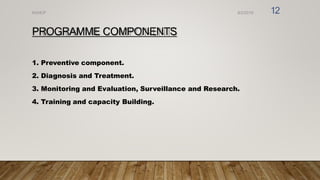
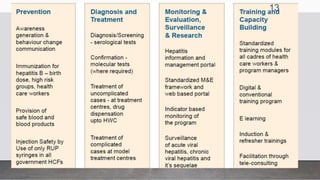
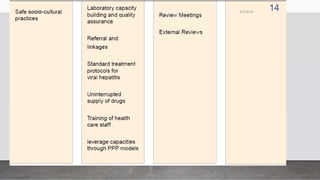
PROGRAMME COMPONENTS
1. Preventive component.
2. Diagnosis and Treatment.
3. Monitoring and Evaluation, Surveillance and Research.
4. Training and capacity Building.
8/2/2019
NVHCP 12
8/2/2019
NVHCP
13
8/2/2019
NVHCP
14
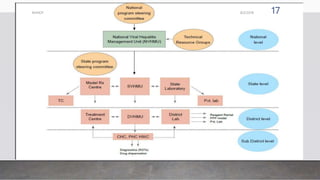
IMPLEMENTATION STRUCTURE AT NATIONAL,
STATE AND DISTRICT LEVEL
The program will have two key prongs:
1. Program management.
2. Servicedelivery component.
8/2/2019
NVHCP 15
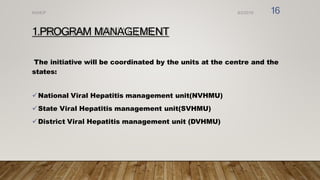
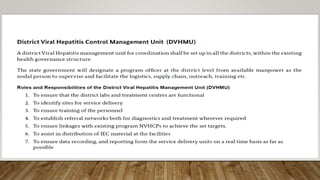
1.PROGRAM MANAGEMENT
The initiative will be coordinated by the units at the centre and the
states:
National Viral Hepatitis management unit(NVHMU)
State Viral Hepatitis management unit(SVHMU)
District Viral Hepatitis management unit (DVHMU)
8/2/2019
NVHCP 16
8/2/2019
NVHCP 17
2.SERVICE DELIVERY
Synergies with the existing programs and relevant ministries of
Government of India.
New Interventions- Diagnosis and Management of Viral Hepatitis
with focus on treatment of Hepatitis B&C.
8/2/2019
NVHCP 18
PREVENTION OF VIRAL
HEPATITIS
8/2/2019
NVHCP 19
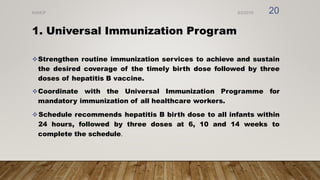
1. Universal Immunization Program
Strengthen routine immunization services to achieve and sustain
the desired coverage of the timely birth dose followed by three
doses of hepatitis B vaccine.
Coordinate with the Universal Immunization Programme for
mandatory immunization of all healthcare workers.
Schedule recommends hepatitis B birth dose to all infants within
24 hours, followed by three doses at 6, 10 and 14 weeks to
complete the schedule.
8/2/2019
NVHCP 20
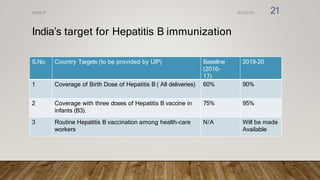
India’s target for Hepatitis B immunization
S.No. Country Targets (to be provided by UIP) Baseline
(2016-
17)
2019-20
1 Coverage of Birth Dose of Hepatitis B ( All deliveries) 60% 90%
2 Coverage with three doses of Hepatitis B vaccine in
infants (B3).
75% 95%
3 Routine Hepatitis B vaccination among health-care
workers
N/A Will be made
Available
8/2/2019
NVHCP 21
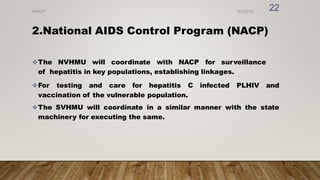
2.National AIDS Control Program (NACP)
The NVHMU will coordinate with NACP for surveillance
of hepatitis in key populations, establishing linkages.
For testing and care for hepatitis C infected PLHIV and
vaccination of the vulnerable population.
The SVHMU will coordinate in a similar manner with the state
machinery for executing the same.
8/2/2019
NVHCP
22
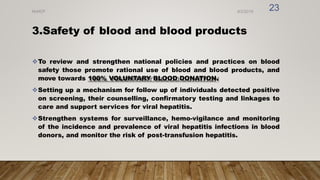
3.Safety of blood and blood products
To review and strengthen national policies and practices on blood
safety those promote rational use of blood and blood products, and
move towards 100% VOLUNTARY BLOOD DONATION.
Setting up a mechanism for follow up of individuals detected positive
on screening, their counselling, confirmatory testing and linkages to
care and support services for viral hepatitis.
Strengthen systems for surveillance, hemo-vigilance and monitoring
of the incidence and prevalence of viral hepatitis infections in blood
donors, and monitor the risk of post-transfusion hepatitis.
8/2/2019
NVHCP
23
Establish mechanisms for counselling of HBsAg& anti-HCV
reactive blood donors for referral and follow-up to confirm the
presence of infection by confirmatory tests & provide treatment
for Hepatitis B and C where necessary.
Developing/updating training modules with SACS, State Blood
Transfusion Council and blood cells on safety of blood and blood
products with special focus on prevention of Viral Hepatitis
through transfusion of blood and blood products and linkages for
those screened positive.
8/2/2019
NVHCP
24
4.Harm reduction in key populations
• Targeted Interventions in key population include female sex
workers (FSW), men who have sex with men (MSM), transgender
(TG)& people who inject drugs (PWID), while bridge populations
include migrants & truckers.
• Provide a package of prevention services.
• Needle syringe exchange program and opioid substitution therapy
are provided for prevention of HIV among PWID.
8/2/2019
NVHCP
25
5.Injection safety and infection control
 By 2020, 100% of all injections are administered with safety engineered devices.
 NVHMU and SVHMU will integrate with the national and state regulatory bodies to
strengthen the infection prevention and control practices in healthcare settings.
 Coordinate with the Pradhan Mantri National Dialysis Program for making special
emphasis on the component of injection safety and infection control in their
program module.
 Coordinate with the regulatory body towards effective roll-out of re-use
prevention (RUP) syringes, addressing prescriber practices and community
preference.
 Coordinate with the Ministry of Environment & Forestry and pollution control
board for capacity building for effective implementation of the bio-medical waste
management rules.
8/2/2019
NVHCP
26
6.Integrated Disease
Surveillance Programme
The NVHMU, SVHMU and DVHMU will integrate with the IDSP
.
To provide technical support for outbreak investigation and
reporting and monitoring of outbreaks of viral hepatitis, specially
hepatitis A and E.
Assisting in rapid response team activities during outbreaks.
Ensure linkages with the laboratory and treatment facilities of
those affected in the outbreak with the disease.
To involve all structures up to PHC level.
8/2/2019
NVHCP
27
DIAGNOSIS AND MANAGEMENT OF VIRAL
HEPATITIS
A. Laboratory services: Laboratory services are necessary for
screening, confirmation and monitoring the response and
outcomes of treatment.
B. Treatment services: Designated treatment sites that are
located within an existing health facility, such as district
hospitals and state medical colleges will utilize the current
health care system.
8/2/2019
NVHCP 28
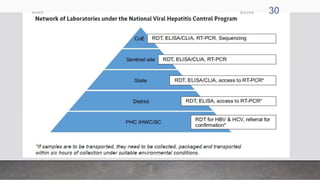
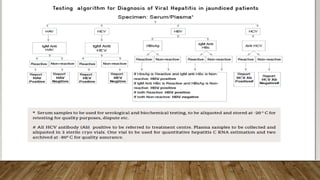
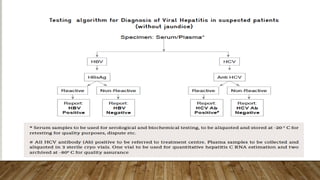
LABORATORIES SERVICES
Laboratory services are necessary for screening, confirmation
and monitoring the response and outcomes of treatment.
To facilitate the same, the program will strengthen the state,
district, and sub district level laboratories in a phased manner.
8/2/2019
NVHCP 29
8/2/2019
NVHCP 30
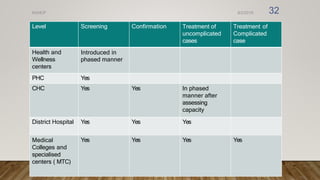
TREATMENT SITES
 The services under the hepatitis treatment initiative will be delivered through
the designated treatment sites that are located within an existing health
facility, such as district hospitals and state medical colleges.
 Model Hepatitis Treatment centres (MTC) will act as places for referral and
mentoring of the other treatment centres (TC).
 The Hepatitis Treatment centre can be located in the district hospital or co-
located with the sentinel sites.
 The diagnosis and treatment centers will have the capacity to differentiate
whether the patient has advanced liver disease or not.
8/2/2019
NVHCP 31
Level Screening Confirmation Treatment of
uncomplicated
cases
Treatment of
Complicated
case
Health and
Wellness
centers
Introduced in
phased manner
PHC Yes
CHC Yes Yes In phased
manner after
assessing
capacity
District Hospital Yes Yes Yes
Medical
Colleges and
specialised
centers ( MTC)
Yes Yes Yes Yes
8/2/2019
NVHCP 32
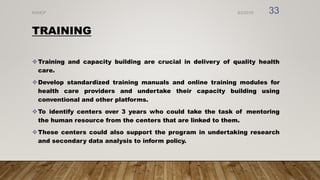
TRAINING
Training and capacity building are crucial in delivery of quality health
care.
Develop standardized training manuals and online training modules for
health care providers and undertake their capacity building using
conventional and other platforms.
To identify centers over 3 years who could take the task of mentoring
the human resource from the centers that are linked to them.
These centers could also support the program in undertaking research
and secondary data analysis to inform policy.
8/2/2019
NVHCP 33
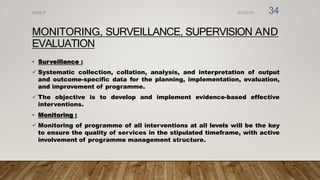
MONITORING, SURVEILLANCE, SUPERVISION AND
EVALUATION
• Surveillance :
 Systematic collection, collation, analysis, and interpretation of output
and outcome-specific data for the planning, implementation, evaluation,
and improvement of programme.
 The objective is to develop and implement evidence-based effective
interventions.
• Monitoring :
 Monitoring of programme of all interventions at all levels will be the key
to ensure the quality of services in the stipulated timeframe, with active
involvement of programme management structure.
8/2/2019
NVHCP 34
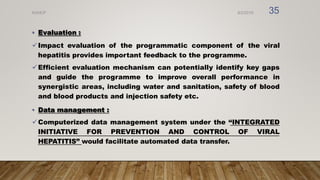
• Evaluation :
Impact evaluation of the programmatic component of the viral
hepatitis provides important feedback to the programme.
Efficient evaluation mechanism can potentially identify key gaps
and guide the programme to improve overall performance in
synergistic areas, including water and sanitation, safety of blood
and blood products and injection safety etc.
• Data management :
Computerized data management system under the ‘‘INTEGRATED
INITIATIVE FOR PREVENTION AND CONTROL OF VIRAL
HEPATITIS’’ would facilitate automated data transfer.
8/2/2019
NVHCP 35
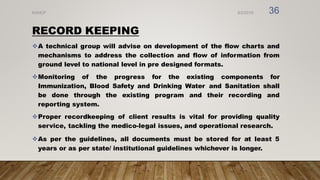
RECORD KEEPING
A technical group will advise on development of the flow charts and
mechanisms to address the collection and flow of information from
ground level to national level in pre designed formats.
Monitoring of the progress for the existing components for
Immunization, Blood Safety and Drinking Water and Sanitation shall
be done through the existing program and their recording and
reporting system.
Proper recordkeeping of client results is vital for providing quality
service, tackling the medico-legal issues, and operational research.
As per the guidelines, all documents must be stored for at least 5
years or as per state/ institutional guidelines whichever is longer.
8/2/2019
NVHCP 36
AWARENESS GENERATION
Increasing awareness among
communication channels will
general population.
be used (like mass
Various
media,
advertisements, radio jingles, posters, TV spots etc).
Behavior change communication strategies for vulnerable groups.
Continued focus on demand generation of services including
hepatitis B birth dose and safe injections and testing for
hepatitis.
Increasing treatment literacy and adherence to treatment.
8/2/2019
NVHCP 37
DISTRICT ROLES
• These laboratories would be co- located with the Treatment Centres at the district
hospitals. The capacities of these labs will be strengthened in a phased manner. The
state laboratories will train the district laboratories in carrying out serological testing
for viral hepatitis (immuno-assays/rapid Tests). These laboratories will perform the
testing and would be linked to other treatment centres in the district, sub-district
levels in the region.
• Roles and Responsibilities
• Sample collection and serological testing under the NVHCP Molecular testing where
feasible.
• Sample transportation for molecular testing, where necessary
THANKYOU
8/2/2019
NVHCP 38

Viral hepatitis control program

  • 1.
    NA TIONALVIRALHEP A TITIS CONTROLPROGRAM Dr. Rishabh KumarRana MBBS ,MD ,CCIP Assistant Professor SNMMCH 8/2/2019 NVHCP 1
  • 2.
    CONTENTS 1. EPIDEMIOLOGY. 2. INTRODUCTIONTO THE PROGRAM. 3. AIM & OBJECTIVES. 4. PROGRAMME STRATEGIES. 5. PROGRAMME COMPONENTS. 6. IMPLEMENTATION STRUCTURE. 7. PREVENTION OF VIRAL HEPATITIS. 8. MONITORING, SURVEILLANCE, SUPERVISION AND EVALUATION. 9. TOTAL NO SLIDES: 38 8/2/2019 NVHCP 2
  • 3.
    Introduction Viral hepatitis isa global public health problem of epidemic proportions that caused 1.34 million deaths in 2015 a number comparable to deaths caused by tuberculosis and higher than those caused by HIV. Infection can be caused by the five known hepatitis viruses – A, B, C, D and E (HAV, HBV, HCV, HDV and HEV). HEPATITIS B AND C are responsible for 96% of overall hepatitis mortality. 8/2/2019 NVHCP 3
  • 4.
    National Viral HepatitisControl Program (NVHCP) prevention and control of viral hepatitis- • free of charge screening, • diagnosis, • treatment & • counselling services to all, (specially to people belonging to high-risk groups).
  • 5.
  • 6.
    Global It is estimatedthat 325 million people worldwide are living with chronic HBV or HCV infection. Approximately,1.75 million people were estimated to be newly infected with HCV in 2015, increasing the total number of people living with Hepatitis C to 71 million. Hepatitis A Virus (HAV) infections caused approximately 11,000 deaths in 2015. It is estimated that Hepatitis E caused 44,000 deaths in 2015. *Source: WHO Global Hepatitis Report. 2017. 8/2/2019 NVHCP 5
  • 7.
    India  HAV isresponsible for 10-30% of acute hepatitis and 5-15% of acute liver failure.  HEV accounts for 10-40% of acute hepatitis and 15-45% of acute liver failure.  Hepatitis B surface Antigen (HBsAg) positivity in the general population ranges from 1.1% to 12.2%, with an average prevalence of 3-4%.  Approximately 40 million people are chronically infected with Hepatitis B and 6-12 million people with Hepatitis C.  Chronic HBV infection accounts for 40% of Hepato-cellular Carcinoma (HCC) and 20-30% cases of cirrhosis in India.  Chronic HCV infection accounts for 12-32% of HCC and 12-20% of cirrhosis. 8/2/2019 NVHCP 6
  • 9.
    INTRODUCTION TO THEPROGRAM  India is committed to progressively move towards elimination of viral hepatitis B and C and control other virus induced hepatitis.  This is in line with our global commitment towards achieving Sustainable development goal (SDG) goal 3; target 3.3 which aims to “BY 2030, END THE EPIDEMICS OF AIDS, TUBERCULOSIS, MALARIA AND NEGLECTED TROPICAL DISEASES AND COMBAT HEPATITIS, WATER BORNE DISEASES AND OTHER COMMUNICABLE DISEASES”.  Government of India is a signatory to the resolution 69.22 endorsed in the WHO Global Health Sector Strategy on Viral Hepatitis 2016-2021 at 69th WHA towards ending viral hepatitis by 2030. • 8/2/2019 NVHCP 7
  • 10.
    Aim Combat hepatitis andachieve country wide elimination of Hepatitis C by 2030. Achieve significant reduction in the infected population, morbidity and mortality associated with Hepatitis B and C viz. Cirrhosis and Hepatocellular carcinoma. Reduce the risk morbidity and mortality due to Hepatitis A and E. 8/2/2019 NVHCP 8
  • 11.
    OBJECTIVES Enhance community awarenesson hepatitis and lay stress on preventive measures among general population especially high- risk groups and in hotspots. Provide early diagnosis and management of viral hepatitis at all levels of healthcare. Develop standard diagnostic and treatment protocols for management of viral hepatitis and its complications. 8/2/2019 NVHCP 9
  • 12.
    Strengthen the existinginfrastructure facilities, build capacities of existing human resource and raise additional human resources, where required, for providing comprehensive services for management of viral hepatitis and its complications in all districts of the country. Develop linkages with the existing National programmes towards awareness, prevention, diagnosis and treatment for viral hepatitis. Develop a web-based “VIRAL HEPATITIS INFORMATION AND MANAGEMENT SYSTEM” to maintain a registry of persons affected with viral hepatitis and its sequelae. 8/2/2019 NVHCP 10
  • 13.
    PROGRAMME STRATEGIES  Preventiveand promotive interventions with focus on awareness generation, safe injection and socio cultural practices, sanitation and hygiene, safe drinking water supply, infection control and immunization.  Co-ordination and collaboration with different Ministries and departments, NACP for safety of blood and blood products and with IDSP and NACP for surveillance.  Increasing access and promoting diagnosis and providing treatment support for patients of viral hepatitis.  Building capacities at national, state, district and sub district levels up to PHC and Health and Wellness center in a phased manner. 8/2/2019 NVHCP 11
  • 14.
    PROGRAMME COMPONENTS 1. Preventivecomponent. 2. Diagnosis and Treatment. 3. Monitoring and Evaluation, Surveillance and Research. 4. Training and capacity Building. 8/2/2019 NVHCP 12
  • 15.
  • 16.
  • 17.
    IMPLEMENTATION STRUCTURE ATNATIONAL, STATE AND DISTRICT LEVEL The program will have two key prongs: 1. Program management. 2. Servicedelivery component. 8/2/2019 NVHCP 15
  • 18.
    1.PROGRAM MANAGEMENT The initiativewill be coordinated by the units at the centre and the states: National Viral Hepatitis management unit(NVHMU) State Viral Hepatitis management unit(SVHMU) District Viral Hepatitis management unit (DVHMU) 8/2/2019 NVHCP 16
  • 19.
  • 21.
    2.SERVICE DELIVERY Synergies withthe existing programs and relevant ministries of Government of India. New Interventions- Diagnosis and Management of Viral Hepatitis with focus on treatment of Hepatitis B&C. 8/2/2019 NVHCP 18
  • 22.
  • 23.
    1. Universal ImmunizationProgram Strengthen routine immunization services to achieve and sustain the desired coverage of the timely birth dose followed by three doses of hepatitis B vaccine. Coordinate with the Universal Immunization Programme for mandatory immunization of all healthcare workers. Schedule recommends hepatitis B birth dose to all infants within 24 hours, followed by three doses at 6, 10 and 14 weeks to complete the schedule. 8/2/2019 NVHCP 20
  • 24.
    India’s target forHepatitis B immunization S.No. Country Targets (to be provided by UIP) Baseline (2016- 17) 2019-20 1 Coverage of Birth Dose of Hepatitis B ( All deliveries) 60% 90% 2 Coverage with three doses of Hepatitis B vaccine in infants (B3). 75% 95% 3 Routine Hepatitis B vaccination among health-care workers N/A Will be made Available 8/2/2019 NVHCP 21
  • 25.
    2.National AIDS ControlProgram (NACP) The NVHMU will coordinate with NACP for surveillance of hepatitis in key populations, establishing linkages. For testing and care for hepatitis C infected PLHIV and vaccination of the vulnerable population. The SVHMU will coordinate in a similar manner with the state machinery for executing the same. 8/2/2019 NVHCP 22
  • 26.
    3.Safety of bloodand blood products To review and strengthen national policies and practices on blood safety those promote rational use of blood and blood products, and move towards 100% VOLUNTARY BLOOD DONATION. Setting up a mechanism for follow up of individuals detected positive on screening, their counselling, confirmatory testing and linkages to care and support services for viral hepatitis. Strengthen systems for surveillance, hemo-vigilance and monitoring of the incidence and prevalence of viral hepatitis infections in blood donors, and monitor the risk of post-transfusion hepatitis. 8/2/2019 NVHCP 23
  • 27.
    Establish mechanisms forcounselling of HBsAg& anti-HCV reactive blood donors for referral and follow-up to confirm the presence of infection by confirmatory tests & provide treatment for Hepatitis B and C where necessary. Developing/updating training modules with SACS, State Blood Transfusion Council and blood cells on safety of blood and blood products with special focus on prevention of Viral Hepatitis through transfusion of blood and blood products and linkages for those screened positive. 8/2/2019 NVHCP 24
  • 28.
    4.Harm reduction inkey populations • Targeted Interventions in key population include female sex workers (FSW), men who have sex with men (MSM), transgender (TG)& people who inject drugs (PWID), while bridge populations include migrants & truckers. • Provide a package of prevention services. • Needle syringe exchange program and opioid substitution therapy are provided for prevention of HIV among PWID. 8/2/2019 NVHCP 25
  • 29.
    5.Injection safety andinfection control  By 2020, 100% of all injections are administered with safety engineered devices.  NVHMU and SVHMU will integrate with the national and state regulatory bodies to strengthen the infection prevention and control practices in healthcare settings.  Coordinate with the Pradhan Mantri National Dialysis Program for making special emphasis on the component of injection safety and infection control in their program module.  Coordinate with the regulatory body towards effective roll-out of re-use prevention (RUP) syringes, addressing prescriber practices and community preference.  Coordinate with the Ministry of Environment & Forestry and pollution control board for capacity building for effective implementation of the bio-medical waste management rules. 8/2/2019 NVHCP 26
  • 30.
    6.Integrated Disease Surveillance Programme TheNVHMU, SVHMU and DVHMU will integrate with the IDSP . To provide technical support for outbreak investigation and reporting and monitoring of outbreaks of viral hepatitis, specially hepatitis A and E. Assisting in rapid response team activities during outbreaks. Ensure linkages with the laboratory and treatment facilities of those affected in the outbreak with the disease. To involve all structures up to PHC level. 8/2/2019 NVHCP 27
  • 31.
    DIAGNOSIS AND MANAGEMENTOF VIRAL HEPATITIS A. Laboratory services: Laboratory services are necessary for screening, confirmation and monitoring the response and outcomes of treatment. B. Treatment services: Designated treatment sites that are located within an existing health facility, such as district hospitals and state medical colleges will utilize the current health care system. 8/2/2019 NVHCP 28
  • 32.
    LABORATORIES SERVICES Laboratory servicesare necessary for screening, confirmation and monitoring the response and outcomes of treatment. To facilitate the same, the program will strengthen the state, district, and sub district level laboratories in a phased manner. 8/2/2019 NVHCP 29
  • 33.
  • 34.
    TREATMENT SITES  Theservices under the hepatitis treatment initiative will be delivered through the designated treatment sites that are located within an existing health facility, such as district hospitals and state medical colleges.  Model Hepatitis Treatment centres (MTC) will act as places for referral and mentoring of the other treatment centres (TC).  The Hepatitis Treatment centre can be located in the district hospital or co- located with the sentinel sites.  The diagnosis and treatment centers will have the capacity to differentiate whether the patient has advanced liver disease or not. 8/2/2019 NVHCP 31
  • 35.
    Level Screening ConfirmationTreatment of uncomplicated cases Treatment of Complicated case Health and Wellness centers Introduced in phased manner PHC Yes CHC Yes Yes In phased manner after assessing capacity District Hospital Yes Yes Yes Medical Colleges and specialised centers ( MTC) Yes Yes Yes Yes 8/2/2019 NVHCP 32
  • 36.
    TRAINING Training and capacitybuilding are crucial in delivery of quality health care. Develop standardized training manuals and online training modules for health care providers and undertake their capacity building using conventional and other platforms. To identify centers over 3 years who could take the task of mentoring the human resource from the centers that are linked to them. These centers could also support the program in undertaking research and secondary data analysis to inform policy. 8/2/2019 NVHCP 33
  • 37.
    MONITORING, SURVEILLANCE, SUPERVISIONAND EVALUATION • Surveillance :  Systematic collection, collation, analysis, and interpretation of output and outcome-specific data for the planning, implementation, evaluation, and improvement of programme.  The objective is to develop and implement evidence-based effective interventions. • Monitoring :  Monitoring of programme of all interventions at all levels will be the key to ensure the quality of services in the stipulated timeframe, with active involvement of programme management structure. 8/2/2019 NVHCP 34
  • 38.
    • Evaluation : Impactevaluation of the programmatic component of the viral hepatitis provides important feedback to the programme. Efficient evaluation mechanism can potentially identify key gaps and guide the programme to improve overall performance in synergistic areas, including water and sanitation, safety of blood and blood products and injection safety etc. • Data management : Computerized data management system under the ‘‘INTEGRATED INITIATIVE FOR PREVENTION AND CONTROL OF VIRAL HEPATITIS’’ would facilitate automated data transfer. 8/2/2019 NVHCP 35
  • 39.
    RECORD KEEPING A technicalgroup will advise on development of the flow charts and mechanisms to address the collection and flow of information from ground level to national level in pre designed formats. Monitoring of the progress for the existing components for Immunization, Blood Safety and Drinking Water and Sanitation shall be done through the existing program and their recording and reporting system. Proper recordkeeping of client results is vital for providing quality service, tackling the medico-legal issues, and operational research. As per the guidelines, all documents must be stored for at least 5 years or as per state/ institutional guidelines whichever is longer. 8/2/2019 NVHCP 36
  • 40.
    AWARENESS GENERATION Increasing awarenessamong communication channels will general population. be used (like mass Various media, advertisements, radio jingles, posters, TV spots etc). Behavior change communication strategies for vulnerable groups. Continued focus on demand generation of services including hepatitis B birth dose and safe injections and testing for hepatitis. Increasing treatment literacy and adherence to treatment. 8/2/2019 NVHCP 37
  • 41.
    DISTRICT ROLES • Theselaboratories would be co- located with the Treatment Centres at the district hospitals. The capacities of these labs will be strengthened in a phased manner. The state laboratories will train the district laboratories in carrying out serological testing for viral hepatitis (immuno-assays/rapid Tests). These laboratories will perform the testing and would be linked to other treatment centres in the district, sub-district levels in the region. • Roles and Responsibilities • Sample collection and serological testing under the NVHCP Molecular testing where feasible. • Sample transportation for molecular testing, where necessary
  • 44.