Seminar
On
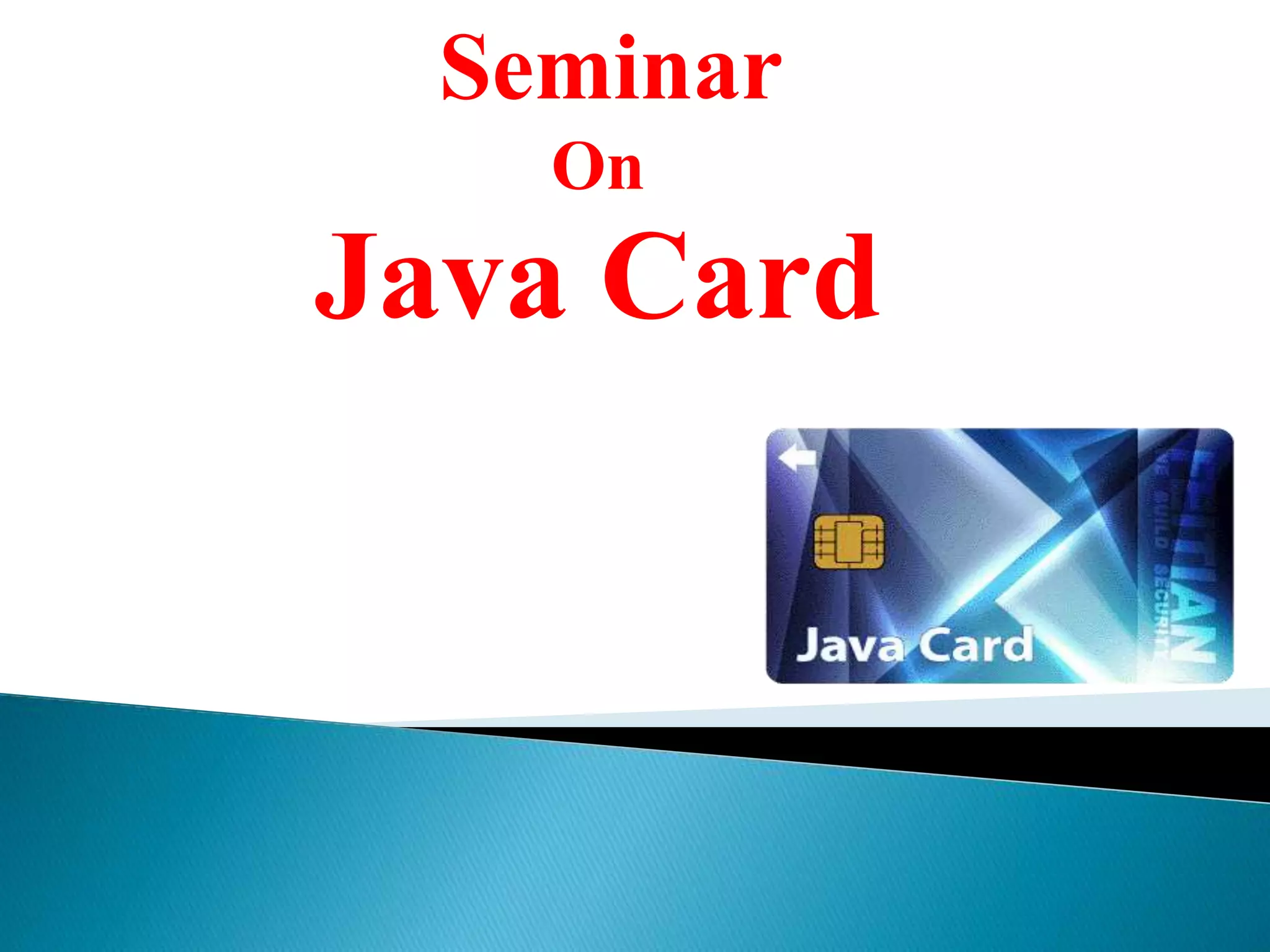
Java Card
 Introduction
 What is a Java Card?
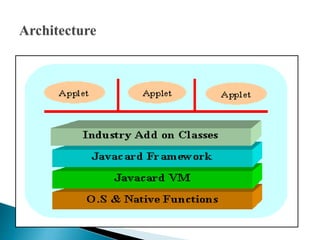
 Architecture
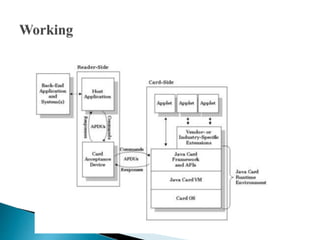
 Working
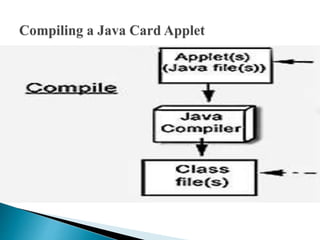
 Development Process
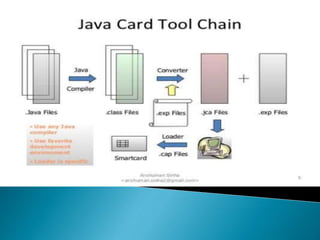
 Java Card Tool Chain
 Why Java for Smart Cards
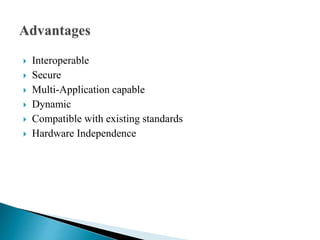
 Advantages
 Limitations
 Applications
 Challenges
 Conclusion
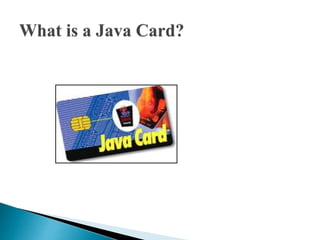
 Java Card is a smart card that is capable of running programs
written in Java.
 For this a new Java platform, Sun's JavaSoft division has made
available the Java Card 2.0 API specification, and several
licensees are now implementing this API on smart cards.
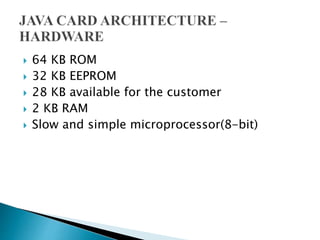
 64 KB ROM
 32 KB EEPROM
 28 KB available for the customer
 2 KB RAM
 Slow and simple microprocessor(8-bit)
 Interoperable
 Secure
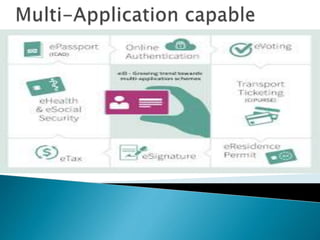
 Multi-Application capable
 Dynamic
 Compatible with existing standards
 Hardware Independence
Secure
Limitations
 Language Features
 Keywords
 Types
 Classes and Interfaces
 Exceptions
Applications
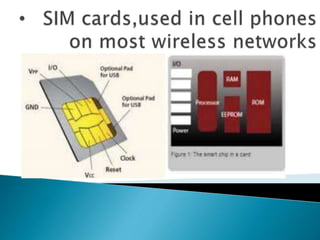
 SIM cards , used in cell Phones on most wireless
networks
 Government and health-care identity cards
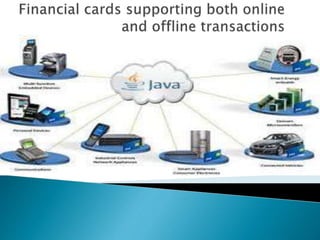
 Financial cards supporting both online and offline
transactions
 Smart tickets for mass trans
Industry News
Java cards have very restricted resources
1.Limited Memory
2.Limited Computing Power
Java Card doesn’t support some of java features
1.Large primitive data types : long, double, float
2.char,string
3.Multidimensional array
4.Dynamic class loading
5.Garbage collection
6.Multithreading
7.Object Cloning
 The Java Card adds a new platform to the world of Java.
 Widespread adoption and deployment of the Java Card will
require marketing promotion, more applications and tools
development, and time.
 At the same time, the number of Java Cards in existence could
easily extend into the millions within the next few years.
Java card

Java card

  • 1.
  • 2.
     Introduction  Whatis a Java Card?  Architecture  Working  Development Process  Java Card Tool Chain  Why Java for Smart Cards  Advantages  Limitations  Applications  Challenges  Conclusion
  • 3.
     Java Cardis a smart card that is capable of running programs written in Java.  For this a new Java platform, Sun's JavaSoft division has made available the Java Card 2.0 API specification, and several licensees are now implementing this API on smart cards.
  • 6.
     64 KBROM  32 KB EEPROM  28 KB available for the customer  2 KB RAM  Slow and simple microprocessor(8-bit)
  • 11.
     Interoperable  Secure Multi-Application capable  Dynamic  Compatible with existing standards  Hardware Independence
  • 14.
  • 16.
    Limitations  Language Features Keywords  Types  Classes and Interfaces  Exceptions
  • 17.
    Applications  SIM cards, used in cell Phones on most wireless networks  Government and health-care identity cards  Financial cards supporting both online and offline transactions  Smart tickets for mass trans
  • 22.
  • 24.
    Java cards havevery restricted resources 1.Limited Memory 2.Limited Computing Power Java Card doesn’t support some of java features 1.Large primitive data types : long, double, float 2.char,string 3.Multidimensional array 4.Dynamic class loading 5.Garbage collection 6.Multithreading 7.Object Cloning
  • 25.
     The JavaCard adds a new platform to the world of Java.  Widespread adoption and deployment of the Java Card will require marketing promotion, more applications and tools development, and time.  At the same time, the number of Java Cards in existence could easily extend into the millions within the next few years.