SaaS : Software As A Service Suhas Kelkar VP Product Management Digité ( www.digite.com ) Keynote Speech For SCIT ( www.scit.edu )  Software Development Challenges & Issues Seminar January 19, 2008
Agenda What is SaaS? Why SaaS? History and current state of SaaS SaaS Architecture
SaaS Elevator Pitch "Software deployed as a hosted service and accessed over the Internet"
Business Services versus Consumer Oriented Services
What is SaaS? SaaS is a software  delivery  method that provides access to software and its functions remotely as a Web-based service. SaaS allows organizations to access business functionality at a cost typically  less  than paying for licensed applications since SaaS pricing is based on  a  monthly fee .   Users don’t need to invest as much in hardware, server support, security audits  and need fewer in house IT staff
SaaS Advantages Lower Costs. The user need not pay a single (usually large) licensing fee. He only needs to pay recurring subscription fees.  Smaller Storage and Hardware Requirements. The user need not store software or data stored on his computer  Fewer Personnel. SaaS reduces the need for specially trained IT personnel to handle maintenance, monitoring and software updates.  Key Advantages for the End User Continuous and recurring stream of income Reduced losses from piracy and unlicensed use of software Greater valuation for the company!  Key Advantages for the Vendor
Key characteristics of SaaS? Network based access and management of commercial software Central management of commercial software rather than at each customer’s site One to many application delivery model based on single instance, multi tenant architecture Centralized updating of software No more install hassles, downloadable patches and painful upgrades Upgrades are frequent and completely transparent. Gmail version keeps changing
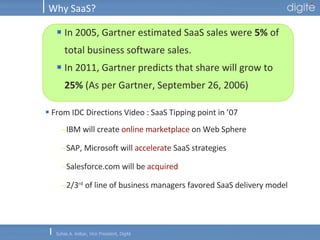
Why SaaS? In 2005, Gartner estimated SaaS sales were  5%  of total business software sales.  In 2011, Gartner predicts that share will grow to  25%  (As per Gartner, September 26, 2006) From IDC Directions Video : SaaS Tipping point in ’07 IBM will create  online marketplace  on Web Sphere SAP, Microsoft will  accelerate  SaaS strategies Salesforce.com will be  acquired 2/3 rd  of line of business managers favored SaaS delivery model
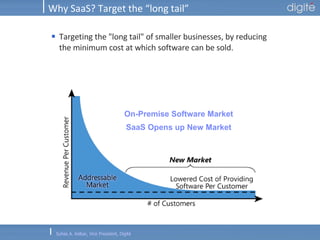
Why SaaS? Target the “long tail” Targeting the "long tail" of smaller businesses, by reducing the minimum cost at which software can be sold .   On-Premise Software Market SaaS Opens up New Market
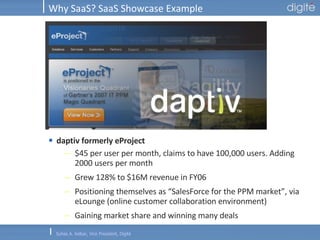
Why SaaS? SaaS Showcase Example daptiv formerly eProject  $45 per user per month, claims to have 100,000 users. Adding 2000 users per month Grew 128% to $16M revenue in FY06 Positioning themselves as “SalesForce for the PPM market”, via eLounge (online customer collaboration environment) Gaining market share and winning many deals
Agenda What is SaaS? History and current state of SaaS SaaS Architecture
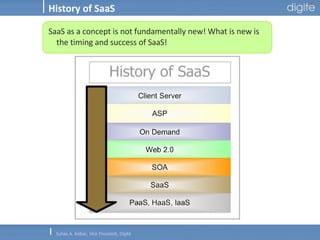
History of SaaS SaaS as a concept is not fundamentally new! What is new is the timing and success of SaaS!
ASP Versus SaaS It is important to understand the difference between ASP and SaaS. It is very common to confuse SaaS with ASP. ASP applications were traditional client-server applications with HTML façade ASP suffered with poor performance Shift in center of gravity : SaaS is about what customer wants, ASP was what the client would offer ASP concept did not scale!
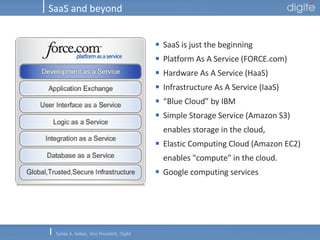
SaaS and beyond SaaS is just the beginning Platform As A Service (FORCE.com) Hardware As A Service (HaaS) Infrastructure As A Service (IaaS) “ Blue Cloud” by IBM Simple Storage Service (Amazon S3) enables storage in the cloud,  Elastic Computing Cloud (Amazon EC2) enables "compute" in the cloud. Google computing services
Agenda What is SaaS? History and current state of SaaS SaaS Architecture
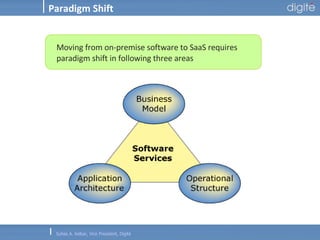
Paradigm Shift Moving from on-premise software to SaaS requires paradigm shift in following three areas
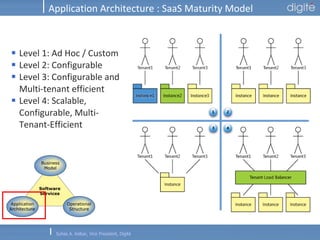
Application Architecture : SaaS Maturity Model Level 1:   Ad Hoc / Custom Level 2:   Configurable Level 3:   Configurable and Multi-tenant efficient Level 4:   Scalable, Configurable, Multi-Tenant-Efficient
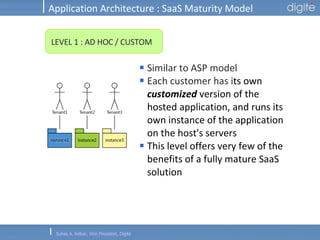
Application Architecture : SaaS Maturity Model Similar to ASP model Each customer has i ts own  customized  version of the hosted application, and runs its own instance of the application on the host's servers   This level offers very few of the benefits of a fully mature SaaS solution   LEVEL 1 : AD HOC / CUSTOM
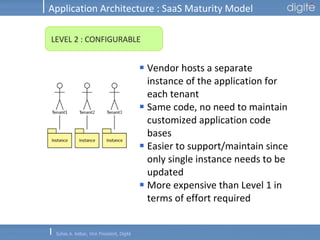
Application Architecture : SaaS Maturity Model Vendor hosts a separate instance of the application for each tenant Same code, no need to maintain customized application code bases Easier to support/maintain since only single instance needs to be updated More expensive than Level 1 in terms of effort required LEVEL 2 : CONFIGURABLE
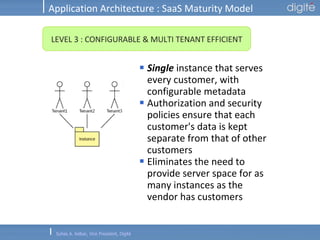
Application Architecture : SaaS Maturity Model Single  instance that serves every customer, with configurable metadata  Authorization and security policies ensure that each customer's data is kept separate from that of other customers  Eliminates the need to provide server space for as many instances as the vendor has customers  LEVEL 3 : CONFIGURABLE & MULTI TENANT EFFICIENT
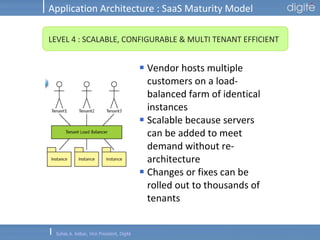
Application Architecture : SaaS Maturity Model Vendor hosts multiple customers on a load-balanced farm of identical instances   Scalable because servers can be added to meet demand without re-architecture Changes or fixes can be rolled out to thousands of tenants  LEVEL 4 : SCALABLE, CONFIGURABLE & MULTI TENANT EFFICIENT
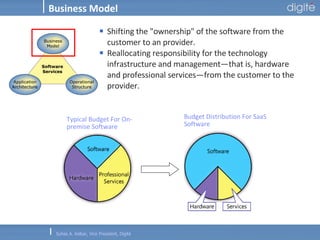
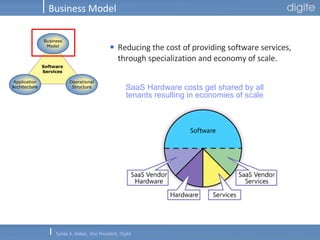
Business Model Shifting the "ownership" of the software from the customer to an provider.  Reallocating responsibility for the technology infrastructure and management—that is, hardware and professional services—from the customer to the provider.  Typical Budget For On-premise Software Budget Distribution For SaaS Software
Business Model Reducing the cost of providing software services, through specialization and economy of scale.  SaaS Hardware costs get shared by all tenants resulting in economies of scale
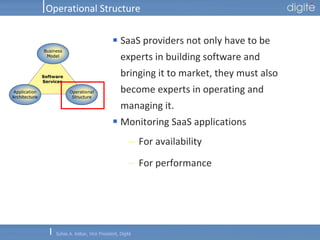
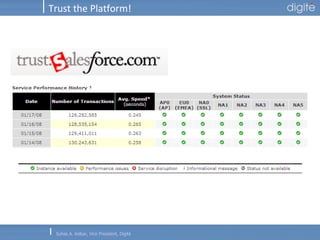
Operational Structure SaaS providers not only have to be experts in building software and bringing it to market, they must also become experts in operating and managing it.  Monitoring SaaS applications For availability For performance
Trust the Platform!
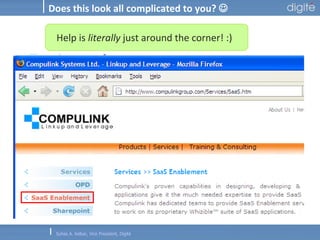
Does this look all complicated to you?   Help is  literally  just around the corner! :)
Summary SaaS  is  going to have a major impact on the software industry, because SaaS will change the way people  build, sell, buy & use  software As students of SCIT, you are the future of tomorrow’s IT industry. Hence you need to track SaaS very closely as it will have material impact on your future!
Thanks! [email_address]
Glossary and References http://msdn2.microsoft.com/en-us/library/aa479069.aspx http://blogs.msdn.com/gianpaolo/ http://www.microsoft.com/serviceproviders/saas/default.mspx http:// en.wikipedia.org/wiki/SaaS

SaaS Presentation at SCIT Conference

  • 1.
    SaaS : SoftwareAs A Service Suhas Kelkar VP Product Management Digité ( www.digite.com ) Keynote Speech For SCIT ( www.scit.edu ) Software Development Challenges & Issues Seminar January 19, 2008
  • 2.
    Agenda What isSaaS? Why SaaS? History and current state of SaaS SaaS Architecture
  • 3.
    SaaS Elevator Pitch"Software deployed as a hosted service and accessed over the Internet"
  • 4.
    Business Services versusConsumer Oriented Services
  • 5.
    What is SaaS?SaaS is a software delivery method that provides access to software and its functions remotely as a Web-based service. SaaS allows organizations to access business functionality at a cost typically less than paying for licensed applications since SaaS pricing is based on a monthly fee . Users don’t need to invest as much in hardware, server support, security audits and need fewer in house IT staff
  • 6.
    SaaS Advantages LowerCosts. The user need not pay a single (usually large) licensing fee. He only needs to pay recurring subscription fees. Smaller Storage and Hardware Requirements. The user need not store software or data stored on his computer Fewer Personnel. SaaS reduces the need for specially trained IT personnel to handle maintenance, monitoring and software updates. Key Advantages for the End User Continuous and recurring stream of income Reduced losses from piracy and unlicensed use of software Greater valuation for the company! Key Advantages for the Vendor
  • 7.
    Key characteristics ofSaaS? Network based access and management of commercial software Central management of commercial software rather than at each customer’s site One to many application delivery model based on single instance, multi tenant architecture Centralized updating of software No more install hassles, downloadable patches and painful upgrades Upgrades are frequent and completely transparent. Gmail version keeps changing
  • 8.
    Why SaaS? In2005, Gartner estimated SaaS sales were 5% of total business software sales. In 2011, Gartner predicts that share will grow to 25% (As per Gartner, September 26, 2006) From IDC Directions Video : SaaS Tipping point in ’07 IBM will create online marketplace on Web Sphere SAP, Microsoft will accelerate SaaS strategies Salesforce.com will be acquired 2/3 rd of line of business managers favored SaaS delivery model
  • 9.
    Why SaaS? Targetthe “long tail” Targeting the "long tail" of smaller businesses, by reducing the minimum cost at which software can be sold . On-Premise Software Market SaaS Opens up New Market
  • 10.
    Why SaaS? SaaSShowcase Example daptiv formerly eProject $45 per user per month, claims to have 100,000 users. Adding 2000 users per month Grew 128% to $16M revenue in FY06 Positioning themselves as “SalesForce for the PPM market”, via eLounge (online customer collaboration environment) Gaining market share and winning many deals
  • 11.
    Agenda What isSaaS? History and current state of SaaS SaaS Architecture
  • 12.
    History of SaaSSaaS as a concept is not fundamentally new! What is new is the timing and success of SaaS!
  • 13.
    ASP Versus SaaSIt is important to understand the difference between ASP and SaaS. It is very common to confuse SaaS with ASP. ASP applications were traditional client-server applications with HTML façade ASP suffered with poor performance Shift in center of gravity : SaaS is about what customer wants, ASP was what the client would offer ASP concept did not scale!
  • 14.
    SaaS and beyondSaaS is just the beginning Platform As A Service (FORCE.com) Hardware As A Service (HaaS) Infrastructure As A Service (IaaS) “ Blue Cloud” by IBM Simple Storage Service (Amazon S3) enables storage in the cloud, Elastic Computing Cloud (Amazon EC2) enables "compute" in the cloud. Google computing services
  • 15.
    Agenda What isSaaS? History and current state of SaaS SaaS Architecture
  • 16.
    Paradigm Shift Movingfrom on-premise software to SaaS requires paradigm shift in following three areas
  • 17.
    Application Architecture :SaaS Maturity Model Level 1: Ad Hoc / Custom Level 2: Configurable Level 3: Configurable and Multi-tenant efficient Level 4: Scalable, Configurable, Multi-Tenant-Efficient
  • 18.
    Application Architecture :SaaS Maturity Model Similar to ASP model Each customer has i ts own customized version of the hosted application, and runs its own instance of the application on the host's servers This level offers very few of the benefits of a fully mature SaaS solution LEVEL 1 : AD HOC / CUSTOM
  • 19.
    Application Architecture :SaaS Maturity Model Vendor hosts a separate instance of the application for each tenant Same code, no need to maintain customized application code bases Easier to support/maintain since only single instance needs to be updated More expensive than Level 1 in terms of effort required LEVEL 2 : CONFIGURABLE
  • 20.
    Application Architecture :SaaS Maturity Model Single instance that serves every customer, with configurable metadata Authorization and security policies ensure that each customer's data is kept separate from that of other customers Eliminates the need to provide server space for as many instances as the vendor has customers LEVEL 3 : CONFIGURABLE & MULTI TENANT EFFICIENT
  • 21.
    Application Architecture :SaaS Maturity Model Vendor hosts multiple customers on a load-balanced farm of identical instances Scalable because servers can be added to meet demand without re-architecture Changes or fixes can be rolled out to thousands of tenants LEVEL 4 : SCALABLE, CONFIGURABLE & MULTI TENANT EFFICIENT
  • 22.
    Business Model Shiftingthe "ownership" of the software from the customer to an provider. Reallocating responsibility for the technology infrastructure and management—that is, hardware and professional services—from the customer to the provider. Typical Budget For On-premise Software Budget Distribution For SaaS Software
  • 23.
    Business Model Reducingthe cost of providing software services, through specialization and economy of scale. SaaS Hardware costs get shared by all tenants resulting in economies of scale
  • 24.
    Operational Structure SaaSproviders not only have to be experts in building software and bringing it to market, they must also become experts in operating and managing it. Monitoring SaaS applications For availability For performance
  • 25.
  • 26.
    Does this lookall complicated to you?  Help is literally just around the corner! :)
  • 27.
    Summary SaaS is going to have a major impact on the software industry, because SaaS will change the way people build, sell, buy & use software As students of SCIT, you are the future of tomorrow’s IT industry. Hence you need to track SaaS very closely as it will have material impact on your future!
  • 28.
  • 29.
    Glossary and Referenceshttp://msdn2.microsoft.com/en-us/library/aa479069.aspx http://blogs.msdn.com/gianpaolo/ http://www.microsoft.com/serviceproviders/saas/default.mspx http:// en.wikipedia.org/wiki/SaaS

Editor's Notes

  • #2 Microsoft is offering the Professional version of Dynamics CRM Online for an introductory price of $39 per user per month. The Professional Plus release is $59 per user per month.