Suhas A. Kelkar, VP Product Management, Digité   Cloud Computing And Traditional SDLC
Suhas A. Kelkar, VP Product Management, Digité   How Cloud Computing May Change Traditional SDLC & ALM The goal of this presentation is to take a look at how cloud computing may change the traditional SDLC and ALM disciplines and to see how we can leverage it for our product…
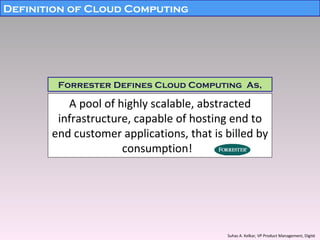
Definition of Cloud Computing Forrester Defines Cloud Computing  As, A pool of highly scalable, abstracted infrastructure, capable of hosting end to end customer applications, that is billed by consumption!  Suhas A. Kelkar, VP Product Management, Digité
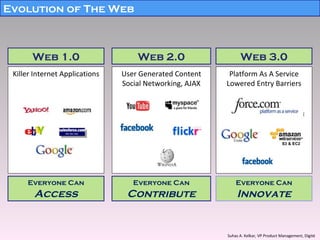
Evolution of The Web Web 1.0 Killer Internet Applications Everyone Can  Access Web 2.0 User Generated Content Social Networking, AJAX Everyone Can  Contribute Web 3.0 Platform As A Service Lowered Entry Barriers Everyone Can  Innovate Suhas A. Kelkar, VP Product Management, Digité
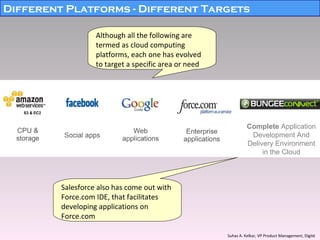
Different Platforms - Different Targets Complete  Application Development And Delivery Environment in the Cloud Salesforce also has come out with Force.com IDE, that facilitates developing applications on Force.com Although all the following are termed as cloud computing platforms, each one has evolved to target a specific area or need Suhas A. Kelkar, VP Product Management, Digité
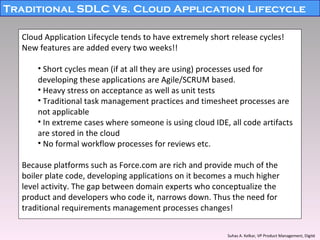
Traditional SDLC Vs. Cloud Application Lifecycle Cloud Application Lifecycle tends to have extremely short release cycles! New features are added every two weeks!! Short cycles mean (if at all they are using) processes used for developing these applications are Agile/SCRUM based. Heavy stress on acceptance as well as unit tests Traditional task management practices and timesheet processes are not applicable In extreme cases where someone is using cloud IDE, all code artifacts are stored in the cloud No formal workflow processes for reviews etc. Because platforms such as Force.com are rich and provide much of the boiler plate code, developing applications on it becomes a much higher level activity. The gap between domain experts who conceptualize the product and developers who code it, narrows down. Thus the need for traditional requirements management processes changes! Suhas A. Kelkar, VP Product Management, Digité
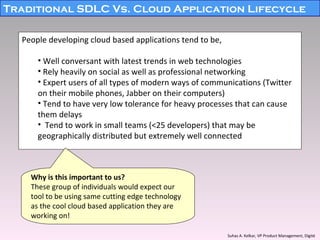
Traditional   SDLC Vs. Cloud Application Lifecycle People developing cloud based applications tend to be, Well conversant with latest trends in web technologies Rely heavily on social as well as professional networking Expert users of all types of modern ways of communications (Twitter on their mobile phones, Jabber on their computers) Tend to have very low tolerance for heavy processes that can cause them delays Tend to work in small teams (<25 developers) that may be geographically distributed but extremely well connected Why is this important to us? These group of individuals would expect our tool to be using same cutting edge technology as the cool cloud based application they are working on! Suhas A. Kelkar, VP Product Management, Digité
Summary Development Lifecycle for applications developed in Cloud is not too different from traditional SDLC.  However importance and duration of some of the stages is significantly different. E.g. For a business app that can be completely modeled on Salesforce.com architecture, Requirements gathering will become the most important activity. Once the requirements are understood and business logic decided upon, the application can simply be configured without any code been written. (This obviously is only possible in most idealistic or simplistic situation.  In most cases you would end up having to write some code. Cloud computing architectures such as Microsoft Azure promise to enable developing cloud applications as seamless as developing regular desktop application. If this vision is indeed realized, then the gap between Cloud Application Lifecycle and Traditional SDLC will further reduce! Cloud computing is still in infancy stages.  It remains to be seen how Enterprises will embrace it. As such the target market for people developing cloud based applications is still fairly small. Suhas A. Kelkar, VP Product Management, Digité
Suhas A. Kelkar, VP Product Management, Digité   Supporting Slides
Microsoft Azure This Slide is under construction… Suhas A. Kelkar, VP Product Management, Digité
Salesforce This Slide is under construction… Suhas A. Kelkar, VP Product Management, Digité
Eclipse Process Framework Initiated in Jan 2006, EPF is an Open Source project within the Eclipse Foundation The goals of EPF are to provide: An extensible framework and tooling for authoring, configuring and publishing processes Exemplary processes - first delivered is OpenUP EPF is  NOT: Only applicable for Eclipse Java development. Intended to create the “perfect process” What is EPF? Suhas A. Kelkar, VP Product Management, Digité
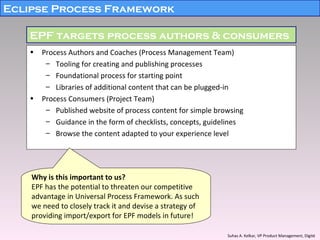
Eclipse Process Framework EPF targets process authors & consumers Process Authors and Coaches (Process Management Team) Tooling for creating and publishing processes Foundational process for starting point Libraries of additional content that can be plugged-in  Process Consumers (Project Team) Published website of process content for simple browsing Guidance in the form of checklists, concepts, guidelines Browse the content adapted to your experience level Why is this important to us? EPF has the potential to threaten our competitive advantage in Universal Process Framework. As such we need to closely track it and devise a strategy of providing import/export for EPF models in future! Suhas A. Kelkar, VP Product Management, Digité
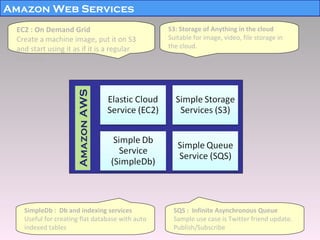
EC2 : On Demand Grid Create a machine image, put it on S3 and start using it as if it is a regular machine S3: Storage of Anything in the cloud Suitable for image, video, file storage in the cloud. SimpleDb :  Db and indexing services Useful for creating flat database with auto indexed tables SQS :  Infinite Asynchronous Queue Sample use case is Twitter friend update.  Publish/Subscribe Amazon Web Services Amazon AWS
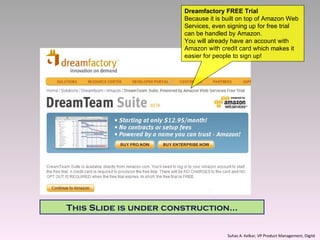
Dreamfactory FREE Trial Because it is built on top of Amazon Web Services, even signing up for free trial can be handled by Amazon. You will already have an account with Amazon with credit card which makes it easier for people to sign up!   This Slide is under construction… Suhas A. Kelkar, VP Product Management, Digité

Cloud Application Development Lifecycle

  • 1.
    Suhas A. Kelkar,VP Product Management, Digité Cloud Computing And Traditional SDLC
  • 2.
    Suhas A. Kelkar,VP Product Management, Digité How Cloud Computing May Change Traditional SDLC & ALM The goal of this presentation is to take a look at how cloud computing may change the traditional SDLC and ALM disciplines and to see how we can leverage it for our product…
  • 3.
    Definition of CloudComputing Forrester Defines Cloud Computing As, A pool of highly scalable, abstracted infrastructure, capable of hosting end to end customer applications, that is billed by consumption! Suhas A. Kelkar, VP Product Management, Digité
  • 4.
    Evolution of TheWeb Web 1.0 Killer Internet Applications Everyone Can Access Web 2.0 User Generated Content Social Networking, AJAX Everyone Can Contribute Web 3.0 Platform As A Service Lowered Entry Barriers Everyone Can Innovate Suhas A. Kelkar, VP Product Management, Digité
  • 5.
    Different Platforms -Different Targets Complete Application Development And Delivery Environment in the Cloud Salesforce also has come out with Force.com IDE, that facilitates developing applications on Force.com Although all the following are termed as cloud computing platforms, each one has evolved to target a specific area or need Suhas A. Kelkar, VP Product Management, Digité
  • 6.
    Traditional SDLC Vs.Cloud Application Lifecycle Cloud Application Lifecycle tends to have extremely short release cycles! New features are added every two weeks!! Short cycles mean (if at all they are using) processes used for developing these applications are Agile/SCRUM based. Heavy stress on acceptance as well as unit tests Traditional task management practices and timesheet processes are not applicable In extreme cases where someone is using cloud IDE, all code artifacts are stored in the cloud No formal workflow processes for reviews etc. Because platforms such as Force.com are rich and provide much of the boiler plate code, developing applications on it becomes a much higher level activity. The gap between domain experts who conceptualize the product and developers who code it, narrows down. Thus the need for traditional requirements management processes changes! Suhas A. Kelkar, VP Product Management, Digité
  • 7.
    Traditional SDLC Vs. Cloud Application Lifecycle People developing cloud based applications tend to be, Well conversant with latest trends in web technologies Rely heavily on social as well as professional networking Expert users of all types of modern ways of communications (Twitter on their mobile phones, Jabber on their computers) Tend to have very low tolerance for heavy processes that can cause them delays Tend to work in small teams (<25 developers) that may be geographically distributed but extremely well connected Why is this important to us? These group of individuals would expect our tool to be using same cutting edge technology as the cool cloud based application they are working on! Suhas A. Kelkar, VP Product Management, Digité
  • 8.
    Summary Development Lifecyclefor applications developed in Cloud is not too different from traditional SDLC. However importance and duration of some of the stages is significantly different. E.g. For a business app that can be completely modeled on Salesforce.com architecture, Requirements gathering will become the most important activity. Once the requirements are understood and business logic decided upon, the application can simply be configured without any code been written. (This obviously is only possible in most idealistic or simplistic situation. In most cases you would end up having to write some code. Cloud computing architectures such as Microsoft Azure promise to enable developing cloud applications as seamless as developing regular desktop application. If this vision is indeed realized, then the gap between Cloud Application Lifecycle and Traditional SDLC will further reduce! Cloud computing is still in infancy stages. It remains to be seen how Enterprises will embrace it. As such the target market for people developing cloud based applications is still fairly small. Suhas A. Kelkar, VP Product Management, Digité
  • 9.
    Suhas A. Kelkar,VP Product Management, Digité Supporting Slides
  • 10.
    Microsoft Azure ThisSlide is under construction… Suhas A. Kelkar, VP Product Management, Digité
  • 11.
    Salesforce This Slideis under construction… Suhas A. Kelkar, VP Product Management, Digité
  • 12.
    Eclipse Process FrameworkInitiated in Jan 2006, EPF is an Open Source project within the Eclipse Foundation The goals of EPF are to provide: An extensible framework and tooling for authoring, configuring and publishing processes Exemplary processes - first delivered is OpenUP EPF is NOT: Only applicable for Eclipse Java development. Intended to create the “perfect process” What is EPF? Suhas A. Kelkar, VP Product Management, Digité
  • 13.
    Eclipse Process FrameworkEPF targets process authors & consumers Process Authors and Coaches (Process Management Team) Tooling for creating and publishing processes Foundational process for starting point Libraries of additional content that can be plugged-in Process Consumers (Project Team) Published website of process content for simple browsing Guidance in the form of checklists, concepts, guidelines Browse the content adapted to your experience level Why is this important to us? EPF has the potential to threaten our competitive advantage in Universal Process Framework. As such we need to closely track it and devise a strategy of providing import/export for EPF models in future! Suhas A. Kelkar, VP Product Management, Digité
  • 14.
    EC2 : OnDemand Grid Create a machine image, put it on S3 and start using it as if it is a regular machine S3: Storage of Anything in the cloud Suitable for image, video, file storage in the cloud. SimpleDb : Db and indexing services Useful for creating flat database with auto indexed tables SQS : Infinite Asynchronous Queue Sample use case is Twitter friend update. Publish/Subscribe Amazon Web Services Amazon AWS
  • 15.
    Dreamfactory FREE TrialBecause it is built on top of Amazon Web Services, even signing up for free trial can be handled by Amazon. You will already have an account with Amazon with credit card which makes it easier for people to sign up! This Slide is under construction… Suhas A. Kelkar, VP Product Management, Digité