Java Card
Technology


        Presented By:
           k.keerthi
           093Q1A0529
Presentation Agenda
 Introduction
 What is Smart Card?
 Java Card
 Java Card Architecture
 Developing a Java Card Application
 Features
 Applications
 Advantages
 Limitations
 Conclusion
Introduction
 The first Java Card was introduced in 1996 by Schlumberge’s
  card division which later merged with Gemplus to form
  Gemalto
 Java Card refers to a technology that allows Java-based
  applications to be run securely on smart cards.
 Java Card gives the user, the ability to program the device and
  make them application specific.
 Java Card is a smart card that is capable of running programs
  written in Java.
Smart Cards
 A smart card is a plastic
  card that contains an
  embedded integrated
  circuit (IC)
 Examples:
   Our very Own T-Card!
   Credit Cards
   Cell Phone SIM Cards
Java Cards are Smart! How??

 They store and process Information


 Smart Cards can be used to add
  authentication and secure access to
  information systems that require a high
  level of security
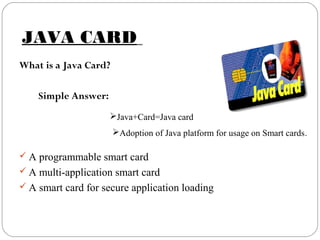
JAVA CARD
What is a Java Card?

    Simple Answer:
                     Java+Card=Java card
                       Adoption of Java platform for usage on Smart cards .

 A programmable smart card
 A multi-application smart card
 A smart card for secure application loading
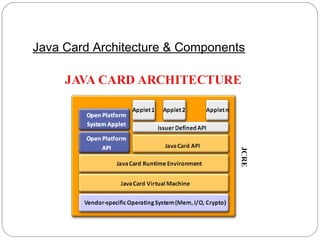
Java Card Architecture & Components
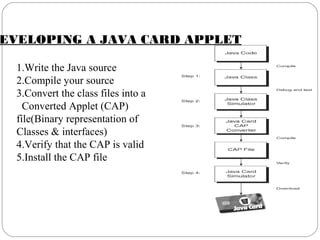
EVELOPING A JAVA CARD APPLET

  1.Write the Java source
  2.Compile your source
  3.Convert the class files into a
    Converted Applet (CAP)
  file(Binary representation of
  Classes & interfaces)
  4.Verify that the CAP is valid
  5.Install the CAP file
Features of Java Card
     SUPPORTED                      NOT SUPPORTED


 • Small primitive data types:   • Large primitive data types:
   boolean, byte, short.             long, double, float.
                                 •    Characters, strings.
 • One dimensional arrays.
                                 •    Multidimensional arrays.
 • Object oriented features:     •    Dynamic class loading.
   inheritance, virtual          •   Garbage collection.
   methods, dynamic object       •   Threads.
   creation, overloading,        •   Object Cloning
   scope.
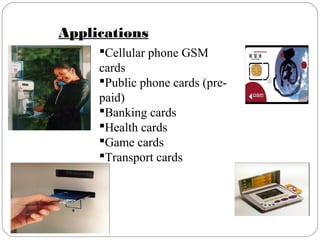
Applications
     Cellular phone GSM
     cards
     Public phone cards (pre-
     paid)
     Banking cards
     Health cards
     Game cards
     Transport cards
Advantages
•Interoperable
•Secure
•Multi-Application capable
•Dynamic
•Compatible with existing standards
•Hardware Independence
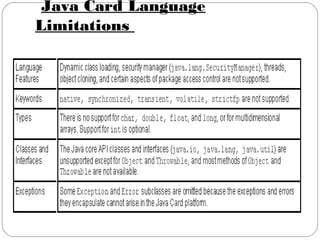
Java Card Language
Limitations
CONCLUSION
•Java Card and other flavors of Java will open new markets
•Java Card Technology defines a run time environment that
supports the smart card memory, communication, security and
application execution model.
•Java Card Technology fits java system software in a smart
card while conserving enough space for applications.
•Java Card mitigates some risks associated with Java such as
dynamic class loading
Java card technology

Java card technology

  • 1.
    Java Card Technology Presented By: k.keerthi 093Q1A0529
  • 2.
    Presentation Agenda  Introduction What is Smart Card?  Java Card  Java Card Architecture  Developing a Java Card Application  Features  Applications  Advantages  Limitations  Conclusion
  • 3.
    Introduction  The firstJava Card was introduced in 1996 by Schlumberge’s card division which later merged with Gemplus to form Gemalto  Java Card refers to a technology that allows Java-based applications to be run securely on smart cards.  Java Card gives the user, the ability to program the device and make them application specific.  Java Card is a smart card that is capable of running programs written in Java.
  • 4.
    Smart Cards  Asmart card is a plastic card that contains an embedded integrated circuit (IC)  Examples:  Our very Own T-Card!  Credit Cards  Cell Phone SIM Cards
  • 5.
    Java Cards areSmart! How??  They store and process Information  Smart Cards can be used to add authentication and secure access to information systems that require a high level of security
  • 6.
    JAVA CARD What isa Java Card? Simple Answer: Java+Card=Java card Adoption of Java platform for usage on Smart cards .  A programmable smart card  A multi-application smart card  A smart card for secure application loading
  • 7.
  • 8.
    EVELOPING A JAVACARD APPLET 1.Write the Java source 2.Compile your source 3.Convert the class files into a Converted Applet (CAP) file(Binary representation of Classes & interfaces) 4.Verify that the CAP is valid 5.Install the CAP file
  • 9.
    Features of JavaCard  SUPPORTED NOT SUPPORTED • Small primitive data types: • Large primitive data types: boolean, byte, short. long, double, float. • Characters, strings. • One dimensional arrays. • Multidimensional arrays. • Object oriented features: • Dynamic class loading. inheritance, virtual • Garbage collection. methods, dynamic object • Threads. creation, overloading, • Object Cloning scope.
  • 10.
    Applications Cellular phone GSM cards Public phone cards (pre- paid) Banking cards Health cards Game cards Transport cards
  • 11.
  • 12.
  • 13.
    CONCLUSION •Java Card andother flavors of Java will open new markets •Java Card Technology defines a run time environment that supports the smart card memory, communication, security and application execution model. •Java Card Technology fits java system software in a smart card while conserving enough space for applications. •Java Card mitigates some risks associated with Java such as dynamic class loading