EQ:
Understanding Yourself
Your Impact on Others
and the Psychology of Groups
MUMBRELLA NEXT
JANEY FRANCIS
My PASSION is unlocking individuals creative and
strategic thinking powers in order to inspire them to
embrace, be invested in, and execute to a unified
organizational vision.
My EXPERTISE is in building individual and
collective Emotional Intelligence. I believe in
studying individuals different thinking styles and
with these insights, enhancing and cultivating
critical leadership capabilities such as
collaborative communication, setting vision and
strategy, driving innovation ,and shifting to a
customer orientation.
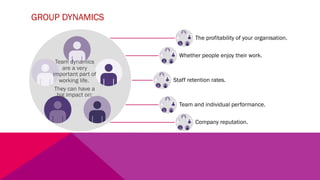
GROUP DYNAMICS
Team dynamics
are a very
important part of
working life.
They can have a
big impact on:
The profitability of your organisation.
Whether people enjoy their work.
Staff retention rates.
Team and individual performance.
Company reputation.
E.Q.
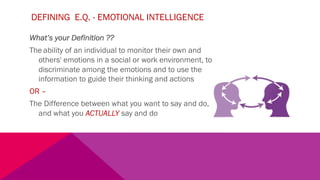
DEFINING E.Q. - EMOTIONAL INTELLIGENCE
What’s your Definition ??
The ability of an individual to monitor their own and
others' emotions in a social or work environment, to
discriminate among the emotions and to use the
information to guide their thinking and actions
OR –
The Difference between what you want to say and do,
and what you ACTUALLY say and do
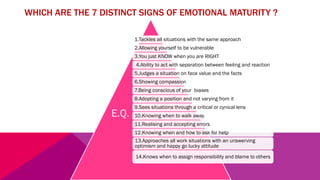
WHICH ARE THE 7 DISTINCT SIGNS OF EMOTIONAL MATURITY ?
1.Tackles all situations with the same approach
2.Allowing yourself to be vulnerable
3.You just KNOW when you are RIGHT
4.Ability to act with separation between feeling and reaction
5.Judges a situation on face value and the facts
6.Showing compassion
7.Being conscious of your biases
8.Adopting a position and not varying from it
9.Sees situations through a critical or cynical lens
10.Knowing when to walk away
11.Realising and accepting errors
12.Knowing when and how to ask for help
13.Approaches all work situations with an unswerving
optimism and happy go lucky attitude
14.Knows when to assign responsibility and blame to others
E.Q.
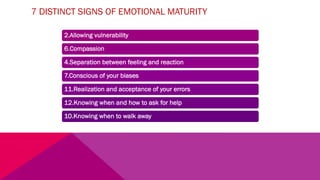
7 DISTINCT SIGNS OF EMOTIONAL MATURITY
2.Allowing vulnerability
6.Compassion
4.Separation between feeling and reaction
7.Conscious of your biases
11.Realization and acceptance of your errors
12.Knowing when and how to ask for help
10.Knowing when to walk away
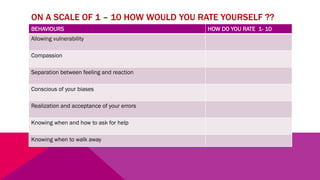
ON A SCALE OF 1 – 10 HOW WOULD YOU RATE YOURSELF ??
BEHAVIOURS HOW DO YOU RATE 1- 10
Allowing vulnerability
Compassion
Separation between feeling and reaction
Conscious of your biases
Realization and acceptance of your errors
Knowing when and how to ask for help
Knowing when to walk away
COMMUNICATION
§ Strengthen and deepen work
relationships
§ Avoid potential conflict
§ Work more productively with diverse
thinkers;
§ Develop effective teamwork and
COLLABORATIVE cross functional
teams
DECISION MAKING
§ Stretches your thinking to enable
you to go beyond your mental
comfort zones;
§ View problems, ideas and
processes in new and diverse
ways
PROBLEM SOLVING
§ Build a strong, balanced tolerant, and result
driven team,
§ Drive your strategic business plan more
effectively.
§ Unleash and apply the creativity of your
entire workforce
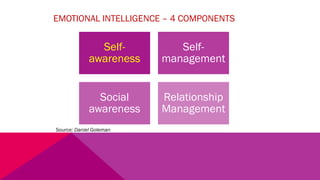
EMOTIONAL INTELLIGENCE – 4 COMPONENTS
Self-
awareness
Self-
management
Social
awareness
Relationship
Management
Source: Daniel Goleman
SELF AWARENESS What is my preferred
style ?
HOW DOES NEUROSCIENCE HELP ?
WHAT IS NEUROSCIENCE ?
THE ROLE OF NEUROSCIENCE IS TO
EXPLAIN BEHAVIOUR IN TERMS OF THE
ACTIVITIES OF THE BRAIN.
HOW THE BRAIN MARSHALS ITS
BILLIONS OF INDIVIDUAL
NERVE CELLS TO PRODUCE
BEHAVIOUR, AND HOW THESE
CELLS ARE INFLUENCED BY THE
ENVIRONMENT
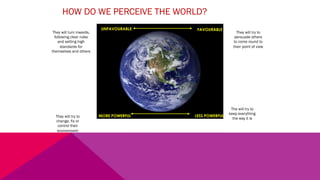
UNFAVOURABLE FAVOURABLE
MORE POWERFUL LESS POWERFUL
HOW DO WE PERCEIVE THE WORLD?
They will try to
change, fix or
control their
environment
They will turn inwards,
following clear rules
and setting high
standards for
themselves and others
The will try to
keep everything
the way it is
They will try to
persuade others
to come round to
their point of view
WHAT DO WE KNOW ABOUT THE HUMAN BRAIN ?
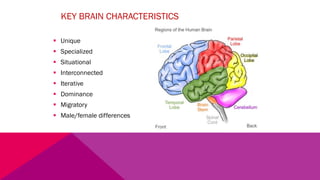
KEY BRAIN CHARACTERISTICS
§ Unique
§ Specialized
§ Situational
§ Interconnected
§ Iterative
§ Dominance
§ Migratory
§ Male/female differences
Myers and Sperry performed split brain operations
Hermann expanded this research to test thinking activity in each
hemisphere and then each quadrant.
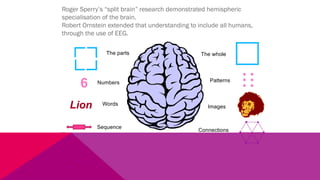
The wholeThe parts
Numbers
Images
Words
Sequence
6 Patterns
Lion
Connections
Roger Sperry’s “split brain” research demonstrated hemispheric
specialisation of the brain.
Robert Ornstein extended that understanding to include all humans,
through the use of EEG.
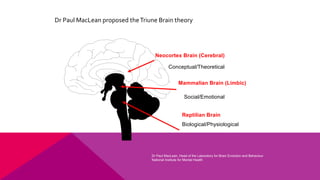
Reptilian Brain
Mammalian Brain (Limbic)
Neocortex Brain (Cerebral)
Biological/Physiological
Social/Emotional
Conceptual/Theoretical
Dr Paul MacLean, Head of the Laboratory for Brain Evolution and Behaviour
National Institute for Mental Health
Dr Paul MacLean proposed theTriune Brain theory
EFFECTIVE WORKPLACE RELATIONS
DEVELOP AND USE EMOTIONAL INTELLIGENCE
DEALING WITH CONFLICT
© Warner Group Pty Ltd
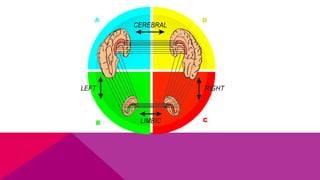
A
B
D
C
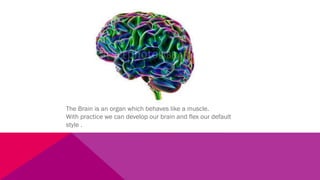
The Brain is an organ which behaves like a muscle.
With practice we can develop our brain and flex our default
style .
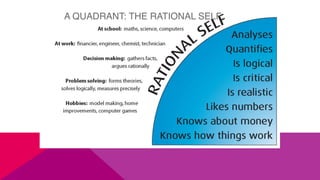
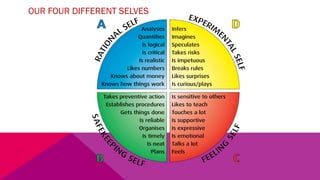
A QUADRANT: THE RATIONAL SELF
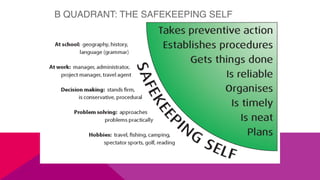
B QUADRANT: THE SAFEKEEPING SELF
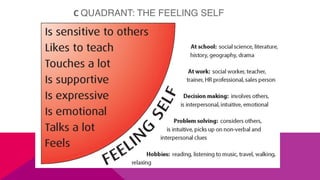
C QUADRANT: THE FEELING SELF
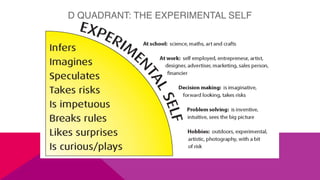
D QUADRANT: THE EXPERIMENTAL SELF
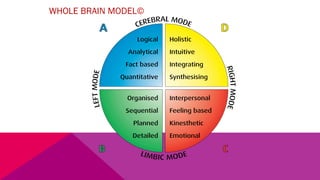
WHOLE BRAIN MODEL©
OUR FOUR DIFFERENT SELVES
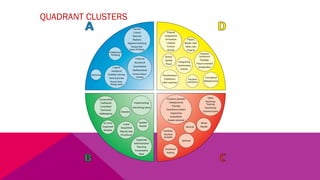
QUADRANT CLUSTERS
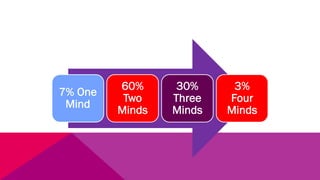
7% One
Mind
60%
Two
Minds
30%
Three
Minds
3%
Four
Minds
35
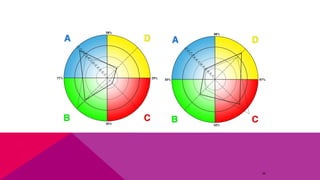
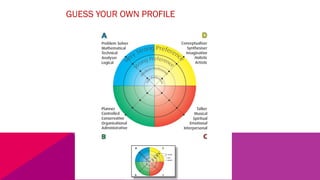
GUESS YOUR OWN PROFILE
Where are
your
strengths?
Where are
your Blind
spots?
What can you
learn from
your profile?
GUESS YOUR OWN PROFILE
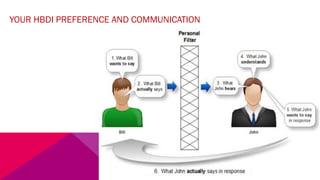
YOUR HBDI PREFERENCE AND COMMUNICATION
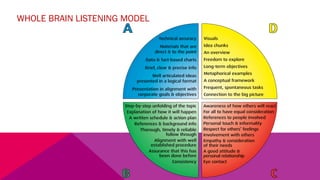
WHOLE BRAIN LISTENING MODEL
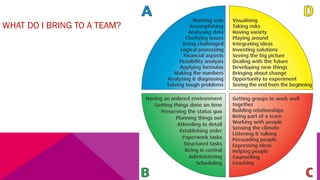
WHAT DO I BRING TO A TEAM?
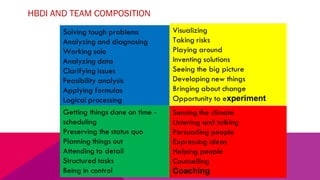
HBDI AND TEAM COMPOSITION
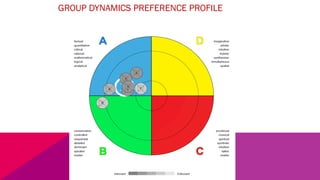
GROUP DYNAMICS PREFERENCE PROFILE
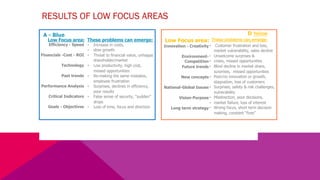
RESULTS OF LOW FOCUS AREAS
Efficiency - Speed
Financials -Cost - ROI
Technology
Past trends
Performance Analysis
Critical Indicators
Goals - Objectives
• Increase in costs,
• slow growth
• Threat to financial value, unhappy
shareholder/market
• Low productivity, high cost,
missed opportunities
• Re-making the same mistakes,
employee frustration
• Surprises, declines in efficiency,
poor results
• False sense of security, “sudden”
drops
• Loss of time, focus and direction
These problems can emerge:
• Customer frustration and loss,
market vulnerability, sales decline
• Unwelcome surprises &
• crises, missed opportunities
• Blind decline in market share,
surprises, missed opportunities
• Poor/no innovation or growth,
stagnation, loss of customers
• Surprises, safety & risk challenges,
vulnerability
• Misdirection, poor decisions,
• market failure, loss of interest
• Wrong focus, short term decision
making, constant “fires”
Innovation - Creativity
Environment-
Competition
Future trends
New concepts
National-Global Issues
Vision-Purpose
Long term strategy
Low Focus area: These problems can emerge:Low Focus area:
A - Blue D Yellow
-
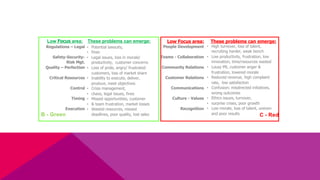
Regulations – Legal
Safety-Security-
Risk Mgt.
Quality – Perfection
Critical Resources
Control
Timing
Execution
• Potential lawsuits,
• fines
• Legal issues, loss in morale/
productivity, customer concerns
• Loss of pride, angry/ frustrated
customers, loss of market share
• Inability to execute, deliver,
produce, meet objectives
• Crisis management,
• chaos, legal issues, fines
• Missed opportunities, customer
• & team frustration, market losses
• Wasted resources, missed
deadlines, poor quality, lost sales
• High turnover, loss of talent,
recruiting harder, weak bench
• Low productivity, frustration, low
innovation, time/resources wasted
• Lousy PR, customer anger &
frustration, lowered morale
• Reduced revenue, high complaint
rate, low satisfaction
• Confusion; misdirected initiatives,
wrong outcomes
• Ethics issues, turnover,
• surprise crises, poor growth
• Low morale, loss of talent, uneven
and poor results
People Development
Teams - Collaboration
Community Relations
Customer Relations
Communications
Culture - Values
Recognition
These problems can emerge: These problems can emerge:Low Focus area: Low Focus area:
C - RedB - Green
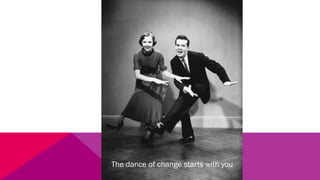
The dance of change starts with you
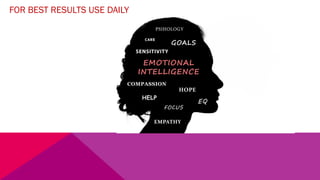
FOR BEST RESULTS USE DAILY
THANK YOU
JANEY FRANCIS
SCARLETT STARTEGIC SOLUTIONS
WWW.SCARLETTSTRATEGIC.COM.AU

Janey Francis' Presentation at Mumbrella neXt

  • 1.
    EQ: Understanding Yourself Your Impacton Others and the Psychology of Groups MUMBRELLA NEXT
  • 2.
    JANEY FRANCIS My PASSIONis unlocking individuals creative and strategic thinking powers in order to inspire them to embrace, be invested in, and execute to a unified organizational vision. My EXPERTISE is in building individual and collective Emotional Intelligence. I believe in studying individuals different thinking styles and with these insights, enhancing and cultivating critical leadership capabilities such as collaborative communication, setting vision and strategy, driving innovation ,and shifting to a customer orientation.
  • 3.
    GROUP DYNAMICS Team dynamics area very important part of working life. They can have a big impact on: The profitability of your organisation. Whether people enjoy their work. Staff retention rates. Team and individual performance. Company reputation.
  • 4.
  • 5.
    DEFINING E.Q. -EMOTIONAL INTELLIGENCE What’s your Definition ?? The ability of an individual to monitor their own and others' emotions in a social or work environment, to discriminate among the emotions and to use the information to guide their thinking and actions OR – The Difference between what you want to say and do, and what you ACTUALLY say and do
  • 6.
    WHICH ARE THE7 DISTINCT SIGNS OF EMOTIONAL MATURITY ? 1.Tackles all situations with the same approach 2.Allowing yourself to be vulnerable 3.You just KNOW when you are RIGHT 4.Ability to act with separation between feeling and reaction 5.Judges a situation on face value and the facts 6.Showing compassion 7.Being conscious of your biases 8.Adopting a position and not varying from it 9.Sees situations through a critical or cynical lens 10.Knowing when to walk away 11.Realising and accepting errors 12.Knowing when and how to ask for help 13.Approaches all work situations with an unswerving optimism and happy go lucky attitude 14.Knows when to assign responsibility and blame to others E.Q.
  • 7.
    7 DISTINCT SIGNSOF EMOTIONAL MATURITY 2.Allowing vulnerability 6.Compassion 4.Separation between feeling and reaction 7.Conscious of your biases 11.Realization and acceptance of your errors 12.Knowing when and how to ask for help 10.Knowing when to walk away
  • 8.
    ON A SCALEOF 1 – 10 HOW WOULD YOU RATE YOURSELF ?? BEHAVIOURS HOW DO YOU RATE 1- 10 Allowing vulnerability Compassion Separation between feeling and reaction Conscious of your biases Realization and acceptance of your errors Knowing when and how to ask for help Knowing when to walk away
  • 9.
    COMMUNICATION § Strengthen anddeepen work relationships § Avoid potential conflict § Work more productively with diverse thinkers; § Develop effective teamwork and COLLABORATIVE cross functional teams
  • 10.
    DECISION MAKING § Stretchesyour thinking to enable you to go beyond your mental comfort zones; § View problems, ideas and processes in new and diverse ways
  • 11.
    PROBLEM SOLVING § Builda strong, balanced tolerant, and result driven team, § Drive your strategic business plan more effectively. § Unleash and apply the creativity of your entire workforce
  • 12.
    EMOTIONAL INTELLIGENCE –4 COMPONENTS Self- awareness Self- management Social awareness Relationship Management Source: Daniel Goleman
  • 13.
    SELF AWARENESS Whatis my preferred style ?
  • 14.
  • 15.
    WHAT IS NEUROSCIENCE? THE ROLE OF NEUROSCIENCE IS TO EXPLAIN BEHAVIOUR IN TERMS OF THE ACTIVITIES OF THE BRAIN. HOW THE BRAIN MARSHALS ITS BILLIONS OF INDIVIDUAL NERVE CELLS TO PRODUCE BEHAVIOUR, AND HOW THESE CELLS ARE INFLUENCED BY THE ENVIRONMENT
  • 16.
    UNFAVOURABLE FAVOURABLE MORE POWERFULLESS POWERFUL HOW DO WE PERCEIVE THE WORLD? They will try to change, fix or control their environment They will turn inwards, following clear rules and setting high standards for themselves and others The will try to keep everything the way it is They will try to persuade others to come round to their point of view
  • 17.
    WHAT DO WEKNOW ABOUT THE HUMAN BRAIN ?
  • 18.
    KEY BRAIN CHARACTERISTICS §Unique § Specialized § Situational § Interconnected § Iterative § Dominance § Migratory § Male/female differences
  • 19.
    Myers and Sperryperformed split brain operations Hermann expanded this research to test thinking activity in each hemisphere and then each quadrant.
  • 20.
    The wholeThe parts Numbers Images Words Sequence 6Patterns Lion Connections Roger Sperry’s “split brain” research demonstrated hemispheric specialisation of the brain. Robert Ornstein extended that understanding to include all humans, through the use of EEG.
  • 21.
    Reptilian Brain Mammalian Brain(Limbic) Neocortex Brain (Cerebral) Biological/Physiological Social/Emotional Conceptual/Theoretical Dr Paul MacLean, Head of the Laboratory for Brain Evolution and Behaviour National Institute for Mental Health Dr Paul MacLean proposed theTriune Brain theory
  • 22.
    EFFECTIVE WORKPLACE RELATIONS DEVELOPAND USE EMOTIONAL INTELLIGENCE DEALING WITH CONFLICT © Warner Group Pty Ltd
  • 23.
  • 24.
    The Brain isan organ which behaves like a muscle. With practice we can develop our brain and flex our default style .
  • 25.
    A QUADRANT: THERATIONAL SELF
  • 26.
    B QUADRANT: THESAFEKEEPING SELF
  • 27.
    C QUADRANT: THEFEELING SELF
  • 28.
    D QUADRANT: THEEXPERIMENTAL SELF
  • 29.
  • 30.
  • 31.
  • 32.
  • 34.
  • 35.
  • 36.
    Where are your strengths? Where are yourBlind spots? What can you learn from your profile? GUESS YOUR OWN PROFILE
  • 37.
    YOUR HBDI PREFERENCEAND COMMUNICATION
  • 38.
  • 39.
    WHAT DO IBRING TO A TEAM?
  • 40.
    HBDI AND TEAMCOMPOSITION
  • 41.
  • 42.
    RESULTS OF LOWFOCUS AREAS Efficiency - Speed Financials -Cost - ROI Technology Past trends Performance Analysis Critical Indicators Goals - Objectives • Increase in costs, • slow growth • Threat to financial value, unhappy shareholder/market • Low productivity, high cost, missed opportunities • Re-making the same mistakes, employee frustration • Surprises, declines in efficiency, poor results • False sense of security, “sudden” drops • Loss of time, focus and direction These problems can emerge: • Customer frustration and loss, market vulnerability, sales decline • Unwelcome surprises & • crises, missed opportunities • Blind decline in market share, surprises, missed opportunities • Poor/no innovation or growth, stagnation, loss of customers • Surprises, safety & risk challenges, vulnerability • Misdirection, poor decisions, • market failure, loss of interest • Wrong focus, short term decision making, constant “fires” Innovation - Creativity Environment- Competition Future trends New concepts National-Global Issues Vision-Purpose Long term strategy Low Focus area: These problems can emerge:Low Focus area: A - Blue D Yellow -
  • 43.
    Regulations – Legal Safety-Security- RiskMgt. Quality – Perfection Critical Resources Control Timing Execution • Potential lawsuits, • fines • Legal issues, loss in morale/ productivity, customer concerns • Loss of pride, angry/ frustrated customers, loss of market share • Inability to execute, deliver, produce, meet objectives • Crisis management, • chaos, legal issues, fines • Missed opportunities, customer • & team frustration, market losses • Wasted resources, missed deadlines, poor quality, lost sales • High turnover, loss of talent, recruiting harder, weak bench • Low productivity, frustration, low innovation, time/resources wasted • Lousy PR, customer anger & frustration, lowered morale • Reduced revenue, high complaint rate, low satisfaction • Confusion; misdirected initiatives, wrong outcomes • Ethics issues, turnover, • surprise crises, poor growth • Low morale, loss of talent, uneven and poor results People Development Teams - Collaboration Community Relations Customer Relations Communications Culture - Values Recognition These problems can emerge: These problems can emerge:Low Focus area: Low Focus area: C - RedB - Green
  • 44.
    The dance ofchange starts with you
  • 45.
  • 46.
    THANK YOU JANEY FRANCIS SCARLETTSTARTEGIC SOLUTIONS WWW.SCARLETTSTRATEGIC.COM.AU