
LEADING WITHLEADING WITH
HEARTHEART
Inspiring Loyalty and Commitment withInspiring Loyalty and Commitment with
Vision-Based LeadershipVision-Based Leadership
William G. DeFoore, Ph.D.
Institute for Personal & Professional Development, www.goodfinding.com
LEADERSHIP STYLESLEADERSHIP STYLES
In research drawn from a global database ofIn research drawn from a global database of
3,871 executives, it was found that3,871 executives, it was found that “leaders“leaders
who used styles with a positive emotionalwho used styles with a positive emotional
impact saw decidedly betterimpact saw decidedly better FINANCIALFINANCIAL
RETURNSRETURNS than those who did not.”than those who did not.”
(From Goleman, et.al. PRIMAL LEADERSHIP, 2002)(From Goleman, et.al. PRIMAL LEADERSHIP, 2002)
LEADERSHIP STYLESLEADERSHIP STYLES
And how they were perceivedAnd how they were perceived
• Visionary-Visionary-MOST POSITIVEMOST POSITIVE
• Coaching-Coaching-HIGHLY POSITIVEHIGHLY POSITIVE
• Affiliative-Affiliative-POSITIVEPOSITIVE
• Democratic-Democratic-POSITIVEPOSITIVE
• Pacesetting-Pacesetting-OFTEN HIGHLY NEGATIVEOFTEN HIGHLY NEGATIVE
• Commanding-Commanding-HIGHLY NEGATIVEHIGHLY NEGATIVE
LEADERSHIP STYLESLEADERSHIP STYLES
Leadership is very much aLeadership is very much a
MATTER OF THE HEARTMATTER OF THE HEART
and yet…and yet…
TRUE GREATNESS IN LEADERSHIPTRUE GREATNESS IN LEADERSHIP
Is a matter ofIs a matter of HEADHEAD AND HEARTAND HEART
WorkingWorking BRILLIANTLYBRILLIANTLY together!together!
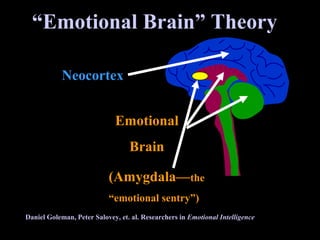
“Emotional Brain” Theory
Daniel Goleman, Peter Salovey, et. al. Researchers in Emotional Intelligence
NeocortexNeocortex
EmotionalEmotional
BrainBrain
(Amygdala—(Amygdala—thethe
““emotional sentry”)emotional sentry”)
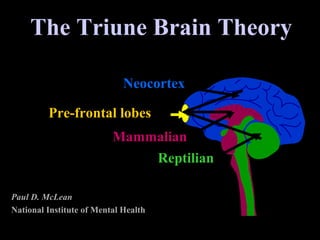
The Triune Brain Theory
Paul D. McLean
National Institute of Mental Health
NeocortexNeocortex
MammalianMammalian
ReptilianReptilian
Pre-frontal lobesPre-frontal lobes
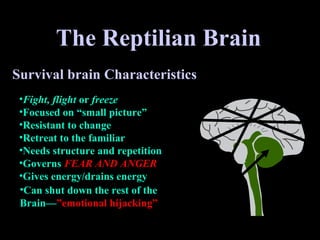
The Reptilian BrainThe Reptilian Brain
Survival brain CharacteristicsSurvival brain Characteristics
•Fight, flightFight, flight oror freezefreeze
•Focused on “small picture”Focused on “small picture”
•Resistant to changeResistant to change
•Retreat to the familiarRetreat to the familiar
•Needs structure and repetitionNeeds structure and repetition
•GovernsGoverns FEAR AND ANGERFEAR AND ANGER
•Gives energy/drains energyGives energy/drains energy
•Can shut down the rest of theCan shut down the rest of the
Brain—Brain—”emotional hijacking””emotional hijacking”
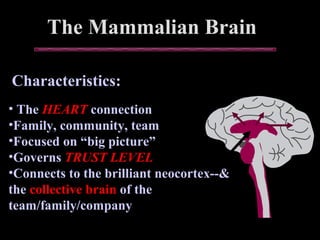
The Mammalian BrainThe Mammalian Brain
• TheThe HEARTHEART connectionconnection
•Family, community, teamFamily, community, team
•Focused on “big picture”Focused on “big picture”
•GovernsGoverns TRUST LEVELTRUST LEVEL
•Connects to the brilliant neocortex--&Connects to the brilliant neocortex--&
thethe collective braincollective brain of theof the
team/family/companyteam/family/company
Characteristics:Characteristics:
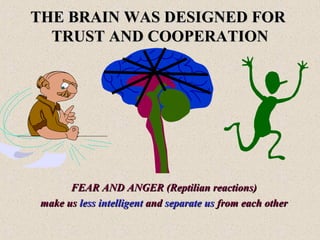
THE BRAIN WAS DESIGNED FORTHE BRAIN WAS DESIGNED FOR
TRUST AND COOPERATIONTRUST AND COOPERATION
FEAR AND ANGER (Reptilian reactions)FEAR AND ANGER (Reptilian reactions)
make usmake us less intelligentless intelligent andand separate usseparate us from each otherfrom each other
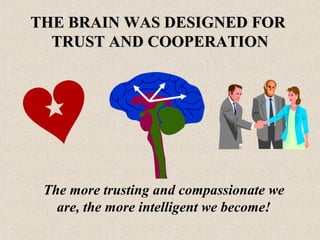
The more trusting and compassionate we
are, the more intelligent we become!
THE BRAIN WAS DESIGNED FORTHE BRAIN WAS DESIGNED FOR
TRUST AND COOPERATIONTRUST AND COOPERATION
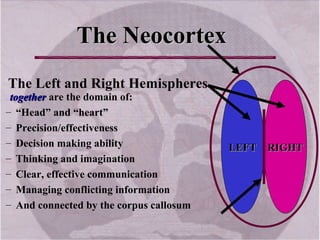
The NeocortexThe Neocortex
togethertogether are the domain of:
– “Head” and “heart”
– Precision/effectiveness
– Decision making ability
– Thinking and imagination
– Clear, effective communication
– Managing conflicting information
– And connected by the corpus callosum
RIGHTRIGHTLEFTLEFT
The Left and Right Hemispheres
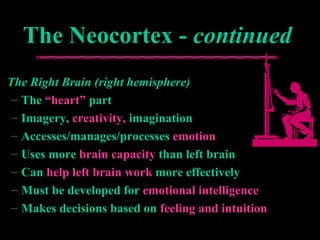
The Neocortex-continued
The Left Brain (left hemisphere)
– The “head” part
– Problem solving
– Time oriented, rational
– Logical decision-making
– Highly valued in school/business
– It provides what the reptilian brain needs
– Can operate independently of emotion (+&-)
The Neocortex -The Neocortex - continuedcontinued
The Right Brain (right hemisphere)The Right Brain (right hemisphere)
– TheThe “heart”“heart” partpart
– Imagery,Imagery, creativity,creativity, imaginationimagination
– Accesses/manages/processesAccesses/manages/processes emotionemotion
– Uses moreUses more brain capacitybrain capacity than left brainthan left brain
– CanCan help left brain workhelp left brain work more effectivelymore effectively
– Must be developed forMust be developed for emotional intelligenceemotional intelligence
– Makes decisions based onMakes decisions based on feeling and intuitionfeeling and intuition
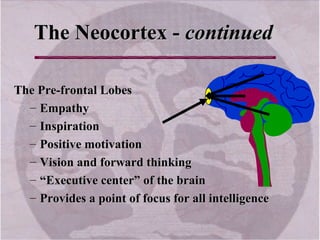
The Neocortex -The Neocortex - continuedcontinued
The Pre-frontal LobesThe Pre-frontal Lobes
– EmpathyEmpathy
– InspirationInspiration
– Positive motivationPositive motivation
– Vision and forward thinkingVision and forward thinking
– ““Executive center” of the brainExecutive center” of the brain
– Provides a point of focus for all intelligenceProvides a point of focus for all intelligence
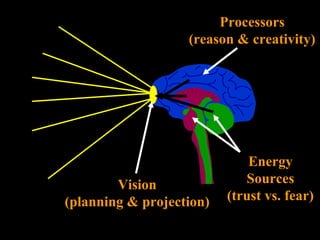
EnergyEnergy
SourcesSources
(trust vs. fear)(trust vs. fear)
ProcessorsProcessors
(reason & creativity)(reason & creativity)
VisionVision
(planning & projection)(planning & projection)
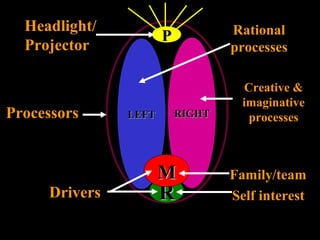
RIGHTRIGHTLEFTLEFT
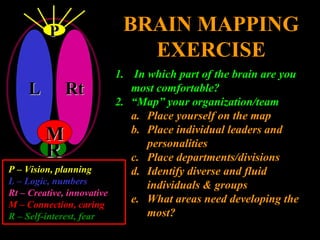
RR
PP
MM
Headlight/Headlight/
ProjectorProjector
DriversDrivers Self interestSelf interest
Family/teamFamily/team
ProcessorsProcessors
Creative &Creative &
imaginativeimaginative
processesprocesses
RationalRational
processesprocesses
1.1.   In wIn which part of the brain are you hich part of the brain are you 
most comfortable?most comfortable?
2.2. ““Map” your organization/teamMap” your organization/team  
a.a. Place yourself on the mapPlace yourself on the map
b.b. Place individual leaders and Place individual leaders and 
personalitiespersonalities
c.c. Place departments/divisionsPlace departments/divisions
d.d. Identify diverse and fluid Identify diverse and fluid 
individuals & groupsindividuals & groups
e.e. What areas need developing the What areas need developing the 
most?most?
BRAIN MAPPINGBRAIN MAPPING
EXERCISEEXERCISE
RtRtLL
RR
PP
MM
P – Vision, planningP – Vision, planning
L – Logic, numbers L – Logic, numbers 
Rt – Creative, innovativeRt – Creative, innovative
M – Connection, caringM – Connection, caring
R – Self-interest, fearR – Self-interest, fear
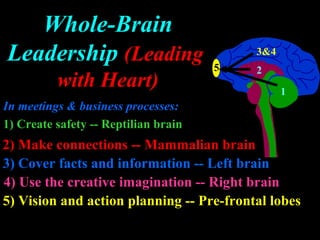
Whole-Brain
Leadership (Leading 
with Heart)
In meetings & business processes:In meetings & business processes:
1) Create safety -- Reptilian brain1) Create safety -- Reptilian brain
1
2
3&4
2) Make connections -- Mammalian brain2) Make connections -- Mammalian brain
3) Cover facts and information -- Left brain3) Cover facts and information -- Left brain
4) Use the creative imagination -- Right brain4) Use the creative imagination -- Right brain
5) Vision and action planning -- Pre-frontal lobes5) Vision and action planning -- Pre-frontal lobes
5
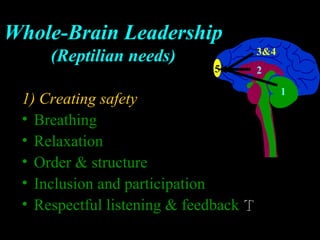
Whole-Brain Leadership
(Reptilian needs)
1) Creating safety1) Creating safety
• BreathingBreathing
• RelaxationRelaxation
• Order & structureOrder & structure
• Inclusion and participationInclusion and participation
• Respectful listening & feedbackRespectful listening & feedback TT
5
1
2
3&4
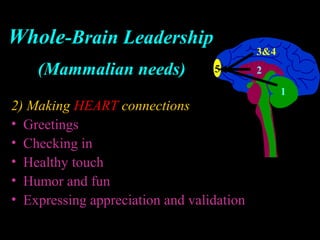
2) Making2) Making HEARTHEART connectionsconnections
• GreetingsGreetings
• Checking inChecking in
• Healthy touchHealthy touch
• Humor and funHumor and fun
• Expressing appreciation and validationExpressing appreciation and validation
5
1
2
3&4
(Mammalian needs)
Whole-Brain Leadership 
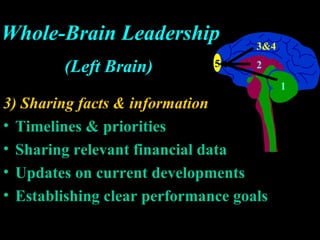
3) Sharing facts & information
• Timelines & prioritiesTimelines & priorities
• Sharing relevant financial dataSharing relevant financial data
• Updates on current developmentsUpdates on current developments
• Establishing clear performance goalsEstablishing clear performance goals
5
1
2
3&4
(Left Brain)
Whole-Brain Leadership 
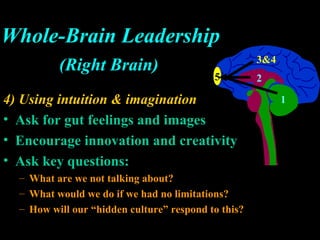
4) Using intuition & imagination
• Ask for gut feelings and imagesAsk for gut feelings and images
• Encourage innovation and creativityEncourage innovation and creativity
• Ask key questions:Ask key questions:
– What are we not talking about?What are we not talking about?
– What would we do if we had no limitations?What would we do if we had no limitations?
– How will our “hidden culture” respond to this?How will our “hidden culture” respond to this?
5
1
2
3&4
(Right Brain)
Whole-Brain Leadership 
IN HARVARD BUSINESS REVIEWIN HARVARD BUSINESS REVIEW
Jim Loehr & Tony Schwartz observed…Jim Loehr & Tony Schwartz observed…
““Great athletes spend a lot of time practicing and aGreat athletes spend a lot of time practicing and a
little time performing, whilelittle time performing, while executives spend noexecutives spend no
time practicing and all of their time performing.”time practicing and all of their time performing.”
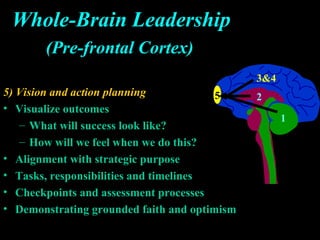
5) Vision and action planning5) Vision and action planning
• Visualize outcomesVisualize outcomes
– What will success look like?What will success look like?
– How will we feel when we do this?How will we feel when we do this?
• Alignment with strategic purposeAlignment with strategic purpose
• Tasks, responsibilities and timelinesTasks, responsibilities and timelines
• Checkpoints and assessment processesCheckpoints and assessment processes
• Demonstrating grounded faith and optimismDemonstrating grounded faith and optimism
5
1
2
3&4
(Pre-frontal Cortex)
Whole-Brain Leadership 
CONFLICTCONFLICT
MANAGEMENTMANAGEMENT
AND DISPUTE RESOLUTIONAND DISPUTE RESOLUTION
1.1. Reflective listeningReflective listening
2.2. Empathy, understanding, validationEmpathy, understanding, validation
3.3. Taking responsibility - “I” statementsTaking responsibility - “I” statements
4.4. Appreciating and valuingAppreciating and valuing
5.5. Negotiating resolutionNegotiating resolution
6.6. Establishing accountabilityEstablishing accountability
THE ART AND SCIENCETHE ART AND SCIENCE
OFOF APPRECIATIONAPPRECIATION
1.1. Raises the value ofRaises the value of
a.a. The relationshipThe relationship
b.b. The person (in your eyes)The person (in your eyes)
2.2. Raises your energy levelRaises your energy level
3.3. Adds energy to the relationshipAdds energy to the relationship
4.4. Inspires loyalty & camaraderieInspires loyalty & camaraderie
5.5. Think of someone you appreciate (orThink of someone you appreciate (or
need to)…need to)…
SYSTEM ANDSYSTEM AND
PROCESSPROCESS
EXAMPLESEXAMPLES
1.1. Whole-brain communicationWhole-brain communication
2.2. Innovation and the “angel’s advocate”Innovation and the “angel’s advocate”
3.3. Regular practice/use sessions for:Regular practice/use sessions for:
a.a. Conflict ResolutionConflict Resolution
b.b. ““Emotional Intelligence” sessionsEmotional Intelligence” sessions
4.4. Regular social opportunitiesRegular social opportunities
5.5. Vision focus meetings & remindersVision focus meetings & reminders
BUILDINGBUILDING
TRUST ANDTRUST AND
LOYALTYLOYALTY
1.1. ““Open books” business communicationOpen books” business communication
2.2. Asking for feedback—the “360” approachAsking for feedback—the “360” approach
3.3. Processing feedback for lasting changeProcessing feedback for lasting change
4.4. Using feedback to enhance leadershipUsing feedback to enhance leadership
5.5. The power of the personal story as aThe power of the personal story as a
leadership toolleadership tool
YOUR STORY AS AYOUR STORY AS A
LEADERSHIP TOOLLEADERSHIP TOOL
1.1. What life experiences have impacted you theWhat life experiences have impacted you the
most?most?
2.2. How do these life lessons affect your leadershipHow do these life lessons affect your leadership
style and decision-making?style and decision-making?
3.3. What vulnerabilities have resulted?What vulnerabilities have resulted?
4.4. What strengths have you developed as a result ofWhat strengths have you developed as a result of
your experiences?your experiences?
Leading With Heart: Incorporate Emotional Intelligence Into Your Leadership Style

Leading With Heart: Incorporate Emotional Intelligence Into Your Leadership Style

  • 1.
    LEADING WITHLEADING WITH HEARTHEART InspiringLoyalty and Commitment withInspiring Loyalty and Commitment with Vision-Based LeadershipVision-Based Leadership William G. DeFoore, Ph.D. Institute for Personal & Professional Development, www.goodfinding.com
  • 2.
    LEADERSHIP STYLESLEADERSHIP STYLES Inresearch drawn from a global database ofIn research drawn from a global database of 3,871 executives, it was found that3,871 executives, it was found that “leaders“leaders who used styles with a positive emotionalwho used styles with a positive emotional impact saw decidedly betterimpact saw decidedly better FINANCIALFINANCIAL RETURNSRETURNS than those who did not.”than those who did not.” (From Goleman, et.al. PRIMAL LEADERSHIP, 2002)(From Goleman, et.al. PRIMAL LEADERSHIP, 2002)
  • 3.
    LEADERSHIP STYLESLEADERSHIP STYLES Andhow they were perceivedAnd how they were perceived • Visionary-Visionary-MOST POSITIVEMOST POSITIVE • Coaching-Coaching-HIGHLY POSITIVEHIGHLY POSITIVE • Affiliative-Affiliative-POSITIVEPOSITIVE • Democratic-Democratic-POSITIVEPOSITIVE • Pacesetting-Pacesetting-OFTEN HIGHLY NEGATIVEOFTEN HIGHLY NEGATIVE • Commanding-Commanding-HIGHLY NEGATIVEHIGHLY NEGATIVE
  • 4.
    LEADERSHIP STYLESLEADERSHIP STYLES Leadershipis very much aLeadership is very much a MATTER OF THE HEARTMATTER OF THE HEART and yet…and yet… TRUE GREATNESS IN LEADERSHIPTRUE GREATNESS IN LEADERSHIP Is a matter ofIs a matter of HEADHEAD AND HEARTAND HEART WorkingWorking BRILLIANTLYBRILLIANTLY together!together!
  • 5.
    “Emotional Brain” Theory DanielGoleman, Peter Salovey, et. al. Researchers in Emotional Intelligence NeocortexNeocortex EmotionalEmotional BrainBrain (Amygdala—(Amygdala—thethe ““emotional sentry”)emotional sentry”)
  • 6.
    The Triune BrainTheory Paul D. McLean National Institute of Mental Health NeocortexNeocortex MammalianMammalian ReptilianReptilian Pre-frontal lobesPre-frontal lobes
  • 7.
    The Reptilian BrainTheReptilian Brain Survival brain CharacteristicsSurvival brain Characteristics •Fight, flightFight, flight oror freezefreeze •Focused on “small picture”Focused on “small picture” •Resistant to changeResistant to change •Retreat to the familiarRetreat to the familiar •Needs structure and repetitionNeeds structure and repetition •GovernsGoverns FEAR AND ANGERFEAR AND ANGER •Gives energy/drains energyGives energy/drains energy •Can shut down the rest of theCan shut down the rest of the Brain—Brain—”emotional hijacking””emotional hijacking”
  • 8.
    The Mammalian BrainTheMammalian Brain • TheThe HEARTHEART connectionconnection •Family, community, teamFamily, community, team •Focused on “big picture”Focused on “big picture” •GovernsGoverns TRUST LEVELTRUST LEVEL •Connects to the brilliant neocortex--&Connects to the brilliant neocortex--& thethe collective braincollective brain of theof the team/family/companyteam/family/company Characteristics:Characteristics:
  • 9.
    THE BRAIN WASDESIGNED FORTHE BRAIN WAS DESIGNED FOR TRUST AND COOPERATIONTRUST AND COOPERATION FEAR AND ANGER (Reptilian reactions)FEAR AND ANGER (Reptilian reactions) make usmake us less intelligentless intelligent andand separate usseparate us from each otherfrom each other
  • 10.
    The more trustingand compassionate we are, the more intelligent we become! THE BRAIN WAS DESIGNED FORTHE BRAIN WAS DESIGNED FOR TRUST AND COOPERATIONTRUST AND COOPERATION
  • 11.
    The NeocortexThe Neocortex togethertogetherare the domain of: – “Head” and “heart” – Precision/effectiveness – Decision making ability – Thinking and imagination – Clear, effective communication – Managing conflicting information – And connected by the corpus callosum RIGHTRIGHTLEFTLEFT The Left and Right Hemispheres
  • 12.
    The Neocortex-continued The LeftBrain (left hemisphere) – The “head” part – Problem solving – Time oriented, rational – Logical decision-making – Highly valued in school/business – It provides what the reptilian brain needs – Can operate independently of emotion (+&-)
  • 13.
    The Neocortex -TheNeocortex - continuedcontinued The Right Brain (right hemisphere)The Right Brain (right hemisphere) – TheThe “heart”“heart” partpart – Imagery,Imagery, creativity,creativity, imaginationimagination – Accesses/manages/processesAccesses/manages/processes emotionemotion – Uses moreUses more brain capacitybrain capacity than left brainthan left brain – CanCan help left brain workhelp left brain work more effectivelymore effectively – Must be developed forMust be developed for emotional intelligenceemotional intelligence – Makes decisions based onMakes decisions based on feeling and intuitionfeeling and intuition
  • 14.
    The Neocortex -TheNeocortex - continuedcontinued The Pre-frontal LobesThe Pre-frontal Lobes – EmpathyEmpathy – InspirationInspiration – Positive motivationPositive motivation – Vision and forward thinkingVision and forward thinking – ““Executive center” of the brainExecutive center” of the brain – Provides a point of focus for all intelligenceProvides a point of focus for all intelligence
  • 15.
    EnergyEnergy SourcesSources (trust vs. fear)(trustvs. fear) ProcessorsProcessors (reason & creativity)(reason & creativity) VisionVision (planning & projection)(planning & projection)
  • 16.
    RIGHTRIGHTLEFTLEFT RR PP MM Headlight/Headlight/ ProjectorProjector DriversDrivers Self interestSelfinterest Family/teamFamily/team ProcessorsProcessors Creative &Creative & imaginativeimaginative processesprocesses RationalRational processesprocesses
  • 17.
    1.1.   In wIn which part of the brain are you hich part of the brain are you  most comfortable?most comfortable? 2.2. ““Map” your organization/teamMap” your organization/team   a.a.Place yourself on the mapPlace yourself on the map b.b. Place individual leaders and Place individual leaders and  personalitiespersonalities c.c. Place departments/divisionsPlace departments/divisions d.d. Identify diverse and fluid Identify diverse and fluid  individuals & groupsindividuals & groups e.e. What areas need developing the What areas need developing the  most?most? BRAIN MAPPINGBRAIN MAPPING EXERCISEEXERCISE RtRtLL RR PP MM P – Vision, planningP – Vision, planning L – Logic, numbers L – Logic, numbers  Rt – Creative, innovativeRt – Creative, innovative M – Connection, caringM – Connection, caring R – Self-interest, fearR – Self-interest, fear
  • 18.
    Whole-Brain Leadership (Leading  with Heart) In meetings & business processes:In meetings & business processes: 1) Create safety-- Reptilian brain1) Create safety -- Reptilian brain 1 2 3&4 2) Make connections -- Mammalian brain2) Make connections -- Mammalian brain 3) Cover facts and information -- Left brain3) Cover facts and information -- Left brain 4) Use the creative imagination -- Right brain4) Use the creative imagination -- Right brain 5) Vision and action planning -- Pre-frontal lobes5) Vision and action planning -- Pre-frontal lobes 5
  • 19.
    Whole-Brain Leadership (Reptilian needs) 1) Creating safety1)Creating safety • BreathingBreathing • RelaxationRelaxation • Order & structureOrder & structure • Inclusion and participationInclusion and participation • Respectful listening & feedbackRespectful listening & feedback TT 5 1 2 3&4
  • 20.
    2) Making2) MakingHEARTHEART connectionsconnections • GreetingsGreetings • Checking inChecking in • Healthy touchHealthy touch • Humor and funHumor and fun • Expressing appreciation and validationExpressing appreciation and validation 5 1 2 3&4 (Mammalian needs) Whole-Brain Leadership 
  • 21.
    3) Sharing facts & information • Timelines &prioritiesTimelines & priorities • Sharing relevant financial dataSharing relevant financial data • Updates on current developmentsUpdates on current developments • Establishing clear performance goalsEstablishing clear performance goals 5 1 2 3&4 (Left Brain) Whole-Brain Leadership 
  • 22.
    4) Using intuition & imagination • Ask forgut feelings and imagesAsk for gut feelings and images • Encourage innovation and creativityEncourage innovation and creativity • Ask key questions:Ask key questions: – What are we not talking about?What are we not talking about? – What would we do if we had no limitations?What would we do if we had no limitations? – How will our “hidden culture” respond to this?How will our “hidden culture” respond to this? 5 1 2 3&4 (Right Brain) Whole-Brain Leadership 
  • 23.
    IN HARVARD BUSINESSREVIEWIN HARVARD BUSINESS REVIEW Jim Loehr & Tony Schwartz observed…Jim Loehr & Tony Schwartz observed… ““Great athletes spend a lot of time practicing and aGreat athletes spend a lot of time practicing and a little time performing, whilelittle time performing, while executives spend noexecutives spend no time practicing and all of their time performing.”time practicing and all of their time performing.”
  • 24.
    5) Vision and action planning5) Vision and action planning • Visualize outcomesVisualizeoutcomes – What will success look like?What will success look like? – How will we feel when we do this?How will we feel when we do this? • Alignment with strategic purposeAlignment with strategic purpose • Tasks, responsibilities and timelinesTasks, responsibilities and timelines • Checkpoints and assessment processesCheckpoints and assessment processes • Demonstrating grounded faith and optimismDemonstrating grounded faith and optimism 5 1 2 3&4 (Pre-frontal Cortex) Whole-Brain Leadership 
  • 25.
    CONFLICTCONFLICT MANAGEMENTMANAGEMENT AND DISPUTE RESOLUTIONANDDISPUTE RESOLUTION 1.1. Reflective listeningReflective listening 2.2. Empathy, understanding, validationEmpathy, understanding, validation 3.3. Taking responsibility - “I” statementsTaking responsibility - “I” statements 4.4. Appreciating and valuingAppreciating and valuing 5.5. Negotiating resolutionNegotiating resolution 6.6. Establishing accountabilityEstablishing accountability
  • 26.
    THE ART ANDSCIENCETHE ART AND SCIENCE OFOF APPRECIATIONAPPRECIATION 1.1. Raises the value ofRaises the value of a.a. The relationshipThe relationship b.b. The person (in your eyes)The person (in your eyes) 2.2. Raises your energy levelRaises your energy level 3.3. Adds energy to the relationshipAdds energy to the relationship 4.4. Inspires loyalty & camaraderieInspires loyalty & camaraderie 5.5. Think of someone you appreciate (orThink of someone you appreciate (or need to)…need to)…
  • 27.
    SYSTEM ANDSYSTEM AND PROCESSPROCESS EXAMPLESEXAMPLES 1.1.Whole-brain communicationWhole-brain communication 2.2. Innovation and the “angel’s advocate”Innovation and the “angel’s advocate” 3.3. Regular practice/use sessions for:Regular practice/use sessions for: a.a. Conflict ResolutionConflict Resolution b.b. ““Emotional Intelligence” sessionsEmotional Intelligence” sessions 4.4. Regular social opportunitiesRegular social opportunities 5.5. Vision focus meetings & remindersVision focus meetings & reminders
  • 28.
    BUILDINGBUILDING TRUST ANDTRUST AND LOYALTYLOYALTY 1.1.““Open books” business communicationOpen books” business communication 2.2. Asking for feedback—the “360” approachAsking for feedback—the “360” approach 3.3. Processing feedback for lasting changeProcessing feedback for lasting change 4.4. Using feedback to enhance leadershipUsing feedback to enhance leadership 5.5. The power of the personal story as aThe power of the personal story as a leadership toolleadership tool
  • 29.
    YOUR STORY ASAYOUR STORY AS A LEADERSHIP TOOLLEADERSHIP TOOL 1.1. What life experiences have impacted you theWhat life experiences have impacted you the most?most? 2.2. How do these life lessons affect your leadershipHow do these life lessons affect your leadership style and decision-making?style and decision-making? 3.3. What vulnerabilities have resulted?What vulnerabilities have resulted? 4.4. What strengths have you developed as a result ofWhat strengths have you developed as a result of your experiences?your experiences?

Editor's Notes

  • #2 Timing of program components: Introduction and overview: 9-9:30am Economics of Emotion: Overview: 9:30-10am Exercise: 10-10:15am Energy Flow and Goals:10:30-11am Exercise—Emotional Balance Sheet: 11-11:30 Discussion:11:30-12pm Lunch Physiology of Emotion: 1-1:30pm Exercise: 1:30-1:45pm Whole Brain Communication: 1:30-2:00pm Exercise: 2:15-2:45pm Emotional Development Process: 2:45-3:15pm Emotional Healing Process: 3:15-3:30pm Integrative Model and closing discussion: 3:30-4pm