


1 | P a g e
PROJECT REPORT
ON
“A study on Socio-Economic status of farmers of villages, Barmer District”
Submitted To
Executive Director: Dr. M. Mukhtar Alam
(Centre for Agriculture and Rural Development)
By -Pratosh Parihar
INSTITUTE OF RURAL MANAGEMENT, JODHPUR
(Approved by AICTE, Recognizedby Ministry of HRD, Govt. of India)
For the partial fulfillment of Post Graduate Diploma in Rural Management
Submitted By: Submitted To:
Pratosh Parihar Mr. Ankur Sharma
FMS-IRM, Jodhpur Coordinator & Placement Cell
FMS-IRM, Jodhpur
2 | P a g e
ACKNOWLEDGEMENT
At the very beginning, I take the privilege of offering my deep sense of gratitude and indebt ness to
all the members of CARD for their support and co-operation throughout the study
.
Before taking up this pleasant task, I would like to first acknowledge the contribution this study has
made to myself growth and experience as a development worker.
This research is the result of the efforts and support of many people who helped me and made this
experience worthwhile.
I sincerely acknowledge my gratitude to CARD and field animator for helping me conducts the
study and accesses all its resources.
This research would not have been possible if it wasn’t for the encouragement and the moral support
of a lot of people who I came across during the course of my research. My sincere thanks to Mr. Dr.
M. Mukhtar alam (Program Coordinator) from CARD from whom I have learnt so much and who
have constantly inspired me to do better each time in our meetings .They gave me their precious time
and inputs to make this research possible.
I am very much thankful to Mr. Dr. Prakash Sinha, the Director of Institute of Rural Management
(FMS-IRM) Jodhpur for providing me with this opportunity to undergo a practical exposure in a
non-governmental organization working on agriculture.
Finally I add special thanks to my parents & friends for their continuous support inspiration and
stimulation in the progress of this research. Above all “The Grace of Almighty” to complete my
research work most successfully in the midst of so many hurdles and hardships encountered during
my stay in the field area.
Pratosh Parihar
FMS-IRM
3 | P a g e
TABLE OF CONTENTS
Introduction
Study methodology
Title of study
Duration of study
Objectives of project
Sample size and method of collecting sample
Agriculture Data
Findings
Recommendations
SWOT analysis
Annexure
4 | P a g e
Introduction
About CARD
CARD was Established and registered in the year 2000 under the Societies Registration Act 1860,
Center for Agriculture and Rural Development is a premier Non Government Organization,
accredited with ISO 9001: 2008 is playing a vibrant role in the national efforts of developing India
through agriculture led transformation. CARD is committed to reaching all parts of the rural society
especially farming community and participates actively towards improving the quality of life of rural
masses by addressing technical, economical policy issues related to the development of agriculture
and rural society.
CARD is engaged in a variety of activities in agriculture, horticulture and rural development with an
all India presence. CARD envisages developing agriculture and rural sector through project based
activities. It focuses on information dissemination, training, capacity building and technology
exposure by organizing business seminars, technical conferences, farmers workshops, agro trade
fairs, conducting surveys & studies and adopting villages for their sustainable development. CARD
monitors trends in agriculture and agribusinesses and advises Central and State Governments, NGOs
and various bodies on appropriate policies and actions for the development of agriculture and rural
economy. Its various bodies are engaged in a host of developmental activities for the benefit of rural
society.
CARD has strong links with the farming, business communities as well as policy makers built up
through many years of consistent effort to voice agriculture issues and facilitating partnership
between Government and the industry by initiating public private partnership in agriculture. The
pioneering roles played by CARD in popularizing the concept of PPP, Government initiative on
mass media support to agriculture, lowering of interest rates by organizing Parliamentarians
conferences and working towards greater investments in agriculture sector, There has also been a
long association of CARD with farmers throughout the country and with agencies and organizations
involved with rural development. CARD has organized hundreds of rural expos, farmers’ seminars
and workshops and participated in field projects.
Through a series of activities to empower farmers on latest technology, quality products and services
by organizing several capacities building sessions, workshops, rural exhibitions and interaction
5 | P a g e
programmes. CARD has impacted over three lacs framers by a series of successfully carried out
awareness campaigns at District and block levels. Till now CARD has covered 74 districts in various
states like U.P., M.P., H.P, Haryana, Punjab, Maharashtra, Andhra Pradesh and North east region.
CARD team is comprised of highly qualified and experienced persons from agriculture, horticulture,
development sector, media and marketing, who have strong background in planning, designing and
implementation of development initiatives.
Vision
To play a vibrant role in the national endeavor of developing India through agriculture led
transformation; and participate actively in addressing information, technology, policy, resource and
environment related issues for sustainable development of agriculture and towards improving the
quality of life of rural India.
Mission
To act as a link and facilitator towards the national efforts of improving the quality of life of rural
India by creating awareness, training & skills development and mobilizing the farmers and
participating with them in implementation of developmental activities.
Objective
 To create pro-technology environment in agriculture by conducting surveys and studies on the
important issues and spreading awareness among stake holders in rural and agriculture sector.
 To develop information bank on agriculture and rural subjects and provide information access
to people connected with agriculture, agribusiness and rural sectors.
 To conduct studies and organize expert discussions, seminars and conferences on important
agricultural issues and network with various institutions and agri industry to facilitate trade and
agribusiness growth.
 To mobilize, organize and work with the farmers on developmental projects to help them
improve productivity and quality, cost reduction, crop diversification, skills development and taking
up small rural enterprises.
6 | P a g e
 To establish Farmers Information Centers at district levels, which would provide information on
agriculture, value addition, rural enterprises etc. and would provide training & skills development to
help improve the income of farmers and rural youths.
ProjectDivision
Given the daunting challenge of feeding over one billion population and to give agriculture the
desired boost, Government of India came up with large scale projects such as Rashtriya Krishi Vikas
Yojana, National Food Security Mission, National Horticulture Mission and Ushering Green
Revolution in Eastern Region to name a few. With the funds being made available for development
of agriculture, the issue remains of effective execution, as organizations in the State Government are
short of manpower to alone handle large scale intervention projects. It therefore underlines the need
for undertaking large projects under the above schemes. Centre for Agriculture and Rural
Development, which is a large national non Governmental organization in agriculture and rural
development and whose Management Board is headed by Dr. MS Swaminathan, has come forward
to propose major interventions in agriculture sector in different States under various Central and
State schemes in collaboration with public research and development institutions, wherein the front
role being played by public institution, to execute development projects to ensure that accelerated
pace of growth in agriculture.
Exposure Division
Government of India initiated the extension reforms programs in agriculture a long time ago. But it
was only schemes like ATMA, NHM and HTM that really proved to be a watershed in the Agri
Extension programmes. These schemes were mainly based on the concept of "Seeing believes". The
farmers, through the medium of Demos, Melas, Training and Tours, are acquainted with the
agricultural techniques practiced elsewhere and based on the results they get motivated to replicate
the same in their farms. So far, the Technology Exposure Tours have been found to be the best
source of informal learning for the farmers. So, these schemes have helped farmers not only raising
the farm productivity- both quantitatively and qualitatively, but also have become the prime reason
in improving economic conditions of farmers with added advantage of capacity building. Centre for
Agriculture and Rural Development, a National level non-profit organization is on the forefront of
7 | P a g e
Addressing the multitude of issues concerning agriculture, environment and society at large. The
organization, among many other endeavors concerning farmers, also focuses on organizing and
mobilizing communities to local as well as external resources for social, educational, environmental,
technological and developmental interventions. CARD also undertakes training, capacity building
and exposure visits by organizing business and technical seminars, workshops, technology tours and
agro fairs to different parts of the country. CARD is the only national level organization, conducting
farmers’ technology tours on behalf of various State Governments and District Authorities. CARD
has successfully executed a large number of farmers’ exposure visits cum training programs for a
number of states and agencies. CARD has developed over 45 tour modules and 12 training
programs, suiting the needs of farmers belonging to different agro-climatic conditions, cropping
husbandry and situations for improved cropping practices, modern technology etc. CARD has
already identified Institutes of excellence, model farms and progressive/ innovative farmers for the
tours, for instance Gujarat tour for cotton crop, Maharashtra tour for Horticulture, Rice tour to PAU
Punjab and so on.
About Bhagidari
Centre for Agriculture and Rural Development is a premier Non Governmental Organization, which
is playing a vibrant role for the development of agriculture sector in India. Since its inception,
CARD is doing a variety of intervention to develop rural India. Under its ambitious, Uttar Pradesh
Agriculture Development Project, CARD has established more than 130 Bhagidari Agribusiness
Centre’s in Uttar Pradesh in various districts of Uttar Pradesh at Block level. This Centre’s are
providing quality Agri-inputs and agronomic advisory services to farmers, organizing farmer’s
workshops, execution of various Governmental schemes. Centre for Agriculture and Rural
Development is the only NGO in India, which has the network of more than 130 Bhagidari
Agribusiness Centre’s in UP, which is a unique model of Agri-entrepreneurship.
Vision
To act as a bridge among institutions, industries & grass roots through developing a network of
Block level self sustaining Bhagidari Agribusiness Centre’s in Uttar Pradesh.
8 | P a g e
Mission
 To act as entry facilitator by providing complete solutions for agricultural products.
 To offer as a single platform to corporate and institutions for sale and promotion of their product and
scheme.
 To function as a state level agency for execution of various agri and rural development programmes.
 To act as catalyst and provide platform for product promotion, customized events, farmer’s
workshops and capacity building programmes.
 To facilitate agri graduates in establishing and running ACABC Centre’s and linking them with the
Govt., Institutions and Industries to help them serve farmers better.
 To maintain quality of the ACABC training programme and extend best possible help in the form
handholding to agriculture graduates.
MajorActivities
 Customized rural promotion programmes.
 Customized rural marketing and events services.
 Execution of various agriculture development projects.
 Rural Market Research.
 Seed Production.
 Marketing platform.
 Bhagidari bulletin
9 | P a g e
Core Executive Teamof CARD
Director:
Dr. Sahdev Singh
With two post-graduate degrees in agriculture from USA, Dr. Singh has more than 25 years
international academic, research and outreach experience in USA, Thailand and India through
several universities and FAO-UN. He has written one book on ICT for agriculture and rural
development, 8 book chapters, and more than 50 research papers in various international journals
and books. He has travelled extensively in Europe, America, Asia, Africa and Middle-east on more
than 50 professional consultancy missions and as invited conference speaker. He is a certified trainer
from ILO-UN and has trained more than 1000 development professionals from around the world.
Team:
Shailendra Bahadur Pal: Head- Exposure Visit & Training CARD.
B.tech in Biotechnology From Allahabad Agricultural Institute- Deemed University, Allahabad and
Got a selected in CARD as Head- Exposure Visit & Training from last three years and responsible to
manage the tour related matters like Liaison from different State level officials like Agriculture,
Horticulture and Animal Husbandry Directors and Dy. Director Agri & Horti, Preparing proposal for
Agriculture and Horticulture for Agri & Horti Exposure Visit & Training Program. .Handling the
training and exposure visit programme under A.T.M.A. and N.H.M. Norms.
.
Ashima Colvin: ProjectOfficerCARD.
M.sc. in Microbiology, Worked as SRF for last two years in Agricultural University, Meerut.
Possess a wide knowledge of Agricultural sector as a whole. Completed Research on enhancing the
protein content in Legumes and providing resistance to the plants and identification of DRG
(drought resistant genes)in Legumes.
Madhawendra Kumar Thakur: Zonal ProjectCoordinator, CARD.
B.Sc. Agriculture From Allahabad Agricultural Institute- Deemed University, Allahabad and Got
Selected for ICAR’s Junior Research Fellowship in Social Science group. Completed Masters from
National Dairy Research Institute- Karnal with Dairy Economics. My dissertation on ‘Economics of
Milk Production and Marketing of Milk in Samastipur District of Bihar’. Joined CARD as Senior
Project Officer and responsible for Project formulation especially for Animal Husbandry and Dairy
sectors.
10 | P a g e
Mohd Shakeel:AssistantManager(Business Development), CARD.
M.B.A. (Sales & Marketing) B.Sc. (Ag) from CSJM Kanpur-2004. Worked as a Field Assistant in
Microplex Agro-chemicals during eight months from August-2004-June-2005.Join CARD in 2007
as Nodal Officer-ACABC-Cell looking after entire Uttar Pradesh. Key expertise: Training and
Capacity building, project drafting Event management
.
Sanghmitra Singh: ProjectManager, CARD.
B.Sc. (Maths) from CCS University, Meerut and MBA from UPTU and got selected in CARD as
Project Manager from last two years and responsible to manage the tour related matters like like
Liaison from different State level officials like Agriculture, Horticulture and Anilam Husbandry
Directors and Dy. Director Agri & Horti & Animal Husbandry. Tour Arrangement (including
accommodation through fa or calling, certificate, banner), Tour related data management, Preparing
proposal for tour.
Sanjeeta : AssistantManager, CARD.
B.Sc. Agriculture from College of Agriculture Nagpur, which comes under Dr. P.D.K.V., Akola
University. Got Selected for ICAR’s Junior Research Fellowship in Social Science group, and
completed M.B.A. (Agri-Business) from U.A.S. Bangalore. Joined CARD as Assistant Manager in
Research & Development and responsible for Project formulation, project handlings in market
research working from last one year
.
ShahnawazAhmad: ProjectOfficer, CARD.
M.B.A Tourism from University of Lucknow , and got selected in CARD as a Project Officer-
Exposure Visit & Training from Feb 2011, responsible to manage the tour related matters like
Liaisoning from different State level officials like Agriculture, Horticulture and Animal Husbandry
Directors and Dy. Director Agri & Horti, .Handling the farmer training and exposure visit
programme under A.T.M.A. and N.H.M. Norms.
TabassumParveen:ProjectManger(TechnicalExposure),CARD.
M.Sc. (Biotechnology) from CCS University, Meerut and B.Sc. (Biotechnology) from CCS
University, Meerut and get selected in CARD as project Manager (Technical Exposure) . Handling
the training and exposure visit programme under A.T.M.A. and N.H.M. Norms.
11 | P a g e
PROJECT TITLE
A study on Socio-Economic status of farmers of villages, Barmer District.
DURATION OF PROJECT
20th may to 20th July 2013( 2 months )
STUDY METHODOLOGY
Objectives of the study
 The main objective of the study was to assess the social, economical and agricultural condition in
Barmer District.
 To explore the possibilities of improvement in these villages through various foundations.
 To know about the satisfaction level of community.
 To study about the perception level of community towards the agriculture.
Approach of the study
To fulfill the objective one has to analyze situation of area in all aspects. During the study it will be
important for me to know about the agriculture, their working conditions, the resources available to
them and the problems they face during their functioning. Secondly, necessary information is
required about the impact of agriculture on community and the problems faced during the
cultivation.
For carrying out the study, combined methods of data collection were used so that all possible
information will be available to make a comprehensive analysis and to examine recommendations
for future interventions.
Statisticaldata collection from primary and secondarysources
Primary data
 PRA (Participatory Rural Appraisal) exercise was carried out in order to gather the data,
knowledge and experience of the villagers. The key points on which the information was gathered
were related to the status of the villagers their land/crop management. Primary data is collected
through the interview of 100 Farmers families of 6 region of Barmer and survey 11 more villages
12 | P a g e
 which were mainly focus on agriculture.
 In focus group discussion, the villagers personal opinions suggestions and requests were asked
aspects of their needs.
 Social and resource Mapping exercise were conducted in which the villagers sketched the village
map
Secondarydata.
Secondary data was made available to us by the KVK (KRISHI VIGYAN KENDRA)
13 | P a g e
SCOPE OF STUDY
STATE: RAJASTHAN
DISTRICT: BARMER
TOTAL NO OF VILLAGE 17
Godaro ki dhani
Chandaniyon ki dhani
Mananiyon ki dhani
Chittar ka paar
Khan ji ka tala
Chokhla
Alamsar
Sedva
Sanau
Nagdada
Sava
Suwala
Sanawara
Bola
Bishala
Jasindhar
Ramdariya
14 | P a g e
1. What qualification do you have?
S No. Qualification No. of respondent % of respondent
A Primary 30 30
b Middle 10 10
c HSEC 0 0
d Graduate 0 0
e SEC 0 0
f Illiterate 60 60
Total 100 100
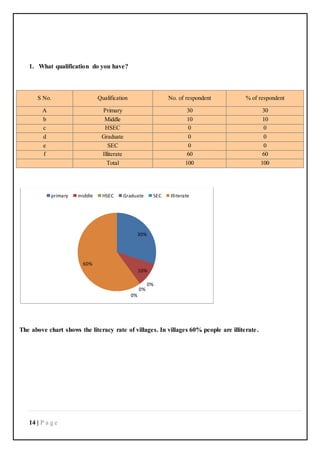
The above chart shows the literacy rate of villages. In villages 60% people are illiterate.
30%
10%
0%
0%
0%
60%
primary middle HSEC Graduate SEC Illiterate
15 | P a g e
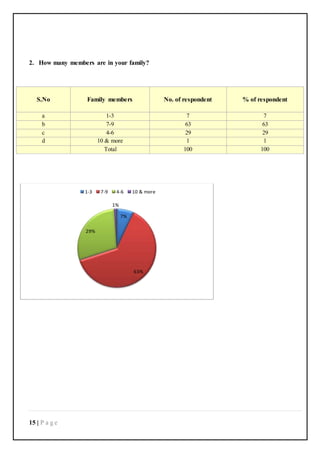
2. How many members are in your family?
S.No Family members No. of respondent % of respondent
a 1-3 7 7
b 7-9 63 63
c 4-6 29 29
d 10 & more 1 1
Total 100 100
7%
63%
29%
1%
1-3 7-9 4-6 10 & more
16 | P a g e
3. What is the main source of income of your family?
S.No source of income No. of respondent % of respondent
a Agriculture 65 65
b Business 0 0
c Daily wage working 40 40
d Cattle ship 0 0
e Service 2 2
f others 1 1
Total 108 108
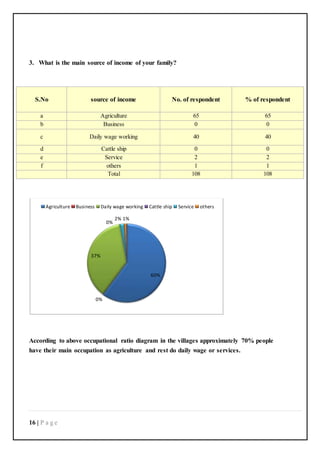
According to above occupational ratio diagram in the villages approximately 70% people
have their main occupation as agriculture and rest do daily wage or services.
60%
0%
37%
0%
2% 1%
Agriculture Business Daily wage working Cattle ship Service others
17 | P a g e
4. Do you have any debts?
S.No Debts No. of respondent % of respondent
A Yes 4 4
B No 96 96
Total 100 100
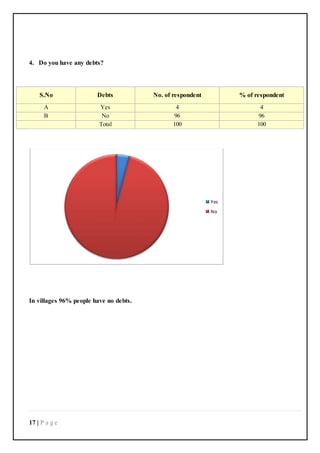
In villages 96% people have no debts.
Yes
No
18 | P a g e
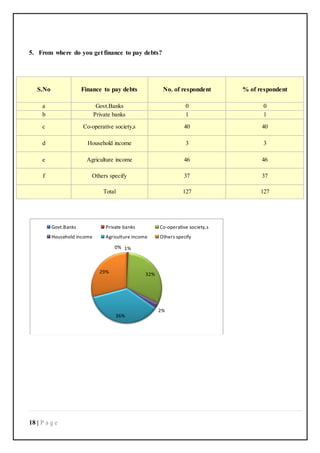
5. From where do you get finance to pay debts?
S.No Finance to pay debts No. of respondent % of respondent
a Govt.Banks 0 0
b Private banks 1 1
c Co-operative society,s 40 40
d Household income 3 3
e Agriculture income 46 46
f Others specify 37 37
Total 127 127
0% 1%
32%
2%
36%
29%
Govt.Banks Private banks Co-operative society,s
Household income Agriculture income Others specify
19 | P a g e
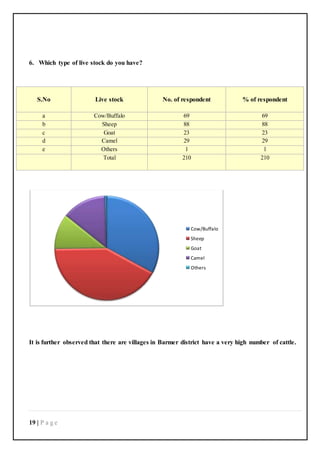
6. Which type of live stock do you have?
S.No Live stock No. of respondent % of respondent
a Cow/Buffalo 69 69
b Sheep 88 88
c Goat 23 23
d Camel 29 29
e Others 1 1
Total 210 210
It is further observed that there are villages in Barmer district have a very high number of cattle.
Cow/Buffalo
Sheep
Goat
Camel
Others
20 | P a g e
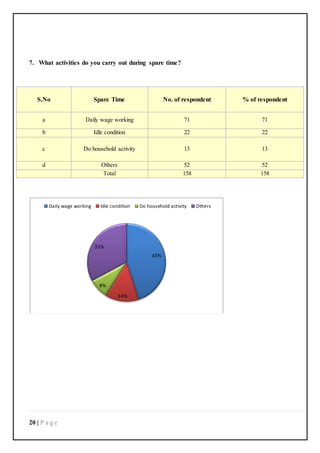
7. What activities do you carry out during spare time?
S.No Spare Time No. of respondent % of respondent
a Daily wage working 71 71
b Idle condition 22 22
c Do household activity 13 13
d Others 52 52
Total 158 158
45%
14%
8%
33%
Daily wage working Idle condition Do household activity Others
21 | P a g e
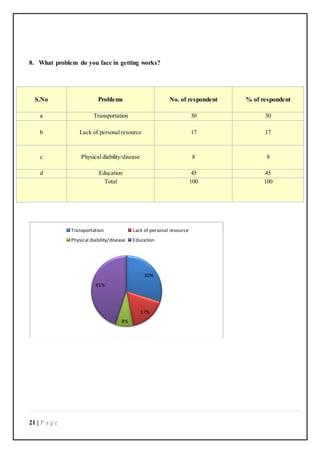
8. What problem do you face in getting works?
S.No Problems No. of respondent % of respondent
a Transportation 30 30
b Lack of personal resource 17 17
c Physical diability/disease 8 8
d Education 45 45
Total 100 100
30%
17%
8%
45%
Transportation Lack of personal resource
Physical diability/disease Education
22 | P a g e
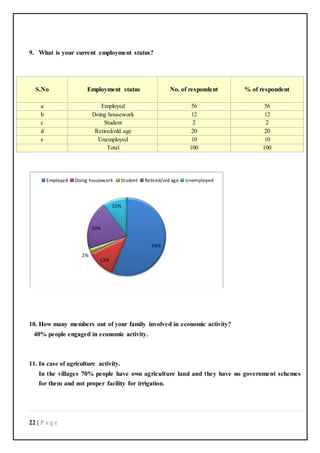
9. What is your current employment status?
S.No Employment status No. of respondent % of respondent
a Employed 56 56
b Doing housework 12 12
c Student 2 2
d Retired/old age 20 20
e Unemployed 10 10
Total 100 100
10. How many members out of your family involved in economic activity?
40% people engaged in economic activity.
11. In case of agriculture activity.
In the villages 70% people have own agriculture land and they have no government schemes
for them and not proper facility for irrigation.
56%
12%
2%
20%
10%
Employed Doing housework Student Retired/old age Unemployed
23 | P a g e
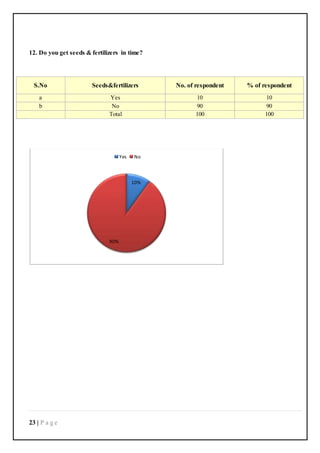
12. Do you get seeds & fertilizers in time?
S.No Seeds&fertilizers No. of respondent % of respondent
a Yes 10 10
b No 90 90
Total 100 100
10%
90%
Yes No
24 | P a g e
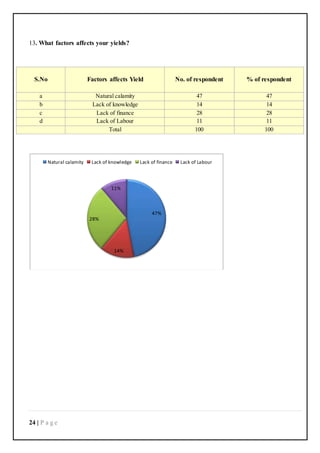
13. What factors affects your yields?
S.No Factors affects Yield No. of respondent % of respondent
a Natural calamity 47 47
b Lack of knowledge 14 14
c Lack of finance 28 28
d Lack of Labour 11 11
Total 100 100
47%
14%
28%
11%
Natural calamity Lack of knowledge Lack of finance Lack of Labour
25 | P a g e
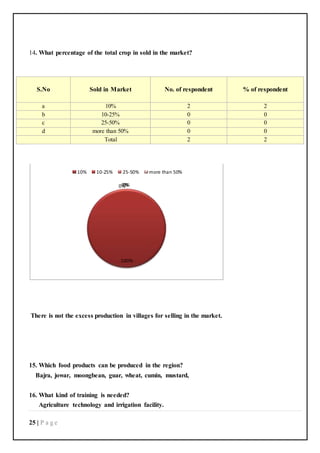
14. What percentage of the total crop in sold in the market?
S.No Sold in Market No. of respondent % of respondent
a 10% 2 2
b 10-25% 0 0
c 25-50% 0 0
d more than 50% 0 0
Total 2 2
There is not the excess production in villages for selling in the market.
15. Which food products can be produced in the region?
Bajra, jowar, moongbean, guar, wheat, cumin, mustard,
16. What kind of training is needed?
Agriculture technology and irrigation facility.
100%
0%0%0%
10% 10-25% 25-50% more than 50%
26 | P a g e
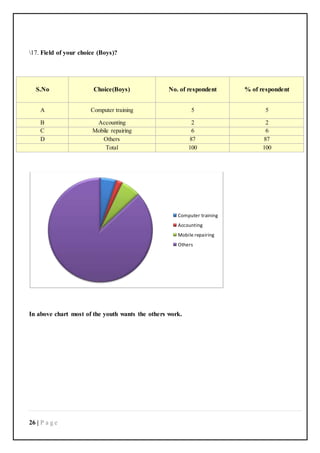
17. Field of your choice (Boys)?
S.No Choice(Boys) No. of respondent % of respondent
A Computer training 5 5
B Accounting 2 2
C Mobile repairing 6 6
D Others 87 87
Total 100 100
In above chart most of the youth wants the others work.
Computer training
Accounting
Mobile repairing
Others
27 | P a g e
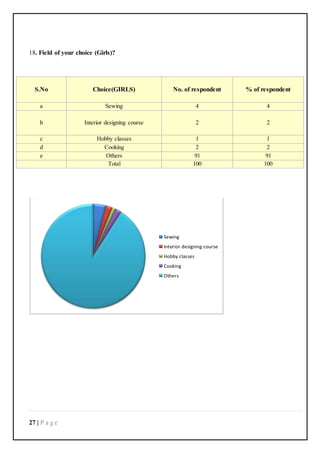
18. Field of your choice (Girls)?
S.No Choice(GIRLS) No. of respondent % of respondent
a Sewing 4 4
b Interior designing course 2 2
c Hobby classes 1 1
d Cooking 2 2
e Others 91 91
Total 100 100
Sewing
Interior designing course
Hobby classes
Cooking
Others
28 | P a g e
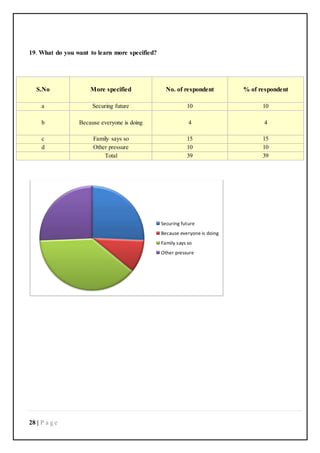
19. What do you want to learn more specified?
S.No More specified No. of respondent % of respondent
a Securing future 10 10
b Because everyone is doing 4 4
c Family says so 15 15
d Other pressure 10 10
Total 39 39
Securing future
Because everyone is doing
Family says so
Other pressure
29 | P a g e
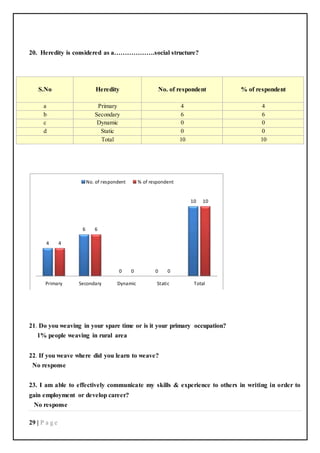
20. Heredity is considered as a……………….social structure?
S.No Heredity No. of respondent % of respondent
a Primary 4 4
b Secondary 6 6
c Dynamic 0 0
d Static 0 0
Total 10 10
21. Do you weaving in your spare time or is it your primary occupation?
1% people weaving in rural area
22. If you weave where did you learn to weave?
No response
23. I am able to effectively communicate my skills & experience to others in writing in order to
gain employment or develop career?
No response
4
6
0 0
10
4
6
0 0
10
Primary Secondary Dynamic Static Total
No. of respondent % of respondent
30 | P a g e
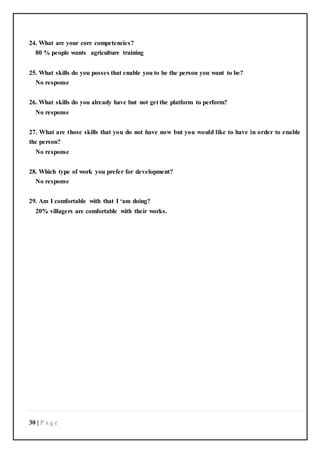
24. What are your core competencies?
80 % people wants agriculture training
25. What skills do you posses that enable you to be the person you want to be?
No response
26. What skills do you already have but not get the platform to perform?
No response
27. What are those skills that you do not have now but you would like to have in order to enable
the person?
No response
28. Which type of work you prefer for development?
No response
29. Am I comfortable with that I ‘am doing?
20% villagers are comfortable with their works.
31 | P a g e
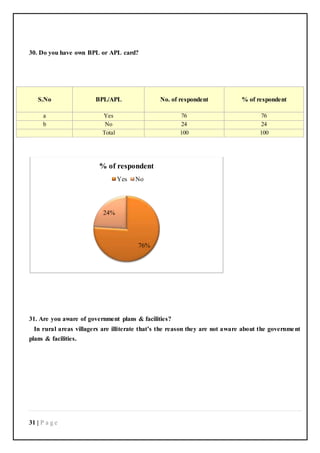
30. Do you have own BPL or APL card?
S.No BPL/APL No. of respondent % of respondent
a Yes 76 76
b No 24 24
Total 100 100
31. Are you aware of government plans & facilities?
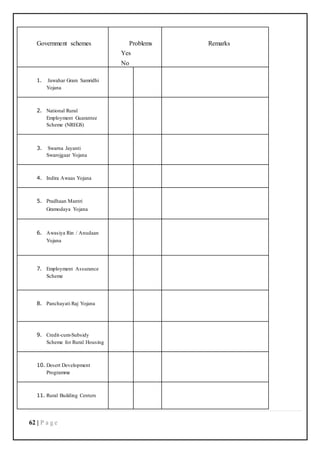
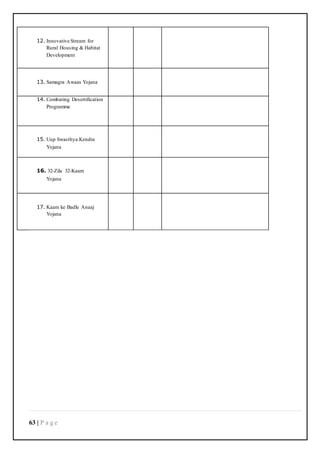
In rural areas villagers are illiterate that’s the reason they are not aware about the government
plans & facilities.
76%
24%
% of respondent
Yes No
32 | P a g e
HISTORY
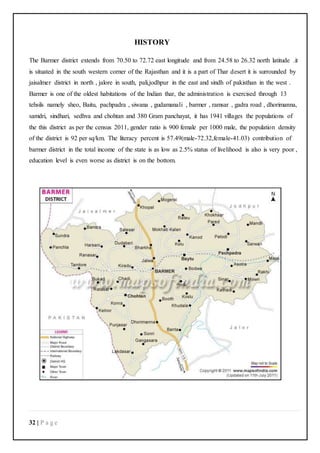
The Barmer district extends from 70.50 to 72.72 east longitude and from 24.58 to 26.32 north latitude .it
is situated in the south western corner of the Rajasthan and it is a part of Thar desert it is surrounded by
jaisalmer district in north , jalore in south, pali,jodhpur in the east and sindh of pakisthan in the west .
Barmer is one of the oldest habitations of the Indian thar, the administration is exercised through 13
tehsils namely sheo, Baitu, pachpadra , siwana , gudamanali , barmer , ramsar , gadra road , dhorimanna,
samdri, sindhari, sedhva and chohtan and 380 Gram panchayat, it has 1941 villages the populations of
the this district as per the census 2011, gender ratio is 900 female per 1000 male, the population density
of the district is 92 per sq/km. The literacy percent is 57.49(male-72.32,female-41.03) contribution of
barmer district in the total income of the state is as low as 2.5% status of livelihood is also is very poor ,
education level is even worse as district is on the bottom.
33 | P a g e
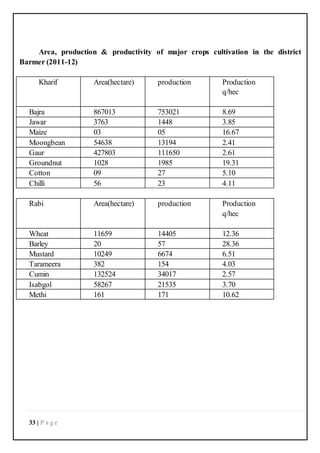
Area, production & productivity of major crops cultivation in the district
Barmer (2011-12)
Kharif Area(hectare) production Production
q/hec
Bajra 867013 753021 8.69
Jawar 3763 1448 3.85
Maize 03 05 16.67
Moongbean 54638 13194 2.41
Gaur 427803 111650 2.61
Groundnut 1028 1985 19.31
Cotton 09 27 5.10
Chilli 56 23 4.11
Rabi Area(hectare) production Production
q/hec
Wheat 11659 14405 12.36
Barley 20 57 28.36
Mustard 10249 6674 6.51
Tarameera 382 154 4.03
Cumin 132524 34017 2.57
Isabgol 58267 21535 3.70
Methi 161 171 10.62
34 | P a g e
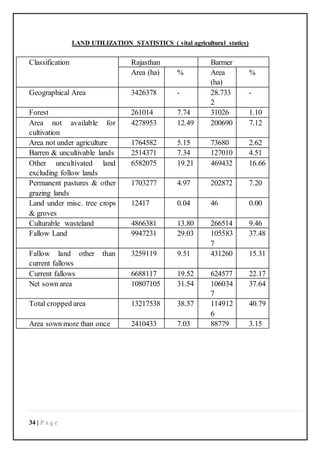
LAND UTILIZATION STATISTICS ( vital agricultural statics)
Classification Rajasthan Barmer
Area (ha) % Area
(ha)
%
Geographical Area 3426378 - 28.733
2
-
Forest 261014 7.74 31026 1.10
Area not available for
cultivation
4278953 12.49 200690 7.12
Area not under agriculture 1764582 5.15 73680 2.62
Barren & uncultivable lands 2514371 7.34 127010 4.51
Other uncultivated land
excluding follow lands
6582075 19.21 469432 16.66
Permanent pastures & other
grazing lands
1703277 4.97 202872 7.20
Land under misc. tree crops
& groves
12417 0.04 46 0.00
Culturable wasteland 4866381 13.80 266514 9.46
Fallow Land 9947231 29.03 105583
7
37.48
Fallow land other than
current fallows
3259119 9.51 431260 15.31
Current fallows 6688117 19.52 624577 22.17
Net sown area 10807105 31.54 106034
7
37.64
Total cropped area 13217538 38.57 114912
6
40.79
Area sown more than once 2410433 7.03 88779 3.15
35 | P a g e
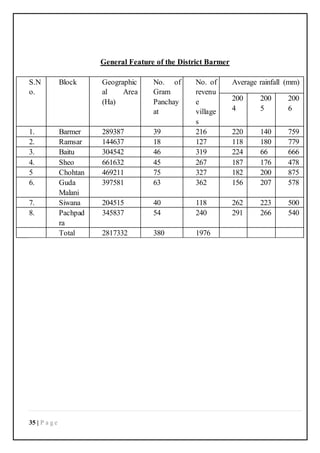
General Feature of the District Barmer
S.N
o.
Block Geographic
al Area
(Ha)
No. of
Gram
Panchay
at
No. of
revenu
e
village
s
Average rainfall (mm)
200
4
200
5
200
6
1. Barmer 289387 39 216 220 140 759
2. Ramsar 144637 18 127 118 180 779
3. Baitu 304542 46 319 224 66 666
4. Sheo 661632 45 267 187 176 478
5 Chohtan 469211 75 327 182 200 875
6. Guda
Malani
397581 63 362 156 207 578
7. Siwana 204515 40 118 262 223 500
8. Pachpad
ra
345837 54 240 291 266 540
Total 2817332 380 1976
36 | P a g e
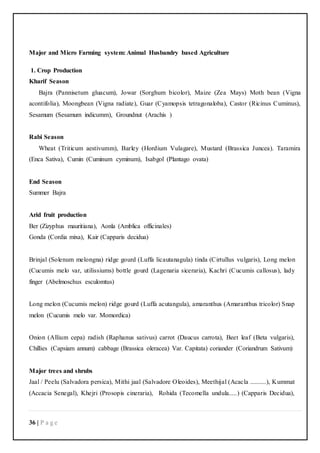
Major and Micro Farming system: Animal Husbandry based Agriculture
1. Crop Production
Kharif Season
Bajra (Pannisetum gluacum), Jowar (Sorghum bicolor), Maize (Zea Mays) Moth bean (Vigna
acontifolia), Moongbean (Vigna radiate), Guar (Cyamopsis tetragonaloba), Castor (Ricinus Cuminus),
Sesamum (Sesamum indicumm), Groundnut (Arachis )
Rabi Season
Wheat (Triticum aestivumm), Barley (Hordium Vulagare), Mustard (Brassica Juncea). Taramira
(Enca Sativa), Cumin (Cuminum cyminum), Isabgol (Plantago ovata)
End Season
Summer Bajra
Arid fruit production
Ber (Zizyphus mauritiana), Aonla (Amblica officinales)
Gonda (Cordia mixa), Kair (Capparis decidua)
Brinjal (Solenum melongna) ridge gourd (Luffa licautanagula) tinda (Cirtullus vulgaris), Long melon
(Cucumis melo var, utilissiums) bottle gourd (Lagenaria siceraria), Kachri (Cucumis callosus), lady
finger (Abelmoschus esculomtus)
Long melon (Cucumis melon) ridge gourd (Luffa acutangula), amaranthus (Amaranthus tricolor) Snap
melon (Cucumis melo var. Momordica)
Onion (Allium cepa) radish (Raphanus sativus) carrot (Daucus carrota), Beet leaf (Beta vulgaris),
Chillies (Capsiam annum) cabbage (Brassica oleracea) Var. Capitata) coriander (Coriandrum Sativum)
Major trees and shrubs
Jaal / Peelu (Salvadora persica), Mithi jaal (Salvadore Oleoides), Meethijal (Acacla ..........), Kummat
(Accacia Senegal), Khejri (Prosopis cineraria), Rohida (Tecomella undula.....) (Capparis Decidua),
37 | P a g e
Jharberi (Zizyphus mumularia), Babool (Acacia tortilis) Vilayati (Prosopis Juliflore). Fog (calligonum
poly gonoides)
Medicinal Crop/Trees
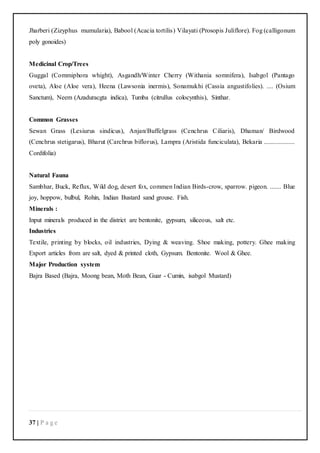
Guggal (Commiphora whight), Asgandh/Winter Cherry (Withania somnifera), Isabgol (Pantago
oveta), Aloe (Aloe vera), Heena (Lawsonia inermis), Sonamukhi (Cassia angustifolies). .... (Osium
Sanctum), Neem (Azaduracgta indica), Tumba (citrullus colocynthis), Sinthar.
Common Grasses
Sewan Grass (Lesiurus sindicus), Anjan/Buffelgrass (Cenchrus Ciliaris), Dhaman/ Birdwood
(Cenchrus stetigarus), Bharut (Carchrus biflorus), Lampra (Aristida funciculata), Bekaria ...................
Cordifolia)
Natural Fauna
Sambhar, Buck, Reflux, Wild dog, desert fox, commen Indian Birds-crow, sparrow. pigeon. ....... Blue
joy, hoppow, bulbul, Rohin, Indian Bustard sand grouse. Fish.
Minerals :
Input minerals produced in the district are bentonite, gypsum, siliceous, salt etc.
Industries
Textile, printing by blocks, oil industries, Dying & weaving. Shoe making, pottery. Ghee making
Export articles from are salt, dyed & printed cloth, Gypsum. Bentonite. Wool & Ghee.
Major Production system
Bajra Based (Bajra, Moong bean, Moth Bean, Guar - Cumin, isabgol Mustard)
38 | P a g e
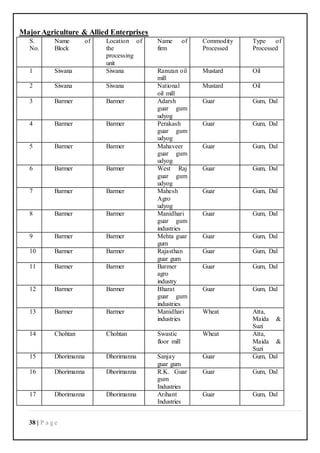
MajorAgriculture & Allied Enterprises
S.
No.
Name of
Block
Location of
the
processing
unit
Name of
firm
Commodity
Processed
Type of
Processed
1 Siwana Siwana Ramzan oil
mill
Mustard Oil
2 Siwana Siwana National
oil mill
Mustard Oil
3 Barmer Barmer Adarsh
guar gum
udyog
Guar Gum, Dal
4 Barmer Barmer Perakash
guar gum
udyog
Guar Gum, Dal
5 Barmer Barmer Mahaveer
guar gum
udyog
Guar Gum, Dal
6 Barmer Barmer West Raj
guar gum
udyog
Guar Gum, Dal
7 Barmer Barmer Mahesh
Agro
udyog
Guar Gum, Dal
8 Barmer Barmer Manidhari
guar gum
industries
Guar Gum, Dal
9 Barmer Barmer Mehta guar
gum
Guar Gum, Dal
10 Barmer Barmer Rajasthan
guar gum
Guar Gum, Dal
11 Barmer Barmer Barmer
agro
industry
Guar Gum, Dal
12 Barmer Barmer Bharat
guar gum
industries
Guar Gum, Dal
13 Barmer Barmer Manidhari
industries
Wheat Atta,
Maida &
Suzi
14 Chohtan Chohtan Swastic
floor mill
Wheat Atta,
Maida &
Suzi
15 Dhorimanna Dhorimanna Sanjay
guar gum
Guar Gum, Dal
16 Dhorimanna Dhorimanna R.K. Guar
gum
Industries
Guar Gum, Dal
17 Dhorimanna Dhorimanna Arihant
Industries
Guar Gum, Dal
39 | P a g e
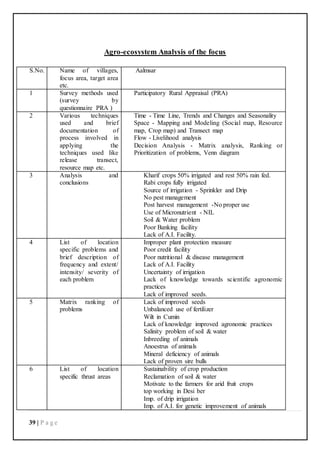
Agro-ecosystem Analysis of the focus
S.No. Name of villages,
focus area, target area
etc.
Aalmsar
1 Survey methods used
(survey by
questionnaire PRA )
Participatory Rural Appraisal (PRA)
2 Various techniques
used and brief
documentation of
process involved in
applying the
techniques used like
release transect,
resource map etc.
Time - Time Line, Trends and Changes and Seasonality
Space - Mapping and Modeling (Social map, Resource
map, Crop map) and Transect map
Flow - Livelihood analysis
Decision Analysis - Matrix analysis, Ranking or
Prioritization of problems, Venn diagram
3 Analysis and
conclusions
Kharif crops 50% irrigated and rest 50% rain fed.
Rabi crops fully irrigated
Source of irrigation - Sprinkler and Drip
No pest management
Post harvest management -No proper use
Use of Micronutrient - NIL
Soil & Water problem
Poor Banking facility
Lack of A.I. Facility.
4 List of location
specific problems and
brief description of
frequency and extent/
intensity/ severity of
each problem
Improper plant protection measure
Poor credit facility
Poor nutritional & disease management
Lack of A.I. Facility
Uncertainty of irrigation
Lack of knowledge towards scientific agronomic
practices
Lack of improved seeds.
5 Matrix ranking of
problems
Lack of improved seeds
Unbalanced use of fertilizer
Wilt in Cumin
Lack of knowledge improved agronomic practices
Salinity problem of soil & water
Inbreeding of animals
Anoestrus of animals
Mineral deficiency of animals
Lack of proven sire bulls
6 List of location
specific thrust areas
Sustainability of crop production
Reclamation of soil & water
Motivate to the farmers for arid fruit crops
top working in Desi ber
Imp. of drip irrigation
Imp. of A.I. for genetic improvement of animals
40 | P a g e
Imp. of mineral mixture to animals
7 List of location
specific technology
needs for OFT and
FLD
Wilt problem in cumin
Balanced conc. ration
Use of improved seeds.
Reclamation of soil
Use of feed supplements in ration.
8 Matrix ranking of
technologies
Urea treatment of coarse roughage
Incorporation of feed supplements in ration
Crop rotation
Seed treatment of crops
Reclamation of soil
Top Working in Desi Ber.
9 List of location
specific training needs
On Campus as well as Off-Campus trainings will be
organized on above aspect.
S.
N
o.
Name of villages, focus
area, target area etc.
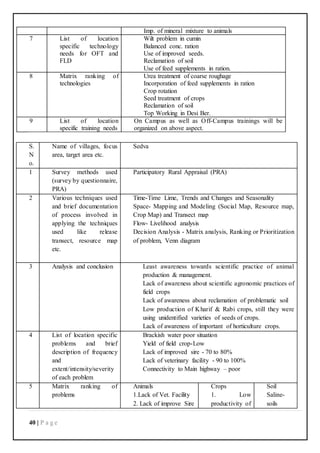
Sedva
1 Survey methods used
(survey by questionnaire,
PRA)
Participatory Rural Appraisal (PRA)
2 Various techniques used
and brief documentation
of process involved in
applying the techniques
used like release
transect, resource map
etc.
Time-Time Lime, Trends and Changes and Seasonality
Space- Mapping and Modeling (Social Map, Resource map,
Crop Map) and Transect map
Flow- Livelihood analysis
Decision Analysis - Matrix analysis, Ranking or Prioritization
of problem, Venn diagram
3 Analysis and conclusion Least awareness towards scientific practice of animal
production & management.
Lack of awareness about scientific agronomic practices of
field crops
Lack of awareness about reclamation of problematic soil
Low production of Kharif & Rabi crops, still they were
using unidentified varieties of seeds of crops.
Lack of awareness of important of horticulture crops.
4 List of location specific
problems and brief
description of frequency
and
extent/intensity/severity
of each problem
Brackish water poor situation
Yield of field crop-Low
Lack of improved sire - 70 to 80%
Lack of veterinary facility - 90 to 100%
Connectivity to Main highway – poor
5 Matrix ranking of
problems
Animals
1.Lack of Vet. Facility
2. Lack of improve Sire
Crops
1. Low
productivity of
Soil
Saline-
soils
41 | P a g e
3. Lack of market
facility of milk &
products
Kharif crops
2. Low
productivity of
Rabi crops
3. Lack of
availability of
HYV seeds
Brackish
water
6 List of location specific
thrust areas
Sustainable crop production by adopting improved agril.
practices
Management of saline soil
Popularization of drip irrigation
Diversification of agriculture through horticulture
Increase area under horticulture crops (Ber. Aonla. Date
Palm)
7 List of location specific
technology needs for
OFT and FLD
Balanced concentrate ration
Popularization of HYV of Kharif pulses
Popularization of Mineral Mixture.
Wilt resistant varieties of Cumin
8 Matrix ranking of
technologies
Animals
1.Popularization
Prophylactic Health
practices
2. Awareness about
A.I.
3. Tie up with Barmer
Saras Dairy, Barmer
Crops
1.HYV of
Kharif Pulses
2. HYV of Rabi
crops
3. INM & IPM
awareness
Soil
1.
reclamati
on of soil
through
Gypsum
& green
manure
2. Crop -
rotation
9 List of location specific
training needs
Preparation of conc. ration at home
Preparation of mineral mixture.
Improved practices of field crops
Awareness about INM & IPM
Popularization of vermi compost.
S.
N
o.
Name of villages, focus
area, target area etc.
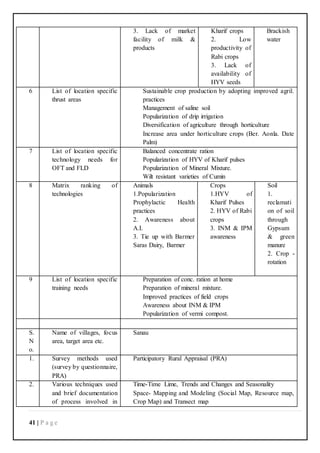
Sanau
1. Survey methods used
(survey by questionnaire,
PRA)
Participatory Rural Appraisal (PRA)
2. Various techniques used
and brief documentation
of process involved in
Time-Time Lime, Trends and Changes and Seasonality
Space- Mapping and Modeling (Social Map, Resource map,
Crop Map) and Transect map
42 | P a g e
applying the techniques
used like release
transect, resource map
etc.
Flow- Livelihood analysis
Decision Analysis - Matrix analysis, Ranking or Prioritization
of problem, Venn diagram
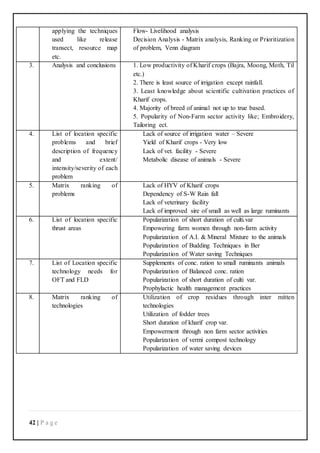
3. Analysis and conclusions 1. Low productivity of Kharif crops (Bajra, Moong, Moth, Til
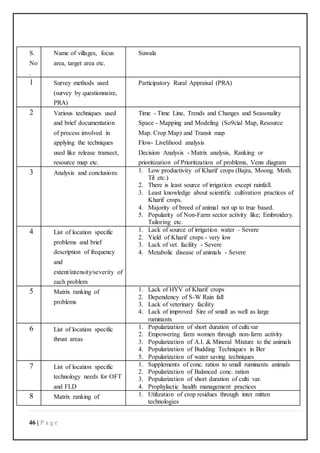
etc.)
2. There is least source of irrigation except rainfall.
3. Least knowledge about scientific cultivation practices of
Kharif crops.
4. Majority of breed of animal not up to true based.
5. Popularity of Non-Farm sector activity like; Embroidery,
Tailoring ect.
4. List of location specific
problems and brief
description of frequency
and extent/
intensity/severity of each
problem
Lack of source of irrigation water – Severe
Yield of Kharif crops - Very low
Lack of vet. facility - Severe
Metabolic disease of animals - Severe
5. Matrix ranking of
problems
Lack of HYV of Kharif crops
Dependency of S-W Rain fall
Lack of veterinary facility
Lack of improved sire of small as well as large ruminants
6. List of location specific
thrust areas
Popularization of short duration of culti.var
Empowering farm women through non-farm activity
Popularization of A.I. & Mineral Mixture to the animals
Popularization of Budding Techniques in Ber
Popularization of Water saving Techniques
7. List of Location specific
technology needs for
OFT and FLD
Supplements of conc. ration to small ruminants animals
Popularization of Balanced conc. ration
Popularization of short duration of culti var.
Prophylactic health management practices
8. Matrix ranking of
technologies
Utilization of crop residues through inter mitten
technologies
Utilization of fodder trees
Short duration of kharif crop var.
Empowerment through non farm sector activities
Popularization of vermi compost technology
Popularization of water saving devices
43 | P a g e
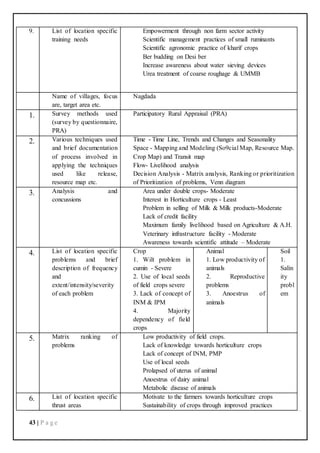
9. List of location specific
training needs
Empowerment through non farm sector activity
Scientific management practices of small ruminants
Scientific agronomic practice of kharif crops
Ber budding on Desi ber
Increase awareness about water sieving devices
Urea treatment of coarse roughage & UMMB
Name of villages, focus
are, target area etc.
Nagdada
1. Survey methods used
(survey by questionnaire,
PRA)
Participatory Rural Appraisal (PRA)
2. Various techniques used
and brief documentation
of process involved in
applying the techniques
used like release,
resource map etc.
Time - Time Line, Trends and Changes and Seasonality
Space - Mapping and Modeling (So9cial Map, Resource Map.
Crop Map) and Transit map
Flow- Livelihood analysis
Decision Analysis - Matrix analysis, Ranking or prioritization
of Prioritization of problems, Venn diagram
3. Analysis and
concussions
Area under double crops- Moderate
Interest in Horticulture crops - Least
Problem in selling of Milk & Milk products-Moderate
Lack of credit facility
Maximum family livelihood based on Agriculture & A.H.
Veterinary infrastructure facility - Moderate
Awareness towards scientific attitude – Moderate
4. List of location specific
problems and brief
description of frequency
and
extent/intensity/severity
of each problem
Crop
1. Wilt problem in
cumin - Severe
2. Use of local seeds
of field crops severe
3. Lack of concept of
INM & IPM
4. Majority
dependency of field
crops
Animal
1. Low productivity of
animals
2. Reproductive
problems
3. Anoestrus of
animals
Soil
1.
Salin
ity
probl
em
5. Matrix ranking of
problems
Low productivity of field crops.
Lack of knowledge towards horticulture crops
Lack of concept of INM, PMP
Use of local seeds
Prolapsed of uterus of animal
Anoestrus of dairy animal
Metabolic disease of animals
6. List of location specific
thrust areas
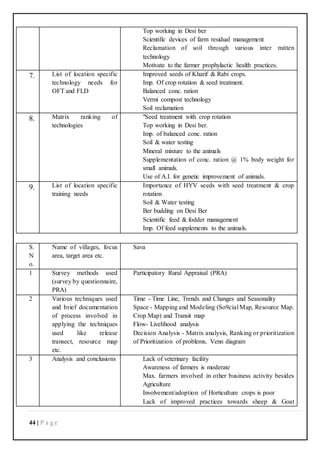
Motivate to the farmers towards horticulture crops
Sustainability of crops through improved practices
44 | P a g e
Top working in Desi ber
Scientific devices of farm residual management
Reclamation of soil through various inter mitten
technology
Motivate to the farmer prophylactic health practices.
7. List of location specific
technology needs for
OFT and FLD
Improved seeds of Kharif & Rabi crops.
Imp. Of crop rotation & seed treatment.
Balanced conc. ration
Vermi compost technology
Soil reclamation
8. Matrix ranking of
technologies
"Seed treatment with crop rotation
Top working in Desi ber.
Imp. of balanced conc. ration
Soil & water testing
Mineral mixture to the animals
Supplementation of conc. ration @ 1% body weight for
small animals.
Use of A.I. for genetic improvement of animals.
9. List of location specific
training needs
Importance of HYV seeds with seed treatment & crop
rotation
Soil & Water testing
Ber budding on Desi Ber
Scientific feed & fodder management
Imp. Of feed supplements to the animals.
S.
N
o.
Name of villages, focus
area, target area etc.
Sava
1 Survey methods used
(survey by questionnaire,
PRA)
Participatory Rural Appraisal (PRA)
2 Various techniques used
and brief documentation
of process involved in
applying the techniques
used like release
transect, resource map
etc.
Time - Time Line, Trends and Changes and Seasonality
Space - Mapping and Modeling (So9cial Map, Resource Map.
Crop Map) and Transit map
Flow- Livelihood analysis
Decision Analysis - Matrix analysis, Ranking or prioritization
of Prioritization of problems, Venn diagram
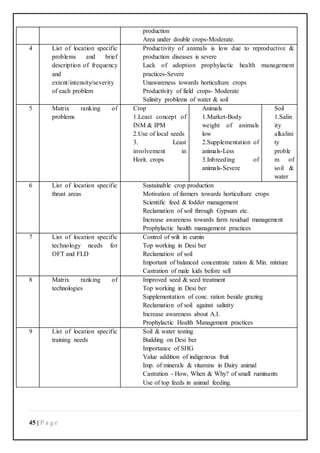
3 Analysis and conclusions Lack of veterinary facility
Awareness of farmers is moderate
Max. farmers involved in other business activity besides
Agriculture
Involvement/adoption of Horticulture crops is poor
Lack of improved practices towards sheep & Goat
45 | P a g e
production
Area under double crops-Moderate.
4 List of location specific
problems and brief
description of frequency
and
extent/intensity/severity
of each problem
Productivity of animals is low due to reproductive &
production diseases is severe
Lack of adoption prophylactic health management
practices-Severe
Unawareness towards horticulture crops
Productivity of field crops- Moderate
Salinity problems of water & soil
5 Matrix ranking of
problems
Crop
1.Least concept of
INM & IPM
2.Use of local seeds
3. Least
involvement in
Horit. crops
Animals
1.Market-Body
weight of animals
low
2.Supplementation of
animals-Less
3.Inbreeding of
animals-Severe
Soil
1.Salin
ity
alkalini
ty
proble
m of
soil &
water
6 List of location specific
thrust areas
Sustainable crop production
Motivation of farmers towards horticulture crops
Scientific feed & fodder management
Reclamation of soil through Gypsum etc.
Increase awareness towards farm residual management
Prophylactic health management practices
7 List of location specific
technology needs for
OFT and FLD
Control of wilt in cumin
Top working in Desi ber
Reclamation of soil
Important of balanced concentrate ration & Min. mixture
Castration of male kids before sell
8 Matrix ranking of
technologies
Improved seed & seed treatment
Top working in Desi ber
Supplementation of conc. ration beside grazing
Reclamation of soil against salinity
Increase awareness about A.I.
Prophylactic Health Management practices
9 List of location specific
training needs
Soil & water testing
Budding on Desi ber
Importance of SHG
Value addition of indigenous fruit
Imp. of minerals & vitamins in Dairy animal
Castration - How, When & Why? of small ruminants
Use of top feeds in animal feeding.
46 | P a g e
S.
No
.
Name of villages, focus
area, target area etc.
Suwala
1 Survey methods used
(survey by questionnaire,
PRA)
Participatory Rural Appraisal (PRA)
2 Various techniques used
and brief documentation
of process involved in
applying the techniques
used like release transect,
resource map etc.
Time - Time Line, Trends and Changes and Seasonality
Space - Mapping and Modeling (So9cial Map, Resource
Map. Crop Map) and Transit map
Flow- Livelihood analysis
Decision Analysis - Matrix analysis, Ranking or
prioritization of Prioritization of problems, Venn diagram
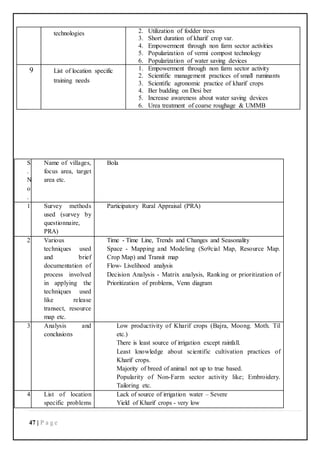
3 Analysis and conclusions 1. Low productivity of Kharif crops (Bajra, Moong. Moth.
Til etc.)
2. There is least source of irrigation except rainfall.
3. Least knowledge about scientific cultivation practices of
Kharif crops.
4. Majority of breed of animal not up to true based.
5. Popularity of Non-Farm sector activity like; Embroidery.
Tailoring etc.
4 List of location specific
problems and brief
description of frequency
and
extent/intensity/severity of
each problem
1. Lack of source of irrigation water – Severe
2. Yield of Kharif crops - very low
3. Lack of vet. facility - Severe
4. Metabolic disease of animals - Severe
5 Matrix ranking of
problems
1. Lack of HYV of Kharif crops
2. Dependency of S-W Rain fall
3. Lack of veterinary facility
4. Lack of improved Sire of small as well as large
ruminants
6 List of location specific
thrust areas
1. Popularization of short duration of culti.var
2. Empowering farm women through non-farm activity
3. Popularization of A.I. & Mineral Mixture to the animals
4. Popularization of Budding Techniques in Ber
5. Popularization of water saving techniques
7 List of location specific
technology needs for OFT
and FLD
1. Supplements of conc. ration to small ruminants animals
2. Popularization of Balanced conc. ration
3. Popularization of short duration of culti var.
4. Prophylactic health management practices
8 Matrix ranking of 1. Utilization of crop residues through inter mitten
technologies
47 | P a g e
technologies 2. Utilization of fodder trees
3. Short duration of kharif crop var.
4. Empowerment through non farm sector activities
5. Popularization of vermi compost technology
6. Popularization of water saving devices
9 List of location specific
training needs
1. Empowerment through non farm sector activity
2. Scientific management practices of small ruminants
3. Scientific agronomic practice of kharif crops
4. Ber budding on Desi ber
5. Increase awareness about water saving devices
6. Urea treatment of coarse roughage & UMMB
S
.
N
o
.
Name of villages,
focus area, target
area etc.
Bola
1 Survey methods
used (survey by
questionnaire,
PRA)
Participatory Rural Appraisal (PRA)
2 Various
techniques used
and brief
documentation of
process involved
in applying the
techniques used
like release
transect, resource
map etc.
Time - Time Line, Trends and Changes and Seasonality
Space - Mapping and Modeling (So9cial Map, Resource Map.
Crop Map) and Transit map
Flow- Livelihood analysis
Decision Analysis - Matrix analysis, Ranking or prioritization of
Prioritization of problems, Venn diagram
3 Analysis and
conclusions
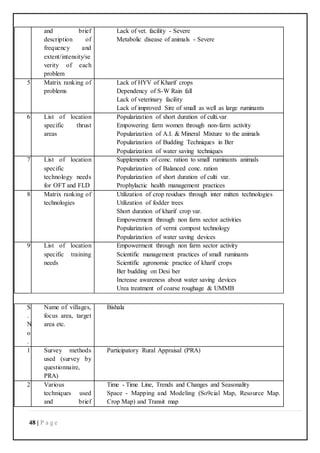
Low productivity of Kharif crops (Bajra, Moong. Moth. Til
etc.)
There is least source of irrigation except rainfall.
Least knowledge about scientific cultivation practices of
Kharif crops.
Majority of breed of animal not up to true based.
Popularity of Non-Farm sector activity like; Embroidery.
Tailoring etc.
4 List of location
specific problems
Lack of source of irrigation water – Severe
Yield of Kharif crops - very low
48 | P a g e
and brief
description of
frequency and
extent/intensity/se
verity of each
problem
Lack of vet. facility - Severe
Metabolic disease of animals - Severe
5 Matrix ranking of
problems
Lack of HYV of Kharif crops
Dependency of S-W Rain fall
Lack of veterinary facility
Lack of improved Sire of small as well as large ruminants
6 List of location
specific thrust
areas
Popularization of short duration of culti.var
Empowering farm women through non-farm activity
Popularization of A.I. & Mineral Mixture to the animals
Popularization of Budding Techniques in Ber
Popularization of water saving techniques
7 List of location
specific
technology needs
for OFT and FLD
Supplements of conc. ration to small ruminants animals
Popularization of Balanced conc. ration
Popularization of short duration of culti var.
Prophylactic health management practices
8 Matrix ranking of
technologies
Utilization of crop residues through inter mitten technologies
Utilization of fodder trees
Short duration of kharif crop var.
Empowerment through non farm sector activities
Popularization of vermi compost technology
Popularization of water saving devices
9 List of location
specific training
needs
Empowerment through non farm sector activity
Scientific management practices of small ruminants
Scientific agronomic practice of kharif crops
Ber budding on Desi ber
Increase awareness about water saving devices
Urea treatment of coarse roughage & UMMB
S
.
N
o
.
Name of villages,
focus area, target
area etc.
Bishala
1 Survey methods
used (survey by
questionnaire,
PRA)
Participatory Rural Appraisal (PRA)
2 Various
techniques used
and brief
Time - Time Line, Trends and Changes and Seasonality
Space - Mapping and Modeling (So9cial Map, Resource Map.
Crop Map) and Transit map
49 | P a g e
documentation of
process involved
in applying the
techniques used
like release
transect, resource
map etc.
Flow- Livelihood analysis
Decision Analysis - Matrix analysis, Ranking or prioritization of
Prioritization of problems, Venn diagram
3 Analysis and
conclusions
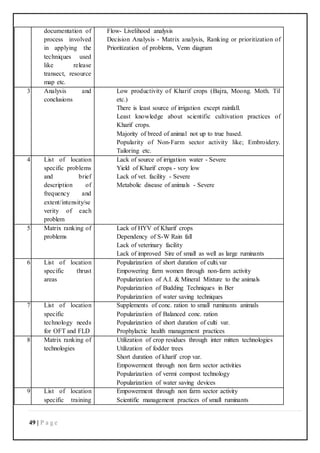
Low productivity of Kharif crops (Bajra, Moong. Moth. Til
etc.)
There is least source of irrigation except rainfall.
Least knowledge about scientific cultivation practices of
Kharif crops.
Majority of breed of animal not up to true based.
Popularity of Non-Farm sector activity like; Embroidery.
Tailoring etc.
4 List of location
specific problems
and brief
description of
frequency and
extent/intensity/se
verity of each
problem
Lack of source of irrigation water - Severe
Yield of Kharif crops - very low
Lack of vet. facility - Severe
Metabolic disease of animals - Severe
5 Matrix ranking of
problems
Lack of HYV of Kharif crops
Dependency of S-W Rain fall
Lack of veterinary facility
Lack of improved Sire of small as well as large ruminants
6 List of location
specific thrust
areas
Popularization of short duration of culti.var
Empowering farm women through non-farm activity
Popularization of A.I. & Mineral Mixture to the animals
Popularization of Budding Techniques in Ber
Popularization of water saving techniques
7 List of location
specific
technology needs
for OFT and FLD
Supplements of conc. ration to small ruminants animals
Popularization of Balanced conc. ration
Popularization of short duration of culti var.
Prophylactic health management practices
8 Matrix ranking of
technologies
Utilization of crop residues through inter mitten technologies
Utilization of fodder trees
Short duration of kharif crop var.
Empowerment through non farm sector activities
Popularization of vermi compost technology
Popularization of water saving devices
9 List of location
specific training
Empowerment through non farm sector activity
Scientific management practices of small ruminants
50 | P a g e
needs Scientific agronomic practice of kharif crops
Ber budding on Desi ber
Increase awareness about water saving devices
Urea treatment of coarse roughage & UMMB
S.
N
o.
Name of
villages, focus
area, target area
etc.
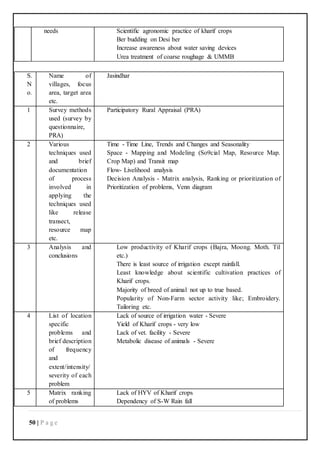
Jasindhar
1 Survey methods
used (survey by
questionnaire,
PRA)
Participatory Rural Appraisal (PRA)
2 Various
techniques used
and brief
documentation
of process
involved in
applying the
techniques used
like release
transect,
resource map
etc.
Time - Time Line, Trends and Changes and Seasonality
Space - Mapping and Modeling (So9cial Map, Resource Map.
Crop Map) and Transit map
Flow- Livelihood analysis
Decision Analysis - Matrix analysis, Ranking or prioritization of
Prioritization of problems, Venn diagram
3 Analysis and
conclusions
Low productivity of Kharif crops (Bajra, Moong. Moth. Til
etc.)
There is least source of irrigation except rainfall.
Least knowledge about scientific cultivation practices of
Kharif crops.
Majority of breed of animal not up to true based.
Popularity of Non-Farm sector activity like; Embroidery.
Tailoring etc.
4 List of location
specific
problems and
brief description
of frequency
and
extent/intensity/
severity of each
problem
Lack of source of irrigation water - Severe
Yield of Kharif crops - very low
Lack of vet. facility - Severe
Metabolic disease of animals - Severe
5 Matrix ranking
of problems
Lack of HYV of Kharif crops
Dependency of S-W Rain fall
51 | P a g e
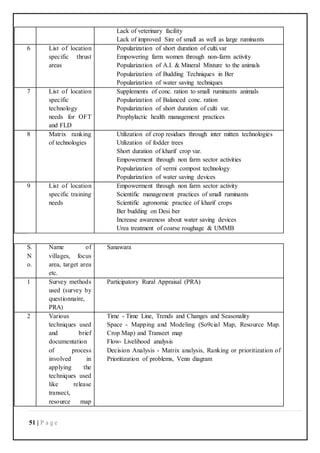
Lack of veterinary facility
Lack of improved Sire of small as well as large ruminants
6 List of location
specific thrust
areas
Popularization of short duration of culti.var
Empowering farm women through non-farm activity
Popularization of A.I. & Mineral Mixture to the animals
Popularization of Budding Techniques in Ber
Popularization of water saving techniques
7 List of location
specific
technology
needs for OFT
and FLD
Supplements of conc. ration to small ruminants animals
Popularization of Balanced conc. ration
Popularization of short duration of culti var.
Prophylactic health management practices
8 Matrix ranking
of technologies
Utilization of crop residues through inter mitten technologies
Utilization of fodder trees
Short duration of kharif crop var.
Empowerment through non farm sector activities
Popularization of vermi compost technology
Popularization of water saving devices
9 List of location
specific training
needs
Empowerment through non farm sector activity
Scientific management practices of small ruminants
Scientific agronomic practice of kharif crops
Ber budding on Desi ber
Increase awareness about water saving devices
Urea treatment of coarse roughage & UMMB
S.
N
o.
Name of
villages, focus
area, target area
etc.
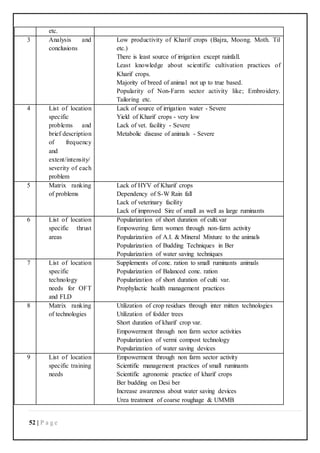
Sanawara
1 Survey methods
used (survey by
questionnaire,
PRA)
Participatory Rural Appraisal (PRA)
2 Various
techniques used
and brief
documentation
of process
involved in
applying the
techniques used
like release
transect,
resource map
Time - Time Line, Trends and Changes and Seasonality
Space - Mapping and Modeling (So9cial Map, Resource Map.
Crop Map) and Transeet map
Flow- Livelihood analysis
Decision Analysis - Matrix analysis, Ranking or prioritization of
Prioritization of problems, Venn diagram
52 | P a g e
etc.
3 Analysis and
conclusions
Low productivity of Kharif crops (Bajra, Moong. Moth. Til
etc.)
There is least source of irrigation except rainfall.
Least knowledge about scientific cultivation practices of
Kharif crops.
Majority of breed of animal not up to true based.
Popularity of Non-Farm sector activity like; Embroidery.
Tailoring etc.
4 List of location
specific
problems and
brief description
of frequency
and
extent/intensity/
severity of each
problem
Lack of source of irrigation water - Severe
Yield of Kharif crops - very low
Lack of vet. facility - Severe
Metabolic disease of animals - Severe
5 Matrix ranking
of problems
Lack of HYV of Kharif crops
Dependency of S-W Rain fall
Lack of veterinary facility
Lack of improved Sire of small as well as large ruminants
6 List of location
specific thrust
areas
Popularization of short duration of culti.var
Empowering farm women through non-farm activity
Popularization of A.I. & Mineral Mixture to the animals
Popularization of Budding Techniques in Ber
Popularization of water saving techniques
7 List of location
specific
technology
needs for OFT
and FLD
Supplements of conc. ration to small ruminants animals
Popularization of Balanced conc. ration
Popularization of short duration of culti var.
Prophylactic health management practices
8 Matrix ranking
of technologies
Utilization of crop residues through inter mitten technologies
Utilization of fodder trees
Short duration of kharif crop var.
Empowerment through non farm sector activities
Popularization of vermi compost technology
Popularization of water saving devices
9 List of location
specific training
needs
Empowerment through non farm sector activity
Scientific management practices of small ruminants
Scientific agronomic practice of kharif crops
Ber budding on Desi ber
Increase awareness about water saving devices
Urea treatment of coarse roughage & UMMB
53 | P a g e
S
.
N
o
.
Name of villages,
focus area, target
area etc.
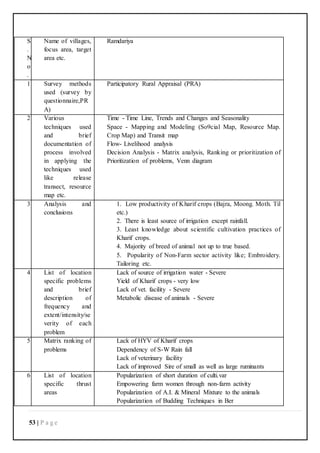
Ramdariya
1 Survey methods
used (survey by
questionnaire,PR
A)
Participatory Rural Appraisal (PRA)
2 Various
techniques used
and brief
documentation of
process involved
in applying the
techniques used
like release
transect, resource
map etc.
Time - Time Line, Trends and Changes and Seasonality
Space - Mapping and Modeling (So9cial Map, Resource Map.
Crop Map) and Transit map
Flow- Livelihood analysis
Decision Analysis - Matrix analysis, Ranking or prioritization of
Prioritization of problems, Venn diagram
3 Analysis and
conclusions
1. Low productivity of Kharif crops (Bajra, Moong. Moth. Til
etc.)
2. There is least source of irrigation except rainfall.
3. Least knowledge about scientific cultivation practices of
Kharif crops.
4. Majority of breed of animal not up to true based.
5. Popularity of Non-Farm sector activity like; Embroidery.
Tailoring etc.
4 List of location
specific problems
and brief
description of
frequency and
extent/intensity/se
verity of each
problem
Lack of source of irrigation water - Severe
Yield of Kharif crops - very low
Lack of vet. facility - Severe
Metabolic disease of animals - Severe
5 Matrix ranking of
problems
Lack of HYV of Kharif crops
Dependency of S-W Rain fall
Lack of veterinary facility
Lack of improved Sire of small as well as large ruminants
6 List of location
specific thrust
areas
Popularization of short duration of culti.var
Empowering farm women through non-farm activity
Popularization of A.I. & Mineral Mixture to the animals
Popularization of Budding Techniques in Ber
54 | P a g e
Popularization of water saving techniques
7 List of location
specific
technology needs
for OFT and FLD
Supplements of conc. ration to small ruminants animals
Popularization of Balanced conc. ration
Popularization of short duration of culti var.
Prophylactic health management practices
8 Matrix ranking of
technologies
Utilization of crop residues through inter mitten technologies
Utilization of fodder trees
Short duration of kharif crop var.
Empowerment through non farm sector activities
Popularization of vermi compost technology
Popularization of water saving devices
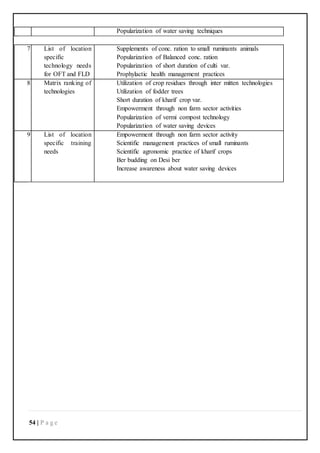
9 List of location
specific training
needs
Empowerment through non farm sector activity
Scientific management practices of small ruminants
Scientific agronomic practice of kharif crops
Ber budding on Desi ber
Increase awareness about water saving devices
55 | P a g e
FINDINGS
1. The people of Barmer are facing the problem of water for irrigation.
2. The people of villages are facing the problem of electricity.
3. The people of villages are facing the problems of education .Theirs children’s have to go far if they
want to get admission in upper than primary classes.
4. In villages the ratio of females are more than men, because the men of backward caste migrated in
search of work.
5. In villages production of bajara is more than other crops.
6. In villages most of the people are BPL (below poverty line)
7. In villages mostly farmers sow crops two times in a year.
8. Lack of transportation.
9. Lack of aanganwari in villages.
10. Lack of livestock safety.
56 | P a g e
RECOMMENDATIONS
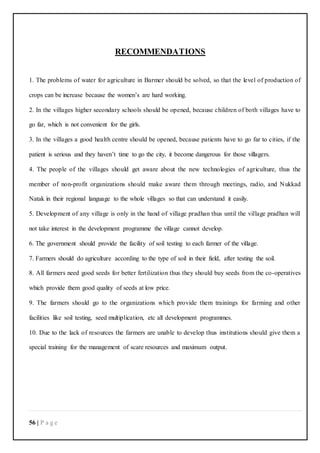
1. The problems of water for agriculture in Barmer should be solved, so that the level of production of
crops can be increase because the women’s are hard working.
2. In the villages higher secondary schools should be opened, because children of both villages have to
go far, which is not convenient for the girls.
3. In the villages a good health centre should be opened, because patients have to go far to cities, if the
patient is serious and they haven’t time to go the city, it become dangerous for those villagers.
4. The people of the villages should get aware about the new technologies of agriculture, thus the
member of non-profit organizations should make aware them through meetings, radio, and Nukkad
Natak in their regional language to the whole villages so that can understand it easily.
5. Development of any village is only in the hand of village pradhan thus until the village pradhan will
not take interest in the development programme the village cannot develop.
6. The government should provide the facility of soil testing to each farmer of the village.
7. Farmers should do agriculture according to the type of soil in their field, after testing the soil.
8. All farmers need good seeds for better fertilization thus they should buy seeds from the co-operatives
which provide them good quality of seeds at low price.
9. The farmers should go to the organizations which provide them trainings for farming and other
facilities like soil testing, seed multiplication, etc all development programmes.
10. Due to the lack of resources the farmers are unable to develop thus institutions should give them a
special training for the management of scare resources and maximum output.
57 | P a g e
SWOT ANALYSIS
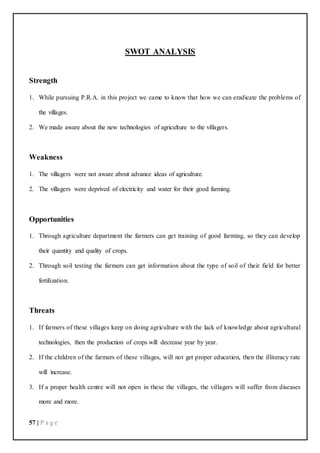
Strength
1. While pursuing P.R.A. in this project we came to know that how we can eradicate the problems of
the villages.
2. We made aware about the new technologies of agriculture to the villagers.
Weakness
1. The villagers were not aware about advance ideas of agriculture.
2. The villagers were deprived of electricity and water for their good farming.
Opportunities
1. Through agriculture department the farmers can get training of good farming, so they can develop
their quantity and quality of crops.
2. Through soil testing the farmers can get information about the type of soil of their field for better
fertilization.
Threats
1. If farmers of these villages keep on doing agriculture with the lack of knowledge about agricultural
technologies, then the production of crops will decrease year by year.
2. If the children of the farmers of these villages, will not get proper education, then the illiteracy rate
will increase.
3. If a proper health centre will not open in these the villages, the villagers will suffer from diseases
more and more.
58 | P a g e
ANNEXURE
Name of respondent..................................................................................................................
Caste..........................................Religion.....................................................Age........................Gender......
......................Village….............................................................................................
Gram Panchayat...............................................Population of village.......................................
1. What qualification do you have?
a. Primary b. Middle d. HSEC e. Graduate
b. SEC f. Illiterate
2. How many members are in your family?
a. 1-3 c. 7-9
b. 4-6 d. 10 & above
3. What is the main source of income of your family?
a. Agriculture d. Cattle ship
b. Business e. Service
c. Daily wage working f. Others
4. Do you have any debts?
a. Yes b. No
If Yes (specify)………………………………………………………………………….
…………………………………………………………………………………………………………
…………………………………………………………………………….
5. From where do you get finance to pay debts?
a. Govt. Banks b. Private banks c. Co-operative society’s d. Household income e.
Agriculture income f. Others Specify
6. Which type of live stock do you have?
a. Cow/buffalo d. Camel
b. Sheep e. Others
c. Goat
59 | P a g e
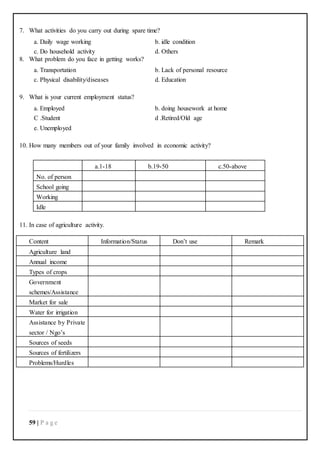
7. What activities do you carry out during spare time?
a. Daily wage working b. idle condition
c. Do household activity d. Others
8. What problem do you face in getting works?
a. Transportation b. Lack of personal resource
c. Physical disability/diseases d. Education
9. What is your current employment status?
a. Employed b. doing housework at home
C .Student d .Retired/Old age
e. Unemployed
10. How many members out of your family involved in economic activity?
a.1-18 b.19-50 c.50-above
No. of person
School going
Working
Idle
11. In case of agriculture activity.
Content Information/Status Don’t use Remark
Agriculture land
Annual income
Types of crops
Government
schemes/Assistance
Market for sale
Water for irrigation
Assistance by Private
sector / Ngo’s
Sources of seeds
Sources of fertilizers
Problems/Hurdles
60 | P a g e
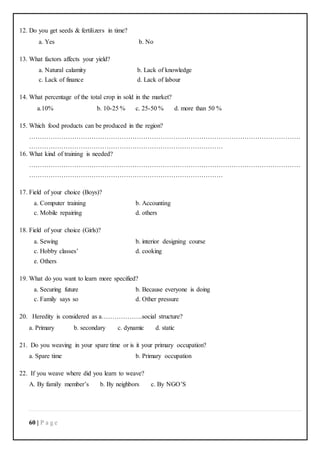
12. Do you get seeds & fertilizers in time?
a. Yes b. No
13. What factors affects your yield?
a. Natural calamity b. Lack of knowledge
c. Lack of finance d. Lack of labour
14. What percentage of the total crop in sold in the market?
a.10% b. 10-25 % c. 25-50 % d. more than 50 %
15. Which food products can be produced in the region?
………………………………………………………………………………………………………………
………………………………………………………………………………
16. What kind of training is needed?
………………………………………………………………………………………………………………
………………………………………………………………………………
17. Field of your choice (Boys)?
a. Computer training b. Accounting
c. Mobile repairing d. others
18. Field of your choice (Girls)?
a. Sewing b. interior designing course
c. Hobby classes’ d. cooking
e. Others
19. What do you want to learn more specified?
a. Securing future b. Because everyone is doing
c. Family says so d. Other pressure
20. Heredity is considered as a……………….social structure?
a. Primary b. secondary c. dynamic d. static
21. Do you weaving in your spare time or is it your primary occupation?
a. Spare time b. Primary occupation
22. If you weave where did you learn to weave?
A. By family member’s b. By neighbors c. By NGO’S
61 | P a g e
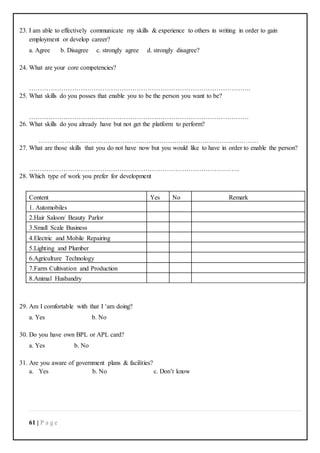
23. I am able to effectively communicate my skills & experience to others in writing in order to gain
employment or develop career?
a. Agree b. Disagree c. strongly agree d. strongly disagree?
24. What are your core competencies?
………………………………………………………………………………………….
25. What skills do you posses that enable you to be the person you want to be?
…………………………………………………………………………………………
26. What skills do you already have but not get the platform to perform?
…………………………………………………………………………………………
27. What are those skills that you do not have now but you would like to have in order to enable the person?
……………………………………………………………………………………..
28. Which type of work you prefer for development
Content Yes No Remark
1. Automobiles
2.Hair Saloon/ Beauty Parlor
3.Small Scale Business
4.Electric and Mobile Repairing
5.Lighting and Plumber
6.Agriculture Technology
7.Farm Cultivation and Production
8.Animal Husbandry
29. Am I comfortable with that I ‘am doing?
a. Yes b. No
30. Do you have own BPL or APL card?
a. Yes b. No
31. Are you aware of government plans & facilities?
a. Yes b. No c. Don’t know
62 | P a g e
Government schemes Problems
Yes
No
Remarks
1. Jawahar Gram Samridhi
Yojana
2. National Rural
Employment Guarantee
Scheme (NREGS)
3. Swarna Jayanti
Swarojgaar Yojana
4. Indira Awaas Yojana
5. Pradhaan Mantri
Gramodaya Yojana
6. Awasiya Rin / Anudaan
Yojana
7. Employment Assurance
Scheme
8. Panchayati Raj Yojana
9. Credit-cum-Subsidy
Scheme for Rural Housing
10. Desert Development
Programme
11. Rural Building Centers
63 | P a g e
12. Innovative Stream for
Rural Housing & Habitat
Development
13. Samagra Awaas Yojana
14. Combating Desertification
Programme
15. Uup Swasthya Kendra
Yojana
16. 32-Zila 32-Kaam
Yojana
17. Kaam ke Badle Anaaj
Yojana

A study on Socio-Economic status of farmers of villages in Jaisalmair district of Rajasthant

  • 1.
    1 | Pa g e PROJECT REPORT ON “A study on Socio-Economic status of farmers of villages, Barmer District” Submitted To Executive Director: Dr. M. Mukhtar Alam (Centre for Agriculture and Rural Development) By -Pratosh Parihar INSTITUTE OF RURAL MANAGEMENT, JODHPUR (Approved by AICTE, Recognizedby Ministry of HRD, Govt. of India) For the partial fulfillment of Post Graduate Diploma in Rural Management Submitted By: Submitted To: Pratosh Parihar Mr. Ankur Sharma FMS-IRM, Jodhpur Coordinator & Placement Cell FMS-IRM, Jodhpur
  • 2.
    2 | Pa g e ACKNOWLEDGEMENT At the very beginning, I take the privilege of offering my deep sense of gratitude and indebt ness to all the members of CARD for their support and co-operation throughout the study . Before taking up this pleasant task, I would like to first acknowledge the contribution this study has made to myself growth and experience as a development worker. This research is the result of the efforts and support of many people who helped me and made this experience worthwhile. I sincerely acknowledge my gratitude to CARD and field animator for helping me conducts the study and accesses all its resources. This research would not have been possible if it wasn’t for the encouragement and the moral support of a lot of people who I came across during the course of my research. My sincere thanks to Mr. Dr. M. Mukhtar alam (Program Coordinator) from CARD from whom I have learnt so much and who have constantly inspired me to do better each time in our meetings .They gave me their precious time and inputs to make this research possible. I am very much thankful to Mr. Dr. Prakash Sinha, the Director of Institute of Rural Management (FMS-IRM) Jodhpur for providing me with this opportunity to undergo a practical exposure in a non-governmental organization working on agriculture. Finally I add special thanks to my parents & friends for their continuous support inspiration and stimulation in the progress of this research. Above all “The Grace of Almighty” to complete my research work most successfully in the midst of so many hurdles and hardships encountered during my stay in the field area. Pratosh Parihar FMS-IRM
  • 3.
    3 | Pa g e TABLE OF CONTENTS Introduction Study methodology Title of study Duration of study Objectives of project Sample size and method of collecting sample Agriculture Data Findings Recommendations SWOT analysis Annexure
  • 4.
    4 | Pa g e Introduction About CARD CARD was Established and registered in the year 2000 under the Societies Registration Act 1860, Center for Agriculture and Rural Development is a premier Non Government Organization, accredited with ISO 9001: 2008 is playing a vibrant role in the national efforts of developing India through agriculture led transformation. CARD is committed to reaching all parts of the rural society especially farming community and participates actively towards improving the quality of life of rural masses by addressing technical, economical policy issues related to the development of agriculture and rural society. CARD is engaged in a variety of activities in agriculture, horticulture and rural development with an all India presence. CARD envisages developing agriculture and rural sector through project based activities. It focuses on information dissemination, training, capacity building and technology exposure by organizing business seminars, technical conferences, farmers workshops, agro trade fairs, conducting surveys & studies and adopting villages for their sustainable development. CARD monitors trends in agriculture and agribusinesses and advises Central and State Governments, NGOs and various bodies on appropriate policies and actions for the development of agriculture and rural economy. Its various bodies are engaged in a host of developmental activities for the benefit of rural society. CARD has strong links with the farming, business communities as well as policy makers built up through many years of consistent effort to voice agriculture issues and facilitating partnership between Government and the industry by initiating public private partnership in agriculture. The pioneering roles played by CARD in popularizing the concept of PPP, Government initiative on mass media support to agriculture, lowering of interest rates by organizing Parliamentarians conferences and working towards greater investments in agriculture sector, There has also been a long association of CARD with farmers throughout the country and with agencies and organizations involved with rural development. CARD has organized hundreds of rural expos, farmers’ seminars and workshops and participated in field projects. Through a series of activities to empower farmers on latest technology, quality products and services by organizing several capacities building sessions, workshops, rural exhibitions and interaction
  • 5.
    5 | Pa g e programmes. CARD has impacted over three lacs framers by a series of successfully carried out awareness campaigns at District and block levels. Till now CARD has covered 74 districts in various states like U.P., M.P., H.P, Haryana, Punjab, Maharashtra, Andhra Pradesh and North east region. CARD team is comprised of highly qualified and experienced persons from agriculture, horticulture, development sector, media and marketing, who have strong background in planning, designing and implementation of development initiatives. Vision To play a vibrant role in the national endeavor of developing India through agriculture led transformation; and participate actively in addressing information, technology, policy, resource and environment related issues for sustainable development of agriculture and towards improving the quality of life of rural India. Mission To act as a link and facilitator towards the national efforts of improving the quality of life of rural India by creating awareness, training & skills development and mobilizing the farmers and participating with them in implementation of developmental activities. Objective  To create pro-technology environment in agriculture by conducting surveys and studies on the important issues and spreading awareness among stake holders in rural and agriculture sector.  To develop information bank on agriculture and rural subjects and provide information access to people connected with agriculture, agribusiness and rural sectors.  To conduct studies and organize expert discussions, seminars and conferences on important agricultural issues and network with various institutions and agri industry to facilitate trade and agribusiness growth.  To mobilize, organize and work with the farmers on developmental projects to help them improve productivity and quality, cost reduction, crop diversification, skills development and taking up small rural enterprises.
  • 6.
    6 | Pa g e  To establish Farmers Information Centers at district levels, which would provide information on agriculture, value addition, rural enterprises etc. and would provide training & skills development to help improve the income of farmers and rural youths. ProjectDivision Given the daunting challenge of feeding over one billion population and to give agriculture the desired boost, Government of India came up with large scale projects such as Rashtriya Krishi Vikas Yojana, National Food Security Mission, National Horticulture Mission and Ushering Green Revolution in Eastern Region to name a few. With the funds being made available for development of agriculture, the issue remains of effective execution, as organizations in the State Government are short of manpower to alone handle large scale intervention projects. It therefore underlines the need for undertaking large projects under the above schemes. Centre for Agriculture and Rural Development, which is a large national non Governmental organization in agriculture and rural development and whose Management Board is headed by Dr. MS Swaminathan, has come forward to propose major interventions in agriculture sector in different States under various Central and State schemes in collaboration with public research and development institutions, wherein the front role being played by public institution, to execute development projects to ensure that accelerated pace of growth in agriculture. Exposure Division Government of India initiated the extension reforms programs in agriculture a long time ago. But it was only schemes like ATMA, NHM and HTM that really proved to be a watershed in the Agri Extension programmes. These schemes were mainly based on the concept of "Seeing believes". The farmers, through the medium of Demos, Melas, Training and Tours, are acquainted with the agricultural techniques practiced elsewhere and based on the results they get motivated to replicate the same in their farms. So far, the Technology Exposure Tours have been found to be the best source of informal learning for the farmers. So, these schemes have helped farmers not only raising the farm productivity- both quantitatively and qualitatively, but also have become the prime reason in improving economic conditions of farmers with added advantage of capacity building. Centre for Agriculture and Rural Development, a National level non-profit organization is on the forefront of
  • 7.
    7 | Pa g e Addressing the multitude of issues concerning agriculture, environment and society at large. The organization, among many other endeavors concerning farmers, also focuses on organizing and mobilizing communities to local as well as external resources for social, educational, environmental, technological and developmental interventions. CARD also undertakes training, capacity building and exposure visits by organizing business and technical seminars, workshops, technology tours and agro fairs to different parts of the country. CARD is the only national level organization, conducting farmers’ technology tours on behalf of various State Governments and District Authorities. CARD has successfully executed a large number of farmers’ exposure visits cum training programs for a number of states and agencies. CARD has developed over 45 tour modules and 12 training programs, suiting the needs of farmers belonging to different agro-climatic conditions, cropping husbandry and situations for improved cropping practices, modern technology etc. CARD has already identified Institutes of excellence, model farms and progressive/ innovative farmers for the tours, for instance Gujarat tour for cotton crop, Maharashtra tour for Horticulture, Rice tour to PAU Punjab and so on. About Bhagidari Centre for Agriculture and Rural Development is a premier Non Governmental Organization, which is playing a vibrant role for the development of agriculture sector in India. Since its inception, CARD is doing a variety of intervention to develop rural India. Under its ambitious, Uttar Pradesh Agriculture Development Project, CARD has established more than 130 Bhagidari Agribusiness Centre’s in Uttar Pradesh in various districts of Uttar Pradesh at Block level. This Centre’s are providing quality Agri-inputs and agronomic advisory services to farmers, organizing farmer’s workshops, execution of various Governmental schemes. Centre for Agriculture and Rural Development is the only NGO in India, which has the network of more than 130 Bhagidari Agribusiness Centre’s in UP, which is a unique model of Agri-entrepreneurship. Vision To act as a bridge among institutions, industries & grass roots through developing a network of Block level self sustaining Bhagidari Agribusiness Centre’s in Uttar Pradesh.
  • 8.
    8 | Pa g e Mission  To act as entry facilitator by providing complete solutions for agricultural products.  To offer as a single platform to corporate and institutions for sale and promotion of their product and scheme.  To function as a state level agency for execution of various agri and rural development programmes.  To act as catalyst and provide platform for product promotion, customized events, farmer’s workshops and capacity building programmes.  To facilitate agri graduates in establishing and running ACABC Centre’s and linking them with the Govt., Institutions and Industries to help them serve farmers better.  To maintain quality of the ACABC training programme and extend best possible help in the form handholding to agriculture graduates. MajorActivities  Customized rural promotion programmes.  Customized rural marketing and events services.  Execution of various agriculture development projects.  Rural Market Research.  Seed Production.  Marketing platform.  Bhagidari bulletin
  • 9.
    9 | Pa g e Core Executive Teamof CARD Director: Dr. Sahdev Singh With two post-graduate degrees in agriculture from USA, Dr. Singh has more than 25 years international academic, research and outreach experience in USA, Thailand and India through several universities and FAO-UN. He has written one book on ICT for agriculture and rural development, 8 book chapters, and more than 50 research papers in various international journals and books. He has travelled extensively in Europe, America, Asia, Africa and Middle-east on more than 50 professional consultancy missions and as invited conference speaker. He is a certified trainer from ILO-UN and has trained more than 1000 development professionals from around the world. Team: Shailendra Bahadur Pal: Head- Exposure Visit & Training CARD. B.tech in Biotechnology From Allahabad Agricultural Institute- Deemed University, Allahabad and Got a selected in CARD as Head- Exposure Visit & Training from last three years and responsible to manage the tour related matters like Liaison from different State level officials like Agriculture, Horticulture and Animal Husbandry Directors and Dy. Director Agri & Horti, Preparing proposal for Agriculture and Horticulture for Agri & Horti Exposure Visit & Training Program. .Handling the training and exposure visit programme under A.T.M.A. and N.H.M. Norms. . Ashima Colvin: ProjectOfficerCARD. M.sc. in Microbiology, Worked as SRF for last two years in Agricultural University, Meerut. Possess a wide knowledge of Agricultural sector as a whole. Completed Research on enhancing the protein content in Legumes and providing resistance to the plants and identification of DRG (drought resistant genes)in Legumes. Madhawendra Kumar Thakur: Zonal ProjectCoordinator, CARD. B.Sc. Agriculture From Allahabad Agricultural Institute- Deemed University, Allahabad and Got Selected for ICAR’s Junior Research Fellowship in Social Science group. Completed Masters from National Dairy Research Institute- Karnal with Dairy Economics. My dissertation on ‘Economics of Milk Production and Marketing of Milk in Samastipur District of Bihar’. Joined CARD as Senior Project Officer and responsible for Project formulation especially for Animal Husbandry and Dairy sectors.
  • 10.
    10 | Pa g e Mohd Shakeel:AssistantManager(Business Development), CARD. M.B.A. (Sales & Marketing) B.Sc. (Ag) from CSJM Kanpur-2004. Worked as a Field Assistant in Microplex Agro-chemicals during eight months from August-2004-June-2005.Join CARD in 2007 as Nodal Officer-ACABC-Cell looking after entire Uttar Pradesh. Key expertise: Training and Capacity building, project drafting Event management . Sanghmitra Singh: ProjectManager, CARD. B.Sc. (Maths) from CCS University, Meerut and MBA from UPTU and got selected in CARD as Project Manager from last two years and responsible to manage the tour related matters like like Liaison from different State level officials like Agriculture, Horticulture and Anilam Husbandry Directors and Dy. Director Agri & Horti & Animal Husbandry. Tour Arrangement (including accommodation through fa or calling, certificate, banner), Tour related data management, Preparing proposal for tour. Sanjeeta : AssistantManager, CARD. B.Sc. Agriculture from College of Agriculture Nagpur, which comes under Dr. P.D.K.V., Akola University. Got Selected for ICAR’s Junior Research Fellowship in Social Science group, and completed M.B.A. (Agri-Business) from U.A.S. Bangalore. Joined CARD as Assistant Manager in Research & Development and responsible for Project formulation, project handlings in market research working from last one year . ShahnawazAhmad: ProjectOfficer, CARD. M.B.A Tourism from University of Lucknow , and got selected in CARD as a Project Officer- Exposure Visit & Training from Feb 2011, responsible to manage the tour related matters like Liaisoning from different State level officials like Agriculture, Horticulture and Animal Husbandry Directors and Dy. Director Agri & Horti, .Handling the farmer training and exposure visit programme under A.T.M.A. and N.H.M. Norms. TabassumParveen:ProjectManger(TechnicalExposure),CARD. M.Sc. (Biotechnology) from CCS University, Meerut and B.Sc. (Biotechnology) from CCS University, Meerut and get selected in CARD as project Manager (Technical Exposure) . Handling the training and exposure visit programme under A.T.M.A. and N.H.M. Norms.
  • 11.
    11 | Pa g e PROJECT TITLE A study on Socio-Economic status of farmers of villages, Barmer District. DURATION OF PROJECT 20th may to 20th July 2013( 2 months ) STUDY METHODOLOGY Objectives of the study  The main objective of the study was to assess the social, economical and agricultural condition in Barmer District.  To explore the possibilities of improvement in these villages through various foundations.  To know about the satisfaction level of community.  To study about the perception level of community towards the agriculture. Approach of the study To fulfill the objective one has to analyze situation of area in all aspects. During the study it will be important for me to know about the agriculture, their working conditions, the resources available to them and the problems they face during their functioning. Secondly, necessary information is required about the impact of agriculture on community and the problems faced during the cultivation. For carrying out the study, combined methods of data collection were used so that all possible information will be available to make a comprehensive analysis and to examine recommendations for future interventions. Statisticaldata collection from primary and secondarysources Primary data  PRA (Participatory Rural Appraisal) exercise was carried out in order to gather the data, knowledge and experience of the villagers. The key points on which the information was gathered were related to the status of the villagers their land/crop management. Primary data is collected through the interview of 100 Farmers families of 6 region of Barmer and survey 11 more villages
  • 12.
    12 | Pa g e  which were mainly focus on agriculture.  In focus group discussion, the villagers personal opinions suggestions and requests were asked aspects of their needs.  Social and resource Mapping exercise were conducted in which the villagers sketched the village map Secondarydata. Secondary data was made available to us by the KVK (KRISHI VIGYAN KENDRA)
  • 13.
    13 | Pa g e SCOPE OF STUDY STATE: RAJASTHAN DISTRICT: BARMER TOTAL NO OF VILLAGE 17 Godaro ki dhani Chandaniyon ki dhani Mananiyon ki dhani Chittar ka paar Khan ji ka tala Chokhla Alamsar Sedva Sanau Nagdada Sava Suwala Sanawara Bola Bishala Jasindhar Ramdariya
  • 14.
    14 | Pa g e 1. What qualification do you have? S No. Qualification No. of respondent % of respondent A Primary 30 30 b Middle 10 10 c HSEC 0 0 d Graduate 0 0 e SEC 0 0 f Illiterate 60 60 Total 100 100 The above chart shows the literacy rate of villages. In villages 60% people are illiterate. 30% 10% 0% 0% 0% 60% primary middle HSEC Graduate SEC Illiterate
  • 15.
    15 | Pa g e 2. How many members are in your family? S.No Family members No. of respondent % of respondent a 1-3 7 7 b 7-9 63 63 c 4-6 29 29 d 10 & more 1 1 Total 100 100 7% 63% 29% 1% 1-3 7-9 4-6 10 & more
  • 16.
    16 | Pa g e 3. What is the main source of income of your family? S.No source of income No. of respondent % of respondent a Agriculture 65 65 b Business 0 0 c Daily wage working 40 40 d Cattle ship 0 0 e Service 2 2 f others 1 1 Total 108 108 According to above occupational ratio diagram in the villages approximately 70% people have their main occupation as agriculture and rest do daily wage or services. 60% 0% 37% 0% 2% 1% Agriculture Business Daily wage working Cattle ship Service others
  • 17.
    17 | Pa g e 4. Do you have any debts? S.No Debts No. of respondent % of respondent A Yes 4 4 B No 96 96 Total 100 100 In villages 96% people have no debts. Yes No
  • 18.
    18 | Pa g e 5. From where do you get finance to pay debts? S.No Finance to pay debts No. of respondent % of respondent a Govt.Banks 0 0 b Private banks 1 1 c Co-operative society,s 40 40 d Household income 3 3 e Agriculture income 46 46 f Others specify 37 37 Total 127 127 0% 1% 32% 2% 36% 29% Govt.Banks Private banks Co-operative society,s Household income Agriculture income Others specify
  • 19.
    19 | Pa g e 6. Which type of live stock do you have? S.No Live stock No. of respondent % of respondent a Cow/Buffalo 69 69 b Sheep 88 88 c Goat 23 23 d Camel 29 29 e Others 1 1 Total 210 210 It is further observed that there are villages in Barmer district have a very high number of cattle. Cow/Buffalo Sheep Goat Camel Others
  • 20.
    20 | Pa g e 7. What activities do you carry out during spare time? S.No Spare Time No. of respondent % of respondent a Daily wage working 71 71 b Idle condition 22 22 c Do household activity 13 13 d Others 52 52 Total 158 158 45% 14% 8% 33% Daily wage working Idle condition Do household activity Others
  • 21.
    21 | Pa g e 8. What problem do you face in getting works? S.No Problems No. of respondent % of respondent a Transportation 30 30 b Lack of personal resource 17 17 c Physical diability/disease 8 8 d Education 45 45 Total 100 100 30% 17% 8% 45% Transportation Lack of personal resource Physical diability/disease Education
  • 22.
    22 | Pa g e 9. What is your current employment status? S.No Employment status No. of respondent % of respondent a Employed 56 56 b Doing housework 12 12 c Student 2 2 d Retired/old age 20 20 e Unemployed 10 10 Total 100 100 10. How many members out of your family involved in economic activity? 40% people engaged in economic activity. 11. In case of agriculture activity. In the villages 70% people have own agriculture land and they have no government schemes for them and not proper facility for irrigation. 56% 12% 2% 20% 10% Employed Doing housework Student Retired/old age Unemployed
  • 23.
    23 | Pa g e 12. Do you get seeds & fertilizers in time? S.No Seeds&fertilizers No. of respondent % of respondent a Yes 10 10 b No 90 90 Total 100 100 10% 90% Yes No
  • 24.
    24 | Pa g e 13. What factors affects your yields? S.No Factors affects Yield No. of respondent % of respondent a Natural calamity 47 47 b Lack of knowledge 14 14 c Lack of finance 28 28 d Lack of Labour 11 11 Total 100 100 47% 14% 28% 11% Natural calamity Lack of knowledge Lack of finance Lack of Labour
  • 25.
    25 | Pa g e 14. What percentage of the total crop in sold in the market? S.No Sold in Market No. of respondent % of respondent a 10% 2 2 b 10-25% 0 0 c 25-50% 0 0 d more than 50% 0 0 Total 2 2 There is not the excess production in villages for selling in the market. 15. Which food products can be produced in the region? Bajra, jowar, moongbean, guar, wheat, cumin, mustard, 16. What kind of training is needed? Agriculture technology and irrigation facility. 100% 0%0%0% 10% 10-25% 25-50% more than 50%
  • 26.
    26 | Pa g e 17. Field of your choice (Boys)? S.No Choice(Boys) No. of respondent % of respondent A Computer training 5 5 B Accounting 2 2 C Mobile repairing 6 6 D Others 87 87 Total 100 100 In above chart most of the youth wants the others work. Computer training Accounting Mobile repairing Others
  • 27.
    27 | Pa g e 18. Field of your choice (Girls)? S.No Choice(GIRLS) No. of respondent % of respondent a Sewing 4 4 b Interior designing course 2 2 c Hobby classes 1 1 d Cooking 2 2 e Others 91 91 Total 100 100 Sewing Interior designing course Hobby classes Cooking Others
  • 28.
    28 | Pa g e 19. What do you want to learn more specified? S.No More specified No. of respondent % of respondent a Securing future 10 10 b Because everyone is doing 4 4 c Family says so 15 15 d Other pressure 10 10 Total 39 39 Securing future Because everyone is doing Family says so Other pressure
  • 29.
    29 | Pa g e 20. Heredity is considered as a……………….social structure? S.No Heredity No. of respondent % of respondent a Primary 4 4 b Secondary 6 6 c Dynamic 0 0 d Static 0 0 Total 10 10 21. Do you weaving in your spare time or is it your primary occupation? 1% people weaving in rural area 22. If you weave where did you learn to weave? No response 23. I am able to effectively communicate my skills & experience to others in writing in order to gain employment or develop career? No response 4 6 0 0 10 4 6 0 0 10 Primary Secondary Dynamic Static Total No. of respondent % of respondent
  • 30.
    30 | Pa g e 24. What are your core competencies? 80 % people wants agriculture training 25. What skills do you posses that enable you to be the person you want to be? No response 26. What skills do you already have but not get the platform to perform? No response 27. What are those skills that you do not have now but you would like to have in order to enable the person? No response 28. Which type of work you prefer for development? No response 29. Am I comfortable with that I ‘am doing? 20% villagers are comfortable with their works.
  • 31.
    31 | Pa g e 30. Do you have own BPL or APL card? S.No BPL/APL No. of respondent % of respondent a Yes 76 76 b No 24 24 Total 100 100 31. Are you aware of government plans & facilities? In rural areas villagers are illiterate that’s the reason they are not aware about the government plans & facilities. 76% 24% % of respondent Yes No
  • 32.
    32 | Pa g e HISTORY The Barmer district extends from 70.50 to 72.72 east longitude and from 24.58 to 26.32 north latitude .it is situated in the south western corner of the Rajasthan and it is a part of Thar desert it is surrounded by jaisalmer district in north , jalore in south, pali,jodhpur in the east and sindh of pakisthan in the west . Barmer is one of the oldest habitations of the Indian thar, the administration is exercised through 13 tehsils namely sheo, Baitu, pachpadra , siwana , gudamanali , barmer , ramsar , gadra road , dhorimanna, samdri, sindhari, sedhva and chohtan and 380 Gram panchayat, it has 1941 villages the populations of the this district as per the census 2011, gender ratio is 900 female per 1000 male, the population density of the district is 92 per sq/km. The literacy percent is 57.49(male-72.32,female-41.03) contribution of barmer district in the total income of the state is as low as 2.5% status of livelihood is also is very poor , education level is even worse as district is on the bottom.
  • 33.
    33 | Pa g e Area, production & productivity of major crops cultivation in the district Barmer (2011-12) Kharif Area(hectare) production Production q/hec Bajra 867013 753021 8.69 Jawar 3763 1448 3.85 Maize 03 05 16.67 Moongbean 54638 13194 2.41 Gaur 427803 111650 2.61 Groundnut 1028 1985 19.31 Cotton 09 27 5.10 Chilli 56 23 4.11 Rabi Area(hectare) production Production q/hec Wheat 11659 14405 12.36 Barley 20 57 28.36 Mustard 10249 6674 6.51 Tarameera 382 154 4.03 Cumin 132524 34017 2.57 Isabgol 58267 21535 3.70 Methi 161 171 10.62
  • 34.
    34 | Pa g e LAND UTILIZATION STATISTICS ( vital agricultural statics) Classification Rajasthan Barmer Area (ha) % Area (ha) % Geographical Area 3426378 - 28.733 2 - Forest 261014 7.74 31026 1.10 Area not available for cultivation 4278953 12.49 200690 7.12 Area not under agriculture 1764582 5.15 73680 2.62 Barren & uncultivable lands 2514371 7.34 127010 4.51 Other uncultivated land excluding follow lands 6582075 19.21 469432 16.66 Permanent pastures & other grazing lands 1703277 4.97 202872 7.20 Land under misc. tree crops & groves 12417 0.04 46 0.00 Culturable wasteland 4866381 13.80 266514 9.46 Fallow Land 9947231 29.03 105583 7 37.48 Fallow land other than current fallows 3259119 9.51 431260 15.31 Current fallows 6688117 19.52 624577 22.17 Net sown area 10807105 31.54 106034 7 37.64 Total cropped area 13217538 38.57 114912 6 40.79 Area sown more than once 2410433 7.03 88779 3.15
  • 35.
    35 | Pa g e General Feature of the District Barmer S.N o. Block Geographic al Area (Ha) No. of Gram Panchay at No. of revenu e village s Average rainfall (mm) 200 4 200 5 200 6 1. Barmer 289387 39 216 220 140 759 2. Ramsar 144637 18 127 118 180 779 3. Baitu 304542 46 319 224 66 666 4. Sheo 661632 45 267 187 176 478 5 Chohtan 469211 75 327 182 200 875 6. Guda Malani 397581 63 362 156 207 578 7. Siwana 204515 40 118 262 223 500 8. Pachpad ra 345837 54 240 291 266 540 Total 2817332 380 1976
  • 36.
    36 | Pa g e Major and Micro Farming system: Animal Husbandry based Agriculture 1. Crop Production Kharif Season Bajra (Pannisetum gluacum), Jowar (Sorghum bicolor), Maize (Zea Mays) Moth bean (Vigna acontifolia), Moongbean (Vigna radiate), Guar (Cyamopsis tetragonaloba), Castor (Ricinus Cuminus), Sesamum (Sesamum indicumm), Groundnut (Arachis ) Rabi Season Wheat (Triticum aestivumm), Barley (Hordium Vulagare), Mustard (Brassica Juncea). Taramira (Enca Sativa), Cumin (Cuminum cyminum), Isabgol (Plantago ovata) End Season Summer Bajra Arid fruit production Ber (Zizyphus mauritiana), Aonla (Amblica officinales) Gonda (Cordia mixa), Kair (Capparis decidua) Brinjal (Solenum melongna) ridge gourd (Luffa licautanagula) tinda (Cirtullus vulgaris), Long melon (Cucumis melo var, utilissiums) bottle gourd (Lagenaria siceraria), Kachri (Cucumis callosus), lady finger (Abelmoschus esculomtus) Long melon (Cucumis melon) ridge gourd (Luffa acutangula), amaranthus (Amaranthus tricolor) Snap melon (Cucumis melo var. Momordica) Onion (Allium cepa) radish (Raphanus sativus) carrot (Daucus carrota), Beet leaf (Beta vulgaris), Chillies (Capsiam annum) cabbage (Brassica oleracea) Var. Capitata) coriander (Coriandrum Sativum) Major trees and shrubs Jaal / Peelu (Salvadora persica), Mithi jaal (Salvadore Oleoides), Meethijal (Acacla ..........), Kummat (Accacia Senegal), Khejri (Prosopis cineraria), Rohida (Tecomella undula.....) (Capparis Decidua),
  • 37.
    37 | Pa g e Jharberi (Zizyphus mumularia), Babool (Acacia tortilis) Vilayati (Prosopis Juliflore). Fog (calligonum poly gonoides) Medicinal Crop/Trees Guggal (Commiphora whight), Asgandh/Winter Cherry (Withania somnifera), Isabgol (Pantago oveta), Aloe (Aloe vera), Heena (Lawsonia inermis), Sonamukhi (Cassia angustifolies). .... (Osium Sanctum), Neem (Azaduracgta indica), Tumba (citrullus colocynthis), Sinthar. Common Grasses Sewan Grass (Lesiurus sindicus), Anjan/Buffelgrass (Cenchrus Ciliaris), Dhaman/ Birdwood (Cenchrus stetigarus), Bharut (Carchrus biflorus), Lampra (Aristida funciculata), Bekaria ................... Cordifolia) Natural Fauna Sambhar, Buck, Reflux, Wild dog, desert fox, commen Indian Birds-crow, sparrow. pigeon. ....... Blue joy, hoppow, bulbul, Rohin, Indian Bustard sand grouse. Fish. Minerals : Input minerals produced in the district are bentonite, gypsum, siliceous, salt etc. Industries Textile, printing by blocks, oil industries, Dying & weaving. Shoe making, pottery. Ghee making Export articles from are salt, dyed & printed cloth, Gypsum. Bentonite. Wool & Ghee. Major Production system Bajra Based (Bajra, Moong bean, Moth Bean, Guar - Cumin, isabgol Mustard)
  • 38.
    38 | Pa g e MajorAgriculture & Allied Enterprises S. No. Name of Block Location of the processing unit Name of firm Commodity Processed Type of Processed 1 Siwana Siwana Ramzan oil mill Mustard Oil 2 Siwana Siwana National oil mill Mustard Oil 3 Barmer Barmer Adarsh guar gum udyog Guar Gum, Dal 4 Barmer Barmer Perakash guar gum udyog Guar Gum, Dal 5 Barmer Barmer Mahaveer guar gum udyog Guar Gum, Dal 6 Barmer Barmer West Raj guar gum udyog Guar Gum, Dal 7 Barmer Barmer Mahesh Agro udyog Guar Gum, Dal 8 Barmer Barmer Manidhari guar gum industries Guar Gum, Dal 9 Barmer Barmer Mehta guar gum Guar Gum, Dal 10 Barmer Barmer Rajasthan guar gum Guar Gum, Dal 11 Barmer Barmer Barmer agro industry Guar Gum, Dal 12 Barmer Barmer Bharat guar gum industries Guar Gum, Dal 13 Barmer Barmer Manidhari industries Wheat Atta, Maida & Suzi 14 Chohtan Chohtan Swastic floor mill Wheat Atta, Maida & Suzi 15 Dhorimanna Dhorimanna Sanjay guar gum Guar Gum, Dal 16 Dhorimanna Dhorimanna R.K. Guar gum Industries Guar Gum, Dal 17 Dhorimanna Dhorimanna Arihant Industries Guar Gum, Dal
  • 39.
    39 | Pa g e Agro-ecosystem Analysis of the focus S.No. Name of villages, focus area, target area etc. Aalmsar 1 Survey methods used (survey by questionnaire PRA ) Participatory Rural Appraisal (PRA) 2 Various techniques used and brief documentation of process involved in applying the techniques used like release transect, resource map etc. Time - Time Line, Trends and Changes and Seasonality Space - Mapping and Modeling (Social map, Resource map, Crop map) and Transect map Flow - Livelihood analysis Decision Analysis - Matrix analysis, Ranking or Prioritization of problems, Venn diagram 3 Analysis and conclusions Kharif crops 50% irrigated and rest 50% rain fed. Rabi crops fully irrigated Source of irrigation - Sprinkler and Drip No pest management Post harvest management -No proper use Use of Micronutrient - NIL Soil & Water problem Poor Banking facility Lack of A.I. Facility. 4 List of location specific problems and brief description of frequency and extent/ intensity/ severity of each problem Improper plant protection measure Poor credit facility Poor nutritional & disease management Lack of A.I. Facility Uncertainty of irrigation Lack of knowledge towards scientific agronomic practices Lack of improved seeds. 5 Matrix ranking of problems Lack of improved seeds Unbalanced use of fertilizer Wilt in Cumin Lack of knowledge improved agronomic practices Salinity problem of soil & water Inbreeding of animals Anoestrus of animals Mineral deficiency of animals Lack of proven sire bulls 6 List of location specific thrust areas Sustainability of crop production Reclamation of soil & water Motivate to the farmers for arid fruit crops top working in Desi ber Imp. of drip irrigation Imp. of A.I. for genetic improvement of animals
  • 40.
    40 | Pa g e Imp. of mineral mixture to animals 7 List of location specific technology needs for OFT and FLD Wilt problem in cumin Balanced conc. ration Use of improved seeds. Reclamation of soil Use of feed supplements in ration. 8 Matrix ranking of technologies Urea treatment of coarse roughage Incorporation of feed supplements in ration Crop rotation Seed treatment of crops Reclamation of soil Top Working in Desi Ber. 9 List of location specific training needs On Campus as well as Off-Campus trainings will be organized on above aspect. S. N o. Name of villages, focus area, target area etc. Sedva 1 Survey methods used (survey by questionnaire, PRA) Participatory Rural Appraisal (PRA) 2 Various techniques used and brief documentation of process involved in applying the techniques used like release transect, resource map etc. Time-Time Lime, Trends and Changes and Seasonality Space- Mapping and Modeling (Social Map, Resource map, Crop Map) and Transect map Flow- Livelihood analysis Decision Analysis - Matrix analysis, Ranking or Prioritization of problem, Venn diagram 3 Analysis and conclusion Least awareness towards scientific practice of animal production & management. Lack of awareness about scientific agronomic practices of field crops Lack of awareness about reclamation of problematic soil Low production of Kharif & Rabi crops, still they were using unidentified varieties of seeds of crops. Lack of awareness of important of horticulture crops. 4 List of location specific problems and brief description of frequency and extent/intensity/severity of each problem Brackish water poor situation Yield of field crop-Low Lack of improved sire - 70 to 80% Lack of veterinary facility - 90 to 100% Connectivity to Main highway – poor 5 Matrix ranking of problems Animals 1.Lack of Vet. Facility 2. Lack of improve Sire Crops 1. Low productivity of Soil Saline- soils
  • 41.
    41 | Pa g e 3. Lack of market facility of milk & products Kharif crops 2. Low productivity of Rabi crops 3. Lack of availability of HYV seeds Brackish water 6 List of location specific thrust areas Sustainable crop production by adopting improved agril. practices Management of saline soil Popularization of drip irrigation Diversification of agriculture through horticulture Increase area under horticulture crops (Ber. Aonla. Date Palm) 7 List of location specific technology needs for OFT and FLD Balanced concentrate ration Popularization of HYV of Kharif pulses Popularization of Mineral Mixture. Wilt resistant varieties of Cumin 8 Matrix ranking of technologies Animals 1.Popularization Prophylactic Health practices 2. Awareness about A.I. 3. Tie up with Barmer Saras Dairy, Barmer Crops 1.HYV of Kharif Pulses 2. HYV of Rabi crops 3. INM & IPM awareness Soil 1. reclamati on of soil through Gypsum & green manure 2. Crop - rotation 9 List of location specific training needs Preparation of conc. ration at home Preparation of mineral mixture. Improved practices of field crops Awareness about INM & IPM Popularization of vermi compost. S. N o. Name of villages, focus area, target area etc. Sanau 1. Survey methods used (survey by questionnaire, PRA) Participatory Rural Appraisal (PRA) 2. Various techniques used and brief documentation of process involved in Time-Time Lime, Trends and Changes and Seasonality Space- Mapping and Modeling (Social Map, Resource map, Crop Map) and Transect map
  • 42.
    42 | Pa g e applying the techniques used like release transect, resource map etc. Flow- Livelihood analysis Decision Analysis - Matrix analysis, Ranking or Prioritization of problem, Venn diagram 3. Analysis and conclusions 1. Low productivity of Kharif crops (Bajra, Moong, Moth, Til etc.) 2. There is least source of irrigation except rainfall. 3. Least knowledge about scientific cultivation practices of Kharif crops. 4. Majority of breed of animal not up to true based. 5. Popularity of Non-Farm sector activity like; Embroidery, Tailoring ect. 4. List of location specific problems and brief description of frequency and extent/ intensity/severity of each problem Lack of source of irrigation water – Severe Yield of Kharif crops - Very low Lack of vet. facility - Severe Metabolic disease of animals - Severe 5. Matrix ranking of problems Lack of HYV of Kharif crops Dependency of S-W Rain fall Lack of veterinary facility Lack of improved sire of small as well as large ruminants 6. List of location specific thrust areas Popularization of short duration of culti.var Empowering farm women through non-farm activity Popularization of A.I. & Mineral Mixture to the animals Popularization of Budding Techniques in Ber Popularization of Water saving Techniques 7. List of Location specific technology needs for OFT and FLD Supplements of conc. ration to small ruminants animals Popularization of Balanced conc. ration Popularization of short duration of culti var. Prophylactic health management practices 8. Matrix ranking of technologies Utilization of crop residues through inter mitten technologies Utilization of fodder trees Short duration of kharif crop var. Empowerment through non farm sector activities Popularization of vermi compost technology Popularization of water saving devices
  • 43.
    43 | Pa g e 9. List of location specific training needs Empowerment through non farm sector activity Scientific management practices of small ruminants Scientific agronomic practice of kharif crops Ber budding on Desi ber Increase awareness about water sieving devices Urea treatment of coarse roughage & UMMB Name of villages, focus are, target area etc. Nagdada 1. Survey methods used (survey by questionnaire, PRA) Participatory Rural Appraisal (PRA) 2. Various techniques used and brief documentation of process involved in applying the techniques used like release, resource map etc. Time - Time Line, Trends and Changes and Seasonality Space - Mapping and Modeling (So9cial Map, Resource Map. Crop Map) and Transit map Flow- Livelihood analysis Decision Analysis - Matrix analysis, Ranking or prioritization of Prioritization of problems, Venn diagram 3. Analysis and concussions Area under double crops- Moderate Interest in Horticulture crops - Least Problem in selling of Milk & Milk products-Moderate Lack of credit facility Maximum family livelihood based on Agriculture & A.H. Veterinary infrastructure facility - Moderate Awareness towards scientific attitude – Moderate 4. List of location specific problems and brief description of frequency and extent/intensity/severity of each problem Crop 1. Wilt problem in cumin - Severe 2. Use of local seeds of field crops severe 3. Lack of concept of INM & IPM 4. Majority dependency of field crops Animal 1. Low productivity of animals 2. Reproductive problems 3. Anoestrus of animals Soil 1. Salin ity probl em 5. Matrix ranking of problems Low productivity of field crops. Lack of knowledge towards horticulture crops Lack of concept of INM, PMP Use of local seeds Prolapsed of uterus of animal Anoestrus of dairy animal Metabolic disease of animals 6. List of location specific thrust areas Motivate to the farmers towards horticulture crops Sustainability of crops through improved practices
  • 44.
    44 | Pa g e Top working in Desi ber Scientific devices of farm residual management Reclamation of soil through various inter mitten technology Motivate to the farmer prophylactic health practices. 7. List of location specific technology needs for OFT and FLD Improved seeds of Kharif & Rabi crops. Imp. Of crop rotation & seed treatment. Balanced conc. ration Vermi compost technology Soil reclamation 8. Matrix ranking of technologies "Seed treatment with crop rotation Top working in Desi ber. Imp. of balanced conc. ration Soil & water testing Mineral mixture to the animals Supplementation of conc. ration @ 1% body weight for small animals. Use of A.I. for genetic improvement of animals. 9. List of location specific training needs Importance of HYV seeds with seed treatment & crop rotation Soil & Water testing Ber budding on Desi Ber Scientific feed & fodder management Imp. Of feed supplements to the animals. S. N o. Name of villages, focus area, target area etc. Sava 1 Survey methods used (survey by questionnaire, PRA) Participatory Rural Appraisal (PRA) 2 Various techniques used and brief documentation of process involved in applying the techniques used like release transect, resource map etc. Time - Time Line, Trends and Changes and Seasonality Space - Mapping and Modeling (So9cial Map, Resource Map. Crop Map) and Transit map Flow- Livelihood analysis Decision Analysis - Matrix analysis, Ranking or prioritization of Prioritization of problems, Venn diagram 3 Analysis and conclusions Lack of veterinary facility Awareness of farmers is moderate Max. farmers involved in other business activity besides Agriculture Involvement/adoption of Horticulture crops is poor Lack of improved practices towards sheep & Goat
  • 45.
    45 | Pa g e production Area under double crops-Moderate. 4 List of location specific problems and brief description of frequency and extent/intensity/severity of each problem Productivity of animals is low due to reproductive & production diseases is severe Lack of adoption prophylactic health management practices-Severe Unawareness towards horticulture crops Productivity of field crops- Moderate Salinity problems of water & soil 5 Matrix ranking of problems Crop 1.Least concept of INM & IPM 2.Use of local seeds 3. Least involvement in Horit. crops Animals 1.Market-Body weight of animals low 2.Supplementation of animals-Less 3.Inbreeding of animals-Severe Soil 1.Salin ity alkalini ty proble m of soil & water 6 List of location specific thrust areas Sustainable crop production Motivation of farmers towards horticulture crops Scientific feed & fodder management Reclamation of soil through Gypsum etc. Increase awareness towards farm residual management Prophylactic health management practices 7 List of location specific technology needs for OFT and FLD Control of wilt in cumin Top working in Desi ber Reclamation of soil Important of balanced concentrate ration & Min. mixture Castration of male kids before sell 8 Matrix ranking of technologies Improved seed & seed treatment Top working in Desi ber Supplementation of conc. ration beside grazing Reclamation of soil against salinity Increase awareness about A.I. Prophylactic Health Management practices 9 List of location specific training needs Soil & water testing Budding on Desi ber Importance of SHG Value addition of indigenous fruit Imp. of minerals & vitamins in Dairy animal Castration - How, When & Why? of small ruminants Use of top feeds in animal feeding.
  • 46.
    46 | Pa g e S. No . Name of villages, focus area, target area etc. Suwala 1 Survey methods used (survey by questionnaire, PRA) Participatory Rural Appraisal (PRA) 2 Various techniques used and brief documentation of process involved in applying the techniques used like release transect, resource map etc. Time - Time Line, Trends and Changes and Seasonality Space - Mapping and Modeling (So9cial Map, Resource Map. Crop Map) and Transit map Flow- Livelihood analysis Decision Analysis - Matrix analysis, Ranking or prioritization of Prioritization of problems, Venn diagram 3 Analysis and conclusions 1. Low productivity of Kharif crops (Bajra, Moong. Moth. Til etc.) 2. There is least source of irrigation except rainfall. 3. Least knowledge about scientific cultivation practices of Kharif crops. 4. Majority of breed of animal not up to true based. 5. Popularity of Non-Farm sector activity like; Embroidery. Tailoring etc. 4 List of location specific problems and brief description of frequency and extent/intensity/severity of each problem 1. Lack of source of irrigation water – Severe 2. Yield of Kharif crops - very low 3. Lack of vet. facility - Severe 4. Metabolic disease of animals - Severe 5 Matrix ranking of problems 1. Lack of HYV of Kharif crops 2. Dependency of S-W Rain fall 3. Lack of veterinary facility 4. Lack of improved Sire of small as well as large ruminants 6 List of location specific thrust areas 1. Popularization of short duration of culti.var 2. Empowering farm women through non-farm activity 3. Popularization of A.I. & Mineral Mixture to the animals 4. Popularization of Budding Techniques in Ber 5. Popularization of water saving techniques 7 List of location specific technology needs for OFT and FLD 1. Supplements of conc. ration to small ruminants animals 2. Popularization of Balanced conc. ration 3. Popularization of short duration of culti var. 4. Prophylactic health management practices 8 Matrix ranking of 1. Utilization of crop residues through inter mitten technologies
  • 47.
    47 | Pa g e technologies 2. Utilization of fodder trees 3. Short duration of kharif crop var. 4. Empowerment through non farm sector activities 5. Popularization of vermi compost technology 6. Popularization of water saving devices 9 List of location specific training needs 1. Empowerment through non farm sector activity 2. Scientific management practices of small ruminants 3. Scientific agronomic practice of kharif crops 4. Ber budding on Desi ber 5. Increase awareness about water saving devices 6. Urea treatment of coarse roughage & UMMB S . N o . Name of villages, focus area, target area etc. Bola 1 Survey methods used (survey by questionnaire, PRA) Participatory Rural Appraisal (PRA) 2 Various techniques used and brief documentation of process involved in applying the techniques used like release transect, resource map etc. Time - Time Line, Trends and Changes and Seasonality Space - Mapping and Modeling (So9cial Map, Resource Map. Crop Map) and Transit map Flow- Livelihood analysis Decision Analysis - Matrix analysis, Ranking or prioritization of Prioritization of problems, Venn diagram 3 Analysis and conclusions Low productivity of Kharif crops (Bajra, Moong. Moth. Til etc.) There is least source of irrigation except rainfall. Least knowledge about scientific cultivation practices of Kharif crops. Majority of breed of animal not up to true based. Popularity of Non-Farm sector activity like; Embroidery. Tailoring etc. 4 List of location specific problems Lack of source of irrigation water – Severe Yield of Kharif crops - very low
  • 48.
    48 | Pa g e and brief description of frequency and extent/intensity/se verity of each problem Lack of vet. facility - Severe Metabolic disease of animals - Severe 5 Matrix ranking of problems Lack of HYV of Kharif crops Dependency of S-W Rain fall Lack of veterinary facility Lack of improved Sire of small as well as large ruminants 6 List of location specific thrust areas Popularization of short duration of culti.var Empowering farm women through non-farm activity Popularization of A.I. & Mineral Mixture to the animals Popularization of Budding Techniques in Ber Popularization of water saving techniques 7 List of location specific technology needs for OFT and FLD Supplements of conc. ration to small ruminants animals Popularization of Balanced conc. ration Popularization of short duration of culti var. Prophylactic health management practices 8 Matrix ranking of technologies Utilization of crop residues through inter mitten technologies Utilization of fodder trees Short duration of kharif crop var. Empowerment through non farm sector activities Popularization of vermi compost technology Popularization of water saving devices 9 List of location specific training needs Empowerment through non farm sector activity Scientific management practices of small ruminants Scientific agronomic practice of kharif crops Ber budding on Desi ber Increase awareness about water saving devices Urea treatment of coarse roughage & UMMB S . N o . Name of villages, focus area, target area etc. Bishala 1 Survey methods used (survey by questionnaire, PRA) Participatory Rural Appraisal (PRA) 2 Various techniques used and brief Time - Time Line, Trends and Changes and Seasonality Space - Mapping and Modeling (So9cial Map, Resource Map. Crop Map) and Transit map
  • 49.
    49 | Pa g e documentation of process involved in applying the techniques used like release transect, resource map etc. Flow- Livelihood analysis Decision Analysis - Matrix analysis, Ranking or prioritization of Prioritization of problems, Venn diagram 3 Analysis and conclusions Low productivity of Kharif crops (Bajra, Moong. Moth. Til etc.) There is least source of irrigation except rainfall. Least knowledge about scientific cultivation practices of Kharif crops. Majority of breed of animal not up to true based. Popularity of Non-Farm sector activity like; Embroidery. Tailoring etc. 4 List of location specific problems and brief description of frequency and extent/intensity/se verity of each problem Lack of source of irrigation water - Severe Yield of Kharif crops - very low Lack of vet. facility - Severe Metabolic disease of animals - Severe 5 Matrix ranking of problems Lack of HYV of Kharif crops Dependency of S-W Rain fall Lack of veterinary facility Lack of improved Sire of small as well as large ruminants 6 List of location specific thrust areas Popularization of short duration of culti.var Empowering farm women through non-farm activity Popularization of A.I. & Mineral Mixture to the animals Popularization of Budding Techniques in Ber Popularization of water saving techniques 7 List of location specific technology needs for OFT and FLD Supplements of conc. ration to small ruminants animals Popularization of Balanced conc. ration Popularization of short duration of culti var. Prophylactic health management practices 8 Matrix ranking of technologies Utilization of crop residues through inter mitten technologies Utilization of fodder trees Short duration of kharif crop var. Empowerment through non farm sector activities Popularization of vermi compost technology Popularization of water saving devices 9 List of location specific training Empowerment through non farm sector activity Scientific management practices of small ruminants
  • 50.
    50 | Pa g e needs Scientific agronomic practice of kharif crops Ber budding on Desi ber Increase awareness about water saving devices Urea treatment of coarse roughage & UMMB S. N o. Name of villages, focus area, target area etc. Jasindhar 1 Survey methods used (survey by questionnaire, PRA) Participatory Rural Appraisal (PRA) 2 Various techniques used and brief documentation of process involved in applying the techniques used like release transect, resource map etc. Time - Time Line, Trends and Changes and Seasonality Space - Mapping and Modeling (So9cial Map, Resource Map. Crop Map) and Transit map Flow- Livelihood analysis Decision Analysis - Matrix analysis, Ranking or prioritization of Prioritization of problems, Venn diagram 3 Analysis and conclusions Low productivity of Kharif crops (Bajra, Moong. Moth. Til etc.) There is least source of irrigation except rainfall. Least knowledge about scientific cultivation practices of Kharif crops. Majority of breed of animal not up to true based. Popularity of Non-Farm sector activity like; Embroidery. Tailoring etc. 4 List of location specific problems and brief description of frequency and extent/intensity/ severity of each problem Lack of source of irrigation water - Severe Yield of Kharif crops - very low Lack of vet. facility - Severe Metabolic disease of animals - Severe 5 Matrix ranking of problems Lack of HYV of Kharif crops Dependency of S-W Rain fall
  • 51.
    51 | Pa g e Lack of veterinary facility Lack of improved Sire of small as well as large ruminants 6 List of location specific thrust areas Popularization of short duration of culti.var Empowering farm women through non-farm activity Popularization of A.I. & Mineral Mixture to the animals Popularization of Budding Techniques in Ber Popularization of water saving techniques 7 List of location specific technology needs for OFT and FLD Supplements of conc. ration to small ruminants animals Popularization of Balanced conc. ration Popularization of short duration of culti var. Prophylactic health management practices 8 Matrix ranking of technologies Utilization of crop residues through inter mitten technologies Utilization of fodder trees Short duration of kharif crop var. Empowerment through non farm sector activities Popularization of vermi compost technology Popularization of water saving devices 9 List of location specific training needs Empowerment through non farm sector activity Scientific management practices of small ruminants Scientific agronomic practice of kharif crops Ber budding on Desi ber Increase awareness about water saving devices Urea treatment of coarse roughage & UMMB S. N o. Name of villages, focus area, target area etc. Sanawara 1 Survey methods used (survey by questionnaire, PRA) Participatory Rural Appraisal (PRA) 2 Various techniques used and brief documentation of process involved in applying the techniques used like release transect, resource map Time - Time Line, Trends and Changes and Seasonality Space - Mapping and Modeling (So9cial Map, Resource Map. Crop Map) and Transeet map Flow- Livelihood analysis Decision Analysis - Matrix analysis, Ranking or prioritization of Prioritization of problems, Venn diagram
  • 52.
    52 | Pa g e etc. 3 Analysis and conclusions Low productivity of Kharif crops (Bajra, Moong. Moth. Til etc.) There is least source of irrigation except rainfall. Least knowledge about scientific cultivation practices of Kharif crops. Majority of breed of animal not up to true based. Popularity of Non-Farm sector activity like; Embroidery. Tailoring etc. 4 List of location specific problems and brief description of frequency and extent/intensity/ severity of each problem Lack of source of irrigation water - Severe Yield of Kharif crops - very low Lack of vet. facility - Severe Metabolic disease of animals - Severe 5 Matrix ranking of problems Lack of HYV of Kharif crops Dependency of S-W Rain fall Lack of veterinary facility Lack of improved Sire of small as well as large ruminants 6 List of location specific thrust areas Popularization of short duration of culti.var Empowering farm women through non-farm activity Popularization of A.I. & Mineral Mixture to the animals Popularization of Budding Techniques in Ber Popularization of water saving techniques 7 List of location specific technology needs for OFT and FLD Supplements of conc. ration to small ruminants animals Popularization of Balanced conc. ration Popularization of short duration of culti var. Prophylactic health management practices 8 Matrix ranking of technologies Utilization of crop residues through inter mitten technologies Utilization of fodder trees Short duration of kharif crop var. Empowerment through non farm sector activities Popularization of vermi compost technology Popularization of water saving devices 9 List of location specific training needs Empowerment through non farm sector activity Scientific management practices of small ruminants Scientific agronomic practice of kharif crops Ber budding on Desi ber Increase awareness about water saving devices Urea treatment of coarse roughage & UMMB
  • 53.
    53 | Pa g e S . N o . Name of villages, focus area, target area etc. Ramdariya 1 Survey methods used (survey by questionnaire,PR A) Participatory Rural Appraisal (PRA) 2 Various techniques used and brief documentation of process involved in applying the techniques used like release transect, resource map etc. Time - Time Line, Trends and Changes and Seasonality Space - Mapping and Modeling (So9cial Map, Resource Map. Crop Map) and Transit map Flow- Livelihood analysis Decision Analysis - Matrix analysis, Ranking or prioritization of Prioritization of problems, Venn diagram 3 Analysis and conclusions 1. Low productivity of Kharif crops (Bajra, Moong. Moth. Til etc.) 2. There is least source of irrigation except rainfall. 3. Least knowledge about scientific cultivation practices of Kharif crops. 4. Majority of breed of animal not up to true based. 5. Popularity of Non-Farm sector activity like; Embroidery. Tailoring etc. 4 List of location specific problems and brief description of frequency and extent/intensity/se verity of each problem Lack of source of irrigation water - Severe Yield of Kharif crops - very low Lack of vet. facility - Severe Metabolic disease of animals - Severe 5 Matrix ranking of problems Lack of HYV of Kharif crops Dependency of S-W Rain fall Lack of veterinary facility Lack of improved Sire of small as well as large ruminants 6 List of location specific thrust areas Popularization of short duration of culti.var Empowering farm women through non-farm activity Popularization of A.I. & Mineral Mixture to the animals Popularization of Budding Techniques in Ber
  • 54.
    54 | Pa g e Popularization of water saving techniques 7 List of location specific technology needs for OFT and FLD Supplements of conc. ration to small ruminants animals Popularization of Balanced conc. ration Popularization of short duration of culti var. Prophylactic health management practices 8 Matrix ranking of technologies Utilization of crop residues through inter mitten technologies Utilization of fodder trees Short duration of kharif crop var. Empowerment through non farm sector activities Popularization of vermi compost technology Popularization of water saving devices 9 List of location specific training needs Empowerment through non farm sector activity Scientific management practices of small ruminants Scientific agronomic practice of kharif crops Ber budding on Desi ber Increase awareness about water saving devices
  • 55.
    55 | Pa g e FINDINGS 1. The people of Barmer are facing the problem of water for irrigation. 2. The people of villages are facing the problem of electricity. 3. The people of villages are facing the problems of education .Theirs children’s have to go far if they want to get admission in upper than primary classes. 4. In villages the ratio of females are more than men, because the men of backward caste migrated in search of work. 5. In villages production of bajara is more than other crops. 6. In villages most of the people are BPL (below poverty line) 7. In villages mostly farmers sow crops two times in a year. 8. Lack of transportation. 9. Lack of aanganwari in villages. 10. Lack of livestock safety.
  • 56.
    56 | Pa g e RECOMMENDATIONS 1. The problems of water for agriculture in Barmer should be solved, so that the level of production of crops can be increase because the women’s are hard working. 2. In the villages higher secondary schools should be opened, because children of both villages have to go far, which is not convenient for the girls. 3. In the villages a good health centre should be opened, because patients have to go far to cities, if the patient is serious and they haven’t time to go the city, it become dangerous for those villagers. 4. The people of the villages should get aware about the new technologies of agriculture, thus the member of non-profit organizations should make aware them through meetings, radio, and Nukkad Natak in their regional language to the whole villages so that can understand it easily. 5. Development of any village is only in the hand of village pradhan thus until the village pradhan will not take interest in the development programme the village cannot develop. 6. The government should provide the facility of soil testing to each farmer of the village. 7. Farmers should do agriculture according to the type of soil in their field, after testing the soil. 8. All farmers need good seeds for better fertilization thus they should buy seeds from the co-operatives which provide them good quality of seeds at low price. 9. The farmers should go to the organizations which provide them trainings for farming and other facilities like soil testing, seed multiplication, etc all development programmes. 10. Due to the lack of resources the farmers are unable to develop thus institutions should give them a special training for the management of scare resources and maximum output.
  • 57.
    57 | Pa g e SWOT ANALYSIS Strength 1. While pursuing P.R.A. in this project we came to know that how we can eradicate the problems of the villages. 2. We made aware about the new technologies of agriculture to the villagers. Weakness 1. The villagers were not aware about advance ideas of agriculture. 2. The villagers were deprived of electricity and water for their good farming. Opportunities 1. Through agriculture department the farmers can get training of good farming, so they can develop their quantity and quality of crops. 2. Through soil testing the farmers can get information about the type of soil of their field for better fertilization. Threats 1. If farmers of these villages keep on doing agriculture with the lack of knowledge about agricultural technologies, then the production of crops will decrease year by year. 2. If the children of the farmers of these villages, will not get proper education, then the illiteracy rate will increase. 3. If a proper health centre will not open in these the villages, the villagers will suffer from diseases more and more.
  • 58.
    58 | Pa g e ANNEXURE Name of respondent.................................................................................................................. Caste..........................................Religion.....................................................Age........................Gender...... ......................Village…............................................................................................. Gram Panchayat...............................................Population of village....................................... 1. What qualification do you have? a. Primary b. Middle d. HSEC e. Graduate b. SEC f. Illiterate 2. How many members are in your family? a. 1-3 c. 7-9 b. 4-6 d. 10 & above 3. What is the main source of income of your family? a. Agriculture d. Cattle ship b. Business e. Service c. Daily wage working f. Others 4. Do you have any debts? a. Yes b. No If Yes (specify)…………………………………………………………………………. ………………………………………………………………………………………………………… ……………………………………………………………………………. 5. From where do you get finance to pay debts? a. Govt. Banks b. Private banks c. Co-operative society’s d. Household income e. Agriculture income f. Others Specify 6. Which type of live stock do you have? a. Cow/buffalo d. Camel b. Sheep e. Others c. Goat
  • 59.
    59 | Pa g e 7. What activities do you carry out during spare time? a. Daily wage working b. idle condition c. Do household activity d. Others 8. What problem do you face in getting works? a. Transportation b. Lack of personal resource c. Physical disability/diseases d. Education 9. What is your current employment status? a. Employed b. doing housework at home C .Student d .Retired/Old age e. Unemployed 10. How many members out of your family involved in economic activity? a.1-18 b.19-50 c.50-above No. of person School going Working Idle 11. In case of agriculture activity. Content Information/Status Don’t use Remark Agriculture land Annual income Types of crops Government schemes/Assistance Market for sale Water for irrigation Assistance by Private sector / Ngo’s Sources of seeds Sources of fertilizers Problems/Hurdles
  • 60.
    60 | Pa g e 12. Do you get seeds & fertilizers in time? a. Yes b. No 13. What factors affects your yield? a. Natural calamity b. Lack of knowledge c. Lack of finance d. Lack of labour 14. What percentage of the total crop in sold in the market? a.10% b. 10-25 % c. 25-50 % d. more than 50 % 15. Which food products can be produced in the region? ……………………………………………………………………………………………………………… ……………………………………………………………………………… 16. What kind of training is needed? ……………………………………………………………………………………………………………… ……………………………………………………………………………… 17. Field of your choice (Boys)? a. Computer training b. Accounting c. Mobile repairing d. others 18. Field of your choice (Girls)? a. Sewing b. interior designing course c. Hobby classes’ d. cooking e. Others 19. What do you want to learn more specified? a. Securing future b. Because everyone is doing c. Family says so d. Other pressure 20. Heredity is considered as a……………….social structure? a. Primary b. secondary c. dynamic d. static 21. Do you weaving in your spare time or is it your primary occupation? a. Spare time b. Primary occupation 22. If you weave where did you learn to weave? A. By family member’s b. By neighbors c. By NGO’S
  • 61.
    61 | Pa g e 23. I am able to effectively communicate my skills & experience to others in writing in order to gain employment or develop career? a. Agree b. Disagree c. strongly agree d. strongly disagree? 24. What are your core competencies? …………………………………………………………………………………………. 25. What skills do you posses that enable you to be the person you want to be? ………………………………………………………………………………………… 26. What skills do you already have but not get the platform to perform? ………………………………………………………………………………………… 27. What are those skills that you do not have now but you would like to have in order to enable the person? …………………………………………………………………………………….. 28. Which type of work you prefer for development Content Yes No Remark 1. Automobiles 2.Hair Saloon/ Beauty Parlor 3.Small Scale Business 4.Electric and Mobile Repairing 5.Lighting and Plumber 6.Agriculture Technology 7.Farm Cultivation and Production 8.Animal Husbandry 29. Am I comfortable with that I ‘am doing? a. Yes b. No 30. Do you have own BPL or APL card? a. Yes b. No 31. Are you aware of government plans & facilities? a. Yes b. No c. Don’t know
  • 62.
    62 | Pa g e Government schemes Problems Yes No Remarks 1. Jawahar Gram Samridhi Yojana 2. National Rural Employment Guarantee Scheme (NREGS) 3. Swarna Jayanti Swarojgaar Yojana 4. Indira Awaas Yojana 5. Pradhaan Mantri Gramodaya Yojana 6. Awasiya Rin / Anudaan Yojana 7. Employment Assurance Scheme 8. Panchayati Raj Yojana 9. Credit-cum-Subsidy Scheme for Rural Housing 10. Desert Development Programme 11. Rural Building Centers
  • 63.
    63 | Pa g e 12. Innovative Stream for Rural Housing & Habitat Development 13. Samagra Awaas Yojana 14. Combating Desertification Programme 15. Uup Swasthya Kendra Yojana 16. 32-Zila 32-Kaam Yojana 17. Kaam ke Badle Anaaj Yojana