
Author = Subhasis Nayak CMC
Distributed computing  Evolution of distributive computing. Past step affairs Development environments were developed with a specific task in mind. A backend application A front end application Development languages for  backend and front end environments.
Cont’d ….  For backend we used: Cobol Mind frame For front end we used: C++ VB Too much difficult to customize because layer by layer. Communication of communication devices are improved: TCT/IP Some complex soft wares developed for data transmission. All those time consuming . The internet provide a new way of communication through HTTP.
Challenges Challenges of enterprise application development: Application is usually across multiple machines. Develop an enterprise application with emphasis on response times. Rapidly develop application. Quicker error fixing. As internet adapted everywhere Maintain and leverage existing system. Use new technologies to accelerate the organization. Quick problem solving
Why J2EE platform It is a three tier to n –tier architecture . Not limited to single machine and single OS. Addresses core issues that enterprise application needed. Use variety of enterprise computing vendors. Can use widest possible range of  enterprise application requirements.
Tiered Architecture How ever there are 4 types of tiered architecture is available: Single tier architecture  2 – tier architecture 3 – tier architecture N – tier architecture
Single tier architecture Client  Logic  EIS
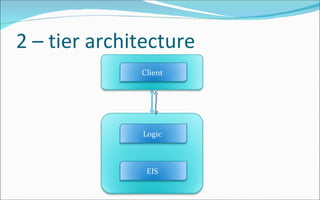
2 – tier architecture  Client  Logic  EIS
3 – tier architecture Client  Logic  EIS
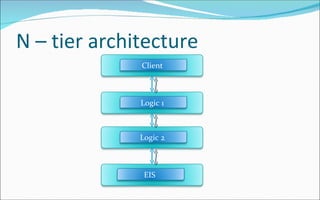
N – tier architecture Client  Logic 1  EIS  Logic 2
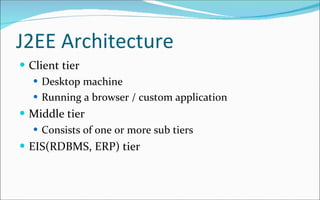
J2EE Architecture Client tier Desktop machine Running a browser / custom application Middle tier Consists of one or more sub tiers EIS(RDBMS, ERP) tier
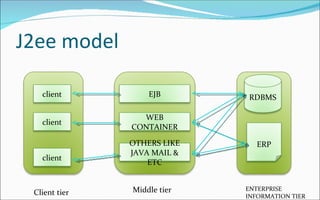
J2ee model Client tier Middle tier ENTERPRISE INFORMATION TIER client client client EJB WEB CONTAINER OTHERS LIKE JAVA MAIL & ETC RDBMS ERP
J2ee specification Different scenario for J2EE. J2ee specification tends to embrace and encourage diversity. J2ee programming model needs to embrace application scenarios It treats EJB and web containers as optional logical entities(break down the components and put them in different tier).
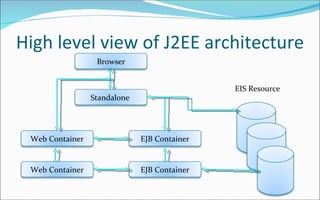
High level view of J2EE architecture Web Container Web Container EJB Container EJB Container Browser Standalone  EIS Resource
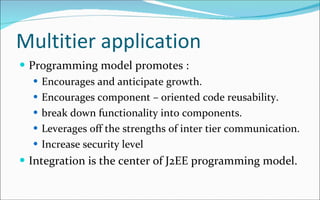
Multitier application  Programming model promotes : Encourages and anticipate growth. Encourages component – oriented code reusability. break down functionality into components. Leverages off the strengths of inter tier communication. Increase security level Integration is the center of J2EE programming model.
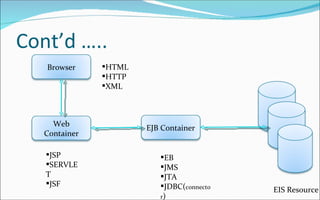
Cont’d ….. EIS Resource JSP SERVLET JSF HTML HTTP XML EB JMS JTA JDBC( connector ) Web Container EJB Container Browser
Stand alone application JSP SERVLET JSF HTML HTTP XML EB JMS JTA JDBC( connector ) EIS Resource Web Container EJB Container Stand alone Client
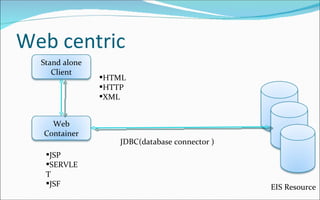
Web centric  JSP SERVLET JSF HTML HTTP XML JDBC(database connector ) EIS Resource Web Container Stand alone Client
3 – tier web centric Browser JSP Data Access Object Fire wall Servlet Data Access Object Java Mail
Technology to work on web architecture You have to use: JDK 1.5 or higher Tomcat apache 5.2 or higher A text editor Dreamweaver
MVC Architecture MVC stands for  Model  –  View  –  Controller.  It analyze feature of distributed application. Fine art of dividing object functionality into logical components.  Logical components can be developed more quickly. Developed to map input, processing, and output tasks of a graphical user interaction model.
Cont’d …. Model represents application Data. Rules that govern the modification of data. Notifies view when it changes. Provides the ability to query the model about state when ever required. View renders the contents of a model  & maintains consistency in its presentation. Controller defines the application behavior.
Flow of data in MVC Controller   View   Model   Web Browser
 

J2ee connector architecture

  • 1.
  • 2.
    Distributed computing Evolution of distributive computing. Past step affairs Development environments were developed with a specific task in mind. A backend application A front end application Development languages for backend and front end environments.
  • 3.
    Cont’d …. For backend we used: Cobol Mind frame For front end we used: C++ VB Too much difficult to customize because layer by layer. Communication of communication devices are improved: TCT/IP Some complex soft wares developed for data transmission. All those time consuming . The internet provide a new way of communication through HTTP.
  • 4.
    Challenges Challenges ofenterprise application development: Application is usually across multiple machines. Develop an enterprise application with emphasis on response times. Rapidly develop application. Quicker error fixing. As internet adapted everywhere Maintain and leverage existing system. Use new technologies to accelerate the organization. Quick problem solving
  • 5.
    Why J2EE platformIt is a three tier to n –tier architecture . Not limited to single machine and single OS. Addresses core issues that enterprise application needed. Use variety of enterprise computing vendors. Can use widest possible range of enterprise application requirements.
  • 6.
    Tiered Architecture However there are 4 types of tiered architecture is available: Single tier architecture 2 – tier architecture 3 – tier architecture N – tier architecture
  • 7.
    Single tier architectureClient Logic EIS
  • 8.
    2 – tierarchitecture Client Logic EIS
  • 9.
    3 – tierarchitecture Client Logic EIS
  • 10.
    N – tierarchitecture Client Logic 1 EIS Logic 2
  • 11.
    J2EE Architecture Clienttier Desktop machine Running a browser / custom application Middle tier Consists of one or more sub tiers EIS(RDBMS, ERP) tier
  • 12.
    J2ee model Clienttier Middle tier ENTERPRISE INFORMATION TIER client client client EJB WEB CONTAINER OTHERS LIKE JAVA MAIL & ETC RDBMS ERP
  • 13.
    J2ee specification Differentscenario for J2EE. J2ee specification tends to embrace and encourage diversity. J2ee programming model needs to embrace application scenarios It treats EJB and web containers as optional logical entities(break down the components and put them in different tier).
  • 14.
    High level viewof J2EE architecture Web Container Web Container EJB Container EJB Container Browser Standalone EIS Resource
  • 15.
    Multitier application Programming model promotes : Encourages and anticipate growth. Encourages component – oriented code reusability. break down functionality into components. Leverages off the strengths of inter tier communication. Increase security level Integration is the center of J2EE programming model.
  • 16.
    Cont’d ….. EISResource JSP SERVLET JSF HTML HTTP XML EB JMS JTA JDBC( connector ) Web Container EJB Container Browser
  • 17.
    Stand alone applicationJSP SERVLET JSF HTML HTTP XML EB JMS JTA JDBC( connector ) EIS Resource Web Container EJB Container Stand alone Client
  • 18.
    Web centric JSP SERVLET JSF HTML HTTP XML JDBC(database connector ) EIS Resource Web Container Stand alone Client
  • 19.
    3 – tierweb centric Browser JSP Data Access Object Fire wall Servlet Data Access Object Java Mail
  • 20.
    Technology to workon web architecture You have to use: JDK 1.5 or higher Tomcat apache 5.2 or higher A text editor Dreamweaver
  • 21.
    MVC Architecture MVCstands for Model – View – Controller. It analyze feature of distributed application. Fine art of dividing object functionality into logical components. Logical components can be developed more quickly. Developed to map input, processing, and output tasks of a graphical user interaction model.
  • 22.
    Cont’d …. Modelrepresents application Data. Rules that govern the modification of data. Notifies view when it changes. Provides the ability to query the model about state when ever required. View renders the contents of a model & maintains consistency in its presentation. Controller defines the application behavior.
  • 23.
    Flow of datain MVC Controller View Model Web Browser
  • 24.