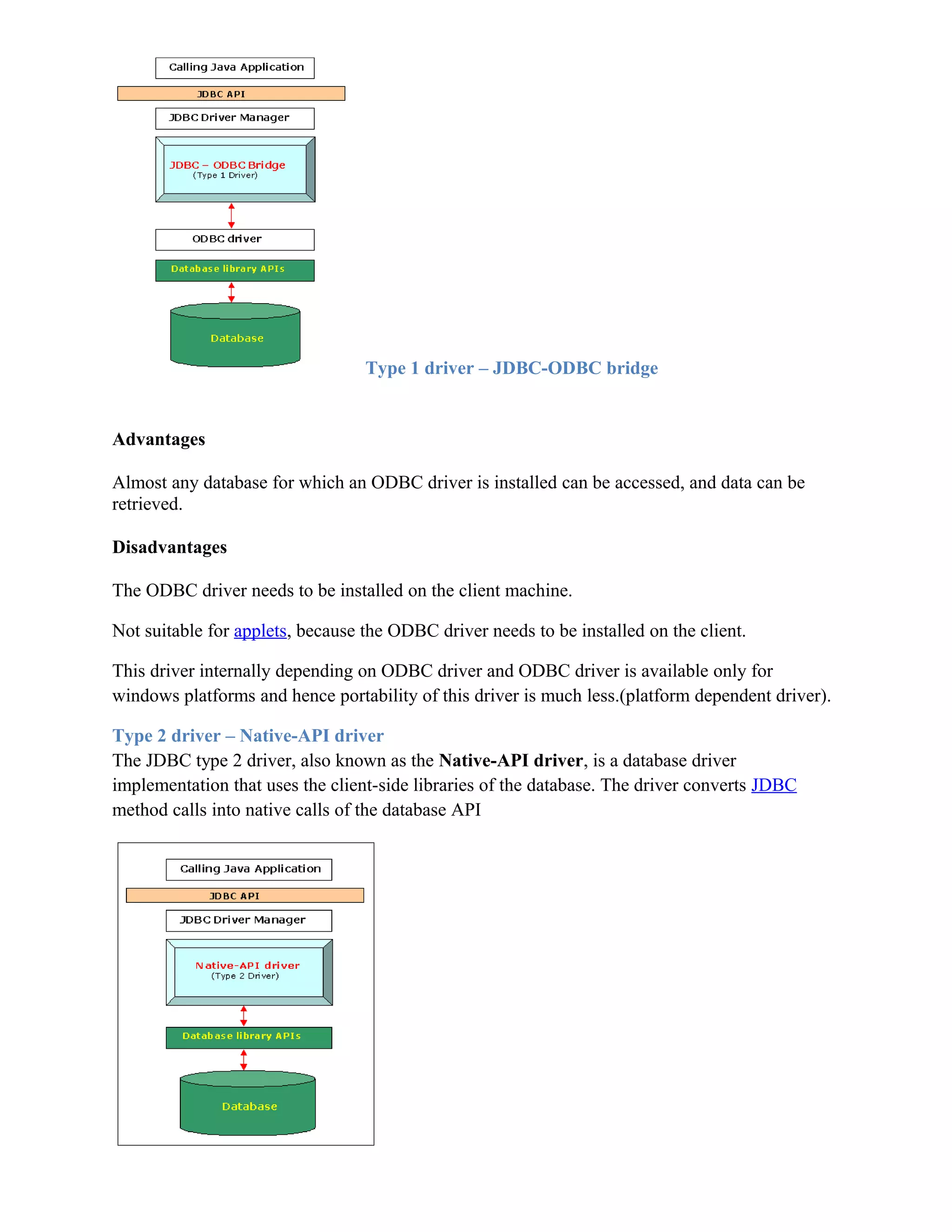
Type 1 driver – JDBC-ODBC bridge
Advantages
Almost any database for which an ODBC driver is installed can be accessed, and data can be
retrieved.
Disadvantages
The ODBC driver needs to be installed on the client machine.
Not suitable for applets, because the ODBC driver needs to be installed on the client.
This driver internally depending on ODBC driver and ODBC driver is available only for
windows platforms and hence portability of this driver is much less.(platform dependent driver).
Type 2 driver – Native-API driver
The JDBC type 2 driver, also known as the Native-API driver, is a database driver
implementation that uses the client-side libraries of the database. The driver converts JDBC
method calls into native calls of the database API
Advantages
• As there is no implementation of JDBC-ODBC bridge, its considerably faster than a type
1 driver.
Disadvantages
• The vendor client library needs to be installed on the client machine.
• Not all databases have a client side library.
• This driver is platform dependent.
• This driver supports all java applications except applets.
Type 3 driver – Network-Protocol driver (middleware driver)
The JDBC type 3 driver, also known as the Pure Java driver for database middleware,[6]
is a
database driver implementation which makes use of a middle tier between the calling program
and the database. The middle-tier (application server) converts JDBC calls directly or indirectly
into the vendor-specific database protocol.
. Advantages
• Since the communication between client and the middleware server is database
independent, there is no need for the database vendor library on the client. The client
need not be changed for a new database.
• The middleware server (which can be a full-fledged J2EE Application server) can
provide typical middleware services like caching (of connections, query results, etc.),
load balancing, logging, and auditing.
• A single driver can handle any database, provided the middleware supports it.
• E.g.: IDA Server
Disadvantages
• Requires database-specific coding to be done in the middle tier.
• The middleware layer added may result in additional latency, but is typically overcome
by using better middleware services.
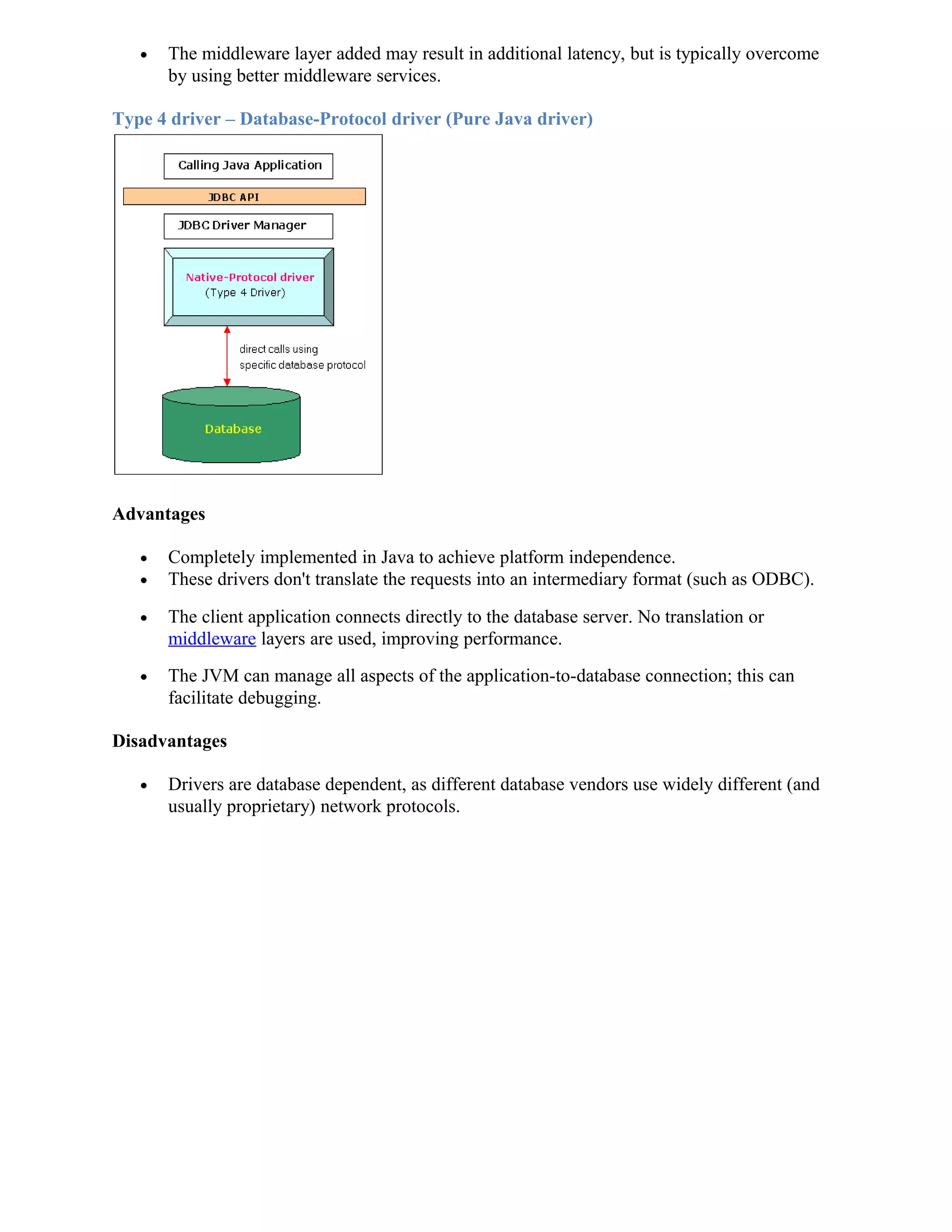
Type 4 driver – Database-Protocol driver (Pure Java driver)
Advantages
• Completely implemented in Java to achieve platform independence.
• These drivers don't translate the requests into an intermediary format (such as ODBC).
• The client application connects directly to the database server. No translation or
middleware layers are used, improving performance.
• The JVM can manage all aspects of the application-to-database connection; this can
facilitate debugging.
Disadvantages
• Drivers are database dependent, as different database vendors use widely different (and
usually proprietary) network protocols.

Jdbc drivers

  • 1.
    Type 1 driver– JDBC-ODBC bridge Advantages Almost any database for which an ODBC driver is installed can be accessed, and data can be retrieved. Disadvantages The ODBC driver needs to be installed on the client machine. Not suitable for applets, because the ODBC driver needs to be installed on the client. This driver internally depending on ODBC driver and ODBC driver is available only for windows platforms and hence portability of this driver is much less.(platform dependent driver). Type 2 driver – Native-API driver The JDBC type 2 driver, also known as the Native-API driver, is a database driver implementation that uses the client-side libraries of the database. The driver converts JDBC method calls into native calls of the database API
  • 2.
    Advantages • As thereis no implementation of JDBC-ODBC bridge, its considerably faster than a type 1 driver. Disadvantages • The vendor client library needs to be installed on the client machine. • Not all databases have a client side library. • This driver is platform dependent. • This driver supports all java applications except applets. Type 3 driver – Network-Protocol driver (middleware driver) The JDBC type 3 driver, also known as the Pure Java driver for database middleware,[6] is a database driver implementation which makes use of a middle tier between the calling program and the database. The middle-tier (application server) converts JDBC calls directly or indirectly into the vendor-specific database protocol. . Advantages • Since the communication between client and the middleware server is database independent, there is no need for the database vendor library on the client. The client need not be changed for a new database. • The middleware server (which can be a full-fledged J2EE Application server) can provide typical middleware services like caching (of connections, query results, etc.), load balancing, logging, and auditing. • A single driver can handle any database, provided the middleware supports it. • E.g.: IDA Server Disadvantages • Requires database-specific coding to be done in the middle tier.
  • 3.
    • The middlewarelayer added may result in additional latency, but is typically overcome by using better middleware services. Type 4 driver – Database-Protocol driver (Pure Java driver) Advantages • Completely implemented in Java to achieve platform independence. • These drivers don't translate the requests into an intermediary format (such as ODBC). • The client application connects directly to the database server. No translation or middleware layers are used, improving performance. • The JVM can manage all aspects of the application-to-database connection; this can facilitate debugging. Disadvantages • Drivers are database dependent, as different database vendors use widely different (and usually proprietary) network protocols.