


Author – Subhasis Nayak
   It means a program can obtain required
    memory at runtime. Run time means when
    the program starts executing not compile
    time.
   In C++ for dynamic memory allocation we
    have two uninary operators.
    ◦ New
    ◦ Delete
   It is used to allocate the memory space when
    ever required.
   It is also used to create objects of all types,
    including a class name.
   You can allocate memory to a pointer only at
    runtime. Syntax is:
    ◦ Pointer-variable = new data-type
      the data type may be a valid C++ data type
      Pointer-variable is a pointer of type data-type
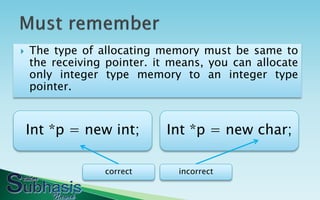
   The type of allocating memory must be same to
    the receiving pointer. it means, you can allocate
    only integer type memory to an integer type
    pointer.


    Int *p = new int;        Int *p = new char;

                 correct       incorrect
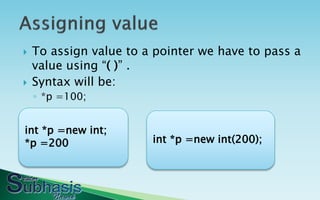
   To assign value to a pointer we have to pass a
    value using “( )” .
   Syntax will be:
    ◦ *p =100;


int *p =new int;
*p =200                 int *p =new int(200);
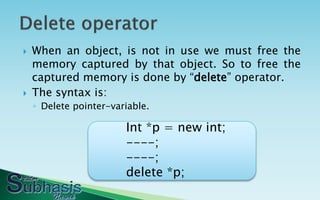
   When an object, is not in use we must free the
    memory captured by that object. So to free the
    captured memory is done by “delete” operator.
   The syntax is:
    ◦ Delete pointer-variable.

                        Int *p = new int;
                        ----;
                        ----;
                        delete *p;
   We can use the keyword const for pointers
    before the type, after the type, or in both
    places. For example, all the following
    declarations are legal:
    ◦ const int * p;
    ◦ int * const q;
    ◦ const int * const r;
   Each of the above having different meaning
    and different tasks.
   *p is a pointer to a constant integer. The
    value that is pointed to can‟t be changed.
   We can say the int pointed to a constant.
   „q‟ is a constant pointer to an integer. The
    integer can be changed, but „q‟ can‟t point to
    anything else.
   „q‟ is constant, it can‟t point to anything else.
   „r‟ is a constant pointer to a constant integer.
    The value that is pointed to can‟t be changed,
    and „r‟ can‟t be changed to point to anything
    else.

Pointer in c++ part3

  • 1.
  • 2.
    It means a program can obtain required memory at runtime. Run time means when the program starts executing not compile time.  In C++ for dynamic memory allocation we have two uninary operators. ◦ New ◦ Delete
  • 3.
    It is used to allocate the memory space when ever required.  It is also used to create objects of all types, including a class name.  You can allocate memory to a pointer only at runtime. Syntax is: ◦ Pointer-variable = new data-type  the data type may be a valid C++ data type  Pointer-variable is a pointer of type data-type
  • 4.
    The type of allocating memory must be same to the receiving pointer. it means, you can allocate only integer type memory to an integer type pointer. Int *p = new int; Int *p = new char; correct incorrect
  • 5.
    To assign value to a pointer we have to pass a value using “( )” .  Syntax will be: ◦ *p =100; int *p =new int; *p =200 int *p =new int(200);
  • 7.
    When an object, is not in use we must free the memory captured by that object. So to free the captured memory is done by “delete” operator.  The syntax is: ◦ Delete pointer-variable. Int *p = new int; ----; ----; delete *p;
  • 8.
    We can use the keyword const for pointers before the type, after the type, or in both places. For example, all the following declarations are legal: ◦ const int * p; ◦ int * const q; ◦ const int * const r;  Each of the above having different meaning and different tasks.
  • 9.
    *p is a pointer to a constant integer. The value that is pointed to can‟t be changed.  We can say the int pointed to a constant.
  • 10.
    „q‟ is a constant pointer to an integer. The integer can be changed, but „q‟ can‟t point to anything else.  „q‟ is constant, it can‟t point to anything else.
  • 11.
    „r‟ is a constant pointer to a constant integer. The value that is pointed to can‟t be changed, and „r‟ can‟t be changed to point to anything else.