Overview of Design Patterns
             &
 The MVC Design Pattern
         Sapana Mehta
Sapana Mehta (CS-6V81)


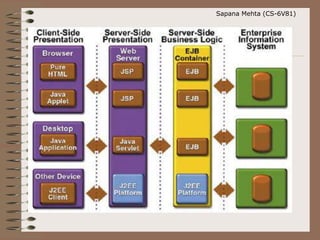
                    J2EE

• Components
   – Enterprise Java Beans (EJB)
   – Java Server Pages (JSP)
   – Servlets
• Containers (service providers)
   – Web container
   – Bean Container
• Connectors (connection service providers)
Sapana Mehta (CS-6V81)


     J2EE and Design Patterns

• J2EE: AN OPERATING SYSTEM FOR THE WEB
  Enterprise web applications, which live on
  networks and are accessible through
  browsers, are redefining Enterprise Web
  Software. This is the next wave of computing.


• The J2EE architecture is built to enable
  component developers to use a Model View
  Controller (MVC) Design Pattern.
Sapana Mehta (CS-6V81)


        MVC continued

• Model encapsulates the core data and
  functionality
• View encapsulates the presentation of the data
  there can be many views of the common data
• Controller accepts input from the user and
  makes request from the model for the data to
  produce a new view.
Sapana Mehta (CS-6V81)


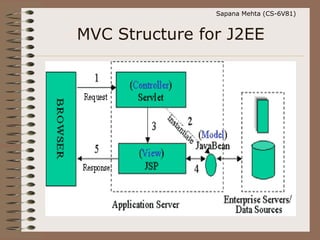
MVC Structure for J2EE
Sapana Mehta (CS-6V81)


             MVC Architecture
• The Model represents the structure of the data in the
  application, as well as application-specific operations
  on those data.

• A View (of which there may be many) presents data in
  some form to a user, in the context of some
  application function.

• A Controller translates user actions (mouse
  motions, keystrokes, words spoken, etc.) and user
  input into application function calls on the model, and
  selects the appropriate View based on user preferences
  and Model state.
Sapana Mehta (CS-6V81)


           Advantages of MVC

• Separating Model from View (that is,
  separating data representation from
  presentation)
  - easy to add multiple data presentations for
    the same data,
  -facilitates adding new types of data
  presentation as technology develops.
  -Model and View components can vary
  independently enhancing maintainability,
  extensibility, and testability.
Sapana Mehta (CS-6V81)

     Advantages of MVC design
             Pattern
• Separating Controller from View (application behavior
   from presentation)
   - permits run-time selection of appropriate
    Views based on workflow, user preferences,
    or Model state.
• Separating Controller from Model (application behavior
   from data representation)
  - allows configurable mapping of user actions
    on the Controller to application functions on
    the Model.
Sapana Mehta (CS-6V81)


    Consequences or Benefits

• We make changes without bringing down the
  server.
• We leave the core code alone
• We can have multiple versions of the same
  data displayed
• We can test our changes in the actual
  environment.
• We have achieved “separation of concerns”

Jsp with mvc

  • 1.
    Overview of DesignPatterns & The MVC Design Pattern Sapana Mehta
  • 2.
    Sapana Mehta (CS-6V81) J2EE • Components – Enterprise Java Beans (EJB) – Java Server Pages (JSP) – Servlets • Containers (service providers) – Web container – Bean Container • Connectors (connection service providers)
  • 3.
  • 4.
    Sapana Mehta (CS-6V81) J2EE and Design Patterns • J2EE: AN OPERATING SYSTEM FOR THE WEB Enterprise web applications, which live on networks and are accessible through browsers, are redefining Enterprise Web Software. This is the next wave of computing. • The J2EE architecture is built to enable component developers to use a Model View Controller (MVC) Design Pattern.
  • 5.
    Sapana Mehta (CS-6V81) MVC continued • Model encapsulates the core data and functionality • View encapsulates the presentation of the data there can be many views of the common data • Controller accepts input from the user and makes request from the model for the data to produce a new view.
  • 6.
    Sapana Mehta (CS-6V81) MVCStructure for J2EE
  • 7.
    Sapana Mehta (CS-6V81) MVC Architecture • The Model represents the structure of the data in the application, as well as application-specific operations on those data. • A View (of which there may be many) presents data in some form to a user, in the context of some application function. • A Controller translates user actions (mouse motions, keystrokes, words spoken, etc.) and user input into application function calls on the model, and selects the appropriate View based on user preferences and Model state.
  • 8.
    Sapana Mehta (CS-6V81) Advantages of MVC • Separating Model from View (that is, separating data representation from presentation) - easy to add multiple data presentations for the same data, -facilitates adding new types of data presentation as technology develops. -Model and View components can vary independently enhancing maintainability, extensibility, and testability.
  • 9.
    Sapana Mehta (CS-6V81) Advantages of MVC design Pattern • Separating Controller from View (application behavior from presentation) - permits run-time selection of appropriate Views based on workflow, user preferences, or Model state. • Separating Controller from Model (application behavior from data representation) - allows configurable mapping of user actions on the Controller to application functions on the Model.
  • 10.
    Sapana Mehta (CS-6V81) Consequences or Benefits • We make changes without bringing down the server. • We leave the core code alone • We can have multiple versions of the same data displayed • We can test our changes in the actual environment. • We have achieved “separation of concerns”