Author – Subhasis Nayak
 A pointer is a variable that holds a
  memory address. That’s it.
 This is what the difference in between
  variable and pointer.
    ◦ Pointer holds the address
    ◦ Variable holds the value.
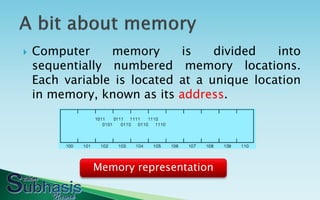
   Computer     memory        is    divided   into
    sequentially numbered       memory locations.
    Each variable is located   at a unique location
    in memory, known as its    address.


              Memory representation
 Thecapability to use pointers and
 manipulate memory at a low level
 is one of the factors that makes
 C++ the language of choice for
 embedded        and      real-time
 applications.
   Different computers number this memory
    using different complex schemes.
   We must happy, as a programmer, We don’t
    need to know the particular address of any
    given variable because the compiler handles
    the details.
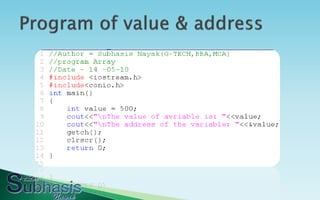
   If we want this information, though, you can
    use the address-of operator (&), which
    returns the address of an object in memory.
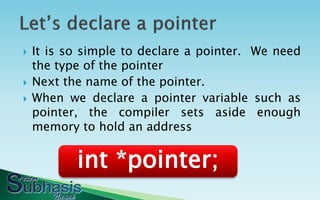
   It is so simple to declare a pointer. We need
    the type of the pointer
   Next the name of the pointer.
   When we declare a pointer variable such as
    pointer, the compiler sets aside enough
    memory to hold an address


           int *pointer;
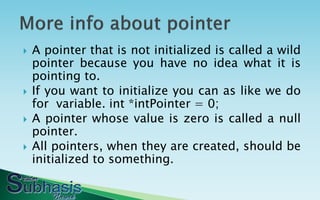
   A pointer that is not initialized is called a wild
    pointer because you have no idea what it is
    pointing to.
   If you want to initialize you can as like we do
    for variable. int *intPointer = 0;
   A pointer whose value is zero is called a null
    pointer.
   All pointers, when they are created, should be
    initialized to something.
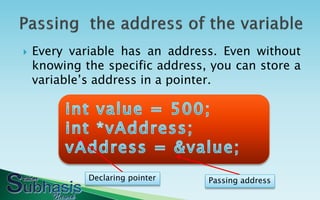
   Every variable has an address. Even without
    knowing the specific address, you can store a
    variable’s address in a pointer.


             Declaring pointer   Passing address
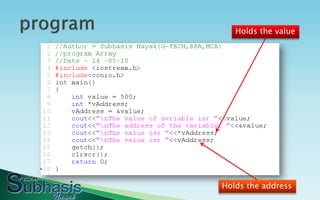
Holds the value


Holds the address
   Type must be same to the variable whose
    address is going to pass to the pointer.
   When you want to pass the address of the
    variable use (&) before the variable name.
   When you want to pass the value use (*)
    before the pointer.

Pointer in c++ part1

  • 1.
  • 2.
     A pointeris a variable that holds a memory address. That’s it.  This is what the difference in between variable and pointer. ◦ Pointer holds the address ◦ Variable holds the value.
  • 3.
    Computer memory is divided into sequentially numbered memory locations. Each variable is located at a unique location in memory, known as its address. Memory representation
  • 4.
     Thecapability touse pointers and manipulate memory at a low level is one of the factors that makes C++ the language of choice for embedded and real-time applications.
  • 5.
    Different computers number this memory using different complex schemes.  We must happy, as a programmer, We don’t need to know the particular address of any given variable because the compiler handles the details.  If we want this information, though, you can use the address-of operator (&), which returns the address of an object in memory.
  • 7.
    It is so simple to declare a pointer. We need the type of the pointer  Next the name of the pointer.  When we declare a pointer variable such as pointer, the compiler sets aside enough memory to hold an address int *pointer;
  • 8.
    A pointer that is not initialized is called a wild pointer because you have no idea what it is pointing to.  If you want to initialize you can as like we do for variable. int *intPointer = 0;  A pointer whose value is zero is called a null pointer.  All pointers, when they are created, should be initialized to something.
  • 9.
    Every variable has an address. Even without knowing the specific address, you can store a variable’s address in a pointer. Declaring pointer Passing address
  • 10.
  • 11.
    Type must be same to the variable whose address is going to pass to the pointer.  When you want to pass the address of the variable use (&) before the variable name.  When you want to pass the value use (*) before the pointer.