ETHICS DEFINED Ethics is a study of good conduct, character, & motives & is concerned with determining what is good or valuable for all people.  It goes beyond personal preferences to establish norms & standards upon which individuals, professions & societies agree.
NURSING ETHICS Within nursing, specific values & moral requirements are necessary to maintain the integrity of the profession.  An ethical nurse will act & treat others in specific ways that are consistent with nursing norms & will be guided by more than personal preferences or values.
NURSING ETHICS (cont’d) To become mature professionals who are able to participate effectively in the ethical dimensions of their practice, nurses must continue to develop a strong sense of their moral identity, seek support from professional resources & expand their knowledge and skill in the area of ethics.
NURSING ETHICS (cont’d) A nurse assumes responsibility and accountability for nursing care provided.
RESPONSIBILITY Refers to the execution of duties associated with the nurse’s particular role.  A nurse who acts in a responsible manner gains the trust of clients & other professionals.  A responsible nurse remains competent in knowledge & skills & demonstrates a willingness to perform within the ethical guidelines of the profession.
RESPONSIBILITY  (example) When administering medications, the nurse is responsible for assessing clients’ need for the drugs, giving them safely & correctly, and evaluating the responses.
ACCOUNTABILITY Being answerable for one’s own actions.  A nurse is accountable to self, the client, the profession, the employer, and society
ACCOUNTABILITY (example) If a wrong dose of medication is given, the nurse is accountable to the client who received it, the physician who ordered it, the nursing service that set standards of expected performance, & society which demands professional excellence.
ACCOUNTABILITY (example cont’d) Thus, when an error is made, the nurse reports it and initiates care to prevent further injury.  Accountability calls for an evaluation of a nurse’s effectiveness in practice.
ACCOUNTABILITY PURPOSE 1. To evaluate new professional practices & reassess existing ones. 2. To maintain standards of health care. 3. To facilitate personal reflection, ethical thought, & personal growth on the part of health care professionals. 4. To provide a basis for ethical decision making.
VARIABLES AFFECTING ETHICAL DECISIONS Because ethical problems occur in situations involving people who have different approaches to “moral reasoning”, it is helpful if the nurse can sort through the various factors that influence a persons’ thinking.
VARIABLES (cont’d) Emotions Legal considerations Cultural diversity Religious/Spiritual convictions Education level Past life experiences Developmental level
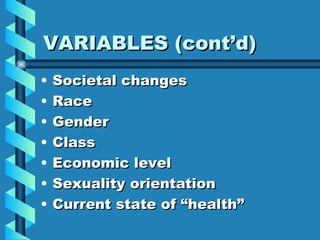
VARIABLES (cont’d) Societal changes Race Gender Class Economic level Sexuality orientation Current state of “health”
ETHICAL DECISION MAKING METHODS Each ethical situation or dilemma will be different, but the nurse in any setting can use the following guidelines for ethical processing and decision making.
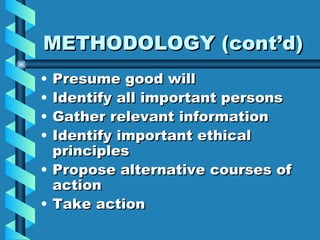
METHODOLOGY (cont’d) Presume good will Identify all important persons Gather relevant information Identify important ethical principles Propose alternative courses of action Take action
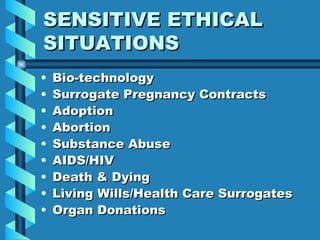
SENSITIVE ETHICAL SITUATIONS Bio-technology Surrogate Pregnancy Contracts Adoption Abortion Substance Abuse AIDS/HIV Death & Dying Living Wills/Health Care Surrogates Organ Donations
NAPNES CODE OF ETHICS (LPN) Refer to the printed sheets
STANDARD OF PRACTICE (LPN) Refer to printed sheets
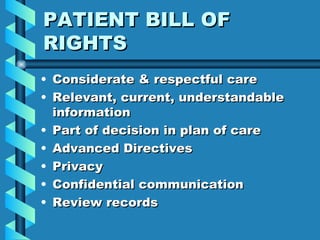
PATIENT BILL OF RIGHTS Considerate & respectful care Relevant, current, understandable information Part of decision in plan of care Advanced Directives Privacy Confidential communication Review records
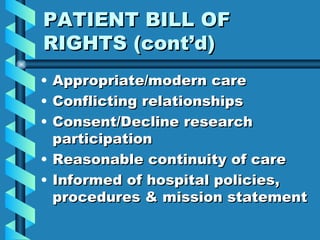
PATIENT BILL OF RIGHTS (cont’d) Appropriate/modern care Conflicting relationships Consent/Decline research participation Reasonable continuity of care Informed of hospital policies, procedures & mission statement
NURSE PRACTICE ACT In all states in the US, nurse practice acts regulate the licensure & practice of nurses.  Each state defines for itself the scope of nursing practice.
LEGAL TERMS DEFINED A  TORT  is a civil wrong made against a property.  Torts may be classified as unintentional or intentional.  An example of an unintentional tort is  NEGLIGENCE  or  MALPRACTICE.  Intentional torts are willful acts that violate another’s rights (assault, battery, defamation, and invasion of privacy).
LEGAL DEFINITIONS (cont’d) NEGLIGENCE: Conduct that falls below a standard of care. MALPRACTICE: Results when nursing care is below that required for safe nursing practice.
LEGAL DEFINITIONS (cont’d) No intent is needed for negligence to occur.  It is established by law for the protection of others against reasonable risk of harm.  It is characterized chiefly by inadvertence, thoughtlessness, carelessness, or inattention.
NEGLIGENCE & MALPRACTICE (cont’d) If a nurse performs a procedure for which they have not been trained and do it carefully, but still harm the patient, a claim of negligence or malpractice could be made.
NEGLIGENCE & MALPRACTICE (cont’d) If nurses give care that does not meet appropriate standards, they may be held negligent.  Because these actions are performed by a professional, the negligence of the nurse is termed malpractice.
NEGLIGENCE & MALPRACTICE RISKS IV therapy errors resulting in infiltration of phlebitis Burns from improperly monitored heat therapy Falls resulting in injury Failure to use aseptic technique Errors in sponge, instrument, or needle counts in surgical cases
NEGLIGENCE & MALPRACTICE (cont’d) Nurses must perform all procedures correctly.  They must also use professional judgment as they carry out MD orders as well as independent nursing therapies for which they have authority.
NEGLIGENCE & MALPRACTICE (cont’d) The following actions must take place for Nursing Negligence to occur: Nurse owed a duty to patient Nurse did not carry out duty Patient was injured Patient’s injuries were result of the nurse’s failure to carry out the duty
STUDENT NURSE ROLE Student nurses must also practice nursing in a reasonably safe manner. They should never be assigned to tasks for which they are unprepared & should be carefully supervised by instructors/staff as they learn new procedures.
STUDENT ROLE (cont’d) Student nurses are expected to perform as professional nurses would in providing safe patient care. Student nurses must be accountable for informing staff of their current safe level of practice.
STAYING LEGAL Nurses can reduce their chances of being named in lawsuits by following standards of care, giving competent health care, & developing an empathetic rapport with patients.  In addition, careful, complete, & objective documentation serves as evidence of the standard of nursing care provided.
NATIONAL LEAGUE FOR NURSING NLN Membership:  Anyone interested in the future of nursing. Objective: Improvement of care & education, workshops, conferences, eval svcs, politics. Publish:  Nursing & Health Care.
AMERICAN NURSES ASSOCIATION ANA Membership:  RN & SN’s only Objective: Improvement of care & education, workshops, conferences, eval svs, a very strong political force Publish:  The American Journal of Nursing
NATIONAL FEDERATION OF LICENSED PRACTICAL NURSES NFLPN Membership: LPN & SPN’s only Objective: Improvement of care & education, workshops, conferences, eval sys, politics Publish:  The Journal of Nursing Care
NAT’L ASSC OF PRACTICAL NURSES FOR EDUC & SERVICE NAPNES Membership: Anyone interested in Practical Nursing (BTC) Objective: Improvement of care & education, workshops, conferences, eval sys, politics (focus on the LPN role) Publish:  Journal of Practical Nursing
BEGIN PVR #3
CONCEPTUAL FRAMEWORKS Conceptual Framework is the structure, scaffolding, or skeleton used to determine human behaviors, learning styles, and learning capabilities. The development of nursing science, conceptual models & theory is a scholarly activity.
NURSING THEORY Theories, which are composed of concepts & propositions, focus more specifically on the events & phenomena of the nursing discipline. Theory contributes to a sound basis of nursing practice. Nurses now & in the future need to have models of care from which their practice is based.
NURSING THEORY As nursing continues to evolve, nurses theorize about the nature of nursing practice, the principles on which practice is based, & the proper goals & functions of nursing in society.
NURSING THEORY Conceptual and theoretical nursing models are used to provide knowledge to improve practice, guide research and curricula, and identify the domain and goals of nursing practice.
HEALTH CARE THEORISTS Nightingale (1860) To aid “the body’s reparative processes” by manipulating the environment Peplau (1952) Interaction btwn nurse & client Henderson (1955) Work interdependently with other health care workers to help client regain independence quickly
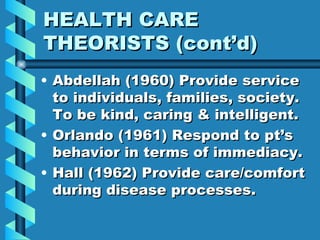
HEALTH CARE THEORISTS (cont’d) Abdellah (1960) Provide service to individuals, families, society. To be kind, caring & intelligent. Orlando (1961) Respond to pt’s behavior in terms of immediacy. Hall (1962) Provide care/comfort during disease processes.
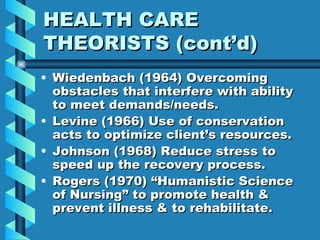
HEALTH CARE THEORISTS (cont’d) Wiedenbach (1964) Overcoming obstacles that interfere with ability to meet demands/needs. Levine (1966) Use of conservation acts to optimize client’s resources. Johnson (1968) Reduce stress to speed up the recovery process. Rogers (1970) “Humanistic Science of Nursing” to promote health & prevent illness & to rehabilitate.
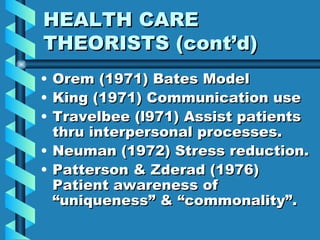
HEALTH CARE THEORISTS (cont’d) Orem (1971) Bates Model King (1971) Communication use Travelbee (l971) Assist patients thru interpersonal processes. Neuman (1972) Stress reduction. Patterson & Zderad (1976) Patient awareness of “uniqueness” & “commonality”.
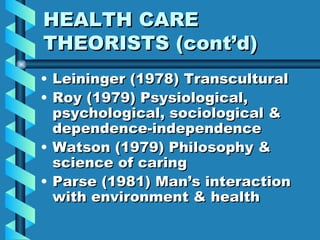
HEALTH CARE THEORISTS (cont’d) Leininger (1978) Transcultural Roy (1979) Psysiological, psychological, sociological & dependence-independence Watson (1979) Philosophy & science of caring Parse (1981) Man’s interaction with environment & health
OREM’S THEORY Dorothea Orem (1971) developed a definition of nursing that emphasizes the client’s self-care needs. “Nursing has a special concern for man’s needs for self-care action & the provision & management of it on a continuous basis in order to sustain life & health, recover from disease or injury, & cope with their effects.”
OREM’S THEORY (cont’d) “Self-care is a requirement of every person – man, woman & child.  When self-care is not maintained, illness, disease, or death will occur.  Nurses sometimes manage & maintain required self-care continually for persons who are totally incapacitated.”
OREM’S THEORY (cont’d) “In other instances, nurses help persons to maintain required self-care by performing some but not all care measures, by supervising others who assist patients, and by instructing and guiding individuals as they gradually move toward self-care.”
OREM’S GOAL To help the client perform self-care.  Nursing care is necessary when the client is unable to fulfill biological, psychological, developmental, or social needs.  The nurse determines why a client is unable to meet them, & how much self-care the client is able to perform.  The goal of nursing is to increase the client’s ability to independently meet these needs.
OREM’S APPLICATION Man: Individuals who use self-care to sustain life & health, recover from disease or injury, or cope with its effects. Health: The result of practices that individuals have learned to carry out on their own behalf to maintain life & well-being.
OREM’S APPLICATION (cont’d) Environment: External elements with which man interacts in his struggle to maintain self-care. Nursing: A human service that assists individuals to progressively maximize their self-care potential.
OREM’S APPLICATION (cont’d) Synopsis of Theory: Individuals learn behaviors that they perform on their own behalf to maintain life, health & well-being. Application to Nursing Practice: Nurses assist patients with self-care to improve or maintain health.
SELF-CARE REQUISITES UNIVERSAL SELF-CARE: Needs that support life processes & structural & functional integrity common to all (air, food, H2O, elimination, activity, sleep, etc) DEVELOPMENT SELF-CARE: Needs that promote development at each period of the life cycle (Infancy thru gerontology & special pregnant nds)
SELF-CARE REQUISITES (cont’d) HEALTH DEVIATION SELF-CARE: Needs for prevention or control of genetic or constitutional defects.  Needs are met by seeking out medical assistance, carrying out treatments, understanding & learning to live with the deficit.
SELF-CARE DEFICITS Self-Care deficits are not having the capacity to meet self-care demands.  Nursing approaches & care are aimed at those pts with actual or potential deficits.  Nurses use the “Nursing Process” to pinpoint self-care deficits & plan for ways to help the patient overcome them.
BTC SCHOOL OF NURSING CONCEPTUAL FRAMEWORK Based on Orem’s Theory of self-care.  It complies with the Bates Technical College’s Mission statement and all state quidelines/requirements for accreditation in the State of Washington.
BTC: WHY USE A FRAMEWORK Conceptual Frameworks enhance the reliability and validity of the material presented, it establishes “norms” of student practice, encourages/fosters steady upward & progressive nursing growth, and increases integrity among the student nurses.
BTC: WHY (cont’d) Appropriate use of conceptual frameworks also provide an avenue to accurately measure student outcomes.  Proven & predictable self-care models place the student nurse on the path to efficacy.

PVR Modules 2 and 3

  • 1.
    ETHICS DEFINED Ethicsis a study of good conduct, character, & motives & is concerned with determining what is good or valuable for all people. It goes beyond personal preferences to establish norms & standards upon which individuals, professions & societies agree.
  • 2.
    NURSING ETHICS Withinnursing, specific values & moral requirements are necessary to maintain the integrity of the profession. An ethical nurse will act & treat others in specific ways that are consistent with nursing norms & will be guided by more than personal preferences or values.
  • 3.
    NURSING ETHICS (cont’d)To become mature professionals who are able to participate effectively in the ethical dimensions of their practice, nurses must continue to develop a strong sense of their moral identity, seek support from professional resources & expand their knowledge and skill in the area of ethics.
  • 4.
    NURSING ETHICS (cont’d)A nurse assumes responsibility and accountability for nursing care provided.
  • 5.
    RESPONSIBILITY Refers tothe execution of duties associated with the nurse’s particular role. A nurse who acts in a responsible manner gains the trust of clients & other professionals. A responsible nurse remains competent in knowledge & skills & demonstrates a willingness to perform within the ethical guidelines of the profession.
  • 6.
    RESPONSIBILITY (example)When administering medications, the nurse is responsible for assessing clients’ need for the drugs, giving them safely & correctly, and evaluating the responses.
  • 7.
    ACCOUNTABILITY Being answerablefor one’s own actions. A nurse is accountable to self, the client, the profession, the employer, and society
  • 8.
    ACCOUNTABILITY (example) Ifa wrong dose of medication is given, the nurse is accountable to the client who received it, the physician who ordered it, the nursing service that set standards of expected performance, & society which demands professional excellence.
  • 9.
    ACCOUNTABILITY (example cont’d)Thus, when an error is made, the nurse reports it and initiates care to prevent further injury. Accountability calls for an evaluation of a nurse’s effectiveness in practice.
  • 10.
    ACCOUNTABILITY PURPOSE 1.To evaluate new professional practices & reassess existing ones. 2. To maintain standards of health care. 3. To facilitate personal reflection, ethical thought, & personal growth on the part of health care professionals. 4. To provide a basis for ethical decision making.
  • 11.
    VARIABLES AFFECTING ETHICALDECISIONS Because ethical problems occur in situations involving people who have different approaches to “moral reasoning”, it is helpful if the nurse can sort through the various factors that influence a persons’ thinking.
  • 12.
    VARIABLES (cont’d) EmotionsLegal considerations Cultural diversity Religious/Spiritual convictions Education level Past life experiences Developmental level
  • 13.
    VARIABLES (cont’d) Societalchanges Race Gender Class Economic level Sexuality orientation Current state of “health”
  • 14.
    ETHICAL DECISION MAKINGMETHODS Each ethical situation or dilemma will be different, but the nurse in any setting can use the following guidelines for ethical processing and decision making.
  • 15.
    METHODOLOGY (cont’d) Presumegood will Identify all important persons Gather relevant information Identify important ethical principles Propose alternative courses of action Take action
  • 16.
    SENSITIVE ETHICAL SITUATIONSBio-technology Surrogate Pregnancy Contracts Adoption Abortion Substance Abuse AIDS/HIV Death & Dying Living Wills/Health Care Surrogates Organ Donations
  • 17.
    NAPNES CODE OFETHICS (LPN) Refer to the printed sheets
  • 18.
    STANDARD OF PRACTICE(LPN) Refer to printed sheets
  • 19.
    PATIENT BILL OFRIGHTS Considerate & respectful care Relevant, current, understandable information Part of decision in plan of care Advanced Directives Privacy Confidential communication Review records
  • 20.
    PATIENT BILL OFRIGHTS (cont’d) Appropriate/modern care Conflicting relationships Consent/Decline research participation Reasonable continuity of care Informed of hospital policies, procedures & mission statement
  • 21.
    NURSE PRACTICE ACTIn all states in the US, nurse practice acts regulate the licensure & practice of nurses. Each state defines for itself the scope of nursing practice.
  • 22.
    LEGAL TERMS DEFINEDA TORT is a civil wrong made against a property. Torts may be classified as unintentional or intentional. An example of an unintentional tort is NEGLIGENCE or MALPRACTICE. Intentional torts are willful acts that violate another’s rights (assault, battery, defamation, and invasion of privacy).
  • 23.
    LEGAL DEFINITIONS (cont’d)NEGLIGENCE: Conduct that falls below a standard of care. MALPRACTICE: Results when nursing care is below that required for safe nursing practice.
  • 24.
    LEGAL DEFINITIONS (cont’d)No intent is needed for negligence to occur. It is established by law for the protection of others against reasonable risk of harm. It is characterized chiefly by inadvertence, thoughtlessness, carelessness, or inattention.
  • 25.
    NEGLIGENCE & MALPRACTICE(cont’d) If a nurse performs a procedure for which they have not been trained and do it carefully, but still harm the patient, a claim of negligence or malpractice could be made.
  • 26.
    NEGLIGENCE & MALPRACTICE(cont’d) If nurses give care that does not meet appropriate standards, they may be held negligent. Because these actions are performed by a professional, the negligence of the nurse is termed malpractice.
  • 27.
    NEGLIGENCE & MALPRACTICERISKS IV therapy errors resulting in infiltration of phlebitis Burns from improperly monitored heat therapy Falls resulting in injury Failure to use aseptic technique Errors in sponge, instrument, or needle counts in surgical cases
  • 28.
    NEGLIGENCE & MALPRACTICE(cont’d) Nurses must perform all procedures correctly. They must also use professional judgment as they carry out MD orders as well as independent nursing therapies for which they have authority.
  • 29.
    NEGLIGENCE & MALPRACTICE(cont’d) The following actions must take place for Nursing Negligence to occur: Nurse owed a duty to patient Nurse did not carry out duty Patient was injured Patient’s injuries were result of the nurse’s failure to carry out the duty
  • 30.
    STUDENT NURSE ROLEStudent nurses must also practice nursing in a reasonably safe manner. They should never be assigned to tasks for which they are unprepared & should be carefully supervised by instructors/staff as they learn new procedures.
  • 31.
    STUDENT ROLE (cont’d)Student nurses are expected to perform as professional nurses would in providing safe patient care. Student nurses must be accountable for informing staff of their current safe level of practice.
  • 32.
    STAYING LEGAL Nursescan reduce their chances of being named in lawsuits by following standards of care, giving competent health care, & developing an empathetic rapport with patients. In addition, careful, complete, & objective documentation serves as evidence of the standard of nursing care provided.
  • 33.
    NATIONAL LEAGUE FORNURSING NLN Membership: Anyone interested in the future of nursing. Objective: Improvement of care & education, workshops, conferences, eval svcs, politics. Publish: Nursing & Health Care.
  • 34.
    AMERICAN NURSES ASSOCIATIONANA Membership: RN & SN’s only Objective: Improvement of care & education, workshops, conferences, eval svs, a very strong political force Publish: The American Journal of Nursing
  • 35.
    NATIONAL FEDERATION OFLICENSED PRACTICAL NURSES NFLPN Membership: LPN & SPN’s only Objective: Improvement of care & education, workshops, conferences, eval sys, politics Publish: The Journal of Nursing Care
  • 36.
    NAT’L ASSC OFPRACTICAL NURSES FOR EDUC & SERVICE NAPNES Membership: Anyone interested in Practical Nursing (BTC) Objective: Improvement of care & education, workshops, conferences, eval sys, politics (focus on the LPN role) Publish: Journal of Practical Nursing
  • 37.
  • 38.
    CONCEPTUAL FRAMEWORKS ConceptualFramework is the structure, scaffolding, or skeleton used to determine human behaviors, learning styles, and learning capabilities. The development of nursing science, conceptual models & theory is a scholarly activity.
  • 39.
    NURSING THEORY Theories,which are composed of concepts & propositions, focus more specifically on the events & phenomena of the nursing discipline. Theory contributes to a sound basis of nursing practice. Nurses now & in the future need to have models of care from which their practice is based.
  • 40.
    NURSING THEORY Asnursing continues to evolve, nurses theorize about the nature of nursing practice, the principles on which practice is based, & the proper goals & functions of nursing in society.
  • 41.
    NURSING THEORY Conceptualand theoretical nursing models are used to provide knowledge to improve practice, guide research and curricula, and identify the domain and goals of nursing practice.
  • 42.
    HEALTH CARE THEORISTSNightingale (1860) To aid “the body’s reparative processes” by manipulating the environment Peplau (1952) Interaction btwn nurse & client Henderson (1955) Work interdependently with other health care workers to help client regain independence quickly
  • 43.
    HEALTH CARE THEORISTS(cont’d) Abdellah (1960) Provide service to individuals, families, society. To be kind, caring & intelligent. Orlando (1961) Respond to pt’s behavior in terms of immediacy. Hall (1962) Provide care/comfort during disease processes.
  • 44.
    HEALTH CARE THEORISTS(cont’d) Wiedenbach (1964) Overcoming obstacles that interfere with ability to meet demands/needs. Levine (1966) Use of conservation acts to optimize client’s resources. Johnson (1968) Reduce stress to speed up the recovery process. Rogers (1970) “Humanistic Science of Nursing” to promote health & prevent illness & to rehabilitate.
  • 45.
    HEALTH CARE THEORISTS(cont’d) Orem (1971) Bates Model King (1971) Communication use Travelbee (l971) Assist patients thru interpersonal processes. Neuman (1972) Stress reduction. Patterson & Zderad (1976) Patient awareness of “uniqueness” & “commonality”.
  • 46.
    HEALTH CARE THEORISTS(cont’d) Leininger (1978) Transcultural Roy (1979) Psysiological, psychological, sociological & dependence-independence Watson (1979) Philosophy & science of caring Parse (1981) Man’s interaction with environment & health
  • 47.
    OREM’S THEORY DorotheaOrem (1971) developed a definition of nursing that emphasizes the client’s self-care needs. “Nursing has a special concern for man’s needs for self-care action & the provision & management of it on a continuous basis in order to sustain life & health, recover from disease or injury, & cope with their effects.”
  • 48.
    OREM’S THEORY (cont’d)“Self-care is a requirement of every person – man, woman & child. When self-care is not maintained, illness, disease, or death will occur. Nurses sometimes manage & maintain required self-care continually for persons who are totally incapacitated.”
  • 49.
    OREM’S THEORY (cont’d)“In other instances, nurses help persons to maintain required self-care by performing some but not all care measures, by supervising others who assist patients, and by instructing and guiding individuals as they gradually move toward self-care.”
  • 50.
    OREM’S GOAL Tohelp the client perform self-care. Nursing care is necessary when the client is unable to fulfill biological, psychological, developmental, or social needs. The nurse determines why a client is unable to meet them, & how much self-care the client is able to perform. The goal of nursing is to increase the client’s ability to independently meet these needs.
  • 51.
    OREM’S APPLICATION Man:Individuals who use self-care to sustain life & health, recover from disease or injury, or cope with its effects. Health: The result of practices that individuals have learned to carry out on their own behalf to maintain life & well-being.
  • 52.
    OREM’S APPLICATION (cont’d)Environment: External elements with which man interacts in his struggle to maintain self-care. Nursing: A human service that assists individuals to progressively maximize their self-care potential.
  • 53.
    OREM’S APPLICATION (cont’d)Synopsis of Theory: Individuals learn behaviors that they perform on their own behalf to maintain life, health & well-being. Application to Nursing Practice: Nurses assist patients with self-care to improve or maintain health.
  • 54.
    SELF-CARE REQUISITES UNIVERSALSELF-CARE: Needs that support life processes & structural & functional integrity common to all (air, food, H2O, elimination, activity, sleep, etc) DEVELOPMENT SELF-CARE: Needs that promote development at each period of the life cycle (Infancy thru gerontology & special pregnant nds)
  • 55.
    SELF-CARE REQUISITES (cont’d)HEALTH DEVIATION SELF-CARE: Needs for prevention or control of genetic or constitutional defects. Needs are met by seeking out medical assistance, carrying out treatments, understanding & learning to live with the deficit.
  • 56.
    SELF-CARE DEFICITS Self-Caredeficits are not having the capacity to meet self-care demands. Nursing approaches & care are aimed at those pts with actual or potential deficits. Nurses use the “Nursing Process” to pinpoint self-care deficits & plan for ways to help the patient overcome them.

  • 57.
    BTC SCHOOL OFNURSING CONCEPTUAL FRAMEWORK Based on Orem’s Theory of self-care. It complies with the Bates Technical College’s Mission statement and all state quidelines/requirements for accreditation in the State of Washington.
  • 58.
    BTC: WHY USEA FRAMEWORK Conceptual Frameworks enhance the reliability and validity of the material presented, it establishes “norms” of student practice, encourages/fosters steady upward & progressive nursing growth, and increases integrity among the student nurses.
  • 59.
    BTC: WHY (cont’d)Appropriate use of conceptual frameworks also provide an avenue to accurately measure student outcomes. Proven & predictable self-care models place the student nurse on the path to efficacy.