Unknown Facts About
IV Cannulation
Dr. Tushar Chokshi
M.D. (Anesthesiology)
Intravenous (IV) Cannulation
Is a technique in which a cannula is
placed inside a vein to provide venous
access
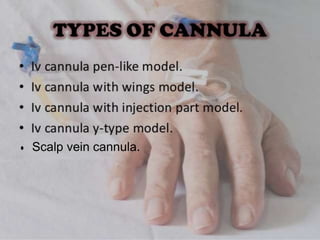
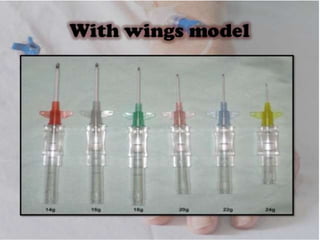
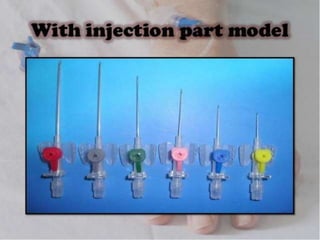
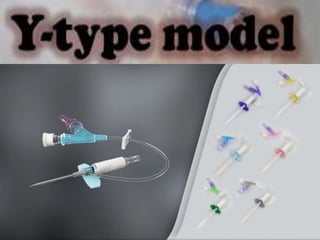
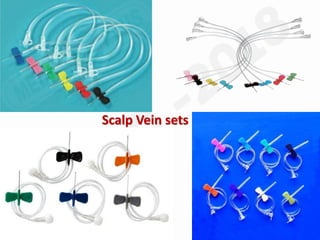
Scalp vein cannula.
Scalp Vein sets
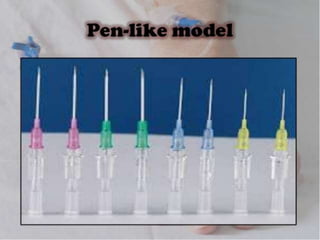
Length of Cannula
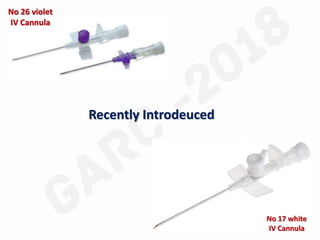
No 26 violet
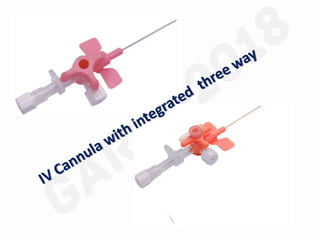
IV Cannula
No 17 white
IV Cannula
Recently Introdeuced
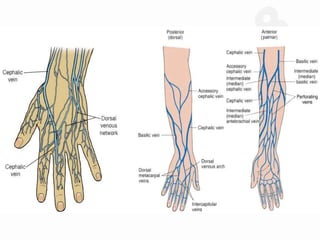
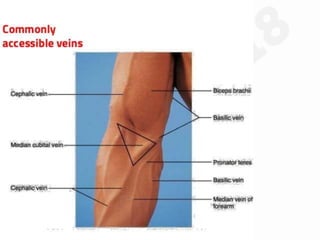
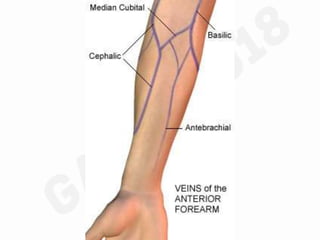
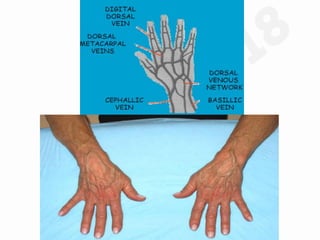
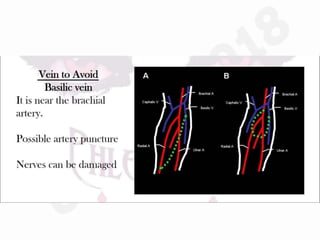
Anatomy of Veins
in Upper Limb
For IV cannulation
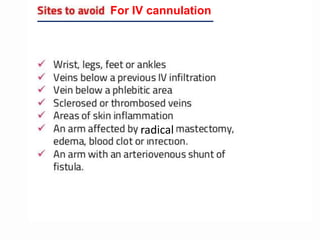
radical
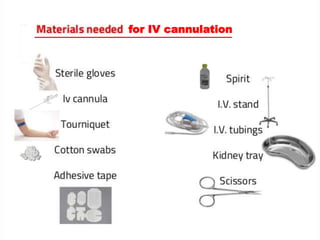
for IV cannulation
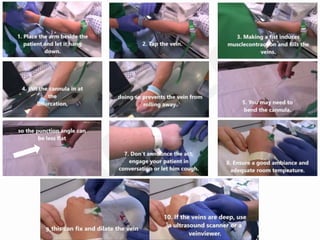
Tips and Tricks for IV Cannulation
Introduction And Overview
Vein Selection
Making the Vein More Visible
For Insertion of the IV Catheter
Securing the IV Line
Special Considerations for IV Therapy
Post-Cannulation
Introduction
And
Overview
• Introduce Yourself
• Explain the Procedure
• Stay calm and be
prepared
• Get your confidence
• Assess for needle phobia
• Observe Infection control
measures
• Assess the vein

• Feel rather than look
• Ask your patient any
previous experience
• Use appropriate cannula
size
• Consider the use
• Insert at the non-
dominant hand first
Vein Selection
• Start with distal veins and
work proximally
• Hand should be lower than
the patient’s heart
• Use a BP cuff rather than a
tourniquet
• Apply the
tourniquet correctly
• Puncture without a
tourniquet in adequately
filled but fragile veins
Making the Vein More
Visible
• Gravity is your friend
• Use warm compress
• Do not slap the vein
• Flick or tap the vein
• Feel the vein
• Fist clenching and Release
• Use the multiple tourniquet
technique ( Arm & Forearm)
• Vein dilation using
nitroglycerine
• Flow where you want it to
go ( Alcohol Swab)
• Clean vigorously and widely
• Use a vein finder if needed
For Insertion of the IV
Catheter
• Stabilize the vein
• Insert the IV catheter directly atop
the vein
• Prevent kinking
• Twirl the catheter hub
• Bevel up
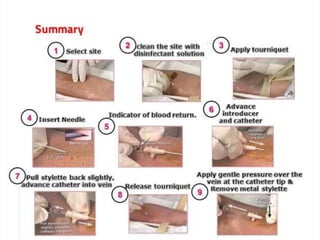
• Make the shot at a 15-30 degree
angle over the skin
• Feel for any resistance
• The Flashback (backflow of blood)
• Don’t go all in
• Do not pass cannula through valve,
as it is very painful
• Don’t rush into starting the IV fluid
• Release the tourniquet first
Securing the IV Line
• Limbs in motion inside an
ambulance
• On taping the IV tubing
• Go with the flow when
taping
• Stress tape to prevent
accidental yanking between
cannula and IV fluid tubing
• If it leaks, change taping
• Do not probe for a vein also
called “fishing” or “vein
searching”, it will damage
surrounding muscle and
tendon
Special Considerations for IV
Therapy
• For older patients and
pediatric patients
• For patients who have dark
skin tone
• For veins with valves, use the
floating technique
• Bifurcating veins (highest
success)
• Call the “vein whisperer” or
experts, after some
reasonable unsuccessful
attempts to insert the IV
catheter
• On the use of restraints
• Do not shave site, shaving
can cause micro abrasions,
just remove hair with
scissors or clippers only
Post-Cannulation
Labelling with date-time,
type-length of catheter,
rate calculation & initials
Common Problems During Cannulation
9.
movie
movie
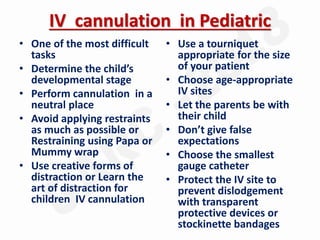
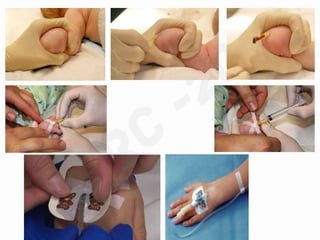
IV cannulation in Pediatric
• One of the most difficult
tasks
• Determine the child’s
developmental stage
• Perform cannulation in a
neutral place
• Avoid applying restraints
as much as possible or
Restraining using Papa or
Mummy wrap
• Use creative forms of
distraction or Learn the
art of distraction for
children IV cannulation
• Use a tourniquet
appropriate for the size
of your patient
• Choose age-appropriate
IV sites
• Let the parents be with
their child
• Don’t give false
expectations
• Choose the smallest
gauge catheter
• Protect the IV site to
prevent dislodgement
with transparent
protective devices or
stockinette bandages
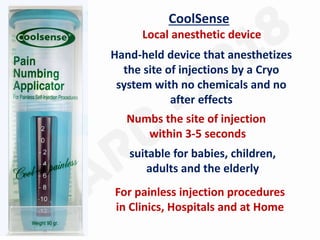
CoolSense
Local anesthetic device
Hand-held device that anesthetizes
the site of injections by a Cryo
system with no chemicals and no
after effects
Numbs the site of injection
within 3-5 seconds
suitable for babies, children,
adults and the elderly
For painless injection procedures
in Clinics, Hospitals and at Home
Loacal Spray
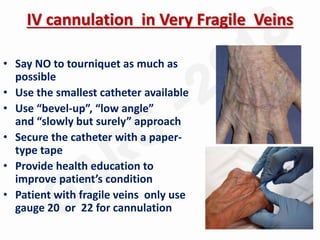
IV cannulation in Very Fragile Veins
• Say NO to tourniquet as much as
possible
• Use the smallest catheter available
• Use “bevel-up”, “low angle”
and “slowly but surely” approach
• Secure the catheter with a paper-
type tape
• Provide health education to
improve patient’s condition
• Patient with fragile veins only use
gauge 20 or 22 for cannulation
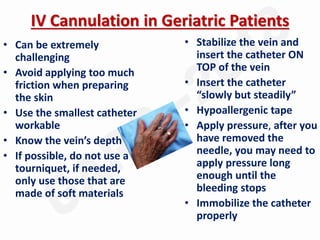
IV Cannulation in Geriatric Patients
• Can be extremely
challenging
• Avoid applying too much
friction when preparing
the skin
• Use the smallest catheter
workable
• Know the vein’s depth
• If possible, do not use a
tourniquet, if needed,
only use those that are
made of soft materials
• Stabilize the vein and
insert the catheter ON
TOP of the vein
• Insert the catheter
“slowly but steadily”
• Hypoallergenic tape
• Apply pressure, after you
have removed the
needle, you may need to
apply pressure long
enough until the
bleeding stops
• Immobilize the catheter
properly
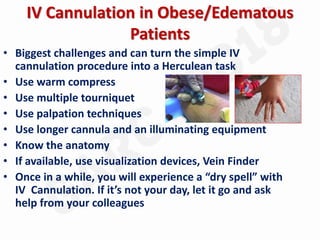
IV Cannulation in Obese/Edematous
Patients
• Biggest challenges and can turn the simple IV
cannulation procedure into a Herculean task
• Use warm compress
• Use multiple tourniquet
• Use palpation techniques
• Use longer cannula and an illuminating equipment
• Know the anatomy
• If available, use visualization devices, Vein Finder
• Once in a while, you will experience a “dry spell” with
IV Cannulation. If it’s not your day, let it go and ask
help from your colleagues
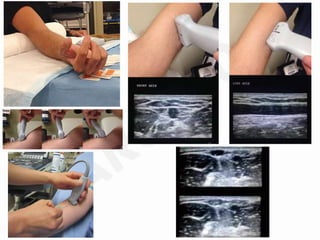
Ultrasound-Guided IV Cannulation
• Be Prepared
• Position the Patient
and the Ultrasound
• Use a Waterproof
Transparent Dressing to
Cover the Ultrasound
Probe
• Place the Tourniquet
High and Tight, or
Possibly Place Two
• Place the Ultrasound
on Shallowest Depth
for the Vascular Probe
• Short Axis Versus Long
Axis Approach
• Do the Math
• Be Cognizant of
Compression
• Look Before You Leap
• Verify Your Success
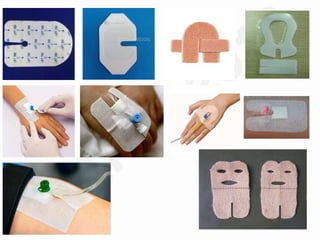
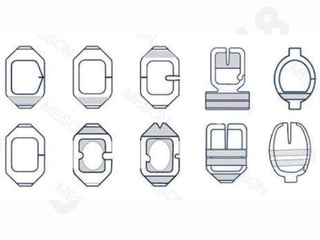
Different types of IV Canuula Fixators
Different types of
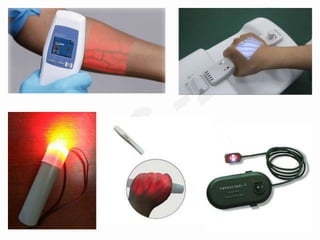
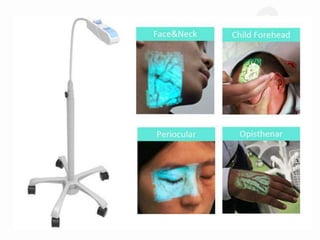
Vein finders
Vein Finder Used in
• Elderly people
• Patients with dark skin tones
• Obese people
• Patients who undergo many diagnostic or
intravenous therapeutic procedures
• People who were burn victims
• Patients who are restless, agitated, or won’t stay
still
• Oncology patients undergoing chemotherapy
• Drug abusers
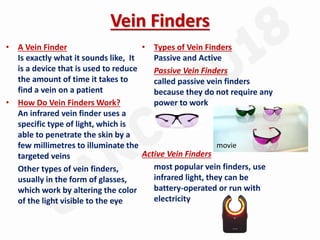
Vein Finders
• A Vein Finder
Is exactly what it sounds like, It
is a device that is used to reduce
the amount of time it takes to
find a vein on a patient
• How Do Vein Finders Work?
An infrared vein finder uses a
specific type of light, which is
able to penetrate the skin by a
few millimetres to illuminate the
targeted veins
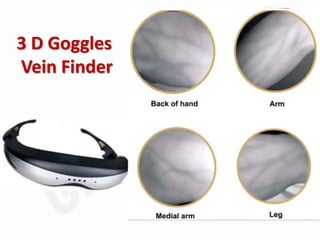
Other types of vein finders,
usually in the form of glasses,
which work by altering the color
of the light visible to the eye
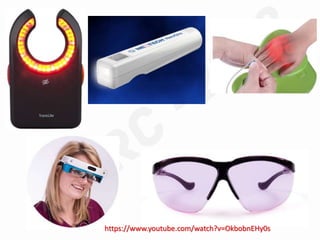
• Types of Vein Finders
Passive and Active
Passive Vein Finders
called passive vein finders
because they do not require any
power to work
Active Vein Finders
most popular vein finders, use
infrared light, they can be
battery-operated or run with
electricity
movie
https://www.youtube.com/watch?v=OkbobnEHy0s
3 D Goggles
Vein Finder
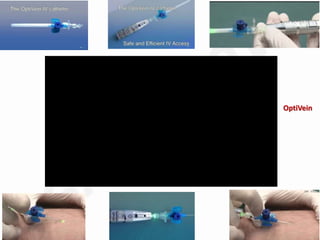
OptiVein
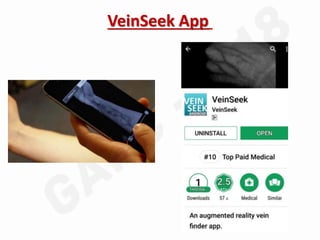
VeinSeek App
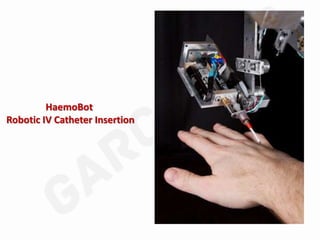
HaemoBot
Robotic IV Catheter Insertion
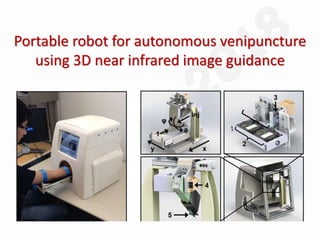
Portable robot for autonomous venipuncture
using 3D near infrared image guidance
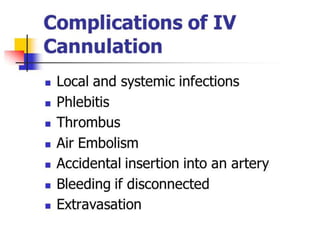
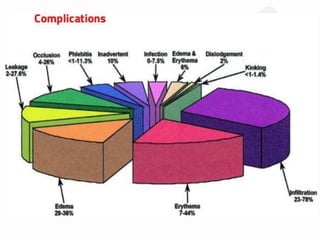
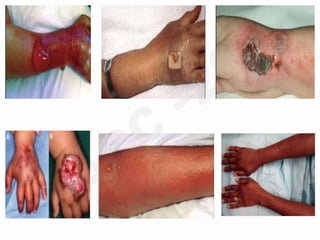
Complications of
IV Cannulation
Unknown facts about iv cannulation

Unknown facts about iv cannulation

  • 1.
    Unknown Facts About IVCannulation Dr. Tushar Chokshi M.D. (Anesthesiology)
  • 2.
    Intravenous (IV) Cannulation Isa technique in which a cannula is placed inside a vein to provide venous access
  • 4.
  • 9.
  • 10.
  • 14.
    No 26 violet IVCannula No 17 white IV Cannula Recently Introdeuced
  • 19.
  • 26.
  • 27.
  • 28.
    Tips and Tricksfor IV Cannulation Introduction And Overview Vein Selection Making the Vein More Visible For Insertion of the IV Catheter Securing the IV Line Special Considerations for IV Therapy Post-Cannulation
  • 29.
    Introduction And Overview • Introduce Yourself •Explain the Procedure • Stay calm and be prepared • Get your confidence • Assess for needle phobia • Observe Infection control measures • Assess the vein • Feel rather than look • Ask your patient any previous experience • Use appropriate cannula size • Consider the use • Insert at the non- dominant hand first
  • 30.
    Vein Selection • Startwith distal veins and work proximally • Hand should be lower than the patient’s heart • Use a BP cuff rather than a tourniquet • Apply the tourniquet correctly • Puncture without a tourniquet in adequately filled but fragile veins Making the Vein More Visible • Gravity is your friend • Use warm compress • Do not slap the vein • Flick or tap the vein • Feel the vein • Fist clenching and Release • Use the multiple tourniquet technique ( Arm & Forearm) • Vein dilation using nitroglycerine • Flow where you want it to go ( Alcohol Swab) • Clean vigorously and widely • Use a vein finder if needed
  • 31.
    For Insertion ofthe IV Catheter • Stabilize the vein • Insert the IV catheter directly atop the vein • Prevent kinking • Twirl the catheter hub • Bevel up • Make the shot at a 15-30 degree angle over the skin • Feel for any resistance • The Flashback (backflow of blood) • Don’t go all in • Do not pass cannula through valve, as it is very painful • Don’t rush into starting the IV fluid • Release the tourniquet first Securing the IV Line • Limbs in motion inside an ambulance • On taping the IV tubing • Go with the flow when taping • Stress tape to prevent accidental yanking between cannula and IV fluid tubing • If it leaks, change taping • Do not probe for a vein also called “fishing” or “vein searching”, it will damage surrounding muscle and tendon
  • 32.
    Special Considerations forIV Therapy • For older patients and pediatric patients • For patients who have dark skin tone • For veins with valves, use the floating technique • Bifurcating veins (highest success) • Call the “vein whisperer” or experts, after some reasonable unsuccessful attempts to insert the IV catheter • On the use of restraints • Do not shave site, shaving can cause micro abrasions, just remove hair with scissors or clippers only Post-Cannulation Labelling with date-time, type-length of catheter, rate calculation & initials
  • 33.
  • 36.
  • 38.
  • 39.
  • 40.
    IV cannulation inPediatric • One of the most difficult tasks • Determine the child’s developmental stage • Perform cannulation in a neutral place • Avoid applying restraints as much as possible or Restraining using Papa or Mummy wrap • Use creative forms of distraction or Learn the art of distraction for children IV cannulation • Use a tourniquet appropriate for the size of your patient • Choose age-appropriate IV sites • Let the parents be with their child • Don’t give false expectations • Choose the smallest gauge catheter • Protect the IV site to prevent dislodgement with transparent protective devices or stockinette bandages
  • 43.
    CoolSense Local anesthetic device Hand-helddevice that anesthetizes the site of injections by a Cryo system with no chemicals and no after effects Numbs the site of injection within 3-5 seconds suitable for babies, children, adults and the elderly For painless injection procedures in Clinics, Hospitals and at Home
  • 44.
  • 45.
    IV cannulation inVery Fragile Veins • Say NO to tourniquet as much as possible • Use the smallest catheter available • Use “bevel-up”, “low angle” and “slowly but surely” approach • Secure the catheter with a paper- type tape • Provide health education to improve patient’s condition • Patient with fragile veins only use gauge 20 or 22 for cannulation
  • 46.
    IV Cannulation inGeriatric Patients • Can be extremely challenging • Avoid applying too much friction when preparing the skin • Use the smallest catheter workable • Know the vein’s depth • If possible, do not use a tourniquet, if needed, only use those that are made of soft materials • Stabilize the vein and insert the catheter ON TOP of the vein • Insert the catheter “slowly but steadily” • Hypoallergenic tape • Apply pressure, after you have removed the needle, you may need to apply pressure long enough until the bleeding stops • Immobilize the catheter properly
  • 48.
    IV Cannulation inObese/Edematous Patients • Biggest challenges and can turn the simple IV cannulation procedure into a Herculean task • Use warm compress • Use multiple tourniquet • Use palpation techniques • Use longer cannula and an illuminating equipment • Know the anatomy • If available, use visualization devices, Vein Finder • Once in a while, you will experience a “dry spell” with IV Cannulation. If it’s not your day, let it go and ask help from your colleagues
  • 49.
    Ultrasound-Guided IV Cannulation •Be Prepared • Position the Patient and the Ultrasound • Use a Waterproof Transparent Dressing to Cover the Ultrasound Probe • Place the Tourniquet High and Tight, or Possibly Place Two • Place the Ultrasound on Shallowest Depth for the Vascular Probe • Short Axis Versus Long Axis Approach • Do the Math • Be Cognizant of Compression • Look Before You Leap • Verify Your Success
  • 51.
    Different types ofIV Canuula Fixators
  • 54.
  • 55.
    Vein Finder Usedin • Elderly people • Patients with dark skin tones • Obese people • Patients who undergo many diagnostic or intravenous therapeutic procedures • People who were burn victims • Patients who are restless, agitated, or won’t stay still • Oncology patients undergoing chemotherapy • Drug abusers
  • 56.
    Vein Finders • AVein Finder Is exactly what it sounds like, It is a device that is used to reduce the amount of time it takes to find a vein on a patient • How Do Vein Finders Work? An infrared vein finder uses a specific type of light, which is able to penetrate the skin by a few millimetres to illuminate the targeted veins Other types of vein finders, usually in the form of glasses, which work by altering the color of the light visible to the eye • Types of Vein Finders Passive and Active Passive Vein Finders called passive vein finders because they do not require any power to work Active Vein Finders most popular vein finders, use infrared light, they can be battery-operated or run with electricity movie
  • 57.
  • 59.
  • 61.
  • 62.
  • 63.
  • 64.
    Portable robot forautonomous venipuncture using 3D near infrared image guidance
  • 65.