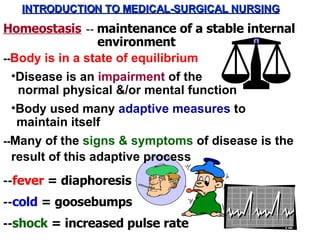
INTRODUCTION TO MEDICAL-SURGICAL NURSING Homeostasis -- Body is in a state of equilibrium Disease is an  impairment  of the  normal physical &/or mental function -- cold  = goosebumps -- fever  = diaphoresis -- shock  = increased pulse rate --  maintenance of a stable internal environment Body used many  adaptive measures  to maintain itself -- Many of the  signs & symptoms  of disease is the result of this adaptive process
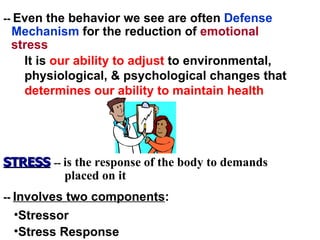
It is  our ability to adjust  to environmental, physiological, & psychological changes that  determines our ability to maintain health STRESS --  Involves two components : Stressor Stress Response --  Even the behavior we see are often  Defense Mechanism  for the reduction of  emotional stress --  is the response of the body to demands placed on it
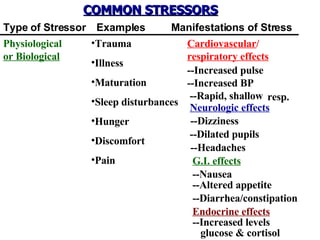
COMMON STRESSORS Physiological  or Biological Trauma Illness Maturation Sleep disturbances Hunger Discomfort Pain Type of Stressor Examples Manifestations of Stress Cardiovascular /  respiratory effects --Increased pulse  --Increased BP  --Rapid, shallow resp. Neurologic effects --Dilated pupils --Dizziness --Headaches G.I. effects --Nausea --Altered appetite --Diarrhea/constipation Endocrine effects --Increased levels glucose & cortisol
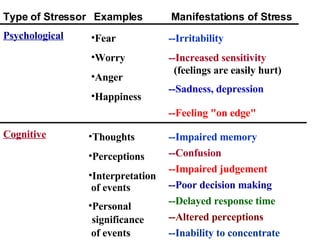
Psychological Cognitive Fear Worry Anger Happiness Type of Stressor Examples Manifestations of Stress --Irritability --Increased sensitivity (feelings are easily hurt) --Sadness, depression --Feeling "on edge" Thoughts Perceptions Interpretation  of events Personal of events significance --Impaired memory --Confusion --Impaired judgement --Poor decision making --Delayed response time --Altered perceptions --Inability to concentrate
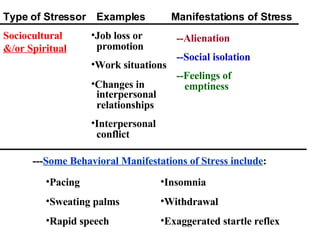
Sociocultural  &/or Spiritual --- Some Behavioral Manifestations of Stress include : Pacing Sweating palms Rapid speech Insomnia Withdrawal Exaggerated startle reflex Type of Stressor Examples Manifestations of Stress Job loss or promotion Work situations  Changes in interpersonal relationships Interpersonal conflict --Alienation --Social isolation --Feelings of emptiness
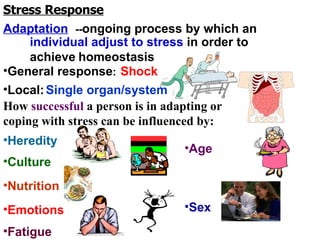
Stress Response Adaptation General response :   Local: How  successful  a person is in adapting or coping with stress can be influenced by: -- ongoing process by which an individual adjust to stress  in order to achieve   homeostasis Shock Single organ/system Heredity Culture Nutrition Emotions Fatigue Age Sex
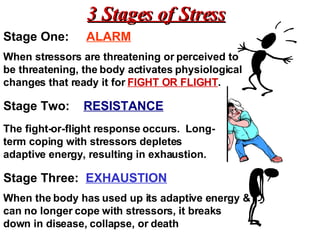
3 Stages of Stress When stressors are threatening or perceived to be threatening, the body activates physiological changes that ready it for  FIGHT OR FLIGHT . The fight-or-flight response occurs.  Long-term coping with stressors depletes adaptive energy, resulting in exhaustion. When the body has used up its adaptive energy & can no longer cope with stressors, it breaks down in disease, collapse, or death Stage One:  ALARM Stage Two:  RESISTANCE Stage Three:  EXHAUSTION
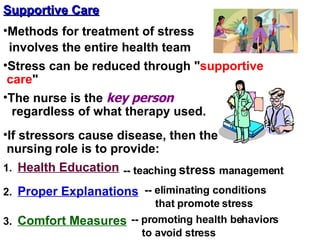
Supportive Care 1.  Health Education 2.  Proper Explanations 3.  Comfort Measures -- teaching  stress  management Methods for treatment of stress involves the entire health team The nurse is the  key person regardless of what therapy used.  If stressors cause disease, then the nursing   role is to provide: -- eliminating conditions that promote stress -- promoting health behaviors to avoid stress Stress can be reduced through " supportive care "
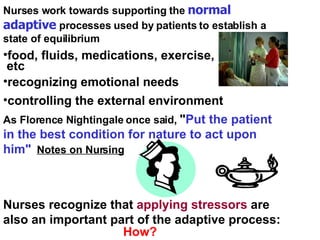
Nurses work towards supporting the  normal adaptive  processes used by patients to establish a state of equilibrium recognizing emotional needs controlling the external environment As Florence Nightingale once said,  " Put the patient in the best condition for nature to act upon him"   Notes on Nursing Nurses recognize that  applying stressors  are also an important part of the adaptive process:  How? food, fluids, medications, exercise,  etc
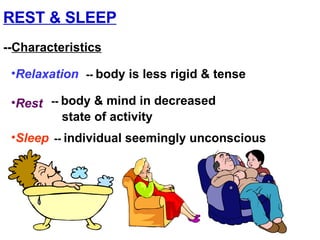
REST & SLEEP -- Characteristics Relaxation Rest Sleep --  body is less rigid & tense --  individual seemingly unconscious --  body & mind in decreased state of activity
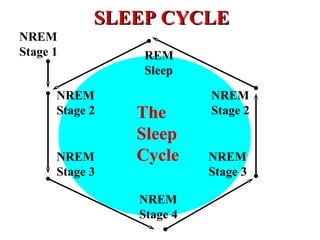
SLEEP CYCLE REM Sleep NREM Stage 2 NREM Stage 3 NREM Stage 4 NREM Stage 3 NREM Stage 2 The  Sleep  Cycle NREM Stage 1
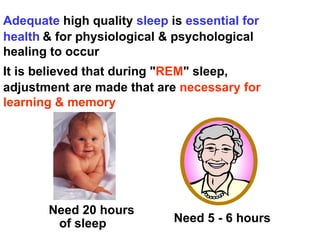
Adequate  high quality  sleep  is  essential for health   & for physiological & psychological healing to occur It is believed that during " REM " sleep,  adjustment are made that are  necessary for learning & memory Need 20 hours of sleep Need 5 - 6 hours
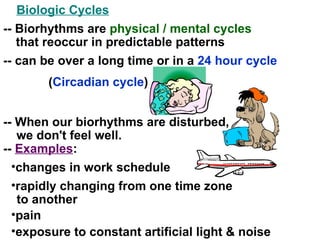
Biologic Cycles -- can be over a long time or in a  24 hour cycle --  Examples : changes in work schedule pain exposure to constant artificial light & noise -- Biorhythms are  physical / mental cycles   that reoccur in predictable patterns ( Circadian cycle ) -- When our biorhythms are disturbed,  we don't feel well. rapidly changing from one time zone to another
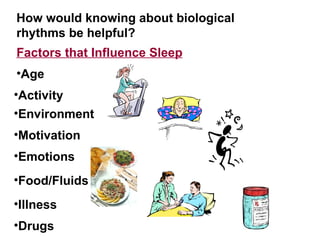
How would knowing about biological   rhythms be helpful? Factors that Influence Sleep Age Motivation Activity Drugs Environment Emotions Food/Fluids Illness
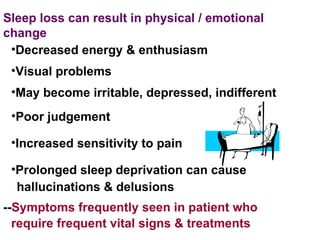
Sleep loss can result in physical / emotional change Decreased energy & enthusiasm Visual problems May become irritable, depressed, indifferent Increased sensitivity to pain Poor judgement Prolonged sleep deprivation can cause hallucinations & delusions -- Symptoms frequently seen in patient who require frequent vital signs & treatments
COMMON SLEEP PROBLEMS Insomnia 1.  Symptoms difficulty falling asleep awakening in the night early waking -- Most incidences of insomnia resolve themselves -- if last longer than  3 weeks , may become chronic
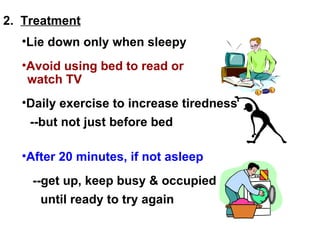
2.  Treatment Lie down only when sleepy --but not just before bed After 20 minutes, if not asleep --get up, keep busy & occupied until ready to try again Avoid using bed to read or watch TV Daily exercise to increase tiredness
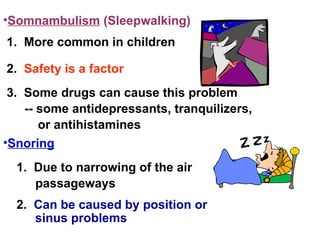
1.  More common in children 2.  Safety is a factor 3.  Some drugs can cause this problem -- some antidepressants, tranquilizers, or antihistamines Somnambulism  (Sleepwalking) 1.  Due to narrowing of the air passageways Snoring 2.  Can be caused by position or sinus problems
Sleep Apnea  (Hypopnea) 1.  May experience  30 or more  episodes 5.  Symptoms : --hypertension --daytime fatigue --morning headache --personality changes --intellectual impairment 2.  More common in men; in the obese; & increases with age 3.  Can be due to obstruction of airways ; inhibited ventilatory drive, or both 4.  Increased  CO 2  & decreased  O 2  causes person to start breathing
6.  Treatment Nasal CPAP --Continuous positive airway pressure ( CPAP ) --lose weight (only  50%  successful) -- Uvulopalatopharyngoplasty to remove excess tissue from soft palate, uvula, & pharynx
Narcolepsy Sleep talking 1.  Neurological disorder 2.  125,000 in U.S have disorder -- Can occur in families 3.  Safety is an issue --Only disturbs the person sharing the room 4.  Treat with drugs that cause wakefulness such as Dexedrine or Ritalin
What do we mean by comfort? Dictionary Definitions:  Comfort   (Webster)   1.  To soothe in distress or sorrow. 2. Relief from distress (absence of previous discomfort) (negative sense) 3. A person or thing that comforts 4. A state of ease and quiet enjoyment, free from worry (neutral sense) 5. Anything that makes life easy  6. Suggests the lessening of misery or grief by cheering, calming, or inspiring with hope (positive sense) verb, noun, adjective, adverb
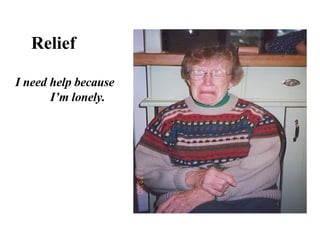
Relief   I need help because I’m lonely.
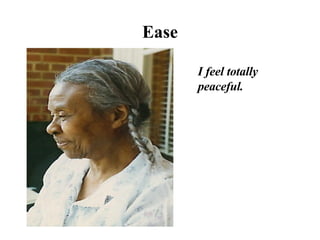
Ease I feel totally  peaceful.
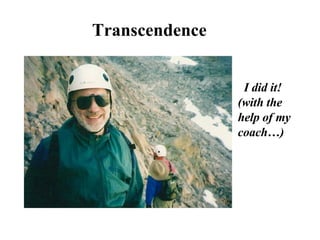
Transcendence I did it! (with the help of my coach…)
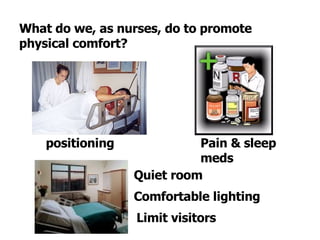
What do we, as nurses, do to promote physical comfort? positioning Pain & sleep meds Quiet room Comfortable lighting Limit visitors
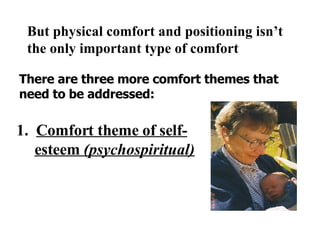
But physical comfort and positioning isn’t the only important type of comfort There are three more comfort themes that need to be addressed: 1.  Comfort theme of self-esteem  (psychospiritual)
2.  Comfort theme of approach and   attitudes of staff  (sociocultural)
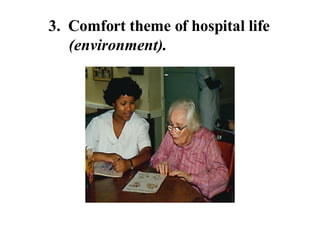
3.  Comfort theme of hospital life  (environment).
Technical definition of  Comfort The state of being strengthened when needs for  relief ,  ease , and  transcendence  are met in four contexts of experience:  physical, psychospiritual, sociocultural , and  environmental   Nice fit with nursing practice!
Comfort Theory  (3 parts) Comforting interventions enhance patients’ comfort. Enhanced patient comfort is positively related to engagement in  Health Seeking Behaviors (HSBs)  Comfort is strengthening When patients (and families) engage in HSBs, institutions have better outcomes Patient satisfaction, nurse retention, costs down
Relationship of  comfort  (holistic outcome) to health seeking behaviors  (HSBs)   External HSBs: e.g. functional status, rehab progress Internal HSBs: e.g. healing, t-cell counts, etc. Peaceful death: perfect for hospice and palliative care
Sensory Stimulus Can be external and/or internal -- both can cause : 1.  withdrawal 2.  depression 4.  confusion 3.  impaired problem solving 5.  irritability Solitude  versus   Loneliness Stimulus is any change in the environment that is sufficient to cause a response Sensory Overload  versus   Sensory Deprivation
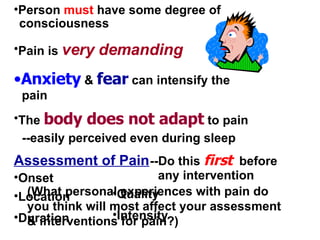
PAIN Nociceptors Pain is a personal,  subjective  feeling All pain is  real Unpleasant sensation  caused by a potentially harmful stimulus --nerves that receive & transmit painful stimuli
Components of Pain Perception 1.  Pain  Threshold 2.  Pain  Tolerance Characteristics of Pain Elderly may have   atypical   response Culture may affect response Past experience with pain Response Not always  in proportion to tissue damage
Pain is  very demanding The  body does not adapt  to pain --easily perceived even during sleep Assessment of Pain Onset Location Duration Quality Intensity (What personal experiences with pain do you think will most affect your assessment & interventions for pain?) Person  must  have some degree of consciousness Anxiety  &  fear  can intensify the pain --Do this  first   before any intervention
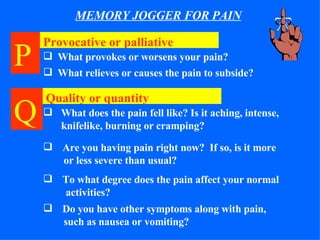
MEMORY JOGGER FOR PAIN P   Provocative or palliative What provokes or worsens your pain? What relieves or causes the pain to subside? Quality or quantity What does the pain fell like? Is it aching, intense, knifelike, burning or cramping? Are you having pain right now?  If so, is it more   or less severe than usual? To what degree does the pain affect your normal   activities? Do you have other symptoms along with pain,   such as nausea or vomiting? Q
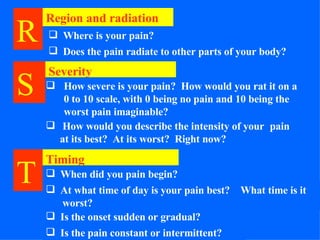
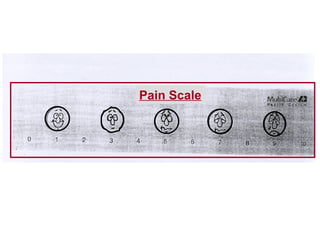
R   Region and radiation Where is your pain? Does the pain radiate to other parts of your body? Severity How severe is your pain?  How would you rat it on a 0 to 10 scale, with 0 being no pain and 10 being the worst pain imaginable? How would you describe the intensity of your  pain at its best?  At its worst?  Right now? S   T   Timing When did you pain begin? At what time of day is your pain best?   What time is it   worst? Is the onset sudden or gradual? Is the pain constant or intermittent?
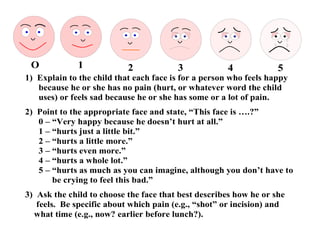
Pain Scale
 
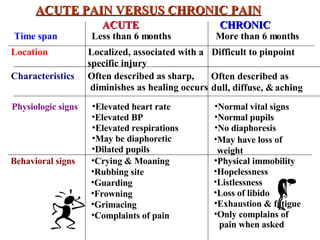
ACUTE PAIN VERSUS CHRONIC PAIN ACUTE CHRONIC Time span Less than 6 months More than 6 months Location Localized, associated with a specific injury Difficult to pinpoint Characteristics Often described as sharp, diminishes as healing occurs Often described as dull, diffuse, & aching Physiologic signs Elevated heart rate Elevated BP Elevated respirations May be diaphoretic Dilated pupils Normal vital signs Normal pupils No diaphoresis May have loss of weight Behavioral signs Crying & Moaning Rubbing site Guarding Frowning Grimacing Complaints of pain Physical immobility Hopelessness Listlessness Loss of libido Exhaustion & fatigue Only complains of pain when asked
Why do nurses tend to underestimate the characteristics of chronic pain? Intermittent Pain Comes & goes May be acute or chronic Intractable Pain Constant pain Referred Pain Usually associated with conditions considered incurable Pain felt in another part of the body rather than in the area diseased or injured
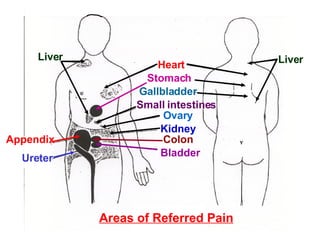
Areas of Referred Pain Liver Appendix Ureter Liver Heart Stomach Gallbladder Small intestines Ovary Kidney Colon Bladder
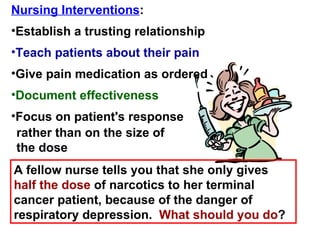
Nursing Interventions : Establish a trusting relationship Teach patients about their pain Document effectiveness A fellow nurse tells you that she only gives  half the dose  of narcotics to her terminal cancer patient, because of the danger of respiratory depression.  What should you do ? Give pain medication as ordered Focus on patient's response rather than on the size of the dose
Other treatments for pain control: -- Uses Gate theory Box with batteries Lead wires Electrodes Transcutaneous Electrical Nerve Stimulation (TENS) -- Stimulates release of Endorphins if impulses reaches large nerve fibers they  close the gate  to small fibers, thus relieving pain pain is carried by small nerve fibers non-pain impulses are carried by  large fibers
--may need to destroy nerves --give patient a measure of control Surgery --possible to achieve anesthesia or modify pain Hypnosis Biofeedback --teaches patients to recognize  stress-related responses Acupuncture/acupressure Hot/Cold; imagery/distraction/ massage
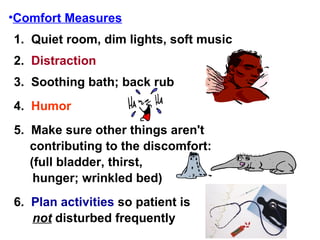
Comfort Measures 1.  Quiet room, dim lights, soft music 2.  Distraction 3.  Soothing bath; back rub 4.  Humor 5.  Make sure other things aren't contributing to the discomfort: (full bladder, thirst,  hunger; wrinkled bed) 6.  Plan activities  so patient is  not  disturbed frequently
REHABILITATION Terms : Impairment Disability Handicap Allows client to achieve optimum level of functioning Begins with initial contact Should be the underlying theme of  nursing care, regardless of setting --disturbance in structure or function --degree of observable and measurable impairment --how this disability limits normal level of functioning
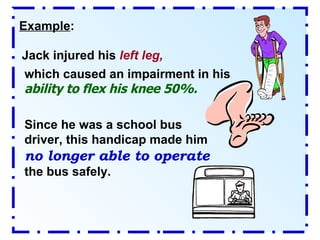
Example : Jack injured his  left leg,  which caused an impairment in his  ability to flex his knee 50%. Since he was a school bus driver, this handicap made him  no longer able to operate  the bus safely.
Case Study Mr. Thompson, age 72, suffered a left-sided brain hemorrhage 3 weeks earlier.  Because of this, he was unable to speak or use his right arm or leg.  He was also incontinent of urine and exhibited some right-sided facial paralysis.  After 5 days in the hospital, it was determined that Mr. Thompson’s condition had stabilized, and he was transferred to a rehabilitation facility to continue the rehabilitation process.  At this time, his speech had returned, but was slurred and halting.
He had minimal movement in his right arm and leg but was still unable to walk or feed himself.  The incontinence of urine persisted, and he had several reddened areas on his right hip and coccyx.  Before his injury Mr. Thompson had been living with only his wife of 50 years, who also was in poor health.  They had no family living in the state, and she was quite concerned about how she would care for him once he was sent home.
To comprehend all that is involved in helping Mr. Thompson’s return to full functioning (if that is possible), first you need to imagine a typical day in the Thompson household and to identify all the ADL and IADL competencies required to get through the day.  Next, think about all the people and services that may be necessary to prevent further injury and to increase functioning.
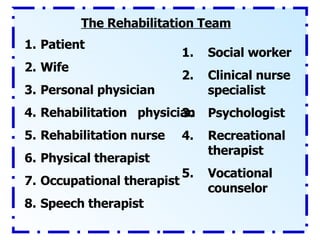
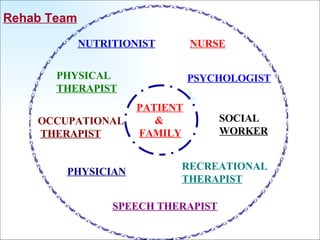
The Rehabilitation Team Patient  Wife Personal physician Rehabilitation  physician Rehabilitation nurse Physical therapist Occupational therapist Speech therapist Social worker Clinical nurse specialist Psychologist Recreational  therapist Vocational counselor
PATIENT & FAMILY Rehab Team NUTRITIONIST NURSE PSYCHOLOGIST PHYSICAL THERAPIST OCCUPATIONAL THERAPIST SOCIAL  WORKER PHYSICIAN RECREATIONAL  THERAPIST SPEECH THERAPIST
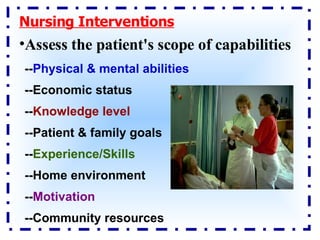
Nursing Interventions Assess the patient's scope of capabilities   -- Physical & mental abilities --Economic status -- Knowledge level --Patient & family goals -- Experience/Skills --Home environment -- Motivation --Community resources
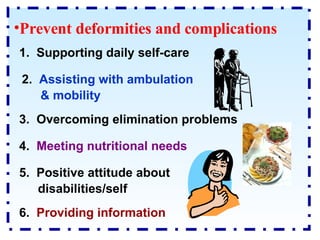
Prevent deformities and complications 1.  Supporting daily self-care 3.  Overcoming elimination problems 6.  Providing information 2.  Assisting with ambulation & mobility 4.  Meeting nutritional needs 5.  Positive attitude about disabilities/self
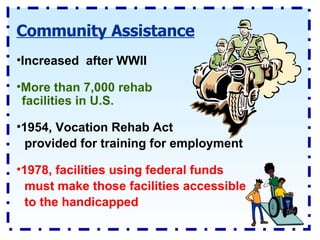
Community Assistance 1954, Vocation Rehab Act provided for training for employment Increased  after WWII More than 7,000 rehab facilities in U.S. 1978, facilities using federal funds must make those facilities accessible to the handicapped
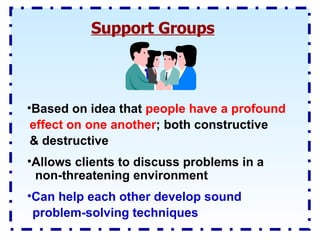
Support Groups Based on idea that  people have a profound effect on one another ; both constructive & destructive Allows clients to discuss problems in a non-threatening environment Can help each other develop sound problem-solving techniques
CHRONIC ILLNESS Not time limited Greater incidence of chronic illness Generally accompanies a person for the remainder of his/her life --estimated that  number  of persons with chronic illness  will triple by the year 2040 --worldwide problem
Stages of Chronic Illness : 1.  Development of symptoms 2.  Period of accepted illness 3.  Convalescence (dealing with disabilities) Development of a chronic illness is influenced by: -- Heredity -- Lifestyle -- Age *** This is the  difference  between an acute illness and a chronic illness
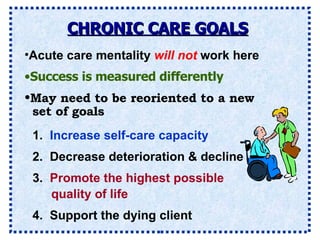
CHRONIC CARE GOALS Acute care mentality  will not  work here Success is measured differently 1.  Increase self-care capacity 2.  Decrease deterioration & decline 4.  Support the dying client May need to be reoriented to a new set of goals 3.  Promote the highest possible quality of life
ROLE OF THE LPN Need good assessment skills All employment areas  will deal with clients with chronic illness Many clients will have multi-system involvement   Educate yourself & clients in ways to prevent &   decrease complications

Intro To Med-Surge

  • 1.
    INTRODUCTION TO MEDICAL-SURGICALNURSING Homeostasis -- Body is in a state of equilibrium Disease is an impairment of the normal physical &/or mental function -- cold = goosebumps -- fever = diaphoresis -- shock = increased pulse rate -- maintenance of a stable internal environment Body used many adaptive measures to maintain itself -- Many of the signs & symptoms of disease is the result of this adaptive process
  • 2.
    It is our ability to adjust to environmental, physiological, & psychological changes that determines our ability to maintain health STRESS -- Involves two components : Stressor Stress Response -- Even the behavior we see are often Defense Mechanism for the reduction of emotional stress -- is the response of the body to demands placed on it
  • 3.
    COMMON STRESSORS Physiological or Biological Trauma Illness Maturation Sleep disturbances Hunger Discomfort Pain Type of Stressor Examples Manifestations of Stress Cardiovascular / respiratory effects --Increased pulse --Increased BP --Rapid, shallow resp. Neurologic effects --Dilated pupils --Dizziness --Headaches G.I. effects --Nausea --Altered appetite --Diarrhea/constipation Endocrine effects --Increased levels glucose & cortisol
  • 4.
    Psychological Cognitive FearWorry Anger Happiness Type of Stressor Examples Manifestations of Stress --Irritability --Increased sensitivity (feelings are easily hurt) --Sadness, depression --Feeling "on edge" Thoughts Perceptions Interpretation of events Personal of events significance --Impaired memory --Confusion --Impaired judgement --Poor decision making --Delayed response time --Altered perceptions --Inability to concentrate
  • 5.
    Sociocultural &/orSpiritual --- Some Behavioral Manifestations of Stress include : Pacing Sweating palms Rapid speech Insomnia Withdrawal Exaggerated startle reflex Type of Stressor Examples Manifestations of Stress Job loss or promotion Work situations Changes in interpersonal relationships Interpersonal conflict --Alienation --Social isolation --Feelings of emptiness
  • 6.
    Stress Response AdaptationGeneral response : Local: How successful a person is in adapting or coping with stress can be influenced by: -- ongoing process by which an individual adjust to stress in order to achieve homeostasis Shock Single organ/system Heredity Culture Nutrition Emotions Fatigue Age Sex
  • 7.
    3 Stages ofStress When stressors are threatening or perceived to be threatening, the body activates physiological changes that ready it for FIGHT OR FLIGHT . The fight-or-flight response occurs. Long-term coping with stressors depletes adaptive energy, resulting in exhaustion. When the body has used up its adaptive energy & can no longer cope with stressors, it breaks down in disease, collapse, or death Stage One: ALARM Stage Two: RESISTANCE Stage Three: EXHAUSTION
  • 8.
    Supportive Care 1. Health Education 2. Proper Explanations 3. Comfort Measures -- teaching stress management Methods for treatment of stress involves the entire health team The nurse is the key person regardless of what therapy used. If stressors cause disease, then the nursing role is to provide: -- eliminating conditions that promote stress -- promoting health behaviors to avoid stress Stress can be reduced through " supportive care "
  • 9.
    Nurses work towardssupporting the normal adaptive processes used by patients to establish a state of equilibrium recognizing emotional needs controlling the external environment As Florence Nightingale once said, " Put the patient in the best condition for nature to act upon him" Notes on Nursing Nurses recognize that applying stressors are also an important part of the adaptive process: How? food, fluids, medications, exercise, etc
  • 10.
    REST & SLEEP-- Characteristics Relaxation Rest Sleep -- body is less rigid & tense -- individual seemingly unconscious -- body & mind in decreased state of activity
  • 11.
    SLEEP CYCLE REMSleep NREM Stage 2 NREM Stage 3 NREM Stage 4 NREM Stage 3 NREM Stage 2 The Sleep Cycle NREM Stage 1
  • 12.
    Adequate highquality sleep is essential for health & for physiological & psychological healing to occur It is believed that during " REM " sleep, adjustment are made that are necessary for learning & memory Need 20 hours of sleep Need 5 - 6 hours
  • 13.
    Biologic Cycles --can be over a long time or in a 24 hour cycle -- Examples : changes in work schedule pain exposure to constant artificial light & noise -- Biorhythms are physical / mental cycles that reoccur in predictable patterns ( Circadian cycle ) -- When our biorhythms are disturbed, we don't feel well. rapidly changing from one time zone to another
  • 14.
    How would knowingabout biological rhythms be helpful? Factors that Influence Sleep Age Motivation Activity Drugs Environment Emotions Food/Fluids Illness
  • 15.
    Sleep loss canresult in physical / emotional change Decreased energy & enthusiasm Visual problems May become irritable, depressed, indifferent Increased sensitivity to pain Poor judgement Prolonged sleep deprivation can cause hallucinations & delusions -- Symptoms frequently seen in patient who require frequent vital signs & treatments
  • 16.
    COMMON SLEEP PROBLEMSInsomnia 1. Symptoms difficulty falling asleep awakening in the night early waking -- Most incidences of insomnia resolve themselves -- if last longer than 3 weeks , may become chronic
  • 17.
    2. TreatmentLie down only when sleepy --but not just before bed After 20 minutes, if not asleep --get up, keep busy & occupied until ready to try again Avoid using bed to read or watch TV Daily exercise to increase tiredness
  • 18.
    1. Morecommon in children 2. Safety is a factor 3. Some drugs can cause this problem -- some antidepressants, tranquilizers, or antihistamines Somnambulism (Sleepwalking) 1. Due to narrowing of the air passageways Snoring 2. Can be caused by position or sinus problems
  • 19.
    Sleep Apnea (Hypopnea) 1. May experience 30 or more episodes 5. Symptoms : --hypertension --daytime fatigue --morning headache --personality changes --intellectual impairment 2. More common in men; in the obese; & increases with age 3. Can be due to obstruction of airways ; inhibited ventilatory drive, or both 4. Increased CO 2 & decreased O 2 causes person to start breathing
  • 20.
    6. TreatmentNasal CPAP --Continuous positive airway pressure ( CPAP ) --lose weight (only 50% successful) -- Uvulopalatopharyngoplasty to remove excess tissue from soft palate, uvula, & pharynx
  • 21.
    Narcolepsy Sleep talking1. Neurological disorder 2. 125,000 in U.S have disorder -- Can occur in families 3. Safety is an issue --Only disturbs the person sharing the room 4. Treat with drugs that cause wakefulness such as Dexedrine or Ritalin
  • 22.
    What do wemean by comfort? Dictionary Definitions: Comfort (Webster) 1. To soothe in distress or sorrow. 2. Relief from distress (absence of previous discomfort) (negative sense) 3. A person or thing that comforts 4. A state of ease and quiet enjoyment, free from worry (neutral sense) 5. Anything that makes life easy 6. Suggests the lessening of misery or grief by cheering, calming, or inspiring with hope (positive sense) verb, noun, adjective, adverb
  • 23.
    Relief I need help because I’m lonely.
  • 24.
    Ease I feeltotally peaceful.
  • 25.
    Transcendence I didit! (with the help of my coach…)
  • 26.
    What do we,as nurses, do to promote physical comfort? positioning Pain & sleep meds Quiet room Comfortable lighting Limit visitors
  • 27.
    But physical comfortand positioning isn’t the only important type of comfort There are three more comfort themes that need to be addressed: 1. Comfort theme of self-esteem (psychospiritual)
  • 28.
    2. Comforttheme of approach and attitudes of staff (sociocultural)
  • 29.
    3. Comforttheme of hospital life (environment).
  • 30.
    Technical definition of Comfort The state of being strengthened when needs for relief , ease , and transcendence are met in four contexts of experience: physical, psychospiritual, sociocultural , and environmental Nice fit with nursing practice!
  • 31.
    Comfort Theory (3 parts) Comforting interventions enhance patients’ comfort. Enhanced patient comfort is positively related to engagement in Health Seeking Behaviors (HSBs) Comfort is strengthening When patients (and families) engage in HSBs, institutions have better outcomes Patient satisfaction, nurse retention, costs down
  • 32.
    Relationship of comfort (holistic outcome) to health seeking behaviors (HSBs) External HSBs: e.g. functional status, rehab progress Internal HSBs: e.g. healing, t-cell counts, etc. Peaceful death: perfect for hospice and palliative care
  • 33.
    Sensory Stimulus Canbe external and/or internal -- both can cause : 1. withdrawal 2. depression 4. confusion 3. impaired problem solving 5. irritability Solitude versus Loneliness Stimulus is any change in the environment that is sufficient to cause a response Sensory Overload versus Sensory Deprivation
  • 34.
    PAIN Nociceptors Painis a personal, subjective feeling All pain is real Unpleasant sensation caused by a potentially harmful stimulus --nerves that receive & transmit painful stimuli
  • 35.
    Components of PainPerception 1. Pain Threshold 2. Pain Tolerance Characteristics of Pain Elderly may have atypical response Culture may affect response Past experience with pain Response Not always in proportion to tissue damage
  • 36.
    Pain is very demanding The body does not adapt to pain --easily perceived even during sleep Assessment of Pain Onset Location Duration Quality Intensity (What personal experiences with pain do you think will most affect your assessment & interventions for pain?) Person must have some degree of consciousness Anxiety & fear can intensify the pain --Do this first before any intervention
  • 37.
    MEMORY JOGGER FORPAIN P Provocative or palliative What provokes or worsens your pain? What relieves or causes the pain to subside? Quality or quantity What does the pain fell like? Is it aching, intense, knifelike, burning or cramping? Are you having pain right now? If so, is it more or less severe than usual? To what degree does the pain affect your normal activities? Do you have other symptoms along with pain, such as nausea or vomiting? Q
  • 38.
    R Region and radiation Where is your pain? Does the pain radiate to other parts of your body? Severity How severe is your pain? How would you rat it on a 0 to 10 scale, with 0 being no pain and 10 being the worst pain imaginable? How would you describe the intensity of your pain at its best? At its worst? Right now? S T Timing When did you pain begin? At what time of day is your pain best? What time is it worst? Is the onset sudden or gradual? Is the pain constant or intermittent?
  • 39.
  • 40.
  • 41.
    ACUTE PAIN VERSUSCHRONIC PAIN ACUTE CHRONIC Time span Less than 6 months More than 6 months Location Localized, associated with a specific injury Difficult to pinpoint Characteristics Often described as sharp, diminishes as healing occurs Often described as dull, diffuse, & aching Physiologic signs Elevated heart rate Elevated BP Elevated respirations May be diaphoretic Dilated pupils Normal vital signs Normal pupils No diaphoresis May have loss of weight Behavioral signs Crying & Moaning Rubbing site Guarding Frowning Grimacing Complaints of pain Physical immobility Hopelessness Listlessness Loss of libido Exhaustion & fatigue Only complains of pain when asked
  • 42.
    Why do nursestend to underestimate the characteristics of chronic pain? Intermittent Pain Comes & goes May be acute or chronic Intractable Pain Constant pain Referred Pain Usually associated with conditions considered incurable Pain felt in another part of the body rather than in the area diseased or injured
  • 43.
    Areas of ReferredPain Liver Appendix Ureter Liver Heart Stomach Gallbladder Small intestines Ovary Kidney Colon Bladder
  • 44.
    Nursing Interventions :Establish a trusting relationship Teach patients about their pain Document effectiveness A fellow nurse tells you that she only gives half the dose of narcotics to her terminal cancer patient, because of the danger of respiratory depression. What should you do ? Give pain medication as ordered Focus on patient's response rather than on the size of the dose
  • 45.
    Other treatments forpain control: -- Uses Gate theory Box with batteries Lead wires Electrodes Transcutaneous Electrical Nerve Stimulation (TENS) -- Stimulates release of Endorphins if impulses reaches large nerve fibers they close the gate to small fibers, thus relieving pain pain is carried by small nerve fibers non-pain impulses are carried by large fibers
  • 46.
    --may need todestroy nerves --give patient a measure of control Surgery --possible to achieve anesthesia or modify pain Hypnosis Biofeedback --teaches patients to recognize stress-related responses Acupuncture/acupressure Hot/Cold; imagery/distraction/ massage
  • 47.
    Comfort Measures 1. Quiet room, dim lights, soft music 2. Distraction 3. Soothing bath; back rub 4. Humor 5. Make sure other things aren't contributing to the discomfort: (full bladder, thirst, hunger; wrinkled bed) 6. Plan activities so patient is not disturbed frequently
  • 48.
    REHABILITATION Terms :Impairment Disability Handicap Allows client to achieve optimum level of functioning Begins with initial contact Should be the underlying theme of nursing care, regardless of setting --disturbance in structure or function --degree of observable and measurable impairment --how this disability limits normal level of functioning
  • 49.
    Example : Jackinjured his left leg, which caused an impairment in his ability to flex his knee 50%. Since he was a school bus driver, this handicap made him no longer able to operate the bus safely.
  • 50.
    Case Study Mr.Thompson, age 72, suffered a left-sided brain hemorrhage 3 weeks earlier. Because of this, he was unable to speak or use his right arm or leg. He was also incontinent of urine and exhibited some right-sided facial paralysis. After 5 days in the hospital, it was determined that Mr. Thompson’s condition had stabilized, and he was transferred to a rehabilitation facility to continue the rehabilitation process. At this time, his speech had returned, but was slurred and halting.
  • 51.
    He had minimalmovement in his right arm and leg but was still unable to walk or feed himself. The incontinence of urine persisted, and he had several reddened areas on his right hip and coccyx. Before his injury Mr. Thompson had been living with only his wife of 50 years, who also was in poor health. They had no family living in the state, and she was quite concerned about how she would care for him once he was sent home.
  • 52.
    To comprehend allthat is involved in helping Mr. Thompson’s return to full functioning (if that is possible), first you need to imagine a typical day in the Thompson household and to identify all the ADL and IADL competencies required to get through the day. Next, think about all the people and services that may be necessary to prevent further injury and to increase functioning.
  • 53.
    The Rehabilitation TeamPatient Wife Personal physician Rehabilitation physician Rehabilitation nurse Physical therapist Occupational therapist Speech therapist Social worker Clinical nurse specialist Psychologist Recreational therapist Vocational counselor
  • 54.
    PATIENT & FAMILYRehab Team NUTRITIONIST NURSE PSYCHOLOGIST PHYSICAL THERAPIST OCCUPATIONAL THERAPIST SOCIAL WORKER PHYSICIAN RECREATIONAL THERAPIST SPEECH THERAPIST
  • 55.
    Nursing Interventions Assessthe patient's scope of capabilities -- Physical & mental abilities --Economic status -- Knowledge level --Patient & family goals -- Experience/Skills --Home environment -- Motivation --Community resources
  • 56.
    Prevent deformities andcomplications 1. Supporting daily self-care 3. Overcoming elimination problems 6. Providing information 2. Assisting with ambulation & mobility 4. Meeting nutritional needs 5. Positive attitude about disabilities/self
  • 57.
    Community Assistance 1954,Vocation Rehab Act provided for training for employment Increased after WWII More than 7,000 rehab facilities in U.S. 1978, facilities using federal funds must make those facilities accessible to the handicapped
  • 58.
    Support Groups Basedon idea that people have a profound effect on one another ; both constructive & destructive Allows clients to discuss problems in a non-threatening environment Can help each other develop sound problem-solving techniques
  • 59.
    CHRONIC ILLNESS Nottime limited Greater incidence of chronic illness Generally accompanies a person for the remainder of his/her life --estimated that number of persons with chronic illness will triple by the year 2040 --worldwide problem
  • 60.
    Stages of ChronicIllness : 1. Development of symptoms 2. Period of accepted illness 3. Convalescence (dealing with disabilities) Development of a chronic illness is influenced by: -- Heredity -- Lifestyle -- Age *** This is the difference between an acute illness and a chronic illness
  • 61.
    CHRONIC CARE GOALSAcute care mentality will not work here Success is measured differently 1. Increase self-care capacity 2. Decrease deterioration & decline 4. Support the dying client May need to be reoriented to a new set of goals 3. Promote the highest possible quality of life
  • 62.
    ROLE OF THELPN Need good assessment skills All employment areas will deal with clients with chronic illness Many clients will have multi-system involvement Educate yourself & clients in ways to prevent & decrease complications

Editor's Notes

  • #2 Disease: and anything that disrupts function, limits freedom of action. Have students discuss what this means to them