Intra Uterine
Growth Retardation
By
Dr. VARSHA DESHMUKH
Small for Gestational AgeSmall for Gestational Age
Healthy small baby:Healthy small baby:
In accurately datedIn accurately dated
pregnancies, approximately 80–85% ofpregnancies, approximately 80–85% of
fetuses identified as SGAfetuses identified as SGA areare
constitutionally small but healthy,constitutionally small but healthy,
‘‘True’ IUGR :10–15%True’ IUGR :10–15%
5–10% of fetuses are affected by5–10% of fetuses are affected by
chromosomal/structural anomalies orchromosomal/structural anomalies or
chronic intrauterine infection.chronic intrauterine infection.
Small for Gestational Age
Causes:
Small for Gestational Age
Causes:
• Incorrect dating of the pregnancyIncorrect dating of the pregnancy
• Constitutionally small sizeConstitutionally small size
• Genetic/Chromosomal defects in the fetusGenetic/Chromosomal defects in the fetus
• Intrauterine infectionIntrauterine infection
• Intrauterine growth restriction (IUGR)Intrauterine growth restriction (IUGR)
related to an inadequacy in the supply ofrelated to an inadequacy in the supply of
nutrients and/or oxygen to the fetusnutrients and/or oxygen to the fetus
through the uteroplacental unit.through the uteroplacental unit.
Currently Accepted Classification
as per birth-weight percentiles
• Very small for gestational age (<3rd percentile),
• Small for gestational age (SGA, <10th percentile),
• Appropriate for gestational age (AGA, 10th to 90th
percentile) or
• Large for gestational age (>90th percentile)
Drawback:
• Birth-weight percentiles do not distinguish between
the small neonate who is normally grown given his
genetic potential, and the neonate who is growth
restricted owing to a disease process hence use
other USG criteria
6 to 10 times greater than AGA.
120 per 1,000 for all cases of IUGR
80 per 1,000 [after excluding congenital
malformations]
53 percent of preterm stillbirths are IUGR
26 percent of term stillbirths are growth
restricted.
* AGA - appropriate for gestational age
Perinatal Mortality in IUGR:
* Ethnic group
* Parity
* Weight
* Height
Determinant of birth weight
such as maternal
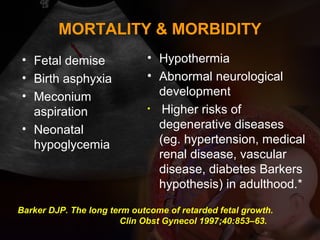
MORTALITY & MORBIDITY
• Fetal demise
• Birth asphyxia
• Meconium
aspiration
• Neonatal
hypoglycemia
• Hypothermia
• Abnormal neurological
development
• Higher risks of
degenerative diseases
(eg. hypertension, medical
renal disease, vascular
disease, diabetes Barkers
hypothesis) in adulthood.*
Barker DJP. The long term outcome of retarded fetal growth.
Clin Obst Gynecol 1997;40:853–63.
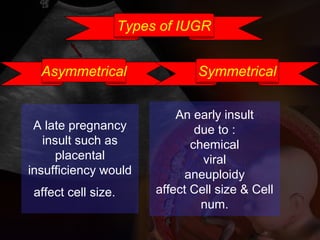
A late pregnancy
insult such as
placental
insufficiency would
affect cell size.
Asymmetrical Symmetrical
An early insult
due to :
chemical
viral
aneuploidy
affect Cell size & Cell
num.
Types of IUGR
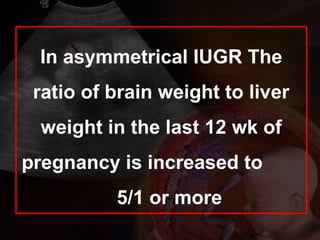
In asymmetrical IUGR The
ratio of brain weight to liver
weight in the last 12 wk of
pregnancy is increased to
5/1 or more
Detection of IUGR:
Clinical methods:
• Abdominal palpation,
• Weekly measurement of symphyseal fundal
height[SFH]
• Abdominal girth.
There is enough evidence that SFH measurement
performs better if the charts used to plot SFH are
customised to match particular variables affecting
fetal growth in fetuses of different mothers
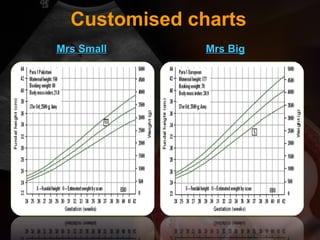
Customised charts
Mrs SmallMrs Small Mrs BigMrs Big
Role of Ultrasound:
USG biometric parameters:
• Abdominal
circumference[AC]
• estimated fetal
weight[EFW],
• Femoral length[FL],
• head circumference[HC],
• Biparietal diameter[BPD]
USG Prognostic parameters:
•Growth velocity,
•Amniotic fluid volume[AFV],
•Uterine artery Doppler,
•Cerebral artery Doppler
•umbilical artery Doppler,
•Umbilical venous Doppler,
• biophysical profile.
The growth velocity is the most sensitive indicator of fetal growth.
for symmetric and asymmetric IUGR AC is a good indicator
[sensitivity of > 95% when AC is <2.5th percentile]
Customiosed charts are available for most parameters
• Umbilical artery Doppler[UAD]: primary surveillance tool.
When an anomaly scan and umbilical artery Doppler are
normal, the small fetus is likely to be a ‘normal small fetus’
• Amniotic fluid volume[AFI] measurement: Reference range
for AFI has been devised for Indian subset of population.*
• Biophysical Profile[BPP] There is evidence from uncontrolled
observational studies that biophysical profile in high-risk
women has good negative predictive value, fetal death is
rare in women with a normal biophysical profile
• Use of cardiotocography [CTG] antepartum to assess fetal
condition is not associated with better perinatal outcome;
however daily NST is practiced in many centers with its own
efficiency.
Monitoring IUGR pregnancy
*Khadilkar SS, Desai SS, Tayade SM, Purandare CN. Amniotic fluid index in normal pregnancy:
an assessment of gestation specific reference values among Indian women.J Obstet Gynaecol
Res. 2003 Jun;29(3):136-41
Management
Once a SGA is suspected ,
intensive effort should be made
to determine if IUGR is present
and if so, its type and etiology.
If LMP not sure:
• First ANC visit SFH
•First trimester ultrasound scanning (USS) with an
accuracy to within 5 days,
•Second trimester scanning should be accurate to within
10 days.
Accurate dating of the pregnancy is essential in the use of
any parameter. In the absence of reliable dating, serial
scans at two- or three-week intervals must be performed to
identify IUGR. It should always be remembered that each
parameter measured has an error potential of about one
week up to 20 gestational weeks, about two weeks from 20
to 36 weeks of gestation, and about three weeks thereafter.
Certainty of Gestational Age
Significant
oligohydraminos is
indication for delivery if
G.A has reached>34 wk.
Gestation Specific AFI
chart in Indian women
have been devised
by Khadilkar et al 2003
Gestation specific reference range for AFI values in normal
pregnancy amongst Indian women :
Khadilkar SS,Desai SS, Tayade SM,PurandareCN
J.Obstet.Gynaecol Res vol29,no.3:136-141,June 2003
Gestation specific percentile
values of AFI in Indian Women
Weeks of
Gestation
5th
50th
95th
Number of cases
16--19 80 130 180 19
20 84 132 184 15
21 87 139 194 10
22 88 142 196 12
23 88 145 198 12
24 90 147 200 16
25 92 157 212 20
26 93 158 214 30
27 93 169 219 20
28 92 162 224 22
29 88 150 221 19
30 84 148 218 24
31 83 146 213 32
32 83 144 199 45
33 80 140 195 33
34 76 142 190 28
35 74 138 185 23
36 72 135 183 14
37 70 128 182 36
38 68 122 176 20
39 61 115 168 24
40 59 113 166 24
41--42 54 111 152 19
Total
n= 517
[gestation specific
values< than 5th
percentile:
oligohydramnios and
> 95th
percentile:
polyhydramnios ]
Birthweight gestation
specific charts
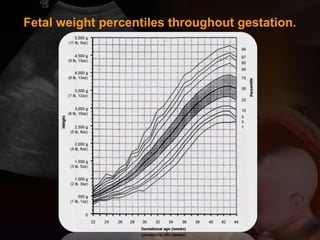
Fetal weight percentiles throughout gestation.
If the fetus is in the lower centiles
but continues to grow within those
centiles, this is reassuring but if
growth is slow and the fetus is
falling into lower centiles, this is
cause for concern.
IUGR. REMOTE FROM TERM
before 34 wk
Normal
Amniotic volume
Normal
fetal surveillance
Observation
USG is repeated at interval of 2 wk
Rarely amniocentesis for
assessment of pulmonary
maturity may be helpful in
clinical decision making.
Many clinicians advised a
program of modified rest in
the lateral recumbent
position in which placental
perfusion is maximized.
Many clinicians advised a
program of modified rest in
the lateral recumbent
position in which placental
perfusion is maximized.
Early anti platelet therapy with
low dose aspirin may prevent
 uretroplacental thrombosis
 placental infarction
 idiopathic IUGR in women with a
history of recurrent severe IUGR
LABOR AND
DELIVERY
There is general consensus that
delivery is indicated when the
risk of fetal death or significant
morbidity from continued
intrauterine existence is greater
than the risk of prematurity.
Hospitalisation, bed rest, oxygen therapy, plasma
volume expansion.
Maternal nutrient therapy:
Macronutrients.
Balanced protein energy supplementation.
High protein diet/ IV amino acids,
Glucose powder intake,
DHA supplementation
Micronutrients
Vitamins and mineral supplementation.
Betamimetics,
Calcium channel blockers,
Hormonal therapy
Empirical treatment
Delivery room:
It should be equipped with Intrapartum monitoring with continuous
cardiotocography
ppropriate neonatal staff and facilities to care for the IUGR affected
newborn [NICU].
The mode of delivery
It is based on the gestation, fetal condition, and cervical status
In cases where there is evidence of fetal academia, caesarean section may
be appropriate.
The Growth Restriction Intervention Trial (GRIT)* concluded that, in
general, at gestations less than 31 weeks, delivery is best delayed. The
GRIT has not provided evidence to date that ‘early delivery to pre-empt
severe hypoxia and acidosis reduces any adverse outcome’.
Resnik R. Fetal growth restriction: Management. 2005 UpToDate. Available at: www.uptodate.com
Delivery :
IUGR is the result of insufficient
placental function
↓A.F cord
compression
breech presentation
↑c/s
When to deliver?
Individualised approach most appropriate
General guidelines:
Indications for delivery:
• (PED)end diastolic flow is absent or reversed, admission,
close surveillance and administration of steroids are required.
• If other surveillance results are abnormal (poor biophysical
profile, pulsations on venous Doppler),
• If growth is static between two scans 2 weeks apart in a fetus
more than 32 weeks, (once steroids have been administered
to those 34 weeks).
• If gestation is over 34 weeks, even if other results are normal,
delivery may be considered.
Continuation of pregnancy
• (PED), end diastolic flow normal: delay delivery until at least
37 weeks, provided other surveillance findings are normal.
Prolonged symmetrical IUGR is likely to be
followed by slow growth after birth.
The asymmetrically GR is more likely to catch
up after birth.
Postnatal Development of the IUGR Baby
* Accurate dating is essential to allow careful monitoring
* Customisation of fetal growth assessment SFH, birth
weight, AC, AFI charts assists in distinguishing the
healthy small fetus from one affected by IUGR.
* Empirical treatment helps to some extent but no
enough evidence exists
* Balancing the risks and benefits of continuation of
pregnancy to attain maturity
* Ensure delivery of the baby at the optimal time,
Conclusion
Source:
RCOG guideline no.31 ,1-16 , 2003,
The Investigation and Management Of
The Small-For-Gestational-Age Fetus
Iugr vld

Iugr vld

  • 1.
  • 2.
    Small for GestationalAgeSmall for Gestational Age Healthy small baby:Healthy small baby: In accurately datedIn accurately dated pregnancies, approximately 80–85% ofpregnancies, approximately 80–85% of fetuses identified as SGAfetuses identified as SGA areare constitutionally small but healthy,constitutionally small but healthy, ‘‘True’ IUGR :10–15%True’ IUGR :10–15% 5–10% of fetuses are affected by5–10% of fetuses are affected by chromosomal/structural anomalies orchromosomal/structural anomalies or chronic intrauterine infection.chronic intrauterine infection.
  • 3.
    Small for GestationalAge Causes: Small for Gestational Age Causes: • Incorrect dating of the pregnancyIncorrect dating of the pregnancy • Constitutionally small sizeConstitutionally small size • Genetic/Chromosomal defects in the fetusGenetic/Chromosomal defects in the fetus • Intrauterine infectionIntrauterine infection • Intrauterine growth restriction (IUGR)Intrauterine growth restriction (IUGR) related to an inadequacy in the supply ofrelated to an inadequacy in the supply of nutrients and/or oxygen to the fetusnutrients and/or oxygen to the fetus through the uteroplacental unit.through the uteroplacental unit.
  • 4.
    Currently Accepted Classification asper birth-weight percentiles • Very small for gestational age (<3rd percentile), • Small for gestational age (SGA, <10th percentile), • Appropriate for gestational age (AGA, 10th to 90th percentile) or • Large for gestational age (>90th percentile) Drawback: • Birth-weight percentiles do not distinguish between the small neonate who is normally grown given his genetic potential, and the neonate who is growth restricted owing to a disease process hence use other USG criteria
  • 5.
    6 to 10times greater than AGA. 120 per 1,000 for all cases of IUGR 80 per 1,000 [after excluding congenital malformations] 53 percent of preterm stillbirths are IUGR 26 percent of term stillbirths are growth restricted. * AGA - appropriate for gestational age Perinatal Mortality in IUGR:
  • 6.
    * Ethnic group *Parity * Weight * Height Determinant of birth weight such as maternal
  • 7.
    MORTALITY & MORBIDITY •Fetal demise • Birth asphyxia • Meconium aspiration • Neonatal hypoglycemia • Hypothermia • Abnormal neurological development • Higher risks of degenerative diseases (eg. hypertension, medical renal disease, vascular disease, diabetes Barkers hypothesis) in adulthood.* Barker DJP. The long term outcome of retarded fetal growth. Clin Obst Gynecol 1997;40:853–63.
  • 8.
    A late pregnancy insultsuch as placental insufficiency would affect cell size. Asymmetrical Symmetrical An early insult due to : chemical viral aneuploidy affect Cell size & Cell num. Types of IUGR
  • 9.
    In asymmetrical IUGRThe ratio of brain weight to liver weight in the last 12 wk of pregnancy is increased to 5/1 or more
  • 10.
    Detection of IUGR: Clinicalmethods: • Abdominal palpation, • Weekly measurement of symphyseal fundal height[SFH] • Abdominal girth. There is enough evidence that SFH measurement performs better if the charts used to plot SFH are customised to match particular variables affecting fetal growth in fetuses of different mothers
  • 11.
    Customised charts Mrs SmallMrsSmall Mrs BigMrs Big
  • 12.
    Role of Ultrasound: USGbiometric parameters: • Abdominal circumference[AC] • estimated fetal weight[EFW], • Femoral length[FL], • head circumference[HC], • Biparietal diameter[BPD] USG Prognostic parameters: •Growth velocity, •Amniotic fluid volume[AFV], •Uterine artery Doppler, •Cerebral artery Doppler •umbilical artery Doppler, •Umbilical venous Doppler, • biophysical profile. The growth velocity is the most sensitive indicator of fetal growth. for symmetric and asymmetric IUGR AC is a good indicator [sensitivity of > 95% when AC is <2.5th percentile] Customiosed charts are available for most parameters
  • 13.
    • Umbilical arteryDoppler[UAD]: primary surveillance tool. When an anomaly scan and umbilical artery Doppler are normal, the small fetus is likely to be a ‘normal small fetus’ • Amniotic fluid volume[AFI] measurement: Reference range for AFI has been devised for Indian subset of population.* • Biophysical Profile[BPP] There is evidence from uncontrolled observational studies that biophysical profile in high-risk women has good negative predictive value, fetal death is rare in women with a normal biophysical profile • Use of cardiotocography [CTG] antepartum to assess fetal condition is not associated with better perinatal outcome; however daily NST is practiced in many centers with its own efficiency. Monitoring IUGR pregnancy *Khadilkar SS, Desai SS, Tayade SM, Purandare CN. Amniotic fluid index in normal pregnancy: an assessment of gestation specific reference values among Indian women.J Obstet Gynaecol Res. 2003 Jun;29(3):136-41
  • 14.
    Management Once a SGAis suspected , intensive effort should be made to determine if IUGR is present and if so, its type and etiology.
  • 15.
    If LMP notsure: • First ANC visit SFH •First trimester ultrasound scanning (USS) with an accuracy to within 5 days, •Second trimester scanning should be accurate to within 10 days. Accurate dating of the pregnancy is essential in the use of any parameter. In the absence of reliable dating, serial scans at two- or three-week intervals must be performed to identify IUGR. It should always be remembered that each parameter measured has an error potential of about one week up to 20 gestational weeks, about two weeks from 20 to 36 weeks of gestation, and about three weeks thereafter. Certainty of Gestational Age
  • 16.
    Significant oligohydraminos is indication fordelivery if G.A has reached>34 wk. Gestation Specific AFI chart in Indian women have been devised by Khadilkar et al 2003
  • 17.
    Gestation specific referencerange for AFI values in normal pregnancy amongst Indian women : Khadilkar SS,Desai SS, Tayade SM,PurandareCN J.Obstet.Gynaecol Res vol29,no.3:136-141,June 2003 Gestation specific percentile values of AFI in Indian Women Weeks of Gestation 5th 50th 95th Number of cases 16--19 80 130 180 19 20 84 132 184 15 21 87 139 194 10 22 88 142 196 12 23 88 145 198 12 24 90 147 200 16 25 92 157 212 20 26 93 158 214 30 27 93 169 219 20 28 92 162 224 22 29 88 150 221 19 30 84 148 218 24 31 83 146 213 32 32 83 144 199 45 33 80 140 195 33 34 76 142 190 28 35 74 138 185 23 36 72 135 183 14 37 70 128 182 36 38 68 122 176 20 39 61 115 168 24 40 59 113 166 24 41--42 54 111 152 19 Total n= 517 [gestation specific values< than 5th percentile: oligohydramnios and > 95th percentile: polyhydramnios ]
  • 18.
  • 19.
    Fetal weight percentilesthroughout gestation.
  • 20.
    If the fetusis in the lower centiles but continues to grow within those centiles, this is reassuring but if growth is slow and the fetus is falling into lower centiles, this is cause for concern.
  • 21.
    IUGR. REMOTE FROMTERM before 34 wk Normal Amniotic volume Normal fetal surveillance Observation USG is repeated at interval of 2 wk
  • 22.
    Rarely amniocentesis for assessmentof pulmonary maturity may be helpful in clinical decision making.
  • 23.
    Many clinicians adviseda program of modified rest in the lateral recumbent position in which placental perfusion is maximized. Many clinicians advised a program of modified rest in the lateral recumbent position in which placental perfusion is maximized.
  • 24.
    Early anti platelettherapy with low dose aspirin may prevent  uretroplacental thrombosis  placental infarction  idiopathic IUGR in women with a history of recurrent severe IUGR
  • 25.
  • 26.
    There is generalconsensus that delivery is indicated when the risk of fetal death or significant morbidity from continued intrauterine existence is greater than the risk of prematurity.
  • 27.
    Hospitalisation, bed rest,oxygen therapy, plasma volume expansion. Maternal nutrient therapy: Macronutrients. Balanced protein energy supplementation. High protein diet/ IV amino acids, Glucose powder intake, DHA supplementation Micronutrients Vitamins and mineral supplementation. Betamimetics, Calcium channel blockers, Hormonal therapy Empirical treatment
  • 28.
    Delivery room: It shouldbe equipped with Intrapartum monitoring with continuous cardiotocography ppropriate neonatal staff and facilities to care for the IUGR affected newborn [NICU]. The mode of delivery It is based on the gestation, fetal condition, and cervical status In cases where there is evidence of fetal academia, caesarean section may be appropriate. The Growth Restriction Intervention Trial (GRIT)* concluded that, in general, at gestations less than 31 weeks, delivery is best delayed. The GRIT has not provided evidence to date that ‘early delivery to pre-empt severe hypoxia and acidosis reduces any adverse outcome’. Resnik R. Fetal growth restriction: Management. 2005 UpToDate. Available at: www.uptodate.com Delivery :
  • 29.
    IUGR is theresult of insufficient placental function ↓A.F cord compression breech presentation ↑c/s
  • 30.
    When to deliver? Individualisedapproach most appropriate General guidelines: Indications for delivery: • (PED)end diastolic flow is absent or reversed, admission, close surveillance and administration of steroids are required. • If other surveillance results are abnormal (poor biophysical profile, pulsations on venous Doppler), • If growth is static between two scans 2 weeks apart in a fetus more than 32 weeks, (once steroids have been administered to those 34 weeks). • If gestation is over 34 weeks, even if other results are normal, delivery may be considered. Continuation of pregnancy • (PED), end diastolic flow normal: delay delivery until at least 37 weeks, provided other surveillance findings are normal.
  • 31.
    Prolonged symmetrical IUGRis likely to be followed by slow growth after birth. The asymmetrically GR is more likely to catch up after birth. Postnatal Development of the IUGR Baby
  • 32.
    * Accurate datingis essential to allow careful monitoring * Customisation of fetal growth assessment SFH, birth weight, AC, AFI charts assists in distinguishing the healthy small fetus from one affected by IUGR. * Empirical treatment helps to some extent but no enough evidence exists * Balancing the risks and benefits of continuation of pregnancy to attain maturity * Ensure delivery of the baby at the optimal time, Conclusion
  • 33.
    Source: RCOG guideline no.31,1-16 , 2003, The Investigation and Management Of The Small-For-Gestational-Age Fetus