DR.GEETA SHAH
DR.ARATI JOSHI
CASE REPORT
CAESAREAN SCAR
ECTOPIC PREGNANCY
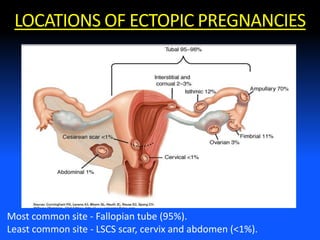
LOCATIONS OF ECTOPIC PREGNANCIES
Most common site - Fallopian tube (95%).
Least common site - LSCS scar, cervix and abdomen (<1%).
CASE : LSCS SCAR PREGNANCY
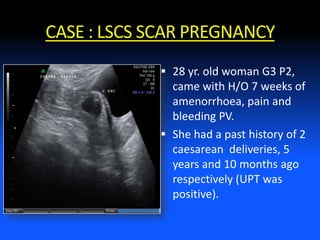
 28 yr. old woman G3 P2,
came with H/O 7 weeks of
amenorrhoea, pain and
bleeding PV.
 She had a past history of 2
caesarean deliveries, 5
years and 10 months ago
respectively (UPT was
positive).
ULTRASOUND FINDINGS
 The uterus and cervical
canal were empty.
 G sac was seen in the
anterior part of lower
uterine segment in the
region of previous LSCS
scar.
 There was absence of
myometrium between
bladder wall and G.sac.
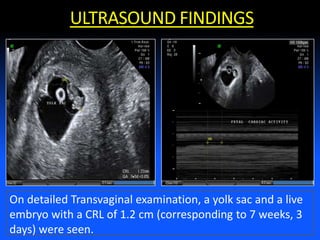
On detailed Transvaginal examination, a yolk sac and a live
embryo with a CRL of 1.2 cm (corresponding to 7 weeks, 3
days) were seen.
ULTRASOUND FINDINGS
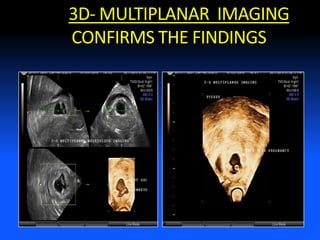
3D- MULTIPLANAR IMAGING
CONFIRMS THE FINDINGS
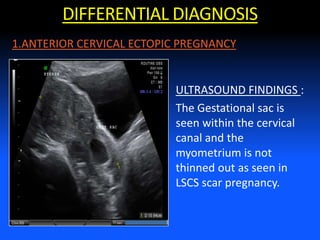
DIFFERENTIAL DIAGNOSIS
ULTRASOUND FINDINGS :
The Gestational sac is
seen within the cervical
canal and the
myometrium is not
thinned out as seen in
LSCS scar pregnancy.
1.ANTERIOR CERVICAL ECTOPIC PREGNANCY
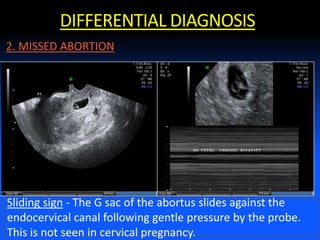
DIFFERENTIAL DIAGNOSIS
Sliding sign - The G sac of the abortus slides against the
endocervical canal following gentle pressure by the probe.
This is not seen in cervical pregnancy.
2. MISSED ABORTION
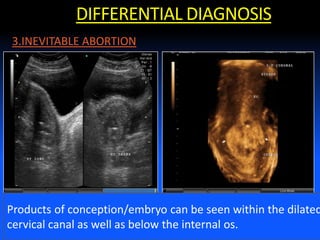
DIFFERENTIAL DIAGNOSIS
Products of conception/embryo can be seen within the dilated
cervical canal as well as below the internal os.
3.INEVITABLE ABORTION
COLOURDOPPLERHELPSTODIFFERENTIATE
LSCS SCAR PREGNANCY MISSED ABORTION
Peri-trophoblastic flow is seen
in Caesarean scar pregnancy.
No Flow is seen around the
sac in missed abortion.
 Caesarean scar pregnancy is a rare type of ectopic
pregnancy ( 1:1800) and is a life threatening condition due
to risk of severe haemorrhage.
 A rising problem due to increasing number of Caesarean
deliveries worldwide in the recent years .
 It is believed to result from canalisation of the LSCS scar to
the endometrial cavity creating a “niche” in which the
pregnancy may implant.
DISCUSSION
RISK FACTORS FOR CAESAREAN SCAR PREGNANCY :
 Multiple Caesarean deliveries.
 Previous Dilatation and Curettage.
 Previous abnormal placentation.
 Uterine surgeries:
myomectomy, metroplasty, hysteroscopy.
 Previous manual removal of placenta.
DISCUSSION
COMPLICATIONS OF CAESAREAN SCAR
PREGNANCY
 Myometrial rupture - can lead to fatal outcome .
 Massive secondary Postpartum haemorrhage
due to scar dehiscence – may require emergency
hysterectomy.
 Abnormal placentations - Placenta Accreta
, Percreta.
CONCLUSION
 Early detection by Transvaginal USG can detect
 Location of sac.
 Abnormal placentation.
 Allows more treatment options.
 Reduces risk of complications.
 Caesarean scar pregnancy is a rare diagnosis but should
be considered in a patient with low lying G. sac and an
appropriate surgical history.
REFERENCES
 Caesarean scar pregnancy diagnosis, management
and follow up -J ultrasound July 2013.
 3D power doppler USG and conservative treatment of
ectopic in caesarean section scar- Fertil Stertil 2007.
 Caesarean scar pregnancy : issues in management -
Ultrasound Obstret Gynecol 2004.
 First trimester caesarean scar pregnancy evolving into
placenta previa /accreta at term- J ultrasound med
2005.
THANK YOU

Caesarean scar pregnancy.ppt

  • 1.
    DR.GEETA SHAH DR.ARATI JOSHI CASEREPORT CAESAREAN SCAR ECTOPIC PREGNANCY
  • 2.
    LOCATIONS OF ECTOPICPREGNANCIES Most common site - Fallopian tube (95%). Least common site - LSCS scar, cervix and abdomen (<1%).
  • 3.
    CASE : LSCSSCAR PREGNANCY  28 yr. old woman G3 P2, came with H/O 7 weeks of amenorrhoea, pain and bleeding PV.  She had a past history of 2 caesarean deliveries, 5 years and 10 months ago respectively (UPT was positive).
  • 4.
    ULTRASOUND FINDINGS  Theuterus and cervical canal were empty.  G sac was seen in the anterior part of lower uterine segment in the region of previous LSCS scar.  There was absence of myometrium between bladder wall and G.sac.
  • 5.
    On detailed Transvaginalexamination, a yolk sac and a live embryo with a CRL of 1.2 cm (corresponding to 7 weeks, 3 days) were seen. ULTRASOUND FINDINGS
  • 6.
  • 7.
    DIFFERENTIAL DIAGNOSIS ULTRASOUND FINDINGS: The Gestational sac is seen within the cervical canal and the myometrium is not thinned out as seen in LSCS scar pregnancy. 1.ANTERIOR CERVICAL ECTOPIC PREGNANCY
  • 8.
    DIFFERENTIAL DIAGNOSIS Sliding sign- The G sac of the abortus slides against the endocervical canal following gentle pressure by the probe. This is not seen in cervical pregnancy. 2. MISSED ABORTION
  • 9.
    DIFFERENTIAL DIAGNOSIS Products ofconception/embryo can be seen within the dilated cervical canal as well as below the internal os. 3.INEVITABLE ABORTION
  • 10.
    COLOURDOPPLERHELPSTODIFFERENTIATE LSCS SCAR PREGNANCYMISSED ABORTION Peri-trophoblastic flow is seen in Caesarean scar pregnancy. No Flow is seen around the sac in missed abortion.
  • 11.
     Caesarean scarpregnancy is a rare type of ectopic pregnancy ( 1:1800) and is a life threatening condition due to risk of severe haemorrhage.  A rising problem due to increasing number of Caesarean deliveries worldwide in the recent years .  It is believed to result from canalisation of the LSCS scar to the endometrial cavity creating a “niche” in which the pregnancy may implant. DISCUSSION
  • 12.
    RISK FACTORS FORCAESAREAN SCAR PREGNANCY :  Multiple Caesarean deliveries.  Previous Dilatation and Curettage.  Previous abnormal placentation.  Uterine surgeries: myomectomy, metroplasty, hysteroscopy.  Previous manual removal of placenta. DISCUSSION
  • 13.
    COMPLICATIONS OF CAESAREANSCAR PREGNANCY  Myometrial rupture - can lead to fatal outcome .  Massive secondary Postpartum haemorrhage due to scar dehiscence – may require emergency hysterectomy.  Abnormal placentations - Placenta Accreta , Percreta.
  • 14.
    CONCLUSION  Early detectionby Transvaginal USG can detect  Location of sac.  Abnormal placentation.  Allows more treatment options.  Reduces risk of complications.  Caesarean scar pregnancy is a rare diagnosis but should be considered in a patient with low lying G. sac and an appropriate surgical history.
  • 15.
    REFERENCES  Caesarean scarpregnancy diagnosis, management and follow up -J ultrasound July 2013.  3D power doppler USG and conservative treatment of ectopic in caesarean section scar- Fertil Stertil 2007.  Caesarean scar pregnancy : issues in management - Ultrasound Obstret Gynecol 2004.  First trimester caesarean scar pregnancy evolving into placenta previa /accreta at term- J ultrasound med 2005.
  • 16.