www.totalpregnancycare.com


                             www.totalpregnancycare.com
Intra-uterine Growth Restriction

         Dr Shantala Vadeyar
                  MD, FRCOG, DM
      Advanced Obstetric Ultrasound (RCOG / RCR)
     Subspecialist Fetal & Maternal Medicine (RCOG)

Consultant Obstetrician, Fetal & Maternal Medicine
   Kokilaben Dhirubhai Ambani Hospital, Mumbai


                                              www.totalpregnancycare.com
Definition
• IUGR is failure to achieve the fetal growth
  potential
• Difference between size and growth
• Size - one measurement
• Growth – multiple measurements plotted on a
  graph
• Growth charts – important in fetuses like in
  children

                                    www.totalpregnancycare.com
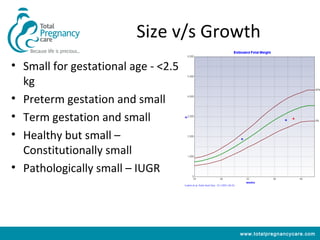
Size v/s Growth
• Small for gestational age - <2.5
  kg
• Preterm gestation and small
• Term gestation and small
• Healthy but small –
  Constitutionally small
• Pathologically small – IUGR


                                     www.totalpregnancycare.com
Causes of IUGR – 1.
                           Maternal
• Chronic maternal conditions
   –   Renal disease
   –   Hypertension
   –   Long standing Diabetes
   –   Congenital heart disease
• Smoking
• Alcohol
• Anemia - severe


                                     www.totalpregnancycare.com
Causes of IUGR – 2. Fetal
• Infection – TORCH
  – Toxoplasma, Rubella, CMV
• Malformation
  – Gastroschisis
• Chromosomal abnormalities
  – Trisomy 18 (Edward syndrome)
• Multifetal pregnancy
  – Chorionicity determination is vital
  – MC Twins, Twin twin transfusion syndrome

                                       www.totalpregnancycare.com
Causes of IUGR – 3.
                     Placental
• Placental thrombosis / infarctions
• Antiphospholipid syndrome
• Chorioamnionitis
• Abruptio placentae – usually acute, but
  sometimes, small recurrent bleeds
• Placenta previa


                                     www.totalpregnancycare.com
Causes of IUGR – 4.
                        Uterine
•   Poor uterine blood flow
•   Poor placental blood flow
•   Large fibroids leading to poor placentation
•   Uterine anomalies – septate or subseptate
    uterus


                                        www.totalpregnancycare.com
IUGR screening
• Whom to screen?
• Ideally Symphysis Fundal Height performed
  regularly for all pregnancies
• SFH in cms = weeks of gestation
• High risk cases will need ultrasound for
  growth, liquor volume, umbilical artery
  Doppler and Biophysical Profile
• Umbilical Artery Doppler is the best test!

                                     www.totalpregnancycare.com
Diagnosis
• Accurate dating is vital!
  – < 20 weeks of gestation, preferably < 14 wks
• Suspect clinically
  – Uterus palpates small
  – Less amniotic fluid
  – Reduced fetal movements
• High risk maternal, placental, uterine or fetal
  factors

                                         www.totalpregnancycare.com
Ultrasound diagnosis of
                       IUGR
• Growth
• Measure the fetus – biometry
  – Head circumference
  – Abdominal circumference
  – Femur length
• Measure the amniotic fluid- AF index, SDP
• Evaluate the blood flows- Dopplers!


                                     www.totalpregnancycare.com
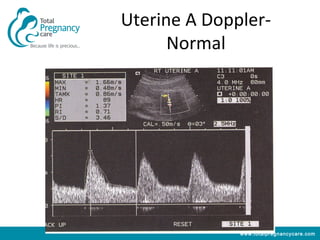
Uterine Artery Doppler
• Screening test in pregnant women
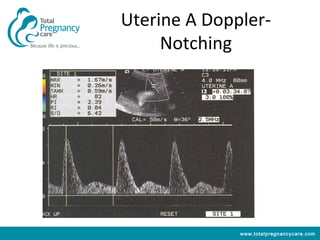
• High resistance waveform- ‘notching’
  indicates poor placentation
• Notches are present in early gestation but
  disappear 24 weeks onwards
• Bilateral notches are significant


                                      www.totalpregnancycare.com
Uterine A Doppler-
      Normal


              www.totalpregnancycare.com
Uterine Artery Doppler

• Notching indicates a high risk pregnancy
• Increased risk of
  – Pre-eclampsia
  – Growth restriction
  – Placental abruption
  – Intrauterine fetal death
• Increased monitoring- growth scans,
  Umbilical artery Doppler

                                   www.totalpregnancycare.com
Uterine A Doppler-
     Notching


              www.totalpregnancycare.com
Umbilical Artery Doppler

• Indicates resistance in the feto-placental
  vascular bed
• Angle of insonation should be <60o
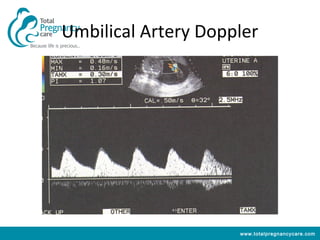
• From 16 weeks onwards- positive end
  diastolic flow (EDF)
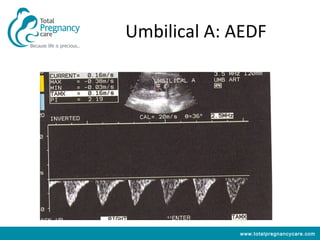
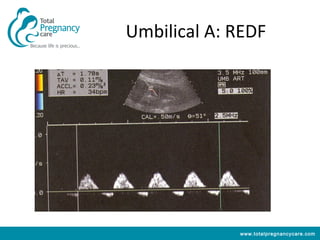
• Reduced EDF, Absent EDF and Reversed EDF
  represent increasing resistance in the
  vascular bed

                                 www.totalpregnancycare.com
Umbilical Artery Doppler


                     www.totalpregnancycare.com
Umbilical A: AEDF


             www.totalpregnancycare.com
Umbilical A: REDF


             www.totalpregnancycare.com
Fetal growth
• Serial assessments are important
• Growth trajectory is important, not size!
• Symmetrically small fetus
  – Constitutionally small
  – Genetic syndromes/ chromosomal abn
  – Very early onset IUGR
• Asymmetric- HC>AC suggests growth
  restriction due to placental insufficiency


                                      www.totalpregnancycare.com
Interpretation of
               Ultrasound findings in
                        IUGR
• Clinical history
   – Previous poor outcome
   – Antepartum haemorrhage
   – Reduced fetal movements
• Gestation- how accurate? Viability?
• U/S- Growth, Biphysical profile, Umbilical
  Artery and Uterine Dopplers
• CTG (NST)

                                     www.totalpregnancycare.com
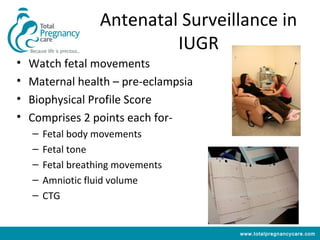
Antenatal Surveillance in
                             IUGR
•   Watch fetal movements
•   Maternal health – pre-eclampsia
•   Biophysical Profile Score
•   Comprises 2 points each for-
    –   Fetal body movements
    –   Fetal tone
    –   Fetal breathing movements
    –   Amniotic fluid volume
    –   CTG


                                      www.totalpregnancycare.com
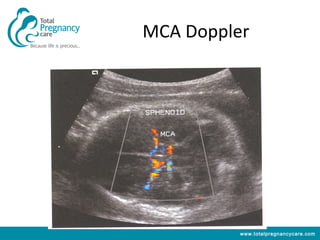
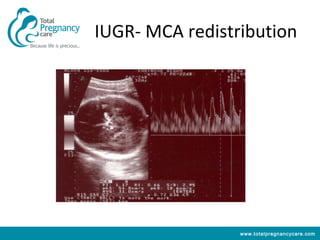
Fetal Middle Cerebral Artery Doppler
• 22-28 weeks- no EDF in MCA
• 28w to term- some EDF seen- normal
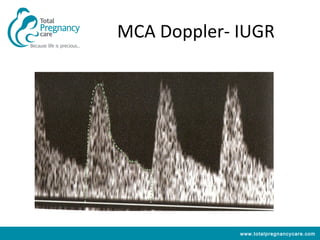
• Increased EDF ( low PI) suggests ‘brain sparing’
  redistribution in IUGR
• Worsening hypoxia- fetal acidemia- paradoxical rise
  in resistance (high PI)
• Cerebro-placental ratio increases – this is indicative
  of IUGR


                                             www.totalpregnancycare.com
MCA Doppler


          www.totalpregnancycare.com
MCA Doppler- IUGR


             www.totalpregnancycare.com
What does NOT help…
•   Duvadilan / Bricanyl
•   Amnioinfusions
•   Oxygen therapy
•   Amninoacid preparations
•   Bed rest ??


                              www.totalpregnancycare.com
Timing of delivery
• >34 weeks – good neonatal outcome
• <34 weeks - Betamethasone inj should be given to
  the mother
• Fetal pulmonary maturity
• Reduces risk of intra-ventricular haemorrhage
• Very preterm gestation - <28 weeks ?
• To wait or to deliver…


                                      www.totalpregnancycare.com
Preterm labour in IUGR
• Often IUGR fetuses / pregnancies tend to go
  into preterm labour
• Nature’s way of resolving the problem
• Important to recognise this and avoid
  prolongation of pregnancy!


                                    www.totalpregnancycare.com
Mode of delivery
• Labour is a stressful process for the fetus
• Every contraction reduces oxygenation,
  though briefly and it recovers
• Prolonged difficult labours should be avoided!
• Continuous fetal monitoring is a MUST!
• Elective LSCS for severe IUGR, abnormal
  presentation, oligohydramnios, abnormal
  CTG/ NST


                                      www.totalpregnancycare.com
Outcome
• Mild – moderate IUGR – good
• Severe early onset IUGR – some organ systems may
  be compromised
• Gut - Neonatal necrotising enterocolitis
• Kidneys – renal failure
• Brain – cerebral palsy
• Genetic syndromes /
  malformations


                                       www.totalpregnancycare.com
IUGR in DC twins
• Dichorionic twins- confirmed by 10-12w scans
• Twin 1
   –   AC : dropped from 10th to 5th centile
   –   AF : 3rd centile
   –   Absent EDF in one umb artery initially, then both
   –   Bladder seen, normal biophysical score
• Twin 2
   – AC: 50th centile, Normal AF, Normal UA Doppler
   – Normal sized bladder, heart, biophysical scores


                                                           www.totalpregnancycare.com
Management- when to deliver?
• Monitor biophysical profiles and Umbilical Artery
  Dopplers
• Risk of preterm delivery versus compromise
• What is the significance of worsening Umbilical A
  Dopplers?
• Risks of preterm delivery- respiratory distress
  syndrome, necrotising enterocolitis, infection
• Risk to well grown fetus of prematurity
• Intrauterine complications- abruption, worsening of
  maternal PET, IUFD

                                          www.totalpregnancycare.com
Decision to deliver
•   Twice weekly Biophysical scores
•   Twice daily CTGs, FM monitoring
•   31 weeks: Both Umb A in twin 1 showed absent EDF.
•   Discussion with parents- proceed to LSCS
•   Twin 1 was1 kg, twin 2 was 1.8 kg, both males
•   NEC in Twin 1 – recovered
•   Good outcome


                                          www.totalpregnancycare.com
IUGR- Case 2
• 25 year old primigravida
• 34 weeks, presented with severe oedema, raised BP,
  proteinuria
• Diagnosis: PET (pre-eclampsia)
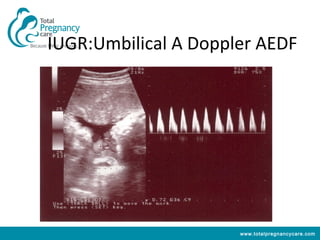
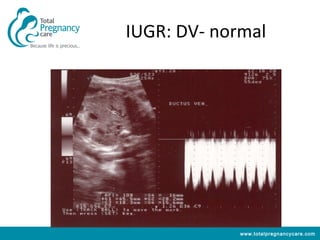
• Scan: Both AC, HC less than 3rd centile
• Amniotic fluid volume: 5th centile
• Biophysical score 6/10


                                          www.totalpregnancycare.com
IUGR- MCA redistribution


                 www.totalpregnancycare.com
IUGR:Umbilical A Doppler AEDF


                      www.totalpregnancycare.com
IUGR: DV- normal


             www.totalpregnancycare.com
Profile
•   Total Pregnancy Care is an online guide for pregnancy, childbirth and motherhood related
    information. Women wanting to conceive, pregnant women, expecting parents, and new mothers
    can use this pregnancy portal for a healthy pregnancy, fulfilling childbirth and joyful motherhood.
    With pregnancy at its core, this portal covers various important aspects and especially addresses
    those matters that the Indian Woman always wanted to know but did not know whom to ask.

•   This website is compiled by Dr. Shantala, an Indian Obstetrician and Gynaecologist. She has over 20
    years of extensive medical and diagnostics experience in areas commonly related to the Maternity
    and Pregnancy fields. She has studied and practiced in India as well as in the United Kingdom and
    thus brings about the fusion of best practices of the Oriental East and the Progressive West.

•   A mother of three children, she has complete understanding of the emotional, mental and physical
    needs of the New Age Pregnant Woman. Her patients appreciate her empathic approach and
    wholeheartedly express their gratitude for her generosity and care. Dr.Shantala is presently a full
    time Obstetrics and Gynaecology Consultant at the Kokilaben Dhirubhai Ambani Hospital and
    Medical Research Institute, a premier health care initiative of the Reliance ADA Group. Dr.Shantala
    has a clear vision to promote a holistic pregnancy approach and her mission is to provide
    comprehensive maternity care. This website, www.TotalPregnancyCare.com, is her first step
    towards this future.


                                                                                  www.totalpregnancycare.com
Services Offered
•   Pre-pregnancy counseling
•   Genetic counseling
•   Antenatal care, Labour Delivery
•   Specialist Ultrasound scans
     –   Viability scan
     –   The First trimester scan / Nuchal translucency scans
     –   Detailed anatomy / anomaly scans
     –   Fetal Echocardiograph
     –   3D / 4D scans
•   Assessment of the High risk Fetus and Mother
•   Amniocentesis
•   Chorionic Villous sampling
•   Cordocentesis
•   Intra-uterine transfusions
•   Embryo Reduction / Selective fetocide
•   Second opinion scans


                                                                www.totalpregnancycare.com
Topics covered
• Pre-Conception
  – Working on getting pregnant or just starting to think about a family, this is
    the place for you
• Pregnancy
  – From trying to conceive to the first trimester to labor, learn what to
    expect during your pregnancy and more
• Labor Delivery
  – From that first contraction to the final push, here's what to expect
    during labor and delivery
• Post-Pregnancy
  – Learn more about your diet and workouts, shopping, feeding and your
    child's health


                                                               www.totalpregnancycare.com
Interactive Corner
•   Month by Month happenings
•   Articles
•   FAQs
•   Gestation Calendar


                                www.totalpregnancycare.com
Society Memberships
• British Maternal & Fetal Medicine Society
• Fetal Medicine Centre
• Kokilaben Dhirubhai Ambani Hospital &
  Medical Research Institute
• Royal College of Obstetricians and
  Gynaecologists
• International Society of Ultrasound in
  Obstetrics and Gynecology


                                              www.totalpregnancycare.com
Contact Us
• Email: shantala@totalpregnancycare.com
• Mobile: +91 9324304212
• KDAH Board line: +91 22 30999999


                                  www.totalpregnancycare.com
THANK YOU
www.totalpregnancycare.com
                             www.totalpregnancycare.com

Intra uterine growth restriction

  • 1.
    www.totalpregnancycare.com www.totalpregnancycare.com
  • 2.
    Intra-uterine Growth Restriction Dr Shantala Vadeyar MD, FRCOG, DM Advanced Obstetric Ultrasound (RCOG / RCR) Subspecialist Fetal & Maternal Medicine (RCOG) Consultant Obstetrician, Fetal & Maternal Medicine Kokilaben Dhirubhai Ambani Hospital, Mumbai www.totalpregnancycare.com
  • 3.
    Definition • IUGR isfailure to achieve the fetal growth potential • Difference between size and growth • Size - one measurement • Growth – multiple measurements plotted on a graph • Growth charts – important in fetuses like in children www.totalpregnancycare.com
  • 4.
    Size v/s Growth •Small for gestational age - <2.5 kg • Preterm gestation and small • Term gestation and small • Healthy but small – Constitutionally small • Pathologically small – IUGR www.totalpregnancycare.com
  • 5.
    Causes of IUGR– 1. Maternal • Chronic maternal conditions – Renal disease – Hypertension – Long standing Diabetes – Congenital heart disease • Smoking • Alcohol • Anemia - severe www.totalpregnancycare.com
  • 6.
    Causes of IUGR– 2. Fetal • Infection – TORCH – Toxoplasma, Rubella, CMV • Malformation – Gastroschisis • Chromosomal abnormalities – Trisomy 18 (Edward syndrome) • Multifetal pregnancy – Chorionicity determination is vital – MC Twins, Twin twin transfusion syndrome www.totalpregnancycare.com
  • 7.
    Causes of IUGR– 3. Placental • Placental thrombosis / infarctions • Antiphospholipid syndrome • Chorioamnionitis • Abruptio placentae – usually acute, but sometimes, small recurrent bleeds • Placenta previa www.totalpregnancycare.com
  • 8.
    Causes of IUGR– 4. Uterine • Poor uterine blood flow • Poor placental blood flow • Large fibroids leading to poor placentation • Uterine anomalies – septate or subseptate uterus www.totalpregnancycare.com
  • 9.
    IUGR screening • Whomto screen? • Ideally Symphysis Fundal Height performed regularly for all pregnancies • SFH in cms = weeks of gestation • High risk cases will need ultrasound for growth, liquor volume, umbilical artery Doppler and Biophysical Profile • Umbilical Artery Doppler is the best test! www.totalpregnancycare.com
  • 10.
    Diagnosis • Accurate datingis vital! – < 20 weeks of gestation, preferably < 14 wks • Suspect clinically – Uterus palpates small – Less amniotic fluid – Reduced fetal movements • High risk maternal, placental, uterine or fetal factors www.totalpregnancycare.com
  • 11.
    Ultrasound diagnosis of IUGR • Growth • Measure the fetus – biometry – Head circumference – Abdominal circumference – Femur length • Measure the amniotic fluid- AF index, SDP • Evaluate the blood flows- Dopplers! www.totalpregnancycare.com
  • 12.
    Uterine Artery Doppler •Screening test in pregnant women • High resistance waveform- ‘notching’ indicates poor placentation • Notches are present in early gestation but disappear 24 weeks onwards • Bilateral notches are significant www.totalpregnancycare.com
  • 13.
    Uterine A Doppler- Normal www.totalpregnancycare.com
  • 14.
    Uterine Artery Doppler •Notching indicates a high risk pregnancy • Increased risk of – Pre-eclampsia – Growth restriction – Placental abruption – Intrauterine fetal death • Increased monitoring- growth scans, Umbilical artery Doppler www.totalpregnancycare.com
  • 15.
    Uterine A Doppler- Notching www.totalpregnancycare.com
  • 16.
    Umbilical Artery Doppler •Indicates resistance in the feto-placental vascular bed • Angle of insonation should be <60o • From 16 weeks onwards- positive end diastolic flow (EDF) • Reduced EDF, Absent EDF and Reversed EDF represent increasing resistance in the vascular bed www.totalpregnancycare.com
  • 17.
    Umbilical Artery Doppler www.totalpregnancycare.com
  • 18.
    Umbilical A: AEDF www.totalpregnancycare.com
  • 19.
    Umbilical A: REDF www.totalpregnancycare.com
  • 20.
    Fetal growth • Serialassessments are important • Growth trajectory is important, not size! • Symmetrically small fetus – Constitutionally small – Genetic syndromes/ chromosomal abn – Very early onset IUGR • Asymmetric- HC>AC suggests growth restriction due to placental insufficiency www.totalpregnancycare.com
  • 21.
    Interpretation of Ultrasound findings in IUGR • Clinical history – Previous poor outcome – Antepartum haemorrhage – Reduced fetal movements • Gestation- how accurate? Viability? • U/S- Growth, Biphysical profile, Umbilical Artery and Uterine Dopplers • CTG (NST) www.totalpregnancycare.com
  • 22.
    Antenatal Surveillance in IUGR • Watch fetal movements • Maternal health – pre-eclampsia • Biophysical Profile Score • Comprises 2 points each for- – Fetal body movements – Fetal tone – Fetal breathing movements – Amniotic fluid volume – CTG www.totalpregnancycare.com
  • 23.
    Fetal Middle CerebralArtery Doppler • 22-28 weeks- no EDF in MCA • 28w to term- some EDF seen- normal • Increased EDF ( low PI) suggests ‘brain sparing’ redistribution in IUGR • Worsening hypoxia- fetal acidemia- paradoxical rise in resistance (high PI) • Cerebro-placental ratio increases – this is indicative of IUGR www.totalpregnancycare.com
  • 24.
    MCA Doppler www.totalpregnancycare.com
  • 25.
    MCA Doppler- IUGR www.totalpregnancycare.com
  • 26.
    What does NOThelp… • Duvadilan / Bricanyl • Amnioinfusions • Oxygen therapy • Amninoacid preparations • Bed rest ?? www.totalpregnancycare.com
  • 27.
    Timing of delivery •>34 weeks – good neonatal outcome • <34 weeks - Betamethasone inj should be given to the mother • Fetal pulmonary maturity • Reduces risk of intra-ventricular haemorrhage • Very preterm gestation - <28 weeks ? • To wait or to deliver… www.totalpregnancycare.com
  • 28.
    Preterm labour inIUGR • Often IUGR fetuses / pregnancies tend to go into preterm labour • Nature’s way of resolving the problem • Important to recognise this and avoid prolongation of pregnancy! www.totalpregnancycare.com
  • 29.
    Mode of delivery •Labour is a stressful process for the fetus • Every contraction reduces oxygenation, though briefly and it recovers • Prolonged difficult labours should be avoided! • Continuous fetal monitoring is a MUST! • Elective LSCS for severe IUGR, abnormal presentation, oligohydramnios, abnormal CTG/ NST www.totalpregnancycare.com
  • 30.
    Outcome • Mild –moderate IUGR – good • Severe early onset IUGR – some organ systems may be compromised • Gut - Neonatal necrotising enterocolitis • Kidneys – renal failure • Brain – cerebral palsy • Genetic syndromes / malformations www.totalpregnancycare.com
  • 31.
    IUGR in DCtwins • Dichorionic twins- confirmed by 10-12w scans • Twin 1 – AC : dropped from 10th to 5th centile – AF : 3rd centile – Absent EDF in one umb artery initially, then both – Bladder seen, normal biophysical score • Twin 2 – AC: 50th centile, Normal AF, Normal UA Doppler – Normal sized bladder, heart, biophysical scores www.totalpregnancycare.com
  • 32.
    Management- when todeliver? • Monitor biophysical profiles and Umbilical Artery Dopplers • Risk of preterm delivery versus compromise • What is the significance of worsening Umbilical A Dopplers? • Risks of preterm delivery- respiratory distress syndrome, necrotising enterocolitis, infection • Risk to well grown fetus of prematurity • Intrauterine complications- abruption, worsening of maternal PET, IUFD www.totalpregnancycare.com
  • 33.
    Decision to deliver • Twice weekly Biophysical scores • Twice daily CTGs, FM monitoring • 31 weeks: Both Umb A in twin 1 showed absent EDF. • Discussion with parents- proceed to LSCS • Twin 1 was1 kg, twin 2 was 1.8 kg, both males • NEC in Twin 1 – recovered • Good outcome www.totalpregnancycare.com
  • 34.
    IUGR- Case 2 •25 year old primigravida • 34 weeks, presented with severe oedema, raised BP, proteinuria • Diagnosis: PET (pre-eclampsia) • Scan: Both AC, HC less than 3rd centile • Amniotic fluid volume: 5th centile • Biophysical score 6/10 www.totalpregnancycare.com
  • 35.
    IUGR- MCA redistribution www.totalpregnancycare.com
  • 36.
    IUGR:Umbilical A DopplerAEDF www.totalpregnancycare.com
  • 37.
    IUGR: DV- normal www.totalpregnancycare.com
  • 38.
    Profile • Total Pregnancy Care is an online guide for pregnancy, childbirth and motherhood related information. Women wanting to conceive, pregnant women, expecting parents, and new mothers can use this pregnancy portal for a healthy pregnancy, fulfilling childbirth and joyful motherhood. With pregnancy at its core, this portal covers various important aspects and especially addresses those matters that the Indian Woman always wanted to know but did not know whom to ask. • This website is compiled by Dr. Shantala, an Indian Obstetrician and Gynaecologist. She has over 20 years of extensive medical and diagnostics experience in areas commonly related to the Maternity and Pregnancy fields. She has studied and practiced in India as well as in the United Kingdom and thus brings about the fusion of best practices of the Oriental East and the Progressive West. • A mother of three children, she has complete understanding of the emotional, mental and physical needs of the New Age Pregnant Woman. Her patients appreciate her empathic approach and wholeheartedly express their gratitude for her generosity and care. Dr.Shantala is presently a full time Obstetrics and Gynaecology Consultant at the Kokilaben Dhirubhai Ambani Hospital and Medical Research Institute, a premier health care initiative of the Reliance ADA Group. Dr.Shantala has a clear vision to promote a holistic pregnancy approach and her mission is to provide comprehensive maternity care. This website, www.TotalPregnancyCare.com, is her first step towards this future. www.totalpregnancycare.com
  • 39.
    Services Offered • Pre-pregnancy counseling • Genetic counseling • Antenatal care, Labour Delivery • Specialist Ultrasound scans – Viability scan – The First trimester scan / Nuchal translucency scans – Detailed anatomy / anomaly scans – Fetal Echocardiograph – 3D / 4D scans • Assessment of the High risk Fetus and Mother • Amniocentesis • Chorionic Villous sampling • Cordocentesis • Intra-uterine transfusions • Embryo Reduction / Selective fetocide • Second opinion scans www.totalpregnancycare.com
  • 40.
    Topics covered • Pre-Conception – Working on getting pregnant or just starting to think about a family, this is the place for you • Pregnancy – From trying to conceive to the first trimester to labor, learn what to expect during your pregnancy and more • Labor Delivery – From that first contraction to the final push, here's what to expect during labor and delivery • Post-Pregnancy – Learn more about your diet and workouts, shopping, feeding and your child's health www.totalpregnancycare.com
  • 41.
    Interactive Corner • Month by Month happenings • Articles • FAQs • Gestation Calendar www.totalpregnancycare.com
  • 42.
    Society Memberships • BritishMaternal & Fetal Medicine Society • Fetal Medicine Centre • Kokilaben Dhirubhai Ambani Hospital & Medical Research Institute • Royal College of Obstetricians and Gynaecologists • International Society of Ultrasound in Obstetrics and Gynecology www.totalpregnancycare.com
  • 43.
    Contact Us • Email:shantala@totalpregnancycare.com • Mobile: +91 9324304212 • KDAH Board line: +91 22 30999999 www.totalpregnancycare.com
  • 44.
    THANK YOU www.totalpregnancycare.com www.totalpregnancycare.com