INTERFICIAL TRANSITION ZONES
IN
RECYCLED AGGREATE CONCRETE
Using different mixing approaches and techniques
INTRODUCTION
 RAC or Recycled Aggregate Concrete is
one of the most important use of waste
concrete and is being used throughout the
world .
 It is manufactured by using previously
prepared concrete as aggregate with
fresh cement matrix.
 It is sustainable and environment friendly
as it recycles the concrete which would
have been discarded as waste and had to
be dumped off.
 It reduces the construction cost and when
used properly gives similar performance
as virgin aggregate concrete.
INTRODUCTION (cont.)
 Some advantages of using RAC are:
 Keeping concrete debris out of landfills saves landfill
space.
 Using recycled material as gravel reduces the need for
gravel mining.
 Recycling one ton of cement could save 1,360 gallons
(5.14 m3) water, 900 kg of CO2.
 Using recycled concrete as the base material for
roadways reduces the pollution involved in trucking
material.
INTRODUCTION(cont.)
 The strength of RAC greatly depends
on the micro structural interfaces
present in it.
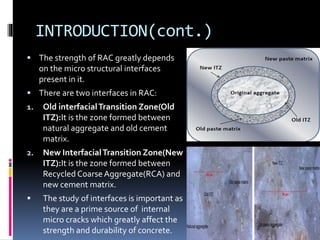
 There are two interfaces in RAC:
1. Old interfacialTransition Zone(Old
ITZ):It is the zone formed between
natural aggregate and old cement
matrix.
2. New InterfacialTransition Zone(New
ITZ):It is the zone formed between
Recycled Coarse Aggregate(RCA) and
new cement matrix.
 The study of interfaces is important as
they are a prime source of internal
micro cracks which greatly affect the
strength and durability of concrete.
SOME TERMS AND DEFENITIONS
 NORMAL MIXING APPROACH(NMA)
 It is traditional mixing approach in which all the ingredients
are mixed all together.
 It has been used for a long time and is effective for the
production of virgin aggregate concrete.
 TWO STAGE MIXINGAPPROACH(TSMA)
 In this method, the RCA is firstly mixed with cement paste,
which is followed by adding sand to the mixture, thus making
a two stage mixing.
 The two-stage mixing can help to form a layer of cement
slurry on the surface of RCA to fill up the initial damage such
as micro-cracks and voids, leading to an improved interfacial
zone at the pre-mix stage.
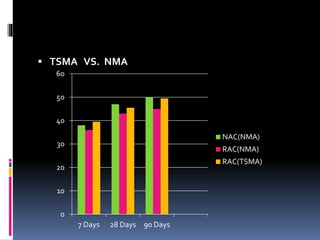
 TSMA VS. NMA
0
10
20
30
40
50
60
7 Days 28 Days 90 Days
NAC(NMA)
RAC(NMA)
RAC(TSMA)
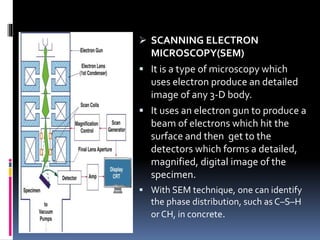
 SCANNING ELECTRON
MICROSCOPY(SEM)
 It is a type of microscopy which
uses electron produce an detailed
image of any 3-D body.
 It uses an electron gun to produce a
beam of electrons which hit the
surface and then get to the
detectors which forms a detailed,
magnified, digital image of the
specimen.
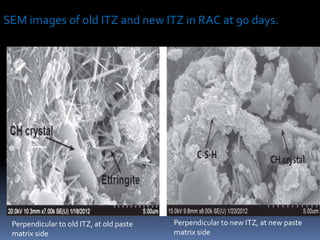
 With SEM technique, one can identify
the phase distribution, such as C–S–H
or CH, in concrete.
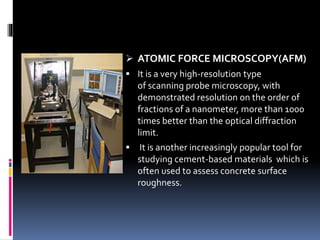
 ATOMIC FORCE MICROSCOPY(AFM)
 It is a very high-resolution type
of scanning probe microscopy, with
demonstrated resolution on the order of
fractions of a nanometer, more than 1000
times better than the optical diffraction
limit.
 It is another increasingly popular tool for
studying cement-based materials which is
often used to assess concrete surface
roughness.
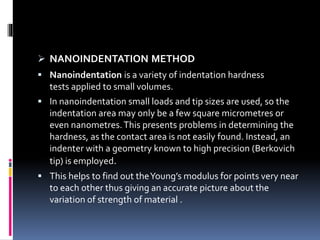
 NANOINDENTATION METHOD
 Nanoindentation is a variety of indentation hardness
tests applied to small volumes.
 In nanoindentation small loads and tip sizes are used, so the
indentation area may only be a few square micrometres or
even nanometres.This presents problems in determining the
hardness, as the contact area is not easily found. Instead, an
indenter with a geometry known to high precision (Berkovich
tip) is employed.
 This helps to find out theYoung’s modulus for points very near
to each other thus giving an accurate picture about the
variation of strength of material .
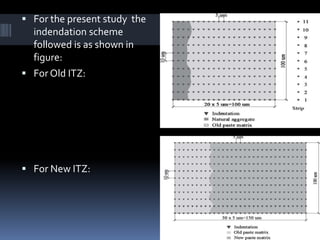
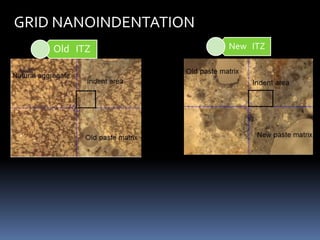
 For the present study the
indendation scheme
followed is as shown in
figure:
 For Old ITZ:
 For New ITZ:
RESEARCH SCOPE AND ADVANTAGES
 This research mainly focuses on studying two properties of ITZs: the
elastic modulus and the thickness.
 Knowing the elastic modulus distribution within ITZs can help to
improve our knowledge of the failure mechanism and cracking
progresses in RAC.
 And knowing the thickness can help to develop methodologies to
improve the quality of RAC by minimizing the ITZ volume.
 This study presents two gaps in the current understanding of RAC
behavior by:
1. Obtaining a more accurate understanding of local mechanical
properties on nanoscales for ITZs in RAC
2. Revealing the differences in nanoscale mechanical properties
between old and new ITZs in RAC
CONCLUSIONS
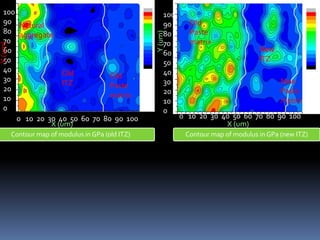
 For the old ITZ, the indentation modulus increases as the distance
from original aggregate surface increases. For the new ITZ with
TSMA, there is no obvious trend indicating that the indentation
modulus increases or decreases with the increasing distance from
the old paste matrix surface, while in the new ITZ with NMA the
modulus distribution appears to decrease significantly from the old
paste matrix surface.
 It indicates that theTSMA can effectively reduce the size and
effect of water layers and CH crystals formed around the RCA.
Therefore, the amount of porosity is reduced and the enhanced
hydration provides a source for production of C–S–H.
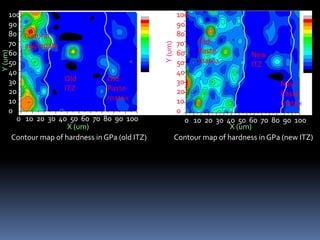
 It is observed that the volume fractions of porosity and CH phases
in the new ITZ withTSMA are relatively lower than those of the old
ITZ and new ITZ with NMA, which can explain the improvement in
RAC compressive strength.
CONCLUSIONS (cont.)
 For the new ITZ withTSMA, the
cement slurry permeates into the
porous old paste matrix and fills
up the voids and cracks, which
improve the microstructure of the
new ITZ.However, for the new ITZ
with NMA, there is a significantly
loose microstructure that contains
a large volume of porosity and CH
crystals.
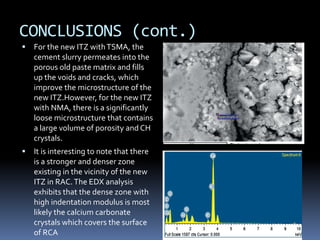
 It is interesting to note that there
is a stronger and denser zone
existing in the vicinity of the new
ITZ in RAC.The EDX analysis
exhibits that the dense zone with
high indentation modulus is most
likely the calcium carbonate
crystals which covers the surface
of RCA
GRID NANOINDENTATION
Old ITZ New ITZ
100
90
80
70
60
50
40
30
20
10
0
0 10 20 30 40 50 60 70 80 90 100
100
90
80
70
60
50
40
30
20
10
0
0 10 20 30 40 50 60 70 80 90 100
Natural
aggregate
Old
ITZ
Old
Paste
matrix
Old
Paste
matrix
New
ITZ
New
Paste
matrix
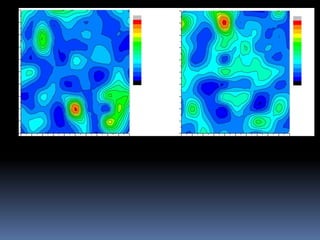
Contour map of modulus in GPa (old ITZ) Contour map of modulus in GPa (new ITZ)
X (um) X (um)
Y(um)
Y(um)
100
90
80
70
60
50
40
30
20
10
0
100
90
80
70
60
50
40
30
20
10
0
0 10 20 30 40 50 60 70 80 90 100 0 10 20 30 40 50 60 70 80 90 100
Contour map of hardness in GPa (old ITZ) Contour map of hardness in GPa (new ITZ)
X (um) X (um)
Y(um)
Y(um)
Natural
aggregate
Old
ITZ
Old
Paste
matrix
Old
Paste
matrix
New
ITZ
New
Paste
matrix
Perpendicular to old ITZ, at old paste
matrix side
Perpendicular to new ITZ, at new paste
matrix side
SEM images of old ITZ and new ITZ in RAC at 90 days.
ITZ in Recycled Aggregate Concrete  presentation

ITZ in Recycled Aggregate Concrete presentation

  • 1.
    INTERFICIAL TRANSITION ZONES IN RECYCLEDAGGREATE CONCRETE Using different mixing approaches and techniques
  • 2.
    INTRODUCTION  RAC orRecycled Aggregate Concrete is one of the most important use of waste concrete and is being used throughout the world .  It is manufactured by using previously prepared concrete as aggregate with fresh cement matrix.  It is sustainable and environment friendly as it recycles the concrete which would have been discarded as waste and had to be dumped off.  It reduces the construction cost and when used properly gives similar performance as virgin aggregate concrete.
  • 3.
    INTRODUCTION (cont.)  Someadvantages of using RAC are:  Keeping concrete debris out of landfills saves landfill space.  Using recycled material as gravel reduces the need for gravel mining.  Recycling one ton of cement could save 1,360 gallons (5.14 m3) water, 900 kg of CO2.  Using recycled concrete as the base material for roadways reduces the pollution involved in trucking material.
  • 4.
    INTRODUCTION(cont.)  The strengthof RAC greatly depends on the micro structural interfaces present in it.  There are two interfaces in RAC: 1. Old interfacialTransition Zone(Old ITZ):It is the zone formed between natural aggregate and old cement matrix. 2. New InterfacialTransition Zone(New ITZ):It is the zone formed between Recycled Coarse Aggregate(RCA) and new cement matrix.  The study of interfaces is important as they are a prime source of internal micro cracks which greatly affect the strength and durability of concrete.
  • 5.
    SOME TERMS ANDDEFENITIONS  NORMAL MIXING APPROACH(NMA)  It is traditional mixing approach in which all the ingredients are mixed all together.  It has been used for a long time and is effective for the production of virgin aggregate concrete.  TWO STAGE MIXINGAPPROACH(TSMA)  In this method, the RCA is firstly mixed with cement paste, which is followed by adding sand to the mixture, thus making a two stage mixing.  The two-stage mixing can help to form a layer of cement slurry on the surface of RCA to fill up the initial damage such as micro-cracks and voids, leading to an improved interfacial zone at the pre-mix stage.
  • 6.
     TSMA VS.NMA 0 10 20 30 40 50 60 7 Days 28 Days 90 Days NAC(NMA) RAC(NMA) RAC(TSMA)
  • 7.
     SCANNING ELECTRON MICROSCOPY(SEM) It is a type of microscopy which uses electron produce an detailed image of any 3-D body.  It uses an electron gun to produce a beam of electrons which hit the surface and then get to the detectors which forms a detailed, magnified, digital image of the specimen.  With SEM technique, one can identify the phase distribution, such as C–S–H or CH, in concrete.
  • 8.
     ATOMIC FORCEMICROSCOPY(AFM)  It is a very high-resolution type of scanning probe microscopy, with demonstrated resolution on the order of fractions of a nanometer, more than 1000 times better than the optical diffraction limit.  It is another increasingly popular tool for studying cement-based materials which is often used to assess concrete surface roughness.
  • 9.
     NANOINDENTATION METHOD Nanoindentation is a variety of indentation hardness tests applied to small volumes.  In nanoindentation small loads and tip sizes are used, so the indentation area may only be a few square micrometres or even nanometres.This presents problems in determining the hardness, as the contact area is not easily found. Instead, an indenter with a geometry known to high precision (Berkovich tip) is employed.  This helps to find out theYoung’s modulus for points very near to each other thus giving an accurate picture about the variation of strength of material .
  • 10.
     For thepresent study the indendation scheme followed is as shown in figure:  For Old ITZ:  For New ITZ:
  • 11.
    RESEARCH SCOPE ANDADVANTAGES  This research mainly focuses on studying two properties of ITZs: the elastic modulus and the thickness.  Knowing the elastic modulus distribution within ITZs can help to improve our knowledge of the failure mechanism and cracking progresses in RAC.  And knowing the thickness can help to develop methodologies to improve the quality of RAC by minimizing the ITZ volume.  This study presents two gaps in the current understanding of RAC behavior by: 1. Obtaining a more accurate understanding of local mechanical properties on nanoscales for ITZs in RAC 2. Revealing the differences in nanoscale mechanical properties between old and new ITZs in RAC
  • 12.
    CONCLUSIONS  For theold ITZ, the indentation modulus increases as the distance from original aggregate surface increases. For the new ITZ with TSMA, there is no obvious trend indicating that the indentation modulus increases or decreases with the increasing distance from the old paste matrix surface, while in the new ITZ with NMA the modulus distribution appears to decrease significantly from the old paste matrix surface.  It indicates that theTSMA can effectively reduce the size and effect of water layers and CH crystals formed around the RCA. Therefore, the amount of porosity is reduced and the enhanced hydration provides a source for production of C–S–H.  It is observed that the volume fractions of porosity and CH phases in the new ITZ withTSMA are relatively lower than those of the old ITZ and new ITZ with NMA, which can explain the improvement in RAC compressive strength.
  • 13.
    CONCLUSIONS (cont.)  Forthe new ITZ withTSMA, the cement slurry permeates into the porous old paste matrix and fills up the voids and cracks, which improve the microstructure of the new ITZ.However, for the new ITZ with NMA, there is a significantly loose microstructure that contains a large volume of porosity and CH crystals.  It is interesting to note that there is a stronger and denser zone existing in the vicinity of the new ITZ in RAC.The EDX analysis exhibits that the dense zone with high indentation modulus is most likely the calcium carbonate crystals which covers the surface of RCA
  • 15.
  • 16.
    100 90 80 70 60 50 40 30 20 10 0 0 10 2030 40 50 60 70 80 90 100 100 90 80 70 60 50 40 30 20 10 0 0 10 20 30 40 50 60 70 80 90 100 Natural aggregate Old ITZ Old Paste matrix Old Paste matrix New ITZ New Paste matrix Contour map of modulus in GPa (old ITZ) Contour map of modulus in GPa (new ITZ) X (um) X (um) Y(um) Y(um)
  • 17.
    100 90 80 70 60 50 40 30 20 10 0 100 90 80 70 60 50 40 30 20 10 0 0 10 2030 40 50 60 70 80 90 100 0 10 20 30 40 50 60 70 80 90 100 Contour map of hardness in GPa (old ITZ) Contour map of hardness in GPa (new ITZ) X (um) X (um) Y(um) Y(um) Natural aggregate Old ITZ Old Paste matrix Old Paste matrix New ITZ New Paste matrix
  • 18.
    Perpendicular to oldITZ, at old paste matrix side Perpendicular to new ITZ, at new paste matrix side SEM images of old ITZ and new ITZ in RAC at 90 days.