NON-DESTRUCTIVE
TESTING OF
CONCRETE
PRESENTED BY
AGLAIA
NON-DESTRUCTIVE TESTING OF
CONCRETE (NDT ON CONCRETE)
 It is a method of testing existing concrete structures to
assess the strength and durability of concrete structure.
 In NDT without loading the specimen to failure we can
measure strength of concrete.
 Now days this method has become a part of quality
control process.
 This method helps us to investigate crack depth, micro
cracks and deterioration of concrete.
 It requires skilled and experienced persons.
PURPOSES OF NON-DESTRUCTIVE TESTS
 Estimating the in-situ compressive strength,uniformity,
quality and homogeneity
 Identifying areas of lower integrity
 Detection of presence of imperfections
 Monitoring changes in the structure of the concrete.
 Condition of reinforcement steel with respect to
corrosion
 Chloride, sulphate, alkali contents or degree
of carbonation
 Measurement of Elastic Modulus
 Condition of grouting in prestressing cable ducts
DIFFERENT METHODS OF NDT
 Penetration method
 Rebound hammer method
 Pull out test method
 Ultrasonic pulse velocity method
 Radioactive methods
PENETRATION TESTS ON CONCRETE
 The Windsor probe is generally considered to be the best
means of testing penetration.
 Equipment consists of a powder-actuated gun or driver,
hardened alloy probes, loaded cartridges, a depth gauge
for measuring penetration of probes and other related
equipment.
 A probe, diameter 0.25 in. (6.5 mm) and length 3.125 in.
(8.0 cm), is driven into the concrete by means of a
precision powder charge.
 Depth of penetration provides an indication of the
compressive strength of the concrete.
 Although calibration charts are provided by the
manufacturer, the instrument should be calibrated for type
of concrete and type and size of aggregate used.
BENEFITS AND LIMITATIONS
 The test produces quite variable results and should
not be expected to give accurate values of concrete
strength.
 It has, however, the potential for providing a quick
means of checking quality and maturity of in situ
concrete.
 It also provides a means of assessing strength
development with curing.
 The test is essentially non-destructive, since
concrete and structural members can be tested in
situ, with only minor patching of holes on exposed
faces.
REBOUND HAMMER METHOD
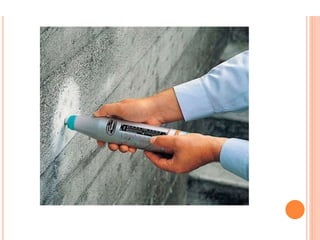
 It is a surface hardness tester for which an empirical
correlation has been established between strength and
rebound number.
 The only known instrument to make use of the rebound
principle for concrete testing is the Schmidt hammer,
which weighs about 4 lb (1.8 kg).
 It consists of a spring-controlled hammer mass that
slides on a plunger within a tubular housing.
 The hammer is forced against the surface of the
concrete by the spring and the distance of rebound is
measured on a scale.
 The test surface can be horizontal, vertical or at any
angle but the instrument must be calibrated in this
position.
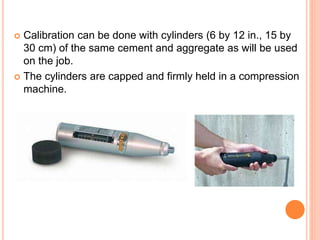
 Calibration can be done with cylinders (6 by 12 in., 15 by
30 cm) of the same cement and aggregate as will be used
on the job.
 The cylinders are capped and firmly held in a compression
machine.
LIMITATIONS AND ADVANTAGES
 The Schmidt hammer provides an inexpensive, simple
and quick method of obtaining an indication of concrete
strength.
 The results are affected by factors such as
1. smoothness of surface
2. size and shape of specimen
3. moisture condition of the concrete
4. type of cement and coarse aggregate
5. extent of carbonation of surface.
PULL-OUT TESTS ON CONCRETE
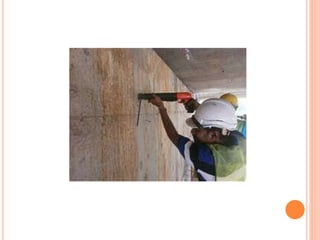
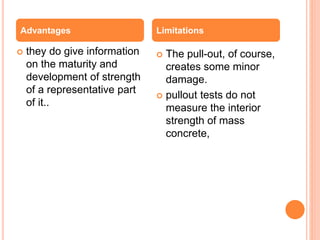
 A pull-out test measures, with a special ram, the force
required to pull from the concrete a specially shaped
steel rod whose enlarged end has been cast into the
concrete to a depth of 3 in. (7.6 cm).
 The concrete is simultaneously in tension and in shear,
but the force required to pull the concrete out can be
related to its compressive strength.
 The pull-out technique can thus measure quantitatively
the in-situ strength of concrete when proper
correlations have been made.
 It has been found, over a wide range of strengths, that
pull-out strengths have a coefficient of variation
comparable to that of compressive strength.
 they do give information
on the maturity and
development of strength
of a representative part
of it..
 The pull-out, of course,
creates some minor
damage.
 pullout tests do not
measure the interior
strength of mass
concrete,
Advantages Limitations
ULTRASONIC PULSE VELOCITY METHOD
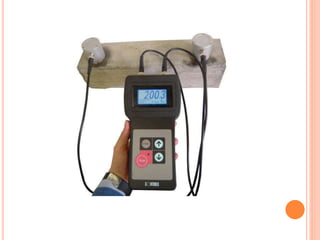
 It is the only one of this type that shows potential for
testing concrete strength in situ.
 It measures the time of travel of an ultrasonic pulse
passing through the concrete.
 It consist of a pulse generator and a pulse receiver.
 Pulses are generated by shock-exciting piezoelectric
crystals, with similar crystals used in the receiver.
 The time taken for the pulse to pass through the
concrete is measured by electronic measuring
circuits.
 It can be carried out on both laboratory-sized
specimens and completed concrete structures.
 There must be smooth contact with the surface under
test; a coupling medium such as a thin film of oil is
mandatory.
 It is desirable for path-lengths to be at least 12 in. (30
cm) in order to avoid any errors introduced by
heterogeneity.
 There is an increase in pulse velocity at below-freezing
temperature owing to freezing of water; from 5 to 30°C
(41 – 86°F) pulse velocities are not temperature
dependent.
 The presence of reinforcing steel in concrete has an
appreciable effect on pulse velocity.
APPLICATIONS AND LIMITATIONS
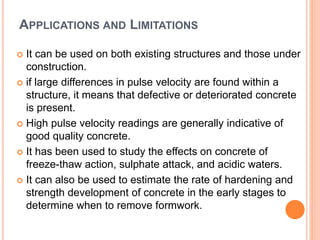
 It can be used on both existing structures and those under
construction.
 if large differences in pulse velocity are found within a
structure, it means that defective or deteriorated concrete
is present.
 High pulse velocity readings are generally indicative of
good quality concrete.
 It has been used to study the effects on concrete of
freeze-thaw action, sulphate attack, and acidic waters.
 It can also be used to estimate the rate of hardening and
strength development of concrete in the early stages to
determine when to remove formwork.
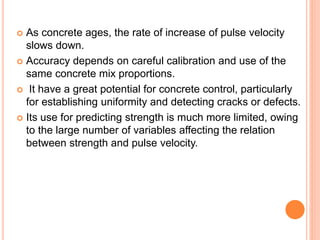
 As concrete ages, the rate of increase of pulse velocity
slows down.
 Accuracy depends on careful calibration and use of the
same concrete mix proportions.
 It have a great potential for concrete control, particularly
for establishing uniformity and detecting cracks or defects.
 Its use for predicting strength is much more limited, owing
to the large number of variables affecting the relation
between strength and pulse velocity.
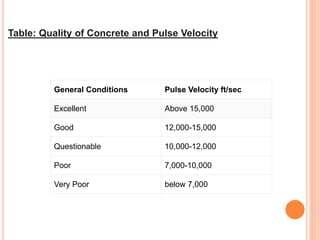
General Conditions Pulse Velocity ft/sec
Excellent Above 15,000
Good 12,000-15,000
Questionable 10,000-12,000
Poor 7,000-10,000
Very Poor below 7,000
Table: Quality of Concrete and Pulse Velocity
RADIOACTIVE METHODS OF NDT
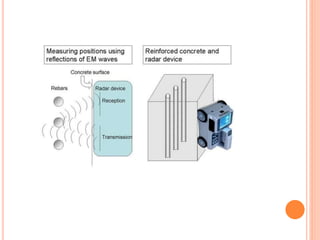
 It can be used to detect the location of reinforcement,
measure density.
 It can be used to check whether honeycombing has
occurred in structural concrete units.
 Gamma radiography is increasingly accepted in England
and Europe.
 The equipment is quite simple and running costs are
small, although the initial price can be high.
 Concrete up to 18 in. (45 cm) thick can be examined
without difficulty.
THANK YOU
For more…. Mail to aglaiaconnect2018@gmail.com

Non destructive test on concrete

  • 1.
  • 2.
    NON-DESTRUCTIVE TESTING OF CONCRETE(NDT ON CONCRETE)  It is a method of testing existing concrete structures to assess the strength and durability of concrete structure.  In NDT without loading the specimen to failure we can measure strength of concrete.  Now days this method has become a part of quality control process.  This method helps us to investigate crack depth, micro cracks and deterioration of concrete.  It requires skilled and experienced persons.
  • 4.
    PURPOSES OF NON-DESTRUCTIVETESTS  Estimating the in-situ compressive strength,uniformity, quality and homogeneity  Identifying areas of lower integrity  Detection of presence of imperfections  Monitoring changes in the structure of the concrete.  Condition of reinforcement steel with respect to corrosion  Chloride, sulphate, alkali contents or degree of carbonation  Measurement of Elastic Modulus  Condition of grouting in prestressing cable ducts
  • 5.
    DIFFERENT METHODS OFNDT  Penetration method  Rebound hammer method  Pull out test method  Ultrasonic pulse velocity method  Radioactive methods
  • 6.
    PENETRATION TESTS ONCONCRETE  The Windsor probe is generally considered to be the best means of testing penetration.  Equipment consists of a powder-actuated gun or driver, hardened alloy probes, loaded cartridges, a depth gauge for measuring penetration of probes and other related equipment.  A probe, diameter 0.25 in. (6.5 mm) and length 3.125 in. (8.0 cm), is driven into the concrete by means of a precision powder charge.  Depth of penetration provides an indication of the compressive strength of the concrete.  Although calibration charts are provided by the manufacturer, the instrument should be calibrated for type of concrete and type and size of aggregate used.
  • 8.
    BENEFITS AND LIMITATIONS The test produces quite variable results and should not be expected to give accurate values of concrete strength.  It has, however, the potential for providing a quick means of checking quality and maturity of in situ concrete.  It also provides a means of assessing strength development with curing.  The test is essentially non-destructive, since concrete and structural members can be tested in situ, with only minor patching of holes on exposed faces.
  • 9.
    REBOUND HAMMER METHOD It is a surface hardness tester for which an empirical correlation has been established between strength and rebound number.  The only known instrument to make use of the rebound principle for concrete testing is the Schmidt hammer, which weighs about 4 lb (1.8 kg).  It consists of a spring-controlled hammer mass that slides on a plunger within a tubular housing.  The hammer is forced against the surface of the concrete by the spring and the distance of rebound is measured on a scale.  The test surface can be horizontal, vertical or at any angle but the instrument must be calibrated in this position.
  • 10.
     Calibration canbe done with cylinders (6 by 12 in., 15 by 30 cm) of the same cement and aggregate as will be used on the job.  The cylinders are capped and firmly held in a compression machine.
  • 11.
    LIMITATIONS AND ADVANTAGES The Schmidt hammer provides an inexpensive, simple and quick method of obtaining an indication of concrete strength.  The results are affected by factors such as 1. smoothness of surface 2. size and shape of specimen 3. moisture condition of the concrete 4. type of cement and coarse aggregate 5. extent of carbonation of surface.
  • 12.
    PULL-OUT TESTS ONCONCRETE  A pull-out test measures, with a special ram, the force required to pull from the concrete a specially shaped steel rod whose enlarged end has been cast into the concrete to a depth of 3 in. (7.6 cm).  The concrete is simultaneously in tension and in shear, but the force required to pull the concrete out can be related to its compressive strength.  The pull-out technique can thus measure quantitatively the in-situ strength of concrete when proper correlations have been made.  It has been found, over a wide range of strengths, that pull-out strengths have a coefficient of variation comparable to that of compressive strength.
  • 14.
     they dogive information on the maturity and development of strength of a representative part of it..  The pull-out, of course, creates some minor damage.  pullout tests do not measure the interior strength of mass concrete, Advantages Limitations
  • 15.
    ULTRASONIC PULSE VELOCITYMETHOD  It is the only one of this type that shows potential for testing concrete strength in situ.  It measures the time of travel of an ultrasonic pulse passing through the concrete.  It consist of a pulse generator and a pulse receiver.  Pulses are generated by shock-exciting piezoelectric crystals, with similar crystals used in the receiver.  The time taken for the pulse to pass through the concrete is measured by electronic measuring circuits.  It can be carried out on both laboratory-sized specimens and completed concrete structures.
  • 16.
     There mustbe smooth contact with the surface under test; a coupling medium such as a thin film of oil is mandatory.  It is desirable for path-lengths to be at least 12 in. (30 cm) in order to avoid any errors introduced by heterogeneity.  There is an increase in pulse velocity at below-freezing temperature owing to freezing of water; from 5 to 30°C (41 – 86°F) pulse velocities are not temperature dependent.  The presence of reinforcing steel in concrete has an appreciable effect on pulse velocity.
  • 18.
    APPLICATIONS AND LIMITATIONS It can be used on both existing structures and those under construction.  if large differences in pulse velocity are found within a structure, it means that defective or deteriorated concrete is present.  High pulse velocity readings are generally indicative of good quality concrete.  It has been used to study the effects on concrete of freeze-thaw action, sulphate attack, and acidic waters.  It can also be used to estimate the rate of hardening and strength development of concrete in the early stages to determine when to remove formwork.
  • 19.
     As concreteages, the rate of increase of pulse velocity slows down.  Accuracy depends on careful calibration and use of the same concrete mix proportions.  It have a great potential for concrete control, particularly for establishing uniformity and detecting cracks or defects.  Its use for predicting strength is much more limited, owing to the large number of variables affecting the relation between strength and pulse velocity.
  • 20.
    General Conditions PulseVelocity ft/sec Excellent Above 15,000 Good 12,000-15,000 Questionable 10,000-12,000 Poor 7,000-10,000 Very Poor below 7,000 Table: Quality of Concrete and Pulse Velocity
  • 21.
    RADIOACTIVE METHODS OFNDT  It can be used to detect the location of reinforcement, measure density.  It can be used to check whether honeycombing has occurred in structural concrete units.  Gamma radiography is increasingly accepted in England and Europe.  The equipment is quite simple and running costs are small, although the initial price can be high.  Concrete up to 18 in. (45 cm) thick can be examined without difficulty.
  • 23.
    THANK YOU For more….Mail to aglaiaconnect2018@gmail.com