www.itu150.org
Building Cybersecurity
Capacity
Tomas Lamanauskas
Head, Corporate Strategy Division
25 March 2015
Committed to Connecting the World
2
The importance of Cybersecurity
• From industrial age to information societies
- Increasing dependence on the availability of ICTs
- Number of Internet users growing constantly (now 40% of world’s population)
• Statistics and reports show that
cyber-threats are on the rise
- The likely annual cost to the global economy
from Cybercrime is estimated at more than
$455 billion (Source: McAfee Report on Economic
Impact of Cybercrime, 2013).
• Developing countries most at risk as
they adopt broader use of ICTs
- E.g. Africa leading in Mobile-broadband
penetration: almost 20% in 2014- up from
less than 2% in 2010 (Source: ITU ICT Statistics)
Committed to Connecting the World
3
Need for building cybersecurity capacity
Committed to Connecting the World
4
Committed to Connecting the World
Coordinated Response
Need for a multilevel response to the cybersecurity challenges
International Cooperation
frameworks and exchange
of information
Harmonization of legislation and best
practices at regional level
National strategies and policies
National response capabilities
Country level capacity building and training
International
Regional
National
5
Committed to Connecting the World
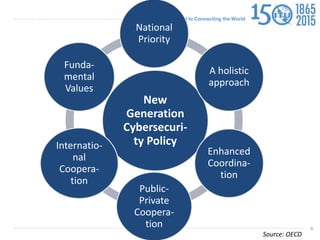
New
Generation
Cybersecuri-
ty Policy
National
Priority
A holistic
approach
Enhanced
Coordina-
tion
Public-
Private
Coopera-
tion
Internatio-
nal
Coopera-
tion
Funda-
mental
Values
Source: OECD
6
Committed to Connecting the World
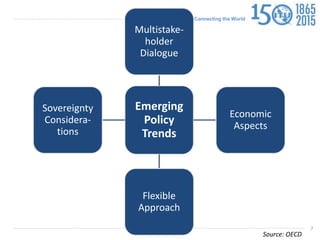
Emerging
Policy
Trends
Multistake-
holder
Dialogue
Economic
Aspects
Flexible
Approach
Sovereignty
Considera-
tions
Source: OECD
7
Committed to Connecting the World
8
ITU and Cybersecurity
Committed to Connecting the World
9
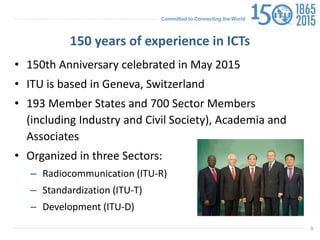
150 years of experience in ICTs
• 150th Anniversary celebrated in May 2015
• ITU is based in Geneva, Switzerland
• 193 Member States and 700 Sector Members
(including Industry and Civil Society), Academia and
Associates
• Organized in three Sectors:
– Radiocommunication (ITU-R)
– Standardization (ITU-T)
– Development (ITU-D)
Committed to Connecting the World
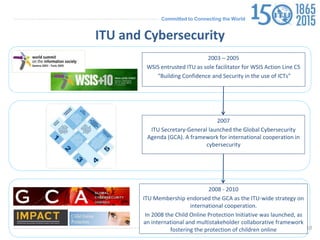
ITU and Cybersecurity
2003 – 2005
WSIS entrusted ITU as sole facilitator for WSIS Action Line C5
“Building Confidence and Security in the use of ICTs”
2007
ITU Secretary-General launched the Global Cybersecurity
Agenda (GCA). A framework for international cooperation in
cybersecurity
2008 - 2010
ITU Membership endorsed the GCA as the ITU-wide strategy on
international cooperation.
In 2008 the Child Online Protection Initiative was launched, as
an international and multistakeholder collaborative framework
fostering the protection of children online 10
Committed to Connecting the World
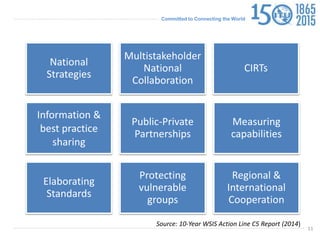
National
Strategies
Multistakeholder
National
Collaboration
CIRTs
Information &
best practice
sharing
Public-Private
Partnerships
Measuring
capabilities
Elaborating
Standards
Protecting
vulnerable
groups
Regional &
International
Cooperation
11
Source: 10-Year WSIS Action Line C5 Report (2014)
Committed to Connecting the World
12
National Strategies
 Developing comprehensive and efficient
National Cybersecurity Strategies is
fundamental for building a secure ICT
ecosystem.
 ITU together with its partners helps countries
organize Child Online Protection Strategy
Framework workshops to assist national
stakeholders in planning and deploying an
effective and practical approach to COP at a
national level.
Committed to Connecting the World
13
Committed to Connecting the World
14
Cybersecurity Strategy Model
Committed to Connecting the World
15
101 National CIRTs Worldwide
National CIRTs for enhancing global resilience
Need to fill the gaps
Committed to Connecting the World
16
National CIRT Programme
 Assess existing capability
of/need for national
cybersecurity mechanisms
 On-site assessment through
meetings, training, interview
sessions and site visits
 Form recommendations for plan
of action (institutional,
organizational and technical
requirements)
 Implement based on the identified
needs and organizational structures
of the country
 Assist with planning,
implementation, and operation of
the CIRT.
 Continued collaboration with the
newly established CIRT for
additional support
 Capacity Building and trainings on
the operational and technical details
 Exercises organized at both
regional and international
levels
 Help enhance the
communication and
response capabilities of the
participating CIRTs
 Improve overall
cybersecurity readiness in
the region
 Provide opportunities for
public-private cooperation
Committed to Connecting the World
17
ITU’s National CIRT Programme
• Assessments conducted for 61 countries
• Implementation completed for 9 countries
Cyprus​, Burkina Faso, Côte d'Ivoire, Ghana, ​Kenya​, Montenegro, Tanzania, Uganda,
Zambia
• Implementation in progress for 6 countries
Barbados, ​Burundi, Gambia, Jamaica, Lebanon​, Trinidad and Tobago
• 9 cyber drills conducted with participation of over 90
countries
Organized in Myanmar, Jordan, Bulgaria, Uruguay, Oman, Lao P.D.R., Turkey, Peru, Zambia
Committed to Connecting the World
Objective
The Global Cybersecurity Index (GCI)
measures and ranks each nation state’s
level of cybersecurity development in five
main areas:
• Legal Measures
• Technical Measures
• Organizational Measures
• Capacity Building
• National and International Cooperation
Goals
- Promote cyberesecurity strategies at a
national level
- Drive implementation efforts across
industries and sectors
- Integrate security into the core of
technological progress
- Foster a global culture of cybersecurity
18
Final Global and Regional Results 2014 are on ITU Website
Next iteration in progress
Committed to Connecting the World
19
Cyberwellness Country Profiles
Factual information on cybersecurity
achievements on each country based on the
GCA pillars
• 194 profiles to date
• Live documents
e.g.
Committed to Connecting the World
20
Enhancing Cybersecurity in Least Developed Countries project
Aims at supporting the 49 Least Developed Countries in strengthening their cybersecurity
capabilities.
How
• Assessment for selected key government ministries &
subsequent solutions provision
• Capacity building through training of trainers, workshops,..
• Customised guidelines on legislation, regulation and technologies
End Result
• protection of their national infrastructure, including the critical information
infrastructure, thereby making the Internet safer and protecting Internet users
• serve national priorities and maximize socio-economic benefits in line with the
objectives of the World Summit on the Information Society (WSIS) and the Millennium
Development Goals (MDGs).
We are only as secure as our weakest link
Implemented in 4 countries
Different stages of planning/implementation in 15 more
Committed to Connecting the World
Child Online Protection Initiative
Key Objectives:
 Identify risks and
vulnerabilities to children in
cyberspace
 Create awareness
 Develop practical tools to
help minimize risk
 Share knowledge and
experience
Partners:
- 10 international organizations
- 34 civil society organizations
- 13 private sector organizations 21
Committed to Connecting the World
22
Key COP Activities
 Elaboration of COP Guidelines for parents, children, policy makers and industry
 New! Updated version of the COP Guidelines for Industry with the contribution
of several partners (UNICEF, GSMA, Sony, Facebook, The Walt Disney Company
and EBU)
 COP National Strategy Framework
 ITU together with its partners helps countries organize Child Online Protection
Strategy Framework workshops to assist national stakeholders in planning and
deploying an effective and practical approach to COP at a national level.
 Child Online Protection Challenge
 Educating children by presenting an interactive platform where children, parents
and educators can engage in fun activities to learn more about the risks that the
children face on the Internet and how these risks can be averted.
 Council Working Group on Child Online Protection (CWG-COP)
 Multi-stakeholder open platform, where 193 Member States and other
stakeholders exchange views and promote work on the subject matter
Committed to Connecting the World
Economic Impact
of Standardization
Adds 0.3% - 1% to
the GDP
Source: European Commission
ITU-T Study Group 17 – Security
• Over 300 standards (ITU-T Recommendations)
relevant to security
• Key areas of current work:
• Cybersecurity
• Child Online Protection
• Security architectures and frameworks
• Countering spam
• Identity management
• Security of applications and services
for the Internet of Things, web
services, social networks, cloud
computing and Big Data
Standardization
23
Committed to Connecting the World
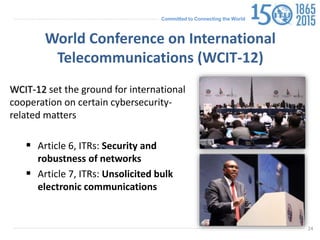
World Conference on International
Telecommunications (WCIT-12)
WCIT-12 set the ground for international
cooperation on certain cybersecurity-
related matters
 Article 6, ITRs: Security and
robustness of networks
 Article 7, ITRs: Unsolicited bulk
electronic communications
24
Committed to Connecting the World
25
New edition 2014: ITU Publication on UNDERSTANDING
CYBERCRIME: Phenomena, Challenges and Legal Response
The Guide serves to help developing countries better understand
the implications related to the growing cyber-threats and assist in
the assessment of the current legal framework and in the
establishment of a sound legal foundation.
Publications
COMBATTING CYBERCRIME: TOOLS AND CAPACITY BUILDING FOR
EMERGING ECONOMIES
Joint project among several partners under the coordination of the
World Bank to build capacity in developing countries in the policy,
legal and criminal justice aspects of the combat against “cybercrime”
Committed to Connecting the World
26
Capacity building initiatives, joint consultations and more.
Best practices in cybercrime legislations, joint technical assistance to member
states, information sharing
Tap on expertise of globally recognized industry players and accelerate
info sharing with ITU member states
Building a global partnership
Collaboration with ABI Research – The Global Cybersecurity Index (GCI)
Collaboration with FIRST – To share best practices on computer incident response, engage
in joint events, facilitate affiliation of national CIRTS of member states
Collaboration with Member States – Regional Cybersecurity Centres
Committed to Connecting the World
27
Coordinated Action
Committed to Connecting the World
Budapest Convention (2001), 45 Countries ratified/acceded
24/7 Network – some 50 countries, since 1997
EU Cybersecurity Strategy (2013)
Produced set of confidence-building measures (CBMs) to reduce
the risks of conflict stemming from the use of ICTs
International and Regional Cooperation
Comparative Analyses on Cybersecurity Policies
Convention on Cybersecurity and Personal Data Protection (2014)
28
Committed to Connecting the World
UN Efforts
- Resolutions 69/166 and 68/167 of the UN General Assembly on “The Right to
privacy in the digital age” (2014-2013)
- Resolutions 69/28 and 68/243 of the UN General Assembly on “Developments in
the field of information and telecommunications in the context of international
security” (2014-2013)
- Report of the Group of Governmental Experts on Developments in the Field of
Information and Telecommunications in the Context of International Security
(2013)
- Resolution 20/8 of the Human Rights Council on “The promotion, protection and
enjoyment of human rights on the Internet” (2012)
- Resolution 64/211 of the UN General Assembly on “Creation of a global culture
of cybersecurity and taking stock of national efforts to protect critical
information infrastructures” (2010)
29
Committed to Connecting the World
UN-wide cooperation mechanisms
UN-wide Framework on Cybersecurity and Cybercrime (2013)
 Developed by ITU and UNODC along with 33 UN Agencies.
 Enables enhanced coordination among UN entities in their response to
concerns of Member States regarding cybercrime and cybersecurity
UN System Internal Coordination Plan on Cybersecurity and
Cybercrime (2014)
 Developed building on the UN-wide Framework on Cybersecurity and
Cybercrime upon request by the UN Secretary-General, Mr. Ban Ki-moon
 Designed as a guide to improve the internal coordination activities of the
UN system organizations on related matters
30
Committed to Connecting the World
31
• ITU Member States committed to work towards
the shared vision of:
– “An information society, empowered by
the interconnected world, where
telecommunication/ICTs enable and
accelerate social, economic and
environmentally sustainable growth
and development for everyone”
Connect 2020 Agenda for Global
Telecommunication/ICT Development
Committed to Connecting the World
32
Global Telecommunication/ICT Targets
4
by2020...
Goal 1 Growth – Enable and foster access to and increased use of telecommunications/ICTs
55%
of households should
have access to the
Internet
60%
of individuals should
be using the Internet
40%
Telecommunications/ICTs
should be 40% more
affordable
Goal 2 Inclusiveness – Bridge the digital divide and provide broadband for all
50%
of households should have
access to the Internet in
the developing world; 15%
in the least developed
countries
50%
of individuals should be
using the Internet in the
developing world; 20% in
the least developed
countries
40%
affordability gap
between developed
and developing
countries should be
reduced by 40%
5%
Broadband services
should cost no more
than 5% of average
monthly income in the
developing countries
90%
of the rural population should be
covered by broadband services
Gender equality
among Internet users
should be reached
Goal 4 Innovation and partnership – Lead, improve and adapt to the changing
telecommunication/ICT environment
Enabling environments ensuring accessible
ICTs for persons with disabilities should be
established in all countries
40%
improvement in
cybersecurity readiness
50%
reduction in volume of
redundant e-waste
30%
decrease in Green House Gas emissions per
device generated by the telecommunication/ICT
sector
Telecommunication/ICT environment
conducive to innovation
Effective partnerships of stakeholders in
telecommunication/ICT environment
Goal 3 Sustainability – Manage challenges resulting from the telecommunication/ICT development
Committed to Connecting the World
• Regional Cyber Security Summit
29-30 March 2015, Muscat, Oman
• WSIS Forum 2015
25-29 May 2015, Geneva, Switzerland
• Regional Cyber Drills planned for 2015
Cyberdrill for Africa, Kigali, Rwanda, 5-7 May 2015
Upcoming ones in Egypt, Sri Lanka, Montenegro and Colombia
Upcoming Related Events
33
Committed to Connecting the World
International
Organizations
Private Sector
Civil Society
& Academia
Governments
34
Only together we can achieve best results
35
Thank You
www.itu.int/cybersecurity www.itu150.org
tomas.lamanauskas@itu.int
itu150.org

ITU Cybersecurity Capabilities

  • 1.
  • 2.
    Committed to Connectingthe World 2 The importance of Cybersecurity • From industrial age to information societies - Increasing dependence on the availability of ICTs - Number of Internet users growing constantly (now 40% of world’s population) • Statistics and reports show that cyber-threats are on the rise - The likely annual cost to the global economy from Cybercrime is estimated at more than $455 billion (Source: McAfee Report on Economic Impact of Cybercrime, 2013). • Developing countries most at risk as they adopt broader use of ICTs - E.g. Africa leading in Mobile-broadband penetration: almost 20% in 2014- up from less than 2% in 2010 (Source: ITU ICT Statistics)
  • 3.
    Committed to Connectingthe World 3 Need for building cybersecurity capacity
  • 4.
  • 5.
    Committed to Connectingthe World Coordinated Response Need for a multilevel response to the cybersecurity challenges International Cooperation frameworks and exchange of information Harmonization of legislation and best practices at regional level National strategies and policies National response capabilities Country level capacity building and training International Regional National 5
  • 6.
    Committed to Connectingthe World New Generation Cybersecuri- ty Policy National Priority A holistic approach Enhanced Coordina- tion Public- Private Coopera- tion Internatio- nal Coopera- tion Funda- mental Values Source: OECD 6
  • 7.
    Committed to Connectingthe World Emerging Policy Trends Multistake- holder Dialogue Economic Aspects Flexible Approach Sovereignty Considera- tions Source: OECD 7
  • 8.
    Committed to Connectingthe World 8 ITU and Cybersecurity
  • 9.
    Committed to Connectingthe World 9 150 years of experience in ICTs • 150th Anniversary celebrated in May 2015 • ITU is based in Geneva, Switzerland • 193 Member States and 700 Sector Members (including Industry and Civil Society), Academia and Associates • Organized in three Sectors: – Radiocommunication (ITU-R) – Standardization (ITU-T) – Development (ITU-D)
  • 10.
    Committed to Connectingthe World ITU and Cybersecurity 2003 – 2005 WSIS entrusted ITU as sole facilitator for WSIS Action Line C5 “Building Confidence and Security in the use of ICTs” 2007 ITU Secretary-General launched the Global Cybersecurity Agenda (GCA). A framework for international cooperation in cybersecurity 2008 - 2010 ITU Membership endorsed the GCA as the ITU-wide strategy on international cooperation. In 2008 the Child Online Protection Initiative was launched, as an international and multistakeholder collaborative framework fostering the protection of children online 10
  • 11.
    Committed to Connectingthe World National Strategies Multistakeholder National Collaboration CIRTs Information & best practice sharing Public-Private Partnerships Measuring capabilities Elaborating Standards Protecting vulnerable groups Regional & International Cooperation 11 Source: 10-Year WSIS Action Line C5 Report (2014)
  • 12.
    Committed to Connectingthe World 12 National Strategies  Developing comprehensive and efficient National Cybersecurity Strategies is fundamental for building a secure ICT ecosystem.  ITU together with its partners helps countries organize Child Online Protection Strategy Framework workshops to assist national stakeholders in planning and deploying an effective and practical approach to COP at a national level.
  • 13.
  • 14.
    Committed to Connectingthe World 14 Cybersecurity Strategy Model
  • 15.
    Committed to Connectingthe World 15 101 National CIRTs Worldwide National CIRTs for enhancing global resilience Need to fill the gaps
  • 16.
    Committed to Connectingthe World 16 National CIRT Programme  Assess existing capability of/need for national cybersecurity mechanisms  On-site assessment through meetings, training, interview sessions and site visits  Form recommendations for plan of action (institutional, organizational and technical requirements)  Implement based on the identified needs and organizational structures of the country  Assist with planning, implementation, and operation of the CIRT.  Continued collaboration with the newly established CIRT for additional support  Capacity Building and trainings on the operational and technical details  Exercises organized at both regional and international levels  Help enhance the communication and response capabilities of the participating CIRTs  Improve overall cybersecurity readiness in the region  Provide opportunities for public-private cooperation
  • 17.
    Committed to Connectingthe World 17 ITU’s National CIRT Programme • Assessments conducted for 61 countries • Implementation completed for 9 countries Cyprus​, Burkina Faso, Côte d'Ivoire, Ghana, ​Kenya​, Montenegro, Tanzania, Uganda, Zambia • Implementation in progress for 6 countries Barbados, ​Burundi, Gambia, Jamaica, Lebanon​, Trinidad and Tobago • 9 cyber drills conducted with participation of over 90 countries Organized in Myanmar, Jordan, Bulgaria, Uruguay, Oman, Lao P.D.R., Turkey, Peru, Zambia
  • 18.
    Committed to Connectingthe World Objective The Global Cybersecurity Index (GCI) measures and ranks each nation state’s level of cybersecurity development in five main areas: • Legal Measures • Technical Measures • Organizational Measures • Capacity Building • National and International Cooperation Goals - Promote cyberesecurity strategies at a national level - Drive implementation efforts across industries and sectors - Integrate security into the core of technological progress - Foster a global culture of cybersecurity 18 Final Global and Regional Results 2014 are on ITU Website Next iteration in progress
  • 19.
    Committed to Connectingthe World 19 Cyberwellness Country Profiles Factual information on cybersecurity achievements on each country based on the GCA pillars • 194 profiles to date • Live documents e.g.
  • 20.
    Committed to Connectingthe World 20 Enhancing Cybersecurity in Least Developed Countries project Aims at supporting the 49 Least Developed Countries in strengthening their cybersecurity capabilities. How • Assessment for selected key government ministries & subsequent solutions provision • Capacity building through training of trainers, workshops,.. • Customised guidelines on legislation, regulation and technologies End Result • protection of their national infrastructure, including the critical information infrastructure, thereby making the Internet safer and protecting Internet users • serve national priorities and maximize socio-economic benefits in line with the objectives of the World Summit on the Information Society (WSIS) and the Millennium Development Goals (MDGs). We are only as secure as our weakest link Implemented in 4 countries Different stages of planning/implementation in 15 more
  • 21.
    Committed to Connectingthe World Child Online Protection Initiative Key Objectives:  Identify risks and vulnerabilities to children in cyberspace  Create awareness  Develop practical tools to help minimize risk  Share knowledge and experience Partners: - 10 international organizations - 34 civil society organizations - 13 private sector organizations 21
  • 22.
    Committed to Connectingthe World 22 Key COP Activities  Elaboration of COP Guidelines for parents, children, policy makers and industry  New! Updated version of the COP Guidelines for Industry with the contribution of several partners (UNICEF, GSMA, Sony, Facebook, The Walt Disney Company and EBU)  COP National Strategy Framework  ITU together with its partners helps countries organize Child Online Protection Strategy Framework workshops to assist national stakeholders in planning and deploying an effective and practical approach to COP at a national level.  Child Online Protection Challenge  Educating children by presenting an interactive platform where children, parents and educators can engage in fun activities to learn more about the risks that the children face on the Internet and how these risks can be averted.  Council Working Group on Child Online Protection (CWG-COP)  Multi-stakeholder open platform, where 193 Member States and other stakeholders exchange views and promote work on the subject matter
  • 23.
    Committed to Connectingthe World Economic Impact of Standardization Adds 0.3% - 1% to the GDP Source: European Commission ITU-T Study Group 17 – Security • Over 300 standards (ITU-T Recommendations) relevant to security • Key areas of current work: • Cybersecurity • Child Online Protection • Security architectures and frameworks • Countering spam • Identity management • Security of applications and services for the Internet of Things, web services, social networks, cloud computing and Big Data Standardization 23
  • 24.
    Committed to Connectingthe World World Conference on International Telecommunications (WCIT-12) WCIT-12 set the ground for international cooperation on certain cybersecurity- related matters  Article 6, ITRs: Security and robustness of networks  Article 7, ITRs: Unsolicited bulk electronic communications 24
  • 25.
    Committed to Connectingthe World 25 New edition 2014: ITU Publication on UNDERSTANDING CYBERCRIME: Phenomena, Challenges and Legal Response The Guide serves to help developing countries better understand the implications related to the growing cyber-threats and assist in the assessment of the current legal framework and in the establishment of a sound legal foundation. Publications COMBATTING CYBERCRIME: TOOLS AND CAPACITY BUILDING FOR EMERGING ECONOMIES Joint project among several partners under the coordination of the World Bank to build capacity in developing countries in the policy, legal and criminal justice aspects of the combat against “cybercrime”
  • 26.
    Committed to Connectingthe World 26 Capacity building initiatives, joint consultations and more. Best practices in cybercrime legislations, joint technical assistance to member states, information sharing Tap on expertise of globally recognized industry players and accelerate info sharing with ITU member states Building a global partnership Collaboration with ABI Research – The Global Cybersecurity Index (GCI) Collaboration with FIRST – To share best practices on computer incident response, engage in joint events, facilitate affiliation of national CIRTS of member states Collaboration with Member States – Regional Cybersecurity Centres
  • 27.
    Committed to Connectingthe World 27 Coordinated Action
  • 28.
    Committed to Connectingthe World Budapest Convention (2001), 45 Countries ratified/acceded 24/7 Network – some 50 countries, since 1997 EU Cybersecurity Strategy (2013) Produced set of confidence-building measures (CBMs) to reduce the risks of conflict stemming from the use of ICTs International and Regional Cooperation Comparative Analyses on Cybersecurity Policies Convention on Cybersecurity and Personal Data Protection (2014) 28
  • 29.
    Committed to Connectingthe World UN Efforts - Resolutions 69/166 and 68/167 of the UN General Assembly on “The Right to privacy in the digital age” (2014-2013) - Resolutions 69/28 and 68/243 of the UN General Assembly on “Developments in the field of information and telecommunications in the context of international security” (2014-2013) - Report of the Group of Governmental Experts on Developments in the Field of Information and Telecommunications in the Context of International Security (2013) - Resolution 20/8 of the Human Rights Council on “The promotion, protection and enjoyment of human rights on the Internet” (2012) - Resolution 64/211 of the UN General Assembly on “Creation of a global culture of cybersecurity and taking stock of national efforts to protect critical information infrastructures” (2010) 29
  • 30.
    Committed to Connectingthe World UN-wide cooperation mechanisms UN-wide Framework on Cybersecurity and Cybercrime (2013)  Developed by ITU and UNODC along with 33 UN Agencies.  Enables enhanced coordination among UN entities in their response to concerns of Member States regarding cybercrime and cybersecurity UN System Internal Coordination Plan on Cybersecurity and Cybercrime (2014)  Developed building on the UN-wide Framework on Cybersecurity and Cybercrime upon request by the UN Secretary-General, Mr. Ban Ki-moon  Designed as a guide to improve the internal coordination activities of the UN system organizations on related matters 30
  • 31.
    Committed to Connectingthe World 31 • ITU Member States committed to work towards the shared vision of: – “An information society, empowered by the interconnected world, where telecommunication/ICTs enable and accelerate social, economic and environmentally sustainable growth and development for everyone” Connect 2020 Agenda for Global Telecommunication/ICT Development
  • 32.
    Committed to Connectingthe World 32 Global Telecommunication/ICT Targets 4 by2020... Goal 1 Growth – Enable and foster access to and increased use of telecommunications/ICTs 55% of households should have access to the Internet 60% of individuals should be using the Internet 40% Telecommunications/ICTs should be 40% more affordable Goal 2 Inclusiveness – Bridge the digital divide and provide broadband for all 50% of households should have access to the Internet in the developing world; 15% in the least developed countries 50% of individuals should be using the Internet in the developing world; 20% in the least developed countries 40% affordability gap between developed and developing countries should be reduced by 40% 5% Broadband services should cost no more than 5% of average monthly income in the developing countries 90% of the rural population should be covered by broadband services Gender equality among Internet users should be reached Goal 4 Innovation and partnership – Lead, improve and adapt to the changing telecommunication/ICT environment Enabling environments ensuring accessible ICTs for persons with disabilities should be established in all countries 40% improvement in cybersecurity readiness 50% reduction in volume of redundant e-waste 30% decrease in Green House Gas emissions per device generated by the telecommunication/ICT sector Telecommunication/ICT environment conducive to innovation Effective partnerships of stakeholders in telecommunication/ICT environment Goal 3 Sustainability – Manage challenges resulting from the telecommunication/ICT development
  • 33.
    Committed to Connectingthe World • Regional Cyber Security Summit 29-30 March 2015, Muscat, Oman • WSIS Forum 2015 25-29 May 2015, Geneva, Switzerland • Regional Cyber Drills planned for 2015 Cyberdrill for Africa, Kigali, Rwanda, 5-7 May 2015 Upcoming ones in Egypt, Sri Lanka, Montenegro and Colombia Upcoming Related Events 33
  • 34.
    Committed to Connectingthe World International Organizations Private Sector Civil Society & Academia Governments 34 Only together we can achieve best results
  • 35.