ITUPublications International Telecommunication Union
Development Sector
Global Cybersecurity
Index 2024
5th
Edition
Global Cybersecurity
Index 2024
5th Edition
Acknowledgements
The International Telecommunication Union (ITU) would like to thank the Global Cybersecurity
Index (GCI) focal points, who have collected data on cybersecurity commitments from across
their respective countries. This report would not have been possible without the GCI country
focal points.
Particular acknowledgement is given to the members of the ITU GCI Expert Group for their work
on improving the questionnaire, providing weighting recommendations and developing the tier-
based model, notably Robin Almario, Hamza Bekhti, Alana G. Ramos, Fleur-de-lis A. Nadua, Na’ela
Abanda, Aysha Ahmed BinHaji, Abdulla Mohammed Al Boinin, Dana Yousif Al-Abdulla, Noora
Yousif Al-Abdulla, Alaidar Amirseiit, Abdulaziz Alfaiz, Ali Ali, Yusuf Mohamed Ali Mothanna, Ruaa
AlJassar, Ghada Aljuhaiman, Wassim AlJuneidi, Ali Saeed Alkindi, Aziza Alrashdi, Siham Alrashdi,
Aziza Sultan Al Rashdi, Mahran Alsheikh, Palakiyem Assih, Janelle Augustin-Henry, Anthony
B Turner, Makarem Mohamed Bamatraf, Tarique Barkatullah, Mohamed Benziane, Wojciech
Berezowski, Ahmad Amsyar bin Haji Ariffin, Katia Bonello, Yevhen Bryksin, Vladyslav Bublyk,
Emmanuel J. Bwogi, Richard Calderón, Martin Camilleri, Wang Chunhui, Vanessa Copetti Cravo,
Luc Dandurand, Daran Park, Aniel de Beer, Elena de la Calle, Miguel De Bruycker, Nangbam
Didemana, Stefania Ducci, James Eaton-Lee, Aly Elshekh, Dai Fangfang, M. Rabenjamina
Fenonirina Harinanadrianina, Christina Filipovic, Gabriela Gallegos, Carlos Leonardo Garcia,
Marco Gercke, Henry Raul Gonzalez Brito, Boyan Grigorov, Alexander Grishchenko, Banchale Gufu,
Ahmed Helmy, John Hering, René Andrade Hernández, Cristine Hoepers, Ella Holland, Fabián
Iñiguez Matute, Tadas Jakštas, Michelet Jerome, Xiao Jing, Jacobo Bello Joya, Teemu Juujärvi,
Dina Kabeel, Mustafa Kamal, Amos Kamugabirwe, Kadri Kaska, Nada Khater, Alan Khubaev, Bita
Kiamehr, Elom Klevor, Fodé Kouyate, Igor Kovač, Anissa Kpakpabia, Rizky Hendra Kurniawan,
Shadrack Ledwaba, Syntilla Likouni, Lim May-Ann, Charlotte Lindsey, Gosia Loj, Nicte Lopez, Iman
Mahmoud, Indra Prasad Mainali, Tadesse Mak, Shafiq Malo, Mukesh Mangal, Dikokole Maqutu,
Marcel Garcia Marcel Furtado Garcia, Louise Marie Hurel, Carlos Martins, Sametria McKinney,
Tarik Babiker Merghani, Mhd Koudmani, Danylo Mialkovskyi, Molupe Molupe, James Musinguzi,
Ngundi Vincent, Héctor Núñez, Doğukan Ömer Gür, Winston Oyadomari, Terrence Park, Nasim
Parvez, Arseny Plossky, Nguyen Quy Quyen, Duha Rahahleh, Agria Rhamdhan, Andrea Rigoni,
César Moliné Rodríguez, Eraste Rurangwa, Matej Šalmík, Abdelmalek Shafiee, Nizar Shanaah,
Rajesh Sharma, Laurent Sliepe, Laura Striegel, Salman Sulaiman, Dr. Sulistyo, Samuel Tew, Marcelo
Trindade Pitta, Kaleem Ahmed Usmani, Guillermo Valencia, Francisco Valle, Dinh Van Ket, Nia
Wahyu Utami, Leon Wessels, Denys Yashchuk, Mariama Yormah, Heung Youl Youm, Ziad Zubidah,
Hanibal Lemma, Simegnew Tizazu, Yirga Badma, Zekarias Getnet, Bruno Halopeau and Albtoul
alMuhanna. In particular, we would like to thank Winston Oyadomari for his leadership of the
discussion of the transition to a tier-based model.
Please consider the environment before printing this report.
© ITU 2024
Some rights reserved. This work is licensed to the public through a Creative Commons Attribution-Non-
Commercial-Share Alike 3.0 IGO license (CC BY-NC-SA 3.0 IGO).
Under the terms of this licence, you may copy, redistribute and adapt the work for non-commercial purposes,
provided the work is appropriately cited. In any use of this work, there should be no suggestion that ITU
endorse any specific organization, products or services. The unauthorized use of the ITU names or logos is
not permitted. If you adapt the work, then you must license your work under the same or equivalent Creative
Commons licence. If you create a translation of this work, you should add the following disclaimer along
with the suggested citation: “This translation was not created by the International Telecommunication Union
(ITU). ITU is not responsible for the content or accuracy of this translation. The original English edition shall
be the binding and authentic edition”. For more information, please visit https://creativecommons.org/
licenses/by-nc-sa/3.0/igo/
Disclaimers
The designations employed and the presentation of the material in this publication do not imply
the expression of any opinion whatsoever on the part of the International Telecommunication Union
(ITU) or of the ITU secretariat concerning the legal status of any country, territory, city, or area or of
its authorities, or concerning the delimitation of its frontiers or boundaries.
The mention of specific companies or of certain manufacturers’ products does not imply that they
are endorsed or recommended by ITU in preference to others of a similar nature that are not
mentioned. Errors and omissions excepted; the names of proprietary products are distinguished
by initial capital letters.
All reasonable precautions have been taken by ITU to verify the information contained in this
publication. However, the published material is being distributed without warranty of any kind,
either expressed or implied. The responsibility for the interpretation and use of the material lies
with the reader.
The opinions, findings and conclusions expressed in this publication do not necessarily reflect the
views of ITU or its membership.
ISBN
978-92-61-38751-8 (Electronic version)
978-92-61-38761-7 (EPUB version)
978-92-61-38771-6 (Mobi version)
iv
Foreword
Over the past decade since the launch of the first Global Cybersecurity
Index in 2015, 2.5 billion people have come online. The past 10 years
have witnessed a significant evolution in the cybersecurity landscape,
driven in part by the emergence of new technologies like artificial
intelligence (AI), blockchain, and the potential of quantum computing.
However, one constant remains: the human element. Cybersecurity
efforts and the responsible use of digital technologies by individuals
are paramount in shaping the future of this domain, and for working
towards meaningful connectivity.
Recognizing the centrality of people, ITU Member States adopted the
Kigali Action Plan in 2022 and highlighted the need for inclusive and secure telecommunications/
ICTs for sustainable development through supporting components like cybersecurity, in
addition to digital literacy, strengthening the security of users online, assisting Member States
with national cybersecurity strategies and computer incident response teams (CIRTs), digital
skills and digital trainings, and secure infrastructure.
This edition of the Global Cybersecurity Index features record engagement by countries and is
our most rigorous yet. Each country submission has been independently verified for accuracy,
against consistent baselines and definitions. As a result, users of the Index can feel assured in
its quality and applicability. Indeed, we have been encouraged to learn that Member States are
incorporating GCI-based metrics into their national plans and activities.
The results of this edition of the GCI highlights significant improvements made by countries
such as adding foundational legislation, establishing incident response efforts, developing
clearer national plans, training people across society, and working together with national and
international partners. In particular, many countries have been increasingly targeting their
cybersecurity efforts toward vulnerable and underrepresented populations.
However, while the rise in cybersecurity initiatives is encouraging, a crucial next step for Member
States lies in ensuring that these efforts are effective. Simply committing to action is not enough,
we need to make sure that cyber commitments are implemented through high-quality, high-
impact activities. In the future, we hope to support countries in enhancing the steps they have
already been taking through the GCI.
This need is more important than ever, as this edition of the Global Cybersecurity Index shows,
given that the gaps between Least Developed Countries (LDCs), Small Island Developing States
(SIDS), Land Landlocked Developing Countries (LLDCs), and developed countries continues to
persist. As countries work to bridge these gaps on their path towards meaningful connectivity,
I hope that they work to draw on good practices, and to develop well-defined, relevant and
applicable legal frameworks, set up technical teams in incidence response, to address lack of
skilled talent, and to enhance collaboration, particularly around issues impacting vulnerable
populations.
v
Furthermore, international cooperation emerges as an indispensable component in addressing
the transnational nature of cyber threats. Collaborative endeavours facilitate the sharing of
best practices, intelligence, and resources, strengthening the collective cyber resilience.
However, to fully harness the benefits of international cooperation, it is imperative to support
the development of requisite capacities to meaningfully engage in collaborative efforts. Building
and fortifying national cybersecurity capabilities lays the groundwork for countries to actively
contribute to global cybersecurity endeavours and navigate the complexities of cyberspace
with confidence and competence.
The Global Cybersecurity Index is only part of the puzzle in improving countries’ commitments
to cybersecurity. I hope that countries find ways to use the Global Cybersecurity Index in their
efforts to develop secure and trustworthy ICTs.
Dr Cosmas Luckyson Zavazava
Director of the Telecommunication Development Bureau
International Telecommunication Union
vi
Acknowledgements������������������������������������������������������������������������������������������������������������������������ii
Foreword�����������������������������������������������������������������������������������������������������������������������������������������iv
Report summary����������������������������������������������������������������������������������������������������������������������������� 1
Introduction������������������������������������������������������������������������������������������������������������������������������������� 3
Global view�������������������������������������������������������������������������������������������������������������������������������������� 5
Legal measures���������������������������������������������������������������������������������������������������������������������� 6
Technical measures��������������������������������������������������������������������������������������������������������������� 8
Organizational measures���������������������������������������������������������������������������������������������������� 12
Capacity-development measures�������������������������������������������������������������������������������������� 17
Cooperation measures�������������������������������������������������������������������������������������������������������� 20
Conclusion�������������������������������������������������������������������������������������������������������������������������������������23
Annexes�����������������������������������������������������������������������������������������������������������������������������������������24
Tier performance: Global��������������������������������������������������������������������������������������������������� 24
Tier Performance: Africa����������������������������������������������������������������������������������������������������� 26
Tier Performance: Americas����������������������������������������������������������������������������������������������� 27
Tier Performance: Arab States������������������������������������������������������������������������������������������� 27
Tier Performance: Asia and the Pacific������������������������������������������������������������������������������ 28
Tier Performance: CIS���������������������������������������������������������������������������������������������������������� 28
Tier Performance: Europe��������������������������������������������������������������������������������������������������� 29
Country Profiles�������������������������������������������������������������������������������������������������������������������� 30
Africa������������������������������������������������������������������������������������������������������������������������� 30
Americas������������������������������������������������������������������������������������������������������������������ 52
Arab States��������������������������������������������������������������������������������������������������������������� 70
Asia and the Pacific������������������������������������������������������������������������������������������������� 81
Commonwealth of Independent States�������������������������������������������������������������100
Europe��������������������������������������������������������������������������������������������������������������������105
Methodology����������������������������������������������������������������������������������������������������������������������128
Scope and objectives�������������������������������������������������������������������������������������������128
Structure�����������������������������������������������������������������������������������������������������������������128
Computational methodology������������������������������������������������������������������������������132
Key changes and limitations in the fifth edition of the GCI�����������������������������134
Table of contents
vii
GCI report development process�������������������������������������������������������������������������137
Areas for further research���������������������������������������������������������������������������������������������������138
List of figures and table
Figures
Figure 1: Tier performance, by region������������������������������������������������������������������������������������� 1
Figure 2: GCI tier performance, by region (with counts)������������������������������������������������������ 5
Figure 3: ITU ICT Development Index (2024) as compared to the Global
Cybersecurity Index�������������������������������������������������������������������������������������������������������������������� 6
Figure 4: Legal measures, by region (one dot = one country)��������������������������������������������� 6
Figure 5: Number of countries with regulations on personal data protection,
privacy protection and/or breach notification������������������������������������������������������������������������ 7
Figure 6: Technical measures, by region (one dot = one country)�������������������������������������� 8
Figure 7: Percentage of countries with a CIRT, by region/income group/
development status�������������������������������������������������������������������������������������������������������������������� 9
Figure 8: Percentage of countries with CIRTs and running cyber drills, by
region/income group���������������������������������������������������������������������������������������������������������������11
Figure 9: Countries with a sectoral CIRT, by region/income group/
development status������������������������������������������������������������������������������������������������������������������11
Figure 10: Organizational measures, by region (one dot = one country)������������������������12
Figure 11: Overlap of having an NCS with an action plan and conducting
national cybersecurity audits���������������������������������������������������������������������������������������������������14
Figure 12: Percentage of countries which have measures in force related to
critical information infrastructure, by region�������������������������������������������������������������������������15
Figure 13: Countries with national child online protection strategies, with
associated current child online protection initiatives, by region���������������������������������������16
Figure 14: Example child online protection initiative, offered by ITU with partners�������17
Figure 15: Capacity-development measures, by region (one dot = one country)����������17
Figure 16: Number of countries with targeted cyber-awareness campaigns
beyond the general population, global���������������������������������������������������������������������������������18
Figure 17: Percentage of countries in region with curricula or training, at
various stages of education, by region����������������������������������������������������������������������������������19
Figure 18: Cooperation measures, by region (one dot = one country)���������������������������20
Figure 19: Percentage of regions part of any bilateral or multilateral
agreement that addresses information-sharing or capacity development, by
region������������������������������������������������������������������������������������������������������������������������������������������21
Figure 20: Intersection of countries with a responsible agency and inter-
agency collaboration (compared to the fourth edition of the GCI in 2021)��������������������22
viii
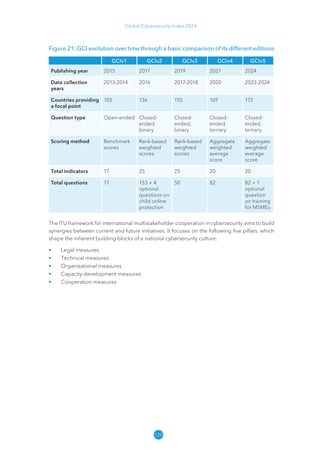
Figure 21: GCI evolution over time through a basic comparison of its different
editions�������������������������������������������������������������������������������������������������������������������������������������129
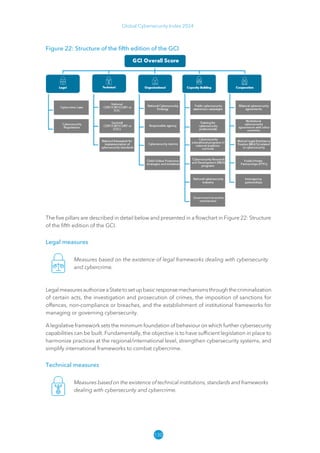
Figure 22: Structure of the fifth edition of the GCI�������������������������������������������������������������130
Figure 23: GCI report development process����������������������������������������������������������������������137
Table
Table 1: Tier-based model�����������������������������������������������������������������������������������������������������137
1
Global Cybersecurity Index 2024
Report summary
The fifth edition of the Global Cybersecurity Index (GCI) measures the commitment of countries to
cybersecurity in the context of measures across the following five pillars:
Legal Technical Organizational
Capacity
development
Cooperation
The GCI, launched in 2015 by the International Telecommunication Union, seeks to help countries to
identify areas of improvement and encourage countries to act in building capacity and capabilities
under each pillar. The GCI has been continuously adapted across editions to respond to changing
risks, priorities and resources, in order to provide a more relevant snapshot of cybersecurity measures
taken by countries.
Countries measured Collection years
Focal points from
countries
Average overall
score growth since
2020
194 2023-2024 172 27%
Since 2021, countries have on average taken more cybersecurity-related actions and improved their
commitments to cybersecurity. The global average country score has risen to 65.7/100.
Across the five GCI pillars, most countries are strongest in the legal pillar. By contrast, the average
country is weakest in the capacity-development and technical pillars.
Each region has countries that are role-modelling or are advancing, and each region also has
countries that are in the beginning stages of building their cybersecurity commitments. To capture
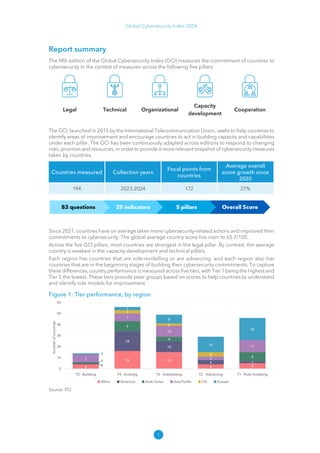
these differences, country performance is measured across five tiers, with Tier 1 being the highest and
Tier 5 the lowest. These tiers provide peer groups based on scores to help countries to understand
and identify role models for improvement.
Figure 1: Tier performance, by region
Source: ITU
2
Global Cybersecurity Index 2024
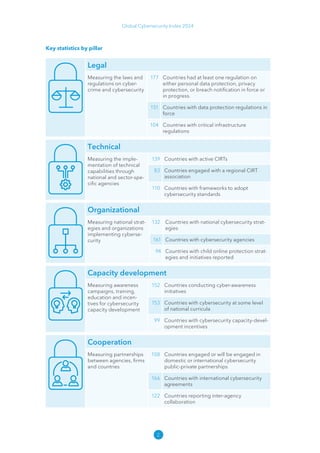
Key statistics by pillar
Legal
Measuring the laws and
regulations on cyber-
crime and cybersecurity
177 Countries had at least one regulation on
either personal data protection, privacy
protection, or breach notification in force or
in progress.
151 Countries with data protection regulations in
force
104 Countries with critical infrastructure
regulations
Technical
Measuring the imple-
mentation of technical
capabilities through
national and sector-spe-
cific agencies
139 Countries with active CIRTs
83 Countries engaged with a regional CIRT
association
110 Countries with frameworks to adopt
cybersecurity standards
Organizational
Measuring national strat-
egies and organizations
implementing cyberse-
curity
132 Countries with national cybersecurity strat-
egies
161 Countries with cybersecurity agencies
94 Countries with child online protection strat-
egies and initiatives reported
Capacity development
Measuring awareness
campaigns, training,
education and incen-
tives for cybersecurity
capacity development
152 Countries conducting cyber-awareness
initiatives
153 Countries with cybersecurity at some level
of national curricula
99 Countries with cybersecurity capacity-devel-
opment incentives
Cooperation
Measuring partnerships
between agencies, firms
and countries
108 Countries engaged or will be engaged in
domestic or international cybersecurity
public-private partnerships
166 Countries with international cybersecurity
agreements
122 Countries reporting inter-agency
collaboration
3
Global Cybersecurity Index 2024
Introduction
Robust and coordinated cybersecurity efforts by countries have become more important
since the previous edition of the Global Cybersecurity Index (GCI). With approximately 5.4
billion people online,1
even offline populations are impacted by continued acceleration of
technological developments with the adoption of artificial intelligence, renewed efforts towards
digitalization and widespread advances toward universal and meaningful connectivity.2
Cybersecurity issues have become more prominent, owing inter alia to:
1) Increased ransomware: growing reports of ransomware attacks targeting government
services and other critical sectors in many countries.3
2) Breaches affecting core industries: the scale, frequency and intensity of cybersecurity
incidents or breaches affecting individuals and various sectors including education,
manufacturing, energy and IT services, to name but a few.
3) Privacy concerns: data breaches resulted in European data protection authorities issuing
General Data Protection Regulation (GDPR) fines worth over EUR 1.9 billion in 2023,4
with
total GDPR fines issued since 2018 estimated to be currently worth more than EUR 4.5
billion.5
4) Cost to businesses: the global average cost of a data breach was estimated at USD 4.45
million in 2023.
5) Outages: information technology disruptions affecting the integrity and availability of
systems, services and supply chains.6
It has been 35 years since the first International Telecommunication Union (ITU) cybersecurity
standard, Recommendation ITU-T X.509, and a decade since the launch of the first GCI.
During this time, ITU has worked with over 140 different Member States on their cybersecurity
readiness, as cybersecurity has firmly emerged as a strategic imperative for governments, as
well as for critical and non-critical sectors of society. Measuring the efforts towards improving
cybersecurity has become a crucial touchstone for governments in driving development in the
area. The GCI sits at the nexus of cybersecurity metrics, by assessing the measures taken by
countries at the national level to improve their cybersecurity commitments. Based on the five
work areas established in the 2008 Global Cybersecurity Agenda, i.e. legal measures, technical
and procedural measures, organizational structures, capacity building and international
cooperation, the GCI scores complement output-based measurements, such as number of
cyberattacks and extent of vulnerabilities, among others. By contrasting the efforts taken by
countries with cybersecurity outputs, countries, companies and civil society organizations can
identify whether existing efforts need to be revisited or strengthened, how to prioritize future
interventions, and how to begin to evaluate the effectiveness of these measures.
1
https://​
www​
.itu​
.int/​
itu​
-d/​
reports/​
statistics/​
2023/​
10/​
10/​
ff23​
-internet​
-use/​
2
Measuring digital development – ICT Development Index 2024, https://​
www​
.itu​
.int/​
hub/​
publication/​
D​
-IND​
-ICT​
_MDD​
-2024​
-3/​
3
https://​
www​
.fortinet​
.com/​
resources/​
cyberglossary/​
ransomware​
-statistics
4
European Data Protection Board, Annual Report 2023, https://​
www​
.edpb​
.europa​
.eu/​
our​
-work​
-tools/​
our​
-documents/​
annual​
-report/​
edpb​
-annual​
-report​
-2023​
_en
5
https://​
www​
.enforcementtracker​
.com/​
?insights
6
CrowdStrike disruption in July 2024: https://​
www​
.nytimes​
.com/​
2024/​
07/​
19/​
business/​
microsoft​
-outage​
-cause​
-azure​
-crowdstrike​
.html; https://​
www​
.wired​
.com/​
story/​
microsoft​
-windows​
-outage​
-crowdstrike​
-global​
-it​
-probems/​
; https://​
www​
.bloomberg​
.com/​
news/​
articles/​
2024​
-07​
-19/​
microsoft​
-cloud​
-service​
-issues​
-disrupt​
-air​
-travel​
-operations
4
Global Cybersecurity Index 2024
The fifth edition of the GCI explores the current level of cybersecurity commitment among
193 Member States and the State of Palestine and the progress made since the last edition.
The GCI report examines the implications of the results for governments and policy-makers
as they navigate national and regional circumstances, as well as global developments, while
planning cybersecurity measures and initiatives. One of the key changes made in this edition
is a shift from ranking countries to using a five-level tier for viewing countries' cybersecurity
commitments. This tier-based perspective allows for greater focus on the extent of advances in
cybersecurity commitments and what this may mean for countries. Moreover, given the nature
of the cybersecurity landscape, there is always room for growth, refinement and adaptation
regardless of a country’s GCI score. While a score of 100/ 100 reflects a strong cybersecurity
commitment, it does not mean further work is not required in terms of adopting appropriate
cybersecurity measures in response to countries’ shifting operating environments and the
evolving cybersecurity ecosystem.
The GCI is used by countries, investment groups, development organizations, companies and
other actors as an important tool in understanding cybersecurity commitments for several
reasons, including:
• Comprehensive evidence-based cybersecurity measures: the GCI takes a multi-
dimensional approach to cybersecurity and relies on either publicly available data or
verifiable evidence provided by countries. This approach leads to a trustworthy, more
reliable view of cybersecurity commitments. As a result, countries have come to rely on
the GCI to inform their national cybersecurity plans.
• Informing national policies: countries can better understand their progress in key areas of
cybersecurity and identify opportunities for further developments and innovations aligned
with their national priorities and situational contexts.
• Fostering research and development: the cybersecurity landscape’s dynamism
necessitates proactive responses that include the identification or collection of data and
the investigation and development of relevant cybersecurity artefacts, including new
policies, laws and regulations, products and standards, among others.
• Benchmarking: countries can assess their level of cybersecurity commitment and progress
over time against global and regional averages.
• Enhancing cooperation: with cooperation being a central part of good cybersecurity
measures, opportunities for various levels of cooperation can be found and leveraged to
support mutual strategic, operational and tactical cybersecurity responses.
To help countries consider their cybersecurity commitments considering the above issues, this
edition of the GCI aims to be the most robust yet. It features greater clarity and refinement in
questions, greater efforts to ensure consistency in verification and validation, while maintaining
high-quality analysis. However, the GCI should be used with consideration for its limitations as
it does not measure the quality of actions; it only assesses whether they are in place, partially in
place/in progress or do not exist. ITU, in collaboration with the GCI Expert Group, will continue
actively to seek ways of improving the relevance, rigour and validity of the indicators relied on
and to better communicate results.
5
Global Cybersecurity Index 2024
Global view
Overall, the fifth edition of the GCI presents many countries working to improve their cybersecurity
commitments through implementing relevant measures across the five pillars: legal, technical,
organizational, capacity development and cooperation. To give a more accurate view of the
clusters of performance within the GCI, the GCI has shifted to a tier-based presentation of
country scores, using score ranges set by the GCI Expert Group. (For more information on the
tiers and their development, see section Tiers.)
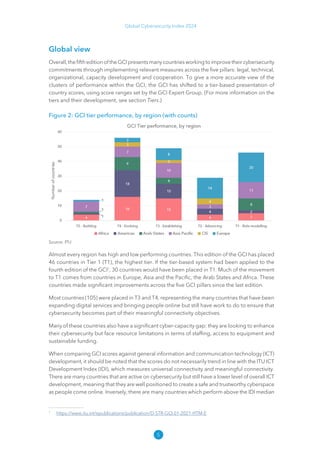
Figure 2: GCI tier performance, by region (with counts)
Source: ITU
Almost every region has high and low performing countries. This edition of the GCI has placed
46 countries in Tier 1 (T1), the highest tier. If the tier-based system had been applied to the
fourth edition of the GCI7
, 30 countries would have been placed in T1. Much of the movement
to T1 comes from countries in Europe, Asia and the Pacific, the Arab States and Africa. These
countries made significant improvements across the five GCI pillars since the last edition.
Most countries (105) were placed in T3 and T4, representing the many countries that have been
expanding digital services and bringing people online but still have work to do to ensure that
cybersecurity becomes part of their meaningful connectivity objectives.
Many of these countries also have a significant cyber-capacity gap: they are looking to enhance
their cybersecurity but face resource limitations in terms of staffing, access to equipment and
sustainable funding.
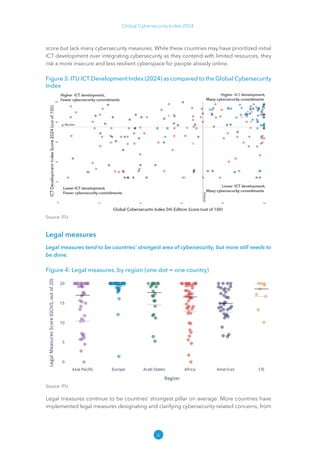
When comparing GCI scores against general information and communication technology (ICT)
development, it should be noted that the scores do not necessarily trend in line with the ITU ICT
Development Index (IDI), which measures universal connectivity and meaningful connectivity.
There are many countries that are active on cybersecurity but still have a lower level of overall ICT
development, meaning that they are well positioned to create a safe and trustworthy cyberspace
as people come online. Inversely, there are many countries which perform above the IDI median
7
https://​
www​
.itu​
.int/​
epublications/​
publication/​
D​
-STR​
-GCI​
.01​
-2021​
-HTM​
-E
6
Global Cybersecurity Index 2024
score but lack many cybersecurity measures. While these countries may have prioritized initial
ICT development over integrating cybersecurity as they contend with limited resources, they
risk a more insecure and less resilient cyberspace for people already online.
Figure 3: ITU ICT Development Index (2024) as compared to the Global Cybersecurity
Index
Source: ITU
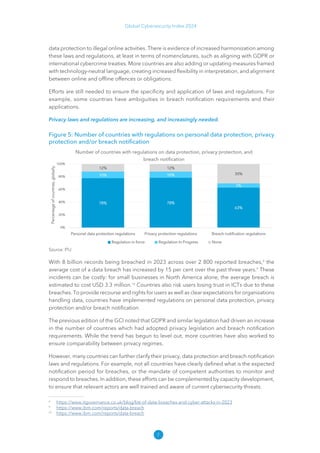
Legal measures
Legal measures tend to be countries’ strongest area of cybersecurity, but more still needs to
be done.
Figure 4: Legal measures, by region (one dot = one country)
Source: ITU
Legal measures continue to be countries’ strongest pillar on average. More countries have
implemented legal measures designating and clarifying cybersecurity-related concerns, from
7
Global Cybersecurity Index 2024
data protection to illegal online activities. There is evidence of increased harmonization among
these laws and regulations, at least in terms of nomenclatures, such as aligning with GDPR or
international cybercrime treaties. More countries are also adding or updating measures framed
with technology-neutral language, creating increased flexibility in interpretation, and alignment
between online and offline offences or obligations.
Efforts are still needed to ensure the specificity and application of laws and regulations. For
example, some countries have ambiguities in breach notification requirements and their
applications.
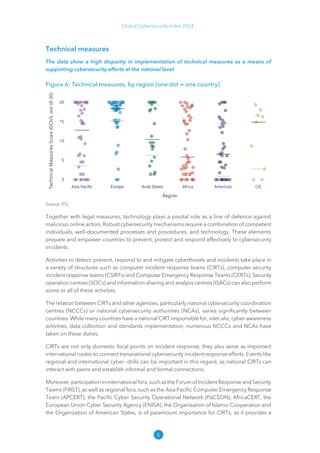
Privacy laws and regulations are increasing, and increasingly needed.
Figure 5: Number of countries with regulations on personal data protection, privacy
protection and/or breach notification
Source: ITU
With 8 billion records being breached in 2023 across over 2 800 reported breaches,8
the
average cost of a data breach has increased by 15 per cent over the past three years.9
These
incidents can be costly: for small businesses in North America alone, the average breach is
estimated to cost USD 3.3 million.10
Countries also risk users losing trust in ICTs due to these
breaches. To provide recourse and rights for users as well as clear expectations for organizations
handling data, countries have implemented regulations on personal data protection, privacy
protection and/or breach notification.
The previous edition of the GCI noted that GDPR and similar legislation had driven an increase
in the number of countries which had adopted privacy legislation and breach notification
requirements. While the trend has begun to level out, more countries have also worked to
ensure comparability between privacy regimes.
However, many countries can further clarify their privacy, data protection and breach notification
laws and regulations. For example, not all countries have clearly defined what is the expected
notification period for breaches, or the mandate of competent authorities to monitor and
respond to breaches. In addition, these efforts can be complemented by capacity development,
to ensure that relevant actors are well trained and aware of current cybersecurity threats.
8
https://​
www​
.itgovernance​
.co​
.uk/​
blog/​
list​
-of​
-data​
-breaches​
-and​
-cyber​
-attacks​
-in​
-2023
9
https://​
www​
.ibm​
.com/​
reports/​
data​
-breach
10
https://​
www​
.ibm​
.com/​
reports/​
data​
-breach
8
Global Cybersecurity Index 2024
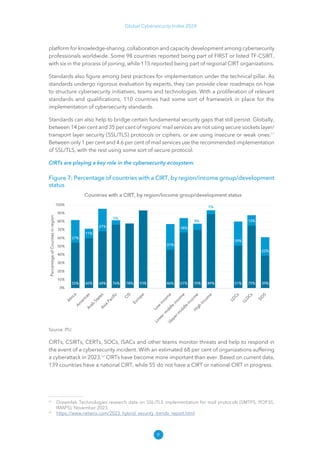
Technical measures
The data show a high disparity in implementation of technical measures as a means of
supporting cybersecurity efforts at the national level.
Figure 6: Technical measures, by region (one dot = one country)
Source: ITU
Together with legal measures, technology plays a pivotal role as a line of defence against
malicious online actors. Robust cybersecurity mechanisms require a combination of competent
individuals, well-documented processes and procedures, and technology. These elements
prepare and empower countries to prevent, protect and respond effectively to cybersecurity
incidents.
Activities to detect, prevent, respond to and mitigate cyberthreats and incidents take place in
a variety of structures such as computer incident response teams (CIRTs), computer security
incident response teams (CSIRTs) and Computer Emergency Response Teams (CERTs). Security
operation centres (SOCs) and information-sharing and analysis centres (ISACs) can also perform
some or all of these activities.
The relation between CIRTs and other agencies, particularly national cybersecurity coordination
centres (NCCCs) or national cybersecurity authorities (NCAs), varies significantly between
countries. While many countries have a national CIRT responsible for, inter alia, cyber-awareness
activities, data collection and standards implementation, numerous NCCCs and NCAs have
taken on these duties.
CIRTs are not only domestic focal points on incident response, they also serve as important
international nodes to connect transnational cybersecurity incident response efforts. Events like
regional and international cyber -drills can be important in this regard, as national CIRTs can
interact with peers and establish informal and formal connections.
Moreover, participation in international fora, such as the Forum of Incident Response and Security
Teams (FIRST), as well as regional fora, such as the Asia Pacific Computer Emergency Response
Team (APCERT), the Pacific Cyber Security Operational Network (PaCSON), AfricaCERT, the
European Union Cyber Security Agency (ENISA), the Organisation of Islamic Cooperation and
the Organization of American States, is of paramount importance for CIRTs, as it provides a
9
Global Cybersecurity Index 2024
platform for knowledge-sharing, collaboration and capacity development among cybersecurity
professionals worldwide. Some 98 countries reported being part of FIRST or listed TF-CSIRT,
with six in the process of joining, while 115 reported being part of regional CIRT organizations.
Standards also figure among best practices for implementation under the technical pillar. As
standards undergo rigorous evaluation by experts, they can provide clear roadmaps on how
to structure cybersecurity initiatives, teams and technologies. With a proliferation of relevant
standards and qualifications, 110 countries had some sort of framework in place for the
implementation of cybersecurity standards.
Standards can also help to bridge certain fundamental security gaps that still persist. Globally,
between 14 per cent and 35 per cent of regions’ mail services are not using secure sockets layer/
transport layer security (SSL/TLS) protocols or ciphers, or are using insecure or weak ones.11
Between only 1 per cent and 4.6 per cent of mail services use the recommended implementation
of SSL/TLS, with the rest using some sort of secure protocol.
CIRTs are playing a key role in the cybersecurity ecosystem.
Figure 7: Percentage of countries with a CIRT, by region/income group/development
status
Source: ITU
CIRTs, CSIRTs, CERTs, SOCs, ISACs and other teams monitor threats and help to respond in
the event of a cybersecurity incident. With an estimated 68 per cent of organizations suffering
a cyberattack in 2023,12
CIRTs have become more important than ever. Based on current data,
139 countries have a national CIRT, while 55 do not have a CIRT or national CIRT in progress.
11
Dreamlab Technologies research data on SSL/TLS implementation for mail protocols (SMTPS, POP3S,
IMAPS), November 2023.
12
https://​
www​
.netwrix​
.com/​
2023​
_hybrid​
_security​
_trends​
_report​
.html
10
Global Cybersecurity Index 2024
Beyond their immediate function of incident response, CIRTs serve as a catalyst for broader
engagement within organizations, fostering a culture of cybersecurity awareness and resilience.
By conducting coordinated responses to cyber-incidents, CIRTs not only mitigate immediate
risks but also lay the groundwork for proactive security measures and continuous improvement in
organizational cybersecurity posture. For example, CIRTs can monitor and drive implementation
of best practices, such as Domain Name System Security Extensions (DNSSEC) and security
vulnerability disclosure.
For example, to ensure that the domain name system (DNS) is safe and authenticates responses
to domain name lookups, only 0.43 per cent of African providers have implemented DNSSEC,
compared to a higher adoption rate of 13.13 per cent in the Commonwealth of Independent
States (CIS) region. Regions with high numbers of Internet users, such as Asia and the Pacific,
only have a 1.52 per cent adoption of DNSSEC, versus 11.28 per cent in Europe.13
CIRTs can also drive security disclosures. For example, websites can adopt security.txt,14
which
includes key contact information in the event of a vulnerability discovery, as well as relevant
policies and acknowledgements. Currently, this is underused globally, with less than 0.7 per cent
of sites using this mechanism.15
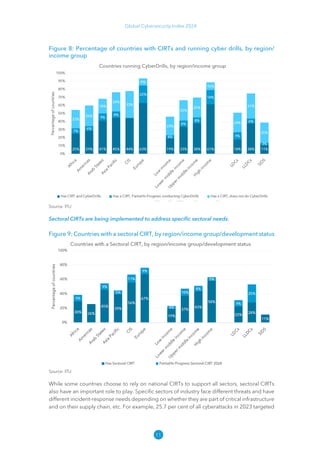
The presence of a CIRT is most likely in high-income countries (globally, 89 per cent of such
countries have a national CIRT), with upper-middle and lower-middle income countries less
likely (70 per cent and 67 per cent, respectively). Some 46 per cent of lower-income countries
had an operational national CIRT as of 2024.
The ability to respond to an incident varies based on the country’s investment, local capacity
and overall organization.
To enhance preparedness and capabilities, CIRTs, as well as cybersecurity authorities, are
increasingly running cybersecurity simulation exercises (cyber drills) among stakeholders. While
140 countries participated in regional cyber drills organized by ITU in 2023, running national
cyber drills remains important to engage domestic stakeholders in hands-on exercises. National
cyber drills can engage a wider set of domestic actors than regional or international cyber drills
do and can be better tailored to the national context.
13
Dreamlab Technologies research data on global DNSSEC implementation, November 2023
14
RFC9116. Note that other mechanisms may be used by organizations.
15
Dreamlab Technologies research data on adoption of security.txt for vulnerability disclosure, January 2023.
11
Global Cybersecurity Index 2024
Figure 8: Percentage of countries with CIRTs and running cyber drills, by region/
income group
Source: ITU
Sectoral CIRTs are being implemented to address specific sectoral needs.
Figure 9: Countries with a sectoral CIRT, by region/income group/development status
Source: ITU
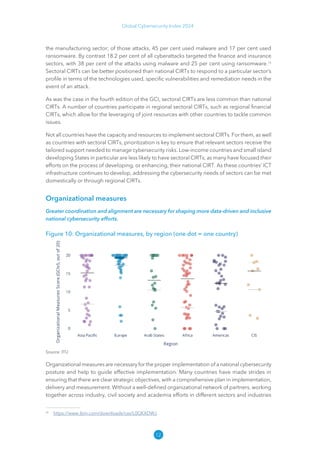
While some countries choose to rely on national CIRTs to support all sectors, sectoral CIRTs
also have an important role to play. Specific sectors of industry face different threats and have
different incident-response needs depending on whether they are part of critical infrastructure
and on their supply chain, etc. For example, 25.7 per cent of all cyberattacks in 2023 targeted
12
Global Cybersecurity Index 2024
the manufacturing sector; of those attacks, 45 per cent used malware and 17 per cent used
ransomware. By contrast 18.2 per cent of all cyberattacks targeted the finance and insurance
sectors, with 38 per cent of the attacks using malware and 25 per cent using ransomware.16
Sectoral CIRTs can be better positioned than national CIRTs to respond to a particular sector’s
profile in terms of the technologies used, specific vulnerabilities and remediation needs in the
event of an attack.
As was the case in the fourth edition of the GCI, sectoral CIRTs are less common than national
CIRTs. A number of countries participate in regional sectoral CIRTs, such as regional financial
CIRTs, which allow for the leveraging of joint resources with other countries to tackle common
issues.
Not all countries have the capacity and resources to implement sectoral CIRTs. For them, as well
as countries with sectoral CIRTs, prioritization is key to ensure that relevant sectors receive the
tailored support needed to manage cybersecurity risks. Low-income countries and small island
developing States in particular are less likely to have sectoral CIRTs, as many have focused their
efforts on the process of developing, or enhancing, their national CIRT. As these countries’ ICT
infrastructure continues to develop, addressing the cybersecurity needs of sectors can be met
domestically or through regional CIRTs.
Organizational measures
Greater coordination and alignment are necessary for shaping more data-driven and inclusive
national cybersecurity efforts.
Figure 10: Organizational measures, by region (one dot = one country)
Source: ITU
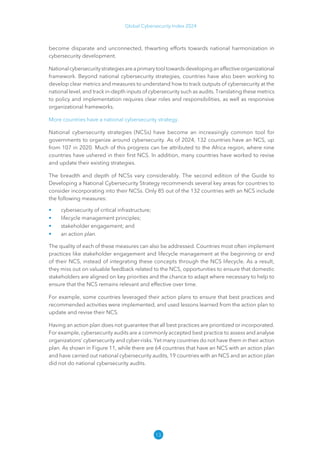
Organizational measures are necessary for the proper implementation of a national cybersecurity
posture and help to guide effective implementation. Many countries have made strides in
ensuring that there are clear strategic objectives, with a comprehensive plan in implementation,
delivery and measurement. Without a well-defined organizational network of partners, working
together across industry, civil society and academia efforts in different sectors and industries
16
https://​
www​
.ibm​
.com/​
downloads/​
cas/​
L0GKXDWJ
13
Global Cybersecurity Index 2024
become disparate and unconnected, thwarting efforts towards national harmonization in
cybersecurity development.
Nationalcybersecuritystrategiesareaprimarytooltowardsdevelopinganeffectiveorganizational
framework. Beyond national cybersecurity strategies, countries have also been working to
develop clear metrics and measures to understand how to track outputs of cybersecurity at the
national level, and track in-depth inputs of cybersecurity such as audits. Translating these metrics
to policy and implementation requires clear roles and responsibilities, as well as responsive
organizational frameworks.
More countries have a national cybersecurity strategy.
National cybersecurity strategies (NCSs) have become an increasingly common tool for
governments to organize around cybersecurity. As of 2024, 132 countries have an NCS, up
from 107 in 2020. Much of this progress can be attributed to the Africa region, where nine
countries have ushered in their first NCS. In addition, many countries have worked to revise
and update their existing strategies.
The breadth and depth of NCSs vary considerably. The second edition of the Guide to
Developing a National Cybersecurity Strategy recommends several key areas for countries to
consider incorporating into their NCSs. Only 85 out of the 132 countries with an NCS include
the following measures:
• cybersecurity of critical infrastructure;
• lifecycle management principles;
• stakeholder engagement; and
• an action plan.
The quality of each of these measures can also be addressed. Countries most often implement
practices like stakeholder engagement and lifecycle management at the beginning or end
of their NCS, instead of integrating these concepts through the NCS lifecycle. As a result,
they miss out on valuable feedback related to the NCS, opportunities to ensure that domestic
stakeholders are aligned on key priorities and the chance to adapt where necessary to help to
ensure that the NCS remains relevant and effective over time.
For example, some countries leveraged their action plans to ensure that best practices and
recommended activities were implemented, and used lessons learned from the action plan to
update and revise their NCS.
Having an action plan does not guarantee that all best practices are prioritized or incorporated.
For example, cybersecurity audits are a commonly accepted best practice to assess and analyse
organizations’ cybersecurity and cyber-risks. Yet many countries do not have them in their action
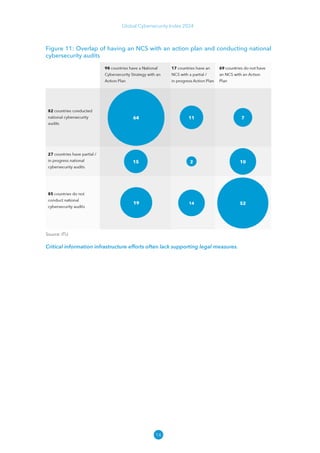
plan. As shown in Figure 11, while there are 64 countries that have an NCS with an action plan
and have carried out national cybersecurity audits, 19 countries with an NCS and an action plan
did not do national cybersecurity audits.
14
Global Cybersecurity Index 2024
Figure 11: Overlap of having an NCS with an action plan and conducting national
cybersecurity audits
Source: ITU
Critical information infrastructure efforts often lack supporting legal measures.
15
Global Cybersecurity Index 2024
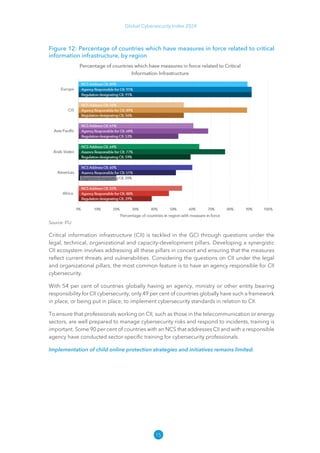
Figure 12: Percentage of countries which have measures in force related to critical
information infrastructure, by region
Source: ITU
Critical information infrastructure (CII) is tackled in the GCI through questions under the
legal, technical, organizational and capacity-development pillars. Developing a synergistic
CII ecosystem involves addressing all these pillars in concert and ensuring that the measures
reflect current threats and vulnerabilities. Considering the questions on CII under the legal
and organizational pillars, the most common feature is to have an agency responsible for CII
cybersecurity.
With 54 per cent of countries globally having an agency, ministry or other entity bearing
responsibility for CII cybersecurity, only 49 per cent of countries globally have such a framework
in place, or being put in place, to implement cybersecurity standards in relation to CII.
To ensure that professionals working on CII, such as those in the telecommunication or energy
sectors, are well prepared to manage cybersecurity risks and respond to incidents, training is
important. Some 90 per cent of countries with an NCS that addresses CII and with a responsible
agency have conducted sector-specific training for cybersecurity professionals.
Implementation of child online protection strategies and initiatives remains limited.
16
Global Cybersecurity Index 2024
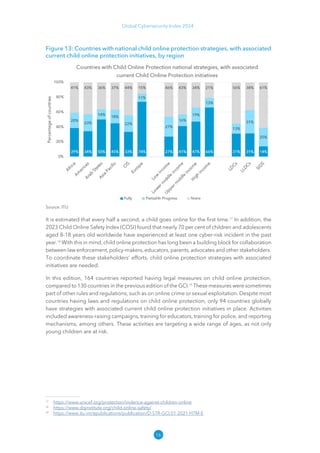
Figure 13: Countries with national child online protection strategies, with associated
current child online protection initiatives, by region
Source: ITU
It is estimated that every half a second, a child goes online for the first time.17
In addition, the
2023 Child Online Safety Index (COSI) found that nearly 70 per cent of children and adolescents
aged 8-18 years old worldwide have experienced at least one cyber-risk incident in the past
year.18
With this in mind, child online protection has long been a building block for collaboration
between law enforcement, policy-makers, educators, parents, advocates and other stakeholders.
To coordinate these stakeholders’ efforts, child online protection strategies with associated
initiatives are needed.
In this edition, 164 countries reported having legal measures on child online protection,
compared to 130 countries in the previous edition of the GCI.19
These measures were sometimes
part of other rules and regulations, such as on online crime or sexual exploitation. Despite most
countries having laws and regulations on child online protection, only 94 countries globally
have strategies with associated current child online protection initiatives in place. Activities
included awareness-raising campaigns, training for educators, training for police, and reporting
mechanisms, among others. These activities are targeting a wide range of ages, as not only
young children are at risk.
17
https://​
www​
.unicef​
.org/​
protection/​
violence​
-against​
-children​
-online
18
https://​
www​
.dqinstitute​
.org/​
child​
-online​
-safety/​
19
https://​
www​
.itu​
.int/​
epublications/​
publication/​
D​
-STR​
-GCI​
.01​
-2021​
-HTM​
-E
17
Global Cybersecurity Index 2024
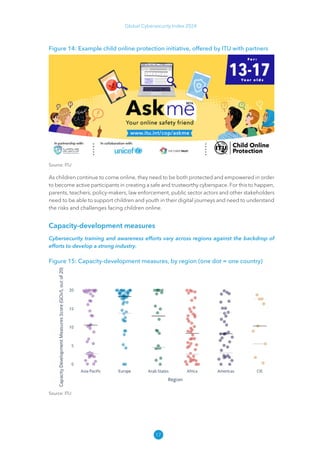
Figure 14: Example child online protection initiative, offered by ITU with partners
Source: ITU
As children continue to come online, they need to be both protected and empowered in order
to become active participants in creating a safe and trustworthy cyberspace. For this to happen,
parents, teachers, policy-makers, law enforcement, public sector actors and other stakeholders
need to be able to support children and youth in their digital journeys and need to understand
the risks and challenges facing children online.
Capacity-development measures
Cybersecurity training and awareness efforts vary across regions against the backdrop of
efforts to develop a strong industry.
Figure 15: Capacity-development measures, by region (one dot = one country)
Source: ITU
18
Global Cybersecurity Index 2024
Capacity development is key to building a robust cybersecurity ecosystem. Countries risk
eroding progress that has been made in enhancing full and universal connectivity if they do
not support cybersecurity skills and awareness-raising. Over 95 per cent of countries have
some activity under the capacity-development pillar, with the most activities reported in the
awareness-raising campaign category.
Efforts to develop a domestic cybersecurity industry were also present in many countries, taking
the form of incentive mechanisms, such as grants and scholarships, and organizations acting to
promote the cybersecurity industry. Such initiatives can increase the level of cybersecurity in a
country beyond the level that may have developed without government support.
Research and development (RD) was also tracked as part of efforts to develop domestic
capacity. Some 127 countries reported some form of RD, whether through the private sector,
public sector or academia, with academia being the most common centre for RD.
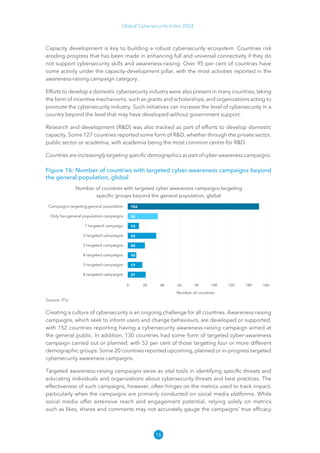
Countries are increasingly targeting specific demographics as part of cyber-awareness campaigns.
Figure 16: Number of countries with targeted cyber-awareness campaigns beyond
the general population, global
Source: ITU
Creating a culture of cybersecurity is an ongoing challenge for all countries. Awareness-raising
campaigns, which seek to inform users and change behaviours, are developed or supported,
with 152 countries reporting having a cybersecurity awareness-raising campaign aimed at
the general public. In addition, 130 countries had some form of targeted cyber-awareness
campaign carried out or planned, with 52 per cent of those targeting four or more different
demographic groups. Some 20 countries reported upcoming, planned or in-progress targeted
cybersecurity awareness campaigns.
Targeted awareness-raising campaigns serve as vital tools in identifying specific threats and
educating individuals and organizations about cybersecurity threats and best practices. The
effectiveness of such campaigns, however, often hinges on the metrics used to track impact,
particularly when the campaigns are primarily conducted on social media platforms. While
social media offer extensive reach and engagement potential, relying solely on metrics
such as likes, shares and comments may not accurately gauge the campaigns' true efficacy
19
Global Cybersecurity Index 2024
in raising awareness and changing behaviour. Instead, there is a growing recognition of the
need for human-centred approaches that resonate with people's realities and address their
specific concerns and challenges in navigating the digital landscape securely. This requires
the tailoring of awareness-raising campaigns to diverse audiences, considering factors such
as cultural context, digital literacy levels and socio-economic backgrounds. By adopting a
more nuanced approach that prioritizes meaningful engagement and behavioural outcomes
over superficial metrics, organizations can ensure that their awareness campaigns effectively
empower individuals to protect themselves against cyberthreats and contribute to building a
safer online environment for all.
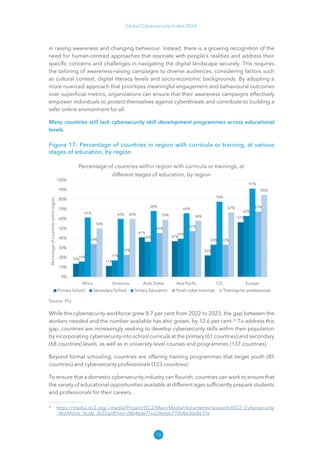
Many countries still lack cybersecurity skill development programmes across educational
levels.
Figure 17: Percentage of countries in region with curricula or training, at various
stages of education, by region
Source: ITU
While the cybersecurity workforce grew 8.7 per cent from 2022 to 2023, the gap between the
workers needed and the number available has also grown, by 12.6 per cent.20
To address this
gap, countries are increasingly seeking to develop cybersecurity skills within their population
by incorporating cybersecurity into school curricula at the primary (61 countries) and secondary
(68 countries) levels, as well as in university-level courses and programmes (137 countries).
Beyond formal schooling, countries are offering training programmes that target youth (85
countries) and cybersecurity professionals (123 countries).
To ensure that a domestic cybersecurity industry can flourish, countries can work to ensure that
the variety of educational opportunities available at different ages sufficiently prepare students
and professionals for their careers.
20
https://​
media​
.isc2​
.org/​
-/​
media/​
Project/​
ISC2/​
Main/​
Media/​
documents/​
research/​
ISC2​
_Cybersecurity​
_Workforce​
_Study​
_2023​
.pdf​
?rev​
=​
28​
b46de71ce2​
4e6ab7705f6e3da8637e
20
Global Cybersecurity Index 2024
Cooperation measures
Operationalization and impact of agreements and frameworks remains a challenge.
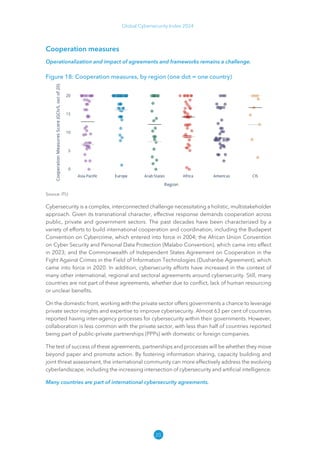
Figure 18: Cooperation measures, by region (one dot = one country)
Source: ITU
Cybersecurity is a complex, interconnected challenge necessitating a holistic, multistakeholder
approach. Given its transnational character, effective response demands cooperation across
public, private and government sectors. The past decades have been characterized by a
variety of efforts to build international cooperation and coordination, including the Budapest
Convention on Cybercrime, which entered into force in 2004; the African Union Convention
on Cyber Security and Personal Data Protection (Malabo Convention), which came into effect
in 2023; and the Commonwealth of Independent States Agreement on Cooperation in the
Fight Against Crimes in the Field of Information Technologies (Dushanbe Agreement), which
came into force in 2020. In addition, cybersecurity efforts have increased in the context of
many other international, regional and sectoral agreements around cybersecurity. Still, many
countries are not part of these agreements, whether due to conflict, lack of human resourcing
or unclear benefits.
On the domestic front, working with the private sector offers governments a chance to leverage
private sector insights and expertise to improve cybersecurity. Almost 63 per cent of countries
reported having inter-agency processes for cybersecurity within their governments. However,
collaboration is less common with the private sector, with less than half of countries reported
being part of public-private partnerships (PPPs) with domestic or foreign companies.
The test of success of these agreements, partnerships and processes will be whether they move
beyond paper and promote action. By fostering information sharing, capacity building and
joint threat assessment, the international community can more effectively address the evolving
cyberlandscape, including the increasing intersection of cybersecurity and artificial intelligence.
Many countries are part of international cybersecurity agreements.
21
Global Cybersecurity Index 2024
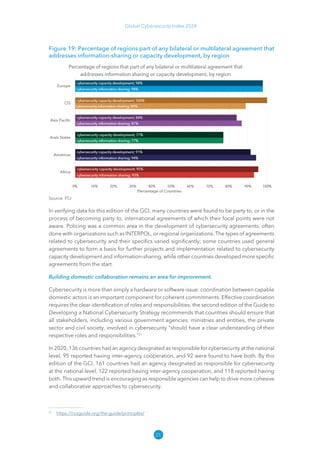
Figure 19: Percentage of regions part of any bilateral or multilateral agreement that
addresses information-sharing or capacity development, by region
Source: ITU
In verifying data for this edition of the GCI, many countries were found to be party to, or in the
process of becoming party to, international agreements of which their focal points were not
aware. Policing was a common area in the development of cybersecurity agreements, often
done with organizations such as INTERPOL, or regional organizations. The types of agreements
related to cybersecurity and their specifics varied significantly; some countries used general
agreements to form a basis for further projects and implementation related to cybersecurity
capacity development and information-sharing, while other countries developed more specific
agreements from the start.
Building domestic collaboration remains an area for improvement.
Cybersecurity is more than simply a hardware or software issue: coordination between capable
domestic actors is an important component for coherent commitments. Effective coordination
requires the clear identification of roles and responsibilities: the second edition of the Guide to
Developing a National Cybersecurity Strategy recommends that countries should ensure that
all stakeholders, including various government agencies, ministries and entities, the private
sector and civil society, involved in cybersecurity “should have a clear understanding of their
respective roles and responsibilities.”21
In 2020, 136 countries had an agency designated as responsible for cybersecurity at the national
level, 95 reported having inter-agency cooperation, and 92 were found to have both. By this
edition of the GCI, 161 countries had an agency designated as responsible for cybersecurity
at the national level, 122 reported having inter-agency cooperation, and 118 reported having
both. This upward trend is encouraging as responsible agencies can help to drive more cohesive
and collaborative approaches to cybersecurity.
21
https://​
ncsguide​
.org/​
the​
-guide/​
principles/​
22
Global Cybersecurity Index 2024
Figure 20: Intersection of countries with a responsible agency and inter-agency
collaboration (compared to the fourth edition of the GCI in 2021)
Source: ITU
23
Global Cybersecurity Index 2024
Conclusion
There has been much improvement since the previous edition of the Global Cybersecurity Index
(GCI). Still, more needs to be done to meet the evolving digital threat landscape. Cyberattacks
are perceived to be the fifth most likely risk to present a material crisis on a global scale in
2024.22
Recent global technical outages demonstrated the world’s dependency on the digital
infrastructure and the need for resilience. If countries want to benefit from the promise of
information and communication technologies (ICTs), they need to think about cybersecurity.
Across the GCI and its legal, technical, organizational, capacity-development and cooperation
pillars, countries need to carefully prioritize high-impact activities in their efforts, rather than
surface-level documents or campaigns. Countries may want to consider efforts to:
• implement legal measures that can be clearly and fairly applied across all sectors;
• foster cross-functional efforts that address more than just information technology;
• maintain well-trained and responsive national institutions, including computer incident
response teams;
• engage a wide range of stakeholders across all cybersecurity initiatives;
• develop and regularly update the national cybersecurity strategy with an implementable
action plan;
• implement effective child online protection measures;
• address cybersecurity challenges faced by critical infrastructure;
• run cyber-awareness campaigns that address relevant issues;
• provide training opportunities for cybersecurity professionals, critical infrastructure actors
and youth in order to build and enhance cybersecurity skills;
• create incentive mechanisms to encourage cybersecurity capacity development and
research and development; and
• foster domestic and international cooperation and collaboration in information-sharing
and capacity development.
Cybersecurity is continuing to evolve. For countries working to achieve cybersecure meaningful
connectivity, the GCI offers a clear picture of where they are and a roadmap of activities to make
progress. Countries must, however, be willing to engage in the ongoing processes of enhancing
cybersecurity and working to enhance the quality and impact of their activities. The GCI will
continue to capture countries’ work and progress as they strive to meet future challenges and
bring meaningful connectivity to all.
22
https://​
www​
.weforum​
.org/​
publications/​
global​
-risks​
-report​
-2024/​
digest/​
24
Global Cybersecurity Index 2024
Annexes
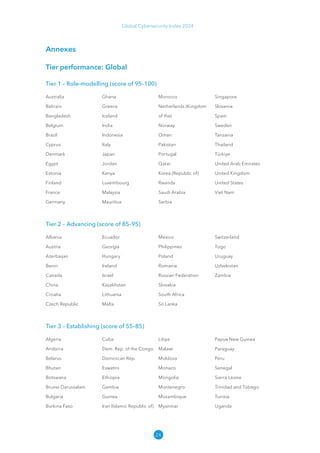
Tier performance: Global
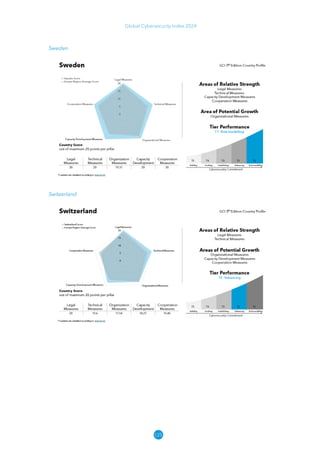
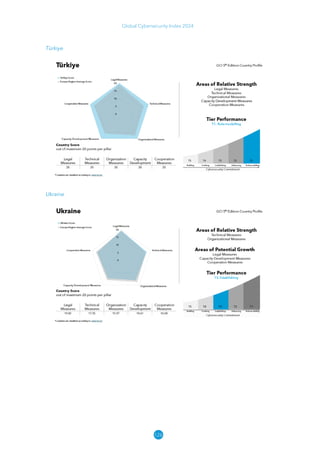
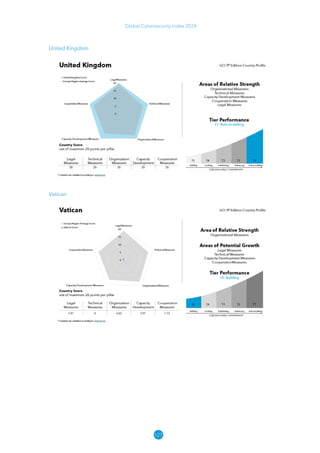
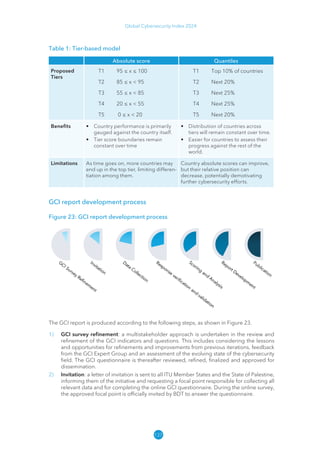
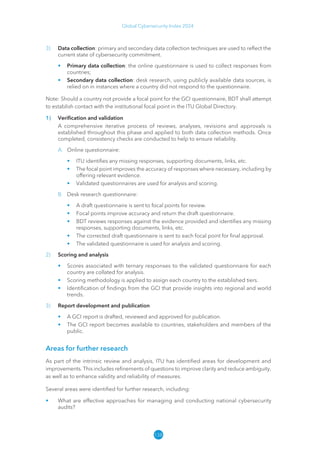
Tier 1 – Role-modelling (score of 95–100)
Australia Ghana Morocco Singapore
Bahrain Greece Netherlands (Kingdom Slovenia
Bangladesh Iceland of the) Spain
Belgium India Norway Sweden
Brazil Indonesia Oman Tanzania
Cyprus Italy Pakistan Thailand
Denmark Japan Portugal Türkiye
Egypt Jordan Qatar United Arab Emirates
Estonia Kenya Korea (Republic of) United Kingdom
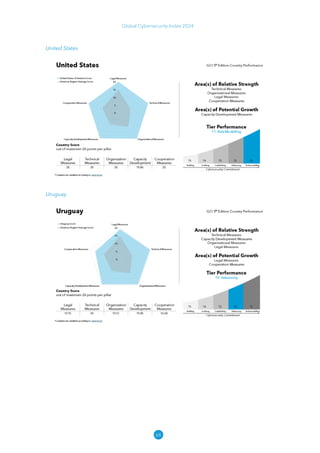
Finland Luxembourg Rwanda United States
France Malaysia Saudi Arabia Viet Nam
Germany Mauritius Serbia
Tier 2 – Advancing (score of 85–95)
Albania Ecuador Mexico Switzerland
Austria Georgia Philippines Togo
Azerbaijan Hungary Poland Uruguay
Benin Ireland Romania Uzbekistan
Canada Israel Russian Federation Zambia
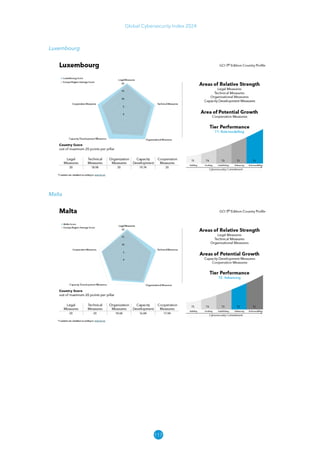
China Kazakhstan Slovakia
Croatia Lithuania South Africa
Czech Republic Malta Sri Lanka
Tier 3 – Establishing (score of 55–85)
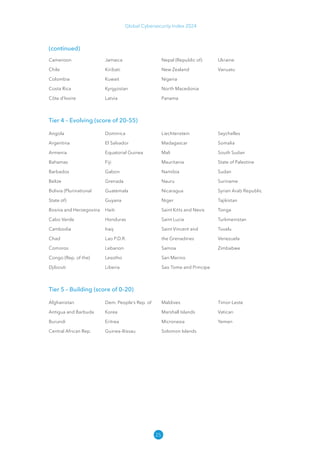
Algeria Cuba Libya Papua New Guinea
Andorra Dem. Rep. of the Congo Malawi Paraguay
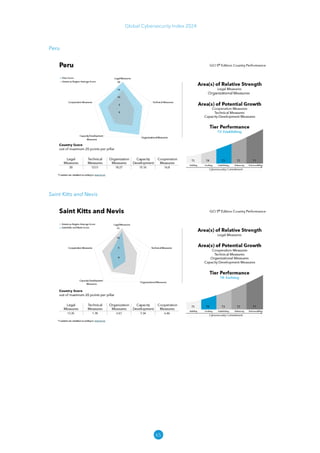
Belarus Dominican Rep. Moldova Peru
Bhutan Eswatini Monaco Senegal
Botswana Ethiopia Mongolia Sierra Leone
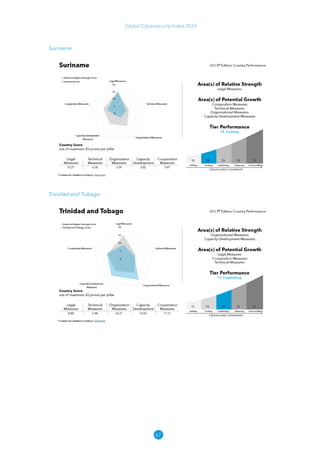
Brunei Darussalam Gambia Montenegro Trinidad and Tobago
Bulgaria Guinea Mozambique Tunisia
Burkina Faso Iran (Islamic Republic of) Myanmar Uganda
25
Global Cybersecurity Index 2024
Cameroon Jamaica Nepal (Republic of) Ukraine
Chile Kiribati New Zealand Vanuatu
Colombia Kuwait Nigeria
Costa Rica Kyrgyzstan North Macedonia
Côte d'Ivoire Latvia Panama
Tier 4 – Evolving (score of 20–55)
Angola Dominica Liechtenstein Seychelles
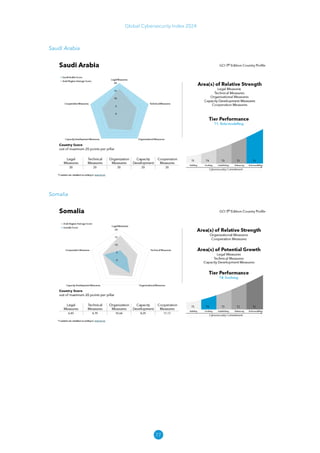
Argentina El Salvador Madagascar Somalia
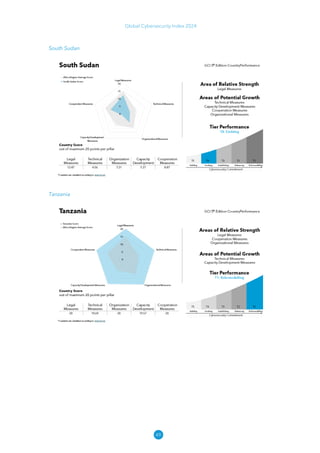
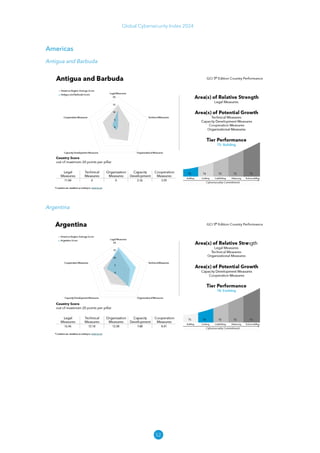
Armenia Equatorial Guinea Mali South Sudan
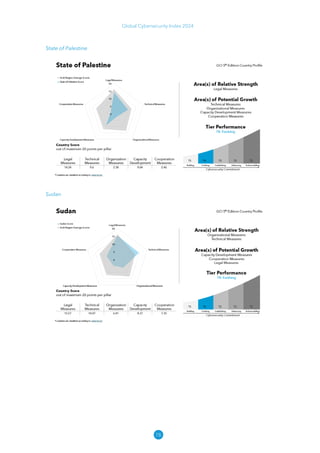
Bahamas Fiji Mauritania State of Palestine
Barbados Gabon Namibia Sudan
Belize Grenada Nauru Suriname
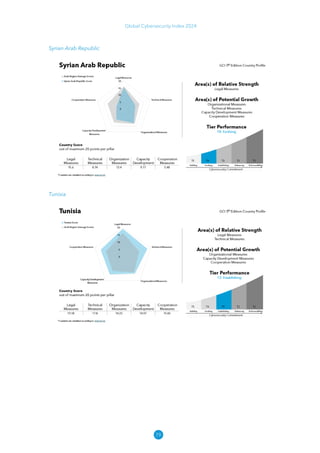
Bolivia (Plurinational Guatemala Nicaragua Syrian Arab Republic
State of) Guyana Niger Tajikistan
Bosnia and Herzegovina Haiti Saint Kitts and Nevis Tonga
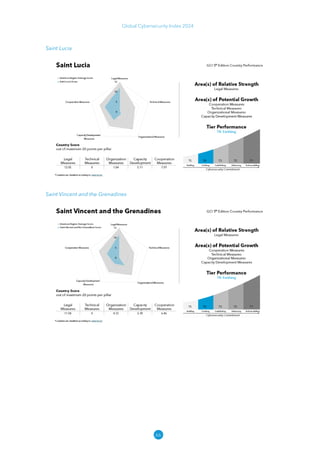
Cabo Verde Honduras Saint Lucia Turkmenistan
Cambodia Iraq Saint Vincent and Tuvalu
Chad Lao P.D.R. the Grenadines Venezuela
Comoros Lebanon Samoa Zimbabwe
Congo (Rep. of the) Lesotho San Marino
Djibouti Liberia Sao Tome and Principe
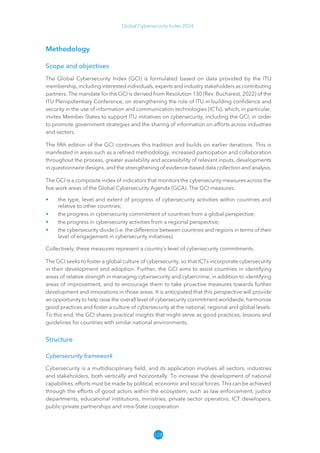
Tier 5 – Building (score of 0–20)
Afghanistan Dem. People’s Rep. of Maldives Timor-Leste
Antigua and Barbuda Korea Marshall Islands Vatican
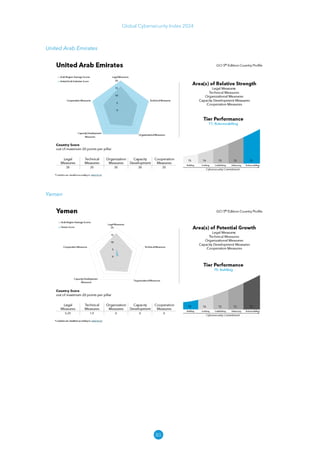
Burundi Eritrea Micronesia Yemen
Central African Rep. Guinea-Bissau Solomon Islands
(continued)
26
Global Cybersecurity Index 2024
Tier Performance: Africa
T5
Building
T4
Evolving
T3
Establishing
T2
Advancing
T1
Role-modelling
Burundi
Central African
Rep.
Eritrea
Guinea-Bissau
Angola
Cabo Verde
Chad
Congo (Rep. of
the)
Equatorial
Guinea
Gabon
Lesotho
Liberia
Madagascar
Mali
Namibia
Niger
Sao Tome and
Principe
Seychelles
South Sudan
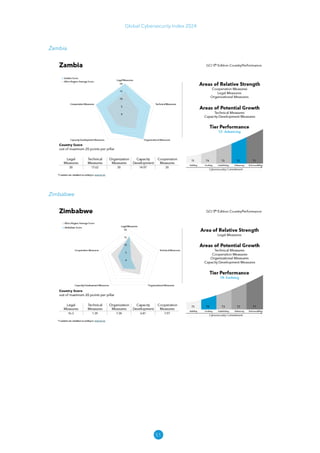
Zimbabwe
Botswana
Burkina Faso
Cameroon
Côte d'Ivoire
Dem. Rep. of the
Congo
Eswatini
Ethiopia
Gambia
Guinea
Malawi
Mozambique
Nigeria
Senegal
Sierra Leone
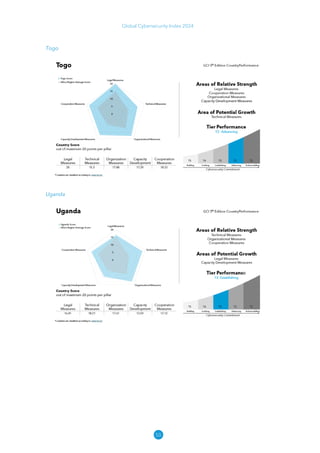
Uganda
Benin
South Africa
Togo
Zambia
Ghana
Kenya
Mauritius
Rwanda
Tanzania
27
Global Cybersecurity Index 2024
Tier Performance: Americas
T5
Building
T4
Evolving
T3
Establishing
T2
Advancing
T1
Role-modelling
Antigua and
Barbuda
Argentina
Bahamas
Barbados
Belize
Bolivia (Plurina-
tional State of)
Dominica
El Salvador
Grenada
Guatemala
Guyana
Haiti
Honduras
Nicaragua
Saint Kitts and
Nevis
Saint Lucia
Saint Vincent
and the Grena-
dines
Suriname
Venezuela
Chile
Colombia
Costa Rica
Cuba
Dominican Rep.
Jamaica
Panama
Paraguay
Peru
Trinidad and
Tobago
Canada
Ecuador
Mexico
Uruguay
Brazil
United States
Tier Performance: Arab States
T5
Building
T4
Evolving
T3
Establishing
T2
Advancing
T1
Role-modelling
Yemen Comoros
Djibouti
Iraq
Lebanon
Mauritania
Somalia
State of Palestine
Sudan
Syrian Arab Republic
Algeria
Kuwait
Libya
Tunisia
(none) Bahrain
Egypt
Jordan
Morocco
Oman
Qatar
Saudi Arabia
United Arab Emir-
ates
28
Global Cybersecurity Index 2024
Tier Performance: Asia and the Pacific
T5
Building
T4
Evolving
T3
Establishing
T2
Advancing
T1
Role-modelling
Afghanistan
Dem. People’s Rep. of
Korea
Maldives
Marshall Islands
Micronesia
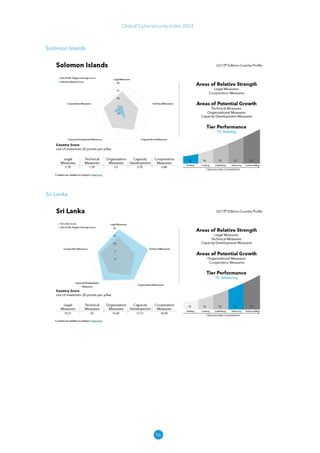
Solomon Islands
Timor-Leste
Cambodia
Fiji
Lao P.D.R.
Nauru
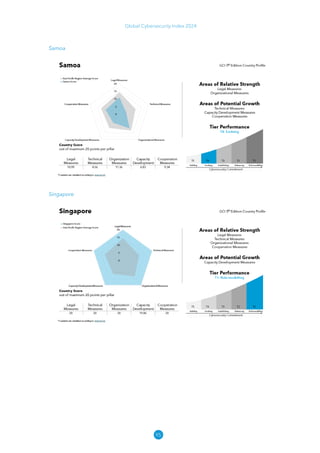
Samoa
Tonga
Tuvalu
Bhutan
Brunei Darussalam
Iran (Islamic
Republic of)
Kiribati
Mongolia
Myanmar
Nepal (Republic of)
New Zealand
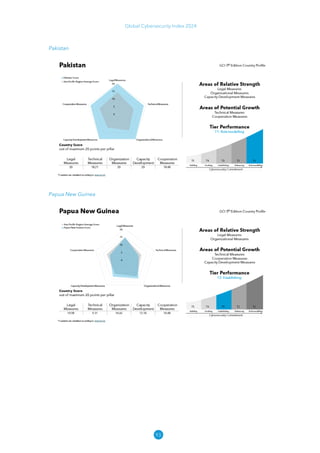
Papua New Guinea
Vanuatu
China
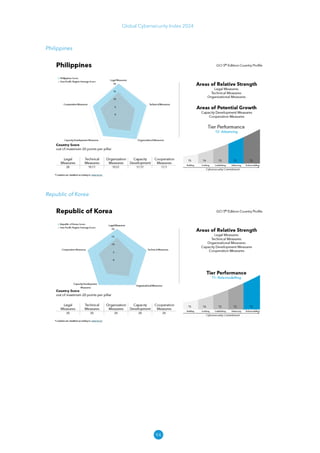
Philippines
Sri Lanka
Australia
Bangladesh
India
Indonesia
Japan
Malaysia
Pakistan
Republic of
Korea
Singapore
Thailand
Viet Nam
Tier Performance: CIS
T5
Building
T4
Evolving
T3
Establishing
T2
Advancing
T1
Role-modelling
(none) Armenia
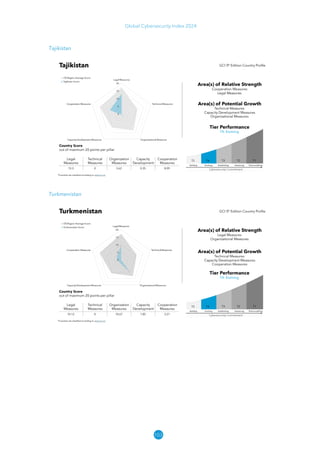
Tajikistan
Turkmenistan
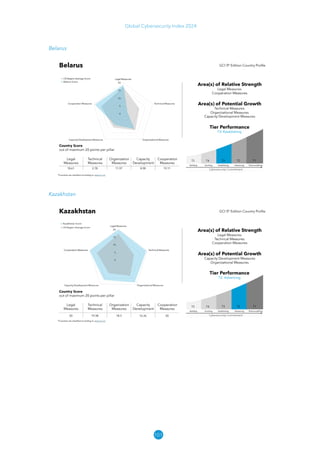
Belarus
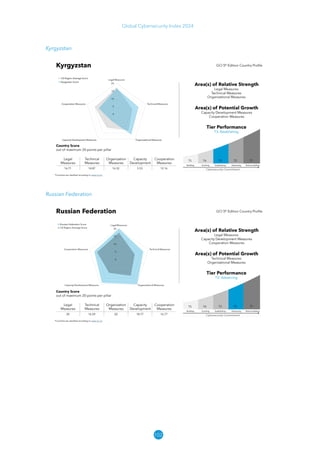
Kyrgyzstan
Azerbaijan
Kazakhstan
Russian Feder-
ation
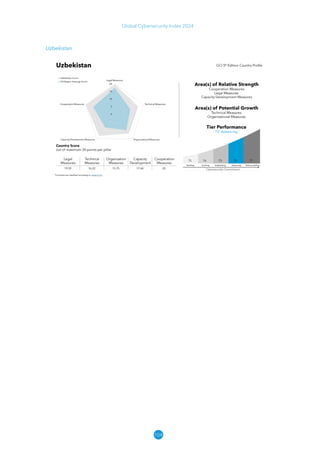
Uzbekistan
(none)
29
Global Cybersecurity Index 2024
Tier Performance: Europe
T5
Building
T4
Evolving
T3
Establishing
T2
Advancing
T1
Role-modelling
Vatican Bosnia and Herzegov-
ina
Liechtenstein
San Marino
Andorra
Bulgaria
Latvia
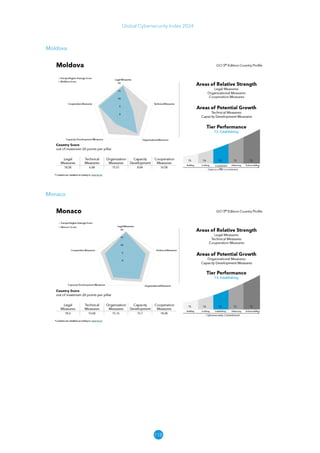
Moldova
Monaco
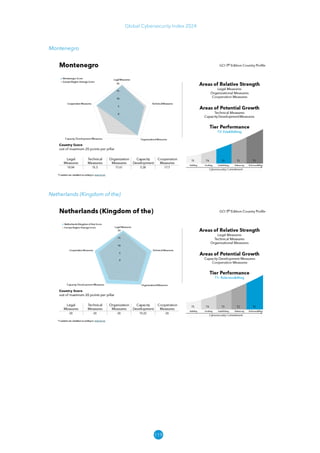
Montenegro
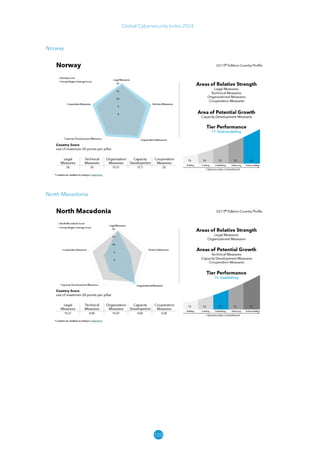
North Macedonia
Ukraine
Albania
Austria
Croatia
Czech Republic
Georgia
Hungary
Ireland
Israel
Lithuania
Malta
Poland
Romania
Slovakia
Switzerland
Belgium
Cyprus
Denmark
Estonia
Finland
France
Germany
Greece
Iceland
Italy
Luxembourg
Netherlands
(Kingdom of the)
Norway
Portugal
Serbia
Slovenia
Spain
Sweden
Türkiye
United Kingdom
30
Global Cybersecurity Index 2024
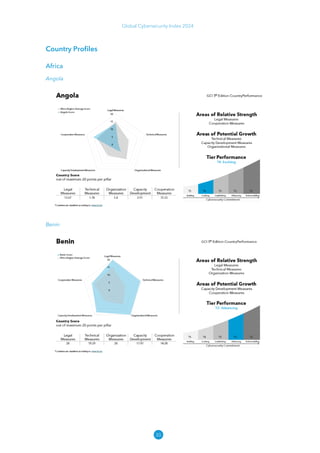
Country Profiles
Africa
Angola
Benin
31
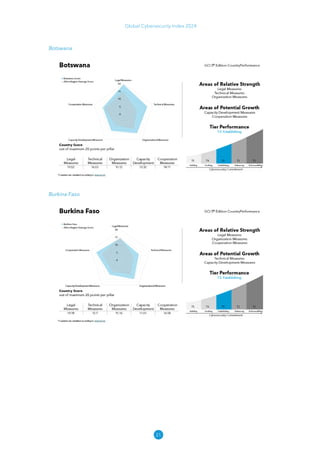
Global Cybersecurity Index 2024
Botswana
Burkina Faso
32
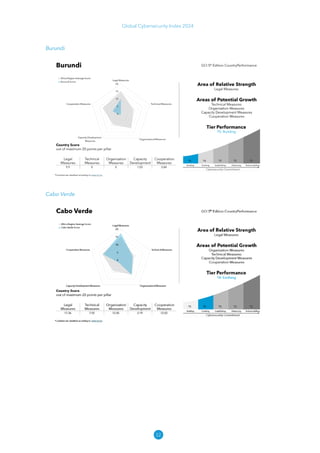
Global Cybersecurity Index 2024
Burundi
Cabo Verde
33
Global Cybersecurity Index 2024
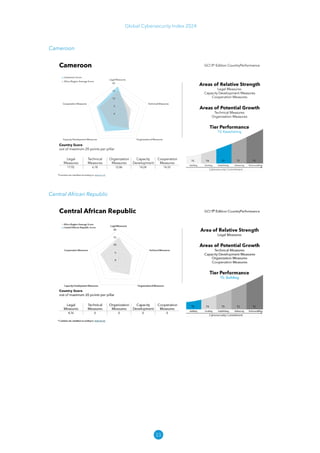
Cameroon
Central African Republic
34
Global Cybersecurity Index 2024
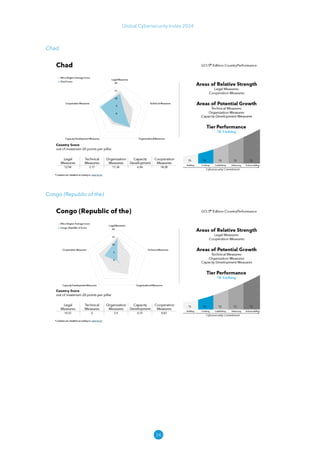
Chad
Congo (Republic of the)
35
Global Cybersecurity Index 2024
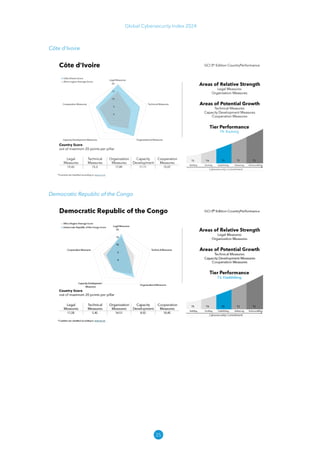
Côte d'Ivoire
Democratic Republic of the Congo
36
Global Cybersecurity Index 2024
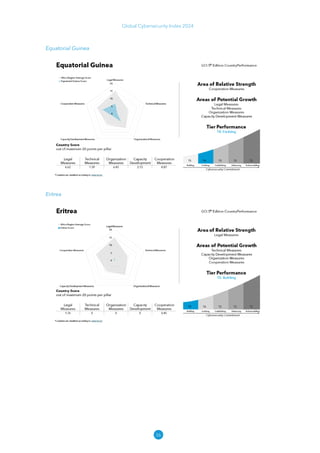
Equatorial Guinea
Eritrea
37
Global Cybersecurity Index 2024
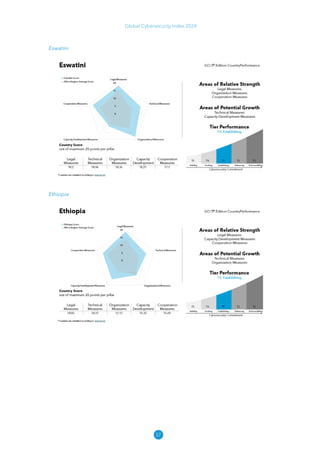
Eswatini
Ethiopia
38
Global Cybersecurity Index 2024
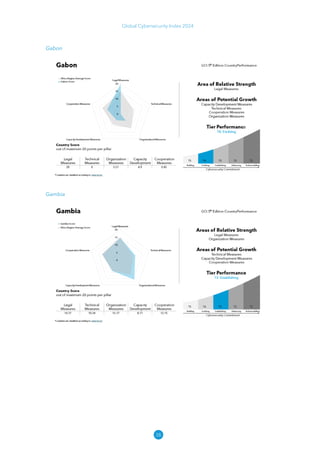
Gabon
Gambia
39
Global Cybersecurity Index 2024
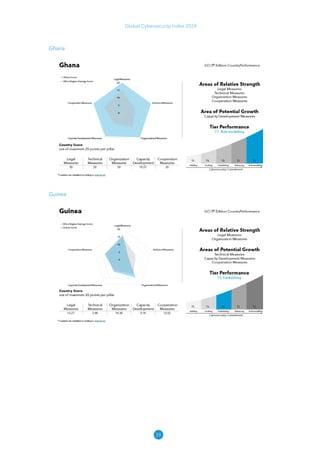
Ghana
Guinea
40
Global Cybersecurity Index 2024
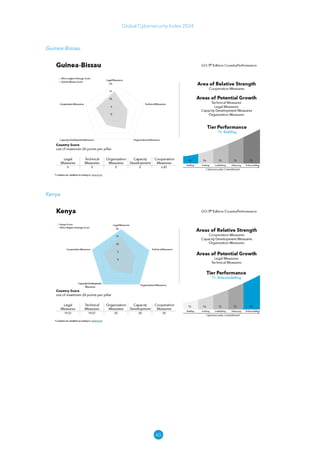
Guinea-Bissau
Kenya
41
Global Cybersecurity Index 2024
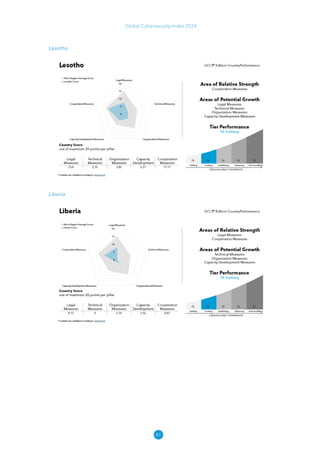
Lesotho
Liberia
42
Global Cybersecurity Index 2024
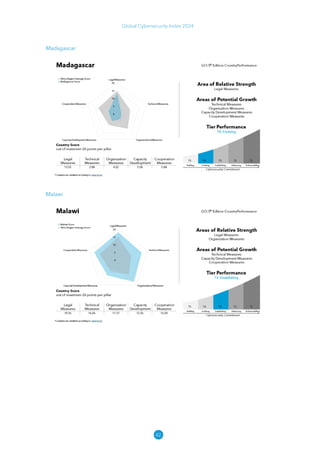
Madagascar
Malawi
43
Global Cybersecurity Index 2024
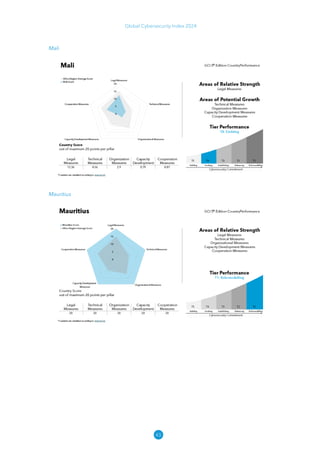
Mali
Mauritius
44
Global Cybersecurity Index 2024
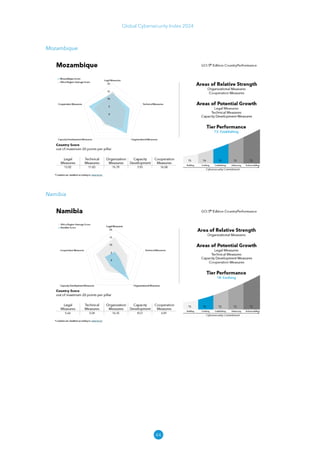
Mozambique
Namibia
45
Global Cybersecurity Index 2024
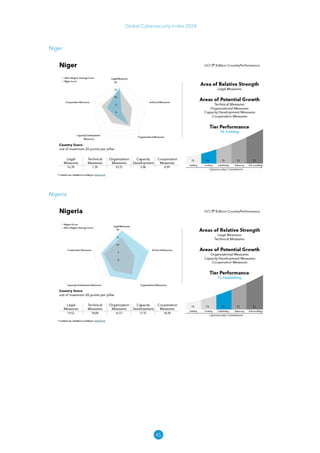
Niger
Nigeria
46
Global Cybersecurity Index 2024
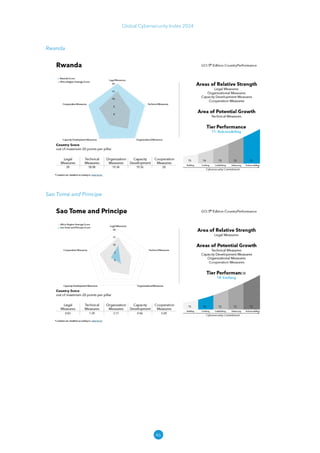
Rwanda
Sao Tome and Principe
47
Global Cybersecurity Index 2024
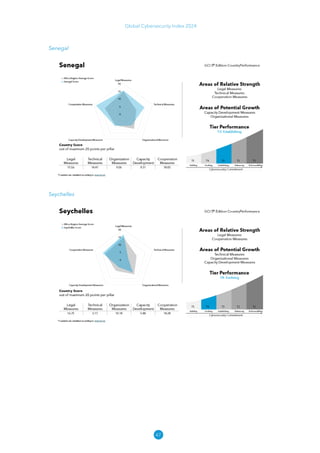
Senegal
Seychelles
48
Global Cybersecurity Index 2024
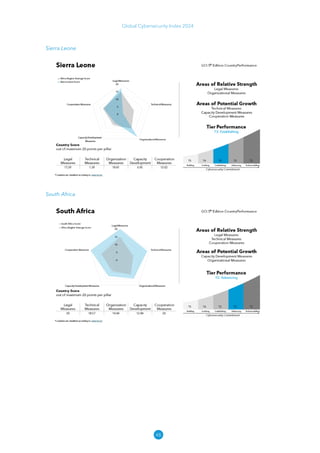
Sierra Leone
South Africa
49
Global Cybersecurity Index 2024
South Sudan
Tanzania
50
Global Cybersecurity Index 2024
Togo
Uganda
51
Global Cybersecurity Index 2024
Zambia
Zimbabwe
52
Global Cybersecurity Index 2024
Americas
Antigua and Barbuda
Argentina
53
Global Cybersecurity Index 2024
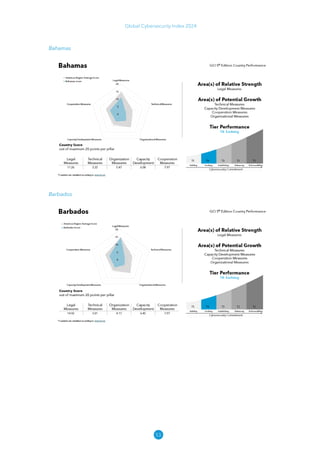
Bahamas
Barbados
54
Global Cybersecurity Index 2024
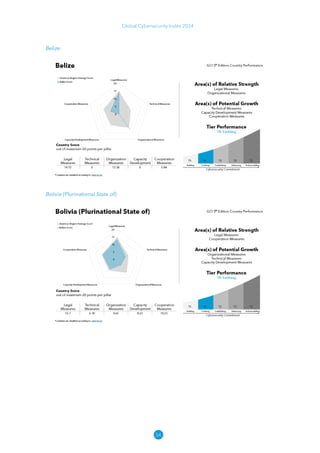
Belize
Bolivia (Plurinational State of)
55
Global Cybersecurity Index 2024
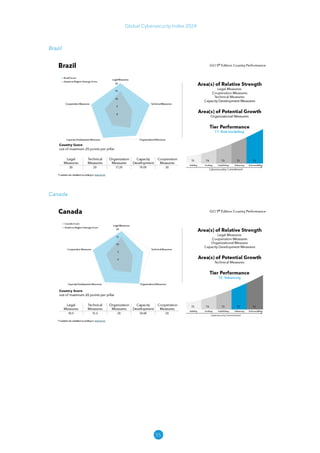
Brazil
Canada
56
Global Cybersecurity Index 2024
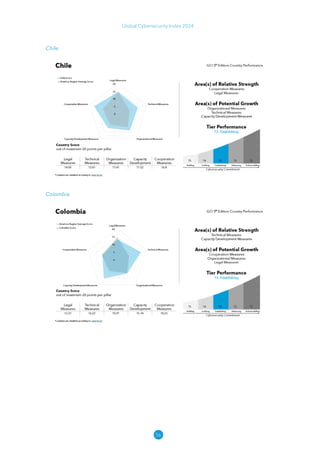
Chile
Colombia
57
Global Cybersecurity Index 2024
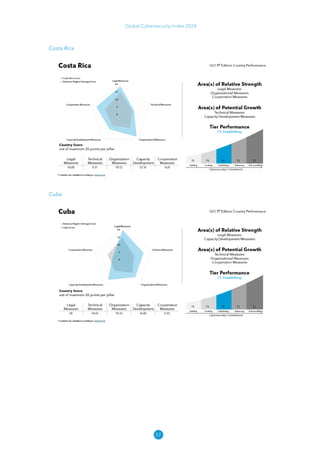
Costa Rica
Cuba
58
Global Cybersecurity Index 2024
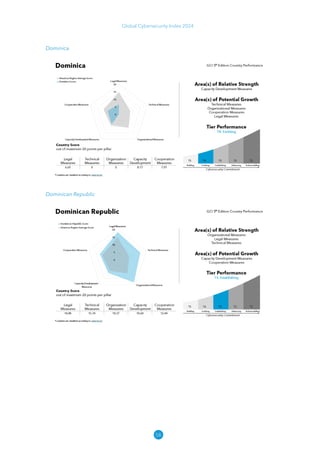
Dominica
Dominican Republic
59
Global Cybersecurity Index 2024
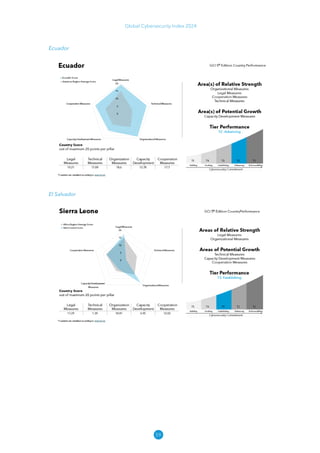
Ecuador
El Salvador
60
Global Cybersecurity Index 2024
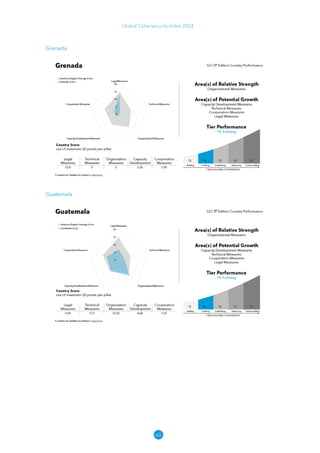
Grenada
Guatemala
61
Global Cybersecurity Index 2024
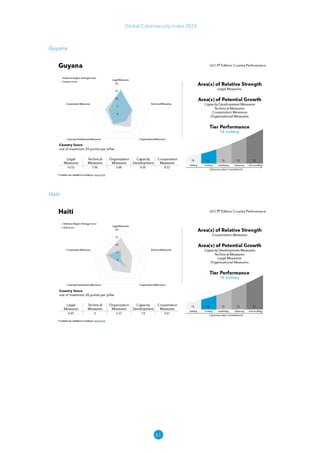
Guyana
Haiti
62
Global Cybersecurity Index 2024
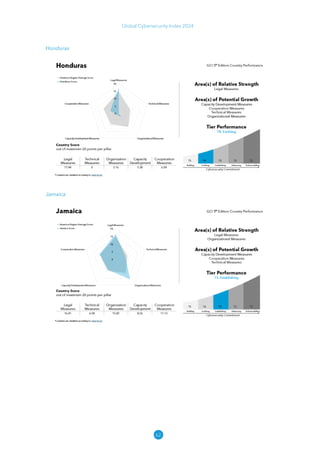
Honduras
Jamaica
63
Global Cybersecurity Index 2024
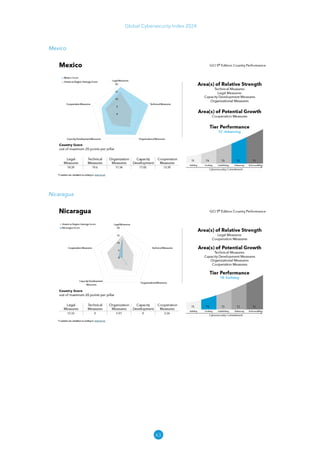
Mexico
Nicaragua
64
Global Cybersecurity Index 2024
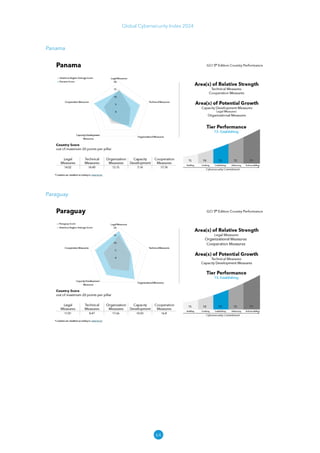
Panama
Paraguay
65
Global Cybersecurity Index 2024
Peru
Saint Kitts and Nevis
66
Global Cybersecurity Index 2024
Saint Lucia
Saint Vincent and the Grenadines
67
Global Cybersecurity Index 2024
Suriname
Trinidad and Tobago
68
Global Cybersecurity Index 2024
United States
Uruguay
69
Global Cybersecurity Index 2024
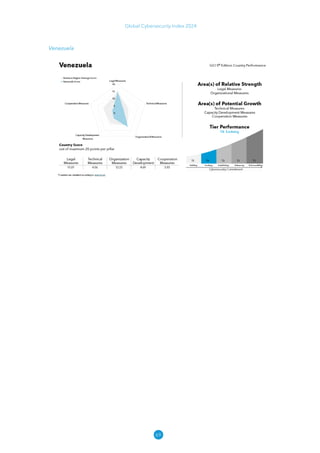
Venezuela
70
Global Cybersecurity Index 2024
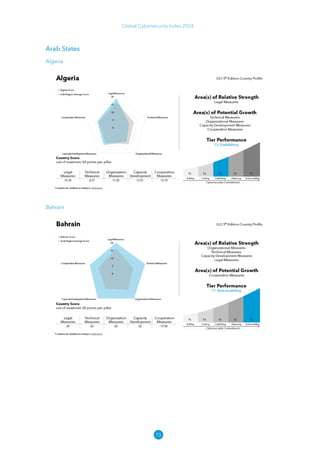
Arab States
Algeria
Bahrain
71
Global Cybersecurity Index 2024
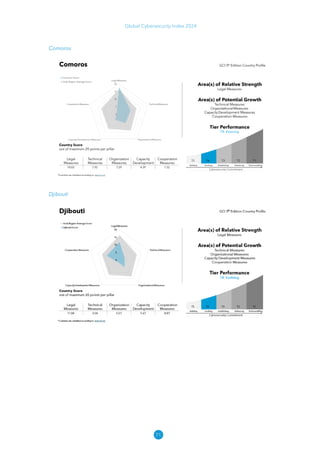
Comoros
Djibouti
72
Global Cybersecurity Index 2024
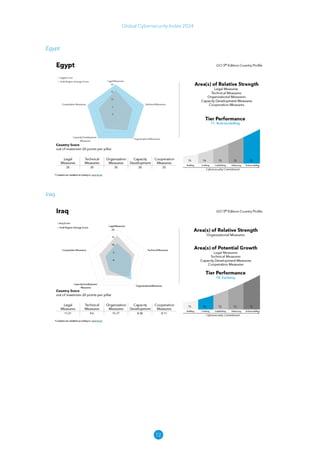
Egypt
Iraq
73
Global Cybersecurity Index 2024
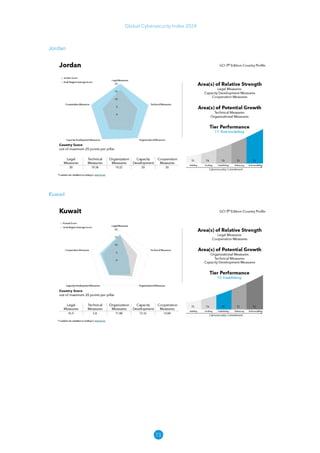
Jordan
Kuwait
74
Global Cybersecurity Index 2024
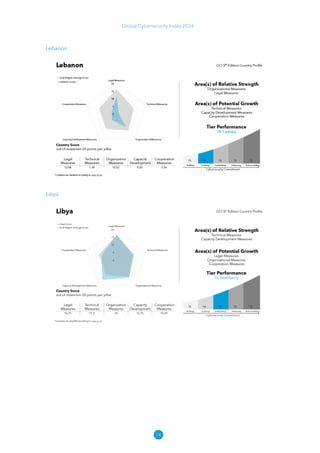
Lebanon
Libya
75
Global Cybersecurity Index 2024
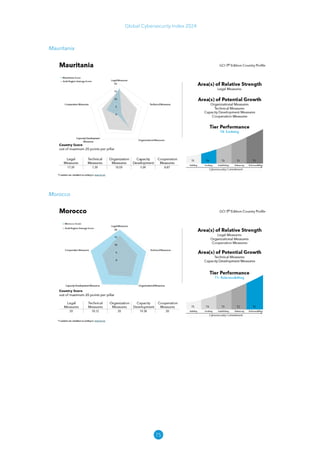
Mauritania
Morocco
76
Global Cybersecurity Index 2024
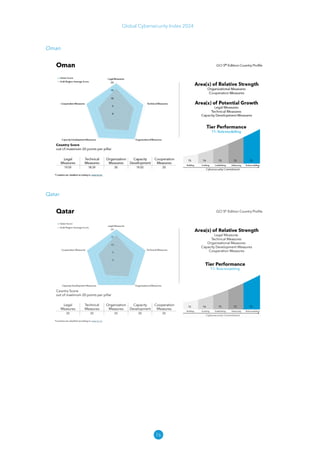
Oman
Qatar
77
Global Cybersecurity Index 2024
Saudi Arabia
Somalia
78
Global Cybersecurity Index 2024
State of Palestine
Sudan
79
Global Cybersecurity Index 2024
Syrian Arab Republic
Tunisia
80
Global Cybersecurity Index 2024
United Arab Emirates
Yemen
81
Global Cybersecurity Index 2024
Asia and the Pacific
Afghanistan
Australia
82
Global Cybersecurity Index 2024
Bangladesh
Bhutan
83
Global Cybersecurity Index 2024
Brunei Darussalam
Cambodia
84
Global Cybersecurity Index 2024
China
Democratic People’s Republic of Korea
85
Global Cybersecurity Index 2024
Fiji
India
86
Global Cybersecurity Index 2024
Indonesia
Iran (Islamic Republic of)
87
Global Cybersecurity Index 2024
Japan
Kiribati
88
Global Cybersecurity Index 2024
Lao P.D.R.
Malaysia
89
Global Cybersecurity Index 2024
Maldives
Marshall Islands
90
Global Cybersecurity Index 2024
Micronesia
Mongolia
91
Global Cybersecurity Index 2024
Myanmar
Nauru
92
Global Cybersecurity Index 2024
Nepal (Republic of)
New Zealand
93
Global Cybersecurity Index 2024
Pakistan
Papua New Guinea
94
Global Cybersecurity Index 2024
Philippines
Republic of Korea
95
Global Cybersecurity Index 2024
Samoa
Singapore
96
Global Cybersecurity Index 2024
Solomon Islands
Sri Lanka
97
Global Cybersecurity Index 2024
Thailand
Timor-Leste
98
Global Cybersecurity Index 2024
Tonga
Tuvalu
99
Global Cybersecurity Index 2024
Vanuatu
Viet Nam
100
Global Cybersecurity Index 2024
Commonwealth of Independent States
Armenia
Azerbaijan
101
Global Cybersecurity Index 2024
Belarus
Kazakhstan
102
Global Cybersecurity Index 2024
Kyrgyzstan
Russian Federation
103
Global Cybersecurity Index 2024
Tajikistan
Turkmenistan
104
Global Cybersecurity Index 2024
Uzbekistan
105
Global Cybersecurity Index 2024
Europe
Albania
Andorra
106
Global Cybersecurity Index 2024
Austria
Belgium
107
Global Cybersecurity Index 2024
Bosnia and Herzegovina
Bulgaria
108
Global Cybersecurity Index 2024
Croatia
Cyprus
109
Global Cybersecurity Index 2024
Czech Republic
Denmark
110
Global Cybersecurity Index 2024
Estonia
Finland
111
Global Cybersecurity Index 2024
France
Georgia
112
Global Cybersecurity Index 2024
Germany
Greece
113
Global Cybersecurity Index 2024
Hungary
Iceland
114
Global Cybersecurity Index 2024
Ireland
Israel
115
Global Cybersecurity Index 2024
Italy
Latvia
116
Global Cybersecurity Index 2024
Liechtenstein
Lithuania
117
Global Cybersecurity Index 2024
Luxembourg
Malta
118
Global Cybersecurity Index 2024
Moldova
Monaco
119
Global Cybersecurity Index 2024
Montenegro
Netherlands (Kingdom of the)
120
Global Cybersecurity Index 2024
Norway
North Macedonia
121
Global Cybersecurity Index 2024
Poland
Portugal
122
Global Cybersecurity Index 2024
Romania
San Marino
123
Global Cybersecurity Index 2024
Serbia
Slovakia
124
Global Cybersecurity Index 2024
Slovenia
Spain
125
Global Cybersecurity Index 2024
Sweden
Switzerland
126
Global Cybersecurity Index 2024
Türkiye
Ukraine
127
Global Cybersecurity Index 2024
United Kingdom
Vatican
128
Global Cybersecurity Index 2024
Methodology
Scope and objectives
The Global Cybersecurity Index (GCI) is formulated based on data provided by the ITU
membership, including interested individuals, experts and industry stakeholders as contributing
partners. The mandate for the GCI is derived from Resolution 130 (Rev. Bucharest, 2022) of the
ITU Plenipotentiary Conference, on strengthening the role of ITU in building confidence and
security in the use of information and communication technologies (ICTs), which, in particular,
invites Member States to support ITU initiatives on cybersecurity, including the GCI, in order
to promote government strategies and the sharing of information on efforts across industries
and sectors.
The fifth edition of the GCI continues this tradition and builds on earlier iterations. This is
manifested in areas such as a refined methodology, increased participation and collaboration
throughout the process, greater availability and accessibility of relevant inputs, developments
in questionnaire designs, and the strengthening of evidence-based data collection and analysis.
The GCI is a composite index of indicators that monitors the cybersecurity measures across the
five work areas of the Global Cybersecurity Agenda (GCA). The GCI measures:
• the type, level and extent of progress of cybersecurity activities within countries and
relative to other countries;
• the progress in cybersecurity commitment of countries from a global perspective;
• the progress in cybersecurity activities from a regional perspective;
• the cybersecurity divide (i.e. the difference between countries and regions in terms of their
level of engagement in cybersecurity initiatives).
Collectively, these measures represent a country’s level of cybersecurity commitments.
The GCI seeks to foster a global culture of cybersecurity, so that ICTs incorporate cybersecurity
in their development and adoption. Further, the GCI aims to assist countries in identifying
areas of relative strength in managing cybersecurity and cybercrime, in addition to identifying
areas of improvement, and to encourage them to take proactive measures towards further
development and innovations in those areas. It is anticipated that this perspective will provide
an opportunity to help raise the overall level of cybersecurity commitment worldwide, harmonize
good practices and foster a culture of cybersecurity at the national, regional and global levels.
To this end, the GCI shares practical insights that might serve as good practices, lessons and
guidelines for countries with similar national environments.
Structure
Cybersecurity framework
Cybersecurity is a multidisciplinary field, and its application involves all sectors, industries
and stakeholders, both vertically and horizontally. To increase the development of national
capabilities, efforts must be made by political, economic and social forces. This can be achieved
through the efforts of good actors within the ecosystem, such as law enforcement, justice
departments, educational institutions, ministries, private sector operators, ICT developers,
public-private partnerships and intra-State cooperation.
129
Global Cybersecurity Index 2024
Figure 21: GCI evolution over time through a basic comparison of its different editions
GCIv1 GCIv2 GCIv3 GCIv4 GCIv5
Publishing year 2015 2017 2019 2021 2024
Data collection
years
2013-2014 2016 2017-2018 2020 2023-2024
Countries providing
a focal point
105 136 155 169 172
Question type Open-ended Closed-
ended,
binary
Closed-
ended,
binary
Closed-
ended,
ternary
Closed-
ended,
ternary
Scoring method Benchmark
scores
Rank-based
weighted
scores
Rank-based
weighted
scores
Aggregate
weighted
average
score
Aggregate
weighted
average
score
Total indicators 17 25 25 20 20
Total questions 17 153 + 4
optional
questions on
child online
protection
50 82 82 + 1
optional
question
on training
for MSMEs
The ITU framework for international multistakeholder cooperation in cybersecurity aims to build
synergies between current and future initiatives. It focuses on the following five pillars, which
shape the inherent building blocks of a national cybersecurity culture:
• Legal measures
• Technical measures
• Organizational measures
• Capacity-development measures
• Cooperation measures
130
Global Cybersecurity Index 2024
Figure 22: Structure of the fifth edition of the GCI
The five pillars are described in detail below and presented in a flowchart in Figure 22: Structure
of the fifth edition of the GCI.
Legal measures
Measures based on the existence of legal frameworks dealing with cybersecurity
and cybercrime.
LegalmeasuresauthorizeaStatetosetupbasicresponsemechanismsthroughthecriminalization
of certain acts, the investigation and prosecution of crimes, the imposition of sanctions for
offences, non-compliance or breaches, and the establishment of institutional frameworks for
managing or governing cybersecurity.
A legislative framework sets the minimum foundation of behaviour on which further cybersecurity
capabilities can be built. Fundamentally, the objective is to have sufficient legislation in place to
harmonize practices at the regional/international level, strengthen cybersecurity systems, and
simplify international frameworks to combat cybercrime.
Technical measures
Measures based on the existence of technical institutions, standards and frameworks
dealing with cybersecurity and cybercrime.
131
Global Cybersecurity Index 2024
Efficient ICT development and use can only prosper in an environment of trust and security.
Countries therefore need to have the technical capabilities and capacity to be able to effectively
identify, detect, protect and respond to cyber-risks and cyberthreats, and to recover from
attacks, as well as to promote information-sharing and evaluate and implement standards,
good cybersecurity practices, and schemes for secure ICTs.
Organizational measures
Measures based on the existence of coordination institutions, policies and strategies
for cybercrime management and cybersecurity development at the national level.
Organizational measures include the identification of cybersecurity objectives and strategic
plans, as well as the formal definition of institutional roles, responsibilities and accountabilities
to ensure implementation and achievement of objectives. These measures are indispensable
for endorsing the elaboration and implementation of an effective cybersecurity posture.
Broad strategic targets and goals need to be set by the State, along with a comprehensive
plan for implementation, delivery and measurement. National agencies must be present to
implement the strategy and evaluate outcomes. Without a national strategy, governance model
or supervisory body, efforts in different sectors become conflicted, undermining efforts to obtain
an effective harmonization in cybersecurity development.
Capacity-development measures
Measures based on the existence of research and development, awareness raising,
education and training programmes, certified professionals and public sector
agencies fostering capacity development.
Capacity development includes public awareness-raising campaigns, frameworks for certification
and accreditation of cybersecurity professionals, professional training courses in cybersecurity,
educational programmes or academic curricula, etc. This pillar is intrinsic to the first three pillars
(legal, technical and organizational). Cybersecurity is most often tackled from a technological
perspective even though there are numerous socio-economic and political implications. Human
and institutional capacity development is essential to increasing awareness, knowledge and
know-how across sectors for systematic and appropriate solutions and to promoting the
development of qualified professionals.
Cooperation measures
Measures based on the existence of partnerships, cooperation frameworks and
information sharing networks at the national, regional and global levels.
Due to the unprecedented level of interconnection between states, cybersecurity is a shared
responsibility and a transnational challenge. Greater cooperation can enable the development
of much stronger cybersecurity capabilities, helping to mitigate cyber-risks and enable better
investigation, apprehension and prosecution of malicious agents.
132
Global Cybersecurity Index 2024
Computational methodology
The GCI is based on cybersecurity measures that a country can undertake as part of strengthening
their cybersecurity commitment. The GCI questionnaire provides a value for the 20 indicators
constructed through 83 questions, where one question is not scored. Countries can submit
ternary responses (yes; partial/in progress; no) to all questions.
To ensure accuracy, countries were required to support their answer through evidence, such as
an active URL, pdf, photo or other document which can reasonably substantiate their response.
Countries can also comment on their submission to contextualize their evidence.
Weighting
This fifth iteration of the GCI is on a scale of 0 to 100, with each pillar weighted at 20 points.
As a composite weighted index, each indicator, sub-indicator and micro-indicator is assigned
a weight given the relative importance to the indicator group. Weighting can have a significant
impact on final scores, and different techniques will produce different overall scores.
Weighting recommendations were done using a budget allocation method.23
Experts were
asked to contribute weighting recommendations for pillars in which they had expertise. Experts
were given a “budget” that they could distribute within an indicator group, thereby allocating
a greater amount towards indicators that were assessed as more important within their relative
group. The average weighting recommendations were adopted.
These weightings were not shared with countries during the GCI data collection period so as
not to influence country responses. The weighting does not account for the accuracy of the data.
Aggregation
Indicator groups were aggregated using weighted arithmetic averages. As a result, a country
scoring poorly in one area could compensate by performing well elsewhere. However, for the
purposes of clarity and comprehension, a linear approach was deemed more understandable.
A country’s score aggregation for each pillar is expressed as follows:
Where:
GCIp
= each pillar of the GCI
qi
= the score associated with a ternary response to a question within a pillar
wi
= weight assigned to a question within that pillar
n = total number of questions in each pillar
20 is the value of each pillar weighting
A country’s overall score is the summation of its scores in each pillar, GCIp
.
23
https://​
www​
.oecd​
-ilibrary​
.org/​
docserver/​
533411815016​
.pdf​
?expires​
=​
1722358078​
​
id​
=​
id​
​
accname​
=​
ocid195767​
​
checksum​
=​
D0​
6A2D569CE2B1DC75AAF3967AEBEFE3
133
Global Cybersecurity Index 2024
Tiers
As noted in in the methodology section on the move to a tier-based model, this edition presents
country performance in tiers, rather than ranks. Tiers represent several benefits over ranks,
as differences between country scores can be very narrow and include an error range based
on the accuracy of questionnaire responses, clarifications provided or country engagement.
Each tier groups similarly scoring countries together, thereby presenting a group of similarly
performing peers.
The tier-based model has been set for overall scores. As the overall score is a weighted average
of a country’s cybersecurity activities across all five pillars in the questionnaire, countries with
similar scores may still have significant differences on a pillar, indicator, sub-indicator or micro-
indicator level. Countries’ activities across pillars and indicators will vary in terms of quality and
impact, factors not measured by the GCI.
Countries may choose to develop their own rankings or tiers for the GCI; it must be noted,
however, that alternative ways of comparing countries are not endorsed by ITU.
The absolute-score method for tiers was applied based on the following, as described above
in Table 1:
• T1 95 ≤ x ≤ 100
• T2 85 ≤ x  95
• T3 55 ≤ x  85
• T4 20 ≤ x  55
• T5 0 ≤ x  20
The tiers may be interpreted as follows:
• Tier 1 (T1) – Role-modelling represents countries that obtained an overall GCI score of
at least 95/100 by demonstrating a strong cybersecurity commitment to coordinated and
government-driven actions that encompass evaluating, establishing and implementing
certain generally accepted cybersecurity measures across all five pillars or up to all
indicators.
• Tier 2 (T2) – Advancing represents countries that have obtained an overall score of at
least 85/100 by demonstrating a strong cybersecurity commitment to coordinated and
government-driven actions that encompass evaluating, establishing or implementing
certain generally accepted cybersecurity measures in up to four pillars or a substantial
number of indicators.
• Tier 3 (T3) – Establishing represents countries that obtained an overall score of at least
55/100 by demonstrating a basic cybersecurity commitment to government-driven actions
that encompass evaluating, establishing or implementing certain generally accepted
cybersecurity measures across a moderate number of pillars or indicators.
• Tier 4 (T4) – Evolving represents countries that obtained an overall score of at least
20/100 by demonstrating a basic cybersecurity commitment to government-driven actions
that encompass evaluating, establishing or implementing certain generally accepted
cybersecurity measures in at least one pillar, or several indicators and/or sub-indicators.
• Tier 5 (T5) – Building represents countries that obtained an overall score below 20/100
by demonstrating a basic cybersecurity commitment to government-driven actions
that encompass evaluating, establishing or implementing certain generally accepted
cybersecurity measures in at least one indicator and/or sub-indicator.
The tier-based model underscores that a cybersecurity commitment requires an adaptive stance
in evaluating, establishing or implementing appropriate actions to effectively meet the demands
134
Global Cybersecurity Index 2024
of the rapidly evolving cybersecurity landscape. Under these circumstances, opportunities will
exist for further coordinated actions, improvements and expansions of the breadth and depth
of cybersecurity measures, irrespective of a country’s overall score.
Key changes and limitations in the fifth edition of the GCI
The GCI has been updated to ensure greater methodological consistency, clarify questions,
reflect current weighting recommendations and better represent country performance,
including in the following areas:
• Questionnaire: based on a series of meetings of the GCI Expert Group, questions were
clarified and refined. This included expanding on the rationales for each question. A final
version of the questionnaire was approved by the ITU Telecommunication Development
Bureau (BDT) management.
• Weightings: as country scores are calculated using a weighted average, the GCI Expert
Group was invited to update their weighting recommendations. Some 140 experts were
tasked with providing weighting recommendations in pillars related to their areas of
expertise. Based on their recommendations, an arithmetic average is taken and used in
computation.
• Tier model: the GCI Expert Group met and put forward several possible models for a
tier-based GCI scoring model to replace the existing model, which ranked country
performance. For the final selection of the model, BDT management relied on the
preferred choice of the Expert Group.
As cybersecurity continues to be an area of change and countries have innovated to find ways
forward, the aim is for GCI questions not to be overly prescriptive and instead to capture
the wide variety of tools, programmes, initiatives and other methods countries may use to
accomplish various objectives; the trade-off with this less prescriptive approach, however, is
that questions might contain ambiguities.
The GCI verification team worked to ensure consistency through regular meetings and
communications to ensure that verification decisions were coherent across countries. While
feedback from countries was solicited where necessary, the risk of inconsistencies in the
verifications remains, particularly in edge cases.
Changes and limitations by pillar
The changes made across the pillars include:
Legal measures
The legal pillar has been updated to better reflect:
• legislation that is in force versus partial/in progress.
Notable limitations that arose during verification include:
• comparability of laws, regulations and decrees – what can be considered a law in one
country may have lower enforceability or implementation in another country; and
• applicability of laws and regulations – while some countries used targeted laws that directly
addressed issues at hand, other countries reported using general laws and regulations
and applying them to cybersecurity; for the latter, verification was challenging as it was
not always clear whether the law or regulation could be applied in a cyber-context.
135
Global Cybersecurity Index 2024
Technical measures
The technical pillar has been restructured to better reflect how computer incident response
teams (CIRTs) operate, including by:
• clarifying that CIRTs do not need to develop and deliver cyber awareness activities, but
their involvement is desirable; and
• better reflecting that national CIRTs often develop and deliver cyber drills, while sectoral
CIRTs may only participate in them.
Notable limitations that arose included:
• the relevance of certain types of cybersecurity standards and certification;
• the definition of a “framework” for implementation of standards;
• roles and functions of information-sharing and analysis centres (ISACs);
• key activities by CIRTs, particularly around cyber-awareness campaigns and threat
notifications.
Organizational measures
The organizational pillar has been updated to better reflect:
• the second edition of the Guide to Developing a National Cybersecurity Strategy;
• regional CIRT membership;
• the need for national CIRTs to assist in conducting cyber drills, while sectoral CIRTs need
only to participate.
Notable limitations that arose included:
• the comparability of draft status of national cybersecurity strategies (NCSs);
• perspectives on the life of NCSs;
• depth and specificity of NCS action plans;
• assessment of outcomes of the adoption of cybersecurity metrics; and
• many countries’ national CIRTs participated in regional cyber drills but did not organize
their own.
Capacity-development measures
The capacity-development pillar has been updated to better reflect:
• diversity in the types of targeted cyber-awareness campaigns;
• promotion and development of the cybersecurity private sector; and
• cybersecurity certification schemes.
Notable limitations that arose included:
• evaluation of whether cybersecurity was substantially present in academic curricula in
primary and secondary education;
• lack of data about reach and impact of cyber-awareness campaigns;
• measurement of the cybersecurity industry; and
• evaluation of the presence of research and development in academia and the private and
public sectors.
136
Global Cybersecurity Index 2024
Cooperation measures
The cooperation pillar has been updated to better reflect:
• types of bilateral and multilateral agreements that are to be considered; and
• cooperation agreements that have been signed or ratified – the Budapest Convention had
been previously counted under international mechanisms, which is no longer a question,
and is now counted under multilateral agreements.
Notable limitations that arose included:
• definition of what an “agreement” should be (e.g. joint statement or signed treaty); and
• assessment of the outcomes of cooperation agreements.
The verification team has noted areas of ambiguity and has striven to apply any decisions as
evenly as possible to country verifications. The GCI team will present their observations to the
GCI Expert Group for feedback and input ahead of the next edition.
Changes to the weighted average scoring
As with the previous edition of the GCI, weightings have been updated as the relative
importance and influence of questions and measures may have changed. These changes reflect
the dynamism of the cybersecurity landscape and access to an enlarged and more diverse GCI
Expert Group. In the future, it is reasonable to expect central tendency effects should there be
a sufficiently large expert group.
As always, individual countries may judge that their ideal weighting mix is different, based on
their own priorities and dependencies.
Move to a tier-based model
Through Resolution 45 (Rev. Kigali, 2022) of the World Telecommunication Development
Conference and Resolution 130 (Rev. Bucharest, 2022) of the Plenipotentiary Conference,
BDT was instructed by Member States to move from a rank-based presentation of GCI scoring
to a tier-based model.
The GCI Expert Group developed and presented recommendations on how these tiers could
be set. After six meetings, the group arrived at two proposals for BDT management. The final
proposals are reflected in Table 1.
Based on the recommendations of the GCI Expert Group, ITU management approved the use
of the “absolute score” method.
137
Global Cybersecurity Index 2024
Table 1: Tier-based model
Absolute score Quantiles
Proposed
Tiers
T1 95 ≤ x ≤ 100
T2 85 ≤ x  95
T3 55 ≤ x  85
T4 20 ≤ x  55
T5 0 ≤ x  20
T1 Top 10% of countries
T2 Next 20%
T3 Next 25%
T4 Next 25%
T5 Next 20%
Benefits • Country performance is primarily
gauged against the country itself.
• Tier score boundaries remain
constant over time
• Distribution of countries across
tiers will remain constant over time.
• Easier for countries to assess their
progress against the rest of the
world.
Limitations As time goes on, more countries may
end up in the top tier, limiting differen-
tiation among them.
Country absolute scores can improve,
but their relative position can
decrease, potentially demotivating
further cybersecurity efforts.
GCI report development process
Figure 23: GCI report development process
The GCI report is produced according to the following steps, as shown in Figure 23.
1) GCI survey refinement: a multistakeholder approach is undertaken in the review and
refinement of the GCI indicators and questions. This includes considering the lessons
and opportunities for refinements and improvements from previous iterations, feedback
from the GCI Expert Group and an assessment of the evolving state of the cybersecurity
field. The GCI questionnaire is thereafter reviewed, refined, finalized and approved for
dissemination.
2) Invitation: a letter of invitation is sent to all ITU Member States and the State of Palestine,
informing them of the initiative and requesting a focal point responsible for collecting all
relevant data and for completing the online GCI questionnaire. During the online survey,
the approved focal point is officially invited by BDT to answer the questionnaire.
138
Global Cybersecurity Index 2024
3) Data collection: primary and secondary data collection techniques are used to reflect the
current state of cybersecurity commitment.
• Primary data collection: the online questionnaire is used to collect responses from
countries;
• Secondary data collection: desk research, using publicly available data sources, is
relied on in instances where a country did not respond to the questionnaire.
Note: Should a country not provide a focal point for the GCI questionnaire, BDT shall attempt
to establish contact with the institutional focal point in the ITU Global Directory.
1) Verification and validation
A comprehensive iterative process of reviews, analyses, revisions and approvals is
established throughout this phase and applied to both data collection methods. Once
completed, consistency checks are conducted to help to ensure reliability.
A. Online questionnaire:
• ITU identifies any missing responses, supporting documents, links, etc.
• The focal point improves the accuracy of responses where necessary, including by
offering relevant evidence.
• Validated questionnaires are used for analysis and scoring.
B. Desk research questionnaire:
• A draft questionnaire is sent to focal points for review.
• Focal points improve accuracy and return the draft questionnaire.
• BDT reviews responses against the evidence provided and identifies any missing
responses, supporting documents, links, etc.
• The corrected draft questionnaire is sent to each focal point for final approval.
• The validated questionnaire is used for analysis and scoring.
2) Scoring and analysis
• Scores associated with ternary responses to the validated questionnaire for each
country are collated for analysis.
• Scoring methodology is applied to assign each country to the established tiers.
• Identification of findings from the GCI that provide insights into regional and world
trends.
3) Report development and publication
• A GCI report is drafted, reviewed and approved for publication.
• The GCI report becomes available to countries, stakeholders and members of the
public.
Areas for further research
As part of the intrinsic review and analysis, ITU has identified areas for development and
improvements. This includes refinements of questions to improve clarity and reduce ambiguity,
as well as to enhance validity and reliability of measures.
Several areas were identified for further research, including:
• What are effective approaches for managing and conducting national cybersecurity
audits?
139
Global Cybersecurity Index 2024
• What are the most effective strategies for conducting cybersecurity awareness activities?
Do these strategies differ based on the target group?
• How can the effectiveness of cyber development activities be evaluated in the short term?
• How can countries improve utilization of bilateral and multilateral cybersecurity
agreements?
• What are the barriers to establishing and adopting effective cooperation measures, such
as bilateral and multilateral cybersecurity agreements?
• How effective are government incentives at developing the cybersecurity industry?
• How effective are government incentives at driving cybersecurity research and
development?
• Based on a country’s level of digitalization, what activities are needed from CIRTs?
The GCI team hopes that researchers continue to explore these and other cybersecurity-related
areas.
Office of the Director
International Telecommunication Union (ITU)
Telecommunication Development Bureau (BDT)
Place des Nations
CH-1211 Geneva 20
Switzerland
Office of Deputy Director and Regional Presence
Field Operations Coordination Department (DDR)
Place des Nations
CH-1211 Geneva 20
Switzerland
Email: bdtdirector@itu.int Email: bdtdeputydir@itu.int
Tel.: +41 22 730 5035/5435 Tel.: +41 22 730 5131
Fax: +41 22 730 5484 Fax: +41 22 730 5484
Digital Networks and Society (DNS) Digital Knowledge Hub Department
(DKH)
Partnerships for Digital Development
Department (PDD)
Email: bdt-dns@itu.int Email: bdt-dkh@itu.int Email: bdt-pdd@itu.int
Tel.: +41 22 730 5421 Tel.: +41 22 730 5900 Tel.: +41 22 730 5447
Fax: +41 22 730 5484 Fax: +41 22 730 5484 Fax: +41 22 730 5484
Africa
Ethiopia Cameroon Senegal Zimbabwe
International Telecommunication
Union (ITU) Regional Office
Gambia Road
Leghar Ethio Telecom Bldg. 3rd floor
P.O. Box 60 005
Addis Ababa
Ethiopia
Union internationale des
télécommunications (UIT)
Bureau de zone
Immeuble CAMPOST, 3e étage
Boulevard du 20 mai
Boîte postale 11017
Yaoundé
Cameroon
Union internationale des
télécommunications (UIT)
Bureau de zone
8, Route du Méridien Président
Immeuble Rokhaya, 3e étage
Boîte postale 29471
Dakar - Yoff
Senegal
International Telecommunication
Union (ITU) Area Office
USAF POTRAZ Building
877 Endeavour Crescent
Mount Pleasant Business Park
Harare
Zimbabwe
Email: itu-ro-africa@itu.int Email: itu-yaounde@itu.int Email: itu-dakar@itu.int Email: itu-harare@itu.int
Tel.: +251 11 551 4977 Tel.: + 237 22 22 9292 Tel.: +221 33 859 7010 Tel.: +263 242 369015
Tel.: +251 11 551 4855 Tel.: + 237 22 22 9291 Tel.: +221 33 859 7021 Tel.: +263 242 369016
Tel.: +251 11 551 8328 Fax: + 237 22 22 9297 Fax: +221 33 868 6386
Fax: +251 11 551 7299
Americas
Brazil Barbados Chile Honduras
União Internacional de
Telecomunicações (UIT)
Escritório Regional
SAUS Quadra 6 Ed. Luis Eduardo
Magalhães,
Bloco “E”, 10º andar, Ala Sul
(Anatel)
CEP 70070-940 Brasilia - DF
Brazil
International Telecommunication
Union (ITU) Area Office
United Nations House
Marine Gardens
Hastings, Christ Church
P.O. Box 1047
Bridgetown
Barbados
Unión Internacional de
Telecomunicaciones (UIT)
Oficina de Representación de Área
Merced 753, Piso 4
Santiago de Chile
Chile
Unión Internacional de
Telecomunicaciones (UIT)
Oficina de Representación de Área
Colonia Altos de Miramontes
Calle principal, Edificio No. 1583
Frente a Santos y Cía
Apartado Postal 976
Tegucigalpa
Honduras
Email: itubrasilia@itu.int Email: itubridgetown@itu.int Email: itusantiago@itu.int Email: itutegucigalpa@itu.int
Tel.: +55 61 2312 2730-1 Tel.: +1 246 431 0343 Tel.: +56 2 632 6134/6147 Tel.: +504 2235 5470
Tel.: +55 61 2312 2733-5 Fax: +1 246 437 7403 Fax: +56 2 632 6154 Fax: +504 2235 5471
Fax: +55 61 2312 2738
Arab States Asia-Pacific
Egypt Thailand Indonesia India
International Telecommunication
Union (ITU) Regional Office
Smart Village, Building B 147,
3rd floor
Km 28 Cairo
Alexandria Desert Road
Giza Governorate
Cairo
Egypt
International Telecommunication
Union (ITU) Regional Office
4th floor NBTC Region 1 Building
101 Chaengwattana Road
Laksi,
Bangkok 10210,
Thailand
International Telecommunication
Union (ITU) Area Office
Gedung Sapta Pesona
13th floor
JI. Merdeka Barat No. 17
Jakarta 10110
Indonesia
International Telecommunication
Union (ITU) Area Office and Innovation
Centre
C-DOT Campus
Mandi Road
Chhatarpur, Mehrauli
New Delhi 110030
India
Email: itu-ro-arabstates@itu.int Email: itu-ro-asiapacific@itu.int Email: bdt-ao-jakarta@itu.int Email:
Tel.: +202 3537 1777 Tel.: +66 2 574 9326 – 8 Tel.: +62 21 380 2322 Area Office: itu-ao-southasia@itu.int
Fax: +202 3537 1888 +66 2 575 0055 Innovation
Centre:
itu-ic-southasia@itu.int
Website: ITUInnovationCentrein
NewDelhi,India
CIS Europe
Russian Federation Switzerland
International Telecommunication
Union (ITU) Regional Office
4, Building 1
Sergiy Radonezhsky Str.
Moscow 105120
Russian Federation
International Telecommunication
Union (ITU) Office for Europe
Place des Nations
CH-1211 Geneva 20
Switzerland
Email: itu-ro-cis@itu.int Email: eurregion@itu.int
Tel.: +7 495 926 6070 Tel.: +41 22 730 5467
Fax: +41 22 730 5484
International Telecommunication Union
Telecommunication Development Bureau
Place des Nations
CH-1211 Geneva 20
Switzerland
Published in Switzerland
Geneva, 2024
Photo credit: Adobe Stock
ISBN: 978-92-61-38751-8
9 7 8 9 2 6 1 3 8 7 5 1 8

Global Cybersecurity Index 2024 to emerging risks

  • 1.
    ITUPublications International TelecommunicationUnion Development Sector Global Cybersecurity Index 2024 5th Edition
  • 2.
  • 3.
    Acknowledgements The International TelecommunicationUnion (ITU) would like to thank the Global Cybersecurity Index (GCI) focal points, who have collected data on cybersecurity commitments from across their respective countries. This report would not have been possible without the GCI country focal points. Particular acknowledgement is given to the members of the ITU GCI Expert Group for their work on improving the questionnaire, providing weighting recommendations and developing the tier- based model, notably Robin Almario, Hamza Bekhti, Alana G. Ramos, Fleur-de-lis A. Nadua, Na’ela Abanda, Aysha Ahmed BinHaji, Abdulla Mohammed Al Boinin, Dana Yousif Al-Abdulla, Noora Yousif Al-Abdulla, Alaidar Amirseiit, Abdulaziz Alfaiz, Ali Ali, Yusuf Mohamed Ali Mothanna, Ruaa AlJassar, Ghada Aljuhaiman, Wassim AlJuneidi, Ali Saeed Alkindi, Aziza Alrashdi, Siham Alrashdi, Aziza Sultan Al Rashdi, Mahran Alsheikh, Palakiyem Assih, Janelle Augustin-Henry, Anthony B Turner, Makarem Mohamed Bamatraf, Tarique Barkatullah, Mohamed Benziane, Wojciech Berezowski, Ahmad Amsyar bin Haji Ariffin, Katia Bonello, Yevhen Bryksin, Vladyslav Bublyk, Emmanuel J. Bwogi, Richard Calderón, Martin Camilleri, Wang Chunhui, Vanessa Copetti Cravo, Luc Dandurand, Daran Park, Aniel de Beer, Elena de la Calle, Miguel De Bruycker, Nangbam Didemana, Stefania Ducci, James Eaton-Lee, Aly Elshekh, Dai Fangfang, M. Rabenjamina Fenonirina Harinanadrianina, Christina Filipovic, Gabriela Gallegos, Carlos Leonardo Garcia, Marco Gercke, Henry Raul Gonzalez Brito, Boyan Grigorov, Alexander Grishchenko, Banchale Gufu, Ahmed Helmy, John Hering, René Andrade Hernández, Cristine Hoepers, Ella Holland, Fabián Iñiguez Matute, Tadas Jakštas, Michelet Jerome, Xiao Jing, Jacobo Bello Joya, Teemu Juujärvi, Dina Kabeel, Mustafa Kamal, Amos Kamugabirwe, Kadri Kaska, Nada Khater, Alan Khubaev, Bita Kiamehr, Elom Klevor, Fodé Kouyate, Igor Kovač, Anissa Kpakpabia, Rizky Hendra Kurniawan, Shadrack Ledwaba, Syntilla Likouni, Lim May-Ann, Charlotte Lindsey, Gosia Loj, Nicte Lopez, Iman Mahmoud, Indra Prasad Mainali, Tadesse Mak, Shafiq Malo, Mukesh Mangal, Dikokole Maqutu, Marcel Garcia Marcel Furtado Garcia, Louise Marie Hurel, Carlos Martins, Sametria McKinney, Tarik Babiker Merghani, Mhd Koudmani, Danylo Mialkovskyi, Molupe Molupe, James Musinguzi, Ngundi Vincent, Héctor Núñez, Doğukan Ömer Gür, Winston Oyadomari, Terrence Park, Nasim Parvez, Arseny Plossky, Nguyen Quy Quyen, Duha Rahahleh, Agria Rhamdhan, Andrea Rigoni, César Moliné Rodríguez, Eraste Rurangwa, Matej Šalmík, Abdelmalek Shafiee, Nizar Shanaah, Rajesh Sharma, Laurent Sliepe, Laura Striegel, Salman Sulaiman, Dr. Sulistyo, Samuel Tew, Marcelo Trindade Pitta, Kaleem Ahmed Usmani, Guillermo Valencia, Francisco Valle, Dinh Van Ket, Nia Wahyu Utami, Leon Wessels, Denys Yashchuk, Mariama Yormah, Heung Youl Youm, Ziad Zubidah, Hanibal Lemma, Simegnew Tizazu, Yirga Badma, Zekarias Getnet, Bruno Halopeau and Albtoul alMuhanna. In particular, we would like to thank Winston Oyadomari for his leadership of the discussion of the transition to a tier-based model.
  • 4.
    Please consider theenvironment before printing this report. © ITU 2024 Some rights reserved. This work is licensed to the public through a Creative Commons Attribution-Non- Commercial-Share Alike 3.0 IGO license (CC BY-NC-SA 3.0 IGO). Under the terms of this licence, you may copy, redistribute and adapt the work for non-commercial purposes, provided the work is appropriately cited. In any use of this work, there should be no suggestion that ITU endorse any specific organization, products or services. The unauthorized use of the ITU names or logos is not permitted. If you adapt the work, then you must license your work under the same or equivalent Creative Commons licence. If you create a translation of this work, you should add the following disclaimer along with the suggested citation: “This translation was not created by the International Telecommunication Union (ITU). ITU is not responsible for the content or accuracy of this translation. The original English edition shall be the binding and authentic edition”. For more information, please visit https://creativecommons.org/ licenses/by-nc-sa/3.0/igo/ Disclaimers The designations employed and the presentation of the material in this publication do not imply the expression of any opinion whatsoever on the part of the International Telecommunication Union (ITU) or of the ITU secretariat concerning the legal status of any country, territory, city, or area or of its authorities, or concerning the delimitation of its frontiers or boundaries. The mention of specific companies or of certain manufacturers’ products does not imply that they are endorsed or recommended by ITU in preference to others of a similar nature that are not mentioned. Errors and omissions excepted; the names of proprietary products are distinguished by initial capital letters. All reasonable precautions have been taken by ITU to verify the information contained in this publication. However, the published material is being distributed without warranty of any kind, either expressed or implied. The responsibility for the interpretation and use of the material lies with the reader. The opinions, findings and conclusions expressed in this publication do not necessarily reflect the views of ITU or its membership. ISBN 978-92-61-38751-8 (Electronic version) 978-92-61-38761-7 (EPUB version) 978-92-61-38771-6 (Mobi version)
  • 5.
    iv Foreword Over the pastdecade since the launch of the first Global Cybersecurity Index in 2015, 2.5 billion people have come online. The past 10 years have witnessed a significant evolution in the cybersecurity landscape, driven in part by the emergence of new technologies like artificial intelligence (AI), blockchain, and the potential of quantum computing. However, one constant remains: the human element. Cybersecurity efforts and the responsible use of digital technologies by individuals are paramount in shaping the future of this domain, and for working towards meaningful connectivity. Recognizing the centrality of people, ITU Member States adopted the Kigali Action Plan in 2022 and highlighted the need for inclusive and secure telecommunications/ ICTs for sustainable development through supporting components like cybersecurity, in addition to digital literacy, strengthening the security of users online, assisting Member States with national cybersecurity strategies and computer incident response teams (CIRTs), digital skills and digital trainings, and secure infrastructure. This edition of the Global Cybersecurity Index features record engagement by countries and is our most rigorous yet. Each country submission has been independently verified for accuracy, against consistent baselines and definitions. As a result, users of the Index can feel assured in its quality and applicability. Indeed, we have been encouraged to learn that Member States are incorporating GCI-based metrics into their national plans and activities. The results of this edition of the GCI highlights significant improvements made by countries such as adding foundational legislation, establishing incident response efforts, developing clearer national plans, training people across society, and working together with national and international partners. In particular, many countries have been increasingly targeting their cybersecurity efforts toward vulnerable and underrepresented populations. However, while the rise in cybersecurity initiatives is encouraging, a crucial next step for Member States lies in ensuring that these efforts are effective. Simply committing to action is not enough, we need to make sure that cyber commitments are implemented through high-quality, high- impact activities. In the future, we hope to support countries in enhancing the steps they have already been taking through the GCI. This need is more important than ever, as this edition of the Global Cybersecurity Index shows, given that the gaps between Least Developed Countries (LDCs), Small Island Developing States (SIDS), Land Landlocked Developing Countries (LLDCs), and developed countries continues to persist. As countries work to bridge these gaps on their path towards meaningful connectivity, I hope that they work to draw on good practices, and to develop well-defined, relevant and applicable legal frameworks, set up technical teams in incidence response, to address lack of skilled talent, and to enhance collaboration, particularly around issues impacting vulnerable populations.
  • 6.
    v Furthermore, international cooperationemerges as an indispensable component in addressing the transnational nature of cyber threats. Collaborative endeavours facilitate the sharing of best practices, intelligence, and resources, strengthening the collective cyber resilience. However, to fully harness the benefits of international cooperation, it is imperative to support the development of requisite capacities to meaningfully engage in collaborative efforts. Building and fortifying national cybersecurity capabilities lays the groundwork for countries to actively contribute to global cybersecurity endeavours and navigate the complexities of cyberspace with confidence and competence. The Global Cybersecurity Index is only part of the puzzle in improving countries’ commitments to cybersecurity. I hope that countries find ways to use the Global Cybersecurity Index in their efforts to develop secure and trustworthy ICTs. Dr Cosmas Luckyson Zavazava Director of the Telecommunication Development Bureau International Telecommunication Union
  • 7.
    vi Acknowledgements������������������������������������������������������������������������������������������������������������������������ii Foreword�����������������������������������������������������������������������������������������������������������������������������������������iv Report summary����������������������������������������������������������������������������������������������������������������������������� 1 Introduction�������������������������������������������������������������������������������������������������������������������������������������3 Global view�������������������������������������������������������������������������������������������������������������������������������������� 5 Legal measures���������������������������������������������������������������������������������������������������������������������� 6 Technical measures��������������������������������������������������������������������������������������������������������������� 8 Organizational measures���������������������������������������������������������������������������������������������������� 12 Capacity-development measures�������������������������������������������������������������������������������������� 17 Cooperation measures�������������������������������������������������������������������������������������������������������� 20 Conclusion�������������������������������������������������������������������������������������������������������������������������������������23 Annexes�����������������������������������������������������������������������������������������������������������������������������������������24 Tier performance: Global��������������������������������������������������������������������������������������������������� 24 Tier Performance: Africa����������������������������������������������������������������������������������������������������� 26 Tier Performance: Americas����������������������������������������������������������������������������������������������� 27 Tier Performance: Arab States������������������������������������������������������������������������������������������� 27 Tier Performance: Asia and the Pacific������������������������������������������������������������������������������ 28 Tier Performance: CIS���������������������������������������������������������������������������������������������������������� 28 Tier Performance: Europe��������������������������������������������������������������������������������������������������� 29 Country Profiles�������������������������������������������������������������������������������������������������������������������� 30 Africa������������������������������������������������������������������������������������������������������������������������� 30 Americas������������������������������������������������������������������������������������������������������������������ 52 Arab States��������������������������������������������������������������������������������������������������������������� 70 Asia and the Pacific������������������������������������������������������������������������������������������������� 81 Commonwealth of Independent States�������������������������������������������������������������100 Europe��������������������������������������������������������������������������������������������������������������������105 Methodology����������������������������������������������������������������������������������������������������������������������128 Scope and objectives�������������������������������������������������������������������������������������������128 Structure�����������������������������������������������������������������������������������������������������������������128 Computational methodology������������������������������������������������������������������������������132 Key changes and limitations in the fifth edition of the GCI�����������������������������134 Table of contents
  • 8.
    vii GCI report developmentprocess�������������������������������������������������������������������������137 Areas for further research���������������������������������������������������������������������������������������������������138 List of figures and table Figures Figure 1: Tier performance, by region������������������������������������������������������������������������������������� 1 Figure 2: GCI tier performance, by region (with counts)������������������������������������������������������ 5 Figure 3: ITU ICT Development Index (2024) as compared to the Global Cybersecurity Index�������������������������������������������������������������������������������������������������������������������� 6 Figure 4: Legal measures, by region (one dot = one country)��������������������������������������������� 6 Figure 5: Number of countries with regulations on personal data protection, privacy protection and/or breach notification������������������������������������������������������������������������ 7 Figure 6: Technical measures, by region (one dot = one country)�������������������������������������� 8 Figure 7: Percentage of countries with a CIRT, by region/income group/ development status�������������������������������������������������������������������������������������������������������������������� 9 Figure 8: Percentage of countries with CIRTs and running cyber drills, by region/income group���������������������������������������������������������������������������������������������������������������11 Figure 9: Countries with a sectoral CIRT, by region/income group/ development status������������������������������������������������������������������������������������������������������������������11 Figure 10: Organizational measures, by region (one dot = one country)������������������������12 Figure 11: Overlap of having an NCS with an action plan and conducting national cybersecurity audits���������������������������������������������������������������������������������������������������14 Figure 12: Percentage of countries which have measures in force related to critical information infrastructure, by region�������������������������������������������������������������������������15 Figure 13: Countries with national child online protection strategies, with associated current child online protection initiatives, by region���������������������������������������16 Figure 14: Example child online protection initiative, offered by ITU with partners�������17 Figure 15: Capacity-development measures, by region (one dot = one country)����������17 Figure 16: Number of countries with targeted cyber-awareness campaigns beyond the general population, global���������������������������������������������������������������������������������18 Figure 17: Percentage of countries in region with curricula or training, at various stages of education, by region����������������������������������������������������������������������������������19 Figure 18: Cooperation measures, by region (one dot = one country)���������������������������20 Figure 19: Percentage of regions part of any bilateral or multilateral agreement that addresses information-sharing or capacity development, by region������������������������������������������������������������������������������������������������������������������������������������������21 Figure 20: Intersection of countries with a responsible agency and inter- agency collaboration (compared to the fourth edition of the GCI in 2021)��������������������22
  • 9.
    viii Figure 21: GCIevolution over time through a basic comparison of its different editions�������������������������������������������������������������������������������������������������������������������������������������129 Figure 22: Structure of the fifth edition of the GCI�������������������������������������������������������������130 Figure 23: GCI report development process����������������������������������������������������������������������137 Table Table 1: Tier-based model�����������������������������������������������������������������������������������������������������137
  • 10.
    1 Global Cybersecurity Index2024 Report summary The fifth edition of the Global Cybersecurity Index (GCI) measures the commitment of countries to cybersecurity in the context of measures across the following five pillars: Legal Technical Organizational Capacity development Cooperation The GCI, launched in 2015 by the International Telecommunication Union, seeks to help countries to identify areas of improvement and encourage countries to act in building capacity and capabilities under each pillar. The GCI has been continuously adapted across editions to respond to changing risks, priorities and resources, in order to provide a more relevant snapshot of cybersecurity measures taken by countries. Countries measured Collection years Focal points from countries Average overall score growth since 2020 194 2023-2024 172 27% Since 2021, countries have on average taken more cybersecurity-related actions and improved their commitments to cybersecurity. The global average country score has risen to 65.7/100. Across the five GCI pillars, most countries are strongest in the legal pillar. By contrast, the average country is weakest in the capacity-development and technical pillars. Each region has countries that are role-modelling or are advancing, and each region also has countries that are in the beginning stages of building their cybersecurity commitments. To capture these differences, country performance is measured across five tiers, with Tier 1 being the highest and Tier 5 the lowest. These tiers provide peer groups based on scores to help countries to understand and identify role models for improvement. Figure 1: Tier performance, by region Source: ITU
  • 11.
    2 Global Cybersecurity Index2024 Key statistics by pillar Legal Measuring the laws and regulations on cyber- crime and cybersecurity 177 Countries had at least one regulation on either personal data protection, privacy protection, or breach notification in force or in progress. 151 Countries with data protection regulations in force 104 Countries with critical infrastructure regulations Technical Measuring the imple- mentation of technical capabilities through national and sector-spe- cific agencies 139 Countries with active CIRTs 83 Countries engaged with a regional CIRT association 110 Countries with frameworks to adopt cybersecurity standards Organizational Measuring national strat- egies and organizations implementing cyberse- curity 132 Countries with national cybersecurity strat- egies 161 Countries with cybersecurity agencies 94 Countries with child online protection strat- egies and initiatives reported Capacity development Measuring awareness campaigns, training, education and incen- tives for cybersecurity capacity development 152 Countries conducting cyber-awareness initiatives 153 Countries with cybersecurity at some level of national curricula 99 Countries with cybersecurity capacity-devel- opment incentives Cooperation Measuring partnerships between agencies, firms and countries 108 Countries engaged or will be engaged in domestic or international cybersecurity public-private partnerships 166 Countries with international cybersecurity agreements 122 Countries reporting inter-agency collaboration
  • 12.
    3 Global Cybersecurity Index2024 Introduction Robust and coordinated cybersecurity efforts by countries have become more important since the previous edition of the Global Cybersecurity Index (GCI). With approximately 5.4 billion people online,1 even offline populations are impacted by continued acceleration of technological developments with the adoption of artificial intelligence, renewed efforts towards digitalization and widespread advances toward universal and meaningful connectivity.2 Cybersecurity issues have become more prominent, owing inter alia to: 1) Increased ransomware: growing reports of ransomware attacks targeting government services and other critical sectors in many countries.3 2) Breaches affecting core industries: the scale, frequency and intensity of cybersecurity incidents or breaches affecting individuals and various sectors including education, manufacturing, energy and IT services, to name but a few. 3) Privacy concerns: data breaches resulted in European data protection authorities issuing General Data Protection Regulation (GDPR) fines worth over EUR 1.9 billion in 2023,4 with total GDPR fines issued since 2018 estimated to be currently worth more than EUR 4.5 billion.5 4) Cost to businesses: the global average cost of a data breach was estimated at USD 4.45 million in 2023. 5) Outages: information technology disruptions affecting the integrity and availability of systems, services and supply chains.6 It has been 35 years since the first International Telecommunication Union (ITU) cybersecurity standard, Recommendation ITU-T X.509, and a decade since the launch of the first GCI. During this time, ITU has worked with over 140 different Member States on their cybersecurity readiness, as cybersecurity has firmly emerged as a strategic imperative for governments, as well as for critical and non-critical sectors of society. Measuring the efforts towards improving cybersecurity has become a crucial touchstone for governments in driving development in the area. The GCI sits at the nexus of cybersecurity metrics, by assessing the measures taken by countries at the national level to improve their cybersecurity commitments. Based on the five work areas established in the 2008 Global Cybersecurity Agenda, i.e. legal measures, technical and procedural measures, organizational structures, capacity building and international cooperation, the GCI scores complement output-based measurements, such as number of cyberattacks and extent of vulnerabilities, among others. By contrasting the efforts taken by countries with cybersecurity outputs, countries, companies and civil society organizations can identify whether existing efforts need to be revisited or strengthened, how to prioritize future interventions, and how to begin to evaluate the effectiveness of these measures. 1 https://​ www​ .itu​ .int/​ itu​ -d/​ reports/​ statistics/​ 2023/​ 10/​ 10/​ ff23​ -internet​ -use/​ 2 Measuring digital development – ICT Development Index 2024, https://​ www​ .itu​ .int/​ hub/​ publication/​ D​ -IND​ -ICT​ _MDD​ -2024​ -3/​ 3 https://​ www​ .fortinet​ .com/​ resources/​ cyberglossary/​ ransomware​ -statistics 4 European Data Protection Board, Annual Report 2023, https://​ www​ .edpb​ .europa​ .eu/​ our​ -work​ -tools/​ our​ -documents/​ annual​ -report/​ edpb​ -annual​ -report​ -2023​ _en 5 https://​ www​ .enforcementtracker​ .com/​ ?insights 6 CrowdStrike disruption in July 2024: https://​ www​ .nytimes​ .com/​ 2024/​ 07/​ 19/​ business/​ microsoft​ -outage​ -cause​ -azure​ -crowdstrike​ .html; https://​ www​ .wired​ .com/​ story/​ microsoft​ -windows​ -outage​ -crowdstrike​ -global​ -it​ -probems/​ ; https://​ www​ .bloomberg​ .com/​ news/​ articles/​ 2024​ -07​ -19/​ microsoft​ -cloud​ -service​ -issues​ -disrupt​ -air​ -travel​ -operations
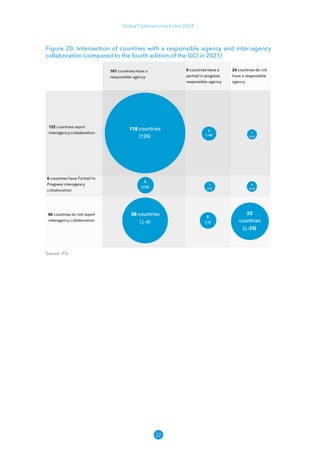
  • 13.
    4 Global Cybersecurity Index2024 The fifth edition of the GCI explores the current level of cybersecurity commitment among 193 Member States and the State of Palestine and the progress made since the last edition. The GCI report examines the implications of the results for governments and policy-makers as they navigate national and regional circumstances, as well as global developments, while planning cybersecurity measures and initiatives. One of the key changes made in this edition is a shift from ranking countries to using a five-level tier for viewing countries' cybersecurity commitments. This tier-based perspective allows for greater focus on the extent of advances in cybersecurity commitments and what this may mean for countries. Moreover, given the nature of the cybersecurity landscape, there is always room for growth, refinement and adaptation regardless of a country’s GCI score. While a score of 100/ 100 reflects a strong cybersecurity commitment, it does not mean further work is not required in terms of adopting appropriate cybersecurity measures in response to countries’ shifting operating environments and the evolving cybersecurity ecosystem. The GCI is used by countries, investment groups, development organizations, companies and other actors as an important tool in understanding cybersecurity commitments for several reasons, including: • Comprehensive evidence-based cybersecurity measures: the GCI takes a multi- dimensional approach to cybersecurity and relies on either publicly available data or verifiable evidence provided by countries. This approach leads to a trustworthy, more reliable view of cybersecurity commitments. As a result, countries have come to rely on the GCI to inform their national cybersecurity plans. • Informing national policies: countries can better understand their progress in key areas of cybersecurity and identify opportunities for further developments and innovations aligned with their national priorities and situational contexts. • Fostering research and development: the cybersecurity landscape’s dynamism necessitates proactive responses that include the identification or collection of data and the investigation and development of relevant cybersecurity artefacts, including new policies, laws and regulations, products and standards, among others. • Benchmarking: countries can assess their level of cybersecurity commitment and progress over time against global and regional averages. • Enhancing cooperation: with cooperation being a central part of good cybersecurity measures, opportunities for various levels of cooperation can be found and leveraged to support mutual strategic, operational and tactical cybersecurity responses. To help countries consider their cybersecurity commitments considering the above issues, this edition of the GCI aims to be the most robust yet. It features greater clarity and refinement in questions, greater efforts to ensure consistency in verification and validation, while maintaining high-quality analysis. However, the GCI should be used with consideration for its limitations as it does not measure the quality of actions; it only assesses whether they are in place, partially in place/in progress or do not exist. ITU, in collaboration with the GCI Expert Group, will continue actively to seek ways of improving the relevance, rigour and validity of the indicators relied on and to better communicate results.
  • 14.
    5 Global Cybersecurity Index2024 Global view Overall, the fifth edition of the GCI presents many countries working to improve their cybersecurity commitments through implementing relevant measures across the five pillars: legal, technical, organizational, capacity development and cooperation. To give a more accurate view of the clusters of performance within the GCI, the GCI has shifted to a tier-based presentation of country scores, using score ranges set by the GCI Expert Group. (For more information on the tiers and their development, see section Tiers.) Figure 2: GCI tier performance, by region (with counts) Source: ITU Almost every region has high and low performing countries. This edition of the GCI has placed 46 countries in Tier 1 (T1), the highest tier. If the tier-based system had been applied to the fourth edition of the GCI7 , 30 countries would have been placed in T1. Much of the movement to T1 comes from countries in Europe, Asia and the Pacific, the Arab States and Africa. These countries made significant improvements across the five GCI pillars since the last edition. Most countries (105) were placed in T3 and T4, representing the many countries that have been expanding digital services and bringing people online but still have work to do to ensure that cybersecurity becomes part of their meaningful connectivity objectives. Many of these countries also have a significant cyber-capacity gap: they are looking to enhance their cybersecurity but face resource limitations in terms of staffing, access to equipment and sustainable funding. When comparing GCI scores against general information and communication technology (ICT) development, it should be noted that the scores do not necessarily trend in line with the ITU ICT Development Index (IDI), which measures universal connectivity and meaningful connectivity. There are many countries that are active on cybersecurity but still have a lower level of overall ICT development, meaning that they are well positioned to create a safe and trustworthy cyberspace as people come online. Inversely, there are many countries which perform above the IDI median 7 https://​ www​ .itu​ .int/​ epublications/​ publication/​ D​ -STR​ -GCI​ .01​ -2021​ -HTM​ -E
  • 15.
    6 Global Cybersecurity Index2024 score but lack many cybersecurity measures. While these countries may have prioritized initial ICT development over integrating cybersecurity as they contend with limited resources, they risk a more insecure and less resilient cyberspace for people already online. Figure 3: ITU ICT Development Index (2024) as compared to the Global Cybersecurity Index Source: ITU Legal measures Legal measures tend to be countries’ strongest area of cybersecurity, but more still needs to be done. Figure 4: Legal measures, by region (one dot = one country) Source: ITU Legal measures continue to be countries’ strongest pillar on average. More countries have implemented legal measures designating and clarifying cybersecurity-related concerns, from
  • 16.
    7 Global Cybersecurity Index2024 data protection to illegal online activities. There is evidence of increased harmonization among these laws and regulations, at least in terms of nomenclatures, such as aligning with GDPR or international cybercrime treaties. More countries are also adding or updating measures framed with technology-neutral language, creating increased flexibility in interpretation, and alignment between online and offline offences or obligations. Efforts are still needed to ensure the specificity and application of laws and regulations. For example, some countries have ambiguities in breach notification requirements and their applications. Privacy laws and regulations are increasing, and increasingly needed. Figure 5: Number of countries with regulations on personal data protection, privacy protection and/or breach notification Source: ITU With 8 billion records being breached in 2023 across over 2 800 reported breaches,8 the average cost of a data breach has increased by 15 per cent over the past three years.9 These incidents can be costly: for small businesses in North America alone, the average breach is estimated to cost USD 3.3 million.10 Countries also risk users losing trust in ICTs due to these breaches. To provide recourse and rights for users as well as clear expectations for organizations handling data, countries have implemented regulations on personal data protection, privacy protection and/or breach notification. The previous edition of the GCI noted that GDPR and similar legislation had driven an increase in the number of countries which had adopted privacy legislation and breach notification requirements. While the trend has begun to level out, more countries have also worked to ensure comparability between privacy regimes. However, many countries can further clarify their privacy, data protection and breach notification laws and regulations. For example, not all countries have clearly defined what is the expected notification period for breaches, or the mandate of competent authorities to monitor and respond to breaches. In addition, these efforts can be complemented by capacity development, to ensure that relevant actors are well trained and aware of current cybersecurity threats. 8 https://​ www​ .itgovernance​ .co​ .uk/​ blog/​ list​ -of​ -data​ -breaches​ -and​ -cyber​ -attacks​ -in​ -2023 9 https://​ www​ .ibm​ .com/​ reports/​ data​ -breach 10 https://​ www​ .ibm​ .com/​ reports/​ data​ -breach
  • 17.
    8 Global Cybersecurity Index2024 Technical measures The data show a high disparity in implementation of technical measures as a means of supporting cybersecurity efforts at the national level. Figure 6: Technical measures, by region (one dot = one country) Source: ITU Together with legal measures, technology plays a pivotal role as a line of defence against malicious online actors. Robust cybersecurity mechanisms require a combination of competent individuals, well-documented processes and procedures, and technology. These elements prepare and empower countries to prevent, protect and respond effectively to cybersecurity incidents. Activities to detect, prevent, respond to and mitigate cyberthreats and incidents take place in a variety of structures such as computer incident response teams (CIRTs), computer security incident response teams (CSIRTs) and Computer Emergency Response Teams (CERTs). Security operation centres (SOCs) and information-sharing and analysis centres (ISACs) can also perform some or all of these activities. The relation between CIRTs and other agencies, particularly national cybersecurity coordination centres (NCCCs) or national cybersecurity authorities (NCAs), varies significantly between countries. While many countries have a national CIRT responsible for, inter alia, cyber-awareness activities, data collection and standards implementation, numerous NCCCs and NCAs have taken on these duties. CIRTs are not only domestic focal points on incident response, they also serve as important international nodes to connect transnational cybersecurity incident response efforts. Events like regional and international cyber -drills can be important in this regard, as national CIRTs can interact with peers and establish informal and formal connections. Moreover, participation in international fora, such as the Forum of Incident Response and Security Teams (FIRST), as well as regional fora, such as the Asia Pacific Computer Emergency Response Team (APCERT), the Pacific Cyber Security Operational Network (PaCSON), AfricaCERT, the European Union Cyber Security Agency (ENISA), the Organisation of Islamic Cooperation and the Organization of American States, is of paramount importance for CIRTs, as it provides a
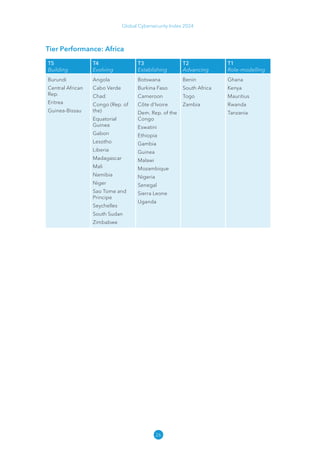
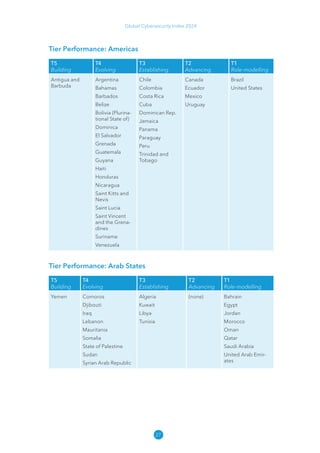
  • 18.
    9 Global Cybersecurity Index2024 platform for knowledge-sharing, collaboration and capacity development among cybersecurity professionals worldwide. Some 98 countries reported being part of FIRST or listed TF-CSIRT, with six in the process of joining, while 115 reported being part of regional CIRT organizations. Standards also figure among best practices for implementation under the technical pillar. As standards undergo rigorous evaluation by experts, they can provide clear roadmaps on how to structure cybersecurity initiatives, teams and technologies. With a proliferation of relevant standards and qualifications, 110 countries had some sort of framework in place for the implementation of cybersecurity standards. Standards can also help to bridge certain fundamental security gaps that still persist. Globally, between 14 per cent and 35 per cent of regions’ mail services are not using secure sockets layer/ transport layer security (SSL/TLS) protocols or ciphers, or are using insecure or weak ones.11 Between only 1 per cent and 4.6 per cent of mail services use the recommended implementation of SSL/TLS, with the rest using some sort of secure protocol. CIRTs are playing a key role in the cybersecurity ecosystem. Figure 7: Percentage of countries with a CIRT, by region/income group/development status Source: ITU CIRTs, CSIRTs, CERTs, SOCs, ISACs and other teams monitor threats and help to respond in the event of a cybersecurity incident. With an estimated 68 per cent of organizations suffering a cyberattack in 2023,12 CIRTs have become more important than ever. Based on current data, 139 countries have a national CIRT, while 55 do not have a CIRT or national CIRT in progress. 11 Dreamlab Technologies research data on SSL/TLS implementation for mail protocols (SMTPS, POP3S, IMAPS), November 2023. 12 https://​ www​ .netwrix​ .com/​ 2023​ _hybrid​ _security​ _trends​ _report​ .html
  • 19.
    10 Global Cybersecurity Index2024 Beyond their immediate function of incident response, CIRTs serve as a catalyst for broader engagement within organizations, fostering a culture of cybersecurity awareness and resilience. By conducting coordinated responses to cyber-incidents, CIRTs not only mitigate immediate risks but also lay the groundwork for proactive security measures and continuous improvement in organizational cybersecurity posture. For example, CIRTs can monitor and drive implementation of best practices, such as Domain Name System Security Extensions (DNSSEC) and security vulnerability disclosure. For example, to ensure that the domain name system (DNS) is safe and authenticates responses to domain name lookups, only 0.43 per cent of African providers have implemented DNSSEC, compared to a higher adoption rate of 13.13 per cent in the Commonwealth of Independent States (CIS) region. Regions with high numbers of Internet users, such as Asia and the Pacific, only have a 1.52 per cent adoption of DNSSEC, versus 11.28 per cent in Europe.13 CIRTs can also drive security disclosures. For example, websites can adopt security.txt,14 which includes key contact information in the event of a vulnerability discovery, as well as relevant policies and acknowledgements. Currently, this is underused globally, with less than 0.7 per cent of sites using this mechanism.15 The presence of a CIRT is most likely in high-income countries (globally, 89 per cent of such countries have a national CIRT), with upper-middle and lower-middle income countries less likely (70 per cent and 67 per cent, respectively). Some 46 per cent of lower-income countries had an operational national CIRT as of 2024. The ability to respond to an incident varies based on the country’s investment, local capacity and overall organization. To enhance preparedness and capabilities, CIRTs, as well as cybersecurity authorities, are increasingly running cybersecurity simulation exercises (cyber drills) among stakeholders. While 140 countries participated in regional cyber drills organized by ITU in 2023, running national cyber drills remains important to engage domestic stakeholders in hands-on exercises. National cyber drills can engage a wider set of domestic actors than regional or international cyber drills do and can be better tailored to the national context. 13 Dreamlab Technologies research data on global DNSSEC implementation, November 2023 14 RFC9116. Note that other mechanisms may be used by organizations. 15 Dreamlab Technologies research data on adoption of security.txt for vulnerability disclosure, January 2023.
  • 20.
    11 Global Cybersecurity Index2024 Figure 8: Percentage of countries with CIRTs and running cyber drills, by region/ income group Source: ITU Sectoral CIRTs are being implemented to address specific sectoral needs. Figure 9: Countries with a sectoral CIRT, by region/income group/development status Source: ITU While some countries choose to rely on national CIRTs to support all sectors, sectoral CIRTs also have an important role to play. Specific sectors of industry face different threats and have different incident-response needs depending on whether they are part of critical infrastructure and on their supply chain, etc. For example, 25.7 per cent of all cyberattacks in 2023 targeted
  • 21.
    12 Global Cybersecurity Index2024 the manufacturing sector; of those attacks, 45 per cent used malware and 17 per cent used ransomware. By contrast 18.2 per cent of all cyberattacks targeted the finance and insurance sectors, with 38 per cent of the attacks using malware and 25 per cent using ransomware.16 Sectoral CIRTs can be better positioned than national CIRTs to respond to a particular sector’s profile in terms of the technologies used, specific vulnerabilities and remediation needs in the event of an attack. As was the case in the fourth edition of the GCI, sectoral CIRTs are less common than national CIRTs. A number of countries participate in regional sectoral CIRTs, such as regional financial CIRTs, which allow for the leveraging of joint resources with other countries to tackle common issues. Not all countries have the capacity and resources to implement sectoral CIRTs. For them, as well as countries with sectoral CIRTs, prioritization is key to ensure that relevant sectors receive the tailored support needed to manage cybersecurity risks. Low-income countries and small island developing States in particular are less likely to have sectoral CIRTs, as many have focused their efforts on the process of developing, or enhancing, their national CIRT. As these countries’ ICT infrastructure continues to develop, addressing the cybersecurity needs of sectors can be met domestically or through regional CIRTs. Organizational measures Greater coordination and alignment are necessary for shaping more data-driven and inclusive national cybersecurity efforts. Figure 10: Organizational measures, by region (one dot = one country) Source: ITU Organizational measures are necessary for the proper implementation of a national cybersecurity posture and help to guide effective implementation. Many countries have made strides in ensuring that there are clear strategic objectives, with a comprehensive plan in implementation, delivery and measurement. Without a well-defined organizational network of partners, working together across industry, civil society and academia efforts in different sectors and industries 16 https://​ www​ .ibm​ .com/​ downloads/​ cas/​ L0GKXDWJ
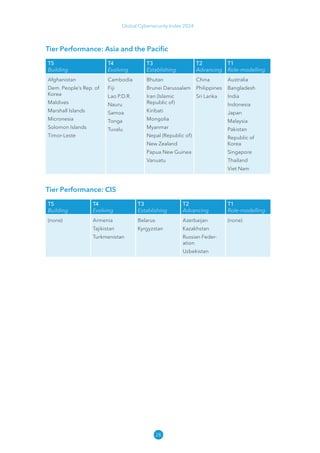
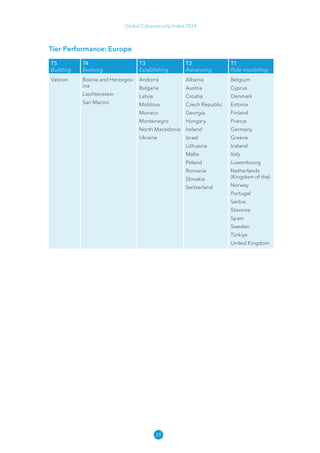
  • 22.
    13 Global Cybersecurity Index2024 become disparate and unconnected, thwarting efforts towards national harmonization in cybersecurity development. Nationalcybersecuritystrategiesareaprimarytooltowardsdevelopinganeffectiveorganizational framework. Beyond national cybersecurity strategies, countries have also been working to develop clear metrics and measures to understand how to track outputs of cybersecurity at the national level, and track in-depth inputs of cybersecurity such as audits. Translating these metrics to policy and implementation requires clear roles and responsibilities, as well as responsive organizational frameworks. More countries have a national cybersecurity strategy. National cybersecurity strategies (NCSs) have become an increasingly common tool for governments to organize around cybersecurity. As of 2024, 132 countries have an NCS, up from 107 in 2020. Much of this progress can be attributed to the Africa region, where nine countries have ushered in their first NCS. In addition, many countries have worked to revise and update their existing strategies. The breadth and depth of NCSs vary considerably. The second edition of the Guide to Developing a National Cybersecurity Strategy recommends several key areas for countries to consider incorporating into their NCSs. Only 85 out of the 132 countries with an NCS include the following measures: • cybersecurity of critical infrastructure; • lifecycle management principles; • stakeholder engagement; and • an action plan. The quality of each of these measures can also be addressed. Countries most often implement practices like stakeholder engagement and lifecycle management at the beginning or end of their NCS, instead of integrating these concepts through the NCS lifecycle. As a result, they miss out on valuable feedback related to the NCS, opportunities to ensure that domestic stakeholders are aligned on key priorities and the chance to adapt where necessary to help to ensure that the NCS remains relevant and effective over time. For example, some countries leveraged their action plans to ensure that best practices and recommended activities were implemented, and used lessons learned from the action plan to update and revise their NCS. Having an action plan does not guarantee that all best practices are prioritized or incorporated. For example, cybersecurity audits are a commonly accepted best practice to assess and analyse organizations’ cybersecurity and cyber-risks. Yet many countries do not have them in their action plan. As shown in Figure 11, while there are 64 countries that have an NCS with an action plan and have carried out national cybersecurity audits, 19 countries with an NCS and an action plan did not do national cybersecurity audits.
  • 23.
    14 Global Cybersecurity Index2024 Figure 11: Overlap of having an NCS with an action plan and conducting national cybersecurity audits Source: ITU Critical information infrastructure efforts often lack supporting legal measures.
  • 24.
    15 Global Cybersecurity Index2024 Figure 12: Percentage of countries which have measures in force related to critical information infrastructure, by region Source: ITU Critical information infrastructure (CII) is tackled in the GCI through questions under the legal, technical, organizational and capacity-development pillars. Developing a synergistic CII ecosystem involves addressing all these pillars in concert and ensuring that the measures reflect current threats and vulnerabilities. Considering the questions on CII under the legal and organizational pillars, the most common feature is to have an agency responsible for CII cybersecurity. With 54 per cent of countries globally having an agency, ministry or other entity bearing responsibility for CII cybersecurity, only 49 per cent of countries globally have such a framework in place, or being put in place, to implement cybersecurity standards in relation to CII. To ensure that professionals working on CII, such as those in the telecommunication or energy sectors, are well prepared to manage cybersecurity risks and respond to incidents, training is important. Some 90 per cent of countries with an NCS that addresses CII and with a responsible agency have conducted sector-specific training for cybersecurity professionals. Implementation of child online protection strategies and initiatives remains limited.
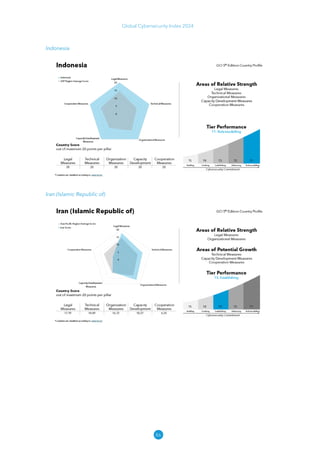
  • 25.
    16 Global Cybersecurity Index2024 Figure 13: Countries with national child online protection strategies, with associated current child online protection initiatives, by region Source: ITU It is estimated that every half a second, a child goes online for the first time.17 In addition, the 2023 Child Online Safety Index (COSI) found that nearly 70 per cent of children and adolescents aged 8-18 years old worldwide have experienced at least one cyber-risk incident in the past year.18 With this in mind, child online protection has long been a building block for collaboration between law enforcement, policy-makers, educators, parents, advocates and other stakeholders. To coordinate these stakeholders’ efforts, child online protection strategies with associated initiatives are needed. In this edition, 164 countries reported having legal measures on child online protection, compared to 130 countries in the previous edition of the GCI.19 These measures were sometimes part of other rules and regulations, such as on online crime or sexual exploitation. Despite most countries having laws and regulations on child online protection, only 94 countries globally have strategies with associated current child online protection initiatives in place. Activities included awareness-raising campaigns, training for educators, training for police, and reporting mechanisms, among others. These activities are targeting a wide range of ages, as not only young children are at risk. 17 https://​ www​ .unicef​ .org/​ protection/​ violence​ -against​ -children​ -online 18 https://​ www​ .dqinstitute​ .org/​ child​ -online​ -safety/​ 19 https://​ www​ .itu​ .int/​ epublications/​ publication/​ D​ -STR​ -GCI​ .01​ -2021​ -HTM​ -E
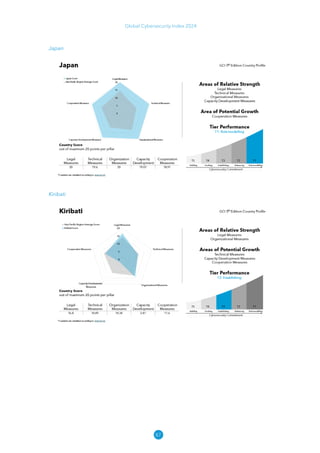
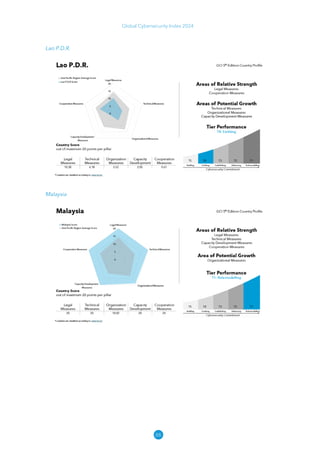
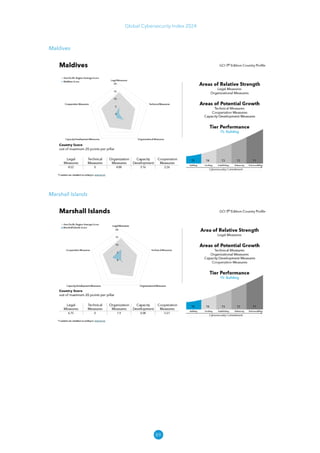
  • 26.
    17 Global Cybersecurity Index2024 Figure 14: Example child online protection initiative, offered by ITU with partners Source: ITU As children continue to come online, they need to be both protected and empowered in order to become active participants in creating a safe and trustworthy cyberspace. For this to happen, parents, teachers, policy-makers, law enforcement, public sector actors and other stakeholders need to be able to support children and youth in their digital journeys and need to understand the risks and challenges facing children online. Capacity-development measures Cybersecurity training and awareness efforts vary across regions against the backdrop of efforts to develop a strong industry. Figure 15: Capacity-development measures, by region (one dot = one country) Source: ITU
  • 27.
    18 Global Cybersecurity Index2024 Capacity development is key to building a robust cybersecurity ecosystem. Countries risk eroding progress that has been made in enhancing full and universal connectivity if they do not support cybersecurity skills and awareness-raising. Over 95 per cent of countries have some activity under the capacity-development pillar, with the most activities reported in the awareness-raising campaign category. Efforts to develop a domestic cybersecurity industry were also present in many countries, taking the form of incentive mechanisms, such as grants and scholarships, and organizations acting to promote the cybersecurity industry. Such initiatives can increase the level of cybersecurity in a country beyond the level that may have developed without government support. Research and development (RD) was also tracked as part of efforts to develop domestic capacity. Some 127 countries reported some form of RD, whether through the private sector, public sector or academia, with academia being the most common centre for RD. Countries are increasingly targeting specific demographics as part of cyber-awareness campaigns. Figure 16: Number of countries with targeted cyber-awareness campaigns beyond the general population, global Source: ITU Creating a culture of cybersecurity is an ongoing challenge for all countries. Awareness-raising campaigns, which seek to inform users and change behaviours, are developed or supported, with 152 countries reporting having a cybersecurity awareness-raising campaign aimed at the general public. In addition, 130 countries had some form of targeted cyber-awareness campaign carried out or planned, with 52 per cent of those targeting four or more different demographic groups. Some 20 countries reported upcoming, planned or in-progress targeted cybersecurity awareness campaigns. Targeted awareness-raising campaigns serve as vital tools in identifying specific threats and educating individuals and organizations about cybersecurity threats and best practices. The effectiveness of such campaigns, however, often hinges on the metrics used to track impact, particularly when the campaigns are primarily conducted on social media platforms. While social media offer extensive reach and engagement potential, relying solely on metrics such as likes, shares and comments may not accurately gauge the campaigns' true efficacy
  • 28.
    19 Global Cybersecurity Index2024 in raising awareness and changing behaviour. Instead, there is a growing recognition of the need for human-centred approaches that resonate with people's realities and address their specific concerns and challenges in navigating the digital landscape securely. This requires the tailoring of awareness-raising campaigns to diverse audiences, considering factors such as cultural context, digital literacy levels and socio-economic backgrounds. By adopting a more nuanced approach that prioritizes meaningful engagement and behavioural outcomes over superficial metrics, organizations can ensure that their awareness campaigns effectively empower individuals to protect themselves against cyberthreats and contribute to building a safer online environment for all. Many countries still lack cybersecurity skill development programmes across educational levels. Figure 17: Percentage of countries in region with curricula or training, at various stages of education, by region Source: ITU While the cybersecurity workforce grew 8.7 per cent from 2022 to 2023, the gap between the workers needed and the number available has also grown, by 12.6 per cent.20 To address this gap, countries are increasingly seeking to develop cybersecurity skills within their population by incorporating cybersecurity into school curricula at the primary (61 countries) and secondary (68 countries) levels, as well as in university-level courses and programmes (137 countries). Beyond formal schooling, countries are offering training programmes that target youth (85 countries) and cybersecurity professionals (123 countries). To ensure that a domestic cybersecurity industry can flourish, countries can work to ensure that the variety of educational opportunities available at different ages sufficiently prepare students and professionals for their careers. 20 https://​ media​ .isc2​ .org/​ -/​ media/​ Project/​ ISC2/​ Main/​ Media/​ documents/​ research/​ ISC2​ _Cybersecurity​ _Workforce​ _Study​ _2023​ .pdf​ ?rev​ =​ 28​ b46de71ce2​ 4e6ab7705f6e3da8637e
  • 29.
    20 Global Cybersecurity Index2024 Cooperation measures Operationalization and impact of agreements and frameworks remains a challenge. Figure 18: Cooperation measures, by region (one dot = one country) Source: ITU Cybersecurity is a complex, interconnected challenge necessitating a holistic, multistakeholder approach. Given its transnational character, effective response demands cooperation across public, private and government sectors. The past decades have been characterized by a variety of efforts to build international cooperation and coordination, including the Budapest Convention on Cybercrime, which entered into force in 2004; the African Union Convention on Cyber Security and Personal Data Protection (Malabo Convention), which came into effect in 2023; and the Commonwealth of Independent States Agreement on Cooperation in the Fight Against Crimes in the Field of Information Technologies (Dushanbe Agreement), which came into force in 2020. In addition, cybersecurity efforts have increased in the context of many other international, regional and sectoral agreements around cybersecurity. Still, many countries are not part of these agreements, whether due to conflict, lack of human resourcing or unclear benefits. On the domestic front, working with the private sector offers governments a chance to leverage private sector insights and expertise to improve cybersecurity. Almost 63 per cent of countries reported having inter-agency processes for cybersecurity within their governments. However, collaboration is less common with the private sector, with less than half of countries reported being part of public-private partnerships (PPPs) with domestic or foreign companies. The test of success of these agreements, partnerships and processes will be whether they move beyond paper and promote action. By fostering information sharing, capacity building and joint threat assessment, the international community can more effectively address the evolving cyberlandscape, including the increasing intersection of cybersecurity and artificial intelligence. Many countries are part of international cybersecurity agreements.
  • 30.
    21 Global Cybersecurity Index2024 Figure 19: Percentage of regions part of any bilateral or multilateral agreement that addresses information-sharing or capacity development, by region Source: ITU In verifying data for this edition of the GCI, many countries were found to be party to, or in the process of becoming party to, international agreements of which their focal points were not aware. Policing was a common area in the development of cybersecurity agreements, often done with organizations such as INTERPOL, or regional organizations. The types of agreements related to cybersecurity and their specifics varied significantly; some countries used general agreements to form a basis for further projects and implementation related to cybersecurity capacity development and information-sharing, while other countries developed more specific agreements from the start. Building domestic collaboration remains an area for improvement. Cybersecurity is more than simply a hardware or software issue: coordination between capable domestic actors is an important component for coherent commitments. Effective coordination requires the clear identification of roles and responsibilities: the second edition of the Guide to Developing a National Cybersecurity Strategy recommends that countries should ensure that all stakeholders, including various government agencies, ministries and entities, the private sector and civil society, involved in cybersecurity “should have a clear understanding of their respective roles and responsibilities.”21 In 2020, 136 countries had an agency designated as responsible for cybersecurity at the national level, 95 reported having inter-agency cooperation, and 92 were found to have both. By this edition of the GCI, 161 countries had an agency designated as responsible for cybersecurity at the national level, 122 reported having inter-agency cooperation, and 118 reported having both. This upward trend is encouraging as responsible agencies can help to drive more cohesive and collaborative approaches to cybersecurity. 21 https://​ ncsguide​ .org/​ the​ -guide/​ principles/​
  • 31.
    22 Global Cybersecurity Index2024 Figure 20: Intersection of countries with a responsible agency and inter-agency collaboration (compared to the fourth edition of the GCI in 2021) Source: ITU
  • 32.
    23 Global Cybersecurity Index2024 Conclusion There has been much improvement since the previous edition of the Global Cybersecurity Index (GCI). Still, more needs to be done to meet the evolving digital threat landscape. Cyberattacks are perceived to be the fifth most likely risk to present a material crisis on a global scale in 2024.22 Recent global technical outages demonstrated the world’s dependency on the digital infrastructure and the need for resilience. If countries want to benefit from the promise of information and communication technologies (ICTs), they need to think about cybersecurity. Across the GCI and its legal, technical, organizational, capacity-development and cooperation pillars, countries need to carefully prioritize high-impact activities in their efforts, rather than surface-level documents or campaigns. Countries may want to consider efforts to: • implement legal measures that can be clearly and fairly applied across all sectors; • foster cross-functional efforts that address more than just information technology; • maintain well-trained and responsive national institutions, including computer incident response teams; • engage a wide range of stakeholders across all cybersecurity initiatives; • develop and regularly update the national cybersecurity strategy with an implementable action plan; • implement effective child online protection measures; • address cybersecurity challenges faced by critical infrastructure; • run cyber-awareness campaigns that address relevant issues; • provide training opportunities for cybersecurity professionals, critical infrastructure actors and youth in order to build and enhance cybersecurity skills; • create incentive mechanisms to encourage cybersecurity capacity development and research and development; and • foster domestic and international cooperation and collaboration in information-sharing and capacity development. Cybersecurity is continuing to evolve. For countries working to achieve cybersecure meaningful connectivity, the GCI offers a clear picture of where they are and a roadmap of activities to make progress. Countries must, however, be willing to engage in the ongoing processes of enhancing cybersecurity and working to enhance the quality and impact of their activities. The GCI will continue to capture countries’ work and progress as they strive to meet future challenges and bring meaningful connectivity to all. 22 https://​ www​ .weforum​ .org/​ publications/​ global​ -risks​ -report​ -2024/​ digest/​
  • 33.
    24 Global Cybersecurity Index2024 Annexes Tier performance: Global Tier 1 – Role-modelling (score of 95–100) Australia Ghana Morocco Singapore Bahrain Greece Netherlands (Kingdom Slovenia Bangladesh Iceland of the) Spain Belgium India Norway Sweden Brazil Indonesia Oman Tanzania Cyprus Italy Pakistan Thailand Denmark Japan Portugal Türkiye Egypt Jordan Qatar United Arab Emirates Estonia Kenya Korea (Republic of) United Kingdom Finland Luxembourg Rwanda United States France Malaysia Saudi Arabia Viet Nam Germany Mauritius Serbia Tier 2 – Advancing (score of 85–95) Albania Ecuador Mexico Switzerland Austria Georgia Philippines Togo Azerbaijan Hungary Poland Uruguay Benin Ireland Romania Uzbekistan Canada Israel Russian Federation Zambia China Kazakhstan Slovakia Croatia Lithuania South Africa Czech Republic Malta Sri Lanka Tier 3 – Establishing (score of 55–85) Algeria Cuba Libya Papua New Guinea Andorra Dem. Rep. of the Congo Malawi Paraguay Belarus Dominican Rep. Moldova Peru Bhutan Eswatini Monaco Senegal Botswana Ethiopia Mongolia Sierra Leone Brunei Darussalam Gambia Montenegro Trinidad and Tobago Bulgaria Guinea Mozambique Tunisia Burkina Faso Iran (Islamic Republic of) Myanmar Uganda
  • 34.
    25 Global Cybersecurity Index2024 Cameroon Jamaica Nepal (Republic of) Ukraine Chile Kiribati New Zealand Vanuatu Colombia Kuwait Nigeria Costa Rica Kyrgyzstan North Macedonia Côte d'Ivoire Latvia Panama Tier 4 – Evolving (score of 20–55) Angola Dominica Liechtenstein Seychelles Argentina El Salvador Madagascar Somalia Armenia Equatorial Guinea Mali South Sudan Bahamas Fiji Mauritania State of Palestine Barbados Gabon Namibia Sudan Belize Grenada Nauru Suriname Bolivia (Plurinational Guatemala Nicaragua Syrian Arab Republic State of) Guyana Niger Tajikistan Bosnia and Herzegovina Haiti Saint Kitts and Nevis Tonga Cabo Verde Honduras Saint Lucia Turkmenistan Cambodia Iraq Saint Vincent and Tuvalu Chad Lao P.D.R. the Grenadines Venezuela Comoros Lebanon Samoa Zimbabwe Congo (Rep. of the) Lesotho San Marino Djibouti Liberia Sao Tome and Principe Tier 5 – Building (score of 0–20) Afghanistan Dem. People’s Rep. of Maldives Timor-Leste Antigua and Barbuda Korea Marshall Islands Vatican Burundi Eritrea Micronesia Yemen Central African Rep. Guinea-Bissau Solomon Islands (continued)
  • 35.
    26 Global Cybersecurity Index2024 Tier Performance: Africa T5 Building T4 Evolving T3 Establishing T2 Advancing T1 Role-modelling Burundi Central African Rep. Eritrea Guinea-Bissau Angola Cabo Verde Chad Congo (Rep. of the) Equatorial Guinea Gabon Lesotho Liberia Madagascar Mali Namibia Niger Sao Tome and Principe Seychelles South Sudan Zimbabwe Botswana Burkina Faso Cameroon Côte d'Ivoire Dem. Rep. of the Congo Eswatini Ethiopia Gambia Guinea Malawi Mozambique Nigeria Senegal Sierra Leone Uganda Benin South Africa Togo Zambia Ghana Kenya Mauritius Rwanda Tanzania
  • 36.
    27 Global Cybersecurity Index2024 Tier Performance: Americas T5 Building T4 Evolving T3 Establishing T2 Advancing T1 Role-modelling Antigua and Barbuda Argentina Bahamas Barbados Belize Bolivia (Plurina- tional State of) Dominica El Salvador Grenada Guatemala Guyana Haiti Honduras Nicaragua Saint Kitts and Nevis Saint Lucia Saint Vincent and the Grena- dines Suriname Venezuela Chile Colombia Costa Rica Cuba Dominican Rep. Jamaica Panama Paraguay Peru Trinidad and Tobago Canada Ecuador Mexico Uruguay Brazil United States Tier Performance: Arab States T5 Building T4 Evolving T3 Establishing T2 Advancing T1 Role-modelling Yemen Comoros Djibouti Iraq Lebanon Mauritania Somalia State of Palestine Sudan Syrian Arab Republic Algeria Kuwait Libya Tunisia (none) Bahrain Egypt Jordan Morocco Oman Qatar Saudi Arabia United Arab Emir- ates
  • 37.
    28 Global Cybersecurity Index2024 Tier Performance: Asia and the Pacific T5 Building T4 Evolving T3 Establishing T2 Advancing T1 Role-modelling Afghanistan Dem. People’s Rep. of Korea Maldives Marshall Islands Micronesia Solomon Islands Timor-Leste Cambodia Fiji Lao P.D.R. Nauru Samoa Tonga Tuvalu Bhutan Brunei Darussalam Iran (Islamic Republic of) Kiribati Mongolia Myanmar Nepal (Republic of) New Zealand Papua New Guinea Vanuatu China Philippines Sri Lanka Australia Bangladesh India Indonesia Japan Malaysia Pakistan Republic of Korea Singapore Thailand Viet Nam Tier Performance: CIS T5 Building T4 Evolving T3 Establishing T2 Advancing T1 Role-modelling (none) Armenia Tajikistan Turkmenistan Belarus Kyrgyzstan Azerbaijan Kazakhstan Russian Feder- ation Uzbekistan (none)
  • 38.
    29 Global Cybersecurity Index2024 Tier Performance: Europe T5 Building T4 Evolving T3 Establishing T2 Advancing T1 Role-modelling Vatican Bosnia and Herzegov- ina Liechtenstein San Marino Andorra Bulgaria Latvia Moldova Monaco Montenegro North Macedonia Ukraine Albania Austria Croatia Czech Republic Georgia Hungary Ireland Israel Lithuania Malta Poland Romania Slovakia Switzerland Belgium Cyprus Denmark Estonia Finland France Germany Greece Iceland Italy Luxembourg Netherlands (Kingdom of the) Norway Portugal Serbia Slovenia Spain Sweden Türkiye United Kingdom
  • 39.
    30 Global Cybersecurity Index2024 Country Profiles Africa Angola Benin
  • 40.
    31 Global Cybersecurity Index2024 Botswana Burkina Faso
  • 41.
    32 Global Cybersecurity Index2024 Burundi Cabo Verde
  • 42.
    33 Global Cybersecurity Index2024 Cameroon Central African Republic
  • 43.
    34 Global Cybersecurity Index2024 Chad Congo (Republic of the)
  • 44.
    35 Global Cybersecurity Index2024 Côte d'Ivoire Democratic Republic of the Congo
  • 45.
    36 Global Cybersecurity Index2024 Equatorial Guinea Eritrea
  • 46.
    37 Global Cybersecurity Index2024 Eswatini Ethiopia
  • 47.
  • 48.
  • 49.
    40 Global Cybersecurity Index2024 Guinea-Bissau Kenya
  • 50.
    41 Global Cybersecurity Index2024 Lesotho Liberia
  • 51.
    42 Global Cybersecurity Index2024 Madagascar Malawi
  • 52.
    43 Global Cybersecurity Index2024 Mali Mauritius
  • 53.
    44 Global Cybersecurity Index2024 Mozambique Namibia
  • 54.
  • 55.
    46 Global Cybersecurity Index2024 Rwanda Sao Tome and Principe
  • 56.
    47 Global Cybersecurity Index2024 Senegal Seychelles
  • 57.
    48 Global Cybersecurity Index2024 Sierra Leone South Africa
  • 58.
    49 Global Cybersecurity Index2024 South Sudan Tanzania
  • 59.
  • 60.
    51 Global Cybersecurity Index2024 Zambia Zimbabwe
  • 61.
    52 Global Cybersecurity Index2024 Americas Antigua and Barbuda Argentina
  • 62.
    53 Global Cybersecurity Index2024 Bahamas Barbados
  • 63.
    54 Global Cybersecurity Index2024 Belize Bolivia (Plurinational State of)
  • 64.
  • 65.
    56 Global Cybersecurity Index2024 Chile Colombia
  • 66.
    57 Global Cybersecurity Index2024 Costa Rica Cuba
  • 67.
    58 Global Cybersecurity Index2024 Dominica Dominican Republic
  • 68.
    59 Global Cybersecurity Index2024 Ecuador El Salvador
  • 69.
    60 Global Cybersecurity Index2024 Grenada Guatemala
  • 70.
  • 71.
    62 Global Cybersecurity Index2024 Honduras Jamaica
  • 72.
    63 Global Cybersecurity Index2024 Mexico Nicaragua
  • 73.
    64 Global Cybersecurity Index2024 Panama Paraguay
  • 74.
    65 Global Cybersecurity Index2024 Peru Saint Kitts and Nevis
  • 75.
    66 Global Cybersecurity Index2024 Saint Lucia Saint Vincent and the Grenadines
  • 76.
    67 Global Cybersecurity Index2024 Suriname Trinidad and Tobago
  • 77.
    68 Global Cybersecurity Index2024 United States Uruguay
  • 78.
  • 79.
    70 Global Cybersecurity Index2024 Arab States Algeria Bahrain
  • 80.
    71 Global Cybersecurity Index2024 Comoros Djibouti
  • 81.
  • 82.
  • 83.
  • 84.
    75 Global Cybersecurity Index2024 Mauritania Morocco
  • 85.
  • 86.
    77 Global Cybersecurity Index2024 Saudi Arabia Somalia
  • 87.
    78 Global Cybersecurity Index2024 State of Palestine Sudan
  • 88.
    79 Global Cybersecurity Index2024 Syrian Arab Republic Tunisia
  • 89.
    80 Global Cybersecurity Index2024 United Arab Emirates Yemen
  • 90.
    81 Global Cybersecurity Index2024 Asia and the Pacific Afghanistan Australia
  • 91.
    82 Global Cybersecurity Index2024 Bangladesh Bhutan
  • 92.
    83 Global Cybersecurity Index2024 Brunei Darussalam Cambodia
  • 93.
    84 Global Cybersecurity Index2024 China Democratic People’s Republic of Korea
  • 94.
  • 95.
    86 Global Cybersecurity Index2024 Indonesia Iran (Islamic Republic of)
  • 96.
    87 Global Cybersecurity Index2024 Japan Kiribati
  • 97.
    88 Global Cybersecurity Index2024 Lao P.D.R. Malaysia
  • 98.
    89 Global Cybersecurity Index2024 Maldives Marshall Islands
  • 99.
    90 Global Cybersecurity Index2024 Micronesia Mongolia
  • 100.
  • 101.
    92 Global Cybersecurity Index2024 Nepal (Republic of) New Zealand
  • 102.
    93 Global Cybersecurity Index2024 Pakistan Papua New Guinea
  • 103.
    94 Global Cybersecurity Index2024 Philippines Republic of Korea
  • 104.
    95 Global Cybersecurity Index2024 Samoa Singapore
  • 105.
    96 Global Cybersecurity Index2024 Solomon Islands Sri Lanka
  • 106.
    97 Global Cybersecurity Index2024 Thailand Timor-Leste
  • 107.
  • 108.
    99 Global Cybersecurity Index2024 Vanuatu Viet Nam
  • 109.
    100 Global Cybersecurity Index2024 Commonwealth of Independent States Armenia Azerbaijan
  • 110.
    101 Global Cybersecurity Index2024 Belarus Kazakhstan
  • 111.
    102 Global Cybersecurity Index2024 Kyrgyzstan Russian Federation
  • 112.
    103 Global Cybersecurity Index2024 Tajikistan Turkmenistan
  • 113.
  • 114.
    105 Global Cybersecurity Index2024 Europe Albania Andorra
  • 115.
    106 Global Cybersecurity Index2024 Austria Belgium
  • 116.
    107 Global Cybersecurity Index2024 Bosnia and Herzegovina Bulgaria
  • 117.
    108 Global Cybersecurity Index2024 Croatia Cyprus
  • 118.
    109 Global Cybersecurity Index2024 Czech Republic Denmark
  • 119.
    110 Global Cybersecurity Index2024 Estonia Finland
  • 120.
    111 Global Cybersecurity Index2024 France Georgia
  • 121.
    112 Global Cybersecurity Index2024 Germany Greece
  • 122.
    113 Global Cybersecurity Index2024 Hungary Iceland
  • 123.
    114 Global Cybersecurity Index2024 Ireland Israel
  • 124.
  • 125.
    116 Global Cybersecurity Index2024 Liechtenstein Lithuania
  • 126.
    117 Global Cybersecurity Index2024 Luxembourg Malta
  • 127.
    118 Global Cybersecurity Index2024 Moldova Monaco
  • 128.
    119 Global Cybersecurity Index2024 Montenegro Netherlands (Kingdom of the)
  • 129.
    120 Global Cybersecurity Index2024 Norway North Macedonia
  • 130.
    121 Global Cybersecurity Index2024 Poland Portugal
  • 131.
    122 Global Cybersecurity Index2024 Romania San Marino
  • 132.
    123 Global Cybersecurity Index2024 Serbia Slovakia
  • 133.
    124 Global Cybersecurity Index2024 Slovenia Spain
  • 134.
    125 Global Cybersecurity Index2024 Sweden Switzerland
  • 135.
    126 Global Cybersecurity Index2024 Türkiye Ukraine
  • 136.
    127 Global Cybersecurity Index2024 United Kingdom Vatican
  • 137.
    128 Global Cybersecurity Index2024 Methodology Scope and objectives The Global Cybersecurity Index (GCI) is formulated based on data provided by the ITU membership, including interested individuals, experts and industry stakeholders as contributing partners. The mandate for the GCI is derived from Resolution 130 (Rev. Bucharest, 2022) of the ITU Plenipotentiary Conference, on strengthening the role of ITU in building confidence and security in the use of information and communication technologies (ICTs), which, in particular, invites Member States to support ITU initiatives on cybersecurity, including the GCI, in order to promote government strategies and the sharing of information on efforts across industries and sectors. The fifth edition of the GCI continues this tradition and builds on earlier iterations. This is manifested in areas such as a refined methodology, increased participation and collaboration throughout the process, greater availability and accessibility of relevant inputs, developments in questionnaire designs, and the strengthening of evidence-based data collection and analysis. The GCI is a composite index of indicators that monitors the cybersecurity measures across the five work areas of the Global Cybersecurity Agenda (GCA). The GCI measures: • the type, level and extent of progress of cybersecurity activities within countries and relative to other countries; • the progress in cybersecurity commitment of countries from a global perspective; • the progress in cybersecurity activities from a regional perspective; • the cybersecurity divide (i.e. the difference between countries and regions in terms of their level of engagement in cybersecurity initiatives). Collectively, these measures represent a country’s level of cybersecurity commitments. The GCI seeks to foster a global culture of cybersecurity, so that ICTs incorporate cybersecurity in their development and adoption. Further, the GCI aims to assist countries in identifying areas of relative strength in managing cybersecurity and cybercrime, in addition to identifying areas of improvement, and to encourage them to take proactive measures towards further development and innovations in those areas. It is anticipated that this perspective will provide an opportunity to help raise the overall level of cybersecurity commitment worldwide, harmonize good practices and foster a culture of cybersecurity at the national, regional and global levels. To this end, the GCI shares practical insights that might serve as good practices, lessons and guidelines for countries with similar national environments. Structure Cybersecurity framework Cybersecurity is a multidisciplinary field, and its application involves all sectors, industries and stakeholders, both vertically and horizontally. To increase the development of national capabilities, efforts must be made by political, economic and social forces. This can be achieved through the efforts of good actors within the ecosystem, such as law enforcement, justice departments, educational institutions, ministries, private sector operators, ICT developers, public-private partnerships and intra-State cooperation.
  • 138.
    129 Global Cybersecurity Index2024 Figure 21: GCI evolution over time through a basic comparison of its different editions GCIv1 GCIv2 GCIv3 GCIv4 GCIv5 Publishing year 2015 2017 2019 2021 2024 Data collection years 2013-2014 2016 2017-2018 2020 2023-2024 Countries providing a focal point 105 136 155 169 172 Question type Open-ended Closed- ended, binary Closed- ended, binary Closed- ended, ternary Closed- ended, ternary Scoring method Benchmark scores Rank-based weighted scores Rank-based weighted scores Aggregate weighted average score Aggregate weighted average score Total indicators 17 25 25 20 20 Total questions 17 153 + 4 optional questions on child online protection 50 82 82 + 1 optional question on training for MSMEs The ITU framework for international multistakeholder cooperation in cybersecurity aims to build synergies between current and future initiatives. It focuses on the following five pillars, which shape the inherent building blocks of a national cybersecurity culture: • Legal measures • Technical measures • Organizational measures • Capacity-development measures • Cooperation measures
  • 139.
    130 Global Cybersecurity Index2024 Figure 22: Structure of the fifth edition of the GCI The five pillars are described in detail below and presented in a flowchart in Figure 22: Structure of the fifth edition of the GCI. Legal measures Measures based on the existence of legal frameworks dealing with cybersecurity and cybercrime. LegalmeasuresauthorizeaStatetosetupbasicresponsemechanismsthroughthecriminalization of certain acts, the investigation and prosecution of crimes, the imposition of sanctions for offences, non-compliance or breaches, and the establishment of institutional frameworks for managing or governing cybersecurity. A legislative framework sets the minimum foundation of behaviour on which further cybersecurity capabilities can be built. Fundamentally, the objective is to have sufficient legislation in place to harmonize practices at the regional/international level, strengthen cybersecurity systems, and simplify international frameworks to combat cybercrime. Technical measures Measures based on the existence of technical institutions, standards and frameworks dealing with cybersecurity and cybercrime.
  • 140.
    131 Global Cybersecurity Index2024 Efficient ICT development and use can only prosper in an environment of trust and security. Countries therefore need to have the technical capabilities and capacity to be able to effectively identify, detect, protect and respond to cyber-risks and cyberthreats, and to recover from attacks, as well as to promote information-sharing and evaluate and implement standards, good cybersecurity practices, and schemes for secure ICTs. Organizational measures Measures based on the existence of coordination institutions, policies and strategies for cybercrime management and cybersecurity development at the national level. Organizational measures include the identification of cybersecurity objectives and strategic plans, as well as the formal definition of institutional roles, responsibilities and accountabilities to ensure implementation and achievement of objectives. These measures are indispensable for endorsing the elaboration and implementation of an effective cybersecurity posture. Broad strategic targets and goals need to be set by the State, along with a comprehensive plan for implementation, delivery and measurement. National agencies must be present to implement the strategy and evaluate outcomes. Without a national strategy, governance model or supervisory body, efforts in different sectors become conflicted, undermining efforts to obtain an effective harmonization in cybersecurity development. Capacity-development measures Measures based on the existence of research and development, awareness raising, education and training programmes, certified professionals and public sector agencies fostering capacity development. Capacity development includes public awareness-raising campaigns, frameworks for certification and accreditation of cybersecurity professionals, professional training courses in cybersecurity, educational programmes or academic curricula, etc. This pillar is intrinsic to the first three pillars (legal, technical and organizational). Cybersecurity is most often tackled from a technological perspective even though there are numerous socio-economic and political implications. Human and institutional capacity development is essential to increasing awareness, knowledge and know-how across sectors for systematic and appropriate solutions and to promoting the development of qualified professionals. Cooperation measures Measures based on the existence of partnerships, cooperation frameworks and information sharing networks at the national, regional and global levels. Due to the unprecedented level of interconnection between states, cybersecurity is a shared responsibility and a transnational challenge. Greater cooperation can enable the development of much stronger cybersecurity capabilities, helping to mitigate cyber-risks and enable better investigation, apprehension and prosecution of malicious agents.
  • 141.
    132 Global Cybersecurity Index2024 Computational methodology The GCI is based on cybersecurity measures that a country can undertake as part of strengthening their cybersecurity commitment. The GCI questionnaire provides a value for the 20 indicators constructed through 83 questions, where one question is not scored. Countries can submit ternary responses (yes; partial/in progress; no) to all questions. To ensure accuracy, countries were required to support their answer through evidence, such as an active URL, pdf, photo or other document which can reasonably substantiate their response. Countries can also comment on their submission to contextualize their evidence. Weighting This fifth iteration of the GCI is on a scale of 0 to 100, with each pillar weighted at 20 points. As a composite weighted index, each indicator, sub-indicator and micro-indicator is assigned a weight given the relative importance to the indicator group. Weighting can have a significant impact on final scores, and different techniques will produce different overall scores. Weighting recommendations were done using a budget allocation method.23 Experts were asked to contribute weighting recommendations for pillars in which they had expertise. Experts were given a “budget” that they could distribute within an indicator group, thereby allocating a greater amount towards indicators that were assessed as more important within their relative group. The average weighting recommendations were adopted. These weightings were not shared with countries during the GCI data collection period so as not to influence country responses. The weighting does not account for the accuracy of the data. Aggregation Indicator groups were aggregated using weighted arithmetic averages. As a result, a country scoring poorly in one area could compensate by performing well elsewhere. However, for the purposes of clarity and comprehension, a linear approach was deemed more understandable. A country’s score aggregation for each pillar is expressed as follows: Where: GCIp = each pillar of the GCI qi = the score associated with a ternary response to a question within a pillar wi = weight assigned to a question within that pillar n = total number of questions in each pillar 20 is the value of each pillar weighting A country’s overall score is the summation of its scores in each pillar, GCIp . 23 https://​ www​ .oecd​ -ilibrary​ .org/​ docserver/​ 533411815016​ .pdf​ ?expires​ =​ 1722358078​ ​ id​ =​ id​ ​ accname​ =​ ocid195767​ ​ checksum​ =​ D0​ 6A2D569CE2B1DC75AAF3967AEBEFE3
  • 142.
    133 Global Cybersecurity Index2024 Tiers As noted in in the methodology section on the move to a tier-based model, this edition presents country performance in tiers, rather than ranks. Tiers represent several benefits over ranks, as differences between country scores can be very narrow and include an error range based on the accuracy of questionnaire responses, clarifications provided or country engagement. Each tier groups similarly scoring countries together, thereby presenting a group of similarly performing peers. The tier-based model has been set for overall scores. As the overall score is a weighted average of a country’s cybersecurity activities across all five pillars in the questionnaire, countries with similar scores may still have significant differences on a pillar, indicator, sub-indicator or micro- indicator level. Countries’ activities across pillars and indicators will vary in terms of quality and impact, factors not measured by the GCI. Countries may choose to develop their own rankings or tiers for the GCI; it must be noted, however, that alternative ways of comparing countries are not endorsed by ITU. The absolute-score method for tiers was applied based on the following, as described above in Table 1: • T1 95 ≤ x ≤ 100 • T2 85 ≤ x 95 • T3 55 ≤ x 85 • T4 20 ≤ x 55 • T5 0 ≤ x 20 The tiers may be interpreted as follows: • Tier 1 (T1) – Role-modelling represents countries that obtained an overall GCI score of at least 95/100 by demonstrating a strong cybersecurity commitment to coordinated and government-driven actions that encompass evaluating, establishing and implementing certain generally accepted cybersecurity measures across all five pillars or up to all indicators. • Tier 2 (T2) – Advancing represents countries that have obtained an overall score of at least 85/100 by demonstrating a strong cybersecurity commitment to coordinated and government-driven actions that encompass evaluating, establishing or implementing certain generally accepted cybersecurity measures in up to four pillars or a substantial number of indicators. • Tier 3 (T3) – Establishing represents countries that obtained an overall score of at least 55/100 by demonstrating a basic cybersecurity commitment to government-driven actions that encompass evaluating, establishing or implementing certain generally accepted cybersecurity measures across a moderate number of pillars or indicators. • Tier 4 (T4) – Evolving represents countries that obtained an overall score of at least 20/100 by demonstrating a basic cybersecurity commitment to government-driven actions that encompass evaluating, establishing or implementing certain generally accepted cybersecurity measures in at least one pillar, or several indicators and/or sub-indicators. • Tier 5 (T5) – Building represents countries that obtained an overall score below 20/100 by demonstrating a basic cybersecurity commitment to government-driven actions that encompass evaluating, establishing or implementing certain generally accepted cybersecurity measures in at least one indicator and/or sub-indicator. The tier-based model underscores that a cybersecurity commitment requires an adaptive stance in evaluating, establishing or implementing appropriate actions to effectively meet the demands
  • 143.
    134 Global Cybersecurity Index2024 of the rapidly evolving cybersecurity landscape. Under these circumstances, opportunities will exist for further coordinated actions, improvements and expansions of the breadth and depth of cybersecurity measures, irrespective of a country’s overall score. Key changes and limitations in the fifth edition of the GCI The GCI has been updated to ensure greater methodological consistency, clarify questions, reflect current weighting recommendations and better represent country performance, including in the following areas: • Questionnaire: based on a series of meetings of the GCI Expert Group, questions were clarified and refined. This included expanding on the rationales for each question. A final version of the questionnaire was approved by the ITU Telecommunication Development Bureau (BDT) management. • Weightings: as country scores are calculated using a weighted average, the GCI Expert Group was invited to update their weighting recommendations. Some 140 experts were tasked with providing weighting recommendations in pillars related to their areas of expertise. Based on their recommendations, an arithmetic average is taken and used in computation. • Tier model: the GCI Expert Group met and put forward several possible models for a tier-based GCI scoring model to replace the existing model, which ranked country performance. For the final selection of the model, BDT management relied on the preferred choice of the Expert Group. As cybersecurity continues to be an area of change and countries have innovated to find ways forward, the aim is for GCI questions not to be overly prescriptive and instead to capture the wide variety of tools, programmes, initiatives and other methods countries may use to accomplish various objectives; the trade-off with this less prescriptive approach, however, is that questions might contain ambiguities. The GCI verification team worked to ensure consistency through regular meetings and communications to ensure that verification decisions were coherent across countries. While feedback from countries was solicited where necessary, the risk of inconsistencies in the verifications remains, particularly in edge cases. Changes and limitations by pillar The changes made across the pillars include: Legal measures The legal pillar has been updated to better reflect: • legislation that is in force versus partial/in progress. Notable limitations that arose during verification include: • comparability of laws, regulations and decrees – what can be considered a law in one country may have lower enforceability or implementation in another country; and • applicability of laws and regulations – while some countries used targeted laws that directly addressed issues at hand, other countries reported using general laws and regulations and applying them to cybersecurity; for the latter, verification was challenging as it was not always clear whether the law or regulation could be applied in a cyber-context.
  • 144.
    135 Global Cybersecurity Index2024 Technical measures The technical pillar has been restructured to better reflect how computer incident response teams (CIRTs) operate, including by: • clarifying that CIRTs do not need to develop and deliver cyber awareness activities, but their involvement is desirable; and • better reflecting that national CIRTs often develop and deliver cyber drills, while sectoral CIRTs may only participate in them. Notable limitations that arose included: • the relevance of certain types of cybersecurity standards and certification; • the definition of a “framework” for implementation of standards; • roles and functions of information-sharing and analysis centres (ISACs); • key activities by CIRTs, particularly around cyber-awareness campaigns and threat notifications. Organizational measures The organizational pillar has been updated to better reflect: • the second edition of the Guide to Developing a National Cybersecurity Strategy; • regional CIRT membership; • the need for national CIRTs to assist in conducting cyber drills, while sectoral CIRTs need only to participate. Notable limitations that arose included: • the comparability of draft status of national cybersecurity strategies (NCSs); • perspectives on the life of NCSs; • depth and specificity of NCS action plans; • assessment of outcomes of the adoption of cybersecurity metrics; and • many countries’ national CIRTs participated in regional cyber drills but did not organize their own. Capacity-development measures The capacity-development pillar has been updated to better reflect: • diversity in the types of targeted cyber-awareness campaigns; • promotion and development of the cybersecurity private sector; and • cybersecurity certification schemes. Notable limitations that arose included: • evaluation of whether cybersecurity was substantially present in academic curricula in primary and secondary education; • lack of data about reach and impact of cyber-awareness campaigns; • measurement of the cybersecurity industry; and • evaluation of the presence of research and development in academia and the private and public sectors.
  • 145.
    136 Global Cybersecurity Index2024 Cooperation measures The cooperation pillar has been updated to better reflect: • types of bilateral and multilateral agreements that are to be considered; and • cooperation agreements that have been signed or ratified – the Budapest Convention had been previously counted under international mechanisms, which is no longer a question, and is now counted under multilateral agreements. Notable limitations that arose included: • definition of what an “agreement” should be (e.g. joint statement or signed treaty); and • assessment of the outcomes of cooperation agreements. The verification team has noted areas of ambiguity and has striven to apply any decisions as evenly as possible to country verifications. The GCI team will present their observations to the GCI Expert Group for feedback and input ahead of the next edition. Changes to the weighted average scoring As with the previous edition of the GCI, weightings have been updated as the relative importance and influence of questions and measures may have changed. These changes reflect the dynamism of the cybersecurity landscape and access to an enlarged and more diverse GCI Expert Group. In the future, it is reasonable to expect central tendency effects should there be a sufficiently large expert group. As always, individual countries may judge that their ideal weighting mix is different, based on their own priorities and dependencies. Move to a tier-based model Through Resolution 45 (Rev. Kigali, 2022) of the World Telecommunication Development Conference and Resolution 130 (Rev. Bucharest, 2022) of the Plenipotentiary Conference, BDT was instructed by Member States to move from a rank-based presentation of GCI scoring to a tier-based model. The GCI Expert Group developed and presented recommendations on how these tiers could be set. After six meetings, the group arrived at two proposals for BDT management. The final proposals are reflected in Table 1. Based on the recommendations of the GCI Expert Group, ITU management approved the use of the “absolute score” method.
  • 146.
    137 Global Cybersecurity Index2024 Table 1: Tier-based model Absolute score Quantiles Proposed Tiers T1 95 ≤ x ≤ 100 T2 85 ≤ x 95 T3 55 ≤ x 85 T4 20 ≤ x 55 T5 0 ≤ x 20 T1 Top 10% of countries T2 Next 20% T3 Next 25% T4 Next 25% T5 Next 20% Benefits • Country performance is primarily gauged against the country itself. • Tier score boundaries remain constant over time • Distribution of countries across tiers will remain constant over time. • Easier for countries to assess their progress against the rest of the world. Limitations As time goes on, more countries may end up in the top tier, limiting differen- tiation among them. Country absolute scores can improve, but their relative position can decrease, potentially demotivating further cybersecurity efforts. GCI report development process Figure 23: GCI report development process The GCI report is produced according to the following steps, as shown in Figure 23. 1) GCI survey refinement: a multistakeholder approach is undertaken in the review and refinement of the GCI indicators and questions. This includes considering the lessons and opportunities for refinements and improvements from previous iterations, feedback from the GCI Expert Group and an assessment of the evolving state of the cybersecurity field. The GCI questionnaire is thereafter reviewed, refined, finalized and approved for dissemination. 2) Invitation: a letter of invitation is sent to all ITU Member States and the State of Palestine, informing them of the initiative and requesting a focal point responsible for collecting all relevant data and for completing the online GCI questionnaire. During the online survey, the approved focal point is officially invited by BDT to answer the questionnaire.
  • 147.
    138 Global Cybersecurity Index2024 3) Data collection: primary and secondary data collection techniques are used to reflect the current state of cybersecurity commitment. • Primary data collection: the online questionnaire is used to collect responses from countries; • Secondary data collection: desk research, using publicly available data sources, is relied on in instances where a country did not respond to the questionnaire. Note: Should a country not provide a focal point for the GCI questionnaire, BDT shall attempt to establish contact with the institutional focal point in the ITU Global Directory. 1) Verification and validation A comprehensive iterative process of reviews, analyses, revisions and approvals is established throughout this phase and applied to both data collection methods. Once completed, consistency checks are conducted to help to ensure reliability. A. Online questionnaire: • ITU identifies any missing responses, supporting documents, links, etc. • The focal point improves the accuracy of responses where necessary, including by offering relevant evidence. • Validated questionnaires are used for analysis and scoring. B. Desk research questionnaire: • A draft questionnaire is sent to focal points for review. • Focal points improve accuracy and return the draft questionnaire. • BDT reviews responses against the evidence provided and identifies any missing responses, supporting documents, links, etc. • The corrected draft questionnaire is sent to each focal point for final approval. • The validated questionnaire is used for analysis and scoring. 2) Scoring and analysis • Scores associated with ternary responses to the validated questionnaire for each country are collated for analysis. • Scoring methodology is applied to assign each country to the established tiers. • Identification of findings from the GCI that provide insights into regional and world trends. 3) Report development and publication • A GCI report is drafted, reviewed and approved for publication. • The GCI report becomes available to countries, stakeholders and members of the public. Areas for further research As part of the intrinsic review and analysis, ITU has identified areas for development and improvements. This includes refinements of questions to improve clarity and reduce ambiguity, as well as to enhance validity and reliability of measures. Several areas were identified for further research, including: • What are effective approaches for managing and conducting national cybersecurity audits?
  • 148.
    139 Global Cybersecurity Index2024 • What are the most effective strategies for conducting cybersecurity awareness activities? Do these strategies differ based on the target group? • How can the effectiveness of cyber development activities be evaluated in the short term? • How can countries improve utilization of bilateral and multilateral cybersecurity agreements? • What are the barriers to establishing and adopting effective cooperation measures, such as bilateral and multilateral cybersecurity agreements? • How effective are government incentives at developing the cybersecurity industry? • How effective are government incentives at driving cybersecurity research and development? • Based on a country’s level of digitalization, what activities are needed from CIRTs? The GCI team hopes that researchers continue to explore these and other cybersecurity-related areas.
  • 150.
    Office of theDirector International Telecommunication Union (ITU) Telecommunication Development Bureau (BDT) Place des Nations CH-1211 Geneva 20 Switzerland Office of Deputy Director and Regional Presence Field Operations Coordination Department (DDR) Place des Nations CH-1211 Geneva 20 Switzerland Email: bdtdirector@itu.int Email: bdtdeputydir@itu.int Tel.: +41 22 730 5035/5435 Tel.: +41 22 730 5131 Fax: +41 22 730 5484 Fax: +41 22 730 5484 Digital Networks and Society (DNS) Digital Knowledge Hub Department (DKH) Partnerships for Digital Development Department (PDD) Email: bdt-dns@itu.int Email: bdt-dkh@itu.int Email: bdt-pdd@itu.int Tel.: +41 22 730 5421 Tel.: +41 22 730 5900 Tel.: +41 22 730 5447 Fax: +41 22 730 5484 Fax: +41 22 730 5484 Fax: +41 22 730 5484 Africa Ethiopia Cameroon Senegal Zimbabwe International Telecommunication Union (ITU) Regional Office Gambia Road Leghar Ethio Telecom Bldg. 3rd floor P.O. Box 60 005 Addis Ababa Ethiopia Union internationale des télécommunications (UIT) Bureau de zone Immeuble CAMPOST, 3e étage Boulevard du 20 mai Boîte postale 11017 Yaoundé Cameroon Union internationale des télécommunications (UIT) Bureau de zone 8, Route du Méridien Président Immeuble Rokhaya, 3e étage Boîte postale 29471 Dakar - Yoff Senegal International Telecommunication Union (ITU) Area Office USAF POTRAZ Building 877 Endeavour Crescent Mount Pleasant Business Park Harare Zimbabwe Email: itu-ro-africa@itu.int Email: itu-yaounde@itu.int Email: itu-dakar@itu.int Email: itu-harare@itu.int Tel.: +251 11 551 4977 Tel.: + 237 22 22 9292 Tel.: +221 33 859 7010 Tel.: +263 242 369015 Tel.: +251 11 551 4855 Tel.: + 237 22 22 9291 Tel.: +221 33 859 7021 Tel.: +263 242 369016 Tel.: +251 11 551 8328 Fax: + 237 22 22 9297 Fax: +221 33 868 6386 Fax: +251 11 551 7299 Americas Brazil Barbados Chile Honduras União Internacional de Telecomunicações (UIT) Escritório Regional SAUS Quadra 6 Ed. Luis Eduardo Magalhães, Bloco “E”, 10º andar, Ala Sul (Anatel) CEP 70070-940 Brasilia - DF Brazil International Telecommunication Union (ITU) Area Office United Nations House Marine Gardens Hastings, Christ Church P.O. Box 1047 Bridgetown Barbados Unión Internacional de Telecomunicaciones (UIT) Oficina de Representación de Área Merced 753, Piso 4 Santiago de Chile Chile Unión Internacional de Telecomunicaciones (UIT) Oficina de Representación de Área Colonia Altos de Miramontes Calle principal, Edificio No. 1583 Frente a Santos y Cía Apartado Postal 976 Tegucigalpa Honduras Email: itubrasilia@itu.int Email: itubridgetown@itu.int Email: itusantiago@itu.int Email: itutegucigalpa@itu.int Tel.: +55 61 2312 2730-1 Tel.: +1 246 431 0343 Tel.: +56 2 632 6134/6147 Tel.: +504 2235 5470 Tel.: +55 61 2312 2733-5 Fax: +1 246 437 7403 Fax: +56 2 632 6154 Fax: +504 2235 5471 Fax: +55 61 2312 2738 Arab States Asia-Pacific Egypt Thailand Indonesia India International Telecommunication Union (ITU) Regional Office Smart Village, Building B 147, 3rd floor Km 28 Cairo Alexandria Desert Road Giza Governorate Cairo Egypt International Telecommunication Union (ITU) Regional Office 4th floor NBTC Region 1 Building 101 Chaengwattana Road Laksi, Bangkok 10210, Thailand International Telecommunication Union (ITU) Area Office Gedung Sapta Pesona 13th floor JI. Merdeka Barat No. 17 Jakarta 10110 Indonesia International Telecommunication Union (ITU) Area Office and Innovation Centre C-DOT Campus Mandi Road Chhatarpur, Mehrauli New Delhi 110030 India Email: itu-ro-arabstates@itu.int Email: itu-ro-asiapacific@itu.int Email: bdt-ao-jakarta@itu.int Email: Tel.: +202 3537 1777 Tel.: +66 2 574 9326 – 8 Tel.: +62 21 380 2322 Area Office: itu-ao-southasia@itu.int Fax: +202 3537 1888 +66 2 575 0055 Innovation Centre: itu-ic-southasia@itu.int Website: ITUInnovationCentrein NewDelhi,India CIS Europe Russian Federation Switzerland International Telecommunication Union (ITU) Regional Office 4, Building 1 Sergiy Radonezhsky Str. Moscow 105120 Russian Federation International Telecommunication Union (ITU) Office for Europe Place des Nations CH-1211 Geneva 20 Switzerland Email: itu-ro-cis@itu.int Email: eurregion@itu.int Tel.: +7 495 926 6070 Tel.: +41 22 730 5467 Fax: +41 22 730 5484
  • 151.
    International Telecommunication Union TelecommunicationDevelopment Bureau Place des Nations CH-1211 Geneva 20 Switzerland Published in Switzerland Geneva, 2024 Photo credit: Adobe Stock ISBN: 978-92-61-38751-8 9 7 8 9 2 6 1 3 8 7 5 1 8