Internet Attack Trend  and Defense SC Leung Senior Consultant
Agenda Trend of the information security threat How we become victims … Most economical way to mitigate risks
Security Threat Landscape
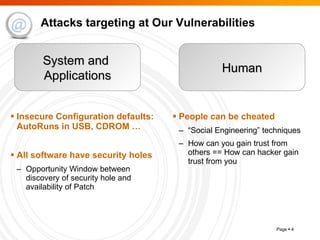
Attacks targeting at Our Vulnerabilities Insecure Configuration defaults: AutoRuns in USB, CDROM … All software have security holes Opportunity Window between discovery of security hole and availability of Patch People can be cheated “ Social Engineering” techniques How can you gain trust from others == How can hacker gain trust from you System and  Applications Human
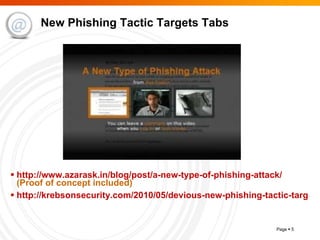
New Phishing Tactic Targets Tabs http:// www.azarask.in /blog/post/a-new-type-of-phishing-attack/   (Proof of concept included) http://krebsonsecurity.com/2010/05/devious-new-phishing-tactic-targets-tabs/
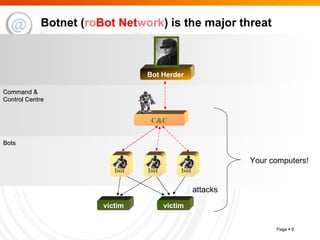
Botnet ( ro Bot Net work ) ‏  is the major threat Bot Herder C&C Command &  Control Centre Bots attacks Your computers! victim victim bot bot bot
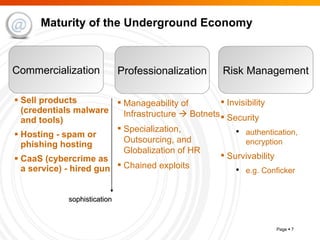
Maturity of the Underground Economy Sell products (credentials malware and tools)  Hosting - spam or phishing hosting CaaS (cybercrime as a service) - hired gun Commercialization Professionalization Manageability of Infrastructure    Botnets Specialization, Outsourcing, and Globalization of HR Chained exploits Risk Management Invisibility Security authentication, encryption Survivability e.g. Conficker sophistication
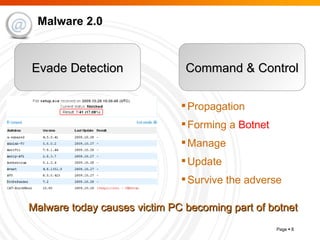
Malware 2.0 Evade Detection Command & Control Propagation Forming a  Botnet Manage Update Survive the adverse Malware today causes victim PC becoming part of botnet
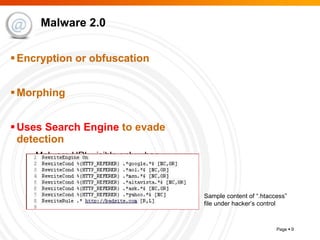
Malware 2.0 Encryption or obfuscation Morphing Uses Search Engine  to evade detection Malware URL visible only when referred by search engine Done by configuring “.htaccess” file of web server Sample content of “.htaccess” file under hacker’s control
Malware Propagation channels Executables Document  Malware Website
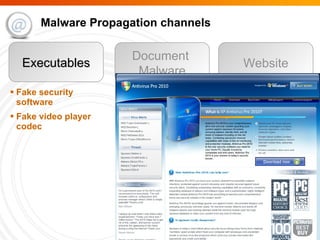
Malware Propagation channels Fake security software Fake video player codec Executables Document  Malware Website
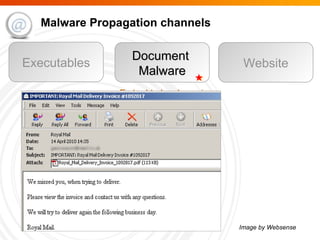
Malware Propagation channels Executables Document  Malware Embedded malware in PDF or Office files Zeus botnet served PDF malware (Apr-2010) Website Image by Websense
Malware Propagation channels Executables Document  Malware Website Legitimate and trusted websites compromised Used to redirect user to malicious websites (via injected invisible iframes) Most significant Web admin incapable to detect and mitigate the risks
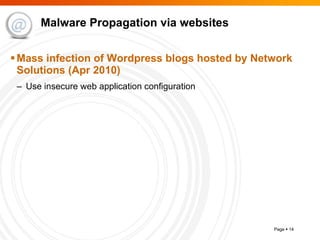
Malware Propagation via websites Mass infection of Wordpress blogs hosted by Network Solutions (Apr 2010) Use insecure web application configuration
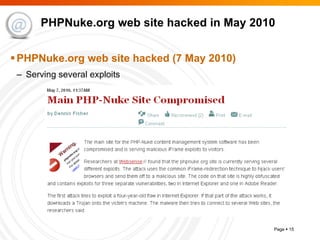
PHPNuke.org web site hacked in May 2010 PHPNuke.org web site hacked (7 May 2010) Serving several exploits
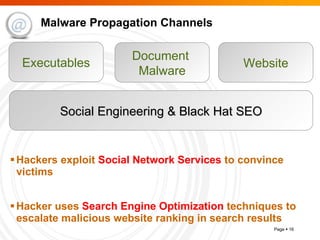
Malware Propagation Channels Hackers exploit  Social Network Services  to convince victims Hacker uses  Search Engine Optimization  techniques to escalate malicious website ranking in search results Executables Document  Malware Website Social Engineering & Black Hat SEO
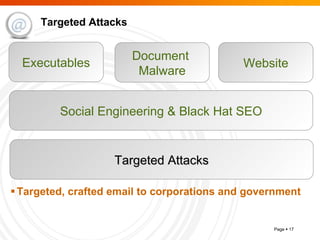
Targeted Attacks Targeted, crafted email to corporations and government Executables Document  Malware Website Social Engineering & Black Hat SEO Targeted Attacks
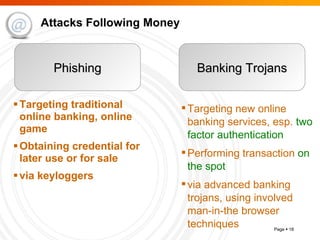
Attacks Following Money Targeting traditional online banking, online game Obtaining credential for later use or for sale via keyloggers Phishing Banking Trojans Targeting new online banking services, esp.   two factor authentication Performing transaction   on the spot via advanced banking trojans, using involved man-in-the browser techniques
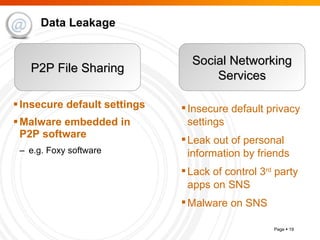
Data Leakage Insecure default settings Malware embedded in P2P software e.g. Foxy software P2P File Sharing Social Networking Services Insecure default privacy settings Leak out of personal information by friends Lack of control 3 rd  party apps on SNS Malware on SNS
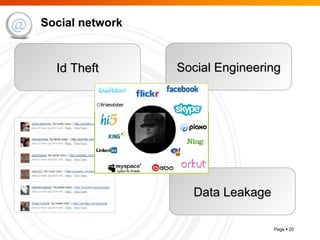
Social network Id Theft Data Leakage Social Engineering
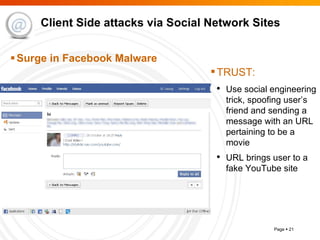
Client Side attacks via Social Network Sites Surge in Facebook Malware TRUST: Use social engineering trick, spoofing user’s friend and sending a message with an URL pertaining to be a movie URL brings user to a fake YouTube site
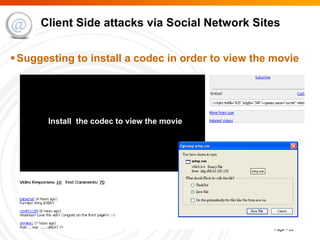
Client Side attacks via Social Network Sites Suggesting to install a codec in order to view the movie Install  the codec to view the movie
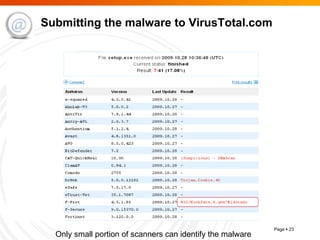
Submitting the malware to VirusTotal.com Only small portion of scanners can identify the malware
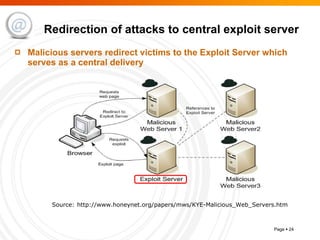
Malicious servers redirect victims to the Exploit Server which serves as a central delivery Redirection of attacks to central exploit server Source:   http://www.honeynet.org/papers/mws/KYE-Malicious_Web_Servers.htm
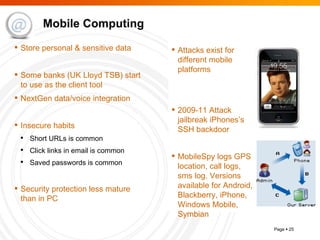
Mobile Computing Attacks exist for different mobile platforms 2009-11 Attack jailbreak iPhones’s SSH backdoor MobileSpy logs GPS location, call logs, sms log. Versions available for Android, Blackberry, iPhone, Windows Mobile, Symbian Store personal & sensitive data Some banks (UK Lloyd TSB) start to use as the client tool NextGen data/voice integration Insecure habits Short URLs is common Click links in email is common Saved passwords is common Security protection less mature than in PC
Targeted Attack continues Chained exploit Advanced Persist Threats Governments, critical infrastructure, private companies
Consequence of Attack
Consequences of Security Exposure Machines fall into control by Hackers Theft of Credentials    financial loss Hacker launch local attacks to the whole network Bandwidth and Performance downgrade Legal liability    liable for hacking activities within your premise
Mitigation Strategies Revisited
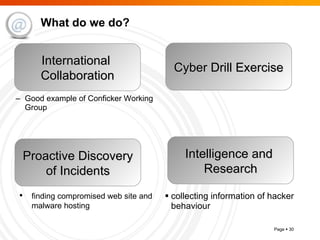
What do we do? Good example of Conficker Working Group collecting information of hacker behaviour International  Collaboration Cyber Drill Exercise Proactive Discovery of Incidents Intelligence and  Research finding compromised web site and malware hosting
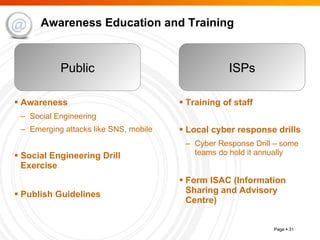
Awareness Education and Training Awareness Social Engineering Emerging attacks like SNS, mobile Social Engineering Drill Exercise Publish Guidelines Training of staff Local cyber response drills Cyber Response Drill – some teams do hold it annually Form ISAC (Information Sharing and Advisory Centre) Public ISPs
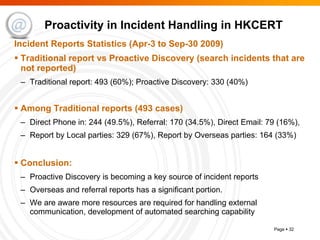
Proactivity in Incident Handling in HKCERT Incident Reports Statistics (Apr-3 to Sep-30 2009) Traditional report vs Proactive Discovery (search incidents that are not reported) Traditional report: 493 (60%); Proactive Discovery: 330 (40%) Among Traditional reports (493 cases)  Direct Phone in: 244 (49.5%), Referral: 170 (34.5%), Direct Email: 79 (16%),  Report by Local parties: 329 (67%), Report by Overseas parties: 164 (33%) Conclusion: Proactive Discovery is becoming a key source of incident reports Overseas and referral reports has a significant portion. We are aware more resources are required for handling external communication, development of automated searching capability
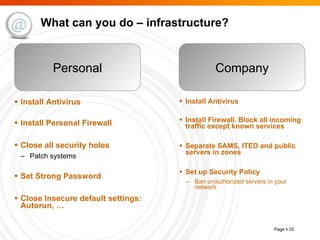
What can you do – infrastructure? Install Antivirus Install Personal Firewall Close all security holes Patch systems Set Strong Password Close Insecure default settings: Autorun, … Install Antivirus Install Firewall. Block all incoming traffic except known services Separate SAMS, ITED and public servers in zones Set up Security Policy Ban unauthorized servers in your network Personal Company
HKCERT Guidelines "Autorun virus" Removal Procedure SQL Injection Defense Guideline Data Protection Guideline Guideline for Safety Using Wireless LA SME Information Security Guideline Guideline for Prevention of Spyware and other Potentially Unwanted Software    http:// www.hkcert.org/english/sguide_faq/home.html
Point of Contact Phone :   +852   8105 6060 Fax :   +852 8105 9760 Email :   hkcert @ hkcert.org URL :   http://www.hkcert.org/

3 Hkcert Trend

  • 1.
    Internet Attack Trend and Defense SC Leung Senior Consultant
  • 2.
    Agenda Trend ofthe information security threat How we become victims … Most economical way to mitigate risks
  • 3.
  • 4.
    Attacks targeting atOur Vulnerabilities Insecure Configuration defaults: AutoRuns in USB, CDROM … All software have security holes Opportunity Window between discovery of security hole and availability of Patch People can be cheated “ Social Engineering” techniques How can you gain trust from others == How can hacker gain trust from you System and Applications Human
  • 5.
    New Phishing TacticTargets Tabs http:// www.azarask.in /blog/post/a-new-type-of-phishing-attack/   (Proof of concept included) http://krebsonsecurity.com/2010/05/devious-new-phishing-tactic-targets-tabs/
  • 6.
    Botnet ( roBot Net work ) ‏ is the major threat Bot Herder C&C Command & Control Centre Bots attacks Your computers! victim victim bot bot bot
  • 7.
    Maturity of theUnderground Economy Sell products (credentials malware and tools) Hosting - spam or phishing hosting CaaS (cybercrime as a service) - hired gun Commercialization Professionalization Manageability of Infrastructure  Botnets Specialization, Outsourcing, and Globalization of HR Chained exploits Risk Management Invisibility Security authentication, encryption Survivability e.g. Conficker sophistication
  • 8.
    Malware 2.0 EvadeDetection Command & Control Propagation Forming a Botnet Manage Update Survive the adverse Malware today causes victim PC becoming part of botnet
  • 9.
    Malware 2.0 Encryptionor obfuscation Morphing Uses Search Engine to evade detection Malware URL visible only when referred by search engine Done by configuring “.htaccess” file of web server Sample content of “.htaccess” file under hacker’s control
  • 10.
    Malware Propagation channelsExecutables Document Malware Website
  • 11.
    Malware Propagation channelsFake security software Fake video player codec Executables Document Malware Website
  • 12.
    Malware Propagation channelsExecutables Document Malware Embedded malware in PDF or Office files Zeus botnet served PDF malware (Apr-2010) Website Image by Websense
  • 13.
    Malware Propagation channelsExecutables Document Malware Website Legitimate and trusted websites compromised Used to redirect user to malicious websites (via injected invisible iframes) Most significant Web admin incapable to detect and mitigate the risks
  • 14.
    Malware Propagation viawebsites Mass infection of Wordpress blogs hosted by Network Solutions (Apr 2010) Use insecure web application configuration
  • 15.
    PHPNuke.org web sitehacked in May 2010 PHPNuke.org web site hacked (7 May 2010) Serving several exploits
  • 16.
    Malware Propagation ChannelsHackers exploit Social Network Services to convince victims Hacker uses Search Engine Optimization techniques to escalate malicious website ranking in search results Executables Document Malware Website Social Engineering & Black Hat SEO
  • 17.
    Targeted Attacks Targeted,crafted email to corporations and government Executables Document Malware Website Social Engineering & Black Hat SEO Targeted Attacks
  • 18.
    Attacks Following MoneyTargeting traditional online banking, online game Obtaining credential for later use or for sale via keyloggers Phishing Banking Trojans Targeting new online banking services, esp. two factor authentication Performing transaction on the spot via advanced banking trojans, using involved man-in-the browser techniques
  • 19.
    Data Leakage Insecuredefault settings Malware embedded in P2P software e.g. Foxy software P2P File Sharing Social Networking Services Insecure default privacy settings Leak out of personal information by friends Lack of control 3 rd party apps on SNS Malware on SNS
  • 20.
    Social network IdTheft Data Leakage Social Engineering
  • 21.
    Client Side attacksvia Social Network Sites Surge in Facebook Malware TRUST: Use social engineering trick, spoofing user’s friend and sending a message with an URL pertaining to be a movie URL brings user to a fake YouTube site
  • 22.
    Client Side attacksvia Social Network Sites Suggesting to install a codec in order to view the movie Install the codec to view the movie
  • 23.
    Submitting the malwareto VirusTotal.com Only small portion of scanners can identify the malware
  • 24.
    Malicious servers redirectvictims to the Exploit Server which serves as a central delivery Redirection of attacks to central exploit server Source: http://www.honeynet.org/papers/mws/KYE-Malicious_Web_Servers.htm
  • 25.
    Mobile Computing Attacksexist for different mobile platforms 2009-11 Attack jailbreak iPhones’s SSH backdoor MobileSpy logs GPS location, call logs, sms log. Versions available for Android, Blackberry, iPhone, Windows Mobile, Symbian Store personal & sensitive data Some banks (UK Lloyd TSB) start to use as the client tool NextGen data/voice integration Insecure habits Short URLs is common Click links in email is common Saved passwords is common Security protection less mature than in PC
  • 26.
    Targeted Attack continuesChained exploit Advanced Persist Threats Governments, critical infrastructure, private companies
  • 27.
  • 28.
    Consequences of SecurityExposure Machines fall into control by Hackers Theft of Credentials  financial loss Hacker launch local attacks to the whole network Bandwidth and Performance downgrade Legal liability  liable for hacking activities within your premise
  • 29.
  • 30.
    What do wedo? Good example of Conficker Working Group collecting information of hacker behaviour International Collaboration Cyber Drill Exercise Proactive Discovery of Incidents Intelligence and Research finding compromised web site and malware hosting
  • 31.
    Awareness Education andTraining Awareness Social Engineering Emerging attacks like SNS, mobile Social Engineering Drill Exercise Publish Guidelines Training of staff Local cyber response drills Cyber Response Drill – some teams do hold it annually Form ISAC (Information Sharing and Advisory Centre) Public ISPs
  • 32.
    Proactivity in IncidentHandling in HKCERT Incident Reports Statistics (Apr-3 to Sep-30 2009) Traditional report vs Proactive Discovery (search incidents that are not reported) Traditional report: 493 (60%); Proactive Discovery: 330 (40%) Among Traditional reports (493 cases) Direct Phone in: 244 (49.5%), Referral: 170 (34.5%), Direct Email: 79 (16%), Report by Local parties: 329 (67%), Report by Overseas parties: 164 (33%) Conclusion: Proactive Discovery is becoming a key source of incident reports Overseas and referral reports has a significant portion. We are aware more resources are required for handling external communication, development of automated searching capability
  • 33.
    What can youdo – infrastructure? Install Antivirus Install Personal Firewall Close all security holes Patch systems Set Strong Password Close Insecure default settings: Autorun, … Install Antivirus Install Firewall. Block all incoming traffic except known services Separate SAMS, ITED and public servers in zones Set up Security Policy Ban unauthorized servers in your network Personal Company
  • 34.
    HKCERT Guidelines "Autorunvirus" Removal Procedure SQL Injection Defense Guideline Data Protection Guideline Guideline for Safety Using Wireless LA SME Information Security Guideline Guideline for Prevention of Spyware and other Potentially Unwanted Software  http:// www.hkcert.org/english/sguide_faq/home.html
  • 35.
    Point of ContactPhone : +852 8105 6060 Fax : +852 8105 9760 Email : hkcert @ hkcert.org URL : http://www.hkcert.org/