



04/2015
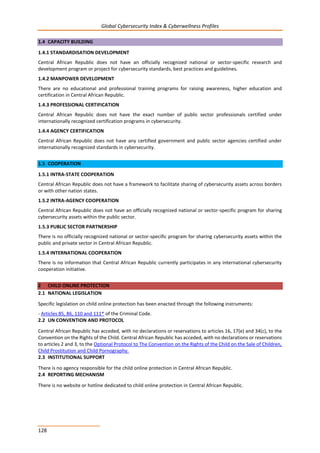
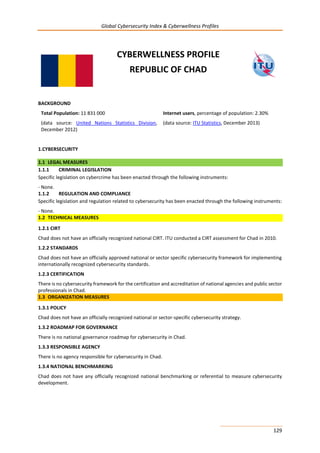
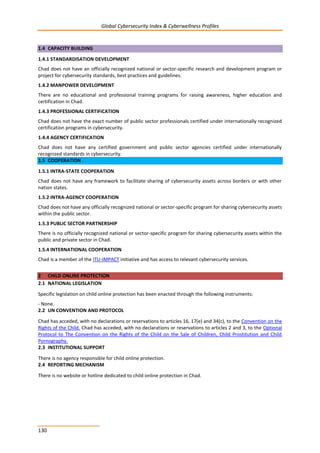
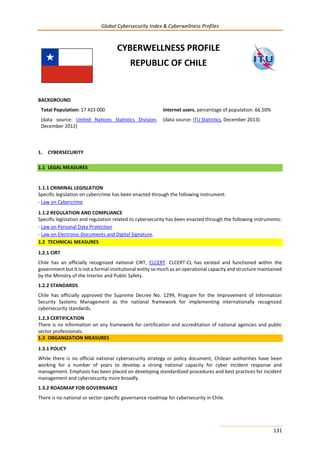
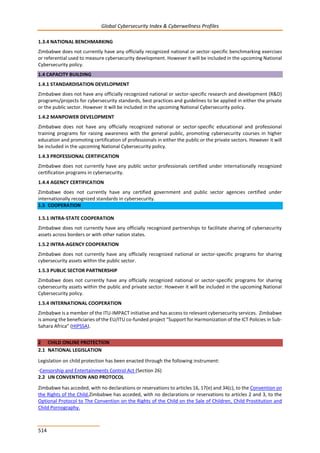
G l o b a l
CYBERSECURITY INDEX &
CYBERWELLNESS PROFILES
CYBERSECURITY
Te l e c o m m u n i c a t i o n D e v e l o p m e n t S e c t o r
Price: 258 CHF
Printed in Switzerland
Geneva, 2015
International Telecommunication Union
Telecommunication Development Bureau
Place des Nations
CH-1211 Geneva 20
Switzerland
www.itu.int
Report
GLOBALCYBERSECURITYINDEX&CYBERWELLNESSPROFILES	APRIL2015
ISBN 978-92-61-15781-4
9 7 8 9 2 6 1 1 5 7 8 1 4
Global Cybersecurity Index &
Cyberwellness Profiles
April 2015
Acknowledgements
The International Telecommunication Union would like to thank Aaron Boyd and Michela Menting of the
ABI Research team for their input to this report. The cyberwellness country profiles have been put together
with the support of Shao Tong Zhang, Qin Chuan The, Aliya Abdul Razack, and Ineze Anni. If you have any
comments, please contact the ITU cybersecurity team: cybersecurity@itu.int
Please consider the environment before printing this report.
 ITU 2015
All rights reserved. No part of this publication may be reproduced, by any means whatsoever, without the
prior written permission of ITU.
Global Cybersecurity Index & Cyberwellness Profiles
iii
Foreword
Technology is ever evolving and new cyber threats continue to be devised. In embracing technology
progress, cybersecurity must form an integral and indivisible part of the process. Unfortunately,
cybersecurity is not yet at the core of many national and industrial technology strategies. Countries need
to be aware of their current capability level in cybersecurity and at the same time identify areas where
cybersecurity needs to be enhanced.
The Global Cybersecurity Index (GCI) is a measure of each nation state’s level of cybersecurity development.
The GCI aims at providing the right motivation to countries to intensify their efforts in cybersecurity. The
ultimate goal is to help foster a global culture of cybersecurity and its integration at the core of information
and communication technologies.
Implemented with one of our partners, ABI Research, GCI brings in expertise in statistical analysis and
industry benchmarking. An information letter and a questionnaire were sent to all ITU Member States in
October 2013. Following the responses received, regional preliminary results were issued. With the support
of each and every Member State, ITU is now publishing a global status report of cybersecurity for 2014.
I thank all Member States for their support and as the GCI is an ongoing exercise I invite all respondents to
continue sending in and updating this vital information that will improve the GCI by effectively sharing
experiences, opinions and concerns. This will provide you with a tool that will grow, that will help gauge
cybersecurity readiness at a national level and take informed decisions to foster a global culture of
cybersecurity.
Brahima Sanou
Director
Telecommunication Development Bureau
Global Cybersecurity Index & Cyberwellness Profiles
v
ABI Research
After three solid years of painstaking effort representing a meaningful commitment by the leadership of
ITU to collaborate with the private sector toward an important goal for the global community, ABI Research
is extremely pleased with release of the first annual Global Cybersecurity Index (GCI).
The GCI was embarked upon as a result of the vision of the ITU leadership to raise awareness about
cybersecurity preparedness. ABI Research, as a technology intelligence company with 25 years of
experience, is proud to have been a part of the international cooperation which is central to this project.
The cost of cybercrime and the growing threat of increasingly sophisticated cyberattacks perpetrated by
highly resourceful and competent threat agents continue to plague the development of safe ICTs globally.
Safeguarding ICTs ensures the economic stability of cyberspace and provides for a reliable environment
critical for organizations and individuals to conduct business and freely communicate.
The goal of the GCI is to establish a measurement by which the continued innovation in technology and
internet-based activities can be undertaken safely and securely. The growing dangers of opportunistic,
financially or politically motivated crime can be minimized through a blend of technology, policy, legal,
organization, and academic rigor.
We look forward to continuing to work with ITU on the Global Cybersecurity Index as it represents an
important first step in identifying areas of improvement for cybersecurity and helps drive open cooperation
among all participants to share and learn from one another.
Tim Archdeacon
Founder and CEO
ABI Research
Global Cybersecurity Index & Cyberwellness Profiles
vii
Table of contents
Page
1 Introduction...................................................................................................................... 1
2 Key findings....................................................................................................................... 1
2.1 Global ranking................................................................................................................... 1
2.2 Regional ranking ............................................................................................................... 7
2.3 Additional analysis............................................................................................................ 17
3 Good practices .................................................................................................................. 17
3.1 Africa................................................................................................................................. 17
3.2 Americas ........................................................................................................................... 19
3.3 Arab States........................................................................................................................ 21
3.4 Asia Pacific ........................................................................................................................ 22
3.5 Commonwealth of Independent States (CIS) ................................................................... 24
3.6 Europe............................................................................................................................... 26
4 Cyberwellness country profiles........................................................................................... 28
5 Concluding remarks ........................................................................................................... 28
Annex 1: Conceptual framework .................................................................................................. 29
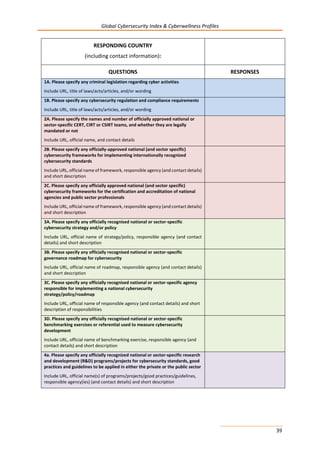
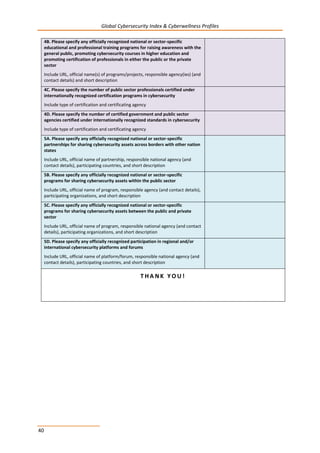
Annex 2: Sample questionnaire.................................................................................................... 38
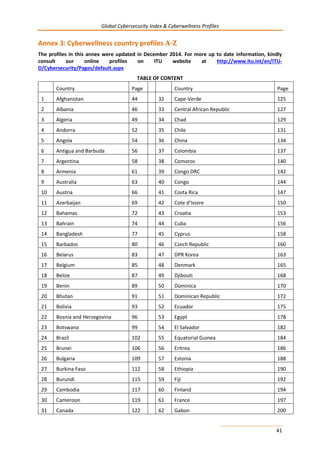
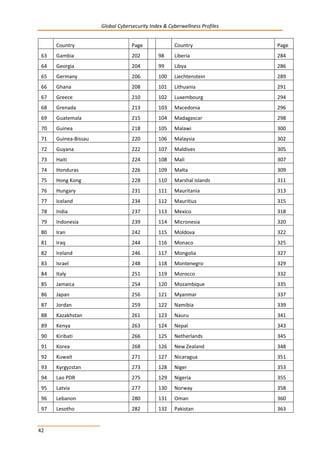
Annex 3: Cyberwellness country profiles A-Z................................................................................ 41
Global Cybersecurity Index & Cyberwellness Profiles
1
1 Introduction
The Global Cybersecurity Index (GCI) is born of a cooperative partnership between private sector and
international organization to drive the issue of cybersecurity to the forefront of national agendas. A joint
project undertaken by ABI Research and the International Telecommunication Union, the GCI provides
insight into the cybersecurity engagement of sovereign states.
Rooted in the ITU Global Cybersecurity Agenda, the GCI looks at the level of commitment in five areas: legal
measures, technical measures, organizational measures, capacity building and international cooperation.
The result is a country-level index and a global ranking on cybersecurity readiness. The GCI does not seek
to determine the efficacy or success of a particular measure, but simply the existence of national structures
in place to implement and promote cybersecurity.
The project is a result of intensive primary and secondary research by both ITU and ABI Research. Country-
level surveys, complemented by in-depth qualitative research, were sent out to all ITU Member States.
Information was collected on laws, regulations, CERTs and CIRTs, policies, national strategies, standards,
certifications, professional training, awareness raising, and cooperative partnerships.
The aim of the GCI is to provide a snapshot of where countries stand in their cybersecurity engagement at
the national level. The visions as seen by ABI Research and ITU is to promote cybersecurity awareness and
the important role governments have to play in integrating appropriate mechanisms to both support and
promote this crucial discipline. Safeguarding the integrity of cyberspace must involve the development of
cybersecurity.
2 Key findings
2.1 Global ranking
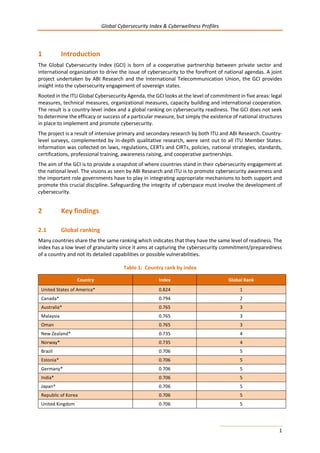
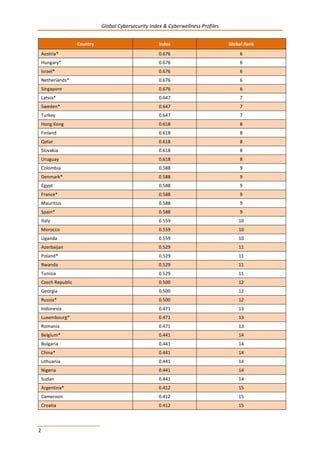
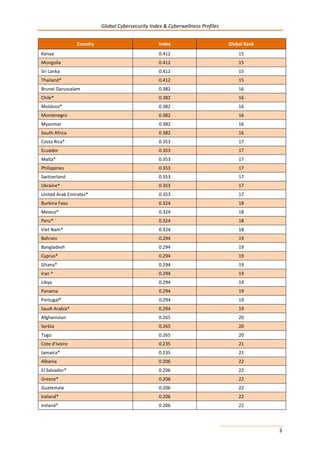
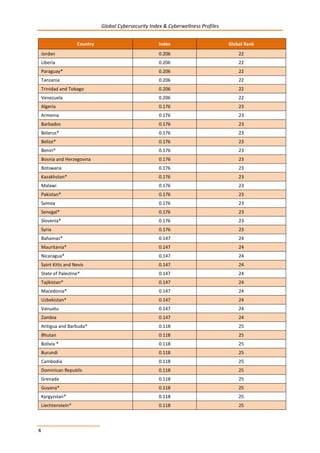
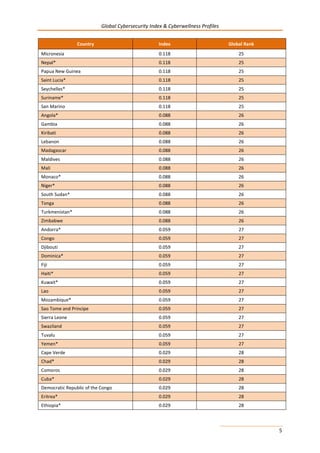
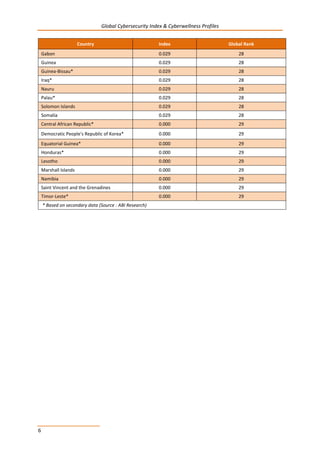
Many countries share the the same ranking which indicates that they have the same level of readiness. The
index has a low level of granularity since it aims at capturing the cybersecurity commitment/preparedness
of a country and not its detailed capabilities or possible vulnerabilities.
Table 1: Country rank by index
Country Index Global Rank
United States of America* 0.824 1
Canada* 0.794 2
Australia* 0.765 3
Malaysia 0.765 3
Oman 0.765 3
New Zealand* 0.735 4
Norway* 0.735 4
Brazil 0.706 5
Estonia* 0.706 5
Germany* 0.706 5
India* 0.706 5
Japan* 0.706 5
Republic of Korea 0.706 5
United Kingdom 0.706 5
Global Cybersecurity Index & Cyberwellness Profiles
2
Country Index Global Rank
Austria* 0.676 6
Hungary* 0.676 6
Israel* 0.676 6
Netherlands* 0.676 6
Singapore 0.676 6
Latvia* 0.647 7
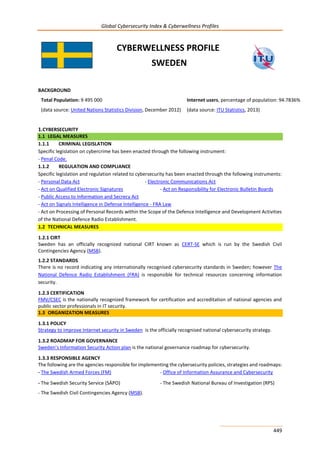
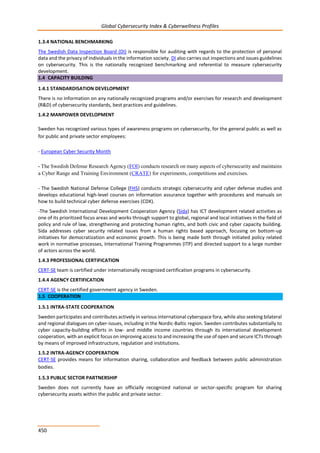
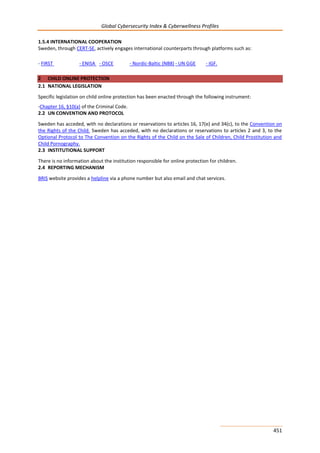
Sweden* 0.647 7
Turkey 0.647 7
Hong Kong 0.618 8
Finland 0.618 8
Qatar 0.618 8
Slovakia 0.618 8
Uruguay 0.618 8
Colombia 0.588 9
Denmark* 0.588 9
Egypt 0.588 9
France* 0.588 9
Mauritius 0.588 9
Spain* 0.588 9
Italy 0.559 10
Morocco 0.559 10
Uganda 0.559 10
Azerbaijan 0.529 11
Poland* 0.529 11
Rwanda 0.529 11
Tunisia 0.529 11
Czech Republic 0.500 12
Georgia 0.500 12
Russia* 0.500 12
Indonesia 0.471 13
Luxembourg* 0.471 13
Romania 0.471 13
Belgium* 0.441 14
Bulgaria 0.441 14
China* 0.441 14
Lithuania 0.441 14
Nigeria 0.441 14
Sudan 0.441 14
Argentina* 0.412 15
Cameroon 0.412 15
Croatia 0.412 15
Global Cybersecurity Index & Cyberwellness Profiles
3
Country Index Global Rank
Kenya 0.412 15
Mongolia 0.412 15
Sri Lanka 0.412 15
Thailand* 0.412 15
Brunei Darussalam 0.382 16
Chile* 0.382 16
Moldova* 0.382 16
Montenegro 0.382 16
Myanmar 0.382 16
South Africa 0.382 16
Costa Rica* 0.353 17
Ecuador 0.353 17
Malta* 0.353 17
Philippines 0.353 17
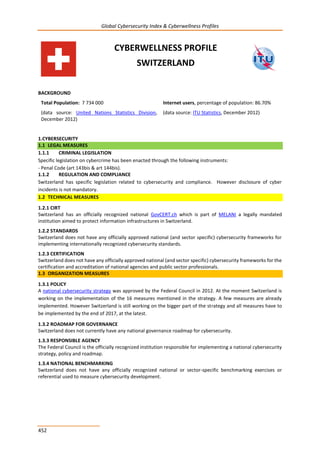
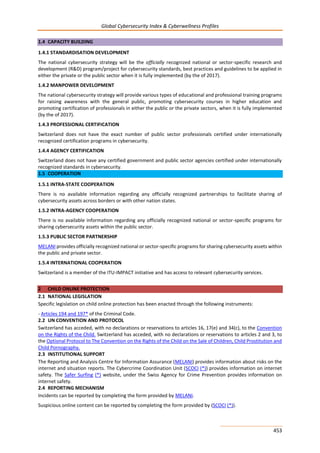
Switzerland 0.353 17
Ukraine* 0.353 17
United Arab Emirates* 0.353 17
Burkina Faso 0.324 18
Mexico* 0.324 18
Peru* 0.324 18
Viet Nam* 0.324 18
Bahrain 0.294 19
Bangladesh 0.294 19
Cyprus* 0.294 19
Ghana* 0.294 19
Iran * 0.294 19
Libya 0.294 19
Panama 0.294 19
Portugal* 0.294 19
Saudi Arabia* 0.294 19
Afghanistan 0.265 20
Serbia 0.265 20
Togo 0.265 20
Cote d'Ivoire 0.235 21
Jamaica* 0.235 21
Albania 0.206 22
El Salvador* 0.206 22
Greece* 0.206 22
Guatemala 0.206 22
Iceland* 0.206 22
Ireland* 0.206 22
Global Cybersecurity Index & Cyberwellness Profiles
4
Country Index Global Rank
Jordan 0.206 22
Liberia 0.206 22
Paraguay* 0.206 22
Tanzania 0.206 22
Trinidad and Tobago 0.206 22
Venezuela 0.206 22
Algeria 0.176 23
Armenia 0.176 23
Barbados 0.176 23
Belarus* 0.176 23
Belize* 0.176 23
Benin* 0.176 23
Bosnia and Herzegovina 0.176 23
Botswana 0.176 23
Kazakhstan* 0.176 23
Malawi 0.176 23
Pakistan* 0.176 23
Samoa 0.176 23
Senegal* 0.176 23
Slovenia* 0.176 23
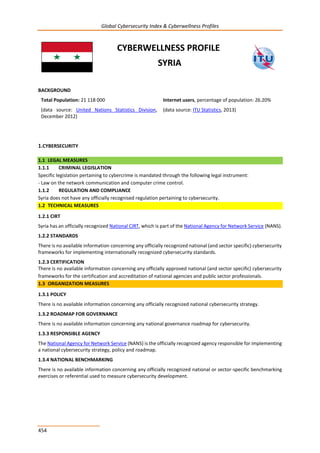
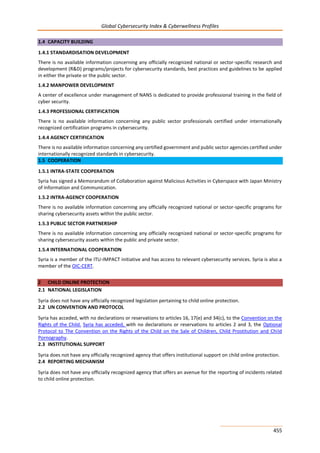
Syria 0.176 23
Bahamas* 0.147 24
Mauritania* 0.147 24
Nicaragua* 0.147 24
Saint Kitts and Nevis 0.147 24
State of Palestine* 0.147 24
Tajikistan* 0.147 24
Macedonia* 0.147 24
Uzbekistan* 0.147 24
Vanuatu 0.147 24
Zambia 0.147 24
Antigua and Barbuda* 0.118 25
Bhutan 0.118 25
Bolivia * 0.118 25
Burundi 0.118 25
Cambodia 0.118 25
Dominican Republic 0.118 25
Grenada 0.118 25
Guyana* 0.118 25
Kyrgyzstan* 0.118 25
Liechtenstein* 0.118 25
Global Cybersecurity Index & Cyberwellness Profiles
5
Country Index Global Rank
Micronesia 0.118 25
Nepal* 0.118 25
Papua New Guinea 0.118 25
Saint Lucia* 0.118 25
Seychelles* 0.118 25
Suriname* 0.118 25
San Marino 0.118 25
Angola* 0.088 26
Gambia 0.088 26
Kiribati 0.088 26
Lebanon 0.088 26
Madagascar 0.088 26
Maldives 0.088 26
Mali 0.088 26
Monaco* 0.088 26
Niger* 0.088 26
South Sudan* 0.088 26
Tonga 0.088 26
Turkmenistan* 0.088 26
Zimbabwe 0.088 26
Andorra* 0.059 27
Congo 0.059 27
Djibouti 0.059 27
Dominica* 0.059 27
Fiji 0.059 27
Haiti* 0.059 27
Kuwait* 0.059 27
Lao 0.059 27
Mozambique* 0.059 27
Sao Tome and Principe 0.059 27
Sierra Leone 0.059 27
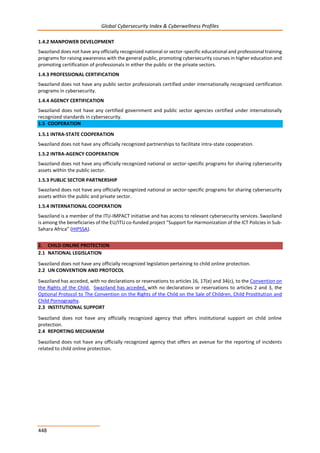
Swaziland 0.059 27
Tuvalu 0.059 27
Yemen* 0.059 27
Cape Verde 0.029 28
Chad* 0.029 28
Comoros 0.029 28
Cuba* 0.029 28
Democratic Republic of the Congo 0.029 28
Eritrea* 0.029 28
Ethiopia* 0.029 28
Global Cybersecurity Index & Cyberwellness Profiles
6
Country Index Global Rank
Gabon 0.029 28
Guinea 0.029 28
Guinea-Bissau* 0.029 28
Iraq* 0.029 28
Nauru 0.029 28
Palau* 0.029 28
Solomon Islands 0.029 28
Somalia 0.029 28
Central African Republic* 0.000 29
Democratic People's Republic of Korea* 0.000 29
Equatorial Guinea* 0.000 29
Honduras* 0.000 29
Lesotho 0.000 29
Marshall Islands 0.000 29
Namibia 0.000 29
Saint Vincent and the Grenadines 0.000 29
Timor-Leste* 0.000 29
* Based on secondary data (Source : ABI Research)
7
GlobalCybersecurityIndex&CyberwellnessProfiles
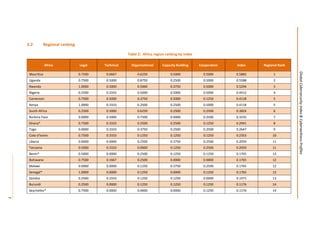
2.2 Regional ranking
Table 2: Africa region ranking by index
Africa Legal Technical Organizational Capacity Building Cooperation Index Regional Rank
Mauritius 0.7500 0.6667 0.6250 0.5000 0.5000 0.5882 1
Uganda 0.7500 0.5000 0.8750 0.2500 0.5000 0.5588 2
Rwanda 1.0000 0.5000 0.5000 0.3750 0.5000 0.5294 3
Nigeria 0.2500 0.3333 0.5000 0.5000 0.5000 0.4412 4
Cameroon 0.7500 0.5000 0.3750 0.5000 0.1250 0.4118 5
Kenya 1.0000 0.3333 0.2500 0.2500 0.5000 0.4118 5
South Africa 0.2500 0.5000 0.6250 0.2500 0.2500 0.3824 6
Burkina Faso 0.0000 0.5000 0.7500 0.0000 0.2500 0.3235 7
Ghana* 0.7500 0.3333 0.2500 0.2500 0.1250 0.2941 8
Togo 0.0000 0.3333 0.3750 0.2500 0.2500 0.2647 9
Cote d'Ivoire 0.7500 0.3333 0.1250 0.1250 0.1250 0.2353 10
Liberia 0.0000 0.0000 0.2500 0.3750 0.2500 0.2059 11
Tanzania 0.5000 0.3333 0.0000 0.1250 0.2500 0.2059 11
Benin* 0.5000 0.0000 0.2500 0.1250 0.1250 0.1765 12
Botswana 0.7500 0.1667 0.2500 0.0000 0.0000 0.1765 12
Malawi 0.0000 0.0000 0.1250 0.3750 0.2500 0.1765 12
Senegal* 1.0000 0.0000 0.1250 0.0000 0.1250 0.1765 12
Zambia 0.2500 0.3333 0.1250 0.1250 0.0000 0.1471 13
Burundi 0.2500 0.0000 0.1250 0.1250 0.1250 0.1176 14
Seychelles* 0.7500 0.0000 0.0000 0.0000 0.1250 0.1176 14
8
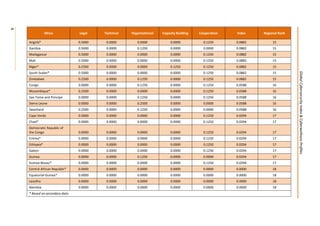
8
GlobalCybersecurityIndex&CyberwellnessProfiles
Africa Legal Technical Organizational Capacity Building Cooperation Index Regional Rank
Angola* 0.5000 0.0000 0.0000 0.0000 0.1250 0.0882 15
Gambia 0.5000 0.0000 0.1250 0.0000 0.0000 0.0882 15
Madagascar 0.5000 0.0000 0.0000 0.0000 0.1250 0.0882 15
Mali 0.5000 0.0000 0.0000 0.0000 0.1250 0.0882 15
Niger* 0.2500 0.0000 0.0000 0.1250 0.1250 0.0882 15
South Sudan* 0.5000 0.0000 0.0000 0.0000 0.1250 0.0882 15
Zimbabwe 0.2500 0.0000 0.1250 0.0000 0.1250 0.0882 15
Congo 0.0000 0.0000 0.1250 0.0000 0.1250 0.0588 16
Mozambique* 0.2500 0.0000 0.0000 0.0000 0.1250 0.0588 16
Sao Tome and Principe 0.0000 0.0000 0.1250 0.0000 0.1250 0.0588 16
Sierra Leone 0.0000 0.0000 0.2500 0.0000 0.0000 0.0588 16
Swaziland 0.2500 0.0000 0.1250 0.0000 0.0000 0.0588 16
Cape Verde 0.0000 0.0000 0.0000 0.0000 0.1250 0.0294 17
Chad* 0.0000 0.0000 0.0000 0.0000 0.1250 0.0294 17
Democratic Republic of
the Congo 0.0000 0.0000 0.0000 0.0000 0.1250 0.0294 17
Eritrea* 0.0000 0.0000 0.0000 0.0000 0.1250 0.0294 17
Ethiopia* 0.0000 0.0000 0.0000 0.0000 0.1250 0.0294 17
Gabon 0.0000 0.0000 0.0000 0.0000 0.1250 0.0294 17
Guinea 0.0000 0.0000 0.1250 0.0000 0.0000 0.0294 17
Guinea-Bissau* 0.0000 0.0000 0.0000 0.0000 0.1250 0.0294 17
Central African Republic* 0.0000 0.0000 0.0000 0.0000 0.0000 0.0000 18
Equatorial Guinea* 0.0000 0.0000 0.0000 0.0000 0.0000 0.0000 18
Lesotho 0.0000 0.0000 0.0000 0.0000 0.0000 0.0000 18
Namibia 0.0000 0.0000 0.0000 0.0000 0.0000 0.0000 18
* Based on secondary data
9
GlobalCybersecurityIndex&CyberwellnessProfiles
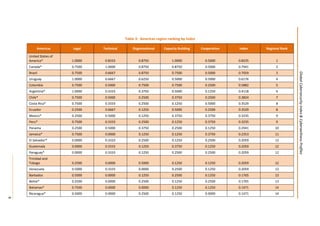
Table 3: Americas region ranking by index
Americas Legal Technical Organizational Capacity Building Cooperation Index Regional Rank
United States of
America* 1.0000 0.8333 0.8750 1.0000 0.5000 0.8235 1
Canada* 0.7500 1.0000 0.8750 0.8750 0.5000 0.7941 2
Brazil 0.7500 0.6667 0.8750 0.7500 0.5000 0.7059 3
Uruguay 1.0000 0.6667 0.6250 0.5000 0.5000 0.6176 4
Colombia 0.7500 0.5000 0.7500 0.7500 0.2500 0.5882 5
Argentina* 1.0000 0.3333 0.3750 0.5000 0.1250 0.4118 6
Chile* 0.7500 0.5000 0.2500 0.3750 0.2500 0.3824 7
Costa Rica* 0.7500 0.3333 0.2500 0.1250 0.5000 0.3529 8
Ecuador 0.2500 0.6667 0.1250 0.5000 0.2500 0.3529 8
Mexico* 0.2500 0.5000 0.1250 0.3750 0.3750 0.3235 9
Peru* 0.7500 0.3333 0.2500 0.1250 0.3750 0.3235 9
Panama 0.2500 0.5000 0.3750 0.2500 0.1250 0.2941 10
Jamaica* 0.7500 0.0000 0.1250 0.1250 0.3750 0.2353 11
El Salvador* 0.0000 0.3333 0.2500 0.1250 0.2500 0.2059 12
Guatemala 0.0000 0.3333 0.1250 0.3750 0.1250 0.2059 12
Paraguay* 0.0000 0.3333 0.1250 0.2500 0.2500 0.2059 12
Trinidad and
Tobago 0.2500 0.0000 0.5000 0.1250 0.1250 0.2059 12
Venezuela 0.5000 0.3333 0.0000 0.2500 0.1250 0.2059 12
Barbados 0.5000 0.0000 0.1250 0.2500 0.1250 0.1765 13
Belize* 0.2500 0.0000 0.2500 0.1250 0.2500 0.1765 13
Bahamas* 0.7500 0.0000 0.0000 0.1250 0.1250 0.1471 14
Nicaragua* 0.5000 0.0000 0.2500 0.1250 0.0000 0.1471 14
10
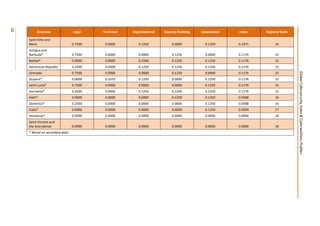
10
GlobalCybersecurityIndex&CyberwellnessProfiles
Americas Legal Technical Organizational Capacity Building Cooperation Index Regional Rank
Saint Kitts and
Nevis 0.7500 0.0000 0.1250 0.0000 0.1250 0.1471 14
Antigua and
Barbuda* 0.7500 0.0000 0.0000 0.1250 0.0000 0.1176 15
Bolivia* 0.0000 0.0000 0.2500 0.1250 0.1250 0.1176 15
Dominican Republic 0.2500 0.0000 0.1250 0.1250 0.1250 0.1176 15
Grenada 0.7500 0.0000 0.0000 0.1250 0.0000 0.1176 15
Guyana* 0.0000 0.3333 0.1250 0.0000 0.1250 0.1176 15
Saint Lucia* 0.7500 0.0000 0.0000 0.0000 0.1250 0.1176 15
Suriname* 0.2500 0.0000 0.1250 0.1250 0.1250 0.1176 15
Haiti* 0.0000 0.0000 0.0000 0.1250 0.1250 0.0588 16
Dominica* 0.2500 0.0000 0.0000 0.0000 0.1250 0.0588 16
Cuba* 0.0000 0.0000 0.0000 0.0000 0.1250 0.0294 17
Honduras* 0.0000 0.0000 0.0000 0.0000 0.0000 0.0000 18
Saint Vincent and
the Grenadines 0.0000 0.0000 0.0000 0.0000 0.0000 0.0000 18
* Based on secondary data
11
GlobalCybersecurityIndex&CyberwellnessProfiles
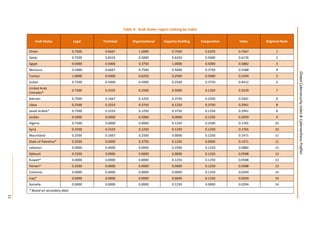
Table 4: Arab States region ranking by index
Arab States Legal Technical Organizational Capacity Building Cooperation Index Regional Rank
Oman 0.7500 0.6667 1.0000 0.7500 0.6250 0.7647 1
Qatar 0.7500 0.8333 0.5000 0.6250 0.5000 0.6176 2
Egypt 0.5000 0.5000 0.3750 1.0000 0.5000 0.5882 3
Morocco 0.5000 0.6667 0.7500 0.5000 0.3750 0.5588 4
Tunisia 1.0000 0.5000 0.6250 0.2500 0.5000 0.5294 5
Sudan 0.7500 0.5000 0.5000 0.2500 0.3750 0.4412 6
United Arab
Emirates*
0.7500 0.3333 0.2500 0.5000 0.1250 0.3529 7
Bahrain 0.7500 0.1667 0.1250 0.3750 0.2500 0.2941 8
Libya 0.2500 0.3333 0.3750 0.1250 0.3750 0.2941 8
Saudi Arabia* 0.7500 0.3333 0.1250 0.3750 0.1250 0.2941 8
Jordan 0.5000 0.0000 0.5000 0.0000 0.1250 0.2059 9
Algeria 0.7500 0.0000 0.0000 0.1250 0.2500 0.1765 10
Syria 0.2500 0.3333 0.1250 0.1250 0.1250 0.1765 10
Mauritania 0.2500 0.1667 0.2500 0.0000 0.1250 0.1471 11
State of Palestine* 0.2500 0.0000 0.3750 0.1250 0.0000 0.1471 11
Lebanon 0.0000 0.0000 0.0000 0.2500 0.1250 0.0882 12
Djibouti 0.2500 0.0000 0.0000 0.0000 0.1250 0.0588 13
Kuwait* 0.0000 0.0000 0.0000 0.1250 0.1250 0.0588 13
Yemen* 0.2500 0.0000 0.0000 0.0000 0.1250 0.0588 13
Comoros 0.0000 0.0000 0.0000 0.0000 0.1250 0.0294 14
Iraq* 0.0000 0.0000 0.0000 0.0000 0.1250 0.0294 14
Somalia 0.0000 0.0000 0.0000 0.1250 0.0000 0.0294 14
* Based on secondary data
12
12
GlobalCybersecurityIndex&CyberwellnessProfiles
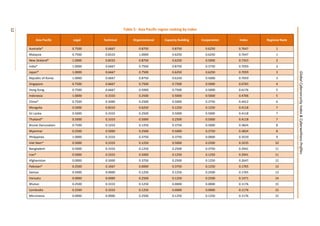
Table 5: Asia Pacific region ranking by index
Asia Pacific Legal Technical Organizational Capacity Building Cooperation Index Regional Rank
Australia* 0.7500 0.6667 0.8750 0.8750 0.6250 0.7647 1
Malaysia 0.7500 0.8333 1.0000 0.6250 0.6250 0.7647 1
New Zealand* 1.0000 0.8333 0.8750 0.6250 0.5000 0.7353 2
India* 1.0000 0.6667 0.7500 0.8750 0.3750 0.7059 3
Japan* 1.0000 0.6667 0.7500 0.6250 0.6250 0.7059 3
Republic of Korea 1.0000 0.6667 0.8750 0.6250 0.5000 0.7059 3
Singapore 0.7500 0.6667 0.7500 0.7500 0.5000 0.6765 4
Hong Kong 0.7500 0.6667 0.5000 0.7500 0.5000 0.6176 5
Indonesia 1.0000 0.3333 0.2500 0.5000 0.5000 0.4706 5
China* 0.7500 0.5000 0.2500 0.5000 0.3750 0.4412 6
Mongolia 0.5000 0.8333 0.6250 0.1250 0.1250 0.4118 7
Sri Lanka 0.5000 0.3333 0.2500 0.5000 0.5000 0.4118 7
Thailand* 0.5000 0.3333 0.5000 0.2500 0.5000 0.4118 7
Brunei Darussalam 0.7500 0.3333 0.1250 0.3750 0.5000 0.3824 8
Myanmar 0.2500 0.5000 0.2500 0.5000 0.3750 0.3824 8
Philippines 1.0000 0.3333 0.3750 0.3750 0.0000 0.3529 9
Viet Nam* 0.5000 0.3333 0.1250 0.5000 0.2500 0.3235 10
Bangladesh 0.5000 0.3333 0.1250 0.2500 0.3750 0.2941 11
Iran* 0.5000 0.3333 0.5000 0.1250 0.1250 0.2941 11
Afghanistan 0.0000 0.5000 0.3750 0.2500 0.1250 0.2647 12
Pakistan* 0.2500 0.1667 0.0000 0.3750 0.1250 0.1765 13
Samoa 0.5000 0.0000 0.1250 0.1250 0.2500 0.1765 13
Vanuatu 0.0000 0.0000 0.2500 0.1250 0.2500 0.1471 14
Bhutan 0.2500 0.3333 0.1250 0.0000 0.0000 0.1176 15
Cambodia 0.2500 0.3333 0.1250 0.0000 0.0000 0.1176 15
Micronesia 0.0000 0.0000 0.2500 0.1250 0.1250 0.1176 15
13
GlobalCybersecurityIndex&CyberwellnessProfiles
Asia Pacific Legal Technical Organizational Capacity Building Cooperation Index Regional Rank
Nepal* 0.5000 0.0000 0.1250 0.0000 0.1250 0.1176 15
Papua New Guinea 0.0000 0.0000 0.3750 0.0000 0.1250 0.1176 15
Kiribati 0.0000 0.0000 0.1250 0.0000 0.2500 0.0882 16
Maldives 0.0000 0.0000 0.1250 0.0000 0.2500 0.0882 16
Tonga 0.5000 0.0000 0.1250 0.0000 0.0000 0.0882 16
Fiji 0.2500 0.0000 0.0000 0.0000 0.1250 0.0588 17
Lao 0.0000 0.3333 0.0000 0.0000 0.0000 0.0588 17
Tuvalu 0.0000 0.0000 0.1250 0.0000 0.1250 0.0588 17
Nauru 0.0000 0.1667 0.0000 0.0000 0.0000 0.0294 18
Palau* 0.0000 0.0000 0.0000 0.0000 0.1250 0.0294 18
Solomon Islands* 0.0000 0.0000 0.0000 0.0000 0.1250 0.0294 18
Democratic People's
Republic of Korea* 0.0000 0.0000 0.0000 0.0000 0.0000 0.0000 19
Marshall Islands 0.0000 0.0000 0.0000 0.0000 0.0000 0.0000 19
Timor-Leste* 0.0000 0.0000 0.0000 0.0000 0.0000 0.0000 19
* Based on secondary data
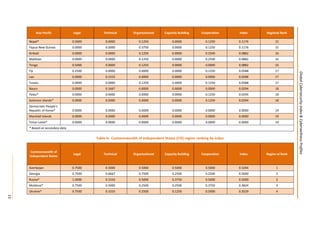
Table 6: Commonwealth of Independent States (CIS) region ranking by index
Commonwealth of
Independent States
Legal Technical Organizational Capacity Building Cooperation Index Region-al Rank
Azerbaijan 0.7500 0.5000 0.5000 0.5000 0.5000 0.5294 1
Georgia 0.7500 0.6667 0.7500 0.2500 0.2500 0.5000 2
Russia* 1.0000 0.3333 0.5000 0.3750 0.5000 0.5000 2
Moldova* 0.7500 0.5000 0.2500 0.2500 0.3750 0.3824 3
Ukraine* 0.7500 0.3333 0.2500 0.1250 0.5000 0.3529 4
14
14
GlobalCybersecurityIndex&CyberwellnessProfiles
Commonwealth of
Independent States
Legal Technical Organizational Capacity Building Cooperation Index Region-al Rank
Armenia 0.5000 0.5000 0.0000 0.0000 0.1250 0.1765 5
Belarus* 0.7500 0.3333 0.0000 0.0000 0.1250 0.1765 5
Kazakhstan* 0.7500 0.3333 0.0000 0.0000 0.1250 0.1765 5
Tajikistan* 0.7500 0.0000 0.0000 0.0000 0.2500 0.1471 6
Uzbekistan* 0.7500 0.1667 0.0000 0.0000 0.1250 0.1471 6
Kyrgyzstan* 0.5000 0.0000 0.0000 0.0000 0.2500 0.1176 7
Turkmenistan* 0.7500 0.0000 0.0000 0.0000 0.0000 0.0882 8
* Based on secondary data
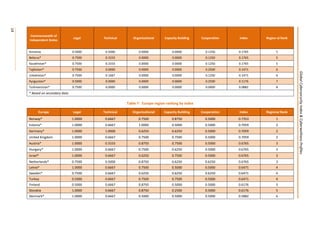
Table 7: Europe region ranking by index
Europe Legal Technical Organizational Capacity Building Cooperation Index Regional Rank
Norway* 1.0000 0.6667 0.7500 0.8750 0.5000 0.7353 1
Estonia* 1.0000 0.6667 1.0000 0.5000 0.5000 0.7059 2
Germany* 1.0000 1.0000 0.6250 0.6250 0.5000 0.7059 2
United Kingdom 1.0000 0.6667 0.7500 0.7500 0.5000 0.7059 2
Austria* 1.0000 0.3333 0.8750 0.7500 0.5000 0.6765 3
Hungary* 1.0000 0.6667 0.7500 0.6250 0.5000 0.6765 3
Israel* 1.0000 0.6667 0.6250 0.7500 0.5000 0.6765 3
Netherlands* 0.7500 0.5000 0.8750 0.6250 0.6250 0.6765 3
Latvia* 1.0000 0.6667 0.7500 0.5000 0.5000 0.6471 4
Sweden* 0.7500 0.6667 0.6250 0.6250 0.6250 0.6471 4
Turkey 0.5000 0.6667 0.7500 0.7500 0.5000 0.6471 4
Finland 0.5000 0.6667 0.8750 0.5000 0.5000 0.6176 5
Slovakia 1.0000 0.6667 0.8750 0.2500 0.5000 0.6176 5
Denmark* 1.0000 0.6667 0.5000 0.5000 0.5000 0.5882 6
15
GlobalCybersecurityIndex&CyberwellnessProfiles
Europe Legal Technical Organizational Capacity Building Cooperation Index Regional Rank
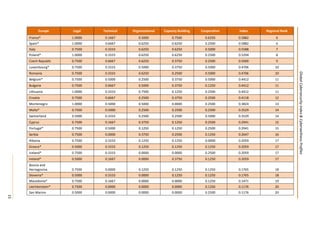
France* 1.0000 0.1667 0.5000 0.7500 0.6250 0.5882 6
Spain* 1.0000 0.6667 0.6250 0.6250 0.2500 0.5882 6
Italy 0.7500 0.3333 0.6250 0.6250 0.5000 0.5588 7
Poland* 1.0000 0.3333 0.6250 0.6250 0.2500 0.5294 8
Czech Republic 0.7500 0.6667 0.6250 0.3750 0.2500 0.5000 9
Luxembourg* 0.7500 0.3333 0.5000 0.3750 0.5000 0.4706 10
Romania 0.7500 0.3333 0.6250 0.2500 0.5000 0.4706 10
Belgium* 0.7500 0.5000 0.2500 0.3750 0.5000 0.4412 11
Bulgaria 0.7500 0.6667 0.5000 0.3750 0.1250 0.4412 11
Lithuania 1.0000 0.3333 0.7500 0.1250 0.2500 0.4412 11
Croatia 0.7500 0.6667 0.2500 0.3750 0.2500 0.4118 12
Montenegro 1.0000 0.5000 0.5000 0.0000 0.2500 0.3824 13
Malta* 0.7500 0.5000 0.2500 0.2500 0.2500 0.3529 14
Switzerland 0.5000 0.3333 0.2500 0.2500 0.5000 0.3529 14
Cyprus 0.7500 0.1667 0.3750 0.1250 0.2500 0.2941 15
Portugal* 0.7500 0.5000 0.1250 0.1250 0.2500 0.2941 15
Serbia 0.7500 0.0000 0.3750 0.2500 0.1250 0.2647 16
Albania 0.7500 0.3333 0.1250 0.1250 0.0000 0.2059 17
Greece* 0.5000 0.3333 0.1250 0.1250 0.1250 0.2059 17
Iceland* 0.7500 0.3333 0.0000 0.0000 0.2500 0.2059 17
Ireland* 0.5000 0.1667 0.0000 0.3750 0.1250 0.2059 17
Bosnia and
Herzegovina 0.7500 0.0000 0.1250 0.1250 0.1250 0.1765 18
Slovenia* 0.5000 0.3333 0.0000 0.1250 0.1250 0.1765 18
Macedonia* 0.7500 0.1667 0.0000 0.0000 0.1250 0.1471 19
Liechtenstein* 0.7500 0.0000 0.0000 0.0000 0.1250 0.1176 20
San Marino 0.5000 0.0000 0.0000 0.0000 0.2500 0.1176 20
16
16
GlobalCybersecurityIndex&CyberwellnessProfiles
Europe Legal Technical Organizational Capacity Building Cooperation Index Regional Rank
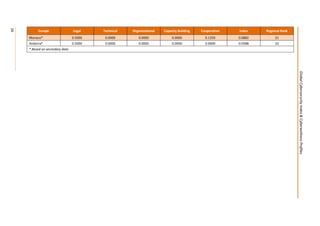
Monaco* 0.5000 0.0000 0.0000 0.0000 0.1250 0.0882 21
Andorra* 0.5000 0.0000 0.0000 0.0000 0.0000 0.0588 22
* Based on secondary data
Global Cybersecurity Index & Cyberwellness Profiles
17
2.3 Additional analysis
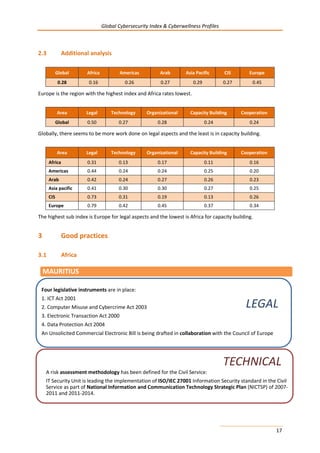
Global Africa Americas Arab Asia Pacific CIS Europe
0.28 0.16 0.26 0.27 0.29 0.27 0.45
Europe is the region with the highest index and Africa rates lowest.
Area Legal Technology Organizational Capacity Building Cooperation
Global 0.50 0.27 0.28 0.24 0.24
Globally, there seems to be more work done on legal aspects and the least is in capacity building.
Area Legal Technology Organizational Capacity Building Cooperation
Africa 0.31 0.13 0.17 0.11 0.16
Americas 0.44 0.24 0.24 0.25 0.20
Arab 0.42 0.24 0.27 0.26 0.23
Asia pacific 0.41 0.30 0.30 0.27 0.25
CIS 0.73 0.31 0.19 0.13 0.26
Europe 0.79 0.42 0.45 0.37 0.34
The highest sub index is Europe for legal aspects and the lowest is Africa for capacity building.
3 Good practices
3.1 Africa
MAURITIUS
Four legislative instruments are in place:
1. ICT Act 2001
2. Computer Misuse and Cybercrime Act 2003
3. Electronic Transaction Act 2000
4. Data Protection Act 2004
An Unsolicited Commercial Electronic Bill is being drafted in collaboration with the Council of Europe
LEGAL
A risk assessment methodology has been defined for the Civil Service:
IT Security Unit is leading the implementation of ISO/IEC 27001 Information Security standard in the Civil
Service as part of National Information and Communication Technology Strategic Plan (NICTSP) of 2007-
2011 and 2011-2014.
TECHNICAL
Global Cybersecurity Index & Cyberwellness Profiles
18
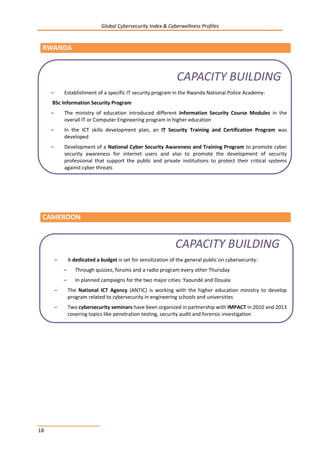
RWANDA
CAMEROON
– A dedicated a budget is set for sensitization of the general public on cybersecurity:
– Through quizzes, forums and a radio program every other Thursday
– In planned campaigns for the two major cities: Yaoundé and Douala
– The National ICT Agency (ANTIC) is working with the higher education ministry to develop
program related to cybersecurity in engineering schools and universities
– Two cybersecurity seminars have been organized in partnership with IMPACT in 2010 and 2013
covering topics like penetration testing, security audit and forensic investigation
CAPACITY BUILDING
– Establishment of a specific IT security program in the Rwanda National Police Academy:
BSc Information Security Program
– The ministry of education introduced different Information Security Course Modules in the
overall IT or Computer Engineering program in higher education
– In the ICT skills development plan, an IT Security Training and Certification Program was
developed
– Development of a National Cyber Security Awareness and Training Program to promote cyber
security awareness for internet users and also to promote the development of security
professional that support the public and private institutions to protect their critical systems
against cyber threats
CAPACITY BUILDING
Global Cybersecurity Index & Cyberwellness Profiles
19
3.2 Americas
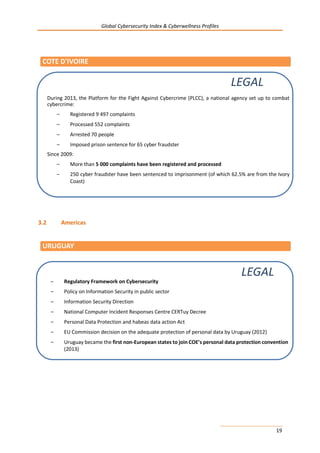
COTE D'IVOIRE
URUGUAY
– Regulatory Framework on Cybersecurity
– Policy on Information Security in public sector
– Information Security Direction
– National Computer Incident Responses Centre CERTuy Decree
– Personal Data Protection and habeas data action Act
– EU Commission decision on the adequate protection of personal data by Uruguay (2012)
– Uruguay became the first non-European states to join COE’s personal data protection convention
(2013)
LEGAL
During 2013, the Platform for the Fight Against Cybercrime (PLCC), a national agency set up to combat
cybercrime:
– Registered 9 497 complaints
– Processed 552 complaints
– Arrested 70 people
– Imposed prison sentence for 65 cyber fraudster
Since 2009:
– More than 5 000 complaints have been registered and processed
– 250 cyber fraudster have been sentenced to imprisonment (of which 62.5% are from the Ivory
Coast)
LEGAL
Global Cybersecurity Index & Cyberwellness Profiles
20
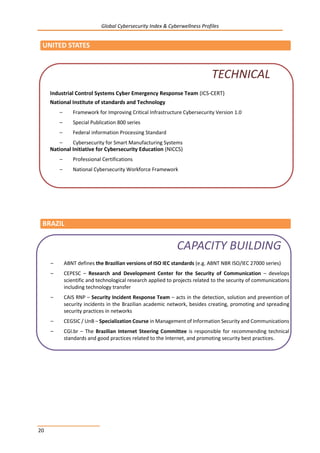
UNITED STATES
BRAZIL
Industrial Control Systems Cyber Emergency Response Team (ICS-CERT)
National Institute of standards and Technology
– Framework for Improving Critical Infrastructure Cybersecurity Version 1.0
– Special Publication 800 series
– Federal information Processing Standard
– Cybersecurity for Smart Manufacturing Systems
National Initiative for Cybersecurity Education (NICCS)
– Professional Certifications
– National Cybersecurity Workforce Framework
TECHNICAL
– ABNT defines the Brazilian versions of ISO IEC standards (e.g. ABNT NBR ISO/IEC 27000 series)
– CEPESC – Research and Development Center for the Security of Communication – develops
scientific and technological research applied to projects related to the security of communications
including technology transfer
– CAIS RNP – Security Incident Response Team – acts in the detection, solution and prevention of
security incidents in the Brazilian academic network, besides creating, promoting and spreading
security practices in networks
– CEGSIC / UnB – Specialization Course in Management of Information Security and Communications
– CGI.br – The Brazilian Internet Steering Committee is responsible for recommending technical
standards and good practices related to the Internet, and promoting security best practices.
CAPACITY BUILDING
Global Cybersecurity Index & Cyberwellness Profiles
21
3.3 Arab States
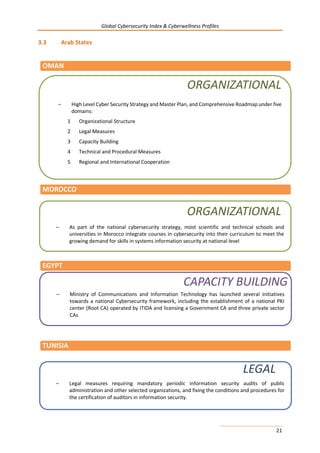
OMAN
MOROCCO
EGYPT
TUNISIA
– High Level Cyber Security Strategy and Master Plan, and Comprehensive Roadmap under five
domains:
1 Organizational Structure
2 Legal Measures
3 Capacity Building
4 Technical and Procedural Measures
5 Regional and International Cooperation
ORGANIZATIONAL
– As part of the national cybersecurity strategy, most scientific and technical schools and
universities in Morocco integrate courses in cybersecurity into their curriculum to meet the
growing demand for skills in systems information security at national level
ORGANIZATIONAL
– Ministry of Communications and Information Technology has launched several initiatives
towards a national Cybersecurity framework, including the establishment of a national PKI
center (Root CA) operated by ITIDA and licensing a Government CA and three private sector
CAs
CAPACITY BUILDING
– Legal measures requiring mandatory periodic information security audits of public
administration and other selected organizations, and fixing the conditions and procedures for
the certification of auditors in information security.
LEGAL
Global Cybersecurity Index & Cyberwellness Profiles
22
3.4 Asia Pacific
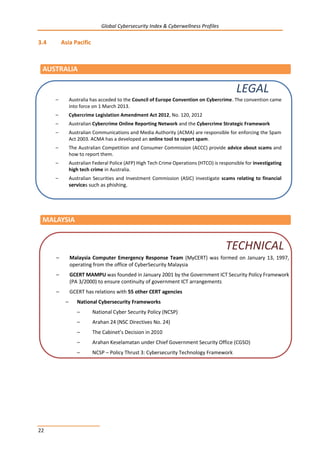
AUSTRALIA
MALAYSIA
– Australia has acceded to the Council of Europe Convention on Cybercrime. The convention came
into force on 1 March 2013.
– Cybercrime Legislation Amendment Act 2012, No. 120, 2012
– Australian Cybercrime Online Reporting Network and the Cybercrime Strategic Framework
– Australian Communications and Media Authority (ACMA) are responsible for enforcing the Spam
Act 2003. ACMA has a developed an online tool to report spam.
– The Australian Competition and Consumer Commission (ACCC) provide advice about scams and
how to report them.
– Australian Federal Police (AFP) High Tech Crime Operations (HTCO) is responsible for investigating
high tech crime in Australia.
– Australian Securities and Investment Commission (ASIC) investigate scams relating to financial
services such as phishing.
LEGAL
– Malaysia Computer Emergency Response Team (MyCERT) was formed on January 13, 1997,
operating from the office of CyberSecurity Malaysia
– GCERT MAMPU was founded in January 2001 by the Government ICT Security Policy Framework
(PA 3/2000) to ensure continuity of government ICT arrangements
– GCERT has relations with 55 other CERT agencies
– National Cybersecurity Frameworks
– National Cyber Security Policy (NCSP)
– Arahan 24 (NSC Directives No. 24)
– The Cabinet’s Decision in 2010
– Arahan Keselamatan under Chief Government Security Office (CGSO)
– NCSP – Policy Thrust 3: Cybersecurity Technology Framework
TECHNICAL
Global Cybersecurity Index & Cyberwellness Profiles
23
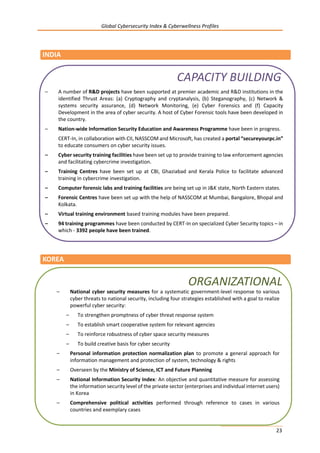
INDIA
KOREA
– A number of R&D projects have been supported at premier academic and R&D institutions in the
identified Thrust Areas: (a) Cryptography and cryptanalysis, (b) Steganography, (c) Network &
systems security assurance, (d) Network Monitoring, (e) Cyber Forensics and (f) Capacity
Development in the area of cyber security. A host of Cyber Forensic tools have been developed in
the country.
– Nation-wide Information Security Education and Awareness Programme have been in progress.
CERT-In, in collaboration with CII, NASSCOM and Microsoft, has created a portal “secureyourpc.in”
to educate consumers on cyber security issues.
– Cyber security training facilities have been set up to provide training to law enforcement agencies
and facilitating cybercrime investigation.
– Training Centres have been set up at CBI, Ghaziabad and Kerala Police to facilitate advanced
training in cybercrime investigation.
– Computer forensic labs and training facilities are being set up in J&K state, North Eastern states.
– Forensic Centres have been set up with the help of NASSCOM at Mumbai, Bangalore, Bhopal and
Kolkata.
– Virtual training environment based training modules have been prepared.
– 94 training programmes have been conducted by CERT-In on specialized Cyber Security topics – in
which - 3392 people have been trained.
CAPACITY BUILDING
– National cyber security measures for a systematic government-level response to various
cyber threats to national security, including four strategies established with a goal to realize
powerful cyber security:
– To strengthen promptness of cyber threat response system
– To establish smart cooperative system for relevant agencies
– To reinforce robustness of cyber space security measures
– To build creative basis for cyber security
– Personal information protection normalization plan to promote a general approach for
information management and protection of system, technology & rights
– Overseen by the Ministry of Science, ICT and Future Planning
– National Information Security Index: An objective and quantitative measure for assessing
the information security level of the private sector (enterprises and individual internet users)
in Korea
– Comprehensive political activities performed through reference to cases in various
countries and exemplary cases
ORGANIZATIONAL
Global Cybersecurity Index & Cyberwellness Profiles
24
3.5 Commonwealth of Independent States (CIS)
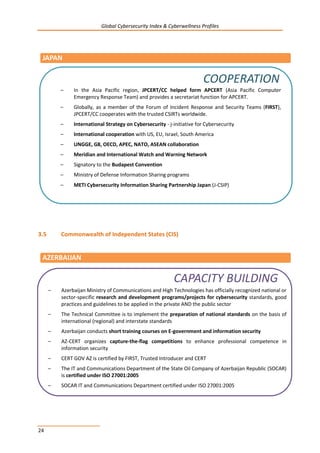
JAPAN
AZERBAIJAN
– In the Asia Pacific region, JPCERT/CC helped form APCERT (Asia Pacific Computer
Emergency Response Team) and provides a secretariat function for APCERT.
– Globally, as a member of the Forum of Incident Response and Security Teams (FIRST),
JPCERT/CC cooperates with the trusted CSIRTs worldwide.
– International Strategy on Cybersecurity - j-initiative for Cybersecurity
– International cooperation with US, EU, Israel, South America
– UNGGE, G8, OECD, APEC, NATO, ASEAN collaboration
– Meridian and International Watch and Warning Network
– Signatory to the Budapest Convention
– Ministry of Defense Information Sharing programs
– METI Cybersecurity Information Sharing Partnership Japan (J-CSIP)
COOPERATION
– Azerbaijan Ministry of Communications and High Technologies has officially recognized national or
sector-specific research and development programs/projects for cybersecurity standards, good
practices and guidelines to be applied in the private AND the public sector
– The Technical Committee is to implement the preparation of national standards on the basis of
international (regional) and interstate standards
– Azerbaijan conducts short training courses on E-government and information security
– AZ-CERT organizes capture-the-flag competitions to enhance professional competence in
information security
– CERT GOV AZ is certified by FIRST, Trusted Introducer and CERT
– The IT and Communications Department of the State Oil Company of Azerbaijan Republic (SOCAR)
is certified under ISO 27001:2005
– SOCAR IT and Communications Department certified under ISO 27001:2005
CAPACITY BUILDING
Global Cybersecurity Index & Cyberwellness Profiles
25
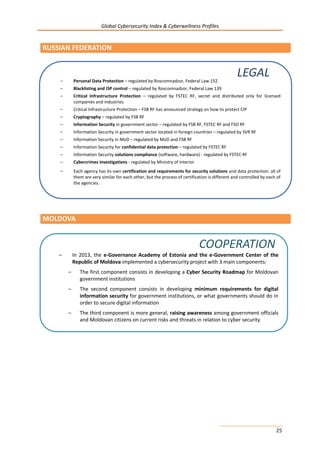
RUSSIAN FEDERATION
MOLDOVA
– Personal Data Protection – regulated by Roscomnadzor, Federal Law 152
– Blacklisting and ISP control – regulated by Roscomnadzor, Federal Law 139
– Critical Infrastructure Protection – regulated by FSTEC RF, secret and distributed only for licensed
companies and industries
– Critical Infrastructure Protection – FSB RF has announced strategy on how to protect CIP
– Cryptography – regulated by FSB RF
– Information Security in government sector – regulated by FSB RF, FSTEC RF and FSO RF
– Information Security in government sector located in foreign countries – regulated by SVR RF
– Information Security in MoD – regulated by MoD and FSB RF
– Information Security for confidential data protection – regulated by FSTEC RF
– Information Security solutions compliance (software, hardware) - regulated by FSTEC RF
– Cybercrimes investigations - regulated by Ministry of Interior
– Each agency has its own certification and requirements for security solutions and data protection: all of
them are very similar for each other, but the process of certification is different and controlled by each of
the agencies.
LEGAL
– In 2013, the e-Governance Academy of Estonia and the e-Government Center of the
Republic of Moldova implemented a cybersecurity project with 3 main components:
– The first component consists in developing a Cyber Security Roadmap for Moldovan
government institutions
– The second component consists in developing minimum requirements for digital
information security for government institutions, or what governments should do in
order to secure digital information
– The third component is more general, raising awareness among government officials
and Moldovan citizens on current risks and threats in relation to cyber security
COOPERATION
Global Cybersecurity Index & Cyberwellness Profiles
26
3.6 Europe
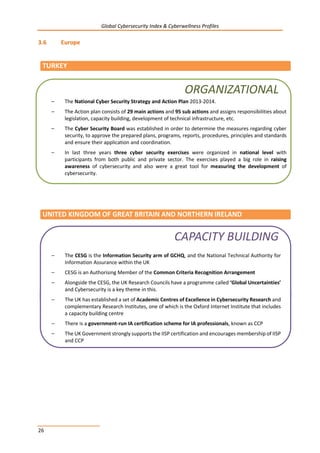
TURKEY
UNITED KINGDOM OF GREAT BRITAIN AND NORTHERN IRELAND
ESTONIA
– The National Cyber Security Strategy and Action Plan 2013-2014.
– The Action plan consists of 29 main actions and 95 sub actions and assigns responsibilities about
legislation, capacity building, development of technical infrastructure, etc.
– The Cyber Security Board was established in order to determine the measures regarding cyber
security, to approve the prepared plans, programs, reports, procedures, principles and standards
and ensure their application and coordination.
– In last three years three cyber security exercises were organized in national level with
participants from both public and private sector. The exercises played a big role in raising
awareness of cybersecurity and also were a great tool for measuring the development of
cybersecurity.
ORGANIZATIONAL
– The CESG is the Information Security arm of GCHQ, and the National Technical Authority for
Information Assurance within the UK
– CESG is an Authorising Member of the Common Criteria Recognition Arrangement
– Alongside the CESG, the UK Research Councils have a programme called ‘Global Uncertainties’
and Cybersecurity is a key theme in this.
– The UK has established a set of Academic Centres of Excellence in Cybersecurity Research and
complementary Research Institutes, one of which is the Oxford Internet Institute that includes
a capacity building centre
– There is a government-run IA certification scheme for IA professionals, known as CCP
– The UK Government strongly supports the IISP certification and encourages membership of IISP
and CCP
CAPACITY BUILDING
Global Cybersecurity Index & Cyberwellness Profiles
27
ESTONIA
THE NETHERLANDS
– ISKE is an information security standard that is developed for the Estonian public sector
which is compulsory for state and local government organisations who handle
databases/registers.
– A three-level baseline system means three different sets of security measures for three
different security requirements have been developed .
– The Estonian e-Government and IT infrastructure system uses 2048-bit encryption to power
Estonia’s Electronic-ID, digital signatures and X-road-enabled systems.
– Estonia has implemented a national PKI. The most substantial fields related to the field of PKI
are organised by the state:
– The collection of applications necessary for using the PKI (the base software of ID card),
which is handled by the Information System Authority (RIA).
– Legislation that determines the quality and trust requirements of the PKI services. This
field is handled by the Department of State Information Systems of the Ministry of
Economic Affairs and Communications.
– Issuing means for secure electronic authentication and signing (ID card, etc.). This field is
handled by the Police and Border Guard Board.
TECHNICAL
– Intra-Agency Cooperation is done through the High-Tech Crime Unit of the Dutch Police
Services Agency (KLPD) and through the National Cyber Security Centre (NCSC). The NCSC
collects information on ICT security and advises organizations on security.
– The services offered by the NCSC derive most of their added value from the cooperation
between public and private parties.
– NCSC concentrates mainly on those parties which are crucial for society, the so-called vital
sectors: energy companies, the telecommunications and the financial sector.
– Participants from the government in the NCSC PPPs include the Ministries of Security and
Justice, Economic Affairs, Agriculture and Innovation, the Interior and Kingdom Relations,
Foreign Affairs and Defence, Public Prosecution Service, the General Intelligence and
Security Service and the National Police Services Agency.
COOPERATION
Global Cybersecurity Index & Cyberwellness Profiles
28
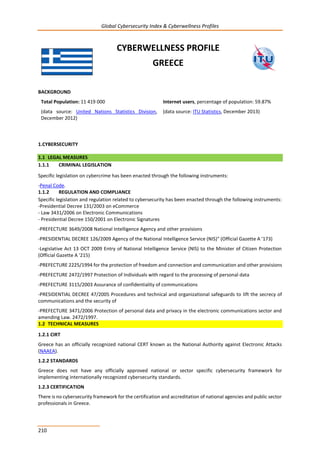
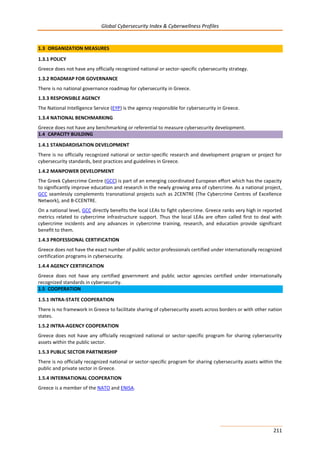
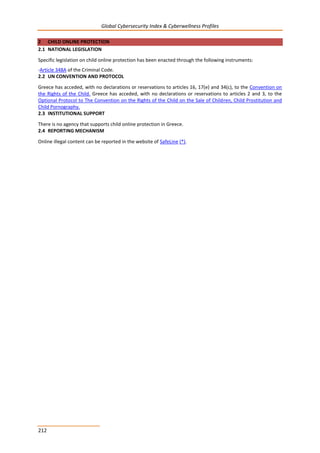
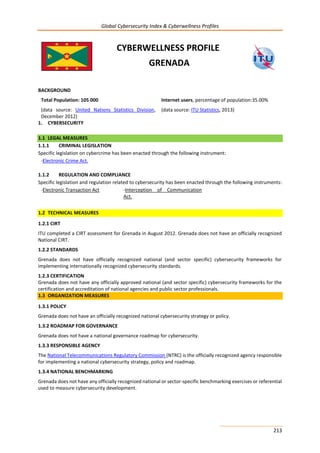
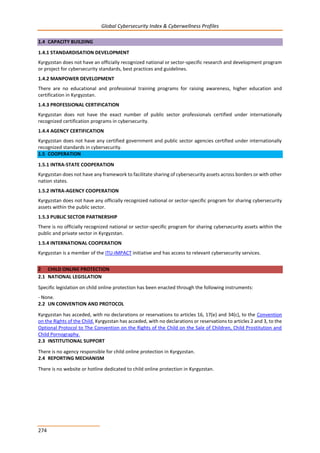
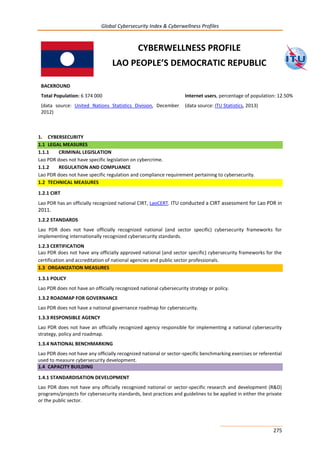
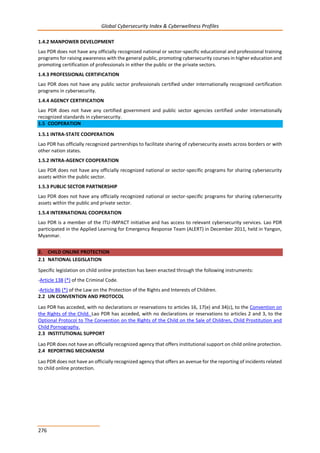
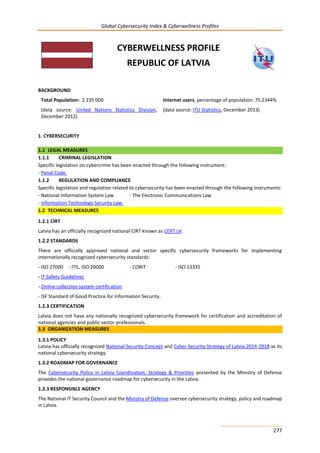
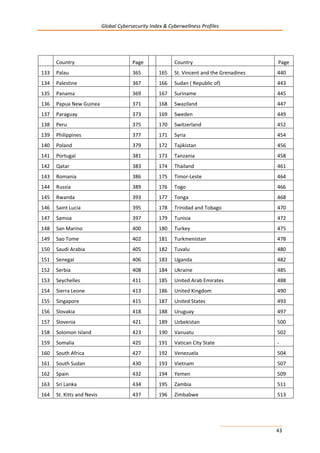
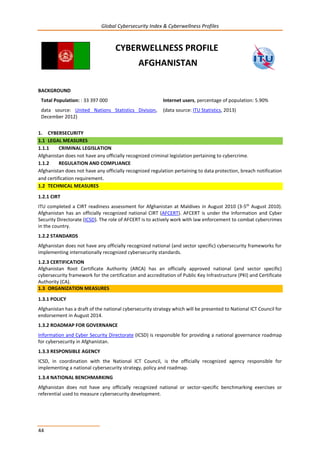
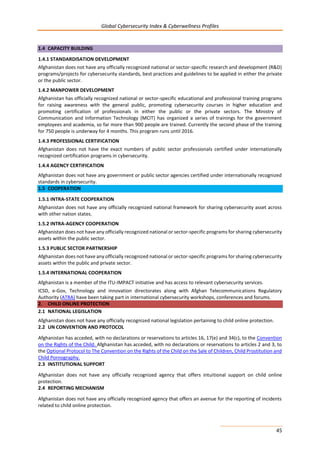
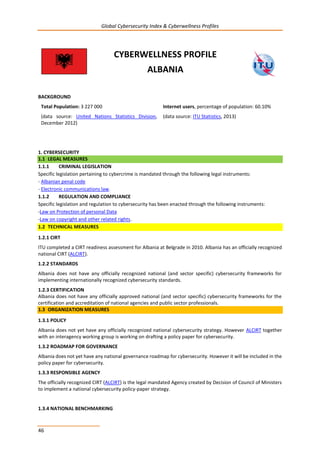
4 Cyberwellness country profiles1
As part of the ITU overall support to its 193 Member States within the framework of the Global
Cybersecurity Agenda2, the cyberwellness profiles are being presented as factual representations of each
nation state’s level of cybersecurity development. It aims to provide a clear perspective on the current
cybersecurity landscape based on the five pillars of the Global Cybersecurity Agenda namely legal measures,
technical measures, organization measures, capacity building and cooperation. The aspect of Child Online
Protection, a key ITU initiative is also included.
No single publication can adequately cover all aspects in depth. Nonetheless, we hope that the
cyberwellness profile will assist in ongoing discussions and research by providing facts of today’s challenges
and opportunities in cybersecurity.
Annex 3 is a compilation of the cyberwellness profiles of all ITU Member States updated as at the time of
printing of this publication. The latest version of profiles can be viewed at www.itu.int/en/ITU-
D/Cybersecurity/Pages/Country_Profiles.asp
5 Concluding remarks
The GCI has been successfully recognized at the ITU Plenipotentiary Conference in Busan and included
under Resolution 130 (Rev. Busan, 2014) on strengthening the role of ITU in building confidence and security
in the use of information and communication technologies. Specifically, Member States are invited “to
support ITU initiatives on cybersecurity, including the Global Cybersecurity Index (GCI), in order to promote
government strategies and the sharing of information on efforts across industries and sectors”.
The GCI maiden edition succeeded in measuring the commitment of Member States to cybersecurity and
generated interest on cybersecurity assessment among Member States. GCI has motivated countries to
intensify their efforts in cybersecurity, raised awareness in countries for the need to start bilateral
cooperation, and increased visibility of what countries are doing in cybersecurity.
In order for the GCI to continue to have an impact on raising awareness on this global emerging concern
over time, continuity of the GCI would be crucial. Member States and industry stakeholders are welcome
to participate in the continued research and development, to enhance the current reference model and to
introduce contributing partners.
These partners could pool resources to increase the granularity of the GCI questionnaire, to provide strong
evidence based secondary data, to further analyse the data collected through a qualitative appreciation
from experts as well as quantitative correlations with other established indicators such as the ITU ICT
Development Index and Word Economic Forum Network Readiness Index.
The success of this extensive data gathering effort depends heavily on the response rate to the
questionnaire and we call on all Member States to take part in the GCI exercise. The future GCI work will
offer more opportunities for open consultation with ITU Member States and relevant stakeholders and will
become an annual exercise with results reported at WSIS. The ultimate goal of this initiative is to help foster
a global culture of cybersecurity and its integration at the core of ICTs, a key ITU mandate.
1 There are currently 193 cyberwellness profiles available. Please contact ITU at cybersecurity@itu.int to help keep the
cyberwellness profiles up to date, and new data from the ITU membership is welcome especially for countries for which the
profiles have not yet been elaborated due to lack of reliable data. Annex 3 is a compilation of the cyberwellness profiles of
all Member States updated as at the time of printing of this publication. The latest version of profiles can be viewed at
www.itu.int/en/ITU-D/Cybersecurity/Pages/Country_Profiles.asp
2
www.itu.int/en/ITU-D/Cybersecurity/Pages/GCI.aspx
Global Cybersecurity Index & Cyberwellness Profiles
29
Annex 1: Conceptual framework
Information and Communication Technologies (ICT) are the driving force behind the evolution of modern
societies. They underpin the social, economic and political growth of individuals, organizations and
governments alike. ICTs have become not only ubiquitous, but essential for progress. Smart devices, M2M
communications and cloud-based services, among many other technologies, are advancing the next-
generation of networked (NGN) societies. Digital technology and internet connectivity are being
systematically integrated into all verticals of the private and public sectors because they offer significant
advantages: productivity, speed, cost-reduction and flexibility. As a result, ICTs are progressively being
deployed in new platforms, such as retail RFID systems and vehicular telematics for example. But more
significantly, they are being used to upgrade critical infrastructures, including energy grids, transport
networks and healthcare systems.
Cybersecurity is paramount for sustaining a technologically-sound model. The disruption of electricity or
the impairment of financial systems through interference with ICT networks is a reality; these events
constitute national security threats. Malicious online agents are numerous, organized and of diverse
persuasions: political, criminal, terrorist, hacktivist. The tools at their disposal become more sophisticated
and complex over time and with experience; the growing number of connected platforms only serves to
offer new attack vectors. There is no going back to simpler times. In embracing technological progress,
cybersecurity must form an integral and indivisible part of that process.
Unfortunately, cybersecurity is not yet at the core of many national and industrial technology strategies.
Although cybersecurity efforts are numerous, they are eclectic and dispersed. Differences in internet
penetration, technological development, private sector dynamics, government strategies, means that
cybersecurity is emerging from a bottom up approach; a natural occurrence where disparities exist between
nation states, public and private sectors, and across industries. In essence however, a global culture of
cybersecurity can be more successfully initiated from the top down. Information sharing and cooperation
are key to tackling cross-border threats. Such elements require a certain measure of organization in a
multitude of disciplines: legal, technical, educational. While a particular country or a specific sector will
have developed and adopted a highly effective cybersecurity framework, the knowledge is rarely shared
outside of that circle.
The primary obstacle is that cybersecurity is a sensitive issue, whether from a government or private sector
perspective. Admission of vulnerabilities can be seen as a weakness. This is a barrier to the discussion and
sharing of threat information and best practices. Yet security through obscurity is not a viable defense
model against modern cyber threats. The answer is to implement cybersecurity mechanisms in all layers of
society. However, the drive and the incentive to do so are inadequate, either due to cost constraints or
simply lack of awareness. A first step towards remedying the situation lies in comparing cybersecurity
capabilities of nation states and publishing an effective ranking of their status. A ranking system would
reveal shortcomings and motivate states to intensify their efforts in cybersecurity. It is only through
comparison that the real value of a nation’s cybersecurity capability can truly be weighed.
The Global Cybersecurity Index (GCI) project aims to effectively measure each nation state’s level of
commitment to cybersecurity. The ultimate goal is to help foster a global culture of cybersecurity and its
integration at the core of information and communication technologies. The project has been launched by
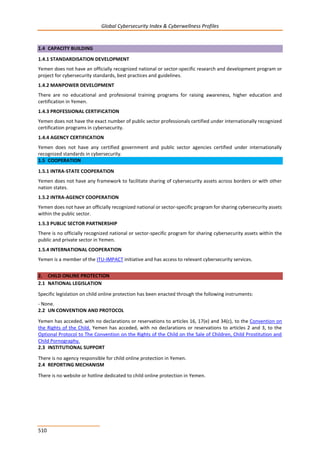
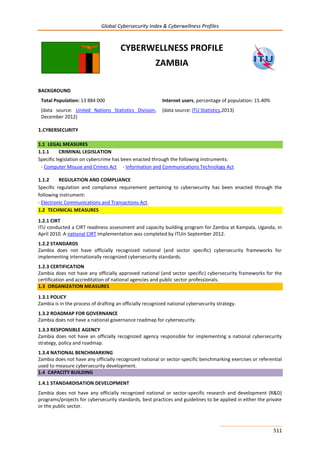
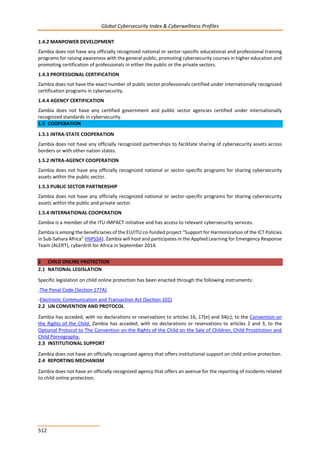
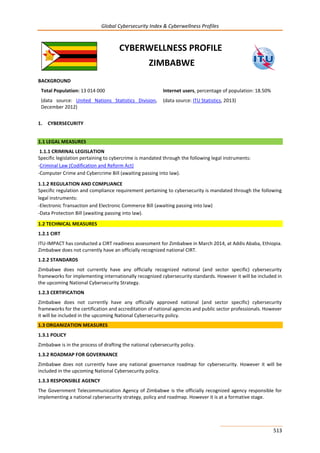
the International Telecommunication Union (ITU) and private sector company ABI Research. The GCI project
finds its basis in the current ITU mandate and the related projects and activities of the ITU
Telecommunication Development Bureau (BDT).
ITU is the lead facilitator for WSIS (World Summit on the Information Society) Action Line C5 for assisting
stakeholders in building confidence and security in the use of ICTs at national, regional and international
levels. The ITU mandate in cybersecurity is further supported by Resolution 69 on the “Creation of national
computer incident response teams, particularly for developing countries, and cooperation between them”
adopted at the fifth World Telecommunication Development Conference (WTDC-10) and by Resolution 130
Global Cybersecurity Index & Cyberwellness Profiles
30
(Busan, 2014) on “Strengthening the role of ITU in building confidence and security in the use of information
and communication technologies”. In this framework, the Global Cybersecurity Agenda (GCA) was launched
by the ITU Secretary-General as the ITU framework for international multi-stakeholder cooperation towards
a safer and more secure information society, and focuses on the following five work areas:
• Legal Measures
• Technical Measures
• Organizational Measures
• Capacity Building
• Cooperation.
These five designated areas will form the basis of the indicators for the GCI. These five indicators are critical
to measuring national capabilities in cybersecurity because they form the inherent building blocks of a
national culture. Cybersecurity has a field of application that cuts across all industries, all sectors, both
vertically and horizontally. Enabling the development of national capabilities therefore requires investment
by political, economic and social forces. This can be done by law enforcement and justice departments,
educational institutions and ministries, private sector operators and developers of technology, public-
private partnerships and intra-state cooperation.
The long-term aim is to drive further efforts in the adoption and integration of cybersecurity on a global
scale. A comparison of national cybersecurity strategies will reveal those states with high rankings in specific
areas, and consequently expose lesser-known yet successful cybersecurity strategies. This can prompt
increased information sharing on deploying cybersecurity for those states at different levels of
development as well. By measuring the level of cybersecurity preparedness in various areas, the index will
allow states to assess where they are on a scale of development, where they need to make further
improvements and how far they are from implementing an acceptable level of cybersecurity. All states are
moving towards a more digitized and connected environment, and adopting cybersecurity early on can
enable the deployment of more secure and resilient infrastructure in the long term.
The GCI project will be a joint effort between the BDT, specifically the Cybersecurity and ICT applications
Division (CYB) and ABI Research. CYB will act as focal point and owner of the project, and ABI Research will
bring in its core skill sets in strategy development, competitive intelligence, business planning, technology
assessment, and industry benchmarking for the realization of the project. ABI Research is a market
intelligence company specializing in global technology markets through quantitative forecasting and
analysis of key metrics and trends. Uniquely competent in providing forward-looking insight and actionable,
timely, real-world data points in the technology sector, ABI Research will bring its expertise for the timely
development and production of a reliable index. Under the arrangement, ITU and ABI Research:
• Identified performance metrics;
• Developed a global ranking mechanism;
• Researched and collected data on nation states’ cybersecurity capabilities;
• Contacted and liaised with nation states and relevant organizations;
• Identified and inserted the relevant data in the index;
• Published a global cybersecurity index.
Categories and Performance Indicators
The GCI will be a benchmark ranking measuring the cybersecurity development capabilities of sovereign
nation states. The index is essentially a composite indicator, aggregating a number of individual indicators.
The process of cybersecurity development can be analysed within five important broad categories. The
following indicators and sub-groups have been identified, and nations will be ranked against the benchmark
provided in each indicator.
Global Cybersecurity Index & Cyberwellness Profiles
31
Legal Measures
Legislation is a critical measure for providing a harmonized framework for entities to align themselves to a
common regulatory basis, whether on the matter of prohibition of specified criminal conduct or minimum
regulatory requirements. Legal measures also allow a nation state to set down the basic response
mechanisms to breach: through investigation and prosecution of crimes and the imposition of sanctions for
non-compliance or breach of law. A legislative framework sets the minimum standards of behaviour across
the board, applicable to all, and on which further cybersecurity capabilities can be built. Ultimately, the goal
is to enable all nation states to have adequate legislation in place in order to harmonize practices
supranationally and offer a setting for interoperable measures, facilitating international combat against
cybercrime.
The legal environment can be measured based on the existence and number of legal institutions and
frameworks dealing with cybersecurity and cybercrime. The sub-group is composed of the following
performance indicators:
A. Criminal legislation
Cybercrime legislation designates laws on the unauthorized (without right) access, interference,
interception of computers, systems and data. The laws can be ranked by level: none, partial or
comprehensive. Partial legislation refers to the simple insertion of computer-related wording in an existing
criminal law or code, with language limited to extending for example fraud or forgery, or surveillance and
theft to cyberspace. Comprehensive legislation refers to the enactment of a dedicated law or act dealing
with the specific aspects of computer crime (i.e. the UK Computer Misuse Act 1990). This category can
include partial legislation where the case law or jurisprudence is extensively developed. Please specify the
types of laws and regulations and whether there are none or whether they are partial or comprehensive.
B. Regulation and compliance
Cybersecurity regulation designates laws dealing with data protection, breach notification and
certification/standardization requirements. The laws can be ranked by level: none, partial or
comprehensive. Partial regulation refers to the insertion of computer-related wording in existing or new
criminal or civil law, so that the law extends applicability to cyberspace in regulation not specifically or
uniquely related to cybersecurity (i.e. the EU Directive 95/46/EC on the protection of individuals with regard
to the processing of personal data and on the free movement of such data). Comprehensive regulation
refers to the enactment of a dedicated law, act or directive requiring cybersecurity compliance (i.e. the US
Federal Information Security Management Act 2002). Please specify the types of laws and regulations and
whether there are none or whether they are partial or comprehensive.
Technical Measures
Technology is the first line of defense against cyberthreats and malicious online agents. Without adequate
technical measures and the capabilities to detect and respond to cyberattacks, nation states and their
respective entities remain vulnerable to cyberthreats. The emergence and success of ICTs can only truly
prosper in a climate of trust and security. Nation states therefore need to be capable of developing
strategies for the establishment of accepted minimum security criteria and accreditation schemes for
software applications and systems. These efforts need to be accompanied by the creation of a national
entity focused on dealing with cyber incidents at a national level, at the very least with a responsible
government agency and with an accompanying national framework for watch, warning and incident
response.
Technical measures can be measured based on the existence and number of technical institutions and
frameworks dealing with cybersecurity endorsed or created by the nation state. The sub-group is composed
of the following performance indicators:
Global Cybersecurity Index & Cyberwellness Profiles
32
A. CERT/CIRT/CSIRT
The establishment of a national CIRT (Computer Incident Response Team), CERT (Computer Emergency
Response Team) or CSIRT (Computer Security incident Response Team) which provides the capabilities to
identify, defend, respond and manage cyber threats and enhance cyberspace security in the nation state.
This ability needs to be coupled with the gathering of its own intelligence instead of relying on secondary
reporting of security incidents whether from the CIRT’s constituencies or from other sources. Please specify
the names and number of officially approved national or sector-specific* CERT or CSIRT teams, and whether
they are legally mandated or not. The level of development will be ranked based on if there are any national
teams and whether they are legally mandated or not.
B. Standards
This indicator measures the existence of a government-approved (or endorsed) framework (or frameworks)
for the implementation of internationally recognized cybersecurity standards within the public sector
(government agencies) and within the critical infrastructure (even if operated by the private sector). These
standards include, but are not limited to those developed by the following agencies: ISO, ITU, IETF, IEEE,
ATIS, OASIS, 3GPP, 3GPP2, IAB, ISOC, ISG, ISI, ETSI, ISF, RFC, ISA, IEC, NERC, NIST, FIPS, PCI DSS, etc. Please
specify any officially-approved national (and sector specific) frameworks for implementing internationally
recognized cybersecurity standards.
C. Certification
This indicator measures the existence of a government-approved (or endorsed) framework (or frameworks)
for the certification and accreditation of national (government) agencies and public sector professionals by
internationally recognized cybersecurity standards. These certifications, accreditations and standards
include, but are not limited to, the following: Cloud Security knowledge (Cloud Security Alliance), CISSP,
SSCP, CSSLP CBK, Cybersecurity Forensic Analyst (ISC²), GIAC, GIAC GSSP (SANS), CISM, CISA, CRISC (ISACA),
CompTIA, C|CISO, CEH, ECSA, CHFI (EC Council), OSSTMM (ISECOM), PCIP/CCISP (Critical Infrastructure
Institute), (No Suggestions) Certification, Q/ISP, Software Security Engineering Certification (Security
University), CPP, PSP, PCI (ASIS), LPQ, LPC (Loss Prevention Institute, CFE (Association of Certified Fraud
Examiners), CERT-Certified Computer Security Incident Handler (SEI), CITRMS (Institute of Consumer
Financial Education), CSFA (Cybersecurity Institute), CIPP (IAPP), ABCP, CBCP, MBCP (DRI), BCCP, BCCS,
BCCE, DRCS, DRCE (BCM), CIA, CCSA (Institute of Internal Auditors), (Professional Risk Managers
International Association), PMP (Project Management Institute), etc. Please specify any officially approved
national (and sector specific) frameworks for the certification and accreditation of national agencies and
public sector professionals.
Organizational Measures
Organization and procedural measures are necessary for the proper implementation of any type of national
initiative. A broad strategic objective needs to be set by the nation state, with a comprehensive plan in
implementation, delivery and measurement. Structures such as national agencies need to put in place in
order to put the strategy into effect and evaluate the success or failure of the plan. Without a national
strategy, governance model and supervisory body, efforts in different sectors and industries become
disparate and unconnected, thwarting efforts to reach national harmonization in terms of cybersecurity
capability development.
The organizational structures can be measured based on the existence and number of institutions and
strategies organizing cybersecurity development at the national level. The creation of effective
organizational structures is necessary for promoting cybersecurity, combating cybercrime and promoting
the role of watch, warning and incident response to ensure intra-agency, cross-sector and cross-border
coordination between new and existing initiatives. The sub-group is composed of the following
performance indicators:
Global Cybersecurity Index & Cyberwellness Profiles
33
A. Policy
The development of a policy to promote cybersecurity is recognized as a top priority. A national strategy
for Security of Network and Information Systems should maintain resilient and reliable information
infrastructure and aim to ensure the safety of citizens; protect the material and intellectual assets of
citizens, organizations and the State; prevent cyber-attacks against critical infrastructures; and minimize
damage and recovery times from cyber-attacks. Policies on National Cybersecurity Strategies or National
Plans for the Protection of Information Infrastructures are those officially defined and endorsed by a nation
sate, and can include the following commitments: establishing clear responsibility for cybersecurity at all
levels of government (local, regional and federal or national), with clearly defined roles and responsibilities;
making a clear commitment to cybersecurity, which is public and transparent; encouraging private sector
involvement and partnership in government-led initiatives to promote cybersecurity. Please specify any
officially recognized national or sector-specific cybersecurity strategy.
B. Roadmap for governance
A roadmap for governance in cybersecurity is generally established by a national strategy /policy for
cybersecurity, and identifies key stakeholders. The development of a national policy framework is a top
priority in developing high-level governance for cybersecurity. The national policy framework must take
into account the needs of national critical information infrastructure protection. It should also seek to foster
information-sharing within the public sector, and also between the public and private sectors. Cybersecurity
governance should be built on a national framework addressing challenges and other information security
and network security issues at the national level, which could include: national strategy and policy; legal
foundations for transposing security laws into networked and online environments; involvement of all
stakeholders; developing a culture for cybersecurity; procedures for addressing ICT security breaches and
incident-handling (reporting, information sharing, alerts management, justice and police collaboration);
effective implementation of the national cybersecurity policy; cybersecurity program control, evaluation,
validation and optimization. Please specify any officially recognized national or sector-specific governance
roadmap for cybersecurity.
C. Responsible agency
A responsible agency for implementing a national cybersecurity strategy/policy can include permanent
committees, official working groups, advisory councils or cross-disciplinary centers. Most national agencies
will be directly responsible for watch and warning systems and incident response, and for the development
of organizational structures needed for coordinating responses to cyber-attacks. Please specify any officially
recognized national or sector-specific cybersecurity agency.
D. National benchmarking
This indicator measures the existence of any officially recognized national or sector-specific benchmarking
exercises or referential used to measure cybersecurity development. For example, based on ISO/IEC 27002-
2005, a national cybersecurity standard (NCSec Referential) can help nation states respond to specify
cybersecurity requirements. This referential is split into five domains: NCSec Strategy and Policies; NCSec
Organizational Structures; NCSec Implementation; National Coordination; Cybersecurity Awareness
Activities. Please specify any officially recognized national or sector-specific benchmarking exercises or
referential used to measure cybersecurity development.
Capacity Building
Capacity building is intrinsic to the first three measures (legal, technical and organizational). Understanding
the technology, the risk and the implications can help to develop better legislation, better policies and
strategies, and better organization as to the various roles and responsibilities. Cybersecurity is a relatively
new area, not much older than the internet itself. This area of study is most often tackled from a
technological perspective; yet there are numerous socio-economic and political implications that have
applicability in this area. Human and institutional capacity building is necessary to enhance knowledge and
know-how across sectors, to apply the most appropriate solutions, and promote the development of the
most competent professionals.
Global Cybersecurity Index & Cyberwellness Profiles
34
A capacity building framework for promoting cybersecurity should include awareness-raising and the
availability of resources. Capacity building can be measured based on the existence and number of research
and development, education and training programs, and certified professionals and public sector agencies.
The sub-group is composed of the following performance indicators:
A. Standardization development
Standardization is a good indicator of the level of maturity of a technology, and the emergence of new
standards in key areas underlines the vital importance of standards. Although cybersecurity has always
been an issue for national security and treated differently in different countries, common approaches are
supported by commonly recognized standards. These standards include, but are not limited to those
developed by the following agencies: ISO, ITU, IETF, IEEE, ATIS, OASIS, 3GPP, 3GPP2, IAB, ISOC, ISG, ISI, ETSI,
ISF, RFC, ISA, IEC, NERC, NIST, FIPS, PCI DSS, etc. Please specify any officially recognized national or sector-
specific research and development (R&D) programs/projects for cybersecurity standards, best practices and
guidelines to be applied in either the private or the public sector.
B. Manpower development
Manpower development should include efforts by nation states to promote widespread publicity
campaigns to reach as many people as possible as well as making use of NGOs, institutions, organizations,
ISPs, libraries, local trade organizations, community centers, computer stores, community colleges and
adult education programs, schools and parent-teacher organizations to get the message across about safe
cyber-behavior online. This includes actions such as setting up portals and websites to promote awareness,
disseminating support material for educators and establishing (or incentivizing) professional training
courses and education programs. Please specify any officially recognized national or sector-specific
educational and professional training programs for raising awareness with the general public (i.e. national
cybersecurity awareness day, week, or month), promoting cybersecurity courses in higher education
(technical, social sciences, etc.) and promoting certification of professionals in either the public or the
private sector.
C. Professional Certification
This performance indicator can be measured by the number of public sector professionals certified under
internationally recognized certification programs standards including, but not limited to, the following:
Cloud Security knowledge (Cloud Security Alliance), CISSP, SSCP, CSSLP CBK, Cybersecurity Forensic Analyst
(ISC²), GIAC, GIAC GSSP (SANS), CISM, CISA, CRISC (ISACA), CompTIA, C|CISO, CEH, ECSA, CHFI (EC Council),
OSSTMM (ISECOM), PCIP/CCISP (Critical Infrastructure Institute), Q/ISP, Software Security Engineering
Certification (Security University), CPP, PSP, PCI (ASIS), LPQ, LPC (Loss Prevention Institute, CFE (Association
of Certified Fraud Examiners), CERT-Certified Computer Security Incident Handler (SEI), CITRMS (Institute
of Consumer Financial Education), CSFA (Cybersecurity Institute), CIPP (IAPP), ABCP, CBCP, MBCP (DRI),
BCCP, BCCS, BCCE, DRCS, DRCE (BCM), CIA, CCSA (Institute of Internal Auditors), (Professional Risk
Managers International Association), PMP (Project Management Institute), etc. Please specify the number
of public sector professionals certified under internationally recognized certification programs.
D. Agency certification
This performance indicator can be measured by the number of certified government and public sector
agencies certified under internationally recognized standards. These standards include, but are not limited
to those developed by the following agencies: ISO, ITU, IETF, IEEE, ATIS, OASIS, 3GPP, 3GPP2, IAB, ISOC, ISG,
ISI, ETSI, ISF, RFC, ISA, IEC, NERC, NIST, FIPS, PCI DSS, etc. Please specify the number of certified government
and public sector agencies certified under internationally recognized standards.
Cooperation
Cybersecurity requires input from all sectors and disciplines and for this reason needs to be tackled from a
multi-stakeholder approach. Cooperation enhances dialogue and coordination, enabling the creation of a
more comprehensive cybersecurity field of application. Information sharing is difficult at best between
different disciplines, and within private sector operators. It becomes increasingly so at the international
level. However, the cybercrime problem is one of a global nature and is blind to national borders or sectorial
Global Cybersecurity Index & Cyberwellness Profiles
35
distinctions. Cooperation enables sharing of threat information, attack scenarios and best practices in
response and defense. Greater cooperative initiatives can enable the development of much stronger
cybersecurity capabilities, helping to deter repeated and persistent online threats, and enable better
investigation, apprehension and prosecution of malicious agents.
National and international cooperation can be measured based on the existence and number of
partnerships, cooperative frameworks and information sharing networks. The sub-group is composed of
the following performance indicators:
A. Intra-state cooperation
Intra-state cooperation refers to any officially recognized national or sector-specific partnerships for sharing
cybersecurity assets across borders with other nation states (i.e. signed bi-lateral or multi-lateral
partnerships for the cooperation or exchange of information, expertise, technology and/or resources).
Intra-state cooperation also includes regional level initiatives such as (but not limited to) those
implemented by the European Union, the Council of Europe, the G8 Group of States, Asian Pacific Economic
Cooperation (APEC), Organization of American States (OAS), the Association of South East Asian Nations
(ASEAN), the Arab League, the African Union, the Shanghai Cooperation Organization (SCO) and Network
Operations Groups (NOG), etc. Please specify any officially recognized national or sector-specific
partnerships for sharing cybersecurity assets across borders with other nation states.
B. Intra-agency cooperation
Intra-agency cooperation refers to any officially recognized national or sector-specific programs for sharing
cybersecurity assets (people, processes, tools) within the public sector (i.e. official partnerships for the
cooperation or exchange of information, expertise, technology and/or resources between departments and
agencies). This includes initiatives and programs between different sectors (law enforcement, military,
healthcare, transport, energy, waste and water management, etc.) as well as within departments/ministries
(federal/local government, human resources, IT service desk, PR, etc.). Please specify any officially
recognized national or sector-specific programs for sharing cybersecurity assets within the public sector.
C. Public-Private Partnerships
Public-private partnerships (PPP) refer to ventures between the public and private sector. This performance
indicator can be measured by the number of officially recognized national or sector-specific PPPs for sharing
cybersecurity assets (people, processes, tools) between the public and private sector (i.e. official
partnerships for the cooperation or exchange of information, expertise, technology and/or resources).
Please specify any officially recognized national or sector-specific programs for sharing cybersecurity assets
between the public and private sector.
D. International cooperation
This performance indicator refers to any officially recognized participation in international cybersecurity
platforms and forums. Such cooperative initiatives include those undertaken by (but not limited to): United
Nations General Assembly; International Telecommunication Union (ITU); Interpol / Europol; The
Organization for Economic Cooperation and Development (OECD); UN Organizations on Drug and Crime
Problems (UNODC); UN Interregional Crime and Justice Research Institute (UNICRI); Internet Corporation
for Assigned Names and Numbers (ICANN); International Organization for Standardization (ISO); The
International Electrotechnical Commission (IEC); Internet Engineering Task Force; FIRST (Forum of Incident
Response and Security Teams). Please specify any officially recognized participation in regional and/or/
international cybersecurity platforms and forums.
Methodology
The statistical model used will be based on a Multi-Criteria Analysis (MCA). The MCA establishes
preferences between options by reference to an explicit set of identified objectives and for which there are
established measurable criteria to assess the extent to which the objectives have been achieved. A simple
linear additive evaluation model will be applied. The MCA performance matrix describes the options and
each column describes the performance of the options against each criterion. The individual performance
assessment is numerical.
Global Cybersecurity Index & Cyberwellness Profiles
36
The benchmark scoring will be based on the indicators below, each of which is weighted equally (although
the weighting for the sub-categories will be slightly higher than others since some contain more sub-
groups). 0 points are allocated where there are no activities; 1 point is allocation for partial action; and 2
points for more comprehensive action. Total points allocated for each category are:
1. Legal Measures 4
A. Criminal Legislation 2
B. Regulation & Compliance. 2
2. Technical Measures 6
A. CERT/CIRT/CSIRT 2
B. Standards 2
C. Certification 2
3. Organizational Measures 8
A. Policy 2
B. Roadmap for Governance 2
C. Responsible Agency 2
D. National Benchmarking 2
4. Capacity building 8
A. Standardization Development 2
B. Manpower Development 2
C. Professional Certification 2
D. Agency Certification 2
5. Cooperation 8
A. Intra-state Cooperation 2
B. Intra-agency Cooperation 2
C. Public-Private Partnerships 2
D. International Cooperation 2
Notation:
𝑥 𝑞𝑐 Value of the individual indicator q for country c, with q=1,..., Q and c=1,..., M.
𝐼 𝑞𝑐 Normalized value of individual indicator q for country c
𝐶𝐼𝑐 Value of the composite indicator for country c
The benchmark used will be the score of the hypothetical country that maximizes the overall
readiness (34) points. The resulting composite index will range between zero (worst possible
readiness) and 1 (the benchmark):
𝐶𝐼𝑐 =
𝐼 𝑞𝑐
34
The normalization technique will be based on a ranking method:
𝐼 𝑞𝑐 = 𝑅𝑎𝑛𝑘 (𝑥 𝑞𝑐)
Impact
The long-term aim of the GCI is to drive further efforts in the adoption and integration of cybersecurity on
a global scale. A comparison of national cybersecurity strategies will reveal those states with high rankings
Global Cybersecurity Index & Cyberwellness Profiles
37
in specific areas, and consequently expose lesser-known yet successful cybersecurity strategies. This can
prompt increased information sharing on deploying cybersecurity for those states at different levels of
development as well. By measuring the level of cybersecurity preparedness in various areas, the index will
allow states to assess where they are on a scale of development, where they need to make further
improvements and how far they are from implementing an acceptable level of cybersecurity. All states are
moving towards a more digitized and connected environment, and adopting cybersecurity early on can
enable the deployment of more secure and resilient infrastructure.
Global Cybersecurity Index & Cyberwellness Profiles
38
Annex 2: Sample questionnaire
QUESTIONNAIRE
GLOBAL CYBERSECURITY INDEX
Global Cybersecurity Index & Cyberwellness Profiles
39
RESPONDING COUNTRY
(including contact information):
QUESTIONS RESPONSES
1A. Please specify any criminal legislation regarding cyber activities
Include URL, title of laws/acts/articles, and/or wording
1B. Please specify any cybersecurity regulation and compliance requirements
Include URL, title of laws/acts/articles, and/or wording
2A. Please specify the names and number of officially approved national or
sector-specific CERT, CIRT or CSIRT teams, and whether they are legally
mandated or not
Include URL, official name, and contact details
2B. Please specify any officially-approved national (and sector specific)
cybersecurity frameworks for implementing internationally recognized
cybersecurity standards
Include URL, official name of framework, responsible agency (and contact details)
and short description
2C. Please specify any officially approved national (and sector specific)
cybersecurity frameworks for the certification and accreditation of national
agencies and public sector professionals
Include URL, official name of framework, responsible agency (and contact details)
and short description
3A. Please specify any officially recognised national or sector-specific
cybersecurity strategy and/or policy
Include URL, official name of strategy/policy, responsible agency (and contact
details) and short description
3B. Please specify any officially recognised national or sector-specific
governance roadmap for cybersecurity
Include URL, official name of roadmap, responsible agency (and contact details)
and short description
3C. Please specify any officially recognised national or sector-specific agency
responsible for implementing a national cybersecurity
strategy/policy/roadmap
Include URL, official name of responsible agency (and contact details) and short
description of responsibilities
3D. Please specify any officially recognised national or sector-specific
benchmarking exercises or referential used to measure cybersecurity
development
Include URL, official name of benchmarking exercise, responsible agency (and
contact details) and short description
4a. Please specify any officially recognized national or sector-specific research
and development (R&D) programs/projects for cybersecurity standards, good
practices and guidelines to be applied in either the private or the public sector
Include URL, official name(s) of programs/projects/good practices/guidelines,
responsible agency(ies) (and contact details) and short description
Global Cybersecurity Index & Cyberwellness Profiles
40
4B. Please specify any officially recognized national or sector-specific
educational and professional training programs for raising awareness with the
general public, promoting cybersecurity courses in higher education and
promoting certification of professionals in either the public or the private
sector
Include URL, official name(s) of programs/projects, responsible agency(ies) (and
contact details) and short description
4C. Please specify the number of public sector professionals certified under
internationally recognized certification programs in cybersecurity
Include type of certification and certificating agency
4D. Please specify the number of certified government and public sector
agencies certified under internationally recognized standards in cybersecurity
Include type of certification and certificating agency
5A. Please specify any officially recognized national or sector-specific
partnerships for sharing cybersecurity assets across borders with other nation
states
Include URL, official name of partnership, responsible national agency (and
contact details), participating countries, and short description
5B. Please specify any officially recognized national or sector-specific
programs for sharing cybersecurity assets within the public sector
Include URL, official name of program, responsible agency (and contact details),
participating organizations, and short description
5C. Please specify any officially recognized national or sector-specific
programs for sharing cybersecurity assets between the public and private
sector
Include URL, official name of program, responsible national agency (and contact
details), participating organizations, and short description
5D. Please specify any officially recognized participation in regional and/or
international cybersecurity platforms and forums
Include URL, official name of platform/forum, responsible national agency (and
contact details), participating countries, and short description
T H A N K Y O U !
Global Cybersecurity Index & Cyberwellness Profiles
41
Annex 3: Cyberwellness country profiles A-Z
The profiles in this annex were updated in December 2014. For more up to date information, kindly
consult our online profiles on ITU website at http://www.itu.int/en/ITU-
D/Cybersecurity/Pages/default.aspx
TABLE OF CONTENT
Country Page Country Page
1 Afghanistan 44 32 Cape-Verde 125
2 Albania 46 33 Central African Republic 127
3 Algeria 49 34 Chad 129
4 Andorra 52 35 Chile 131
5 Angola 54 36 China 134
6 Antigua and Barbuda 56 37 Colombia 137
7 Argentina 58 38 Comoros 140
8 Armenia 61 39 Congo DRC 142
9 Australia 63 40 Congo 144
10 Austria 66 41 Costa Rica 147
11 Azerbaijan 69 42 Cote d’Ivoire 150
12 Bahamas 72 43 Croatia 153
13 Bahrain 74 44 Cuba 156
14 Bangladesh 77 45 Cyprus 158
15 Barbados 80 46 Czech Republic 160
16 Belarus 83 47 DPR Korea 163
17 Belgium 85 48 Denmark 165
18 Belize 87 49 Djibouti 168
19 Benin 89 50 Dominica 170
20 Bhutan 91 51 Dominican Republic 172
21 Bolivia 93 52 Ecuador 175
22 Bosnia and Herzegovina 96 53 Egypt 178
23 Botswana 99 54 El Salvador 182
24 Brazil 102 55 Equatorial Guinea 184
25 Brunei 106 56 Eritrea 186
26 Bulgaria 109 57 Estonia 188
27 Burkina Faso 112 58 Ethiopia 190
28 Burundi 115 59 Fiji 192
29 Cambodia 117 60 Finland 194
30 Cameroon 119 61 France 197
31 Canada 122 62 Gabon 200
Global Cybersecurity Index & Cyberwellness Profiles
42
Country Page Country Page
63 Gambia 202 98 Liberia 284
64 Georgia 204 99 Libya 286
65 Germany 206 100 Liechtenstein 289
66 Ghana 208 101 Lithuania 291
67 Greece 210 102 Luxembourg 294
68 Grenada 213 103 Macedonia 296
69 Guatemala 215 104 Madagascar 298
70 Guinea 218 105 Malawi 300
71 Guinea-Bissau 220 106 Malaysia 302
72 Guyana 222 107 Maldives 305
73 Haiti 224 108 Mali 307
74 Honduras 226 109 Malta 309
75 Hong Kong 228 110 Marshal Islands 311
76 Hungary 231 111 Mauritania 313
77 Iceland 234 112 Mauritius 315
78 India 237 113 Mexico 318
79 Indonesia 239 114 Micronesia 320
80 Iran 242 115 Moldova 322
81 Iraq 244 116 Monaco 325
82 Ireland 246 117 Mongolia 327
83 Israel 248 118 Montenegro 329
84 Italy 251 119 Morocco 332
85 Jamaica 254 120 Mozambique 335
86 Japan 256 121 Myanmar 337
87 Jordan 259 122 Namibia 339
88 Kazakhstan 261 123 Nauru 341
89 Kenya 263 124 Nepal 343
90 Kiribati 266 125 Netherlands 345
91 Korea 268 126 New Zealand 348
92 Kuwait 271 127 Nicaragua 351
93 Kyrgyzstan 273 128 Niger 353
94 Lao PDR 275 129 Nigeria 355
95 Latvia 277 130 Norway 358
96 Lebanon 280 131 Oman 360
97 Lesotho 282 132 Pakistan 363
Global Cybersecurity Index & Cyberwellness Profiles
43
Country Page Country Page
133 Palau 365 165 St. Vincent and the Grenadines 440
134 Palestine 367 166 Sudan ( Republic of) 443
135 Panama 369 167 Suriname 445
136 Papua New Guinea 371 168 Swaziland 447
137 Paraguay 373 169 Sweden 449
138 Peru 375 170 Switzerland 452
139 Philippines 377 171 Syria 454
140 Poland 379 172 Tajikistan 456
141 Portugal 381 173 Tanzania 458
142 Qatar 383 174 Thailand 461
143 Romania 386 175 Timor-Leste 464
144 Russia 389 176 Togo 466
145 Rwanda 393 177 Tonga 468
146 Saint Lucia 395 178 Trinidad and Tobago 470
147 Samoa 397 179 Tunisia 472
148 San Marino 400 180 Turkey 475
149 Sao Tome 402 181 Turkmenistan 478
150 Saudi Arabia 405 182 Tuvalu 480
151 Senegal 406 183 Uganda 482
152 Serbia 408 184 Ukraine 485
153 Seychelles 411 185 United Arab Emirates 488
154 Sierra Leone 413 186 United Kingdom 490
155 Singapore 415 187 United States 493
156 Slovakia 418 188 Uruguay 497
157 Slovenia 421 189 Uzbekistan 500
158 Solomon Island 423 190 Vanuatu 502
159 Somalia 425 191 Vatican City State -
160 South Africa 427 192 Venezuela 504
161 South Sudan 430 193 Vietnam 507
162 Spain 432 194 Yemen 509
163 Sri Lanka 434 195 Zambia 511
164 St. Kitts and Nevis 437 196 Zimbabwe 513
Global Cybersecurity Index & Cyberwellness Profiles
44
CYBERWELLNESS PROFILE
AFGHANISTAN
BACKGROUND
Total Population: : 33 397 000
data source: United Nations Statistics Division,
December 2012)
Internet users, percentage of population: 5.90%
(data source: ITU Statistics, 2013)
1. CYBERSECURITY
1.1 LEGAL MEASURES
1.1.1 CRIMINAL LEGISLATION
Afghanistan does not have any officially recognized criminal legislation pertaining to cybercrime.
1.1.2 REGULATION AND COMPLIANCE
Afghanistan does not have any officially recognized regulation pertaining to data protection, breach notification
and certification requirement.
1.2 TECHNICAL MEASURES
1.2.1 CIRT
ITU completed a CIRT readiness assessment for Afghanistan at Maldives in August 2010 (3-5th
August 2010).
Afghanistan has an officially recognized national CIRT (AFCERT). AFCERT is under the Information and Cyber
Security Directorate (ICSD). The role of AFCERT is to actively work with law enforcement to combat cybercrimes
in the country.
1.2.2 STANDARDS
Afghanistan does not have any officially recognized national (and sector specific) cybersecurity frameworks for
implementing internationally recognized cybersecurity standards.
1.2.3 CERTIFICATION
Afghanistan Root Certificate Authority (ARCA) has an officially approved national (and sector specific)
cybersecurity framework for the certification and accreditation of Public Key Infrastructure (PKI) and Certificate
Authority (CA).
1.3 ORGANIZATION MEASURES
1.3.1 POLICY
Afghanistan has a draft of the national cybersecurity strategy which will be presented to National ICT Council for
endorsement in August 2014.
1.3.2 ROADMAP FOR GOVERNANCE
Information and Cyber Security Directorate (ICSD) is responsible for providing a national governance roadmap
for cybersecurity in Afghanistan.
1.3.3 RESPONSIBLE AGENCY
ICSD, in coordination with the National ICT Council, is the officially recognized agency responsible for
implementing a national cybersecurity strategy, policy and roadmap.
1.3.4 NATIONAL BENCHMARKING
Afghanistan does not have any officially recognized national or sector-specific benchmarking exercises or
referential used to measure cybersecurity development.
Global Cybersecurity Index & Cyberwellness Profiles
45
1.4 CAPACITY BUILDING
1.4.1 STANDARDISATION DEVELOPMENT
Afghanistan does not have any officially recognized national or sector-specific research and development (R&D)
programs/projects for cybersecurity standards, best practices and guidelines to be applied in either the private
or the public sector.
1.4.2 MANPOWER DEVELOPMENT
Afghanistan has officially recognized national or sector-specific educational and professional training programs
for raising awareness with the general public, promoting cybersecurity courses in higher education and
promoting certification of professionals in either the public or the private sectors. The Ministry of
Communication and Information Technology (MCIT) has organized a series of trainings for the government
employees and academia, so far more than 900 people are trained. Currently the second phase of the training
for 750 people is underway for 4 months. This program runs until 2016.
1.4.3 PROFESSIONAL CERTIFICATION
Afghanistan does not have the exact numbers of public sector professionals certified under internationally
recognized certification programs in cybersecurity.
1.4.4 AGENCY CERTIFICATION
Afghanistan does not have any government or public sector agencies certified under internationally recognized
standards in cybersecurity.
1.5 COOPERATION
1.5.1 INTRA-STATE COOPERATION
Afghanistan does not have any officially recognized national framework for sharing cybersecurity asset across
with other nation states.
1.5.2 INTRA-AGENCY COOPERATION
Afghanistan does not have any officially recognized national or sector-specific programs for sharing cybersecurity
assets within the public sector.
1.5.3 PUBLIC SECTOR PARTNERSHIP
Afghanistan does not have any officially recognized national or sector-specific programs for sharing cybersecurity
assets within the public and private sector.
1.5.4 INTERNATIONAL COOPERATION
Afghanistan is a member of the ITU-IMPACT initiative and has access to relevant cybersecurity services.
ICSD, e-Gov, Technology and innovation directorates along with Afghan Telecommunications Regulatory
Authority (ATRA) have been taking part in international cybersecurity workshops, conferences and forums.
2. CHILD ONLINE PROTECTION
2.1 NATIONAL LEGISLATION
Afghanistan does not have any officially recognized national legislation pertaining to child online protection.
2.2 UN CONVENTION AND PROTOCOL
Afghanistan has acceded, with no declarations or reservations to articles 16, 17(e) and 34(c), to the Convention
on the Rights of the Child. Afghanistan has acceded, with no declarations or reservations to articles 2 and 3, to
the Optional Protocol to The Convention on the Rights of the Child on the Sale of Children, Child Prostitution and
Child Pornography.
2.3 INSTITUTIONAL SUPPORT
Afghanistan does not have any officially recognized agency that offers intuitional support on child online
protection.
2.4 REPORTING MECHANISM
Afghanistan does not have any officially recognized agency that offers an avenue for the reporting of incidents
related to child online protection.
Global Cybersecurity Index & Cyberwellness Profiles
46
CYBERWELLNESS PROFILE
ALBANIA
BACKGROUND
Total Population: 3 227 000
(data source: United Nations Statistics Division,
December 2012)
Internet users, percentage of population: 60.10%
(data source: ITU Statistics, 2013)
1. CYBERSECURITY
1.1 LEGAL MEASURES
1.1.1 CRIMINAL LEGISLATION
Specific legislation pertaining to cybercrime is mandated through the following legal instruments:
- Albanian penal code
- Electronic communications law.
1.1.2 REGULATION AND COMPLIANCE
Specific legislation and regulation to cybersecurity has been enacted through the following instruments:
-Law on Protection of personal Data
-Law on copyright and other related rights.
1.2 TECHNICAL MEASURES
1.2.1 CIRT
ITU completed a CIRT readiness assessment for Albania at Belgrade in 2010. Albania has an officially recognized
national CIRT (ALCIRT).
1.2.2 STANDARDS
Albania does not have any officially recognized national (and sector specific) cybersecurity frameworks for
implementing internationally recognized cybersecurity standards.
1.2.3 CERTIFICATION
Albania does not have any officially approved national (and sector specific) cybersecurity frameworks for the
certification and accreditation of national agencies and public sector professionals.
1.3 ORGANIZATION MEASURES
1.3.1 POLICY
Albania does not yet have any officially recognized national cybersecurity strategy. However ALCIRT together
with an interagency working group is working on drafting a policy paper for cybersecurity.
1.3.2 ROADMAP FOR GOVERNANCE
Albania does not yet have any national governance roadmap for cybersecurity. However it will be included in the
policy paper for cybersecurity.
1.3.3 RESPONSIBLE AGENCY
The officially recognized CIRT (ALCIRT) is the legal mandated Agency created by Decision of Council of Ministers
to implement a national cybersecurity policy-paper strategy.
1.3.4 NATIONAL BENCHMARKING
Global Cybersecurity Index & Cyberwellness Profiles
47
Albania does not have any officially recognized national or sector-specific benchmarking exercises or referential
used to measure cybersecurity development.
1.4 CAPACITY BUILDING
1.4.1 STANDARDISATION DEVELOPMENT
Albania does not have any officially recognized national or sector-specific research and development (R&D)
programs/projects for cybersecurity standards, best practices and guidelines to be applied in either the private
or the public sector.
1.4.2 MANPOWER DEVELOPMENT
The officially recognized CIRT (ALCIRT) is the legal mandated Agency created by Decision of Council of Ministers
to organize awareness campaigns, trainings, publish informative materials either for the private or public sector.
1.4.3 PROFESSIONAL CERTIFICATION
Albania does not have the exact number of public sector professionals certified under internationally recognized
certification programs in cybersecurity.
1.4.4 AGENCY CERTIFICATION
Albania does not have any certified government and public sector agencies certified under internationally
recognized standards in cybersecurity.
1.5 COOPERATION
1.5.1 INTRA-STATE COOPERATION
Albania does not have any officially recognized partnerships to facilitate sharing of cybersecurity assets across
borders or with other nation states.
1.5.2 INTRA-AGENCY COOPERATION
Albania does not have any officially recognized national or sector-specific programs for sharing cybersecurity
assets within the public sector.
1.5.3 PUBLIC SECTOR PARTNERSHIP
Albania does not have any officially recognized national or sector-specific programs for sharing cybersecurity
assets within the public and private sector.
1.5.4 INTERNATIONAL COOPERATION
Albania is a member of the ITU-IMPACT initiative and has access to relevant cybersecurity services. Albania
participated in the ITU Regional Forum on Cybersecurity for Europe and CIS in October 2012 at Sofia, Bulgaria.
Albania participated in the International Cyber Shield Exercise 2014 in Turkey (ICSE 2014).
2 CHILD ONLINE PROTECTION
2.1 NATIONAL LEGISLATION AND STRATEGY
Specific legislation on child protection has been enacted through the following instruments:
-Article 117 of the Criminal Code
-Law N. 23/201231.
Objectives 4.2 and 5.2 of the National Child Strategy of Albania refer to the protection from inappropriate and
harmful content and establishment of helplines.
2.2 UN CONVENTION AND PROTOCOL
Albania has acceded, with no declarations or reservations to articles 16, 17(e) and 34(c), to the Convention on
the Rights of the Child.
Albania has acceded, with no declarations or reservations to articles 2 and 3, to the Optional Protocol to The
Convention on the Rights of the Child on the Sale of Children, Child Prostitution and Child Pornography.
Global Cybersecurity Index & Cyberwellness Profiles
48
2.3 INSTITUTIONAL SUPPORT
Albania does not have any officially recognized agency that offers institutional support on child online protection.
2.4 REPORTING MECHANISM
Albanian National Child Helpline (ALO 116 ANCH) is a free service available to children and youth 24/7, website
under construction as of 05.05.14.
Global Cybersecurity Index & Cyberwellness Profiles
49
CYBERWELLNESS PROFILE
ALGERIA
BACKGROUND
Total Population: 36 486 000
(data source: United Nations Statistics Division,
December 2012)
Internet users, percentage of population: 16.50%
(data source: ITU Statistics, 2013)
1. CYBERSECURITY
1.1 LEGAL MEASURES
1.1.1 CRIMINAL LEGISLATION
Specific legislation on cybercrime has been enacted through the following instruments:
-Penal Code -Law for Post and
Telecommunications
-Law to prevent and combat ICT
crime.
1.1.2 REGULATION AND COMPLIANCE
Specific legislation and regulation related to cybersecurity has been enacted through the following
instruments:
-Law on Electronic Signature -Executive Decree 07-162.
1.2 TECHNICAL MEASURES
1.2.1 CIRT
Algeria does not have an officially recognized national CIRT. United States Agency for International Development
(USAID) is assisting the Algerian government in developing its own national CIRT capability.
1.2.2 STANDARDS
Algeria does not have an officially recognized national (and sector specific) cybersecurity framework for
implementing internationally recognized cybersecurity standards.
1.2.3 CERTIFICATION
Algeria does not have any officially approved national (and sector specific) cybersecurity frameworks for the
certification and accreditation of national agencies and public sector professionals. However an inter-ministerial
committee has been established and is working on it.
1.3 ORGANIZATION MEASURES
1.3.1 POLICY
Algeria does not have an officially recognized national cybersecurity strategy.
1.3.2 ROADMAP FOR GOVERNANCE
Algeria does not have a national governance roadmap for cybersecurity.
1.3.3 RESPONSIBLE AGENCY
Algeria does not have an officially recognized agency responsible for implementing a national cybersecurity
strategy, policy and roadmap. However a National Prevention and Control Body will be set up.
Global Cybersecurity Index & Cyberwellness Profiles
50
1.3.4 NATIONAL BENCHMARKING
Algeria does not have any officially recognized national or sector-specific benchmarking exercises or referential
used to measure cybersecurity development.
1.4 CAPACITY BUILDING
1.4.1 STANDARDISATION DEVELOPMENT
Algeria does not have any officially recognized national or sector-specific research and development
programs/projects for cybersecurity standards, best practices and guidelines to be applied in either the private
or the public sector.
1.4.2 MANPOWER DEVELOPMENT
Algeria does not have any officially recognized national or sector-specific educational and professional training
programs for raising awareness with the general public, promoting cybersecurity courses in higher education and
promoting certification of professionals in either the public or the private sectors.
However there are several academic clubs in Algeria that are active in this field such as student clubs of the
National Superior School of Computer Science (ENSI).
1.4.3 PROFESSIONAL CERTIFICATION
Algeria does not have any public sector professionals certified under internationally recognized certification
programs in cybersecurity.
1.4.4 AGENCY CERTIFICATION
Algeria does not have any government or public sector agencies certified under internationally recognized
standards in cybersecurity.
1.5 COOPERATION
1.5.1 INTRA-STATE COOPERATION
To facilitate sharing of cybersecurity assets across borders or with other nation states, Algeria have official
recognized partnerships with the following organizations:
-France cooperation for Information Society -Bilateral Agreement with United States.
1.5.2 INTRA-AGENCY COOPERATION
Algeria does not have any officially recognized national or sector-specific programs for sharing cybersecurity
assets within the public sector.
1.5.3 PUBLIC SECTOR PARTNERSHIP
Algeria does not have any officially recognized national or sector-specific programs for sharing cybersecurity
assets within the public and private sector.
1.5.4 INTERNATIONAL COOPERATION
Algeria is a member of the ITU-IMPACT initiative and has access to relevant cybersecurity services. Algeria
participated in the 2012 ITU-IMPACT Workshop on Cyber Drill in Jordan and in the ITU RCC Regional cybersecurity
Forum Cyber Drill 2013 in Oman.
2 CHILD ONLINE PROTECTION
2.1 NATIONAL LEGISLATION
Specific legislation on child online protection has been enacted through the following instruments:
-The Criminal Code (Article 303, 324-344 and 347)
-Law to prevent and combat ICT crime (Article 12).
2.2 UN CONVENTION AND PROTOCOL
Algeria has acceded, with no declarations or reservations to articles 16, 17(e) and 34(c), to the Convention on
the Rights of the Child. Algeria has acceded, with no declarations or reservations to articles 2 and 3, to the
Optional Protocol to The Convention on the Rights of the Child on the Sale of Children, Child Prostitution and
Child Pornography
Global Cybersecurity Index & Cyberwellness Profiles
51
2.3 INSTITUTIONAL SUPPORT
Algeria does not have an officially recognized agency that offers institutional support on child online protection.
2.4 REPORTING MECHANISM
Algeria does not have an officially recognized agency that offers an avenue for the reporting of incidents related
to child online protection.
Global Cybersecurity Index & Cyberwellness Profiles
52
CYBERWELLNESS PROFILE
PRINCIPALITY OF ANDORRA
BACKGROUND
Total Population: 79 300
(data source: United Nations Statistics Division,
December 2012)
Internet users, percentage of population: 94.00%
(data source: ITU Statistics, December 2013)
1. CYBERSECURITY
1.1 LEGAL MEASURES
1.1.1 CRIMINAL LEGISLATION
Specific legislation on cybercrime has been enacted through the following instrument:
- Penal Code.
1.1.2 REGULATION AND COMPLIANCE
Specific legislation and regulation related to cybersecurity has been enacted through the following instruments:
- Data Protection
- Electronic Signature.
1.2 TECHNICAL MEASURES
1.2.1 CIRT
Andorra does not have any officially recognized national CIRT.
1.2.2 STANDARDS
Andorra does not have any officially approved national or sector specific cybersecurity framework for
implementing internationally recognized cybersecurity standards.
1.2.3 CERTIFICATION
There is no cybersecurity framework for the certification and accreditation of national agencies and public sector
professionals in Andorra.
1.3 ORGANIZATION MEASURES
1.3.1 POLICY
Andorra does not have any officially recognized national or sector-specific cybersecurity strategy.
1.3.2 ROADMAP FOR GOVERNANCE
There is no national governance roadmap for cybersecurity in Andorra.
1.3.3 RESPONSIBLE AGENCY
There is no agency responsible for cybersecurity in Andorra.
1.3.4 NATIONAL BENCHMARKING
Andorra does not have any officially recognized national benchmarking or referential to measure cybersecurity
development.
Global Cybersecurity Index & Cyberwellness Profiles
53
1.4 CAPACITY BUILDING
1.4.1 STANDARDISATION DEVELOPMENT
Andorra does not have an officially recognized national or sector-specific research and development program or
project for cybersecurity standards, best practices and guidelines.
1.4.2 MANPOWER DEVELOPMENT
There are no educational and professional training programs for raising awareness, higher education and
certification in Andorra.
1.4.3 PROFESSIONAL CERTIFICATION
Andorra does not have the exact number of public sector professionals certified under internationally recognized
certification programs in cybersecurity.
1.4.4 AGENCY CERTIFICATION
Andorra does not have any certified government and public sector agencies certified under internationally
recognized standards in cybersecurity.
1.5 COOPERATION
1.5.1 INTRA-STATE COOPERATION
Andorra does not have any framework to facilitate sharing of cybersecurity assets across borders or with other
nation states.
1.5.2 INTRA-AGENCY COOPERATION
Andorra does not have any officially recognized national or sector-specific program for sharing cybersecurity
assets within the public sector.
1.5.3 PUBLIC SECTOR PARTNERSHIP
There is no officially recognized national or sector-specific program for sharing cybersecurity assets within the
public and private sector in Andorra.
1.5.4 INTERNATIONAL COOPERATION
Andorra is a member of the ITU-IMPACT initiative and has access to relevant cybersecurity services.
2. CHILD ONLINE PROTECTION
2.1 NATIONAL LEGISLATION
Specific legislation on child online protection has been enacted through the following instruments:
- Articles 155-157 of the Criminal Code. [Article 155 modified by the Law 15/2008].
2.2 UN CONVENTION AND PROTOCOL
Andorra has acceded, with no declarations or reservations to articles 16, 17(e) and 34(c), to the Convention on
the Rights of the Child.
Andorra has acceded, with no declarations or reservations to articles 2 and 3, to the Optional Protocol to The
Convention on the Rights of the Child on the Sale of Children, Child Prostitution and Child Pornography.
2.3 INSTITUTIONAL SUPPORT
There is no agency responsible for child online protection in Andorra.
2.4 REPORTING MECHANISM
There is no website or hotline dedicated to child online protection in Andorra.
Global Cybersecurity Index & Cyberwellness Profiles
54
CYBERWELLNESS PROFILE
REPUBLIC OF ANGOLA
BACKGROUND
Total Population: 20 163 000
(data source: United Nations Statistics Division,
December 2012)
Internet users, percentage of population:
19.10%
(data source: ITU Statistics, December 2013)
1. CYBERSECURITY
1.1 LEGAL MEASURES
1.1.1 CRIMINAL LEGISLATION
Specific legislation on cybercrime has been enacted through the following instrument:
- Penal Code.
1.1.2 REGULATION AND COMPLIANCE
Specific legislation and regulation related to cybersecurity has been enacted through the following instruments:
- Law on Electronic Signature
- Law on Data Protection.
1.2 TECHNICAL MEASURES
1.2.1 CIRT
Angola does not have an officially recognized national CIRT. A CIRT readiness assessment was conducted for
Angola in 2014 by ITU.
1.2.2 STANDARDS
Angola does not have an officially approved national or sector specific cybersecurity framework for implementing
internationally recognized cybersecurity standards.
1.2.3 CERTIFICATION
There is no cybersecurity framework for the certification and accreditation of national agencies and public sector
professionals in Angola.
1.3 ORGANIZATION MEASURES
1.3.1 POLICY
Angola does not have any officially recognized national or sector-specific cybersecurity strategy.
1.3.2 ROADMAP FOR GOVERNANCE
There is no national governance roadmap for cybersecurity in Angola.
1.3.3 RESPONSIBLE AGENCY
There is no agency responsible for cybersecurity in Angola.
1.3.4 NATIONAL BENCHMARKING
Angola does not have any officially recognized national benchmarking or referential to measure cybersecurity
development.
Global Cybersecurity Index & Cyberwellness Profiles
55
1.4 CAPACITY BUILDING
1.4.1 STANDARDISATION DEVELOPMENT
Angola does not have an officially recognized national or sector-specific research and development program or
project for cybersecurity standards, best practices and guidelines.
1.4.2 MANPOWER DEVELOPMENT
There are no educational and professional training programs for raising awareness, higher education and
certification in Angola.
1.4.3 PROFESSIONAL CERTIFICATION
Angola does not have the exact number of public sector professionals certified under internationally recognized
certification programs in cybersecurity.
1.4.4 AGENCY CERTIFICATION
Angola does not have any certified government and public sector agencies certified under internationally
recognized standards in cybersecurity.
1.5 COOPERATION
1.5.1 INTRA-STATE COOPERATION
Angola does not have any framework to facilitate sharing of cybersecurity assets across borders or with other
nation states
1.5.2 INTRA-AGENCY COOPERATION
Angola does not have any officially recognized national or sector-specific program for sharing cybersecurity
assets within the public sector.
1.5.3 PUBLIC SECTOR PARTNERSHIP
There is no officially recognized national or sector-specific program for sharing cybersecurity assets within the
public and private sector in Angola.
1.5.4 INTERNATIONAL COOPERATION
Angola is a member of the ITU-IMPACT initiative and has access to relevant cybersecurity services.
2 CHILD ONLINE PROTECTION
2.1 NATIONAL LEGISLATION
Specific legislation on child online protection has been enacted through the following instruments:
- Article 184* of the Criminal Code
- Articles 12, 13, 16 and 17* of the Law to Combat Crime in the Field of ICT and Information Society.
2.2 UN CONVENTION AND PROTOCOL
Angola has acceded, with no declarations or reservations to articles 16, 17(e) and 34(c), to the Convention on
the Rights of the Child. Angola has acceded, with no declarations or reservations to articles 2 and 3, to the
Optional Protocol to The Convention on the Rights of the Child on the Sale of Children, Child Prostitution and
Child Pornography.
2.3 INSTITUTIONAL SUPPORT
There is no agency responsible for child online protection in Angola.
2.4 REPORTING MECHANISM
There is no website or hotline dedicated to child online protection in Angola.
Global Cybersecurity Index & Cyberwellness Profiles
56
CYBERWELLNESS PROFILE
ANTIGUA AND BARBUDA
BACKGROUND
Total Population: 90, 800
(data source: United Nations Statistics Division,
December 2012)
Internet users, percentage of population: 63.40%
(data source: ITU Statistics, December 2013)
1. CYBERSECURITY
1.1 LEGAL MEASURES
1.1.1 CRIMINAL LEGISLATION
Specific legislation on cybercrime has been enacted through the following instruments:
- The Computer Misuse Act
- The Telecommunications Act
- The Electronic Transactions Bill
- The Electronic Transfer of Funds Crimes Act.
1.1.2 REGULATION AND COMPLIANCE
Specific legislation and regulation related to cybersecurity has been enacted through the following instruments:
- Electronic Transactions Bill
- Electronic Evidence Act
- Electronic Crimes Act
- Data Protection Act.
1.2 TECHNICAL MEASURES
1.2.1 CIRT
Antigua and Barbuda does not have any officially recognized national CIRT.
1.2.2 STANDARDS
Antigua and Barbuda does not have any officially approved national or sector specific cybersecurity framework
for implementing internationally recognized cybersecurity standards.
1.2.3 CERTIFICATION
There is no cybersecurity framework for the certification and accreditation of national agencies and public sector
professionals in Antigua and Barbuda.
1.3 ORGANIZATION MEASURES
1.3.1 POLICY
Antigua and Barbuda has the Information and Communication technologies (ICTs) draft policy.
1.3.2 ROADMAP FOR GOVERNANCE
There is no national governance roadmap for cybersecurity in Antigua and Barbuda.
1.3.3 RESPONSIBLE AGENCY
The Telecommunications Division, Ministry of Information, Broadcasting and Telecommunications and the Royal
Police Force of Antigua and Barbuda are the agencies responsible for cybersecurity.
1.3.4 NATIONAL BENCHMARKING
Global Cybersecurity Index & Cyberwellness Profiles
57
Antigua and Barbuda does not have any officially recognized national benchmarking or referential to measure
cybersecurity development.
1.4 CAPACITY BUILDING
1.4.1 STANDARDISATION DEVELOPMENT
Antigua and Barbuda does not have any officially recognized national or sector-specific research and
development program or project for cybersecurity standards, best practices and guidelines.
1.4.2 MANPOWER DEVELOPMENT
Antigua and Barbuda held the First National Workshop on Cyber Security and Incident Response. The workshop’s
objectives, and the objectives of the government of Antigua and Barbuda, were to conduct a national security
self-assessment in order to identify vulnerabilities particular to the cyber domain, and to create a governmental
Cyber Security Incident Response Team. Antigua and Barbuda is already home to a Regional Cyber Forensics Lab
that assists in regional cyber law enforcement, and has started training police officers in cybercrime investigation.
1.4.3 PROFESSIONAL CERTIFICATION
Antigua and Barbuda does not have the exact number of public sector professionals certified under
internationally recognized certification programs in cybersecurity.
1.4.4 AGENCY CERTIFICATION
Antigua and Barbuda does not have any certified government and public sector agencies certified under
internationally recognized standards in cybersecurity.
1.5 COOPERATION
1.5.1 INTRA-STATE COOPERATION
There is no framework to facilitate sharing of cybersecurity assets across borders or with other nation states.
1.5.2 INTRA-AGENCY COOPERATION
Antigua and Barbuda does not have any officially recognized national or sector-specific program for sharing
cybersecurity assets within the public sector.
1.5.3 PUBLIC SECTOR PARTNERSHIP
There is no officially recognized national or sector-specific program for sharing cybersecurity assets within the
public and private sector in Antigua and Barbuda.
1.5.4 INTERNATIONAL COOPERATION
Antigua and Barbuda is a member of the ITU-IMPACT initiative and has access to relevant cybersecurity services.
2. CHILD ONLINE PROTECTION
2.1 NATIONAL LEGISLATION
Specific legislation on child online protection has been enacted through the following instrument:
- Section 15 of the Computer Misuse Act.
2.2 UN CONVENTION AND PROTOCOL
Antigua and Barbuda has acceded, with no declarations or reservations to articles 16, 17(e) and 34(c), to the
Convention on the Rights of the Child. Antigua and Barbuda has acceded, with no declarations or reservations to
articles 2 and 3, to the Optional Protocol to The Convention on the Rights of the Child on the Sale of Children,
Child Prostitution and Child Pornography.
2.3 INSTITUTIONAL SUPPORT
There is no agency responsible for child online protection in Antigua and Barbuda.
2.4 REPORTING MECHANISM
There is no website or hotline dedicated to reporting incidents in Antigua and Barbuda.
Global Cybersecurity Index & Cyberwellness Profiles
58
CYBERWELLNESS PROFILE
ARGENTINE REPUBLIC
BACKGROUND
Total Population: 41 119 000
(data source: United Nations Statistics Division,
December 2012)
Internet users, percentage of population: 59.90%
(data source: ITU Statistics, December 2013)
1. CYBERSECURITY
1.1 LEGAL MEASURES
1.1.1 CRIMINAL LEGISLATION
Specific legislation on cybercrime has been enacted through the following instrument:
- Criminal Code.
1.1.2 REGULATION AND COMPLIANCE
Specific legislation and regulation related to cybersecurity has been enacted through the following instruments:
- Law on Digital Signatures
- Law on Internet Providers
- Law on Personal Data Protection.
1.2 TECHNICAL MEASURES
1.2.1 CIRT
Argentina has an officially recognized national CIRT known as the Computer Emergency Response Team of the
Argentine, ArCERT.
1.2.2 STANDARDS
There is no information on any officially approved national (and sector specific) cybersecurity frameworks for
implementing internationally recognized cybersecurity standards in Argentina.
1.2.3 CERTIFICATION
There is no information on any cybersecurity framework for the certification and accreditation of national
agencies and public sector professionals.
1.3 ORGANIZATION MEASURES
1.3.1 POLICY
The Oficina Nacional de Tecnologías de Información ONTI is currently working on the second draft of the National
Cyber Security and Critical Infrastructure Protection Plan 2013–2015. This Plan is based on four pillars: awareness
raising, securing digital assets, promoting judicial and academic understanding of information security, and
critical information infrastructure.
1.3.2 ROADMAP FOR GOVERNANCE
There is no national or sector-specific governance roadmap for cybersecurity in Argentina.
1.3.3 RESPONSIBLE AGENCY
Global Cybersecurity Index & Cyberwellness Profiles
59
The following agencies are responsible for implementing a national cybersecurity strategy, policy and roadmap
by respective agencies:
- ONTI - ArCERT
- Argentine Federal Police
- Argentine National Gendarmerie ANG
- Programa Nacional de Infrastructuras Criticas ICIC.
1.3.4 NATIONAL BENCHMARKING
There is no national benching exercises or referential to measure cybersecurity development in Argentina.
1.4 CAPACITY BUILDING
1.4.1 STANDARDISATION DEVELOPMENT
ICIC GAP conducts research and preventative actions to reduce security incidents. This is the officially recognized
national research and development (R&D) program/project for cybersecurity standards, best practices and
guidelines to be applied in the public sector.
1.4.2 MANPOWER DEVELOPMENT
The ICIC has also developed an initiative referred to as Internet Sano (“healthy” or “sound” Internet), which aims
to promote responsible use of ICTs and the internet. A second awareness raising program called “With you on
the web” has been developed by the National Directorate for the Protection of Personal Information, under the
Ministry of Justice and Human Rights. Several institutions of higher learning in Argentina currently offer
certification and degree programs in a wide range of aspects of cybersecurity, including digital forensics. The
National Institute for Public Administration (INAP) also reportedly offers training and coursework on
cybersecurity-related topics. The Argentine Federal Police Cyber Crimes Unit organizes seminars to train staff
and the general public and works with NGOs, prosecutors and judges.
1.4.3 PROFESSIONAL CERTIFICATION
Argentina does not have the exact number of public sector professionals certified under internationally
recognized certification programs in cybersecurity.
1.4.4 AGENCY CERTIFICATION
Argentina does not have any certified government and public sector agencies certified under internationally
recognized standards in cybersecurity.
1.5 COOPERATION
1.5.1 INTRA-STATE COOPERATION
There is no information about any framework for sharing cybersecurity assets across borders with other nation
states in Argentina.
1.5.2 INTRA-AGENCY COOPERATION
Argentina does not have an officially recognized national or sector-specific program for sharing cybersecurity
assets within the public sector.
1.5.3 PUBLIC SECTOR PARTNERSHIP
Argentina does not have an officially recognized national or sector-specific program for sharing cybersecurity
assets within the public and private sector.
1.5.4 INTERNATIONAL COOPERATION
Argentina is a member of the ITU-IMPACT initiative and has access to relevant cybersecurity services. Argentina
hosted the OAS Crisis Management Exercise on Cybersecurity.
2. CHILD ONLINE PROTECTION
2.1 NATIONAL LEGISLATION
Specific legislation on child online protection has been enacted through the following instruments:
Global Cybersecurity Index & Cyberwellness Profiles
60
- Article 128* of the Criminal Code
- Law for the Protection of Children and Adolescents* there is not specifically pertaining to the internet.
2.2 UN CONVENTION AND PROTOCOL
Argentina has acceded, with no declarations or reservations to articles 16, 17(e) and 34(c), to the Convention on
the Rights of the Child. Argentina has acceded, with no declarations or reservations to articles 2 and 3, to the
Optional Protocol to The Convention on the Rights of the Child on the Sale of Children, Child Prostitution and
Child Pornography.
2.3 INSTITUTIONAL SUPPORT
ICIC provides information on general cybersecurity and a link to the governmental initiative aiming to promote
safety on internet. The Internet Sano initiative provides information* on child online protection for children,
parents and educators.
2.4 REPORTING MECHANISM
InternetSano initiative provides a practical guide to report computer-facilitated offenses. The federal police
receives complaints about computer incidents through the email address
delitostecnologicos@policiafederal.gov.ar.
Global Cybersecurity Index & Cyberwellness Profiles
61
CYBERWELLNESS PROFILE
ARMENIA
BACKGROUND
Total Population: 3 109 000
(data source: United Nations Statistics Division,
December 2012)
Internet users, percentage of population: 46.30%
(data source: ITU Statistics, 2013)
1. CYBERSECURITY
1.1 LEGAL MEASURES
1.1.1 CRIMINAL LEGISLATION
Specific legislation on cybercrime has been enacted through the following instruments:
-Penal Code -Law on Electronic Communication.
1.1.2 REGULATION AND COMPLIANCE
Armenia does not have specific regulation and compliance requirement pertaining to cybersecurity.
1.2 TECHNICAL MEASURES
1.2.1 CIRT
ITU completed a CIRT readiness assessment in October 2011. Armenia has an officially recognized national CIRT
(CERT AM).
1.2.2 STANDARDS
Armenia does not have an officially recognized national (and sector specific) cybersecurity framework for
implementing internationally recognized cybersecurity standards.
1.2.3 CERTIFICATION
Armenia does not have any officially approved national (and sector specific) cybersecurity frameworks for the
certification and accreditation of national agencies and public sector professionals.
1.3 ORGANIZATION MEASURES
1.3.1 POLICY
Armenia does not have an officially recognized national cybersecurity strategy.
1.3.2 ROADMAP FOR GOVERNANCE
Armenia does not have a national governance roadmap for cybersecurity.
1.3.3 RESPONSIBLE AGENCY
Armenia does not have an officially recognized agency responsible for implementing a national cybersecurity
strategy, policy and roadmap.
1.3.4 NATIONAL BENCHMARKING
Armenia does not have any officially recognized national or sector-specific benchmarking exercises or referential
used to measure cybersecurity development.
1.4 CAPACITY BUILDING
1.4.1 STANDARDISATION DEVELOPMENT
Global Cybersecurity Index & Cyberwellness Profiles
62
Armenia does not have any officially recognized national or sector-specific research and development (R&D)
programs/projects for cybersecurity standards, best practices and guidelines to be applied in either the private
or the public sector.
1.4.2 MANPOWER DEVELOPMENT
Armenia does not have any officially recognized national or sector-specific educational and professional training
programs for raising awareness with the general public, promoting cybersecurity courses in higher education and
promoting certification of professionals in either the public or the private sectors.
1.4.3 PROFESSIONAL CERTIFICATION
Armenia does not have any public sector professionals certified under internationally recognized certification
programs in cybersecurity
1.4.4 AGENCY CERTIFICATION
Armenia does not have any certified government and public sector agencies certified under internationally
recognized standards in cybersecurity.
1.5 COOPERATION
1.5.1 INTRA-STATE COOPERATION
Armenia does not have official recognized partnerships to facilitate sharing of cybersecurity assets across borders
or with other nation states.
1.5.2 INTRA-AGENCY COOPERATION
Armenia does not have any officially recognized national or sector-specific programs for sharing cybersecurity
assets within the public sector.
1.5.3 PUBLIC SECTOR PARTNERSHIP
Armenia does not have any officially recognized national or sector-specific programs for sharing cybersecurity
assets within the public and private sector.
1.5.4 INTERNATIONAL COOPERATION
Armenia is a member of the ITU-IMPACT initiative and has access to relevant cybersecurity services
2. CHILD ONLINE PROTECTION
2.1 NATIONAL LEGISLATION
Specific legislation on child online protection has been enacted through the following instruments:
-The Criminal Code (Article 263).
2.2 UN CONVENTION AND PROTOCOL
Armenia has acceded, with no declarations or reservations to articles 16, 17(e) and 34(c), to the Convention on
the Rights of the Child.
Armenia has acceded, with no declarations or reservations to articles 2 and 3, to the Optional Protocol to The
Convention on the Rights of the Child on the Sale of Children, Child Prostitution and Child Pornography.
2.3 INSTITUTIONAL SUPPORT
Armenia does not have an officially recognized agency that offers institutional support on child online protection.
2.4 REPORTING MECHANISM
Armenia Computer Incident Response Team (CERT AM) is the officially recognized agency that offers an avenue
for the reporting of incidents related to child online protection.
Global Cybersecurity Index & Cyberwellness Profiles
63
CYBERWELLNESS PROFILE
AUSTRALIA
BACKGROUND
Total Population: 22 919 000
(data source: United Nations Statistics Division,
December 2012)
Internet users, percentage of population: 83.00%
(data source: ITU Statistics, 2013)
1.CYBERSECURITY
1.1 LEGAL MEASURES
1.1.1 CRIMINAL LEGISLATION
Specific legislation on cybercrime has been enacted through the following instrument:
- Cybercrime Legislation Amendment Act 2012.
1.1.2 REGULATION AND COMPLIANCE
Specific legislation and regulation related to cybersecurity has been enacted through the following instruments:
- National Plan to Combat Cybercrime
- Australian Communications and Media Authority (ACMA)
enforces the Spam Act.
- Australian Cybercrime Online Reporting Network
- Data breach notification
1.2 TECHNICAL MEASURES
1.2.1 CIRT
CERT Australia is the officially recognized national computer emergency response team (CERT). In addition the
Cyber Security Operations Centre (CSOC) is also responsible for coordinating and assisting operational responses
to cyber events of national importance across government and systems of national importance.
1.2.2 STANDARDS
The ASD is responsible for producing ICT security policy and standards for the government and publishes these
in the Australian Government Information Security Manual.
1.2.3 CERTIFICATION
The Emanation Security Program is responsible for the framework for certification and accreditation of national
agencies and public sector professionals, and sets out the requirements for government and industry agencies
to be formally recognised by the national authority. ASD conducts emanation security practices to national
standards.
1.3 ORGANIZATION MEASURES
1.3.1 POLICY
Australia has officially recognized the National Plan to Combat Cybercrime and the Cyber Security Strategy as
the national strategy.
1.3.2 ROADMAP FOR GOVERNANCE
The national governance roadmap for cybersecurity is elaborated in the National Security Information
Environment Roadmap: 2020 Vision.
Global Cybersecurity Index & Cyberwellness Profiles
64
1.3.3 RESPONSIBLE AGENCY
The following are the officially recognized agencies responsible for cybersecurity in Australia:
- The Cyber Policy and Intelligence Division - The Attorney-General's Department
- The Department of Prime Minister and Cabinet - The Australian Signals Directorate.
1.3.4 NATIONAL BENCHMARKING
In Australia the Federal Government entities subject to the Public Governance, Performance and Accountability
Act 2013 participate in annual benchmarking of their ICT activities.
1.4 CAPACITY BUILDING
1.4.1 STANDARDISATION DEVELOPMENT
Currently Australia does not have any national or sector-specific recognized body or framework responsible for
Research and development (R&D) of cybersecurity standards, best practices and guidelines.
1.4.2 MANPOWER DEVELOPMENT
The following programs have been put in place fostering educational and professional programs for raising
awareness, higher education:- Cybersmart - Stay Smart Online - Budd:e Cybersecurity
builder.
1.4.3 PROFESSIONAL CERTIFICATION
Australia does not have a recognized national or sector-specific body for certifying professionals in cybersecurity.
Currently there is no record showing the number of public sector professionals who are certified in the area of
cybersecurity.
1.4.4 AGENCY CERTIFICATION
In Australia there is no recognized national or sector-specific body for certifying agencies in the area of
cybersecurity.
1.5 COOPERATION
1.5.1 INTRA-STATE COOPERATION
To facilitate sharing of cybersecurity assets across borders or with other nation states, Australia has officially
recognized the following partnerships:
- Statement of Intent regarding the Cooperation on Cybersecurity and Cyber Incident Response between the
United States Department of Homeland Security (DHS) and the Attorney-General's Department (AGD) of the
Commonwealth of Australia.
- CERT Australia has direct working relationships and a range of bilateral and multilateral agreements with
government and business computer emergency response teams around the world.
1.5.2 INTRA-AGENCY COOPERATION
Through the Govdex and Govshare platforms, agencies are encouraged and supported to share knowledge, skills,
and resources in the pursuit of more effective, efficient and innovative solutions. These are the nationally
recognized platforms for sharing cybersecurity assets within the public sector.
1.5.3 PUBLIC SECTOR PARTNERSHIP
The Trusted Information Sharing Network (TISN) is the framework for sharing cybersecurity assets between the
public and private sectors in Australia.
1.5.4 INTERNATIONAL COOPERATION
Australia participates in the following:
- UN GGE - ASEAN
CERT Australia is a member of APCERT and FIRST.
Global Cybersecurity Index & Cyberwellness Profiles
65
2 CHILD ONLINE PROTECTION
2.1 NATIONAL LEGISLATION
Specific legislation on child online protection has been enacted through the following instrument:
-Divisions 273 and 474 (subdivisions D-F) of the Criminal code.
2.2 UN CONVENTION AND PROTOCOL
Australia has acceded, with no declarations or reservations to articles 16, 17(e) and 34(c), to the Convention on
the Rights of the Child. Australia has acceded, with no declarations or reservations to articles 2 and 3, to the
Optional Protocol to The Convention on the Rights of the Child on the Sale of Children, Child Prostitution and
Child Pornography.
2.3 INSTITUTIONAL SUPPORT
The Australian Communications and Media Authority ACMA and Stay smart online are the institutions
responsible for child online protection.
2.4 REPORTING MECHANISM
Inappropriate and offensive content can be reported directly to the CERT Australia on the number: 1300 172
499 (24 hours) and by the e-mail info@cert.gov.au. Also online content complaints can be directed to ACMA.
Global Cybersecurity Index & Cyberwellness Profiles
66
CYBERWELLNESS PROFILE
AUSTRIA
BACKGROUND
Total Population: 8 429 000
(data source: United Nations Statistics Division,
December 2012)
Internet users, percentage of population: 80.62%
(data source: ITU Statistics, December 2013)
1. CYBERSECURITY
1.1 LEGAL MEASURES
1.1.1 CRIMINAL LEGISLATION
Specific legislation on cybercrime has been enacted through the following instrument:
- Penal Code.
1.1.2 REGULATION AND COMPLIANCE
Specific legislation and regulation related to cybersecurity has been enacted through the following instruments:
- E-Commerce Act - The Austrian E-Government Act
- Federal Electronic Signature Law - Federal Act on the Protection of Personal Data
- Austrian Signature Ordinance.
1.2 TECHNICAL MEASURES
1.2.1 CIRT
Austria has an officially recognized government CIRT (GovCERT.AT) and a military CERT (milCERT) operated by
the Defence Agency (Abwehramt) and the Command Support Centre (Führungsunterstützungszentrum) of the
Federal Ministry of Defense and Sports (BMVLS).
1.2.2 STANDARDS
There is no available information regarding any officially approved national (and sector specific) cybersecurity
frameworks for implementing internationally recognized cybersecurity standards.
1.2.3 CERTIFICATION
There is no available information regarding any officially approved national (and sector specific) cybersecurity
frameworks for the certification and accreditation of national agencies and public sector professionals.
1.3 ORGANIZATION MEASURES
1.3.1 POLICY
ty strategyAustrian cybersecuriin 2012 and anNational ICT Security StrategyAustria has officially recognized a
in 2013.
1.3.2 ROADMAP FOR GOVERNANCE
The implementation of the measures adopted by the federal government in March 2013 in order to increase
national cyber security are monitored by the Cyber Security Steering Group (consisting of members liaising with
the National Security Council as well as the cyber security experts of all ministries) which provides the national
governance roadmap for cybersecurity in Austria.
Global Cybersecurity Index & Cyberwellness Profiles
67
1.3.3 RESPONSIBLE AGENCY
The Cybersecurity Steering Group and the Cyber Crime Competence Center (C4) of the Federal Ministry of the
Interior (BM.I) are the national coordination and reporting bodies for combating cybercrime and the officially
recognized agencies responsible for implementing a national cybersecurity strategy, policy and roadmap in
Austria.
1.3.4 NATIONAL BENCHMARKING
Every year the government publishes a cybersecurity report used to measure cybersecurity development in
Austria.
1.4 CAPACITY BUILDING
1.4.1 STANDARDISATION DEVELOPMENT
The Austrian IT Security Handbook contributes to the research and development (R&D) program/project for
cybersecurity standards, best practices and guidelines to be applied in either the private or the public sector.
Also the Austrian security research funding program (KIRAS) is a national program to promote safety research in
Austria. KIRAS supports national research projects with the aim of increasing the security of Austria and its
people.
1.4.2 MANPOWER DEVELOPMENT
The European Cybersecurity Month in Austria provides educational and professional training programs for raising
awareness with the general public, promoting cybersecurity courses in higher education and promoting
certification of professionals in either the public or the private sectors.
1.4.3 PROFESSIONAL CERTIFICATION
There is no available information regarding the exact number of public sector professionals certified under
internationally recognized certification programs in cybersecurity.
1.4.4 AGENCY CERTIFICATION
The number of certificates accredited by national accredited bodies against ISO/IEC 27001 was 28 in 2012.
1.5 COOPERATION
1.5.1 INTRA-STATE COOPERATION
To facilitate sharing of cybersecurity assets across borders or with other nation states, Austria has officially
recognized partnerships with the following organizations:
-Coalition Warrior Interoperability eXploration, eXperimentation, eXamination, eXercise (CWIX) - The exercise
held in Poland in June 2013 provided an opportunity to perform technical and operational tests with deployment-
oriented systems, services and applications. Cybersecurity Platform (CECSP) was founded in May 2013 on the
initiative of Austria and the Czech Republic and aims to enable the information, best practices, lessons learned
and know-how sharing about cyber threats and potential or (un)successfully carried out cyber-attacks.
1.5.2 INTRA-AGENCY COOPERATION
The ICT Security Portal is a measure defined in the Austrian Cybersecurity Strategy and is officially recognized as
the national or sector-specific program for sharing cybersecurity assets within the public sector. It was launched
as an inter-ministerial initiative in cooperation with the Austrian economy. The aim of the Web platform, which
went online in 2013, is to raise awareness and it serves as a valuable source for information and communication
for different target groups.
1.5.3 PUBLIC SECTOR PARTNERSHIP
Austria has officially recognized the following national or sector-specific programs for sharing cybersecurity
assets within the public and private sector.
- The Private Public Partnership Program for Critical Infrastructure Protection (APCIP) with the objective to
develop a comprehensive strategy and detailed measures and to bring all relevant public and private
organizations and infrastructure operators under one common conceptual roof.
Global Cybersecurity Index & Cyberwellness Profiles
68
-The CERT Alliance which enhances cooperation of Austrian CERTs in the public as well as the private sector. Its
aim is to bundle available resources and to use the joint know-how optimally in order to ensure maximum ICT
security.
- The Austrian Trust Circle (ATC) founded in 2010 is an initiative of GovCERT.AT and the Federal Chancellery in
order to build confidence between the responsible persons and organizations in individual sectors of strategic
infrastructures so as to facilitate the exchange of security-related experience and ensure that swift and joint
action will be taken in concrete cases.
1.5.4 INTERNATIONAL COOPERATION
Austria is a member of the ITU-IMPACT initiative and has access to relevant cybersecurity services. To facilitate
sharing of cybersecurity assets across borders or with other nation states, Austria has officially recognized
partnerships with the following organizations:
- UN - NATO - EU - OSCE - ENISA - FIRST
- Trusted Introducer - The European Forum for Member States (EFMS)
- Participation in NATO exercise Cyber Coalition 2013.
2 CHILD ONLINE PROTECTION
2.1 NATIONAL LEGISLATION AND STRATEGY
Specific legislation on child online protection has been enacted through the following instruments:
- §64(1)4a and §207a* of the Criminal Code.
- Law on Obscene Publications and on the fight to protect the youth against moral hazard*.
The National ICT Strategy Austria considers campaigning on a social media guide for parent in its objective of
awareness-raising.
2.2 UN CONVENTION AND PROTOCOL
Austria has acceded, with no declarations or reservations to articles 16, 17(e) and 34(c), to the Convention on
the Rights of the Child. Austria has acceded, with no declarations or reservations to articles 2 and 3, to the
Optional Protocol to The Convention on the Rights of the Child on the Sale of Children, Child Prostitution and
Child Pornography.
2.3 INSTITUTIONAL SUPPORT
The Computer Emergency Response Team of Austria (CERT.at (*)) does not provide specific information on child
online protection.
2.4 REPORTING MECHANISM
Illegal online content can be reported at www.stopline.at(*).
Global Cybersecurity Index & Cyberwellness Profiles
69
CYBERWELLNESS PROFILE
AZERBAIJAN
BACKGROUND
Total Population: 9 421 000
(data source: United Nations Statistics Division,
December 2012)
Internet users, percentage of population: 58.70%
(data source: ITU Statistics, 2013)
1. CYBERSECURITY
1.1 LEGAL MEASURES
1.1.1 CRIMINAL LEGISLATION
Specific legislation on cybercrime has been enacted through the following instrument:
-Criminal Code .
1.1.2 REGULATION AND COMPLIANCE
Specific legislation and regulation related to cybersecurity has been enacted through the following instrument:
-Law on Protection of Information.
1.2 TECHNICAL MEASURES
1.2.1 CIRT
Azerbaijan officially recognized national CIRTs are AZ-CERT and ScienceCERT. AZ-CERT is under the Ministry of
Communications while ScienceCERT is under the National Academy of Science and is an information security
incident responding group in Internet network which aim is to maintain the information security risk at an
accepted level.
1.2.2 STANDARDS
Azerbaijan has an officially recognized national (and sector specific) cybersecurity framework for implementing
internationally recognized cybersecurity standards through the Standardization, Metrology and Patents
Committee of the Republic of Azerbaijan.
1.2.3 CERTIFICATION
Azerbaijan does not have any officially approved national (and sector specific) cybersecurity frameworks for the
certification and accreditation of national agencies and public sector professionals. However it provides the
ISO/IEC 27001:2013 Training course through the Standardization, Metrology and Patents Committee of the
Republic of Azerbaijan
1.2 ORGANIZATION MEASURES
1.3.1 POLICY
Azerbaijan has an officially recognized national cybersecurity strategy (National Strategy of the Republic of
Azerbaijan on the Development of the İnformation Society for the years 2014-2020)
1.3.2 ROADMAP FOR GOVERNANCE
Azerbaijan does not have a national governance roadmap for cybersecurity.
1.3.3 RESPONSIBLE AGENCY
The AZ-CERT and ScienceCERT are the officially recognized agencies responsible for implementing a national
cybersecurity strategy, policy and roadmap in Azerbaijan.
Global Cybersecurity Index & Cyberwellness Profiles
70
1.3.4 NATIONAL BENCHMARKING
Azerbaijan does not have any officially recognized national or sector-specific benchmarking exercises or
referential used to measure cybersecurity development.
1.3 CAPACITY BUILDING
1.4.1 STANDARDISATION DEVELOPMENT
Azerbaijan Ministry of Communications and High Technologies has officially recognized national or sector-
specific research and development (R&D) programs/projects for cybersecurity standards, best practices and
guidelines to be applied in either the private or the public sector. The Technical Committee is to implement the
preparation of national standards on the basis of international (regional) and interstate standards
1.4.2 MANPOWER DEVELOPMENT
Azerbaijan conducts short training courses on E-government and information security. In addition, the AZ-CERT
organizes capture-the-flag competitions to enhance professional competence in information security.
1.4.3 PROFESSIONAL CERTIFICATION
Azerbaijan has numerous public sector professionals certified under internationally recognized certification
programs in cybersecurity. However it did not have the exact statistic.
1.4.4 AGENCY CERTIFICATION
The IT and Communications Department of the State Oil Company of Azerbaijan Republic (SOCAR) is certified
under ISO 27001:2005.
1.4 COOPERATION
1.5.1 INTRA-STATE COOPERATION
To facilitate sharing of cybersecurity assets across borders or with other nation states, Azerbaijan has officially
recognized partnerships with Japan, Russia, Ukraine, Republic of Latvia and Republic of Slovakia.
1.5.2 INTRA-AGENCY COOPERATION
Azerbaijan AZ-CERT has an officially recognized national program (knowledge base) for sharing cybersecurity
assets within the public sector.
1.5.3 PUBLIC SECTOR PARTNERSHIP
Azerbaijan AZ-CERT has an officially recognized national program for public-private sector partnership. The
purpose is to share information on the latest cybersecurity landscape.
1.5.4 INTERNATIONAL COOPERATION
Azerbaijan is a member of the ITU-IMPACT initiative and has access to relevant cybersecurity services. Azerbaijan
hosted an IT security conference in December 2012 with ITU.
Azerbaijan also participated in the following cybersecurity activities:
-International Cyber Shield
Exercise 2014
-Security Conference Israel 2014
-HP Discover 2013
-Global Cybersecurity
Cooperation: Challenges and
Visions
-The Ninth Advanced International
Conference on
Telecommunications AICT 2013
-Applied Learning for Emergency
Response Team (ALERT) 2012 on
Regional Forum on cybersecurity
AZ-CERT is a member of FIRST.
2. CHILD ONLINE PROTECTION
2.2 NATIONAL LEGISLATION
Specific legislation on child online protection has been enacted through the following instruments:
-Article 242* of the Criminal Code.
-Article 10 (*) of the Law on Mass Media.
Global Cybersecurity Index & Cyberwellness Profiles
71
2.3 UN CONVENTION AND PROTOCOL
Azerbaijan has acceded, with no declarations or reservations to articles 16, 17(e) and 34(c), to the Convention
on the Rights of the Child. Azerbaijan has acceded, with no declarations or reservations to articles 2 and 3, to the
Optional Protocol to The Convention on the Rights of the Child on the Sale of Children, Child Prostitution and
Child Pornography
2.4 INSTITUTIONAL SUPPORT
Azerbaijan does not have an officially recognized agency that offers institutional support on child online
protection.
2.5 REPORTING MECHANISM
Azerbaijan does not have an officially recognized agency that offers an avenue for the reporting of incidents
related to child online protection. However there is a 24/7 helpline service.
Global Cybersecurity Index & Cyberwellness Profiles
72
CYBERWELLNESS PROFILE
COMMONWEALTH OF THE
BAHAMAS
BACKGROUND
Total Population: 351 000
(data source: United Nations Statistics Division,
December 2012)
Internet users, percentage of population: 72.00%
(data source: ITU Statistics, December 2013)
1. CYBERSECURITY
1.1 LEGAL MEASURES
1.1.2 CRIMINAL LEGISLATION
Specific legislation on cybercrime has been enacted through the following instrument:
- Computer Misuse Act.
1.1.2 REGULATION AND COMPLIANCE
Specific legislation and regulation related to cybersecurity has been enacted through the following instruments:
- Data Protection Act
- Electronic Communications and Transactions Act.
1.2 TECHNICAL MEASURES
1.2.1 CIRT
The Bahamas does not have officially recognized national CIRT.
1.2.2 STANDARDS
The Bahamas does not have officially approved national or sector specific cybersecurity framework for
implementing internationally recognized cybersecurity standards.
1.2.3 CERTIFICATION
There is no cybersecurity framework for the certification and accreditation of national agencies and public sector
professionals in The Bahamas.
1.3 ORGANIZATION MEASURES
1.3.1 POLICY
The Bahamas does not have an officially recognized national or sector-specific cybersecurity strategy.
1.3.2 ROADMAP FOR GOVERNANCE
There is no national governance roadmap for cybersecurity in The Bahamas.
1.3.3 RESPONSIBLE AGENCY
There is no officially recognized agency responsible for cybersecurity in The Bahamas.
1.3.4 NATIONAL BENCHMARKING
The Bahamas does not have any officially recognized national benchmarking or referential for measuring
cybersecurity development.
Global Cybersecurity Index & Cyberwellness Profiles
73
1.4 CAPACITY BUILDING
1.4.1 STANDARDISATION DEVELOPMENT
There is no officially recognized national or sector-specific research and development program or project for
cybersecurity standards, best practices and guidelines in The Bahamas.
1.4.2 MANPOWER DEVELOPMENT
The Inter-American Committee against Terrorism (CICTE) of OAS conducted a two-day cybersecurity workshop
in The Bahamas, as part of the technical assistance to be provided to the Government of The Bahamas for the
development of its National Cyber Security Strategy, through an initiative that will be coordinated by the OAS
Cyber Security Program together with the Ministry of National Security of The Bahamas. There is the ICA
Advanced Certificate in Cyber Security at the Bahamas Institute of Financial Services.
1.4.3 PROFESSIONAL CERTIFICATION
The Bahamas does not have the exact number of public sector professionals certified under internationally
recognized certification programs in cybersecurity.
1.4.4 AGENCY CERTIFICATION
The Bahamas does not have any certified government and public sector agencies certified under internationally
recognized standards in cybersecurity.
1.5 COOPERATION
1.5.1 INTRA-STATE COOPERATION
There is no framework to facilitate sharing of cybersecurity assets across borders or with other nation states.
1.5.2 INTRA-AGENCY COOPERATION
The Bahamas does not have any officially recognized national or sector-specific program for sharing cybersecurity
assets within the public sector.
1.5.3 PUBLIC SECTOR PARTNERSHIP
There is no officially recognized national or sector-specific program for sharing cybersecurity assets within the
public and private sector in The Bahamas.
1.5.4 INTERNATIONAL COOPERATION
The Bahamas participates in the inter-American Committee against Terrorism (CICTE) of the OAS.
2. CHILD ONLINE PROTECTION
2.1 NATIONAL LEGISLATION
Specific legislation on child online protection has been enacted through the following instruments:
-Sections 5A and 16A of the “The Sexual Offences and Domestic Violence Act, January 2006, amended by the Act
n. 29, December 2008.
2.2 UN CONVENTION AND PROTOCOL
The Bahamas has acceded, with no declarations or reservations to articles 16, 17(e) and 34(c), to the Convention
on the Rights of the Child. The Bahamas has not acceded to Optional Protocol to The Convention on the Rights
of the Child on the Sale of Children, Child Prostitution and Child Pornography.
2.3 INSTITUTIONAL SUPPORT
There is no agency responsible for the child online protection in the Bahamas.
2.4 REPORTING MECHANISM
There is no website or hotline dedicated to receiving reports of incidents.
Global Cybersecurity Index & Cyberwellness Profiles
74
CYBERWELLNESS PROFILE
BAHRAIN
BACKGROUND
Total Population: 1 359 000
(data source: United Nations Statistics Division,
December 2012)
Internet users, percentage of population: 90.00%
(data source: ITU Statistics, 2013)
1. CYBERSECURITY
1.1 LEGAL MEASURES
1.1.1 CRIMINAL LEGISLATION
Specific legislation on cybercrime has been enacted through the following instruments:
- Law No. 60 of 2014 concerning Information Technology Crimes
- Law No. 16 of 2014 concerning Protection of State Information and Documents.
1.1.2 REGULATION AND COMPLIANCE
Specific legislation and regulation related to cybersecurity has been enacted through the following instrument:
- Regulation 9 of 2009 concerning Lawful Access.
1.2 TECHNICAL MEASURES
1.2.1 CIRT
Bahrain has an officially recognized national CERT (CERT.bh) mandated by Bahrain’s the Supreme Council for
Information and Communication Technology via Resolution No. 37-2/2013. However CERT.bh is currently under
formation.
1.2.2 STANDARDS
Bahrain does not have an officially recognized national (and sector specific) cybersecurity framework for
implementing internationally recognized cybersecurity standards.
1.2.3 CERTIFICATION
Bahrain does not have an officially approved national (and sector specific) cybersecurity framework for the
certification and accreditation of national agencies and public sector professionals.
1.3 ORGANIZATION MEASURES
1.3.1 POLICY
Bahrain is currently in the process of drafting the national cybersecurity policy.
1.3.2 ROADMAP FOR GOVERNANCE
The “National Trust Programme”, which is currently under development, will provide a framework for the
Government sector to improve cybersecurity governance and operations.
1.3.3 RESPONSIBLE AGENCY
The General Directorate of Information Security from the Central Informatics Organization is the officially
recognized agency responsible for implementing a national cybersecurity strategy, policy and roadmap.
1.3.4 NATIONAL BENCHMARKING
Bahrain does not currently have any officially recognized national or sector-specific benchmarking exercises or
referential used to measure cybersecurity development.
Global Cybersecurity Index & Cyberwellness Profiles
75
1.4 CAPACITY BUILDING
1.4.1 STANDARDISATION DEVELOPMENT
Bahrain does not have any officially recognized national or sector-specific research and development (R&D)
programs/projects for cybersecurity standards, best practices and guidelines to be applied in either the private
or the public sector.
1.4.2 MANPOWER DEVELOPMENT
Bahrain has officially recognized through SafeSurf Programme an educational and professional training program
for raising awareness with the general public, promoting cybersecurity courses in higher education and
promoting certification of professionals in either the public or the private sectors. The SafeSurf Bahrain offers
tutorials to help parents and carers to enjoy all the best aspects of the online world and to facilitate learning of
the dangers their children could face online – so they can use these new technologies safely and responsibly.
1.4.3 PROFESSIONAL CERTIFICATION
Bahrain’s information security team at the Central Informatics Organization, which is responsible for overall
government security, is certified under more than 50 internationally recognized certification programs in
cybersecurity.
1.4.4 AGENCY CERTIFICATION
Bahrain has numerous public sector agencies that are certified in accordance with ISO 27001 certification.
Furthermore, the national PKI implementation is currently undergoing ETSI certification for qualified digital
signatures, encryption, and authentication.
1.5 COOPERATION
1.5.1 INTRA-STATE COOPERATION
Bahrain does not have any certified government and public sector agencies certified under internationally
recognized standards in cybersecurity.
1.5.2 INTRA-AGENCY COOPERATION
Bahrain CERT (CERT.bh) which is currently under formation will be the official certified government and public
sector agency certified under internationally recognized standards in cybersecurity.
1.5.3 PUBLIC SECTOR PARTNERSHIP
Bahrain does not have any certified government and public sector agencies certified under internationally
recognized standards in cybersecurity.
1.5.4 INTERNATIONAL COOPERATION
Bahrain is a member of the ITU-IMPACT initiative and has access to relevant cybersecurity services. Bahrain is
also is a member of the Gulf Cooperation Council CERT committee (GCC-CERT).
2. CHILD ONLINE PROTECTION
2.1 NATIONAL LEGISLATION
Bahrain has not enacted any specific legislation on child online protection.
2.2 UN CONVENTION AND PROTOCOL
Bahrain has acceded, with no declarations or reservations to articles 16, 17(e) and 34(c), to the Convention on
the Rights of the Child. Bahrain has acceded, with no declarations or reservations to articles 2 and 3, to the
Optional Protocol to The Convention on the Rights of the Child on the Sale of Children, Child Prostitution and
Child Pornography.
2.3 INSTITUTIONAL SUPPORT
The National Centre for Child Protection (*), under the Ministry of Social Development, is the governmental
organ responsible assessing and following up children’s rights together with other governmental organs. It has
no specific policy on online protection.
Global Cybersecurity Index & Cyberwellness Profiles
76
The Telecommunications Regulatory Authority(*) provides information for child online protection on its space
for Safe Surf. It has launched a Report on the state of internet safety in the Kingdom. It also organizes lectures in
schools to help parents and teachers understand the online safety issues which affect children.
2.4 REPORTING MECHANISM
Bahrain Telecommunications Regulatory Authority provides a space for complaints and enquiries on its website.
Global Cybersecurity Index & Cyberwellness Profiles
77
CYBERWELLNESS PROFILE
BANGLADESH
BACKGROUND
Total Population: 152 490 000
(data source: United Nations Statistics Division,
December 2012)
Internet users, percentage of population: 6.50%
(data source: ITU Statistics, 2013)
1.CYBERSECURITY
1.1 LEGAL MEASURES
1.1.1 CRIMINAL LEGISLATION
Specific legislation on cybercrime has been enacted through the following instruments:
-Information and Communication
Technology Act
-Bangladesh Telecommunication
Regulation Act.
-Penal Code
1.1.2 REGULATION AND COMPLIANCE
Bangladesh does not have specific regulation and compliance requirement pertaining to cybersecurity.
1.2 TECHNICAL MEASURES
1.2.1 CIRT
ITU completed a CIRT assessment for Bangladesh at Dhaka, Bangladesh from November to May 2010, and at
Maldives in August 2010.
Bangladesh has an officially recognized CIRT (BDCERT).
1.2.2 STANDARDS
Bangladesh does not have any officially recognized national (and sector specific) cybersecurity frameworks for
implementing internationally recognized cybersecurity standards.
1.2.3 CERTIFICATION
Bangladesh does not have any officially approved national (and sector specific) cybersecurity frameworks for the
certification and accreditation of national agencies and public sector professionals.
1.3 ORGANIZATION MEASURES
1.3.1 POLICY
Bangladesh does not have an officially recognized national cybersecurity strategy.
1.3.2 ROADMAP FOR GOVERNANCE
Bangladesh does not have a national governance roadmap for cybersecurity in Bangladesh. However there are
efforts from the Honorable Prime Minister’s office, Bangladesh Computer Council and the Telecommunication
Regulatory Commission (BTRC) to finalize a roadmap to ensure cybersecurity.
1.3.3 RESPONSIBLE AGENCY
Bangladesh does have an officially recognized agency responsible for implementing a national cybersecurity
strategy, policy and roadmap.
1.3.4 NATIONAL BENCHMARKING
Bangladesh does not have any officially recognized national or sector-specific benchmarking exercises or
referential used to measure cybersecurity development.
Global Cybersecurity Index & Cyberwellness Profiles
78
1.4 CAPACITY BUILDING
1.4.1 STANDARDISATION DEVELOPMENT
Bangladesh does not have any officially recognized national or sector-specific research and development (R&D)
programs/projects for cybersecurity standards, best practices and guidelines to be applied in either the private
or the public sector.
1.4.2 MANPOWER DEVELOPMENT
BDCERT organises educational and professional training every year to raise awareness and capabilities for
combating cyber incidents. In addition there are also organised programs to raise awareness in general public,
e.g. SMS circulation throughout the country.
1.4.3 PROFESSIONAL CERTIFICATION
Bangladesh has numerous public sector professionals certified under internationally recognized certification
programs in cybersecurity. However it did not conduct a survey to gather the exact statistic.
1.4.4 AGENCY CERTIFICATION
Bangladesh does not have any certified government and public sector agencies certified under internationally
recognized standards in cybersecurity.
1.5 COOPERATION
1.5.1 INTRA-STATE COOPERATION
To facilitate sharing of cybersecurity assets across borders or with other nation states, Bangladesh has official
recognized partnerships with the following organizations:
-ITU -APCERT -OIC-CERT.
1.5.2 INTRA-AGENCY COOPERATION
Bangladesh does not have any officially recognized national or sector-specific programs for sharing cybersecurity
assets within the public sector
1.5.3 PUBLIC SECTOR PARTNERSHIP
Bangladesh does not have any officially recognized national or sector-specific programs for sharing cybersecurity
assets within the public and private sector. However BDCERT organizes events to share knowledge with the law
enforcing agencies, industry and academia.
1.5.4 INTERNATIONAL COOPERATION
Bangladesh is a member of the ITU-IMPACT initiative and has access to relevant cybersecurity services.
In addition, BDCERT has joined Asia Pacific CIRT (APCERT) Cyber Security Drills for the last 5 years. It also attends
regional events organized by other CERTs like Japan CIRT (JPCERT) and Korean CIRT (KRCERT).
2 CHILD ONLINE PROTECTION
2.1 NATIONAL LEGISLATION
Specific legislation on child online protection has been enacted through the following instruments:
-The Criminal Code (Article 292 and 294)
-Information Technology and Communication Act (Article 57).
2.3 UN CONVENTION AND PROTOCOL
Bangladesh has acceded, with no declarations or reservations to articles 16, 17(e) and 34(c), to the Convention
on the Rights of the Child. Bangladesh has acceded, with no declarations or reservations to articles 2 and 3, to
the Optional Protocol to The Convention on the Rights of the Child on the Sale of Children, Child Prostitution and
Child Pornography.
Global Cybersecurity Index & Cyberwellness Profiles
79
2.4 INSTITUTIONAL SUPPORT
Bangladesh does not have an officially recognized agency that offers institutional support on child online
protection.
2.5 REPORTING MECHANISM
Bangladesh does not have an officially recognized agency that offers an avenue for the reporting of incidents
related to child online protection. However Arapajeyo Bangladesh provides a helpline at the number: 1098 and
can be contacted by email: info@arapajeyo.org.
Global Cybersecurity Index & Cyberwellness Profiles
80
CYBERWELLNESS PROFILE
BARBADOS
BACKGROUND
Total Population: 275 000
(data source: United Nations Statistics Division,
December 2012)
Internet users, percentage of population: 75%
(data source: ITU Statistics, 2013)
1.CYBERSECURITY
1.1 LEGAL MEASURES
1.1.1 CRIMINAL LEGISLATION
Specific legislation on cybercrime has been enacted through the following instruments:
-Telecommunications Act -Computer Misuse Act -Privacy and Data Protection Act(Draft
Stage).
1.1.2 REGULATION AND COMPLIANCE
Specific legislation and regulation related to cybersecurity has been enacted through the following instruments:
-Privacy and Data Protection Act (Draft Stage).
1.2 TECHNICAL MEASURES
1.2.1 CIRT
A CIRT readiness assessment was conducted for Barbados in August 2012 during the Regional Workshop on
establishing National Computer Incident Response Team (CIRT), Caribbean Region at St. Georges, Grenada.
Barbados is currently in the process of implementing a National CERT with the assistance of ITU.
1.2.2 STANDARDS
Barbados does not have any officially recognized national (and sector specific) cybersecurity frameworks for
implementing internationally recognized cybersecurity standards.
However Barbados, in collaboration with the Caribbean Governments, the Caribbean Telecommunication Union
(CTU) and Commonwealth Telecommunications Organization (CTO) are currently organising discussions on
“Consultation on a Commonwealth Cyber Governance Model” to be implemented by the Commonwealth
countries. This includes a framework for implementing internationally recognized cybersecurity standards.
1.2.3 CERTIFICATION
Barbados does not have any officially approved national (and sector specific) cybersecurity frameworks for the
certification and accreditation of national agencies and public sector professionals.
However the “Consultation on a Commonwealth Cyber Governance Model” mentioned earlier will include a
framework for the certification and accreditation of national agencies and public sector professionals.
1.3 ORGANIZATION MEASURES
1.3.1 POLICY
Barbados does not have any officially recognized national cybersecurity strategy. However the “Consultation on
a Commonwealth Cyber Governance Model” mentioned earlier will include a national cybersecurity strategy.
1.3.2 ROADMAP FOR GOVERNANCE
Barbados does not have any official recognized national or sector specific governance for cybersecurity. However
a National Cyber Security Strategic Plan is in the pipeline.
Global Cybersecurity Index & Cyberwellness Profiles
81
1.3.3 RESPONSIBLE AGENCY
The Telecommunications Unit is the officially recognized agency responsible for implementing a national
cybersecurity strategy, policy and roadmap.
1.3.4 NATIONAL BENCHMARKING
The Telecommunications Unit is collecting data on cyber-attacks across government departments. This data will
enable critical analysis of the types of attacks, frequency and mitigation techniques currently being implemented.
1.4 CAPACITY BUILDING
1.4.1 STANDARDISATION DEVELOPMENT
Barbados does not have any officially recognized national or sector-specific research and development (R&D)
programs/projects for cybersecurity standards, best practices and guidelines to be applied in either the private
or the public sector. However a National Cyber Security Strategic Plan is in the pipeline.
1.4.2 MANPOWER DEVELOPMENT
The Telecommunications Unit has endeavored in a campaign since 2010 to raise awareness in the area of
protecting kids in Cyberspace. Since then the unit has partnered with the Caribbean Cyber Security Centre to
assist in promoting the “Think Click Surf” campaign.
1.4.3 PROFESSIONAL CERTIFICATION
Caribbean Cybersecurity Center has numerous public sector professionals who are certified under internationally
recognized certification programs in cyber security. However it has not conducted a survey to gather the exact
statistic.
1.4.4 AGENCY CERTIFICATION
Barbados does not have any government and public sector agencies certified under internationally recognized
standards in cybersecurity. However the National Cyber Security Strategic Plan, which is in the pipeline, will
provide a national program to enable certification of professionals in the government and public sector.
1.5 COOPERATION
1.5.1 INTRA-STATE COOPERATION
Barbados does not have any officially recognized partnerships to facilitate sharing of cybersecurity assets across
borders or with other nation states. However this is expected to change after the development of the national
CIRT.
1.5.2 INTRA-AGENCY COOPERATION
Barbados does not have an officially recognized national or sector-specific program for sharing cybersecurity
assets within the public sector. However this is expected to change after the development of the national CIRT.
1.5.3 PUBLIC SECTOR PARTNERSHIP
Barbados does not have an officially recognized national or sector-specific program for sharing cybersecurity
assets within the public and private sector. However this is expected to change after the development of the
national CIRT.
1.5.4 INTERNATIONAL COOPERATION
Barbados is a member of the ITU-IMPACT initiative and has access to relevant cybersecurity services. In addition,
the Government of Barbados participates in CTU, ITU, and Organization of American States (OAS) platforms and
forums.
Barbados is among the beneficiary countries of the EU/ITU co-funded project “Enhancing Competitiveness in the
Caribbean through the Harmonization of ICT Policies, Legislation and Regulatory Procedures” (HIPCAR). Barbados
participated in the ITU-IMPACT Applied Learning for Emergency Response Teams (ALERT- 2013) in Montevideo,
Uruguay.
Global Cybersecurity Index & Cyberwellness Profiles
82
2 CHILD ONLINE PROTECTION
2.1 NATIONAL LEGISLATION
Specific legislation on child online protection has been enacted through the following instruments:
-Computer Misuse Act.
2.2 UN CONVENTION AND PROTOCOL
Barbados has acceded, with no declarations or reservations to articles 16, 17(e) and 34(c), to the Convention on
the Rights of the Child.
2.3 INSTITUTIONAL SUPPORT
Barbados does not have any officially recognized agency that offers institutional support on child online
protection.
2.4 REPORTING MECHANISM
Barbados does not have any officially recognized agency that offers an avenue for the reporting of incidents
related to child online protection.
Global Cybersecurity Index & Cyberwellness Profiles
83
CYBERWELLNESS PROFILE REPUBLIC
OF BELARUS
BACKGROUND
Total Population: 9 527 000
(data source: United Nations Statistics Division,
December 2012)
Internet users, percentage of population: 54.17%
(data source: ITU Statistics, December 2013)
1.CYBERSECURITY
1.1 LEGAL MEASURES
1.1.1 CRIMINAL LEGISLATION
Specific legislation on cybercrime has been enacted through the following instruments:
-Penal Code.
1.1.2 REGULATION AND COMPLIANCE
Specific legislation and regulation related to cybersecurity has been enacted through the following instruments:
-Law on information, Informatization and Protection of Information.
1.2 TECHNICAL MEASURES
1.2.1 CIRT
Belarus has an officially recognized national CIRT known as CERT.BY which is under the Operational and Analytical
Center under the Aegis of the President of the Republic of Belarus (OAC).
1.2.2 STANDARDS
Belarus does not have an officially approved national or sector specific cybersecurity framework for
implementing internationally recognized cybersecurity standards.
1.2.3 CERTIFICATION
There is no cybersecurity framework for the certification and accreditation of national agencies and public sector
professionals in Belarus.
1.3 ORGANIZATION MEASURES
1.3.1 POLICY
There is no national or sector-specific cybersecurity strategy in Belarus.
1.3.2 ROADMAP FOR GOVERNANCE
There is no national governance roadmap for cybersecurity in Belarus.
1.3.3 RESPONSIBLE AGENCY
There is no information on any agency responsible for cybersecurity in Belarus.
1.3.4 NATIONAL BENCHMARKING
Belarus does not have an officially recognized national benchmarking or referential for measuring cybersecurity
development in Belarus.
Global Cybersecurity Index & Cyberwellness Profiles
84
1.4 CAPACITY BUILDING
1.4.1 STANDARDISATION DEVELOPMENT
There is no officially recognized national or sector-specific research and development program or project for
cybersecurity standards, best practices and guidelines in the Belarus.
1.4.2 MANPOWER DEVELOPMENT
There is no program or project for cybersecurity standards in educational and professional training programs for
raising awareness, higher education and certification in Belarus.
1.4.3 PROFESSIONAL CERTIFICATION
Belarus does not have the exact number of public sector professionals certified under internationally recognized
certification programs in cybersecurity.
1.4.4 AGENCY CERTIFICATION
Belarus does not have any certified government and public sector agencies certified under internationally
recognized standards in cybersecurity.
1.5 COOPERATION
1.5.1 INTRA-STATE COOPERATION
There is no framework to facilitate sharing of cybersecurity assets across borders or with other nation states.
1.5.2 INTRA-AGENCY COOPERATION
Belarus does not have any officially recognized national or sector-specific program for sharing cybersecurity
assets within the public sector.
1.5.3 PUBLIC SECTOR PARTNERSHIP
There is no officially recognized national or sector-specific program for sharing cybersecurity assets within the
public and private sector in Belarus.
1.5.4 INTERNATIONAL COOPERATION
Belarus is a member of the ITU-IMPACT initiative and has access to relevant cybersecurity services. Belarus also
participates in the following cybersecurity activities:
-FIRST -OSCE -NATO.
2. CHILD ONLINE PROTECTION
2.1 NATIONAL LEGISLATION
Specific legislation on child online protection has been enacted through the following instruments:
-Articles 343 and 343.1* of the Criminal Code.
2.2 UN CONVENTION AND PROTOCOL
Belarus has acceded, with no declarations or reservations to articles 16, 17(e) and 34(c), to the Convention on
the Rights of the Child. Belarus has acceded, with no declarations or reservations to articles 2 and 3, to the
Optional Protocol to The Convention on the Rights of the Child on the Sale of Children, Child Prostitution and
Child Pornography.
2.3 INSTITUTIONAL SUPPORT
There is no agency responsible for child online protection in Belarus.
2.4 REPORTING MECHANISM
There is a helpline and website where incidents can be reported.
Global Cybersecurity Index & Cyberwellness Profiles
85
CYBERWELLNESS PROFILE
BELGIUM
BACKGROUND
Total Population: 10 788 000
(data source: United Nations Statistics Division,
December 2012)
Internet users, percentage of population: 82.17%
(data source: ITU Statistics, December 2013)
1.CYBERSECURITY
1.1 LEGAL MEASURES
1.1.1 CRIMINAL LEGISLATION
Specific legislation on cybercrime has been enacted through the following instrument:
- Penal Code.
1.1.2 REGULATION AND COMPLIANCE
Specific legislation and regulation related to cybersecurity has been enacted through the following instruments:
- Electronic Communications Act
- Law on Electronic Signatures and certification services
- Law on Certain legal aspects of the Information Society
- Law on the protection of private life with regard to the processing of personal data.
1.2 TECHNICAL MEASURES
1.2.1 CIRT
Belgium has an officially recognized national CIRT known as CERT.be formerly Belnet CERT (both CERTs have since
merged) and it is operated by Belnet, the Belgian national research network, on behalf of Fedict.
1.2.2 STANDARDS
Belgium has officially approved national and sector specific cybersecurity frameworks for implementing
internationally recognized cybersecurity standards through the Federal Public Service for Information and
Communication Technology Fedict.
1.2.3 CERTIFICATION
There is no information about any framework for certification and accreditation of national agencies and public
sector professionals in Belgium.
1.3 ORGANIZATION MEASURES
1.3.1 POLICY
Belgium has an officially recognized national cybersecurity strategy known as Belgian Cyber Security Strategy
Guide.
1.3.2 ROADMAP FOR GOVERNANCE
There is no information on any national or sector-specific governance roadmap for cybersecurity strategy in
Belgium.
1.3.3 RESPONSIBLE AGENCY
The CERT.be, Fedict and the Centre Cyber Security Belgique (CCSB) monitor and coordinate the implementation
of the national cybersecurity strategy and policy.
Global Cybersecurity Index & Cyberwellness Profiles
86
1.3.4 NATIONAL BENCHMARKING
Belgium does not have any national benchmarking exercises or referential to measure cybersecurity
development.
1.4 CAPACITY BUILDING
1.4.1 STANDARDISATION DEVELOPMENT
The Belgian Cybersecurity Guide makes provision for the national research and development (R&D)
programs/projects for cybersecurity standards, best practices and guidelines to be applied in either the private
or the public sector.
1.4.2 MANPOWER DEVELOPMENT
The European Cyber Security Month for Belgium has had over 5 events which are programs for raising awareness
for higher education, professional training and certification.
1.4.3 PROFESSIONAL CERTIFICATION
Belgium does not have the exact number of public sector professionals certified under internationally recognized
certification programs in cybersecurity.
1.4.4 AGENCY CERTIFICATION
Belgium does not have any certified government and public sector agencies certified under internationally
recognized standards in cybersecurity.
1.5 COOPERATION
1.5.1 INTRA-STATE COOPERATION
To facilitate sharing of cybersecurity assets across borders or with other nation states, B-CCENTRE coordinates
and collaborates beyond the Belgian borders and partners in the Netherlands (UVT, WODC) and European
collaboration and coordination via the 2CENTRE network with a.o. national centres in Ireland and France.
1.5.2 INTRA-AGENCY COOPERATION
Belgium has an officially recognized national or sector-specific program for sharing cybersecurity assets within
the public sector through the B-CCENTRE.
1.5.3 PUBLIC SECTOR PARTNERSHIP
The B-CCENTRE is the main platform for collaboration; it provides officially recognized national or sector-specific
programs for sharing cybersecurity assets within the public and private sectors.
1.5.4 INTERNATIONAL COOPERATION
To facilitate sharing of cybersecurity assets and for participation in regional and international cybersecurity
platforms Belgium, through Belnet CERT, is a member of FIRST.
2 CHILD ONLINE PROTECTION
2.1 NATIONAL LEGISLATION
Specific legislation on child online protection has been enacted through the following instruments:
- Articles 383, 383bis, 385, 386 and 387* of the Criminal Code.
2.2 UN CONVENTION AND PROTOCOL
Belgium has acceded, with no declarations or reservations to articles 16, 17(e) and 34(c), to the Convention on
the Rights of the Child. Belgium has acceded, with no declarations or reservations to articles 2 and 3, to the
Optional Protocol to The Convention on the Rights of the Child on the Sale of Children, Child Prostitution and
Child Pornography.
2.3 INSTITUTIONAL SUPPORT
There is no information on any institution that supports child online protection in Belgium.
2.4 REPORTING MECHANISM
Online child abuse images can be reported www.stopchildporno.be.
Global Cybersecurity Index & Cyberwellness Profiles
87
CYBERWELLNESS PROFILE
BELIZE
BACKGROUND
Total Population: 324 000
(data source: United Nations Statistics Division,
December 2012)
Internet users, percentage of population: 31.70%
(data source: ITU Statistics, December 2013)
1. CYBERSECURITY
1.1 LEGAL MEASURES
1.1.1 CRIMINAL LEGISLATION
Specific legislation on cybercrime has been enacted through the following instruments:
-None.
1.1.2EGULATION AND COMPLIANCE
Specific legislation and regulation related to cybersecurity has been enacted through the following instruments:
- Electronic Transactions Act - Electronic Evidence Act.
1.2 TECHNICAL MEASURES
1.2.1 CIRT
Belize does not have an officially recognized national CIRT.
1.2.2 STANDARDS
Belize does not have an officially approved national or sector specific cybersecurity framework for implementing
internationally recognized cybersecurity standards.
1.2.3 CERTIFICATION
There is no cybersecurity framework for the certification and accreditation of national agencies and public sector
professionals.
1.3 ORGANIZATION MEASURES
1.3.1 POLICY
The Ministry of National Security – specifically the focal point for CICTE-OAS is presently working on establishing
an ICT Steering Committee within the Ministry, with the dual aims of developing a national cybersecurity strategy
and reviewing and strengthening the legislative framework regarding cybercrime.
1.3.2 ROADMAP FOR GOVERNANCE
There is no national governance roadmap for cybersecurity in Belize.
1.3.3 RESPONSIBLE AGENCY
The Ministry of National Security and the Belize Police Department (BPD) are the agencies responsible for
cybersecurity in Belize.
1.3.4 NATIONAL BENCHMARKING
There is no benchmarking or referential to measure cybersecurity development in Belize.
Global Cybersecurity Index & Cyberwellness Profiles
88
1.4 CAPACITY BUILDING
1.4.1 STANDARDISATION DEVELOPMENT
There is no national or sector-specific research and development program or project for cybersecurity standards,
best practices and guidelines in Belize.
1.4.2 MANPOWER DEVELOPMENT
The BPD’s IT Unit undertakes an annual countrywide “ICT Road Show” to promote increased awareness of
internet and cybersecurity-related issues among the general public.
1.4.3 PROFESSIONAL CERTIFICATION
Belize does not have the exact number of public sector professionals certified under internationally recognized
certification programs in cybersecurity.
1.4.4 AGENCY CERTIFICATION
Belize does not have any government and public sector agencies certified under internationally recognized
standards in cybersecurity.
1.5 COOPERATION
1.5.1 INTRA-STATE COOPERATION
There is no framework for sharing of cybersecurity assets across borders or with other nation states.
1.5.2 INTRA-AGENCY COOPERATION
Belize does not have an officially recognized national or sector-specific program for sharing cybersecurity assets
within the public sector.
1.5.3 PUBLIC SECTOR PARTNERSHIP
Private sector institutions are not legally required to report cyber incidents to national authorities; the BPD has
worked to establish cooperative relationships with many private sector entities, and has provided support and
assistance when it has been requested.
1.5.4 INTERNATIONAL COOPERATION
Belize is a member of the ITU-IMPACT initiative and has access to relevant cybersecurity services. Belize
participates in the CICTE-OAS.
2. CHILD ONLINE PROTECTION
2.1 NATIONAL LEGISLATION
Specific legislation on child online protection has been enacted through the following instruments:
-None.
2.2 UN CONVENTION AND PROTOCOL
Belize has acceded, with no declarations or reservations to articles 16, 17(e) and 34(c), to the Convention on the
Rights of the Child. Belize has acceded, with no declarations or reservations to articles 2 and 3, to the Optional
Protocol to The Convention on the Rights of the Child on the Sale of Children, Child Prostitution and Child
Pornography.
2.3 INSTITUTIONAL SUPPORT
There is no agency that is responsible for child online protection in Belize.
2.4 REPORTING MECHANISM
There is no website or hotline to report incidents in Belize.
Global Cybersecurity Index & Cyberwellness Profiles
89
CYBERWELLNESS PROFILE
REPUBLIC OF BENIN
BACKGROUND
Total Population: 9 352 000
(data source: United Nations Statistics Division,
December 2012)
Internet users, percentage of population: 4.90%
(data source: ITU Statistics, December 2013)
1.CYBERSECURITY
1.1 LEGAL MEASURES
1.1.1 CRIMINAL LEGISLATION
Specific legislation on cybercrime has been enacted through the following instrument:
- Decree No. 200/MISP/DC/SGM/DGPN/SERCT/DER/SA related to the creation of a division in charge of the fight
against internet crime. This decree stipulates that victims of internet crime can approach Interpol or the BEF with
their complaints.
1.1.2 REGULATION AND COMPLIANCE
Specific legislation and regulation related to cybersecurity has been enacted through the following instrument:
- Loi 9 of 27 Apr 2009 (protection of personal information in databases).
1.2 TECHNICAL MEASURES
1.2.1 CIRT
Benin does not have an officially recognized national CIRT.
1.2.2 STANDARDS
Benin does not have an officially approved national or sector specific cybersecurity framework for implementing
internationally recognized cybersecurity standards.
1.2.3 CERTIFICATION
Benin does not have a cybersecurity framework for the certification and accreditation of national agencies and
public sector professionals.
1.3 ORGANIZATION MEASURES
1.3.1 POLICY
Benin does not have a national or sector-specific cybersecurity strategy. However the Telecoms Regulatory
Authority has presented a plan to combat cybercrime to the president in November 2012.
1.3.2 ROADMAP FOR GOVERNANCE
There is no governance roadmap for cybersecurity in Benin.
1.3.3 RESPONSIBLE AGENCY
The Economic and Financial Crimes Commission (EFCC) is responsible for cybersecurity in Benin.
1.3.4 NATIONAL BENCHMARKING
Benin does not have any benchmarking or referential to measure cybersecurity development.
Global Cybersecurity Index & Cyberwellness Profiles
90
1.4 CAPACITY BUILDING
1.4.1 STANDARDISATION DEVELOPMENT
There is no officially recognized national or sector-specific research and development program or project for
cybersecurity standards, best practices and guidelines in Benin.
1.4.2 MANPOWER DEVELOPMENT
The CNF of the AUF at Cotonou, in association with the Abomey-Calavi University, The Lawyer Order of Benin
and the Union of Media Professionals of Benin organize a training seminar on the topic Cyber-criminality: New
threats to privacy, companies, banks and administrations.
1.4.3 PROFESSIONAL CERTIFICATION
Benin does not have the exact number of public sector professionals certified under internationally recognized
certification programs in cybersecurity.
1.4.4 AGENCY CERTIFICATION
Benin does not have any certified government and public sector agencies certified under internationally
recognized standards in cybersecurity.
1.5 COOPERATION
1.5.1 INTRA-STATE COOPERATION
There is no framework to facilitate sharing of cybersecurity assets across borders or with other nation states.
1.5.2 INTRA-AGENCY COOPERATION
Benin does not have an officially recognized national or sector-specific program for sharing cybersecurity assets
within the public sector.
1.5.3 PUBLIC SECTOR PARTNERSHIP
There is no officially recognized national or sector-specific program for sharing cybersecurity assets within the
public and private sector in Benin.
1.5.4 INTERNATIONAL COOPERATION
Benin is a member of the ITU-IMPACT initiative and has access to relevant cybersecurity services.
2 CHILD ONLINE PROTECTION
2.1 NATIONAL LEGISLATION
Specific legislation on child online protection has been enacted through the following instruments:
- None.
2.2 UN CONVENTION AND PROTOCOL
Benin has acceded, with no declarations or reservations to articles 16, 17(e) and 34(c), to the Convention on the
Rights of the Child. Benin has acceded, with no declarations or reservations to articles 2 and 3, to the Optional
Protocol to The Convention on the Rights of the Child on the Sale of Children, Child Prostitution and Child
Pornography.
2.3 INSTITUTIONAL SUPPORT
There is no agency responsible for child online protection in Benin.
2.4 REPORTING MECHANISM
There is no website or hotline to report incidence in Benin.
Global Cybersecurity Index & Cyberwellness Profiles
91
CYBERWELLNESS PROFILE
BHUTAN
BACKGROUND
Total Population: 750 000
(data source: United Nations Statistics Division,
December 2012)
Internet users, percentage of population: 29.9%
(data source: ITU Statistics 2013)
1.CYBERSECURITY
1.1 LEGAL MEASURES
1.1.1 CRIMINAL LEGISLATION
Specific legislation pertaining to cybercrime is mandated through the following legal instrument:
-Information Communications & Media Act.
1.1.2 REGULATION AND COMPLIANCE
Bhutan does not have any officially recognised regulation pertaining to cybersecurity.
1.2 TECHNICAL MEASURES
1.2.1 CIRT
ITU completed a CIRT readiness assessment for Bhutan at Maldives in August 2010. Bhutan does not have an
officially recognized national CIRT. However there are plans to build one in the near future.
1.2.2 STANDARDS
Bhutan does not have any officially recognized national (and sector specific) cybersecurity frameworks for
implementing internationally recognized cybersecurity standards.
1.2.3 CERTIFICATION
Bhutan does not have any officially approved national (and sector specific) cybersecurity frameworks for the
certification and accreditation of national agencies and public sector professionals.
1.3 ORGANIZATION MEASURES
1.3.1 POLICY
Bhutan does not have any officially recognized national cybersecurity strategy. However Bhutan is going to
develop the e-Gov Policy (2014) where cybersecurity will be one of the key components.
1.3.2 ROADMAP FOR GOVERNANCE
Bhutan does not have any national governance roadmap for cybersecurity.
1.3.3 RESPONSIBLE AGENCY
The Ministry of Information and Communication is the officially recognized agency responsible for implementing
a national cybersecurity strategy, policy and roadmap.
1.3.4 NATIONAL BENCHMARKING
Bhutan does not have any officially recognized national or sector-specific benchmarking exercises or referential
used to measure cybersecurity development.
Global Cybersecurity Index & Cyberwellness Profiles
92
1.4 CAPACITY BUILDING
1.4.1 STANDARDISATION DEVELOPMENT
Bhutan does not have any officially recognized national or sector-specific research and development (R&D)
programs/projects for cybersecurity standards, best practices and guidelines to be applied in either the private
or the public sector.
1.4.2 MANPOWER DEVELOPMENT
Bhutan does not have any officially recognized national or sector-specific educational and professional training
programs for raising awareness with the general public, promoting cybersecurity courses in higher education and
promoting certification of professionals in either the public or the private sectors.
1.4.3 PROFESSIONAL CERTIFICATION
Bhutan does not have any public sector professionals certified under internationally recognized certification
programs in cybersecurity.
1.4.4 AGENCY CERTIFICATION
Bhutan does not have any certified government and public sector agencies certified under internationally
recognized standards in cybersecurity.
1.5 COOPERATION
1.5.1 INTRA-STATE COOPERATION
Bhutan does not any official recognized partnerships to facilitate sharing of cybersecurity assets across borders
or with other nation states.
1.5.2 INTRA-AGENCY COOPERATION
Bhutan does not have any officially recognized national or sector-specific programs for sharing cybersecurity
assets within the public sector.
1.5.3 PUBLIC SECTOR PARTNERSHIP
Bhutan does not have any officially recognized national or sector-specific programs for sharing cybersecurity
assets within the public and private sector.
1.5.4 INTERNATIONAL COOPERATION
Bhutan is a member of the ITU-IMPACT initiative and has access to relevant cybersecurity services.
2. CHILD ONLINE PROTECTION
2.1 NATIONAL LEGISLATION
Specific legislation on child protection has been enacted through the following instruments:
-The Criminal Code (Article 225 and 476)
-Information Communications & Media Act (Article 160 and 179).
2.2 UN CONVENTION AND PROTOCOL
Bhutan has acceded, with no declarations or reservations to articles 16, 17(e) and 34(c), to the Convention on
the Rights of the Child. Bhutan has acceded, with no declarations or reservations to articles 2 and 3, to the
Optional Protocol to The Convention on the Rights of the Child on the Sale of Children, Child Prostitution and
Child Pornography.
2.3 INSTITUTIONAL SUPPORT
Bhutan does not have any officially recognized agency that offers institutional support on child online protection.
2.4 REPORTING MECHANISM
Bhutan does not have any officially recognized agency that offers an avenue for the reporting of incidents related
to child online protection.
Global Cybersecurity Index & Cyberwellness Profiles
93
CYBERWELLNESS PROFILE
PLURINATIONAL STATE OF
BOLIVIA
BACKGROUND
Total Population: 10 248 000
(data source: United Nations Statistics Division,
December 2012)
Internet users, percentage of population: 39.50%
(data source: ITU Statistics, December 2013)
1. CYBERSECURITY
1.1 LEGAL MEASURES
1.1.1 CRIMINAL LEGISLATION
Specific legislation on cybercrime has been enacted through the following instruments:
- None.
1.1.2 REGULATION AND COMPLIANCE
Specific legislation and regulation related to cybersecurity has been enacted through the following instrument:
- Draft law on E-Documents, E-Signatures and E-Commerce.
1.2 TECHNICAL MEASURES
1.2.1 CIRT
There is not yet an official national CIRT; however the Agency for the Development of an Information Society in
Bolivia, ADSIB, is in the process of creating a national incident response capability utilizing its existing team of
trained and competent personnel. A CIRT readiness assessment was conducted for Bolivia by the ITU in 2014.
1.2.2 STANDARDS
Bolivia does not have any officially approved national or sector specific cybersecurity framework for
implementing internationally recognized cybersecurity standards.
1.2.3 CERTIFICATION
There is no cybersecurity framework for the certification and accreditation of national agencies and public sector
professionals in Bolivia.
1.3 ORGANIZATION MEASURES
1.3.1 POLICY
Bolivia does not have any officially recognized national or sector-specific cybersecurity strategy.
1.3.2 ROADMAP FOR GOVERNANCE
There is no national governance roadmap for cybersecurity in Bolivia.
1.3.3 RESPONSIBLE AGENCY
The Scientific Technical Research Institute of the Police University (IITCUP) and ADSIB are the agencies
responsible for cybersecurity in Bolivia.
1.3.4 NATIONAL BENCHMARKING
Bolivia does not have any officially recognized national benchmarking or referential to measure cybersecurity
development.
Global Cybersecurity Index & Cyberwellness Profiles
94
1.4 CAPACITY BUILDING
1.4.1 STANDARDISATION DEVELOPMENT
Bolivia does not have an officially recognized national or sector-specific research and development program or
project for cybersecurity standards, best practices and guidelines.
1.4.2 MANPOWER DEVELOPMENT
World Telecommunication and Information Society Day is held annually on May 17. To coincide with Bolivia's
celebrations, the Autonomous Municipal Act No. 067 of the Internet in the Municipality of La Paz came into
effect, requiring Internet cafes in the La Paz region to filter Internet content to protect children. EducaBolivia is
a portal operated by the Ministry of Education and contains information aimed at parents, teachers and students
on a wide range of topics, including online safety. ADSIB has also organized a training seminar on protecting web
sites from cyberattacks. IITCUP reports that many universities in Bolivia offer cybersecurity-related coursework,
including in digital forensics, and that appropriate personnel from IITCUP often utilize these courses for training.
However, most of the coursework offered is general in scope and theory-based, and incorporates little in the
way of hands-on practical training. Authorities report that to date, very little has been done to raise cybersecurity
awareness within government, the private sector, or society at large.
1.4.3 PROFESSIONAL CERTIFICATION
Bolivia does not have the exact number of public sector professionals certified under internationally recognized
certification programs in cybersecurity.
1.4.4 AGENCY CERTIFICATION
Bolivia does not have any certified government and public sector agencies certified under internationally
recognized standards in cybersecurity.
1.5 COOPERATION
1.5.1 INTRA-STATE COOPERATION
Sharing of cybersecurity assets across borders or with other nation states between ADSIB and its counterpart
entities in other countries is limited. However one particular reported security incident resulted in direct
coordination with the national CIRT of Argentina, ArCERT, in responding to and resolving a situation involving
phishing and the targeting of an enterprise deemed critical to Bolivia’s national interests. The successful
management of this incident was considered a major success for the government.
1.5.2 INTRA-AGENCY COOPERATION
Bolivia does not have any officially recognized national or sector-specific program for sharing cybersecurity assets
within the public sector.
1.5.3 PUBLIC SECTOR PARTNERSHIP
There is no officially recognized national or sector-specific program for sharing cybersecurity assets within the
public and private sector in Bolivia.
1.5.4 INTERNATIONAL COOPERATION
Bolivia is a member of the ITU-IMPACT initiative and has access to relevant cybersecurity services. Bolivia is a
member of the OAS.
2 CHILD ONLINE PROTECTION
2.1 NATIONAL LEGISLATION
Specific legislation on child online protection has been enacted through the following instruments:
- Article 318 and 319 of the Criminal Code.
- Article 281(quarter) of Law 3325 on Trafficking in human beings and related crimes.
Global Cybersecurity Index & Cyberwellness Profiles
95
2.2 UN CONVENTION AND PROTOCOL
Bolivia has acceded, with no declarations or reservations to articles 16, 17(e) and 34(c), to the Convention on the
Rights of the Child. Bolivia has acceded, with no declarations or reservations to articles 2 and 3, to the Optional
Protocol to The Convention on the Rights of the Child on the Sale of Children, Child Prostitution and Child
Pornography.
2.3 INSTITUTIONAL SUPPORT
There is no agency responsible for child online protection in Bolivia.
2.4 REPORTING MECHANISM
There is no website or hotline where incidents can be reported in Bolivia.
Global Cybersecurity Index & Cyberwellness Profiles
96
CYBERWELLNESS PROFILE
BOSNIA AND HERZEGOVINA
BACKGROUND
Total Population: 3 744 000
(data source: United Nations Statistics Division,
December 2012)
Internet users, percentage of population: 67.90%
(data source: ITU Statistics, 2013)
1. CYBERSECURITY
1.1 LEGAL MEASURES
1.1.1 CRIMINAL LEGISLATION
Specific legislation on cybercrime has been enacted through the following instruments:
- Council of Europe’s Convention on Cybercrime -Penal Code.
1.1.2 REGULATION AND COMPLIANCE
Specific legislation and regulation related to cybersecurity has been enacted through the following instruments:
-Legal Interception and Data Collection -Children Protection.
1.2 TECHNICAL MEASURES
1.2.1 CIRT
Bosnia and Herzegovina has a strategy and establishment of a national CERT.
1.2.2 STANDARDS
There is no available information concerning any officially recognized national (and sector specific) cybersecurity
frameworks for implementing internationally recognized cybersecurity standards.
1.2.3 CERTIFICATION
There is no available information concerning any officially approved national (and sector specific) cybersecurity
frameworks for the certification and accreditation of national agencies and public sector professionals.
1.3 ORGANIZATION MEASURES
1.3.1 POLICY
Bosnia and Herzegovina has an officially recognized national cybersecurity strategy through the establishment
of a national CERT and an action Plan on Protection of Children and Prevention of Violence against Children
through ICT 2014-2015, in accordance with the Strategy on Combating Trafficking in Human Beings in Bosnia and
Herzegovina (2013 – 2015).
1.3.2 ROADMAP FOR GOVERNANCE
There is no available information concerning a national governance roadmap for cybersecurity.
1.3.3 RESPONSIBLE AGENCY
There is no available information concerning an officially recognized agency responsible for implementing a
national cybersecurity strategy, policy and roadmap.
1.3.4 NATIONAL BENCHMARKING
There is no available information concerning any officially recognized national or sector-specific benchmarking
exercises or referential used to measure cybersecurity development
Global Cybersecurity Index & Cyberwellness Profiles
97
1.4 CAPACITY BUILDING
1.4.1 STANDARDISATION DEVELOPMENT
There is no available information concerning any officially recognized national or sector-specific research and
development (R&D) programs/projects for cybersecurity standards, best practices and guidelines to be applied
in either the private or the public sector.
1.4.2 MANPOWER DEVELOPMENT
Bosnia and Herzegovina began the implementation of the EU funded project “EU Support to Law Enforcement”
the objectives of which are to enhance information exchange by more efficient usage of existing and new
communication and IT systems and procedures. However there is no available information concerning an
officially recognized national or sector-specific educational and professional training program for raising
awareness with the general public, promoting cybersecurity courses in higher education and promoting
certification of professionals in either the public or the private sectors.
1.4.3 PROFESSIONAL CERTIFICATION
There is no available information concerning any public sector professionals certified under internationally
recognized certification programs in cybersecurity.
1.4.4 AGENCY CERTIFICATION
There is no available information concerning any certified government and public sector agencies certified under
internationally recognized standards in cybersecurity.
1.5 COOPERATION
1.5.1 INTRA-STATE COOPERATION
There is no available information concerning any official recognized partnerships to facilitate sharing of
cybersecurity assets across borders or with other nation states.
1.5.2 INTRA-AGENCY COOPERATION
There is no available information concerning any officially recognized national or sector-specific programs for
sharing cybersecurity assets within the public sector.
1.5.3 PUBLIC SECTOR PARTNERSHIP
There is no available information concerning any officially recognized national or sector-specific programs for
sharing cybersecurity assets within the public and private sector.
1.5.4 INTERNATIONAL COOPERATION
Bosnia and Herzegovina is a member of the ITU-IMPACT initiative and has access to relevant cybersecurity
services. Bosnia and Herzegovina participated in the International Cyber Shield Exercise 2014 in Turkey (ICSE
2014)
2 CHILD ONLINE PROTECTION
2.1 NATIONAL LEGISLATION
Specific legislation on child online protection has been enacted through the following instruments:
- The Federal Criminal Code Articles 211 and 212.
2.2 UN CONVENTION AND PROTOCOL
Bosnia and Herzegovina has acceded, with no declarations or reservations to articles 16, 17(e) and 34(c), to the
Convention on the Rights of the Child. Bosnia and Herzegovina has acceded, with no declarations or reservations
to articles 2 and 3, to the Optional Protocol to The Convention on the Rights of the Child on the Sale of Children,
Child Prostitution and Child Pornography.
2.3 INSTITUTIONAL SUPPORT
Bosnia and Herzegovina does not have any officially recognized agency that offers institutional support on child
online protection.
Global Cybersecurity Index & Cyberwellness Profiles
98
2.4 REPORTING MECHANISM
2.5 International Forum of Solidarity offers space in its website (*) for the reporting of incidents related to child
online protection.
Global Cybersecurity Index & Cyberwellness Profiles
99
CYBERWELLNESS PROFILE
BOTSWANA
BACKGROUND
Total Population: 2 053 000
(data source: United Nations Statistics Division,
December 2012)
Internet users, percentage of population: 15%
(data source: ITU Statistics, 2013)
1 CYBERSECURITY
1.1 LEGAL MEASURES
1.1.1 CRIMINAL LEGISLATION
Specific legislation on cybercrime has been enacted through the following instruments:
-Cybercrime and Computer Related Crimes Act.
1.1.2 REGULATION AND COMPLIANCE
Specific legislation and regulation related to cybersecurity has been enacted through the following instruments:
-Law on Data Protection (Under Review)
-Electronic (Evidence) Records ACT 2014.
-Electronic Commerce and Signatures Bill
1.2 TECHNICAL MEASURES
1.2.1 CIRT
ITU conducted a CIRT readiness assessment for Botswana at Maseru, Lesotho in October 2012. Botswana does
not have an officially recognized national CIRT.
1.2.2 STANDARDS
Botswana does not have any officially recognized national (and sector specific) cybersecurity frameworks for
implementing internationally recognized cybersecurity standards.
1.2.3 CERTIFICATION
Botswana does not have any officially approved national (and sector specific) cybersecurity frameworks for the
certification and accreditation of national agencies and public sector professionals.
1.3 ORGANIZATION MEASURES
1.3.1 POLICY
Botswana does not have an officially recognized national cybersecurity strategy. However the Maitlamo National
ICT policy provides provisions for cybersecurity.
1.3.2 ROADMAP FOR GOVERNANCE
Botswana does not have a national governance roadmap for cybersecurity. However the Maitlamo National ICT
policy provides provisions for cybersecurity.
1.3.3 RESPONSIBLE AGENCY
The Telecommunication Authority is the officially recognized agency responsible for implementing a national
cybersecurity strategy, policy and roadmap.
Global Cybersecurity Index & Cyberwellness Profiles
100
1.3.4 NATIONAL BENCHMARKING
Botswana does not have any officially recognized national benchmarking and referential to measure
cybersecurity development.
1.4 CAPACITY BUILDING
1.4.1 STANDARDISATION DEVELOPMENT
Botswana does not have any officially recognized national or sector-specific research and development (R&D)
programs/projects for cybersecurity standards, best practices and guidelines to be applied in either the private
or the public sector.
1.4.2 MANPOWER DEVELOPMENT
Botswana does not have any officially recognized national or sector-specific educational and professional training
programs for raising awareness with the general public, promoting cybersecurity courses in higher education and
promoting certification of professionals in either the public or the private sectors.
1.4.3 PROFESSIONAL CERTIFICATION
Botswana does not have any public sector professionals certified under internationally recognized certification
programs in cybersecurity.
1.4.4 AGENCY CERTIFICATION
Botswana does not have any certified government and public sector agencies certified under internationally
recognized standards in cybersecurity.
1.5 COOPERATION
1.5.1 INTRA-STATE COOPERATION
Botswana does not have any officially recognized partnerships to facilitate sharing of cybersecurity assets across
borders or with other nation states.
1.5.2 INTRA-AGENCY COOPERATION
Botswana does not have any officially recognized national or sector-specific programs for sharing cybersecurity
assets within the public sector.
1.5.3 PUBLIC SECTOR PARTNERSHIP
Botswana does not have any officially recognized national or sector-specific programs for sharing cybersecurity
assets within the public and private sector.
1.5.4 INTERNATIONAL COOPERATION
Botswana is a member of the ITU-IMPACT initiative and has access to relevant cybersecurity services. Bostwana
is among the beneficiaries of the EU/ITU co-funded project “Support for Harmonization of the ICT Policies in Sub-
Sahara Africa” (HIPSSA).
2 CHILD ONLINE PROTECTION
2.1 NATIONAL LEGISLATION
Specific legislation on cybercrime has been enacted through the following instruments:
-The Criminal Code (Section 178)
-Cybercrime and Computer Related Crimes (Section 16).
2.2 UN CONVENTION AND PROTOCOL
Botswana has acceded, with no declarations or reservations to articles 16, 17(e) and 34(c), to the Convention on
the Rights of the Child. Botswana has acceded, with no declarations or reservations to articles 2 and 3, to the
Optional Protocol to The Convention on the Rights of the Child on the Sale of Children, Child Prostitution and
Child Pornography.
Global Cybersecurity Index & Cyberwellness Profiles
101
2.3 INSTITUTIONAL SUPPORT
Botswana does not have any officially recognized agency that offers institutional support on child online
protection.
2.4 REPORTING MECHANISM
Botswana does not have any officially recognized agency that offers an avenue for the reporting of incidents
related to child online protection. However Childline Botswana, a non for profit organization, has a helpline
available.
Global Cybersecurity Index & Cyberwellness Profiles
102
CYBERWELLNESS PROFILE
BRAZIL
BACKGROUND
Total Population: 198 361 000
(data source: United Nations Statistics Division,
December 2012)
Internet users, percentage of population: 51.60%
(data source: ITU Statistics, December 2012)
1 CYBERSECURITY
1.1 LEGAL MEASURES
1.1.1 CRIMINAL LEGISLATION
Specific legislation on cybercrime has been enacted through the following instruments:
- Law 8,137/1990, Art. 2 - Law 8,069/1990, Art. 241 - Law 9,100/1995, Art. 67
- Law 9,296/1996, Art. 10 - Law 9,504/1997 - Law 9,983/2000
- Law 11,829/2008 - Law 12,735/2012, Art.4 - Law 12,737/2012.
1.1.2 REGULATION AND COMPLIANCE
Specific legislation and regulation related to cybersecurity has been enacted through the following instruments:
- Administrative Rule no. 35/2009 - Administrative Rule no. 45/2009 - Administrative Rule no. 34/2009
- Decree 3,505/2000 - Decree 7,845/2012
- Resolution No. 614/2013, Art. 53 - Resolution No. 617/2013, Art. 47.
1.2 TECHNICAL MEASURES
1.2.1 CIRT
Bazil has officially recognized a national CERT, a government CSIRT and a sector specific SCIRT.
1.2.2 STANDARDS
Brazil has officially approved national (and sector specific) cybersecurity frameworks for implementing
internationally recognized cybersecurity standards through three instruments:
-Normative Instruction GSI no 1/2008 which organizes the Management of Information and Communications
Security in the Federal Public Administration, direct and indirect, among other provisions.
-Normative Instruction GSI no 2/2008 which provides for accreditation on security for the treatment of classified
information at any level of confidentiality in the under the Federal Executive Branch.
-Normative Instruction GSI no 3/2008 that defines minimum parameters and standards for cryptographic
algorithms for encryption of classified information under the Federal Executive Branch.
1.2.3 CERTIFICATION
The Complementary Standards offer a cybersecurity framework for the certification and accreditation of national
agencies and public sector professionals.
Complementary Standard no. nº 17 establishes guidelines for the certification and accreditation for information
and communication security professionals of the direct and indirect Federal Public Administration.
Complementary Standard no. nº 18 establishes guidelines for training of the information and communication
security professionals of the direct and indirect Federal Public Administration.
1.3 ORGANIZATION MEASURES
1.3.1 POLICY
Brazil has an officially recognized national cybersecurity policy through the following instruments:
- Decree 6703/2008 - National Defense Strategy - Information Technology Strategy, 2013-2015
Global Cybersecurity Index & Cyberwellness Profiles
103
- Anatel - Public Consultation no. 21, on a regulation for critical telecommunication infrastructure protection.
This regulation establishes measures to be undertaken by telecom operators to promote risk management
processes related to security and performance of network and telecommunication services. It also promotes
coordination among telecom operators for disaster relief.
- Administrative Normative Rule no. 3,389 of the Ministry of Defense, which establishes the Cyber Defence
Policy
- Critical Information and Communication Infrastructure protection.
1.3.2 ROADMAP FOR GOVERNANCE
Brazil does not currently have any national governance roadmap for cybersecurity.
1.3.3 RESPONSIBLE AGENCY
Brazil does not have an officially recognised national or sector-specific agency responsible for implementing a
national cybersecurity strategy, policy and roadmap since responsibilities are shared among the following several
entities:
- National Defense Council in charge of planning and conducting the policy and strategy for national defence
- Cabinet of Institutional Security of the Presidency of the Republic which proposes guidelines and strategies for
the cybersecurity in the scope of the Federal Public Administration, by means of the Communication and
Information Safety Department
- Cyber defense Centre of the Brazilian Army - Brazilian Intelligency Agency
- Ministry of Justice – Department of Federal Police.
1.3.4 NATIONAL BENCHMARKING
Brazil has officially recognized the following national or sector-specific benchmarking exercises or referential
used to measure cybersecurity development.
- TIC Kids Online 2012 - Survey on Internet Use by Children in Brazil
- ICT Households and Enterprises - Survey on the Use of Information and Communication Technologies in Brazil
- Survey on the Use of Information and Communication Technologies in Brazil
- The Bureau of Information Technology Audit (Sefti/TCU) conducts benchmark exercises periodically to measure
cybersecurity development in government sector.
1.4 CAPACITY BUILDING
1.4.1 STANDARDISATION DEVELOPMENT
Brazil has officially recognized the following national or sector-specific research and development (R&D)
programs/projects for cybersecurity standards, best practices and guidelines to be applied in either the private
or the public sector.
-ABNT which defines the Brazilian versions of ISO IEC standards (e.g. ABNT NBR ISO/IEC 27000 series)
-CEPESC - Research and Development Center for the Security of Communication – that develops scientific and
technological research applied to projects related to the security of communications including technology
transfer.
-CAIS RNP – Security Incident Response Team – which acts in the detection, solution and prevention of security
incidents in the Brazilian academic network, besides creating, promoting and spreading security practices in
networks.
1.4.2 MANPOWER DEVELOPMENT
The Brazilian Internet Steering Committee (CGI.br) is responsible for recommending technical standards and best
practices related to the Internet, and promoting security best practices. In order to perform its activities the
CGI.br created the Brazilian Network Information Center (NIC.br) which implements these efforts through:
- Brazilian national (CERT.br) which offers professional training programs.
- Best practices Portal BCP.nic.br - a portal to promote Current Best Practices (BCPs) for system administrators.
- Antispam.br - a portal for awareness about spam, with contents to both end users and system administrators.
Global Cybersecurity Index & Cyberwellness Profiles
104
- InternetSegura.br - a portal with links to all currently known awareness materials developed by Brazilian
organizations.
- SaferNet Brazil works with prevention, providing information to the users and organizing awareness campaigns,
but it also functions as an internet complaint center for crimes against human rights.
- CEGSIC which offers specialization course in Management of Information Security and Communications.
1.4.3 PROFESSIONAL CERTIFICATION
Brazil has numerous public sector professionals certified under internationally recognized certification programs
in cybersecurity. However it did not conduct a survey to gather the exact statistic.
1.4.4 AGENCY CERTIFICATION
Brazil has numerous certified government and public sector agencies under internationally recognized standards
in cybersecurity. However it did not conduct a survey to gather the exact statistic.
1.5 COOPERATION
1.5.1 INTRA-STATE COOPERATION
To facilitate sharing of cybersecurity assets access borders and with other nation states, Brazil has officially
recognized a partnership with the Inter-American Committee Against Terrorism (CICTE) by enhancing the
exchange of information via the competent national authorities.
1.5.2 INTRA-AGENCY COOPERATION
The SegInfo blog is the officially recognized national or sector-specific program for sharing cybersecurity assets
within the public sector since it offers to its readers the main news related to information security, and frequent
articles by renowned professionals in the information security area. The site aims to collect, catalog and spray
events, news, vulnerability warnings and most relevant projects in the information security area, among
countless other aspects.
1.5.3 PUBLIC SECTOR PARTNERSHIP
Brazilian national CERT (CERT.br) participates in several initiatives for sharing cybersecurity assets within the
public and private sector.
- SpamPots Project which gathers data related to the
abuse of Internet infrastructure by spammers in order
to identify malware botnets etc.
- Distributed Honeypots Project which objective is to
increase the capacity of incident detection and trend
analysis in the Brazilian Internet Space.
- Tentacles Project : a Cooperation Agreement between the Brazilian Federal Police Department and FEBRABAN
(Brazil´s Bank Federation) in which the Brazilian Federal Police Department receives on line information on
almost the entire electronic frauds committed inside Brazil borders, allowing the continuous feeding of the
National Electronic Frauds Database and the quick generation of statistics, crime analysis and strategic planning,
among other means known to be effective in combating this type of illicit act.
1.5.4 INTERNATIONAL COOPERATION
Brazil is a member of the ITU-IMPACT initiative and has access to relevant cybersecurity services. Brazil
participated in the following cybersecurity activities.
- Latin American and Caribbean Regional CSIRTs Meeting organized by LACNIC.
- Brazilian Federal Police participates in the I-24/7 global police communications system developed by Interpol
to connect law enforcement officers, including cybercrimes:
CERT.br is a member of FIRST.
2 CHILD ONLINE PROTECTION
2.1 NATIONAL LEGISLATION
Specific legislation on child online protection has been enacted through the following instruments:
-Articles 218, 218A, 218B* of the Criminal Code, amended and included by the Law n. 12015/2009
-Articles 240* and 241A-E* of the Law n. 8069/1990, amended by the law n. 11829/2008.
Global Cybersecurity Index & Cyberwellness Profiles
105
2.2 UN CONVENTION AND PROTOCOL
Brazil has acceded, with no declarations or reservations to articles 16, 17(e) and 34(c), to the Convention on the
Rights of the Child.
Brazil has acceded, with no declarations or reservations to articles 2 and 3, to the Optional Protocol to The
Convention on the Rights of the Child on the Sale of Children, Child Prostitution and Child Pornography.
2.3 INSTITUTIONAL SUPPORT
The Brazilian national CERT (CERT-BR*) provides for information* on internet security in its website. Also there
is a Website* gathering Brazilian initiatives on internet security, built by the Brazilian Internet Steering
Committee*.
2.4 REPORTING MECHANISM
Online illegal content can be reported in the helpline on child and adolescent pornography in internet created
by the government: www.disque100.gov.br* Available as a telephone number in: 100.
SaferNet Brasil provides information on internet safety and space for complaints in its website.
The Federal Police* has a dedicated space to receive denouncements at its website, which can also be made by
its email address denuncia.ddh@dpf.gov.br.
Global Cybersecurity Index & Cyberwellness Profiles
106
CYBERWELLNESS PROFILE
BRUNEI
BACKGROUND
Total Population: 413 000
(data source: United Nations Statistics Division,
December 2012)
Internet users, percentage of population: 64.50%
(data source: ITU Statistics, 2013)
1. CYBERSECURITY
1.1 LEGAL MEASURES
1.1.1 CRIMINAL LEGISLATION
Specific legislation on cybercrime has been enacted through the following instruments:
-Computer Misuse Act -Penal Code -Copyright Act.
1.1.2 REGULATION AND COMPLIANCE
Specific legislation and regulation related to cybersecurity has been enacted through the following instruments:
-Broadcasting (Class License)
Notification
-Internet Code of Practice
Notification
-Electronic Transaction Act.
1.2 TECHNICAL MEASURES
1.2.1 CIRT
Brunei has an officially recognized national CIRT (BruCERT).
1.2.2 STANDARDS
Brunei does not have any officially recognized national (and sector specific) cybersecurity frameworks for
implementing internationally recognized cybersecurity standards. However the E-Government National Centre
(EGNC) is in progress in developing the Brunei National Cyber Security Framework.
1.2.3 CERTIFICATION
Brunei does not have any officially approved national (and sector specific) cybersecurity frameworks for the
certification and accreditation of national agencies and public sector professionals.
1.3 ORGANIZATION MEASURES
1.3.1 POLICY
Brunei has an officially recognized national cybersecurity strategy through the E-Government Strategic Plan
2009-2014.
1.3.2 ROADMAP FOR GOVERNANCE
Brunei does not have a national governance roadmap for cybersecurity.
1.3.3 RESPONSIBLE AGENCY
Brunei does not have an officially recognized agency responsible for implementing a national cybersecurity
strategy, policy and roadmap.
Global Cybersecurity Index & Cyberwellness Profiles
107
1.3.4 NATIONAL BENCHMARKING
Brunei does not have any officially recognized national or sector-specific benchmarking exercises or referential
used to measure cybersecurity development.
1.4 CAPACITY BUILDING
1.4.1 STANDARDISATION DEVELOPMENT
Brunei does not have any officially recognized national or sector-specific research and development (R&D)
programs/projects for cybersecurity standards, best practices and guidelines to be applied in either the private
or the public sector.
1.4.2 MANPOWER DEVELOPMENT
Brunei Ministry of Education incorporates cybersecurity awareness to their education curriculum. In Year 3, there
is one syllabus about risk/dangers/responsible internet and email safety rules. BruCERT conduct awareness
training programs for Civil Servants since 2005, Awareness Outreach Programs for Schools. It also disseminates
information through printed and digital media, and roadshows so as to raise youth and citizens’ awareness.
1.4.3 PROFESSIONAL CERTIFICATION
Brunei has 30 public sector professionals certified under internationally recognized certification programs in
cybersecurity.
1.4.4 AGENCY CERTIFICATION
Brunei does not have any certified government and public sector agencies certified under internationally
recognized standards in cybersecurity.
1.5 COOPERATION
1.5.1 INTRA-STATE COOPERATION
To facilitate sharing of cybersecurity assets across borders or with other nation states, Brunei has officially
recognized partnerships with the following organizations:
-ITU -APCERT -ASEAN
-FIRST -OIC-CERT
BruCERT is a member of FIRST.
1.5.2 INTRA-AGENCY COOPERATION
Brunei has officially recognized national or sector-specific programs for sharing cybersecurity assets within the
public sector through the E-Government National Center.
1.5.3 PUBLIC SECTOR PARTNERSHIP
Brunei has officially recognized national or sector-specific programs for sharing cybersecurity assets within the
public and private sector through the Information Technology Protective Security Services.
1.5.4 INTERNATIONAL COOPERATION
Brunei is a member of the ITU-IMPACT initiative and has access to relevant cybersecurity services and has
participated in the ASEAN-Japan Information Security Meetings since 2009.
2 CHILD ONLINE PROTECTION
2.1 NATIONAL LEGISLATION
Specific legislation on child online protection has been enacted through the following instruments:
-Sections 292-294 of the Criminal Code
-Section 3 of the Undesirable Publications Act.
2.2 UN CONVENTION AND PROTOCOL
Brunei has acceded, with no declarations or reservations to articles 16, 17(e) and 34(c), to the Convention on the
Rights of the Child. Brunei has acceded, with no declarations or reservations to articles 2 and 3, to the Optional
Global Cybersecurity Index & Cyberwellness Profiles
108
Protocol to The Convention on the Rights of the Child on the Sale of Children, Child Prostitution and Child
Pornography.
2.3 INSTITUTIONAL SUPPORT
Brunei does not have any officially recognized agency that offers institutional support on child online protection.
2.4 REPORTING MECHANISM
Brunei BruCERT is the officially recognized agency that offers an avenue for the reporting of incidents related to
child online protection.
Global Cybersecurity Index & Cyberwellness Profiles
109
CYBERWELLNESS PROFILE
BULGARIA
BACKGROUND
Total Population: 7 398 000
(data source: United Nations Statistics Division,
December 2012)
Internet users, percentage of population: 53.06%
(data source: ITU Statistics, 2013)
1.CYBERSECURITY
1.1 LEGAL MEASURES
1.1.1 CRIMINAL LEGISLATION
Specific legislation on cybercrime has been enacted through the following instrument:
-The Criminal Code.
1.1.2 REGULATION AND COMPLIANCE
Specific legislation and regulation related to cybersecurity has been enacted through the following instruments:
-Electronic Communication Act -E-Governance Act -State National Security Agency
Act
1.2 TECHNICAL MEASURES
1.2.1 CIRT
Bulgaria has an officially recognized national CIRT (CERT Bulgaria).
1.2.2 STANDARDS
Bulgaria has officially recognized national (and sector specific) cybersecurity frameworks for implementing
internationally recognized cybersecurity standards through the Electronic Communications Act and E-
governance Act.
1.2.3 CERTIFICATION
Bulgaria has officially approved national (and sector specific) cybersecurity frameworks for the certification and
accreditation of national agencies and public sector professionals through the E-governance Act.
1.3 ORGANIZATION MEASURES
1.3.1 POLICY
Bulgaria is currently developing a national cybersecurity strategy with an inter-departmental working group. It is
expected to be completed by the end of 2014.
1.3.2 ROADMAP FOR GOVERNANCE
Bulgaria does not have a national governance roadmap for cybersecurity currently. The roadmap will be included
in the national cybersecurity strategy which is expected to be completed by end of 2014.
1.3.3 RESPONSIBLE AGENCY
The Ministry of Transport, information Technology and Communications, State Agency “National Security” and
the Ministry of Defense are the officially recognized agencies responsible for implementing a national
cybersecurity strategy, policy and roadmap.
Global Cybersecurity Index & Cyberwellness Profiles
110
1.3.4 NATIONAL BENCHMARKING
Bulgaria has the following official benchmark exercise to measure cybersecurity development:
- 2011 – Computer-Aided Exercise “Cyber-Winter” within the Ministry of Transport, Information Technology and
Communications;
- 2012 – Cyber-drill during the Regional Cybersecurity Forum, Sofia, Bulgaria
- 2013 – Operational Program Administrative Capacity Directorate (OPAC) project on development of plan,
scenarios, assessment methodology, questionnaires for conducting national exercise for critical information
infrastructure protection
1.4 CAPACITY BUILDING
1.4.1 STANDARDISATION DEVELOPMENT
The National Laboratory of Computer Virology is a research unit within the Bulgarian Academy of Sciences and
has officially recognized national research and development (R&D) programs/projects on cybersecurity.
1.4.2 MANPOWER DEVELOPMENT
The State National Security Agency is involved in an OPAC national project to conduct professional cybersecurity
training.
1.4.3 PROFESSIONAL CERTIFICATION
Bulgaria does not have the exact number of public sector professionals certified under internationally recognized
certification programs in cybersecurity.
1.4.4 AGENCY CERTIFICATION
Bulgaria does not have the exact number of government and public sector agencies certified under
internationally recognized standards in cybersecurity.
1.5 COOPERATION
1.5.1 INTRA-STATE COOPERATION
Bulgaria does not have officially recognized partnerships to facilitate sharing of cybersecurity assets across
borders or with other nation states.
1.5.2 INTRA-AGENCY COOPERATION
Bulgaria does not have any officially recognized national or sector-specific programs for sharing cybersecurity
assets within the public sector
1.5.3 PUBLIC SECTOR PARTNERSHIP
Bulgaria does not have any officially recognized national or sector-specific programs for sharing cybersecurity
assets within the public and private sector.
1.5.4 INTERNATIONAL COOPERATION
Bulgaria is a member of the ITU-IMPACT initiative and has access to relevant cybersecurity services and also
collaborates with the European Commission and ENISA for cybersecurity issues. Bulgaria hosted and participated
in the Applied Learning for Emergency Response Team (ALERT) for Europe and CIS countries in October 2012.
Bulgaria participated in the International Cyber Shield Exercise 2014 in Turkey (ICSE 2014).
2 CHILD ONLINE PROTECTION
2.1 NATIONAL LEGISLATION
Specific legislation on child online protection has been enacted through the following instruments:
-The Criminal Code (Article 159).
2.2 UN CONVENTION AND PROTOCOL
Bulgaria has acceded, with no declarations or reservations to articles 16, 17(e) and 34(c), to the Convention on
the Rights of the Child.
Global Cybersecurity Index & Cyberwellness Profiles
111
Bulgaria has acceded, with no declarations or reservations to articles 2 and 3, to the Optional Protocol to The
Convention on the Rights of the Child on the Sale of Children, Child Prostitution and Child Pornography.
2.3 INSTITUTIONAL SUPPORT
Bulgaria does not have an officially recognized agency that offers institutional support on child online protection.
2.4 REPORTING MECHANISM
Report of online illegal content pertaining to child online protection can be made at safenet.bg (*).
Global Cybersecurity Index & Cyberwellness Profiles
112
CYBERWELLNESS PROFILE
BURKINA-FASO
BACKGROUND
Total Population: 17 482 000
(data source: United Nations Statistics Division,
December 2012)
Internet users, percentage of population: 4.40%
(data source: ITU Statistics, 2013)
1. CYBERSECURITY
1.1 LEGAL MEASURES
1.1.1 CRIMINAL LEGISLATION
Specific legislation on cybercrime has been enacted through the following instrument:
-Law on Network and Electronic communication services.
1.1.2 REGULATION AND COMPLIANCE
Specific legislation and regulation related to cybersecurity has been enacted through the following instrument:
-Law on Services and Electronic Transaction.
1.2 TECHNICAL MEASURES
1.2.1 CIRT
ITU conducted a CIRT readiness assessment for Burkina Faso in Ouagadougou, Burkina-Faso in May 2010. The
ITU-IMPACT established the national CIRT of Burkina-Faso, CIRT.BF which will be part of the National Agency for
Information Systems Security (ANSSI).
1.2.2 STANDARDS
The National CIRT (CIRT.BF) has officially recognized national (and sector specific) cybersecurity frameworks for
implementing internationally recognized cybersecurity standards.
1.2.3 CERTIFICATION
Burkina-Faso does not have any officially approved national (and sector specific) cybersecurity frameworks for
the certification and accreditation of national agencies and public sector professionals.
1.3 ORGANIZATION MEASURES
1.3.1 POLICY
ANSSI is currently developing an officially recognized national cybersecurity strategy.
1.3.2 ROADMAP FOR GOVERNANCE
The National Cybersecurity Plan provides a national governance roadmap for cybersecurity in Burkina-Faso. It is
designed as a global reference that will help build all the actions in the sector of cybersecurity. This plan contains
major actions that must be taken into account in order to build a sustainable protection against all the types of
attacks coming from Internet.
Global Cybersecurity Index & Cyberwellness Profiles
113
1.3.3 RESPONSIBLE AGENCY
The National Agency for Information Systems Security (ANSSI) is the officially recognized agency responsible for
implementing a national cybersecurity strategy, policy and roadmap. ANSSI will be in charge of the Internet
ecosystem of Burkina Faso, in terms of information systems security. ANSSI will have also the power of an Auditor
Agency for Information security. ANSSI will only be fully operational at the end of 2014.
1.3.4 NATIONAL BENCHMARKING
The regulatory authority for electronic communication of Burkina Faso (ARCEP), with the assistance of ITU, has
conducted in 2010 a global study in Burkina Faso. This study set the benchmark for the level of cybersecurity
protection in Burkina-Faso.
1.4 CAPACITY BUILDING
1.4.1 STANDARDISATION DEVELOPMENT
Burkina-Faso does not have any officially recognized national or sector-specific research and development (R&D)
programs/projects for cybersecurity standards, best practices and guidelines to be applied in either the private
or the public sector.
1.4.2 MANPOWER DEVELOPMENT
Burkina-Faso does not have any officially recognized national or sector-specific educational and professional
training programs for raising awareness with the general public, promoting cybersecurity courses in higher
education and promoting certification of professionals in either the public or the private sectors.
1.4.3 PROFESSIONAL CERTIFICATION
Burkina-Faso does not have any public sector professionals certified under internationally recognized
certification programs in cybersecurity.
1.4.4 AGENCY CERTIFICATION
Burkina-Faso does not have any certified government and public sector agencies certified under internationally
recognized standards in cybersecurity.
1.5 COOPERATION
1.5.1 INTRA-STATE COOPERATION
Burkina-Faso does not have any official recognized partnerships to facilitate sharing of cybersecurity assets
across borders or with other nation states.
1.5.2 INTRA-AGENCY COOPERATION
Burkina-Faso has an officially recognized national or sector-specific program for sharing cybersecurity assets
within the public sector, through the national CIRT (CIRT.BF).
1.5.3 PUBLIC SECTOR PARTNERSHIP
Burkina-Faso does not have any officially recognized national or sector-specific programs for sharing
cybersecurity assets within the public and private sector.
1.5.4 INTERNATIONAL COOPERATION
Burkina-Faso is a member of the ITU-IMPACT initiative and has access to relevant cybersecurity services. Burkina
Faso is among the beneficiaries of the EU/ITU co-funded project “Support for Harmonization of the ICT Policies
in Sub-Sahara Africa” (HIPSSA).
2. CHILD ONLINE PROTECTION
2.1 NATIONAL LEGISLATION
Burkina-Faso does not have any national legislation pertaining to child online protection.
2.2 UN CONVENTION AND PROTOCOL
Global Cybersecurity Index & Cyberwellness Profiles
114
Burkina-Faso has acceded, with no declarations or reservations to articles 16, 17(e) and 34(c), to the Convention
on the Rights of the Child. Burkina-Faso has acceded, with no declarations or reservations to articles 2 and 3, to
the Optional Protocol to The Convention on the Rights of the Child on the Sale of Children, Child Prostitution and
Child Pornography.
2.3 INSTITUTIONAL SUPPORT
Burkina-Faso does not have any officially recognized agency that offers intuitional support on child online
protection.
2.4 REPORTING MECHANISM
Burkina-Faso does not have any officially recognized agency that offers an avenue for the reporting of incidents
related to child online protection.
Global Cybersecurity Index & Cyberwellness Profiles
115
CYBERWELLNESS PROFILE
BURUNDI
BACKGROUND
Total Population: 8 749 000
(data source: United Nations Statistics Division,
December 2012)
Internet users, percentage of population: 1.30%
(data source: ITU Statistics, 2013)
1.CYBERSECURITY
1.1 LEGAL MEASURES
1.1.1 CRIMINAL LEGISLATION
Specific legislation on cybercrime has been enacted through the following instrument:
-Penal Code (Article 467-470).
1.1.2 REGULATION AND COMPLIANCE
Burundi does not have officially recognised regulations and compliance requirement pertaining to cybersecurity.
1.2 TECHNICAL MEASURES
1.2.1 CIRT
ITU is currently cooperating with Burundi to implement the national CIRT project.
1.2.2 STANDARDS
Burundi does not have officially recognized national (and sector specific) cybersecurity frameworks for
implementing internationally recognized cybersecurity standards.
1.2.3 CERTIFICATION
Burundi does not have any officially approved national (and sector specific) cybersecurity frameworks for the
certification and accreditation of national agencies and public sector professionals.
1.3 ORGANIZATION MEASURES
1.3.1 POLICY
Burundi does not have an officially recognized national cybersecurity strategy.
1.3.2 ROADMAP FOR GOVERNANCE
Burundi does not have a national governance roadmap for cybersecurity.
1.3.3 RESPONSIBLE AGENCY
The Agency for Regulation and Control of Telecommunications (ARCT) is the officially recognized agency
responsible for implementing a national cybersecurity strategy, policy and roadmap.
1.3.4 NATIONAL BENCHMARKING
Burundi does not have any officially recognized national or sector-specific benchmarking exercises or referential
used to measure cybersecurity development.
Global Cybersecurity Index & Cyberwellness Profiles
116
1.4 CAPACITY BUILDING
1.4.1 STANDARDISATION DEVELOPMENT
Burundi does not have any officially recognized national or sector-specific research and development (R&D)
programs/projects for cybersecurity standards, best practices and guidelines to be applied in either the private
or the public sector.
1.4.2 MANPOWER DEVELOPMENT
Burundi does not have any officially recognized national or sector-specific educational and professional training
programs for raising awareness with the general public, promoting cybersecurity courses in higher education and
promoting certification of professionals in either the public or the private sectors.
1.4.3 PROFESSIONAL CERTIFICATION
Burundi does not have any public sector professionals certified under internationally recognized certification
programs in cybersecurity.
1.4.4 AGENCY CERTIFICATION
Burundi does not have any certified government and public sector agencies certified under internationally
recognized standards in cybersecurity.
1.5 COOPERATION
1.5.1 INTRA-STATE COOPERATION
Burundi has officially recognized partnerships with Common Market for Eastern and Southern Africa (COMESA)
and East African Communications Organisation (EACO) for intra-state cooperation.
1.5.2 INTRA-AGENCY COOPERATION
Burundi does not have any officially recognized national or sector-specific programs for sharing cybersecurity
assets within the public sector.
1.5.3 PUBLIC SECTOR PARTNERSHIP
Burundi does not have any officially recognized national or sector-specific programs for sharing cybersecurity
assets within the public and private sector.
1.5.4 INTERNATIONAL COOPERATION
Burundi is a member of the ITU-IMPACT initiative and has access to relevant cybersecurity services. Burundi is
among the beneficiaries of the EU/ITU co-funded project “Support for Harmonization of the ICT Policies in Sub-
Sahara Africa” (HIPSSA).
2 CHILD ONLINE PROTECTION
2.1 NATIONAL LEGISLATION
Specific legislation on child online protection has been enacted through the following instruments:
-The Criminal Code (Article 519, 523).
2.2 UN CONVENTION AND PROTOCOL
Burundi has acceded, with no declarations or reservations to articles 16, 17(e) and 34(c), to the Convention on
the Rights of the Child. Burundi has acceded, with no declarations or reservations to articles 2 and 3, to the
Optional Protocol to The Convention on the Rights of the Child on the Sale of Children, Child Prostitution and
Child Pornography.
2.3 INSTITUTIONAL SUPPORT
Burundi does not have an officially recognized agency that offers institutional support on child online protection.
2.4 REPORTING MECHANISM
Burundi does not have an officially recognized agency that offers an avenue for the reporting of incidents related
to child online protection.
Global Cybersecurity Index & Cyberwellness Profiles
117
CYBERWELLNESS PROFILE
CAMBODIA
BACKGROUND
Total Population: 14 478 000
(data source: United Nations Statistics Division,
December 2012)
Internet users, percentage of population: 6.00%
(data source: ITU Statistics, 2013)
1. CYBERSECURITY
1.1 LEGAL MEASURES
1.1.1 CRIMINAL LEGISLATION
Specific legislation pertaining to cybercrime is mandated through the following legal instrument:
- Criminal Court of the Kingdom of Cambodia: Articles 317-320 and Articles 427-432.
1.1.2 REGULATION AND COMPLIANCE
Cambodia does not have any officially recognised regulation pertaining to cybersecurity.
1.2 TECHNICAL MEASURES
1.2.1 CIRT
ITU completed a CIRT readiness assessment for Cambodia at Yangon, Myanmar in October 2011. Cambodia has
an officially recognized national CIRT (CamCERT).
1.2.2 STANDARDS
Cambodia does not have any officially recognized national (and sector specific) cybersecurity frameworks for
implementing internationally recognized cybersecurity standards.
1.2.3 CERTIFICATION
Cambodia does not have any officially approved national (and sector specific) cybersecurity frameworks for the
certification and accreditation of national agencies and public sector professionals.
1.3 ORGANIZATION MEASURES
1.3.1 POLICY
Cambodia does not have any officially recognized national cybersecurity strategy.
1.3.2 ROADMAP FOR GOVERNANCE
Cambodia does not have any national governance roadmap for cybersecurity.
1.3.3 RESPONSIBLE AGENCY
The Department of ICT Security, Ministry of Posts and Telecommunications is the officially recognized agency
responsible for implementing a national cybersecurity strategy, policy and roadmap.
1.3.4 NATIONAL BENCHMARKING
Cambodia does not have any officially recognized national or sector-specific benchmarking exercises or
referential used to measure cybersecurity development.
Global Cybersecurity Index & Cyberwellness Profiles
118
1.4 CAPACITY BUILDING
1.4.1 STANDARDISATION DEVELOPMENT
Cambodia does not have any officially recognized national or sector-specific research and development programs
or projects for cybersecurity standards, best practices and guidelines to be applied in either the private or the
public sector.
1.4.2 MANPOWER DEVELOPMENT
Cambodia does not have any officially recognized national or sector-specific educational and professional
training programs for raising awareness with the general public, promoting cybersecurity courses in higher
education and promoting certification of professionals in either the public or the private sectors.
1.4.3 PROFESSIONAL CERTIFICATION
Cambodia does not have any public sector professionals certified under internationally recognized certification
programs in cybersecurity.
1.4.4 AGENCY CERTIFICATION
Cambodia does not have any certified government and public sector agencies certified under internationally
recognized standards in cybersecurity.
1.5 COOPERATION
1.5.1 INTRA-STATE COOPERATION
Cambodia does not have any officially recognized partnerships to facilitate sharing of cybersecurity assets across
borders or with other nation states.
1.5.2 INTRA-AGENCY COOPERATION
Cambodia does not have any officially recognized national or sector-specific programs for sharing cybersecurity
assets within the public sector.
1.5.3 PUBLIC SECTOR PARTNERSHIP
Cambodia does not have any officially recognized national or sector-specific programs for sharing cybersecurity
assets within the public and private sector.
1.5.4 INTERNATIONAL COOPERATION
Cambodia is a member of the ITU-IMPACT initiative and has access to relevant cybersecurity services. Cambodia
participated in the Applied Learning for Emergency Response Team (ALERT) in December 2011, held in Yangon,
Myanmar. Cambodia also participated in the ALERT at Vientiane, Lao P.D.R., in December 2013 (9-11th December
2013).
2 CHILD ONLINE PROTECTION
2.1 NATIONAL LEGISLATION
Specific legislation on child protection has been enacted through the following instrument:
-Article 349 of the Criminal Code.
2.2 UN CONVENTION AND PROTOCOL
Cambodia has acceded, with no declarations or reservations to articles 16, 17(e) and 34(c), to the Convention on
the Rights of the Child. Cambodia has signed and ratified, with no declarations or reservations to articles 2 and
3, to the Optional Protocol to The Convention on the Rights of the Child on the Sale of Children, Child Prostitution
and Child Pornography.
2.3 INSTITUTIONAL SUPPORT
Cambodia does not have any officially recognized agency that offers institutional support on child online
protection.
2.4 REPORTING MECHANISM
Computer incidents can be reported to the National Cambodia Computer Emergency Response Team (CamCERT)
on the phone number (855) 92 335 536 and by the email incident@camcert.gov.kh
Global Cybersecurity Index & Cyberwellness Profiles
119
CYBERWELLNESS PROFILE
CAMEROON
BACKGROUND
Total Population: 20 469 000
(data source: United Nations Statistics Division,
December 2012)
Internet users, percentage of population: 6.40%
(data source: ITU Statistics, 2013)
1.CYBERSECURITY
1.1 LEGAL MEASURES
1.1.1 CRIMINAL LEGISLATION
Specific legislation on cybercrime has been enacted through the following instrument:
-Law on Cybersecurity and Cybercrime.
1.1.2 REGULATION AND COMPLIANCE
Specific legislation and regulation related to cybersecurity has been enacted through the following instruments:
-Decree on IT Security Audit -Decree on Electronic Certification -Cybersecurity Standard.
1.2 TECHNICAL MEASURES
1.2.1 CIRT
ITU conducted a CIRT Assessment for Cameroon at Yaoundé, Cameroon in December 2010. Cameroon has
established an officially recognized National CIRT.
1.2.2 STANDARDS
Cameroon has an officially recognized national (and sector specific) cybersecurity framework for implementing
internationally recognized cybersecurity standards. The framework is developed by the National Information
Technology Agency (ANTIC) for government agencies.
1.2.3 CERTIFICATION
Cameroon does not have any officially approved national (and sector specific) cybersecurity frameworks for the
certification and accreditation of national agencies and public sector professionals.
1.3 ORGANIZATION MEASURES
1.3.1 POLICY
Cameroon does not have an officially recognized national cybersecurity strategy. However it has developed a
cybersecurity policy for government agencies.
1.3.2 ROADMAP FOR GOVERNANCE
Cameroon ICT/Telecomm roadmap includes a national governance roadmap for cybersecurity.
1.3.3 RESPONSIBLE AGENCY
ANTIC is the officially recognized agency responsible for implementing a national cybersecurity strategy, policy
and roadmap.
Global Cybersecurity Index & Cyberwellness Profiles
120
1.3.4 NATIONAL BENCHMARKING
Cameroon does not have any officially recognized national or sector-specific benchmarking exercises or
referential used to measure cybersecurity development. However in the ICT/Telecom roadmap, there are
studies planned on to measure the impact of cybercrime in Cameroon.
1.4 CAPACITY BUILDING
1.4.1 STANDARDISATION DEVELOPMENT
Cameroon does not have any officially recognized national or sector-specific research and development (R&D)
programs/projects for cybersecurity standards. ANTIC has developed best practices and guidelines to be applied
in the public sector.
1.4.2 MANPOWER DEVELOPMENT
Cameroon has dedicated a budget for public awareness program. Two awareness programs will be organized in
Yaoundé and Douala which are the two major cities of our country. ANTIC also raises awareness on cybersecurity
through a radio program every fortnight.
ANTIC is now working with the tertiary institution to develop programs related to cybersecurity in its engineering
schools and universities.
Two cybersecurity seminars have also been organized in partnership with IMPACT in 2010 and 2013. Topics like
penetration testing, security audit and forensic investigation were taught.
1.4.3 PROFESSIONAL CERTIFICATION
Cameroon has 3 public sector professionals certified under internationally recognized certification programs in
cybersecurity.
1.4.4 AGENCY CERTIFICATION
Cameroon does not have any certified government and public sector agencies certified under internationally
recognized standards in cybersecurity.
1.5 COOPERATION
1.5.1 INTRA-STATE COOPERATION
Cameroon does not have officially recognized partnerships to facilitate sharing of cybersecurity assets across
borders or with other nation states. However Central Africa’s countries are finalizing the development of a
cybersecurity framework for intra-state cooperation.
1.5.2 INTRA-AGENCY COOPERATION
Cameroon does not have any officially recognized national or sector-specific programs for sharing cybersecurity
assets within the public sector.
1.5.3 PUBLIC SECTOR PARTNERSHIP
Cameroon does not have any officially recognized national or sector-specific programs for sharing cybersecurity
assets within the public and private sector.
1.5.4 INTERNATIONAL COOPERATION
Cameroon is a member of the ITU-IMPACT initiative and has access to relevant cybersecurity services. Cameroon
is among the beneficiaries of the EU/ITU co-funded project “Support for Harmonization of the ICT Policies in Sub-
Sahara Africa” (HIPSSA).
2 CHILD ONLINE PROTECTION
2.1 NATIONAL LEGISLATION
Specific legislation on child online protection has been enacted through the following instrument:
-Law on Cybersecurity and Cybercrime (Article 43, 76 and 80-82).
2.2 UN CONVENTION AND PROTOCOL
Cameroon has acceded, with no declarations or reservations to articles 16, 17(e) and 34(c), to the Convention on
the Rights of the Child.
Global Cybersecurity Index & Cyberwellness Profiles
121
Cameroon has acceded, with no declarations or reservations to articles 2 and 3, to the Optional Protocol to The
Convention on the Rights of the Child on the Sale of Children, Child Prostitution and Child Pornography.
2.3 INSTITUTIONAL SUPPORT
Cameroon does not have an officially recognized agency that offers institutional support on child online
protection.
2.4 REPORTING MECHANISM
Cameroon does not have an officially recognized agency that offers an avenue for the reporting of incidents
related to child online protection.
Global Cybersecurity Index & Cyberwellness Profiles
122
CYBERWELLNESS PROFILE
CANADA
BACKGROUND
Total Population: 36 675 000
(data source: United Nations Statistics Division, December 2012)
Internet users, percentage of population: 85.80%
(data source: ITU Statistics, 2013)
1.CYBERSECURITY
1.1 LEGAL MEASURES
1.1.1 CRIMINAL LEGISLATION
Specific legislation on cybercrime has been enacted through the following instrument:
-Criminal Code (1985).
1.1.2 REGULATION AND COMPLIANCE
Specific legislation and regulation related to cybersecurity has been enacted through the following
instruments:
-Anti-Spam Act
-Secure Electronic Signature Regulations
-Electronic Commerce Protection Regulations
-Personal Information Protection and Electronic Documents Act
-Draft Bill C-12: An Act to Amend the Personal Information Protection and Electronic Documents Act.
1.2 TECHNICAL MEASURES
1.2.1 CIRT
The Canadian Cyber Incident Response Centre (CCIRC) is the officially recognized CIRT. The Cyber Threat
Evaluation Centre (CTEC) is another establishment responsible for the detection, analysis, and assessment of
cyber threat activity on nationally important networks.
1.2.2 STANDARDS
In Canada the Management of Information Technology Security (MITS) is the body responsible for operational
security standards. The government has a security policy that states the requirements for protecting information
and it directs the federal departments and agencies to which it applies to have an IT security strategy. The
Operational Standard for the Security of Information Act is the nationally recognised instrument for cybersecurity
standards.
1.2.3 CERTIFICATION
Canada does not have a national or sector-specific framework for certification and accreditation of national
agencies and public sector professionals.
1.3 ORGANIZATION MEASURES
1.3.1 POLICY
The officially recognized national and sector-specific strategy for cybersecurity is the Canada's Cyber Security
Strategy.
Global Cybersecurity Index & Cyberwellness Profiles
123
1.3.2 ROADMAP FOR GOVERNANCE
The Action Plan 2010-2015 for Canada's Cyber Security Strategy is the national roadmap for governance of
cybersecurity.
1.3.3 RESPONSIBLE AGENCY
The following agencies are the officially recognised national and sector-specific agencies responsible for
cybersecurity in Canada:
-Royal Canadian Mounted Police (RCMP)
-Canadian Cyber Incident Response Centre (CCIRC)
-Office of the Privacy Commissioner of Canada (OPC)
-Office of the Critical Infrastructure Protection and Emergency Preparedness (OCIPEP).
1.3.4 NATIONAL BENCHMARKING
Canada does not currently have any national benchmarking exercise or referential to measure cybersecurity.
1.4 CAPACITY BUILDING
1.4.1 STANDARDISATION DEVELOPMENT
The following are the national and sector-specific organizations responsible for R&D in Canada:
-Defence Research and Development Canada (DRDC) -Canadian Cyber Incident Response Centre
(CCIRC)
-The Communications Security Establishment Canada (CSEC) -Information Technology Incident Management
Plan
-Cyber Security Self-Assessment Guidance for Federally Regulated Financial Institutions.
1.4.2 MANPOWER DEVELOPMENT
Canada has recognized various types of awareness programs on cybersecurity, for the general public as well as
for public and private sector employees through the following:
- CCIRC - OCIPEP -The Canadian Anti-Fraud Centre (CAFC)
- Public Safety Canada's Industrial Control Systems (ICS)
1.4.3 PROFESSIONAL CERTIFICATION
Canada does not have any public sector professionals certified under internationally recognized certification
programs in cybersecurity.
1.4.4 AGENCY CERTIFICATION
Canada does not have any certified government and public sector agencies certified under internationally
recognized standards in cybersecurity.
1.5 COOPERATION
1.5.1 INTRA-STATE COOPERATION
To facilitate sharing of cybersecurity assets between Canada and other nation states, Canada officially recognized
the Canada-US Action plan on cybersecurity under the Beyond Border Action Plan. Additionally the CCIRC works
closely with its international counterparts such as US-CERT, GovCert UK, CERT Australia, New Zealand CCIP to
help mitigate cyber threats and to share information on best practices for protecting critical infrastructure.
1.5.2 INTRA-AGENCY COOPERATION
The OCIPEP and Shared Services Canada (SSC) facilitate communication and networking amongst Canadian
organisations and businesses; these serve as a Framework for sharing cybersecurity assets within the public
sector.
Global Cybersecurity Index & Cyberwellness Profiles
124
1.5.3 PUBLIC SECTOR PARTNERSHIP
Canada has officially recognized national or sector-specific programs for sharing cybersecurity assets within the
public and private sector: The SSC streamlines and consolidates information and communications technologies
between various government departments. The CCIRC works closely with Internet Service Providers and security
companies to help identify threats and develop effective countermeasures in cybersecurity.
1.5.4 INTERNATIONAL COOPERATION
Canada is a member of the following cybersecurity activities:
-FIRST -OAS -OSCE.
2 CHILD ONLINE PROTECTION
2.1 NATIONAL LEGISLATION
Specific legislation on child online protection has been enacted through the following instruments:
-Section 163, 163.1, 172.1 and 172.2 of the Criminal Code.
-Bill C-22 an Act respecting the mandatory reporting of internet child pornography by persons who provide an
internet service.
2.2 UN CONVENTION AND PROTOCOL
Canada has acceded, with no declarations or reservations to articles 16, 17(e) and 34(c), to the Convention on
the Rights of the Child. Canada has acceded, with no declarations or reservations to articles 2 and 3, to the
Optional Protocol to The Convention on the Rights of the Child on the Sale of Children, Child Prostitution and
Child Pornography.
2.3 INSTITUTIONAL SUPPORT
The following institutions are responsible for the activities preventing online child abuse:
- (CCIRC) -Public Safety Canada
-Contribution Program to Combat Child Sexual Exploitation and Human Trafficking (CPCCSEHT)
-The Royal Canadian Mounted Police through the National Child Exploitation Coordination Centre and the
National Missing Children Service.
2.4 REPORTING MECHANISM
Cybertip.ca, Canada’s national tip line for reporting the online sexual exploitation of children, provides an online
form.
Global Cybersecurity Index & Cyberwellness Profiles
125
CYBERWELLNESS PROFILE
CAPE-VERDE
BACKGROUND
Total Population: 505 000
(data source: United Nations Statistics Division,
December 2012)
Internet users, percentage of population: 37.50%
(data source: ITU Statistics, 2013)
1.CYBERSECURITY
1.1 LEGAL MEASURES
1.1.1 CRIMINAL LEGISLATION
Cape-Verde does not have currently any officially recognized national criminal legislation pertaining to
cybercrime but there is a work in progress.
1.1.2 REGULATION AND COMPLIANCE
Cape-Verde does not have currently any officially recognized national regulation pertaining to cybersecurity but
there is a work in progress.
1.2 TECHNICAL MEASURES
1.2.1 CIRT
Cape-Verde does not have currently any officially recognized national CIRT but there is a work in progress.
1.2.2 STANDARDS
Cape-Verde does not have currently any officially recognized national (and sector specific) cybersecurity
frameworks for implementing internationally recognized cybersecurity but there is a work in progress.
1.2.3 CERTIFICATION
Cape-Verde does not have currently any officially approved national (and sector specific) cybersecurity
frameworks for the certification and accreditation of national agencies and public sector professionals but there
is a work in progress.
1.3 ORGANIZATION MEASURES
1.3.1 POLICY
Cape-Verde does not have currently an officially recognized national cybersecurity strategy but there is a work
in progress.
1.3.2 ROADMAP FOR GOVERNANCE
Cape-Verde does not have currently an officially recognized national governance roadmap for cybersecurity but
there is a work in progress.
1.3.3 RESPONSIBLE AGENCY
Cape-Verde does not have any officially recognized agencies responsible for implementing a national
cybersecurity strategy, policy and roadmap. However there is a committee working on cybersecurity strategy.
1.3.4 NATIONAL BENCHMARKING
Cape-Verde does not have any officially recognized national or sector-specific benchmarking exercises or
referential used to measure cybersecurity development.
Global Cybersecurity Index & Cyberwellness Profiles
126
1.4 CAPACITY BUILDING
1.4.1 STANDARDISATION DEVELOPMENT
Cape-Verde does not have any officially recognized national or sector-specific research and development (R&D)
programs/projects for cybersecurity standards, best practices and guidelines to be applied in either the private
or the public sector.
1.4.2 MANPOWER DEVELOPMENT
Cape-Verde does not have any officially recognized national or sector-specific educational and professional
training programs for raising awareness with the general public, promoting cybersecurity courses in higher
education and promoting certification of professionals in either the public or the private sectors.
1.4.3 PROFESSIONAL CERTIFICATION
Cape-Verde does not have the exact numbers of public sector professionals certified under internationally
recognized certification programs in cybersecurity.
1.4.4 AGENCY CERTIFICATION
Cape-Verde does not have any certified government and public sector agencies certified under internationally
recognized standards in cybersecurity.
1.5 COOPERATION
1.5.1 INTRA-STATE COOPERATION
Cape-Verde does not have officially recognized partnerships to facilitate sharing of cybersecurity assets across
borders or with other nation states.
1.5.2 INTRA-AGENCY COOPERATION
Cape-Verde does not have any officially recognized national or sector-specific programs for sharing cybersecurity
assets within the public sector.
1.5.3 PUBLIC SECTOR PARTNERSHIP
Cape-Verde does not have any officially recognized national or sector-specific programs for sharing cybersecurity
assets within the public and private sector.
1.5.4 INTERNATIONAL COOPERATION
Cape-Verde is a member of the ITU-IMPACT initiative and has access to relevant cybersecurity services. Cape-
Verde is among the beneficiaries of the EU/ITU co-funded project “Support for Harmonization of the ICT Policies
in Sub-Sahara Africa” (HIPSSA).
2 CHILD ONLINE PROTECTION
2.1 NATIONAL LEGISLATION
Specific legislation on cybercrime has been enacted through the following instruments:
-The Criminal Code (Article 150).
2.2 UN CONVENTION AND PROTOCOL
Cape-Verde has acceded, with no declarations or reservations to articles 16, 17(e) and 34(c), to the Convention
on the Rights of the Child. Cape-Verde has acceded, with no declarations or reservations to articles 2 and 3, to
the Optional Protocol to The Convention on the Rights of the Child on the Sale of Children, Child Prostitution and
Child Pornography.
2.3 INSTITUTIONAL SUPPORT
Cape-Verde does not have any officially recognized agencies that offer institutional support on child online
protection.
2.4 REPORTING MECHANISM
Cape-Verde does not have any officially recognized agencies that offer an avenue for the reporting of incidents
related to child online protection.
Global Cybersecurity Index & Cyberwellness Profiles
127
CYBERWELLNESS PROFILE
CENTRAL AFRICAN REPUBLIC
BACKGROUND
Total Population: 4 576 000
(data source: United Nations Statistics Division,
December 2012)
Internet users, percentage of population: 3.50%
(data source: ITU Statistics, December 2013)
1.CYBERSECURITY
1.1 LEGAL MEASURES
1.1.1 CRIMINAL LEGISLATION
Specific legislation on cybercrime has been enacted through the following instruments:
- None.
1.1.2 REGULATION AND COMPLIANCE
Specific legislation and regulation related to cybersecurity has been enacted through the following instruments:
- None.
1.2 TECHNICAL MEASURES
1.2.1 CIRT
Central African Republic does not have an officially recognized national CIRT.
1.2.2 STANDARDS
Central African Republic does not have an officially approved national or sector specific cybersecurity framework
for implementing internationally recognized cybersecurity standards.
1.2.3 CERTIFICATION
There is no cybersecurity framework for the certification and accreditation of national agencies and public sector
professionals in Central African Republic.
1.3 ORGANIZATION MEASURES
1.3.1 POLICY
Central African Republic does not have an officially recognized national or sector-specific cybersecurity strategy.
1.3.2 ROADMAP FOR GOVERNANCE
There is no national governance roadmap for cybersecurity in Central African Republic.
1.3.3 RESPONSIBLE AGENCY
There is no agency responsible for cybersecurity in Central African Republic.
1.3.4 NATIONAL BENCHMARKING
Central African Republic does not have any officially recognized national benchmarking or referential to measure
cybersecurity development.
Global Cybersecurity Index & Cyberwellness Profiles
128
1.4 CAPACITY BUILDING
1.4.1 STANDARDISATION DEVELOPMENT
Central African Republic does not have an officially recognized national or sector-specific research and
development program or project for cybersecurity standards, best practices and guidelines.
1.4.2 MANPOWER DEVELOPMENT
There are no educational and professional training programs for raising awareness, higher education and
certification in Central African Republic.
1.4.3 PROFESSIONAL CERTIFICATION
Central African Republic does not have the exact number of public sector professionals certified under
internationally recognized certification programs in cybersecurity.
1.4.4 AGENCY CERTIFICATION
Central African Republic does not have any certified government and public sector agencies certified under
internationally recognized standards in cybersecurity.
1.5 COOPERATION
1.5.1 INTRA-STATE COOPERATION
Central African Republic does not have a framework to facilitate sharing of cybersecurity assets across borders
or with other nation states.
1.5.2 INTRA-AGENCY COOPERATION
Central African Republic does not have an officially recognized national or sector-specific program for sharing
cybersecurity assets within the public sector.
1.5.3 PUBLIC SECTOR PARTNERSHIP
There is no officially recognized national or sector-specific program for sharing cybersecurity assets within the
public and private sector in Central African Republic.
1.5.4 INTERNATIONAL COOPERATION
There is no information that Central African Republic currently participates in any international cybersecurity
cooperation initiative.
2 CHILD ONLINE PROTECTION
2.1 NATIONAL LEGISLATION
Specific legislation on child online protection has been enacted through the following instruments:
- Articles 85, 86, 110 and 111* of the Criminal Code.
2.2 UN CONVENTION AND PROTOCOL
Central African Republic has acceded, with no declarations or reservations to articles 16, 17(e) and 34(c), to the
Convention on the Rights of the Child. Central African Republic has acceded, with no declarations or reservations
to articles 2 and 3, to the Optional Protocol to The Convention on the Rights of the Child on the Sale of Children,
Child Prostitution and Child Pornography.
2.3 INSTITUTIONAL SUPPORT
There is no agency responsible for the child online protection in Central African Republic.
2.4 REPORTING MECHANISM
There is no website or hotline dedicated to child online protection in Central African Republic.
Global Cybersecurity Index & Cyberwellness Profiles
129
CYBERWELLNESS PROFILE
REPUBLIC OF CHAD
BACKGROUND
Total Population: 11 831 000
(data source: United Nations Statistics Division,
December 2012)
Internet users, percentage of population: 2.30%
(data source: ITU Statistics, December 2013)
1.CYBERSECURITY
1.1 LEGAL MEASURES
1.1.1 CRIMINAL LEGISLATION
Specific legislation on cybercrime has been enacted through the following instruments:
- None.
1.1.2 REGULATION AND COMPLIANCE
Specific legislation and regulation related to cybersecurity has been enacted through the following instruments:
- None.
1.2 TECHNICAL MEASURES
1.2.1 CIRT
Chad does not have an officially recognized national CIRT. ITU conducted a CIRT assessment for Chad in 2010.
1.2.2 STANDARDS
Chad does not have an officially approved national or sector specific cybersecurity framework for implementing
internationally recognized cybersecurity standards.
1.2.3 CERTIFICATION
There is no cybersecurity framework for the certification and accreditation of national agencies and public sector
professionals in Chad.
1.3 ORGANIZATION MEASURES
1.3.1 POLICY
Chad does not have an officially recognized national or sector-specific cybersecurity strategy.
1.3.2 ROADMAP FOR GOVERNANCE
There is no national governance roadmap for cybersecurity in Chad.
1.3.3 RESPONSIBLE AGENCY
There is no agency responsible for cybersecurity in Chad.
1.3.4 NATIONAL BENCHMARKING
Chad does not have any officially recognized national benchmarking or referential to measure cybersecurity
development.
Global Cybersecurity Index & Cyberwellness Profiles
130
1.4 CAPACITY BUILDING
1.4.1 STANDARDISATION DEVELOPMENT
Chad does not have an officially recognized national or sector-specific research and development program or
project for cybersecurity standards, best practices and guidelines.
1.4.2 MANPOWER DEVELOPMENT
There are no educational and professional training programs for raising awareness, higher education and
certification in Chad.
1.4.3 PROFESSIONAL CERTIFICATION
Chad does not have the exact number of public sector professionals certified under internationally recognized
certification programs in cybersecurity.
1.4.4 AGENCY CERTIFICATION
Chad does not have any certified government and public sector agencies certified under internationally
recognized standards in cybersecurity.
1.5 COOPERATION
1.5.1 INTRA-STATE COOPERATION
Chad does not have any framework to facilitate sharing of cybersecurity assets across borders or with other
nation states.
1.5.2 INTRA-AGENCY COOPERATION
Chad does not have any officially recognized national or sector-specific program for sharing cybersecurity assets
within the public sector.
1.5.3 PUBLIC SECTOR PARTNERSHIP
There is no officially recognized national or sector-specific program for sharing cybersecurity assets within the
public and private sector in Chad.
1.5.4 INTERNATIONAL COOPERATION
Chad is a member of the ITU-IMPACT initiative and has access to relevant cybersecurity services.
2 CHILD ONLINE PROTECTION
2.1 NATIONAL LEGISLATION
Specific legislation on child online protection has been enacted through the following instruments:
- None.
2.2 UN CONVENTION AND PROTOCOL
Chad has acceded, with no declarations or reservations to articles 16, 17(e) and 34(c), to the Convention on the
Rights of the Child. Chad has acceded, with no declarations or reservations to articles 2 and 3, to the Optional
Protocol to The Convention on the Rights of the Child on the Sale of Children, Child Prostitution and Child
Pornography.
2.3 INSTITUTIONAL SUPPORT
There is no agency responsible for child online protection.
2.4 REPORTING MECHANISM
There is no website or hotline dedicated to child online protection in Chad.
Global Cybersecurity Index & Cyberwellness Profiles
131
CYBERWELLNESS PROFILE
REPUBLIC OF CHILE
BACKGROUND
Total Population: 17 423 000
(data source: United Nations Statistics Division,
December 2012)
Internet users, percentage of population: 66.50%
(data source: ITU Statistics, December 2013)
1. CYBERSECURITY
1.1 LEGAL MEASURES
1.1.1 CRIMINAL LEGISLATION
Specific legislation on cybercrime has been enacted through the following instrument:
- Law on Cybercrime.
1.1.2 REGULATION AND COMPLIANCE
Specific legislation and regulation related to cybersecurity has been enacted through the following instruments:
- Law on Personal Data Protection
- Law on Electronic Documents and Digital Signature.
1.2 TECHNICAL MEASURES
1.2.1 CIRT
Chile has an officially recognized national CIRT, CLCERT. CLCERT-CL has existed and functioned within the
government but it is not a formal institutional entity so much as an operational capacity and structure maintained
by the Ministry of the Interior and Public Safety.
1.2.2 STANDARDS
Chile has officially approved the Supreme Decree No. 1299, Program for the Improvement of Information
Security Systems Management as the national framework for implementing internationally recognized
cybersecurity standards.
1.2.3 CERTIFICATION
There is no information on any framework for certification and accreditation of national agencies and public
sector professionals.
1.3 ORGANIZATION MEASURES
1.3.1 POLICY
While there is no official national cybersecurity strategy or policy document, Chilean authorities have been
working for a number of years to develop a strong national capacity for cyber incident response and
management. Emphasis has been placed on developing standardized procedures and best practices for incident
management and cybersecurity more broadly.
1.3.2 ROADMAP FOR GOVERNANCE
There is no national or sector-specific governance roadmap for cybersecurity in Chile.
Global Cybersecurity Index & Cyberwellness Profiles
132
1.3.3 RESPONSIBLE AGENCY
The Ministry of the Interior and Public Safety, Cyber Crime Investigation Unit (BRICIB), the General Secretariat of
the Presidency and the Sub-Secretariat of Telecommunications all play key roles in cybersecurity.
1.3.4 NATIONAL BENCHMARKING
There is no national benchmarking and referential to measure cybersecurity development in Chile.
1.4 CAPACITY BUILDING
1.4.1 STANDARDISATION DEVELOPMENT
Regular risk assessments and trainings for staff are also carried out occasionally as a means of research and
development (R&D) programs/projects for cybersecurity standards, best practices and guidelines to be applied
in the public sector.
1.4.2 MANPOWER DEVELOPMENT
Personnel from CLCERT -CL receive technical training in aspects of cyber investigations and incident management
from experts in the field. Cybersecurity and cybercrime-related bachelors and masters degrees are offered by
the University of Chile and other academic institutions. To raise awareness and promote a culture of
cybersecurity the Ministry of Education has developed and is implementing, in partnership with several private
sector entities, a long-term campaign called Internet Segura. Internet safety is taught in schools as part of the
ethics competencies contained in the Technology curriculum.
1.4.3 PROFESSIONAL CERTIFICATION
Chile does not have the exact number of public sector professionals certified under internationally recognized
certification programs in cybersecurity.
1.4.4 AGENCY CERTIFICATION
Chile does not have any certified government and public sector agencies certified under internationally
recognized standards in cybersecurity.
1.5 COOPERATION
1.5.1 INTRA-STATE COOPERATION
To facilitate sharing of cybersecurity assets across borders or with other nation states, CLCERT-CL has actively
collaborated with other national CSIRTs around the region in responding to incidents.
1.5.2 INTRA-AGENCY COOPERATION
Chile does not have any officially recognized national or sector-specific programs for sharing cybersecurity assets
within the public sector.
1.5.3 PUBLIC SECTOR PARTNERSHIP
Private companies are able and encouraged by the government to also provide incident management-related
services, both to other private enterprises as well as public institutions in Chile.
1.5.4 INTERNATIONAL COOPERATION
To facilitate participation in regional/international cybersecurity platforms and forums:
CLCERT is a member of the FIRST.
CLCERT-CL has participated in initiatives to train personnel in other OAS Member States.
2. CHILD ONLINE PROTECTION
2.1 NATIONAL LEGISLATION
-Article 366quater and 366quinquies of the Criminal Code, included by Law n. 19.927/2004, January 2004.
-Articles 374 to 374ter of the Criminal Code, included by the Law n.19.617, July 1999, 19.806, May 2002 and
19.927, January 2004.
Global Cybersecurity Index & Cyberwellness Profiles
133
2.2 UN CONVENTION AND PROTOCOL
Chile has acceded, with no declarations or reservations to articles 16, 17(e) and 34(c), to the Convention on the
Rights of the Child. Chile has acceded, with no declarations or reservations to articles 2 and 3, to the Optional
Protocol to The Convention on the Rights of the Child on the Sale of Children, Child Prostitution and Child
Pornography.
2.3 INSTITUTIONAL SUPPORT
The website of the Chilean Computer Emergency Response Team CLCERT has general information on
cybersecurity and specific information on child online protection.
2.4 REPORTING MECHANISM
Computer incidents can be reported to the National Chile Computer Emergency Response Team CLCERT by the
email clcert@clcert.cl. The Integra Foundation provides a helpline.
Global Cybersecurity Index & Cyberwellness Profiles
134
CYBERWELLNESS PROFILE
CHINA
BACKGROUND
Total Population: 1 353 601 000
(data source: United Nations Statistics Division,
December 2012)
Internet users, percentage of population: 45.80%
(data source: ITU Statistics, December 2013)
1. CYBERSECURITY
1.1 LEGAL MEASURES
1.1.1 CRIMINAL LEGISLATION
Specific legislation on cybercrime has been enacted through the following instruments:
- Art 285,286 & 287 Criminal Law, 1997
- Art 285, Criminal Law, 2009.
1.1.2 REGULATION AND COMPLIANCE
Specific legislation and regulation related to cybersecurity has been enacted through the following instruments:
- Regulations on Safeguarding Computer Information Systems 1996
- Measures on Management of Internet Information Services 2000
- Decision of the Standing Committee of the National People's Congress on Preserving Computer Network
Security 2000.
1.2 TECHNICAL MEASURES
1.2.1 CIRT
There is an officially recognized National Computer Network Emergency Response Technical
Team/Coordination Center of China (CNCERT).
1.2.2 STANDARDS
Through China’s Information Security Standardization Technical committee 18 standards were issued in 2010.
1.2.3 CERTIFICATION
Currently China does not have any officially recognized national or sector specific certification body for
cybersecurity.
1.3 ORGANIZATION MEASURES
1.3.1 POLICY
China has an officially recognized national cybersecurity policy through the following instrument:
- The National Medium- and Long-Term Program for Science and Technology Development (2006-2020).
1.3.2 ROADMAP FOR GOVERNANCE
China does not currently have any national governance roadmap for cybersecurity.
1.3.3 RESPONSIBLE AGENCY
In China the officially recognised national or sector-specific agency responsible for implementing a national
cybersecurity strategy and policy are:
- Ministry of Industry and Information Technology (MIIT) - State Internet information Office
- National Network & Information Security Coordination Team - Ministry of Science and Technology
- The Central Internet Security and Informatization Leading Group.
Global Cybersecurity Index & Cyberwellness Profiles
135
1.3.4 NATIONAL BENCHMARKING
China does not have an officially recognized national or sector-specific benchmarking exercise or body.
1.4 CAPACITY BUILDING
1.4.1 STANDARDISATION DEVELOPMENT
A blue paper “China’s Protection for Critical Information Infrastructure” issued by the Information Security Law
Research Centre which identifies priority sectors such as Government affairs information system, educational
and government research institutes, public communications such as radio and television, suffices as the national
and sector-specific (R&D) of cybersecurity standards, best practices and guidelines.
1.4.2 MANPOWER DEVELOPMENT
The CNCERT produces reports that are used for educational and professional training purposes.
1.4.3 PROFESSIONAL CERTIFICATION
China does not have any officially recognized certified public sector professionals.
1.4.4 AGENCY CERTIFICATION
There are no certified government and public sector bodies recognized for certification of agencies in
cybersecurity.
1.5 COOPERATION
1.5.1 INTRA-STATE COOPERATION
Currently there are no officially recognized national or sector-specific partnerships for sharing cybersecurity
assets across borders in China.
1.5.2 INTRA-AGENCY COOPERATION
The Annual Chinese Conference on Computer and Network Security by the Office of the Cyber Affairs is the
officially recognized national or sector-specific program for sharing cybersecurity assets within the public sector.
The Central Internet Security and Information Leading Group increases the coordination between different
government department sectors.
1.5.3 PUBLIC SECTOR PARTNERSHIP
There is massive cooperation between the Internet Society of China, China mobile, China Telecom, China Unicom,
China Internet Network Information Center and CNCERT/CC.
1.5.4 INTERNATIONAL COOPERATION
China is a member of the ITU-IMPACT initiative and has access to relevant cybersecurity services. China is also a
member of the following organizations:
- FIRST -APCERT -ASEAN -Anti-Phishing Working Group.
2 CHILD ONLINE PROTECTION
2.1 NATIONAL LEGISLATION
Specific legislation on child online protection has been enacted through the following instruments:
- Chapter VI, Section 9 of the Criminal Code.
2.2 UN CONVENTION AND PROTOCOL
China has acceded, with no declarations or reservations to articles 16, 17(e) and 34(c), to the Convention on the
Rights of the Child.
China has acceded, with no declarations or reservations to articles 2 and 3, to the Optional Protocol to The
Convention on the Rights of the Child on the Sale of Children, Child Prostitution and Child Pornography.
2.3 INSTITUTIONAL SUPPORT
There is no specific institution recognized for child online protection as The National Computer Network
Emergency Response Technical Team Coordination Center of China (CNCERT (*)) does not provide specific
information on this.
Global Cybersecurity Index & Cyberwellness Profiles
136
2.4 REPORTING MECHANISM
Online illegal or harmful content can be reported by filling the form on the (CNCERT) website.
China Internet Network Information Center (CNNIC (*)) accepts complaints by the number 8610-58813000 and
by the email address supervise@cnnic.cn .
Global Cybersecurity Index & Cyberwellness Profiles
137
CYBERWELLNESS PROFILE
COLOMBIA
BACKGROUND
Total Population: 47 551 500
(data source: United Nations Statistics Division,
December 2012)
Internet users, percentage of population: 51.70%
(data source: ITU Statistics, 2013)
1.CYBERSECURITY
1.1 LEGAL MEASURES
1.1.1 CRIMINAL LEGISLATION
Specific legislation on cybercrime has been enacted through the following instrument:
-The Criminal Code (Protection of Information and
Data).
1.1.2 REGULATION AND COMPLIANCE
Specific legislation and regulation related to cybersecurity has been enacted through the following instruments:
-Statutory Law 1266 -Statutory Law 1581 -Decree 1377 of 2013
-External Circular 042 of 2012 of the
Financial Superintendence of Colombia.
-External Circular 042 of
2012
-Statutory Law 1621
1.2 TECHNICAL MEASURES
1.2.1 CIRT
Colombia has the following National and sector-specific CIRT:
-ColCERT (group Cyber Emergency
Response of Colombia), under the
Ministry of Defense.
-CSIRT-Ponal (headquarters of
the National Police telematics).
-CSIRT-CCIT (Computer Security
Incident Response Team of the
Colombian Chamber Informatics
and Telecommunications).
CSIRT-ETB (Computer Security
Incident Response Team - Empresa
de Telecomunicaciones de Bogota
SA ESP).
DigiCSIRT (DigiSOC Computer
Security Incident Response
Team).
SOC-CCOC (Security Operations
Center - Cyber Operations
Command Joint)
1.2.2 STANDARDS
Colombia has an officially recognized national (and sector specific) cybersecurity frameworks for implementing
internationally recognized cybersecurity standards through the Model of information security for government
online strategy and Conpes 3701 (National Planning Policy guidelines for cyber security and defense) .
1.2.3 CERTIFICATION
Colombia does not have any officially approved national (and sector specific) cybersecurity frameworks for the
certification and accreditation of national agencies and public sector professionals.
Global Cybersecurity Index & Cyberwellness Profiles
138
1.3 ORGANIZATION MEASURES
1.3.1 POLICY
Colombia has an officially recognized national cybersecurity strategy through the Conpes 3701 (National Planning
Policy guidelines for cyber security and defense).
1.3.2 ROADMAP FOR GOVERNANCE
The Conpes 3701 (National Planning Policy guidelines for cyber security and defense) provides a national
governance roadmap for cybersecurity in Colombia.
1.3.3 RESPONSIBLE AGENCY
The National Planning Department and the Ministry of Information Technologies and Communications (MINTIC)
are the officially recognized agencies responsible for implementing a national cybersecurity strategy, policy and
roadmap.
1.3.4 NATIONAL BENCHMARKING
Colombia does not have any officially recognized national or sector-specific benchmarking exercises or
referential used to measure cybersecurity development.
1.4 CAPACITY BUILDING
1.4.1 STANDARDISATION DEVELOPMENT
Colombia has an officially recognized national or sector-specific research and development (R&D) program
(through the MINTIC) for cybersecurity standards, best practices and guidelines to be applied in either the private
or the public sector.
1.4.2 MANPOWER DEVELOPMENT
Colombia does not have any officially recognized national educational and professional training programs for
raising awareness with the general public, promoting cybersecurity courses in higher education and promoting
certification of professionals in either the public or the private sectors.
However Colombia has different sector initiatives that address these issues. There are 113 companies nationwide
that provide specialized courses which address cybersecurity fronts. Also it has 11 academic programs offered
by security institutions nationwide.
1.4.3 PROFESSIONAL CERTIFICATION
Colombia has numerous public sector professionals certified under internationally recognized certification
programs in cybersecurity. However Colombia did not carry out a survey to gather the exact statistic.
1.4.4 AGENCY CERTIFICATION
Colombia does not have any certified government and public sector agencies certified under internationally
recognized standards in cybersecurity.
1.5 COOPERATION
1.5.1 INTRA-STATE COOPERATION
Colombia is able to facilitate sharing of cybersecurity assets across borders or with other nation states through
the ColCERT and CSIRTPonal.
1.5.2 INTRA-AGENCY COOPERATION
Colombia does not have any officially recognized national or sector-specific programs for sharing cybersecurity
assets within the public sector.
1.5.3 PUBLIC SECTOR PARTNERSHIP
Colombia does not have any officially recognized national or sector-specific programs for sharing cybersecurity
assets within the public and private sector.
Global Cybersecurity Index & Cyberwellness Profiles
139
1.5.4 INTERNATIONAL COOPERATION
Colombia cooperated as a member in the Anti-Phishing Working Group (APWG). ColCERT, CSIRT-ETB, CSIRTPonal,
DigiCSIRT ,CSIRT-CCIT and SOC-CCOC are members of FIRST.
2 CHILD ONLINE PROTECTION
2.1 NATIONAL LEGISLATION
Specific legislation on child online protection has been enacted through the following instruments:
-The Criminal Code (Article 218 and 219A)
-Law n. 679*.
2.2 UN CONVENTION AND PROTOCOL
Colombia has acceded, with no declarations or reservations to articles 16, 17(e) and 34(c), to the Convention on
the Rights of the Child. Colombia has acceded, with no declarations or reservations to articles 2 and 3, to the
Optional Protocol to The Convention on the Rights of the Child on the Sale of Children, Child Prostitution and
Child Pornography.
2.3 INSTITUTIONAL SUPPORT
The Police Cybernetic Centre*is the officially recognized agency that offers institutional support on child online
protection.
2.4 REPORTING MECHANISM
The Police Cybernetic Centre* is the officially recognized agency that offers an avenue for the reporting of
incidents related to child online protection.
Global Cybersecurity Index & Cyberwellness Profiles
140
CYBERWELLNESS PROFILE
COMOROS
BACKGROUND
Total Population: 773 000
(data source: United Nations Statistics Division,
December 2012)
Internet users, percentage of population: 6.50%
(data source: ITU Statistics, 2013)
1. CYBERSECURITY
1.1 LEGAL MEASURES
1.1.1 CRIMINAL LEGISLATION
Comoros does not have any officially recognized national criminal legislation pertaining to cybercrime.
1.1.2 REGULATION AND COMPLIANCE
Comoros does not have any officially recognized national regulation pertaining to cybersecurity.
1.2 TECHNICAL MEASURES
1.2.1 CIRT
Comoros does not have any officially recognized national CIRT. ITU conducted a CIRT readiness assessment for
Comoros in 2014.
1.2.2 STANDARDS
Comoros does not have any officially recognized national (and sector specific) cybersecurity frameworks for
implementing internationally recognized cybersecurity standards.
1.2.3 CERTIFICATION
Comoros does not have any officially approved national (and sector specific) cybersecurity frameworks for the
certification and accreditation of national agencies and public sector professionals.
1.3 ORGANIZATION MEASURES
1.3.1 POLICY
Comoros does not have an officially recognized national cybersecurity strategy.
1.3.2 ROADMAP FOR GOVERNANCE
Comoros does not have an officially recognized national governance roadmap for cybersecurity.
1.3.3 RESPONSIBLE AGENCY
Comoros does not have any officially recognized agencies responsible for implementing a national cybersecurity
strategy, policy and roadmap. However there is a committee working on cybersecurity strategy.
1.3.4 NATIONAL BENCHMARKING
Comoros does not have any officially recognized national or sector-specific benchmarking exercises or referential
used to measure cybersecurity development.
1.4 CAPACITY BUILDING
1.4.1 STANDARDISATION DEVELOPMENT
Comoros does not have any officially recognized national or sector-specific research and development (R&D)
programs/projects for cybersecurity standards, best practices and guidelines to be applied in either the private
or the public sector.
Global Cybersecurity Index & Cyberwellness Profiles
141
1.4.2 MANPOWER DEVELOPMENT
Comoros does not have any officially recognized national or sector-specific educational and professional training
programs for raising awareness with the general public, promoting cybersecurity courses in higher education and
promoting certification of professionals in either the public or the private sectors.
1.4.3 PROFESSIONAL CERTIFICATION
Comoros does not have any public sector professionals certified under internationally recognized certification
programs in cybersecurity.
1.4.4 AGENCY CERTIFICATION
Comoros does not have any certified government and public sector agencies certified under internationally
recognized standards in cybersecurity.
1.5 COOPERATION
1.5.1 INTRA-STATE COOPERATION
Comoros does not have officially recognized partnerships to facilitate sharing of cybersecurity assets across
borders or with other nation states.
1.5.2 INTRA-AGENCY COOPERATION
Comoros does not have any officially recognized national or sector-specific programs for sharing cybersecurity
assets within the public sector.
1.5.3 PUBLIC SECTOR PARTNERSHIP
Comoros does not have any officially recognized national or sector-specific programs for sharing cybersecurity
assets within the public and private sector.
1.5.4 INTERNATIONAL COOPERATION
Comoros is a member of the ITU-IMPACT initiative and has access to relevant cybersecurity services.
2 CHILD ONLINE PROTECTION
2.1 NATIONAL LEGISLATION
Specific legislation on child online protection has been enacted through the following instruments:
-The Criminal Code (Article 247,317 and 318).
2.2 UN CONVENTION AND PROTOCOL
Comoros has acceded, with no declarations or reservations to articles 16, 17(e) and 34(c), to the Convention on
the Rights of the Child. Comoros has acceded, with no declarations or reservations to articles 2 and 3, to the
Optional Protocol to The Convention on the Rights of the Child on the Sale of Children, Child Prostitution and
Child Pornography.
2.3 INSTITUTIONAL SUPPORT
Comoros does not have any officially recognized agencies that offer institutional support on child online
protection.
2.4 REPORTING MECHANISM
Comoros does not have any officially recognized agencies that offer an avenue for the reporting of incidents
related to child online protection.
Global Cybersecurity Index & Cyberwellness Profiles
142
CYBERWELLNESS PROFILE
DEMOCRATIC REPUBLIC OF
CONGO
BACKGROUND
Total Population: 69 575 000
(data source: United Nations Statistics Division,
December 2012)
Internet users, percentage of population: 2.20%
(data source: ITU Statistics, 2013)
1. CYBERSECURITY
1.1 LEGAL MEASURES
1.1.1 CRIMINAL LEGISLATION
DRC does not have any officially recognized national legislation pertaining to cybercrime.
1.1.2 REGULATION AND COMPLIANCE
DRC does not have any officially recognised regulation pertaining to cybersecurity.
1.2 TECHNICAL MEASURES
1.2.1 CIRT
A CIRT Assessment was conducted by ITU in December 2010. DRC does not have an officially recognized national
CIRT currently.
1.2.2 STANDARDS
DRC does not have any officially recognized national (and sector specific) cybersecurity frameworks for
implementing internationally recognized cybersecurity standards.
1.2.3 CERTIFICATION
DRC does not have any officially approved national (and sector specific) cybersecurity frameworks for the
certification and accreditation of national agencies and public sector professionals.
1.3 ORGANIZATION MEASURES
1.3.1 POLICY
DRC does not have any officially recognized national cybersecurity strategy.
1.3.2 ROADMAP FOR GOVERNANCE
DRC does not have any national governance roadmap for cybersecurity.
1.3.3 RESPONSIBLE AGENCY
DRC does not have an officially recognized agency responsible for implementing a national cybersecurity
strategy, policy and roadmap.
1.3.4 NATIONAL BENCHMARKING
DRC does not have any officially recognized national or sector-specific benchmarking exercises or referential
used to measure cybersecurity development.
Global Cybersecurity Index & Cyberwellness Profiles
143
1.4 CAPACITY BUILDING
1.4.1 STANDARDISATION DEVELOPMENT
DRC does not have any officially recognized national or sector-specific research and development (R&D)
programs/projects for cybersecurity standards, best practices and guidelines to be applied in either the private
or the public sector.
1.4.2 MANPOWER DEVELOPMENT
DRC does not have any officially recognized national or sector-specific educational and professional training
programs for raising awareness with the general public, promoting cybersecurity courses in higher education and
promoting certification of professionals in either the public or the private sectors.
1.4.3 PROFESSIONAL CERTIFICATION
DRC does not have any public sector professionals certified under internationally recognized certification
programs in cybersecurity.
1.4.4 AGENCY CERTIFICATION
DRC does not have any certified government and public sector agencies certified under internationally
recognized standards in cybersecurity.
1.5 COOPERATION
1.5.1 INTRA-STATE COOPERATION
DRC does not any officially recognized partnerships to facilitate sharing of cybersecurity assets across borders or
with other nation states.
1.5.2 INTRA-AGENCY COOPERATION
DRC does not have any officially recognized national or sector-specific programs for sharing cybersecurity assets
within the public sector.
1.5.3 PUBLIC SECTOR PARTNERSHIP
DRC does not have any officially recognized national or sector-specific programs for sharing cybersecurity assets
within the public and private sector.
1.5.4 INTERNATIONAL COOPERATION
DRC is a member of the ITU-IMPACT initiative and has access to relevant cybersecurity services. DRC is among
the beneficiaries of the EU/ITU co-funded project “Support for Harmonization of the ICT Policies in Sub-Sahara
Africa” (HIPSSA).
2. CHILD ONLINE PROTECTION
2.1 NATIONAL LEGISLATION
Specific legislation on child protection has been enacted through the following instruments:
-The Criminal Code (Article 172, 175-177)
-Child Protection Law (Article 160, 169, 173 and 179-180).
2.2 UN CONVENTION AND PROTOCOL
DRC has acceded, with no declarations or reservations to articles 16, 17(e) and 34(c), to the Convention on the
Rights of the Child. DRC has acceded, with no declarations or reservations to articles 2 and 3, to the Optional
Protocol to The Convention on the Rights of the Child on the Sale of Children, Child Prostitution and Child
Pornography.
2.3 INSTITUTIONAL SUPPORT
DRC does not have any officially recognized agency that offers institutional support on child online protection.
2.4 REPORTING MECHANISM
DRC does not have any officially recognized agency that offers an avenue for the reporting of incidents related
to child online protection.
Global Cybersecurity Index & Cyberwellness Profiles
144
CYBERWELLNESS PROFILE
CONGO
BACKGROUND
Total Population: 4 233 000
(data source: United Nations Statistics Division,
December 2012)
Internet users, percentage of population: 6.60%
(data source: ITU Statistics, 2013)
1 CYBERSECURITY
1.1 LEGAL MEASURES
1.1.1 CRIMINAL LEGISLATION
Specific legislation on cybercrime has been enacted through the following instruments:
-Draft Law on the Fight against Cybercrime
1.1.2 REGULATION AND COMPLIANCE
Specific legislation and regulation related to cybersecurity has been enacted through the following instruments:
-Draft Law on Cybersecurity -Draft Law on Electronic Transaction
-Draft Law on Protection of Personal Data. -Draft Law on Copyright and neighbouring Right
1.2 TECHNICAL MEASURES
1.2.1 CIRT
Congo does not have an officially recognized national CIRT. ITU is currently conducting a CIRT readiness
assessment for Congo.
1.2.2 STANDARDS
Congo does not have officially recognized national (and sector specific) cybersecurity frameworks for
implementing internationally recognized cybersecurity standards.
1.2.3 CERTIFICATION
Congo does not have any officially approved national (and sector specific) cybersecurity frameworks for the
certification and accreditation of national agencies and public sector professionals.
1.3 ORGANIZATION MEASURES
1.3.1 POLICY
Congo does not have an officially recognized national cybersecurity strategy.
1.3.2 ROADMAP FOR GOVERNANCE
Congo does not have a national governance roadmap for cybersecurity.
1.3.3 RESPONSIBLE AGENCY
Congo does not have an officially recognized agency responsible for implementing a national cybersecurity
strategy, policy and roadmap. However Congo is planning to establish the Congolese Agency for ICT.
Global Cybersecurity Index & Cyberwellness Profiles
145
1.3.4 NATIONAL BENCHMARKING
Congo does not have any officially recognized national or sector-specific benchmarking exercises or referential
used to measure cybersecurity development.
1.4 CAPACITY BUILDING
1.4.1 STANDARDISATION DEVELOPMENT
Congo does not have any officially recognized national or sector-specific research and development (R&D)
programs/projects for cybersecurity standards, best practices and guidelines to be applied in either the private
or the public sector.
1.4.2 MANPOWER DEVELOPMENT
Congo does not have any officially recognized national or sector-specific educational and professional training
programs for raising awareness with the general public, promoting cybersecurity courses in higher education and
promoting certification of professionals in either the public or the private sectors.
1.4.3 PROFESSIONAL CERTIFICATION
Congo does not have any public sector professionals certified under internationally recognized certification
programs in cybersecurity.
1.4.4 AGENCY CERTIFICATION
Congo does not have any certified government and public sector agencies certified under internationally
recognized standards in cybersecurity.
1.5 COOPERATION
1.5.1 INTRA-STATE COOPERATION
Congo does not have officially recognized partnerships to facilitate sharing of cybersecurity assets across borders
or with other nation states.
1.5.2 INTRA-AGENCY COOPERATION
Congo does not have any officially recognized national or sector-specific programs for sharing cybersecurity
assets within the public sector.
1.5.3 PUBLIC SECTOR PARTNERSHIP
Congo does not have any officially recognized national or sector-specific programs for sharing cybersecurity
assets within the public and private sector.
1.5.4 INTERNATIONAL COOPERATION
Congo is a member of the ITU-IMPACT initiative and has access to relevant cybersecurity services. Congo is
among the beneficiaries of the EU/ITU co-funded project “Support for Harmonization of the ICT Policies in Sub-
Sahara Africa” (HIPSSA).
2 CHILD ONLINE PROTECTION
2.1 NATIONAL LEGISLATION
Specific legislation on child online protection has been enacted through the following instruments:
-Article 66* of the Law on Child Protection.
2.2 UN CONVENTION AND PROTOCOL
Congo has acceded, with no declarations or reservations to articles 16, 17(e) and 34(c), to the Convention on the
Rights of the Child. Congo has acceded, with no declarations or reservations to articles 2 and 3, to the Optional
Protocol to The Convention on the Rights of the Child on the Sale of Children, Child Prostitution and Child
Pornography.
2.3 INSTITUTIONAL SUPPORT
Congo does not have an officially recognized agency that offers institutional support on child online protection.
Global Cybersecurity Index & Cyberwellness Profiles
146
2.4 REPORTING MECHANISM
Congo does not have an officially recognized agency that offers an avenue for the reporting of incidents related
to child online protection.
Global Cybersecurity Index & Cyberwellness Profiles
147
CYBERWELLNESS PROFILE
REPUBLIC OF COSTA RICA
BACKGROUND
Total Population: 4 794 000
(data source: United Nations Statistics Division,
December 2012)
Internet users, percentage of population: 45.96%
(data source: ITU Statistics, December 2013)
1. CYBERSECURITY
1.1 LEGAL MEASURES
1.1.1 CRIMINAL LEGISLATION
Specific legislation on cybercrime has been enacted through the following instrument:
- Penal Code amended by the Costa Rican Cybercrime Offence Law 9048.
1.1.2 REGULATION AND COMPLIANCE
Specific legislation and regulation related to cybersecurity has been enacted through the following instruments:
- Law on Protecting Individual Personal Information
- Law on the Certificates, Digital Signatures and Electronic Documents
- Law on Registration, Seizure and Examination of Private Documents and Intervention in Communications.
1.2 MEASURES
1.2.1 CIRT
Costa Rica has an officially recognized national CIRT known as CSIRT-CR established under the Ministry of Science,
Technology and Telecommunications.
1.2.2 STANDARDS
Cost Rica does not have any framework for implementing internationally recognized cybersecurity standards.
1.2.3 CERTIFICATION
Costa Rica does not have any framework for certification and accreditation of national agencies and public
sectors professionals.
1.3 ORGANIZATION MEASURES
1.3.1 POLICY
A National Digital Strategy has been adopted by the government. Its primary focus is on defining a vision for the
integrated use of technologies by the State, and it does not go much beyond identifying cybersecurity as a
priority. There is presently no national cybersecurity strategy or policy guiding the related efforts of national
authorities.
1.3.2 ROADMAP FOR GOVERNANCE
There is no national or sector-specific governance roadmap for cybersecurity in Costa Rica.
1.3.3 RESPONSIBLE AGENCY
The following agencies are responsible for cybersecurity in Costa Rica:
-CSIRT-CR -Directorate for Digital Signatures
-Digital Government / Digital Secretariat -The Superintendency for Telecommunications
Global Cybersecurity Index & Cyberwellness Profiles
148
-The Computer Crimes Section of the Judiciary -Ministry of Science, Technology and
Telecommunications
-The Computer Crime Section of the Investigative Branch of the Judiciary.
1.3.4 NATIONAL BENCHMARKING
Costa Rica does not have any national benchmarking and referential to measure cybersecurity development.
1.4 CAPACITY BUILDING
1.4.1 STANDARDISATION DEVELOPMENT
There is no information on any programs for research and development of cybersecurity standards, best
practices and guidelines in Costa Rica.
1.4.2 MANPOWER DEVELOPMENT
The Centre for the Formation of ICTs (CENFOTEC) offers a specialization in cyber security; the Latin American
Science and Technology University (ULACIT) offers a specialization in information Security. Other institutions in
Costa Rica offer cybersecurity and cybercrime relevant courses.
1.4.3 PROFESSIONAL CERTIFICATION
Costa Rica does not have the exact number of public sector professionals certified under internationally
recognized certification programs in cybersecurity.
1.4.4 AGENCY CERTIFICATION
Costa Rica does not have any certified government and public sector agencies certified under internationally
recognized standards in cybersecurity.
1.5 COOPERATION
1.5.1 INTRA-STATE COOPERATION
To facilitate sharing of cybersecurity assets across borders or with other nation states Costa Rica has participated
in various training programs by the OAS. Personnel of the computer crime section have received training in the
United States and Canada.
1.5.2 INTRA-AGENCY COOPERATION
CSIRT-CR is mandated to coordinate among entities of the State and autonomous institutions to identify threats,
minimize risks, and improve cooperation and information-sharing on relevant cybersecurity-related matters.
1.5.3 PUBLIC SECTOR PARTNERSHIP
CSIRT-CR is also mandated to coordinate not just among entities of the State and autonomous institutions, but
also companies and banks to identify threats, minimize risks, and improve cooperation and information-sharing
on relevant cybersecurity-related matters. There is no legal obligation for private sector entities to share
information with national authorities in the event of an incident and the links and mechanisms necessary for
facilitating such cooperation are limited and informal.
1.5.4 INTERNATIONAL COOPERATION
Costa Rica is a member of the ITU-IMPACT initiative and has access to relevant cybersecurity services.
2. CHILD ONLINE PROTECTION
2.1 NATIONAL LEGISLATION
Specific legislation on child online protection has been enacted through the following instruments:
- Article 173* of the Criminal Code, amended by the law n. 8590, July 2007
- Article 173bis* of the Criminal Code, added by the law n. 8590, July 2007
- Article 13* of Law n. 7739, Code for Childhood and Adolescence
- Article 174* of the Criminal Code, reformed by the law 7899, August 1999
- Law n. 8934*Protection of Children and Young from Harmful Content on the Internet and other Electronic
Media, March 2011.
Global Cybersecurity Index & Cyberwellness Profiles
149
2.2 UN CONVENTION AND PROTOCOL
Costa Rica has acceded, with no declarations or reservations to articles 16, 17(e) and 34(c), to the Convention on
the Rights of the Child. Costa Rica has acceded, with no declarations or reservations to articles 2 and 3, to the
Optional Protocol to The Convention on the Rights of the Child on the Sale of Children, Child Prostitution and
Child Pornography.
2.3 INSTITUTIONAL SUPPORT
A National Committee on the commercial sexual exploitation of children was created under the National Plan
against Commercial Sexual Exploitation, 2002- Plan Nacional contra la Exploitación Sexual Comercial de Niñas,
Niõs y Adolescentes. A National Committee for Online Security was created in December 2010-Comisión Nacional
de Seguridad en Línea (Decree n.36274).
2.4 REPORTING MECHANISM
The Patronato Nacional de la Infancia (PANI) provides a space for online reporting on its Website.
Global Cybersecurity Index & Cyberwellness Profiles
150
CYBERWELLNESS PROFILE
CÔTE D’IVOIRE
BACKGROUND
Total Population: 20 595 000
(data source: United Nations Statistics Division,
December 2012)
Internet users, percentage of population: 2.60%
(data source: ITU Statistics, 2013)
1 CYBERSECURITY
1.1 LEGAL MEASURES
1.1.1 CRIMINAL LEGISLATION
Specific legislation on cybercrime has been enacted through the following instrument:
-Law No. 2013-451.
1.1.2 REGULATION AND COMPLIANCE
Specific legislation and regulation related to cybersecurity has been enacted through the following instruments:
-Electronic Transaction Act -Protection of Personal Data Act -Decree No. 2011-476.
1.2 TECHNICAL MEASURES
1.2.1 CIRT
The national computer incident response team is the CI-CERT. ITU completed an auditing exercise in May 2010.
An exercise to improve and enhance CI-CERT’s performance was carried out in 2013.
1.2.2 STANDARDS
Côte d’Ivoire does not have any officially recognized national (and sector specific) cybersecurity frameworks for
implementing internationally recognized cybersecurity standards.
1.2.3 CERTIFICATION
Côte d’Ivoire does not have any officially approved national (and sector specific) cybersecurity frameworks for
the certification and accreditation of national agencies and public sector professionals.
1.3 ORGANIZATION MEASURES
1.3.1 POLICY
Côte d’Ivoire does not have any officially recognized national cybersecurity strategy and policy.
1.3.2 ROADMAP FOR GOVERNANCE
Côte d’Ivoire does not have any national governance roadmap for cybersecurity.
1.3.3 RESPONSIBLE AGENCY
The Telecommunication Regulatory is the officially recognized agency responsible for implementing a national
cybersecurity strategy, policy and roadmap for data protection and audit of information systems.
Global Cybersecurity Index & Cyberwellness Profiles
151
1.3.4 NATIONAL BENCHMARKING
Côte d’Ivoire does not have any officially recognized national or sector-specific benchmarking exercises or
referential used to measure cybersecurity development.
1.4 CAPACITY BUILDING
1.4.1 STANDARDISATION DEVELOPMENT
Côte d’Ivoire does not have any officially recognized national or sector-specific research and development (R&D)
programs/projects for cybersecurity standards, best practices and guidelines to be applied in either the private
or the public sector.
1.4.2 MANPOWER DEVELOPMENT
Côte d’Ivoire does not have any officially recognized national or sector-specific educational and professional
training programs for raising awareness with the general public, promoting cybersecurity courses in higher
education and promoting certification of professionals in either the public or the private sectors.
However the Training Center Computer Security CI-CERT (CFSI) will be set up. This organization will be responsible
to provide programs at school and university as well as certification programs in cybersecurity.
1.4.3 PROFESSIONAL CERTIFICATION
Côte d’Ivoire has 12 public sector professionals certified under internationally recognized certification programs
in cybersecurity.
1.4.4 AGENCY CERTIFICATION
Côte d’Ivoire does not have any certified government and public sector agencies certified under internationally
recognized standards in cybersecurity.
1.5 COOPERATION
1.5.1 INTRA-STATE COOPERATION
Côte d’Ivoire does not have any officially recognized partnerships to facilitate sharing of cybersecurity assets
across borders or with other nation states.
1.5.2 INTRA-AGENCY COOPERATION
Côte d’Ivoire does not have any officially recognized national or sector-specific programs for sharing
cybersecurity assets within the public sector.
1.5.3 PUBLIC SECTOR PARTNERSHIP
Côte d’Ivoire has 12 officially recognized national or sector-specific programs for sharing cybersecurity assets
within the public and private sector.
1.5.4 INTERNATIONAL COOPERATION
Côte d’Ivoire is a member of the ITU-IMPACT initiative and has access to relevant cybersecurity services. As a
member of the African CERT, Côte d’Ivoire is involved in the promoting of preventive measures and coordinating
of cyber security response in the event of cyber incidents. Côte d’Ivoire is among the beneficiaries of the EU/ITU
co-funded project “Support for Harmonization of the ICT Policies in Sub-Sahara Africa” (HIPSSA).
2 CHILD ONLINE PROTECTION
2.1 NATIONAL LEGISLATION
Specific legislation on cybercrime has been enacted through the following instrument:
-The Criminal Code (Article 334, 337 and 338).
2.2 UN CONVENTION AND PROTOCOL
Côte d’Ivoire has acceded, with no declarations or reservations to articles 16, 17(e) and 34(c), to the Convention
on the Rights of the Child. Côte d’Ivoire has acceded, with no declarations or reservations to articles 2 and 3, to
the Optional Protocol to The Convention on the Rights of the Child on the Sale of Children, Child Prostitution and
Child Pornography.
Global Cybersecurity Index & Cyberwellness Profiles
152
2.3 INSTITUTIONAL SUPPORT
Côte d’Ivoire Computer Incident Response Team (CI-CERT) is the officially recognized agency that offers
institutional support on child online protection.
2.4 REPORTING MECHANISM
Côte d’Ivoire does not have any officially recognized agency that offers an avenue for the reporting of incidents
related to child online protection. However there is a helpline “SOS enfant en détresse”: 800 800 80.
Global Cybersecurity Index & Cyberwellness Profiles
153
CYBERWELLNESS PROFILE
CROATIA
BACKGROUND
Total Population: 4 387 000
(data source: United Nations Statistics Division,
December 2012)
Internet users, percentage of population: 66.75%
(data source: ITU Statistics, December 2012)
1. CYBERSECURITY
1.1 LEGAL MEASURES
1.1.1 CRIMINAL LEGISLATION
Specific legislation on cybercrime has been enacted through the following instruments:
- Croatian Criminal Law (January 2013).
1.1.2 REGULATION AND COMPLIANCE
Specific legislation and regulation related to cybersecurity has been enacted through the following instruments:
- Law on Information Security 2007
- Law on Protection of Personal Data 2003
- Law on Ratification of conventions on cybercrime 2002
- Law on Electronic Document
- Law on the Security and Intelligence System 2006
- Law on Security validation
- Ordinance on the manner and deadlines for the implementation of measures for protection safety and
integrity of networks and services 2012
- Regulation on Information Security Measures 2008.
1.2 TECHNICAL MEASURES
1.2.1 CIRT
Croatia has an officially recognized national CERT in accordance with the Information security law and its
main task is processing of incidents on the Internet. Croatia has also a government CERT ZSIS which is
responsible for state authorities, local and territorial (regional) governments, legal personnel with public
authorities and legal and physical person who have access to, or handle classified and unclassified
information.
1.2.2 STANDARDS
Croatia has officially approved national (and sector specific) cybersecurity frameworks for implementing
internationally recognized cybersecurity standards. They can be found under the guidelines set by Information
Systems Security Bureau and by Office of the National Security Council.
1.2.3 CERTIFICATION
Croatia has officially approved national (and sector specific) cybersecurity frameworks for the certification and
accreditation of national agencies and public sector professionals. They can be found under the guidelines set by
Information Systems Security Bureau and by Office of the National Security Council.
Global Cybersecurity Index & Cyberwellness Profiles
154
1.3 ORGANIZATION MEASURES
1.3.1 POLICY
Croatia is currently in progress for adoption of a national strategy on cybersecurity. The Office of the National
Security Council is responsible for the preparation of this document. Other bodies involved in the preparation of
this document are: Information Systems Security Bureau, Croatian Regulatory Authority for Network Industries,
Ministry of Interior, Ministry of Foreign and European Affairs, Croatian national computer emergency response
team, Croatian National Bank, Ministry of Maritime Affairs, Transport and Infrastructure, Ministry of Public
Administration, Security and Intelligence Agency, Ministry of Defence of the Republic of Croatia.
1.3.2 ROADMAP FOR GOVERNANCE
Croatia does not currently have any national governance roadmap for cybersecurity.
1.3.3 RESPONSIBLE AGENCY
The Office of the National Security Council is the officially recognized institution responsible for implementing a
national cybersecurity strategy, policy and roadmap.
1.3.4 NATIONAL BENCHMARKING
Croatia does not have any officially recognized national or sector-specific benchmarking exercises or referential
used to measure cybersecurity development.
1.4 CAPACITY BUILDING
1.4.1 STANDARDISATION DEVELOPMENT
Croatia does not have any officially recognized national or sector-specific research and development (R&D)
programs/projects for cybersecurity standards, best practices and guidelines to be applied in either the private
or the public sector.
1.4.2 MANPOWER DEVELOPMENT
Croatian national CERT provides a national or sector-specific research and development (R&D) program through
many presentations and easily accessible documents. It also informs people about threats on Internet, gives
them statistics about the most common problems concerning cybercrime and also give them advice about how
to protect themselves. Center for Information Security (CIS) also creates documents on topics in information
security that will be useful to the public, develops educational materials intended for the public, organizes events
to raise awareness of information security for the public and for specific groups, cooperates with all the media
to raise awareness about information security, brings together young people interested in information security
and educates them and also prepares them for professional engagement in the field of information security.
1.4.3 PROFESSIONAL CERTIFICATION
The Information Systems Security Bureau (ZSIS) and the national CERT are public sector professionals certified
under internationally recognized certification programs in cybersecurity.
1.4.4 AGENCY CERTIFICATION
The Information Systems Security Bureau (ZSIS) is the central state authority responsible for the technical areas
of information security of the state certified under internationally recognized standards in cybersecurity.
1.5 COOPERATION
1.5.1 INTRA-STATE COOPERATION
The authorities in Croatia work closely with European Network and Information Security Agency (ENISA), as a
body of expertise, whose main task is to help the European Commission, the Member States and the business
community to address, respond and especially to prevent network and information security problems and thus
Republic of Croatia works with other European countries regarding security incidents.
1.5.2 INTRA-AGENCY COOPERATION
Croatia does not have any officially recognized national or sector-specific programs for sharing cybersecurity
assets within the public sector.
Global Cybersecurity Index & Cyberwellness Profiles
155
1.5.3 PUBLIC SECTOR PARTNERSHIP
Croatia does not have any officially recognized national or sector-specific programs for sharing cybersecurity
assets within the public and private sector.
1.5.4 INTERNATIONAL COOPERATION
Croatia is a member of the ITU-IMPACT initiative and has access to relevant cybersecurity services. Croatia also
participated at conference on Strategic Priorities on Cybercrime (Dubrovnik, February, 15th 2013) also
participating were Albania, Bosnia and Herzegovina, Montenegro, Serbia, Macedonia, Turkey and Kosovo in
cooperation with the Council of Europe and the European Union.
2. CHILD ONLINE PROTECTION
2.1 NATIONAL LEGISLATION
Specific legislation on child online protection has been enacted through the following instrument:
- Articles 163-165* of the Criminal Code.
2.2 UN CONVENTION AND PROTOCOL
Croatia has acceded, with no declarations or reservations to articles 16, 17(e) and 34(c), to the Convention on
the Rights of the Child. Croatia has acceded, with no declarations or reservations to articles 2 and 3, to the
Optional Protocol to The Convention on the Rights of the Child on the Sale of Children, Child Prostitution and
Child Pornography.
2.3 INSTITUTIONAL SUPPORT
The Croatian national CERT provides specific information for parents in its guide about online safety.
2.4 REPORTING MECHANISM
The Croatian national CERT provides the following email address to report computer incidents: ncert@cert.hr
The Center for Missing and Exploited Children provides an online form to report illegal content.
Global Cybersecurity Index & Cyberwellness Profiles
156
CYBERWELLNESS PROFILE
REPUBLIC OF CUBA
BACKGROUND
Total Population: 11 249 000
(data source: United Nations Statistics Division,
December 2012)
Internet users, percentage of population: 25.71%
(data source: ITU Statistics, December 2013)
1 CYBERSECURITY
1.1 LEGAL MEASURES
1.1.1 CRIMINAL LEGISLATION
Specific legislation on cybercrime has been enacted through the following instruments:
- None.
1.1.2 REGULATION AND COMPLIANCE
Specific legislation and regulation related to cybersecurity has been enacted through the following instruments:
- None.
1.2 TECHNICAL MEASURES
1.2.1 CIRT
Chad does not have an officially recognized national CIRT.
1.2.2 STANDARDS
Cuba does not have an officially approved national or sector specific cybersecurity framework for implementing
internationally recognized cybersecurity standards.
1.2.3 CERTIFICATION
There is no cybersecurity framework for the certification and accreditation of national agencies and public sector
professionals in Cuba.
1.3 ORGANIZATION MEASURES
1.3.1 POLICY
Cuba does not have any officially recognized national or sector-specific cybersecurity strategy.
1.3.2 ROADMAP FOR GOVERNANCE
There is no national governance roadmap for cybersecurity in Cuba.
1.3.3 RESPONSIBLE AGENCY
There is no agency responsible for cybersecurity in Cuba.
1.3.4 NATIONAL BENCHMARKING
Cuba does not have any officially recognized national benchmarking or referential to measure cybersecurity
development.
Global Cybersecurity Index & Cyberwellness Profiles
157
1.4 CAPACITY BUILDING
1.4.1 STANDARDISATION DEVELOPMENT
Cuba does not have an officially recognized national or sector-specific research and development program or
project for cybersecurity standards, best practices and guidelines.
1.4.2 MANPOWER DEVELOPMENT
There are no educational and professional training programs for raising awareness, higher education and
certification in Cuba.
1.4.3 PROFESSIONAL CERTIFICATION
Cuba does not have the exact number of public sector professionals certified under internationally recognized
certification programs in cybersecurity.
1.4.4 AGENCY CERTIFICATION
Cuba does not have any certified government and public sector agencies certified under internationally
recognized standards in cybersecurity.
1.5 COOPERATION
1.5.1 INTRA-STATE COOPERATION
Cuba does not have any framework to facilitate sharing of cybersecurity assets across borders or with other
nation states.
1.5.2 INTRA-AGENCY COOPERATION
Cuba does not have an officially recognized national or sector-specific program for sharing cybersecurity assets
within the public sector.
1.5.3 PUBLIC SECTOR PARTNERSHIP
There is no officially recognized national or sector-specific program for sharing cybersecurity assets within the
public and private sector in Cuba.
1.5.4 INTERNATIONAL COOPERATION
Cuba is a member of the ITU-IMPACT initiative and has access to relevant cybersecurity services.
2 CHILD ONLINE PROTECTION
2.1 NATIONAL LEGISLATION
Specific legislation on child online protection has been enacted through the following instruments:
- Article 310.1* and 311(c)* of the Criminal Code, modified by the Decree 175, June 1997, and the Law 87,
February 1999.
2.2 UN CONVENTION AND PROTOCOL
Cuba has acceded, with no declarations or reservations to articles 16, 17(e) and 34(c), to the Convention on the
Rights of the Child. Cuba has acceded, with no declarations or reservations to articles 2 and 3, to the Optional
Protocol to The Convention on the Rights of the Child on the Sale of Children, Child Prostitution and Child
Pornography.
2.3 INSTITUTIONAL SUPPORT
There is no agency responsible for the child online protection in Cuba.
2.4 REPORTING MECHANISM
There is no website or hotline dedicated to child online protection in Cuba.
Global Cybersecurity Index & Cyberwellness Profiles
158
CYBERWELLNESS PROFILE
CYPRUS
BACKGROUND
Total Population: 1 129 000
(data source: United Nations Statistics Division,
December 2012)
Internet users, percentage of population: 65.45%
(data source: ITU Statistics, December 2013)
1.CYBERSECURITY
1.1 LEGAL MEASURES
1.1.1 CRIMINAL LEGISLATION
Specific legislation on cybercrime has been enacted through the following instrument:
- Law Ratifying the Cybercrime Convention of 2001 (22(III)/2004).
1.1.2 REGULATION AND COMPLIANCE
Specific legislation and regulation related to cybersecurity has been enacted through the following instruments:
- Processing of Personal Data Law
- Electronic Commerce Law (156(I)/2004)
- Law for the Protection of Confidentiality of Private Communications
- Law Regulating Electronic Communications and Postal Services of 2004
- Legal Framework for Electronic Signatures and for Relevant Matters Law.
1.2 TECHNICAL MEASURES
1.2.1 CIRT
Cyprus has an officially recognized research and education CSIRT known as Cyprus Research & Academic
Network. ITU conducted a CIRT readiness assessment for Cyprus in 2014.
1.2.2 STANDARDS
Cyprus does not have an officially recognized national or sector specific cybersecurity framework for
implementing internationally recognized standard.
1.2.3 CERTIFICATION
There is no cybersecurity framework for the certification and accreditation of national agencies and public sector
professionals in Cyprus.
1.3 ORGANIZATION MEASURES
1.3.1 POLICY
Cyprus has officially recognised the Cyprus Cybersecurity Strategy Document as its national cybersecurity
strategy.
1.3.2 ROADMAP FOR GOVERNANCE
There is no national governance roadmap for cybersecurity in Cyprus.
1.3.3 RESPONSIBLE AGENCY
The Ministry of Communications & Works and the Office of the Commissioner of Electronic Communications and
Postal Regulation (OCECPR) are responsible for cybersecurity coordination in Cyprus.
Global Cybersecurity Index & Cyberwellness Profiles
159
1.3.4 NATIONAL BENCHMARKING
There is no benchmarking or referential to measure cybersecurity development in Cyprus.
1.4 CAPACITY BUILDING
1.4.1 STANDARDISATION DEVELOPMENT
There is no officially recognized national or sector-specific program or project for the research and development
of cybersecurity standards, best practices and guidelines in Cyprus.
1.4.2 MANPOWER DEVELOPMENT
SafenetCY and Simssafety are the projects that promote the safe use of Internet in Cyprus.
1.4.3 PROFESSIONAL CERTIFICATION
Cyprus does not have the exact number of public sector professionals certified under internationally recognized
certification programs in cybersecurity.
1.4.4 AGENCY CERTIFICATION
Cyprus does not have any certified government and public sector agencies certified under internationally
recognized standards in cybersecurity.
1.5 COOPERATION
1.5.1 INTRA-STATE COOPERATION
There is no information of any framework for sharing cybersecurity assets across borders with other nation
states.
1.5.2 INTRA-AGENCY COOPERATION
Cyprus does not have any officially recognized national or sector-specific program for sharing cybersecurity
assets within the public sector.
1.5.3 PUBLIC SECTOR PARTNERSHIP
CyberEthics is the officially recognized national or sector-specific program for sharing cybersecurity assets within
the public and private sector.
1.5.4 INTERNATIONAL COOPERATION
Cyprus is a member of the ITU-IMPACT initiative and has access to relevant cybersecurity services. Cyprus also
participates in activities of the ENISA.
2 CHILD ONLINE PROTECTION
2.1 NATIONAL LEGISLATION
Specific legislation on child online protection has been enacted through the following instrument:
- Law for Combating Trafficking, Exploitation of Human Beings and for the Protection of Victim.
2.2 UN CONVENTION AND PROTOCOL
Cyprus has acceded, with no declarations or reservations to articles 16, 17(e) and 34(c), to the Convention on
the Rights of the Child. Cyprus has acceded, with no declarations or reservations to articles 2 and 3, to the
Optional Protocol to The Convention on the Rights of the Child on the Sale of Children, Child Prostitution and
Child Pornography.
2.3 INSTITUTIONAL SUPPORT
The Pedagogical Institute of Cyprus* develops support material* for the integration of ICTs in the learning
process.
2.4 REPORTING MECHANISM
Complaints can be addressed to the Cyprian Police on the number 1460. CyberEthics (*) website, sponsored by
the Safer Internet Program of the European Union, provides a form to submit complaints as well as the number
26 67 47 47. CyberEthics is a project of The Cyprus Safer Internet Center.
Global Cybersecurity Index & Cyberwellness Profiles
160
CYBERWELLNESS PROFILE
CZECH REPUBLIC
BACKGROUND
Total Population: 10 566 000
(data source: United Nations Statistics Division,
December 2012)
Internet users, percentage of population: 74.11%
(data source: ITU Statistics, December 2012)
1.CYBERSECURITY
1.1 LEGAL MEASURES
1.1.1 CRIMINAL LEGISLATION
Czech Republic does not have any specific legislation pertaining to cybercrime.
1.1.2 REGULATION AND COMPLIANCE
Specific legislation and regulation related to cybersecurity has been enacted through the following instrument:
- Act on Cybersecurity and Change of Related Acts which has been recently adopted and will become effective
on 1st January 2015.
1.2 TECHNICAL MEASURES
1.2.1 CIRT
Czech Republic has an officially recognized and legally mandated a government CERT (GovCert.CZ) and a national
CSIRT (CSIRT.CZ).
1.2.2 STANDARDS
Czech Republic has officially recognized national (and sector specific) cybersecurity frameworks for implementing
internationally recognized cybersecurity standards through the Act on Cybersecurity and Change of Related Acts.
1.2.3 CERTIFICATION
Czech Republic does not have any officially approved national (and sector specific) cybersecurity frameworks for
the certification and accreditation of national agencies and public sector professionals.
1.3 ORGANIZATION MEASURES
1.3.1 POLICY
The Czech government has officially recognized the National cybersecurity strategy and Action Plan which is valid
through 2015. This strategy is still in force and it is the basic document for the creation of legal acts, security
policies of information and communication systems, standards, rules, operation measures, maintenance plans,
recommendations and other tools for cyber security of the Czech Republic.
1.3.2 ROADMAP FOR GOVERNANCE
Czech Republic does not have an officially recognized national governance roadmap for cybersecurity.
1.3.3 RESPONSIBLE AGENCY
The National Security Authority is the officially recognized agency responsible for implementing a national
cybersecurity strategy, policy and roadmap in Czech Republic and for this purpose it has recently established a
specialized department, the National Cybersecurity Centre.
1.3.4 NATIONAL BENCHMARKING
Czech Republic does not have any officially recognized national or sector-specific benchmarking exercises or
referential used to measure cybersecurity development.
Global Cybersecurity Index & Cyberwellness Profiles
161
1.4 CAPACITY BUILDING
1.4.1 STANDARDISATION DEVELOPMENT
Czech Republic does not yet have any officially recognized national or sector-specific research and development
(R&D) programs/projects for cybersecurity standards, best practices and guidelines to be applied in either the
private or the public sector.
1.4.2 MANPOWER DEVELOPMENT
Czech Republic does not have any officially recognized national or sector-specific educational and professional
training programs for raising awareness with the general public, promoting cybersecurity courses in higher
education and promoting certification of professionals in either the public or the private sectors.
1.4.3 PROFESSIONAL CERTIFICATION
Czech Republic has numerous public sector professionals certified under internationally recognized certification
programs in cybersecurity.
1.4.4 AGENCY CERTIFICATION
The governmental CERT (GovCert.CZ), an accredited member of Terena-Trusted, is the only public agency
certified under internationally recognized standards in cybersecurity.
1.5 COOPERATION
1.5.1 INTRA-STATE COOPERATION
To facilitate sharing of cybersecurity assets across borders or with other nation states, Czech Republic has
officially recognized partnerships with the following organizations:
- FIRST - TRUSTED INTRODUCER - NATO - EUROPOL
- TERENA - ENISA - CCDCOE.
1.5.2 INTRA-AGENCY COOPERATION
Czech Republic does not have any officially recognized national or sector-specific programs for sharing
cybersecurity assets within the public sector.
1.5.3 PUBLIC SECTOR PARTNERSHIP
Czech Republic does not have any officially recognized national or sector-specific programs for sharing
cybersecurity assets within the public and private sector.
1.5.4 INTERNATIONAL COOPERATION
Czech Republic participated in the Central European Cyber Security Platform (CECSP) which was founded in May
2013 on the initiative of Austria and the Czech Republic and whose aim is to enable the sharing of information,
best practices, lesson learned and know-how about cyber threats and potential or (un)successfully carried out
cyber-attacks.
2 CHILD ONLINE PROTECTION
2.1 NATIONAL LEGISLATION AND STRATEGY
Specific legislation on child protection has been enacted through the following instruments:
- §192 and §193* of the Criminal Code.
The Cyber security Strategy of the Czech Republic talks about raising cybersecurity awareness, but does not have
specific provision for child online protection.
2.2 UN CONVENTION AND PROTOCOL
Czech Republic has acceded, with no declarations or reservations to articles 16, 17(e) and 34(c), to the
Convention on the Rights of the Child. Czech Republic has acceded, with no declarations or reservations to
articles 2 and 3, to the Optional Protocol to The Convention on the Rights of the Child on the Sale of Children,
Child Prostitution and Child Pornography.
2.3 INSTITUTIONAL SUPPORT
Global Cybersecurity Index & Cyberwellness Profiles
162
The InternetHotline* website, under the national police in cooperation with non-governmental organizations,
provides information on child online protection for children, parents and educators.
The National Computer Security Incident Response Team (CSIRT*) does not provide specific information on child
online protection.
2.4 REPORTING MECHANISM
Illegal online content can be reported in the website of InternetHotline*.
Illegal and harmful content can be reported by the filling of a form in the Czech Saferinternet (*) website.
Global Cybersecurity Index & Cyberwellness Profiles
163
CYBERWELLNESS PROFILE
DEMOCRATIC PEOPLE’S REPUBLIC
OF KOREA
BACKGROUND
Total Population: 34 554 000
(data source: United Nations Statistics Division,
December 2012)
Internet users, percentage of population: Unknown%
(data source: ITU Statistics, December 2013)
1. CYBERSECURITY
1.1 LEGAL MEASURES
1.1.1 CRIMINAL LEGISLATION
Specific legislation on cybercrime has been enacted through the following instruments:
- None.
1.1.2 REGULATION AND COMPLIANCE
Specific legislation and regulation related to cybersecurity has been enacted through the following instruments:
- None.
1.2 TECHNICAL MEASURES
1.2.1 CIRT
North Korea does not have an officially recognized national CIRT.
1.2.2 STANDARDS
North Korea does not have an officially approved national or sector specific cybersecurity framework for
implementing internationally recognized cybersecurity standards.
1.2.3 CERTIFICATION
There is no cybersecurity framework for the certification and accreditation of national agencies and public sector
professionals in North Korea.
1.3 ORGANIZATION MEASURES
1.3.1 POLICY
North Korea does not have any officially recognized national or sector-specific cybersecurity strategy.
1.3.2 ROADMAP FOR GOVERNANCE
There is no national governance roadmap for cybersecurity in North Korea.
1.3.3 RESPONSIBLE AGENCY
There is no agency responsible for cybersecurity in North Korea.
1.3.4 NATIONAL BENCHMARKING
North Korea does not have an officially recognized national benchmarking or referential to measure
cybersecurity development.
Global Cybersecurity Index & Cyberwellness Profiles
164
1.4 CAPACITY BUILDING
1.4.1 STANDARDISATION DEVELOPMENT
North Korea does not have an officially recognized national or sector-specific research and development program
or project for cybersecurity standards, best practices and guidelines.
1.4.2 MANPOWER DEVELOPMENT
There are no educational and professional training programs for raising awareness, higher education and
certification in North Korea.
1.4.3 PROFESSIONAL CERTIFICATION
North Korea does not have the exact number of public sector professionals certified under internationally
recognized certification programs in cybersecurity.
1.4.4 AGENCY CERTIFICATION
North Korea does not have any certified government and public sector agencies certified under internationally
recognized standards in cybersecurity.
1.5 COOPERATION
1.5.1 INTRA-STATE COOPERATION
North Korea does not have any framework to facilitate sharing of cybersecurity assets across borders or with
other nation states.
1.5.2 INTRA-AGENCY COOPERATION
North Korea does not have an officially recognized national or sector-specific program for sharing cybersecurity
assets within the public sector.
1.5.3 PUBLIC SECTOR PARTNERSHIP
There is no officially recognized national or sector-specific program for sharing cybersecurity assets within the
public and private sector in North Korea.
1.5.4 INTERNATIONAL COOPERATION
There is no information that North Korea participates in any international cybersecurity cooperation initiative.
2. CHILD ONLINE PROTECTION
2.1 NATIONAL LEGISLATION
Specific legislation on child online protection has been enacted through the following instruments:
- None.
2.2 UN CONVENTION AND PROTOCOL
North Korea has acceded, with no declarations or reservations to articles 16, 17(e) and 34(c), to the Convention
on the Rights of the Child. Guinea-Bissau has not acceded to the Optional Protocol to The Convention on the
Rights of the Child on the Sale of Children, Child Prostitution and Child Pornography.
2.3 INSTITUTIONAL SUPPORT
There is no agency responsible for child online protection in North Korea.
2.4 REPORTING MECHANISM
There is no website or hotline dedicated to child online protection in North Korea.
Global Cybersecurity Index & Cyberwellness Profiles
165
CYBERWELLNESS PROFILE
DENMARK
BACKGROUND
Total Population: 5 593 000
(data source: United Nations Statistics Division,
December 2012)
Internet users, percentage of population: 94.6297%
(data source: ITU Statistics, December 2013)
1 CYBERSECURITY
1.1 LEGAL MEASURES
1.1.1 CRIMINAL LEGISLATION
Specific legislation on cybercrime has been enacted through the following instrument:
- Penal Code.
1.1.2 REGULATION AND COMPLIANCE
Specific legislation and regulation related to cybersecurity has been enacted through the following instruments:
- Ecommerce Act
- Law on Electronic Signatures
- Act on Processing of Personal Data
- Law on Electronic Communications Networks and Services
- Act on Processing of Personal Data by the Operation of the Government.
1.2 TECHNICAL MEASURES
1.2.1 CIRT
Denmark has an officially recognized national CIRT known as GovCERT.DK. There is an ISP customer base CIRT
known as CSIRT.DK and an educational and research CIRT known as DKCERT.
1.2.2 STANDARDS
Denmark does not have any officially approved national cybersecurity frameworks for implementing
internationally recognized cybersecurity standards.
1.2.3 CERTIFICATION
Denmark is a member of the CCRA which provides officially approved national cybersecurity frameworks for the
certification and accreditation of national agencies and public sector professionals.
1.3 ORGANIZATION MEASURES
1.3.1 POLICY
Danish cyber strategy is defensive and focused on protecting military computer systems from exploitation or
disruption, without an explicit focus on developing offensive or response mechanisms. Denmark is preparing a
new cyber security strategy.
1.3.2 ROADMAP FOR GOVERNANCE
Denmark does not currently have any national governance roadmap for cybersecurity.
1.3.3 RESPONSIBLE AGENCY
The GovCERT.DK and the Center for Cyber Security are the officially recognized institutions responsible for
implementing a national cybersecurity strategy, policy and roadmap.
Global Cybersecurity Index & Cyberwellness Profiles
166
1.3.4 NATIONAL BENCHMARKING
In Denmark the Center for Cyber Security produces an officially recognized national benchmarking report used
to measure cybersecurity development. The Danish Defense Intelligence Service also makes an annual
intelligence assessment of conditions abroad affecting Danish security, referring to the appropriate risk
assessment.
1.4 CAPACITY BUILDING
1.4.1 STANDARDISATION DEVELOPMENT
Center for Cyber Security’s publications include guides, forms and templates that are relevant to authorities and
the telecommunications industry. This is the officially recognized national or sector-specific research and
development (R&D) program/project for cybersecurity standards, best practices and guidelines to be applied in
either the private or the public sector.
1.4.2 MANPOWER DEVELOPMENT
Computer Security is a new DTU programme which will benefit public and private sectors alike. The programme
comprises—among other things—a special competence course in cyber security, which the Danish Defense
Intelligence Service’s Cyber Security Center, Copenhagen Finance IT Region (CFIR) and IBM have helped to realize.
1.4.3 PROFESSIONAL CERTIFICATION
There is no information on the exact number of public sector professionals certified under internationally
recognized certification programs in cybersecurity for Denmark.
1.4.4 AGENCY CERTIFICATION
There is no information of any government and public sector agencies that are certified under internationally
recognized standards in cybersecurity in Denmark.
1.5 COOPERATION
1.5.1 INTRA-STATE COOPERATION
Center for Cyber Security collaborates with private and public stakeholders at home and abroad to facilitate
sharing of cybersecurity assets across borders, working with various CIRTS of different countries and intelligence
agencies amongst others. Also participates in: - EU - NATO.
1.5.2 INTRA-AGENCY COOPERATION
Center for Cyber Security establishes a contact with representatives of relevant ministries and authorities to
dialogue on the identification of critical ICT infrastructure and to ensure coordination of cyber security in
Denmark. There is also in place an MoU between the members of the ISP Security Forum, DK-CERT and GovCERT
to combat botnets.
1.5.3 PUBLIC SECTOR PARTNERSHIP
Center for Cyber Security has established a forum for cooperation with public and private owners and providers
of ICT infrastructure. The Forum will contribute to the dialogue on security of critical ICT infrastructure and
support this work.
1.5.4 INTERNATIONAL COOPERATION
To facilitate sharing of cybersecurity assets across borders or with other nation states, Denmark has officially
recognized partnerships with the following organizations: -DKCERT is a member of:
- FIRST - EU - NATO - ENISA.
2 CHILD ONLINE PROTECTION
2.1 NATIONAL LEGISLATION
Specific legislation on child online protection has been enacted through the following instrument:
-S235 of the Criminal Code.
Global Cybersecurity Index & Cyberwellness Profiles
167
2.2 UN CONVENTION AND PROTOCOL
Denmark has acceded, with no declarations or reservations to articles 16, 17(e) and 34(c), to the Convention on
the Rights of the Child. Denmark has acceded, with no declarations or reservations to articles 2 and 3, to the
Optional Protocol to The Convention on the Rights of the Child on the Sale of Children, Child Prostitution and
Child Pornography.
2.3 INSTITUTIONAL SUPPORT
There is no information on the institutional support in for online child protection in Denmark.
2.4 REPORTING MECHANISM
Child pornography on the internet can be reported by a form filled in the National Police (*) website. Save the
Children Denmark also provides a space to report child abuse images on the internet.
Global Cybersecurity Index & Cyberwellness Profiles
168
CYBERWELLNESS PROFILE
DJIBOUTI
BACKGROUND
Total Population: 467 000
(data source: United Nations Statistics Division,
December 2012)
Internet users, percentage of population: 9.50%
(data source: ITU Statistics, 2013)
1. CYBERSECURITY
1.1 LEGAL MEASURES
1.1.1 CRIMINAL LEGISLATION
Specific legislation on cybercrime has been enacted through the following instruments:
-Penal Code
-Law on Protection of Copyright
-Law on Information Technology
and Communication Sector
-Law on Postal and
Telecommunication Sector.
1.1.2 REGULATION AND COMPLIANCE
Djibouti does not have officially recognised regulation pertaining to cybersecurity.
1.2 TECHNICAL MEASURES
1.2.1 CIRT
ITU conducted a CIRT readiness assessment for Djibouti at Djibouti City, Djibouti in December 2012. Djibouti does
not have an officially recognized National CIRT.
1.2.2 STANDARDS
Djibouti does not have officially recognized national (and sector specific) cybersecurity frameworks for
implementing internationally recognized cybersecurity standards.
1.2.3 CERTIFICATION
Djibouti does not have any officially approved national (and sector specific) cybersecurity frameworks for the
certification and accreditation of national agencies and public sector professionals.
1.3 ORGANIZATION MEASURES
1.3.1 POLICY
Djibouti does not have an officially recognized national cybersecurity strategy.
1.3.2 ROADMAP FOR GOVERNANCE
Djibouti does not have a national governance roadmap for cybersecurity.
1.3.3 RESPONSIBLE AGENCY
Djibouti does not have an officially recognized agency responsible for implementing a national cybersecurity
strategy, policy and roadmap.
1.3.4 NATIONAL BENCHMARKING
Djibouti does not have any officially recognized national or sector-specific benchmarking exercises or referential
used to measure cybersecurity development.
Global Cybersecurity Index & Cyberwellness Profiles
169
1.4 CAPACITY BUILDING
1.4.1 STANDARDISATION DEVELOPMENT
Djibouti does not have any officially recognized national or sector-specific research and development (R&D)
programs/projects for cybersecurity standards, best practices and guidelines to be applied in either the private
or the public sector.
1.4.2 MANPOWER DEVELOPMENT
Djibouti does not have any officially recognized national or sector-specific educational and professional training
programs for raising awareness with the general public, promoting cybersecurity courses in higher education and
promoting certification of professionals in either the public or the private sectors.
1.4.3 PROFESSIONAL CERTIFICATION
Djibouti does not have any public sector professionals certified under internationally recognized certification
programs in cybersecurity.
1.4.4 AGENCY CERTIFICATION
Djibouti does not have any certified government and public sector agencies certified under internationally
recognized standards in cybersecurity.
1.5 COOPERATION
1.5.1 INTRA-STATE COOPERATION
Djibouti does not have officially recognized partnerships to facilitate sharing of cybersecurity assets across
borders or with other nation states.
1.5.2 INTRA-AGENCY COOPERATION
Djibouti does not have any officially recognized national or sector-specific programs for sharing cybersecurity
assets within the public sector.
1.5.3 PUBLIC SECTOR PARTNERSHIP
Djibouti does not have any officially recognized national or sector-specific programs for sharing cybersecurity
assets within the public and private sector.
1.5.4 INTERNATIONAL COOPERATION
Djibouti is a member of the ITU-IMPACT initiative and has access to relevant cybersecurity services. Djibouti
participated in the 2012 ITU-IMPACT Workshop on Cyber Drill in Jordan.
2 CHILD ONLINE PROTECTION
2.1 NATIONAL LEGISLATION
Specific legislation on child online protection has been enacted through the following instruments:
-The Penal Code (Article 352,353 and 463).
2.2 UN CONVENTION AND PROTOCOL
Djibouti has acceded, with no declarations or reservations to articles 16, 17(e) and 34(c), to the Convention on
the Rights of the Child. Djibouti has acceded, with no declarations or reservations to articles 2 and 3, to the
Optional Protocol to The Convention on the Rights of the Child on the Sale of Children, Child Prostitution and
Child Pornography.
2.3 INSTITUTIONAL SUPPORT
Djibouti does not have an officially recognized agency that offers institutional support on child online protection.
2.4 REPORTING MECHANISM
Djibouti does not have an officially recognized agency that offers an avenue for the reporting of incidents related
to child online protection.
Global Cybersecurity Index & Cyberwellness Profiles
170
CYBERWELLNESS PROFILE
THE COMMONWEALTH OF
DOMINICA
BACKGROUND
Total Population: 71 300
(data source: United Nations Statistics Division,
December 2012)
Internet users, percentage of population: 59.00%
(data source: ITU Statistics, December 2013)
1. CYBERSECURITY
1.1 LEGAL MEASURES
1.1.1 CRIMINAL LEGISLATION
Specific legislation on cybercrime has been enacted through the following instrument:
- Electronic Crimes Bill.
1.1.2 REGULATION AND COMPLIANCE
Specific legislation and regulation related to cybersecurity has been enacted through the following instruments:
- Data Protection Bill
- Electronic Evidence Act
- Electronic Transactions Bill.
1.2 TECHNICAL MEASURES
1.2.1 CIRT
Dominica does not have any officially recognized national CIRT. Dominica is working towards establishing a
national CIRT.
1.2.2 STANDARDS
Dominica does not have any officially approved national or sector specific cybersecurity framework for
implementing internationally recognized cybersecurity standards.
1.2.3 CERTIFICATION
There is no cybersecurity framework for the certification and accreditation of national agencies and public sector
professionals in Dominica.
1.3 ORGANIZATION MEASURES
1.3.1 POLICY
Dominica does not have any officially recognized national or sector-specific cybersecurity strategy.
1.3.2 ROADMAP FOR GOVERNANCE
There is no national governance roadmap for cybersecurity in Dominica.
1.3.3 RESPONSIBLE AGENCY
There is no agency responsible for cybersecurity in Dominica.
Global Cybersecurity Index & Cyberwellness Profiles
171
1.3.4 NATIONAL BENCHMARKING
Dominica does not have any officially recognized national benchmarking or referential to measure cybersecurity
development.
1.4 CAPACITY BUILDING
1.4.1 STANDARDISATION DEVELOPMENT
Dominica does not have an officially recognized national or sector-specific research and development program
or project for cybersecurity standards, best practices and guidelines.
1.4.2 MANPOWER DEVELOPMENT
There are no educational and professional training programs for raising awareness, higher education and
certification in Dominica.
1.4.3 PROFESSIONAL CERTIFICATION
Dominica does not have the exact number of public sector professionals certified under internationally
recognized certification programs in cybersecurity.
1.4.4 AGENCY CERTIFICATION
Dominica does not have any certified government and public sector agencies certified under internationally
recognized standards in cybersecurity.
1.5 COOPERATION
1.5.1 INTRA-STATE COOPERATION
Dominica does not have any framework to facilitate sharing of cybersecurity assets across borders or with other
nation states.
1.5.2 INTRA-AGENCY COOPERATION
Dominica does not have any officially recognized national or sector-specific program for sharing cybersecurity
assets within the public sector.
1.5.3 PUBLIC SECTOR PARTNERSHIP
There is no officially recognized national or sector-specific program for sharing cybersecurity assets within the
public and private sector in Dominica.
1.5.4 INTERNATIONAL COOPERATION
Dominica is a member of the OAS-CICTE.
2. CHILD ONLINE PROTECTION
2.1 NATIONAL LEGISLATION
Specific legislation on child online protection has been enacted through the following instruments:
- None.
2.2 UN CONVENTION AND PROTOCOL
Dominica has acceded, with no declarations or reservations to articles 16, 17(e) and 34(c), to the Convention on
the Rights of the Child. Dominica has acceded, with no declarations or reservations to articles 2 and 3, to the
Optional Protocol to the Convention on the Rights of the Child on the Sale of Children, Child Prostitution and
Child Pornography.
2.3 INSTITUTIONAL SUPPORT
There is no agency responsible for child online protection.
2.4 REPORTING MECHANISM
There is no website or hotline dedicated to child online protection in Dominica.
Global Cybersecurity Index & Cyberwellness Profiles
172
CYBERWELLNESS PROFILE
DOMINICAN REPUBLIC
BACKGROUND
Total Population: 1 359 000
(data source: United Nations Statistics Division,
December 2012)
Internet users, percentage of population: 45.90%
(data source: ITU Statistics, December 2012)
1. CYBERSECURITY
1.1 LEGAL MEASURES
1.1.1 CRIMINAL LEGISLATION
Specific legislation on cybercrime has been enacted through the following instruments:
-High Technology Crimes Law No.
53/07
-Electronic Commerce, Documents
and Digital Signatures Law.
1.1.2 REGULATION AND COMPLIANCE
Dominican Republic does not have specific legislation and regulation related to cybersecurity.
1.2 TECHNICAL MEASURES
1.2.1 CIRT
ITU conducted a CIRT readiness assessment for Dominican Republic at Santo Domingo, Dominican Republic in
April 2012 (23-27th April 2012). Dominican Republic does not have an officially recognized national CIRT.
1.2.2 STANDARDS
Dominican Republic does not have officially recognized national (and sector specific) cybersecurity frameworks
for implementing internationally recognized cybersecurity standards.
1.2.3 CERTIFICATION
Dominican Republic does not have any officially approved national (and sector specific) cybersecurity
frameworks for the certification and accreditation of national agencies and public sector professionals.
1.3 ORGANIZATION MEASURES
1.3.1 POLICY
Dominican Republic does not have an officially recognized national cybersecurity strategy or policy.
1.3.2 ROADMAP FOR GOVERNANCE
Dominican Republic does not have a national governance roadmap for cybersecurity.
1.3.3 RESPONSIBLE AGENCY
The Interagency Commission against Crimes and High Tech Crime is the officially recognized agency responsible
for implementing a national cybersecurity strategy, policy and roadmap.
1.3.4 NATIONAL BENCHMARKING
Dominican Republic does not have any officially recognized national or sector-specific benchmarking exercises
or referential used to measure cybersecurity development.
Global Cybersecurity Index & Cyberwellness Profiles
173
1.4 CAPACITY BUILDING
1.4.1 STANDARDISATION DEVELOPMENT
Dominican Republic does not have any officially recognized national or sector-specific research and development
(R&D) programs/projects for cybersecurity standards, best practices and guidelines to be applied in either the
private or the public sector.
1.4.2 MANPOWER DEVELOPMENT
The National Commission for Information Society and Knowledge (CNSIC) has an officially recognized national
awareness program that promotes norms, values and social behaviors that contribute to integrity, creativity and
innovation in navigating cyberspace.
1.4.3 PROFESSIONAL CERTIFICATION
Dominican Republic does not have any public sector professionals certified under internationally recognized
certification programs in cybersecurity.
1.4.4 AGENCY CERTIFICATION
Dominican Republic does not have any certified government and public sector agencies certified under
internationally recognized standards in cybersecurity.
1.5 COOPERATION
1.5.1 INTRA-STATE COOPERATION
Dominican Republic does not have officially recognized partnerships to facilitate sharing of cybersecurity assets
across borders or with other nation states.
1.5.2 INTRA-AGENCY COOPERATION
Dominican Republic does not have any officially recognized national or sector-specific programs for sharing
cybersecurity assets within the public sector.
1.5.3 PUBLIC SECTOR PARTNERSHIP
Dominican Republic does not have any officially recognized national or sector-specific programs for sharing
cybersecurity assets within the public and private sector.
1.5.4 INTERNATIONAL COOPERATION
Dominican Republic is a member of the ITU-IMPACT initiative and has access to relevant cybersecurity services.
Dominican Republic also cooperated with the Cybercrime Convention Committee (T-CY) of the Council of Europe,
Inter-American Committee contra el Terrorismo (CICTE) of the OAS and INTERPOL.
Dominican Republic is among the beneficiary countries of the EU/ITU co-funded project “Enhancing
Competitiveness in the Caribbean through the Harmonization of ICT Policies, Legislation and Regulatory
Procedures” (HIPCAR).
2. CHILD ONLINE PROTECTION
2.1 NATIONAL LEGISLATION
Specific national legislations pertaining to child online protection are enacted through the following legal
instrument:
- Law against High Technology Crimes and Offences (Article 24).
2.2 UN CONVENTION AND PROTOCOL
Dominican Republic has acceded, with no declarations or reservations to articles 16, 17(e) and 34(c), to the
Convention on the Rights of the Child. Dominican Republic has acceded, with no declarations or reservations to
articles 2 and 3, to the Optional Protocol to The Convention on the Rights of the Child on the Sale of Children,
Child Prostitution and Child Pornography.
2.3 INSTITUTIONAL SUPPORT
The High Technology Investigation Department (Departamento de Investigación de Crímenes de Alta Tecnología)
has produced a presentation on online safety for children.
Global Cybersecurity Index & Cyberwellness Profiles
174
The National Commission for the Information and Knowledge Society (CNSIC*) maintains together with the
Dominican Telecommunications Institute (INDOTEL*) a website* dedicated to prevent the risk of using internet
for young people. The website also has information for parents and teachers.
2.4 REPORTING MECHANISM
Complaints can be made by the telephone of the Attorney-General 1-809-200-7393, or by filling the form
available in the website www.internetsano.do.
Global Cybersecurity Index & Cyberwellness Profiles
175
CYBERWELLNESS PROFILE
ECUADOR
BACKGROUND
Total Population: 14 865 000
(data source: United Nations Statistics Division,
December 2012)
Internet users, percentage of population: 40.35%
(data source: ITU Statistics, 2013)
1. CYBERSECURITY
1.1 LEGAL MEASURES
1.1.1 CRIMINAL LEGISLATION
Specific legislation on cybercrime has been enacted through the following instruments:
- Draft Penal Code.
1.1.2 REGULATION AND COMPLIANCE
Specific legislation and regulation related to cybersecurity has been enacted through the following instruments:
- Electronic commerce -Electronic signatures -Messages of information
Law.
1.2 TECHNICAL MEASURES
1.2.1 CIRT
ITU conducted a CIRT Assessment for Ecuador in 2013. Ecuador has an officially recognized national CIRT
(EcuCERT).
1.2.2 STANDARDS
Ecuador has officially recognized national (and sector specific) cybersecurity frameworks for implementing
internationally recognized cybersecurity standards through the following instruments:
-The “Comite Tecnico de Ciberseguidad”, a local working group, dealing with cybersecurity, which gathers
together many public and private organizations.
- Decree 166 of the National Secretariat of Public Administration establishes that all entities of the Central Public
Administration must comply with technical standards for information security.
1.2.3 CERTIFICATION
Ecuador has officially approved INEN, the national (and sector specific) cybersecurity framework for the
certification and accreditation of national agencies and public sector professionals which helps to ensure
compliance with citizens' rights relating to security and works on technical standards which are applied at the
national level.
1.3 ORGANIZATION MEASURES
1.3.1 POLICY
There is no available information regarding any officially recognized national cybersecurity strategy.
1.3.2 ROADMAP FOR GOVERNANCE
There is no information available regarding any recognized national governance roadmap for cybersecurity.
Global Cybersecurity Index & Cyberwellness Profiles
176
1.3.3 RESPONSIBLE AGENCY
Ecuador has officially recognized the following agencies responsible for implementing a national cybersecurity
strategy, policy and roadmap in Ecuador:
-EcuCERT
- The National Secretariat of Public Administration, through its Directorate for Technological Architecture and
Information Security.
- The Ministry of Intelligence through its Counter-intelligence and Info-communications Section and its Strategic
Technological Operations Centre.
1.3.4 NATIONAL BENCHMARKING
There is no information available regarding any officially recognized national or sector-specific benchmarking
exercises or referential used to measure cybersecurity development.
1.4 CAPACITY BUILDING
1.4.1 STANDARDISATION DEVELOPMENT
The Technological Crimes Investigations Unit and the National Police receive relevant technical training from
higher education institutions within the country, as well as international organizations and are the officially
recognized national and sector-specific research and development (R&D) programs/projects for cybersecurity
standards, best practices and guidelines to be applied in either the private or the public sector.
1.4.2 MANPOWER DEVELOPMENT
Ecuador’s private and public institutions provide various types of awareness programs, industry talks,
conferences, training programs and workshops on cybersecurity, for the general public as well as for public and
private sector employees.
CEDIA is a National Research and Education Network whose mission is "to promote, coordinate and develop
advanced computer and telecommunications networks to boost technology in innovative scientific research and
education." Its members are: Universities, Polytechnics, research centers, public and private organizations.
The ESPOL offers a Master’s degree in Applied Computer Security (MSIA) which is a new academic option
considered by the ESPOL of high national priority and which represents the efforts of a group of senior specialists.
The Judicial Police of Ecuador has created a Facebook page in order to promote awareness raising and prevention
of cybercrimes through publication of complaints, security alerts, information campaigns, technical assistance,
and cybersecurity tips for citizens.
The Ministry of Intelligence has also created a project called “Promoting a culture of intelligence”, which aims to
do precisely that through democratization and more robust citizen participation.
1.4.3 PROFESSIONAL CERTIFICATION
Ecuador has numerous public sector professionals certified under internationally recognized certification
programs in cybersecurity. However it did not conduct a survey to gather the exact statistic.
1.4.4 AGENCY CERTIFICATION
Ecuador has one certified government and public sector agencies certified under internationally recognized
standards in cybersecurity (ISO 270001).
1.5 COOPERATION
1.5.1 INTRA-STATE COOPERATION
There is no information available regarding any officially recognized national or sector-specific partnerships for
sharing cybersecurity assets across borders with other nation states.
1.5.2 INTRA-AGENCY COOPERATION
There is no information available regarding any officially recognized national or sector-specific programs for
sharing cybersecurity assets within the public sector.
1.5.3 PUBLIC SECTOR PARTNERSHIP
Global Cybersecurity Index & Cyberwellness Profiles
177
Ecuador’s Technological Crimes Investigations Unit has begun to create spaces for increased inter-institutional
cooperation between public and private sector entities, both within the country as well as at the international
level. Emphasis has been placed on promoting the exchange of information and cooperation, particularly in the
investigation of electronic fraud and child pornography.
1.5.4 INTERNATIONAL COOPERATION
Ecuador is a member of the ITU-IMPACT initiative and has access to relevant cybersecurity services and has
participated in the following cybersecurity activities:
-Participation in the Latin American Working Group on Cybercrime of INTERPOL
- FIRST -LACNIC -CERT CC.
2. CHILD ONLINE PROTECTION
Please note that in Ecuador a child is a person under 14
2.1 NATIONAL LEGISLATION
- Article 528.6* of the Criminal Code.
-Articles 52, 69* and 72* of the Childhood and Adolescence Code, January 2003.
2.2 UN CONVENTION AND PROTOCOL
Ecuador has acceded, with no declarations or reservations to articles 16, 17(e) and 34(c), to the Convention on
the Rights of the Child. Ecuador has acceded, with no declarations or reservations to articles 2 and 3, to the
Optional Protocol to The Convention on the Rights of the Child on the Sale of Children, Child Prostitution and
Child Pornography.
2.3 INSTITUTIONAL SUPPORT
The National Council on Childhood and Adolescence is the responsible organ for the protection of children but it
has no current project on online protection.
2.4 REPORTING MECHANISM
Ecuador does not have an officially recognized agency that offers an avenue for the reporting of incidents related
to child online protection.
Global Cybersecurity Index & Cyberwellness Profiles
178
CYBERWELLNESS PROFILE
EGYPT
BACKGROUND
Total Population: 83 958 000
(data source: United Nations Statistics Division,
December 2012)
Internet users, percentage of population: 49.56%
(data source: ITU Statistics, 2013)
1.CYBERSECURITY
1.1 LEGAL MEASURES
1.1.1 CRIMINAL LEGISLATION
Specific legislation on cybercrime has been enacted through the following instruments:
-The Penal Code
-E-Signature Law
-Intellectual Property Law
-Child Act.
-Telecom Act
1.1.2 REGULATION AND COMPLIANCE
Specific legislation and regulation related to cybersecurity has been enacted through the following instrument:
-E-Signature Regulation.
1.2 TECHNICAL MEASURES
1.2.1 CIRT
Egypt has an officially recognized national CIRT (EG-CERT). EG-CERT has expanded to reach 26 cybersecurity
professionals working in four departments: incident handling, cyber forensics, malware analysis and reverse
engineering, and penetration testing. EG-CERT has moved to a separate facility and is currently upgrading its labs
in the four key operational departments. Additional labs are being planned for mobile cyber security and
Industrial control systems cyber security.
1.2.2 STANDARDS
Egypt is currently drafting an officially recognized national (and sector specific) cybersecurity frameworks for
implementing internationally recognized cybersecurity standards.
Cybersecurity-based regulations for the banking sector are issued by the Central Bank of Egypt (CBE), in relation
to internet banking and mobile money and by the Egyptian Financial Supervisory Authority (EFSA) in relation to
electronic stock trading.
1.2.3 CERTIFICATION
The e-Signature Law requires ISO 27000 certification for (private sector) Digital Certificates Service Providers
(CSPs). The ISO 27000 certification is a prerequisite for CSPs licensing by IT Industry Development Agency (ITIDA).
1.3 ORGANIZATION MEASURES
1.3.1 POLICY
A joint expert group from Government and (private) Industry were commissioned by the Minister of
Communications and Information Technology to prepare a Cybersecurity Strategic Business Plan (SBP) at the
Global Cybersecurity Index & Cyberwellness Profiles
179
national level. The 6 months efforts resulted in a SBP that has become part of the national ICT strategic plan from
2014 to 2020.
1.3.2 ROADMAP FOR GOVERNANCE
A national committee headed by the minister of Communications and Information Technology with participation
from key governmental stakeholders prepared a roadmap for cybersecurity governance and high level
strategic policy and operational recommendations that was forwarded to the Cabinet of Ministers in September
2014.
1.3.3 RESPONSIBLE AGENCY
The Ministry of Communications and Information Technology (MCIT) is the officially recognized agency
responsible for implementing a national cybersecurity strategy, policy and roadmap.
1.3.4 NATIONAL BENCHMARKING
EG-CERT participates regularly in regional and international cyberdrills. EG-CERT successfully participated in (Asia
Pacific - APCERT) cyberdrill (2012 & 2013), (Organization of Islamic Countries - OIC-CERT) cyberdrill (2012 & 2013),
and ITU-Impact Arab region cyberdrill (2012). In 2014, EG-CERT participated both in APCERT cyberdrills as well
as the OIC-CERT cyberdrills.
1.4 CAPACITY BUILDING
1.4.1 STANDARDISATION DEVELOPMENT
The IT Academia Collaboration (ITAC) Program at ITIDA recognizes cybersecurity as a priority R&D domain. Since
2005, ITAC has provided several grants for cybersecurity related R&D projects carried out jointly by partners from
the academic sector and ICT companies. ITAC R&D grants are valued between $15K and $280K each. (An example
of the ITAC funded R&D cybersecurity related projects is a project that successfully developed a smart PKI token
for e-signature.)
In addition, EG-CERT has on-going R&D activities in the area of cybersecurity.
1.4.2 MANPOWER DEVELOPMENT
In 2009 and 2010, the National Telecommunications Regulatory Authority (NTRA) organized and sponsored an
advanced cybersecurity training program for professionals, training 220 professionals in 38 organizations within
the governmental/public sector, banking sector, education sector, as well as from ICT private sector companies
(Telecom companies, mobile operators, CSPs, etc.). As a result, 179 of those professionals obtained international
certificates from SANS.
In 2008, MCIT established a national Child Online Protection (COP) Committee, and launched a program called
Amanak for public awareness, especially targeting youth, educators, and families. In 2013, the national COP
Committee was given the mandate to develop a comprehensive national COP strategy.
1.4.3 PROFESSIONAL CERTIFICATION
Egypt has over 1000 certified professionals (public and private sector) with international certificates from SANS
(through SANS-EGYPT) and EC Council (through 16 EC Council certified centers that are based and operating in
Egypt).
1.4.4 AGENCY CERTIFICATION
Egypt has 17 entities certified under internationally recognized standards in cybersecurity precisely ISO/IEC
27001 certification in 2013.
1.5 COOPERATION
1.5.1 INTRA-STATE COOPERATION
To facilitate sharing of cybersecurity assets across borders or with other nation states, Egypt has officially
recognized partnerships with the following organizations:
-ITU -OMAN CERT -TUNISIA CERT
-FIRST
-South Korea KISA
-CyberSecurity Malaysia
-Uganda CERT.
-Indian CERT
In addition to the listed partnerships, EG CERT has partnership with US CERT and Tanzania CERT (TZ-CERT).
Global Cybersecurity Index & Cyberwellness Profiles
180
1.5.2 INTRA-AGENCY COOPERATION
EG-CERT organizes workshops and disseminates cybersecurity related reports within the ICT sector,
governmental sector, public sector, and with the banking and financial sectors.
1.5.3 PUBLIC SECTOR PARTNERSHIP
EG-CERT organizes workshops and disseminates cybersecurity related reports within the ICT sector,
governmental sector, public sector, and with the banking and financial sectors.
1.5.4 INTERNATIONAL COOPERATION
Egypt is a member of the ITU-IMPACT initiative and has access to relevant cybersecurity services.
Egypt is a member of the United Nations Group of Government Experts (UN GGE) on the Developments in the
Field of Information and Telecommunications in the Context of International Security (Aug’12-Jun’13). The UN
GGE is a high level group of 15 international experts who prepared a report that addresses emerging
cybersecurity threats, forwarded to the UN General Assembly in Oct 2013.
The UNGGE report that Egyptian Expert participated in preparing (the only expert from Africa and Middle East)
was adopted by United Nations’ General Assembly in October/November 2013. A new UN GGE has been formed
to follow up on the work of the 2012/13 UN GGE, and Egypt continues to be a member of that Group in 2014/15.
Egypt has led the efforts to establish and currently chairs the ITU Council Working Group for Child Online
Protection (CWG-COP) since 2010. Egypt is a member of MERIDIAN conference since 2009. Egypt is an observer
of the OECD’s Committee for Information, Computer and Communications Policy (ICCP), including the working
party on Information Security and Privacy (WPISP).
EG-CERT is a full member of FIRST (2012), has participated in its annual conference since 2009, and has served
on the program committee of the annual FIRST Conference in 2012 and 2013.
EG-CERT is a member of the Organization of Islamic Countries-CERT (OIC-CERT), and has participated in OIC-CERT
annual general meeting since 2009.
NTRA (EG-CERT) hosted an ITU Arab Regional cybersecurity Forum attended by over 120 professionals from 8
countries, in Dec 2011, and an Egypt-US R&D cybersecurity Workshop attended by over 200 professionals, in
May 2013.
Egypt participated in the 2012 ITU-IMPACT Workshop on cyber Drill in Jordan and in the ITU RCC Regional
cybersecurity Forum cyber Drill 2013 in Oman.
Egypt was the chair of the Program Committee of the Annual meeting of the national CERTs held in Boston –
June 2014.
Egypt is also supporting Africa CERT and participated in its annual meeting in Djibouti – May 2014.
2 CHILD ONLINE PROTECTION
2.1 NATIONAL LEGISLATION
Specific legislation on child online protection has been enacted through the following instrument:
Child Act (Article 96 and 116).
2.2 UN CONVENTION AND PROTOCOL
Egypt has acceded, with no declarations or reservations to articles 16, 17(e) and 34(c), to the Convention on the
Rights of the Child.
Egypt has acceded, with no declarations or reservations to articles 2 and 3, to the Optional Protocol to The
Convention on the Rights of the Child on the Sale of Children, Child Prostitution and Child Pornography.
2.3 INSTITUTIONAL SUPPORT
TEDate (*) was established in 2001 by Egypt Telecom (*) and is Egypt’s largest IP based data communications
vehicle. Its service is supervised by the National Telecommunication Regulatory Agency (NTRA). TEData launched
the “Family Internet” service to protect children from inappropriate content exposure on the web.
Egypt has led efforts to establish and currently chairs the ITU Council Working Group for Child Online Protection
(CWG-COP) since 2010. At the national level, a national COP Committee was established in May 2013, with
representatives from key stakeholders from governmental entities, private sector, academia and professional
Global Cybersecurity Index & Cyberwellness Profiles
181
associations. Three national COP competitions were organized in 2013/14, in addition to several awareness
workshops, seminars, and training of trainers sessions.
2.4 REPORTING MECHANISM
Complaints can be addresses to the Child helpline using the number: 16000.
Global Cybersecurity Index & Cyberwellness Profiles
182
CYBERWELLNESS PROFILE
REPUBLIC OF EL SALVADOR
BACKGROUND
Total Population: 6 264 000
(data source: United Nations Statistics Division,
December 2012)
Internet users, percentage of population: 23.11%
(data source: ITU Statistics, December 2013)
1. CYBERSECURITY
1.1 LEGAL MEASURES
1.1.1 CRIMINAL LEGISLATION
Specific legislation on cybercrime has been enacted through the following instrument:
-The proposed Special Law against Cybercrime is currently being considered by the presidency.
1.1.2 REGULATION AND COMPLIANCE
No specific legislation and regulation related to cybersecurity has been enacted.
1.2 TECHNICAL MEASURES
1.2.1 CIRT
El Salvador has an officially recognized national CIRT known as SALCERT.
1.2.2 STANDARDS
Although there is not yet an established national strategy or policy for cybersecurity, one is presently being
developed.
1.2.3 CERTIFICATION
There is no cybersecurity framework for the certification and accreditation of national agencies and public sector
professionals in El Salvador.
1.3 ORGANIZATION MEASURES
1.3.1 POLICY
Although there is not yet an established national strategy or policy for cybersecurity in El Salvador, one is
presently being developed.
1.3.2 ROADMAP FOR GOVERNANCE
There is no national governance roadmap for cybersecurity in El Salvador.
1.3.3 RESPONSIBLE AGENCY
The following agencies are responsible for cybersecurity in El Salvador:
- The Ministry of Justice - Computer Crime Investigations Group of the National Civil Police
- Ministry for Public Security.
1.3.4 NATIONAL BENCHMARKING
El Salvador does not have any benchmarking or referential to measure cybersecurity development.
Global Cybersecurity Index & Cyberwellness Profiles
183
1.4 CAPACITY BUILDING
1.4.1 STANDARDISATION DEVELOPMENT
In El Salvador individual users are provided a cybersecurity policy manual which provides explicit instructions
about authorized and responsible use of government-run information systems.
1.4.2 MANPOWER DEVELOPMENT
There is no information on any educational and professional programs or projects in El Salvador.
1.4.3 PROFESSIONAL CERTIFICATION
El Salvador does not have the exact number of public sector professionals certified under internationally
recognized certification programs in cybersecurity.
1.4.4 AGENCY CERTIFICATION
El Salvador does not have any certified government and public sector agencies certified under internationally
recognized standards in cybersecurity.
1.5 COOPERATION
1.5.1 INTRA-STATE COOPERATION
There is no framework to facilitate sharing of cybersecurity assets across borders with other nation states.
1.5.2 INTRA-AGENCY COOPERATION
In El Salvador there is no framework for sharing cybersecurity assets within the public sector.
1.5.3 PUBLIC SECTOR PARTNERSHIP
There is no framework for sharing cybersecurity assets between the public and private sector in El Salvador.
1.5.4 INTERNATIONAL COOPERATION
El Salvador is currently formalizing a partnership with the UNODC to receive cybercrime related training to
bolster its existing capabilities.
2. CHILD ONLINE PROTECTION
2.1 NATIONAL LEGISLATION
Specific legislation on child online protection has been enacted through the following instruments:
- Article 351(12)* of the Family Code, 1993
- Articles 172, 173* and 173-A* from the Criminal Code, respectively modified and added by Law n.210,
December 2003.
2.2 UN CONVENTION AND PROTOCOL
El Salvador has acceded, with no declarations or reservations to articles 16, 17(e) and 34(c), to the Convention
on the Rights of the Child. El Salvador has acceded, with no declarations or reservations to articles 2 and 3, to
the Optional Protocol to The Convention on the Rights of the Child on the Sale of Children, Child Prostitution and
Child Pornography.
2.3 INSTITUTIONAL SUPPORT
There is no information about any agency responsible for the protection of children online.
2.4 REPORTING MECHANISM
There is no information about any website or hotline where incidents can be reported to.
Global Cybersecurity Index & Cyberwellness Profiles
184
CYBERWELLNESS PROFILE
REPUBLIC OF EQUATORIAL
GUINEA
BACKGROUND
Total Population: 740 000
(data source: United Nations Statistics Division,
December 2012)
Internet users, percentage of population: 16.40%
(data source: ITU Statistics, December 2013)
1.CYBERSECURITY
1.1 LEGAL MEASURES
1.1.1 CRIMINAL LEGISLATION
Specific legislation on cybercrime has been enacted through the following instruments:
- None.
1.1.2 REGULATION AND COMPLIANCE
Specific legislation and regulation related to cybersecurity has been enacted through the following instruments:
- None.
1.2 TECHNICAL MEASURES
1.2.1 CIRT
Equatorial Guinea does not have an officially recognized national CIRT.
1.2.2 STANDARDS
Equatorial Guinea does not have an officially approved national or sector specific cybersecurity framework for
implementing internationally recognized cybersecurity standards.
1.2.3 CERTIFICATION
There is no cybersecurity framework for the certification and accreditation of national agencies and public sector
professionals in Equatorial Guinea.
1.3 ORGANIZATION MEASURES
1.3.1 POLICY
Equatorial Guinea does not have an officially recognized national or sector-specific cybersecurity strategy.
1.3.2 ROADMAP FOR GOVERNANCE
There is no national governance roadmap for cybersecurity in Equatorial Guinea.
1.3.3 RESPONSIBLE AGENCY
There is no agency responsible for cybersecurity in Equatorial Guinea.
1.3.4 NATIONAL BENCHMARKING
Equatorial Guinea does not have any officially recognized national benchmarking or referential to measure
cybersecurity development.
Global Cybersecurity Index & Cyberwellness Profiles
185
1.4 CAPACITY BUILDING
1.4.1 STANDARDISATION DEVELOPMENT
Equatorial Guinea does not have an officially recognized national or sector-specific research and development
program or project for cybersecurity standards, best practices and guidelines.
1.4.2 MANPOWER DEVELOPMENT
There are no educational and professional training programs for raising awareness, higher education and
certification in Equatorial Guinea.
1.4.3 PROFESSIONAL CERTIFICATION
Equatorial Guinea does not have the exact number of public sector professionals certified under internationally
recognized certification programs in cybersecurity.
1.4.4 AGENCY CERTIFICATION
Equatorial Guinea does not have any certified government and public sector agencies certified under
internationally recognized standards in cybersecurity.
1.5 COOPERATION
1.5.1 INTRA-STATE COOPERATION
Equatorial Guinea does not have any framework to facilitate sharing of cybersecurity assets across borders or
with other nation states.
1.5.2 INTRA-AGENCY COOPERATION
Equatorial Guinea does not have an officially recognized national or sector-specific program for sharing
cybersecurity assets within the public sector.
1.5.3 PUBLIC SECTOR PARTNERSHIP
There is no officially recognized national or sector-specific program for sharing cybersecurity assets within the
public and private sector in Equatorial Guinea.
1.5.4 INTERNATIONAL COOPERATION
Equatorial Guinea does not currently participate in any international cybersecurity cooperation initiative.
2 CHILD ONLINE PROTECTION
2.1 NATIONAL LEGISLATION
Specific legislation on child online protection has been enacted through the following instruments:
- None.
2.2 UN CONVENTION AND PROTOCOL
Equatorial Guinea has acceded, with no declarations or reservations to articles 16, 17(e) and 34(c), to the
Convention on the Rights of the Child. Equatorial Guinea has acceded, with no declarations or reservations to
articles 2 and 3, to the Optional Protocol to The Convention on the Rights of the Child on the Sale of Children,
Child Prostitution and Child Pornography.
2.3 INSTITUTIONAL SUPPORT
There is no agency responsible for child online protection in Equatorial Guinea.
2.4 REPORTING MECHANISM
There is no website or hotline dedicated to child online protection in Equatorial Guinea.
Global Cybersecurity Index & Cyberwellness Profiles
186
CYBERWELLNESS PROFILE
STATE OF ERITREA
BACKGROUND
Total Population: 5 581 000
(data source: United Nations Statistics Division,
December 2012)
Internet users, percentage of population: 0.90%
(data source: ITU Statistics, December 2013)
1. CYBERSECURITY
1.1 LEGAL MEASURES
1.1.1 CRIMINAL LEGISLATION
Specific legislation on cybercrime has been enacted through the following instruments: None.
1.1.2 REGULATION AND COMPLIANCE
Specific legislation and regulation related to cybersecurity has been enacted through the following instruments:
None.
1.2 TECHNICAL MEASURES
1.2.1 CIRT
Eritrea does not have an officially recognized national CIRT.
1.2.2 STANDARDS
Eritrea does not have an officially approved national or sector specific cybersecurity framework for implementing
internationally recognized cybersecurity standards.
1.2.3 CERTIFICATION
There is no cybersecurity framework for the certification and accreditation of national agencies and public sector
professionals in Eritrea.
1.3 ORGANIZATION MEASURES
1.3.1 POLICY
Eritrea does not have an officially recognized national or sector-specific cybersecurity strategy.
1.3.2 ROADMAP FOR GOVERNANCE
There is no national governance roadmap for cybersecurity in Eritrea.
1.3.3 RESPONSIBLE AGENCY
There is no agency responsible for cybersecurity in Eritrea.
1.3.4 NATIONAL BENCHMARKING
Eritrea does not have any officially recognized national benchmarking or referential to measure cybersecurity
development.
1.4 CAPACITY BUILDING
1.4.1 STANDARDISATION DEVELOPMENT
Eritrea does not have an officially recognized national or sector-specific research and development program or
project for cybersecurity standards, best practices and guidelines.
Global Cybersecurity Index & Cyberwellness Profiles
187
1.4.2 MANPOWER DEVELOPMENT
There are no educational and professional training programs for raising awareness, higher education and
certification in Eritrea.
1.4.3 PROFESSIONAL CERTIFICATION
Eritrea does not have the exact number of public sector professionals certified under internationally recognized
certification programs in cybersecurity.
1.4.4 AGENCY CERTIFICATION
Eritrea does not have any certified government and public sector agencies certified under internationally
recognized standards in cybersecurity.
1.5 COOPERATION
1.5.1 INTRA-STATE COOPERATION
Eritrea does not have any framework to facilitate sharing of cybersecurity assets across borders or with other
nation states.
1.5.2 INTRA-AGENCY COOPERATION
Eritrea does not have any officially recognized national or sector-specific program for sharing cybersecurity assets
within the public sector.
1.5.3 PUBLIC SECTOR PARTNERSHIP
There is no officially recognized national or sector-specific program for sharing cybersecurity assets within the
public and private sector in Eritrea.
1.5.4 INTERNATIONAL COOPERATION
Eritrea is a member of the ITU-IMPACT initiative and has access to relevant cybersecurity services.
2 CHILD ONLINE PROTECTION
2.1 NATIONAL LEGISLATION
Specific legislation on child online protection has been enacted through the following instruments: None.
2.2 UN CONVENTION AND PROTOCOL
Eritrea has acceded, with no declarations or reservations to articles 16, 17(e) and 34(c), to the Convention on the
Rights of the Child. Eritrea has acceded, with no declarations or reservations to articles 2 and 3, to the Optional
Protocol to The Convention on the Rights of the Child on the Sale of Children, Child Prostitution and Child
Pornography.
2.3 INSTITUTIONAL SUPPORT
There is no agency responsible for child online protection in Eritrea.
2.4 REPORTING MECHANISM
There is no website or hotline dedicated to child online protection in Eritrea.
Global Cybersecurity Index & Cyberwellness Profiles
188
CYBERWELLNESS PROFILE
REPUBLIC OF ESTONIA
BACKGROUND
Total Population: 1 340 000
(data source: United Nations Statistics Division,
December 2012)
Internet users, percentage of population: 80.00%
(data source: ITU Statistics, December 2013)
1.CYBERSECURITY
1.1 LEGAL MEASURES
1.1.1 CRIMINAL LEGISLATION
Specific legislation on cybercrime has been enacted through the following instrument:
- Penal Code.
1.1.2 REGULATION AND COMPLIANCE
Estonia has the following specific legislation related to cybersecurity and compliance:
- Digital Signatures Act - Electronic Communications Act - Public Information Act
- Personal Data Protection Act - Payment and E-money institution Act - Information Society
Services Act.
1.2 TECHNICAL MEASURES
1.2.1 CIRT
Estonia has an officially recognized national CERT known as CERT-EE.
1.2.2 STANDARDS
In Estonia the ISKE is the officially approved national cybersecurity framework for implementing internationally
recognized cybersecurity standards.
1.2.3 CERTIFICATION
Estonia does not have any officially approved national (and sector specific) cybersecurity frameworks for the
certification and accreditation of national agencies and public sector professionals.
1.3 ORGANIZATION MEASURES
1.3.1 POLICY
The Estonian Cyber Security Strategy is the officially recognised national policy for cybersecurity.
1.3.2 ROADMAP FOR GOVERNANCE
The Cyber Security Strategy provides specific actions regarding the implementation of the objectives of the
strategy.
1.3.4 NATIONAL BENCHMARKING
The RIA inspects the security of the information systems of state and local government agencies and providers
of vital services. It also cooperates with the CERT Estonia and CIIP for the better performance of these functions.
There is also Annual Report Cyber Security Branch that serves as the officially recognized national or sector-
specific benchmarking exercise or referential used to measure cybersecurity development.
Global Cybersecurity Index & Cyberwellness Profiles
189
1.4 CAPACITY BUILDING
1.4.1 STANDARDISATION DEVELOPMENT
RIA organizes the protection of the critical information infrastructure, among other things by preparing risk
analyses and developing the security measures needed for the protection of the critical information
infrastructure.
1.4.2 MANPOWER DEVELOPMENT
The Information Security Interoperability Framework and ‘Raising Public Awareness about the Information
Society’ programme are the officially recognized national research and development (R&D) programs/projects
for cybersecurity standards, best practices and guidelines to be applied in either the private or the public sector.
1.4.3 PROFESSIONAL CERTIFICATION
CERT-EE team currently includes one Head Officer and five information security experts, one of them acting as a
GovCERT officer. Four team members are located in Tallinn (the capital of Estonia) and two in Tartu (second
largest city).
1.4.4 AGENCY CERTIFICATION
Estonia does not have any certified government and public sector agencies certified under internationally
recognized standards in cybersecurity.
1.5 COOPERATION
1.5.1 INTRA-STATE COOPERATION
The cooperation initiative was launched in August 2013, at the meeting of the heads of state of Estonia, Latvia
and Lithuania with US President Barack Obama in Washington. The goal of the meeting was primarily to enhance
cyber security dialogue between the Nordic-Baltic regions and the US and to share experiences.
1.5.2 INTRA-AGENCY COOPERATION
The X-Road is the officially recognized national platform for sharing cybersecurity assets within the public sector.
1.5.3 PUBLIC SECTOR PARTNERSHIP
X-Road is the officially recognized national or sector-specific programs for sharing cybersecurity assets within the
public and private sector.
1.5.4 INTERNATIONAL COOPERATION
Estonia is a member of NATO CCDCOE, TERENA and TI TF-CSIRT.
CERT-EE is affiliated to FIRST.
2. CHILD ONLINE PROTECTION
2.1 NATIONAL LEGISLATION
Specific legislation on child online protection has been enacted through the following instruments:
- §178, §178(1) and §179 of the Criminal Code.
2.2 UN CONVENTION AND PROTOCOL
Estonia has acceded, with no declarations or reservations to articles 16, 17(e) and 34(c), to the Convention on
the Rights of the Child. Estonia has acceded, with no declarations or reservations to articles 2 and 3, to the
Optional Protocol to The Convention on the Rights of the Child on the Sale of Children, Child Prostitution and
Child Pornography.
2.3 INSTITUTIONAL SUPPORT
The institution that supports the protection of children online is the Estonian Union for Child Welfare.
2.4 REPORTING MECHANISM
Illegal content can be reported by a form filled on the website of Estonian Union for Child Welfare.
Global Cybersecurity Index & Cyberwellness Profiles
190
CYBERWELLNESS PROFILE
FEDERAL DEMOCRATIC REPUBLIC
OF ETHIOPIA
BACKGROUND
Total Population: 86 539 000
(data source: United Nations Statistics Division,
December 2012)
Internet users, percentage of population: 1.90%
(data source: ITU Statistics, December 2013)
1. CYBERSECURITY
1.1 LEGAL MEASURES
1.1.1 CRIMINAL LEGISLATION
Specific legislation on cybercrime has been enacted through the following instruments:
- None.
1.1.2 REGULATION AND COMPLIANCE
Specific legislation and regulation related to cybersecurity has been enacted through the following instruments:
- None.
1.2 TECHNICAL MEASURES
1.2.1 CIRT
Ethiopia does not have an officially recognized national CIRT. A CIRT Assessment is currently being carried out by
ITU.
1.2.2 STANDARDS
Ethiopia does not have an officially approved national or sector specific cybersecurity framework for
implementing internationally recognized cybersecurity standards.
1.2.3 CERTIFICATION
There is no cybersecurity framework for the certification and accreditation of national agencies and public sector
professionals in Ethiopia.
1.3 ORGANIZATION MEASURES
1.3.1 POLICY
Ethiopia does not have an officially recognized national or sector-specific cybersecurity strategy.
1.3.2 ROADMAP FOR GOVERNANCE
There is no national governance roadmap for cybersecurity in Ethiopia.
1.3.3 RESPONSIBLE AGENCY
There is no agency responsible for cybersecurity in Ethiopia.
1.3.4 NATIONAL BENCHMARKING
Ethiopia does not have any officially recognized national benchmarking or referential to measure cybersecurity
development.
Global Cybersecurity Index & Cyberwellness Profiles
191
1.4 CAPACITY BUILDING
1.4.1 STANDARDISATION DEVELOPMENT
Ethiopia does not have an officially recognized national or sector-specific research and development program or
project for cybersecurity standards, best practices and guidelines.
1.4.2 MANPOWER DEVELOPMENT
There are no educational and professional training programs for raising awareness, higher education and
certification in Ethiopia.
1.4.3 PROFESSIONAL CERTIFICATION
Ethiopia does not have the exact number of public sector professionals certified under internationally recognized
certification programs in cybersecurity.
1.4.4 AGENCY CERTIFICATION
Ethiopia does not have any certified government and public sector agencies certified under internationally
recognized standards in cybersecurity.
1.5 COOPERATION
1.5.1 INTRA-STATE COOPERATION
Ethiopia does not have any framework to facilitate sharing of cybersecurity assets across borders or with other
nation states.
1.5.2 INTRA-AGENCY COOPERATION
Ethiopia does not have an officially recognized national or sector-specific program for sharing cybersecurity
assets within the public sector.
1.5.3 PUBLIC SECTOR PARTNERSHIP
There is no officially recognized national or sector-specific program for sharing cybersecurity assets within the
public and private sector in Ethiopia.
1.5.4 INTERNATIONAL COOPERATION
Ethiopia is a member of the ITU-IMPACT initiative and has access to relevant cybersecurity services.
2 CHILD ONLINE PROTECTION
2.1 NATIONAL LEGISLATION
Specific legislation on child online protection has been enacted through the following instruments:
- Articles 613, 640, 643 and 644 of the Criminal Code.
2.2 UN CONVENTION AND PROTOCOL
Ethiopia has acceded, with no declarations or reservations to articles 16, 17(e) and 34(c), to the Convention on
the Rights of the Child. Ethiopia has not acceded to the Optional Protocol to The Convention on the Rights of the
Child on the Sale of Children, Child Prostitution and Child Pornography.
2.3 INSTITUTIONAL SUPPORT
There is no agency responsible for child online protection in Ethiopia.
2.4 REPORTING MECHANISM
There is no website or hotline dedicated to child online protection in Ethiopia.
Global Cybersecurity Index & Cyberwellness Profiles
192
CYBERWELLNESS PROFILE
FIJI
BACKGROUND
Total Population: 876 000
(data source: United Nations Statistics Division,
December 2012)
Internet users, percentage of population: 37.10%
(data source: ITU Statistics, 2013)
1.CYBERSECURITY
1.1 LEGAL MEASURES
1.1.1 CRIMINAL LEGISLATION
Specific legislation on cybercrime has been enacted through the following instrument:
- CRIMES DECREE 2009 : Division 6 - Computer Offences.
1.1.2 REGULATION AND COMPLIANCE
Fiji does not have specific legislation and regulation related to cybersecurity.
1.2 TECHNICAL MEASURES
1.2.1 CIRT
Fiji does not have an officially recognized National CIRT. However it is a member of the Pacific Regional CIRT
(PacCERT). ITU conducted a CIRT assessment for Fiji in 2014
1.2.2 STANDARDS
Fiji does not have any officially recognized national (and sector specific) cybersecurity frameworks for
implementing internationally recognized cybersecurity standards.
1.2.3 CERTIFICATION
Fiji does not have any officially approved national (and sector specific) cybersecurity frameworks for the
certification and accreditation of national agencies and public sector professionals.
1.3 ORGANIZATION MEASURES
1.3.1 POLICY
Fiji does not have an officially recognized national cybersecurity strategy.
1.3.2 ROADMAP FOR GOVERNANCE
Fiji does not have a national governance roadmap for cybersecurity.
1.3.3 RESPONSIBLE AGENCY
Fiji does not have an officially recognized agency responsible for implementing a national cybersecurity strategy,
policy and roadmap.
1.3.4 NATIONAL BENCHMARKING
Fiji does not have any officially recognized national or sector-specific benchmarking exercises or referential used
to measure cybersecurity development.
Global Cybersecurity Index & Cyberwellness Profiles
193
1.4 CAPACITY BUILDING
1.4.1 STANDARDISATION DEVELOPMENT
Fiji does not have any officially recognized national or sector-specific research and development (R&D)
programs/projects for cybersecurity standards, best practices and guidelines to be applied in either the private
or the public sector.
1.4.2 MANPOWER DEVELOPMENT
Fiji does not have any officially recognized national or sector-specific educational and professional training
programs for raising awareness with the general public, promoting cybersecurity courses in higher education and
promoting certification of professionals in either the public or the private sectors.
1.4.3 PROFESSIONAL CERTIFICATION
Fiji does not have any public sector professionals certified under internationally recognized certification
programs in cybersecurity.
1.4.4 AGENCY CERTIFICATION
Fiji does not have any certified government and public sector agencies certified under internationally recognized
standards in cybersecurity.
1.5 COOPERATION
1.5.1 INTRA-STATE COOPERATION
Fiji does not have official recognized partnerships with any organizations to facilitate the sharing of cybersecurity
assets across borders.
1.5.2 INTRA-AGENCY COOPERATION
Fiji does not have any officially recognized national or sector-specific programs for sharing cybersecurity assets
within the public sector.
1.5.3 PUBLIC SECTOR PARTNERSHIP
Fiji does not have any officially recognized national or sector-specific programs for sharing cybersecurity assets
within the public and private sector.
1.5.4 INTERNATIONAL COOPERATION
Fiji is a member of the ITU-IMPACT initiative and has access to relevant cybersecurity services. Fiji also takes part
in the Asia Pacific CIRT cybersecurity forums. Fiji is among the beneficiary countries of the EU/ITU co-funded
project “Capacity Building and ICT Policy, Regulatory and Legislative Frameworks Support for Pacific Island
Countries” (ICB4PAC).
2 CHILD ONLINE PROTECTION
2.1 NATIONAL LEGISLATION
Fiji does not have specific legislation on child online protection.
2.2 UN CONVENTION AND PROTOCOL
Fiji has acceded, with no declarations or reservations to articles 16, 17(e) and 34(c), to the Convention on the
Rights of the Child.
Fiji has acceded, with no declarations or reservations to articles 2 and 3, to the Optional Protocol to The
Convention on the Rights of the Child on the Sale of Children, Child Prostitution and Child Pornography.
2.3 INSTITUTIONAL SUPPORT
Fiji does not have an officially recognized agency that offers institutional support on child online protection.
2.4 REPORTING MECHANISM
Fiji does not have an officially recognized agency that offers an avenue for the reporting of incidents related to
child online protection.
Global Cybersecurity Index & Cyberwellness Profiles
194
CYBERWELLNESS PROFILE
FINLAND
BACKGROUND
Total Population: 5 403 000
(data source: United Nations Statistics Division,
December 2012)
Internet users, percentage of population: 91.51%
(data source: ITU Statistics, 2013)
1.CYBERSECURITY
1.1 LEGAL MEASURES
1.1.1 CRIMINAL LEGISLATION
Specific legislation on cybercrime has been enacted through the following instrument:
-Criminal Code.
1.1.2 REGULATION AND COMPLIANCE
Specific legislation and regulation related to cybersecurity has been enacted through the following instrument:
-Act on the Protection of Privacy in Electronic Communications.
1.2 TECHNICAL MEASURES
1.2.1 CIRT
Finland has an officially recognized national CIRT (CERT-FI).
1.2.2 STANDARDS
Finland’s National Security Auditing Criteria the main goal of which is to harmonise official measures when an
authority conducts an audit in a company or in another organisation to verify their security level. KATAKRI is used
as a tool when checking the fulfilment of security requirements (e.g. EU and NATO security requirements for
classified information).
1.2.3 CERTIFICATION
The Accreditation of information security inspection bodies in Finland is regulated in the act on information
security inspection bodies. An Inspection body may be a private organization or public agency/body.
Accreditation framework is based on ISO 17021 and ISO 27006 standards with sector specific regulations. The
responsible agency is the national accreditation body FINAS.
1.3 ORGANIZATION MEASURES
1.3.1 POLICY
Finland has an officially recognized national cybersecurity strategy since 2013 (Finland cybersecurity strategy). It
defines the key goals and guidelines which are used in responding to the threats against the cyber domain and
which ensure its functioning. By following the Cyber Security Strategy’s guidelines and the measures required,
Finland can manage deliberate or inadvertent disturbances in the cyber domain as well as respond to and recover
from them.
1.3.2 ROADMAP FOR GOVERNANCE
The Information Society Program provides a national governance roadmap for cybersecurity in Finland.
Global Cybersecurity Index & Cyberwellness Profiles
195
1.3.3 RESPONSIBLE AGENCY
The Security Committee (yet to be established) monitors and coordinates the implementation of a national
cybersecurity strategy, policy and roadmap by respective agencies.
1.3.4 NATIONAL BENCHMARKING
The National Emergency Supply Agency is involved in organizing sector-specific preparedness exercises on some
critical infrastructure sectors. They also have a self-assessment tool CIP organizations can use to measure and
benchmark their level of preparedness to their peers.
1.4 CAPACITY BUILDING
1.4.1 STANDARDISATION DEVELOPMENT
Finland does not have any officially recognized national or sector-specific research and development (R&D)
programs/projects for cybersecurity standards, best practices and guidelines to be applied in either the private
or the public sector.
1.4.2 MANPOWER DEVELOPMENT
Cyber security education is supported by the modern data network laboratory which focuses on the use of the
ICT education as well as projects. Laboratory for cyber security development and research will be built to increase
versatile knowledge of field. The Tekes – the Finnish Funding Agency for Technology and Innovation- is the main
agency responsible for these efforts.
1.4.3 PROFESSIONAL CERTIFICATION
Finland does not have the exact number of public sector professionals certified under internationally recognized
certification programs in cybersecurity.
1.4.4 AGENCY CERTIFICATION
Finland does not have any certified government and public sector agencies certified under internationally
recognized standards in cybersecurity.
1.5 COOPERATION
1.5.1 INTRA-STATE COOPERATION
To facilitate sharing of cybersecurity assets across borders or with other nation states, Finland has officially
recognized partnerships with the following organizations:
-ITU -FIRST -European Government Certs group.
1.5.2 INTRA-AGENCY COOPERATION
Finland has officially recognized national or sector-specific programs for sharing cybersecurity assets within the
public sector through its national CIRT.
1.5.3 PUBLIC SECTOR PARTNERSHIP
Finland does not have any officially recognized national or sector-specific programs for sharing cybersecurity
assets within the public and private sector.
1.5.4 INTERNATIONAL COOPERATION
Finland participated in cybersecurity activities by FIRST and European Government CERTs group.
CERT-FI is a member of FIRST.
2 CHILD ONLINE PROTECTION
2.1 NATIONAL LEGISLATION
Specific legislation on child online protection has been enacted through the following instruments:
-Chapter 17, §18, §18(a), §18(b) and §19-§21* of the Criminal Code.
2.2 UN CONVENTION AND PROTOCOL
Finland has acceded, with no declarations or reservations to articles 16, 17(e) and 34(c), to the Convention on
the Rights of the Child. Finland has acceded, with no declarations or reservations to articles 2 and 3, to the
Global Cybersecurity Index & Cyberwellness Profiles
196
Optional Protocol to The Convention on the Rights of the Child on the Sale of Children, Child Prostitution and
Child Pornography.
2.3 INSTITUTIONAL SUPPORT
The Finish Communications Regulation Authority maintains the Safe on the internet (*) website which provides
information on internet safety for parents, children and educators.
2.4 REPORTING MECHANISM
Online Illegal content can be reported in the website (*) maintained by the organization Save the Children.
Global Cybersecurity Index & Cyberwellness Profiles
197
CYBERWELLNESS PROFILE
FRANCE
BACKGROUND
Total Population: 63 458 000
(data source: United Nations Statistics Division,
December 2012)
Internet users, percentage of population: 81.92%
(data source: ITU Statistics, December 2013)
1. CYBERSECURITY
1.1 LEGAL MEASURES
1.1.1 CRIMINAL LEGISLATION
Specific legislation on cybercrime has been enacted through the following instruments:
- Amended as Law no.2004-575 of June 21 2004,
- Ratification of the Council of Europe Convention on Cybercrime was made on January 10, 2006 (art 323).
1.1.2 REGULATION AND COMPLIANCE
Specific legislation and regulation related to cybersecurity has been enacted through the following instruments:
- Law n° 78-17 of January 1976 relating to computer,
files and freedoms
- Law n° 2004-575 of June 2004 pour la confiance
dans l'économie numérique
- Civil Code Law n° 2000-230 on Electronic Evidence
and Electronic Signature
- Decree n° 2009-834 of July that creates the national
security agency
- Order of November 2011 and the interdepartmental
Policy Statement No. 1300 on the protection of the
confidentiality of national defense which is attached
- Recommendation n°901 of March 1994 for the
protection of information systems dealing with non-
classified sensitive information defense.
- Recommendation n° 600 of March 1993 for the
protection of sensitive information outside the scope
of defense secrets Recommendations for computer
workstations
1.2 TECHNICAL MEASURES
1.2.1 CIRT
France has an officially recognized national CIRT (CERT-FR) and many others CIRT such as the commercial CIRT
(CERT-DEVOTEAM) and CERT LA POSTE etc.
1.2.2 STANDARDS
France has officially approved national (and sector specific) cybersecurity frameworks for implementing
internationally recognized cybersecurity standards through the following instruments:
- ANSSI (National agency of IT security)
- General security referential created by the decree n° 2005-1516 of December 2005 relating electronic exchange.
- Interdepartmental Instruction n°300 of 23 June 2014 on protection against compromising emanations.
- Order n° 485 of November 2013 relating to the installation requirements.
Global Cybersecurity Index & Cyberwellness Profiles
198
- Order n° 495 of November 2013 concerning the TEMPEST zoning concept.
1.2.3 CERTIFICATION
The national agency of IT security (ANSSI) offers a cybersecurity framework for the certification and accreditation
of national agencies and public sector professionals. ANSSI has signed various mutual recognition agreements on
certificates. The certificates issued by the PKI enable official identification of the certification authorities of the
French administration. They also attest to the quality of public key management practices implemented by these
authorities.
1.3 ORGANIZATION MEASURES
1.3.1 POLICY
France has officially recognized an information systems defence and security policy through the national agency
of IT security (ANSSI).
1.3.2 ROADMAP FOR GOVERNANCE
There is no information available regarding any national governance roadmap for cybersecurity in France.
1.3.3 RESPONSIBLE AGENCY
The national agency of IT security (ANSSI) is the officially recognized agency responsible for implementing a
national cybersecurity strategy, policy and roadmap in France.
1.3.4 NATIONAL BENCHMARKING
The Observatory of internet security and resilience is the officially recognized national and sector-specific
benchmarking exercise or referential used to measure cybersecurity development in France.
1.4 CAPACITY BUILDING
1.4.1 STANDARDISATION DEVELOPMENT
The laboratories of the national agency of IT security (ANSSI) contribute to research and development (R&D)
programs/projects for cybersecurity standards, best practices and guidelines to be applied in either the private
or the public sector.
1.4.2 MANPOWER DEVELOPMENT
The training center in the security of information systems (CFSSI) is involved in the definition and implementation
of the training policy, provides training for the benefit of state’s staff, and is the main contact to ANSSI for
agencies in charge of training.
1.4.3 PROFESSIONAL CERTIFICATION
There is no available information regarding the exact number of public sector professionals certified under
internationally recognized certification programs in cybersecurity.
1.4.4 AGENCY CERTIFICATION
The national CERT (CERT-FR) is the officially recognized certified government and public sector agency certified
under internationally recognized standards in cybersecurity.
1.5 COOPERATION
1.5.1 INTRA-STATE COOPERATION
To facilitate sharing of cybersecurity assets across borders or with other nation states, the national agency of IT
security (ANSSI) has officially recognized partnerships with the following organizations:
-German BSI -United Kingdom CESG
-Netherlands NLNCSA -United States NSA & DHS
-Agreement with Estonia on cooperation on
cyberdefense
-Franco-British agreement on defense and security
cooperation.
-ENISA .
Global Cybersecurity Index & Cyberwellness Profiles
199
1.5.2 INTRA-AGENCY COOPERATION
The public sector portal for the prevention of major risk is the officially recognized the following national or
sector-specific program for sharing cybersecurity assets within the public sector. The portal aims to explain how
to behave in different crisis situations and presents the threats to information and communication systems.
1.5.3 PUBLIC SECTOR PARTNERSHIP
The national agency of IT security (ANSSI) is the officially recognized the following national or sector-specific
programs for sharing cybersecurity assets within the public and private sector.
1.5.4 INTERNATIONAL COOPERATION
France is a member of:
- FIRST - NATO - EU - OSCE.
2 CHILD ONLINE PROTECTION
2.1 NATIONAL LEGISLATION
Specific legislation on child online protection has been enacted through the following instrument:
- Article 222-32, 222-33, 226-1, 227-22 until 227-27* of the Criminal Code.
2.2 UN CONVENTION AND PROTOCOL
France has acceded, with no declarations or reservations to articles 16, 17(e) and 34(c), to the Convention on the
Rights of the Child. France has acceded, with no declarations or reservations to articles 2 and 3, to the Optional
Protocol to The Convention on the Rights of the Child on the Sale of Children, Child Prostitution and Child
Pornography.
2.3 INSTITUTIONAL SUPPORT
The official portal on reporting illegal content in the internet (internet-signalement.gouv.fr*) furnishes advices
on internet safety for youth and parents.
2.4 REPORTING MECHANISM
Online illegal content can be reported in the website internet-signalement.gouv.fr*
Online illegal content can be reported in the website pointdecontact.net*.
Global Cybersecurity Index & Cyberwellness Profiles
200
CYBERWELLNESS PROFILE
GABON
BACKGROUND
Total Population: 1 564 000
(data source: United Nations Statistics Division,
December 2012)
Internet users, percentage of population: 9.20%
(data source: ITU Statistics, 2013)
1. CYBERSECURITY
1.1 LEGAL MEASURES
1.1.1 CRIMINAL LEGISLATION
Specific legislation on cybercrime has been enacted through the following instrument:
-Draft Law on Cybercrime.
1.1.2 REGULATION AND COMPLIANCE
Specific legislation and regulation related to cybersecurity has been enacted through the following instrument:
-Draft Law on Cybersecurity.
1.2 TECHNICAL MEASURES
1.2.1 CIRT
Gabon is currently establishing an officially recognized national CIRT. ITU conducted a CIRT assessment for Gabon
in 2010.
1.2.2 STANDARDS
Gabon has an officially recognized national (and sector specific) cybersecurity framework for implementing
internationally recognized cybersecurity standards through the security policy of information systems.
1.2.3 CERTIFICATION
Gabon does not have any officially approved national (and sector specific) cybersecurity frameworks for the
certification and accreditation of national agencies and public sector professionals.
1.3 ORGANIZATION MEASURES
1.3.1 POLICY
Gabon has an officially recognized information system security policy managed by the National Agency for Digital
Infrastructure and Frequencies (ANINF).
1.3.2 ROADMAP FOR GOVERNANCE
Gabon is currently establishing a national governance roadmap for cybersecurity.
1.3.3 RESPONSIBLE AGENCY
The National Agency for Digital Infrastructure and Frequencies (ANINF) is the officially recognized agency
responsible for implementing a national cybersecurity strategy, policy and roadmap.
1.3.4 NATIONAL BENCHMARKING
Gabon has officially recognized national or sector-specific benchmarking exercises or referential used to measure
cybersecurity development.
Global Cybersecurity Index & Cyberwellness Profiles
201
1.4 CAPACITY BUILDING
1.4.1 STANDARDISATION DEVELOPMENT
Gabon does not have any officially recognized national or sector-specific research and development (R&D)
programs/projects for cybersecurity standards, best practices and guidelines to be applied in either the private
or the public sector.
1.4.2 MANPOWER DEVELOPMENT
Gabon does not have any officially recognized national or sector-specific educational and professional training
programs for raising awareness with the general public, promoting cybersecurity courses in higher education and
promoting certification of professionals in either the public or the private sectors.
1.4.3 PROFESSIONAL CERTIFICATION
Gabon does not have any public sector professionals certified under internationally recognized certification
programs in cybersecurity.
1.4.4 AGENCY CERTIFICATION
Gabon does not have any certified government and public sector agencies certified under internationally
recognized standards in cybersecurity.
1.5 COOPERATION
1.5.1 INTRA-STATE COOPERATION
Gabon does not have officially recognized partnerships to facilitate sharing of cybersecurity assets across borders
or with other nation states.
1.5.2 INTRA-AGENCY COOPERATION
Gabon has officially recognized national or sector-specific programs for sharing cybersecurity assets within the
public sector through the AINF.
1.5.3 PUBLIC SECTOR PARTNERSHIP
Gabon does not have any officially recognized national or sector-specific programs for sharing cybersecurity
assets within the public and private sector.
1.5.4 INTERNATIONAL COOPERATION
Gabon is a member of the ITU-IMPACT initiative and has access to relevant cybersecurity services. Gabon is
among the beneficiaries of the EU/ITU co-funded project “Support for Harmonization of the ICT Policies in Sub-
Sahara Africa” (HIPSSA).
2. CHILD ONLINE PROTECTION
2.1 NATIONAL LEGISLATION
Specific legislation on child online protection has been enacted through the following instruments:
-Articles 255 and 263* of the Criminal Code.
2.2 UN CONVENTION AND PROTOCOL
Gabon has acceded, with no declarations or reservations to articles 16, 17(e) and 34(c), to the Convention on the
Rights of the Child. Gabon has acceded, with no declarations or reservations to articles 2 and 3, to the Optional
Protocol to The Convention on the Rights of the Child on the Sale of Children, Child Prostitution and Child
Pornography.
2.3 INSTITUTIONAL SUPPORT
Gabon does not have officially recognized agency that offers institutional support on child online protection.
2.4 REPORTING MECHANISM
Gabon does not have officially recognized agency that offers an avenue for the reporting of incidents related to
child online protection.
Global Cybersecurity Index & Cyberwellness Profiles
202
CYBERWELLNESS PROFILE
THE GAMBIA
BACKGROUND
Total Population: 1 825 000
(data source: United Nations Statistics Division, December
2012)
Internet users, percentage of population: 14.00%
(data source: ITU Statistics, 2013)
1.CYBERSECURITY
1.1 LEGAL MEASURES
1.1.1 CRIMINAL LEGISLATION
Specific legislation pertaining to cybercrime has been mandated through the following legal instrument:
-Information and Communications Act.
1.1.2 REGULATION AND COMPLIANCE
Gambia does not have any officially recognised regulation pertaining to cyber security.
1.2 TECHNICAL MEASURES
1.2.1 CIRT
ITU conducted a CIRT readiness assessment for Gambia at Dakar, Senegal in November 2011 (14-18th November
2011). Gambia does not have an officially recognized national CIRT currently.
1.2.2 STANDARDS
Gambia does not have any officially recognized national (and sector specific) cybersecurity frameworks for
implementing internationally recognized cybersecurity standards.
1.2.3 CERTIFICATION
Gambia does not have any officially approved national (and sector specific) cybersecurity frameworks for the
certification and accreditation of national agencies and public sector professionals.
1.3 ORGANIZATION MEASURES
1.3.1 POLICY
Gambia does not have any officially recognized national cybersecurity strategy.
1.3.2 ROADMAP FOR GOVERNANCE
Gambia does not have any national governance roadmap for cybersecurity.
1.3.3 RESPONSIBLE AGENCY
Gambia does not have an officially recognized agency responsible for implementing a national cybersecurity
strategy, policy and roadmap.
1.3.4 NATIONAL BENCHMARKING
Gambia does not have any officially recognized national or sector-specific benchmarking exercises or referential
used to measure cybersecurity development.
1.4 CAPACITY BUILDING
1.4.1 STANDARDISATION DEVELOPMENT
Gambia does not have any officially recognized national or sector-specific research and development (R&D)
programs/projects for cybersecurity standards, best practices and guidelines to be applied in either the private
or the public sector.
Global Cybersecurity Index & Cyberwellness Profiles
203
1.4.2 MANPOWER DEVELOPMENT
Gambia does not have any officially recognized national or sector-specific educational and professional training
programs for raising awareness with the general public, promoting cybersecurity courses in higher education and
promoting certification of professionals in either the public or the private sectors.
1.4.3 PROFESSIONAL CERTIFICATION
Gambia does not have any public sector professionals certified under internationally recognized certification
programs in cybersecurity.
1.4.4 AGENCY CERTIFICATION
Gambia does not have any certified government and public sector agencies certified under internationally
recognized standards in cybersecurity.
1.5 COOPERATION
1.5.1 INTRA-STATE COOPERATION
Gambia does not have any officially recognized partnerships to facilitate sharing of cybersecurity assets across
borders or with other nation states.
1.5.2 INTRA-AGENCY COOPERATION
Gambia does not have any officially recognized national or sector-specific programs for sharing cybersecurity
assets within the public sector.
1.5.3 PUBLIC SECTOR PARTNERSHIP
Gambia does not have any officially recognized national or sector-specific programs for sharing cybersecurity
assets within the public and private sector.
1.5.4 INTERNATIONAL COOPERATION
Gambia is a member of the ITU-IMPACT initiative and has access to relevant cybersecurity services. Gambia is
among the beneficiaries of the EU/ITU co-funded project “Support for Harmonization of the ICT Policies in Sub-
Sahara Africa” (HIPSSA).
2 CHILD ONLINE PROTECTION
2.1 NATIONAL LEGISLATION
Specific legislation on child protection has been enacted through the following instruments:
-Information and Communications Act (Section 170 and174)
2.2 UN CONVENTION AND PROTOCOL
Gambia has acceded, with no declarations or reservations to articles 16, 17(e) and 34(c), to the Convention on
the Rights of the Child.
Gambia has acceded, with no declarations or reservations to articles 2 and 3, to the Optional Protocol to The
Convention on the Rights of the Child on the Sale of Children, Child Prostitution and Child Pornography.
2.3 INSTITUTIONAL SUPPORT
Gambia does not have any officially recognized agency that offers institutional support on child online protection.
2.4 REPORTING MECHANISM
Gambia does not have any officially recognized agency that offers an avenue for the reporting of incidents related
to child online protection.
Global Cybersecurity Index & Cyberwellness Profiles
204
CYBERWELLNESS PROFILE
GEORGIA
BACKGROUND
Total Population: 4 304 000
(data source: United Nations Statistics Division,
December 2012)
Internet users, percentage of population: 43.10%
(data source: ITU Statistics, 2013)
1.CYBERSECURITY
1.1 LEGAL MEASURES
1.1.1 CRIMINAL LEGISLATION
Specific legislation on cybercrime has been enacted through the following instrument:
1.1.2 REGULATION AND COMPLIANCE
Specific legislation and regulation related to cybersecurity has been enacted through the following instrument:
-Law on Information Security.
1.2 TECHNICAL MEASURES
1.2.1 CIRT
The national computer incident response teams are the CERT-GOV-GE and CERT-MOD-GOV.
1.2.2 STANDARDS
Georgia has an officially recognized national (and sector specific) cybersecurity framework for implementing
internationally recognized cybersecurity standards through the Law on Information Security which is based on
ISO 27000.
1.2.3 CERTIFICATION
The Data Exchange Agency has an officially approved national cybersecurity framework for the certification and
accreditation of public sector professionals.
1.3 ORGANIZATION MEASURES
1.3.1 POLICY
Georgia has an officially recognized national cybersecurity strategy (Cyber security strategy 2012-2015)
1.3.2 ROADMAP FOR GOVERNANCE
The Cybersecurity strategy 2012-2015 provides a national governance roadmap for cybersecurity in Georgia.
1.3.3 RESPONSIBLE AGENCY
The Data Exchange Agency is the officially recognized agency responsible for implementing a national
cybersecurity strategy, policy and roadmap.
1.3.4 NATIONAL BENCHMARKING
The Data Exchange Agency is currently working to measure the cybersecurity readiness of Georgia.
-Georgia Computer System Protection Act.
Global Cybersecurity Index & Cyberwellness Profiles
205
1.4 CAPACITY BUILDING
1.4.1 STANDARDISATION DEVELOPMENT
Georgia does not have any officially recognized national or sector-specific research and development (R&D)
programs/projects for cybersecurity standards, best practices and guidelines to be applied in either the private
or the public sector.
1.4.2 MANPOWER DEVELOPMENT
The Data Exchange Agency has officially recognized national or sector-specific educational and professional
training programs for raising awareness with the general public, promoting cybersecurity courses in higher
education and promoting certification of professionals.
1.4.3 PROFESSIONAL CERTIFICATION
Georgia has 11 public sector professionals certified under internationally recognized certification programs in
cybersecurity.
1.4.4 AGENCY CERTIFICATION
Georgia does not have any certified government and public sector agencies certified under internationally
recognized standards in cybersecurity.
1.5 COOPERATION
1.5.1 INTRA-STATE COOPERATION
Georgia does not have any officially recognized partnerships to facilitate sharing of cybersecurity assets across
borders or with other nation states.
1.5.2 INTRA-AGENCY COOPERATION
Georgia has an officially recognized national or sector-specific program for sharing cybersecurity assets within
the public sector through the Data Exchange Agency.
1.5.3 PUBLIC SECTOR PARTNERSHIP
Georgia has an officially recognized national or sector-specific program for sharing cybersecurity assets within
the public and private sector through the Data Exchange Agency.
1.5.4 INTERNATIONAL COOPERATION
Georgia is a member of the ITU-IMPACT initiative and has access to relevant cybersecurity services. CERT-GOV-
GE is a member of FIRST. Georgia also participated in the International Cyber Shield Exercise 2014 in Turkey (ICSE
2014).
2 CHILD ONLINE PROTECTION
2.1 NATIONAL LEGISLATION
Specific legislation on cybercrime has been enacted through the following instrument:
-The Criminal Code (Article 255 and 256).
2.2 UN CONVENTION AND PROTOCOL
Georgia has acceded, with no declarations or reservations to articles 16, 17(e) and 34(c), to the Convention on
the Rights of the Child. Georgia has acceded, with no declarations or reservations to articles 2 and 3, to the
Optional Protocol to The Convention on the Rights of the Child on the Sale of Children, Child Prostitution and
Child Pornography.
2.3 INSTITUTIONAL SUPPORT
Georgia does not have any officially recognized agency that offers institutional support on child online protection.
2.4 REPORTING MECHANISM
Georgia Computer Incident Response Team (CERT-GOV-GE) is the officially recognized agency that offers an
avenue for the reporting of incidents related to child online protection.
Global Cybersecurity Index & Cyberwellness Profiles
206
CYBERWELLNESS PROFILE
GERMANY
BACKGROUND
Total Population: 81 991 000
(data source: United Nations Statistics Division,
December 2012)
Internet users, percentage of population: 83.96%
(data source: ITU Statistics 2013)
1.CYBERSECURITY
1.1 LEGAL MEASURES
1.1.1 CRIMINAL LEGISLATION
Germany has a specific legislation pertaining to cybercrime. It is mandated through the following legal
instrument:
-German Criminal Code 1998.
1.1.2 REGULATION AND COMPLIANCE
Specific legislation and regulation related to cybersecurity has been enacted through the following instruments:
-Electronic Signature Act 2001 -Freedom of Information Act 2013
-Act on the Federal Office for Information Security 2009 -Federal Data Protection Act 2009
-Act to Strengthen the Security of Federal Information Technology of 14 August 2009.
1.2 TECHNICAL MEASURES
1.2.1 CIRT
Germany has an officially recognized and legally mandated government CERT (CERT Bund).
1.2.2 STANDARDS
There are BSI Technical Guidelines for implementing international recognized cybersecurity standards in
Germany.
1.2.3 CERTIFICATION
The approved national certification and accreditation body in Germany is the IT-Grundschutz.
1.3 ORGANIZATION MEASURES
1.3.1 POLICY
There is a Cyber Security Strategy. Also in place is the National Plan for Information Infrastructure Protection
(NPSI)- these are the officially recognized national and sector-specific cybersecurity strategy in place Germany.
1.3.2 ROADMAP FOR GOVERNANCE
There is no officially recognized national or sector-specific governance roadmap for cybersecurity in Germany.
1.3.3 RESPONSIBLE AGENCY
The Federal Office for Information Security (BSI) is the officially recognized agency responsible for implementing
a national cybersecurity strategy and policy.
1.3.4 NATIONAL BENCHMARKING
The BSI Annual Report is responsible for national or sector-specific benchmarking exercises or referential used
to measure cybersecurity development.
Global Cybersecurity Index & Cyberwellness Profiles
207
1.4 CAPACITY BUILDING
1.4.1 STANDARDISATION DEVELOPMENT
The BSI has published several documents with information on topics of cybersecurity for research and
development (R&D) programs/projects. Also BSI has standards for Internet security (ISi-series).
1.4.2 MANPOWER DEVELOPMENT
The officially recognized national or sector-specific educational and professional training program for raising
awareness with the general public, promoting cybersecurity courses in higher education and promoting
certification of professionals in either the public or the private sectors is the IT -Grundschutz training , Germany.
1.4.3 PROFESSIONAL CERTIFICATION
Germany does not have any body responsible for educational and professional training programs for raising
awareness with the general public, promoting cybersecurity courses in higher education and promoting
certification of professionals in either the public or the private sector.
1.4.4 AGENCY CERTIFICATION
Germany does not have any certified government or public sector agencies certified under internationally
recognized standards.
1.5 COOPERATION
1.5.1 INTRA-STATE COOPERATION
There is a U.S.-Germany Cyber Bilateral Meeting. This serves as a recognized partnership to facilitate sharing of
cybersecurity assets across borders.
1.5.2 INTRA-AGENCY COOPERATION
There is a joint initiative between the Federal Office of Civil Protection, Disaster Assistance (BBK) and the Federal
Office for Information Security (BSI) forming the Internet platform on Critical Infrastructure Protection as a
framework for sharing cybersecurity assets between agencies.
1.5.3 PUBLIC SECTOR PARTNERSHIP
The BSI, Federal Association for Information Technology, Telecommunications and New Media launched a
voluntary program called Alliance for Cybersecurity to inform and report on cyber incidents. The CERT-Verbund
is an alliance of German security and computer emergency response teams.
1.5.4 INTERNATIONAL COOPERATION
Germany is part of the -EGC -TERENA -ENISA -FIRST -APCERT.
2 CHILD ONLINE PROTECTION
2.1 NATIONAL LEGISLATION
Specific legislation on child protection has been enacted through the following instrument:
- Criminal Code (SS 183a, SS184b & SS238).
2.2 UN CONVENTION AND PROTOCOL
Germany has acceded, with no declarations or reservations to articles 16, 17(e) and 34(c), to the Convention on
the Rights of the Child. Germany has acceded, with no declarations or reservations to articles 2 and 3, to the
Optional Protocol to The Convention on the Rights of the Child on the Sale of Children, Child Prostitution and
Child Pornography.
2.3 INSTITUTIONAL SUPPORT
Germany has an officially recognized and legally mandated government CERT (CERT Bund).
2.4 REPORTING MECHANISM
Online illegal content located in Germany can be reported in the website of the Voluntary Self-Monitoring of
Multimedia and Service Providers (FSM e. V. (*)).
Information on the Violation of the protection of minors can be reported in the Website of the Jugendschutz
Program, founded by the Youth Ministers of all states.
The Internet Complaint Office provides online forms to file complaints.
Global Cybersecurity Index & Cyberwellness Profiles
208
CYBERWELLNESS PROFILE
GHANA
BACKGROUND
Total Population: 25 546 000
(data source: United Nations Statistics Division,
December 2012)
Internet users, percentage of population: 12.30%
(data source: ITU Statistics, December 2013)
1.CYBERSECURITY
1.1 LEGAL MEASURES
1.1.1 CRIMINAL LEGISLATION
Specific legislation on cybercrime has been enacted through the following instruments:
- Criminal Code
- Regulation of Interception of Communication Act (RICA).
1.1.2 REGULATION AND COMPLIANCE
Specific legislation and regulation related to cybersecurity has been enacted through the following instruments:
- Electronic Signature Act - Telecommunications Act - Federal Data Protection Act
- Electronic Transactions Act - Act on the Federal Office for Information Security.
1.2 TECHNICAL MEASURES
1.2.1 CIRT
Ghana has two national CIRTs NITA CERT under the Ministry of Communication and CERT-GH which was
established by the ITU-IMPACT.
1.2.2 STANDARDS
Ghana does not have an officially recognized national or sector specific cybersecurity framework for
implementing internationally recognized cybersecurity standards
1.2.3 CERTIFICATION
There is no cybersecurity framework for the certification and accreditation of national agencies and public sector
professionals in Ghana.
1.3 ORGANIZATION MEASURES
1.3.1 POLICY
Ghana does not have an officially recognized national or sector-specific cybersecurity strategy.
1.3.2 ROADMAP FOR GOVERNANCE
There is no national governance roadmap for cybersecurity in Ghana.
1.3.3 RESPONSIBLE AGENCY
The Ministry of Communication, National Information Technology Agency and Commercial Crime Unit, Criminal
Investigation Department of the Ghana Police Force coordinate cybersecurity in Ghana
1.3.4 NATIONAL BENCHMARKING
There is no benchmarking or referential to measure cybersecurity development in Ghana.
1.4 CAPACITY BUILDING
1.4.1 STANDARDISATION DEVELOPMENT
There is no officially recognized national or sector-specific research and development program/project for
cybersecurity standards, best practices and guidelines in Ghana.
Global Cybersecurity Index & Cyberwellness Profiles
209
1.4.2 MANPOWER DEVELOPMENT
NITA CERT trainings create security awareness within the ministries, departments and agencies and other
government institutions and educate them in the area of Information Security with the latest security threats,
needs and developments and deployment of techniques and tools in order to minimize security risk.
1.4.3 PROFESSIONAL CERTIFICATION
Ghana does not have the exact number of public sector professionals certified under internationally recognized
certification programs in cybersecurity.
1.4.4 AGENCY CERTIFICATION
Ghana does not have any certified government and public sector agencies certified under internationally
recognized standards in cybersecurity.
1.5 COOPERATION
1.5.1 INTRA-STATE COOPERATION
There is no information on any framework for sharing cybersecurity assets across borders with other nation
states.
1.5.2 INTRA-AGENCY COOPERATION
Ghana does not have an officially recognized national or sector-specific program for sharing cybersecurity assets
within the public sector.
1.5.3 PUBLIC SECTOR PARTNERSHIP
There is no officially recognized national or sector-specific program for sharing cybersecurity assets within the
public and private sector in Ghana.
1.5.4 INTERNATIONAL COOPERATION
Ghana is a member of the ITU-IMPACT initiative and has access to relevant cybersecurity services. Ghana
participated in the:
- CCI, where the government of Ghana formalized a relationship with the Commonwealth Secretariat, adopting
a Cybersecurity Strategy and signing a Memorandum of Understanding focusing on child online protection and
cybersecurity schemes.
- ACCP - UNCTAD - ISS
2 CHILD ONLINE PROTECTION
2.1 NATIONAL LEGISLATION
Specific legislation on child online protection has been enacted through the following instrument:
-Section 124 of Children’s Act, 1998 provides only a definition of child abuse.
2.2 UN CONVENTION AND PROTOCOL
Ghana has acceded, with no declarations or reservations to articles 16, 17(e) and 34(c), to the Convention on the
Rights of the Child.
Ghana has acceded, with no declarations or reservations to articles 2 and 3, to the Optional Protocol to The
Convention on the Rights of the Child on the Sale of Children, Child Prostitution and Child Pornography.
2.3 INSTITUTIONAL SUPPORT
The Domestic Violence & Victims Support Unit, under the Ghana Police, is mandated to handle child related
crimes but does not have any clear definition of online offences related to child protection.
2.4 REPORTING MECHANISM
NITA CERT provides the following email address to report computer incidents: incident@nitacert.gov.gh.
Global Cybersecurity Index & Cyberwellness Profiles
210
CYBERWELLNESS PROFILE
GREECE
BACKGROUND
Total Population: 11 419 000
(data source: United Nations Statistics Division,
December 2012)
Internet users, percentage of population: 59.87%
(data source: ITU Statistics, December 2013)
1.CYBERSECURITY
1.1 LEGAL MEASURES
1.1.1 CRIMINAL LEGISLATION
Specific legislation on cybercrime has been enacted through the following instruments:
-Penal Code.
1.1.2 REGULATION AND COMPLIANCE
Specific legislation and regulation related to cybersecurity has been enacted through the following instruments:
-Presidential Decree 131/2003 on eCommerce
- Law 3431/2006 on Electronic Communications
- Presidential Decree 150/2001 on Electronic Signatures
-PREFECTURE 3649/2008 National Intelligence Agency and other provisions
-PRESIDENTIAL DECREE 126/2009 Agency of the National Intelligence Service (NIS)" (Official Gazette A '173)
-Legislative Act 13 OCT 2009 Entry of National Intelligence Service (NIS) to the Minister of Citizen Protection
(Official Gazette A '215)
-PREFECTURE 2225/1994 for the protection of freedom and connection and communication and other provisions
-PREFECTURE 2472/1997 Protection of Individuals with regard to the processing of personal data
-PREFECTURE 3115/2003 Assurance of confidentiality of communications
-PRESIDENTIAL DECREE 47/2005 Procedures and technical and organizational safeguards to lift the secrecy of
communications and the security of
-PREFECTURE 3471/2006 Protection of personal data and privacy in the electronic communications sector and
amending Law. 2472/1997.
1.2 TECHNICAL MEASURES
1.2.1 CIRT
Greece has an officially recognized national CERT known as the National Authority against Electronic Attacks
(NAAEA).
1.2.2 STANDARDS
Greece does not have any officially approved national or sector specific cybersecurity framework for
implementing internationally recognized cybersecurity standards.
1.2.3 CERTIFICATION
There is no cybersecurity framework for the certification and accreditation of national agencies and public sector
professionals in Greece.
Global Cybersecurity Index & Cyberwellness Profiles
211
1.3 ORGANIZATION MEASURES
1.3.1 POLICY
Greece does not have any officially recognized national or sector-specific cybersecurity strategy.
1.3.2 ROADMAP FOR GOVERNANCE
There is no national governance roadmap for cybersecurity in Greece.
1.3.3 RESPONSIBLE AGENCY
The National Intelligence Service (EYP) is the agency responsible for cybersecurity in Greece.
1.3.4 NATIONAL BENCHMARKING
Greece does not have any benchmarking or referential to measure cybersecurity development.
1.4 CAPACITY BUILDING
1.4.1 STANDARDISATION DEVELOPMENT
There is no officially recognized national or sector-specific research and development program or project for
cybersecurity standards, best practices and guidelines in Greece.
1.4.2 MANPOWER DEVELOPMENT
The Greek Cybercrime Centre (GCC) is part of an emerging coordinated European effort which has the capacity
to significantly improve education and research in the newly growing area of cybercrime. As a national project,
GCC seamlessly complements transnational projects such as 2CENTRE (The Cybercrime Centres of Excellence
Network), and B-CCENTRE.
On a national level, GCC directly benefits the local LEAs to fight cybercrime. Greece ranks very high in reported
metrics related to cybercrime infrastructure support. Thus the local LEAs are often called first to deal with
cybercrime incidents and any advances in cybercrime training, research, and education provide significant
benefit to them.
1.4.3 PROFESSIONAL CERTIFICATION
Greece does not have the exact number of public sector professionals certified under internationally recognized
certification programs in cybersecurity.
1.4.4 AGENCY CERTIFICATION
Greece does not have any certified government and public sector agencies certified under internationally
recognized standards in cybersecurity.
1.5 COOPERATION
1.5.1 INTRA-STATE COOPERATION
There is no framework in Greece to facilitate sharing of cybersecurity assets across borders or with other nation
states.
1.5.2 INTRA-AGENCY COOPERATION
Greece does not have any officially recognized national or sector-specific program for sharing cybersecurity
assets within the public sector.
1.5.3 PUBLIC SECTOR PARTNERSHIP
There is no officially recognized national or sector-specific program for sharing cybersecurity assets within the
public and private sector in Greece.
1.5.4 INTERNATIONAL COOPERATION
Greece is a member of the NATO and ENISA.
Global Cybersecurity Index & Cyberwellness Profiles
212
2 CHILD ONLINE PROTECTION
2.1 NATIONAL LEGISLATION
Specific legislation on child online protection has been enacted through the following instruments:
-Article 348A of the Criminal Code.
2.2 UN CONVENTION AND PROTOCOL
Greece has acceded, with no declarations or reservations to articles 16, 17(e) and 34(c), to the Convention on
the Rights of the Child. Greece has acceded, with no declarations or reservations to articles 2 and 3, to the
Optional Protocol to The Convention on the Rights of the Child on the Sale of Children, Child Prostitution and
Child Pornography.
2.3 INSTITUTIONAL SUPPORT
There is no agency that supports child online protection in Greece.
2.4 REPORTING MECHANISM
Online illegal content can be reported in the website of SafeLine (*).
Global Cybersecurity Index & Cyberwellness Profiles
213
CYBERWELLNESS PROFILE
GRENADA
BACKGROUND
Total Population: 105 000
(data source: United Nations Statistics Division,
December 2012)
Internet users, percentage of population:35.00%
(data source: ITU Statistics, 2013)
1. CYBERSECURITY
1.1 LEGAL MEASURES
1.1.1 CRIMINAL LEGISLATION
Specific legislation on cybercrime has been enacted through the following instrument:
-Electronic Crime Act.
1.1.2 REGULATION AND COMPLIANCE
Specific legislation and regulation related to cybersecurity has been enacted through the following instruments:
-Electronic Transaction Act -Interception of Communication
Act.
1.2 TECHNICAL MEASURES
1.2.1 CIRT
ITU completed a CIRT assessment for Grenada in August 2012. Grenada does not have an officially recognized
National CIRT.
1.2.2 STANDARDS
Grenada does not have officially recognized national (and sector specific) cybersecurity frameworks for
implementing internationally recognized cybersecurity standards.
1.2.3 CERTIFICATION
Grenada does not have any officially approved national (and sector specific) cybersecurity frameworks for the
certification and accreditation of national agencies and public sector professionals.
1.3 ORGANIZATION MEASURES
1.3.1 POLICY
Grenada does not have an officially recognized national cybersecurity strategy or policy.
1.3.2 ROADMAP FOR GOVERNANCE
Grenada does not have a national governance roadmap for cybersecurity.
1.3.3 RESPONSIBLE AGENCY
The National Telecommunications Regulatory Commission (NTRC) is the officially recognized agency responsible
for implementing a national cybersecurity strategy, policy and roadmap.
1.3.4 NATIONAL BENCHMARKING
Grenada does not have any officially recognized national or sector-specific benchmarking exercises or referential
used to measure cybersecurity development.
Global Cybersecurity Index & Cyberwellness Profiles
214
1.4 CAPACITY BUILDING
1.4.1 STANDARDISATION DEVELOPMENT
Grenada does not have any officially recognized national or sector-specific research and development (R&D)
programs/projects for cybersecurity standards, best practices and guidelines to be applied in either the private
or the public sector.
1.4.2 MANPOWER DEVELOPMENT
Grenada does not have any officially recognized national or sector-specific educational and professional training
programs for raising awareness with the general public, promoting cybersecurity courses in higher education and
promoting certification of professionals in either the public or the private sectors.
1.4.3 PROFESSIONAL CERTIFICATION
Grenada does not have any public sector professionals certified under internationally recognized certification
programs in cybersecurity.
1.4.4 AGENCY CERTIFICATION
Grenada has one public agency (National Defense University) certified under internationally recognized
standards in cybersecurity.
1.5 COOPERATION
1.5.1 INTRA-STATE COOPERATION
Grenada does not have any officially recognized partnerships to facilitate sharing of cybersecurity assets across
borders or with other nation states.
1.5.2 INTRA-AGENCY COOPERATION
Grenada does not have any officially recognized national or sector-specific programs for sharing cybersecurity
assets within the public sector.
1.5.3 PUBLIC SECTOR PARTNERSHIP
Grenada does not have any officially recognized national or sector-specific programs for sharing cybersecurity
assets within the public and private sector.
1.5.4 INTERNATIONAL COOPERATION
Grenada is a member of the ITU-IMPACT initiative and has access to relevant cybersecurity services.
Grenada is among the beneficiary countries of the EU/ITU co-funded project “Enhancing Competitiveness in the
Caribbean through the Harmonization of ICT Policies, Legislation and Regulatory Procedures” (HIPCAR).
2. CHILD ONLINE PROTECTION
2.1 NATIONAL LEGISLATION
Specific legislation on child online protection has been enacted through the following instruments:
-The Criminal Code (Section 133(e) and 203A).
2.2 UN CONVENTION AND PROTOCOL
Grenada has acceded, with no declarations or reservations to articles 16, 17(e) and 34(c), to the Convention on
the Rights of the Child. Grenada has acceded, with no declarations or reservations to articles 2 and 3, to the
Optional Protocol to The Convention on the Rights of the Child on the Sale of Children, Child Prostitution and
Child Pornography.
2.3 INSTITUTIONAL SUPPORT
Grenada does not have an officially recognized agency that offers institutional support on child online protection.
2.4 REPORTING MECHANISM
Grenada does not have an officially recognized agency that offers an avenue for the reporting of incidents related
to child online protection.
Global Cybersecurity Index & Cyberwellness Profiles
215
CYBERWELLNESS PROFILE
GUATEMALA
BACKGROUND
Total Population: 15 138 000
(data source: United Nations Statistics Division,
December 2012)
Internet users, percentage of population: 19.70%
(data source: ITU Statistics, 2013)
1 CYBERSECURITY
1.1 LEGAL MEASURES
1.1.1 CRIMINAL LEGISLATION
Guatemala does not have specific legislation on cybercrime.
1.1.2 REGULATION AND COMPLIANCE
Guatemala does not have specific legislation and regulation related to cybersecurity.
1.2 TECHNICAL MEASURES
1.2.1 CIRT
Guatemala has an officially recognized national CIRT (CSIRT-GT).
1.2.2 STANDARDS
Guatemala does not have any officially recognized national (and sector specific) cybersecurity frameworks for
implementing internationally recognized cybersecurity standards.
1.2.3 CERTIFICATION
Guatemala does not have any officially approved national (and sector specific) cybersecurity frameworks for the
certification and accreditation of national agencies and public sector professionals.
1.3 ORGANIZATION MEASURES
1.3.1 POLICY
Guatemala does not have an officially recognized national cybersecurity strategy.
1.3.2 ROADMAP FOR GOVERNANCE
Guatemala does not have a national governance roadmap for cybersecurity.
1.3.3 RESPONSIBLE AGENCY
Guatemala does not have an officially recognized agency responsible for implementing a national cybersecurity
strategy, policy and roadmap.
1.3.4 NATIONAL BENCHMARKING
Guatemala has officially recognized national or sector-specific benchmarking exercises or referential used to
measure cybersecurity development. In 2014, with the support of OAS, CSIRT-GT organized a benchmarking
exercise on multiple sectors.
Global Cybersecurity Index & Cyberwellness Profiles
216
1.4 CAPACITY BUILDING
1.4.1 STANDARDISATION DEVELOPMENT
Guatemala has officially recognized national or sector-specific research and development (R&D)
programs/projects for cybersecurity standards, best practices and guidelines to be applied in either the private
or the public sector. This is mandated through the 4055 bill which was passed in the congress.
1.4.2 MANPOWER DEVELOPMENT
Guatemala does not have any officially recognized national or sector-specific educational and professional
training programs for raising awareness with the general public, promoting cybersecurity courses in higher
education and promoting certification of professionals in either the public or the private sectors.
However CSIRT-GT has promoted training course with the support of OAS, public sector professionals.
1.4.3 PROFESSIONAL CERTIFICATION
Guatemala has 4 public sector professionals certified under internationally recognized certification programs in
cybersecurity.
1.4.4 AGENCY CERTIFICATION
Guatemala does not have any certified government and public sector agencies certified under internationally
recognized standards in cybersecurity.
1.5 COOPERATION
1.5.1 INTRA-STATE COOPERATION
Guatemala does not have any officially recognized partnerships to facilitate sharing of cybersecurity assets across
borders or with other nation states.
1.5.2 INTRA-AGENCY COOPERATION
Guatemala does not have any officially recognized national or sector-specific programs for sharing cybersecurity
assets within the public sector.
1.5.3 PUBLIC SECTOR PARTNERSHIP
Guatemala does not have any officially recognized national or sector-specific programs for sharing cybersecurity
assets within the public and private sector.
1.5.4 INTERNATIONAL COOPERATION
Guatemala is a member of the ITU-IMPACT initiative and has access to relevant cybersecurity services. Guatemala
also participated in multiple cybersecurity events promoted by the OAS (CICTE) and Council of Europe.
CSIRT-GT is a member of FIRST.
2 CHILD ONLINE PROTECTION
2.1 NATIONAL LEGISLATION
Specific legislation on child online protection has been enacted through the following instruments:
Articles 188-192, 194, 195bis, 195ter, 195quinquies* of the Criminal Code, reformed and added by the Decree n.
9*, February 2009
Article 56* of the Decree n. 27 - Law for the Comprehensive Protection of Childhood and Adolescence, June 2003.
2.2 UN CONVENTION AND PROTOCOL
Guatemala has acceded, with no declarations or reservations to articles 16, 17(e) and 34(c), to the Convention
on the Rights of the Child.
Guatemala has acceded, with no declarations or reservations to articles 2 and 3, to the Optional Protocol to The
Convention on the Rights of the Child on the Sale of Children, Child Prostitution and Child Pornography.
Global Cybersecurity Index & Cyberwellness Profiles
217
2.3 INSTITUTIONAL SUPPORT
Guatemala does not have an officially recognized agency that offers institutional support on child online
protection.
2.4 REPORTING MECHANISM
Guatemala does not have an officially recognized agency that offers an avenue for the reporting of incidents
related to child online protection.
Global Cybersecurity Index & Cyberwellness Profiles
218
CYBERWELLNESS PROFILE
GUINEA
BACKGROUND
Total Population: 10 481 000
(data source: United Nations Statistics Division,
December 2012)
Internet users, percentage of population: 1.60%
(data source: ITU Statistics, 2013)
1 CYBERSECURITY
1.1 LEGAL MEASURES
1.1.1 CRIMINAL LEGISLATION
The ECOWAS legislation is being transposed into Guinean legal system. However specific legislation pertaining
to cybercrime has already been mandated through the following legal instrument:
-The Penal Code.
1.1.2 REGULATION AND COMPLIANCE
Guinea does not have any officially recognized national regulation pertaining to cybersecurity.
1.2 TECHNICAL MEASURES
1.2.1 CIRT
Guinea does not have any officially recognized national CIRT.
1.2.2 STANDARDS
Guinea does not have any officially recognized national (and sector specific) cybersecurity frameworks for
implementing internationally recognized cybersecurity.
1.2.3 CERTIFICATION
Guinea does not have any officially approved national (and sector specific) cybersecurity frameworks for the
certification and accreditation of national agencies and public sector professionals.
1.3 ORGANIZATION MEASURES
1.3.1 POLICY
Guinea is in the process of drafting an officially recognized national cybersecurity strategy.
1.3.2 ROADMAP FOR GOVERNANCE
Guinea is in the process of drafting an officially recognized national governance roadmap for cybersecurity.
1.3.3 RESPONSIBLE AGENCY
The Agence Nationale de la Gouvernance Electronique et de l’Informatisation de l’Etat (ANGEIE) is the officially
recognized agency responsible for implementing a national cybersecurity strategy, policy and roadmap. However
there is a committee working on cybersecurity strategy.
1.3.4 NATIONAL BENCHMARKING
Guinea does not have any officially recognized national or sector-specific benchmarking exercises or referential
used to measure cybersecurity development.
Global Cybersecurity Index & Cyberwellness Profiles
219
1.4 CAPACITY BUILDING
1.4.1 STANDARDISATION DEVELOPMENT
Guinea does not have any officially recognized national or sector-specific research and development (R&D)
programs/projects for cybersecurity standards, best practices and guidelines to be applied in either the private
or the public sector.
1.4.2 MANPOWER DEVELOPMENT
Guinea does not have any officially recognized national or sector-specific educational and professional training
programs for raising awareness with the general public, promoting cybersecurity courses in higher education and
promoting certification of professionals in either the public or the private sectors.
1.4.3 PROFESSIONAL CERTIFICATION
Guinea does not have any public sector professionals certified under internationally recognized certification
programs in cybersecurity.
1.4.4 AGENCY CERTIFICATION
Guinea does not have any certified government and public sector agencies certified under internationally
recognized standards in cybersecurity.
1.5 COOPERATION
1.5.1 INTRA-STATE COOPERATION
Guinea does not have officially recognized partnerships to facilitate sharing of cybersecurity assets across
borders or with other nation states.
1.5.2 INTRA-AGENCY COOPERATION
Guinea does not have any officially recognized national or sector-specific programs for sharing cybersecurity
assets within the public sector.
1.5.3 PUBLIC SECTOR PARTNERSHIP
Guinea does not have any officially recognized national or sector-specific programs for sharing cybersecurity
assets within the public and private sector.
1.5.4 INTERNATIONAL COOPERATION
Guinea is a member of the ITU-IMPACT initiative and has access to relevant cybersecurity services. Guinea is
among the beneficiaries of the EU/ITU co-funded project “Support for Harmonization of the ICT Policies in Sub-
Sahara Africa” (HIPSSA).
2 CHILD ONLINE PROTECTION
2.1 NATIONAL LEGISLATION
Guinea does not have any national legislation pertaining to child online protection.
2.2 UN CONVENTION AND PROTOCOL
Guinea has acceded, with no declarations or reservations to articles 16, 17(e) and 34(c), to the Convention on
the Rights of the Child. Guinea has acceded, with no declarations or reservations to articles 2 and 3, to the
Optional Protocol to The Convention on the Rights of the Child on the Sale of Children, Child Prostitution and
Child Pornography.
2.3 INSTITUTIONAL SUPPORT
Guinea does not have any officially recognized agencies that offer institutional support on child online protection.
2.4 REPORTING MECHANISM
Guinea does not have any officially recognized agencies that offer an avenue for the reporting of incidents related
to child online protection.
Global Cybersecurity Index & Cyberwellness Profiles
220
CYBERWELLNESS PROFILE
REPUBLIC OF GUINEA-BISSAU
BACKGROUND
Total Population: 1 580 000
(data source: United Nations Statistics Division,
December 2012)
Internet users, percentage of population: 3.10%
(data source: ITU Statistics, December 2013)
1 CYBERSECURITY
1.1 LEGAL MEASURES
1.1.1 CRIMINAL LEGISLATION
Specific legislation on cybercrime has been enacted through the following instruments:
- None.
1.1.2 REGULATION AND COMPLIANCE
Specific legislation and regulation related to cybersecurity has been enacted through the following instruments:
- None.
1.2 TECHNICAL MEASURES
1.2.1 CIRT
Guinea-Bissau does not have an officially recognized national CIRT.
1.2.2 STANDARDS
Guinea-Bissau does not have an officially approved national or sector specific cybersecurity framework for
implementing internationally recognized cybersecurity standards.
1.2.3 CERTIFICATION
There is no cybersecurity framework for the certification and accreditation of national agencies and public sector
professionals in Guinea-Bissau.
1.3 ORGANIZATION MEASURES
1.3.1 POLICY
Guinea-Bissau does not have an officially recognized national or sector-specific cybersecurity strategy.
1.3.2 ROADMAP FOR GOVERNANCE
There is no national governance roadmap for cybersecurity in Guinea-Bissau.
1.3.3 RESPONSIBLE AGENCY
There is no agency responsible for cybersecurity in Guinea-Bissau.
1.3.4 NATIONAL BENCHMARKING
Guinea-Bissau does not have an officially recognized national benchmarking or referential to measure
cybersecurity development.
Global Cybersecurity Index & Cyberwellness Profiles
221
1.4 CAPACITY BUILDING
1.4.1 STANDARDISATION DEVELOPMENT
Guinea-Bissau does not have an officially recognized national or sector-specific research and development
program or project for cybersecurity standards, best practices and guidelines.
1.4.2 MANPOWER DEVELOPMENT
There are no educational and professional training programs for raising awareness, higher education and
certification in Guinea-Bissau.
1.4.3 PROFESSIONAL CERTIFICATION
Guinea-Bissau does not have the exact number of public sector professionals certified under internationally
recognized certification programs in cybersecurity.
1.4.4 AGENCY CERTIFICATION
Guinea-Bissau does not have any certified government and public sector agencies certified under internationally
recognized standards in cybersecurity.
1.5 COOPERATION
1.5.1 INTRA-STATE COOPERATION
Guinea-Bissau does not have any framework to facilitate sharing of cybersecurity assets across borders or with
other nation states.
1.5.2 INTRA-AGENCY COOPERATION
Guinea-Bissau does not have an officially recognized national or sector-specific program for sharing cybersecurity
assets within the public sector.
1.5.3 PUBLIC SECTOR PARTNERSHIP
There is no officially recognized national or sector-specific program for sharing cybersecurity assets within the
public and private sector in Guinea-Bissau.
1.5.4 INTERNATIONAL COOPERATION
Guinea-Bissau is a member of the ITU-IMPACT initiative and has access to relevant cybersecurity services.
2 CHILD ONLINE PROTECTION
2.1 NATIONAL LEGISLATION
Specific legislation on child online protection has been enacted through the following instruments:
- None
2.2 UN CONVENTION AND PROTOCOL
Guinea-Bissau has acceded, with no declarations or reservations to articles 16, 17(e) and 34(c), to the Convention
on the Rights of the Child. Guinea-Bissau has acceded, with no declarations or reservations to articles 2 and 3, to
the Optional Protocol to The Convention on the Rights of the Child on the Sale of Children, Child Prostitution and
Child Pornography.
2.3 INSTITUTIONAL SUPPORT
There is no agency responsible for child online protection in Guinea-Bissau.
2.4 REPORTING MECHANISM
There is no website or hotline dedicated to child online protection in Guinea-Bissau.
Global Cybersecurity Index & Cyberwellness Profiles
222
CYBERWELLNESS PROFILE
CO-OPERATIVE REPUBLIC OF GUYANA
BACKGROUND
Total Population: 758 000
(data source: United Nations Statistics Division,
December 2012)
Internet users, percentage of population: 33.00%
(data source: ITU Statistics, December 2013)
1.CYBERSECURITY
1.1 LEGAL MEASURES
1.1.1 CRIMINAL LEGISLATION
Specific legislation on cybercrime has been enacted through the following instruments:
-None.
1.1.2 REGULATION AND COMPLIANCE
Specific legislation and regulation related to cybersecurity has been enacted through the following instruments:
-None.
1.2 TECHNICAL MEASURES
1.2.1 CIRT
Guyana has an officially recognized national CIRT known as GNCIRT.
1.2.2 STANDARDS
Guyana does not have any officially approved national or sector specific cybersecurity framework for
implementing internationally recognized cybersecurity standards.
1.2.3 CERTIFICATION
There is no cybersecurity framework for the certification and accreditation of national agencies and public sector
professionals in Guyana.
1.3 ORGANIZATION MEASURES
1.3.1 POLICY
Guyana does not have any officially recognized national or sector-specific cybersecurity strategy.
1.3.2 ROADMAP FOR GOVERNANCE
There is no national governance roadmap for cybersecurity in Guyana.
1.3.3 RESPONSIBLE AGENCY
GNCIRT and the Criminal Investigations Department of the Guyana Police Force are the agencies responsible for
cybersecurity in Guyana.
1.3.4 NATIONAL BENCHMARKING
Guyana does not have any officially recognized national benchmarking or referential to measure cybersecurity
development.
Global Cybersecurity Index & Cyberwellness Profiles
223
1.4 CAPACITY BUILDING
1.4.1 STANDARDISATION DEVELOPMENT
Guyana does not have an officially recognized national or sector-specific research and development program or
project for cybersecurity standards, best practices and guidelines.
1.4.2 MANPOWER DEVELOPMENT
There are no educational and professional training programs for raising awareness, higher education and
certification in Guyana.
1.4.3 PROFESSIONAL CERTIFICATION
Guyana does not have the exact number of public sector professionals certified under internationally recognized
certification programs in cybersecurity.
1.4.4 AGENCY CERTIFICATION
Guyana does not have any certified government and public sector agencies certified under internationally
recognized standards in cybersecurity.
1.5 COOPERATION
1.5.1 INTRA-STATE COOPERATION
Guyana does not have any framework to facilitate sharing of cybersecurity assets across borders or with other
nation states.
1.5.2 INTRA-AGENCY COOPERATION
Guyana does not have any officially recognized national or sector-specific program for sharing cybersecurity
assets within the public sector.
1.5.3 PUBLIC SECTOR PARTNERSHIP
There is no officially recognized national or sector-specific program for sharing cybersecurity assets within the
public and private sector in Guyana.
1.5.4 INTERNATIONAL COOPERATION
Guyana is a member of the ITU-IMPACT initiative and has access to relevant cybersecurity services. Guyana is
also a member of the OAS-CICTE.
2 CHILD ONLINE PROTECTION
2.1 NATIONAL LEGISLATION
Specific legislation on child online protection has been enacted through the following instruments:
- Section 351 of the Criminal Law Offences Act – does not explicitly criminalize child pornography but only indecent
or obscene material.
- Sections 11 to 13 and 21 of the Sexual Offences Act of 2010.
2.2 UN CONVENTION AND PROTOCOL
Guyana has acceded, with no declarations or reservations to articles 16, 17(e) and 34(c), to the Convention on
the Rights of the Child. Guyana has acceded, with no declarations or reservations to articles 2 and 3, to the
Optional Protocol to The Convention on the Rights of the Child on the Sale of Children, Child Prostitution and
Child Pornography.
2.3 INSTITUTIONAL SUPPORT
Child Care and Protection Agency was created by the government, under the Ministry of Labor, Human Services
and Social Security, and is responsible for child protection.
2.4 REPORTING MECHANISM
There is no website or hotline dedicated to child online protection in Guyana.
Global Cybersecurity Index & Cyberwellness Profiles
224
CYBERWELLNESS PROFILE
REPUBLIC OF HAITI
BACKGROUND
Total Population: 10 256 000
(data source: United Nations Statistics Division,
December 2012)
Internet users, percentage of population: 10.60%
(data source: ITU Statistics, December 2013)
1. CYBERSECURITY
1.1 LEGAL MEASURES
1.1.1 CRIMINAL LEGISLATION
Specific legislation on cybercrime has been enacted through the following instruments:
- None.
1.1.2 REGULATION AND COMPLIANCE
Specific legislation and regulation related to cybersecurity has been enacted through the following instruments:
- None.
1.2 TECHNICAL MEASURES
1.2.1 CIRT
Haiti does not have an officially recognized national CIRT.
1.2.2 STANDARDS
Haiti does not have any officially approved national or sector specific cybersecurity framework for implementing
internationally recognized cybersecurity standards.
1.2.3 CERTIFICATION
There is no cybersecurity framework for the certification and accreditation of national agencies and public sector
professionals in Haiti.
1.3 ORGANIZATION MEASURES
1.3.1 POLICY
Haiti does not have an officially recognized national or sector-specific cybersecurity strategy.
1.3.2 ROADMAP FOR GOVERNANCE
There is no national governance roadmap for cybersecurity in Haiti.
1.3.3 RESPONSIBLE AGENCY
The central Directorate of the Judicial Police (Direction Centrale de la Police Judiciaire –DCPJ) takes the lead on
investigating identified cyberattacks.
1.3.4 NATIONAL BENCHMARKING
Haiti does not have any officially recognized national benchmarking or referential to measure cybersecurity
development.
1.4 CAPACITY BUILDING
Global Cybersecurity Index & Cyberwellness Profiles
225
1.4.1 STANDARDISATION DEVELOPMENT
Haiti does not have an officially recognized national or sector-specific research and development program or
project for cybersecurity standards, best practices and guidelines.
1.4.2 MANPOWER DEVELOPMENT
Some Haitian academic institutions offer course work in cybersecurity or related topics. In conjunction with the
national e-Governance Coordinator, the telecommunication authority CONATEL has undertaken an awareness
raising campaign consisting of a series of events to inform decision-makers and other national stakeholders and
assess opportunities to combat cyber and IT related vulnerabilities and crime.
1.4.3 PROFESSIONAL CERTIFICATION
Haiti does not have the exact number of public sector professionals certified under internationally recognized
certification programs in cybersecurity.
1.4.4 AGENCY CERTIFICATION
Haiti does not have any certified government and public sector agencies certified under internationally
recognized standards in cybersecurity.
1.5 COOPERATION
1.5.1 INTRA-STATE COOPERATION
Haiti does not have any framework to facilitate sharing of cybersecurity assets across borders or with other
nation states.
1.5.2 INTRA-AGENCY COOPERATION
Haiti does not have any officially recognized national or sector-specific program for sharing cybersecurity assets
within the public sector.
1.5.3 PUBLIC SECTOR PARTNERSHIP
There is no officially recognized national or sector-specific program for sharing cybersecurity assets within the
public and private sector in Haiti. There is some degree of informal and unofficial cooperation between the public
and private sector.
1.5.4 INTERNATIONAL COOPERATION
Haiti is a member of the ITU-IMPACT initiative and has access to relevant cybersecurity services. Haiti is also a
member of the OAS-CICTE.
2. CHILD ONLINE PROTECTION
2.1 NATIONAL LEGISLATION
Specific legislation on child online protection has been enacted through the following instrument:
- Article 282 of the Criminal Code – forbids molestation not pornography, for people under 21.
2.2 UN CONVENTION AND PROTOCOL
Haiti has acceded, with no declarations or reservations to articles 16, 17(e) and 34(c), to the Convention on the
Rights of the Child. Haiti has acceded, with no declarations or reservations to articles 2 and 3, to the Optional
Protocol to The Convention on the Rights of the Child on the Sale of Children, Child Prostitution and Child
Pornography.
2.3 INSTITUTIONAL SUPPORT
There is no agency responsible for child online protection in Haiti.
2.4 REPORTING MECHANISM
There is no website or hotline dedicated to child online protection in Haiti.
Global Cybersecurity Index & Cyberwellness Profiles
226
CYBERWELLNESS PROFILE
REPUBLIC OF HONDURAS
BACKGROUND
Total Population: 7 912 000
(data source: United Nations Statistics Division,
December 2012)
Internet users, percentage of population: 17.80%
(data source: ITU Statistics, December 2013)
1.CYBERSECURITY
1.1 LEGAL MEASURES
1.1.1 CRIMINAL LEGISLATION
Specific legislation on cybercrime has been enacted through the following instruments:
- None.
1.1.2 REGULATION AND COMPLIANCE
Specific legislation and regulation related to cybersecurity has been enacted through the following instruments:
- None.
1.2 TECHNICAL MEASURES
1.2.1 CIRT
Honduras does not have an officially recognized national CIRT. A CIRT readiness assessment was conducted for
Honduras by ITU in 2012.
1.2.2 STANDARDS
Honduras does not have an officially approved national or sector specific cybersecurity framework for
implementing internationally recognized cybersecurity standards.
1.2.3 CERTIFICATION
There is no cybersecurity framework for the certification and accreditation of national agencies and public sector
professionals in Honduras.
1.3 ORGANIZATION MEASURES
1.3.1 POLICY
Honduras does not have an officially recognized national or sector-specific cybersecurity strategy.
1.3.2 ROADMAP FOR GOVERNANCE
There is no national governance roadmap for cybersecurity in Honduras.
1.3.3 RESPONSIBLE AGENCY
There is no agency responsible for cybersecurity in Honduras.
1.3.4 NATIONAL BENCHMARKING
Honduras does not have any officially recognized national benchmarking or referential to measure cybersecurity
development.
Global Cybersecurity Index & Cyberwellness Profiles
227
1.4 CAPACITY BUILDING
1.4.1 STANDARDISATION DEVELOPMENT
Honduras does not have an officially recognized national or sector-specific research and development program
or project for cybersecurity standards, best practices and guidelines.
1.4.2 MANPOWER DEVELOPMENT
There are no educational and professional training programs for raising awareness, higher education and
certification in Honduras.
1.4.3 PROFESSIONAL CERTIFICATION
Honduras does not have the exact number of public sector professionals certified under internationally
recognized certification programs in cybersecurity.
1.4.4 AGENCY CERTIFICATION
Honduras does not have any certified government and public sector agencies certified under internationally
recognized standards in cybersecurity.
1.5 COOPERATION
1.5.1 INTRA-STATE COOPERATION
Honduras does not have any framework to facilitate sharing of cybersecurity assets across borders or with other
nation states.
1.5.2 INTRA-AGENCY COOPERATION
Honduras does not have an officially recognized national or sector-specific program for sharing cybersecurity
assets within the public sector.
1.5.3 PUBLIC SECTOR PARTNERSHIP
There is no officially recognized national or sector-specific program for sharing cybersecurity assets within the
public and private sector in Honduras.
1.5.4 INTERNATIONAL COOPERATION
Honduras is a member of the ITU-IMPACT initiative and has access to relevant cybersecurity services.
2 CHILD ONLINE PROTECTION
2.1 NATIONAL LEGISLATION
Specific legislation on child online protection has been enacted through the following instruments:
- Articles 148, 149, 149B, 149D* of the Criminal Code
- Article 134(c)* of the Decree n. 73 – Code for Childhood and Adolescence, September 1996.
2.2 UN CONVENTION AND PROTOCOL
Honduras has acceded, with no declarations or reservations to articles 16, 17(e) and 34(c), to the Convention on
the Rights of the Child. Honduras has acceded, with no declarations or reservations to articles 2 and 3, to the
Optional Protocol to The Convention on the Rights of the Child on the Sale of Children, Child Prostitution and
Child Pornography.
2.3 INSTITUTIONAL SUPPORT
The Center for Investigation of Cybercrimes, under the Public Ministry, is responsible for the investigation of
sexual commercial exploitation of children.
2.4 REPORTING MECHANISM
There is no website or hotline dedicated to child online protection in Honduras.
Global Cybersecurity Index & Cyberwellness Profiles
228
CYBERWELLNESS PROFILE
HONG KONG
BACKGROUND
Total Population: 7 155 000
(data source: United Nations Statistics Division,
December 2012)
Internet users, percentage of population: 74.20%
(data source: ITU Statistics, 2013)
1.CYBERSECURITY
1.1 LEGAL MEASURES
1.1.1 CRIMINAL LEGISLATION
Specific legislation on cybercrime has been enacted through the following instruments:
-Crime Ordinance -Theft Ordinance
1.1.2 REGULATION AND COMPLIANCE
Specific legislation and regulation related to cybersecurity has been enacted through the following instruments:
-Personal Data (Privacy) Ordinance -Electronic Transactions Ordinance
1.2 TECHNICAL MEASURES
1.2.1 CIRT
Hong Kong has an officially recognized CIRT (HKCERT).
1.2.2 STANDARDS
The Baseline IT Security Policy (S17) is an officially-approved cybersecurity framework for all government
departments in Hong Kong. The Policy was developed by making reference to International security standards
such as ISO 27001. In addition, the Hong Kong Monetary Authority (HKMA) has officially issued the Supervisory
Policy Manual on “Supervision of e-banking”. In developing the manual, HKMA has taken into consideration
supervisory approach and guidance of the international regulatory community, particularly those recommended
by the Basel Committee on Banking Supervision.
1.2.3 CERTIFICATION
The Hong Kong Certification Body Accreditation Scheme (HKCAS), operated under the auspices of the Hong Kong
Accreditation Service (HKAS), offers accreditation to certification bodies for information security management
system (ISMS) certification.
1.3 ORGANIZATION MEASURES
1.3.1 POLICY
Hong Kong has an officially recognized national cybersecurity policy (Baseline IT Security Policy)
1.3.2 ROADMAP FOR GOVERNANCE
Hong Kong has a national governance roadmap for cybersecurity.
1.3.3 RESPONSIBLE AGENCY
The Information Security Management Committee is the officially recognized agency responsible for
implementing a national cybersecurity strategy, policy and roadmap.
Global Cybersecurity Index & Cyberwellness Profiles
229
1.3.4 NATIONAL BENCHMARKING
Hong Kong does not have any officially recognized national or sector-specific benchmarking exercises or
referential used to measure cybersecurity development. However HKCERT is producing statistics on number of
incident reports received and number of alerts issued annually so as to provide a reference on the local trend
on cybersecurity.
1.4 CAPACITY BUILDING
1.4.1 STANDARDISATION DEVELOPMENT
The OGCIO continues to review and enhance the Government IT security related requirements to ensure that
they tie in with the advancement of technology, the local and global security trends and the development of
international/industry practices in information security management such as the ISO27001, ISO27002, COBIT,
etc., as well as changes in Government’s information security development.
Cybersecurity best practices and guidelines are published on the one-stop portal INFOSEC for reference by the
public
1.4.2 MANPOWER DEVELOPMENT
To raise public awareness on information security and strengthen the protection of their computers from cyber-
attacks, annual campaigns covering contemporary topics have been organized in Hong Kong since 2005. Every
year, Hong Kong organizes seminars, conferences, competition events to raise public awareness to protect their
computer assets and be mindful on suspicious cyber-attacks with a view to “Build a Secure Cyber Space”. Hong
Kong also disseminates security alerts, news and tips through the one-stop portal INFOSEC website, as well as
promotes security awareness through posters, leaflets and radio clips.
1.4.3 PROFESSIONAL CERTIFICATION
Hong Kong has 1434 professionals certified under internationally recognized certification programs in
cybersecurity.
1.4.4 AGENCY CERTIFICATION
Hong Kong has 32 certified government and public sector agencies certified under internationally recognized
standards in cybersecurity.
1.5 COOPERATION
1.5.1 INTRA-STATE COOPERATION
To facilitate sharing of cybersecurity assets across borders or with other nation states, Hong Kong have officially
recognized partnerships with the following organizations:
-ITU -APCERT -APEC
-Interpol.
1.5.2 INTRA-AGENCY COOPERATION
The Internet Infrastructure Liaison Group (IILG) was established by the OGCIO in 2005 to maintain close liaison
with Internet infrastructure stakeholders and strive in collaboration with the stakeholders to the healthy
operation of the Internet infrastructures of Hong Kong. The IILG is chaired by Deputy Government Chief
Information Officer (Consulting and Operations). Members of the IILG including OGCIO, HKCERT, Hong Kong
Internet Registration Corporation Limited (HKIRC), Hong Kong Internet Service Providers Association (HKISPA),
Hong Kong Police Force (HKPF), and Office of the Communications Authority (OFCA).
The cybersecurity Security Centre (CSC) under the Technology Crime Division of Commercial Crime Bureau of
the Hong Kong Police Force has started its operation since 7 December 2012. The CSC was for enhancing the
protection of critical infrastructures and strengthening the resilience against cyber- attacks in Hong Kong.
1.5.3 PUBLIC SECTOR PARTNERSHIP
Hong Kong has officially recognized national or sector-specific programs for sharing cybersecurity assets within
the public and private sector through the Internet Infrastructure Liaison Group (described above).
Global Cybersecurity Index & Cyberwellness Profiles
230
Furthermore, an Expert Group on Cloud Computing Services and Standards (EGCCSS) was established by the
OGCIO in 2012. The objectives of the EGCCSS are to draw expertise from the industry, academia, community
and Government to facilitate and drive cloud computing adoption and deployment in Hong Kong, as well as
facilitate expert exchanges among cloud experts. EGCCSS includes three working groups, namely Working
Group on Cloud Computing Interoperability Standards (WGCCIS), Working Group on Cloud Security and Privacy
(WGCSP) and Working Group on Provision and Use of Cloud Services (WGPUCS).
1.5.4 INTERNATIONAL COOPERATION
Hong Kong, China participates in various meetings under APEC, including APEC TEL (Telecommunications and
Information Working Group). Under APEC TEL, our delegates participate in meetings and activities of the
Security and Prosperity Steering Group (SPSG).
HKCERT is a member of FIRST. Since 1990, its members have resolved an almost continuous stream of security-
related attacks and incidents including handling thousands of security vulnerabilities affecting nearly all of the
millions of computer systems and networks throughout the world connected by the ever growing Internet.
HKCERT is a member of FIRST
2 CHILD ONLINE PROTECTION
2.1 NATIONAL LEGISLATION
Hong Kong does not have specific legislation on child online protection.
2.2 UN CONVENTION AND PROTOCOL
Hong Kong has acceded, with no declarations or reservations to articles 16, 17(e) and 34(c), to the Convention
on the Rights of the Child.
Hong Kong has acceded, with no declarations or reservations to articles 2 and 3, to the Optional Protocol to The
Convention on the Rights of the Child on the Sale of Children, Child Prostitution and Child Pornography.
2.3 INSTITUTIONAL SUPPORT
Hong Kong Computer Incident Response Team (CIRTHong Kong) is the officially recognized agency that offers
institutional support on child online protection.
2.4 REPORTING MECHANISM
Hong Kong Computer Incident Response Team (CIRTHong Kong) is the officially recognized agency that offers an
avenue for the reporting of incidents related to child online protection.
Global Cybersecurity Index & Cyberwellness Profiles
231
CYBERWELLNESS PROFILE
HUNGARY
BACKGROUND
Total Population: 9 950 000
(data source: United Nations Statistics Division,
December 2012)
Internet users, percentage of population: 72.64%
(data source: ITU Statistics, 2013)
1.CYBERSECURITY
1.1 LEGAL MEASURES
1.1.1 CRIMINAL LEGISLATION
Specific legislation on cybercrime has been enacted through the following instrument:
- Criminal Code.
1.1.2 REGULATION AND COMPLIANCE
Specific legislation and regulation related to cybersecurity has been enacted through the following instruments:
-Act No CVIII/2001 on Electronic Commerce and Information Society Services
-Act No C/2003 on Electronic Communications
-Act No. XC/2005 on the Freedom of Information by Electronic means
-Act No. LXIII of 1992 on the Protection of Personal Data and Disclosure of Data of Public Interest Government
Decision No. 1139/2013 (21 March) on the National Cyber Security Strategy of Hungary
-Act L of 2013 on the Electronic Information Security of Central and Local Government Agencies
-Act No. XXXV/2001 on Electronic Signatures.
1.2 TECHNICAL MEASURES
1.2.1 CIRT
Hungary has an officially recognized national government CERT (GovCERT-Hungary) and other specialized CERTs
such as CIP CERT (operated by General Directorate for National Catastrophe Management).
1.2.2 STANDARDS
Hungary has an officially recognized national (and sector specific) cybersecurity framework for implementing
internationally recognized cybersecurity standard through the Infosec and Crypto Division that performs official
approval, monitoring and control functions regarding electronic systems handling classified information,
operated and managed by governmental organizations and companies.
1.2.3 CERTIFICATION
Hungary has officially approved national (and sector specific) cybersecurity frameworks for the certification and
accreditation of national agencies and public sector professionals through the Product Certification Division. The
Division has been working on the establishment of the legal framework of the certification authority related
activities, such as information and physical security assessments, certification of hardware and software
components applied during classified information handling - in close cooperation with professionals of the
security protection industry.
Global Cybersecurity Index & Cyberwellness Profiles
232
1.3 ORGANIZATION MEASURES
1.3.1 POLICY
Hungary has an officially recognized National Cybersecurity Strategy.
1.3.2 ROADMAP FOR GOVERNANCE
Hungary has a national governance roadmap for cybersecurity through the National cybersecurity Action Plan.
1.3.3 RESPONSIBLE AGENCY
Hungary has officially recognized the following agencies responsible for implementing a national cybersecurity
strategy, policy and roadmap.
- National Cybersecurity Coordination Council (Prime Minister’s Office, national coordination)
- Cybersecurity Authority (Ministry of National Development, assessment and supervision)
- National Security Office (Ministry of Public Administration and Justice, vulnerability handling by request)
- National Electronic Information Security Authority (NEISA).
1.3.4 NATIONAL BENCHMARKING
The National Electronic Information Security Authority (NEISA) is the officially recognized national or sector-
specific benchmarking exercise or referential used to measure cybersecurity development. NEISA works on the
annual audit plan, annual and ad-hoc reports to the Government on IT system security and critical infrastructure
cybersecurity.
1.4 CAPACITY BUILDING
1.4.1 STANDARDISATION DEVELOPMENT
The National Electronic Information Security Authority (NEISA) is the officially recognized national or sector-
specific research and development (R&D) program/project for cybersecurity standards, best practices and
guidelines to be applied in either the private or the public sector.
1.4.2 MANPOWER DEVELOPMENT
The International Children’s Safety Service (ICSS) coordinates the project and serves as its national awareness
center; the Kék Vonal Child Crisis Foundation manages Hungary’s national helpline and the Theodore Puskas
Foundation hosts the National Cyber Security Centre, CERT-Hungary and, since 2011, runs the
Biztonsagosinternet hotline.
The national Electronic Information Security Authority (NEISA) participates in certain National Cybersecurity
Coordination Council workgroups, especially in those informing IT system users, aimed at students of primary
and secondary education by collecting, merging and re-publishing related materials.
1.4.3 PROFESSIONAL CERTIFICATION
The national government CERT (GovCERT-Hungary)’s team is certified under internationally recognized
certification programs in cybersecurity.
1.4.4 AGENCY CERTIFICATION
The national government CERT (GovCERT-Hungary) is officially the government and public sector agency certified
under internationally recognized standards in cybersecurity.
1.5 COOPERATION
1.5.1 INTRA-STATE COOPERATION
Hungary has officially recognized partnerships to facilitate sharing of cybersecurity assets across borders or with
other nation states through the NSA HU division which is responsible for preparing and coordinating negotiations
about bi- and multilateral agreements on the exchange and mutual protection of classified information, as well
as organizing international events. The division is initiating the national security inspection of persons resident
in Hungary at the request of foreign authorities.
Global Cybersecurity Index & Cyberwellness Profiles
233
1.5.2 INTRA-AGENCY COOPERATION
Hungary has officially recognized national or sector-specific programs for sharing cybersecurity assets within the
public sector through the national Electronic Information Security Authority (NEISA).
1.5.3 PUBLIC SECTOR PARTNERSHIP
Hungary has officially recognized national or sector-specific programs for sharing cybersecurity assets within the
public and private sector through the Information and Cyber Security conference (ISCD). The fourth ISCD
Information and Cyber Security conference organized by the Hungarian National Security Authority was held in
Budapest on 8-9 September 2014. The conference touched upon the current issues of cyber security and
discussed the means of cooperation between NGOs and the State.
1.5.4 INTERNATIONAL COOPERATION
Hungary is signatory to Council of Europe Convention on Cybercrime and is part of the following organizations:
- EU - NATO - OSCE - UN.
The NSA HU is representing the national interests by an active and persistent attendance at various NATO and
EU committees and working groups. The division is responsible for coordinating this international attendance.
2 CHILD ONLINE PROTECTION
2.1 NATIONAL LEGISLATION
Specific legislation on child online protection has been enacted through the following instrument:
- Section 208 of the Criminal Code.
2.2 UN CONVENTION AND PROTOCOL
Hungary has acceded, with no declarations or reservations to articles 16, 17(e) and 34(c), to the Convention on
the Rights of the Child. Hungary has acceded, with no declarations or reservations to articles 2 and 3, to the
Optional Protocol to The Convention on the Rights of the Child on the Sale of Children, Child Prostitution and
Child Pornography.
2.3 INSTITUTIONAL SUPPORT
Hungary does not have any officially recognized agency that offers intuitional support on child online protection.
2.4 REPORTING MECHANISM
The National Media and Infocommunications Authority (*) has developed the Internet Hotline website (*) where
online content which is unlawful or detrimental to minors can be reported.
Illegal and harmful online content can be reported at the website (*) created by the Theodore Puskas Foundation
Computer incidents can be reported to the following email address of the National Cybersecurity Center (*):
cert@cert-hungary.hu.
Global Cybersecurity Index & Cyberwellness Profiles
234
CYBERWELLNESS PROFILE
ICELAND
BACKGROUND
Total Population: 328 000
(data source: United Nations Statistics Division,
December 2012)
Internet users, percentage of population: 96.55%
(data source: ITU Statistics, December 2013)
1. CYBERSECURITY
1.1 LEGAL MEASURES
1.1.1 CRIMINAL LEGISLATION
Specific legislation on cybercrime has been enacted through the following instruments:
- Penal Code
- Cybercrime Law.
1.1.2 REGULATION AND COMPLIANCE
Specific legislation and regulation related to cybersecurity has been enacted through the following instruments:
- Information Act - Data Protection Act
- Act on Electronic Signatures - Electronic Communications Act
- Act on Electronic Commerce and other Electronic Services
- Regulation on the Protection of Information on Public Communications Networks
- Regulation on Protection, Functionality, and Quality of IP Communications Services.
1.2 TECHNICAL MEASURES
1.2.1 CIRT
Iceland has an officially recognized national CIRT known as CERT-IS.
1.2.2 STANDARDS
There is no officially approved national or sector specific cybersecurity framework for implementing
internationally recognized cybersecurity standards.
1.2.3 CERTIFICATION
There is no cybersecurity framework for the certification and accreditation of national agencies and public sector
professionals.
1.3 ORGANIZATION MEASURES
1.3.1 POLICY
Iceland does not have an officially recognized national or sector-specific cybersecurity strategy.
1.3.2 ROADMAP FOR GOVERNANCE
There is no national governance roadmap for cybersecurity in Iceland.
1.3.3 RESPONSIBLE AGENCY
The following organizations are responsible for cybersecurity in Iceland:
- Ministry of Interior - The Post
- Telecom Administration - The Icelandic Police
- The Data Protection Authority.
Global Cybersecurity Index & Cyberwellness Profiles
235
1.3.4 NATIONAL BENCHMARKING
Iceland does not have an officially recognized national benchmarking or referential to measure cybersecurity.
1.4 CAPACITY BUILDING
1.4.1 STANDARDISATION DEVELOPMENT
There is no officially recognized national or sector-specific research and development program or project for
cybersecurity standards, best practices and guidelines in Iceland.
1.4.2 MANPOWER DEVELOPMENT
There are no educational and professional training programs for raising awareness, higher education and
certification in Iceland.
1.4.3 PROFESSIONAL CERTIFICATION
Iceland does not have the exact number of public sector professionals certified under internationally recognized
certification programs in cybersecurity.
1.4.4 AGENCY CERTIFICATION
Iceland does not have any certified government and public sector agencies certified under internationally
recognized standards in cybersecurity.
1.5 COOPERATION
1.5.1 INTRA-STATE COOPERATION
To facilitate sharing of cybersecurity assets across borders or with other nation states, Iceland participates in the
Nordic defense cooperation (NORDEFCO).
1.5.2 INTRA-AGENCY COOPERATION
Iceland does not have an officially recognized national or sector-specific program for sharing cybersecurity assets
within the public sector.
1.5.3 PUBLIC SECTOR PARTNERSHIP
There is no officially recognized national or sector-specific program for sharing cybersecurity assets within the
public and private sector in Iceland.
1.5.4 INTERNATIONAL COOPERATION
Iceland participates in the following international cybersecurity platforms:
- NATO CCDCOE - OECD - Council of Europe Convention on Cybercrime.
2. CHILD ONLINE PROTECTION
2.1 NATIONAL LEGISLATION
Specific legislation on child online protection has been enacted through the following instruments:
- Article 210 of the Criminal Code
- Article 1(5) of the Act on the Monitoring of Children’s Access to Films and Computer Games.
2.2 UN CONVENTION AND PROTOCOL
Iceland has acceded, with no declarations or reservations to articles 16, 17(e) and 34(c), to the Convention on
the Rights of the Child. Iceland has acceded, with no declarations or reservations to articles 2 and 3, to the
Optional Protocol to The Convention on the Rights of the Child on the Sale of Children, Child Prostitution and
Child Pornography.
2.3 INSTITUTIONAL SUPPORT
There is no institution responsible for the protection of children online in Iceland.
2.4 REPORTING MECHANISM
The website of Save the Children Iceland provides an online form to report illegal content.
Global Cybersecurity Index & Cyberwellness Profiles
236
CYBERWELLNESS PROFILE
INDIA
BACKGROUND
Total Population: 1 258 351 000
(data source: United Nations Statistics Division,
December 2012)
Internet users, percentage of population: 15.1%
(data source: ITU Statistics, 2013)
1.CYBERSECURITY
1.1 LEGAL MEASURES
1.1.1 CRIMINAL LEGISLATION
Specific legislation on cybercrime has been enacted through the following instruments:
- The Indian Penal Code - Information Technology Act.
1.1.2 REGULATION AND COMPLIANCE
Specific legislation and regulation related to cybersecurity has been enacted through the following instruments:
- Information Technology Act.
1.2 TECHNICAL MEASURES
1.2.1 CIRT
The officially recognized national CIRT is known as CERT-IN.
1.2.2 STANDARDS
In India to enable comprehensive cyber security policy compliance, the government mandated implementation
of security policy within government agencies in accordance with the Information Security Management System
(ISMS) Standard ISO 27001. Computer Security Guidelines have been issued for compliance within government
and are being circulated to all departments and ministries. Cyber security drills are being conducted to assess
preparedness for critical organisations. The Five Year Plan on Information Security also states guides on
standards.
1.2.3 CERTIFICATION
India does not have any officially approved national or sector specific cybersecurity frameworks for the
certification and accreditation of national agencies and public sector professionals. However it has in place the
Information Security Management System (ISMS) Standard ISO 27001.
1.3 ORGANIZATION MEASURES
1.3.1 POLICY
India has an officially recognized National Cyber Security Policy (NCSP).
1.3.2 ROADMAP FOR GOVERNANCE
India has a national governance roadmap for cybersecurity through the Five Year Plan on Information Security.
1.3.3 RESPONSIBLE AGENCY
The Department of Electronics and Information Technology and Ministry of Communications and Information
Technology are the officially recognized agencies responsible for implementing a national cybersecurity strategy,
policy and roadmap.
Global Cybersecurity Index & Cyberwellness Profiles
237
1.3.4 NATIONAL BENCHMARKING
As a means of benchmarking and referential to measure cybersecurity development, security auditors have been
empanelled to conduct security audits including vulnerability assessment, penetration testing of computer
systems and networks of various organizations of the government, critical infrastructure organizations and those
in other sectors of the Indian economy.
1.4 CAPACITY BUILDING
1.4.1 STANDARDISATION DEVELOPMENT
Nation-wide Information Security Education and Awareness Programmes have been implemented to create
necessary cyber security awareness through formal and informal programmes. This is the officially recognized
national or sector-specific research and development (R&D) program/project for cybersecurity standards, best
practices and guidelines to be applied in either the private or the public sector. A number of other R&D projects
have been supported at premier academic and R&D institutions in the identified Thrust Areas like cryptography
and cryptanalysis, steganography, network and systems security assurance, network monitoring, cyber forensics
and capacity development in the area of cyber security.
1.4.2 MANPOWER DEVELOPMENT
Cyber security training facilities have been set up to provide training for law enforcement agencies and facilitate
cyber-crime investigation. CERT-IN in collaboration with CII, NASSCOM and Microsoft has created
PortalSecureYourPc.in to educate consumers on cyber security issues. Training centers have been set up at CBI,
Ghaziabad and Kerala Police to facilitate advanced training in cyber-crime investigation. 94 training programs
have been conducted by CERT-IN on specialized Cyber Security topics in which 3392 people have been trained.
1.4.3 PROFESSIONAL CERTIFICATION
There is no statistics showing how many professionals in India are certified under internationally recognized
certification.
1.4.4 AGENCY CERTIFICATION
Controller of Certifying Authority (CCA) has licensed seven Certifying Authorities (CA).
1.5 COOPERATION
1.5.1 INTRA-STATE COOPERATION
To facilitate sharing of cybersecurity assets across borders or with other nation states, specific cyber security
cooperation agreements were signed with US, Japan and South Korea. India participated in cyber security drills
of US (Cyber Storm III). CERT-IN experts helped in establishment of CERT-Mauritius.
1.5.2 INTRA-AGENCY COOPERATION
There is no officially recognized national program that supports the sharing cybersecurity assets within the public
sector.
1.5.3 PUBLIC SECTOR PARTNERSHIP
As part of national level cooperation, cyber security awareness programs were organized in cooperation with
industry associations – CII, NASSCOM-DSCI.
1.5.4 INTERNATIONAL COOPERATION
India is a member of the ITU-IMPACT initiative and has access to its relevant cybersecurity services. India is also
a member of the UN Committee of Group of Experts as well as in the Council of Security Cooperation in Asia-
Pacific (CSCAP) for enhancing cooperation in the area of Cyber Security.
India participates in the following:
- APCERT -FIRST -APWG
CERT-IN is a member of FIRST.
Global Cybersecurity Index & Cyberwellness Profiles
238
2 CHILD ONLINE PROTECTION
2.1 NATIONAL LEGISLATION
Specific legislation on child online protection has been enacted through the following instruments:
-Sections 67, 67A and 67B of the Information Technology (Amendment) Act.
-Section 20 of the Protection of Children from Sexual Offences Bill.
2.2 UN CONVENTION AND PROTOCOL
India has acceded, with no declarations or reservations to articles 16, 17(e) and 34(c), to the Convention on the
Rights of the Child. India has acceded, with no declarations or reservations to articles 2 and 3, to the Optional
Protocol to The Convention on the Rights of the Child on the Sale of Children, Child Prostitution and Child
Pornography
2.3 INSTITUTIONAL SUPPORT
India does not have an officially recognized agency that offers institutional support to child online protection.
2.4 REPORTING MECHANISM
A security incident report can be filled in the website of CERT-IN which also makes available the phone number
(+91) 1800 11 4949 and the email address incident@cert-in.org.in.
Global Cybersecurity Index & Cyberwellness Profiles
239
BACKGROUND
Total Population: 2 44 769 000
(data source: United Nations Statistics Division,
December 2012)
Internet users, percentage of population: 15.82%
(data source: ITU Statistics, 2013)
1.CYBERSECURITY
1.1 LEGAL MEASURES
1.1.1 CRIMINAL LEGISLATION
Specific legislation on cybercrime has been enacted through the following instrument:
-Law of The Republic of Indonesia Number 11 of 2008 concerning Electronic Information and Transaction (Articles
29-37)
1.1.2 REGULATION AND COMPLIANCE
Indonesia has officially recognized regulations regarding cybersecurity and compliance requirements through the
following instruments:
- Government Regulation of The Republic of Indonesia Number 82 of 2012 concerning Implementation of
Electronic Systems and Transactions
- SNI/ISO/EIC 27001: 2013, Information Security Management System
- National Information Security Index (Index KAMI)
1.2 TECHNICAL MEASURES
1.2.1 CIRT
Indonesia has officially recognized national and sector specific CIRT such as:
Gov-CERT
ID-SIRTII
ID-CERT
Academic CERT.
1.2.2 STANDARDS
Indonesia has not yet officially approved national (and sector specific) cybersecurity frameworks for
implementing internationally recognized cybersecurity standards.
1.2.3 CERTIFICATION
Indonesia does not currently have any officially approved national (and sector specific) cybersecurity frameworks
for the certification and accreditation of national agencies and public sector professionals.
1.3 ORGANIZATION MEASURES
1.3.1 POLICY
Indonesia does not currently have an officially recognized national cybersecurity strategy.
CYBERWELLNESS PROFILE
INDONESIA
Global Cybersecurity Index & Cyberwellness Profiles
240
1.3.2 ROADMAP FOR GOVERNANCE
Indonesia does not currently have an officially recognized national governance roadmap for cybersecurity.
1.3.3 RESPONSIBLE AGENCY
The Directorate of Information Security, the Directorate General of Informatics Applications and the Ministry of
Communication and Information Security are the officially recognized agencies responsible for implementing a
national cybersecurity strategy, policy and roadmap in Indonesia.
1.3.4 NATIONAL BENCHMARKING
Indonesia does not currently have any officially recognized national or sector-specific benchmarking exercises or
referential used to measure cybersecurity development. However the current measurement is based on the
National Information Security Index (Index KAMI).
1.4 CAPACITY BUILDING
1.4.1 STANDARDISATION DEVELOPMENT
Indonesia does not currently have any officially recognized national or sector-specific research and development
(R&D) programs/projects for cybersecurity standards, best practices and guidelines to be applied in either the
private or the public sector.
1.4.2 MANPOWER DEVELOPMENT
The Directorate of Information Security and Ministry of Communication & Information Technology conducts
awareness-raising and technical assistance programs that provide educational and professional training
programs for raising awareness with the general public, promoting cybersecurity courses in higher education and
promoting certification of professionals in either the public or the private sectors.
1.4.3 PROFESSIONAL CERTIFICATION
Indonesia has approximatively 500 public sector professionals certified under internationally recognized
certification programs in cybersecurity such as ISO270001, CEH, CISA, CISM and CISSP.
1.4.4 AGENCY CERTIFICATION
Indonesia has six certified government institutions certified under internationally recognized standards in
cybersecurity such as ISO270001.
1.5 COOPERATION
1.5.1 INTRA-STATE COOPERATION
To facilitate sharing of cybersecurity assets across borders with other nation states Indonesia has officially
recognized partnerships with the National Information Security Council (NISC) of Japan.
1.5.2 INTRA-AGENCY COOPERATION
Indonesia is in the process of recognizing national or sector-specific programs for sharing cybersecurity assets
within the public sector as they are developing national government security monitoring center.
1.5.3 PUBLIC SECTOR PARTNERSHIP
Indonesia is in the process of recognizing national or sector-specific programs for sharing cybersecurity assets
within the public and private sector as they are developing national government security monitoring center.
1.5.4 INTERNATIONAL COOPERATION
Indonesia is a member of the ITU-IMPACT initiative and has access to relevant cybersecurity services. Indonesia
participated in several cybersecurity activities with the following organizations/forums:
-FIRST -AP-CERT -ASEAN-Japan expert cybersecurity Forum,
-Indonesia-JAPAN Bilateral Cybersecurity Forum -Internet Governance Forum
-ASEAN Network Security Council (ANSAC) Working Group
-World Conference on International Communication.
Global Cybersecurity Index & Cyberwellness Profiles
241
2 CHILD ONLINE PROTECTION
2.1 NATIONAL LEGISLATION
Specific legislation on child protection has been enacted through the following instruments:
-Article 295(1)2nd
of the Criminal Code.
-Articles 4, 5, 8-11, 18, 19, 29-32, 37 and 38* of the Law number 44 of 2008 about Pornography.
2.2 UN CONVENTION AND PROTOCOL
Indonesia has acceded, with no declarations or reservations to articles 16, 17(e) and 34(c), to the Convention on
the Rights of the Child. Indonesia has signed and ratified, with no declarations or reservations to articles 2 and 3,
the Optional Protocol to The Convention on the Rights of the Child on the Sale of Children, Child Prostitution
and Child Pornography.
2.3 INSTITUTIONAL SUPPORT
Indonesia does not have any officially recognized agency that offers institutional support on child online
protection.
2.4 REPORTING MECHANISM
Indonesia does not have an officially recognized agency that offers an avenue for the reporting of incidents
related to child online protection.
Global Cybersecurity Index & Cyberwellness Profiles
242
CYBERWELLNESS PROFILE
IRAN
BACKGROUND
Total Population: 75 612 000
(data source: United Nations Statistics Division,
December 2012)
Internet users, percentage of population: 31.40%
(data source: ITU Statistics, December 2013)
1. CYBERSECURITY
1.1 LEGAL MEASURES
1.1.1 CRIMINAL LEGISLATION
Specific legislation on cybercrime has been enacted through the following instrument:
- Computer Crimes Law.
1.1.2 REGULATION AND COMPLIANCE
Specific legislation and regulation related to cybersecurity has been enacted through the following instrument:
- Electronic Commerce Law of Islamic Republic of Iran.
1.2 TECHNICAL MEASURES
1.2.1 CIRT
Iran has an officially recognized national CIRT known as CERTCC MAHER.
1.2.2 STANDARDS
Iran does not have any officially approved national or sector specific cybersecurity framework for implementing
internationally recognized cybersecurity standards.
1.2.3 CERTIFICATION
Iran does not have any cybersecurity framework for the certification and accreditation of national agencies and
public sector professionals.
1.3 ORGANIZATION MEASURES
1.3.1 POLICY
Iran has a comprehensive cybersecurity strategy that includes the creation of what it calls a “national information
network” that could disconnect most of Iran from the global internet.
1.3.2 ROADMAP FOR GOVERNANCE
There is no national governance roadmap for cybersecurity in Iran.
1.3.3 RESPONSIBLE AGENCY
There following agencies are responsible for overseeing cybersecurity activities in Iran:
- BASIJ
- IRGC
- Ministry of ICT
- Iran’s Passive Defense Organization
- Information Technology Organization of Iran.
Global Cybersecurity Index & Cyberwellness Profiles
243
1.3.4 NATIONAL BENCHMARKING
Iran does not have any officially recognized national benchmarking or referential for measuring cybersecurity
development.
1.4 CAPACITY BUILDING
1.4.1 STANDARDISATION DEVELOPMENT
There is no information on any program or project for research and development of cybersecurity standards,
best practices and guidelines in Iran.
1.4.2 MANPOWER DEVELOPMENT
ASIS Cyber Security Contest was created to raise cybersecurity awareness in Iran.
1.4.3 PROFESSIONAL CERTIFICATION
Iran does not have the exact number of public sector professionals certified under internationally recognized
certification programs in cybersecurity.
1.4.4 AGENCY CERTIFICATION
Iran does not have any certified government and public sector agencies certified under internationally recognized
standards in cybersecurity.
1.5 COOPERATION
1.5.1 INTRA-STATE COOPERATION
There is no information on any framework for sharing cybersecurity assets across borders with other nation
states.
1.5.2 INTRA-AGENCY COOPERATION
Iran does not have an officially recognized national or sector-specific program for sharing cybersecurity assets
within the public sector.
1.5.3 PUBLIC SECTOR PARTNERSHIP
There is no officially recognized national or sector-specific program for sharing cybersecurity assets within the
public and private sector in Iran.
1.5.4 INTERNATIONAL COOPERATION
Iran is a member of the ITU-IMPACT initiative and has access to relevant cybersecurity services. Iran is also a
member of the OIC-CERT.
2. CHILD ONLINE PROTECTION
2.1 NATIONAL LEGISLATION
No specific legislation on child online protection has been enacted.
2.2 UN CONVENTION AND PROTOCOL
Iran has acceded, with no declarations or reservations to articles 16, 17(e) and 34(c), to the Convention on the
Rights of the Child. Iran has acceded, with no declarations or reservations to articles 2 and 3, to the Optional
Protocol to The Convention on the Rights of the Child on the Sale of Children, Child Prostitution and Child
Pornography.
2.3 INSTITUTIONAL SUPPORT
The Information Technology and Digital Media Development Center, under the Ministry of Culture and Islamic
Guidance (*), is responsible for online safety at the government level. In 2010, the Information Technology and
Digital Media Development Center has produced two publications regarding online safety (available in Farsi): one
directed at parents*, another directed at children*.
2.4 REPORTING MECHANISM
CERTCC MAHER displays a space for reporting an incident, but it was not working as of 05th
May 2014. The child
helpline SPRC Sedaye Yara can be contacted at the number: 88531109. The Helping Voice helpline can also be
contacted: +98-21-850 1414 or +98-21-850 1415.
Global Cybersecurity Index & Cyberwellness Profiles
244
CYBERWELLNESS PROFILE
REPUBLIC OF IRAQ
BACKGROUND
Total Population: 33 703 000
(data source: United Nations Statistics Division,
December 2012)
Internet users, percentage of population: 9.20%
(data source: ITU Statistics, December 2013)
1 CYBERSECURITY
1.1 LEGAL MEASURES
1.1.1 CRIMINAL LEGISLATION
Specific legislation on cybercrime has been enacted through the following instruments:
-Cyber Crime law in Iraq revoked.
1.1.2 REGULATION AND COMPLIANCE
Specific legislation and regulation related to cybersecurity has been enacted through the following instruments:
-None.
1.2 TECHNICAL MEASURES
1.2.1 CIRT
Iraqi ministry of communications attended a four-day comprehensive capacity building programme (a security
core and CIRT training) with ITU-IMPACT. There is still no nationally recognized CERT in Iraq.
1.2.2 STANDARDS
Iraq does not have an officially approved national or sector specific cybersecurity framework for implementing
internationally recognized cybersecurity standards.
1.2.3 CERTIFICATION
There is no cybersecurity framework for the certification and accreditation of national agencies and public sector
professionals in Iraq.
1.3 ORGANIZATION MEASURES
1.3.1 POLICY
Iraq has made some effort to form a higher committee for cybersecurity.
1.3.2 ROADMAP FOR GOVERNANCE
There is no national governance roadmap for cybersecurity in Iraq.
1.3.3 RESPONSIBLE AGENCY
There is no agency responsible for cybersecurity in Iraq.
1.3.4 NATIONAL BENCHMARKING
Iraq does not have any benchmarking or referential for measuring cybersecurity.
1.4 CAPACITY BUILDING
1.4.1 STANDARDISATION DEVELOPMENT
There is no officially recognized national or sector-specific research and development program or project for
cybersecurity standards, best practices and guidelines.
Global Cybersecurity Index & Cyberwellness Profiles
245
1.4.2 MANPOWER DEVELOPMENT
There is no educational and professional training program for raising awareness, higher education and
certification.
1.4.3 PROFESSIONAL CERTIFICATION
Iraq does not have the exact number of public sector professionals certified under internationally recognized
certification programs in cybersecurity.
1.4.4 AGENCY CERTIFICATION
Iraq does not have any certified government and public sector agencies certified under internationally recognized
standards in cybersecurity.
1.5 COOPERATION
1.5.1 INTRA-STATE COOPERATION
There is no framework to facilitate sharing of cybersecurity assets across borders or with other nation states.
1.5.2 INTRA-AGENCY COOPERATION
Iraq does not have an officially recognized national or sector-specific program for sharing cybersecurity assets
within the public sector.
1.5.3 PUBLIC SECTOR PARTNERSHIP
There is no officially recognized national or sector-specific program for sharing cybersecurity assets within the
public and private sector in Iraq.
1.5.4 INTERNATIONAL COOPERATION
Iraq is a member of the ITU-IMPACT initiative and has access to relevant cybersecurity services.
2 CHILD ONLINE PROTECTION
2.1 NATIONAL LEGISLATION
Specific legislation on child online protection has been enacted through the following instruments:
-None.
2.2 UN CONVENTION AND PROTOCOL
Iraq has acceded, with no declarations or reservations to articles 16, 17(e) and 34(c), to the Convention on the
Rights of the Child. Iraq has acceded, with no declarations or reservations to articles 2 and 3, to the Optional
Protocol to The Convention on the Rights of the Child on the Sale of Children, Child Prostitution and Child
Pornography.
2.3 INSTITUTIONAL SUPPORT
There is no agency responsible for child online protection in Iraq.
2.4 REPORTING MECHANISM
There is no website or hotline dedicated to receiving reports of incidents.
Global Cybersecurity Index & Cyberwellness Profiles
246
CYBERWELLNESS PROFILE
IRELAND
BACKGROUND
Total Population: 4 579 000
(data source: United Nations Statistics Division,
December 2012)
Internet users, percentage of population: 78.25%
(data source: ITU Statistics, December 2013)
1.CYBERSECURITY
1.1 LEGAL MEASURES
1.1.1 CRIMINAL LEGISLATION
Specific legislation on cybercrime has been enacted through the following instrument:
- Criminal Justice (Theft and Fraud Offences) Act 2001.
1.1.2 REGULATION AND COMPLIANCE
Specific legislation and regulation related to cybersecurity has been enacted through the following instruments:
- Data Protection Act - Freedom of Information (Amendment) Act.
- Electronic Commerce Act
- Freedom of Information Act
1.2 TECHNICAL MEASURES
1.2.1 CIRT
Ireland has an officially recognized national CIRT known as IRISS-CERT.
1.2.2 STANDARDS
Ireland does not have an officially recognized national and sector specific cybersecurity framework for
implementing internationally recognized cybersecurity standards.
1.2.3 CERTIFICATION
There is no cybersecurity framework for the certification and accreditation of national agencies and public sector
professionals in Ireland.
1.3 ORGANIZATION MEASURES
1.3.1 POLICY
Ireland does not have any officially recognized national and sector-specific cybersecurity strategy.
1.3.2 ROADMAP FOR GOVERNANCE
There is no national governance roadmap for cybersecurity in Ireland.
1.3.3 RESPONSIBLE AGENCY
There is no information about any agency responsible for cybersecurity in Ireland.
1.3.4 NATIONAL BENCHMARKING
Ireland does not have any officially recognized national benchmarking or referential for cybersecurity.
Global Cybersecurity Index & Cyberwellness Profiles
247
1.4 CAPACITY BUILDING
1.4.1 STANDARDISATION DEVELOPMENT
There is no officially recognized national or sector-specific research and development program or project for
cybersecurity standards, best practices and guidelines.
1.4.2 MANPOWER DEVELOPMENT
IRISS-CERT organizes conferences such as the Cyber Crime Conference annually. IRISS-CERT also hosts Ireland’s
Premier Cyber Security Challenge. UCD Centre for Cybersecurity and Cybercrime Investigation (CCI) is a unique,
world-class education and research Centre with strong and well-established collaborative relationships with law
enforcement and industry.
1.4.3 PROFESSIONAL CERTIFICATION
Ireland does not have the exact number of public sector professionals certified under internationally recognized
certification programs in cybersecurity.
1.4.4 AGENCY CERTIFICATION
Ireland does not have any certified government and public sector agencies certified under internationally
recognized standards in cybersecurity.
1.5 COOPERATION
1.5.1 INTRA-STATE COOPERATION
There is no framework for sharing cybersecurity assets across borders with other nation states.
1.5.2 INTRA-AGENCY COOPERATION
Ireland does not have any officially recognized national or sector-specific program for sharing cybersecurity
assets within the public sector.
1.5.3 PUBLIC SECTOR PARTNERSHIP
There is no officially recognized national or sector-specific program for sharing cybersecurity assets within the
public and private sector in Ireland.
1.5.4 INTERNATIONAL COOPERATION
There is no record of Ireland being involved in any international cooperation.
2 CHILD ONLINE PROTECTION
2.1 NATIONAL LEGISLATION
Specific legislation on child online protection has been enacted through the following instrument:
- Section 4-6 of the Child Trafficking and Pornography Act.
2.2 UN CONVENTION AND PROTOCOL
Ireland has acceded, with no declarations or reservations to articles 16, 17(e) and 34(c), to the Convention on
the Rights of the Child. Ireland has acceded, with no declarations or reservations to articles 2 and 3, to the
Optional Protocol to The Convention on the Rights of the Child on the Sale of Children, Child Prostitution and
Child Pornography.
2.3 INSTITUTIONAL SUPPORT
The Irish Office for Internet Safety provides information on internet safety for parents and children.
2.4 REPORTING MECHANISM
Suspected online illegal content can be reported to the website of Irish internet Hotline. Online illegal content
can be reported in the website of the Irish Office for Internet Safety.
Global Cybersecurity Index & Cyberwellness Profiles
248
CYBERWELLNESS PROFILE
ISRAEL
BACKGROUND
Total Population: 7 695 000
(data source: United Nations Statistics Division,
December 2012)
Internet users, percentage of population: 70.80%
(data source: ITU Statistics, December 2013)
1. CYBERSECURITY
1.1 LEGAL MEASURES
1.1.1 CRIMINAL LEGISLATION
Specific legislation on cybercrime has been enacted through the following instrument:
- Computer Law 1995.
1.1.2 REGULATION AND COMPLIANCE
Specific legislation and regulation related to cybersecurity has been enacted through the following instruments:
- Electronic Signature Law - E-commerce Bill
- The ‘Regulation of Security in Public Bodies Act of 1998’
- Communications Bill (Amendment - Duty to filter harmful websites)
- Communications Bill (Amendment - Sites and harmful content on the Internet)
- Israel resolved (in Resolution 84/b) to determine the areas of responsibility for protecting computerized
systems
- Resolution 3611 "Advancing the national capacity in cyberspace" of August 2011 adopted the recommendations
of the "National Cyber Initiative.
- Special Resolution B/84 on ‘The responsibility for protecting computerized systems in Israel.
1.2 TECHNICAL MEASURES
1.2.1 CIRT
Israel has an officially recognized national CIRT (CERT GOVIL) and an academic network CERT (IUCC-CERT).
1.2.2 STANDARDS
There is no available information regarding any officially approved national (and sector specific) cybersecurity
frameworks for implementing internationally recognized cybersecurity standards.
1.2.3 CERTIFICATION
The Standards Institution of Israel offers a cybersecurity framework for the certification and accreditation of
national agencies and public sector professionals.
1.3 ORGANIZATION MEASURES
1.3.1 POLICY
Israel has officially recognized a cybersecurity policy based on two major official milestones. The first of two has
been the 2010 "National Cyber Initiative", aiming for Israel to become global cyber superpower by 2015. The
second milestone is the Government of Israel's Government Resolution No. 3611 as of August 7, 2011 adopting
recommendations for the "National Cyber Initiative".
Global Cybersecurity Index & Cyberwellness Profiles
249
1.3.2 ROADMAP FOR GOVERNANCE
The Israel’s government Resolution No. 3611 provides the national governance roadmap for cybersecurity in the
Israel.
1.3.3 RESPONSIBLE AGENCY
There are two regulators that monitor and coordinate the implementation of a national cybersecurity strategy,
policy and roadmap in Israel: ‘The top steering committee for the protection of computerized systems in the
State of Israel,’ and ‘the national unit for the protection of vital computerized systems.’ While the steering
committee has a policy perspective, the ‘national unit’ - National Information Security Authority (NISA) - has the
professional authority.
1.3.4 NATIONAL BENCHMARKING
The Israel National Cyber Bureau (INCB) is the officially recognized national or sector-specific benchmarking
exercise or referential used to measure cybersecurity development as it is working towards the establishment of
a national cyber situation assessment and the definition of the national cyber threat reference.
1.4 CAPACITY BUILDING
1.4.1 STANDARDISATION DEVELOPMENT
The Israel National Cyber Bureau (INCB) is the officially recognized national or sector-specific research and
development (R&D) program/project for cybersecurity standards, best practices and guidelines to be applied in
either the private or the public sector as it publishes various "warnings" and "preventive practices" and programs
to prioritize the cyber defense industry, in cooperation with the Chief Scientist of the Ministry of Industry, Trade
and Labor.
1.4.2 MANPOWER DEVELOPMENT
The Israel National Cyber Bureau (INCB) will provide various types of educational and professional training
programs for raising awareness with the general public, promoting cybersecurity courses in higher education and
promoting certification of professionals in either the public or the private sectors such as the "national education
plans", commonly aimed at "increasing public awareness" to cyber threats. The INCB also established a
committee for the definition of the cyber professions.
1.4.3 PROFESSIONAL CERTIFICATION
There is no available information regarding the exact number of public sector professionals certified under
internationally recognized certification programs in cybersecurity.
1.4.4 AGENCY CERTIFICATION
Israeli national CIRT (CERT GOVIL) and the academic network CERT (IUCC-CERT) are the officially recognized
certified government and public sector agencies certified under internationally recognized standards in
cybersecurity.
1.5 COOPERATION
1.5.1 INTRA-STATE COOPERATION
The INCB coordinates national and international exercises as well as cooperation with parallel bodies abroad.
The Bureau acts to develop foreign relations in the cyber field with friendly countries for various purposes such
as information sharing, mutual R&D and more.
1.5.2 INTRA-AGENCY COOPERATION
The Israel National Cyber Bureau (INCB) is the officially recognized national program for sharing cybersecurity
assets within the public sector. The INCB advances coordination and cooperation between governmental bodies,
the defense community, academia, industrial bodies, business and other bodies relevant to the cyber field.
1.5.3 PUBLIC SECTOR PARTNERSHIP
The Israel National Cyber Bureau (INCB) is the officially recognized national or sector-specific program for sharing
cybersecurity assets within the public and private sector. The INCB promotes cybersecurity within the civilian
and private sectors, in cooperation with other government offices.
Global Cybersecurity Index & Cyberwellness Profiles
250
1.5.4 INTERNATIONAL COOPERATION
Israel is a member of the ITU-IMPACT initiative and has access to relevant cybersecurity services. Also the Israel
National Cyber Bureau (INCB) coordinates national and international exercises as well as cooperation with
parallel bodies abroad.
2. CHILD ONLINE PROTECTION
2.1 NATIONAL LEGISLATION
Specific legislation on child online protection has been enacted through the following instrument:
-Article 214 of the Criminal Code.
2.2 UN CONVENTION AND PROTOCOL
Israel has acceded, with no declarations or reservations to articles 16, 17(e) and 34(c), to the Convention on the
Rights of the Child. Israel has acceded, with no declarations or reservations to articles 2 and 3, to the Optional
Protocol to The Convention on the Rights of the Child on the Sale of Children, Child Prostitution and Child
Pornography.
2.3 INSTITUTIONAL SUPPORT
The following supports provide information on internet safety for parents, children and educators:
- The Ministry of Education (*) offers different tools for parents, teachers and children about online safety.
- The website http://safe.org.il/ provides information on safe internet for parents, children and educators.
- The IUCC Computer Emergency Response Team (IUCC CERT) is responsible for Israeli cybersecurity in higher
education. It has no specific information on child online protection.
2.4 REPORTING MECHANISM
The academic network CERT (IUCC-CERT) provides the following email address to report a computer incident:
cert@cert.ac.il.
Also the website ISOC-IL provides an online reporting form.
Global Cybersecurity Index & Cyberwellness Profiles
251
CYBERWELLNESS PROFILE
ITALY
BACKGROUND
Total Population: 60 964 000
(data source: United Nations Statistics Division,
December 2012)
Internet users, percentage of population: 58.46%
(data source: ITU Statistics, 2013)
1 CYBERSECURITY
1.1 LEGAL MEASURES
1.1.1 CRIMINAL LEGISLATION
Specific legislation on cybercrime has been enacted through the following instrument:
-Penal Code.
1.1.2 REGULATION AND COMPLIANCE
Specific legislation and regulation related to cybersecurity has been enacted through the following instruments:
-Law on Electronic Commerce -Law on Electronic Communications -Law on Electronic Signatures.
1.2 TECHNICAL MEASURES
1.2.1 CIRT
The Ministry of Economic Development has been mandated by the Legislative Decree n.70, May 28th
2012, which
transposes the 2009/140/EC Directive, to implement the national CERT (CERT-SPC).
1.2.2 STANDARDS
Italy does not have any officially recognized national (and sector specific) cybersecurity frameworks for
implementing internationally recognized cybersecurity standards.
1.2.3 CERTIFICATION
Italy does not have any officially approved national (and sector specific) cybersecurity frameworks for the
certification and accreditation of national agencies and public sector professionals.
1.3 ORGANIZATION MEASURES
1.3.1 POLICY
Italy has an officially recognized national cybersecurity strategy through the National Strategic Framework for
Cyberspace Security.
1.3.2 ROADMAP FOR GOVERNANCE
The National Plan for Cyberspace Protection and ICT Security provides a national governance roadmap for
cybersecurity in Italy.
1.3.3 RESPONSIBLE AGENCY
The Presidency of the Council of the Ministers is the officially recognized organization responsible for
implementing a national cybersecurity strategy, policy and roadmap.
Global Cybersecurity Index & Cyberwellness Profiles
252
1.3.4 NATIONAL BENCHMARKING
Italy does not have any officially recognized national or sector-specific benchmarking exercises or referential
used to measure cybersecurity development.
1.4 CAPACITY BUILDING
1.4.1 STANDARDISATION DEVELOPMENT
Italy has officially recognized national or sector-specific research and development (R&D) programs/projects for
cybersecurity standards, best practices and guidelines through the National Plan for Cyberspace Protection and
ICT Security.
1.4.2 MANPOWER DEVELOPMENT
Italy has officially recognized national or sector-specific educational and professional training programs for
raising awareness with the general public, promoting cybersecurity courses in higher education and promoting
certification of professionals through the National CERT(CERT-SPC-C) and CNAIPIC (National Anti-Crime
Computer Centre for Critical Infrastructure Protection).
1.4.3 PROFESSIONAL CERTIFICATION
Italy does not have any public sector professionals certified under internationally recognized certification
programs in cybersecurity.
1.4.4 AGENCY CERTIFICATION
The Body of Information Security Certification (OCSI) certifies government and public sector agencies under
internationally recognized standards in cybersecurity. However they are no exact numbers of public agencies
being certified.
1.5 COOPERATION
1.5.1 INTRA-STATE COOPERATION
Italy has an officially recognized partnership with Israel to facilitate sharing of cybersecurity assets across
borders.
1.5.2 INTRA-AGENCY COOPERATION
The Guideline for National Cybersecurity mandates the sharing of cybersecurity assets within the public sector.
1.5.3 PUBLIC SECTOR PARTNERSHIP
Italy has officially recognized national or sector-specific programs for sharing cybersecurity assets within the
public and private sector through the National Plan for Cyberspace Protection and ICT Security.
1.5.4 INTERNATIONAL COOPERATION
Italy is a member of the ITU-IMPACT initiative and has access to relevant cybersecurity services. Italy also
participates in the Network and Information Security Platform (NIS Platform), established by the European
Commission. The output of the platform will feed into the Commission recommendations on cybersecurity. Italy
participated in the International Cyber Shield Exercise 2014 in Turkey (ICSE 2014).
2 CHILD ONLINE PROTECTION
2.1 NATIONAL LEGISLATION
Specific legislation on cybercrime has been enacted through the following instruments:
-The Criminal Code (Article 600 and 609).
2.2 UN CONVENTION AND PROTOCOL
Italy has acceded, with no declarations or reservations to articles 16, 17(e) and 34(c), to the Convention on the
Rights of the Child. Italy has acceded, with no declarations or reservations to articles 2 and 3, to the Optional
Protocol to The Convention on the Rights of the Child on the Sale of Children, Child Prostitution and Child
Pornography.
Global Cybersecurity Index & Cyberwellness Profiles
253
2.3 INSTITUTIONAL SUPPORT
Italy Computer Incident Response Team (CERT-SPC-C) is the officially recognized agency that offers institutional
support on child online protection.
2.4 REPORTING MECHANISM
The Stop-it website provides links to report child online pornography. Telefono Azzuro also provides forms to
report illegal content.
Global Cybersecurity Index & Cyberwellness Profiles
254
CYBERWELLNESS PROFILE
JAMAICA
BACKGROUND
Total Population: 2 761 000
(data source: United Nations Statistics Division,
December 2012)
Internet users, percentage of population: 37.80%
(data source: ITU Statistics, December 2013)
1. CYBERSECURITY
1.1 LEGAL MEASURES
1.1.1 CRIMINAL LEGISLATION
Specific legislation on cybercrime has been enacted through the following instrument:
- Cybercrimes Act.
1.1.2 REGULATION AND COMPLIANCE
Specific legislation and regulation related to cybersecurity has been enacted through the following instrument:
- Electronic Transactions Act.
1.2 TECHNICAL MEASURES
1.2.1 CIRT
The Jamaican government in collaboration with ITU is in the process of establishing a national CIRT to assist in
the protection of Jamaica’s online cyber infrastructure.
1.2.2 STANDARDS
There is no officially approved national or sector specific cybersecurity framework for implementing
internationally recognized cybersecurity standards in Jamaica.
1.2.3 CERTIFICATION
There is no framework for the certification and accreditation of national agencies and public sector professionals
in Jamaica.
1.3 ORGANIZATION MEASURES
1.3.1 POLICY
There is a draft National Cybersecurity Strategy to be launched soon.
1.3.2 ROADMAP FOR GOVERNANCE
There is no governance roadmap for cybersecurity in Jamaica.
1.3.3 RESPONSIBLE AGENCY
The following agencies are responsible for the cybersecurity in Jamaica:
- Constabulary Force (JCF)
- The Ministry of Science, Technology, Energy and Mining (MSTEM)
- Communication Forensic and Cybercrime Unit (CFCU) of the Jamaica.
1.3.4 NATIONAL BENCHMARKING
There is no benchmarking or referential to measure cybersecurity development.
Global Cybersecurity Index & Cyberwellness Profiles
255
1.4 CAPACITY BUILDING
1.4.1 STANDARDISATION DEVELOPMENT
There is no officially recognized national or sector-specific research and development program or project for
cybersecurity standards, best practices and guidelines in Jamaica.
1.4.2 MANPOWER DEVELOPMENT
The National Cybersecurity Task Force (NCSTF) is tasked with assisting in creating a framework to build
confidence in the use of cyberspace and the protection and security of related assets; establishing a public
education and awareness program; and formulating a strategy to develop, grow and retain high quality cyber
talent for the national workforce. Two of the major universities (Northern Caribbean University and the
University of the West Indies) offer degrees in computer science with some degree of specialization in
information security and network security, as well as more advanced coursework in cryptography.
1.4.3 PROFESSIONAL CERTIFICATION
Jamaica does not have the exact number of public sector professionals certified under internationally recognized
certification programs in cybersecurity.
1.4.4 AGENCY CERTIFICATION
Jamaica does not have any certified government and public sector agencies certified under internationally
recognized standards in cybersecurity.
1.5 COOPERATION
1.5.1 INTRA-STATE COOPERATION
There is no framework for sharing cybersecurity assets across borders with other nation states in Jamaica.
1.5.2 INTRA-AGENCY COOPERATION
Jamaica has officially recognized the NCSTF as responsible for the national program for sharing cybersecurity
assets within the public sector.
1.5.3 PUBLIC SECTOR PARTNERSHIP
The NCSTF is tasked with promoting collaboration amongst all stakeholders.
1.5.4 INTERNATIONAL COOPERATION
Jamaica is a member of the ITU-IMPACT initiative and has access to relevant cybersecurity services. Jamaica also
participates in the OAS.
2. CHILD ONLINE PROTECTION
2.1 NATIONAL LEGISLATION
Specific legislation on child online protection has been enacted through the following instruments:
- Section 9 of the Sexual Offences Act
- The Child Pornography (Prevention) Act.
2.2 UN CONVENTION AND PROTOCOL
Jamaica has acceded, with no declarations or reservations to articles 16, 17(e) and 34(c), to the Convention on
the Rights of the Child. Jamaica has acceded, with no declarations or reservations to articles 2 and 3, to the
Optional Protocol to The Convention on the Rights of the Child on the Sale of Children, Child Prostitution and
Child Pornography.
2.3 INSTITUTIONAL SUPPORT
There is no information about any agency that is responsible for the protection of children online.
2.4 REPORTING MECHANISM
There is no information about any website or hotline to which incidents can be reported.
Global Cybersecurity Index & Cyberwellness Profiles
256
CYBERWELLNESS PROFILE
JAPAN
BACKGROUND
Total Population: 126 435 000
(data source: United Nations Statistics Division,
December 2012)
Internet users, percentage of population: 86.25%
(data source: ITU Statistics 2013)
1.CYBERSECURITY
1.1 LEGAL MEASURES
1.1.1 CRIMINAL LEGISLATION
Japan has a specific legislation pertaining to cybercrime. It is mandated through the following legal instrument:
-Unauthorized Computer Access Law 2000.
1.1.2 REGULATION AND COMPLIANCE
Specific legislation and regulation related to cybersecurity has been enacted through the following instruments:
-Electronically Recorded Monetary Claims Act -Telecommunications Business
Law
-Act on Regulation of Transmission of Specified Electronic Mail -Act on the Protection of Personal Information
-Law Concerning Electronic Signatures and Certification Business
-Basic Act on the Formation of an Advanced Information and Telecommunications Network Society.
1.2 TECHNICAL MEASURES
1.2.1 CIRT
Japan has an officially recognized and legally mandated government CERT (JPCERT/CC).
1.2.2 STANDARDS
Japan has an officially approved national (and sector specific) cybersecurity framework for implementing
internationally recognized cybersecurity standards through the following instrument:
-Technical Standards for Information Security Measures for the Central Government Computer Systems (April
2012).
1.2.3 CERTIFICATION
The Management Standards for Information Security Measures for the Central Government Computer Systems
is the framework for certification and accreditation of national agencies and public sector professionals.
1.3 ORGANIZATION MEASURES
1.3.1 POLICY
The Basic Policy of Critical Information Infrastructure Protection and Information Security Strategy for Protecting
the Nation in Japan are the officially recognized national and sector-specific cybersecurity policy and strategy in
Japan.
1.3.2 ROADMAP FOR GOVERNANCE
The Information Security 2012 Annual Plan is the officially recognized national or sector-specific governance
roadmap for cybersecurity in Japan.
Global Cybersecurity Index & Cyberwellness Profiles
257
1.3.3 RESPONSIBLE AGENCY
In Japan the National Information Security Center (NISC) is the officially recognized agency responsible for
implementing a national cybersecurity strategy and policy.
Other agencies include the following:
-Information Security Policy Council (ISPC) -National Policy Agency
-Ministry of Economy, Trade and Industry (METI) -Ministry of Internal Affairs and Communications (MIC)
-Ministry of Defense.
1.3.4 NATIONAL BENCHMARKING
Japan does not have any national benchmarking and referential to measure cybersecurity development.
1.4 CAPACITY BUILDING
1.4.1 STANDARDISATION DEVELOPMENT
Japan has in place an Information Security Research and Development Strategy for cybersecurity standards, best
practices and guidelines.
1.4.2 MANPOWER DEVELOPMENT
The officially recognized national or sector-specific educational and professional training programs for raising
awareness with the general public, promoting cybersecurity courses in higher education and promoting
certification of professionals in either the public or the private sectors are:
-Information Security Human Resource Development Program -NISC Information Security Awareness
Month
-Information Security Outreach and Awareness Program -JPCERT/CC.
1.4.3 PROFESSIONAL CERTIFICATION
Although Japan is home to 22 members of FIRST it does not have an officially recognized national or sector-
specific body responsible for certification of professionals.
1.4.4 AGENCY CERTIFICATION
Japan does not have any officially recognized national or sector-specific body responsible for certifying agencies.
1.5 COOPERATION
1.5.1 INTRA-STATE COOPERATION
Japan currently partners with the US, Israel and the UK on cybersecurity matters.
1.5.2 INTRA-AGENCY COOPERATION
The Ministry of Defense Information sharing programs and the METI Cybersecurity Information Sharing
Partnership Japan (J-CSIP) serve as a framework for sharing cybersecurity assets between agencies.
1.5.3 PUBLIC SECTOR PARTNERSHIP
The officially recognized body for information sharing between the public and private sector is (JPCERT/CC) which
shares information with domestic vendors particularly of the private sector. The METI Cybersecurity Information
Sharing Partnership Japan (J-CSIP) is also responsible for sharing cybersecurity assets between the public and
private sector.
1.5.4 INTERNATIONAL COOPERATION
Japan is part of the ASEAN and APCERT. In place also is an International Strategy on Cybersecurity.
2 CHILD ONLINE PROTECTION
2.1 NATIONAL LEGISLATION
Specific legislation on child protection has been enacted through the following instruments:
-Articles 174 and 175 of the Criminal Code.
Global Cybersecurity Index & Cyberwellness Profiles
258
-Article 7 of the Act on Punishment of Activities relating to Child Prostitution and Child Pornography, and the
Protection of Children.
-The Act on Development of an Environment that Provides Safe and Secure Internet Use for Young People.
2.2 UN CONVENTION AND PROTOCOL
Japan has acceded, with no declarations or reservations to articles 16, 17(e) and 34(c), to the Convention on the
Rights of the Child. Japan has acceded, with no declarations or reservations to articles 2 and 3, to the Optional
Protocol to The Convention on the Rights of the Child on the Sale of Children, Child Prostitution and Child
Pornography.
2.3 INSTITUTIONAL SUPPORT
The following are the officially recognized and legally mandated support institutions in Japan:
- NISC - EMA - JISPA -JPCERTCC.
2.4 REPORTING MECHANISM
Harmful and illegal content online can be filled and reported at the Internet Report Centre in Japan.
Global Cybersecurity Index & Cyberwellness Profiles
259
CYBERWELLNESS PROFILE
JORDAN
BACKGROUND
Total Population: 6 457 000
(data source: United Nations Statistics Division,
December 2012)
Internet users, percentage of population: 44.20%
(data source: ITU Statistics, 2013)
1. CYBERSECURITY
1.1 LEGAL MEASURES
1.1.1 CRIMINAL LEGISLATION
Specific legislation on cybercrime has been enacted through the following instrument:
-Law on Information System and Cybercrime.
1.1.2 REGULATION AND COMPLIANCE
Specific legislation and regulation related to cybersecurity has been enacted through the following instrument:
-Electronic Transaction Act.
1.2 TECHNICAL MEASURES
1.2.1 CIRT
Jordan does not have an officially recognized CIRT Team; however they are currently working on it. A CIRT
readiness assessment was conducted for Jordan in 2014 by ITU.
1.2.2 STANDARDS
Jordan does not have any officially recognized national (and sector specific) cybersecurity frameworks for
implementing internationally recognized cybersecurity standards. However the National Information Technology
Center (NITC) maintains some audits on governmental entities using ISO 27001 standard.
1.2.3 CERTIFICATION
Jordan does not have any officially approved national (and sector specific) cybersecurity frameworks for the
certification and accreditation of national agencies and public sector professionals.
1.3 ORGANIZATION MEASURES
1.3.1 POLICY
Jordan has an officially recognized national cybersecurity strategy (National Information Assurance and Cyber
Security Strategy).
1.3.2 ROADMAP FOR GOVERNANCE
Jordan does not have a national governance roadmap for cybersecurity.
1.3.3 RESPONSIBLE AGENCY
The National Information Technology Center (NITC) is the officially recognized agency responsible for
implementing a national cybersecurity strategy, policy and roadmap.
1.3.4 NATIONAL BENCHMARKING
Jordan does not have any officially recognized national or sector-specific benchmarking exercises or referential
used to measure cybersecurity development.
Global Cybersecurity Index & Cyberwellness Profiles
260
1.4 CAPACITY BUILDING
1.4.1 STANDARDISATION DEVELOPMENT
Jordan does not have any officially recognized national or sector-specific research and development (R&D)
programs/projects for cybersecurity standards, best practices and guidelines to be applied in either the private
or the public sector.
1.4.2 MANPOWER DEVELOPMENT
Jordan does not have any officially recognized national or sector-specific educational and professional training
programs for raising awareness with the general public, promoting cybersecurity courses in higher education and
promoting certification of professionals in either the public or the private sectors.
1.4.3 PROFESSIONAL CERTIFICATION
Jordan has 14 public sector professionals certified under internationally recognized certification programs in
cybersecurity.
1.4.4 AGENCY CERTIFICATION
Jordan does not have any certified government and public sector agencies certified under internationally
recognized standards in cybersecurity.
1.5 COOPERATION
1.5.1 INTRA-STATE COOPERATION
Jordan does not have any officially recognized partnerships to facilitate sharing of cybersecurity assets across
borders or with other nation states.
1.5.2 INTRA-AGENCY COOPERATION
Jordan’s National Information Technology Center has an officially recognized national program for sharing
cybersecurity assets within the public sector.
1.5.3 PUBLIC SECTOR PARTNERSHIP
Jordan does not have any officially recognized national or sector-specific programs for sharing cybersecurity
assets within the public and private sector. However according to the CERT roadmap, they will handle this role.
1.5.4 INTERNATIONAL COOPERATION
Jordan is a member of the ITU-IMPACT initiative and has access to relevant cybersecurity services. Jordan is also
a member of the OIC-CERT Team. The goal of OIC-CERT is to provide a platform for member countries to explore
and to develop collaborative initiatives and possible partnerships in matters pertaining to cybersecurity that shall
strengthen their self-reliance in the cyberspace. Jordan hosted and participated in the ITU-IMPACT Applied
Learning for Emergency Response Teams (ALERT) at Jordan, in July 2012. Jordan participated in the International
Cyber Shield Exercise 2014 in Turkey (ICSE 2014).
2. CHILD ONLINE PROTECTION
2.1 NATIONAL LEGISLATION
Jordan does not have any national legislation pertaining to child online protection.
2.2 UN CONVENTION AND PROTOCOL
Jordan has acceded, with no declarations or reservations to articles 16, 17(e) and 34(c), to the Convention on the
Rights of the Child. Jordan has acceded, with no declarations or reservations to articles 2 and 3, to the Optional
Protocol to The Convention on the Rights of the Child on the Sale of Children, Child Prostitution and Child
Pornography.
2.3 INSTITUTIONAL SUPPORT
Jordan does not have any officially recognized agency that offers intuitional support on child online protection.
2.4 REPORTING MECHANISM
Jordan does not have any officially recognized agency that offers an avenue for the reporting of incidents related
to child online protection.
Global Cybersecurity Index & Cyberwellness Profiles
261
CYBERWELLNESS PROFILE
REPUBLIC OF KAZAKHSTAN
BACKGROUND
Total Population: 16 381 000
(data source: United Nations Statistics Division,
December 2012)
Internet users, percentage of population: 54.00%
(data source: ITU Statistics, December 2013)
1.CYBERSECURITY
1.1 LEGAL MEASURES
1.1.1 CRIMINAL LEGISLATION
Specific legislation on cybercrime has been enacted through the following instruments:
- Penal Code
- Kazakhstan's Criminal Code.
1.1.2 REGULATION AND COMPLIANCE
Specific legislation and regulation related to cybersecurity has been enacted through the following instruments:
- Law on Informatization
- Law on Communications
- Draft Law on Personal Data Protection
- Law on Electronic Documents and Digital Signatures
- Laws on the Protection of State Secrets of the Republic of Kazakhstan
- Amendments and additions to some legislative acts of the Republic of Kazakhstan on Information and
Communication Networks.
1.2 TECHNICAL MEASURES
1.2.1 CIRT
Kazakhstan has an officially recognized national CERT known as KZ-CERT.
1.2.2 STANDARDS
Kazakhstan does not have an officially approved national or sector specific cybersecurity framework for
implementing internationally recognized cybersecurity standards.
1.2.3 CERTIFICATION
There is no cybersecurity framework for the certification and accreditation of national agencies and public sector
professionals in Kazakhstan.
1.3 ORGANIZATION MEASURES
1.3.1 POLICY
Kazakhstan has an officially recognized Military Doctrine and Policy which is the national cybersecurity strategy.
1.3.2 ROADMAP FOR GOVERNANCE
There is no national governance roadmap for cybersecurity in Kazakhstan.
Global Cybersecurity Index & Cyberwellness Profiles
262
1.3.3 RESPONSIBLE AGENCY
There is no information about any agency that is responsible for cybersecurity in Kazakhstan.
1.3.4 NATIONAL BENCHMARKING
Kazakhstan does not have any benchmarking or referential to measure cybersecurity development.
1.4 CAPACITY BUILDING
1.4.1 STANDARDISATION DEVELOPMENT
There is no officially recognized national or sector-specific research and development (R&D) program or project
for cybersecurity standards, best practices and guidelines.
1.4.2 MANPOWER DEVELOPMENT
There are no educational and professional training programs for raising awareness, higher education and
certification in Kazakhstan.
1.4.3 PROFESSIONAL CERTIFICATION
Kazakhstan does not have the exact number of public sector professionals certified under internationally
recognized certification programs in cybersecurity.
1.4.4 AGENCY CERTIFICATION
Kazakhstan does not have any certified government and public sector agencies certified under internationally
recognized standards in cybersecurity.
1.5 COOPERATION
1.5.1 INTRA-STATE COOPERATION
India and Kazakhstan adopted a Road map for 2011-2014 to strengthen the strategic partnership.
1.5.2 INTRA-AGENCY COOPERATION
Kazakhstan does not have any officially recognized national or sector-specific program for sharing cybersecurity
assets within the public sector.
1.5.3 PUBLIC SECTOR PARTNERSHIP
There is no officially recognized national or sector-specific program for sharing cybersecurity assets within the
public and private sector in Kazakhstan.
1.5.4 INTERNATIONAL COOPERATION
KZ-CERT is a member of FIRST.
2 CHILD ONLINE PROTECTION
2.1 NATIONAL LEGISLATION
Specific legislation on child online protection has been enacted through the following instrument:
- Article 273.1* of the Criminal Code.
2.2 UN CONVENTION AND PROTOCOL
Kazakhstan has acceded, with no declarations or reservations to articles 16, 17(e) and 34(c), to the Convention
on the Rights of the Child.
Kazakhstan has acceded, with no declarations or reservations to articles 2 and 3, to the Optional Protocol to The
Convention on the Rights of the Child on the Sale of Children, Child Prostitution and Child Pornography.
2.3 INSTITUTIONAL SUPPORT
There is no agency responsible for child online protection in Kazakhstan.
2.4 REPORTING MECHANISM
Illegal content can be reported to the hotline for prevention and response to illegal content in Kazakhstan.
Global Cybersecurity Index & Cyberwellness Profiles
263
CYBERWELLNESS PROFILE
KENYA
BACKGROUND
Total Population: 42 749 000
(data source: United Nations Statistics Division,
December 2012)
Internet users, percentage of population: 39.00%
(data source: ITU Statistics, 2013 )
1. CYBERSECURITY
1.1 LEGAL MEASURES
1.1.1 CRIMINAL LEGISLATION
Specific legislation on cybercrime has been enacted through the following instrument:
-Information and Communication
Act.
1.1.2 REGULATION AND COMPLIANCE
Specific legislation and regulation related to cybersecurity has been enacted through the following instrument:
-Information and Communication Act (Amended).
1.2 TECHNICAL MEASURES
1.2.1 CIRT
ITU-IMPACT completed a CIRT Implementation in the country in October 2012 and the national computer
incident response team is the KE-CIRT/CC.
1.2.2 STANDARDS
Kenya does not have any officially recognized national (and sector specific) cybersecurity frameworks for
implementing internationally recognized cybersecurity standards.
1.2.3 CERTIFICATION
Kenya does not have any officially approved national (and sector specific) cybersecurity frameworks for the
certification and accreditation of national agencies and public sector professionals.
1.3 ORGANIZATION MEASURES
1.3.1 POLICY
Kenya is in the process of developing an officially recognized national cybersecurity strategy.
1.3.2 ROADMAP FOR GOVERNANCE
Kenya is in the process of developing a national governance roadmap for cybersecurity.
1.3.3 RESPONSIBLE AGENCY
Ministry for Information, Communications and Technology is the officially recognized agency responsible for
implementing a national cybersecurity strategy, policy and roadmap.
Global Cybersecurity Index & Cyberwellness Profiles
264
1.3.4 NATIONAL BENCHMARKING
Kenya has officially recognized national or sector-specific benchmarking exercises or referential used to measure
cybersecurity development through collaboration with ITU.
1.4 CAPACITY BUILDING
1.4.1 STANDARDISATION DEVELOPMENT
Kenya does not have any officially recognized national or sector-specific research and development (R&D)
programs/projects for cybersecurity standards, best practices and guidelines to be applied in either the private
or the public sector.
1.4.2 MANPOWER DEVELOPMENT
Kenya has officially recognized national or sector-specific educational and professional training programs for
raising awareness with the general public, promoting cybersecurity courses in higher education and promoting
certification of professionals through the national CIRT (KE-CIRT/CC).
1.4.3 PROFESSIONAL CERTIFICATION
Kenya does not have the exact numbers of public sector professionals certified under internationally recognized
certification programs in cybersecurity.
1.4.4 AGENCY CERTIFICATION
Kenya Competition Authority is currently in the process of being certified under internationally recognized
standards in cybersecurity.
1.5 COOPERATION
1.5.1 INTRA-STATE COOPERATION
To facilitate sharing of cybersecurity assets across borders or with other nation states, Kenya has officially
recognized partnerships with EACO Working Group 5 on IP Networks, Standards and Cybersecurity.
1.5.2 INTRA-AGENCY COOPERATION
Kenya has officially recognized national or sector-specific programs for sharing cybersecurity assets within the
public sector through the Industry Computer Security Incident Response Team (iCSIRT).
1.5.3 PUBLIC SECTOR PARTNERSHIP
Kenya has officially recognized national or sector-specific programs for sharing cybersecurity assets within the
public and private sector through the national CIRT (KE-CIRT/CC).
1.5.4 INTERNATIONAL COOPERATION
Kenya is a member of the ITU-IMPACT initiative and has access to relevant cybersecurity services. Kenya is also
a member of the EACO Working Group 5 on IP Networks, Standards and Cybersecurity. Kenya is among the
beneficiaries of the EU/ITU co-funded project “Support for Harmonization of the ICT Policies in Sub-Sahara
Africa” (HIPSSA).
2. CHILD ONLINE PROTECTION
2.1 NATIONAL LEGISLATION
Specific legislation on cybercrime has been enacted through the following instruments:
-Sexual Offense Act
-Children Act
-Information and Communication Act.
2.2 UN CONVENTION AND PROTOCOL
Kenya has acceded, with no declarations or reservations to articles 16, 17(e) and 34(c), to the Convention on the
Rights of the Child. Kenya has acceded, with no declarations or reservations to articles 2 and 3, to the Optional
Protocol to The Convention on the Rights of the Child on the Sale of Children, Child Prostitution and Child
Pornography.
Global Cybersecurity Index & Cyberwellness Profiles
265
2.3 INSTITUTIONAL SUPPORT
Kenya does not have any officially recognized agency that offers institutional support on child online protection.
2.4 REPORTING MECHANISM
Kenya does not have any officially recognized agency that offers an avenue for the reporting of incidents related
to child online protection.
Global Cybersecurity Index & Cyberwellness Profiles
266
CYBERWELLNESS PROFILE
KIRIBATI
BACKGROUND
Total Population: 103 000
(data source: United Nations Statistics Division,
December 2012)
Internet users, percentage of population: 11.50%
(data source: ITU Statistics, 2013)
1.CYBERSECURITY
1.1 LEGAL MEASURES
1.1.1 CRIMINAL LEGISLATION
Kiribati does not have any specific legislation on cybercrime.
1.1.2 REGULATION AND COMPLIANCE
Specific legislation and regulation related to cybersecurity has been enacted through the following instrument:
-Telecommunication Act
1.2 TECHNICAL MEASURES
1.2.1 CIRT
Kiribati does not have an officially recognized national CIRT. However it is a member of the Pacific Island Regional
CIRT (PacCERT).
1.2.2 STANDARDS
Kiribati does not have any officially recognized national (and sector specific) cybersecurity frameworks for
implementing internationally recognized cybersecurity standards.
1.2.3 CERTIFICATION
Kiribati does not have any officially approved national (and sector specific) cybersecurity frameworks for the
certification and accreditation of national agencies and public sector professionals.
1.3 ORGANIZATION MEASURES
1.3.1 POLICY
Kiribati does not have an officially recognized national cybersecurity strategy.
1.3.2 ROADMAP FOR GOVERNANCE
Kiribati does not have a national governance roadmap for cybersecurity.
1.3.3 RESPONSIBLE AGENCY
The ICT unit in the Ministry of Communication, Transport and Tourism Development is the officially recognized
agency responsible for implementing a national cybersecurity strategy, policy and roadmap.
1.3.4 NATIONAL BENCHMARKING
Kiribati does not have any officially recognized national or sector-specific benchmarking exercises or referential
used to measure cybersecurity development.
Global Cybersecurity Index & Cyberwellness Profiles
267
1.4 CAPACITY BUILDING
1.4.1 STANDARDISATION DEVELOPMENT
Kiribati does not have any officially recognized national or sector-specific research and development (R&D)
programs/projects for cybersecurity standards, best practices and guidelines to be applied in either the private
or the public sector.
1.4.2 MANPOWER DEVELOPMENT
Kiribati does not have any officially recognized national or sector-specific educational and professional training
programs for raising awareness with the general public, promoting cybersecurity courses in higher education and
promoting certification of professionals in either the public or the private sectors.
1.4.3 PROFESSIONAL CERTIFICATION
Kiribati does not have any public sector professionals certified under internationally recognized certification
programs in cybersecurity.
1.4.4 AGENCY CERTIFICATION
Kiribati does not have any certified government and public sector agencies certified under internationally
recognized standards in cybersecurity.
1.5 COOPERATION
1.5.1 INTRA-STATE COOPERATION
Kiribati has an officially recognized partnership with PacCERT to facilitate sharing of cybersecurity asset across
border.
1.5.2 INTRA-AGENCY COOPERATION
Kiribati does not have any officially recognized national or sector-specific programs for sharing cybersecurity
assets within the public sector.
1.5.3 PUBLIC SECTOR PARTNERSHIP
Kiribati does not have any officially recognized national or sector-specific programs for sharing cybersecurity
assets within the public and private sector.
1.5.4 INTERNATIONAL COOPERATION
Kiribati is a member of the ITU-IMPACT initiative and has access to relevant cybersecurity services. Kiribati also
participated in cybersecurity training and forums organized by PacCERT.
Kiribati is among the beneficiary countries of the EU/ITU co-funded project “Capacity Building and ICT Policy,
Regulatory and Legislative Frameworks Support for Pacific Island Countries” (ICB4PAC).
2 CHILD ONLINE PROTECTION
2.1 NATIONAL LEGISLATION
Kiribati does not have specific legislation on child online protection.
2.2 UN CONVENTION AND PROTOCOL
Kiribati has acceded, with no declarations or reservations to articles 16, 17(e) and 34(c), to the Convention on
the Rights of the Child.
2.3 INSTITUTIONAL SUPPORT
Kiribati does not have an officially recognized agency that offers institutional support on child online protection.
2.4 REPORTING MECHANISM
Kiribati does not have an officially recognized agency that offers an avenue for the reporting of incidents related
to child online protection.
Global Cybersecurity Index & Cyberwellness Profiles
268
CYBERWELLNESS PROFILE
REPUBLIC OF KOREA
BACKROUND
Total Population: 48 588 000
(data source: United Nations Statistics Division,
December 2012)
Internet users, percentage of population: 84.77%
(data source: ITU Statistics, December 2013)
1. CYBERSECURITY
1.1 LEGAL MEASURES
1.1.1 CRIMINAL LEGISLATION
Specific legislation on cybercrime has been enacted through the following instruments:
- Criminal Act (Art. 316(2), Art. 366, Art, 314(2), Art. 347(2), Art. 227(2), Art. 323(2), Art. 140(3), Art 141(1))
- Act on Promotion of Information and Communications Network Utilization and Information Protection
- Personal Information Protection Act
- Act on the Protection of Information and communications Infrastructure.
1.1.2 REGULATION AND COMPLIANCE
Specific legislation and regulation related to cybersecurity has been enacted through the following instruments:
- Act on Promotion of Information and Communications Network Utilization and Information Protection
- Personal Information Protection Act
- Use and Protection of Credit Information Act - Electronic Financial Transactions Act.
1.2 TECHNICAL MEASURES
1.2.1 CIRT
Republic of Korea has an officially recognized national CIRT (KrCERT/CC) and a private CERT (CONCERT) that is
promoting secure operation of information and communications network by preventing incidents in the
domestic information and communications network.
1.2.2 STANDARDS
The Information Security Management system (ISMS) is the officially approved national (and sector specific)
cybersecurity framework for implementing internationally recognized cybersecurity standards.
1.2.3 CERTIFICATION
The Korea Internet Security Agency (KISA) provides cybersecurity frameworks in order to foster professionals
equipped with information security technology and practical abilities, national qualification. Also SIS (Specialist
for Information Security), an accredited private qualification, was promoted to national technical qualification
(information security engineer/ industrial information security engineer) in 2013.
1.3 ORGANIZATION MEASURES
1.3.1 POLICY
Republic of Korea has an officially recognized national cybersecurity strategy National Cybersecurity Measures
in order to ensure a systematic government-level response to various cyber threats to national security.
1.3.2 ROADMAP FOR GOVERNANCE
The Personal information protection normalization plan (five plans) provides a national governance roadmap for
cybersecurity in Republic of Korea.
Global Cybersecurity Index & Cyberwellness Profiles
269
1.3.3 RESPONSIBLE AGENCY
The Ministry of Science, ICT and Future Planning establishes, supervises, adjusts and evaluates scientific and
technological policies, such as on information security, information culture, ICT convergence promotion and
radio wave management. It also monitors and coordinates the implementation of a national cybersecurity
strategy, policy and roadmap in Republic of Korea.
1.3.4 NATIONAL BENCHMARKING
The National Information Security Index is a measure for assessing the information security level of the private
sector (enterprises and individual internet users) in Republic of Korea and is the officially recognized national
benchmarking referential to measure cybersecurity development. The Ministry of Science, ICT and Future
Planning also organizes joint workshops and shares information with countries, agencies and companies holding
excellent technologies by concluding MoU with them .
1.4 CAPACITY BUILDING
1.4.1 STANDARDISATION DEVELOPMENT
The Korea Internet Security Agency (KISA) provides various guidelines regarding personal information protection
on Internet, VOIP information security and biometric information. It is also the officially recognized national or
sector-specific research and development (R&D) program/project for cybersecurity standards, best practices and
guidelines to be applied in either the private or the public sector.
1.4.2 MANPOWER DEVELOPMENT
The ICIS (International Conference on Information Security) share latest information about information security,
such as domestic and international advanced security technologies, success cases and government policies, and
to highlight the importance of security industry as the next-generation growth power.
The Korea Internet Security Agency (KISA) also provides various educational and professional training programs
in order to raise awareness with the general public, promoting cybersecurity courses in higher education and
promoting certification of professionals in both public and private sectors.
1.4.3 PROFESSIONAL CERTIFICATION
Republic of Korea has numerous public sector professionals certified under internationally recognized
certification programs in cybersecurity such as CISA, CISSP etc. However it did not conduct a survey to gather the
exact statistic.
1.4.4 AGENCY CERTIFICATION
The Korea Internet Security Agency (KISA) is the only public agency certified under internationally recognized
standards in cybersecurity.
1.5 COOPERATION
1.5.1 INTRA-STATE COOPERATION
To facilitate sharing of cybersecurity assets across borders or with other nation states, Korea Internet Security
Agency (KISA) has signed MoU and has officially recognized partnerships with the following organizations:
- Office of cybersecurity and Information Assurance
(OCSIA UK)
- Israël National Cyber Bureau (INCB)
- Checkpoint Israel - MacAfee
- Microsoft - CERT Australia
- CERT Romania (CERT-RO) - Japan CERT (JP CERT)
- Chinse CERT (CN CERT) - Cybersecurity Institute (STS) of Kazakhstan.
1.5.2 INTRA-AGENCY COOPERATION
Republic of Korea has officially recognized national or sector-specific programs for sharing cybersecurity assets
within the public sector through the Information Communication Infrastructure Protection Committee which is
Global Cybersecurity Index & Cyberwellness Profiles
270
part of Ministry of Science, ICT and Future Planning and which aims to coordinate policies on critical ICT
infrastructure and improve institution on protection of critical ICT infrastructure.
1.5.3 PUBLIC SECTOR PARTNERSHIP
The National Cyber Security Conference is held on a regular basis in order to share information about key cyber
security threats occurring in public and private sector in which governmental departments, key CERTs, security
companies (vaccine, monitoring) and ISP are the participating organizations.
Republic of Korea has also has a Private – Public – Military Joint Response Team created by the Ministry of
Science, ICT and Future Planning organized and operated for decision-making on cyber threats, situation
monitoring, analysing of threats and joint investigation.
1.5.4 INTERNATIONAL COOPERATION
Republic of Korea participated in several cybersecurity activities with APCERT and FIRST, of which the Korean
CERT KrCERT/CC is a member.
2 CHILD ONLINE PROTECTION
2.1 NATIONAL LEGISLATION
Specific legislation on child online protection has been enacted through the following instruments:
- Articles 243-245 o the Criminal Code.
- Article 8 of the Act on the Protection of Children and Juveniles from Sexual Abuse.
2.2 UN CONVENTION AND PROTOCOL
Republic of Korea has acceded, with no declarations or reservations to articles 16, 17(e) and 34(c), to the
Convention on the Rights of the Child. Republic of Korea has acceded, with no declarations or reservations to
articles 2 and 3, to the Optional Protocol to The Convention on the Rights of the Child on the Sale of Children,
Child Prostitution and Child Pornography.
2.3 INSTITUTIONAL SUPPORT
The Illegal and Harmful Information Report Center (*), under the Korean Communications Standards Commission
(KCSC (*)), works on the protection of internet users with the Korean National Police Agency, the Commission on
Youth Protection, NGOs and ISPs.
The SafeNet (*) website, under KCSC (*) introduced a rating system that allows content providers to rate and
filter content according a selection made by parents and educators.
The Korean Computer Emergency Response Team (KrCERT/CC*) provides information on general cyber-threats.
2.4 REPORTING MECHANISM
The Illegal and Harmful Information Report Center, a channel of the Korean Internet Safety Commission, receives
report on illegal and harmful information.
Global Cybersecurity Index & Cyberwellness Profiles
271
CYBERWELLNESS PROFILE
STATE OF KUWAIT
BACKGROUND
Total Population: 2 892 000
(data source: United Nations Statistics Division,
December 2012)
Internet users, percentage of population: 75.46%
(data source: ITU Statistics, December 2013)
1.CYBERSECURITY
1.1 LEGAL MEASURES
1.1.1 CRIMINAL LEGISLATION
Specific legislation on cybercrime has been enacted through the following instruments:
- None.
1.1.2 REGULATION AND COMPLIANCE
Specific legislation and regulation related to cybersecurity has been enacted through the following instruments:
- None.
1.2. TECHNICAL MEASURES
1.2.1 CIRT
Kuwait does not have an officially recognized national CIRT.
1.2.2 STANDARDS
Kuwait does not have an officially approved national or sector specific cybersecurity framework for implementing
internationally recognized cybersecurity standards.
1.2.3 CERTIFICATION
There is no cybersecurity framework for the certification and accreditation of national agencies and public sector
professionals in Kuwait.
1.3 ORGANIZATION MEASURES
1.3.1 POLICY
Kuwait does not have an officially recognized national or sector-specific cybersecurity strategy.
1.3.2 ROADMAP FOR GOVERNANCE
There is no national governance roadmap for cybersecurity in Kuwait.
1.3.3 RESPONSIBLE AGENCY
There is no agency responsible for cybersecurity in Kuwait.
1.3.4 NATIONAL BENCHMARKING
Kuwait does not have any officially recognized national benchmarking or referential to measure cybersecurity
development.
Global Cybersecurity Index & Cyberwellness Profiles
272
1.4 CAPACITY BUILDING
1.4.1 STANDARDISATION DEVELOPMENT
Kuwait does not have an officially recognized national or sector-specific research and development program or
project for cybersecurity standards, best practices and guidelines.
1.4.2 MANPOWER DEVELOPMENT
Kuwait has an Information Security forum which is nationally recognized as a program for creating awareness for
cybersecurity.
1.4.3 PROFESSIONAL CERTIFICATION
Kuwait does not have the exact number of public sector professionals certified under internationally recognized
certification programs in cybersecurity.
1.4.4 AGENCY CERTIFICATION
Kuwait does not have any certified government and public sector agencies certified under internationally
recognized standards in cybersecurity.
1.5 COOPERATION
1.5.1 INTRA-STATE COOPERATION
Kuwait has a security program with the UK.
1.5.2 INTRA-AGENCY COOPERATION
Kuwait does not have any officially recognized national or sector-specific program for sharing cybersecurity
assets within the public sector.
1.5.3 PUBLIC SECTOR PARTNERSHIP
There is no officially recognized national or sector-specific program for sharing cybersecurity assets within the
public and private sector in Kuwait.
1.5.4 INTERNATIONAL COOPERATION
Kuwait is a member of the ITU-IMPACT initiative and has access to relevant cybersecurity services.
2. CHILD ONLINE PROTECTION
2.1 NATIONAL LEGISLATION
Specific legislation on child online protection has been enacted through the following instruments:
- None.
2.2 UN CONVENTION AND PROTOCOL
Kuwait has acceded, with no declarations or reservations to articles 16, 17(e) and 34(c), to the Convention on
the Rights of the Child. Kuwait has acceded, with no declarations or reservations to articles 2 and 3, to the
Optional Protocol to The Convention on the Rights of the Child on the Sale of Children, Child Prostitution and
Child Pornography.
2.3 INSTITUTIONAL SUPPORT
The Central Agency for Information Technology (*) launched a National Awareness Program in 2008 and
maintains a weekly broadcast in Kuwait Satellite Channel on a variety of IT topics including internet safety.
2.4 REPORTING MECHANISM
There is no website or hotline dedicated to child online protection in Kuwait.
Global Cybersecurity Index & Cyberwellness Profiles
273
CYBERWELLNESS PROFILE
KYRGYZ REPUBLIC
BACKGROUND
Total Population: 5 448 000
(data source: United Nations Statistics Division,
December 2012)
Internet users, percentage of population: 23.40%
(data source: ITU Statistics, December 2013)
1. CYBERSECURITY
1.1 LEGAL MEASURES
1.1.1 CRIMINAL LEGISLATION
Specific legislation on cybercrime has been enacted through the following instrument:
- Criminal Code.
1.1.2 REGULATION AND COMPLIANCE
Specific legislation and regulation related to cybersecurity has been enacted through the following instrument:
- Law on Protection of Software and Databases.
1.2 TECHNICAL MEASURES
1.2.1 CIRT
Kyrgyzstan does not have an officially recognized national CIRT.
1.2.2 STANDARDS
Kyrgyzstan does not have an officially approved national or sector specific cybersecurity framework for
implementing internationally recognized cybersecurity standards.
1.2.3 CERTIFICATION
There is no cybersecurity framework for the certification and accreditation of national agencies and public sector
professionals in Kyrgyzstan.
1.3 ORGANIZATION MEASURES
1.3.1 POLICY
Kyrgyzstan does not have any officially recognized national or sector-specific cybersecurity strategy.
1.3.2 ROADMAP FOR GOVERNANCE
There is no national governance roadmap for cybersecurity in Kyrgyzstan.
1.3.3 RESPONSIBLE AGENCY
There is no agency responsible for cybersecurity in Kyrgyzstan.
1.3.4 NATIONAL BENCHMARKING
Kyrgyzstan does not have any officially recognized national benchmarking or referential to measure cybersecurity
development.
Global Cybersecurity Index & Cyberwellness Profiles
274
1.4 CAPACITY BUILDING
1.4.1 STANDARDISATION DEVELOPMENT
Kyrgyzstan does not have an officially recognized national or sector-specific research and development program
or project for cybersecurity standards, best practices and guidelines.
1.4.2 MANPOWER DEVELOPMENT
There are no educational and professional training programs for raising awareness, higher education and
certification in Kyrgyzstan.
1.4.3 PROFESSIONAL CERTIFICATION
Kyrgyzstan does not have the exact number of public sector professionals certified under internationally
recognized certification programs in cybersecurity.
1.4.4 AGENCY CERTIFICATION
Kyrgyzstan does not have any certified government and public sector agencies certified under internationally
recognized standards in cybersecurity.
1.5 COOPERATION
1.5.1 INTRA-STATE COOPERATION
Kyrgyzstan does not have any framework to facilitate sharing of cybersecurity assets across borders or with other
nation states.
1.5.2 INTRA-AGENCY COOPERATION
Kyrgyzstan does not have any officially recognized national or sector-specific program for sharing cybersecurity
assets within the public sector.
1.5.3 PUBLIC SECTOR PARTNERSHIP
There is no officially recognized national or sector-specific program for sharing cybersecurity assets within the
public and private sector in Kyrgyzstan.
1.5.4 INTERNATIONAL COOPERATION
Kyrgyzstan is a member of the ITU-IMPACT initiative and has access to relevant cybersecurity services.
2 CHILD ONLINE PROTECTION
2.1 NATIONAL LEGISLATION
Specific legislation on child online protection has been enacted through the following instruments:
- None.
2.2 UN CONVENTION AND PROTOCOL
Kyrgyzstan has acceded, with no declarations or reservations to articles 16, 17(e) and 34(c), to the Convention
on the Rights of the Child. Kyrgyzstan has acceded, with no declarations or reservations to articles 2 and 3, to the
Optional Protocol to The Convention on the Rights of the Child on the Sale of Children, Child Prostitution and
Child Pornography.
2.3 INSTITUTIONAL SUPPORT
There is no agency responsible for child online protection in Kyrgyzstan.
2.4 REPORTING MECHANISM
There is no website or hotline dedicated to child online protection in Kyrgyzstan.
Global Cybersecurity Index & Cyberwellness Profiles
275
CYBERWELLNESS PROFILE
LAO PEOPLE’S DEMOCRATIC REPUBLIC
1. CYBERSECURITY
1.1 LEGAL MEASURES
1.1.1 CRIMINAL LEGISLATION
Lao PDR does not have specific legislation on cybercrime.
1.1.2 REGULATION AND COMPLIANCE
Lao PDR does not have specific regulation and compliance requirement pertaining to cybersecurity.
1.2 TECHNICAL MEASURES
1.2.1 CIRT
Lao PDR has an officially recognized national CIRT, LaoCERT. ITU conducted a CIRT assessment for Lao PDR in
2011.
1.2.2 STANDARDS
Lao PDR does not have officially recognized national (and sector specific) cybersecurity frameworks for
implementing internationally recognized cybersecurity standards.
1.2.3 CERTIFICATION
Lao PDR does not have any officially approved national (and sector specific) cybersecurity frameworks for the
certification and accreditation of national agencies and public sector professionals.
1.3 ORGANIZATION MEASURES
1.3.1 POLICY
Lao PDR does not have an officially recognized national cybersecurity strategy or policy.
1.3.2 ROADMAP FOR GOVERNANCE
Lao PDR does not have a national governance roadmap for cybersecurity.
1.3.3 RESPONSIBLE AGENCY
Lao PDR does not have an officially recognized agency responsible for implementing a national cybersecurity
strategy, policy and roadmap.
1.3.4 NATIONAL BENCHMARKING
Lao PDR does not have any officially recognized national or sector-specific benchmarking exercises or referential
used to measure cybersecurity development.
1.4 CAPACITY BUILDING
1.4.1 STANDARDISATION DEVELOPMENT
Lao PDR does not have any officially recognized national or sector-specific research and development (R&D)
programs/projects for cybersecurity standards, best practices and guidelines to be applied in either the private
or the public sector.
BACKROUND
Total Population: 6 374 000
(data source: United Nations Statistics Division, December
2012)
Internet users, percentage of population: 12.50%
(data source: ITU Statistics, 2013)
Global Cybersecurity Index & Cyberwellness Profiles
276
1.4.2 MANPOWER DEVELOPMENT
Lao PDR does not have any officially recognized national or sector-specific educational and professional training
programs for raising awareness with the general public, promoting cybersecurity courses in higher education and
promoting certification of professionals in either the public or the private sectors.
1.4.3 PROFESSIONAL CERTIFICATION
Lao PDR does not have any public sector professionals certified under internationally recognized certification
programs in cybersecurity.
1.4.4 AGENCY CERTIFICATION
Lao PDR does not have any certified government and public sector agencies certified under internationally
recognized standards in cybersecurity.
1.5 COOPERATION
1.5.1 INTRA-STATE COOPERATION
Lao PDR has officially recognized partnerships to facilitate sharing of cybersecurity assets across borders or with
other nation states.
1.5.2 INTRA-AGENCY COOPERATION
Lao PDR does not have any officially recognized national or sector-specific programs for sharing cybersecurity
assets within the public sector.
1.5.3 PUBLIC SECTOR PARTNERSHIP
Lao PDR does not have any officially recognized national or sector-specific programs for sharing cybersecurity
assets within the public and private sector.
1.5.4 INTERNATIONAL COOPERATION
Lao PDR is a member of the ITU-IMPACT initiative and has access to relevant cybersecurity services. Lao PDR
participated in the Applied Learning for Emergency Response Team (ALERT) in December 2011, held in Yangon,
Myanmar.
2. CHILD ONLINE PROTECTION
2.1 NATIONAL LEGISLATION
Specific legislation on child online protection has been enacted through the following instruments:
-Article 138 (*) of the Criminal Code.
-Article 86 (*) of the Law on the Protection of the Rights and Interests of Children.
2.2 UN CONVENTION AND PROTOCOL
Lao PDR has acceded, with no declarations or reservations to articles 16, 17(e) and 34(c), to the Convention on
the Rights of the Child. Lao PDR has acceded, with no declarations or reservations to articles 2 and 3, to the
Optional Protocol to The Convention on the Rights of the Child on the Sale of Children, Child Prostitution and
Child Pornography.
2.3 INSTITUTIONAL SUPPORT
Lao PDR does not have an officially recognized agency that offers institutional support on child online protection.
2.4 REPORTING MECHANISM
Lao PDR does not have an officially recognized agency that offers an avenue for the reporting of incidents related
to child online protection.
Global Cybersecurity Index & Cyberwellness Profiles
277
CYBERWELLNESS PROFILE
REPUBLIC OF LATVIA
BACKGROUND
Total Population: 2 235 000
(data source: United Nations Statistics Division,
December 2012)
Internet users, percentage of population: 75.2344%
(data source: ITU Statistics, December 2013)
1. CYBERSECURITY
1.1 LEGAL MEASURES
1.1.1 CRIMINAL LEGISLATION
Specific legislation on cybercrime has been enacted through the following instrument:
- Penal Code.
1.1.2 REGULATION AND COMPLIANCE
Specific legislation and regulation related to cybersecurity has been enacted through the following instruments:
- National Information System Law - The Electronic Communications Law
- Information Technology Security Law.
1.2 TECHNICAL MEASURES
1.2.1 CIRT
Latvia has an officially recognized national CIRT known as CERT.LV.
1.2.2 STANDARDS
There are officially approved national and sector specific cybersecurity frameworks for implementing
internationally recognized cybersecurity standards:
- ISO 27000 - ITIL, ISO 20000 - COBIT - ISO 13335
- IT Safety Guidelines
- Online collection system certification
- ISF Standard of Good Practice for Information Security.
1.2.3 CERTIFICATION
Latvia does not have any nationally recognized cybersecurity framework for certification and accreditation of
national agencies and public sector professionals.
1.3 ORGANIZATION MEASURES
1.3.1 POLICY
Latvia has officially recognized National Security Concept and Cyber Security Strategy of Latvia 2014-2018 as its
national cybersecurity strategy.
1.3.2 ROADMAP FOR GOVERNANCE
The Cybersecurity Policy in Latvia Coordination, Strategy & Priorities presented by the Ministry of Defense
provides the national governance roadmap for cybersecurity in the Latvia.
1.3.3 RESPONSIBLE AGENCY
The National IT Security Council and the Ministry of Defense oversee cybersecurity strategy, policy and roadmap
in Latvia.
Global Cybersecurity Index & Cyberwellness Profiles
278
1.3.4 NATIONAL BENCHMARKING
Currently there are no national or sector-specific benchmarking exercises or referential used to measure
cybersecurity development in Latvia.
1.4 CAPACITY BUILDING
1.4.1 STANDARDISATION DEVELOPMENT
CERT.LV has developed information technology security recommendations for state and local government
authorities; it also has produced some activity reports which suffice as the officially recognized national or sector-
specific research and development (R&D) programs/projecst for cybersecurity standards, best practices and
guidelines to be applied in either the private or the public sector.
1.4.2 MANPOWER DEVELOPMENT
CERT.LV produces training for IT security issues at the national and local government institutions.
1.4.3 PROFESSIONAL CERTIFICATION
There is no available information regarding the exact number of public sector professionals certified under
internationally recognized certification programs in cybersecurity.
1.4.4 AGENCY CERTIFICATION
CERT.LV is the officially recognized certified government and public sector agency certified under internationally
recognized standards in cybersecurity.
1.5 COOPERATION
1.5.1 INTRA-STATE COOPERATION
CERT.LV partners with its counterparts around Europe, sharing cybersecurity assets. Latvia is an accredited
member state of the TI TF-CSIRT. TF-CSIRT holds regular security incident response team meetings to better get
to know colleagues from other countries, as well as to work together in different areas of research and to improve
incident resolution options.
1.5.2 INTRA-AGENCY COOPERATION
The CERT.LV cooperates with state and local authorities encouraging them to make the security of their
electronic information space a priority. CERT.LV has prepared a brief overview of the legal frame of cooperation
with state and local authorities.
1.5.3 PUBLIC SECTOR PARTNERSHIP
CERT.LV cooperates with the Internet Service providers as a framework for sharing cybersecurity assets between
the public and private sector.
1.5.4 INTERNATIONAL COOPERATION
CERT.LV is a member of FIRST and TERENA. The government of Latvia has recognized the danger of increased
cyber threats and is working together with NATO, the European Union, the Baltic States, Nordic states, and the
United States to strengthen its cybersecurity. The United States supports Latvia’s efforts through visits by U.S.
experts and Latvian participation in EUCOM and NATO sponsored events and U.S.-based training. The
government of Latvia is also a partner in the Freedom Online Coalition, a group of governments collaborating to
advance Internet freedom.
2 CHILD ONLINE PROTECTION
2.1 NATIONAL LEGISLATION
Specific legislation on child online protection has been enacted through the following instrument:
- Section 166 of the Criminal Code.
2.2 UN CONVENTION AND PROTOCOL
Latvia has acceded, with no declarations or reservations to articles 16, 17(e) and 34(c), to the Convention on the
Rights of the Child. Latvia has acceded, with no declarations or reservations to articles 2 and 3, to the Optional
Global Cybersecurity Index & Cyberwellness Profiles
279
Protocol to The Convention on the Rights of the Child on the Sale of Children, Child Prostitution and Child
Pornography.
2.3 INSTITUTIONAL SUPPORT
The Watchmen website, under the Latvian national police provides information on internet safety for children
and youth.
2.4 REPORTING MECHANISM
Illegal online content can be reported in the website of the Latvian Safer Internet Centre or by the phone number:
11611.
Global Cybersecurity Index & Cyberwellness Profiles
280
CYBERWELLNESS PROFILE
LEBANON
BACKGROUND
Total Population: 4 292 000
(data source: United Nations Statistics Division,
December 2012)
Internet users, percentage of population: 70.50%
(data source: ITU Statistics, 2013)
1. CYBERSECURITY
1.1 LEGAL MEASURES
1.1.1 CRIMINAL LEGISLATION
Lebanon does not have specific criminal legislation pertaining to cybercrime.
1.1.2 REGULATION AND COMPLIANCE
Lebanon does not have specific regulation and compliance requirements on cybersecurity.
1.2 TECHNICAL MEASURES
1.2.1 CIRT
ITU-IMPACT conducted a CIRT readiness assessment for Lebanon at Beirut, Lebanon in October 2012.
Lebanon does not have an officially recognized national CIRT currently.
1.2.2 STANDARDS
Lebanon does not have officially recognized national (and sector specific) cybersecurity frameworks for
implementing internationally recognized cybersecurity standards.
1.2.3 CERTIFICATION
Lebanon does not have any officially approved national (and sector specific) cybersecurity frameworks for the
certification and accreditation of national agencies and public sector professionals.
1.3 ORGANIZATION MEASURES
1.3.1 POLICY
Lebanon does not have an officially recognized national cybersecurity strategy or policy.
1.3.2 ROADMAP FOR GOVERNANCE
Lebanon does have a national governance roadmap for cybersecurity.
1.3.3 RESPONSIBLE AGENCY
The Telecommunication Regulatory Authority (TRA) is the officially recognized agency responsible for
implementing a national cybersecurity strategy, policy and roadmap.
1.3.4 NATIONAL BENCHMARKING
Lebanon does not have any officially recognized national or sector-specific benchmarking exercises or referential
used to measure cybersecurity development.
1.4 CAPACITY BUILDING
1.4.1 STANDARDISATION DEVELOPMENT
Lebanon does not have any officially recognized national or sector-specific research and development (R&D)
programs/projects for cybersecurity standards, best practices and guidelines to be applied in either the private
or the public sector.
Global Cybersecurity Index & Cyberwellness Profiles
281
1.4.2 MANPOWER DEVELOPMENT
There are a number of cybersecurity research initiatives in Lebanon conducted under the American University of
Beyrouth.
Currently Lebanon relies on its service providers, Cybercrime Bureau and individual experts to provide support
and knowledge sharing on best practices and security awareness. In addition, the Ministry of
Telecommunications (MOT) and the Telecommunications Regulatory Authority (TRA) hosted the "Responsible
Citizen in Cyberspace" event on April 15, 2013 at the MOT premises.
1.4.3 PROFESSIONAL CERTIFICATION
Lebanon does not have any public sector professionals certified under internationally recognized certification
programs in cybersecurity.
1.4.4 AGENCY CERTIFICATION
Lebanon does not have any certified government and public sector agencies certified under internationally
recognized standards in cybersecurity.
1.5 COOPERATION
1.5.1 INTRA-STATE COOPERATION
To facilitate sharing of cybersecurity assets across borders or with other nation states, Lebanon has an officially
recognized partnership with the following organization:
-Pan Arab Observatory for Cybersecurity.
1.5.2 INTRA-AGENCY COOPERATION
Lebanon does not have any officially recognized national or sector-specific programs for sharing cybersecurity
assets within the public sector.
1.5.3 PUBLIC SECTOR PARTNERSHIP
Lebanon does not have any officially recognized national or sector-specific programs for sharing cybersecurity
assets within the public and private sector.
1.5.4 INTERNATIONAL COOPERATION
Lebanon is a member of the ITU-IMPACT initiative and has access to relevant cybersecurity services.
2. CHILD ONLINE PROTECTION
2.1 NATIONAL LEGISLATION
Lebanon does not have any national legislation pertaining to child online protection.
2.2 UN CONVENTION AND PROTOCOL
Lebanon has acceded, with no declarations or reservations to articles 16, 17(e) and 34(c), to the Convention on
the Rights of the Child. Lebanon has acceded, with no declarations or reservations to articles 2 and 3, to the
Optional Protocol to The Convention on the Rights of the Child on the Sale of Children, Child Prostitution and
Child Pornography.
2.3 INSTITUTIONAL SUPPORT
The Lebanese Telecommunication Regulatory Authority (*) presents information (*) on child online protection,
(link to National Safety Website by TRA www.e-aman.com) and leads an intense awareness program for Child
Online Protection
2.4 REPORTING MECHANISM
Lebanon does not have an officially recognized agency that offers an avenue for the reporting of incidents related
to child online protection.
Global Cybersecurity Index & Cyberwellness Profiles
282
CYBERWELLNESS PROFILE
LESOTHO
BACKGROUND
Total Population: 2 217 000
(data source: United Nations Statistics Division,
December 2012)
Internet users, percentage of population: 5.00%
(data source: ITU Statistics, 2013)
1. CYBERSECURITY
1.1 LEGAL MEASURES
1.1.1 CRIMINAL LEGISLATION
Lesotho does not have any officially recognized national legislation pertaining to cybercrime.
1.1.2 REGULATION AND COMPLIANCE
Lesotho does not have any officially recognised regulation pertaining to cybersecurity.
1.2 TECHNICAL MEASURES
1.2.1 CIRT
ITU-IMPACT conducted a CIRT readiness assessment for Lesotho at Maseru, Lesotho during November 2012 (19
- 23rd November 2012). Lesotho does not have yet an officially recognized national CIRT.
1.2.2 STANDARDS
Lesotho does not have any officially recognized national (and sector specific) cybersecurity frameworks for
implementing internationally recognized cybersecurity standards.
1.2.3 CERTIFICATION
Lesotho does not have any officially approved national (and sector specific) cybersecurity frameworks for the
certification and accreditation of national agencies and public sector professionals.
1.3 ORGANIZATION MEASURES
1.3.1 POLICY
Lesotho does not have an officially recognized national cybersecurity strategy.
1.3.2 ROADMAP FOR GOVERNANCE
Lesotho does not have a national governance roadmap for cybersecurity.
1.3.3 RESPONSIBLE AGENCY
The Ministry of Communication, Science and Technology is the officially recognized agency responsible for
implementing a national cybersecurity strategy, policy and roadmap.
1.3.4 NATIONAL BENCHMARKING
Lesotho does not have any officially recognized national or sector-specific benchmarking exercises or referential
used to measure cybersecurity development.
1.4 CAPACITY BUILDING
1.4.1 STANDARDISATION DEVELOPMENT
Lesotho does not have any officially recognized national or sector-specific research and development (R&D)
programs/projects for cybersecurity standards, best practices and guidelines to be applied in either the private
or the public sector.
Global Cybersecurity Index & Cyberwellness Profiles
283
1.4.2 MANPOWER DEVELOPMENT
Lesotho does not have any officially recognized national or sector-specific educational and professional training
programs for raising awareness with the general public, promoting cybersecurity courses in higher education and
promoting certification of professionals in either the public or the private sectors.
1.4.3 PROFESSIONAL CERTIFICATION
Lesotho does not have any public sector professionals certified under internationally recognized certification
programs in cybersecurity.
1.4.4 AGENCY CERTIFICATION
Lesotho does not have any certified government and public sector agencies certified under internationally
recognized standards in cybersecurity.
1.5 COOPERATION
1.5.1 INTRA-STATE COOPERATION
Lesotho does not have any officially recognized partnerships to facilitate sharing of cybersecurity assets across
borders or with other nation states.
1.5.2 INTRA-AGENCY COOPERATION
Lesotho does not have any officially recognized national or sector-specific programs for sharing cybersecurity
assets within the public sector.
1.5.3 PUBLIC SECTOR PARTNERSHIP
Lesotho does not have any officially recognized national or sector-specific programs for sharing cybersecurity
assets within the public and private sector.
1.5.4 INTERNATIONAL COOPERATION
Lesotho is a member of the ITU-IMPACT initiative and has access to relevant cybersecurity services. Lesotho is
among the beneficiaries of the EU/ITU co-funded project “Support for Harmonization of the ICT Policies in Sub-
Sahara Africa” (HIPSSA).
2. CHILD ONLINE PROTECTION
2.1 NATIONAL LEGISLATION
Specific legislation on child protection has been enacted through the following instruments:
-Sexual Offense Act.
2.2 UN CONVENTION AND PROTOCOL
Lesotho has acceded, with no declarations or reservations to articles 16, 17(e) and 34(c), to the Convention on
the Rights of the Child. Lesotho has acceded, with no declarations or reservations to articles 2 and 3, to the
Optional Protocol to The Convention on the Rights of the Child on the Sale of Children, Child Prostitution and
Child Pornography.
2.3 INSTITUTIONAL SUPPORT
Lesotho does not have any officially recognized agency that offers institutional support on child online
protection.
2.4 REPORTING MECHANISM
Lesotho does not have any officially recognized agency that offers an avenue for the reporting of incidents related
to child online protection.
Global Cybersecurity Index & Cyberwellness Profiles
284
CYBERWELLNESS PROFILE
LIBERIA
BACKGROUND
Total Population: 4 245 000
(data source: United Nations Statistics Division,
December 2012)
Internet users, percentage of population: 4.60%
(data source: ITU Statistics, 2013)
1.CYBERSECURITY
1.1 LEGAL MEASURES
1.1.1 CRIMINAL LEGISLATION
Liberia does not have any officially recognized national legislation pertaining to cybercrime. However it has
transposed the Economic Community of West African States (ECOWAS) Directive on Cybercrime into local
Telecommunications law, which is currently awaiting legislative approval.
1.1.2 REGULATION AND COMPLIANCE
Liberia does not have any officially recognized regulation pertaining to cyber security. However it has transposed
the Economic Community of West African States (ECOWAS) Directive on Cybercrime into our local
Telecommunications law, which is currently awaiting legislative approval.
1.2 TECHNICAL MEASURES
1.2.1 CIRT
ITU conducted a CIRT readiness assessment for Liberia at Addis Ababa, Ethiopia in March 2014 (10-14th March
2014). Currently, Liberia does not have any officially recognized national CIRT. However it is in the process of
developing such a body with technical expertise from ITU.
1.2.2 STANDARDS
Liberia does not have any officially recognized national (and sector specific) cybersecurity frameworks for
implementing internationally recognized cybersecurity standards.
1.2.3 CERTIFICATION
Liberia does not have any officially approved national (and sector specific) cybersecurity frameworks for the
certification and accreditation of national agencies and public sector professionals.
1.3 ORGANIZATION MEASURES
1.3.1 POLICY
Liberia does not have an officially recognized national cybersecurity strategy. Her current ICT policy minimally
addresses cybersecurity.
1.3.2 ROADMAP FOR GOVERNANCE
Liberia does not have a national governance roadmap for cybersecurity.
1.3.3 RESPONSIBLE AGENCY
The Government of Liberia CIO program is the officially recognized agency responsible for implementing a
national cybersecurity strategy, policy and roadmap.
1.3.4 NATIONAL BENCHMARKING
Liberia does not have any officially recognized national or sector-specific benchmarking exercises or referential
used to measure cybersecurity development.
Global Cybersecurity Index & Cyberwellness Profiles
285
1.4 CAPACITY BUILDING
1.4.1 STANDARDISATION DEVELOPMENT
Liberia have officially recognized national or sector-specific research and development (R&D) programs/projects
for cybersecurity standards, best practices and guidelines to be applied in either the private or the public sector.
However these initiatives are currently in their infant stages under the Government of Liberia CIO Program. There
are various assessments being conducted which would consummate into a full Enterprise Architecture (EA)
framework for the Government. The EA framework would address such issues as cybersecurity standards, best
practices etc.
1.4.2 MANPOWER DEVELOPMENT
Liberia has a number of Universities which provide computer security related programs. It has also developed a
professional program that certifies CIOs, which includes security related programs among others.
1.4.3 PROFESSIONAL CERTIFICATION
Liberia does not have the exact number of public sector professionals certified under internationally recognized
certification programs in cybersecurity.
1.4.4 AGENCY CERTIFICATION
Liberia does not have any certified government and public sector agencies certified under internationally
recognized standards in cybersecurity.
1.5 COOPERATION
1.5.1 INTRA-STATE COOPERATION
Liberia does not have any officially recognized partnerships to facilitate sharing of cybersecurity assets across
borders or with other nation states.
1.5.2 INTRA-AGENCY COOPERATION
Liberia Chief Information Officer (CIO) has officially recognized national or sector-specific programs for sharing
cybersecurity assets within the public sector
1.5.3 PUBLIC SECTOR PARTNERSHIP
Liberia does not have any officially recognized national or sector-specific programs for sharing cybersecurity
assets within the public and private sector.
1.5.4 INTERNATIONAL COOPERATION
Liberia is a member of the ITU-IMPACT initiative and has access to relevant cybersecurity services. Liberia is also
a member of ECOWAS. Liberia is among the beneficiaries of the EU/ITU co-funded project “Support for
Harmonization of the ICT Policies in Sub-Sahara Africa” (HIPSSA).
2 CHILD ONLINE PROTECTION
2.1 NATIONAL LEGISLATION
Specific legislation on child online protection has been enacted through the following instrument:
-Children Law (Section 18.16).
2.2 UN CONVENTION AND PROTOCOL
Liberia has acceded, with no declarations or reservations to articles 16, 17(e) and 34(c), to the Convention on the
Rights of the Child. Liberia has acceded, with no declarations or reservations to articles 2 and 3, to the Optional
Protocol to The Convention on the Rights of the Child on the Sale of Children, Child Prostitution and Child
Pornography.
2.3 INSTITUTIONAL SUPPORT
Liberia does not have any officially recognized agency that offers institutional support on child online protection.
2.4 REPORTING MECHANISM
Liberia does not have any officially recognized agency that offers an avenue for the reporting of incidents related
to child online protection.
Global Cybersecurity Index & Cyberwellness Profiles
286
CYBERWELLNESS PROFILE
LIBYA
BACKGROUND
Total Population: 6 469 000
(data source: United Nations Statistics Division,
December 2012)
Internet users, percentage of population: 16.50%
(data source: ITU Statistics, 2013)
1.CYBERSECURITY
1.1 LEGAL MEASURES
1.1.1 CRIMINAL LEGISLATION
Libya does not have specific legislation pertaining to cybercrime. However Libya is currently embarking in drafting
new legislations on cyber-activities e.g. Cybercrime Law, Data Protection Law, Cyber-IPR Law, e-Transactions
Law, e-Commerce Law.
1.1.2 REGULATION AND COMPLIANCE
Libya does not have specific regulation and compliance requirements pertaining to cybersecurity. However,
NISSA is mandated to carry out the needed steps for such cybersecurity compliance process at the national level.
1.2 TECHNICAL MEASURE
1.2.1 CIRT
Libya requested assistance from ITU for establishing a national CIRT. As a result, Libya-CERT is up and running
since February 2013 providing some basic services under the umbrella of the National Information Security and
Safety Authority (NISSA). The webpage of Libya-CERT is under construction.
1.2.2 STANDARDS
Libya does not have officially recognized national (and sector specific) cybersecurity frameworks for
implementing internationally recognized cybersecurity standards. However, NISSA is mandated to carry out the
needed steps for such cybersecurity framework at the national level including governmental agencies.
1.2.3 CERTIFICATION
Libya does not have any officially approved national (and sector specific) cybersecurity frameworks for the
certification and accreditation of national agencies and public sector professionals.
1.3 ORGANIZATION MEASURES
1.3.1 POLICY
Libya does not have an officially recognized national cybersecurity strategy. However NISSA is currently
developing a national cybersecurity strategy.
1.3.2 ROADMAP FOR GOVERNANCE
Libya does not have a national governance roadmap for cybersecurity.
1.3.3 RESPONSIBLE AGENCY
The NISSA and the Ministry of Communications and Informatics are the officially recognized agencies responsible
for implementing a national cybersecurity strategy, policy and roadmap.
1.3.4 NATIONAL BENCHMARKING
Libya does not have any officially recognized national or sector-specific benchmarking exercises or referential
used to measure cybersecurity development.
Global Cybersecurity Index & Cyberwellness Profiles
287
1.4 CAPACITY BUILDING
1.4.1 STANDARDISATION DEVELOPMENT
Libya does not have any officially recognized national or sector-specific research and development (R&D)
programs/projects for cybersecurity standards, best practices and guidelines to be applied in either the private
or the public sector.
1.4.2 MANPOWER DEVELOPMENT
NISSA is running a national program in raising the awareness and promoting cybersecurity specific educational
program among the public and private sectors. NISSA has organized the first International Cybersecurity Days
Conference (CDC) during the period 27-29 August 2013 in Libya with participation from international
organizations.
1.4.3 PROFESSIONAL CERTIFICATION
Libya does not have any public sector professionals certified under internationally recognized certification
programs in cybersecurity.
1.4.4 AGENCY CERTIFICATION
Libya does not have any certified government and public sector agencies certified under internationally
recognized standards in cybersecurity.
1.5 COOPERATION
1.5.1 INTRA-STATE COOPERATION
To facilitate sharing of cybersecurity assets across borders or with other nation states, Libya has officially
recognized partnerships with the following organizations:
-United States Trade and Development
Agency
-National US-Arab Chamber of Commerce -OMAN-CERT
-TUN-CERT
-Alcatel-Lucent France CERT and SOC
1.5.2 INTRA-AGENCY COOPERATION
NISSA is currently implementing an officially recognized national program for sharing cybersecurity assets within
the public sector.
1.5.3 PUBLIC SECTOR PARTNERSHIP
Libya does not have any officially recognized national or sector-specific programs for sharing cybersecurity assets
within the public and private sector.
1.5.4 INTERNATIONAL COOPERATION
Libya participated in the 2012 ITU-IMPACT Applied Learning for Emergency Response Teams (ALERT) from 15-17
July in Amman, Jordan.
Libya also participated in Africa-CERT, OIC-CERT, SANS and EC-Council activities
2 CHILD ONLINE PROTECTION
2.1 NATIONAL LEGISLATION
Specific legislation on child online protection has been enacted through the following instruments:
-The Criminal Code (Article 421)
2.2 UN CONVENTION AND PROTOCOL
Libya has acceded, with no declarations or reservations to articles 16, 17(e) and 34(c), to the Convention on the
Rights of the Child.
Libya has acceded, with no declarations or reservations to articles 2 and 3, to the Optional Protocol to The
Convention on the Rights of the Child on the Sale of Children, Child Prostitution and Child Pornography.
Global Cybersecurity Index & Cyberwellness Profiles
288
2.3 INSTITUTIONAL SUPPORT
Libya does not have an officially recognized agency that offers institutional support on child online protection.
2.4 REPORTING MECHANISM
Libya does not have an officially recognized agency that offers an avenue for the reporting of incidents related
to child online protection.
Global Cybersecurity Index & Cyberwellness Profiles
289
CYBERWELLNESS PROFILE
PRINCIPALITY OF LIECHTENSTEIN
BACKGROUND
Total Population: 36 500
(data source: United Nations Statistics Division,
December 2012)
Internet users, percentage of population: 93.80%
(data source: ITU Statistics, December 2013)
1.CYBERSECURITY
1.1 LEGAL MEASURES
1.1.1 CRIMINAL LEGISLATION
Specific legislation on cybercrime has been enacted through the following instrument:
- Criminal Code.
1.1.2 REGULATION AND COMPLIANCE
Specific legislation and regulation related to cybersecurity has been enacted through the following instruments:
- Data Protection Act
- Law on E-commerce
- Law on Electronic Signatures
- Law on Electronic Communication
- Law on the Re-use of Public Sector Information.
1.2 TECHNICAL MEASURES
1.2.1 CIRT
Liechtenstein does not have an officially recognized national CIRT.
1.2.2 STANDARDS
Liechtenstein does not have an officially approved national or sector specific cybersecurity framework for
implementing internationally recognized cybersecurity standards.
1.2.3 CERTIFICATION
There is no cybersecurity framework for the certification and accreditation of national agencies and public sector
professionals in Liechtenstein.
1.3 ORGANIZATION MEASURES
1.3.1 POLICY
Liechtenstein does not have an officially recognized national or sector-specific cybersecurity strategy.
1.3.2 ROADMAP FOR GOVERNANCE
There is no national governance roadmap for cybersecurity in Liechtenstein.
1.3.3 RESPONSIBLE AGENCY
There is no nationally recognized agency for the cybersecurity in Liechtenstein.
1.3.4 NATIONAL BENCHMARKING
Liechtenstein does not have any officially recognized national benchmarking or referential to measure
cybersecurity development.
Global Cybersecurity Index & Cyberwellness Profiles
290
1.4 CAPACITY BUILDING
1.4.1 STANDARDISATION DEVELOPMENT
Liechtenstein does not have an officially recognized national or sector-specific research and development
program or project for cybersecurity standards, best practices and guidelines.
1.4.2 MANPOWER DEVELOPMENT
There are no educational and professional training programs for raising awareness, higher education and
certification in Liechtenstein.
1.4.3 PROFESSIONAL CERTIFICATION
Liechtenstein does not have the exact number of public sector professionals certified under internationally
recognized certification programs in cybersecurity.
1.4.4 AGENCY CERTIFICATION
Liechtenstein does not have any certified government and public sector agencies certified under internationally
recognized standards in cybersecurity.
1.5 COOPERATION
1.5.1 INTRA-STATE COOPERATION
Liechtenstein does not have any framework to facilitate sharing of cybersecurity assets across borders or with
other nation states.
1.5.2 INTRA-AGENCY COOPERATION
Liechtenstein does not have any officially recognized national or sector-specific program for sharing
cybersecurity assets within the public sector.
1.5.3 PUBLIC SECTOR PARTNERSHIP
There is no officially recognized national or sector-specific program for sharing cybersecurity assets within the
public and private sector in Liechtenstein.
1.5.4 INTERNATIONAL COOPERATION
Liechtenstein is a member of the CoE.
2 CHILD ONLINE PROTECTION
2.1 NATIONAL LEGISLATION
Specific legislation on child online protection has been enacted through the following instruments:
- §218(a) and §219* of the Criminal Code.
2.2 UN CONVENTION AND PROTOCOL
Liechtenstein has acceded, with no declarations or reservations to articles 16, 17(e) and 34(c), to the Convention
on the Rights of the Child. Liechtenstein has acceded, with no declarations or reservations to articles 2 and 3, to
the Optional Protocol to The Convention on the Rights of the Child on the Sale of Children, Child Prostitution and
Child Pornography.
2.3 INSTITUTIONAL SUPPORT
There is no agency responsible for child online protection in Liechtenstein.
2.4 REPORTING MECHANISM
There is no website or hotline dedicated to child online protection in Liechtenstein.
Global Cybersecurity Index & Cyberwellness Profiles
291
CYBERWELLNESS PROFILE
LITHUANIA
BACKGROUND
Total Population: 3 292 000
(data source: United Nations Statistics Division,
December 2012)
Internet users, percentage of population: 68.45%
(data source: ITU Statistics, 2013)
1. CYBERSECURITY
1.1 LEGAL MEASURES
1.1.1 CRIMINAL LEGISLATION
Specific legislation on cybercrime has been enacted through the following instruments:
- Criminal Code of the Republic of Lithuania (chapter on crimes against security of electronic Data and
Information Systems).
1.1.2 REGULATION AND COMPLIANCE
Specific legislation and regulation related to cybersecurity has been enacted through the following instrument:
- Law in Electronic Communication (Article 42 & 62).
1.2 TECHNICAL MEASURES
1.2.1 CIRT
Lithuani a has an officially recognized national CIRT (CERT-LT) established within the Communications Regulatory
Authority dealing with network and information security incidents in Lithuanian public electronic
communications networks.
Concerning sector-specific CERT; LITNET CERT is the Computer Emergency Response Team of the Lithuanian
academic and research network LITNET. SVDPT-CERT is a computer emergency response team of Secure State
Data Communication Network of the Lithuanian state institutions and municipalities and LTU MOD CIRT is a
computer incident response team of the Lithuanian Ministry of Defence.
1.2.2 STANDARDS
There is no available information concerning any officially approved national or sector specific cybersecurity
frameworks for implementing internationally recognized cybersecurity standards.
1.2.3 CERTIFICATION
There is no available information concerning any officially approved national (and sector specific) cybersecurity
frameworks for the certification and accreditation of national agencies and public sector professionals.
1.3 ORGANIZATION MEASURES
1.3.1 POLICY
The Programme for the Development of Electronic Information Security for 2011–2019 approved by Government
of the Republic of Lithuania and carried out by the Ministry of the Interior is the officially recognized national
cybersecurity policy.
The purpose of the Programme is in one hand to determine the objectives and tasks for the development of
electronic information in order to ensure the confidentiality, integrity and accessibility of electronic information
and services provided in cyberspace, safeguarding of electronic communication networks, information systems
and critical information infrastructure against incidents and cyberattacks, protection of personal data and
privacy, as well as to set the tasks, implementation of which would allow total security of cyberspace and entities
operating in this medium. On the other hand the programme ensures the security of state-owned information
resources, an efficient functioning of critical information infrastructure.
Global Cybersecurity Index & Cyberwellness Profiles
292
1.3.2 ROADMAP FOR GOVERNANCE
The Programme for the Development of Electronic Information Security for 2011–2019 provides a national
governance roadmap for cybersecurity in Lithuania.
1.3.3 RESPONSIBLE AGENCY
The coordination of the national cybersecurity strategy (Programme for the Development of Electronic
Information Security for 2011–2019 implementations) is carried out by the Ministry of the Interior of the Republic
of Lithuania. Also, an inter-institutional Electronic Information Security (Cybersecurity) Coordination Commission
is in operation, chaired by the representative of the Ministry of the Interior.
1.3.4 NATIONAL BENCHMARKING
There is no available information concerning any officially recognized national of sector-specific benchmarking
exercises or referential used to measure cybersecurity development in Lithuania.
1.4 CAPACITY BUILDING
1.4.1 STANDARDISATION DEVELOPMENT
There is no available information concerning any officially recognized national or sector-specific research and
development (R&D) programs/projects for cybersecurity standards, best practices and guidelines to be applied
in either the private or the public sector.
1.4.2 MANPOWER DEVELOPMENT
There is no available information concerning any officially recognized national or sector-specific educational and
professional training programs for raising awareness with the general public, promoting cybersecurity courses in
higher education and promoting certification of professionals in either the public or the private sectors.
1.4.3 PROFESSIONAL CERTIFICATION
There is no available information concerning any public sector professionals certified under internationally
recognized certification programs in cybersecurity.
1.4.4 AGENCY CERTIFICATION
Lithuanian CERT-LT, LITNET CERT, SVDPT-CERT are all accredited teams by Trusted Introducer which address
common needs and build a service infrastructure providing vital support for all security and incident responses
teams.
LITNET is a member of the Trans-European Research and Education Networking Association TERENA which offers
a forum to collaborate, innovate and share knowledge in order to foster the development of Internet technology.
1.5 COOPERATION
1.5.1 INTRA-STATE COOPERATION
To facilitate sharing of cybersecurity assets across borders or with other nation states, Lithuania has officially
recognized national or sector-specific partnerships with the following organizations:
-The Communication Regulatory Authority (RTT) which is an independent national institution regulating
communication sector in Lithuania that implements the European Union Safer Internet programme and, in
cooperation with the Centre of Information Technologies in Education (ITC) and other partners executes the
Safer Internet project.
- Association INHOPE which is a hotline established by RRT to report illegal or harmful content on the Internet
- Council of Europe -ENISA
CERT-LT has signed Memorandums of Understanding with CERTs of other countries (e.g., KZ-CERT).
1.5.2 INTRA-AGENCY COOPERATION
There is no available information concerning any officially recognized national or sector-specific programs for
sharing cybersecurity assets within the public sector.
Global Cybersecurity Index & Cyberwellness Profiles
293
1.5.3 PUBLIC SECTOR PARTNERSHIP
There is no available information concerning any officially recognized national or sector-specific programs for
sharing cybersecurity assets between the public and private sector.
1.5.4 INTERNATIONAL COOPERATION
Lithuania is a member of the ITU-IMPACT initiative and has access to relevant cybersecurity services.
Lithuania participated in the cybersecurity activities of ENISA. Lithuania, represented by the Communications
Regulatory Authority, is a member of the Government Advisory Committee (GAC), an advisory body to the Board
of Directors of the Internet Corporation for Assigned Names and Numbers (ICANN), the organization which
performs the administration of the Internet protocol addresses, domain name system and Internet root servers.
The main function of GAC is to advise ICANN on public policy issues.
Lithuania also participated in the International Cyber Shield Exercise 2014 in Turkey (ICSE 2014).
CERT-LT, LITNET CERT, LTU MOD CIRT are members of FIRST and are all listed teams by Trusted Introducer of
TERENA .
2. CHILD ONLINE PROTECTION
2.1 NATIONAL LEGISLATION
Specific legislation on child online protection has been enacted through the following instrument:
- Article 309* of the Criminal Code.
2.2 UN CONVENTION AND PROTOCOL
Lithuania has acceded, with no declarations or reservations to articles 16, 17(e) and 34(c), to the Convention on
the Rights of the Child. Lithuania has acceded, with no declarations or reservations to articles 2 and 3, to the
Optional Protocol to The Convention on the Rights of the Child on the Sale of Children, Child Prostitution and
Child Pornography.
2.3 INSTITUTIONAL SUPPORT
The website of the Lithuanian Communications Regulatory Authority (CRA (*)) has information on internet
security for consumers and provides a link to Safer Internet.
2.4 REPORTING MECHANISM
Online information with pedophilic or pornographic character or information inciting racial and ethnic hatred
can be reported in the website (*) of Safer Internet Lithuania.
Online harmful content can be reported at the website of the Lithuanian Computer Emergency Response
Team (cert-lt (*)).
Global Cybersecurity Index & Cyberwellness Profiles
294
CYBERWELLNESS PROFILE
LUXEMBOURG
BACKGROUND
Total Population: 523 000
(data source: United Nations Statistics Division,
December 2012)
Internet users, percentage of population: 93.77%
(data source: ITU Statistics, December 2013)
1.CYBERSECURITY
1.1 LEGAL MEASURES
1.1.1 CRIMINAL LEGISLATION
Specific legislation on cybercrime has been enacted through the following instrument:
- Penal Code.
1.1.2 REGULATION AND COMPLIANCE
Specific legislation and regulation related to cybersecurity has been enacted through the following instruments:
- Law on Data Protection on Electronic Communications- Law on Electronic Communications and Radio Waves
- Law on Electronic Commerce - Law on Electronic Signature and Cryptography
- Law on the Protection of Individuals with regard to the Processing of Personal Data.
1.2 TECHNICAL MEASURES
1.2.1 CIRT
Luxembourg has an officially recognized national CIRT GOVCERT.LU and the Computer Incident Response Center
Luxembourg (CIRCL) is a government-driven initiative designed to gather, review, report and respond to
computer security threats and incidents.
1.2.2 STANDARDS
There is no information on any framework for implementing internationally recognized cybersecurity standards
in Luxembourg.
1.2.3 CERTIFICATION
There is no information on any framework for certification and accreditation of national agencies and public
sector professionals.
1.3 ORGANIZATION MEASURES
1.3.1 POLICY
Luxembourg has an officially recognized Stratégie Nationale en Matière de Cyber Sécurité as its National
Cybersecurity Strategy.
1.3.2 ROADMAP FOR GOVERNANCE
The Plan Directeur de la Mise en Œuvre des Technologies de l’Information au Sein de l’Etat provides a national
governance roadmap for cybersecurity in Luxembourg.
1.3.3 RESPONSIBLE AGENCY
The GOVCERT.LU and Le Cyber Security Board (CSB) monitor and coordinate the implementation of a national
cybersecurity strategy, policy and roadmap by respective agencies.
1.3.4 NATIONAL BENCHMARKING
There is no information on any national benchmarking exercises or referential used to measure cybersecurity
development in Luxembourg.
Global Cybersecurity Index & Cyberwellness Profiles
295
1.4 CAPACITY BUILDING
1.4.1 STANDARDISATION DEVELOPMENT
There is no information on any program or exercise available for research and development (R&D) of
cybersecurity standards, best practices and guidelines in Luxembourg.
1.4.2 MANPOWER DEVELOPMENT
CIRCL offers courses to its members and organizations based in Luxembourg to improve information security.
CIRCL is sharing its field experience through a set of training or technical courses.
1.4.3 PROFESSIONAL CERTIFICATION
CIRCL team member are certified public sector professionals.
1.4.4 AGENCY CERTIFICATION
CIRCL is RIPE member and an accredited CERT of TF-CSIRT Trusted Introducer.
1.5 COOPERATION
1.5.1 INTRA-STATE COOPERATION
To facilitate sharing of cybersecurity assets across borders or with other nation states, CIRCL cooperates with
CERTs from various countries.
1.5.2 INTRA-AGENCY COOPERATION
Luxembourg has an officially recognized Malware Information Sharing Platform. MISP acts as a platform for
sharing threat indicators within private and public sectors.
1.5.3 PUBLIC SECTOR PARTNERSHIP
Private organizations in Luxembourg or accredited CERTs can request an access to their respective MISP platform.
MISP acts as a platform for sharing threat indicators within private and public sectors. This is the officially
recognized national or sector-specific program for sharing cybersecurity assets within the public and private
sector.
1.5.4 INTERNATIONAL COOPERATION
Luxembourg participates in the following international cooperation activities through CIRCL:
- FIRST - EU - TI.
2 CHILD ONLINE PROTECTION
2.1 NATIONAL LEGISLATION
Specific legislation on child online protection has been enacted through the following instruments:
- Articles 327, 383-385, 385-1 and 385b of the Criminal Code.
2.2 UN CONVENTION AND PROTOCOL
Luxembourg has acceded, with no declarations or reservations to articles 16, 17(e) and 34(c), to the Convention
on the Rights of the Child.
Luxembourg has acceded, with no declarations or reservations to articles 2 and 3, to the Optional Protocol to
The Convention on the Rights of the Child on the Sale of Children, Child Prostitution and Child Pornography.
2.3 INSTITUTIONAL SUPPORT
There is no information showing any agency that provides support for online child protection in Luxembourg.
2.4 REPORTING MECHANISM
Online illegal content can be reported at the website BEE SECURE Stopline (*). Also computer incidents can be
reported in the website of the CIRCL, by the email address info@circl.lu or by the phone number (+352) 247
88444.
Global Cybersecurity Index & Cyberwellness Profiles
296
CYBERWELLNESS PROFILE
REPUBLIC OF MACEDONIA
BACKGROUND
Total Population: 2 067 000
(data source: United Nations Statistics Division,
December 2012)
Internet users, percentage of population: 61.20%
(data source: ITU Statistics, December 2013)
1. CYBERSECURITY
1.1 LEGAL MEASURES
1.1.1 CRIMINAL LEGISLATION
Specific legislation on cybercrime has been enacted through the following instrument:
- Criminal Code.
1.1.2 REGULATION AND COMPLIANCE
Specific legislation and regulation related to cybersecurity has been enacted through the following instruments:
- Law on Personal Data
- Law on Electronic Commerce
- Law on Electronic communications
- Law on Interception of Communications
- Law on free Access to public Information
- Law on Data in Electronic Form and Electronic Signature.
1.2 TECHNICAL MEASURES
1.2.1 CIRT
Macedonia has an officially recognized national CIRT known as MARNet-CERT. ITU conducted a CIRT readiness
assessment for Macedonia in 2012.
1.2.2 STANDARDS
Macedonia does not have any officially approved national or sector specific cybersecurity framework for
implementing internationally recognized cybersecurity standards.
1.2.3 CERTIFICATION
There is no cybersecurity framework for the certification and accreditation of national agencies and public sector
professionals in Macedonia.
1.3 ORGANIZATION MEASURES
1.3.1 POLICY
Macedonia does not have any officially recognized national or sector-specific cybersecurity strategy. But it has a
strategy for personal data protection followed by an Action Plan.
1.3.2 ROADMAP FOR GOVERNANCE
There is no national governance roadmap for cybersecurity in Macedonia.
Global Cybersecurity Index & Cyberwellness Profiles
297
1.3.3 RESPONSIBLE AGENCY
There is no information about any agency responsible for cybersecurity in Macedonia.
1.3.4 NATIONAL BENCHMARKING
Macedonia does not have any officially recognized national benchmarking or referential to measure
cybersecurity development.
1.4 CAPACITY BUILDING
1.4.1 STANDARDISATION DEVELOPMENT
Macedonia does not have an officially recognized national or sector-specific research and development program
or project for cybersecurity standards, best practices and guidelines.
1.4.2 MANPOWER DEVELOPMENT
There are no educational and professional training programs for raising awareness, higher education and
certification in Macedonia.
1.4.3 PROFESSIONAL CERTIFICATION
Macedonia does not have the exact number of public sector professionals certified under internationally
recognized certification programs in cybersecurity.
1.4.4 AGENCY CERTIFICATION
Macedonia does not have any certified government and public sector agencies certified under internationally
recognized standards in cybersecurity.
1.5 COOPERATION
1.5.1 INTRA-STATE COOPERATION
Macedonia does not have any framework to facilitate sharing of cybersecurity assets across borders or with other
nation states.
1.5.2 INTRA-AGENCY COOPERATION
Macedonia does not have any officially recognized national or sector-specific program for sharing cybersecurity
assets within the public sector.
1.5.3 PUBLIC SECTOR PARTNERSHIP
There is no officially recognized national or sector-specific program for sharing cybersecurity assets within the
public and private sector in Macedonia.
1.5.4 INTERNATIONAL COOPERATION
Macedonia is a member of the NATO and CoE.
2. CHILD ONLINE PROTECTION
2.1 NATIONAL LEGISLATION
Specific legislation on child online protection has been enacted through the following instruments:
- Articles 193 and 193a of the Criminal Code.
2.2 UN CONVENTION AND PROTOCOL
Macedonia has acceded, with no declarations or reservations to articles 16, 17(e) and 34(c), to the Convention
on the Rights of the Child. Macedonia has acceded, with no declarations or reservations to articles 2 and 3, to
the Optional Protocol to The Convention on the Rights of the Child on the Sale of Children, Child Prostitution and
Child Pornography.
2.3 INSTITUTIONAL SUPPORT
There is no agency responsible for child online protection in Macedonia.
2.4 REPORTING MECHANISM
There is no website or hotline dedicated to child online protection in Macedonia.
Global Cybersecurity Index & Cyberwellness Profiles
298
CYBERWELLNESS PROFILE
MADAGASCAR
BACKGROUND
Total Population: 21 929 000
(data source: United Nations Statistics Division,
December 2012)
Internet users, percentage of population: 2.20%
(data source: ITU Statistics, 2013)
1. CYBERSECURITY
1.1 LEGAL MEASURES
1.1.1 CRIMINAL LEGISLATION
Specific legislation on cybercrime has been enacted through the following instrument:
- Act 2014-006 on the fight against Cybercrime
1.1.2 REGULATION AND COMPLIANCE
Madagascar does not have specific regulation and compliance requirement related to cybersecurity.
1.2 TECHNICAL MEASURES
1.2.1 CIRT
Madagascar does not have an officially recognized national CIRT.
1.2.2 STANDARDS
Madagascar does not have any officially recognized national (and sector specific) cybersecurity frameworks for
implementing internationally recognized cybersecurity standards.
1.2.3 CERTIFICATION
Madagascar does not have any officially approved national (and sector specific) cybersecurity frameworks for
the certification and accreditation of national agencies and public sector professionals.
1.3 ORGANIZATION MEASURES
1.3.1 POLICY
Madagascar does not have an officially recognized national cybersecurity strategy.
1.3.2 ROADMAP FOR GOVERNANCE
Madagascar does not have a national governance roadmap for cybersecurity.
1.3.3 RESPONSIBLE AGENCY
Madagascar does not have an officially recognized agency responsible for implementing a national cybersecurity
strategy, policy and roadmap.
1.3.4 NATIONAL BENCHMARKING
Madagascar does not have any officially recognized national or sector-specific benchmarking exercises or
referential used to measure cybersecurity development.
Global Cybersecurity Index & Cyberwellness Profiles
299
1.4 CAPACITY BUILDING
1.4.1 STANDARDISATION DEVELOPMENT
Madagascar does not have any officially recognized national or sector-specific research and development (R&D)
programs/projects for cybersecurity standards, best practices and guidelines to be applied in either the private
or the public sector.
1.4.2 MANPOWER DEVELOPMENT
Madagascar does not have any officially recognized national or sector-specific educational and professional
training programs for raising awareness with the general public, promoting cybersecurity courses in higher
education and promoting certification of professionals in either the public or the private sectors.
1.4.3 PROFESSIONAL CERTIFICATION
Madagascar does not have any public sector professionals certified under internationally recognized certification
programs in cybersecurity.
1.4.4 AGENCY CERTIFICATION
Madagascar does not have any certified government and public sector agencies certified under internationally
recognized standards in cybersecurity.
1.5 COOPERATION
1.5.1 INTRA-STATE COOPERATION
Madagascar does not have official recognized partnerships to facilitate sharing of cybersecurity assets across
borders or with other nation states.
1.5.2 INTRA-AGENCY COOPERATION
Madagascar does not have any officially recognized national or sector-specific programs for sharing cybersecurity
assets within the public sector.
1.5.3 PUBLIC SECTOR PARTNERSHIP
Madagascar does not have any officially recognized national or sector-specific programs for sharing cybersecurity
assets within the public and private sector.
1.5.4 INTERNATIONAL COOPERATION
Madagascar is a member of the ITU-IMPACT initiative and has access to relevant cybersecurity services.
Madagascar is among the beneficiaries of the EU/ITU co-funded project “Support for Harmonization of the ICT
Policies in Sub-Sahara Africa” (HIPSSA).
2 CHILD ONLINE PROTECTION
2.1 NATIONAL LEGISLATION
Specific legislation on child online protection has been enacted through the following instruments:
-Articles 330, 346 and 347 of the Criminal Code.
2.2 UN CONVENTION AND PROTOCOL
Madagascar has acceded, with no declarations or reservations to articles 16, 17(e) and 34(c), to the Convention
on the Rights of the Child. Madagascar has acceded, with no declarations or reservations to articles 2 and 3, to
the Optional Protocol to The Convention on the Rights of the Child on the Sale of Children, Child Prostitution and
Child Pornography.
2.3 INSTITUTIONAL SUPPORT
Madagascar does not have an officially recognized agency that offers institutional support on child online
protection.
2.4 REPORTING MECHANISM
Madagascar does not have an officially recognized agency that offers an avenue for the reporting of incidents
related to child online protection.
Global Cybersecurity Index & Cyberwellness Profiles
300
CYBERWELLNESS PROFILE
MALAWI
BACKGROUND
Total Population: 15 883 000
(data source: United Nations Statistics Division,
December 2012)
Internet users, percentage of population: 5.40%
(data source: ITU Statistics, 2013)
1.CYBERSECURITY
1.1 LEGAL MEASURES
1.1.1 CRIMINAL LEGISLATION
Malawi does not have specific criminal legislation pertaining to cybercrime. However a legislation bill is being
drafted and is expected to be passed by parliament shortly.
1.1.2 REGULATION AND COMPLIANCE
Malawi does not have specific regulation and compliance requirement pertaining to cybersecurity.
1.2 TECHNICAL MEASURES
1.2.1 CIRT
Malawi does not have officially recognized national CIRT.
1.2.2 STANDARDS
Malawi does not have any officially recognized national (and sector specific) cybersecurity frameworks for
implementing internationally recognized cybersecurity standards.
1.2.3 CERTIFICATION
Malawi does not have any officially approved national (and sector specific) cybersecurity frameworks for the
certification and accreditation of national agencies and public sector professionals.
1.3 ORGANIZATION MEASURES
1.3.1 POLICY
Malawi has an officially recognized national cybersecurity policy (National ICT Policy 2013). The Policy recognises
the importance of the cyber security and aims at promoting the use of ICTs to mitigate crimes and enhance public
security and cooperate with international security agencies.
1.3.2 ROADMAP FOR GOVERNANCE
Malawi does not have a national governance roadmap for cybersecurity.
1.3.3 RESPONSIBLE AGENCY
Malawi Communication Regulatory Authority is the officially recognized agency responsible for implementing a
national cybersecurity strategy, policy and roadmap.
1.3.4 NATIONAL BENCHMARKING
Malawi does not have any officially recognized national or sector-specific benchmarking exercises or referential
used to measure cybersecurity development.
1.4 CAPACITY BUILDING
1.4.1 STANDARDISATION DEVELOPMENT
Malawi has an officially recognized national research and development (R&D) project (HIPSSA PROJECT) for
cybersecurity standards, best practices and guidelines to be applied in either the private or the public sector.
Global Cybersecurity Index & Cyberwellness Profiles
301
1.4.2 MANPOWER DEVELOPMENT
There is an educational program (MSc. Information Theory, Coding & Cryptography) that provides skills in Coding
and Cryptography for the public and private sector professionals.
1.4.3 PROFESSIONAL CERTIFICATION
Malawi does not have the exact number of public sector professionals certified under internationally recognized
certification programs in cybersecurity.
1.4.4 AGENCY CERTIFICATION
Malawi does not have any certified government and public sector agencies certified under internationally
recognized standards in cybersecurity.
1.5 COOPERATION
1.5.1 INTRA-STATE COOPERATION
To facilitate sharing of cybersecurity assets across borders or with other nation states, Malawi has an officially
recognized partnership with ITU-IMPACT.
1.5.2 INTRA-AGENCY COOPERATION
Malawi does not have any officially recognized national or sector-specific programs for sharing cybersecurity
assets within the public sector.
1.5.3 PUBLIC SECTOR PARTNERSHIP
Malawi does not have any officially recognized national or sector-specific programs for sharing cybersecurity
assets within the public and private sector. However BD CERT organizes events to share knowledge with the law
enforcing agencies, industry and academia.
1.5.4 INTERNATIONAL COOPERATION
Malawi is a member of the ITU-IMPACT initiative and has access to relevant cybersecurity services. Malawi
participated in the ITU-IMPACT meeting within the African Forum on Best Practices in ICT, Ouagadougou, Burkina
Faso, October 10-12, 2013.
Furthermore, Malawi participated in the COMESA Cyber Security Validation Workshop (24th to 28th July 2011)
and the COMESA Cyber Security and Public Key Infrastructure Meeting (25th to 28th November 2013). Malawi is
among the beneficiaries of the EU/ITU co-funded project “Support for Harmonization of the ICT Policies in Sub-
Sahara Africa” (HIPSSA).
2 CHILD ONLINE PROTECTION
2.1 NATIONAL LEGISLATION
Specific legislation on child online protection has been enacted through the following instruments:
-The Criminal Code (Section 179).
2.2 UN CONVENTION AND PROTOCOL
Malawi has acceded, with no declarations or reservations to articles 16, 17(e) and 34(c), to the Convention on
the Rights of the Child. Malawi has acceded, with no declarations or reservations to articles 2 and 3, to the
Optional Protocol to The Convention on the Rights of the Child on the Sale of Children, Child Prostitution and
Child Pornography.
2.3 INSTITUTIONAL SUPPORT
Malawi does not have an officially recognized agency that offers institutional support on child online protection.
2.4 REPORTING MECHANISM
Malawi does not have an officially recognized agency that offers an avenue for the reporting of incidents related
to child online protection.
Global Cybersecurity Index & Cyberwellness Profiles
302
CYBERWELLNESS PROFILE
MALAYSIA
BACKGROUND
Total Population: 29.82 million
(data source: United Nations Statistics Division,
December 2012)
Internet users, percentage of population: 66.97%
(data source: ITU Statistics, December 2013)
1. CYBERSECURITY
1.1 LEGAL MEASURES
1.1.1 CRIMINAL LEGISLATION
Specific legislation on cybercrime has been enacted through the following instruments:
- Communications and Multimedia Act 1998 [Act 588] - Computer Crime Act 1997 [Act 563]
- Personal Data Protection Act 2010 [Act 709] - Penal Code [Act 574]
- Copyright Act 1987 - Digital Signature Act 1997[Act 562]
- Financial Services Act 2013 - Electronic Commerce Act 2006 [Act 658].
1.1.2 REGULATION AND COMPLIANCE
Specific legislation and regulation related to cybersecurity has been enacted through the following instruments:
- Communications and Multimedia Act 1998 - Financial Services Act 2013 -Digital Signature Act 1997.
1.2 TECHNICAL MEASURES
1.2.1 CIRT
Malaysia has an officially recognized national CIRT (MyCERT) operated by the office of Cybersecurity Malaysia.
Malaysia has also a Government CERT (GCERT) which coordinates knowledge sharing and exchanges programs
between MyCERT, Internet Service Providers and enforcement agencies.
1.2.2 STANDARDS
Malaysia has officially approved national (and sector specific) cybersecurity frameworks for implementing
internationally recognized cybersecurity standards through the following instruments:
-National Cybersecurity Policy (NCSP) -National Security Council directive No. 24 “Arahan 24”
-The Cabinet’s Decision in 2010 -Arahan Keselamatan under Chief Government Security Office (CGSO).
1.2.3 CERTIFICATION
The Policy Thrust 3 Cybersecurity Technology Framework from the National Cybersecurity policy (NCSP) offers a
cybersecurity framework for the certifications and accreditations of national agencies and public sector
professionals.
1.3 ORGANIZATION MEASURES
1.3.1 POLICY
Malaysia has an officially recognized National Cybersecurity Policy (NCSP) which was initiated by the Ministry of
Science Technology and Innovation, to harness national effort to enhance the security of Malaysia’s Critical
National Information Infrastructure (CNII).The Policy was formulated based on a National Cybersecurity
Global Cybersecurity Index & Cyberwellness Profiles
303
Framework that comprises legislation and regulatory, technology, public-private cooperation, institutional, and
international aspects.
1.3.2 ROADMAP FOR GOVERNANCE
The Policy Thrust 1 “Effective Governance” from the National Cybersecurity Policy (NCSP) provides a national
governance roadmap for cybersecurity in Malaysia.
1.3.3 RESPONSIBLE AGENCY
The Ministry of Communications and Multimedia (KKMM) and the Ministry of Science, Technology and
Innovation (MOSTI) monitor and coordinate the implementation of a national cybersecurity strategy, policy and
roadmap by respective agencies.
1.3.4 NATIONAL BENCHMARKING
Malaysia has officially recognized national benchmarking for the national cyber crisis management plan. Malaysia
conducted on 2007 by Cybersecurity Malaysia a Malaysian Incident Handling Drill. Cybersecurity Malaysia
coordinated the first National Cyber Crisis Exercise Cyber Drill codenamed X-Maya in collaboration with the
National Security Council in 2008.
1.4 CAPACITY BUILDING
1.4.1 STANDARDISATION DEVELOPMENT
Standards Malaysia is the national standards Body and the national accreditation body, providing confidence to
various stakeholders, through credible standardization and accreditation services for global competitiveness and
has officially recognized national or sector-specific research and development (R&D) programs/projects for
cybersecurity standards, best practices and guidelines to be applied in either the private or the public sector.
1.4.2 MANPOWER DEVELOPMENT
Malaysian Communications and Multimedia Commission provides various types of awareness programs, industry
talks, conferences, training programs and workshops on cybersecurity, for the general public as well as for public
and private sector employees. CyberSAFE, short for Cybersecurity Awareness for Everyone, is Cybersecurity
Malaysia’s initiative to educate and enhance the awareness for the general public on the technological and social
issues facing internet users, particularly on the dangers of getting online.
1.4.3 PROFESSIONAL CERTIFICATION
Malaysia does not have the exact number of public sector professionals certified under internationally
recognized certification programs in cybersecurity.
1.4.4 AGENCY CERTIFICATION
Malaysia does not have any certified government and public sector agencies certified under internationally
recognized standards in cybersecurity.
1.5 COOPERATION
1.5.1 INTRA-STATE COOPERATION
To facilitate sharing of cybersecurity assets across borders or with other nation states, Malaysian
Communications and Multimedia Commission has officially recognized partnerships with the following
organizations:
- ASEAN – Japan Partnership -APT Cybersecurity -ASEAN Cyber Drill.
1.5.2 INTRA-AGENCY COOPERATION
Malaysia has officially recognized national or sector-specific programs for sharing cybersecurity assets within the
public sector through the national X-MAYA and the National Security Council directive No. 24 named Arahan 24.
1.5.3 PUBLIC SECTOR PARTNERSHIP
The Policy Thrust 7 “Cybersecurity Emergency Readiness” from the National Cybersecurity Policy (NCSP) provides
officially recognized national or sector-specific programs for sharing cybersecurity assets within the public and
private sector.
Global Cybersecurity Index & Cyberwellness Profiles
304
1.5.4 INTERNATIONAL COOPERATION
Malaysia is a member of the ITU-IMPACT initiative and has access to relevant cybersecurity services. Malaysia
participated in the International Cyber Shield Exercise 2014 in Turkey (ICSE 2014).
Malaysia participated in the following cybersecurity activities:
- ASEAN JAPAN Information Security -APT Cybersecurity Forum
- Meridian Conference - Octopus Conference (Cooperation against cybercrime)
- JTC 1/SC 27 Meeting
MyCERT is a member of FIRST.
2. CHILD ONLINE PROTECTION
2.2 NATIONAL LEGISLATION
Specific legislation on child online protection has been enacted through the following instruments:
- Child Act 2001 (Act 611)
- Section 293, Penal Code (Act 574)
- Sections 211 and 233, Communications and Multimedia Act 1998.
2.3 UN CONVENTION AND PROTOCOL
Malaysia has acceded, with no declarations or reservations to articles 16, 17(e) and 34(c), to the Convention on
the Rights of the Child.Malaysia has acceded, with no declarations or reservations to articles 2 and 3, to the
Optional Protocol to The Convention on the Rights of the Child on the Sale of Children, Child Prostitution and
Child Pornography.
2.4 INSTITUTIONAL SUPPORT
Ministry of Women, Family and Community Development (MWFCD), Malaysian Communications and
Multimedia Commission (MCMC) and the Ministry of Education (MOE) provide information on internet safety
for parents, children and educators.
2.5 REPORTING MECHANISM
Online Illegal content can be reported on the Child line 15999. NUR Alert is responsible for spreading information
as fast as possible to help trace missing children (below 12 years of age) who could be victims of crime or abuse.
NUR Alert comes under the National Child Protection Policy and Action Plan.
Global Cybersecurity Index & Cyberwellness Profiles
305
CYBERWELLNESS PROFILE
MALDIVES
BACKGROUND
Total Population: 324 000
(data source: United Nations Statistics Division,
December 2012)
Internet users, percentage of population: 44.10%
(data source: ITU Statistics, 2013)
1. CYBERSECURITY
1.1 LEGAL MEASURES
1.1.1 CRIMINAL LEGISLATION
Maldives does not have any officially recognized national legislation pertaining to cybercrime.
1.1.2 REGULATION AND COMPLIANCE
Maldives does not have any officially recognised regulation pertaining to cybersecurity.
1.2 TECHNICAL MEASURES
1.2.1 CIRT
ITU conducted a CIRT readiness assessment for Maldives, at Maldives, in August 2010. Maldives does not have
an officially recognized national CIRT currently.
1.2.2 STANDARDS
Maldives does not have any officially recognized national (and sector specific) cybersecurity frameworks for
implementing internationally recognized cybersecurity standards.
1.2.3 CERTIFICATION
Maldives does not have any officially approved national (and sector specific) cybersecurity frameworks for the
certification and accreditation of national agencies and public sector professionals.
1.3 ORGANIZATION MEASURES
1.3.1 POLICY
Maldives does not have any officially recognized national cybersecurity strategy.
1.3.2 ROADMAP FOR GOVERNANCE
Maldives does not have any national governance roadmap for cybersecurity.
1.3.3 RESPONSIBLE AGENCY
The Communication Authority of Maldives is the officially recognized agency responsible for implementing a
national cybersecurity strategy, policy and roadmap.
1.3.4 NATIONAL BENCHMARKING
Maldives does not have any officially recognized national or sector-specific benchmarking exercises or referential
used to measure cybersecurity development.
1.4 CAPACITY BUILDING
1.4.1 STANDARDISATION DEVELOPMENT
Maldives does not have any officially recognized national or sector-specific research and development (R&D)
programs/projects for cybersecurity standards, best practices and guidelines to be applied in either the private
or the public sector.
Global Cybersecurity Index & Cyberwellness Profiles
306
1.4.2 MANPOWER DEVELOPMENT
Maldives does not have any officially recognized national or sector-specific educational and professional training
programs for raising awareness with the general public, promoting cybersecurity courses in higher education and
promoting certification of professionals in either the public or the private sectors.
1.4.3 PROFESSIONAL CERTIFICATION
Maldives does not have any public sector professionals certified under internationally recognized certification
programs in cybersecurity.
1.4.4 AGENCY CERTIFICATION
Maldives does not have any certified government and public sector agencies certified under internationally
recognized standards in cybersecurity.
1.5 COOPERATION
1.5.1 INTRA-STATE COOPERATION
Maldives has signed a Memorandum of Collaboration against Malicious Activities in Cyberspace with Japan
Ministry of Information and Communication.
1.5.2 INTRA-AGENCY COOPERATION
Maldives does not have any officially recognized national or sector-specific programs for sharing cybersecurity
assets within the public sector.
1.5.3 PUBLIC SECTOR PARTNERSHIP
Maldives does not have any officially recognized national or sector-specific programs for sharing cybersecurity
assets within the public and private sector.
1.5.4 INTERNATIONAL COOPERATION
Maldives is a member of the ITU-IMPACT initiative and has access to relevant cybersecurity services. Maldives
participates in regular forums held by APT and ITU.
2 CHILD ONLINE PROTECTION
2.1 NATIONAL LEGISLATION
Maldives does not have any officially recognized legislation pertaining to child online protection.
2.2 UN CONVENTION AND PROTOCOL
Maldives has acceded, with no declarations or reservations to articles 16, 17(e) and 34(c), to the Convention on
the Rights of the Child. Maldives has acceded, with no declarations or reservations to articles 2 and 3, the
Optional Protocol to The Convention on the Rights of the Child on the Sale of Children, Child Prostitution and
Child Pornography.
2.3 INSTITUTIONAL SUPPORT
Maldives does not have any officially recognized agency that offers institutional support on child online
protection.
2.4 REPORTING MECHANISM
Maldives does not have any officially recognized agency that offers an avenue for the reporting of incidents
related to child online protection.
Global Cybersecurity Index & Cyberwellness Profiles
307
CYBERWELLNESS PROFILE
MALI
BACKGROUND
Total Population: 16 319 000
(data source: United Nations Statistics Division,
December 2012)
Internet users, percentage of population: 2.30%
(data source: ITU Statistics, 2013)
1 CYBERSECURITY
1.1 LEGAL MEASURES
1.1.1. CRIMINAL LEGISLATION
Specific legislations on cybercrime have been enacted through the following legal instrument:
-Criminal Code (Article 264,271)
1.1.2 REGULATION AND COMPLIANCE
Mali does not have specific regulation and compliance requirement pertaining to cybersecurity.
1.2 TECHNICAL MEASURES
1.2.1 CIRT
Mali does not have an officially recognized national CIRT.
1.2.2 STANDARDS
Mali does not have officially recognized national (and sector specific) cybersecurity frameworks for implementing
internationally recognized cybersecurity standards.
1.2.3 CERTIFICATION
Mali does not have any officially approved national (and sector specific) cybersecurity frameworks for the
certification and accreditation of national agencies and public sector professionals.
1.3 ORGANIZATION MEASURES
1.3.1 POLICY
Mali does not have an officially recognized national cybersecurity strategy or policy.
1.3.2 ROADMAP FOR GOVERNANCE
Mali does not have a national governance roadmap for cybersecurity.
1.3.3 RESPONSIBLE AGENCY
Mali does not have an officially recognized agency responsible for implementing a national cybersecurity
strategy, policy and roadmap.
1.3.4 NATIONAL BENCHMARKING
Mali does not have any officially recognized national or sector-specific benchmarking exercises or referential
used to measure cybersecurity development.
1.4 CAPACITY BUILDING
1.4.1 STANDARDISATION DEVELOPMENT
Mali does not have any officially recognized national or sector-specific research and development (R&D)
programs/projects for cybersecurity standards, best practices and guidelines to be applied in either the private
or the public sector.
Global Cybersecurity Index & Cyberwellness Profiles
308
1.4.2 MANPOWER DEVELOPMENT
Mali does not have any officially recognized national or sector-specific educational and professional training
programs for raising awareness with the general public, promoting cybersecurity courses in higher education and
promoting certification of professionals in either the public or the private sectors.
1.4.3 PROFESSIONAL CERTIFICATION
Mali does not have any public sector professionals certified under internationally recognized certification
programs in cybersecurity.
1.4.4 AGENCY CERTIFICATION
Mali does not have any certified government and public sector agencies certified under internationally
recognized standards in cybersecurity.
1.5 COOPERATION
1.5.1 INTRA-STATE COOPERATION
Mali has officially recognized partnerships to facilitate sharing of cybersecurity assets across borders or with
other nation states.
1.5.2 INTRA-AGENCY COOPERATION
Mali does not have any officially recognized national or sector-specific programs for sharing cybersecurity assets
within the public sector.
1.5.3 PUBLIC SECTOR PARTNERSHIP
Mali does not have any officially recognized national or sector-specific programs for sharing cybersecurity assets
within the public and private sector.
1.5.4 INTERNATIONAL COOPERATION
Mali is a member of the ITU-IMPACT initiative and has access to relevant cybersecurity services. Mali also
cooperates with CEDEAO and Africa Union on cybersecurity issues. Mali is among the beneficiaries of the EU/ITU
co-funded project “Support for Harmonization of the ICT Policies in Sub-Sahara Africa” (HIPSSA).
2 CHILD ONLINE PROTECTION
2.1 NATIONAL LEGISLATION
Specific legislation on child online protection has been enacted through the following instrument:
-The Criminal Code (Articles 224-225 and 228)
2.2 UN CONVENTION AND PROTOCOL
Mali has acceded, with no declarations or reservations to articles 16, 17(e) and 34(c), to the Convention on the
Rights of the Child. Mali has acceded, with no declarations or reservations to articles 2 and 3, to the Optional
Protocol to The Convention on the Rights of the Child on the Sale of Children, Child Prostitution and Child
Pornography.
2.3 INSTITUTIONAL SUPPORT
Mali does not have an officially recognized agency that offers institutional support on child online protection.
2.4 REPORTING MECHANISM
Mali does not have an officially recognized agency that offers an avenue for the reporting of incidents related to
child online protection.
Global Cybersecurity Index & Cyberwellness Profiles
309
CYBERWELLNESS PROFILE
MALTA
BACKGROUND
Total Population: 419 000
(data source: United Nations Statistics Division,
December 2012)
Internet users, percentage of population: 68.91%
(data source: ITU Statistics, December 2013)
1.CYBERSECURITY
1.1 LEGAL MEASURES
1.1.1 CRIMINAL LEGISLATION
Specific legislation on cybercrime has been enacted through the following instrument:
- Criminal Code.
1.1.2 REGULATION AND COMPLIANCE
Specific legislation and regulation related to cybersecurity has been enacted through the following instruments:
- Electronic Commerce Act
- Electronic Communications (regulation) Act
- Processing of Personal Data (Electronic Communications Sector) Regulations.
1.2 TECHNICAL MEASURES
1.2.1 CIRT
Malta has an officially recognized national CIRT known as mtCERT.
1.2.2 STANDARDS
There is no officially recognized framework for implementing internationally recognized cybersecurity standards
in Malta.
1.2.3 CERTIFICATION
Malta information Technology Agency (MITA) Security Governance Unit is responsible for ISO27001
implementation and enterprise risk management. This is the recognised cybersecurity framework for the
certification and accreditation of national agencies and public sector professionals.
1.3 ORGANIZATION MEASURES
1.3.1 POLICY
Malta has an officially recognized National Digital Strategy.
1.3.2 ROADMAP FOR GOVERNANCE
There is no national or sector-specific governance roadmap for cybersecurity in Malta.
1.3.3 RESPONSIBLE AGENCY
The following agencies are responsible for cybersecurity in Malta:
- MITA
- Malta Police Cyber Crime Unit.
1.3.4 NATIONAL BENCHMARKING
In Malta there is no national benching marking and referential to measure cybersecurity development.
1.4 CAPACITY BUILDING
1.4.1 STANDARDISATION DEVELOPMENT
The MITA Security Policy is responsible for the research and development of cybersecurity standards, best
practices and guidelines.
Global Cybersecurity Index & Cyberwellness Profiles
310
1.4.2 MANPOWER DEVELOPMENT
There are various programs in Malta to facilitate educational and professional training programs for raising
awareness, higher education and certification. These programs are:
- The Malta Be Smart Online!
- MITA Security Awareness Campaign
- MCAST – student awareness programme
- Malta Cyber Crime Unit Task Force – ‘Child Abuse over the Internet’.
1.4.3 PROFESSIONAL CERTIFICATION
Malta does not have the exact number of public sector professionals certified under internationally recognized
certification programs in cybersecurity.
1.4.4 AGENCY CERTIFICATION
MITA is the certified government and public sector agency for cybersecurity in Malta; it is ISO27001 certified.
1.5 COOPERATION
1.5.1 INTRA-STATE COOPERATION
To facilitate sharing of cybersecurity assets across borders or with other nation states, Malta Cyber Crime Unit
collaborates with international law agencies.
1.5.2 INTRA-AGENCY COOPERATION
Malta does not have any officially recognized national or sector-specific programs for sharing cybersecurity
assets within the public sector.
1.5.3 PUBLIC SECTOR PARTNERSHIP
Malta does not have any officially recognized national or sector-specific program for sharing cybersecurity assets
within the public and private sector.
1.5.4 INTERNATIONAL COOPERATION
Malta is a member of the ITU-IMPACT initiative and has access to relevant cybersecurity services. Malta
participates in the following cybersecurity activities:
- EU - ENISA
MtCERT is a member of FIRST.
2 CHILD ONLINE PROTECTION
2.1 NATIONAL LEGISLATION
Specific legislation on child online protection has been enacted through the following instruments:
- Articles 208A, 208AA, 208AB and 209 of the Criminal Code.
2.2 UN CONVENTION AND PROTOCOL
Malta has acceded, with no declarations or reservations to articles 16, 17(e) and 34(c), to the Convention on the
Rights of the Child. Malta has acceded, with no declarations or reservations to articles 2 and 3, to the Optional
Protocol to The Convention on the Rights of the Child on the Sale of Children, Child Prostitution and Child
Pornography.
2.3 INSTITUTIONAL SUPPORT
There is no information about the institution responsible for online child protection in Malta.
2.4 REPORTING MECHANISM
Child abuse over the internet can be reported through the website of the Foundation for Social and Welfare
Services.
Global Cybersecurity Index & Cyberwellness Profiles
311
CYBERWELLNESS PROFILE
MARSHALL ISLANDS
BACKGROUND
Total Population: 55 000
(data source: United Nations Statistics Division,
December 2012)
Internet users, percentage of population: 11.70%
(data source: ITU Statistics, 2013)
1 CYBERSECURITY
1.1 LEGAL MEASURES
1.1.1 CRIMINAL LEGISLATION
Marshall Islands does not have any officially recognized national legislation pertaining to cybercrime.
1.1.2 REGULATION AND COMPLIANCE
Marshall Islands does not have any officially recognised regulation pertaining to cyber security.
1.2 TECHNICAL MEASURES
1.2.1 CIRT
Marshall Islands does not have an officially recognized national CIRT. However it is a member of the Pacific
Island’s Regional CIRT, PacCERT.
1.2.2 STANDARDS
Marshall Islands does not have any officially recognized national (and sector specific) cybersecurity frameworks
for implementing internationally recognized cybersecurity standards.
1.2.3 CERTIFICATION
Marshall Islands does not have any officially approved national (and sector specific) cybersecurity frameworks
for the certification and accreditation of national agencies and public sector professionals.
1.3 ORGANIZATION MEASURES
1.3.1 POLICY
Marshall Islands does not have any officially recognized national cybersecurity strategy.
1.3.2 ROADMAP FOR GOVERNANCE
Marshall Islands does not have any national governance roadmap for cybersecurity.
1.3.3 RESPONSIBLE AGENCY
The Ministry of Transportation and Communication is the officially recognized agency responsible for
implementing a national cybersecurity strategy, policy and roadmap.
1.3.4 NATIONAL BENCHMARKING
Marshall Islands does not have any officially recognized national or sector-specific benchmarking exercises or
referential used to measure cybersecurity development.
1.4 CAPACITY BUILDING
1.4.1 STANDARDISATION DEVELOPMENT
Marshall Islands does not have any officially recognized national or sector-specific research and development
(R&D) programs/projects for cybersecurity standards, best practices and guidelines to be applied in either the
private or the public sector.
Global Cybersecurity Index & Cyberwellness Profiles
312
1.4.2 MANPOWER DEVELOPMENT
Marshall Islands does not have any officially recognized national or sector-specific educational and professional
training programs for raising awareness with the general public, promoting cybersecurity courses in higher
education and promoting certification of professionals in either the public or the private sectors.
1.4.3 PROFESSIONAL CERTIFICATION
Marshall Islands does not have any public sector professionals certified under internationally recognized
certification programs in cybersecurity.
1.4.4 AGENCY CERTIFICATION
Marshall Islands does not have any certified government and public sector agencies certified under
internationally recognized standards in cybersecurity.
1.5 COOPERATION
1.5.1 INTRA-STATE COOPERATION
Marshall Islands does not have any officially recognized partnerships to facilitate sharing of cybersecurity assets
across borders or with other nation states.
1.5.2 INTRA-AGENCY COOPERATION
Marshall Islands does not have any officially recognized national or sector-specific programs for sharing
cybersecurity assets within the public sector.
1.5.3 PUBLIC SECTOR PARTNERSHIP
Marshall Islands does not have any officially recognized national or sector-specific programs for sharing
cybersecurity assets within the public and private sector.
1.5.4 INTERNATIONAL COOPERATION
Marshall Islands is a member of the ITU-IMPACT initiative and has access to relevant cybersecurity services.
Marshall Islands is among the beneficiary countries of the EU/ITU co-funded project “Capacity Building and ICT
Policy, Regulatory and Legislative Frameworks Support for Pacific Island Countries” (ICB4PAC).
2 CHILD ONLINE PROTECTION
2.1 NATIONAL LEGISLATION
Marshall Islands does not have any officially recognized legislation pertaining to child online protection.
2.2 UN CONVENTION AND PROTOCOL
Marshall Islands has acceded, with no declarations or reservations to articles 16, 17(e) and 34(c), to the
Convention on the Rights of the Child.
2.3 INSTITUTIONAL SUPPORT
Marshall Islands does not have any officially recognized agency that offers institutional support on child online
protection.
2.4 REPORTING MECHANISM
Marshall Islands does not have any officially recognized agency that offers an avenue for the reporting of
incidents related to child online protection.
Global Cybersecurity Index & Cyberwellness Profiles
313
CYBERWELLNESS PROFILE
MAURITANIA
BACKGROUND
Total Population: 3 623 000
(data source: United Nations Statistics Division,
December 2012)
Internet users, percentage of population: 6.20%
(data source: ITU Statistics, 2013)
1. CYBERSECURITY
1.1 LEGAL MEASURES
1.1.1 CRIMINAL LEGISLATION
Mauritania does not have any officially recognized criminal legislation pertaining to cybercrime. However it has
an ICT Legal framework.
1.1.2 REGULATION AND COMPLIANCE
Mauritania does not have currently any officially recognised regulation and compliance requirement pertaining
to cybersecurity.
1.2 TECHNICAL MEASURES
1.2.1 CIRT
Mauritania does not currently have an officially recognized national CIRT but there is a project to create a
National Cybersecurity Agency after the successful CIRT assessment conducted by ITU in 2012. Also there is a
team of unofficial CERT not yet legally mandated.
1.2.2 STANDARDS
Mauritania does not have any officially recognized national or sector specific cybersecurity frameworks for
implementing internationally recognized cybersecurity standards. The cybersecurity vision is still considered as
a part of national ICT strategy but Mauritania is considering implementing a specific cybersecurity strategy.
1.2.3 CERTIFICATION
Mauritania does not have currently any officially approved national (and sector specific) cybersecurity
frameworks for the certification and accreditation of national agencies and public sector professionals.
1.3 ORGANIZATION MEASURES
1.3.1 POLICY
Mauritania has an officially recognized national cybersecurity strategy.
1.3.2 ROADMAP FOR GOVERNANCE
Mauritania has a national governance roadmap for cybersecurity under the national cybersecurity strategy.
1.3.3 RESPONSIBLE AGENCY
Mauritania does not have an officially recognized agency responsible for implementing a national cybersecurity
strategy, policy and roadmap.
1.3.4 NATIONAL BENCHMARKING
Mauritania performs annual security audit on existing infrastructure (administration intranet platform) as part
of a national benchmarking program.
1.4 CAPACITY BUILDING
1.4.1 STANDARDISATION DEVELOPMENT
Mauritania does not have currently any officially recognized national or sector-specific research and
development (R&D) programs/projects for cybersecurity standards, best practices and guidelines to be applied
Global Cybersecurity Index & Cyberwellness Profiles
314
in either the private or the public sector but it will be considered with the collaboration of the University of
Nouakchott.
1.4.2 MANPOWER DEVELOPMENT
Mauritania does not have currently any officially recognized national or sector-specific educational and
professional training programs for raising awareness with the general public, promoting cybersecurity courses in
higher education and promoting certification of professionals in either the public or the private sectors.
1.4.3 PROFESSIONAL CERTIFICATION
Mauritania does not have currently any public sector professionals certified under internationally recognized
certification programs in cybersecurity.
1.4.4 AGENCY CERTIFICATION
Mauritania does not have currently any certified government and public sector agencies certified under
internationally recognized standards in cybersecurity.
1.5 COOPERATION
1.5.1 INTRA-STATE COOPERATION
Mauritania does not have currently officially recognized partnerships to facilitate sharing of cybersecurity assets
across borders or with other nation states.
1.5.2 INTRA-AGENCY COOPERATION
Mauritania does not have currently any officially recognized national or sector-specific programs for sharing
cybersecurity assets within the public sector.
1.5.3 PUBLIC SECTOR PARTNERSHIP
Mauritania does not have currently any officially recognized national or sector-specific programs for sharing
cybersecurity assets within the public and private sector.
1.5.4 INTERNATIONAL COOPERATION
Mauritania is a member of the ITU-IMPACT initiative and has access to relevant cybersecurity services.
Mauritania participated in the 2012 ITU-IMPACT Applied Learning for Emergency Response Teams (ALERT) from
15-17 July in Amman, Jordan.
2. CHILD ONLINE PROTECTION
2.1 NATIONAL LEGISLATION
Specific legislation on child online protection has been enacted through the following instruments:
-Article 306* of the Criminal Code
Articles 47 and 48* of the Protection Code for Children.
2.2 UN CONVENTION AND PROTOCOL
Mauritania has acceded, with no declarations or reservations to articles 16, 17(e) and 34(c), to the Convention
on the Rights of the Child. Mauritania has acceded, with no declarations or reservations to articles 2 and 3, to
the Optional Protocol to The Convention on the Rights of the Child on the Sale of Children, Child Prostitution and
Child Pornography.
2.3 INSTITUTIONAL SUPPORT
Mauritania does not have an officially recognized agency that offers institutional support on child online
protection.
2.4 REPORTING MECHANISM
Mauritania does not have officially recognized agency that offers an avenue for the reporting of incidents related
to child online protection.
Global Cybersecurity Index & Cyberwellness Profiles
315
CYBERWELLNESS PROFILE
MAURITIUS
BACKGROUND
Total Population: 1 314 000
(data source: United Nations Statistics Division,
December 2012)
Internet users, percentage of population: 39.00%
(data source: ITU Statistics, 2013)
1.CYBERSECURITY
1.1 LEGAL MEASURES
1.1.1 CRIMINAL LEGISLATION
Specific legislation on cybercrime has been enacted through four IT legislations:
-ICT Act 2001 -Computer Misuse and Cybercrime Act 2003
-Electronic Transaction Act 2000 -Data Protection Act 2004
Unsolicited Commercial Electronic Bill is being drafted in collaboration with the Council of Europe.
1.1.2 REGULATION AND COMPLIANCE
Specific legislation and regulation related to cybersecurity has been enacted through the following instruments:
- Data Protection Act 2004 which deals with the protection of individuals with regard to the processing of
personal data
- ICT Act 2001.
1.2 TECHNICAL MEASURES
1.2.1 CIRT
Mauritius has a National CERT known as Computer Emergency Response Team of Mauritius (CERT-MU). CERT-
MU operates under the National Computer Board, a statutory body under the aegis of Ministry of Technology,
Communication and Innovation. IT Security Unit (ITSU) acts as the Computer Security Incident Response Team
(CSIRT) for the Civil Service.
1.2.2 STANDARDS
Mauritius has officially approved national (and sector specific) cybersecurity frameworks for implementing
internationally recognized cybersecurity standards. As part of National Information and Communication
Technology Strategic Plan (NICTSP) of 2007-2011 and 2011-2014, the promotion and adoption of international
information cybersecurity standard (ISO 27001) is one of the high priority projects and is already implemented.
Also a risk assessment methodology has been defined for the Civil Service. IT Security Unit is reviewing the
following standards for adoption:
-PAS 555:2013 – Cyber security risk – Governance and management – Specification
-ISO/IEC 27032 – Information technology – Security techniques – Guidelines for cybersecurity
1.2.3 CERTIFICATION
As per the NICTSP 2007-2011, the ISO 27001 is the recommended standard for the adoption within the public
sector. The accreditation of the ISO 27001 standard is done through the Mauritius Standards Bureau. The
Framework for CIIP that covers critical sectors is being drafted and will be completed by June 2014.
1.3 ORGANIZATION MEASURES
1.3.1 POLICY
Cybersecurity strategy is included in NICTSP 2007-2011 and 2011-2014. A new national cybersecurity Strategy
and Action Plan has been developed. The IT Security Unit will be responsible for carrying out information security
risk assessment exercises, to perform IT security audit based on information security standards and industry best
-
Global Cybersecurity Index & Cyberwellness Profiles
316
practices in order to provide an overall assessment of the IT security level as well as for complex and critical
Information Systems in Civil Service and to manage ICT incidents in the Civil Service through the establishment
of an effective incident handling mechanism for government information systems.
1.3.2 ROADMAP FOR GOVERNANCE
National Information Assurance and Critical Information Infrastructure Protection Policy provide a national
governance roadmap for cybersecurity in Mauritius and is in the finalization stage.
1.3.3 RESPONSIBLE AGENCY
The Agency responsible for implementing national cybersecurity strategy policy and roadmap in Mauritius is the
CERT Mauritius (CERT-MU) of the National Computer Board and for IT Security Unit for the Civil Service.
1.3.4 NATIONAL BENCHMARKING
A survey has been carried out to measure the state of Information Security in Businesses in Mauritius in 2013
December by NCB (CERT-MU). So far, this is the first exercise.
1.4 CAPACITY BUILDING
1.4.1 STANDARDISATION DEVELOPMENT
CERT-MU of the national Computer Board publishes regularly best practice and guidelines on different themes
relevant for industry and for general public on information security. IT Security Unit conducts research on ISO
27000 set of standards for information security and issues security guidelines for the Civil Service.
1.4.2 MANPOWER DEVELOPMENT
CERT-MU of the national Computer Board organizes regular trainings to train local ICT professionals on
information security. Certification courses are also organized for both public and private sectors. Postgraduate
courses on cyber security are offered at tertiary institutions such as the Ministry of Education and Human
Resources, Tertiary Education and Scientific Research or the Tertiary Education Commission.
1.4.3 PROFESSIONAL CERTIFICATION
As part of the capacity building exercise, the National Computer Board has organized the following
internationally recognized certification programs. There are more than 100 public sector professionals certified.
1. BS25999 from BSI
2. ISO 27001 Lead Auditor from IRCA
There are public sector professionals also certified on the following internationally recognized certification
programs.
Officers of the IT Security Unit currently hold the following certifications:
-Certified Ethical Hacker (CEH) -Certified Information Systems Security Professional
(CISSP)
- Certified Information System Auditor (CISA) -Certified in Risk and Information System Control (CRISC)
-Certified Information Security Manager (CISM)
1.4.4 AGENCY CERTIFICATION
There are 2 public sector agencies (Passport and Immigration Office and Mauritius Planters Association) who are
ISO 27001 certified as of date. The certified government and public sector agency certified under internationally
recognized standards in cybersecurity in Mauritius is the Mauritius Standards Bureau.
1.5 COOPERATION
1.5.1 INTRA-STATE COOPERATION
To facilitate sharing of cybersecurity assets across borders or with other nation states, Mauritius national CERT,
CERT-MU has officially recognized partnerships with the following organizations:
- FIRST -IMPACT.
Global Cybersecurity Index & Cyberwellness Profiles
317
1.5.2 INTRA-AGENCY COOPERATION
Mauritius has officially recognized national or sector-specific programs for sharing cybersecurity assets within
the public sector through the following instruments:
- CERT-MU that disseminates information security news to the public sector on a daily basis regarding
vulnerability note, advisory and virus alerts.
- The ‘National Information Security Strategy’ of the National ICT Strategic Plan (NICTSP) 2011-2014, which plans
for the setting up of a National IT Security Committee with many agencies.
1.5.3 PUBLIC SECTOR PARTNERSHIP
Mauritius has officially recognized national or sector-specific programs for sharing cybersecurity assets within
the public and private sector through information sharing between ISPs (Internet Service Providers) and ICTA
regarding Online Child Sexual Abuse. Information sharing is done in all the Sectors.
1.5.4 INTERNATIONAL COOPERATION
Mauritius is a member of the ITU-IMPACT initiative and has access to relevant cybersecurity services. Mauritius
has been a party to the Budapest Convention on Cybercrime since November 2013.
The CERT-MU is a member of FIRST and participates in the FIRST Conference.
Mauritius is among the beneficiaries of the EU/ITU co-funded project “Support for Harmonization of the ICT
Policies in Sub-Sahara Africa” (HIPSSA). Mauritius has participated in the following Conferences:
Cyber Security Forum organized by the Commonwealth Telecommunication Organisation and the Forum of the
Council of Europe including the Conferences organized under the GLACY (Global Action on Cybercrime) Project
funded by Council of Europe.
2 CHILD ONLINE PROTECTION
2.1 NATIONAL LEGISLATION AND STRATEGY
Specific legislation on child online protection has been enacted through the following instruments:
- Sections 248, 251 and 288 of the Criminal Code.
- Section 18(m) and 46(h)(i) of the Information and Communication Technologies Act, 2001.
- Sections 13A and 15 of the Child Protection Act, 1995 (not available in pdf or html).
- Section 22 of the Computer Misuse and Cybercrime Act, 2003 (Amends the Child Protection Act.)
Mauritius has adopted the Child Safety Online Action Plan.
2.2 UN CONVENTION AND PROTOCOL
Mauritius has acceded, with no declarations or reservations to articles 16, 17(e) and 34(c), to the Convention on
the Rights of the Child. Mauritius has acceded, with no declarations or reservations to articles 2 and 3, to the
Optional Protocol to The Convention on the Rights of the Child on the Sale of Children, Child Prostitution and
Child Pornography.
2.3 INSTITUTIONAL SUPPORT
The Mauritian ICT Authority is responsible for regulating harmful and illegal online content. It has a procedure of
content-filtering related to child sexual abuse websites.
The National Computer Board (NCB), operating under the Ministry of Technology, Communication and
Innovation and part of the Cybersecurity Emergency Response Team (CERT-MU), has issued a Child Safety Online
Action Plan.
The NCB maintains a website dedicated to promote child safety online.
The CERT-MU has a dedicated space to the information of young people and parents.
2.4 REPORTING MECHANISM
The Mauritian ICT Authority provides an online form to report child sexual abuse images. The NCB also provides
an online form to report cases related to children issues at Child Development Unit.
Global Cybersecurity Index & Cyberwellness Profiles
318
CYBERWELLNESS PROFILE
MEXICO
BACKGROUND
Total Population: 116 147 000
(data source: United Nations Statistics Division,
December 2012)
Internet users, percentage of population: 43.46%
(data source: ITU Statistics, December 2013)
1. CYBERSECURITY
1.1 LEGAL MEASURES
1.1.1 CRIMINAL LEGISLATION
Specific legislation on cybercrime has been enacted through the following instruments:
-Federal Criminal Code.
1.1.2 REGULATION AND COMPLIANCE
Specific legislation and regulation related to cybersecurity has been enacted through the following instruments:
-Law on Advanced Electronic Signatures.
1.2 TECHNICAL MEASURES
1.2.1 CIRT
Mexico has an officially recognized national CIRT known as CERT-MX.
1.2.2 STANDARDS
In Mexico compliance with ISO standard 207001’s requirements for an information security management system
is required of all key government institutions. This is the nationally recognized framework for implementing
internationally recognized cybersecurity standards.
1.2.3 CERTIFICATION
There is no cybersecurity framework for the certification and accreditation of national agencies and public sector
professionals in Mexico.
1.3 ORGANIZATION MEASURES
1.3.1 POLICY
The Specialized Information Security Committee (CESI) was created to develop a National Strategy for
Information Security (ENSI), which guides all actions to be undertaken by entities of the federal government to
prevent, identify, neutralize or counteract risks and threats to information security.
1.3.2 ROADMAP FOR GOVERNANCE
There is no national governance roadmap for cybersecurity in Mexico.
1.3.3 RESPONSIBLE AGENCY
The Federal Police of Mexico of a national cybersecurity strategy, policy and roadmap by respective agencies.
1.3.4 NATIONAL BENCHMARKING
No data available.
1.4 CAPACITY BUILDING
1.4.1 STANDARDISATION DEVELOPMENT
There are no projects or programs for research and development of cybersecurity standards, best practices and
guidelines.
Global Cybersecurity Index & Cyberwellness Profiles
319
1.4.2 MANPOWER DEVELOPMENT
Personnel at the Scientific Division have received and continue to participate in specialized training from the
Police Development System of Mexico (SIDEPOL), as well as from numerous other security and law enforcement
organizations in countries including Colombia, the US, Holland and Japan. Government-led efforts to promote
increased cybersecurity awareness have included the organization of various conferences for both government
institutions and educational institutions.
1.4.3 PROFESSIONAL CERTIFICATION
Mexico does not have the exact number of public sector professionals certified under internationally recognized
certification programs in cybersecurity.
1.4.4 AGENCY CERTIFICATION
Mexico does not have any certified government and public sector agencies certified under internationally
recognized standards in cybersecurity.
1.5 COOPERATION
1.5.1 INTRA-STATE COOPERATION
There is no information about any framework for sharing cybersecurity assets across borders with other nation
states.
1.5.2 INTRA-AGENCY COOPERATION
Mexico has officially recognized national or sector-specific programs for sharing cybersecurity assets within the
public sector through CESI authorities have also developed a collaboration protocol between CERT-MX and the
various dependencies of the Mexican central government to address and respond to cyber incidents.
1.5.3 PUBLIC SECTOR PARTNERSHIP
CERT-MX also communicates and cooperates directly with private institutions. The ENSI has as one of its primary
aims further increasing and institutionalizing cooperation and information-sharing between all sectors of the
society-public and private- in a more integrated fashion.
1.5.4 INTERNATIONAL COOPERATION
To facilitate participation in regional/international cybersecurity platforms and forum Mexico is a member of:
-FIRST -OAS/CICTE.
2. CHILD ONLINE PROTECTION
2.1 NATIONAL LEGISLATION
Specific legislation on child online protection has been enacted through the following instruments:
-Law for the Protection of Children and Adolescents* -nothing regarding internet.
2.2 UN CONVENTION AND PROTOCOL
Mexico has acceded, with no declarations or reservations to articles 16, 17(e) and 34(c), to the Convention on
the Rights of the Child. Mexico has acceded, with no declarations or reservations to articles 2 and 3, to the
Optional Protocol to The Convention on the Rights of the Child on the Sale of Children, Child Prostitution and
Child Pornography.
2.3 INSTITUTIONAL SUPPORT
The Department of Public Safety has issued a document from a cyber-crime workshop containing information on
cyber-threats. The national system eMexico works on internet security and presents information on security of
internet for children.
2.4 REPORTING MECHANISM
Complaints can be made to The Crimes against Children and Cyber Police Unity by the number 5241-0420 or
01800 440 3690 or by the email policia_cibernetica@ssp.gob.mx. Security Alliance in Mexico provides space for
complaints in its website.
Global Cybersecurity Index & Cyberwellness Profiles
320
CYBERWELLNESS PROFILE
FEDERATED STATES OF
MICRONESIA
BACKGROUND
Total Population: 112 000
(data source: United Nations Statistics Division,
December 2012)
Internet users, percentage of population: 27.80%
(data source: ITU Statistics, 2013)
1.CYBERSECURITY
1.1 LEGAL MEASURES
1.1.1 CRIMINAL LEGISLATION
Micronesia does not have officially recognized national legislations on cybercrime.
1.1.2 REGULATION AND COMPLIANCE
Micronesia does not have officially recognised regulations and compliance requirements on cybersecurity.
1.2 TECHNICAL MEASURES
1.2.1 CIRT
Micronesia does not have an officially recognized National CIRT.
1.2.2 STANDARDS
Micronesia does not have officially recognized national (and sector specific) cybersecurity frameworks for
implementing internationally recognized cybersecurity standards.
1.2.3 CERTIFICATION
Micronesia does not have any officially approved national (and sector specific) cybersecurity frameworks for the
certification and accreditation of national agencies and public sector professionals.
1.3 ORGANIZATION MEASURES
1.3.1 POLICY
Micronesia has an officially recognized national cybersecurity strategy (FSM National ICT and Telecommunication
Policy (2012).
1.3.2 ROADMAP FOR GOVERNANCE
Micronesia does not have a national governance roadmap for cybersecurity.
1.3.3 RESPONSIBLE AGENCY
The Division of Communication under the Department of Transportation, Communication and Infrastructure is
the officially recognized agency responsible for implementing a national cybersecurity strategy, policy and
roadmap.
1.3.4 NATIONAL BENCHMARKING
Micronesia does not have any officially recognized national or sector-specific benchmarking exercises or
referential used to measure cybersecurity development.
1.4 CAPACITY BUILDING
1.4.1 STANDARDISATION DEVELOPMENT
Micronesia does not have any officially recognized national or sector-specific research and development (R&D)
programs/projects for cybersecurity standards, best practices and guidelines to be applied in either the private
or the public sector.
Global Cybersecurity Index & Cyberwellness Profiles
321
1.4.2 MANPOWER DEVELOPMENT
Micronesia does not have any officially recognized national or sector-specific educational and professional
training programs for raising awareness with the general public, promoting cybersecurity courses in higher
education and promoting certification of professionals in either the public or the private sectors. However two
workshops were conducted by ITU under ICB4PAC.
1.4.3 PROFESSIONAL CERTIFICATION
Micronesia does not have any public sector professionals certified under internationally recognized certification
programs in cybersecurity.
1.4.4 AGENCY CERTIFICATION
Micronesia does not have any certified government and public sector agencies certified under internationally
recognized standards in cybersecurity.
1.5 COOPERATION
1.5.1 INTRA-STATE COOPERATION
Micronesia does not have officially recognized partnerships to facilitate sharing of cybersecurity assets across
borders or with other nation states.
1.5.2 INTRA-AGENCY COOPERATION
Micronesia does not have any officially recognized national or sector-specific programs for sharing cybersecurity
assets within the public sector.
1.5.3 PUBLIC SECTOR PARTNERSHIP
Micronesia does not have any officially recognized national or sector-specific programs for sharing cybersecurity
assets within the public and private sector.
1.5.4 INTERNATIONAL COOPERATION
Micronesia is a member of the ITU-IMPACT initiative and has access to relevant cybersecurity services.
Micronesia also takes part in the Asia Pacific CIRT cybersecurity forums. Micronesia is among the beneficiary
countries of the EU/ITU co-funded project “Capacity Building and ICT Policy, Regulatory and Legislative
Frameworks Support for Pacific Island Countries” (ICB4PAC).
Micronesia also participated in several workshops/trainings provided by ITU and APT.
2 CHILD ONLINE PROTECTION
2.1 NATIONAL LEGISLATION
Micronesia does not have specific legislation on child online protection.
2.2 UN CONVENTION AND PROTOCOL
Micronesia has acceded, with no declarations or reservations to articles 16, 17(e) and 34(c), to the Convention
on the Rights of the Child. Micronesia has acceded, with no declarations or reservations to articles 2 and 3, to
the Optional Protocol to The Convention on the Rights of the Child on the Sale of Children, Child Prostitution and
Child Pornography.
2.3 INSTITUTIONAL SUPPORT
Micronesia does not have an officially recognized agency that offers institutional support on child online
protection.
2.4 REPORTING MECHANISM
Micronesia does not have an officially recognized agency that offers an avenue for the reporting of incidents
related to child online protection.
Global Cybersecurity Index & Cyberwellness Profiles
322
CYBERWELLNESS PROFILE
MOLDOVA
BACKGROUND
Total Population: 3 519 000
(data source: United Nations Statistics Division,
December 2012)
Internet users, percentage of population: 48.80%
(data source: ITU Statistics, December 2013)
1.CYBERSECURITY
1.1 LEGAL MEASURES
1.1.1 CRIMINAL LEGISLATION
Specific legislation on cybercrime has been enacted through the following instrument:
- Penal Code, Law on Preventing and Combating cybercrime
1.1.2 REGULATION AND COMPLIANCE
Specific legislation and regulation related to cybersecurity has been enacted through the following instruments:
- Law on Informatics - Law on Access to Information - Law on Electronic Communications
- Law on Information and State
Information Resources
- Law on Electronic Document and
Digital Signature
- Law on Personal Data Protection
- Law on E-Commerce
1.2 TECHNICAL MEASURES
1.2.1 CIRT
Moldova has an officially recognized governmental CERT (CERT-GOV-MD).
1.2.2 STANDARDS
There is no available information regarding any officially approved national (and sector specific) cybersecurity
frameworks for implementing internationally recognized cybersecurity standards.
1.2.3 CERTIFICATION
Moldova has officially approved national (and sector specific) cybersecurity frameworks for the certification and
accreditation of national agencies and public sector professionals through the Special Telecommunications
Center that also operates the second level Public Key Certification Authority (CA). The Special
Telecommunications Center is the first and unique CA accredited in Moldova and provides certification services
(including Mobile Signature) for public administration authorities and third parties.
1.3 ORGANIZATION MEASURES
1.3.1 POLICY
Moldova has an officially recognized national strategy for information society development called “Digital
Moldova 2020”.
1.3.2 ROADMAP FOR GOVERNANCE
There is no available information regarding any national governance roadmap for cybersecurity in Moldova.
Global Cybersecurity Index & Cyberwellness Profiles
323
1.3.3 RESPONSIBLE AGENCY
The national governmental CERT (CERT-GOV-MD) is the officially recognized institution responsible for
implementing a national cybersecurity strategy, policy and roadmap in Moldova.
1.3.4 NATIONAL BENCHMARKING
There is no available information regarding any officially recognized national or sector-specific benchmarking
exercises or referential used to measure cybersecurity development in Moldova.
1.4 CAPACITY BUILDING
1.4.1 STANDARDISATION DEVELOPMENT
There is no information available regarding any officially recognized national or sector-specific research and
development (R&D) programs/projects for cybersecurity standards, best practices and guidelines to be applied
in either the private or the public sector.
1.4.2 MANPOWER DEVELOPMENT
Moldova’s Government annually organizes awareness events on cybersecurity. Also The European Cybersecurity
Month in Moldova provides educational and professional training programs for raising awareness with the
general public, promoting cybersecurity courses in higher education and promoting certification of professionals
in either the public or the private sectors.
1.4.3 PROFESSIONAL CERTIFICATION
There is no available information regarding the exact number of public sector professionals certified under
internationally recognized certification programs in cybersecurity.
1.4.4 AGENCY CERTIFICATION
The national governmental CERT (CERT-GOV-MD) is the only certified government and public sector agency
certified under internationally recognized standards in cybersecurity.
1.5 COOPERATION
1.5.1 INTRA-STATE COOPERATION
To facilitate sharing of cybersecurity assets across borders or with other nation states, Moldova has officially
recognized partnerships with the following organizations:
- Romania CERT (CERT-RO) - Israel CERT (CERT GOVIL)
- United Kingdom CERT (CSIRTUK, and GovCertUK) - Ukraine CERT (CERT-UA)
Also, in 2013, the e-Governance Academy of Estonia and the e-Government Center of the Republic of Moldova
implemented a cybersecurity project.
1.5.2 INTRA-AGENCY COOPERATION
The national governmental CERT (CERT-GOV-MD) has officially recognized national or sector-specific programs
for sharing cybersecurity assets within the public sector with the following organizations:
- Intelligence and Security Service
- Ministry of Information Technology and Communications
- Internet service providers in Moldova
1.5.3 PUBLIC SECTOR PARTNERSHIP
There is no information available regarding any officially recognized national or sector-specific programs for
sharing cybersecurity assets within the public and private sector.
1.5.4 INTERNATIONAL COOPERATION
Moldova is a member of the ITU-IMPACT initiative and has access to relevant cybersecurity services. Moldova
has also participated in cybersecurity activities with the following organizations:
- NATO - EU - Council of Europe - USAID
Global Cybersecurity Index & Cyberwellness Profiles
324
2 CHILD ONLINE PROTECTION
2.1 NATIONAL LEGISLATION
Specific legislation on child online protection has been enacted through the following instrument:
- Article 208(1) of the Criminal Code.
2.2 UN CONVENTION AND PROTOCOL
Moldova has acceded, with no declarations or reservations to articles 16, 17(e) and 34(c), to the Convention on
the Rights of the Child. Moldova has acceded, with no declarations or reservations to articles 2 and 3, to the
Optional Protocol to The Convention on the Rights of the Child on the Sale of Children, Child Prostitution and
Child Pornography.
2.3 INSTITUTIONAL SUPPORT
Moldova does not have any officially recognized agency that offers institutional support on child online
protection.
2.4 REPORTING MECHANISM
Moldova does not have any officially recognized agency that offers an avenue for the reporting of incidents
related to child online protection.
Global Cybersecurity Index & Cyberwellness Profiles
325
CYBERWELLNESS PROFILE
PRINCIPALITY OF MONACO
BACKGROUND
Total Population: 36 100
(data source: United Nations Statistics Division,
December 2012)
Internet users, percentage of population: 90.70%
(data source: ITU Statistics, December 2013)
1.CYBERSECURITY
1.1 LEGAL MEASURES
1.1.1 CRIMINAL LEGISLATION
Specific legislation on cybercrime has been enacted through the following instrument:
- Law on Digital Economy.
1.1.2 REGULATION AND COMPLIANCE
Specific legislation and regulation related to cybersecurity has been enacted through the following instrument:
- Law on the Protection of Personal Information.
1.2 TECHNICAL MEASURES
1.2.1 CIRT
Monaco does not have any officially recognized national CIRT. ITU conducted a CIRT readiness assessment for
Monaco in 2013.
1.2.2 STANDARDS
Monaco does not have any officially approved national or sector specific cybersecurity framework for
implementing internationally recognized cybersecurity standards.
1.2.3 CERTIFICATION
There is no cybersecurity framework for the certification and accreditation of national agencies and public sector
professionals in Monaco.
1.3 ORGANIZATION MEASURES
1.3.1 POLICY
Monaco does not have any officially recognized national or sector-specific cybersecurity strategy.
1.3.2 ROADMAP FOR GOVERNANCE
There is no national governance roadmap for cybersecurity in Monaco.
1.3.3 RESPONSIBLE AGENCY
There is no agency responsible for cybersecurity in Monaco.
1.3.4 NATIONAL BENCHMARKING
Monaco does not have any officially recognized national benchmarking or referential to measure cybersecurity
development.
1.4 CAPACITY BUILDING
1.4.1 STANDARDISATION DEVELOPMENT
Monaco does not have an officially recognized national or sector-specific research and development program or
project for cybersecurity standards, best practices and guidelines.
Global Cybersecurity Index & Cyberwellness Profiles
326
1.4.2 MANPOWER DEVELOPMENT
There are no educational and professional training programs for raising awareness, higher education and
certification in Monaco.
1.4.3 PROFESSIONAL CERTIFICATION
Monaco does not have the exact number of public sector professionals certified under internationally recognized
certification programs in cybersecurity.
1.4.4 AGENCY CERTIFICATION
Monaco does not have any certified government and public sector agencies certified under internationally
recognized standards in cybersecurity.
1.5 COOPERATION
1.5.1 INTRA-STATE COOPERATION
Monaco does not have any framework to facilitate sharing of cybersecurity assets across borders or with other
nation states.
1.5.2 INTRA-AGENCY COOPERATION
Monaco does not have any officially recognized national or sector-specific program for sharing cybersecurity
assets within the public sector.
1.5.3 PUBLIC SECTOR PARTNERSHIP
There is no officially recognized national or sector-specific program for sharing cybersecurity assets within the
public and private sector in Monaco.
1.5.4 INTERNATIONAL COOPERATION
Monaco is a member of the ITU-IMPACT initiative and has access to relevant cybersecurity services. Monaco is a
member of the EU and CoE.
2 CHILD ONLINE PROTECTION
2.1 NATIONAL LEGISLATION
Specific legislation on child online protection has been enacted through the following instrument:
- Articles 294-3 to 294-7 of the Criminal Code.
2.2 UN CONVENTION AND PROTOCOL
Monaco has acceded, with no declarations or reservations to articles 16, 17(e) and 34(c), to the Convention on
the Rights of the Child. Monaco has acceded, with no declarations or reservations to articles 2 and 3, to the
Optional Protocol to The Convention on the Rights of the Child on the Sale of Children, Child Prostitution and
Child Pornography.
2.3 INSTITUTIONAL SUPPORT
There is no agency responsible child online protection.
2.4 REPORTING MECHANISM
The government provides an online form to report child pornography content.
Global Cybersecurity Index & Cyberwellness Profiles
327
CYBERWELLNESS PROFILE
MONGOLIA
BACKGROUND
Total Population: 2 844 000
(data source: United Nations Statistics Division,
December 2012)
Internet users, percentage of population: 17.70%
(data source: ITU Statistics, 2013)
1.CYBERSECURITY
1.1 LEGAL MEASURES
1.1.1 CRIMINAL LEGISLATION
There is a draft legislation on cybercrime “Draft of Cyber Security ACT 2013” approved by the joint decree of the
Minister of Justice and Internal Affairs and Chairman of the General Intelligence Authority.
1.1.2 REGULATION AND COMPLIANCE
Within the scope of the implementation of Government Resolution no. 312 of the year 2011 on “Some measures
to ensure state information security”, the risk assessment of information security for the state central
organizations was conducted in 2012. Based on the assessment report, the preparation to organize trainings
among the civil servants on how to prevent risks in the future is now going on.
1.2 TECHNICAL MEASURES
1.2.1 CIRT
Mongolia is currently in the process of creating the National CIRT (MNCIRT).
1.2.2 STANDARDS
Mongolia has officially approved national (and sector specific) cybersecurity frameworks for implementing
internationally recognized cybersecurity standards through the following instruments:
- ISO/IEC 2700x (5 standards) -MNS ISO/IES 13335-1:2009
-MNS ISO/IES 17799:2007 -MNS 5969:2009 IT & information security techniques and risk management
1.2.3 CERTIFICATION
According to Government Decree no. 312 of the 9 November 2011, the State Communication Office under the
auspices of the General Intelligence Authority was reorganized into the Office of Cyber Security to ensure the
information security for state organizations and prevent cyber attacks. Also, the Department for Combating
Cybercrime was established to combat cybercrime and cyber terrorism at the Criminal Police Office of the
General Police Authority on July 2011.
The National Data Center operates the Department for Information Security, Encryption and Protection.
1.3 ORGANIZATION MEASURES
1.3.1 POLICY
Mongolia is in the process of developing a national cybersecurity strategy. In 2010, the national programme on
“Ensuring Information Security” was approved. The programme is to be implemented from 2010 to 2015.
1.3.2 ROADMAP FOR GOVERNANCE
Mongolia has an officially recognized national governance roadmap for cybersecurity that can be found in its
national program in information security action plan.
1.3.3 RESPONSIBLE AGENCY
The National Cybersecurity Center is the officially recognized agency responsible for implementing a national
cybersecurity strategy, policy and roadmap in Mongolia.
Global Cybersecurity Index & Cyberwellness Profiles
328
1.3.4 NATIONAL BENCHMARKING
Mongolia does not have any officially recognized national or sector-specific benchmarking exercises or
referential used to measure cybersecurity development.
1.4 CAPACITY BUILDING
1.4.1 STANDARDISATION DEVELOPMENT
Mongolia does not have any officially recognized national or sector-specific research and development (R&D)
programs/projects for cybersecurity standards, best practices and guidelines to be applied in either the private
or the public sector.
1.4.2 MANPOWER DEVELOPMENT
The National Program of Information Security plan provides educational and professional training programs for
raising awareness with the general public, promoting cybersecurity courses in higher education and promoting
certification of professionals in either the public or the private sectors.
1.4.3 PROFESSIONAL CERTIFICATION
Mongolia does not have any public sector professionals certified under internationally recognized certification
programs in cybersecurity.
1.4.4 AGENCY CERTIFICATION
Mongolia does not have any certified government and public sector agencies certified under internationally
recognized standards in cybersecurity.
1.5 COOPERATION
1.5.1 INTRA-STATE COOPERATION
Mongolia does not have any officially recognized national or sector-specific partnerships for sharing
cybersecurity assets across borders with other nation states.
1.5.2 INTRA-AGENCY COOPERATION
Mongolia does not have any officially recognized national or sector-specific programs for sharing cybersecurity
assets within the public sector.
1.5.3 PUBLIC SECTOR PARTNERSHIP
Mongolia does not have any officially recognized national or sector-specific programs for sharing cybersecurity
assets within the public and private sector.
1.5.4 INTERNATIONAL COOPERATION
Mongolia is a member of the ITU-IMPACT initiative and has access to relevant cybersecurity services. Mongolia
also participated in cybersecurity activities of APT cybersecurity forums.
2 CHILD ONLINE PROTECTION
Please note that in Mongolia a child is a person under 16
2.1 NATIONAL LEGISLATION
- Article 123 of the Criminal Code – does not criminalize simple possession.
2.2 UN CONVENTION AND PROTOCOL
Mongolia has acceded, with no declarations or reservations to articles 16, 17(e) and 34(c), to the Convention on
the Rights of the Child.
2.3 INSTITUTIONAL SUPPORT
Mongolia does not have any officially recognized agency that offers institutional support on child online
protection.
2.4 REPORTING MECHANISM
Mongolia does not have an officially recognized agency that offers an avenue for the reporting of incidents
related to child online protection.
Global Cybersecurity Index & Cyberwellness Profiles
329
CYBERWELLNESS PROFILE
MONTENEGRO
BACKGROUND
Total Population: 633 000
(data source: United Nations Statistics Division,
December 2012)
Internet users, percentage of population: 56.80%
(data source: ITU Statistics, 2013)
1. CYBERSECURITY
1.1 LEGAL MEASURES
1.1.1 CRIMINAL LEGISLATION
Specific legislation on cybercrime has been enacted through the following instruments:
-Law on Ratification of cybercrime
convention
-The Criminal Procedure Code -The Criminal Legislation
Montenegro.
1.1.2 REGULATION AND COMPLIANCE
Specific legislation and regulation related to cybersecurity has been enacted through the following instruments:
-Law on Information Security -Law on Electronic Communications
-Law on data confidentiality -Law on Electronic Commerce
-Regulation on Information Security Measures. -Law on Electronic Signatures
1.2 TECHNICAL MEASURES
1.2.1 CIRT
ITU completed a CIRT assessment for Montenegro at Belgrade, Serbia from November to December 2010 (15th
November-10th December 2010). In April 2012, ITU established the national CIRT of Montenegro, CIRTMontegro.
The CIRT is under the Ministry for Information Society and Telecommunications.
1.2.2 STANDARDS
Montenegro has an officially recognized national (and sector specific) cybersecurity framework for implementing
internationally recognized cybersecurity standards through the Information Security Law and the Regulation on
measures for information security.
1.2.3 CERTIFICATION
Montenegro does not have any officially approved national (and sector specific) cybersecurity frameworks for
the certification and accreditation of national agencies and public sector professionals.
1.3 ORGANIZATION MEASURES
1.3.1 POLICY
Montenegro has an officially recognized national cybersecurity strategy (Cyber security strategy 2013-2017).
1.3.2 ROADMAP FOR GOVERNANCE
The law on information security and regulation of information security measures provides a national governance
roadmap for cybersecurity in Montenegro.
Global Cybersecurity Index & Cyberwellness Profiles
330
1.3.3 RESPONSIBLE AGENCY
Ministry for Information Society and Telecommunications is the officially recognized agency responsible for
implementing a national cybersecurity strategy, policy and roadmap.
1.3.4 NATIONAL BENCHMARKING
Montenegro does not have any officially recognized national or sector-specific benchmarking exercises or
referential used to measure cybersecurity development.
1.4 CAPACITY BUILDING
1.4.1 STANDARDISATION DEVELOPMENT
Montenegro does not have any officially recognized national or sector-specific research and development (R&D)
programs/projects for cybersecurity standards, best practices and guidelines to be applied in either the private
or the public sector.
1.4.2 MANPOWER DEVELOPMENT
Montenegro does not have any officially recognized national or sector-specific educational and professional
training programs for raising awareness with the general public, promoting cybersecurity courses in higher
education and promoting certification of professionals in either the public or the private sectors.
1.4.3 PROFESSIONAL CERTIFICATION
Montenegro does not have any public sector professionals certified under internationally recognized certification
programs in cybersecurity.
1.4.4 AGENCY CERTIFICATION
Montenegro does not have any certified government and public sector agencies certified under internationally
recognized standards in cybersecurity.
1.5 COOPERATION
1.5.1 INTRA-STATE COOPERATION
To facilitate sharing of cybersecurity assets across borders or with other nation states, Montenegro has officially
recognized partnerships with the following organizations:
-ITU -ENISA -TRUSTED Introducer
-FIRST
-CERT/CIRT Networks (Regional
cooperation: Slovenian SI-CERT,i-
Croatian CERT, Cooperation Agreement
with CERT Japan)
-NATO
-ACDC Project Europe (European center for
advanced cyber defense and at the same time
build a modern system of protection against
botnet at EU level)
1.5.2 INTRA-AGENCY COOPERATION
Montenegro does not have any officially recognized national or sector-specific programs for sharing
cybersecurity assets within the public sector.
1.5.3 PUBLIC SECTOR PARTNERSHIP
Montenegro does not have any officially recognized national or sector-specific programs for sharing
cybersecurity assets within the public and private sector.
1.5.4 INTERNATIONAL COOPERATION
Montenegro is a member of the ITU-IMPACT initiative and has access to relevant cybersecurity services.
Montenegro participated in the Applied Learning for Emergency Response Team ALERT 2012 during the ITU
Regional Forum on Cybersecurity for Europe and CIS, held in 2012, in Bulgaria.
CIRTMontegro is a member of FIRST.
Montenegro also participated cybersecurity training in Malaysia (ITU), Japan (JICA) and Turkey/Macedonia
(NATO)
Global Cybersecurity Index & Cyberwellness Profiles
331
2 CHILD ONLINE PROTECTION
2.1 NATIONAL LEGISLATION
Specific legislation on child online protection has been enacted through the following instruments:
-The Criminal Procedure Code.
2.2 UN CONVENTION AND PROTOCOL
Montenegro has acceded, with no declarations or reservations to articles 16, 17(e) and 34(c), to the Convention
on the Rights of the Child. Montenegro has acceded, with no declarations or reservations to articles 2 and 3, to
the Optional Protocol to The Convention on the Rights of the Child on the Sale of Children, Child Prostitution and
Child Pornography.
2.3 INSTITUTIONAL SUPPORT
Montenegro Computer Incident Response Team (CIRTMontenegro) is the officially recognized agency that offers
institutional support on child online protection.
2.4 REPORTING MECHANISM
Montenegro Computer Incident Response Team (CIRTMontenegro) is the officially recognized agency that offers
an avenue for the reporting of incidents related to child online protection.
Global Cybersecurity Index & Cyberwellness Profiles
332
CYBERWELLNESS PROFILE
MOROCCO
BACKGROUND
Total Population: 32 599 000
(data source: United Nations Statistics Division,
December 2012)
Internet users, percentage of population: 56.00%
(data source: ITU Statistics, 2013)
1.CYBERSECURITY
1.1 LEGAL MEASURES
1.1.1 CRIMINAL LEGISLATION
Specific legislation on cybercrime has been enacted through the following instrument:
-Penal Code.
1.1.2 REGULATION AND COMPLIANCE
Specific legislation and regulation related to cybersecurity has been enacted through the following instruments:
-Law on Personal Data Protection -Law on Online Consumer
Protection
-Law on Electronic Transfer of Legal Information.
1.2 TECHNICAL MEASURES
1.2.1 CIRT
Morocco has established an official recognized national CIRT (maCERT).
1.2.2 STANDARDS
Morocco has an officially recognized national (and sector specific) cybersecurity framework for implementing
internationally recognized cybersecurity standards through the National Strategy for Information Society and
Digital Economy and National Strategy of Cybersecurity.
1.2.3 CERTIFICATION
Morocco has an officially approved national (and sector specific) cybersecurity framework for the certification
and accreditation of national agencies and public sector professionals. The framework is called the Project of
professional master for training and certification of professionals in the public sector.
1.3 ORGANIZATION MEASURES
1.3.1 POLICY
Morocco has an officially recognized national cybersecurity strategy through the National Strategy of
Cybersecurity and National Strategy for Information Society and Digital Economy (Digital Morocco 2013).
1.3.2 ROADMAP FOR GOVERNANCE
The national cybersecurity strategy provides a national governance roadmap for cybersecurity in Morocco.
1.3.3 RESPONSIBLE AGENCY
The General Directorate of Information Security Systems under the Administration of National Defense is the
officially recognized agency responsible for implementing a national cybersecurity strategy, policy and roadmap.
Global Cybersecurity Index & Cyberwellness Profiles
333
1.3.4 NATIONAL BENCHMARKING
Morocco has officially recognized national or sector-specific benchmarking exercises or referential used to
measure cybersecurity development. These include a project for identification and classification of national
information systems and another project for measuring the level of maturity of these systems.
1.4 CAPACITY BUILDING
1.4.1 STANDARDISATION DEVELOPMENT
Morocco does not have any officially recognized national or sector-specific research and development (R&D)
programs/projects for cybersecurity standards, best practices and guidelines to be applied in either the private
or the public sector.
1.4.2 MANPOWER DEVELOPMENT
Actions 50 to 53 of the national strategy “Digital Morocco 2013” are related to cybersecurity trainings and
awareness programs. Thus as part of the national cybersecurity strategy, most scientific and technical schools
and universities in Morocco integrate into their curriculum, courses in cybersecurity to meet the growing demand
for skills in systems information security at national level.
1.4.3 PROFESSIONAL CERTIFICATION
Morocco has 69 public sector professionals certified under internationally recognized certification programs in
cybersecurity.
1.4.4 AGENCY CERTIFICATION
Morocco has 7 government and public sector agencies certified under internationally recognized standards in
cybersecurity.
1.5 COOPERATION
1.5.1 INTRA-STATE COOPERATION
To facilitate sharing of cybersecurity assets across borders or with other nation states, Morocco has officially
recognized partnerships with the following organizations:
-ITU -South Korea -Cybersecurity Malaysia
-FIRST -France.
1.5.2 INTRA-AGENCY COOPERATION
Morocco does not have any officially recognized national or sector-specific programs for sharing cybersecurity
assets within the public sector
1.5.3 PUBLIC SECTOR PARTNERSHIP
Morocco does not have any officially recognized national or sector-specific programs for sharing cybersecurity
assets within the public and private sector.
1.5.4 INTERNATIONAL COOPERATION
Morocco is a member of the ITU-IMPACT initiative and has access to relevant cybersecurity services. Morocco
participated in the ITU-IMPACT Cyber Drill in Muscat, Oman in October, 2013. Morocco participated in the
Applied Learning for Emergency Response Teams (ALERT) in Amman, Jordan in July, 2013 (15-17th October
2013). Morocco also participated in the ALERT in Muscat, Oman in October, 2013 (22-24th October 2013).
maCERT is a member of FIRST.
2. CHILD ONLINE PROTECTION
2.1 NATIONAL LEGISLATION
Specific legislation on child online protection has been enacted through the following instruments:
-The Criminal Code (Article 483,497 and 503).
Global Cybersecurity Index & Cyberwellness Profiles
334
2.2 UN CONVENTION AND PROTOCOL
Morocco has acceded, with no declarations or reservations to articles 16, 17(e) and 34(c), to the Convention on
the Rights of the Child. Morocco has acceded, with no declarations or reservations to articles 2 and 3, to the
Optional Protocol to The Convention on the Rights of the Child on the Sale of Children, Child Prostitution and
Child Pornography.
2.3 INSTITUTIONAL SUPPORT
Morocco does not have an officially recognized agency that offers institutional support on child online protection.
2.4 REPORTING MECHANISM
Morocco does not have an officially recognized agency that offers an avenue for the reporting of incidents related
to child online protection.
Global Cybersecurity Index & Cyberwellness Profiles
335
CYBERWELLNESS PROFILE
REPUBLIC OF MOZAMBIQUE
BACKGROUND
Total Population:24 475 000
(data source: United Nations Statistics Division,
December 2012)
Internet users, percentage of population: 5.40%
(data source: ITU Statistics, December 2013)
1.CYBERSECURITY
1.1 LEGAL MEASURES
1.1.1 CRIMINAL LEGISLATION
Specific legislation on cybercrime has been enacted through the following instruments:
- None.
1.1.2 REGULATION AND COMPLIANCE
Specific legislation and regulation related to cybersecurity has been enacted through the following instrument:
- Electronic transaction Act.
1.2 TECHNICAL MEASURES
1.2.1 CIRT
Mozambique does not have an officially recognized national CIRT.
1.2.2 STANDARDS
Mozambique does not have an officially approved national or sector specific cybersecurity framework for
implementing internationally recognized cybersecurity standards.
1.2.3 CERTIFICATION
There is no cybersecurity framework for the certification and accreditation of national agencies and public sector
professionals in Mozambique.
1.3 ORGANIZATION MEASURES
1.3.1 POLICY
Mozambique does not have an officially recognized national or sector-specific cybersecurity strategy. A National
Cybersecurity management system is in the process of being implemented.
1.3.2 ROADMAP FOR GOVERNANCE
There is no national governance roadmap for cybersecurity in Mozambique.
1.3.3 RESPONSIBLE AGENCY
There is no agency responsible for cybersecurity in Mozambique.
1.3.4 NATIONAL BENCHMARKING
Mozambique does not have any officially recognized national benchmarking or referential to measure
cybersecurity development.
1.4 CAPACITY BUILDING
1.4.1 STANDARDISATION DEVELOPMENT
Mozambique does not have an officially recognized national or sector-specific research and development
program or project for cybersecurity standards, best practices and guidelines.
Global Cybersecurity Index & Cyberwellness Profiles
336
1.4.2 MANPOWER DEVELOPMENT
There are no educational and professional training programs for raising awareness, higher education and
certification in Mozambique.
1.4.3 PROFESSIONAL CERTIFICATION
Mozambique does not have the exact number of public sector professionals certified under internationally
recognized certification programs in cybersecurity.
1.4.4 AGENCY CERTIFICATION
Mozambique does not have any certified government and public sector agencies certified under internationally
recognized standards in cybersecurity.
1.5 COOPERATION
1.5.1 INTRA-STATE COOPERATION
Mozambique does not have any framework to facilitate sharing of cybersecurity assets across borders or with
other nation states.
1.5.2 INTRA-AGENCY COOPERATION
Mozambique does not have any officially recognized national or sector-specific program for sharing cybersecurity
assets within the public sector.
1.5.3 PUBLIC SECTOR PARTNERSHIP
There is no officially recognized national or sector-specific program for sharing cybersecurity assets within the
public and private sector in Mozambique.
1.5.4 INTERNATIONAL COOPERATION
Mozambique is a member of the ITU-IMPACT initiative and has access to relevant cybersecurity services.
2 CHILD ONLINE PROTECTION
2.1 NATIONAL LEGISLATION
Specific legislation on child online protection has been enacted through the following instruments:
- None.
2.2 UN CONVENTION AND PROTOCOL
Mozambique has acceded, with no declarations or reservations to articles 16, 17(e) and 34(c), to the Convention
on the Rights of the Child. Mozambique has acceded, with no declarations or reservations to articles 2 and 3, to
the Optional Protocol to The Convention on the Rights of the Child on the Sale of Children, Child Prostitution and
Child Pornography.
2.3 INSTITUTIONAL SUPPORT
There is no agency responsible for child online protection in Mozambique.
2.4 REPORTING MECHANISM
There is no website or hotline dedicated to child online protection in Mozambique.
Global Cybersecurity Index & Cyberwellness Profiles
337
CYBERWELLNESS PROFILE
MYANMAR
BACKGROUND
Total Population: 48 724 000
(data source: United Nations Statistics Division,
December 2012)
Internet users, percentage of population: 1.20%
(data source: ITU Statistics, 2013)
1.CYBERSECURITY
1.1 LEGAL MEASURES
1.1.1 CRIMINAL LEGISLATION
Specific legislation on cybercrime has been enacted through the following instrument:
-Electronic Transaction Act.
1.1.2 REGULATION AND COMPLIANCE
Myanmar does not have specific regulation and compliance requirement pertaining to cybersecurity.
1.2 TECHNICAL MEASURES
1.2.1 CIRT
Myanmar has an officially recognized national CIRT (mmCERT). ITU conducted a CIRT for Myanmar in 2011.
1.2.2 STANDARDS
Myanmar does not have any officially recognized national (and sector specific) cybersecurity frameworks for
implementing internationally recognized cybersecurity standards.
1.2.3 CERTIFICATION
Myanmar does not have any officially approved national (and sector specific) cybersecurity frameworks for the
certification and accreditation of national agencies and public sector professionals.
1.3 ORGANIZATION MEASURES
1.3.1 POLICY
Myanmar does not have an officially recognized national cybersecurity strategy.
1.3.2 ROADMAP FOR GOVERNANCE
Myanmar does not have a national governance roadmap for cybersecurity.
1.3.3 RESPONSIBLE AGENCY
The Ministry of Communications and Information Technology is the officially recognized agency responsible for
implementing a national cybersecurity strategy, policy and roadmap.
1.3.4 NATIONAL BENCHMARKING
Myanmar does not have any officially recognized national or sector-specific benchmarking exercises or
referential used to measure cybersecurity development.
1.4 CAPACITY BUILDING
1.4.1 STANDARDISATION DEVELOPMENT
Myanmar mmCERT cooperates with JPCERT to establish best practices and guidelines to be applied in either the
private or the public sector.
Global Cybersecurity Index & Cyberwellness Profiles
338
1.4.2 MANPOWER DEVELOPMENT
There is the Asean - Japan Joint Cybersecurity Awareness Programs since 2012, which aim to raise awareness of
cybersecurity in ASEAN region. In addition, there are some thesis programs of PhD student that are related to
cybersecurity.
1.4.3 PROFESSIONAL CERTIFICATION
Myanmar does not have the exact number of public sector professionals certified under internationally
recognized certification programs in cybersecurity.
1.4.4 AGENCY CERTIFICATION
Myanmar does not have any certified government and public sector agencies certified under internationally
recognized standards in cybersecurity.
1.5 COOPERATION
1.5.1 INTRA-STATE COOPERATION
To facilitate sharing of cybersecurity assets across borders or with other nation states, Myanmar has officially
recognized partnerships with the following organizations:
-ITU -APCERT -ASEAN China
-FIRST -ASEAN-Japan
1.5.2 INTRA-AGENCY COOPERATION
Myanmar does not have any officially recognized national or sector-specific programs for sharing cybersecurity
assets within the public sector.
1.5.3 PUBLIC SECTOR PARTNERSHIP
Myanmar does not have any officially recognized national or sector-specific programs for sharing cybersecurity
assets within the public and private sector.
1.5.4 INTERNATIONAL COOPERATION
Myanmar is a member of the ITU-IMPACT initiative and has access to relevant cybersecurity services.
Myanmar also participated in cybersecurity activities organized by APCERT, ASEAN-Japan, ASEAN-China and ITU.
In 2011 Myanmar hosted the first ITU-IMPACT Applied Learning for Emergency Response Team (ALERT) in
Yangon. Myanmar also participated in the ALERT at Vientiane in 2013.
2 CHILD ONLINE PROTECTION
2.1 NATIONAL LEGISLATION
Specific legislation on child online protection has been enacted through the following instruments:
-Section 292-293 of the Criminal Code
2.2 UN CONVENTION AND PROTOCOL
Myanmar has acceded, with no declarations or reservations to articles 16, 17(e) and 34(c), to the Convention on
the Rights of the Child. Myanmar has acceded, with no declarations or reservations to articles 2 and 3, to the
Optional Protocol to The Convention on the Rights of the Child on the Sale of Children, Child Prostitution and
Child Pornography.
2.3 INSTITUTIONAL SUPPORT
Myanmar does not have any officially recognized agency that offers institutional support on child online
protection.
2.4 REPORTING MECHANISM
Myanmar Computer Incident Response Team (mmCERT) is the officially recognized agency that offers an avenue
for the reporting of incidents related to child online protection.
Global Cybersecurity Index & Cyberwellness Profiles
339
CYBERWELLNESS PROFILE
NAMIBIA
BACKGROUND
Total Population: 2 364 000
(data source: United Nations Statistics Division,
December 2012)
Internet users, percentage of population: 13.90%
(data source: ITU Statistics, 2013)
1.CYBERSECURITY
1.1 LEGAL MEASURES
1.1.1 CRIMINAL LEGISLATION
The ECOWAS legislation is being transposed into Namibian legal system. However specific legislation pertaining
to cybercrime has already been mandated through the following legal instruments:
-Use of Electronic Transaction and Communication Act
-Cybercrime bill (Draft)
1.1.2 REGULATION AND COMPLIANCE
Namibia does not have any officially recognized national regulation pertaining to cybersecurity.
1.2 TECHNICAL MEASURES
1.2.1 CIRT
Namibia does not have any officially recognized national CIRT.
1.2.2 STANDARDS
Namibia does not have currently any officially recognized national (and sector specific) cybersecurity frameworks
for implementing internationally recognized cybersecurity but it has started working on it with the development
of Cybercrime Bill.
1.2.3 CERTIFICATION
Namibia does not have any officially approved national (and sector specific) cybersecurity frameworks for the
certification and accreditation of national agencies and public sector professionals.
1.3 ORGANIZATION MEASURES
1.3.1 POLICY
Namibia does not have an officially recognized national cybersecurity strategy but it has started working on it
with the development of Cybercrime Bill.
1.3.2 ROADMAP FOR GOVERNANCE
Namibia does not have officially recognized national governance roadmaps for cybersecurity but it has started
working on it with the development of Cybercrime Bill.
1.3.3 RESPONSIBLE AGENCY
Namibia does not have an officially recognized agency responsible for implementing a national cybersecurity
strategy, policy and roadmap. However there is a committee working on cybersecurity strategy but it has started
working on it with the development of Cybercrime Bill.
1.3.4 NATIONAL BENCHMARKING
Namibia does not have any officially recognized national or sector-specific benchmarking exercises or referential
used to measure cybersecurity development but it has started working in it with the development of Cybercrime
Bill.
Global Cybersecurity Index & Cyberwellness Profiles
340
1.4 CAPACITY BUILDING
1.4.1 STANDARDISATION DEVELOPMENT
Namibia does not have any officially recognized national or sector-specific research and development (R&D)
programs/projects for cybersecurity standards, best practices and guidelines to be applied in either the private
or the public sector.
1.4.2 MANPOWER DEVELOPMENT
Namibia does not have any officially recognized national or sector-specific educational and professional training
programs for raising awareness with the general public, promoting cybersecurity courses in higher education and
promoting certification of professionals in either the public or the private sectors.
1.4.3 PROFESSIONAL CERTIFICATION
Namibia does not have any public sector professionals certified under internationally recognized certification
programs in cybersecurity.
1.4.4 AGENCY CERTIFICATION
Namibia does not have any certified government and public sector agencies certified under internationally
recognized standards in cybersecurity.
1.5 COOPERATION
1.5.1 INTRA-STATE COOPERATION
Namibia does not have officially recognized partnerships to facilitate sharing of cybersecurity assets across
borders or with other nation states.
1.5.2 INTRA-AGENCY COOPERATION
Namibia does not have any officially recognized national or sector-specific programs for sharing cybersecurity
assets within the public sector.
1.5.3 PUBLIC SECTOR PARTNERSHIP
Namibia does not have any officially recognized national or sector-specific programs for sharing cybersecurity
assets within the public and private sector.
1.5.4 INTERNATIONAL COOPERATION
Namibia is a member of the ITU-IMPACT initiative and has access to relevant cybersecurity services.
Namibia is among the beneficiaries of the EU/ITU co-funded project “Support for Harmonization of the ICT
Policies in Sub-Sahara Africa” (HIPSSA).
2 CHILD ONLINE PROTECTION
2.1 NATIONAL LEGISLATION
Namibia does not have any national legislation pertaining to child online protection.
2.2 UN CONVENTION AND PROTOCOL
Namibia has acceded, with no declarations or reservations to articles 16, 17(e) and 34(c), to the Convention on
the Rights of the Child. Namibia has acceded, with no declarations or reservations to articles 2 and 3, to the
Optional Protocol to The Convention on the Rights of the Child on the Sale of Children, Child Prostitution and
Child Pornography.
2.3 INSTITUTIONAL SUPPORT
Namibia does not have any officially recognized agencies that offer institutional support on child online
protection.
2.4 REPORTING MECHANISM
Namibia does not have any officially recognized agencies that offer an avenue for the reporting of incidents
related to child online protection.
Global Cybersecurity Index & Cyberwellness Profiles
341
CYBERWELLNESS PROFILE
NAURU
BACKGROUND
Total Population: 10 293
(data source: United Nations Statistics Division,
December 2012)
Internet users, percentage of population: N/A
(data source: ITU Statistics, 2013)
1.CYBERSECURITY
1.1 LEGAL MEASURES
1.1.1 CRIMINAL LEGISLATION
Nauru does not have specific officially recognized national legislation pertaining to cybercrime.
1.1.2 REGULATION AND COMPLIANCE
Nauru does not have specific regulations and compliance requirement pertaining to cyber security.
1.2 TECHNICAL MEASURES
1.2.1 CIRT
Nauru does not have an officially recognized national CIRT. However it is a member of the Pacific CERT (PACCERT).
1.2.2 STANDARDS
Nauru does not have officially recognized national (and sector specific) cybersecurity frameworks for
implementing internationally recognized cybersecurity standards.
1.2.3 CERTIFICATION
Nauru does not have any officially approved national (and sector specific) cybersecurity frameworks for the
certification and accreditation of national agencies and public sector professionals.
1.3 ORGANIZATION MEASURES
1.3.1 POLICY
Nauru does not have an officially recognized national cybersecurity strategy.
1.3.2 ROADMAP FOR GOVERNANCE
Nauru does not have a national governance roadmap for cybersecurity.
1.3.3 RESPONSIBLE AGENCY
Nauru does not have an officially recognized agency responsible for implementing a national cybersecurity
strategy, policy and roadmap.
1.3.4 NATIONAL BENCHMARKING
Nauru does not have any officially recognized national or sector-specific benchmarking exercises or referential
used to measure cybersecurity development.
1.4 CAPACITY BUILDING
1.4.1 STANDARDISATION DEVELOPMENT
Nauru does not have any officially recognized national or sector-specific research and development (R&D)
programs/projects for cybersecurity standards, best practices and guidelines to be applied in either the private
or the public sector.
Global Cybersecurity Index & Cyberwellness Profiles
342
1.4.2 MANPOWER DEVELOPMENT
Nauru does not have any officially recognized national or sector-specific educational and professional training
programs for raising awareness with the general public, promoting cybersecurity courses in higher education and
promoting certification of professionals in either the public or the private sectors.
1.4.3 PROFESSIONAL CERTIFICATION
Nauru does not have any public sector professionals certified under internationally recognized certification
programs in cybersecurity.
1.4.4 AGENCY CERTIFICATION
Nauru does not have any certified government and public sector agencies certified under internationally
recognized standards in cybersecurity.
1.5 COOPERATION
1.5.1 INTRA-STATE COOPERATION
Nauru does not have officially recognized partnerships to facilitate sharing of cybersecurity assets across borders
or with other nation states.
1.5.2 INTRA-AGENCY COOPERATION
Nauru does not have any officially recognized national or sector-specific programs for sharing cybersecurity
assets within the public sector.
1.5.3 PUBLIC SECTOR PARTNERSHIP
Nauru does not have any officially recognized national or sector-specific programs for sharing cybersecurity
assets within the public and private sector.
1.5.4 INTERNATIONAL COOPERATION
Nauru is a member of the ITU-IMPACT initiative and has access to relevant cybersecurity services. Nauru is among
the beneficiary countries of the EU/ITU co-funded project “Capacity Building and ICT Policy, Regulatory and
Legislative Frameworks Support for Pacific Island Countries” (ICB4PAC).
2 CHILD ONLINE PROTECTION
2.1 NATIONAL LEGISLATION
Specific legislation on child online protection has been enacted through the following instruments:
-Sections 227-229 of the Criminal Code.
2.2 UN CONVENTION AND PROTOCOL
Nauru has acceded, with no declarations or reservations to articles 16, 17(e) and 34(c), to the Convention on the
Rights of the Child. Nauru signed but did not ratify articles 2 and 3, to the Optional Protocol to The Convention
on the Rights of the Child on the Sale of Children, Child Prostitution and Child Pornography.
2.3 INSTITUTIONAL SUPPORT
Nauru does not have an officially recognized agency that offers institutional support on child online protection.
2.4 REPORTING MECHANISM
Nauru does not have an officially recognized agency that offers an avenue for the reporting of incidents related
to child online protection.
Global Cybersecurity Index & Cyberwellness Profiles
343
CYBERWELLNESS PROFILE
FEDERAL DEMOCRATIC REPUBLIC
OF NEPAL
BACKGROUND
Total Population: 31 011 00
(data source: United Nations Statistics Division,
December 2012)
Internet users, percentage of population: 13.30%
(data source: ITU Statistics, December 2013)
1.CYBERSECURITY
LEGAL MEASURES
1.1.1 CRIMINAL LEGISLATION
Specific legislation on cybercrime has been enacted through the following instrument:
- The Electronic Transactions Act.
1.1.2 REGULATION AND COMPLIANCE
Specific legislation and regulation related to cybersecurity has been enacted through the following instrument:
- The Electronic Transactions Act.
1.2 TECHNICAL MEASURES
1.2.1 CIRT
Nepal does not have an officially recognized national CIRT. ITU conducted a CIRT assessment for Nepal in 2010.
1.2.2 STANDARDS
Nepal does not have an officially approved national or sector specific cybersecurity framework for implementing
internationally recognized cybersecurity standards.
1.2.3 CERTIFICATION
There is no cybersecurity framework for the certification and accreditation of national agencies and public sector
professionals in Nepal.
1.3 ORGANIZATION MEASURES
1.3.1 POLICY
Nepal does not have any officially recognized national or sector-specific cybersecurity strategy.
1.3.2 ROADMAP FOR GOVERNANCE
There is no national governance roadmap for cybersecurity in Nepal.
1.3.3 RESPONSIBLE AGENCY
The Kathmandu Metropolitan Police Crime Division (KMPCD) is the agency responsible for cybersecurity in Nepal.
1.3.4 NATIONAL BENCHMARKING
Nepal does not have any officially recognized national benchmarking or referential to measure cybersecurity
development.
Global Cybersecurity Index & Cyberwellness Profiles
344
1.4 CAPACITY BUILDING
1.4.1 STANDARDISATION DEVELOPMENT
Nepal does not have an officially recognized national or sector-specific research and development program or
project for cybersecurity standards, best practices and guidelines.
1.4.2 MANPOWER DEVELOPMENT
There are no educational and professional training programs for raising awareness, higher education and
certification in Nepal.
1.4.3 PROFESSIONAL CERTIFICATION
Nepal does not have the exact number of public sector professionals certified under internationally recognized
certification programs in cybersecurity.
1.4.4 AGENCY CERTIFICATION
Nepal does not have any certified government and public sector agencies certified under internationally
recognized standards in cybersecurity.
1.5 COOPERATION
1.5.1 INTRA-STATE COOPERATION
Nepal does not have any framework to facilitate sharing of cybersecurity assets across borders or with other
nation states.
1.5.2 INTRA-AGENCY COOPERATION
Nepal does not have any officially recognized national or sector-specific program for sharing cybersecurity assets
within the public sector.
1.5.3 PUBLIC SECTOR PARTNERSHIP
There is no officially recognized national or sector-specific program for sharing cybersecurity assets within the
public and private sector in Nepal.
1.5.4 INTERNATIONAL COOPERATION
Nepal is a member of the ITU-IMPACT initiative and has access to relevant cybersecurity services.
2 CHILD ONLINE PROTECTION
2.1 NATIONAL LEGISLATION
Specific legislation on child online protection has been enacted through the following instruments:
- Section 47 of the Electronic Transaction ordinance
- Section 2(c1) under Some Public (Crime and Punishment) Act
- Section 16(2) and (3) of the Children’s Act, 2048 – only for children under 16.
2.2 UN CONVENTION AND PROTOCOL
Nepal has acceded, with no declarations or reservations to articles 16, 17(e) and 34(c), to the Convention on the
Rights of the Child. Nepal has acceded, with no declarations or reservations to articles 2 and 3, to the Optional
Protocol to The Convention on the Rights of the Child on the Sale of Children, Child Prostitution and Child
Pornography.
2.3 INSTITUTIONAL SUPPORT
There is no agency responsible for child online protection.
2.4 REPORTING MECHANISM
There is no website or hotline dedicated to child online protection in Nepal.
Global Cybersecurity Index & Cyberwellness Profiles
345
CYBERWELLNESS PROFILE
KINGDOM OF THE NETHERLANDS
BACKGROUND
Total Population: 16 714 000
(data source: United Nations Statistics Division,
December 2012)
Internet users, percentage of population: 93.9564%
(data source: ITU Statistics, 2013)
1.CYBERSECURITY
1.1 LEGAL MEASURES
1.1.1 CRIMINAL LEGISLATION
Specific legislation on cybercrime has been enacted through the following instrument:
- Penal Code.
1.1.2 REGULATION AND COMPLIANCE
Specific legislation and regulation related to cybersecurity has been enacted through the following instruments:
- Electronic Signature Law - Decision on Electronic Signatures - Data Protection Act.
1.2 TECHNICAL MEASURES
1.2.1 CIRT
Until the National Cyber Security Centre was set up, GOVCERT.NL was the government organization dedicated
to cyber security and incident response. The tasks and employees of GOVCERT.NL have all been transferred to
the Center. This has ensured that the NCSC has had a sound foundation from the beginning. Therefore NCSC is
the nationally recognized CIRT.
1.2.2 STANDARDS
There is no information on any internationally recognized standards used in The Netherlands. However, The
Netherlands’ iStrategy will make generic frameworks, services and products available to all Central Government
organizations.
1.2.3 CERTIFICATION
The Netherlands does not have any officially approved national (and sector specific) cybersecurity frameworks
for the certification and accreditation of national agencies and public sector professionals.
1.3 ORGANIZATION MEASURES
1.3.1 POLICY
The Netherlands has adopted The National Cyber Security Strategy (NCSS), National Cyber Security Strategy 2
and The Defense Cyber Strategy as its national cybersecurity strategies.
1.3.2 ROADMAP FOR GOVERNANCE
The Netherlands has a nationally recognized governance roadmap for cybersecurity: 2014-2016 Action
Programme Annex 1 to the NCSS 2.
1.3.3 RESPONSIBLE AGENCY
The following are the officially recognized agencies responsible for implementing the national cybersecurity
strategy, policy and roadmap:
- National Coordinator for Security and Counterterrorism (NCTV) - NCSC.
Global Cybersecurity Index & Cyberwellness Profiles
346
1.3.4 NATIONAL BENCHMARKING
The Netherlands has officially recognized the Cybersecurity Assessment Netherlands (CSBN) as the body
responsible for the national benchmarking exercises or referential used to measure cybersecurity development.
1.4 CAPACITY BUILDING
1.4.1 STANDARDISATION DEVELOPMENT
The NCSC is the officially recognized national agency responsible for research and development (R&D)
programs/projects for cybersecurity standards and best practices and guidelines to be applied in either the
private or the public sector. It fulfils this function by collecting knowledge and expertise in the field of
cybersecurity from all sectors of society, both practical knowledge and data from scientific research. The
government, businesses and universities are able to pool their knowledge in the Center.
1.4.2 MANPOWER DEVELOPMENT
NCSC’s Expertise & Advice and Sharing knowledge is recognized as the national program for raising awareness
and promoting cybersecurity especially educational programs among the public and private sectors.
1.4.3 PROFESSIONAL CERTIFICATION
There is no record of how many professionals are certified under internationally recognized certification
programs in cybersecurity.
1.4.4 AGENCY CERTIFICATION
NCSC is the certified government and public sector agency certified under internationally recognized standards
in cybersecurity.
1.5 COOPERATION
1.5.1 INTRA-STATE COOPERATION
To facilitate sharing of cybersecurity assets across borders or with other nation states, the Netherlands has
officially recognized partnerships with the following organizations:
- EGC - CSIRT
1.5.2 INTRA-AGENCY COOPERATION
Various agencies are able to share cybersecurity assets in The Netherlands through the High-Tech Crime Unit of
the Dutch Police Services Agency (KLPD) and through the NCSC.
1.5.3 PUBLIC SECTOR PARTNERSHIP
The Netherlands has an officially recognized national program for sharing cybersecurity assets within the public
and private sector.
1.5.4 INTERNATIONAL COOPERATION
The NCSC is a member of the following:
- FIRST - TERENA - ENISA - EGC.
The Netherlands is involved in international cooperation with many other agencies.
2 CHILD ONLINE PROTECTION
2.1 NATIONAL LEGISLATION
Specific legislation on child online protection has been enacted through the following instrument:
- Article 240b of the Criminal Code.
2.2 UN CONVENTION AND PROTOCOL
The Netherlands has acceded, with no declarations or reservations to articles 16, 17(e) and 34(c), to the
Convention on the Rights of the Child. The Netherlands has acceded, with no declarations or reservations to
articles 2 and 3, to the Optional Protocol to The Convention on the Rights of the Child on the Sale of Children,
Child Prostitution and Child Pornography.
Global Cybersecurity Index & Cyberwellness Profiles
347
2.3 INSTITUTIONAL SUPPORT
The Government Computer Emergency Response Team of the Netherlands (GOVCERT.NL), merged with the
NCSC, provides information on internet safety. The DigiAware Program, supported by the Ministry of Economic
Affairs, Agriculture and Innovation, provides information about internet safety.
2.4 REPORTING MECHANISM
Online illegal content can be reported in the website of Meldpunt.
Global Cybersecurity Index & Cyberwellness Profiles
348
CYBERWELLNESS PROFILE
NEW ZEALAND
BACKROUND
Total Population: 44 610 000
(data source: United Nations Statistics Division,
December 2012)
Internet users, percentage of population: 82.78%
(data source: ITU Statistics, December 2013)
1.CYBERSECURITY
1.1 LEGAL MEASURES
1.1.1 CRIMINAL LEGISLATION
Specific legislation on cybercrime has been enacted through the following instrument:
- 248-259 Crimes Act 1961.
1.1.2 REGULATION AND COMPLIANCE
Specific legislation and regulation related to cybersecurity has been enacted through the following instruments:
- Electronic Transaction Act - Electronic Data Safety Bill
- Unsolicited Electronic Messages Act - Electronic Identity Verification
Bill
- Government Communications Security Bureau Act
- The Telecommunications (Interception Capability and Security) Act.
1.2 TECHNICAL MEASURES
1.2.1 CIRT
The New Zealand National Cyber Security Centre (NCSC) is the national CIRT responsible for enhanced services
to government agencies and critical infrastructure providers to assist them to defend against cyber-borne
threats.
1.2.2 STANDARDS
Standards New Zealand is the nationally recognized agency responsible for implementing internationally
recognized cybersecurity standards.
1.2.3 CERTIFICATION
There is no nationally recognized body in New Zealand for certification and accreditation of national agencies
and public sector professionals.
1.3 ORGANIZATION MEASURES
1.3.1 POLICY
New Zealand's Cybersecurity Strategy is the officially recognised strategy document in place to ensure a
systematic government-level response to various cyber threats to national security.
1.3.2 ROADMAP FOR GOVERNANCE
There is no officially recognised roadmap for cybersecurity in New Zealand.
1.3.3 RESPONSIBLE AGENCY
The agency responsible for overseeing the implementation of New Zealand's Cybersecurity Strategy is the
Government Communications Security Bureau (GCSB).
1.3.4 NATIONAL BENCHMARKING
Global Cybersecurity Index & Cyberwellness Profiles
349
The GCSB Annual Report and Compliance Report are the nationally recognised benchmarks for cybersecurity in
New Zealand.
1.4 CAPACITY BUILDING
1.4.1 STANDARDISATION DEVELOPMENT
Unitec is home to New Zealand’s first Cybersecurity Centre which is the officially recognized national or sector-
specific research and development (R&D) program/project for cybersecurity standards, best practices and
guidelines to be applied in either the private or the public sector. The University of Waikato has a group known
as Cyber Security Researchers of Waikato (CROW).
2.4.2 MANPOWER DEVELOPMENT
GCSB provides various educational and professional training programs in order to raise awareness with the
general public, promoting cybersecurity courses in higher education and promoting certification of professionals
in both public and private sectors throughout New Zealand.
1.4.3 PROFESSIONAL CERTIFICATION
There is no record of the number of public officers that are certified in cybersecurity.
1.4.4 AGENCY CERTIFICATION
New Zealand does not have any certified government and public sector agencies certified under internationally
recognized standards in cybersecurity.
2.5 COOPERATION
1.5.1 INTRA-STATE COOPERATION
To facilitate sharing of cybersecurity assets across borders or with other nation states, New Zealand (NCSC)
partners with the following International organizations:
- CPNI - GovCertUK - US CERT - CCIRC - CERT Australia.
1.5.2 INTRA-AGENCY COOPERATION
New Zealand has officially recognized national or sector-specific programs for sharing cybersecurity assets within
the public sector through the (NCSC)’s partnership with the following:
- Department of Internal Affairs - New Zealand Police
- Ministry of Business, Innovation and Employment - Domain New Commission.
1.5.3 PUBLIC SECTOR PARTNERSHIP
The (NCSC) partners with a range of organisations from the private sector such as:
- Netsafe - InternetNZ - Connect Smart - New Zealand Internet Task force.
1.5.4 INTERNATIONAL COOPERATION
New Zealand participates in several cybersecurity activities with APCERT.
3 CHILD ONLINE PROTECTION
2.1 NATIONAL LEGISLATION
Specific legislation on child online protection has been enacted through the following instruments:
- Sections 124 and 131B of the Crime Act.
- Sections 3, 127 of the Films, Videos and Publications Classification Act.
2.2 UN CONVENTION AND PROTOCOL
New Zealand has acceded, with no declarations or reservations to articles 16, 17(e) and 34(c), to the Convention
on the Rights of the Child.
New Zealand has acceded, with no declarations or reservations to articles 2 and 3, to the Optional Protocol to
The Convention on the Rights of the Child on the Sale of Children, Child Prostitution and Child Pornography.
Global Cybersecurity Index & Cyberwellness Profiles
350
2.3 INSTITUTIONAL SUPPORT
The following institutions are responsible for child online protection:
- (NCSC)
- The Privacy Commissioner
- The Police of New Zealand
- The Department of Internal Affairs.
2.4 REPORTING MECHANISM
NCSC provides the number (04) 498-7654 and a report to be completed in its website.
Global Cybersecurity Index & Cyberwellness Profiles
351
CYBERWELLNESS PROFILE
REPUBLIC OF NICARAGUA
BACKGROUND
Total Population: 5 955 000
(data source: United Nations Statistics Division,
December 2012)
Internet users, percentage of population: 15.50%
(data source: ITU Statistics, December 2013)
1.CYBERSECURITY
1.1 LEGAL MEASURES
1.1.1 CRIMINAL LEGISLATION
Specific legislation on cybercrime has been enacted through the following instrument:
- Criminal Code.
1.1.2 REGULATION AND COMPLIANCE
Specific legislation and regulation related to cybersecurity has been enacted through the following instruments:
- Law on Electronic Signature
- Law on Personal Data Protection.
1.2 TECHNICAL MEASURES
1.2.1 CIRT
Nicaragua does not have an officially recognized national CIRT.
1.2.2 STANDARDS
Nicaragua does not have an officially approved national or sector specific cybersecurity framework for
implementing internationally recognized cybersecurity standards.
1.2.3 CERTIFICATION
There is no cybersecurity framework for the certification and accreditation of national agencies and public sector
professionals in Nicaragua.
1.3 ORGANIZATION MEASURES
1.3.1 POLICY
Nicaragua does not have an officially recognized national or sector-specific cybersecurity strategy.
1.3.2 ROADMAP FOR GOVERNANCE
There is no national governance roadmap for cybersecurity in Nicaragua.
1.3.3 RESPONSIBLE AGENCY
Nicaraguan Committee on Science and Technology (CONICYT) and the Commission on Electronic Government in
Nicaragua (GOBENIC) are the agencies responsible for cybersecurity in Nicaragua.
1.3.4 NATIONAL BENCHMARKING
Nicaragua does not have officially recognized national benchmarking or referential to measure cybersecurity.
Global Cybersecurity Index & Cyberwellness Profiles
352
1.4 CAPACITY BUILDING
1.4.1 STANDARDISATION DEVELOPMENT
There is no officially recognized national or sector-specific research and development program or project for
cybersecurity standards, best practices and guidelines.
1.4.2 MANPOWER DEVELOPMENT
Academic institutions including the National University of Engineering, Central University, and National
University of Managua offer coursework and specialized training in information security-related topics and
computer forensics.
1.4.3 PROFESSIONAL CERTIFICATION
Nicaragua does not have the exact number of public sector professionals certified under internationally
recognized certification programs in cybersecurity.
1.4.4 AGENCY CERTIFICATION
Nicaragua does not have any certified government and public sector agencies certified under internationally
recognized standards in cybersecurity.
1.5 COOPERATION
1.5.1 INTRA-STATE COOPERATION
There is no framework to facilitate sharing of cybersecurity assets across borders or with other nation states.
1.5.2 INTRA-AGENCY COOPERATION
Nicaragua does not have an officially recognized national or sector-specific program for sharing cybersecurity
assets within the public sector.
1.5.3 PUBLIC SECTOR PARTNERSHIP
There is no officially recognized national or sector-specific program for sharing cybersecurity assets within the
public and private sector.
1.5.4 INTERNATIONAL COOPERATION
There is no information about any international cooperation that Nicaragua participates in.
2 CHILD ONLINE PROTECTION
2.1 NATIONAL LEGISLATION
Specific legislation on child online protection has been enacted through the following instruments:
- Articles 175 and 176* of the Criminal Code
- Article 5* of Law n. 287 – Code for Childhood and Adolescence.
2.2 UN CONVENTION AND PROTOCOL
Nicaragua has acceded, with no declarations or reservations to articles 16, 17(e) and 34(c), to the Convention on
the Rights of the Child. Nicaragua has acceded, with no declarations or reservations to articles 2 and 3, to the
Optional Protocol to The Convention on the Rights of the Child on the Sale of Children, Child Prostitution and
Child Pornography.
2.3 INSTITUTIONAL SUPPORT
There is no agency that is responsible for child online protection.
2.4 REPORTING MECHANISM
There is no website or hotline dedicated to receiving complaints of incidents in Nicaragua.
Global Cybersecurity Index & Cyberwellness Profiles
353
CYBERWELLNESS PROFILE
REPUBLIC OF NIGER
BACKGROUND
Total Population: 16 644 000
(data source: United Nations Statistics Division,
December 2012)
Internet users, percentage of population: 1.70%
(data source: ITU Statistics, December 2013)
1.CYBERSECURITY
1.1 LEGAL MEASURES
1.1.1 CRIMINAL LEGISLATION
Specific legislation on cybercrime has been enacted through the following instrument:
- Law on Offences in the Field of Computer.
1.1.2 REGULATION AND COMPLIANCE
Specific legislation and regulation related to cybersecurity has been enacted through the following instruments:
- None.
1.2 TECHNICAL MEASURES
1.2.1 CIRT
Niger does not have any officially recognized national CIRT. Niger completed a CIRT assessment conducted by
ITUin 2011.
1.2.2 STANDARDS
Niger does not have any officially approved national or sector specific cybersecurity framework for implementing
internationally recognized cybersecurity standards.
1.2.3 CERTIFICATION
There is no cybersecurity framework for the certification and accreditation of national agencies and public sector
professionals in Niger.
1.3 ORGANIZATION MEASURES
1.3.1 POLICY
Niger does not have any officially recognized national or sector-specific cybersecurity strategy.
1.3.2 ROADMAP FOR GOVERNANCE
There is no national governance roadmap for cybersecurity in Niger.
1.3.3 RESPONSIBLE AGENCY
There is no agency responsible for cybersecurity in Niger.
1.3.4 NATIONAL BENCHMARKING
Niger does not have any officially recognized national benchmarking or referential to measure cybersecurity
development.
1.4 CAPACITY BUILDING
1.4.1 STANDARDISATION DEVELOPMENT
Niger does not have an officially recognized national or sector-specific research and development program or
project for cybersecurity standards, best practices and guidelines.
Global Cybersecurity Index & Cyberwellness Profiles
354
1.4.2 MANPOWER DEVELOPMENT
Niger has a Parliamentary Day of Information Technology on Cybercrime: Equipping Parliament on the issue of
cybercrime.
1.4.3 PROFESSIONAL CERTIFICATION
Niger does not have the exact number of public sector professionals certified under internationally recognized
certification programs in cybersecurity.
1.4.4 AGENCY CERTIFICATION
Niger does not have any certified government and public sector agencies certified under internationally
recognized standards in cybersecurity.
1.5 COOPERATION
1.5.1 INTRA-STATE COOPERATION
Niger does not have any framework to facilitate sharing of cybersecurity assets across borders or with other
nation states.
1.5.2 INTRA-AGENCY COOPERATION
Niger does not have any officially recognized national or sector-specific program for sharing cybersecurity assets
within the public sector.
1.5.3 PUBLIC SECTOR PARTNERSHIP
There is no officially recognized national or sector-specific program for sharing cybersecurity assets within the
public and private sector in Niger.
1.5.4 INTERNATIONAL COOPERATION
Niger is a member of the ITU-IMPACT initiative and has access to relevant cybersecurity services. Niger is also a
member of ECOWAS which has a mandate through a Directive to fight against cybercrime.
2 CHILD ONLINE PROTECTION
2.1 NATIONAL LEGISLATION
Specific legislation on child online protection has been enacted through the following instruments:
- Articles 275, 276, 282 and 293 of the Criminal Code.
2.2 UN CONVENTION AND PROTOCOL
Niger has acceded, with no declarations or reservations to articles 16, 17(e) and 34(c), to the Convention on the
Rights of the Child. Niger has acceded, with no declarations or reservations to articles 2 and 3, to the Optional
Protocol to The Convention on the Rights of the Child on the Sale of Children, Child Prostitution and Child
Pornography.
2.3 INSTITUTIONAL SUPPORT
There is no agency responsible for child online protection in Niger.
2.4 REPORTING MECHANISM
There is no website or hotline dedicated to child online protection in Niger.
Global Cybersecurity Index & Cyberwellness Profiles
355
CYBERWELLNESS PROFILE
NIGERIA
BACKGROUND
Total Population: 166 629 000
(data source: United Nations Statistics Division,
December 2012)
Internet users, percentage of population: 38.00%
(data source: ITU Statistics, 2013)
1.CYBERSECURITY
1.1 LEGAL MEASURES
1.1.1 CRIMINAL LEGISLATION
Specific legislation pertaining to cybercrime is mandated through the following legal instruments:
-Money laundering (prohibition) Act 2011
- Advance Free Fraud & other related Offences Act 2006
- Evidence Act 2001
- Cybercrime Bill 2013 (in view).
1.1.2 REGULATION AND COMPLIANCE
There is no available information concerning any officially recognised regulation pertaining to cybersecurity.
1.2 TECHNICAL MEASURES
1.2.1 CIRT
ITU-IMPACT completed a CIRT readiness assessment for Nigeria at Burkina Faso in May 2010. Nigeria has an
officially recognized CIRT (CERRT.ng) by the Office of National Security Adviser. Nigeria is also in process of
building another officially recognized national CIRT (NGCERT).
1.2.2 STANDARDS
The technical framework for cyber and information security (NCC) is the officially recognized national (and sector
specific) cybersecurity framework for implementing internationally recognized cybersecurity standards. The
Legal Framework for CIS Operational Procedure Manual for CIS is currently in view.
1.2.3 CERTIFICATION
The Computer Forensics Institute of Nigeria (CFIN) and the Association of Certified Cybersecurity Policy are the
officially approved national (and sector specific) cybersecurity frameworks for the certification and accreditation
of national agencies and public sector professionals.
1.3 ORGANIZATION MEASURES
1.3.1 POLICY
The Office of the National Security Adviser (ONSA) has officially produced a draft on National cybersecurity policy
and on National cybersecurity strategy.
1.3.2 ROADMAP FOR GOVERNANCE
The Office of the National Security Adviser (ONSA) provides a National cybersecurity roadmap.
1.3.3 RESPONSIBLE AGENCY
Nigeria has officially recognized the following agencies responsible for implementing a national cybersecurity
strategy, policy and roadmap.
- Ministry of Communication Technology - Office of the National Security Adviser
-Nigerian Communications Commission -Economic and Financial Crimes Commission
-National Information and Technology Development Agency.
Global Cybersecurity Index & Cyberwellness Profiles
356
1.3.4 NATIONAL BENCHMARKING
Nigeria has officially recognized national or sector-specific benchmarking exercises or referential used to
measure cybersecurity development through the following instruments:
- Cybersecurity Strategy Bootcamp - Cyber Security Stakeholder’s Forum
- National Information and Technology Development Agency - Office of the National Security Adviser.
1.4 CAPACITY BUILDING
1.4.1 STANDARDISATION DEVELOPMENT
Nigeria does not have any officially recognized national or sector-specific research and development (R&D)
programs/projects for cybersecurity standards, best practices and guidelines to be applied in either the private
or the public sector. However, there is a review of the readiness of social media networks and its implications to
telecommunications regulation and national security.
1.4.2 MANPOWER DEVELOPMENT
Nigeria does not have any officially recognized national or sector-specific educational and professional training
programs for raising awareness with the general public, promoting cybersecurity courses in higher education and
promoting certification of professionals in either the public or the private sectors. However there is collaboration
with the Department of Homeland Security on “Stop.Think.Act” Campaign for Nigeria. CERRT.NG is also engaged
in promoting cybersecurity awareness campaigns.
1.4.3 PROFESSIONAL CERTIFICATION
Nigeria has 4 public sector professionals certified under internationally recognized certification programs in
cybersecurity.
1.4.4 AGENCY CERTIFICATION
The Central Bank of Nigeria is the only public agency certified under internationally recognized standards in
cybersecurity.
1.5 COOPERATION
1.5.1 INTRA-STATE COOPERATION
To facilitate sharing of cybersecurity assets across borders or with other nation states, Nigeria has officially
recognized partnerships with the following organizations:
-FIRST - Egypt (in progress).
1.5.2 INTRA-AGENCY COOPERATION
Nigeria has officially recognized national or sector-specific programs for sharing cybersecurity assets within the
public sector through the following instruments:
- Cybersecurity Forum -Communication Channel among Nigerian CERT using
PGP
-National Information and Technology Development
Agency (in progress)
-Internet Governance Forum.
1.5.3 PUBLIC SECTOR PARTNERSHIP
Nigeria has officially recognized national or sector-specific programs for sharing cybersecurity assets within the
public sector through the following instruments:
- Cybersecurity Forum -Communication Channel among Nigerian CERT
using PKI
-National Information and Technology
Development Agency (in progress)
-Internet Governance Forum
Global Cybersecurity Index & Cyberwellness Profiles
357
1.5.4 INTERNATIONAL COOPERATION
Nigeria is a member of the ITU-IMPACT initiative and has access to relevant cybersecurity services. Nigeria is
among the beneficiaries of the EU/ITU co-funded project “Support for Harmonization of the ICT Policies in Sub-
Sahara Africa” (HIPSSA).
Nigeria also participated in the following cybersecurity activities:
-ITU Impact -CTO – Commonwealth Telecommunications Organization
-ICANN -AFRICACERT (Africacert.org).
2 CHILD ONLINE PROTECTION
2.1 NATIONAL LEGISLATION
Specific legislation on child protection has been enacted through the following instrument:
- Chapter 21A of the Criminal Code – does not explicitly criminalize child pornography but only obscene
publications.
2.2 UN CONVENTION AND PROTOCOL
Nigeria has acceded, with no declarations or reservations to articles 16, 17(e) and 34(c), to the Convention on
the Rights of the Child.
Nigeria has acceded, with no declarations or reservations to articles 2 and 3, to the Optional Protocol to The
Convention on the Rights of the Child on the Sale of Children, Child Prostitution and Child Pornography.
2.3 INSTITUTIONAL SUPPORT
Nigeria does not have any officially recognized agency that offers institutional support on child online protection.
2.4 REPORTING MECHANISM
Nigeria does not have any officially recognized agency that offers an avenue for the reporting of incidents related
to child online protection.
Global Cybersecurity Index & Cyberwellness Profiles
358
CYBERWELLNESS PROFILE
NORWAY
BACKGROUND
Total Population: 4 960 000
(data source: United Nations Statistics Division,
December 2012)
Internet users, percentage of population: 95.05%
(data source: ITU Statistics, December 2013)
1.CYBERSECURITY
1.1 LEGAL MEASURES
1.1.1 CRIMINAL LEGISLATION
Specific legislation on cybercrime has been enacted through the following instruments:
- Penal Code (Proposal)
- General Civil Penal Code (Penal Code).
1.1.2 REGULATION AND COMPLIANCE
Specific legislation and regulation related to cybersecurity has been enacted through the following instruments:
- Electronic Commence Act - Electronic Communication Act - Personal Data Act
- Electronic Signature Act - Act concerning Electronic Money Institutions - Freedom of Information Act
- Act of 20 March 1998 relating to Protective Security Services.
1.2 TECHNICAL MEASURES
1.2.1 CIRT
Norway has an officially recognized national CIRT NorCERT operated by The Norwegian National Security
Authority (NSM).
1.2.2 STANDARDS
Norway is a member of the ETSI standard organization and aligns with its standards for Cybersecurity.
1.2.3 CERTIFICATION
SERTIT offers a cybersecurity framework for the certifications and accreditations of national agencies and public
sector professionals.
1.3 ORGANIZATION MEASURES
1.3.1 POLICY
Norway has an officially recognized National Cybersecurity Policy National Strategy for Cyber Security . The NSM
is currently developing the Norwegian Computer Network Defence (CND) strategy.
1.3.2 ROADMAP FOR GOVERNANCE
There is no nationally recognized roadmap for Norway’s cybersecurity.
1.3.3 RESPONSIBLE AGENCY
The NSM, being a cross-sectoral professional and supervisory authority within the protective security services in
Norway, is also responsible for matters of cybersecurity.
1.3.4 NATIONAL BENCHMARKING
There is no officially recognized national benchmarking exercise or program for cybersecurity in Norway.
Global Cybersecurity Index & Cyberwellness Profiles
359
1.4 CAPACITY BUILDING
1.4.1 STANDARDISATION DEVELOPMENT
Center for Cyber and Information Security (CCIS) provides training and study programs and Norway has officially
recognized it as the national research and development (R&D) program/project for cybersecurity.
1.4.2 MANPOWER DEVELOPMENT
CCIS provides a wide range of organizations with a research and education centre in information. The CCIS also
partners with the following:
- National Security Agency - Police Directorate - IBM
1.4.3 PROFESSIONAL CERTIFICATION
NSM-NorCERT team member are certified under internationally recognized certification programs in
cybersecurity.
1.4.4 AGENCY CERTIFICATION
Norway’s NSM-NorCERT is responsible for government and public sector agencies’ certification under
internationally recognized standards in cybersecurity.
1.5 COOPERATION
1.5.1 INTRA-STATE COOPERATION
To facilitate sharing of cybersecurity assets across borders or with other nation states NSM-NorCERT partners
with its counterparts worldwide.
1.5.2 INTRA-AGENCY COOPERATION
There is no record of any officially recognized national or sector-specific programs for sharing cybersecurity
assets within the public sector.
1.5.3 PUBLIC SECTOR PARTNERSHIP
There is no record of a framework for sharing cybersecurity assets between the public and private sector in
Norway.
1.5.4 INTERNATIONAL COOPERATION
NSM-NorCERT is a member of FIRST.
2 CHILD ONLINE PROTECTION
2.1 NATIONAL LEGISLATION
Specific legislation on child online protection has been enacted through the following instruments:
- §204 and §204a* of the Criminal Code.
2.2 UN CONVENTION AND PROTOCOL
Norway has acceded, with no declarations or reservations to articles 16, 17(e) and 34(c), to the Convention on
the Rights of the Child. Norway has acceded, with no declarations or reservations to articles 2 and 3, to the
Optional Protocol to The Convention on the Rights of the Child on the Sale of Children, Child Prostitution and
Child Pornography.
2.3 INSTITUTIONAL SUPPORT
The following are the institutions responsible for the protection of children online:
- The Norwegian Media Authority - You Decide
- The Norwegian Communication Authority
2.4 REPORTING MECHANISM
Computer incidents can be reported to the NorCERT at the email address norcert@cert.no or by the phone
number 02497.
Global Cybersecurity Index & Cyberwellness Profiles
360
CYBERWELLNESS PROFILE
OMAN
BACKGROUND
Total Population: 2 904 000
(data source: United Nations Statistics Division,
December 2012)
Internet users, percentage of population: 66.45%
(data source: ITU Statistics, 2013)
1. CYBERSECURITY
1.1 LEGAL MEASURES
1.1.1 CRIMINAL LEGISLATION
Specific legislation on cybercrime has been enacted through the following instruments:
-Anti Cybercrime Act -E-Transaction Law -Telecom Act.
1.1.2 REGULATION AND COMPLIANCE
Specific legislation and regulation related to cybersecurity has been enacted through the following instruments:
-General Security Policy -Internet and Email Policy -Web and e-services Policy
-Oman e-Governance
Framework (OeGAF).
1.2 TECHNICAL MEASURES
1.2.1 CIRT & RCC
Oman has an officially recognized national CIRT (OCERT). The national CIRT also hosts the first ITU Regional
Cybersecurity Centre (RCC) established in 2013.
1.2.2 STANDARDS
Oman Information Technology Authority has an officially recognized national (and sector specific) cybersecurity
framework for implementing internationally recognized cybersecurity standards. The framework is based upon
ISO 27001 standards.
1.2.3 CERTIFICATION
Through the cybersecurity professional development service Oman National CERT offers professional
cybersecurity training in different security domains by providing information security competency and capability
courses and certifications. The execution of the program is accomplished through strategic collaborations with
reputable organisations in Oman and international accreditation institutions like (ISC), SANS and EC-council.
1.3 ORGANIZATION MEASURES
1.3.1 POLICY
Oman has an officially recognized High Level Cyber Security Strategy and Master Plan.
1.3.2 ROADMAP FOR GOVERNANCE
Oman has a national governance roadmap for cybersecurity under the High Level Cybersecurity Strategy and
Master Plan.
1.3.3 RESPONSIBLE AGENCY
Oman National CIRT (OCERT) is the officially recognized agency responsible for implementing a national
cybersecurity strategy, policy and roadmap.
Global Cybersecurity Index & Cyberwellness Profiles
361
1.3.4 NATIONAL BENCHMARKING
As part of its continuous effort in measuring the cybersecurity development in Oman OCERT is conducting a
national cybersecurity survey at different levels. It also carries out cybersecurity audit and compliance against
issued policies and framework. Oman also has an agreement with Ernest and Young to conduct a benchmark
exercise under the Global Information Security Survey (GISS). The GISS provides organisation with an opportunity
to compare themselves with others on important information security issues and gain insights for making key
decisions through questions relates to security budget, investments, security governance, security effectiveness,
maturity of security programs, security environment, and emerging technologies and trends.
1.4 CAPACITY BUILDING
1.4.1 STANDARDISATION DEVELOPMENT
OCERT through its research and analysis team lead the development of national projects such as:
-National early warning Project -Intelligence gathering Project -National Cyber Clean Program
In addition, the Research Council is Oman’s exclusive research funding body and leader of research development
in the country. TRC serves as a focal point and hub dedicated to promoting and supporting research, scientific
enquiry, and innovation in the Sultanate of Oman and Research and development in cyber security is one of the
main areas focused by TRC.
1.4.2 MANPOWER DEVELOPMENT
The National CIRT (OCERT) has launched several cybersecurity training and awareness initiatives as below:
- National Awareness Campaign
- “Way Campaign” OCERT Unified Government Information Security Campaign
- Child Online Protection Campaign
- OCERT Ambassador Program
OCERT is working closely with Ministry of Education to introduce Information Security Curriculum in schools. In
addition OCERT is an advisory member at Ministry of Manpower IT Committee reviewing IT and Security
curriculums for the higher technical colleges. OCERT is also an advisory board member of private college.
1.4.3 PROFESSIONAL CERTIFICATION
Oman has about 350 public sector professionals certified under internationally recognized certification programs
in cybersecurity.
1.4.4 AGENCY CERTIFICATION
Oman has 7 government and public sector agencies certified under internationally recognized standards in
cybersecurity.
1.5 COOPERATION
1.5.1 INTRA-STATE COOPERATION
To facilitate sharing of cybersecurity assets across borders or with other nation states, Oman has officially
recognized partnerships with the following organizations:
-ITU -APWG -Malware Alliance
-FIRST
-Estonia
-Malaysia (in progress)
-HoneyNet Project
-Singapore
Korea (in progress).
-GCC CERT/OIC CERT
-China (in progress)
1.5.2 INTRA-AGENCY COOPERATION
Oman has officially recognized national or sector-specific programs for sharing cybersecurity assets within the
public sector through the OCERT Ambassador Program that creates permanent links between OCERT and its
constituents.
Global Cybersecurity Index & Cyberwellness Profiles
362
1.5.3 PUBLIC SECTOR PARTNERSHIP
Oman has officially recognized national or sector-specific programs for sharing cybersecurity assets within the
public and private sector. For example, it has a Cybersecurity Information Exchange with private security center
and the Cybersecurity Agreement with private security services providers’ (Microsoft Security Cooperation
Program).
1.5.4 INTERNATIONAL COOPERATION
Oman is a member of the ITU-IMPACT initiative and has access to relevant cybersecurity services.
OCERT is a member of FIRST.
Oman also participated in the following international cybersecurity activities:
- FIRST Conference and Annual Meetings Japan, Malta, Austria, US, Bangkok
- National CSIRT Meetings of CMU, Japan, Malta, Austria, US, Bangkok
- GCC CERT Continuous meetings, Saudi Arabia, QATAR, Muscat
- Working Group on Legal Framework for COP in the Arab region- June 2013 - Cairo
- Cyber Defence Summit 2012 & 2013, Muscat
- ITU-IMPACT Applied Learning for Emergency Response Teams (ALERT) from 15-17 July 2012 - Amman, Jordan
- 1st Cyber Security Forum for energy and utilities – Abu Dhabi 2012
- COP legal Framework for the Arab countries – Algeria 2012
- Arab Internet Governance Forum – October 2012 - Kuwait
- OIC –CERT Conference and Annual Meeting 2012 – Muscat
- Gulf Cyber Crime Conference 2011, Muscat
- ITU Regional Workshop on “Policy Advocacy & Capacity Building in Child Online Protection for the Arab Region”
Muscat-Oman, 30-31 October 2011
- MIS – CISO Executive Summit 2010, Muscat
- OIC-CERT Conference, 2009, Kuala Lumpur, 2010 UAE, 2011 Muscat
- GOVCERT conference, 2008, Rotterdam, Holland
- CERT- Computer Emergency Response Centers workshop, 2008, Cairo, Egypt
- ITU cybersecurity working group meeting, 2007, Geneva, Switzerland
2. CHILD ONLINE PROTECTION
2.1 NATIONAL LEGISLATION
Specific legislation on child online protection has been enacted through the following instruments:
-Penal Code (Article 220)
-Cybercrime Law (Article 14 and 15)
2.2 UN CONVENTION AND PROTOCOL
Oman has acceded, with no declarations or reservations to articles 16, 17(e) and 34(c), to the Convention on the
Rights of the Child. Oman has acceded, with no declarations or reservations to articles 2 and 3, to the Optional
Protocol to The Convention on the Rights of the Child on the Sale of Children, Child Prostitution and Child
Pornography.
2.3 INSTITUTIONAL SUPPORT
Oman Computer Incident Response Team is the officially recognized agency that offers institutional support on
child online protection.
2.4 REPORTING MECHANISM
Oman Computer Incident Response Team is the officially recognized agency that offers an avenue for the
reporting of incidents related to child online protection. Incidents can also be reported online on the Kids Online
Security Website.
Global Cybersecurity Index & Cyberwellness Profiles
363
CYBERWELLNESS PROFILE ISLAMIC
REPUBLIC OF PAKISTAN
BACKGROUND
Total Population: 179 951 000
(data source: United Nations Statistics Division,
December 2012)
Internet users, percentage of population: 10.90%
(data source: ITU Statistics, December 2013)
1.CYBERSECURITY
1.1 LEGAL MEASURES
1.1.1 CRIMINAL LEGISLATION
Specific legislation on cybercrime has been enacted through the following instrument:
- None.
1.1.2 REGULATION AND COMPLIANCE
Specific legislation and regulation related to cybersecurity has been enacted through the following instrument:
- Electronic Transactions Ordinance.
1.2 TECHNICAL MEASURES
1.2.1 CIRT
Pakistan has an officially recognized national CERT known as PakCERT. PISA-CERT is Pakistan’s first public CERT.
1.2.2 STANDARDS
Pakistan does not have any officially approved national or sector specific cybersecurity framework for
implementing internationally recognized cybersecurity standards.
1.2.3 CERTIFICATION
There is no cybersecurity framework for the certification and accreditation of national agencies and public sector
professionals in Pakistan.
1.3 ORGANIZATION MEASURES
1.3.1 POLICY
Pakistan does not have an officially recognized national or sector-specific cybersecurity strategy.
1.3.2 ROADMAP FOR GOVERNANCE
There is no national governance roadmap for cybersecurity in Pakistan.
1.3.3 RESPONSIBLE AGENCY
There is no recognized agency for cybersecurity in Pakistan.
1.3.4 NATIONAL BENCHMARKING
Pakistan does not have any officially recognized national benchmarking or referential for measuring
cybersecurity.
1.4 CAPACITY BUILDING
1.4.1 STANDARDISATION DEVELOPMENT
There is no officially recognized national or sector-specific research and development program or project for
cybersecurity standards, best practices and guidelines.
Global Cybersecurity Index & Cyberwellness Profiles
364
1.4.2 MANPOWER DEVELOPMENT
PakCERT has a Security Awareness Public Services. It also organizes seminars and presentations in different IT
events.
1.4.3 PROFESSIONAL CERTIFICATION
Pakistan does not have the exact number of public sector professionals certified under internationally recognized
certification programs in cybersecurity.
1.4.4 AGENCY CERTIFICATION
Pakistan does not have any certified government and public sector agencies certified under internationally
recognized standards in cybersecurity.
1.5 COOPERATION
1.5.1 INTRA-STATE COOPERATION
There is no framework to facilitate sharing of cybersecurity assets across borders or with other nation states.
1.5.2 INTRA-AGENCY COOPERATION
Pakistan does not have an officially recognized national or sector-specific program for sharing cybersecurity
assets within the public sector.
1.5.3 PUBLIC SECTOR PARTNERSHIP
PISA R3C is the newly formed collaborative project where multi-sector teams can join together to leverage each
other’s’ skills set and resources to better address the needs of its partners. The core objective of the project is to
bring experts, academia, the public sector and law enforcement closer.
1.5.4 INTERNATIONAL COOPERATION
Pakistan is a member of the ITU-IMPACT initiative and has access to relevant cybersecurity services. Pakistan
participates in Asia Pacific Security Incident Response Coordination Working Group APSIRC-WG.
2 CHILD ONLINE PROTECTION
2.1 NATIONAL LEGISLATION
Specific legislation on child online protection has been enacted through the following instrument:
- Section 293 of the Criminal Code.
2.2 UN CONVENTION AND PROTOCOL
Pakistan has acceded, with no declarations or reservations to articles 16, 17(e) and 34(c), to the Convention on
the Rights of the Child. Pakistan has acceded, with no declarations or reservations to articles 2 and 3, to the
Optional Protocol to The Convention on the Rights of the Child on the Sale of Children, Child Prostitution and
Child Pornography.
2.3 INSTITUTIONAL SUPPORT
There is no agency responsible for online child protection.
2.4 REPORTING MECHANISM
There is no website or hotline dedicated to receiving reports of incidents.
Global Cybersecurity Index & Cyberwellness Profiles
365
CYBERWELLNESS PROFILE
REPUBLIC OF PALAU
BACKGROUND
Total Population: Unknown
(data source: United Nations Statistics Division,
December 2012)
Internet users, percentage of population: Unknown%
(data source: ITU Statistics, December 2013)
1.CYBERSECURITY
1.1 LEGAL MEASURES
1.1.1 CRIMINAL LEGISLATION
Specific legislation on cybercrime has been enacted through the following instruments:
- None.
1.1.2 REGULATION AND COMPLIANCE
Specific legislation and regulation related to cybersecurity has been enacted through the following instruments:
- None.
1.2 TECHNICAL MEASURES
1.2.1 CIRT
Palau does not have an officially recognized national CIRT.
1.2.2 STANDARDS
Palau does not have an officially approved national or sector specific cybersecurity framework for implementing
internationally recognized cybersecurity standards.
1.2.3 CERTIFICATION
There is no cybersecurity framework for the certification and accreditation of national agencies and public sector
professionals in Palau.
1.3 ORGANIZATION MEASURES
1.3.1 POLICY
Palau does not have an officially recognized national or sector-specific cybersecurity strategy.
1.3.2 ROADMAP FOR GOVERNANCE
There is no national governance roadmap for cybersecurity in Palau.
1.3.3 RESPONSIBLE AGENCY
There is no agency responsible for cybersecurity in Palau.
1.3.4 NATIONAL BENCHMARKING
Palau does not have any officially recognized national benchmarking or referential to measure cybersecurity
development.
1.4 CAPACITY BUILDING
1.4.1 STANDARDISATION DEVELOPMENT
Palau does not have an officially recognized national or sector-specific research and development program or
project for cybersecurity standards, best practices and guidelines.
Global Cybersecurity Index & Cyberwellness Profiles
366
1.4.2 MANPOWER DEVELOPMENT
There are no educational and professional training programs for raising awareness, higher education and
certification in Palau.
1.4.3 PROFESSIONAL CERTIFICATION
Palau does not have the exact number of public sector professionals certified under internationally recognized
certification programs in cybersecurity.
1.4.4 AGENCY CERTIFICATION
Palau does not have any certified government and public sector agencies certified under internationally
recognized standards in cybersecurity.
1.5 COOPERATION
1.5.1 INTRA-STATE COOPERATION
Palau does not have any framework to facilitate sharing of cybersecurity assets across borders or with other
nation states.
1.5.2 INTRA-AGENCY COOPERATION
Palau does not have an officially recognized national or sector-specific program for sharing cybersecurity assets
within the public sector.
1.5.3 PUBLIC SECTOR PARTNERSHIP
There is no officially recognized national or sector-specific program for sharing cybersecurity assets within the
public and private sector in Palau.
1.5.4 INTERNATIONAL COOPERATION
Palau participates in the PacCERT .
2 CHILD ONLINE PROTECTION
2.1 NATIONAL LEGISLATION
Specific legislation on child online protection has been enacted through the following instruments:
- None.
2.2 UN CONVENTION AND PROTOCOL
There is no information on whether Palau has acceded to the Convention on the Rights of the Child.
There is no information on whether Palau has acceded to the Optional Protocol to The Convention on the Rights
of the Child on the Sale of Children, Child Prostitution and Child Pornography.
2.3 INSTITUTIONAL SUPPORT
There is no agency responsible for child online protection in Palau.
2.4 REPORTING MECHANISM
There is no website or hotline dedicated to child online protection in Palau.
Global Cybersecurity Index & Cyberwellness Profiles
367
CYBERWELLNESS PROFILE STATE
OF PALESTINE
BACKGROUND
Total Population: unknown
(data source: United Nations Statistics Division,
December 2012)
Internet users, percentage of population: 46.60%
(data source: ITU Statistics, December 2013)
1.CYBERSECURITY
1.1 LEGAL MEASURES
1.1.1 CRIMINAL LEGISLATION
Specific legislation on cybercrime has been enacted through the following instrument:
- None.
1.1.2 REGULATION AND COMPLIANCE
Specific legislation and regulation related to cybersecurity has been enacted through the following instrument:
- Electronic Transactions Act.
1.2 TECHNICAL MEASURES
1.2.1 CIRT
Palestine does not have any officially recognized national CIRT.
1.2.2 STANDARDS
Palestine does not have any officially approved national or sector specific cybersecurity framework for
implementing internationally recognized cybersecurity standards.
1.2.3 CERTIFICATION
There is no cybersecurity framework for the certification and accreditation of national agencies and public sector
professionals in Palestine.
1.3 ORGANIZATION MEASURES
1.3.1 POLICY
Palestine has an officially recognized Information Security Policy and the National Strategy for Information and
Communication Technology.
1.3.2 ROADMAP FOR GOVERNANCE
There is no national governance roadmap for cybersecurity in Palestine.
1.3.3 RESPONSIBLE AGENCY
The Ministry of Communication and Information Technology is the agency responsible for cybersecurity in
Palestine.
1.3.4 NATIONAL BENCHMARKING
Palestine does not have any officially recognized national benchmarking or referential to measure cybersecurity
development.
Global Cybersecurity Index & Cyberwellness Profiles
368
1.4 CAPACITY BUILDING
1.4.1 STANDARDISATION DEVELOPMENT
There is no officially recognized national or sector-specific research and development program or project for
cybersecurity standards, best practices and guidelines.
1.4.2 MANPOWER DEVELOPMENT
The Information Security Bulletins serve as an educational tool and to promote professional cybersecurity
awareness.
1.4.3 PROFESSIONAL CERTIFICATION
Palestine does not have the exact number of public sector professionals certified under internationally
recognized certification programs in cybersecurity.
1.4.4 AGENCY CERTIFICATION
Palestine does not have any certified government and public sector agencies certified under internationally
recognized standards in cybersecurity.
1.5 COOPERATION
1.5.1 INTRA-STATE COOPERATION
There is no framework to facilitate sharing of cybersecurity assets across borders or with other nation states in
Palestine.
1.5.2 INTRA-AGENCY COOPERATION
Palestine does not have any officially recognized national or sector-specific program for sharing cybersecurity
assets within the public sector.
1.5.3 PUBLIC SECTOR PARTNERSHIP
There is no officially recognized national or sector-specific program for sharing cybersecurity assets within the
public and private sector in Palestine.
1.5.4 INTERNATIONAL COOPERATION
There is no information on any international cooperation Palestine participates in.
2 CHILD ONLINE PROTECTION
2.1 NATIONAL LEGISLATION
Specific legislation on child online protection has been enacted through the following instruments:
- None.
2.2 UN CONVENTION AND PROTOCOL
Palestine has acceded, with no declarations or reservations to articles 16, 17(e) and 34(c), to the Convention on
the Rights of the Child. Palestine has acceded, with no declarations or reservations to articles 2 and 3, to the
Optional Protocol to The Convention on the Rights of the Child on the Sale of Children, Child Prostitution and
Child Pornography.
2.3 INSTITUTIONAL SUPPORT
There is no agency responsible for child online protection in Palestine.
2.4 REPORTING MECHANISM
There is no website or hotline dedicated to child online protection in Palestine.
Global Cybersecurity Index & Cyberwellness Profiles
369
CYBERWELLNESS PROFILE
PANAMA
BACKGROUND
Total Population: 3 625 000
(data source: United Nations Statistics Division,
December 2012)
Internet users, percentage of population: 42.90%
(data source: ITU Statistics, 2013)
1.CYBERSECURITY
1.1 LEGAL MEASURES
1.1.1 CRIMINAL LEGISLATION
Specific legislation on cybercrime has been enacted through the following instruments:
-Penal Code
-Law on Electronic Signature
1.1.2 REGULATION AND COMPLIANCE
Panama does not have specific regulations and compliance requirements pertaining to cybersecurity.
1.2 TECHNICAL MEASURES
1.2.1 CIRT
Panama has established an officially recognized National CIRT.
1.2.2 STANDARDS
Panama has an officially recognized national (and sector specific) cybersecurity framework for implementing
internationally recognized cybersecurity standards through the National Cybersecurity Strategy.
1.2.3 CERTIFICATION
Panama does not have any officially approved national (and sector specific) cybersecurity frameworks for the
certification and accreditation of national agencies and public sector professionals.
1.3 ORGANIZATION MEASURES
1.3.1 POLICY
Panama has an officially recognized national cybersecurity strategy.
1.3.2 ROADMAP FOR GOVERNANCE
Panama is currently developing the national governance roadmap for cybersecurity.
1.3.3 RESPONSIBLE AGENCY
The National Innovation Agency is the officially recognized agency responsible for implementing a national
cybersecurity strategy, policy and roadmap.
1.3.4 NATIONAL BENCHMARKING
Panama does not have any officially recognized national or sector-specific benchmarking exercises or referential
used to measure cybersecurity development.
Global Cybersecurity Index & Cyberwellness Profiles
370
1.4 CAPACITY BUILDING
1.4.1 STANDARDISATION DEVELOPMENT
Panama does not have any officially recognized national or sector-specific research and development (R&D)
programs/projects for cybersecurity standards, best practices and guidelines to be applied in either the private
or the public sector.
1.4.2 MANPOWER DEVELOPMENT
Panama has an officially recognised national cooperation agreement with STOP.THINK.CONNECT in 2013. The
purpose of the agreement was to enable the public awareness program to reach people around the country and
unite the hemisphere in the fight against cybercrime.
1.4.3 PROFESSIONAL CERTIFICATION
Panama does not know the exact number of public sector professionals certified under internationally recognized
certification programs in cybersecurity.
1.4.4 AGENCY CERTIFICATION
Panama does not have any certified government and public sector agencies certified under internationally
recognized standards in cybersecurity.
1.5 COOPERATION
1.5.1 INTRA-STATE COOPERATION
Panama does not have officially recognized partnerships to facilitate sharing of cybersecurity assets across
borders or with other nation states.
1.5.2 INTRA-AGENCY COOPERATION
Panama does not have any officially recognized national or sector-specific programs for sharing cybersecurity
assets within the public sector.
1.5.3 PUBLIC SECTOR PARTNERSHIP
Panama does not have any officially recognized national or sector-specific programs for sharing cybersecurity
assets within the public and private sector.
1.5.4 INTERNATIONAL COOPERATION
Panama is a member of the ITU-IMPACT initiative and has access to relevant cybersecurity services. Panama also
works very closely with the OAS/CICTE and with the OAS Member States in implementing a hemispheric
cooperation web forum.
2 CHILD ONLINE PROTECTION
2.1 NATIONAL LEGISLATION
Specific legislation on child online protection has been enacted through the following instruments:
- The Criminal Code (Articles 184-188 and 190*)
-Law n. 16 – Contribution to the prevention and elimination of commercial sexual exploitation of children and
adolescents in Central America, Panama and Dominican Republic (Chapter IV*)
2.2 UN CONVENTION AND PROTOCOL
Panama has acceded, with no declarations or reservations to articles 16, 17(e) and 34(c), to the Convention on
the Rights of the Child. Panama has acceded, with no declarations or reservations to articles 2 and 3, to the
Optional Protocol to The Convention on the Rights of the Child on the Sale of Children, Child Prostitution and
Child Pornography.
2.3 INSTITUTIONAL SUPPORT
Panama does not have an officially recognized agency that offers institutional support on child online protection.
2.4 REPORTING MECHANISM
Panama Computer Incident Response Team (CSIRT Panama*) is the officially recognized agency that offers an
avenue for the reporting of incidents related to child online protection.
Global Cybersecurity Index & Cyberwellness Profiles
371
CYBERWELLNESS PROFILE
PAPUA NEW GUINEA
BACKGROUND
Total Population: 7 171 000
(data source: United Nations Statistics Division,
December 2012)
Internet users, percentage of population: 6.50%
(data source: ITU Statistics, 2013)
1.CYBERSECURITY
1.1 LEGAL MEASURES
1.1.1 CRIMINAL LEGISLATION
Papua New Guinea does not have specific legislation on cybercrime.
1.1.2 REGULATION AND COMPLIANCE
Papua New Guinea does not have specific legislation and regulation related to cybersecurity.
1.2 TECHNICAL MEASURES
1.2.1 CIRT
Papua New Guinea does not have an officially recognized national CIRT.
1.2.2 STANDARDS
Papua New Guinea does not have officially recognized national (and sector specific) cybersecurity frameworks
for implementing internationally recognized cybersecurity standards.
1.2.3 CERTIFICATION
Papua New Guinea does not have any officially approved national (and sector specific) cybersecurity frameworks
for the certification and accreditation of national agencies and public sector professionals.
1.3 ORGANIZATION MEASURES
1.3.1 POLICY
Papua New Guinea does not have an officially recognized national cybersecurity strategy.
1.3.2 ROADMAP FOR GOVERNANCE
Papua New Guinea does not have a national governance roadmap for cybersecurity.
1.3.3 RESPONSIBLE AGENCY
The National Information Communication and Technology Authority (NICTA) is the officially recognized agency
responsible for implementing a national cybersecurity strategy, policy and roadmap.
1.3.4 NATIONAL BENCHMARKING
Papua New Guinea does not have any officially recognized national or sector-specific benchmarking exercises or
referential used to measure cybersecurity development.
1.4 CAPACITY BUILDING
1.4.1 STANDARDISATION DEVELOPMENT
Papua New Guinea does not have any officially recognized national or sector-specific research and development
(R&D) programs/projects for cybersecurity standards, best practices and guidelines to be applied in either the
private or the public sector.
Global Cybersecurity Index & Cyberwellness Profiles
372
1.4.2 MANPOWER DEVELOPMENT
Papua New Guinea does not have any officially recognized national or sector-specific educational and
professional training programs for raising awareness with the general public, promoting cybersecurity courses in
higher education and promoting certification of professionals in either the public or the private sectors.
1.4.3 PROFESSIONAL CERTIFICATION
Papua New Guinea does not have any public sector professionals certified under internationally recognized
certification programs in cybersecurity.
1.4.4 AGENCY CERTIFICATION
Papua New Guinea does not have any certified government and public sector agencies certified under
internationally recognized standards in cybersecurity.
1.5 COOPERATION
1.5.1 INTRA-STATE COOPERATION
Papua New Guinea does not have officially recognized partnerships to facilitate sharing of cybersecurity assets
across borders or with other nation states.
1.5.2 INTRA-AGENCY COOPERATION
Papua New Guinea does not have any officially recognized national or sector-specific programs for sharing
cybersecurity assets within the public sector.
1.5.3 PUBLIC SECTOR PARTNERSHIP
Papua New Guinea does not have any officially recognized national or sector-specific programs for sharing
cybersecurity assets within the public and private sector.
1.5.4 INTERNATIONAL COOPERATION
Papua New Guinea is a member of the ITU-IMPACT initiative and has access to relevant cybersecurity services.
Papua New Guinea is among the beneficiary countries of the EU/ITU co-funded project “Capacity Building and
ICT Policy, Regulatory and Legislative Frameworks Support for Pacific Island Countries” (ICB4PAC).
Papa New Guinea is also a member of the APT and participates in APT organized Forum on cybersecurity.
2 CHILD ONLINE PROTECTION
2.1 NATIONAL LEGISLATION
Specific legislation on child online protection has been enacted through the following instruments:
-Sections 229C and 229R-T of the Criminal Code.
2.2 UN CONVENTION AND PROTOCOL
Papua New Guinea has acceded, with no declarations or reservations to articles 16, 17(e) and 34(c), to the
Convention on the Rights of the Child.
2.3 INSTITUTIONAL SUPPORT
Papua New Guinea does not have any officially recognized agency that offers institutional support on child online
protection.
2.4 REPORTING MECHANISM
Papua New Guinea does not have any officially recognized agency that offers an avenue for the reporting of
incidents related to child online protection.
Global Cybersecurity Index & Cyberwellness Profiles
373
CYBERWELLNESS PROFILE
PARAGUAY
BACKGROUND
Total Population: 6 683 000
(data source: United Nations Statistics Division,
December 2012)
Internet users, percentage of population: 36.90%
(data source: ITU Statistics, December 2013)
1.CYBERSECURITY
1.1 LEGAL MEASURES
1.1.1 CRIMINAL LEGISLATION
Specific legislation on cybercrime has been enacted through the following instrument:
- Law No. 4439/2011 amending the Penal Code.
1.1.2 REGULATION AND COMPLIANCE
Specific legislation and regulation related to cybersecurity has been enacted through the following instruments:
-None.
1.2 TECHNICAL MEASURES
1.2.1 CIRT
Paraguay has an officially recognized national CIRT known as CERT-PY.
1.2.2 STANDARDS
Paraguay does not have an officially recognized national or sector specific cybersecurity framework for
implementing internationally recognized cybersecurity standards.
1.2.3 CERTIFICATION
There is no cybersecurity framework for the certification and accreditation of national agencies and public sector
professionals in Paraguay.
1.3 ORGANIZATION MEASURES
1.3.1 POLICY
Paraguay does not have an officially recognized national or sector-specific cybersecurity strategy.
1.3.2 ROADMAP FOR GOVERNANCE
There is no national governance roadmap for cybersecurity in Paraguay.
1.3.3 RESPONSIBLE AGENCY
CERT-PY and the National Secretariat for Information and Communication Technologies (SENATICs) are the lead
authorities for cybersecurity in Paraguay. The Specialized Unit for Computer Crime, within the Office of the
National Prosecutor, is the lead agency responsible for investigating and prosecuting cybercrimes.
1.3.4 NATIONAL BENCHMARKING
Paraguay does not have any officially recognized national benchmarking or referential to measure cybersecurity.
1.4 CAPACITY BUILDING
1.4.1 STANDARDISATION DEVELOPMENT
The government currently works with key private sector entities to develop shared norms for information
security, including cooperation and information sharing.
Global Cybersecurity Index & Cyberwellness Profiles
374
1.4.2 MANPOWER DEVELOPMENT
The government has undertaken a campaign called “Connect Yourself Safe PY [Paraguay]”, the principle objective
of which is to increase the public’s consciousness about the dangers of posting sensitive personal information on
social networking sites. SENATIC adopted a complementary initiative in 2013, STOPTHINKCONNECT, or
PARAPIENSACONECTATE in Spanish, which is in the implementation phase.
1.4.3 PROFESSIONAL CERTIFICATION
Paraguay does not have the exact number of public sector professionals certified under internationally
recognized certification programs in cybersecurity.
1.4.4 AGENCY CERTIFICATION
Paraguay does not have any certified government and public sector agencies certified under internationally
recognized standards in cybersecurity.
1.5 COOPERATION
1.5.1 INTRA-STATE COOPERATION
Assistance has been received from numerous partners including the OAS, the US Department of State (DS/ATA),
and other competent national authorities in the region. CERT-PY has been actively developing its cooperative
ties with other national CSIRTs in the region, which it reported has enabled it to stay better informed of evolving
cyber threats and techniques.
1.5.2 INTRA-AGENCY COOPERATION
Paraguay does not have any officially recognized national or sector-specific program for sharing cybersecurity
assets.
1.5.3 PUBLIC SECTOR PARTNERSHIP
There is no officially recognized national or sector-specific program for sharing cybersecurity assets within the
public and private sector in Paraguay.
1.5.4 INTERNATIONAL COOPERATION
Paraguay is a member of the ITU-IMPACT initiative and has access to relevant cybersecurity services. Paraguay
also hosted the Congress on Cybersecurity.
2 CHILD ONLINE PROTECTION
2.1 NATIONAL LEGISLATION
Specific legislation on child online protection has been enacted through the following instruments:
- Article 135* of the Criminal Code.
- Article 31* of the Law 1681/2001, Child and Adolescence Code, June 2003.
- Law n. 2861/2006*, “That restrain trade and commercial or noncommercial dissemination of pornographic
material, using the image or other representation of minors or mental unable”, January 2006.
2.2 UN CONVENTION AND PROTOCOL
Paraguay has acceded, with no declarations or reservations to articles 16, 17(e) and 34(c), to the Convention on
the Rights of the Child. Paraguay has acceded, with no declarations or reservations to articles 2 and 3, to the
Optional Protocol to The Convention on the Rights of the Child on the Sale of Children, Child Prostitution and
Child Pornography.
2.3 INSTITUTIONAL SUPPORT
There is no institutional support for child online protection in Paraguay.
2.4 REPORTING MECHANISM
CERT-PY provides an email to report abuses: abuse@csirt.gov.py.
Global Cybersecurity Index & Cyberwellness Profiles
375
CYBERWELLNESS PROFILE
REPUBLIC OF PERU
BACKGROUND
Total Population: 29 734 000
(data source: United Nations Statistics Division,
December 2012)
Internet users, percentage of population: 39.20%
(data source: ITU Statistics, December 2013)
1.CYBERSECURITY
1.1 LEGAL MEASURES
1.1.1 CRIMINAL LEGISLATION
Specific legislation on cybercrime has been enacted through the following instruments:
- Penal Code
- Computer Crimes Act
- Incorporating Computer Crimes in the Criminal Code.
1.1.2 REGULATION AND COMPLIANCE
Specific legislation and regulation related to cybersecurity has been enacted through the following instruments:
- Protection of Personal Data - Digital Signatures and Certificates Law.
1.2 TECHNICAL MEASURES
1.2.1 CIRT
Peru has an officially recognized national CIRT known as PeCERT.
1.2.2 STANDARDS
There is no officially approved national or sector specific cybersecurity framework for implementing
internationally recognized cybersecurity standards.
1.2.3 CERTIFICATION
There is no cybersecurity framework for the certification and accreditation of national agencies and public sector
professionals in Peru.
1.3 ORGANIZATION MEASURES
1.3.1 POLICY
Peru has an officially recognized cybersecurity strategy known as Plan Estratégico en Seguridad Informática y de
la Información.
1.3.2 ROADMAP FOR GOVERNANCE
Peru does not have a national governance roadmap for cybersecurity.
1.3.3 RESPONSIBLE AGENCY
The PeCERT and the Division of High Technology Crimes (DIVINDAT) are responsible for cybersecurity in Peru.
1.3.4 NATIONAL BENCHMARKING
Peru does not have an officially recognized national benchmarking or referential to measure cybersecurity
development.
1.4 CAPACITY BUILDING
1.4.1 STANDARDISATION DEVELOPMENT
There is no program or project for research and development of cybersecurity standards, best practices and
guidelines.
Global Cybersecurity Index & Cyberwellness Profiles
376
1.4.2 MANPOWER DEVELOPMENT
DIVINDAT and PeCERT actively train their personnel to maintain and develop their capacity to perform their core
functions. Internal awareness raising initiatives within their own institutions have entailed a full range of activities
to ensure users’ understanding of concepts not always associated with but key to cybersecurity such as physical
security, security logic, and human security. External awareness raising activities have included media campaigns,
and outreach and education for private sector entities including banks, payment processors, and other business
and commercial interests. Awareness raising campaigns have also targeted citizens at large, emphasizing basic
good practices for reducing vulnerability and protecting one’s identity and information while using the Internet
and ICTs.
1.4.3 PROFESSIONAL CERTIFICATION
Peru does not have the exact number of public sector professionals certified under internationally recognized
certification programs in cybersecurity.
1.4.4 AGENCY CERTIFICATION
Peru does not have any certified government and public sector agencies certified under internationally
recognized standards in cybersecurity.
1.5 COOPERATION
1.5.1 INTRA-STATE COOPERATION
To facilitate sharing of cybersecurity assets across borders or with other nation states DIVINDAT actively seeks
assistance from foreign entities where and when appropriate. It also maintains active partnerships with and
supports the efforts of national and international NGOs working to combat cyber and other crimes that have
utilized ICTs.
1.5.2 INTRA-AGENCY COOPERATION
Peru does not have an officially recognized national or sector-specific program for sharing cybersecurity assets
within the public sector.
1.5.3 PUBLIC SECTOR PARTNERSHIP
PeCERT has initiated a dialogue to increase collaboration with the private sector, particularly ISPs and banks.
1.5.4 INTERNATIONAL COOPERATION
Peru is a member of the ITU-IMPACT initiative and has access to relevant cybersecurity services. Peru also
participates in the OAS CICTE.
2 CHILD ONLINE PROTECTION
2.1 NATIONAL LEGISLATION
Specific legislation on child online protection has been enacted through the following instruments:
-Articles 181-A* and 183-A* of the Criminal Code, added by the law n. 28.251 from April 1991.
2.2 UN CONVENTION AND PROTOCOL
Peru has acceded, with no declarations or reservations to articles 16, 17(e) and 34(c), to the Convention on the
Rights of the Child. Peru has acceded, with no declarations or reservations to articles 2 and 3, to the Optional
Protocol to The Convention on the Rights of the Child on the Sale of Children, Child Prostitution and Child
Pornography.
2.3 INSTITUTIONAL SUPPORT
There is no information about any agency responsible for child online protection in Peru.
2.4 REPORTING MECHANISM
PeCERT provides an email to report incident: pecert@pcm.gob.pe.
Global Cybersecurity Index & Cyberwellness Profiles
377
CYBERWELLNESS PROFILE
PHILIPPINES
BACKGROUND
Total Population: 96 471 000
(data source: United Nations Statistics Division,
December 2012)
Internet users, percentage of population: 37.00%
(data source: ITU Statistics, 2013)
1. CYBERSECURITY
1.1 LEGAL MEASURES
1.1.1 CRIMINAL LEGISLATION
Specific legislation on cybercrime has been enacted through the following instruments:
- Cyber Crime Prevention Act - RA 10175.
1.1.2 REGULATION AND COMPLIANCE
Specific legislation and regulation related to cybersecurity has been enacted through the following instruments:
- Data privacy Act of 2012 RA 10173
- Electronic Act of 200 RA 8792
- Anti-Child Pornography Act of 2009 RA 9775.
1.2 TECHNICAL MEASURES
1.2.1 CIRT
Philippines has an officially recognized national CERT (PHCert).
1.2.2 STANDARDS
Philippines has an officially recognized national (and sector specific) cybersecurity framework for implementing
internationally recognized cybersecurity standards through iGovPhil services which include a single sign-on
facility, a Public Key Infrastructure for secured online transactions.
1.2.3 CERTIFICATION
Philippines does not have an officially approved national (and sector specific) cybersecurity framework for the
certification and accreditation of national agencies and public sector professionals.
1.3 ORGANIZATION MEASURES
1.3.1 POLICY
Philippine has an officially recognized national cybersecurity plan 2005.
1.3.2 ROADMAP FOR GOVERNANCE
Philippines does not have a national governance roadmap for cybersecurity.
1.3.3 RESPONSIBLE AGENCY
Philippines has officially recognized the following agencies responsible for implementing a national cybersecurity
strategy, policy and roadmap:
- Cyber Crime Unit and Cyber Crime Unit - Computer Forensic Labs Computer Forensic Labs
- Zamboanga City Zamboanga City - General Santos City General Santos City
- Davao City Davao City - DOST-ICTO Cyber Security Section
1.3.4 NATIONAL BENCHMARKING
DOST-ICTO Cyber Security Section is responsible for benchmarking and measuring cybersecurity development in
Philippines.
Global Cybersecurity Index & Cyberwellness Profiles
378
1.4 CAPACITY BUILDING
1.4.1 STANDARDISATION DEVELOPMENT
Philippines does not have any officially recognized national or sector-specific research and development (R&D)
programs/projects for cybersecurity standards, best practices and guidelines to be applied in either the private
or the public sector.
1.4.2 MANPOWER DEVELOPMENT
Philippines has officially recognized through ISACA a sector-specific educational and professional training
program for raising awareness with the general public, promoting cybersecurity courses in higher education and
promoting certification of professionals in either the public or the private sectors. ISACA engages in the
development, adoption and use of globally accepted, industry-leading knowledge and practices for information
systems. It provides practical guidance and other effective tools for all enterprises that use information systems.
1.4.3 PROFESSIONAL CERTIFICATION
Philippines does not know the exact number of public sector professionals certified under internationally
recognized certification programs in cybersecurity.
1.4.4 AGENCY CERTIFICATION
Philippines does not have any certified government and public sector agencies certified under internationally
recognized standards in cybersecurity.
1.5 COOPERATION
1.5.1 INTRA-STATE COOPERATION
Philippines does not have any certified government and public sector agencies certified under internationally
recognized standards in cybersecurity.
1.5.2 INTRA-AGENCY COOPERATION
Philippines does not have any certified government and public sector agencies certified under internationally
recognized standards in cybersecurity.
1.5.3 PUBLIC SECTOR PARTNERSHIP
Philippines does not have any certified government and public sector agencies certified under internationally
recognized standards in cybersecurity.
1.5.4 INTERNATIONAL COOPERATION
Philippines is a member of the ITU-IMPACT initiative and has access to relevant cybersecurity services.
2. CHILD ONLINE PROTECTION
2.1 NATIONAL LEGISLATION
Specific legislation on child online protection has been enacted through the following instruments:
- Articles 201 and 355 of the Criminal Code.
- Section 4(c)(1) of the Cybercrime Act.
2.2 UN CONVENTION AND PROTOCOL
Philippines has acceded, with no declarations or reservations to articles 16, 17(e) and 34(c), to the Convention
on the Rights of the Child. Philippines has acceded, with no declarations or reservations to articles 2 and 3, to
the Optional Protocol to The Convention on the Rights of the Child on the Sale of Children, Child Prostitution and
Child Pornography.
2.3 INSTITUTIONAL SUPPORT
Philippines does not have an officially recognized agency that offers institutional support on child online
protection.
2.4 REPORTING MECHANISM
Philippines does not have any officially recognized agency that offers an avenue for the reporting of incidents
related to child online protection.
Global Cybersecurity Index & Cyberwellness Profiles
379
CYBERWELLNESS PROFILE
REPUBLIC OF POLAND
BACKGROUND
Total Population: 38 317 000
(data source: United Nations Statistics Division,
December 2012)
Internet users, percentage of population: 62.8492%
(data source: ITU Statistics, 2013)
1.CYBERSECURITY
1.1 LEGAL MEASURES
1.1.1 CRIMINAL LEGISLATION
Specific legislation on cybercrime has been enacted through the following instruments:
- Penal Code.
1.1.2 REGULATION AND COMPLIANCE
Specific legislation and regulation related to cybersecurity has been enacted through the following instruments:
- Act on Electronic Signature - Act on Electronic Payment Instruments
- The Act on the Protection of Personal Data - Act on Providing Services by Electronic Means
- The Act on the Computerisation of the Operations of Entities Performing Public Tasks.
1.2 TECHNICAL MEASURES
1.2.1 CIRT & RCC
Poland has an officially recognized national CIRT called CERT.GOV.PL. The first CERT created in Poland was the
CERT Polska followed by the PIONIERCERT and the TP CERT.
1.2.2 STANDARDS
There is no information available about any officially recognized national (and sector specific) cybersecurity
framework for implementing internationally recognized cybersecurity standards in Poland.
1.2.3 CERTIFICATION
There is no information about any framework for certification and accreditation of national agencies and public
sector professionals in Poland.
1.3 ORGANIZATION MEASURES
1.3.1 POLICY
Poland has officially recognized national cybersecurity strategy and protection plans which are: National Security
Strategy of the Republic of Poland and Cyberspace Protection Policy of the Republic of Poland.
1.3.2 ROADMAP FOR GOVERNANCE
Poland has a national governance roadmap for cybersecurity under the Cyberspace Protection Policy of the
Republic of Poland.
1.3.3 RESPONSIBLE AGENCY
The Ministry of Administration and Digitization, The Ministry of National Defense and the Internal Security
Service are the officially recognized agencies responsible for implementing a national cybersecurity strategy,
policy and roadmap.
1.3.4 NATIONAL BENCHMARKING
There are reports on the activities of the CERT.GOV.PL and also reports on the state of cybersecurity in Poland.
Global Cybersecurity Index & Cyberwellness Profiles
380
1.4 CAPACITY BUILDING
1.4.1 STANDARDISATION DEVELOPMENT
The National Cryptology Center is responsible for the research and development (R&D) of cybersecurity
standards, best practices and guidelines.
1.4.2 MANPOWER DEVELOPMENT
The National CIRT CERT.GOV.PL conducts series of free training for administrators of IT systems of public
administration. Courses are offered in cooperation with the Internal Security Agency Microsoft IT security SCP
(Security Cooperation Program).
1.4.3 PROFESSIONAL CERTIFICATION
The CERT.GOV.PL members are certified under internationally recognized certification programs in cybersecurity.
1.4.4 AGENCY CERTIFICATION
CERT.GOV.PL and TP CERT are certified under internationally recognized standards in cybersecurity.
1.5 COOPERATION
1.5.1 INTRA-STATE COOPERATION
In facilitating sharing of cybersecurity assets across borders or with other nation states, Poland has officially
recognized partnerships with the following through CERT.GOV.PL and CERT Polska:
- FIRST - TI.
1.5.2 INTRA-AGENCY COOPERATION
Poland has officially recognized ARAKIS-GOV as a national program for sharing cybersecurity assets within the
public sector.
1.5.3 PUBLIC SECTOR PARTNERSHIP
There is no information on any officially recognized national or sector-specific programs for sharing cybersecurity
assets within the public and private sector in Poland.
1.5.4 INTERNATIONAL COOPERATION
Poland is a member of the ITU-IMPACT initiative and has access to relevant cybersecurity services.
CERT Polska is a member of FIRST.
Poland also participates in international cybersecurity activities with the following:
- ENISA - NATO.
2 CHILD ONLINE PROTECTION
2.1 NATIONAL LEGISLATION
Specific legislation on child online protection has been enacted through the following instrument:
- Articles 197, 200a and 202 of the Criminal Code.
2.2 UN CONVENTION AND PROTOCOL
Poland has acceded, with no declarations or reservations to articles 16, 17(e) and 34(c), to the Convention on
the Rights of the Child. Poland has acceded, with no declarations or reservations to articles 2 and 3, to the
Optional Protocol to The Convention on the Rights of the Child on the Sale of Children, Child Prostitution and
Child Pornography.
2.3 INSTITUTIONAL SUPPORT
There is no information on any agencies in Poland that support child online protection.
2.4 REPORTING MECHANISM
Online illegal content can be reported on the website of Dyzurnet.
Global Cybersecurity Index & Cyberwellness Profiles
381
CYBERWELLNESS PROFILE
PORTUGUESE REPUBLIC
BACKGROUND
Total Population: 10 699 000
(data source: United Nations Statistics Division,
December 2012)
Internet users, percentage of population: 62.10%
(data source: ITU Statistics, December 2013)
1.CYBERSECURITY
1.1 LEGAL MEASURES
1.1.1 CRIMINAL LEGISLATION
Specific legislation on cybercrime has been enacted through the following instruments:
- Penal Code
- Cybercrime Law.
1.1.2 REGULATION AND COMPLIANCE
Specific legislation and regulation related to cybersecurity has been enacted through the following instruments:
- Law on protection of Personal Data - Law on Electronic Communications
- Law on Electronic Commerce - Law on Legal protection of Computer Programs
- Law on Electronic Signature - Law on Electronic Communications Infrastructure.
1.2 TECHNICAL MEASURES
1.2.1 CIRT
Portugal has an officially recognized national CIRT known as CER.PT.
1.2.2 STANDARDS
Portugal has an officially approved national or sector specific cybersecurity framework for implementing
internationally recognized cybersecurity standards.
1.2.3 CERTIFICATION
Decree-Law 166-A/2006 creates the electronic certification system of the State-Public key infrastructure and also
designates the national security authority as the national accrediting authority. The national security authority is
competent to issue the accrediting certificate of the certifying entities exercising the accrediting competencies
foreseen.
1.3 ORGANIZATION MEASURES
1.3.1 POLICY
Through the Resolution of the Council of Ministers, there is a strategic plan to rationalize and reduce costs with
the Information Technology and Communication, the task of coordinating with the relevant entities of the
definition and implementation of a National Strategy for Information Security, which comprises, among other
measures, the creation, installation and operation of a National Centre for Cybersecurity.
1.3.2 ROADMAP FOR GOVERNANCE
There is no national governance roadmap for cybersecurity in Portugal.
1.3.3 RESPONSIBLE AGENCY
The proposed National Cybersecurity Center will be responsible for cybersecurity.
Global Cybersecurity Index & Cyberwellness Profiles
382
1.3.4 NATIONAL BENCHMARKING
Portugal does not have an officially recognized national benchmarking or referential for measuring cybersecurity
development
1.4 CAPACITY BUILDING
1.4.1 STANDARDISATION DEVELOPMENT
There is no officially recognized national or sector-specific research and development program or project for
cybersecurity standards, best practices and guidelines.
1.4.2 MANPOWER DEVELOPMENT
There is no known awareness program, training program or workshop on cybersecurity, for the general public or
for public and private sector employees in Portugal.
1.4.3 PROFESSIONAL CERTIFICATION
Portugal does not have the exact number of public sector professionals certified under internationally recognized
certification programs in cybersecurity.
1.4.4 AGENCY CERTIFICATION
CER.PT has been certified since the 2004 under internationally recognized standards in cybersecurity.
1.5 COOPERATION
1.5.1 INTRA-STATE COOPERATION
There is no framework for sharing cybersecurity assets across borders with other nation states.
1.5.2 INTRA-AGENCY COOPERATION
Portugal does not have any framework for sharing cybersecurity assets within the public sector.
1.5.3 PUBLIC SECTOR PARTNERSHIP
There is no framework for sharing cybersecurity assets between the public and private sector.
1.5.4 INTERNATIONAL COOPERATION
Portugal participates in the EU/ENISA.
2 CHILD ONLINE PROTECTION
2.1 NATIONAL LEGISLATION
Specific legislation on child online protection has been enacted through the following instrument:
- Article 172 of the Criminal Code.
2.2 UN CONVENTION AND PROTOCOL
Portugal has acceded, with no declarations or reservations to articles 16, 17(e) and 34(c), to the Convention on
the Rights of the Child. Portugal has acceded, with no declarations or reservations to articles 2 and 3, to the
Optional Protocol to The Convention on the Rights of the Child on the Sale of Children, Child Prostitution and
Child Pornography.
2.3 INSTITUTIONAL SUPPORT
Internet Segura* a public private partnership, gives information on online safety.
2.4 REPORTING MECHANISM
Online illegal content can be reported on the website of Linha Alerta (*).
Global Cybersecurity Index & Cyberwellness Profiles
383
CYBERWELLNESS PROFILE
QATAR
BACKGROUND
Total Population: 1 939 000
(data source: United Nations Statistics Division,
December 2012)
Internet users, percentage of population: 85.30%
(data source: ITU Statistics,2013)
1.CYBERSECURITY
1.1 LEGAL MEASURES
1.1.1 CRIMINAL LEGISLATION
Specific legislation on cybercrime has been enacted through the following instruments:
-Cybercrime Law (final draft phase)
1.1.2 REGULATION AND COMPLIANCE
Specific legislation and regulation related to cybersecurity has been enacted through the following instruments:
-Information Privacy Law (final draft phase) -Critical Information Infrastructure Protection Law (Final
draft phase)
1.2 TECHNICAL MEASURES
1.2.1 CIRT
Qatar has an officially recognized National CIRT (QCERT).
1.2.2 STANDARDS
Qatar has an officially recognized national (and sector specific) cybersecurity framework for implementing
internationally recognized cybersecurity standards through the National Information Assurance Framework
(NIAF).
1.2.3 CERTIFICATION
Qatar recently endorsed the Accreditation & Certification Framework, anticipating to be enforced early 2014.
The NIAF is an officially approved national (and sector specific) cybersecurity framework for the certification and
accreditation of national agencies and public sector professionals.
1.3 ORGANIZATION MEASURES
1.3.1 POLICY
Qatar has finalized the National Cyber Security Strategy and it is currently under review by the Strategy
Stakeholders.
1.3.2 ROADMAP FOR GOVERNANCE
The NIAF provides a national governance roadmap for cybersecurity in Qatar.
1.3.3 RESPONSIBLE AGENCY
The Cybersecurity Division at the Ministry of Information Communication & Technology is the officially
recognized agency responsible for implementing a national cybersecurity strategy, policy and roadmap.
Global Cybersecurity Index & Cyberwellness Profiles
384
1.3.4 NATIONAL BENCHMARKING
Qatar does not have any officially recognized national or sector-specific benchmarking exercises or referential
used to measure cybersecurity development.
1.4 CAPACITY BUILDING
1.4.1 STANDARDISATION DEVELOPMENT
The Qatar Computing Research Institute (QCRI) has officially recognized national or sector-specific research and
development (R&D) programs/projects for cybersecurity standards.
1.4.2 MANPOWER DEVELOPMENT
Qatar national CIRT (QCERT) conducted several awareness programs on Cyber Safety and capacity building e.g.
SANs institute to deliver security Technical courses for practitioners. The website is www.safespace.qa.
1.4.3 PROFESSIONAL CERTIFICATION
Qatar does not have any public sector professionals certified under internationally recognized certification
programs in cybersecurity.
1.4.4 AGENCY CERTIFICATION
Qatar does not have any certified government and public sector agencies certified under internationally
recognized standards in cybersecurity.
1.5 COOPERATION
1.5.1 INTRA-STATE COOPERATION
To facilitate sharing of cybersecurity assets across borders or with other nation states, Qatar has official
recognized partnerships with the following organizations:
-ITU -Meridian Process -OWASP
-FIRST
-Cloud Security Alliance
-APWG
-GCC CERT.
1.5.2 INTRA-AGENCY COOPERATION
Qatar has an officially recognized national program (National Incident Handling Framework) for sharing
cybersecurity assets within the public sector.
1.5.3 PUBLIC SECTOR PARTNERSHIP
Qatar has an officially recognized national program for sharing cybersecurity assets within the public and private
sector. An Information Risk Expert Committee will be set up for each industry sector.
1.5.4 INTERNATIONAL COOPERATION
Qatar is a member of the ITU-IMPACT initiative and has access to relevant cybersecurity services. Qatar also is a
member of ICANN, FIRST, Meridian Process, OWASP, APWG, Cloud Security Alliance. In addition, it is a voting
member in Industry System Automation and GCC CERT. Qatar participated in the 2012 ITU-IMPACT Workshop
and the ITU RCC Regional cybersecurity Forum Cyber Drill 2013 in Oman. QCERT is a member of FIRST.
2 CHILD ONLINE PROTECTION
2.1 NATIONAL LEGISLATION
Specific legislation on child online protection has been enacted through the following instrument:
-The Criminal Code (Article 292).
2.2 UN CONVENTION AND PROTOCOL
Qatar has acceded, with no declarations or reservations to articles 16, 17(e) and 34(c), to the Convention on the
Rights of the Child.
Global Cybersecurity Index & Cyberwellness Profiles
385
Qatar has acceded, with no declarations or reservations to articles 2 and 3, to the Optional Protocol to The
Convention on the Rights of the Child on the Sale of Children, Child Prostitution and Child Pornography.
2.3 INSTITUTIONAL SUPPORT
Qatar Computer Incident Response Team (QCERT) is the officially recognized agency that offers institutional
support on child online protection. It monitors and restrains online threats, making available different
information on Cybersecurity and Child Online Protection.
In addition the Government maintains Safe Space (*), a website dedicated to inform children, parents and
educators about online threats, best practices, policies and tools for Cyber-safety. Furthermore the National
Committee for Internet Safety, under ictQATAR, aggregates government representatives, law enforcement,
academia, non-governmental organizations, parents and local youth.
2.4 REPORTING MECHANISM
Qatar Computer Incident Response Team (QCERT) is the officially recognized agency that offers an avenue for
the reporting of incidents related to child online protection. Safe Space (*) also provides an avenue for the
reporting of incidents.
Global Cybersecurity Index & Cyberwellness Profiles
386
CYBERWELLNESS PROFILE
ROMANIA
BACKROUND
Total Population: 1 314 000
(data source: United Nations Statistics Division,
December 2012)
Internet users, percentage of population: 49.76%
(data source: ITU Statistics, 2013)
1.CYBERSECURITY
1.1 LEGAL MEASURES
1.1.1 CRIMINAL LEGISLATION
Specific legislation on cybercrime has been enacted through the following instruments:
-The Budapest Convention, ratified by the Law no. 64/2004
-Law no. 161/2003 - Anti-Corruption Law – Title III - on preventing and fighting cybercrime (Art.42-51)
1.1.2 REGULATION AND COMPLIANCE
Specific legislation and regulation related to cybersecurity has been enacted through the following instruments:
-Romania's Cyber Security Strategy and the National Action Plan on implementation of the national cyber security
(2013) approved through GD 271/2013
-The Directive of the European Parliament and of the Council on attacks against information systems, to be
transposed by 4 September 2015.
1.2 TECHNICAL MEASURES
1.2.1 CIRT
Romania has an officially recognized national CIRT (CERT-RO).
Romania has also few sectorial CERT:
- CERT-MIL (MoD) - CYBER-INT (Romanian Intelligence Service) - CORIS (Special Telecommunications
Service)
1.2.2 STANDARDS
There is no available information concerning any officially approved national (and sector specific) cybersecurity
frameworks for implementing internationally recognized cybersecurity standards.
1.2.3 CERTIFICATION
There is no available information concerning any officially approved national (and sector specific) cybersecurity
frameworks for the certification and accreditation of national agencies and public sector professionals.
1.3 ORGANIZATION MEASURES
1.3.1 POLICY
Romania has an officially recognized national cybersecurity strategy (Romania's Cyber Security Strategy - national
cybersecurity strategy (2013)).
1.3.2 ROADMAP FOR GOVERNANCE
The National Action Plan on implementation of the Romania's Cybersecurity Strategy provides a national
governance roadmap for cybersecurity in Romania.
1.3.3 RESPONSIBLE AGENCY
The Ministry of Communication and Informational Society monitors and coordinates the implementation of a
national cybersecurity strategy, policy and roadmap by respective agencies.
Global Cybersecurity Index & Cyberwellness Profiles
387
1.3.4 NATIONAL BENCHMARKING
Romania has not yet officially recognized national benchmarking for the national cyber crisis management plan.
However, Romania participated in the annual exercise coordinated by ENISA in 2011 and 2013 and CERT-RO was
the national actor.
1.4 CAPACITY BUILDING
1.4.1 STANDARDISATION DEVELOPMENT
Romania does not have officially recognized national or sector-specific research and development (R&D)
programs/projects for cybersecurity standards, best practices and guidelines to be applied in either the private
or the public sector. However In the framework of European Cybersecurity Month, CERT-RO carried out, beside
private sector partners, an awareness campaign regarding to cybersecurity issues. In this framework, were
posted on the CERT-RO web site the cyber security standards, best practices and guidelines to be applied in either
the private or the public sector.
1.4.2 MANPOWER DEVELOPMENT
Romania does not have yet any officially recognized national or sector-specific educational and professional
training programs for raising awareness with the general public, promoting cybersecurity courses in higher
education and promoting certification of professionals in either the public or the private sectors. However CERT-
RO is currently implementing a European funded project, with the final goal to set up a National System for
Countering Cybercrime.
1.4.3 PROFESSIONAL CERTIFICATION
Romania does not have the exact number of public sector professionals certified under internationally
recognized certification programs in cybersecurity since databases are operated by each responsible public
institution.
1.4.4 AGENCY CERTIFICATION
There is no available information concerning any certified government and public sector agencies certified under
internationally recognized standards in cybersecurity.
1.5 COOPERATION
1.5.1 INTRA-STATE COOPERATION
To facilitate sharing of cybersecurity assets across borders or with other nation states, CERT-RO signed MoU for
cooperation on network security and emergency response, with many other national or governmental CERTs
team from different countries as follows:
-Hungary -Kazakhstan -Uzbekistan - South Korea - Japan - Republic of Moldova -P.R. of China
Also, another European project named Advanced Cyber Defence Centre (ACDC), carried out under FP7 European
program by CERT-RO, has as a major objective, the establishment of the European antibotnet platform.
1.5.2 INTRA-AGENCY COOPERATION
Romania has officially recognized national or sector-specific programs for sharing cybersecurity assets within the
public sector through the national and sectorial CIRT: (CERT-RO, CERT-MIL, CORRIS). CERT-RO signed a
Memorandum of Understanding (MoU) and Protocols with more than 20 public institutions in the cybersecurity
field. Also, National System for Countering Cybercrime, could be considered the framework for sharing
cybersecurity assets within the public sector.
1.5.3 PUBLIC SECTOR PARTNERSHIP
CERT-RO signed Memorandum of Understanding (MoU) and Protocols with private entities in cybersecurity field
from antivirus company as Bitdefender to bank CERT teams.
1.5.4 INTERNATIONAL COOPERATION
Romania is a member of the ITU-IMPACT initiative and has access to relevant cybersecurity services. Romania
recognized participation in regional and international cybersecurity platforms and forums since it is affiliated
with ENISA and TERENA. CERT-RO is a member of FIRST.
Romania participated in the International Cyber Shield Exercise 2014 in Turkey (ICSE 2014).
Global Cybersecurity Index & Cyberwellness Profiles
388
2 CHILD ONLINE PROTECTION
2.1 NATIONAL LEGISLATION
Specific legislation on child online protection has been enacted through the following instruments:
- Articles 374 and 375* of the Criminal Code.
- Articles 7, 11, 13 and 14* of the Law on Preventing and Combating Pornography.
- Article 51* of the Anti-corruption Law.
2.2 UN CONVENTION AND PROTOCOL
Romania has acceded, with no declarations or reservations to articles 16, 17(e) and 34(c), to the Convention on
the Rights of the Child.
Romania has acceded, with no declarations or reservations to articles 2 and 3, to the Optional Protocol to The
Convention on the Rights of the Child on the Sale of Children, Child Prostitution and Child Pornography.
2.3 INSTITUTIONAL SUPPORT
Information on internet safety can be found in the website of the Romanian National Computer Security Incident
Response Team (CERT-RO (*)).
2.4 REPORTING MECHANISM
Illegal content can be reported in the website of Focus Internet Hotline*.
Global Cybersecurity Index & Cyberwellness Profiles
389
CYBERWELLNESS PROFILE
RUSSIAN FEDERATION
BACKGROUND
Total Population: 142 703 000
(data source: United Nations Statistics Division,
December 2012)
Internet users, percentage of population: 61.40%
(data source: ITU Statistics, December 2013)
1.CYBERSECURITY
1.1 LEGAL MEASURES
1.1.1 CRIMINAL LEGISLATION
Specific legislation on cybercrime has been enacted through the following instrument:
- Criminal code (art. 271-273).
1.1.2 REGULATION AND COMPLIANCE
Specific legislation and regulation related to cybersecurity has been enacted through the following instruments:
-Federal Law 152 on Personal Data Protection -
regulated by Roscomnadzor (Telecommunications
Regulator)
-Federal Law 139 on Blacklisting and ISP control -
regulated by Roscomnadzor (Telecommunications
Regulator).
1.2 TECHNICAL MEASURES
1.2.1 CIRT
Russia has an officially recognized governmental CERT (GOV-CERT), a joint government project CIRT (RU-CERT)
and one based on Group IB, the leading Russian company in incident response business CIRT (CERT-GIB).
1.2.2 STANDARDS
Russia does not have an officially approved national (and sector specific) cybersecurity framework for
implementing internationally recognized cybersecurity standards.
1.2.3 CERTIFICATION
Russia does not have any officially approved national (and sector specific) cybersecurity frameworks for the
certification and accreditation of national agencies and public sector professionals.
1.3 ORGANIZATION MEASURES
1.3.1 POLICY
Russia has officially recognized a National Security Concept of the Russian Federation (2000), a concept of the
Foreign Policy of the Russian Federation (2013), an Information Security Doctrine of the Russian Federation
(2000), basic Principles for State Policy of the Russian Federation in the Field of International Information Security
(2013) and conceptual Views Regarding the Activities of the Armed Forces of the Russian Federation in the
Information Space (2011) .
However the draft of Russia’s Cyber Security Strategy is underway.
1.3.2 ROADMAP FOR GOVERNANCE
Russia does not currently have any national governance roadmap for cybersecurity.
Global Cybersecurity Index & Cyberwellness Profiles
390
1.3.3 RESPONSIBLE AGENCY
Russian Federal Security Service (FSB), Federal Protection Service (FSO), Federal Service for Technical and Export
Control (FSTEC), Ministry of Internal Affairs (MVD), Ministry of Defence (MoD) and the Foreign Intelligence
Service (SVR) are the officially recognized institutions responsible for implementing a national cybersecurity
strategy, policy and roadmap in Russia.
1.3.4 NATIONAL BENCHMARKING
Each government entity in Russia performs an annual audit of its own networks and systems depending on the
requirements of the information.
1.4 CAPACITY BUILDING
1.4.1 STANDARDISATION DEVELOPMENT
Russia has officially recognized national or sector-specific research and development (R&D) programs/projects
for cybersecurity standards, best practices and guidelines to be applied in either the private or the public sector
through the ITU-T study group question 17 on security.
1.4.2 MANPOWER DEVELOPMENT
Russia does not have any officially recognized national or sector-specific educational and professional training
programs for raising awareness with the general public, promoting cybersecurity courses in higher education and
promoting certification of professionals in either the public or the private sectors.
1.4.3 PROFESSIONAL CERTIFICATION
Russia does not have the exact number of public sector professionals certified under internationally recognized
certification programs in cybersecurity.
1.4.4 AGENCY CERTIFICATION
There is no available information regarding any certified government and public sector agencies certified under
internationally recognized standards in cybersecurity.
1.5 COOPERATION
1.5.1 INTRA-STATE COOPERATION
To facilitate sharing of cybersecurity assets across borders or with other nation states, the Russian company in
incident response business CIRT (CERT-GIB) has officially recognized partnerships with the League of Safer
Internet and the National Coordination Centre.
1.5.2 INTRA-AGENCY COOPERATION
Russian Federal Security Service (FSB) has officially recognized national or sector-specific programs for sharing
cybersecurity assets within the public sector with the following organizations:
Federal Service for Technical and Export Control (FSTEC) Ministry of Defence (MoD)
Ministry of Internal Affairs (MVD) Financial Crimes Unit in Federal Tax Services.
1.5.3 PUBLIC SECTOR PARTNERSHIP
Russia does not have any officially recognized national or sector-specific programs for sharing cybersecurity
assets within the public and private sector.
1.5.4 INTERNATIONAL COOPERATION
Russia does not have any officially recognized participation in regional and/or international cyber security
platforms and forums.
2 CHILD ONLINE PROTECTION
2.1 NATIONAL LEGISLATION
Specific legislation on child online protection has been enacted through the following instrument:
- Article 242 of the Criminal Code – does not criminalize simple possession.
Global Cybersecurity Index & Cyberwellness Profiles
391
2.2 UN CONVENTION AND PROTOCOL
Russia has acceded, with no declarations or reservations to articles 16, 17(e) and 34(c), to the Convention on the
Rights of the Child. Russia has signed but not ratified (as of 14th
December 2014), the Optional Protocol to The
Convention on the Rights of the Child on the Sale of Children, Child Prostitution and Child Pornography.
2.3 INSTITUTIONAL SUPPORT
Russia does not have ant officially recognized agency that offers institutional support on child online protection.
2.4 REPORTING MECHANISM
Cyber Security and Incident Response Team for the governmental networks of the Russian Federation (GOV-
CERT.RU (*)) provides space in its website to report a computer incident.
Safer Internet Centre for Russia (*) provides space in its website to report online illegal content.
The Friendly RUNET Foundation (*) provides space (*) in its website to report online illegal content.
Global Cybersecurity Index & Cyberwellness Profiles
392
CYBERWELLNESS PROFILE
RWANDA
BACKGROUND
Total Population: 11 272 000
(data source: United Nations Statistics Division,
December 2012)
Internet users, percentage of population: 8.70%
(data source: ITU Statistics, 2013)
1.CYBERSECURITY
1.1 LEGAL MEASURES
1.1.1 CRIMINAL LEGISLATION
Specific legislation on cybercrime has been enacted through the following instruments:
-Penal Code -Law on Electronic Message, Signature and
Transaction
-Draft ICT bill.
1.1.2 REGULATION AND COMPLIANCE
Specific legislation and regulation related to cybersecurity has been enacted through the following instruments:
-National Standards for Cyber Security.
1.2 TECHNICAL MEASURES
1.2.1 CIRT
Rwanda has an officially recognized national CIRT Rw-CSIRT.
1.2.2 STANDARDS
Rwanda developed an Information Security Framework referred to as Government Security Architecture. This
architecture provides information security policies, procedures and guidelines for the public and private sector.
1.2.3 CERTIFICATION
Rwanda does not have any officially approved national (and sector specific) cybersecurity frameworks for the
certification and accreditation of national agencies and public sector professionals. However a draft national
policy has been developed and submitted for cabinet approval. This allows the establishment of the organization
in charge of cyber security, which will perform certification and accreditation of national agencies and public
sector professionals.
1.3 ORGANIZATION MEASURES
1.3.1 POLICY
Rwanda does not yet have an officially recognized national cybersecurity policy. However there is a draft National
Cyber Security Policy. This policy defines priority areas in the field of cyber security. It has been submitted to
cabinet for approval and further dissemination.
1.3.2 ROADMAP FOR GOVERNANCE
Rwanda does not have a national governance roadmap for cybersecurity.
1.3.3 RESPONSIBLE AGENCY
The Specialized Cyber Security Division in Rwanda Development Board (RDB) is the officially recognized agency
responsible for implementing a national cybersecurity strategy, policy and roadmap.
Global Cybersecurity Index & Cyberwellness Profiles
393
1.3.4 NATIONAL BENCHMARKING
Rwanda has officially recognized national or sector-specific benchmarking exercises or referential used to
measure cybersecurity development. The last exercise was performed in 2013.
1.4 CAPACITY BUILDING
1.4.1 STANDARDISATION DEVELOPMENT
Research and Development (R&D) was defined as the most priority initiative in the National Information and
Communication Infrastructure Plan (NICI III) and in the draft National Cyber Security Policy. In addition, a Unit in
charge of R&D was established under the National CSIRT.
1.4.2 MANPOWER DEVELOPMENT
The Ministry of Education introduced different information security course modules in the overall IT or Computer
engineering program in tertiary institutions. In the ICT skills development plan, IT security training and
certification program was developed. For cyber security awareness, the Government of Rwanda developed a
National Cyber Security Awareness and Training Program; this program promotes cyber security awareness for
internet users in Rwanda and also promotes the development of security professional (i.e. cyber security
workforce) in Rwanda that support the public and private institutions to protect their critical systems against
cyber threats.
1.4.3 PROFESSIONAL CERTIFICATION
Rwanda has 80 public sector professionals certified under internationally recognized certification programs in
cybersecurity.
1.4.4 AGENCY CERTIFICATION
Rwanda does not have any certified government and public sector agencies certified under internationally
recognized standards in cybersecurity. However Rwanda started the implementation of a Certification Authority
(CA) which will be responsible of information certification with the usage of digital certificate. In addition, the
draft National Cyber Security Policy defines the establishment of a cybersecurity agency, which will be in charge
of information security compliance and certification.
1.5 COOPERATION
1.5.1 INTRA-STATE COOPERATION
To facilitate sharing of cybersecurity assets across borders or with other nation states, Rwanda has officially
recognized partnerships with the following organizations:
-ITU -Korea KISA
1.5.2 INTRA-AGENCY COOPERATION
Rwanda has officially recognized national programs for sharing cybersecurity assets within the public sector
through the national CIRT.
1.5.3 PUBLIC SECTOR PARTNERSHIP
Rwanda has officially recognized programs for sharing cybersecurity assets within the public and private sector
through the national CIRT.
1.5.4 INTERNATIONAL COOPERATION
Rwanda is a member of the ITU-IMPACT initiative and has access to relevant cybersecurity services. Rwanda
participated in different regional cyber security fora. In East Africa Community (EAC) Rwanda was part of the
forum which developed EAC framework for cyber security laws. Rwanda also participated in the forum to develop
Africa Union Cyber Security Framework.
Rwanda is among the beneficiaries of the EU/ITU co-funded project “Support for Harmonization of the ICT
Policies in Sub-Sahara Africa” (HIPSSA).
Global Cybersecurity Index & Cyberwellness Profiles
394
2 CHILD ONLINE PROTECTION
2.1 NATIONAL LEGISLATION
Specific legislation on child online protection has been enacted through the following instruments:
-Articles 211, 229 and 230 of the Organic Law Instituting the Penal Code
2.2 UN CONVENTION AND PROTOCOL
Rwanda has acceded, with no declarations or reservations to articles 16, 17(e) and 34(c), to the Convention on
the Rights of the Child. Rwanda has acceded, with no declarations or reservations to articles 2 and 3, to the
Optional Protocol to The Convention on the Rights of the Child on the Sale of Children, Child Prostitution and
Child Pornography.
2.3 INSTITUTIONAL SUPPORT
Rwanda does not have an officially recognized agency that offers institutional support on child online protection.
2.4 REPORTING MECHANISM
Rwanda does not have an officially recognized agency that offers an avenue for the reporting of incidents related
to child online protection.
Global Cybersecurity Index & Cyberwellness Profiles
395
CYBERWELLNESS PROFILE
SAINT LUCIA
BACKGROUND
Total Population: 178 000
(data source: United Nations Statistics Division,
December 2012)
Internet users, percentage of population: 35.20%
(data source: ITU Statistics, December 2013)
1.CYBERSECURITY
1.1 LEGAL MEASURES
1.1.1 CRIMINAL LEGISLATION
Specific legislation on cybercrime has been enacted through the following instruments:
- Criminal Code
- Electronics Crimes Bill.
1.1.2 REGULATION AND COMPLIANCE
Specific legislation and regulation related to cybersecurity has been enacted through the following instruments:
- Electronics Crimes Bill
- Interception of Communications Bill.
1.2 TECHNICAL MEASURES
1.2.1 CIRT
Saint Lucia does not have any officially recognized national CIRT.
1.2.2 STANDARDS
Saint Lucia does not have any officially approved national or sector specific cybersecurity framework for
implementing internationally recognized cybersecurity standards.
1.2.3 CERTIFICATION
There is no cybersecurity framework for the certification and accreditation of national agencies and public sector
professionals in Saint Lucia.
1.3 ORGANIZATION MEASURES
1.3.1 POLICY
Saint Lucia does not have any officially recognized national or sector-specific cybersecurity strategy.
1.3.2 ROADMAP FOR GOVERNANCE
There is no national governance roadmap for cybersecurity in Saint Lucia.
1.3.3 RESPONSIBLE AGENCY
There is no agency responsible for cybersecurity in Saint Lucia.
1.3.4 NATIONAL BENCHMARKING
Saint Lucia does not have any officially recognized national benchmarking or referential to measure cybersecurity
development.
Global Cybersecurity Index & Cyberwellness Profiles
396
1.4 CAPACITY BUILDING
1.4.1 STANDARDISATION DEVELOPMENT
Saint Lucia does not have an officially recognized national or sector-specific research and development program
or project for cybersecurity standards, best practices and guidelines.
1.4.2 MANPOWER DEVELOPMENT
There are no educational and professional training programs for raising awareness, higher education and
certification in Saint Lucia.
1.4.3 PROFESSIONAL CERTIFICATION
Saint Lucia does not have the exact number of public sector professionals certified under internationally
recognized certification programs in cybersecurity.
1.4.4 AGENCY CERTIFICATION
Saint Lucia does not have any certified government and public sector agencies certified under internationally
recognized standards in cybersecurity.
1.5 COOPERATION
1.5.1 INTRA-STATE COOPERATION
Saint Lucia does not have any framework to facilitate sharing of cybersecurity assets across borders or with other
nation states.
1.5.2 INTRA-AGENCY COOPERATION
Saint Lucia does not have an officially recognized national or sector-specific program for sharing cybersecurity
assets within the public sector.
1.5.3 PUBLIC SECTOR PARTNERSHIP
There is no officially recognized national or sector-specific program for sharing cybersecurity assets within the
public and private sector in Saint Lucia.
1.5.4 INTERNATIONAL COOPERATION
Saint Lucia is a member of the ITU-IMPACT initiative and has access to relevant cybersecurity services. Saint Lucia
hosted the eighth Caribbean Internet Governance Forum and Cyber Security Workshop from 29 to 30 August
2014 hosted in collaboration with the government of Saint Lucia, the Commonwealth Foundation for ICT and the
Diplo Foundation.
2 CHILD ONLINE PROTECTION
2.1 NATIONAL LEGISLATION
Specific legislation on child online protection has been enacted through the following instruments:
- None.
2.2 UN CONVENTION AND PROTOCOL
Saint Lucia has acceded, with no declarations or reservations to articles 16, 17(e) and 34(c), to the Convention
on the Rights of the Child. Saint Lucia has acceded, with no declarations or reservations to articles 2 and 3, to the
Optional Protocol to The Convention on the Rights of the Child on the Sale of Children, Child Prostitution and
Child Pornography.
2.3 INSTITUTIONAL SUPPORT
There is no agency responsible for child online protection in Saint Lucia.
2.4 REPORTING MECHANISM
There is no website or hotline dedicated to child online protection in Saint Lucia.
Global Cybersecurity Index & Cyberwellness Profiles
397
CYBERWELLNESS PROFILE
SAMOA
BACKGROUND
Total Population: 185 000
(data source: United Nations Statistics Division, December 2012)
Internet users, percentage of population: 15.30%
(data source: ITU Statistics, 2013)
1.CYBERSECURITY
1.1 LEGAL MEASURES
1.1.1 CRIMINAL LEGISLATION
Specific legislation on cybercrime has been enacted through the following instruments:
- Crimes Act 2013 (which deals with accessing electronic system without authorization; illegal remaining in an
electronic system, illegal interception, damaging or interfering with electronic data, SPAM etc.)
- Criminal procedures Act 1972 (currently reviewing)
1.1.2 REGULATION AND COMPLIANCE
Aside from the Crimes Act 2013 aspects of cybersecurity are evident in particular enactments such as the
Telecommunications Act 2005, Broadcasting Act 2010, Electronic Transactions Act 2008, Copyright Act 1998,
Mutual Assistance in Criminal Matters Act 2007, Money Laundering Prevention Act 2007.
1.2 TECHNICAL MEASURES
1.2.1 CIRT
Samoa does not have currently have an officially recognized CIRT. But Samoa has sought through a proposal ITU
assistance to establish its national CIRT entity. It must be noted however that Samoa is a member of PacCERT.
1.2.2 STANDARDS
Samoa does not have officially recognized national (and sector specific) cybersecurity frameworks for
implementing internationally standards.
1.2.3 CERTIFICATION
Samoa does not have an officially approved national (and sector specific) cybersecurity frameworks for
certification and accreditation of national agencies and public sector professionals.
1.3 ORGANIZATION MEASURES
1.3.1 POLICY
Currently there is no national or sector-specific cyber security strategy and/ or policy on cybersecurity in Samoa
but there are some initiatives under the National ICT Sector Plan which are in the pipeline.
However it is important note that on an official scale it is recognized under the National Information and
Communication Technology policy 2012-2017 the need to create an enabling secure environment for the
development and adoption of ICT through policy reform and improvements in legal frameworks, striving to put
in place legislation to ensure the protection of children in relation to use of ICT and the security of information
shared and access using ICT e.g. cybercrime laws.
1.3.2 ROADMAP FOR GOVERNANCE
Samoa does not have an officially recognized national or sector-specific governance roadmap for cybersecurity.
1.3.3 RESPONSIBLE AGENCY
The Office of the Regulator is at the forefront of implementing cybersecurity initiatives. However considering a
holistic approach of promoting and having central focus on the implementation of cybersecurity
strategy/policy/roadmap there is no national or sector-specific agency specifically responsible for implementing
a national cybersecurity strategy/ policy/roadmap.
Global Cybersecurity Index & Cyberwellness Profiles
398
1.3.4 NATIONAL BENCHMARKING
Samoa does not have any officially recognized national or sector-specific benchmarking exercises or referential
used to measure cybersecurity development.
1.4 CAPACITY BUILDING
1.4.1 STANDARDISATION DEVELOPMENT
Samoa does not have any officially recognized national or sector-specific research and development (R&D)
programs/projects for cybersecurity standards, best practices and guidelines to be applied in either the private
or the public sector.
1.4.2 MANPOWER DEVELOPMENT
A workshop on Concepts and Techniques of Developing Cyber Crime Policy and Legislation was hosted by the
Office of the Attorney General and the Office of the Regulator in partnership with ITUand European Commission
under the ICB4PAC Project.
Also, the Ministry of Police conducted several safety campaigns against cybercrime activities in Samoa in
collaboration with telecom service providers.
1.4.3 PROFESSIONAL CERTIFICATION
Samoa does not have an official record of any public sector professionals certified under internationally
recognized certification programs in cybersecurity.
1.4.4 AGENCY CERTIFICATION
Samoa does not have any certified government and public sector agencies certified under internationally
recognized standards in cybersecurity.
1.5 COOPERATION
1.5.1 INTRA-STATE COOPERATION
To facilitate sharing of cybersecurity assets across borders or with other nation states, Samoa has officially
recognized partnerships with the following Organizations:
-Pacific ICT Regulatory Resource Center (“PIRRC”) -Pacific Computer Emergency Response Team
(“PacCERT”)
-Pacific Transnational Crime Network - ITU
-Virtual Global Taskforce (Interpol is a member of - Interpol (Samoa is a member of Interpol)
Virtual Global Taskforce).
1.5.2 INTRA-AGENCY COOPERATION
Samoa does not have any officially recognized national or sector-specific programs for sharing cybersecurity
assets within the public sector.
1.5.3 PUBLIC SECTOR PARTNERSHIP
Samoa does not have any officially recognized national or sector-specific programs for sharing cybersecurity
assets within the public and private sector.
1.5.4 INTERNATIONAL COOPERATION
Samoa is a member of the ITU-IMPACT initiative and has access to relevant cybersecurity services. Samoa also
participated in several cybersecurity activities with ITU and EU.
Samoa is among the beneficiary countries of the EU/ITU co-funded project “Capacity Building and ICT Policy,
Regulatory and Legislative Frameworks Support for Pacific Island Countries” (ICB4PAC).
Samoa is also a participant in the following regional and international platforms and forums:
- Pacific Island Chapter of the Internet Society (“PICISOC”) -Asia Pacific Network Information Center
(“APNIC”)
- Pacific Computer Emergency Response Team (“PacCERT”) - Asia Pacific Telecommunity (“APT”)
- Pacific ICT Regulatory Resource Center (“PIRRC”) - Cyber Safety Pasifika
-Virtual Global Taskforce -Interpol
Global Cybersecurity Index & Cyberwellness Profiles
399
2 CHILD ONLINE PROTECTION
2.1 NATIONAL LEGISLATION
Specific legislation on child online protection has been enacted through the following instruments:
-Sections 43 and 44 of the Crime Offences Act – provides only provision against distribution or exhibition of
indecent matter but does not explicitly mention child pornography.
-Section 218 of Samoa Crimes Act 2013 – only criminalizes solicitation of children through the use of information
and communication technology.
2.2 UN CONVENTION AND PROTOCOL
Samoa has acceded, with no declarations or reservations to articles 16, 17(e) and 34(c), to the Convention on the
Rights of the Child.
2.3 INSTITUTIONAL SUPPORT
Samoa does not have any officially recognized agency that offers institutional support on child online protection.
2.4 REPORTING MECHANISM
Samoa does not have an officially recognized agency that offers an avenue for the reporting of incidents related
to child online protection.
Global Cybersecurity Index & Cyberwellness Profiles
400
CYBERWELLNESS PROFILE
REPUBLIC OF SAN MARINO
BACKGROUND
Total Population: 33 400
(data source: United Nations Statistics Division, December 2012)
Internet users, percentage of population: 50.80%
(data source: ITU Statistics, December 2013)
1.CYBERSECURITY
1.1 LEGAL MEASURES
1.1.1 CRIMINAL LEGISLATION
Specific legislation on cybercrime has been enacted through the following instruments:
-Rules Concerning the Processing of Personal Data related to Information Technology Art. 17 of Law 23/05/1995
n.70
-Art 204, 403- Penal Code.
1.1.2 REGULATION AND COMPLIANCE
Specific legislation and regulation related to cybersecurity has been enacted through the following instruments:
-Law n.115 dated 20/07/2005 Digital document and digital signature
-Law n.58 dated 29/05/2013 Use of Electronic Communications and e-Commerce
-Law n.140 dated 26/11/1987 Procedure modality for the authorization of private databases
-Law n.71 dated 23/05/1995 Collection of statistic data and competences in the state information technology
-Art. 17 of Law 23/05/1995 n.70 Rules concerning the processing of personal data related to information
technology
-Decree n.27 dated 13/03/1984 and decree n.67 dated 03/06/1986 The State Database and assign the
maintenance management to private firms
-Decree n.156 dated 08/11/2005 Technical rules for the creation, transmission, preservation, duplication,
reproduction and validation, of digital documents.
1.2 TECHNICAL MEASURES
1.2.1 CIRT
San Marino does not have an officially recognized national CIRT.
1.2.2 STANDARDS
San Marino does not have an officially approved national (and sector specific) cybersecurity framework for
implementing internationally recognized cybersecurity standards.
1.2.3 CERTIFICATION
There is no cybersecurity framework for the certification and accreditation of national agencies and public sector
professionals in San Marino.
1.3 ORGANIZATION MEASURES
1.3.1 POLICY
San Marino does not have an officially recognized national or sector-specific cybersecurity strategy or policy.
1.3.2 ROADMAP FOR GOVERNANCE
There is no officially recognized national governance roadmap for cybersecurity in San Marino.
1.3.3 RESPONSIBLE AGENCY
The Information Technology Authority (Autorità per l’Informatica) is responsible for the information technology
planning among the Public Administration.
Global Cybersecurity Index & Cyberwellness Profiles
401
The Information Technology Office (Ufficio Informatica, Tecnologia, Dati e Statistica) is the agency responsible
for the technical support, operational and administrative authority for information technology in the
preparation, management and development of the IT plan of the State.
1.3.4 NATIONAL BENCHMARKING
San Marino does not have an officially recognized national benchmarking exercise or referential used to measure
cybersecurity development.
1.4 CAPACITY BUILDING
1.4.1 STANDARDISATION DEVELOPMENT
There is no officially recognized national or sector-specific research and development (R&D) program/project for
cybersecurity standards, best practices and guidelines to be applied in either the private or the public sector in
San Marino.
1.4.2 MANPOWER DEVELOPMENT
There is no officially recognized national or sector-specific educational and professional training program for
raising awareness with the general public, promoting cybersecurity courses in higher education and promoting
certification of professionals in San Marino.
1.4.3 PROFESSIONAL CERTIFICATION
San Marino does not have public sector professionals certified under internationally recognized certification
program in cybersecurity.
1.4.4 AGENCY CERTIFICATION
San Marino does not have any certified government and public sector agencies certified under internationally
recognized standards in cybersecurity.
1.5 COOPERATION
1.5.1 INTRA-STATE COOPERATION
To facilitate sharing of cybersecurity assets across borders or with other nation states San Marino and the Italian
Republic signed an agreement on mutual cooperation in cybercrime prevention and suppression. Cooperation
takes place mainly through the NCB Interpol.
1.5.2 INTRA-AGENCY COOPERATION
San Marino does not have any officially recognized national or sector-specific programs for sharing cybersecurity
assets within the public sector.
1.5.3 PUBLIC SECTOR PARTNERSHIP
There is no officially recognized national or sector-specific program for sharing cybersecurity assets within the
public and private sector in San Marino.
1.5.4 INTERNATIONAL COOPERATION
San Marino is a member of the ICPO-INTERPOL.
2 CHILD ONLINE PROTECTION
2.1 NATIONAL LEGISLATION
Specific legislation on child online protection has been enacted through the following instruments:
-Article 3* of the Law on the Repression of Sexual Exploitation of Minors.
2.2 UN CONVENTION AND PROTOCOL
San Marino has acceded, with no declarations or reservations to articles 16, 17(e) and 34(c), to the Convention
on the Rights of the Child.
San Marino has acceded, with no declarations or reservations to articles 2 and 3, to the Optional Protocol to The
Convention on the Rights of the Child on the Sale of Children, Child Prostitution and Child Pornography.
2.3 INSTITUTIONAL SUPPORT
There is no agency responsible for child online protection in San Marino.
2.4 REPORTING MECHANISM
There is no website or hotline dedicated to report of incidents in San Marino.
Global Cybersecurity Index & Cyberwellness Profiles
402
CYBERWELLNESS PROFILE
SAO TOME AND PRINCIPE
BACKGROUND
Total Population: 182 000
(data source: United Nations Statistics Division,
December 2012)
Internet users, percentage of population: 23.00%
(data source: ITU Statistics, 2013)
1 CYBERSECURITY
1.1 LEGAL MEASURES
1.1.1 CRIMINAL LEGISLATION
Sao Tome and Principe does not have any officially recognized national legislation pertaining to cybercrime.
1.1.2 REGULATION AND COMPLIANCE
Sao Tome and Principe does not have any officially recognized regulation pertaining to cybersecurity.
1.2 TECHNICAL MEASURES
1.2.1 CIRT
Sao Tome and Principe currently does not have any officially recognized national CIRT.
1.2.2 STANDARDS
Sao Tome and Principe does not have any officially recognized national (and sector specific) cybersecurity
frameworks for implementing internationally recognized cybersecurity standards.
1.2.3 CERTIFICATION
Sao Tome and Principe does not have any officially approved national (and sector specific) cybersecurity
frameworks for the certification and accreditation of national agencies and public sector professionals.
1.3 ORGANIZATION MEASURES
1.3.1 POLICY
Sao Tome and Principe does not have any officially recognized national cybersecurity strategy.
1.3.2 ROADMAP FOR GOVERNANCE
Sao Tome and Principe does not have any officially recognized national governance roadmap for cybersecurity.
1.3.3 RESPONSIBLE AGENCY
The General Regulatory Authority (AGER) is the officially recognized agency responsible for implementing a
national cybersecurity strategy, policy and roadmap.
1.3.4 NATIONAL BENCHMARKING
Sao Tome and Principe does not have any officially recognized national or sector-specific benchmarking exercises
or referential used to measure cybersecurity development.
1.4 CAPACITY BUILDING
1.4.1 STANDARDISATION DEVELOPMENT
Sao Tome and Principe does not have any officially recognized national or sector-specific research and
development (R&D) programs/projects for cybersecurity standards, best practices and guidelines to be applied
in either the private or the public sector.
Global Cybersecurity Index & Cyberwellness Profiles
403
1.4.2 MANPOWER DEVELOPMENT
Sao Tome and Principe does not have any officially recognized national or sector-specific educational and
professional training programs for raising awareness with the general public, promoting cybersecurity courses in
higher education and promoting certification of professionals in either the public or the private sectors.
1.4.3 PROFESSIONAL CERTIFICATION
Sao Tome and Principe does not have any public sector professionals certified under internationally recognized
certification programs in cybersecurity.
1.4.4 AGENCY CERTIFICATION
Sao Tome and Principe does not have any certified government and public sector agencies certified under
internationally recognized standards in cybersecurity.
1.5 COOPERATION
1.5.1 INTRA-STATE COOPERATION
Sao Tome and Principe does not have any officially recognized partnerships to facilitate sharing of cybersecurity
assets across borders or with other nation states.
1.5.2 INTRA-AGENCY COOPERATION
Sao Tome and Principe does not have any officially recognized national or sector-specific programs for sharing
cybersecurity assets within the public sector.
1.5.3 PUBLIC SECTOR PARTNERSHIP
Sao Tome and Principe does not have any officially recognized national or sector-specific programs for sharing
cybersecurity assets within the public and private sector.
1.5.4 INTERNATIONAL COOPERATION
Sao Tome is a member of the ITU-IMPACT initiative and has access to relevant cybersecurity services. Sao Tome
is among the beneficiaries of the EU/ITU co-funded project “Support for Harmonization of the ICT Policies in Sub-
Sahara Africa” (HIPSSA). Sao Tome and Principe is also a member of ARCTEL.
2 CHILD ONLINE PROTECTION
2.1 NATIONAL LEGISLATION
Specific legislation on child online protection has been enacted through the following instrument:
-The Criminal Code (Article 180).
2.2 UN CONVENTION AND PROTOCOL
Sao Tome and Principe has acceded, with no declarations or reservations to articles 16, 17(e) and 34(c), to the
Convention on the Rights of the Child.
2.3 INSTITUTIONAL SUPPORT
Sao Tome and Principe does not have any the officially recognized agency that offers institutional support on
child online protection.
2.4 REPORTING MECHANISM
Sao Tome and Principe does not have any the officially recognized agency that offers an avenue for the reporting
of incidents related to child online protection.
Global Cybersecurity Index & Cyberwellness Profiles
404
CYBERWELLNESS PROFILE
KINGDOM OF SAUDI ARABIA
BACKGROUND
Total Population: 28 705 000
(data source: United Nations Statistics Division,
December 2012)
Internet users, percentage of population: 60:50%
(data source: ITU Statistics, December 2013)
1.CYBERSECURITY
1.1 LEGAL MEASURES
1.1.1 CRIMINAL LEGISLATION
Specific legislation on cybercrime has been enacted through the following instrument:
- Anti-Cyber Crime Law.
1.1.2 REGULATION AND COMPLIANCE
Specific legislation and regulation related to cybersecurity has been enacted through the following instrument:
- Electronic Transactions Law.
1.2 TECHNICAL MEASURES
1.2.1 CIRT
Saudi Arabia has an officially recognized national CIRT known as CERT SA.
1.2.2 STANDARDS
Saudi Arabia does not have an officially approved national or sector specific cybersecurity framework for
Cybersecurity.
1.2.3 CERTIFICATION
There is no cybersecurity framework for the certification and accreditation of national agencies and public sector
professionals in Saudi Arabia.
1.3 ORGANIZATION MEASURES
1.3.1 POLICY
There is no national or sector-specific cybersecurity policy in Saudi Arabia.
1.3.2 ROADMAP FOR GOVERNANCE
There is no national governance roadmap for cybersecurity in Saudi Arabia.
1.3.3 RESPONSIBLE AGENCY
CERT SA is the agency responsible for cybersecurity in Saudi Arabia.
1.3.4 NATIONAL BENCHMARKING
Saudi Arabia does not have an official national benchmarking and referential to measure cybersecurity
development.
1.4 CAPACITY BUILDING
1.4.1 STANDARDISATION DEVELOPMENT
There is no officially recognized national or sector-specific research and development program or project for
cybersecurity standards, best practices and guidelines to be applied in either the private or the public sector.
Global Cybersecurity Index & Cyberwellness Profiles
405
1.4.2 MANPOWER DEVELOPMENT
CERT SA security quality management is responsible for awareness building and education/training.
1.4.3 PROFESSIONAL CERTIFICATION
There is a certified professional statistics database where this information is stored.
1.4.4 AGENCY CERTIFICATION
Saudi Arabia does not have any certified government and public sector agencies certified under internationally
recognized standards in cybersecurity.
1.5 COOPERATION
1.5.1 INTRA-STATE COOPERATION
There is no framework for sharing cybersecurity assets across borders with other nation states in Saudi Arabia.
1.5.2 INTRA-AGENCY COOPERATION
Saudi Arabia does not have an officially recognized national or sector-specific program for sharing cybersecurity
assets.
1.5.3 PUBLIC SECTOR PARTNERSHIP
There is no officially recognized national or sector-specific program for sharing cybersecurity assets within the
public and private sector in Saudi Arabia.
1.5.4 INTERNATIONAL COOPERATION
Saudi Arabia is a member of the ITU-IMPACT initiative and has access to relevant cybersecurity services.
Saudi Arabia participates in the following cybersecurity activities:
- APWG - OIC-CERT - The Honeynet Project.
2 CHILD ONLINE PROTECTION
2.1 NATIONAL LEGISLATION
Specific legislation on child online protection has been enacted through the following instruments:
- Articles 6 and 8(3) of the Anti-Cybercrime Law (*).
2.2 UN CONVENTION AND PROTOCOL
Saudi Arabia has acceded, with no declarations or reservations to articles 16, 17(e) and 34(c), to the Convention
on the Rights of the Child. Saudi Arabia has acceded, with no declarations or reservations to articles 2 and 3, to
the Optional Protocol to the Convention on the Rights of the Child on the Sale of Children, Child Prostitution and
Child Pornography.
2.3 INSTITUTIONAL SUPPORT
The Computer Emergency Response Team of Saudi Arabia CERT.SA (*) provides specific information (*) on child
online protection.
2.4 REPORTING MECHANISM
The website of CERT.SA provides space in its website for reporting a computer incident but requires a login to do
so. It is still possible to contact the CERT through an online form or the mail: info@cert.gov.sa.
Global Cybersecurity Index & Cyberwellness Profiles
406
CYBERWELLNESS PROFILE
REPUBLIC OF SENEGAL
BACKGROUND
Total Population: 13 108 000
(data source: United Nations Statistics Division,
December 2012)
Internet users, percentage of population: 20.90%
(data source: ITU Statistics, December 2013)
1.CYBERSECURITY
1.1 LEGAL MEASURES
1.1.1 CRIMINAL LEGISLATION
Specific legislation on cybercrime has been enacted through the following instrument:
- Senegal Law on Cybercrime.
1.1.2 REGULATION AND COMPLIANCE
Specific legislation and regulation related to cybersecurity has been enacted through the following instruments:
- Cryptology Law
- Data Protection Law
- Electronic Transactions Law
- Law Guiding the Information Society.
1.2 TECHNICAL MEASURES
1.2.1 CIRT
ITU-IMPACT completed a CIRT assessment in Senegal in 2011. Senegal does have an official national CIRT.
1.2.2 STANDARDS
Senegal does not have an officially approved national or sector specific cybersecurity framework for
implementing internationally recognized cybersecurity standards.
1.2.3 CERTIFICATION
There is no cybersecurity framework for the certification and accreditation of national agencies and public sector
professionals in Senegal.
1.3 ORGANIZATION MEASURES
1.3.1 POLICY
Senegal does not have an officially recognized national cybersecurity strategy.
1.3.2 ROADMAP FOR GOVERNANCE
There is no national governance roadmap for cybersecurity in Senegal.
1.3.3 RESPONSIBLE AGENCY
Senegal has proposed to establish a National Cybersecurity Centre to be funded by the EU.
1.3.4 NATIONAL BENCHMARKING
Senegal does not have an officially recognized national benchmarking or referential for measuring cybersecurity
development.
Global Cybersecurity Index & Cyberwellness Profiles
407
1.4 CAPACITY BUILDING
1.4.1 STANDARDISATION DEVELOPMENT
There is no officially recognized national or sector-specific research and development or program or project for
cybersecurity standards, best practices and guidelines.
1.4.2 MANPOWER DEVELOPMENT
There is no educational and professional training program for raising awareness, higher education and
certification.
1.4.3 PROFESSIONAL CERTIFICATION
Senegal does not have the exact number of public sector professionals certified under internationally recognized
certification programs in cybersecurity.
1.4.4 AGENCY CERTIFICATION
Senegal does not have any certified government and public sector agencies certified under internationally
recognized standards in cybersecurity.
1.5 COOPERATION
1.5.1 INTRA-STATE COOPERATION
There is no framework to facilitate sharing of cybersecurity assets across borders or with other nation states.
1.5.2 INTRA-AGENCY COOPERATION
Senegal does not have any officially recognized national or sector-specific program for sharing cybersecurity
assets within the public sector.
1.5.3 PUBLIC SECTOR PARTNERSHIP
There is no officially recognized national or sector-specific program for sharing cybersecurity assets within the
public and private sector in Senegal.
1.5.4 INTERNATIONAL COOPERATION
Senegal is a member of the ITU-IMPACT initiative and has access to relevant cybersecurity services. Senegal
partners in a joint project of EU and Council of Europe on Global Action on Cybercrime (GLAY).
2 CHILD ONLINE PROTECTION
2.1 NATIONAL LEGISLATION
Specific legislation on child online protection has been enacted through the following instruments:
- Articles 256, 318 and 320bis* of the Criminal Code.
- Articles 431(34)-431(37), 431(42), 431(58), 431(59) and 431(64)* of the Law on Cybercrime.
2.2 UN CONVENTION AND PROTOCOL
Senegal has acceded, with no declarations or reservations to articles 16, 17(e) and 34(c), to the Convention on
the Rights of the Child. Senegal has acceded, with no declarations or reservations to articles 2 and 3, to the
Optional Protocol to The Convention on the Rights of the Child on the Sale of Children, Child Prostitution and
Child Pornography.
2.3 INSTITUTIONAL SUPPORT
There is no agency responsible for child online protection.
2.4 REPORTING MECHANISM
There is no website or hotline to report incidents in Senegal.
Global Cybersecurity Index & Cyberwellness Profiles
408
CYBERWELLNESS PROFILE
SERBIA
BACKGROUND
Total Population: 9 847 000
(data source: United Nations Statistics Division,
December 2012)
Internet users, percentage of population: 51.50%
(data source: ITU Statistics, December 2012)
1.CYBERSECURITY
1.1 LEGAL MEASURES
1.1.1 CRIMINAL LEGISLATION
Specific legislation pertaining to cybercrime is mandated through the following legal instrument:
- Criminal Code art. 298-304a.
1.1.2 REGULATION AND COMPLIANCE
Serbia does not have any specific legislation and regulation regarding cybersecurity and compliance
requirements.
1.2 TECHNICAL MEASURES
1.2.1 CIRT
ITU conducted a CIRT readiness assessment for Serbia in 2010. Serbia has not yet established and legally
mandated a national CERT. However the following institutions’ tasks are connected to CERT functions.
- Administrative Agency for Joint Service of Government Authorities performs the tasks of managing security
risks in information-communication systems of public administration bodies, protecting the public
administration network and data, cooperation and coordination related to information security.
- The Academic Network of the Republic of Serbia (AMRES) is a public institution that performs the CERT activities
for the educational and scientific-research institutions in the Republic of Serbia.
1.2.2 STANDARDS
Serbia does not have any officially recognized national (and sector specific) cybersecurity frameworks for
implementing internationally recognized cybersecurity standards.
1.2.3 CERTIFICATION
Serbia does not have any officially approved national (and sector specific) cybersecurity frameworks for the
certification and accreditation of national agencies and public sector professionals.
1.3 ORGANIZATION MEASURES
1.3.1 POLICY
Serbia does not have any officially recognized national cybersecurity strategy. However Serbia adopted a
development strategy for Information Society in the Republic of Serbia by 2020 which has six priorities for
development. One of the strategy priorities is Information Security, which will have to be developed by improving
legal and institutional framework, critical infrastructure protection, fight against cybercrime and scientific,
research and development work.
1.3.2 ROADMAP FOR GOVERNANCE
The Action plan (2013-2014) determines activities for the cybersecurity improvement in Serbia. The competent
institution for proposing strategic and action plan documents in the area of information society is Ministry of
Trade, Tourism and Telecommunications.
Global Cybersecurity Index & Cyberwellness Profiles
409
1.3.3 RESPONSIBLE AGENCY
The Ministry of Trade, Tourism and Telecommunications is the officially recognized agency responsible for
implementing a national cybersecurity strategy, policy and roadmap.
1.3.4 NATIONAL BENCHMARKING
Serbia does not have any officially recognized national or sector-specific benchmarking exercises or referential
used to measure cybersecurity development.
1.4 CAPACITY BUILDING
1.4.1 STANDARDISATION DEVELOPMENT
Serbia does not yet have any officially recognized national or sector-specific research and development (R&D)
programs/projects for cybersecurity standards, best practices and guidelines to be applied in either the private
or the public sector.
1.4.2 MANPOWER DEVELOPMENT
Serbia does not have any officially recognized national or sector-specific educational and professional training
programs for raising awareness with the general public, promoting cybersecurity courses in higher education and
promoting certification of professionals in either the public or the private sectors.
1.4.3 PROFESSIONAL CERTIFICATION
The Academic Network of the Republic of Serbia (AMRES) team members are certified under internationally
recognized certification programs in cybersecurity.
1.4.4 AGENCY CERTIFICATION
The Academic Network of the Republic of Serbia (AMRES) is the official certified government and public sector
agency certified under internationally recognized standards in cybersecurity.
1.5 COOPERATION
1.5.1 INTRA-STATE COOPERATION
Serbia does not have any officially recognized partnerships to facilitate sharing of cybersecurity assets across
borders or with other nation states.
1.5.2 INTRA-AGENCY COOPERATION
Serbia does not have any officially recognized national or sector-specific programs for sharing cybersecurity
assets within the public sector.
1.5.3 PUBLIC SECTOR PARTNERSHIP
Serbia does not have any officially recognized national or sector-specific programs for sharing cybersecurity
assets within the public and private sector.
1.5.4 INTERNATIONAL COOPERATION
Serbia is a member of the ITU-IMPACT initiative and has access to relevant cybersecurity services. Serbia
participated in the second conference of South-Eastern Europe National Security Authorities (SEENSA) and the
Serbian NSA participated on the third conference about information security and cybernetic defence “ISCD 2013”
in Hungary.
2 CHILD ONLINE PROTECTION
2.1 NATIONAL LEGISLATION AND STRATEGY
Specific legislation on child protection has been enacted through the following instruments:
-Article 185 of the Criminal Code.
-Articles 54 and 55 of the Law on Amendments and Additions to the Criminal Code, n. 72/09.
Global Cybersecurity Index & Cyberwellness Profiles
410
2.2 UN CONVENTION AND PROTOCOL
Serbia has acceded, with no declarations or reservations to articles 16, 17(e) and 34(c), to the Convention on the
Rights of the Child. Serbia has acceded, with no declarations or reservations to articles 2 and 3, to the Optional
Protocol to The Convention on the Rights of the Child on the Sale of Children, Child Prostitution and Child
Pornography.
2.3 INSTITUTIONAL SUPPORT
Serbia does not have any officially recognized agency that offers institutional support on child online protection.
2.4 REPORTING MECHANISM
The Safer Internet Hotline “Net Patrol” provides an online form to report illegal content.
Global Cybersecurity Index & Cyberwellness Profiles
411
CYBERWELLNESS PROFILE
REPUBLIC OF SEYCHELLES
BACKGROUND
Total Population: 87 400
(data source: United Nations Statistics Division,
December 2012)
Internet users, percentage of population: 50.40%
(data source: ITU Statistics, December 2013)
1. CYBERSECURITY
1.1 LEGAL MEASURES
1.1.1 CRIMINAL LEGISLATION
Specific legislation on cybercrime has been enacted through the following instrument:
- Computer Misuse Act.
1.1.2 REGULATION AND COMPLIANCE
Specific legislation and regulation related to cybersecurity has been enacted through the following instruments:
- Electronic Transactions Act
- Data Protection Act (partial document).
1.2 TECHNICAL MEASURES
1.2.1 CIRT
Seychelles does not have any officially recognized national CIRT.
1.2.2 STANDARDS
Seychelles does not have any officially approved national or sector specific cybersecurity framework for
implementing internationally recognized cybersecurity standards.
1.2.3 CERTIFICATION
There is no cybersecurity framework for the certification and accreditation of national agencies and public sector
professionals in Seychelles.
1.3 ORGANIZATION MEASURES
1.3.1 POLICY
Seychelles does not have an officially recognized national or sector-specific cybersecurity strategy.
1.3.2 ROADMAP FOR GOVERNANCE
There is no national governance roadmap for cybersecurity in Seychelles.
1.3.3 RESPONSIBLE AGENCY
There is no agency responsible for cybersecurity in Seychelles.
1.3.4 NATIONAL BENCHMARKING
Seychelles does not have any officially recognized national benchmarking or referential to measure cybersecurity
development.
Global Cybersecurity Index & Cyberwellness Profiles
412
1.4 CAPACITY BUILDING
1.4.1 STANDARDISATION DEVELOPMENT
Seychelles does not have an officially recognized national or sector-specific research and development program
or project for cybersecurity standards, best practices and guidelines.
1.4.2 MANPOWER DEVELOPMENT
There are no educational and professional training programs for raising awareness, higher education and
certification in Seychelles.
1.4.3 PROFESSIONAL CERTIFICATION
Seychelles does not have the exact number of public sector professionals certified under internationally
recognized certification programs in cybersecurity.
1.4.4 AGENCY CERTIFICATION
Seychelles does not have any certified government and public sector agencies certified under internationally
recognized standards in cybersecurity.
1.5 COOPERATION
1.5.1 INTRA-STATE COOPERATION
Seychelles does not have any framework to facilitate sharing of cybersecurity assets across borders or with other
nation states.
1.5.2 INTRA-AGENCY COOPERATION
Seychelles does not have any officially recognized national or sector-specific program for sharing cybersecurity
assets within the public sector.
1.5.3 PUBLIC SECTOR PARTNERSHIP
There is no officially recognized national or sector-specific program for sharing cybersecurity assets within the
public and private sector in Seychelles.
1.5.4 INTERNATIONAL COOPERATION
Seychelles is a member of the ITU-IMPACT initiative and has access to relevant cybersecurity services.
2. CHILD ONLINE PROTECTION
2.1 NATIONAL LEGISLATION
Specific legislation on child online protection has been enacted through the following instrument:
- Section 152 of the Criminal Code.
2.2 UN CONVENTION AND PROTOCOL
Seychelles has acceded, with no declarations or reservations to articles 16, 17(e) and 34(c), to the Convention on
the Rights of the Child. Seychelles has acceded, with no declarations or reservations to articles 2 and 3, to the
Optional Protocol to The Convention on the Rights of the Child on the Sale of Children, Child Prostitution and
Child Pornography.
2.3 INSTITUTIONAL SUPPORT
There is no agency responsible for the child online protection in Seychelles.
2.4 REPORTING MECHANISM
There is no website or hotline dedicated to child online protection in Seychelles.
Global Cybersecurity Index & Cyberwellness Profiles
413
CYBERWELLNESS PROFILE
SIERRA LEONE
BACKGROUND
Total Population: 6 126 000
(data source: United Nations Statistics Division,
December 2012)
Internet users, percentage of population: 1.70%
(data source: ITU Statistics, 2013)
1.CYBERSECURITY
1.1 LEGAL MEASURES
1.1.1 CRIMINAL LEGISLATION
Sierra Leone does not have specific legislation on cybercrime.
1.1.2 REGULATION AND COMPLIANCE
Sierra Leone does not have specific legislation and regulation related to cybersecurity.
1.2 TECHNICAL MEASURES
1.2.1 CIRT
Sierra Leone does not have an officially recognized national CIRT. However ITU conducted the “Enhancing
Cybersecurity for Least Developed Countries (LDC) Program” in Sierra Leone from 2 to 13 December 2013.
1.2.2 STANDARDS
Sierra Leone does not have officially recognized national (and sector specific) cybersecurity frameworks for
implementing internationally recognized cybersecurity standards.
1.2.3 CERTIFICATION
Sierra Leone does not have any officially approved national (and sector specific) cybersecurity frameworks for
the certification and accreditation of national agencies and public sector professionals.
1.3 ORGANIZATION MEASURES
1.3.1 POLICY
Sierra Leone does not have an officially recognized national cybersecurity strategy.
1.3.2 ROADMAP FOR GOVERNANCE
Sierra Leone does not have a national governance roadmap for cybersecurity.
1.3.3 RESPONSIBLE AGENCY
The National Telecommunications Commission (NATCOM) is the officially recognized agency responsible for
implementing a national cybersecurity strategy, policy and roadmap.
1.3.4 NATIONAL BENCHMARKING
Sierra Leone does not have any officially recognized national or sector-specific benchmarking exercises or
referential used to measure cybersecurity development.
1.4 CAPACITY BUILDING
1.4.1 STANDARDISATION DEVELOPMENT
Sierra Leone does not have any officially recognized national or sector-specific research and development (R&D)
programs/projects for cybersecurity standards, best practices and guidelines to be applied in either the private
or the public sector.
Global Cybersecurity Index & Cyberwellness Profiles
414
1.4.2 MANPOWER DEVELOPMENT
Sierra Leone does not have any officially recognized national or sector-specific educational and professional
training programs for raising awareness with the general public, promoting cybersecurity courses in higher
education and promoting certification of professionals in either the public or the private sectors.
1.4.3 PROFESSIONAL CERTIFICATION
Sierra Leone does not have any public sector professionals certified under internationally recognized certification
programs in cybersecurity.
1.4.4 AGENCY CERTIFICATION
Sierra Leone does not have any certified government and public sector agencies certified under internationally
recognized standards in cybersecurity.
1.5 COOPERATION
1.5.1 INTRA-STATE COOPERATION
Sierra Leone does not have any officially recognized partnerships to facilitate sharing of cybersecurity assets
across borders or with other nation states.
1.5.2 INTRA-AGENCY COOPERATION
Sierra Leone does not have any officially recognized national or sector-specific programs for sharing cybersecurity
assets within the public sector.
1.5.3 PUBLIC SECTOR PARTNERSHIP
Sierra Leone does not have any officially recognized national or sector-specific programs for sharing cybersecurity
assets within the public and private sector.
1.5.4 INTERNATIONAL COOPERATION
Sierra Leone is a member of the ITU-IMPACT initiative and has access to relevant cybersecurity services. Sierra
Leone is among the beneficiaries of the EU/ITU co-funded project “Support for Harmonization of the ICT Policies
in Sub-Sahara Africa” (HIPSSA).
2 CHILD ONLINE PROTECTION
2.1 NATIONAL LEGISLATION
Specific legislation on child online protection has been enacted through the following instruments:
Sections 1 and 26-28 of the Sexual Offenses Act of Sierra Leone
2.2 UN CONVENTION AND PROTOCOL
Sierra Leone has acceded, with no declarations or reservations to articles 16, 17(e) and 34(c), to the Convention
on the Rights of the Child. Sierra Leone has acceded, with no declarations or reservations to articles 2 and 3, to
the Optional Protocol to The Convention on the Rights of the Child on the Sale of Children, Child Prostitution and
Child Pornography.
2.3 INSTITUTIONAL SUPPORT
Sierra Leone does not have an officially recognized agency that offers institutional support on child online
protection.
2.4 REPORTING MECHANISM
Sierra Leone does not have an officially recognized agency that offers an avenue for the reporting of incidents
related to child online protection.
Global Cybersecurity Index & Cyberwellness Profiles
415
CYBERWELLNESS PROFILE
SINGAPORE
BACKGROUND
Total Population: 5 256 000
(data source: United Nations Statistics Division, December 2012)
Internet users, percentage of population: 73.00%
(data source: ITU Statistics, 2013)
1. CYBERSECURITY
1.1 LEGAL MEASURES
1.1.1 CRIMINAL LEGISLATION
Specific legislation on cybercrime has been enacted through the following instrument:
- Computer Misuse and Cybersecurity Act (Chapter 50A).
1.1.2 REGULATION AND COMPLIANCE
“Instruction Manual (IM) 8” specifies government policies, standards, regulations and codes of practice for IT
security implemented by government agencies, that private vendors serving the government would also need to
comply with. All IMs are mandatory for compliance by government agencies and subject to regular audit and
assessment for enforcement purposes.
1.2 TECHNICAL MEASURES
1.2.1 CIRT
Singapore has an officially recognized national CIRT known as SingCERT. For the Government sector, the
Government IT Security Incident Response (GITSIR) team co-ordinates with government agencies to perform
investigations and supports agencies’ response to the incident.
1.2.2 STANDARDS
Internationally recognised cybersecurity standards (such as ISO27000 series) are referenced in the development
of Government security policies and standards. For the Telecommunications sector, internationally recognised
cyber security standards (such as ISO27011) were referenced in the development of the Secure and Resilient
Internet Infrastructure Code of Practice.
1.2.3 CERTIFICATION
Cybersecurity professionals are encouraged to obtain international certifications such as CISSP and the SANS
series of certification. IDA’s Critical Infocomm Technology Resource Programme (CITREP) provides support to
offset the cost for people taking such certifications.
The Association of Information Security Professionals (AISP) aims to transform Infocomm security (IS) into a
distinguished profession, with a recognised body, qualifications, established career paths and career
development programmes.
1.3 ORGANIZATION MEASURES
1.3.1 POLICY
Singapore has an officially recognized National Cyber Security Masterplan 2018 to further secure Singapore's
cyber environment. As regulator of the financial services industry, the Monetary Authority of Singapore (MAS)
uses a number of regulatory instruments to regulate and shape the conduct of financial institutions. While IDA
does not have privileged access to MAS’s cybersecurity strategy for the financial services industry, the publicly
available ‘Technology Risk Management Guidelines’ and the Circular No. SRD TR01/2011: Information
Technology Outsourcing sets out the risk management principles and standards to guide financial institutions in
managing technology and IT outsourcing risks, including those relating to cybersecurity.
Global Cybersecurity Index & Cyberwellness Profiles
416
1.3.2 ROADMAP FOR GOVERNANCE
The National Cyber Security Masterplan 2018 launched to further secure Singapore's cyber environment and
developed through a multi-agency effort led by IDA provides an overarching strategic direction to help
Government and organisations in strengthening resilience against cyber threats.
1.3.3 RESPONSIBLE AGENCY
National Infocomm Security Committee is the national-level committee responsible for steering cybersecurity
strategy in Singapore. Secretariat support is provided by Infocomm Development Authority.
1.3.4 NATIONAL BENCHMARKING
IDA’s Infocomm Security Health Scorecard put in place to measure the level of security readiness, assesses the
state of info-security health of government agencies in areas such as policies, standards, the security knowledge
of public officers, as well as physical and environmental security. The scorecard is aimed at helping government
agencies to improve their info-security strategies and processes.
1.4 CAPACITY BUILDING
1.4.1 STANDARDISATION DEVELOPMENT
One of the research and development (R&D) themes under the National Cybersecurity R&D Programme is on
‘cyberspace governance & policy research’. The Programme is currently undergoing grant call phase. iTrust is a
multidisciplinary research centre located at the Singapore University of Technology and Design (SUTD),
established collaboratively by SUTD and the Ministry of Defence, Singapore which focus is on cybersecurity.
1.4.2 MANPOWER DEVELOPMENT
Singapore has recognized various types of awareness programs on cybersecurity, for the general public as well
as for public and private sector employees.
- National Infocomm Competency Framework (NICF) launched in 2008 serves as a reference for companies to
use in their HR management of ICT professionals. Individuals (students and professionals) can also leverage on
the framework to plan for their skills upgrading and career development.
-Critical Infocomm Technology Resource Programme (CITREP) established by the Infocomm Development
Authority of Singapore (IDA) has the objective to accelerate the development of emerging, critical and specialised
infocomm skills to meet Singapore’s infocomm manpower needs.
-Company-Led training and Centres of Attachment aims to develop graduates and professionals through on-job-
training and mentorship opportunities by leveraging local or overseas industry and education partners. These
programs with focus on emerging skills will provide locals with structured quality learning and better career
progression for the locals.
-Association of Information Security Professionals (AISP) aims to promote and enhance the information security
profession in Singapore.
-National Cyber Security Masterplan 2018 aims to raise the awareness and adoption of cyber security best
practices among the Public, Private and People sectors.
-There is collaboration between National Research Foundation (NRF) and IDA for Post-Grad Scholarship in
Cybersecurity.
1.4.3 PROFESSIONAL CERTIFICATION
Singapore does not have the exact number of public sector professionals certified under internationally
recognized certification programs in cybersecurity.
1.4.4 AGENCY CERTIFICATION
Singapore Prison service (SPS) has been certified for ISO/IEC 27001:2005 (Management and Operations of Data
Centre Infrastructure Services). ISO/IEC 27001:2005 is a risk based information security standard and it is a
requirement for organizations to have in place a risk management process based on the Plan-Do-Check-Act"
(PDCA), Deming cycle approach. As part of maintaining the ISMS certification, organization needs to perform
continual review on their information security program and ensuring effectiveness of security controls
Global Cybersecurity Index & Cyberwellness Profiles
417
Government Agencies comply with IM8 standards and ISD’s Green book which has incorporated good practices
but it is not an internationally recognised standard.
“Instruction Manual (IM) 8” specifies government policies, standards, regulations and codes of practice for IT
security implemented by government agencies, that private vendors serving the government would also need to
comply with.
1.5 COOPERATION
1.5.1 INTRA-STATE COOPERATION
Singapore, through SingCERT, actively engages international counterparts through platforms such as:
-APCERT - FIRST -ASEAN CERT Incident Drill (ACID)
Singapore is also a participant in Japan-led TSUBAME Working Group and PRACTICE (Proactive Response Against
Cyber-attacks Through International Collaborative Exchange) Project.
1.5.2 INTRA-AGENCY COOPERATION
The National Infocomm Security Committee draws its members for senior ranks of relevant public sector
stakeholders. NISC is a platform where national cybersecurity policies are deliberated, information is shared, and
inter-agency action is coordinated.
1.5.3 PUBLIC SECTOR PARTNERSHIP
Singapore has officially recognized national or sector-specific programs for sharing cybersecurity assets within
the public and private sector. Cybersecurity Awareness Alliance amalgamates efforts from its members by
bringing together different strengths and resources, to build a culture of cybersecurity in Singapore and to
promote and enhance awareness and adoption of essential infocomm security (IS) practices for the private and
people sectors.
1.5.4 INTERNATIONAL COOPERATION
Singapore participated in the following cybersecurity activities:
- ASEAN CERT Incident Drill (ACID) -APCERT Incident Drill -ASEAN Japan Comms Check Drill
-APEC-TEL -ASEAN-Japan activities
SingCERT is a member of FIRST.
2. CHILD ONLINE PROTECTION
2.1 NATIONAL LEGISLATION
Specific legislation on child online protection has been enacted through the following instruments:
-Sections 293 and 376E of the Criminal Code.
-Section 32 of the Films Act.
-Sections 11 and 12 of the Publications Act.
2.2 UN CONVENTION AND PROTOCOL
Singapore has acceded, with no declarations or reservations to articles 16, 17(e) and 34(c), to the Convention on
the Rights of the Child. Singapore has acceded, with no declarations or reservations to articles 2 and 3, to the
Optional Protocol to The Convention on the Rights of the Child on the Sale of Children, Child Prostitution and
Child Pornography.
2.3 INSTITUTIONAL SUPPORT
Singapore Computer Emergency Response Team (SingCERT) does not provide specific information on child online
protection.
2.4 REPORTING MECHANISM
The CERT (SingCERT) provides an email to report incident: cert@singcert.org.sg and a hotline: 6211-0911.
Global Cybersecurity Index & Cyberwellness Profiles
418
CYBERWELLNESS PROFILE
SLOVAKIA
BACKGROUND
Total Population: 5 480 000
(data source: United Nations Statistics Division,
December 2012)
Internet users, percentage of population: 77.88%
(data source: ITU Statistics, 2013)
1. CYBERSECURITY
1.1 LEGAL MEASURES
1.1.1 CRIMINAL LEGISLATION
Specific legislation on cybercrime has been enacted through the following instrument:
- Criminal Law (Law 300/2005) Paragraphs § 247, § 283, § 196 and 197
- European Council Convention on Cybercrime.
1.1.2 REGULATION AND COMPLIANCE
Specific legislation and regulation related to cybersecurity has been enacted through the following instruments:
- For banks: Law 483/2001 & Law 747/2004 - For public administration : Law 275/2006
- For telecommunication sector: Law 351/2011 - For Personal identifiable information: Law 122/2013.
1.2 TECHNICAL MEASURES
1.2.1 CIRT
Slovakia has an officially recognized national CIRT (CSIRT Slovakia).
1.2.2 STANDARDS
Slovakia has officially approved national (and sector specific) cybersecurity frameworks for implementing
internationally recognized cybersecurity standards through the Standardization committee for Information
Systems of public administration (ISVS). Standardization committee is responsible for setting standards for ISVS
on security, technical standards, data standards and project management standards.
1.2.3 CERTIFICATION
The national cybersecurity framework for accreditation and certification of information systems is regulated by
the National Security Authority which is the main body of the state administration for the protection of classified
information, and electronic signature.
The officially approved national cybersecurity framework for the certification of information systems used for
the protection of classified information is regulated in the Act on the protection of Classified Information.
1.3 ORGANIZATION MEASURES
1.3.1 POLICY
Slovakia has an officially recognized national cybersecurity strategy through the National strategy for Information
Security (*). It defines strategic goals for Slovak Republic in various sectors such as protection of CII, awareness
raising and capabilities building, ensuring secure environment, technical, operational and strategic controls,
effective management of information security, protection and defence of public administration information
infrastructure and national and international cooperation.
1.3.2 ROADMAP FOR GOVERNANCE
The Action plan to the National Strategy for Information Security defines tasks for various agencies in the field of
information security and provides a national governance roadmap for cybersecurity in Slovakia.
Global Cybersecurity Index & Cyberwellness Profiles
419
1.3.3 RESPONSIBLE AGENCY
The national agency responsible for implementing a national cybersecurity strategy is the Ministry of Finance of
Slovak republic (information security and protection of sector information technology in critical infrastructure).
Other Ministries/agencies responsible for implementing specific areas of a strategy are:
- Ministry of Interior -Ministry of Telecommunication (ISP)
- National Security Authority (NBU) (Protection of classified information, digital signature)
-Ministry of culture (authors’ law) -Ministry of Justice (Fight against cybercrime).
1.3.4 NATIONAL BENCHMARKING
The national CIRT (CSIRT Slovakia) is the officially recognized national or sector-specific benchmarking exercise
or referential used to measure cybersecurity development.
Slovakia has participated in cyber Slovak Information Security Exercise (SISE) on 2011, 2012 and 2013.
1.4 CAPACITY BUILDING
1.4.1 STANDARDISATION DEVELOPMENT
Slovakia has officially recognized national or sector-specific research and development (R&D) programs/projects
for cybersecurity standards, best practices and guidelines through the workgroups created by the Ministry of
Finance, under the Committee of Standardization for various tasks including cybersecurity.
1.4.2 MANPOWER DEVELOPMENT
Slovakia has officially recognized national educational and professional training programs for raising awareness
with the general public, promoting cybersecurity courses in higher education and promoting certification of
professionals through the Ministry of Finance of Slovak Republic (MF SR) project on cybersecurity which consists
of systematic education of non-professionals in IT, managers and security professionals in field of cybersecurity
in public administration.
1.4.3 PROFESSIONAL CERTIFICATION
There is no available information concerning any public sector professionals certified under internationally
recognized certification programs in cybersecurity.
1.4.4 AGENCY CERTIFICATION
There is no available information concerning any certified government and public sector agencies under
internationally recognized standards in cybersecurity.
1.5 COOPERATION
1.5.1 INTRA-STATE COOPERATION
To facilitate sharing of cybersecurity assets across borders or with other nation states, Slovakia has officially
recognized partnerships with the following organizations:
-NATO -FIRST -OSCE -European Union.
1.5.2 INTRA-AGENCY COOPERATION
The Themis project is the officially recognized program for information sharing platform for connected
organization from public administration. The national CIRT (CSIRT Slovakia) mandates the sharing of
cybersecurity assets within the public sector.
1.5.3 PUBLIC SECTOR PARTNERSHIP
Slovakia has officially recognized national or sector-specific programs for sharing cybersecurity assets within the
public and private sector through the Themis project and the national CIRT (CSIRT Slovakia).
1.5.4 INTERNATIONAL COOPERATION
Slovakia is a member of the ITU-IMPACT initiative and has access to relevant cybersecurity services. Slovakia also
participated in the second Central European Cyber Security Platform (CECSP).
Global Cybersecurity Index & Cyberwellness Profiles
420
2. CHILD ONLINE PROTECTION
2.1 NATIONAL LEGISLATION
Specific legislation on cybercrime has been enacted through the following instruments:
-§132 and §368-370* of the Criminal Code.
2.2 UN CONVENTION AND PROTOCOL
Slovakia has acceded, with no declarations or reservations to articles 16, 17(e) and 34(c), to the Convention on
the Rights of the Child. Slovakia has signed and ratified with no declarations or reservations to articles 2 and 3,
to the Optional Protocol to The Convention on the Rights of the Child on the Sale of Children, Child Prostitution
and Child Pornography.
2.3 INSTITUTIONAL SUPPORT
There is no available information concerning any officially recognized agencies that offer institutional support in
child online protection.
2.4 REPORTING MECHANISM
Online illegal content can be reported in the website of Stopline (*). Incidents can be reported in the website of
the Computer Security Incident Response Team of Slovakia (CSIRT (*)).
Global Cybersecurity Index & Cyberwellness Profiles
421
CYBERWELLNESS PROFILE
REPUBLIC OF SLOVENIA
BACKGROUND
Total Population: 2 040 000
(data source: United Nations Statistics Division,
December 2012)
Internet users, percentage of population: 72.68%
(data source: ITU Statistics, December 2013)
1.CYBERSECURITY
1.1 LEGAL MEASURES
1.1.1 CRIMINAL LEGISLATION
Specific legislation on cybercrime has been enacted through the following instrument:
- Penal Code.
1.1.2 REGULATION AND COMPLIANCE
Specific legislation and regulation related to cybersecurity has been enacted through the following instruments:
- Telecommunications Law
- Personal Data Protection Act
- Electronic Communications Act
- Access to Public Information Act
- Electronic Commerce and Electronic Signature Act.
1.2 TECHNICAL MEASURES
1.2.1 CIRT
Slovenia has an officially recognized national CERT known as SI-CERT. It is a service of ARNES (Academic and
Research Network of Slovenia).
1.2.2 STANDARDS
Slovenia does not have any officially approved national or sector specific cybersecurity framework for
implementing internationally recognized cybersecurity standards.
1.2.3 CERTIFICATION
There is no cybersecurity framework for the certification and accreditation of national agencies and public sector
professionals in Slovenia.
1.3 ORGANIZATION MEASURES
1.3.1 POLICY
Slovenia is working out a cybersecurity strategy to upgrade its capability against cyber-attacks.
1.3.2 ROADMAP FOR GOVERNANCE
There is no national governance roadmap for cybersecurity in Slovenia.
1.3.3 RESPONSIBLE AGENCY
The agencies responsible for cybersecurity in Slovenia are:
- Criminal Police Directorate
- Ministry of Interior, Slovenia
- Head of Computer Investigation Centre.
Global Cybersecurity Index & Cyberwellness Profiles
422
1.3.4 NATIONAL BENCHMARKING
Slovenia does not have any benchmarking or referential to measure cybersecurity development.
1.4 CAPACITY BUILDING
1.4.1 STANDARDISATION DEVELOPMENT
There is no officially recognized national or sector-specific research and development program or project for
cybersecurity standards, best practices and guidelines.
1.4.2 MANPOWER DEVELOPMENT
Slovenia participates in the European Cyber Security Month.
1.4.3 PROFESSIONAL CERTIFICATION
Slovenia does not have the exact number of public sector professionals certified under internationally recognized
certification programs in cybersecurity.
1.4.4 AGENCY CERTIFICATION
Slovenia does not have any certified government and public sector agencies certified under internationally
recognized standards in cybersecurity.
1.5 COOPERATION
1.5.1 INTRA-STATE COOPERATION
There is no framework to facilitate sharing of cybersecurity assets across borders or with other nation states.
1.5.2 INTRA-AGENCY COOPERATION
Slovenia does not have an officially recognized national or sector-specific program for sharing cybersecurity
assets within the public sector.
1.5.3 PUBLIC SECTOR PARTNERSHIP
There is no officially recognized national or sector-specific program for sharing cybersecurity assets within the
public and private sector in Slovenia.
1.5.4 INTERNATIONAL COOPERATION
Slovenia is a member of the ITU-IMPACT initiative and has access to relevant cybersecurity services. SI-CERT also
participates in the TF-CSIRT.
SI-CERT is a member of FIRST.
2 CHILD ONLINE PROTECTION
2.1 NATIONAL LEGISLATION
Specific legislation on child online protection has been enacted through the following instrument:
- Article 176 of the Criminal Code.
2.2 UN CONVENTION AND PROTOCOL
Slovenia has acceded, with no declarations or reservations to articles 16, 17(e) and 34(c), to the Convention on
the Rights of the Child. Slovenia has acceded, with no declarations or reservations to articles 2 and 3, to the
Optional Protocol to The Convention on the Rights of the Child on the Sale of Children, Child Prostitution and
Child Pornography.
2.3 INSTITUTIONAL SUPPORT
Information about online safety can be found in the website of Safe in Safe in Internet*, implemented by the SI-
CERT.
2.4 REPORTING MECHANISM
Online illegal content can be reported in the website (*) of a Slovenian hotline co-sponsored by the EU.
Global Cybersecurity Index & Cyberwellness Profiles
423
CYBERWELLNESS PROFILE
SOLOMON ISLANDS
BACKGROUND
Total Population: 566 000
(data source: United Nations Statistics Division, December 2012)
Internet users, percentage of population: 8%
(data source: ITU Statistics, December 2013)
1.CYBERSECURITY
1.1 LEGAL MEASURES
1.1.1 CRIMINAL LEGISLATION
Specific legislation on cybercrime has been enacted through the following instruments:
-None.
1.1.2 REGULATION AND COMPLIANCE
Specific legislation and regulation related to cybersecurity has been enacted through the following instruments:
-None.
1.2 TECHNICAL MEASURES
1.2.1 CIRT
Solomon Islands does not have an officially recognized CIRT.
1.2.2 STANDARDS
Solomon Islands does not have any officially approved national or sector specific cybersecurity framework for
implementing internationally recognized cybersecurity standards.
1.2.3 CERTIFICATION
There is no cybersecurity framework for the certification and accreditation of national agencies and public sector
professionals in Solomon Islands.
1.3 ORGANIZATION MEASURES
1.3.1 POLICY
Solomon Islands does not have any officially recognized national or sector-specific cybersecurity strategy.
1.3.2 ROADMAP FOR GOVERNANCE
There is no national governance roadmap for cybersecurity in Solomon Islands.
1.3.3 RESPONSIBLE AGENCY
There is no agency responsible for cybersecurity in Solomon Islands.
1.3.4 NATIONAL BENCHMARKING
Solomon Islands does not have any benchmarking or referential to measure cybersecurity development.
1.4 CAPACITY BUILDING
1.4.1 STANDARDISATION DEVELOPMENT
There is no officially recognized national or sector-specific research and development program or project for
cybersecurity standards, best practices and guidelines in Solomon Islands.
Global Cybersecurity Index & Cyberwellness Profiles
424
1.4.2 MANPOWER DEVELOPMENT
There is no program or project for education and professional training, raising awareness or higher education
and certification in Solomon Island.
1.4.3 PROFESSIONAL CERTIFICATION
Solomon Islands does not have the exact number of public sector professionals certified under internationally
recognized certification programs in cybersecurity.
1.4.4 AGENCY CERTIFICATION
Solomon Islands does not have any certified government and public sector agencies certified under
internationally recognized standards in cybersecurity.
1.5 COOPERATION
1.5.1 INTRA-STATE COOPERATION
There is no framework in Greece to facilitate sharing of cybersecurity assets across borders or with other nation
states.
1.5.2 INTRA-AGENCY COOPERATION
Solomon Islands does not have any officially recognized national or sector-specific program for sharing
cybersecurity assets within the public sector.
1.5.3 PUBLIC SECTOR PARTNERSHIP
There is no officially recognized national or sector-specific program for sharing cybersecurity assets within the
public and private sector in Solomon Islands.
1.5.4 INTERNATIONAL COOPERATION
Solomon Islands is a member of the PacCERT.
2 CHILD ONLINE PROTECTION
2.1 NATIONAL LEGISLATION
Specific legislation on child online protection has been enacted through the following instruments:
-None.
2.2 UN CONVENTION AND PROTOCOL
Solomon Islands has acceded, with no declarations or reservations to articles 16, 17(e) and 34(c), to the
Convention on the Rights of the Child. Solomon Islands has acceded, with no declarations or reservations to
articles 2 and 3, to the Optional Protocol to The Convention on the Rights of the Child on the Sale of Children,
Child Prostitution and Child Pornography.
2.3 INSTITUTIONAL SUPPORT
There is no agency that supports child online protection in Solomon Islands.
2.4 REPORTING MECHANISM
There is no website or hotline where incident can be reported to in Solomon Islands.
Global Cybersecurity Index & Cyberwellness Profiles
425
CYBERWELLNESS PROFILE
SOMALIA
BACKGROUND
Total Population: 9 797 000
(data source: United Nations Statistics Division,
December 2012)
Internet users, percentage of population: 1.50%
(data source: ITU Statistics, 2013)
1. CYBERSECURITY
1.1 LEGAL MEASURES
1.1.1 CRIMINAL LEGISLATION
Somalia does not currently have any officially recognized national legislation pertaining to cybercrime but there
is a work in progress.
1.1.2 REGULATION AND COMPLIANCE
Somalia does not currently have any officially recognized regulation pertaining to cybersecurity but there is a
work in progress.
1.2 TECHNICAL MEASURES
1.2.1 CIRT
Somalia does not have any officially recognized national CIRT currently but there is a work in progress.
1.2.2 STANDARDS
Somalia does not have any officially recognized national (and sector specific) cybersecurity frameworks for
implementing internationally recognized cybersecurity standards.
1.2.3 CERTIFICATION
Somalia does not currently have any officially approved national (and sector specific) cybersecurity frameworks
for the certification and accreditation of national agencies and public sector professionals but there is a work in
progress.
1.3 ORGANIZATION MEASURES
1.3.1 POLICY
Somalia does not currently have any officially recognized national cybersecurity strategy but there is a work in
progress.
1.3.2 ROADMAP FOR GOVERNANCE
Somalia does not currently have any officially recognized national governance roadmap for cybersecurity but
there is a work in progress.
1.3.3 RESPONSIBLE AGENCY
Somalia does not currently have any officially recognized agency responsible for implementing a national
cybersecurity strategy, policy and roadmap but there is a work in progress.
1.3.4 NATIONAL BENCHMARKING
Somalia does not currently have any officially recognized national or sector-specific benchmarking exercises or
referential used to measure cybersecurity development but there is a work in progress.
Global Cybersecurity Index & Cyberwellness Profiles
426
1.4 CAPACITY BUILDING
1.4.1 STANDARDISATION DEVELOPMENT
Somalia does not have any officially recognized national or sector-specific research and development (R&D)
programs/projects for cybersecurity standards, best practices and guidelines to be applied in either the private
or the public sector. There are some disjointed efforts.
1.4.2 MANPOWER DEVELOPMENT
Somalia does not have any officially recognized national or sector-specific educational and professional training
programs for raising awareness with the general public, promoting cybersecurity courses in higher education and
promoting certification of professionals in either the public or the private sectors. However, Somalia proposes a
few workshops and awareness campaign by the Internet Society Chapter of Somalia at an elementary level.
1.4.3 PROFESSIONAL CERTIFICATION
Somalia does not have any public sector professionals certified under internationally recognized certification
programs in cybersecurity.
1.4.4 AGENCY CERTIFICATION
Somalia does not have any certified government and public sector agencies certified under internationally
recognized standards in cybersecurity.
1.5 COOPERATION
1.5.1 INTRA-STATE COOPERATION
Somalia does not have any officially recognized partnerships to facilitate sharing of cybersecurity assets across
borders or with other nation states.
1.5.2 INTRA-AGENCY COOPERATION
Somalia does not have any officially recognized national or sector-specific programs for sharing cybersecurity
assets within the public sector.
1.5.3 PUBLIC SECTOR PARTNERSHIP
Somalia does not have any officially recognized national or sector-specific programs for sharing cybersecurity
assets within the public and private sector.
1.5.4 INTERNATIONAL COOPERATION
Somalia is a member of the ITU-IMPACT initiative and has access to relevant cybersecurity services. Somalia
participated in the 2012 ITU-IMPACT Applied Learning for Emergency Response Teams (ALERT) from 15-17 July
in Amman, Jordan.
2. CHILD ONLINE PROTECTION
2.1 NATIONAL LEGISLATION
Somalia does not have any national legislation pertaining to child online protection.
2.2 UN CONVENTION AND PROTOCOL
Somalia did not accede to the UN Convention and Protocol pertaining to child online protection.
2.3 INSTITUTIONAL SUPPORT
Somalia does not have any the officially recognized agency that offers institutional support on child online
protection.
2.4 REPORTING MECHANISM
Somalia does not have any the officially recognized agency that offers an avenue for the reporting of incidents
related to child online protection.
Global Cybersecurity Index & Cyberwellness Profiles
427
CYBERWELLNESS PROFILE
SOUTH AFRICA
BACKGROUND
Total Population: 50 738 000
(data source: United Nations Statistics Division,
December 2012)
Internet users, percentage of population: 48.90%
(data source: ITU Statistics, 2013)
1.CYBERSECURITY
1.1 LEGAL MEASURES
1.1.1 CRIMINAL LEGISLATION
Specific legislation on cybercrime has been enacted through the following instruments:
- Electronic communication and Transactions Act No 25 of 2002
- The National Cybersecurity Policy Framework 2012
- Regulation of Interception of Communications and Provision of communication-related Information Act of 2002
- Protection of Personal Information Act 2013.
1.1.2 REGULATION AND COMPLIANCE
South Africa does not have specific legislation and regulation related to cybersecurity.
1.2 TECHNICAL MEASURES
1.2.1 CIRT
South Africa has an officially recognized national CIRT (ECS-CSIRT).
1.2.2 STANDARDS
South Africa has officially approved national (and sector specific) cybersecurity frameworks for implementing
internationally recognized cybersecurity standards through the National Cybersecurity Policy Framework which
aims to promote a cybersecurity culture by strengthening investigation, prosecution and judicial processes, to
establish public-private partnerships for national and international action plans, ensure the protection of
national critical information infrastructure and promote and ensure a comprehensive legal framework governing
cyberspace.
1.2.3 CERTIFICATION
South Africa does not have any officially approved national (and sector specific) cybersecurity frameworks for
the certification and accreditation of national agencies and public sector professionals.
1.3 ORGANIZATION MEASURES
1.3.1 POLICY
South Africa has an officially recognized National Cybersecurity Policy Framework approved by the Cabinet in
March 2012, to establish an environment that will ensure confidence and trust in the secure use of ICTs.
1.3.2 ROADMAP FOR GOVERNANCE
The approved National Cybersecurity Implementation Plan is the officially recognized agency responsible for
implementing a national cybersecurity strategy, policy and roadmap.
1.3.3 RESPONSIBLE AGENCY
The State Security Agency is the officially recognized agency responsible for implementing a national
cybersecurity strategy, policy and roadmap.
1.3.4 NATIONAL BENCHMARKING
Global Cybersecurity Index & Cyberwellness Profiles
428
South Africa does not have any officially recognized national or sector-specific benchmarking exercises or
referential used to measure cybersecurity development.
1.4 CAPACITY BUILDING
1.4.1 STANDARDISATION DEVELOPMENT
South Africa does not have any officially recognized national or sector-specific research and development (R&D)
programs/projects for cybersecurity standards, best practices and guidelines to be applied in either the private
or the public sector.
1.4.2 MANPOWER DEVELOPMENT
South Africa does not have any officially recognized national or sector-specific educational and professional
training programs for raising awareness with the general public, promoting cybersecurity courses in higher
education and promoting certification of professionals in either the public or the private sectors.
1.4.3 PROFESSIONAL CERTIFICATION
South Africa does not have any public sector professionals certified under internationally recognized certification
programs in cybersecurity.
1.4.4 AGENCY CERTIFICATION
South Africa does not have any certified government and public sector agencies certified under internationally
recognized standards in cybersecurity.
1.5 COOPERATION
1.5.1 INTRA-STATE COOPERATION
To facilitate sharing of cybersecurity assets across borders or with other nation states, South Africa has officially
recognized partnerships with the 24/7 program.
1.5.2 INTRA-AGENCY COOPERATION
South Africa does not have any officially recognized national or sector-specific programs for sharing cybersecurity
assets within the public sector. However South Africa is in the process of developing protocols for information
and assets sharing between different stakeholders.
1.5.3 PUBLIC SECTOR PARTNERSHIP
South Africa does not have any officially recognized national or sector-specific programs for sharing cybersecurity
assets within the public and private sector. However South Africa is in the process of developing protocols for
information and assets sharing between different stakeholders.
1.5.4 INTERNATIONAL COOPERATION
South Africa is a member of the ITU-IMPACT initiative and has access to relevant cybersecurity services. South
Africa is among the beneficiaries of the EU/ITU co-funded project “Support for Harmonization of the ICT Policies
in Sub-Sahara Africa” (HIPSSA).
ECS-CSIRT is a member of FIRST.
South Africa is on the finalization stage of the draft AUC Cybersecurity Convention workshop (African Countries).
South Africa participated in international effort on cybercrime by taking part in EU GLACY project.
2 CHILD ONLINE PROTECTION
2.1 NATIONAL LEGISLATION
Specific legislation on child online protection has been enacted through the following instruments:
-Sections 10 and 18-22 of the Amendment to the Sexual Offences and Related Matters Act.
-Section 27 of the Films and Publications Act, amended by the Bill number 75.
-Section 27A of the aforementioned Act, inserted by the Act number 18 of 2004. Sections 24C and 27A
respectively inserted and amended by the Act number 3 of 2009.
2.2 UN CONVENTION AND PROTOCOL
Global Cybersecurity Index & Cyberwellness Profiles
429
South Africa has acceded, with no declarations or reservations to articles 16, 17(e) and 34(c), to the Convention
on the Rights of the Child. South Africa has acceded, with no declarations or reservations to articles 2 and 3, to
the Optional Protocol to The Convention on the Rights of the Child on the Sale of Children, Child Prostitution and
Child Pornography.
2.3 INSTITUTIONAL SUPPORT
South Africa does not have an officially recognized agency that offers institutional support on child online
protection.
2.4 REPORTING MECHANISM
FPB PRO CHILD provides a phone number, 0800 148 148, and space in its website for the denouncement of child
online pornography.
Global Cybersecurity Index & Cyberwellness Profiles
430
CYBERWELLNESS PROFILE
REPUBLIC OF SOUTH SUDAN
BACKGROUND
Total Population: unknown
(data source: United Nations Statistics Division,
December 2012)
Internet users, percentage of population: unknown
(data source: ITU Statistics, December 2013)
1. CYBERSECURITY
1.1 LEGAL MEASURES
1.1.1 CRIMINAL LEGISLATION
Specific legislation on cybercrime has been enacted through the following instrument:
- Penal Code.
1.1.2 REGULATION AND COMPLIANCE
Specific legislation and regulation related to cybersecurity has been enacted through the following instruments:
- None.
1.2 TECHNICAL MEASURES
1.2.1 CIRT
South Sudan does not have any officially recognized national CIRT.
1.2.2 STANDARDS
South Sudan does not have any officially approved national or sector specific cybersecurity framework for
implementing internationally recognized cybersecurity standards.
1.2.3 CERTIFICATION
There is no cybersecurity framework for the certification and accreditation of national agencies and public sector
professionals in South Sudan.
1.3 ORGANIZATION MEASURES
1.3.1 POLICY
South Sudan does not have an officially recognized national or sector-specific cybersecurity strategy.
1.3.2 ROADMAP FOR GOVERNANCE
There is no national governance roadmap for cybersecurity in South Sudan.
1.3.3 RESPONSIBLE AGENCY
There is no agency responsible for cybersecurity in South Sudan.
1.3.4 NATIONAL BENCHMARKING
South Sudan does not have any officially recognized national benchmarking or referential to measure
cybersecurity development.
Global Cybersecurity Index & Cyberwellness Profiles
431
1.4 CAPACITY BUILDING
1.4.1 STANDARDISATION DEVELOPMENT
South Sudan does not have an officially recognized national or sector-specific research and development
program or project for cybersecurity standards, best practices and guidelines.
1.4.2 MANPOWER DEVELOPMENT
There are no educational and professional training programs for raising awareness, higher education and
certification in South Sudan.
1.4.3 PROFESSIONAL CERTIFICATION
South Sudan does not have the exact number of public sector professionals certified under internationally
recognized certification programs in cybersecurity.
1.4.4 AGENCY CERTIFICATION
South Sudan does not have any certified government and public sector agencies certified under internationally
recognized standards in cybersecurity.
1.5 COOPERATION
1.5.1 INTRA-STATE COOPERATION
South Sudan does not have any framework to facilitate sharing of cybersecurity assets across borders or with
other nation states.
1.5.2 INTRA-AGENCY COOPERATION
South Sudan does not have any officially recognized national or sector-specific program for sharing cybersecurity
assets within the public sector.
1.5.3 PUBLIC SECTOR PARTNERSHIP
There is no officially recognized national or sector-specific program for sharing cybersecurity assets within the
public and private sector in South Sudan.
1.5.4 INTERNATIONAL COOPERATION
South Sudan is a member of the ITU-IMPACT initiative and has access to relevant cybersecurity services.
2. CHILD ONLINE PROTECTION
2.1 NATIONAL LEGISLATION
Specific legislation on child online protection has been enacted through the following instrument:
- Article 260 of the Criminal Code – does not explicitly mention child pornography but obscene content.
2.2 UN CONVENTION AND PROTOCOL
South Sudan has not acceded to articles 16, 17(e) and 34(c), to the Convention on the Rights of the Child. South
Sudan has not acceded to articles 2 and 3, to the Optional Protocol to The Convention on the Rights of the Child
on the Sale of Children, Child Prostitution and Child Pornography.
2.3 INSTITUTIONAL SUPPORT
There is no agency responsible for child online protection in South Sudan.
2.4 REPORTING MECHANISM
There is no website or hotline dedicated to child online protection in South Sudan.
Global Cybersecurity Index & Cyberwellness Profiles
432
CYBERWELLNESS PROFILE
SPAIN
BACKGROUND
Total Population: 46 772 000
(data source: United Nations Statistics Division,
December 2012)
Internet users, percentage of population: 71.5719%
(data source: ITU Statistics, 2013)
1.CYBERSECURITY
1.1 LEGAL MEASURES
1.1.1 CRIMINAL LEGISLATION
Specific legislation on cybercrime has been enacted through the following instrument:
- Penal Code.
1.1.2 REGULATION AND COMPLIANCE
Specific legislation and regulation related to cybersecurity has been enacted through the following instruments:
- Law on Electronic Signature - General Telecommunications Law
- Protection of Personal Data.
1.2 TECHNICAL MEASURES
1.2.1 CIRT
Spain has a national CIRT which is known as CNN-CERT.
1.2.2 STANDARDS
The OC/CCN is the officially recognized national agency responsible for cybersecurity frameworks and for
implementing internationally recognized cybersecurity standards. It operates the Common Criteria (ISO-15408).
1.2.3 CERTIFICATION
The National Cryptology Centre (CNN) is the officially approved national (and sector specific) cybersecurity
framework for the certification and accreditation of national agencies and public sector professionals.
1.3 ORGANIZATION MEASURES
1.3.1 POLICY
Spain has an officially recognized national cybersecurity strategy through The National Security Strategy.
1.3.2 ROADMAP FOR GOVERNANCE
The National Security Strategy provides a line of action for cybersecurity in its fourth chapter.
1.3.3 RESPONSIBLE AGENCY
The following are the officially recognized organizations responsible for implementing a national cybersecurity
strategy, policy and roadmap:
- The National Cryptology Centre (CCN) - National Centre of Intelligence
- The National Security Office (ONS).
1.3.4 NATIONAL BENCHMARKING
Spain does not have any officially recognized national or sector-specific benchmarking exercises or referential
used to measure cybersecurity development.
Global Cybersecurity Index & Cyberwellness Profiles
433
1.4 CAPACITY BUILDING
1.4.1 STANDARDISATION DEVELOPMENT
Spain has officially recognized national or sector-specific research and development (R&D) programs/projects
for cybersecurity standards, best practices and guidelines through the CCN-STIC series and SCADA guidelines.
1.4.2 MANPOWER DEVELOPMENT
Spain has officially recognized national or sector-specific educational and professional training programs for
raising awareness with the general public, promoting cybersecurity courses in higher education and promoting
certification of professionals through the SICT Training and European Cyber Security Month.
1.4.3 PROFESSIONAL CERTIFICATION
CNN-CERT team members are certified under internationally recognized certification programs in cybersecurity.
1.4.4 AGENCY CERTIFICATION
CNN-CERT is accredited by FIRST, TI and EGC Group government and public sector agencies under internationally
recognized standards in cybersecurity. However there are no exact numbers of public agencies being certified.
1.5 COOPERATION
1.5.1 INTRA-STATE COOPERATION
CCN-CERT maintains a direct contact with other CIRT teams from the rest of the world in order to, in the event
of an attack, distinguish which information sources are reliable.
1.5.2 INTRA-AGENCY COOPERATION
There is no information about any platform or programs for sharing of cybersecurity assets within the public
sector.
1.5.3 PUBLIC SECTOR PARTNERSHIP
There is no record of a framework for sharing cybersecurity assets between the public and private sectors in
Spain.
1.5.4 INTERNATIONAL COOPERATION
Spain is a member of the ITU-IMPACT initiative and has access to relevant cybersecurity services. CCN-CERT
participates in the following international workshops:
- ENISA - APWG - TI - OTAN’s NCIRC (NATO).
- TERENA - EGC -F IRST
2 CHILD ONLINE PROTECTION
2.1 NATIONAL LEGISLATION
Specific legislation on cybercrime has been enacted through the following instruments:
- Articles 186 and 189 of the Criminal Code.
2.2 UN CONVENTION AND PROTOCOL
Spain has acceded, with no declarations or reservations to articles 16, 17(e) and 34(c), to the Convention on the
Rights of the Child. Spain has acceded, with no declarations or reservations to articles 2 and 3, to the Optional
Protocol to The Convention on the Rights of the Child on the Sale of Children, Child Prostitution and Child
Pornography.
2.3 INSTITUTIONAL SUPPORT
The Internet User Security Office under the Ministry of Telecommunications and Information Society provides
information on internet safety.
2.4 REPORTING MECHANISM
Child pornography can be denounced on the website of Alia2. Child pornography can also be denounced on the
website of protegeles.com or by the phone number 91 74 00 019.
Computer incidents can be reported in a private area of the website of the Computer Security Response
Capability CNN-CERT, the Spanish Government CERT.
Global Cybersecurity Index & Cyberwellness Profiles
434
CYBERWELLNESS PROFILE
SRI LANKA
BACKGROUND
Total Population: 21 224 000
(data source: United Nations Statistics Division,
December 2012)
Internet users, percentage of population: 21.90%
(data source: ITU Statistics, 2013)
1. CYBERSECURITY
1.1 LEGAL MEASURES
1.1.1 CRIMINAL LEGISLATION
Specific legislation on cybercrime has been enacted through the following instrument:
-Computer Crime Act 2007.
1.1.2 REGULATION AND COMPLIANCE
Sri Lanka does not have specific legislation and regulation related to cybersecurity.
1.2 TECHNICAL MEASURES
1.2.1 CIRT
Sri Lanka has an officially recognized national CIRT (Sri Lanka CERT).
1.2.2 STANDARDS
Sri Lanka does not have an officially recognized national (and sector specific) cybersecurity framework for
implementing internationally recognized cybersecurity standards.
1.2.3 CERTIFICATION
Sri Lanka does not have any officially approved national (and sector specific) cybersecurity frameworks for the
certification and accreditation of national agencies and public sector professionals.
1.3 ORGANIZATION MEASURES
1.3.1 POLICY
Sri Lanka has an officially recognized national cybersecurity policy.
1.3.2 ROADMAP FOR GOVERNANCE
Sri Lanka does not have a national governance roadmap for cybersecurity.
1.3.3 RESPONSIBLE AGENCY
Sri Lanka does not have an officially recognized agency responsible for implementing a national cybersecurity
strategy, policy and roadmap.
1.3.4 NATIONAL BENCHMARKING
Sri Lanka does not have any officially recognized national or sector-specific benchmarking exercises or referential
used to measure cybersecurity development.
Global Cybersecurity Index & Cyberwellness Profiles
435
1.4 CAPACITY BUILDING
1.4.1 STANDARDISATION DEVELOPMENT
TechCERT along with Domain Registry conducts R&D programs and projects on cybersecurity. These programs
will benefit both public and private sectors.
1.4.2 MANPOWER DEVELOPMENT
Sri Lanka CERT conducts various types of awareness programs on cybersecurity, for the general public as well as
for public and private sector employees.
The annual Cyber Security Week (CSW) program was introduced from year 2008 which consists of a national
cyber security conference, workshops, seminars, media campaigns, security quiz for the students of tertiary
educational institutions, hacking challenge etc. Details of CSW 2014 can be seen at:
http://www.cert.gov.lk/csw2014/index.html
(1) Tech Cert together with Domain Registry conduct awareness programs through mail across the country
and especially for banking and office private sector organisations. In addition general public is also made
aware through conducting workshops at schools.
(2) Internet Society Sri Lanka chapter supports and conducts similar programs.
Sri Lanka CERT|CC is also engaged in promoting the certification of cyber security professionals by hosting the
Colombo Chapter of ISC2 that provides the CISSP certification
1.4.3 PROFESSIONAL CERTIFICATION
Sri Lanka does not have the exact number of public sector professionals certified under internationally recognized
certification programs in cybersecurity.
1.4.4 AGENCY CERTIFICATION
Sri Lanka does not have any certified government and public sector agencies certified under internationally
recognized standards in cybersecurity.
1.5 COOPERATIO
1.5.1 INTRA-STATE COOPERATION
To facilitate sharing of cybersecurity assets across borders or with other nation states, Sri Lanka has officially
recognized partnerships with the following organizations:
-ITU -APCERT -CYMRU
-FIRST -Shadowserver.
1.5.2 INTRA-AGENCY COOPERATION
Sri Lanka CERT has officially recognized national or sector-specific programs for sharing cybersecurity assets
within the public sector.
1.5.3 PUBLIC SECTOR PARTNERSHIP
Sri Lanka has officially recognized national or sector-specific programs for sharing cybersecurity assets within the
public and private sector.
1.5.4 INTERNATIONAL COOPERATION
Sri Lanka is a member of the ITU-IMPACT initiative and has access to relevant cybersecurity services. Sri Lanka
CERT|CC participates in regional and international cybersecurity drills, workshops, conferences and works closely
with CERTs and other relevant organizations in those countries to resolve or mitigate cybersecurity incidents. Sri
Lanka CERT|CC has been a full member of APCERT and FIRST for the past six years and continues to participate
at their Annual General Meetings and Conferences. It is also a member of IMPACT and the Microsoft Security
Corporation Program (SCP).
Sri Lanka participated in the International Cyber Shield Exercise 2014 in Turkey (ICSE 2014).
Sri Lanka CERT is a member of FIRST.
Global Cybersecurity Index & Cyberwellness Profiles
436
2. CHILD ONLINE PROTECTION
2.1 NATIONAL LEGISLATION
Specific legislation on child online protection has been enacted through the following instruments:
-Section 3 of the Penal Code (Amendment) Act.
2.2 UN CONVENTION AND PROTOCOL
Sri Lanka has acceded, with no declarations or reservations to articles 16, 17(e) and 34(c), to the Convention on
the Rights of the Child.
Sri Lanka has acceded, with no declarations or reservations to articles 2 and 3, to the Optional Protocol to The
Convention on the Rights of the Child on the Sale of Children, Child Prostitution and Child Pornography.
2.3 INSTITUTIONAL SUPPORT
Sri Lanka does not have any officially recognized agency that offers institutional support on child online
protection.
2.4 REPORTING MECHANISM
Sri Lanka CERT is the officially recognized agency that offers an avenue for the reporting of incidents related to
child online protection.
Global Cybersecurity Index & Cyberwellness Profiles
437
CYBERWELLNESS PROFILE
SAINT KITTS AND NEVIS
BACKGROUND
Total Population: 52 000
(data source: United Nations Statistics Division,
December 2012)
Internet users, percentage of population: 80.00%
(data source: ITU Statistics, 2013)
1.CYBERSECURITY
1.1 LEGAL MEASURES
1.1.1 CRIMINAL LEGISLATION
Specific legislation on cybercrime has been enacted through the following instrument:
-Electronic Crime Act.
1.1.2 REGULATION AND COMPLIANCE
Specific regulation and compliance requirement pertaining to cybersecurity is as follows:
-Electronic Crimes (Investigation Procedures, Collection and Preservation of Electronic Crimes Evidence) Rules
1.2 TECHNICAL MEASURES
1.2.1 CIRT
St. Kitts and Nevis does not currently have an officially recognized national CIRT. ITU conducted a CIRT
assessment for St.Kitts and Nevis in 2012.
1.2.2 STANDARDS
St. Kitts and Nevis does not have an officially recognized national (and sector specific) cybersecurity frameworks
for implementing internationally recognized cybersecurity standards.
1.2.3 CERTIFICATION
St. Kitts and Nevis does not have any officially approved national (and sector specific) cybersecurity frameworks
for the certification and accreditation of national agencies and public sector professionals.
1.3 ORGANIZATION MEASURES
1.3.1 POLICY
St. Kitts and Nevis does not have an officially recognized national cybersecurity strategy. However there is one
cybersecurity policy that is currently developed at the CARICOM level for adoption by its Member States.
1.3.2 ROADMAP FOR GOVERNANCE
St. Kitts and Nevis does not have a national governance roadmap for cybersecurity. However there is one
governance roadmap that is currently developed at the CARICOM level for adoption by its Member States.
1.3.3 RESPONSIBLE AGENCY
The Ministry of National Security is the officially recognized agency responsible for implementing a national
cybersecurity strategy, policy and roadmap.
1.3.4 NATIONAL BENCHMARKING
St. Kitts and Nevis does not have any officially recognized national or sector-specific benchmarking exercises or
referential used to measure cybersecurity development. However the Ministry of National Security is working
with the Department of Technology for a new mandate.
Global Cybersecurity Index & Cyberwellness Profiles
438
1.4 CAPACITY BUILDING
1.4.1 STANDARDISATION DEVELOPMENT
St. Kitts and Nevis does not have any officially recognized national or sector-specific research and development
(R&D) programs/projects for cybersecurity standards, best practices and guidelines to be applied in either the
private or the public sector.
1.4.2 MANPOWER DEVELOPMENT
St Kitts and Nevis does not have any officially recognized national or sector-specific educational and professional
training programs for raising awareness with the general public, promoting cybersecurity courses in higher
education and promoting certification of professionals in either the public or the private sector.
1.4.3 PROFESSIONAL CERTIFICATION
St. Kitts and Nevis does not have any public sector professionals certified under internationally recognized
certification programs in cybersecurity.
1.4.4 AGENCY CERTIFICATION
St. Kitts and Nevis does not have any certified government and public sector agencies certified under
internationally recognized standards in cybersecurity.
1.5 COOPERATION
1.5.1 INTRA-STATE COOPERATION
St. Kitts and Nevis does not have officially recognized partnerships to facilitate sharing of cybersecurity assets
across borders or with other nation states.
1.5.2 INTRA-AGENCY COOPERATION
St. Kitts and Nevis does not have any officially recognized national or sector-specific programs for sharing
cybersecurity assets within the public sector.
1.5.3 PUBLIC SECTOR PARTNERSHIP
St. Kitts and Nevis does not have any officially recognized national or sector-specific programs for sharing
cybersecurity assets within the public and private sector. However BD CERT organizes events to share knowledge
with the law enforcing agencies, industry and academia.
1.5.4 INTERNATIONAL COOPERATION
St. Kitts and Nevis is a member of the ITU-IMPACT initiative and has access to relevant cybersecurity services. In
addition, St. Kitts and Nevis also participated in OAS regional forums organized through CITCE.
St. Kitts and Nevis is among the beneficiary countries of the EU/ITU co-funded project “Enhancing
Competitiveness in the Caribbean through the Harmonization of ICT Policies, Legislation and Regulatory
Procedures” (HIPCAR).
2 CHILD ONLINE PROTECTION
2.1 NATIONAL LEGISLATION
Specific legislation on child online protection has been enacted through the following instrument:
-Electronic Crime Act (Section 13).
2.2 UN CONVENTION AND PROTOCOL
St. Kitts and Nevis has acceded, with no declarations or reservations to articles 16, 17(e) and 34(c), to the
Convention on the Rights of the Child.
St. Kitts and Nevis has acceded, with no declarations or reservations to articles 2 and 3, to the Optional Protocol
to The Convention on the Rights of the Child on the Sale of Children, Child Prostitution and Child Pornography.
Global Cybersecurity Index & Cyberwellness Profiles
439
2.3 INSTITUTIONAL SUPPORT
St. Kitts and Nevis does not have an officially recognized agency that offers institutional support on child online
protection. However the Department of Probation and Child Protection Services is the government's primary
agency responsible for ensuring the rights of children.
2.4 REPORTING MECHANISM
St. Kitts and Nevis does not have an officially recognized agency that offers an avenue for the reporting of
incidents related to child online protection.
Global Cybersecurity Index & Cyberwellness Profiles
440
CYBERWELLNESS PROFILE
SAINT VINCENT AND THE
GRENADINES
BACKGROUND
Total Population: 109 000
(data source: United Nations Statistics Division,
December 2012)
Internet users, percentage of population: 52.00%
(data source: ITU Statistics, December 2012)
1. CYBERSECURITY
1.1 LEGAL MEASURES
1.1.1 CRIMINAL LEGISLATION
Saint Vincent and the Grenadines does not have any officially recognized criminal legislation pertaining to
cybercrime.
1.1.2 REGULATION AND COMPLIANCE
Specific legislation and regulation to cybersecurity has been enacted through the following instruments:
- Electronic Transaction Act - Electronic Evidence Act.
1.2 TECHNICAL MEASURES
1.2.1 CIRT
There is no available information regarding any officially recognized national CIRT in Saint Vincent and the
Grenadines. A CIRT readiness assessment was conducted for Saint Vincent and the Grenadines by ITUin 2012.
1.2.2 STANDARDS
There is no available information concerning any officially recognized national (and sector specific) cybersecurity
frameworks for implementing internationally recognized cybersecurity standards.
1.2.3 CERTIFICATION
There is no available information concerning any officially approved national (and sector specific) cybersecurity
frameworks for the certification and accreditation of national agencies and public sector professionals.
1.3 ORGANIZATION MEASURES
1.3.1 POLICY
There is no available information concerning any officially recognized national cybersecurity strategy in Saint
Vincent and the Grenadines.
1.3.2 ROADMAP FOR GOVERNANCE
There is no available information concerning any officially recognized national governance roadmap for
cybersecurity in in Saint Vincent and the Grenadines.
1.3.3 RESPONSIBLE AGENCY
The lead agency for cybersecurity in Saint Vincent and the Grenadines is the SVG Police Force, which has created
an Information Technology Unit to oversee and support the investigation of all cybercrime and information
security-related matters and thus is the officially recognized agency responsible for implementing a national
cybersecurity strategy, policy and roadmap.
Global Cybersecurity Index & Cyberwellness Profiles
441
1.3.4 NATIONAL BENCHMARKING
There is no available information regarding any officially recognized national or sector-specific benchmarking
exercises or referential used to measure cybersecurity development.
1.4 CAPACITY BUILDING
1.4.1 STANDARDISATION DEVELOPMENT
There is no available information regarding any officially recognized national or sector-specific research and
development (R&D) programs/projects for cybersecurity standards, best practices and guidelines to be applied
in either the private or the public sector.
1.4.2 MANPOWER DEVELOPMENT
There is no available information regarding any officially recognized sector-specific educational and professional
training programs for raising awareness with the general public, promoting cybersecurity courses in higher
education and promoting certification of professionals in either the public or the private sectors.
1.4.3 PROFESSIONAL CERTIFICATION
There is no available information regarding the exact number of public sector professionals certified under
internationally recognized certification programs in cybersecurity.
1.4.4 AGENCY CERTIFICATION
There is no available information regarding any certified government and public sector agencies certified under
internationally recognized standards in cybersecurity.
1.5 COOPERATION
1.5.1 INTRA-STATE COOPERATION
International cooperation has centered largely on solicitation of support when needed from the experts of the
Cyber Forensic Laboratory in Antigua and Barbuda.
1.5.2 INTRA-AGENCY COOPERATION
There is no available information concerning any officially recognized national or sector-specific programs for
sharing cybersecurity assets within the public sector.
1.5.3 PUBLIC SECTOR PARTNERSHIP
There is no available information concerning any officially recognized national or sector-specific programs for
sharing cybersecurity assets within the public and private sector.
1.5.4 INTERNATIONAL COOPERATION
Saint Vincent and the Grenadines is a member of the ITU-IMPACT initiative and has access to relevant
cybersecurity services.
Personnel from the government’s Technology Unit have also participated in cybersecurity and cybercrime related
training offered by regional and international partners including the OAS, US Department of State (DS/ATA), CTU,
and INTERPOL, among others.
2. CHILD ONLINE PROTECTION
2.1 NATIONAL LEGISLATION AND STRATEGY
Specific legislation on child protection has been enacted through the following instruments:
- Section 71 and 73 from the Electronic Transactions Act.
2.2 UN CONVENTION AND PROTOCOL
Saint Vincent and the Grenadines has acceded, with no declarations or reservations to articles 16, 17(e) and
34(c), to the Convention on the Rights of the Child.
Global Cybersecurity Index & Cyberwellness Profiles
442
Saint Vincent and the Grenadines has acceded, with no declarations or reservations to articles 2 and 3, to the
Optional Protocol to The Convention on the Rights of the Child on the Sale of Children, Child Prostitution and
Child Pornography.
2.3 INSTITUTIONAL SUPPORT
Saint Vincent and the Grenadines does not have any officially recognized agency that offers institutional support
on child online protection.
2.4 REPORTING MECHANISM
Saint Vincent and the Grenadines does not have an officially recognized agency that offers an avenue for the
reporting of incidents related to child online protection.
Global Cybersecurity Index & Cyberwellness Profiles
443
CYBERWELLNESS PROFILE
SUDAN (REPUBLIC OF)
BACKGROUND
Total Population: 45 722 000
(data source: United Nations Statistics Division,
December 2012)
Internet users, percentage of population: 22.70%
(data source: ITU Statistics, 2013)
1.CYBERSECURITY
1.1 LEGAL MEASURES
1.1.1 CRIMINAL LEGISLATION
Specific legislation on cybercrime has been enacted through the following instruments:
-E-Crime Law
-Literary and Artistic Bill.
-Informatic Offense (Combating)
Act
-Intellectual Property Law
1.1.2 REGULATION AND COMPLIANCE
Sudan does not have specific regulation and compliance requirement pertaining cybersecurity.
1.2 TECHNICAL MEASURES
1.2.1 CIRT
Sudan has an officially recognized national CIRT (SUDAN CERT). ITU conducted a cirt assessment for Sudan in
2013.
1.2.2 STANDARDS
Sudan has officially recognized national (and sector specific) cybersecurity frameworks for implementing
internationally recognized cybersecurity standards through the Information Security Law and the Regulation on
measures for information security.
1.2.3 CERTIFICATION
Sudan does not have any officially approved national (and sector specific) cybersecurity frameworks for the
certification and accreditation of national agencies and public sector professionals.
1.3 ORGANIZATION MEASURES
1.3.1 POLICY
Sudan has an officially recognized national cybersecurity strategy.
1.3.2 ROADMAP FOR GOVERNANCE
There is no available information concerning a national governance roadmap for cybersecurity in Sudan.
1.3.3 RESPONSIBLE AGENCY
The National Telecommunication Corporation is the officially recognized agency responsible for implementing a
national cybersecurity strategy, policy and roadmap.
1.3.4 NATIONAL BENCHMARKING
There is no available information concerning any officially recognized national or sector-specific benchmarking
exercises or referential used to measure cybersecurity development.
1.4 CAPACITY BUILDING
1.4.1 STANDARDISATION DEVELOPMENT
Sudan has officially recognized national or sector-specific research and development (R&D) programs/projects
for cybersecurity standards, best practices and guidelines through the Sudan Cybersecurity Standards
Committee.
Global Cybersecurity Index & Cyberwellness Profiles
444
1.4.2 MANPOWER DEVELOPMENT
Sudan has officially recognized national or sector-specific educational and professional training programs for
raising awareness with the general public, promoting cybersecurity courses in higher education and promoting
certification of professionals in either the public or the private sectors. These include the National Awareness
Project and the “Train the trainer” program.
1.4.3 PROFESSIONAL CERTIFICATION
There is no available information concerning any public sector professionals certified under internationally
recognized certification programs in cybersecurity.
1.4.4 AGENCY CERTIFICATION
There is no available information concerning any certified government and public sector agencies certified under
internationally recognized standards in cybersecurity.
1.5 COOPERATION
1.5.1 INTRA-STATE COOPERATION
There is no available information concerning any officially recognized partnerships to facilitate sharing of
cybersecurity assets across borders or with other nation states.
1.5.2 INTRA-AGENCY COOPERATION
There is no available information concerning any officially recognized national or sector-specific programs for
sharing cybersecurity assets within the public sector.
1.5.3 PUBLIC SECTOR PARTNERSHIP
There is no available information concerning any officially recognized national or sector-specific programs for
sharing cybersecurity assets within the public and private sector.
1.5.4 INTERNATIONAL COOPERATION
Sudan is a member of the ITU-IMPACT initiative and has access to relevant cybersecurity services. Sudan has
participated in many CIRT events. Precisely in the 2012 ITU-IMPACT Workshop on Cyber Drill in Jordan, in the ITU
RCC Regional Cybersecurity Forum Cyber Drill 2013 in Oman and in the International Cyber Shield Exercise 2014
in Turkey.
2 CHILD ONLINE PROTECTION
2.1 NATIONAL LEGISLATION
Specific legislation on child online protection has been enacted through the following instruments:
-The Criminal Code (Section 235)
-Informatic Offense (Combating) Act (Section 14-16).
2.2 UN CONVENTION AND PROTOCOL
Sudan has acceded, with no declarations or reservations to articles 16, 17(e) and 34(c), to the Convention on the
Rights of the Child. Sudan has acceded, with no declarations or reservations to articles 2 and 3, to the Optional
Protocol to The Convention on the Rights of the Child on the Sale of Children, Child Prostitution and Child
Pornography.
2.3 INSTITUTIONAL SUPPORT
SUDAN CERT is the officially recognized agency that offers institutional support on child online protection.
2.4 REPORTING MECHANISM
SUDAN CERT is the officially recognized agency that offers an avenue for the reporting of incidents related to
child online protection.
Global Cybersecurity Index & Cyberwellness Profiles
445
CYBERWELLNESS PROFILE
SURINAME
BACKGROUND
Total Population: 534 000
(data source: United Nations Statistics Division,
December 2012)
Internet users, percentage of population: 37.40%
(data source: ITU Statistics, December 2013)
1.CYBERSECURITY
1.1 LEGAL MEASURES
1.1.1 CRIMINAL LEGISLATION
Specific legislation on cybercrime has been enacted through the following instruments:
- Criminal Code First Book
- Criminal Code Second Book.
1.1.2 REGULATION AND COMPLIANCE
Specific legislation and regulation related to cybersecurity has been enacted through the following instruments:
- None.
1.2 TECHNICAL MEASURES
1.2.1 CIRT
Suriname has a now defunct national CIRT known as SurCIRT. It is in the process of being reactivated.
1.2.2 STANDARDS
Suriname does not have any officially approved national or sector specific cybersecurity framework for
implementing internationally recognized cybersecurity standards.
1.2.3 CERTIFICATION
There is no cybersecurity framework for the certification and accreditation of national agencies and public sector
professionals in Suriname.
1.3 ORGANIZATION MEASURES
1.3.1 POLICY
Suriname does not have an officially recognized national or sector-specific cybersecurity strategy. Negotiations
among stakeholders are ongoing regarding the creation of a national cybersecurity policy and strategy.
1.3.2 ROADMAP FOR GOVERNANCE
There is no national governance roadmap for cybersecurity in Suriname.
1.3.3 RESPONSIBLE AGENCY
The Central Intelligence and Security Agency (CIVD) is the agency responsible for cybersecurity in Suriname. A
Cyber Crime Unit is being created within the national police.
1.3.4 NATIONAL BENCHMARKING
Suriname does not have any officially recognized national benchmarking or referential to measure cybersecurity
development.
Global Cybersecurity Index & Cyberwellness Profiles
446
1.4 CAPACITY BUILDING
1.4.1 STANDARDISATION DEVELOPMENT
Suriname does not have an officially recognized national or sector-specific research and development program
or project for cybersecurity standards, best practices and guidelines.
1.4.2 MANPOWER DEVELOPMENT
Personnel from the national defense force are currently participating in a course on cybersecurity.
1.4.3 PROFESSIONAL CERTIFICATION
Suriname does not have the exact number of public sector professionals certified under internationally
recognized certification programs in cybersecurity.
1.4.4 AGENCY CERTIFICATION
Suriname does not have any certified government and public sector agencies certified under internationally
recognized standards in cybersecurity.
1.5 COOPERATION
1.5.1 INTRA-STATE COOPERATION
Suriname does not have any framework to facilitate sharing of cybersecurity assets across borders or with other
nation states.
1.5.2 INTRA-AGENCY COOPERATION
Suriname does not have any officially recognized national or sector-specific program for sharing cybersecurity
assets within the public sector.
1.5.3 PUBLIC SECTOR PARTNERSHIP
There is no officially recognized national or sector-specific program for sharing cybersecurity assets within the
public and private sector in Suriname.
1.5.4 INTERNATIONAL COOPERATION
Suriname is a member of the ITU-IMPACT initiative and has access to relevant cybersecurity services. Suriname
also participates in the OAS-CICTE.
2 CHILD ONLINE PROTECTION
2.1 NATIONAL LEGISLATION
Specific legislation on child online protection has been enacted through the following instrument:
- Article 292* of the Criminal Code – only for children under 16.
2.2 UN CONVENTION AND PROTOCOL
Suriname has acceded, with no declarations or reservations to articles 16, 17(e) and 34(c), to the Convention on
the Rights of the Child. Suriname has acceded, with no declarations or reservations to articles 2 and 3, to the
Optional Protocol to The Convention on the Rights of the Child on the Sale of Children, Child Prostitution and
Child Pornography.
2.3 INSTITUTIONAL SUPPORT
There is no agency responsible for the child online protection in Suriname.
2.4 REPORTING MECHANISM
There is no website or hotline dedicated to child online protection in Suriname.
Global Cybersecurity Index & Cyberwellness Profiles
447
CYBERWELLNESS PROFILE
SWAZILAND
BACKGROUND
Total Population: 1 220 000
(data source: United Nations Statistics Division,
December 2012)
Internet users, percentage of population: 24.70%
(data source: ITU Statistics, 2013)
1. CYBERSECURITY
1.1 LEGAL MEASURES
1.1.1 CRIMINAL LEGISLATION
Swaziland does not have any officially recognized national legislation pertaining to cybercrime.
1.1.2 REGULATION AND COMPLIANCE
Swaziland does not have any officially recognized regulation and compliance requirement pertaining to
cybersecurity.
1.2 TECHNICAL MEASURES
1.2.1 CIRT
ITU-IMPACT conducted a CIRT readiness assessment for Swaziland at Addis Ababa, Ethiopia in March 2014 (10-
14th March 2014). Swaziland does not currently have an officially recognized national CIRT.
1.2.2 STANDARDS
Swaziland does not have any officially recognized national (and sector specific) cybersecurity frameworks for
implementing internationally recognized cybersecurity standards.
1.2.3 CERTIFICATION
Swaziland does not have any officially approved national (and sector specific) cybersecurity frameworks for the
certification and accreditation of national agencies and public sector professionals.
1.3 ORGANIZATION MEASURES
1.3.1 POLICY
Swaziland does not have any officially recognized national cybersecurity strategy.
1.3.2 ROADMAP FOR GOVERNANCE
Swaziland does not have any national governance roadmap for cybersecurity.
1.3.3 RESPONSIBLE AGENCY
The Ministry of ICT is the officially recognized agency responsible for implementing a national cybersecurity
strategy, policy and roadmap.
1.3.4 NATIONAL BENCHMARKING
Swaziland does not have any officially recognized national or sector-specific benchmarking exercises or
referential used to measure cybersecurity development.
1.4 CAPACITY BUILDING
1.4.1 STANDARDISATION DEVELOPMENT
Swaziland does not have any officially recognized national or sector-specific research and development (R&D)
programs/projects for cybersecurity standards, best practices and guidelines to be applied in either the private
or the public sector.
Global Cybersecurity Index & Cyberwellness Profiles
448
1.4.2 MANPOWER DEVELOPMENT
Swaziland does not have any officially recognized national or sector-specific educational and professional training
programs for raising awareness with the general public, promoting cybersecurity courses in higher education and
promoting certification of professionals in either the public or the private sectors.
1.4.3 PROFESSIONAL CERTIFICATION
Swaziland does not have any public sector professionals certified under internationally recognized certification
programs in cybersecurity.
1.4.4 AGENCY CERTIFICATION
Swaziland does not have any certified government and public sector agencies certified under internationally
recognized standards in cybersecurity.
1.5 COOPERATION
1.5.1 INTRA-STATE COOPERATION
Swaziland does not have any officially recognized partnerships to facilitate intra-state cooperation.
1.5.2 INTRA-AGENCY COOPERATION
Swaziland does not have any officially recognized national or sector-specific programs for sharing cybersecurity
assets within the public sector.
1.5.3 PUBLIC SECTOR PARTNERSHIP
Swaziland does not have any officially recognized national or sector-specific programs for sharing cybersecurity
assets within the public and private sector.
1.5.4 INTERNATIONAL COOPERATION
Swaziland is a member of the ITU-IMPACT initiative and has access to relevant cybersecurity services. Swaziland
is among the beneficiaries of the EU/ITU co-funded project “Support for Harmonization of the ICT Policies in Sub-
Sahara Africa” (HIPSSA).
2. CHILD ONLINE PROTECTION
2.1 NATIONAL LEGISLATION
Swaziland does not have any officially recognized legislation pertaining to child online protection.
2.2 UN CONVENTION AND PROTOCOL
Swaziland has acceded, with no declarations or reservations to articles 16, 17(e) and 34(c), to the Convention on
the Rights of the Child. Swaziland has acceded, with no declarations or reservations to articles 2 and 3, the
Optional Protocol to The Convention on the Rights of the Child on the Sale of Children, Child Prostitution and
Child Pornography.
2.3 INSTITUTIONAL SUPPORT
Swaziland does not have any officially recognized agency that offers institutional support on child online
protection.
2.4 REPORTING MECHANISM
Swaziland does not have any officially recognized agency that offers an avenue for the reporting of incidents
related to child online protection.
Global Cybersecurity Index & Cyberwellness Profiles
449
CYBERWELLNESS PROFILE
SWEDEN
BACKGROUND
Total Population: 9 495 000
(data source: United Nations Statistics Division, December 2012)
Internet users, percentage of population: 94.7836%
(data source: ITU Statistics, 2013)
1.CYBERSECURITY
1.1 LEGAL MEASURES
1.1.1 CRIMINAL LEGISLATION
Specific legislation on cybercrime has been enacted through the following instrument:
- Penal Code.
1.1.2 REGULATION AND COMPLIANCE
Specific legislation and regulation related to cybersecurity has been enacted through the following instruments:
- Personal Data Act - Electronic Communications Act
- Act on Qualified Electronic Signatures - Act on Responsibility for Electronic Bulletin Boards
- Public Access to Information and Secrecy Act
- Act on Signals Intelligence in Defense Intelligence - FRA Law
- Act on Processing of Personal Records within the Scope of the Defence Intelligence and Development Activities
of the National Defence Radio Establishment.
1.2 TECHNICAL MEASURES
1.2.1 CIRT
Sweden has an officially recognized national CIRT known as CERT-SE which is run by the Swedish Civil
Contingencies Agency (MSB).
1.2.2 STANDARDS
There is no record indicating any internationally recognised cybersecurity standards in Sweden; however The
National Defence Radio Establishment (FRA) is responsible for technical resources concerning information
security.
1.2.3 CERTIFICATION
FMV/CSEC is the nationally recognized framework for certification and accreditation of national agencies and
public sector professionals in IT security.
1.3 ORGANIZATION MEASURES
1.3.1 POLICY
Strategy to improve Internet security in Sweden is the officially recognised national cybersecurity strategy.
1.3.2 ROADMAP FOR GOVERNANCE
Sweden’s Information Security Action plan is the national governance roadmap for cybersecurity.
1.3.3 RESPONSIBLE AGENCY
The following are the agencies responsible for implementing the cybersecurity policies, strategies and roadmaps:
- The Swedish Armed Forces (FM) - Office of Information Assurance and Cybersecurity
- The Swedish Security Service (SÄPO) - The Swedish National Bureau of Investigation (RPS)
- The Swedish Civil Contingencies Agency (MSB).
Global Cybersecurity Index & Cyberwellness Profiles
450
1.3.4 NATIONAL BENCHMARKING
The Swedish Data Inspection Board (DI) is responsible for auditing with regards to the protection of personal
data and the privacy of individuals in the information society. DI also carries out inspections and issues guidelines
on cybersecurity. This is the nationally recognized benchmarking and referential to measure cybersecurity
development.
1.4 CAPACITY BUILDING
1.4.1 STANDARDISATION DEVELOPMENT
There is no information on any nationally recognized programs and/or exercises for research and development
(R&D) of cybersecurity standards, best practices and guidelines.
1.4.2 MANPOWER DEVELOPMENT
Sweden has recognized various types of awareness programs on cybersecurity, for the general public as well as
for public and private sector employees:
- European Cyber Security Month
- The Swedish Defense Research Agency (FOI) conducts research on many aspects of cybersecurity and maintains
a Cyber Range and Training Environment (CRATE) for experiments, competitions and exercises.
- The Swedish National Defense College (FHS) conducts strategic cybersecurity and cyber defense studies and
develops educational high-level courses on information assurance together with procedures and manuals on
how to build technical cyber defense exercises (CDX).
-The Swedish International Development Cooperation Agency (Sida) has ICT development related activities as
one of its prioritized focus areas and works through support to global, regional and local initiatives in the field of
policy and rule of law, strengthening and protecting human rights, and both civic and cyber capacity building.
Sida addresses cyber security related issues from a human rights based approach, focusing on bottom-up
initiatives for democratization and economic growth. This is being made both through initiated policy related
work in normative processes, International Training Programmes (ITP) and directed support to a large number
of actors across the world.
1.4.3 PROFESSIONAL CERTIFICATION
CERT-SE team is certified under internationally recognized certification programs in cybersecurity.
1.4.4 AGENCY CERTIFICATION
CERT-SE is the certified government agency in Sweden.
1.5 COOPERATION
1.5.1 INTRA-STATE COOPERATION
Sweden participates and contributes actively in various international cyberspace fora, while also seeking bilateral
and regional dialogues on cyber-issues, including in the Nordic-Baltic region. Sweden contributes substantially to
cyber capacity-building efforts in low- and middle income countries through its international development
cooperation, with an explicit focus on improving access to and increasing the use of open and secure ICTs through
by means of improved infrastructure, regulation and institutions.
1.5.2 INTRA-AGENCY COOPERATION
CERT-SE provides means for information sharing, collaboration and feedback between public administration
bodies.
1.5.3 PUBLIC SECTOR PARTNERSHIP
Sweden does not currently have an officially recognized national or sector-specific program for sharing
cybersecurity assets within the public and private sector.
Global Cybersecurity Index & Cyberwellness Profiles
451
1.5.4 INTERNATIONAL COOPERATION
Sweden, through CERT-SE, actively engages international counterparts through platforms such as:
- FIRST - ENISA - OSCE - Nordic-Baltic (NB8) - UN GGE - IGF.
2 CHILD ONLINE PROTECTION
2.1 NATIONAL LEGISLATION
Specific legislation on child online protection has been enacted through the following instrument:
-Chapter 16, §10(a) of the Criminal Code.
2.2 UN CONVENTION AND PROTOCOL
Sweden has acceded, with no declarations or reservations to articles 16, 17(e) and 34(c), to the Convention on
the Rights of the Child. Sweden has acceded, with no declarations or reservations to articles 2 and 3, to the
Optional Protocol to The Convention on the Rights of the Child on the Sale of Children, Child Prostitution and
Child Pornography.
2.3 INSTITUTIONAL SUPPORT
There is no information about the institution responsible for online protection for children.
2.4 REPORTING MECHANISM
BRIS website provides a helpline via a phone number but also email and chat services.
Global Cybersecurity Index & Cyberwellness Profiles
452
CYBERWELLNESS PROFILE
SWITZERLAND
BACKGROUND
Total Population: 7 734 000
(data source: United Nations Statistics Division,
December 2012)
Internet users, percentage of population: 86.70%
(data source: ITU Statistics, December 2012)
1.CYBERSECURITY
1.1 LEGAL MEASURES
1.1.1 CRIMINAL LEGISLATION
Specific legislation on cybercrime has been enacted through the following instruments:
- Penal Code (art 143bis & art 144bis).
1.1.2 REGULATION AND COMPLIANCE
Switzerland has specific legislation related to cybersecurity and compliance. However disclosure of cyber
incidents is not mandatory.
1.2 TECHNICAL MEASURES
1.2.1 CIRT
Switzerland has an officially recognized national GovCERT.ch which is part of MELANI a legally mandated
institution aimed to protect information infrastructures in Switzerland.
1.2.2 STANDARDS
Switzerland does not have any officially approved national (and sector specific) cybersecurity frameworks for
implementing internationally recognized cybersecurity standards.
1.2.3 CERTIFICATION
Switzerland does not have any officially approved national (and sector specific) cybersecurity frameworks for the
certification and accreditation of national agencies and public sector professionals.
1.3 ORGANIZATION MEASURES
1.3.1 POLICY
A national cybersecurity strategy was approved by the Federal Council in 2012. At the moment Switzerland is
working on the implementation of the 16 measures mentioned in the strategy. A few measures are already
implemented. However Switzerland is still working on the bigger part of the strategy and all measures have to
be implemented by the end of 2017, at the latest.
1.3.2 ROADMAP FOR GOVERNANCE
Switzerland does not currently have any national governance roadmap for cybersecurity.
1.3.3 RESPONSIBLE AGENCY
The Federal Council is the officially recognized institution responsible for implementing a national cybersecurity
strategy, policy and roadmap.
1.3.4 NATIONAL BENCHMARKING
Switzerland does not have any officially recognized national or sector-specific benchmarking exercises or
referential used to measure cybersecurity development.
Global Cybersecurity Index & Cyberwellness Profiles
453
1.4 CAPACITY BUILDING
1.4.1 STANDARDISATION DEVELOPMENT
The national cybersecurity strategy will be the officially recognized national or sector-specific research and
development (R&D) program/project for cybersecurity standards, best practices and guidelines to be applied in
either the private or the public sector when it is fully implemented (by the of 2017).
1.4.2 MANPOWER DEVELOPMENT
The national cybersecurity strategy will provide various types of educational and professional training programs
for raising awareness with the general public, promoting cybersecurity courses in higher education and
promoting certification of professionals in either the public or the private sectors, when it is fully implemented
(by the of 2017).
1.4.3 PROFESSIONAL CERTIFICATION
Switzerland does not have the exact number of public sector professionals certified under internationally
recognized certification programs in cybersecurity.
1.4.4 AGENCY CERTIFICATION
Switzerland does not have any certified government and public sector agencies certified under internationally
recognized standards in cybersecurity.
1.5 COOPERATION
1.5.1 INTRA-STATE COOPERATION
There is no available information regarding any officially recognized partnerships to facilitate sharing of
cybersecurity assets across borders or with other nation states.
1.5.2 INTRA-AGENCY COOPERATION
There is no available information regarding any officially recognized national or sector-specific programs for
sharing cybersecurity assets within the public sector.
1.5.3 PUBLIC SECTOR PARTNERSHIP
MELANI provides officially recognized national or sector-specific programs for sharing cybersecurity assets within
the public and private sector.
1.5.4 INTERNATIONAL COOPERATION
Switzerland is a member of the ITU-IMPACT initiative and has access to relevant cybersecurity services.
2 CHILD ONLINE PROTECTION
2.1 NATIONAL LEGISLATION
Specific legislation on child online protection has been enacted through the following instruments:
- Articles 194 and 197* of the Criminal Code.
2.2 UN CONVENTION AND PROTOCOL
Switzerland has acceded, with no declarations or reservations to articles 16, 17(e) and 34(c), to the Convention
on the Rights of the Child. Switzerland has acceded, with no declarations or reservations to articles 2 and 3, to
the Optional Protocol to The Convention on the Rights of the Child on the Sale of Children, Child Prostitution and
Child Pornography.
2.3 INSTITUTIONAL SUPPORT
The Reporting and Analysis Centre for Information Assurance (MELANI) provides information about risks on the
internet and situation reports. The Cybercrime Coordination Unit (SCOCI (*)) provides information on internet
safety. The Safer Surfing (*) website, under the Swiss Agency for Crime Prevention provides information on
internet safety.
2.4 REPORTING MECHANISM
Incidents can be reported by completing the form provided by MELANI.
Suspicious online content can be reported by completing the form provided by (SCOCI (*)).
Global Cybersecurity Index & Cyberwellness Profiles
454
CYBERWELLNESS PROFILE
SYRIA
BACKGROUND
Total Population: 21 118 000
(data source: United Nations Statistics Division,
December 2012)
Internet users, percentage of population: 26.20%
(data source: ITU Statistics, 2013)
1.CYBERSECURITY
1.1 LEGAL MEASURES
1.1.1 CRIMINAL LEGISLATION
Specific legislation pertaining to cybercrime is mandated through the following legal instrument:
- Law on the network communication and computer crime control.
1.1.2 REGULATION AND COMPLIANCE
Syria does not have any officially recognised regulation pertaining to cybersecurity.
1.2 TECHNICAL MEASURES
1.2.1 CIRT
Syria has an officially recognized National CIRT, which is part of the National Agency for Network Service (NANS).
1.2.2 STANDARDS
There is no available information concerning any officially recognized national (and sector specific) cybersecurity
frameworks for implementing internationally recognized cybersecurity standards.
1.2.3 CERTIFICATION
There is no available information concerning any officially approved national (and sector specific) cybersecurity
frameworks for the certification and accreditation of national agencies and public sector professionals.
1.3 ORGANIZATION MEASURES
1.3.1 POLICY
There is no available information concerning any officially recognized national cybersecurity strategy.
1.3.2 ROADMAP FOR GOVERNANCE
There is no available information concerning any national governance roadmap for cybersecurity.
1.3.3 RESPONSIBLE AGENCY
The National Agency for Network Service (NANS) is the officially recognized agency responsible for implementing
a national cybersecurity strategy, policy and roadmap.
1.3.4 NATIONAL BENCHMARKING
There is no available information concerning any officially recognized national or sector-specific benchmarking
exercises or referential used to measure cybersecurity development.
Global Cybersecurity Index & Cyberwellness Profiles
455
1.4 CAPACITY BUILDING
1.4.1 STANDARDISATION DEVELOPMENT
There is no available information concerning any officially recognized national or sector-specific research and
development (R&D) programs/projects for cybersecurity standards, best practices and guidelines to be applied
in either the private or the public sector.
1.4.2 MANPOWER DEVELOPMENT
A center of excellence under management of NANS is dedicated to provide professional training in the field of
cyber security.
1.4.3 PROFESSIONAL CERTIFICATION
There is no available information concerning any public sector professionals certified under internationally
recognized certification programs in cybersecurity.
1.4.4 AGENCY CERTIFICATION
There is no available information concerning any certified government and public sector agencies certified under
internationally recognized standards in cybersecurity.
1.5 COOPERATION
1.5.1 INTRA-STATE COOPERATION
Syria has signed a Memorandum of Collaboration against Malicious Activities in Cyberspace with Japan Ministry
of Information and Communication.
1.5.2 INTRA-AGENCY COOPERATION
There is no available information concerning any officially recognized national or sector-specific programs for
sharing cybersecurity assets within the public sector.
1.5.3 PUBLIC SECTOR PARTNERSHIP
There is no available information concerning any officially recognized national or sector-specific programs for
sharing cybersecurity assets within the public and private sector.
1.5.4 INTERNATIONAL COOPERATION
Syria is a member of the ITU-IMPACT initiative and has access to relevant cybersecurity services. Syria is also a
member of the OIC-CERT.
2 CHILD ONLINE PROTECTION
2.1 NATIONAL LEGISLATION
Syria does not have any officially recognized legislation pertaining to child online protection.
2.2 UN CONVENTION AND PROTOCOL
Syria has acceded, with no declarations or reservations to articles 16, 17(e) and 34(c), to the Convention on the
Rights of the Child. Syria has acceded, with no declarations or reservations to articles 2 and 3, the Optional
Protocol to The Convention on the Rights of the Child on the Sale of Children, Child Prostitution and Child
Pornography.
2.3 INSTITUTIONAL SUPPORT
Syria does not have any officially recognized agency that offers institutional support on child online protection.
2.4 REPORTING MECHANISM
Syria does not have any officially recognized agency that offers an avenue for the reporting of incidents related
to child online protection.
Global Cybersecurity Index & Cyberwellness Profiles
456
CYBERWELLNESS PROFILE
REPUBLIC OF TAJIKISTAN
BACKGROUND
Total Population: 7 709 000
(data source: United Nations Statistics Division,
December 2012)
Internet users, percentage of population: 16.00%
(data source: ITU Statistics, December 2013)
1.CYBERSECURITY
1.1 LEGAL MEASURES
1.1.1 CRIMINAL LEGISLATION
Specific legislation on cybercrime has been enacted through the following instrument:
- Criminal Code.
1.1.2 REGULATION AND COMPLIANCE
Specific legislation and regulation related to cybersecurity has been enacted through the following instruments:
- Law on Information
- Law on E-Signatures
- Law on Cryptography
- Law on Data Protection
- Law on Telecommunications
- Law on Electronic Document
- Law on the Right of Access to Information.
1.2 TECHNICAL MEASURES
1.2.1 CIRT
Tajikistan does not have any officially recognized national CIRT.
1.2.2 STANDARDS
Tajikistan does not have any officially approved national or sector specific cybersecurity framework for
implementing internationally recognized cybersecurity standards.
1.2.3 CERTIFICATION
There is no cybersecurity framework for the certification and accreditation of national agencies and public sector
professionals in Tajikistan.
1.3 ORGANIZATION MEASURES
1.3.1 POLICY
Tajikistan does not have any officially recognized national or sector-specific cybersecurity strategy.
1.3.2 ROADMAP FOR GOVERNANCE
There is no national governance roadmap for cybersecurity in Tajikistan.
1.3.3 RESPONSIBLE AGENCY
There is no information about any agency responsible for cybersecurity in Tajikistan.
Global Cybersecurity Index & Cyberwellness Profiles
457
1.3.4 NATIONAL BENCHMARKING
Tajikistan does not have any officially recognized national benchmarking or referential to measure cybersecurity
development.
1.4 CAPACITY BUILDING
1.4.1 STANDARDISATION DEVELOPMENT
There is no officially recognized national or sector-specific research and development program or project for
cybersecurity standards, best practices and guidelines.
1.4.2 MANPOWER DEVELOPMENT
There are no educational and professional training programs for raising awareness, higher education and
certification in Tajikistan.
1.4.3 PROFESSIONAL CERTIFICATION
Tajikistan does not have the exact number of public sector professionals certified under internationally
recognized certification programs in cybersecurity.
1.4.4 AGENCY CERTIFICATION
Tajikistan does not have any certified government and public sector agencies certified under internationally
recognized standards in cybersecurity.
1.5 COOPERATION
1.5.1 INTRA-STATE COOPERATION
To facilitate sharing of cybersecurity assets across borders or with other nation states, a set of principles or action
plan related to information security was adopted at the Shanghai Cooperation Organization’s (SCO) seventh
council meeting of heads of states. China and Tajikistan, in a joint declaration, agreed to further strengthen
cooperation and exchanges between law enforcement, security and defense authorities of the two countries.
1.5.2 INTRA-AGENCY COOPERATION
Tajikistan does not have any officially recognized national or sector-specific program for sharing cybersecurity
assets within the public sector.
1.5.3 PUBLIC SECTOR PARTNERSHIP
There is no officially recognized national or sector-specific program for sharing cybersecurity assets within the
public and private sector in Tajikistan.
1.5.4 INTERNATIONAL COOPERATION
Tajikistan is a member of the UN and SCO.
2 CHILD ONLINE PROTECTION
2.1 NATIONAL LEGISLATION
Specific legislation on child online protection has been enacted through the following instrument:
- None.
2.2 UN CONVENTION AND PROTOCOL
Tajikistan has acceded, with no declarations or reservations to articles 16, 17(e) and 34(c), to the Convention on
the Rights of the Child. Tajikistan has acceded, with no declarations or reservations to articles 2 and 3, to the
Optional Protocol to The Convention on the Rights of the Child on the Sale of Children, Child Prostitution and
Child Pornography.
2.3 INSTITUTIONAL SUPPORT
There is no agency responsible for child online protection in Tajikistan.
2.4 REPORTING MECHANISM
There is no website or hotline dedicated to child online protection in Tajikistan.
Global Cybersecurity Index & Cyberwellness Profiles
458
CYBERWELLNESS PROFILE
TANZANIA
BACKGROUND
Total Population: 47 656 000
(data source: United Nations Statistics Division,
December 2012)
Internet users, percentage of population: 4.40%
(data source: ITU Statistics,2013)
1.CYBERSECURITY
1.1 LEGAL MEASURES
1.1.1 CRIMINAL LEGISLATION
Specific legislation on cybercrime has been enacted through the following instruments:
-Electronic and Postal Communications Act
-Computer and Cybercrime Bills (currently being enacted).
1.1.2 REGULATION AND COMPLIANCE
Specific legislation and regulation related to cybersecurity is in the process of being enacted through the
following instruments:
-Personal Data Protection Act -Electronic Transaction Act -The Electronic And Postal
Communications (Computer
Emergency Response Team)
Regulations.
1.2 TECHNICAL MEASURES
1.2.1 CIRT
ITU conducted a CIRT readiness assessment for Tanzania at Kampala, Uganda, in April 2010. Tanzania CERT (TZ-
CERT) is the naional CIRT established by the ITU- IMPACT.
1.2.2 STANDARDS
Tanzania has an officially recognized national (and sector specific) cybersecurity framework for implementing
internationally recognized cybersecurity standards through the Information Security Law and the Regulation on
measures for information security.
1.2.3 CERTIFICATION
Tanzania does not have any officially approved national (and sector specific) cybersecurity frameworks for the
certification and accreditation of national agencies and public sector professionals.
1.3 ORGANIZATION MEASURES
1.3.1 POLICY
Tanzania does not have an officially recognized national cybersecurity strategy.
1.3.2 ROADMAP FOR GOVERNANCE
Tanzania does not have an officially recognized national governance roadmap for cybersecurity.
Global Cybersecurity Index & Cyberwellness Profiles
459
1.3.3 RESPONSIBLE AGENCY
Tanzania does not have any officially recognized agency responsible for implementing a national cybersecurity
strategy, policy and roadmap.
1.3.4 NATIONAL BENCHMARKING
Tanzania does not have any officially recognized national or sector-specific benchmarking exercises or referential
used to measure cybersecurity development.
1.4 CAPACITY BUILDING
1.4.1 STANDARDISATION DEVELOPMENT
Tanzania does not have any officially recognized national or sector-specific research and development (R&D)
programs/projects for cybersecurity standards, best practices and guidelines to be applied in either the private
or the public sector.
1.4.2 MANPOWER DEVELOPMENT
Tanzania does not have any officially recognized national or sector-specific educational and professional training
programs for raising awareness with the general public, promoting cybersecurity courses in higher education and
promoting certification of professionals in either the public or the private sectors.
1.4.3 PROFESSIONAL CERTIFICATION
Tanzania does not have any public sector professionals certified under internationally recognized certification
programs in cybersecurity.
1.4.4 AGENCY CERTIFICATION
Tanzania does not have any certified government and public sector agencies certified under internationally
recognized standards in cybersecurity.
1.5 COOPERATION
1.5.1 INTRA-STATE COOPERATION
To facilitate sharing of cybersecurity assets across borders or with other nation states, Tanzania has officially
recognized partnerships with the following organizations:
-ITU -African Union -GAC/ICANN
-FIRST.
1.5.2 INTRA-AGENCY COOPERATIO
Tanzania does not have any officially recognized national or sector-specific programs for sharing cybersecurity
assets within the public sector.
1.5.3 PUBLIC SECTOR PARTNERSHIP
Tanzania does not have any officially recognized national or sector-specific programs for sharing cybersecurity
assets within the public and private sector.
1.5.4 INTERNATIONAL COOPERATION
Tanzania is a member of the ITU-IMPACT initiative and has access to relevant cybersecurity services.
There is officially recognized participation in East Africa region under the umbrella of East African
Communications Organization (EACO). EACO has a dedicated platform referred as EACO Working Group 5
comprised of members from all 5 countries (Tanzania, Kenya, Uganda, Rwanda and Burundi) within the region
that reports to Assembly of Regulators which is mandated to address IP Networks, Standards and Cybersecurity
issues.
Tanzania is among the beneficiaries of the EU/ITU co-funded project “Support for Harmonization of the ICT
Policies in Sub-Sahara Africa” (HIPSSA).
Global Cybersecurity Index & Cyberwellness Profiles
460
2 CHILD ONLINE PROTECTION
2.1 NATIONAL LEGISLATION
Specific legislation on child online protection has been enacted through the following instrument:
-The Criminal Code(Section 175).
2.2 UN CONVENTION AND PROTOCOL
Tanzania has acceded, with no declarations or reservations to articles 16, 17(e) and 34(c), to the Convention on
the Rights of the Child. Tanzania has acceded, with no declarations or reservations to articles 2 and 3, to the
Optional Protocol to The Convention on the Rights of the Child on the Sale of Children, Child Prostitution and
Child Pornography.
2.3 INSTITUTIONAL SUPPORT
Tanzania does not have any officially recognized agency that offers institutional support on child online
protection.
2.4 REPORTING MECHANISM
The Tanzania Communications Regulatory Authority provides an online complaint form.
Global Cybersecurity Index & Cyberwellness Profiles
461
CYBERWELLNESS PROFILE
THAILAND
BACKGROUND
Total Population: 69 892 000
(data source: United Nations Statistics Division,
December 2012)
Internet users, percentage of population: 28.94%
(data source: ITU Statistics 2013)
1.CYBERSECURITY
1.1 LEGAL MEASURES
1.1.1 CRIMINAL LEGISLATION
Thailand has a specific legislation pertaining to cybercrime. It is mandated through the following legal instrument:
- Act on Computer Crime B.E.2550 (2007).
1.1.2 REGULATION AND COMPLIANCE
Specific legislation and regulation related to cybersecurity has been enacted through the following instrument:
- Ecommerce Act
-Law on Electronic Signatures
-Act on Processing of Personal Data
-Law on Electronic Communications Networks and Services
-Act on Processing of Personal Data by the Operation of the Government.
1.2 TECHNICAL MEASURES
1.2.1 CIRT
Thailand has an officially recognized and legally mandated government CSIRT (ThaiCERT).
1.2.2 STANDARDS
Through the Office of the National Security Council and the Ministry of Information and Communication
Technology Thailand has an officially recognized national (and sector specific) cybersecurity frameworks for
implementing internationally recognized cybersecurity standards.
1.2.3 CERTIFICATION
The approved national certification and accreditation body in Thailand is the IT Crime Prevention and
Suppression Bureau, Ministry of Information and Communication Technology, Thailand and ThaiCERT.
1.3 ORGANIZATION MEASURES
1.3.1 POLICY
Thailand has an officially approved national and sector specific cybersecurity strategy and/or policy through the
IT Crime Prevention and Suppression Bureau, Ministry of Information and Communication Technology, Thailand
and ThaiCERT.
1.3.2 ROADMAP FOR GOVERNANCE
There is an officially recognized national or sector-specific governance roadmap for cybersecurity through the IT
Crime Prevention and Suppression Bureau, Ministry of Information and Communication Technology, Thailand.
Global Cybersecurity Index & Cyberwellness Profiles
462
1.3.3 RESPONSIBLE AGENCY
The Ministry of Information and Communication Technology is the officially recognized agency responsible for
implementing a national cybersecurity strategy, policy and roadmap in Thailand.
1.3.4 NATIONAL BENCHMARKING
The Ministry of Information and Communication Technology is responsible for national or sector-specific
benchmarking exercises or referential used to measure cybersecurity development.
1.4 CAPACITY BUILDING
1.4.1 STANDARDISATION DEVELOPMENT
Thailand’s Ministry of Information and Communication Technology is officially answerable for national or sector-
specific research and development (R&D) programs/projects for cybersecurity standards, best practices and
guidelines to be applied in either the private or the public sector.
1.4.2 MANPOWER DEVELOPMENT
The officially recognized national or sector-specific educational and professional training programs for raising
awareness with the general public, promoting cybersecurity courses in higher education and promoting
certification of professionals in either the public or the private sectors is the Ministry of Information and
Communication Technology, Thailand.
1.4.3 PROFESSIONAL CERTIFICATION
Ministry of Information and Communication Technology, Thailand is responsible for educational and professional
training programs for raising awareness with the general public, promoting cybersecurity courses in higher
education and promoting certification of professionals in either the public or the private sector.
1.4.4 AGENCY CERTIFICATION
There are government and public sector agencies certified under internationally recognized standards in
cybersecurity in Thailand:
-Ministry of Information and Communication Technology
-Electronic Transaction Development Agency.
1.5 COOPERATION
1.5.1 INTRA-STATE COOPERATION
Thailand does not have any officially recognized partnerships to facilitate sharing of cybersecurity assets across
borders or with other nation states.
1.5.2 INTRA-AGENCY COOPERATION
Thailand does not have any officially recognized national or sector-specific programs for sharing cybersecurity
assets within the public sector.
1.5.3 PUBLIC SECTOR PARTNERSHIP
Thailand does not have any officially recognized national or sector-specific programs for sharing cybersecurity
assets within the public and private sector.
1.5.4 INTERNATIONAL COOPERATION
Thailand is a member of the ITU-IMPACT initiatives and has access to relevant cybersecurity services.
2 CHILD ONLINE PROTECTION
2.1 NATIONAL LEGISLATION
Specific legislation on child protection has been enacted through the following instruments:
- Thailand Penal Code (Section 287)
-Computer Crime Act (Section 16).
Global Cybersecurity Index & Cyberwellness Profiles
463
2.2 UN CONVENTION AND PROTOCOL
Thailand has acceded, with no declarations or reservations to articles 16, 17(e) and 34(c), to the Convention on
the Rights of the Child. Thailand has acceded, with no declarations or reservations to articles 2 and 3, to the
Optional Protocol to The Convention on the Rights of the Child on the Sale of Children, Child Prostitution and
Child Pornography.
2.3 INSTITUTIONAL SUPPORT
Thailand has a Computer Emergency Response Team (ThaiCERT) but does not provide specific information on
child online protection.
2.4 REPORTING MECHANISM
Thailand allows for computer incident report using the email: report@thaicert.or.th. ; the website provides keys
to encrypt reports.
Global Cybersecurity Index & Cyberwellness Profiles
464
CYBERWELLNESS PROFILE
DEMOCRATIC REPUBLIC OF TIMOR-
LESTE
BACKGROUND
Total Population: 1 187 000
(data source: United Nations Statistics Division,
December 2012)
Internet users, percentage of population: 1.10%
(data source: ITU Statistics, December 2013)
1.CYBERSECURITY
1.1 LEGAL MEASURES
1.1.1 CRIMINAL LEGISLATION
Specific legislation on cybercrime has been enacted through the following instruments:
- None.
1.1.2 REGULATION AND COMPLIANCE
Specific legislation and regulation related to cybersecurity has been enacted through the following instruments:
- None.
1.2 TECHNICAL MEASURES
1.2.1 CIRT
Timor-Leste does not have an officially recognized national CIRT.
1.2.2 STANDARDS
Timor-Leste does not have an officially approved national or sector specific cybersecurity framework for
implementing internationally recognized cybersecurity standards.
1.2.3 CERTIFICATION
There is no cybersecurity framework for the certification and accreditation of national agencies and public sector
professionals in Timor-Leste.
1.3 ORGANIZATION MEASURES
1.3.1 POLICY
Timor-Leste does not have an officially recognized national or sector-specific cybersecurity strategy.
1.3.2 ROADMAP FOR GOVERNANCE
There is no national governance roadmap for cybersecurity in Timor-Leste.
1.3.3 RESPONSIBLE AGENCY
There is no agency responsible for cybersecurity in Timor-Leste.
1.3.4 NATIONAL BENCHMARKING
Timor-Leste does not have an officially recognized national benchmarking or referential to measure cybersecurity
development.
1.4 CAPACITY BUILDING
1.4.1 STANDARDISATION DEVELOPMENT
Timor-Leste does not have an officially recognized national or sector-specific research and development program
or project for cybersecurity standards, best practices and guidelines.
Global Cybersecurity Index & Cyberwellness Profiles
465
1.4.2 MANPOWER DEVELOPMENT
There are no educational and professional training programs for raising awareness, higher education and
certification in Timor-Leste.
1.4.3 PROFESSIONAL CERTIFICATION
Timor-Leste does not have the exact number of public sector professionals certified under internationally
recognized certification programs in cybersecurity.
1.4.4 AGENCY CERTIFICATION
Timor-Leste does not have any certified government and public sector agencies certified under internationally
recognized standards in cybersecurity.
1.5 COOPERATION
1.5.1 INTRA-STATE COOPERATION
Timor-Leste does not have any framework to facilitate sharing of cybersecurity assets across borders or with
other nation states.
1.5.2 INTRA-AGENCY COOPERATION
Timor-Leste does not have an officially recognized national or sector-specific program for sharing cybersecurity
assets within the public sector.
1.5.3 PUBLIC SECTOR PARTNERSHIP
There is no officially recognized national or sector-specific program for sharing cybersecurity assets within the
public and private sector in Timor-Leste.
1.5.4 INTERNATIONAL COOPERATION
Timor-Leste is a member of the ITU-IMPACT initiative and has access to relevant cybersecurity services.
2 CHILD ONLINE PROTECTION
2.1 NATIONAL LEGISLATION
Specific legislation on child online protection has been enacted through the following instruments:
- Article 176* of the Criminal Code – only for children under 17.
2.2 UN CONVENTION AND PROTOCOL
Timor-Leste has acceded, with no declarations or reservations to articles 16, 17(e) and 34(c), to the Convention
on the Rights of the Child. Timor-Leste has acceded, with no declarations or reservations to articles 2 and 3, to
the Optional Protocol to The Convention on the Rights of the Child on the Sale of Children, Child Prostitution and
Child Pornography.
2.3 INSTITUTIONAL SUPPORT
There is no agency responsible for child online protection in Timor-Leste.
2.4 REPORTING MECHANISM
There is no website or hotline dedicated to child online protection in Timor-Leste.
Global Cybersecurity Index & Cyberwellness Profiles
466
CYBERWELLNESS PROFILE
TOGO
BACKGROUND
Total Population: 6 283 000
(data source: United Nations Statistics Division,
December 2012)
Internet users, percentage of population: 4.50%
(data source: ITU Statistics, 2013)
1.CYBERSECURITY
1.1 LEGAL MEASURES
1.1.1 CRIMINAL LEGISLATION
Togo does not have specific legislation on cybercrime.
1.1.2 REGULATION AND COMPLIANCE
Togo does not have specific legislation and regulation related to cybersecurity.
1.2 TECHNICAL MEASURES
1.2.1 CIRT
Togo does not have an officially recognized national CIRT.
1.2.2 STANDARDS
Togo does not have officially recognized national (and sector specific) cybersecurity frameworks for
implementing internationally recognized cybersecurity standards.
1.2.3 CERTIFICATION
Togo does not have any officially approved national (and sector specific) cybersecurity frameworks for the
certification and accreditation of national agencies and public sector professionals.
1.3 ORGANIZATION MEASURES
1.3.1 POLICY
Togo does not have an officially recognized national cybersecurity strategy.
1.3.2 ROADMAP FOR GOVERNANCE
Togo does not have a national governance roadmap for cybersecurity.
1.3.3 RESPONSIBLE AGENCY
The Electronic Communication Regulator is the officially recognized agency responsible for implementing a
national cybersecurity strategy, policy and roadmap.
1.3.4 NATIONAL BENCHMARKING
Togo Electronic Communication Regulator has officially recognized national or sector-specific benchmarking
exercises or referential used to measure cybersecurity development. Two studies have been made but the results
are not yet published.
1.4 CAPACITY BUILDING
1.4.1 STANDARDISATION DEVELOPMENT
Togo does not have any officially recognized national or sector-specific research and development (R&D)
programs/projects for cybersecurity standards, best practices and guidelines to be applied in either the private
or the public sector.
Global Cybersecurity Index & Cyberwellness Profiles
467
1.4.2 MANPOWER DEVELOPMENT
Togo does not have any officially recognized national or sector-specific educational and professional training
programs for raising awareness with the general public, promoting cybersecurity courses in higher education and
promoting certification of professionals in either the public or the private sectors. However there are a lot of
professional certification centers in the field of security and cybersecurity.
1.4.3 PROFESSIONAL CERTIFICATION
Togo does not have the exact number of public sector professionals certified under internationally recognized
certification programs in cybersecurity.
1.4.4 AGENCY CERTIFICATION
Togo does not have any certified government and public sector agencies certified under internationally
recognized standards in cybersecurity.
1.5 COOPERATION
1.5.1 INTRA-STATE COOPERATION
Togo does not have officially recognized partnerships to facilitate sharing of cybersecurity assets across borders
or with other nation states.
1.5.2 INTRA-AGENCY COOPERATION
Togo does not have any officially recognized national or sector-specific programs for sharing cybersecurity assets
within the public sector.
1.5.3 PUBLIC SECTOR PARTNERSHIP
Togo does not have any officially recognized national or sector-specific programs for sharing cybersecurity assets
within the public and private sector.
1.5.4 INTERNATIONAL COOPERATION
Togo is a member of the ITU-IMPACT initiative and has access to relevant cybersecurity services. Togo is among
the beneficiaries of the EU/ITU co-funded project “Support for Harmonization of the ICT Policies in Sub-Sahara
Africa” (HIPSSA).
2 CHILD ONLINE PROTECTION
2.1 NATIONAL LEGISLATION
Specific legislation on child online protection has been enacted through the following instruments:
Article 89* of the Criminal Code – does not mention explicitly child pornography
Article 392 of the Children’s Code of Togo.
2.2 UN CONVENTION AND PROTOCOL
Togo has acceded, with no declarations or reservations to articles 16, 17(e) and 34(c), to the Convention on the
Rights of the Child. Togo has acceded, with no declarations or reservations to articles 2 and 3, to the Optional
Protocol to The Convention on the Rights of the Child on the Sale of Children, Child Prostitution and Child
Pornography.
2.3 INSTITUTIONAL SUPPORT
Togo does not have an officially recognized agency that offers institutional support on child online protection.
2.4 REPORTING MECHANISM
Togo does not have an officially recognized agency that offers an avenue for the reporting of incidents related
to child online protection.
Global Cybersecurity Index & Cyberwellness Profiles
468
CYBERWELLNESS PROFILE
TONGA
BACKGROUND
Total Population: 105 000
(data source: United Nations Statistics Division,
December 2012)
Internet users, percentage of population: 35.00%
(data source: ITU Statistics, 2013)
1.CYBERSECURITY
1.1 LEGAL MEASURES
1.1.1 CRIMINAL LEGISLATION
Specific legislation on cybercrime has been enacted through the following instruments:
-Computer Misuse Act 2003 -Evidence Act -Criminal Offense Act
-Pornography Control Act 2002 -Copyright Act 2005 -Tongan Internet Corporation
Registration Act 2000.
1.1.2 REGULATION AND COMPLIANCE
Tonga does not have specific legislation and regulation on cybersecurity.
1.2 TECHNICAL MEASURES
1.2.1 CIRT
Tonga does not have an officially recognized national CIRT.
1.2.2 STANDARDS
Tonga does not have officially recognized national (and sector specific) cybersecurity frameworks for
implementing internationally recognized cybersecurity standards.
1.2.3 CERTIFICATION
Tonga does not have any officially approved national (and sector specific) cybersecurity frameworks for the
certification and accreditation of national agencies and public sector professionals.
1.3 ORGANIZATION MEASURES
1.3.1 POLICY
Tonga does not have an officially recognized national cybersecurity strategy. However on 13 December 2013,
the cabinet approved the establishment of a Cyber Challenge Task Force. The Task Force, through its working
groups, is currently drafting a three year implementation plan focusing on the three main areas of cybercrime,
cybersecurity and cybersafety.
1.3.2 ROADMAP FOR GOVERNANCE
Tonga does not have a national governance roadmap for cybersecurity. However the working groups in the Cyber
Challenge Task Force are working on a roadmap.
1.3.3 RESPONSIBLE AGENCY
The Cyber Challenge Task Force is the officially recognized agency responsible for implementing a national
cybersecurity strategy, policy and roadmap.
1.3.4 NATIONAL BENCHMARKING
Tonga does not have any officially recognized national or sector-specific benchmarking exercises or referential
used to measure cybersecurity development.
Global Cybersecurity Index & Cyberwellness Profiles
469
1.4 CAPACITY BUILDING
1.4.1 STANDARDISATION DEVELOPMENT
Tonga does not have any officially recognized national or sector-specific research and development (R&D)
programs/projects for cybersecurity standards, best practices and guidelines to be applied in either the private
or the public sector.
1.4.2 MANPOWER DEVELOPMENT
Tonga does not have any officially recognized national or sector-specific educational and professional training
programs for raising awareness with the general public, promoting cybersecurity courses in higher education and
promoting certification of professionals in either the public or the private sectors.
1.4.3 PROFESSIONAL CERTIFICATION
Tonga does not have any public sector professionals certified under internationally recognized certification
programs in cybersecurity.
1.4.4 AGENCY CERTIFICATION
Tonga does not have any certified government and public sector agencies certified under internationally
recognized standards in cybersecurity.
1.5 COOPERATION
1.5.1 INTRA-STATE COOPERATION
Tonga does not have any officially recognized partnerships to facilitate sharing of cybersecurity assets across
borders or with other nation states.
1.5.2 INTRA-AGENCY COOPERATION
Tonga does not have any officially recognized national or sector-specific programs for sharing cybersecurity
assets within the public sector.
1.5.3 PUBLIC SECTOR PARTNERSHIP
Tonga does not have any officially recognized national or sector-specific programs for sharing cybersecurity
assets within the public and private sector.
1.5.4 INTERNATIONAL COOPERATION
Tonga is a member of the ITU-IMPACT initiative and has access to relevant cybersecurity services. Tonga is among
the beneficiary countries of the EU/ITU co-funded project “Capacity Building and ICT Policy, Regulatory and
Legislative Frameworks Support for Pacific Island Countries” (ICB4PAC).
2 CHILD ONLINE PROTECTION
2.1 NATIONAL LEGISLATION
Specific legislation on child online protection has been enacted through the following instruments:
-Section 115A of the Criminal Code
-Articles 4 and 5 of the Pornography Control Act
2.2 UN CONVENTION AND PROTOCOL
Tonga has acceded, with no declarations or reservations to articles 16, 17(e) and 34(c), to the Convention on the
Rights of the Child.
2.3 INSTITUTIONAL SUPPORT
Tonga does not have an officially recognized agency that offers institutional support on child online protection.
2.4 REPORTING MECHANISM
Tonga does not have an officially recognized agency that offers an avenue for the reporting of incidents related
to child online protection.
Global Cybersecurity Index & Cyberwellness Profiles
470
CYBERWELLNESS PROFILE
TRINIDAD AND TOBAGO
BACKGROUND
Total Population: 1 351 000
(data source: United Nations Statistics Division,
December 2012)
Internet users, percentage of population: 63.80%
(data source: ITU Statistics, 2013)
1.CYBERSECURITY
1.1 LEGAL MEASURES
1.1.1 CRIMINAL LEGISLATION
Trinidad and Tobago does not have specific legislation on cybercrime.
1.1.2 REGULATION AND COMPLIANCE
Specific legislation and regulation related to cybersecurity has been enacted through the following instrument:
-Law on Protection of Personal Information.
1.2 TECHNICAL MEASURES
1.2.1 CIRT
Trinidad and Tobago does not have an officially recognized national CIRT; however it is in the process of
establishing the CIRT. ITUconducted a CIRT readiness assessment for Trinidad and Tobago in 2012.
1.2.2 STANDARDS
Trinidad and Tobago does not currently have an officially recognized national (and sector specific) cybersecurity
framework for implementing internationally recognized cybersecurity standards.
1.2.3 CERTIFICATION
Trinidad and Tobago does not have any officially approved national (and sector specific) cybersecurity
frameworks for the certification and accreditation of national agencies and public sector professionals.
1.3 ORGANIZATION MEASURES
1.3.1 POLICY
Trinidad and Tobago has an officially recognized national cybersecurity strategy.
1.3.2 ROADMAP FOR GOVERNANCE
The national cybersecurity strategy provides a national governance roadmap for cybersecurity in Trinidad and
Tobago.
1.3.3 RESPONSIBLE AGENCY
Trinidad and Tobago does not currently have an officially recognized agency responsible for implementing a
national cybersecurity strategy, policy and roadmap. Precisely this agency is mentioned in the national
cybersecurity strategy but it has not yet been implemented.
1.3.4 NATIONAL BENCHMARKING
Trinidad and Tobago does not have any officially recognized national or sector-specific benchmarking exercises
or referential used to measure cybersecurity development.
1.4 CAPACITY BUILDING
1.4.1 STANDARDISATION DEVELOPMENT
Trinidad and Tobago does not currently have any officially recognized national or sector-specific research and
development (R&D) programs/projects for cybersecurity standards, best practices and guidelines to be applied
in either the private or the public sector.
Global Cybersecurity Index & Cyberwellness Profiles
471
1.4.2 MANPOWER DEVELOPMENT
Trinidad and Tobago does not currently have any officially recognized national or sector-specific educational and
professional training programs for raising awareness with the general public, promoting cybersecurity courses in
higher education and promoting certification of professionals in either the public or the private sectors.
1.4.3 PROFESSIONAL CERTIFICATION
Trinidad and Tobago does not have the exact number of public sector professionals certified under
internationally recognized certification programs in cybersecurity.
1.4.4 AGENCY CERTIFICATION
Trinidad and Tobago does not have any certified government and public sector agencies certified under
internationally recognized standards in cybersecurity.
1.5 COOPERATION
1.5.1 INTRA-STATE COOPERATION
Trinidad and Tobago does not currently have officially recognized partnerships to facilitate sharing of
cybersecurity assets across borders or with other nation states.
1.5.2 INTRA-AGENCY COOPERATION
Trinidad and Tobago does not currently have any officially recognized national or sector-specific programs for
sharing cybersecurity assets within the public sector.
1.5.3 PUBLIC SECTOR PARTNERSHIP
Trinidad and Tobago does not currently have any officially recognized national or sector-specific programs for
sharing cybersecurity assets within the public and private sector.
1.5.4 INTERNATIONAL COOPERATION
Trinidad and Tobago is a member of the ITU-IMPACT initiative and has access to relevant cybersecurity services.
Trinidad and Tobago also participated in the OAS/CICTE cybersecurity activities. Trinidad and Tobago is among
the beneficiary countries of the EU/ITU co-funded project “Enhancing Competitiveness in the Caribbean through
the Harmonization of ICT Policies, Legislation and Regulatory Procedures” (HIPCAR).
2 CHILD ONLINE PROTECTION
2.1 NATIONAL LEGISLATION
Specific legislation on child online protection has been enacted through the following instrument:
Article 25 and part VIII of Act No. 12 of 2012.
2.2 UN CONVENTION AND PROTOCOL
Trinidad and Tobago has acceded, with no declarations or reservations to articles 16, 17(e) and 34(c), to the
Convention on the Rights of the Child.
Trinidad and Tobago has acceded, with no declarations or reservations to articles 2 and 3, to the Optional
Protocol to The Convention on the Rights of the Child on the Sale of Children, Child Prostitution and Child
Pornography.
2.3 INSTITUTIONAL SUPPORT
The Ministry of Education provides internet safety orientation under its program eConnect & Learn. Reference
to child online protection can be found at the Policy and Guidelines on the use of laptops distributed by the
government and on the National School Code of Conduct.
2.4 REPORTING MECHANISM
Trinidad and Tobago does not have an officially recognized agency that offers an avenue for the reporting of
incidents related to child online protection.
Global Cybersecurity Index & Cyberwellness Profiles
472
CYBERWELLNESS PROFILE
TUNISIA
BACKGROUND
Total Population: 10 705 000
(data source: United Nations Statistics Division,
December 2012)
Internet users, percentage of population: 43.80%
(data source: ITU Statistics, 2013)
1.CYBERSECURITY
1.1 LEGAL MEASURES
1.1.1 CRIMINAL LEGISLATION
Specific legislation on cybercrime has been enacted through the following instrument:
-Art.199 bis and 199ter of Tunisia Penal Law.
1.1.2 REGULATION AND COMPLIANCE
Tunisia has officially recognized regulations regarding cybersecurity and compliance requirements through the
following instruments:
- Law n° 2004-5, February 3, 2004, relative to computer security.
- Decree n° 1248 - 2004, May 25, 2004, setting the administrative, financial and operating procedures of the
ANSI.
- Decree n° 1249 - 2004, May 25, 2004, on requirements and procedures for the certification of expert auditors
in the field of computer security.
- Decree n° 1250 - 2004, May 25, 2004, on the institutional computer systems and networks subjected to the
compulsory periodic Risk Assessment of computer security, and on the criteria relating to the nature and
periodicity of the Risk Assessment and to procedures for monitoring the implementation of the
recommendations made in the Risk Assessment report.
1.2 TECHNICAL MEASURES
1.2.1 CIRT
Tunisia has an officially recognized national CIRT (TunCERT).
1.2.2 STANDARDS
There is no available information regarding any officially approved national (and sector specific) cybersecurity
frameworks for implementing internationally recognized cybersecurity standards.
1.2.3 CERTIFICATION
The National Institute for Standardization and Industrial Property (INNORPI) is the leading certification body for
Tunisia. Its objective is to undertake every action concerning standardization, the quality of products and
services, metrology, industrial property protection and the maintaining of a central commercial register.
1.3 ORGANIZATION MEASURES
1.3.1 POLICY
Tunisia has an officially recognized national cybersecurity strategy.
Global Cybersecurity Index & Cyberwellness Profiles
473
1.3.2 ROADMAP FOR GOVERNANCE
The national governance roadmap for cybersecurity in Tunisia is elaborated in the National Agency for Computer
Security (ANSI).
1.3.3 RESPONSIBLE AGENCY
The National Agency for Computer Security (ANSI) is the officially recognized agency responsible for
implementing a national cybersecurity strategy, policy and roadmap in Tunisia.
1.3.4 NATIONAL BENCHMARKING
The National Agency for Computer Security (ANSI) is responsible for the benchmarking and measuring
cybersecurity development in Tunisia.
1.4 CAPACITY BUILDING
1.4.1 STANDARDISATION DEVELOPMENT
There is no available information concerning any officially recognized national or sector-specific research and
development (R&D) programs/projects for cybersecurity standards, best practices and guidelines to be applied
in either the private or the public sector.
1.4.2 MANPOWER DEVELOPMENT
The National Agency for Computer Security (ANSI) is responsible for providing educational and professional
training programs for raising awareness with the general public, promoting cybersecurity courses in higher
education and promoting certification of professionals in either the public or the private sectors.
1.4.3 PROFESSIONAL CERTIFICATION
Tunisia has numerous public sector professionals certified under internationally recognized certification
programs in cybersecurity such as ISO270001, CEH, CISA, CISM and CISSP.
1.4.4 AGENCY CERTIFICATION
There is no available information concerning any certified government and public sector agencies certified under
internationally recognized standards in cybersecurity.
1.5 COOPERATION
1.5.1 INTRA-STATE COOPERATION
To facilitate sharing of cybersecurity assets across borders with other nation states Tunisia has officially
recognized partnerships with the following organizations:
- National Agency for Computer Security - FIRST
- Honeypot Project - OIC-CERT -UNCTAD.
1.5.2 INTRA-AGENCY COOPERATION
The Tunisian honeypot project “Saher-HoneyNet” is an initiative launched by the Tunisian CERT, in order to
mitigate threats related to malicious traffic and to improve the national cyberspace security by ensuring
preventive and response measures to deal with malicious threats. It is the officially recognized program for
sharing cybersecurity assets within the public sector.
1.5.3 PUBLIC SECTOR PARTNERSHIP
The Tunisian honeypot project “Saher-HoneyNet” is an initiative launched by the Tunisian CERT, in order to
mitigate threats related to malicious traffic and to improve the national cyberspace security by ensuring
preventive and response measures to deal with malicious threats. It is the officially recognized program for
sharing cybersecurity assets within the private sector.
1.5.4 INTERNATIONAL COOPERATION
Tunisia is a member of the ITU-IMPACT initiatives and has access to relevant cybersecurity services. Tunisia
participated in several cybersecurity activities with the following organizations/activities:
- National Agency for Computer Security -Honeypot Project
Global Cybersecurity Index & Cyberwellness Profiles
474
- Shadowserver - ArborNetworks
2 CHILD ONLINE PROTECTION
2.1 NATIONAL LEGISLATION
Specific legislation on child protection has been enacted through the following instrument:
- Articles 226, 226bis and 233-235 of the Criminal Code.
2.2 UN CONVENTION AND PROTOCOL
Tunisia has acceded, with no declarations or reservations to articles 16, 17(e) and 34(c), to the Convention on
the Rights of the Child. Tunisia has signed and ratified, with no declarations or reservations to articles 2 and 3,
the Optional Protocol to The Convention on the Rights of the Child on the Sale of Children, Child Prostitution
and Child Pornography.
2.3 INSTITUTIONAL SUPPORT
Tunisia Computer Emergency Response Team (TUN CERT (*)) provides information on tools for parental control.
2.4 REPORTING MECHANISM
TUN CERT makes available the number (+216) 71 843 200 or (+216)71 846 020 - ext. 119 and the email address
incident@ansi.tn to report a computer incident.
Global Cybersecurity Index & Cyberwellness Profiles
475
CYBERWELLNESS PROFILE
TURKEY
BACKGROUND
Total Population: 74 509 000
(data source: United Nations Statistics Division,
December 2012)
Internet users, percentage of population: 46.25%
(data source: ITU Statistics, 2013)
1.CYBERSECURITY
1.1 LEGAL MEASURES
1.1.1 CRIMINAL LEGISLATION
Specific legislation on cybercrime has been enacted through the following instruments:
-Law on Regulation of the publications on the
Internet and Combating against committed crimes by
these publications.
-Turkish Criminal Law
1.1.2 REGULATION AND COMPLIANCE
Specific legislation and regulation related to cybersecurity has been enacted through the following
instruments:
-Law on Security of Electronic
Communications
-Regulation Concerning the Processing of Personal Data and
the Protection of Privacy in the Electronic Communications
Sector.
1.2 TECHNICAL MEASURES
1.2.1 CIRT
Turkey has an officially recognized national CIRT (TR-CERT).
1.2.2 STANDARDS
Turkey has officially recognized national (and sector specific) cybersecurity frameworks for implementing
internationally recognized cybersecurity standards through the National Cyber Security Strategy and Action plan
2013-2014 and the Law on Security of Electronic Communications.
1.2.3 CERTIFICATION
Turkish Standards Institution provides system, personnel and product certification services according to many
international standards including ISO IEC 27001, ISO IEC 15408, ISO IEC 12207.
1.3 ORGANIZATION MEASURES
1.3.1 POLICY
Turkey has an officially recognized national cybersecurity strategy (National Cyber Security Strategy and Action
plan 2013-2014). The strategy is based on the principal of securing the information systems used in critical
infrastructures and taking necessary measures to provide national cybersecurity.
Global Cybersecurity Index & Cyberwellness Profiles
476
1.3.2 ROADMAP FOR GOVERNANCE
The National Cybersecurity Strategy and Action Plan allows for 29 main actions and 95 sub actions and assigns
responsibilities about legislation, capacity building, development of technical infrastructure. This in turn provides
a national governance roadmap for cybersecurity in Turkey.
1.3.3 RESPONSIBLE AGENCY
The Cybersecurity Board is the officially recognized agency responsible for implementing a national cybersecurity
strategy, policy and roadmap. It was established, in order to determine the measures regarding cyber security,
to approve the prepared plans, programs, reports, procedures, principles and standards and ensure the
application and coordination of them.
1.3.4 NATIONAL BENCHMARKING
In last three years Turkey organized three cyber security exercises at the national level. Participants from both
public and private sector have experienced real cyber-attacks and also worked on scenarios. These exercises
played a big role in raising awareness of cybersecurity and also were a great tool for measuring the development
of cybersecurity. Additionally the By-Law on Security of Electronic Communications obliges electronic
communications service providers to comply with ISO IEC 27001. The audits performed by the NRA (ICTA) play a
big role in measuring the cybersecurity development level of electronic communications sector.
1.4 CAPACITY BUILDING
1.4.1 STANDARDISATION DEVELOPMENT
Turkish Standards Institution is the institution that is responsible for standardization activities. Internationally
recognized cybersecurity standards are adopted as Turkish standards as part of harmonization process. The
institution provides also standardization services considering the country and sector specific needs.
1.4.2 MANPOWER DEVELOPMENT
Turkish Scientific and Technologic Research Agency and Turkish Standards Institution provide cyber security
related training programs including CEH, ISO IEC 27001 lead auditor, internet governance, ICT law etc. There are
also graduate programs like information security engineering, cybersecurity, ICT law in several universities like
Bahçeşehir University and Şehir University. The graduate programs cover both technical and legal aspects of
cybersecurity. Besides, several websites such as www.bilgiguvenligi.gov.tr, www.bilgimikoruyorum.org.tr,
www.guvenliweb.org.tr have been established to raise awareness among the people.
1.4.3 PROFESSIONAL CERTIFICATION
Turkey has about 400 public sector professionals certified under internationally recognized certification
programs in cybersecurity.
1.4.4 AGENCY CERTIFICATION
There are 106 electronic communications service providers that have ISO IEC 27001 certification. The
certification agencies include both accredited national (like Turkish Standards Institution, Kalitest etc) and
international certification agencies (like BSI, Bureau Veritas, and DAS etc). There are nearly 15 governmental and
public sector institutions that have certifications like ISO IEC 27001, ISO IEC 17025, ISO/IEC 18045. The
certification agencies are generally accredited national certification agencies (like Turkish Standards Institution,
Kalitest etc).
1.5 COOPERATION
1.5.1 INTRA-STATE COOPERATION
To facilitate sharing of cybersecurity assets across borders or with other nation states, Turkey has officially
recognized partnerships with the following countries and organizations:
-Albania, Azerbaijan, Bosnia, Herzegovina,
Bulgaria, Kosovo, Kyrgyzstan, Macedonia,
-Montenegro, Morocco, Niger, Republic of Sudan,
Senegal, Serbia, Tunisia, Iran, Thailand, Egypt and Ukraine
-NATO.
Global Cybersecurity Index & Cyberwellness Profiles
477
1.5.2 INTRA-AGENCY COOPERATION
The National Cyber Security Strategy and Action Plan 2013-2014 encourages the efficient use and sharing of
resources between governmental institutions in cybersecurity related activities.
1.5.3 PUBLIC SECTOR PARTNERSHIP
The National Cyber Security Strategy and Action Plan 2013-2014 encourages the efficient use and sharing of
resources between public and private sector in cybersecurity related activities.
1.5.4 INTERNATIONAL COOPERATION
Turkey is a member of the ITU-IMPACT initiative and has access to relevant cybersecurity services. Turkey is also
actively involved in the standardization work on cybersecurity within ITU-T. TR-CERT (USOM) is also candidate
for FIRST and Trusted Introducer Membership. Turkey has co-organized with the collaboration of IMPACT and
ITU, the International Cyber Shield Exercise 2014 (ICSE 2014), in May 2014 Istanbul, Turkey. Turkey participated
in Applied Learning for Emergency Response Team (ALERT) 2012 during the ITU Regional Forum on Cybersecurity
for Europe and CIS, in October 2012, in Bulgaria.
2 CHILD ONLINE PROTECTION
2.1 NATIONAL LEGISLATION
Specific legislation on child online protection has been enacted through the following instruments:
-The Criminal Code (Article 26)
-Law on Regulation of the publications on the Internet and Combating against committed crimes by these
publications (Article 8).
2.2 UN CONVENTION AND PROTOCOL
Turkey has acceded, with no declarations or reservations to articles 16, 17(e) and 34(c), to the Convention on
the Rights of the Child. Turkey has acceded, with no declarations or reservations to articles 2 and 3, to the
Optional Protocol to The Convention on the Rights of the Child on the Sale of Children, Child Prostitution and
Child Pornography.
2.3 INSTITUTIONAL SUPPORT
The Turkish Information and Communication Technologies Authority, Telecommunications Presidency (*),
provides information and makes awareness raising activities about online safety and children online protection
to the Turkish public.
2.4 REPORTING MECHANISM
Online illegal material (according to Law 5651) can be reported at the website of Turkish Internet Hotline which
is a member of INHOPE.
Global Cybersecurity Index & Cyberwellness Profiles
478
CYBERWELLNESS PROFILE
TURKMENISTAN
BACKGROUND
Total Population: 5 170 000
(data source: United Nations Statistics Division,
December 2012)
Internet users, percentage of population: 9.60%
(data source: ITU Statistics, December 2013)
1.CYBERSECURITY
1.1 LEGAL MEASURES
1.1.1 CRIMINAL LEGISLATION
Specific legislation on cybercrime has been enacted through the following instrument:
- Criminal Code.
1.1.2 REGULATION AND COMPLIANCE
Specific legislation and regulation related to cybersecurity has been enacted through the following instruments:
- Law on Communications - Law on Electronic Document
- Law of Turkmenistan on the Legal Protection of Algorithms and Programs for Electronic Computers, Databases
and Topographies of Integrated Circuits.
1.2 TECHNICAL MEASURES
1.2.1 CIRT
Turkmenistan does not have any officially recognized national CIRT.
1.2.2 STANDARDS
Turkmenistan does not have any officially approved national or sector specific cybersecurity framework for
implementing internationally recognized cybersecurity standards.
1.2.3 CERTIFICATION
There is no cybersecurity framework for the certification and accreditation of national agencies and public sector
professionals in Turkmenistan.
1.3 ORGANIZATION MEASURES
1.3.1 POLICY
Turkmenistan does not have any officially recognized national or sector-specific cybersecurity strategy.
1.3.2 ROADMAP FOR GOVERNANCE
There is no national governance roadmap for cybersecurity in Turkmenistan.
1.3.3 RESPONSIBLE AGENCY
There is no agency responsible for cybersecurity in Turkmenistan.
1.3.4 NATIONAL BENCHMARKING
Turkmenistan does not have any officially recognized national benchmarking or referential to measure
cybersecurity development.
Global Cybersecurity Index & Cyberwellness Profiles
479
1.4 CAPACITY BUILDING
1.4.1 STANDARDISATION DEVELOPMENT
Turkmenistan does not have an officially recognized national or sector-specific research and development
program or project for cybersecurity standards, best practices and guidelines.
1.4.2 MANPOWER DEVELOPMENT
There are no educational and professional training programs for raising awareness, higher education and
certification in Turkmenistan.
1.4.3 PROFESSIONAL CERTIFICATION
Turkmenistan does not have the exact number of public sector professionals certified under internationally
recognized certification programs in cybersecurity.
1.4.4 AGENCY CERTIFICATION
Turkmenistan does not have any certified government and public sector agencies certified under internationally
recognized standards in cybersecurity.
1.5 COOPERATION
1.5.1 INTRA-STATE COOPERATION
Turkmenistan does not have any framework to facilitate sharing of cybersecurity assets across borders or with
other nation states.
1.5.2 INTRA-AGENCY COOPERATION
Turkmenistan does not have any officially recognized national or sector-specific program for sharing
cybersecurity assets within the public sector.
1.5.3 PUBLIC SECTOR PARTNERSHIP
There is no officially recognized national or sector-specific program for sharing cybersecurity assets within the
public and private sector in Turkmenistan.
1.5.4 INTERNATIONAL COOPERATION
There is no information about any international cooperation initiative that Turkmenistan participates in.
2 CHILD ONLINE PROTECTION
2.1 NATIONAL LEGISLATION
Specific legislation on child online protection has been enacted through the following instruments:
- None.
2.2 UN CONVENTION AND PROTOCOL
Turkmenistan has acceded, with no declarations or reservations to articles 16, 17(e) and 34(c), to the Convention
on the Rights of the Child. Turkmenistan has acceded, with no declarations or reservations to articles 2 and 3, to
the Optional Protocol to The Convention on the Rights of the Child on the Sale of Children, Child Prostitution and
Child Pornography.
2.3 INSTITUTIONAL SUPPORT
There is no agency responsible for child online protection in Turkmenistan.
2.4 REPORTING MECHANISM
There is no website or hotline dedicated to child online protection in Turkmenistan.
Global Cybersecurity Index & Cyberwellness Profiles
480
CYBERWELLNESS PROFILE
TUVALU
BACKGROUND
Total Population: 11 200
(data source: United Nations Statistics Division,
December 2012)
Internet users, percentage of population: 37.00%
(data source: ITU Statistics, 2013)
1.CYBERSECURITY
1.1 LEGAL MEASURES
1.1.1 CRIMINAL LEGISLATION
There is draft legislation on cybercrime prepared and waiting Cabinet’s approval and further progress.
1.1.2 REGULATION AND COMPLIANCE
Together with the draft legislation on cybercrime legislation, there is another draft awaiting further
development, endorsement and implementation.
1.2 TECHNICAL MEASURES
1.2.1 CIRT
Tuvalu has not yet officially approved national or sector specific CIRT. However the Department of ICT is following
PacCert developments, advice and recommendations.
1.2.2 STANDARDS
Tuvalu does not currently have any officially recognized national (and sector specific) cybersecurity frameworks
for implementing internationally recognized cybersecurity standards. However, further development of the
cybercrime policy and legislation are in process.
1.2.3 CERTIFICATION
Tuvalu does not currently have any officially approved national (and sector specific) cybersecurity frameworks
for the certification and accreditation of national agencies and public sector professionals.
1.3 ORGANIZATION MEASURES
1.3.1 POLICY
Tuvalu does not have yet an officially recognized national cybersecurity strategy. However, further development
of the cybercrime policy and legislation are in process.
1.3.2 ROADMAP FOR GOVERNANCE
Tuvalu does not have yet an officially recognized national governance roadmap for cybersecurity.
1.3.3 RESPONSIBLE AGENCY
Tuvalu does not have yet any officially recognized agency responsible for implementing a national cybersecurity
strategy, policy and roadmap. However further development from the Department of ICT are in process.
1.3.4 NATIONAL BENCHMARKING
Tuvalu does not have yet any officially recognized national or sector-specific benchmarking exercises or
referential used to measure cybersecurity development.
Global Cybersecurity Index & Cyberwellness Profiles
481
1.4 CAPACITY BUILDING
1.4.1 STANDARDISATION DEVELOPMENT
Tuvalu does not currently have any officially recognized national or sector-specific research and development
(R&D) programs/projects for cybersecurity standards, best practices and guidelines to be applied in either the
private or the public sector.
1.4.2 MANPOWER DEVELOPMENT
Tuvalu does not currently have any officially recognized national or sector-specific educational and professional
training programs for raising awareness with the general public, promoting cybersecurity courses in higher
education and promoting certification of professionals in either the public or the private sectors.
1.4.3 PROFESSIONAL CERTIFICATION
Tuvalu does not currently have any public sector professionals certified under internationally recognized
certification programs in cybersecurity.
1.4.4 AGENCY CERTIFICATION
Tuvalu does not currently have any certified government and public sector agencies certified under
internationally recognized standards in cybersecurity.
1.5 COOPERATION
1.5.1 INTRA-STATE COOPERATION
To facilitate sharing of cybersecurity assets across borders or with other nation states, Tuvalu has officially
recognized partnerships with the following organizations:
- ITU -PacCert -PiRRC.
1.5.2 INTRA-AGENCY COOPERATION
Tuvalu does not currently have any officially recognized national or sector-specific programs for sharing
cybersecurity assets within the public sector.
1.5.3 PUBLIC SECTOR PARTNERSHIP
Tuvalu does not have any officially recognized national or sector-specific programs for sharing cybersecurity
assets within the public and private sector.
1.5.4 INTERNATIONAL COOPERATION
Tuvalu is a member of the ITU-IMPACT initiative and has access to relevant cybersecurity services. Tuvalu also
participated in the following cybersecurity activities:
- ITU -PacCert -PiRRC -APT
Tuvalu also takes part in the Asia Pacific CIRT cybersecurity forums. Tuvalu is among the beneficiary countries of
the EU/ITU co-funded project “Capacity Building and ICT Policy, Regulatory and Legislative Frameworks Support
for Pacific Island Countries” (ICB4PAC).
2 CHILD ONLINE PROTECTION
2.1 NATIONAL LEGISLATION
Tuvalu does not have specific legislation on child online protection.
2.2 UN CONVENTION AND PROTOCOL
Tuvalu has acceded, with no declarations or reservations to articles 16, 17(e) and 34(c), to the Convention on the
Rights of the Child.
2.3 INSTITUTIONAL SUPPORT
Tuvalu does not have any officially recognized agency that offers institutional support on child online protection.
2.4 REPORTING MECHANISM
Tuvalu does not have an officially recognized agency that offers an avenue for the reporting of incidents related
to child online protection.
Global Cybersecurity Index & Cyberwellness Profiles
482
CYBERWELLNESS PROFILE
UGANDA
BACKGROUND
Total Population: 36 621 000
(data source: United Nations Statistics Division,
December 2012)
Internet users, percentage of population: 16.20%
(data source: ITU Statistics, December 2012)
1.CYBERSECURITY
1.1 LEGAL MEASURES
1.1.1 CRIMINAL LEGISLATION
Specific legislation pertaining to cybercrime is mandated through the following legal instrument:
- Electronic Transaction Act - Electronic Transactions Regulations
- Computer Misuse Act - Penal Code Act.
1.1.2 REGULATION AND COMPLIANCE
Specific legislation and regulation to cybersecurity has been enacted through the following instruments:
- National Information Technology Authority of Uganda - NITA-U Act
- Access to Information Act - Electronic Signatures Act.
1.2 TECHNICAL MEASURES
1.2.1 CIRT
Uganda has two national CIRTs CERT-UG operating under the National Information Technology Authority of
Uganda (NITA-U) and ugCERT operating under the Uganda Communications Commission.
1.2.2 STANDARDS
There is no available information concerning any officially recognized national (and sector specific) cybersecurity
frameworks for implementing internationally recognized cybersecurity standards.
1.2.3 CERTIFICATION
There is no available information concerning any officially approved national (and sector specific) cybersecurity
frameworks for the certification and accreditation of national agencies and public sector professionals.
1.3 ORGANIZATION MEASURES
1.3.1 POLICY
Uganda has an officially recognized national cybersecurity strategy since 2011 (National Information Security
Strategy 2011). The NITA-U has also developed a National Information Security Framework (NISF).
1.3.2 ROADMAP FOR GOVERNANCE
The Information Security Roadmap and the CERT-UG Roadmap provide national governance roadmaps for
cybersecurity in Uganda.
1.3.3 RESPONSIBLE AGENCY
The Ministry of Information and Communication Technology and the National Information Technology Authority
of Uganda are the officially recognized agencies responsible for implementing a national cybersecurity strategy,
policy and roadmap.
Global Cybersecurity Index & Cyberwellness Profiles
483
1.3.4 NATIONAL BENCHMARKING
There is no available information regarding any officially recognized national or sector-specific benchmarking
exercises or referential used to measure cybersecurity development.
1.4 CAPACITY BUILDING
1.4.1 STANDARDISATION DEVELOPMENT
There is no available information regarding any officially recognized national or sector-specific research and
development (R&D) programs/projects for cybersecurity standards, best practices and guidelines to be applied
in either the private or the public sector.
1.4.2 MANPOWER DEVELOPMENT
The National Information Security Framework Validation Workshop provides sector-specific educational and
professional training programs for raising awareness with the general public, promoting cybersecurity courses in
higher education and promoting certification of professionals in either the public or the private sectors.
1.4.3 PROFESSIONAL CERTIFICATION
Uganda does not have the exact number of public sector professionals certified under internationally recognized
certification programs in cybersecurity. However there are at least three within the CERT-UG.
1.4.4 AGENCY CERTIFICATION
The national CIRT (CERT-UG) is the only public sector agency certified under internationally recognized standards
in cybersecurity.
1.5 COOPERATION
1.5.1 INTRA-STATE COOPERATION
Uganda does not have any officially recognized partnerships to facilitate sharing of cybersecurity assets across
borders or with other nation states.
1.5.2 INTRA-AGENCY COOPERATION
Uganda does not have any officially recognized national or sector-specific programs for sharing cybersecurity
assets within the public sector.
1.5.3 PUBLIC SECTOR PARTNERSHIP
Uganda does not have any officially recognized national or sector-specific programs for sharing cybersecurity
assets within the public and private sector.
1.5.4 INTERNATIONAL COOPERATION
Uganda is a member of the ITU-IMPACT initiative and has access to relevant cybersecurity services.
2 CHILD ONLINE PROTECTION
2.1 NATIONAL LEGISLATION AND STRATEGY
Specific legislation on child protection has been enacted through the following instruments:
- Computer Misuse Act, 2011.
- Section 148 of the Criminal Code but does not mention explicitly pornography.
- The Draft of the Nation Information Security Strategy deals with emerging security risks, but has no specific
provisions for child online protection.
2.2 UN CONVENTION AND PROTOCOL
Uganda has acceded, with no declarations or reservations to articles 16, 17(e) and 34(c), to the Convention on
the Rights of the Child. Uganda has acceded, with no declarations or reservations to articles 2 and 3, to the
Optional Protocol to The Convention on the Rights of the Child on the Sale of Children, Child Prostitution and
Child Pornography.
Global Cybersecurity Index & Cyberwellness Profiles
484
2.3 INSTITUTIONAL SUPPORT
Uganda does not have any officially recognized agency that offers institutional support to child online protection.
2.4 REPORTING MECHANISM
Uganda CERT (UgCERT) provides an online form to report incidents.
Global Cybersecurity Index & Cyberwellness Profiles
485
CYBERWELLNESS PROFILE
UKRAINE
BACKGROUND
Total Population: 44 940 000
(data source: United Nations Statistics Division,
December 2012)
Internet users, percentage of population: 41.80%
(data source: ITU Statistics, December 2013)
1.CYBERSECURITY
1.1 LEGAL MEASURES
1.1.1 CRIMINAL LEGISLATION
Specific legislation on cybercrime has been enacted through the following instruments:
- The Penal Code Act
- The Computer Misuse Act.
1.1.2 REGULATION AND COMPLIANCE
Specific legislation and regulation related to cybersecurity has been enacted through the following instruments:
- NITA-U Act - Access to information Act
- Electronic Signatures Act - Electronic Transactions Act
- The Electronic Transactions Regulations.
1.2 TECHNICAL MEASURES
1.2.1 CIRT
Ukraine has an officially recognized national CIRT known as CERT-UA.
1.2.2 STANDARDS
There is no officially approved national (and sector specific) cybersecurity framework for implementing
internationally recognized cybersecurity standards in Ukraine.
1.2.3 CERTIFICATION
There is no cybersecurity framework for the certification and accreditation of national agencies and public sector
professionals in Ukraine.
1.3 ORGANIZATION MEASURES
1.3.1 POLICY
Ukraine has an officially recognized National Security Strategy.
1.3.2 ROADMAP FOR GOVERNANCE
There is no national or sector-specific governance roadmap for cybersecurity in Ukraine.
1.3.3 RESPONSIBLE AGENCY
The function of overseeing cybersecurity is shared between: The Security Service of Ukraine (SBU), the State
Special Communication Service, and the Ministry of Internal Affairs.
1.3.4 NATIONAL BENCHMARKING
Ukraine has no officially recognized national benchmarking and referential to measure cybersecurity
development.
Global Cybersecurity Index & Cyberwellness Profiles
486
1.4 CAPACITY BUILDING
1.4.1 STANDARDISATION DEVELOPMENT
There is no nationally recognized program for research and development of cybersecurity standards, best
practices and guidelines in Ukraine.
1.4.2 MANPOWER DEVELOPMENT
The OSCE project is responsible for the training of twenty Ukrainian police officers and experts, improving their
knowledge and skills in investigating cyber-related crimes. The course was held at the request of the country’s
interior Ministry.
1.4.3 PROFESSIONAL CERTIFICATION
Ukraine does not have the exact number of public sector professionals certified under internationally recognized
certification programs in cybersecurity.
1.4.4 AGENCY CERTIFICATION
Ukraine does not have any certified government and public sector agencies certified under internationally
recognized standards in cybersecurity.
1.5 COOPERATION
1.5.1 INTRA-STATE COOPERATION
To facilitate sharing of cybersecurity assets across borders or with other nation states Ukraine participates in
regional cybersecurity activities especially through the OSCE.
1.5.2 INTRA-AGENCY COOPERATION
Ukraine has officially recognized national programs for sharing cybersecurity assets within the public sector
through CERT-UA.
1.5.3 PUBLIC SECTOR PARTNERSHIP
There is a framework for sharing cybersecurity assets between the public and private sector in Ukraine through
the CERT-UA.
1.5.4 INTERNATIONAL COOPERATION
Ukraine is a member of the ITU-IMPACT initiative and has access to relevant cybersecurity services. Ukraine
participates in the:
- OSCE - ITU - NATO
CERT-UA is a member of FIRST.
2 CHILD ONLINE PROTECTION
2.1 NATIONAL LEGISLATION
Specific legislation on child online protection has been enacted through the following instruments:
- Article 301 of the Criminal Code which does not explicitly mention child pornography but pornographic items
in general.
- Law on the introduction of Amendments to several Legislative Acts of Ukraine regarding Counteraction to
Distribution of Child Pornography.
2.2 UN CONVENTION AND PROTOCOL
Ukraine has acceded, with no declarations or reservations to articles 16, 17(e) and 34(c), to the Convention on
the Rights of the Child. Ukraine has acceded, with no declarations or reservations to articles 2 and 3, to the
Optional Protocol to The Convention on the Rights of the Child on the Sale of Children, Child Prostitution and
Child Pornography.
Global Cybersecurity Index & Cyberwellness Profiles
487
2.3 INSTITUTIONAL SUPPORT
There is no information about any institution responsible for the online protection of children in Ukraine.
2.4 REPORTING MECHANISM
The website of La strada Ukraine provides an online consultation form on child rights protection and a hotline.
The CERT-UA also provides an online form to report incidents.
Global Cybersecurity Index & Cyberwellness Profiles
488
CYBERWELLNESS PROFILE
UNITED ARAB EMIRATES
BACKGROUND
Total Population:
(data source: United Nations Statistics Division,
December 2012)
Internet users, percentage of population: 88.00%
(data source: ITU Statistics, December 2013)
1.CYBERSECURITY
1.1 LEGAL MEASURES
1.1.1 CRIMINAL LEGISLATION
Specific legislation on cybercrime has been enacted through the following instruments:
- Federal Law by Decree No. 5 of 2012 regarding Cyber Crimes
- The Federal Law No. (2) Of 2006 on the Prevention of Information Technology Crimes.
1.1.2 REGULATION AND COMPLIANCE
Specific legislation and regulation related to cybersecurity has been enacted through the following instruments:
- Federal Law No. (1) of 2006 on Electronic Commerce and Transactions.
1.2 TECHNICAL MEASURES
1.2.1 CIRT
The UAE has an officially recognized national CIRT known as aeCERT.
1.2.2 STANDARDS
There are no officially approved national (and sector specific) cybersecurity frameworks for implementing
internationally recognized cybersecurity standards in the UAE.
1.2.3 CERTIFICATION
There is no cybersecurity framework for the certification and accreditation of national agencies and public sector
professionals in the UAE.
1.3 ORGANIZATION MEASURES
1.3.1 POLICY
The UAE has officially recognised the General Policy for the Telecommunications Sector and the Cabinet
Resolution No. 21 of 2013 regarding Information Security Regulation in Government Entities as the national
cybersecurity strategy.
1.3.2 ROADMAP FOR GOVERNANCE
There is no national governance roadmap for cybersecurity in the UAE.
1.3.3 RESPONSIBLE AGENCY
The Telecommunications Regulatory Authority (TRA) is the body responsible for the implementation of a national
cybersecurity strategy and policy in the UAE.
1.3.4 NATIONAL BENCHMARKING
There is no national benching marking or referential to measure cybersecurity development in the UAE.
Global Cybersecurity Index & Cyberwellness Profiles
489
1.4 CAPACITY BUILDING
1.4.1 STANDARDISATION DEVELOPMENT
aeCERT is the officially recognized national body responsible for research and analysis programs/projects for
cybersecurity standards, best practices and guidelines to be applied in either the private or the public sector.
1.4.2 MANPOWER DEVELOPMENT
TRA and the aeCERT launched its awareness campaign Towards a Safe Cyber Culture with Salim, a cyber-security
advisor. The aeCERT is also responsible for Advisory, Education and Awareness.
1.4.3 PROFESSIONAL CERTIFICATION
There is a Certified Professional Statistics Database that holds this record of public sector professionals certified
under the aeCERT.
1.4.4 AGENCY CERTIFICATION
There is no information on any certified government and public sector agencies certified under internationally
recognized standards in cybersecurity in the UAE.
1.5 COOPERATION
1.5.1 INTRA-STATE COOPERATION
There is no information on any framework for sharing cybersecurity assets across borders with other nation
states.
1.5.2 INTRA-AGENCY COOPERATION
There is no information on any framework for sharing cybersecurity assets within the public sector in the UAE.
1.5.3 PUBLIC SECTOR PARTNERSHIP
There is no information on any officially recognized national or sector-specific programs for sharing cybersecurity
assets within the public and private sector in the UAE.
1.5.4 INTERNATIONAL COOPERATION
The UAE is a member of the ITU-IMPACT initiative and has access to relevant cybersecurity services.
The UAE participates in the following cybersecurity activities:
- APWG - The Honeynet Project.
aeCERT is a member of FIRST.
2 CHILD ONLINE PROTECTION
2.1 NATIONAL LEGISLATION
Specific legislation on child online protection has been enacted through the following instrument:
- Article 12 of the prevention of Information Technology Crimes.
2.2 UN CONVENTION AND PROTOCOL
The UAE has acceded, with no declarations or reservations to articles 16, 17(e) and 34(c), to the Convention on
the Rights of the Child. The UAE has acceded, with no declarations or reservations to articles 2 and 3, to the
Optional Protocol to The Convention on the Rights of the Child on the Sale of Children, Child Prostitution and
Child Pornography.
2.3 INSTITUTIONAL SUPPORT
The aeCERT has no current project on child online protection. There is no information on any agency responsible
for the online protection of children.
2.4 REPORTING MECHANISM
The website of TRA provides an online form for complaints and another one for contacting them. The aeCERT
can be contacted by email: info@aecert.ae; the communication can be encrypted using the key available on the
website.
Global Cybersecurity Index & Cyberwellness Profiles
490
CYBERWELLNESS PROFILE
UNITED KINGDOM
BACKGROUND
Total Population: 62 798 000
(data source: United Nations Statistics Division,
December 2012)
Internet users, percentage of population: 89.84%
(data source: ITU Statistics, 2013)
1.CYBERSECURITY
1.1 LEGAL MEASURES
1.1.1 CRIMINAL LEGISLATION
Specific legislation on cybercrime has been enacted through the following instruments:
-Computer Misuse Act (1990) -Data Protection Act (1998) -Fraud Act.
1.1.2 REGULATION AND COMPLIANCE
Specific legislation and regulation related to cybersecurity has been enacted through the following instruments:
-OFCOM Telecom Regulation -Info Commissioner Regulation.
1.2 TECHNICAL MEASURES
1.2.1 CIRT
United Kingdom will be establishing a national CIRT by end of 2014. It has the 3 following governmental CIRTs:
-CSIRTUK (Critical Infrastructure)
- csirtuk@cpni.gsi.gov.uk
-GovCertUK (Govt Networks)
- enquiries@govcertuk.gov.uk
-MODCERT (Military Network)
-cert@cert.mod.uk.
1.2.2 STANDARDS
United Kingdom is the leading member of the Common Criteria standardization group, which mandates
standardization of cyber security in information technology solutions.
1.2.3 CERTIFICATION
The Institute of Information Security Professionals (IISP) is the leading UK professional certification body for the
United Kingdom. The government promotes Information Assurance Professionalism. In particular, there is a
certification scheme run by the ISSP.
1.3 ORGANIZATION MEASURES
1.3.1 POLICY
United Kingdom has an officially recognized national cybersecurity strategy which was published in 2011.
1.3.2 ROADMAP FOR GOVERNANCE
The national governance roadmap for cybersecurity is elaborated in the national cybersecurity strategy.
Global Cybersecurity Index & Cyberwellness Profiles
491
1.3.3 RESPONSIBLE AGENCY
The Office of Cybersecurity and Information Assurance (OCSIA), part of the Cabinet Office, is the officially
recognized agency responsible for implementing a national cybersecurity strategy, policy and roadmap.
1.3.4 NATIONAL BENCHMARKING
OCSIA is responsible for the benchmarking and measuring the progress of the National Cyber Security
Programme.
1.4 CAPACITY BUILDING
1.4.1 STANDARDISATION DEVELOPMENT
United Kingdom does not have any officially recognized national or sector-specific research and development
(R&D) programs/projects for cybersecurity standards, best practices and guidelines to be applied in either the
private or the public sector.
1.4.2 MANPOWER DEVELOPMENT
Getsafeonline is a national program aimed at the general public and businesses to raise awareness about
cybersecurity. In addition, the government published ten steps to cyber security for the private sector. Lastly,
there is a certification scheme run by the ISSP.
1.4.3 PROFESSIONAL CERTIFICATION
United Kingdom has numerous public sector professionals certified under internationally recognized certification
programs in cybersecurity. However it did not conduct a survey to gather the exact statistic.
1.4.4 AGENCY CERTIFICATION
United Kingdom’s National Technical Authority for Information Assurance (CESG) is the only public agency
certified under internationally recognized standards in cybersecurity.
1.5 COOPERATION
1.5.1 INTRA-STATE COOPERATION
To facilitate sharing of cybersecurity assets across borders or with other nation states, United Kingdom has
officially recognized partnerships with the following organizations:
-ITU -ENISA -TRUSTED
Introducer
-European CERT Group -NATO.
1.5.2 INTRA-AGENCY COOPERATION
United Kingdom, through the OCSIA, has officially recognized a national program for sharing cybersecurity assets
within the public sector.
1.5.3 PUBLIC SECTOR PARTNERSHIP
The OCSIA manage the cyber information security partnership (CISP) with private sector. In addition, the Centre
for the Protection of National Infrastructure runs a series of sector-based information exchanges for private
sector running critical information infrastructure.
1.5.4 INTERNATIONAL COOPERATION
The UK Government participates fully in the cybersecurity debates within the UN, ITU, ENISA, NATO, and OSCE.
This work is spread among many government departments and is coordinated by Cabinet Office and the Foreign
Office.
GovCertUK is a member of FIRST.
2 CHILD ONLINE PROTECTION
2.1 NATIONAL LEGISLATION
Specific legislation on child online protection has been enacted through the following instruments:
Global Cybersecurity Index & Cyberwellness Profiles
492
-§48-§50 of the Sexual Offences Act.
-§1 of the Protection of Children Act.
-§63 of the Criminal Justice and Immigration Act.
-§1 of the Malicious Communications Act.
2.2 UN CONVENTION AND PROTOCOL
United Kingdom has acceded, with no declarations or reservations to articles 16, 17(e) and 34(c), to the
Convention on the Rights of the Child.
United Kingdom has acceded, with no declarations or reservations to articles 2 and 3, to the Optional Protocol
to The Convention on the Rights of the Child on the Sale of Children, Child Prostitution and Child Pornography.
2.3 INSTITUTIONAL SUPPORT
Child Exploitation and Online Protection (CEOP), under the UK Police, provides information on online safety for
children and parents.
2.4 REPORTING MECHANISM
Inappropriate and offensive content can be reported in the website of CEOP. Online Criminal Content can be
reported in the website of the Internet Watch Foundation. Computer Incidents can be reported by a filling a form
found in the website of the UK Computer Emergency Response Team (GovCertUK) or by the phone number
01242 709311.
Global Cybersecurity Index & Cyberwellness Profiles
493
CYBERWELLNESS PROFILE
UNITED STATES
BACKGROUND
Total Population: 315 791 00
(data source: United Nations Statistics Division,
December 2012)
Internet users, percentage of population: 84.20%
(data source: ITU Statistics, December 2013)
1.CYBERSECURITY
1.1 LEGAL MEASURES
1.1.1 CRIMINAL LEGISLATION
Specific legislation on cybercrime has been enacted through the following instruments:
- 15 USC Chapter 103 - Controlling the Assault of Non-solicited Pornography and Marketing
- 18 USC, Chapter 47, § 1029 - Fraud and related activity in connection with access devices
- 18 USC, Chapter 47, § 1030 - Fraud and related activity in connection with computers
- 18 USC, Chapter 47, § 1037 - Fraud and related activity in connection with electronic mail
- 18 USC Chapter 119 - Wire and Electronic Communications Interception and Interception of Oral
Communications
- 18 USC Chapter 121 - Stored Wire and Electronic Communications and Transactional Record Access
1.1.2 REGULATION AND COMPLIANCE
Specific legislation and regulation related to cybersecurity has been enacted through the following instruments:
- 44 USC Chapter 35, Subchapter III - Information Security (§3541)
- Uniform Electronic Transactions Act - Electronic Signatures in Global and National Commerce Act
- Homeland Security Act - Cyber Security Research and Development Act
- Protecting Children in the 21st Century Act - Children's Internet Protection Act
- Adam Walsh Child Protection and Safety Act - Keeping the Internet Devoid of Sexual Predators Act
- Freedom of Information Act (5 USC § 552) - Privacy Act (5 U.S.C. § 552a)
- Federal Information Security Management Act of 2002.
1.2 TECHNICAL MEASURES
1.2.1 CIRT
United States has an officially recognized national CIRT (US CERT) and an industrial control systems CERT (ICS-
CERT).
1.2.2 STANDARDS
United States has officially approved national (and sector specific) cybersecurity frameworks for implementing
internationally recognized cybersecurity standards through the following instruments:
-National Institute of Standards and Technology Framework for Improving Critical Infrastructure Cybersecurity
Version 1.0
-Federal Information Security Management Act of 2002
Global Cybersecurity Index & Cyberwellness Profiles
494
-NIST SP 800-37 "Guide for the Security Certification and Accreditation of Federal Information Systems"
-The North American Electric Reliability Corporation (NERC) has created many standards. The most widely
recognized is NERC 1300 which is a modification/update of NERC 1200.
-National Institute of Standards and Technology Special publication 800-12 provides a broad overview of
computer security and control areas.
1.2.3 CERTIFICATION
The National Initiative for Cybersecurity Education (NICCS) offers a cybersecurity framework for the certification
and accreditation of national agencies and public sector professionals.
1.3 ORGANIZATION MEASURES
1.3.1 POLICY
United States has officially recognized International Strategy for Cyberspace. There is also an executive order in
order to improve critical infrastructure cybersecurity. A Critical Infrastructure Protection Program has been in
place since 1996.
1.3.2 ROADMAP FOR GOVERNANCE
The NIST Roadmap for Improving Critical Infrastructure Cybersecurity, the Cross-Sector Roadmap for
Cybersecurity of Control Systems and the Roadmap to achieve energy delivery systems cybersecurity provide the
national governance roadmap for cybersecurity in the United States.
1.3.3 RESPONSIBLE AGENCY
The White House has an appointed US Cybersecurity Coordinator at the level of Special Assistant to the President
to guide Executive branch efforts. The Department of Homeland Security (DHS) and the Department of Defense
(DoD) are the primary cybersecurity actors in order to monitor and coordinate the implementation of a national
cybersecurity strategy, policy and roadmap by respective agencies.
1.3.4 N
Global CyberSecurity Index and Cyberwellness Profiles

Global CyberSecurity Index and Cyberwellness Profiles

  • 1.
    04/2015 G l ob a l CYBERSECURITY INDEX & CYBERWELLNESS PROFILES CYBERSECURITY Te l e c o m m u n i c a t i o n D e v e l o p m e n t S e c t o r Price: 258 CHF Printed in Switzerland Geneva, 2015 International Telecommunication Union Telecommunication Development Bureau Place des Nations CH-1211 Geneva 20 Switzerland www.itu.int Report GLOBALCYBERSECURITYINDEX&CYBERWELLNESSPROFILES APRIL2015 ISBN 978-92-61-15781-4 9 7 8 9 2 6 1 1 5 7 8 1 4
  • 3.
    Global Cybersecurity Index& Cyberwellness Profiles April 2015
  • 4.
    Acknowledgements The International TelecommunicationUnion would like to thank Aaron Boyd and Michela Menting of the ABI Research team for their input to this report. The cyberwellness country profiles have been put together with the support of Shao Tong Zhang, Qin Chuan The, Aliya Abdul Razack, and Ineze Anni. If you have any comments, please contact the ITU cybersecurity team: cybersecurity@itu.int Please consider the environment before printing this report.  ITU 2015 All rights reserved. No part of this publication may be reproduced, by any means whatsoever, without the prior written permission of ITU.
  • 5.
    Global Cybersecurity Index& Cyberwellness Profiles iii Foreword Technology is ever evolving and new cyber threats continue to be devised. In embracing technology progress, cybersecurity must form an integral and indivisible part of the process. Unfortunately, cybersecurity is not yet at the core of many national and industrial technology strategies. Countries need to be aware of their current capability level in cybersecurity and at the same time identify areas where cybersecurity needs to be enhanced. The Global Cybersecurity Index (GCI) is a measure of each nation state’s level of cybersecurity development. The GCI aims at providing the right motivation to countries to intensify their efforts in cybersecurity. The ultimate goal is to help foster a global culture of cybersecurity and its integration at the core of information and communication technologies. Implemented with one of our partners, ABI Research, GCI brings in expertise in statistical analysis and industry benchmarking. An information letter and a questionnaire were sent to all ITU Member States in October 2013. Following the responses received, regional preliminary results were issued. With the support of each and every Member State, ITU is now publishing a global status report of cybersecurity for 2014. I thank all Member States for their support and as the GCI is an ongoing exercise I invite all respondents to continue sending in and updating this vital information that will improve the GCI by effectively sharing experiences, opinions and concerns. This will provide you with a tool that will grow, that will help gauge cybersecurity readiness at a national level and take informed decisions to foster a global culture of cybersecurity. Brahima Sanou Director Telecommunication Development Bureau
  • 7.
    Global Cybersecurity Index& Cyberwellness Profiles v ABI Research After three solid years of painstaking effort representing a meaningful commitment by the leadership of ITU to collaborate with the private sector toward an important goal for the global community, ABI Research is extremely pleased with release of the first annual Global Cybersecurity Index (GCI). The GCI was embarked upon as a result of the vision of the ITU leadership to raise awareness about cybersecurity preparedness. ABI Research, as a technology intelligence company with 25 years of experience, is proud to have been a part of the international cooperation which is central to this project. The cost of cybercrime and the growing threat of increasingly sophisticated cyberattacks perpetrated by highly resourceful and competent threat agents continue to plague the development of safe ICTs globally. Safeguarding ICTs ensures the economic stability of cyberspace and provides for a reliable environment critical for organizations and individuals to conduct business and freely communicate. The goal of the GCI is to establish a measurement by which the continued innovation in technology and internet-based activities can be undertaken safely and securely. The growing dangers of opportunistic, financially or politically motivated crime can be minimized through a blend of technology, policy, legal, organization, and academic rigor. We look forward to continuing to work with ITU on the Global Cybersecurity Index as it represents an important first step in identifying areas of improvement for cybersecurity and helps drive open cooperation among all participants to share and learn from one another. Tim Archdeacon Founder and CEO ABI Research
  • 9.
    Global Cybersecurity Index& Cyberwellness Profiles vii Table of contents Page 1 Introduction...................................................................................................................... 1 2 Key findings....................................................................................................................... 1 2.1 Global ranking................................................................................................................... 1 2.2 Regional ranking ............................................................................................................... 7 2.3 Additional analysis............................................................................................................ 17 3 Good practices .................................................................................................................. 17 3.1 Africa................................................................................................................................. 17 3.2 Americas ........................................................................................................................... 19 3.3 Arab States........................................................................................................................ 21 3.4 Asia Pacific ........................................................................................................................ 22 3.5 Commonwealth of Independent States (CIS) ................................................................... 24 3.6 Europe............................................................................................................................... 26 4 Cyberwellness country profiles........................................................................................... 28 5 Concluding remarks ........................................................................................................... 28 Annex 1: Conceptual framework .................................................................................................. 29 Annex 2: Sample questionnaire.................................................................................................... 38 Annex 3: Cyberwellness country profiles A-Z................................................................................ 41
  • 11.
    Global Cybersecurity Index& Cyberwellness Profiles 1 1 Introduction The Global Cybersecurity Index (GCI) is born of a cooperative partnership between private sector and international organization to drive the issue of cybersecurity to the forefront of national agendas. A joint project undertaken by ABI Research and the International Telecommunication Union, the GCI provides insight into the cybersecurity engagement of sovereign states. Rooted in the ITU Global Cybersecurity Agenda, the GCI looks at the level of commitment in five areas: legal measures, technical measures, organizational measures, capacity building and international cooperation. The result is a country-level index and a global ranking on cybersecurity readiness. The GCI does not seek to determine the efficacy or success of a particular measure, but simply the existence of national structures in place to implement and promote cybersecurity. The project is a result of intensive primary and secondary research by both ITU and ABI Research. Country- level surveys, complemented by in-depth qualitative research, were sent out to all ITU Member States. Information was collected on laws, regulations, CERTs and CIRTs, policies, national strategies, standards, certifications, professional training, awareness raising, and cooperative partnerships. The aim of the GCI is to provide a snapshot of where countries stand in their cybersecurity engagement at the national level. The visions as seen by ABI Research and ITU is to promote cybersecurity awareness and the important role governments have to play in integrating appropriate mechanisms to both support and promote this crucial discipline. Safeguarding the integrity of cyberspace must involve the development of cybersecurity. 2 Key findings 2.1 Global ranking Many countries share the the same ranking which indicates that they have the same level of readiness. The index has a low level of granularity since it aims at capturing the cybersecurity commitment/preparedness of a country and not its detailed capabilities or possible vulnerabilities. Table 1: Country rank by index Country Index Global Rank United States of America* 0.824 1 Canada* 0.794 2 Australia* 0.765 3 Malaysia 0.765 3 Oman 0.765 3 New Zealand* 0.735 4 Norway* 0.735 4 Brazil 0.706 5 Estonia* 0.706 5 Germany* 0.706 5 India* 0.706 5 Japan* 0.706 5 Republic of Korea 0.706 5 United Kingdom 0.706 5
  • 12.
    Global Cybersecurity Index& Cyberwellness Profiles 2 Country Index Global Rank Austria* 0.676 6 Hungary* 0.676 6 Israel* 0.676 6 Netherlands* 0.676 6 Singapore 0.676 6 Latvia* 0.647 7 Sweden* 0.647 7 Turkey 0.647 7 Hong Kong 0.618 8 Finland 0.618 8 Qatar 0.618 8 Slovakia 0.618 8 Uruguay 0.618 8 Colombia 0.588 9 Denmark* 0.588 9 Egypt 0.588 9 France* 0.588 9 Mauritius 0.588 9 Spain* 0.588 9 Italy 0.559 10 Morocco 0.559 10 Uganda 0.559 10 Azerbaijan 0.529 11 Poland* 0.529 11 Rwanda 0.529 11 Tunisia 0.529 11 Czech Republic 0.500 12 Georgia 0.500 12 Russia* 0.500 12 Indonesia 0.471 13 Luxembourg* 0.471 13 Romania 0.471 13 Belgium* 0.441 14 Bulgaria 0.441 14 China* 0.441 14 Lithuania 0.441 14 Nigeria 0.441 14 Sudan 0.441 14 Argentina* 0.412 15 Cameroon 0.412 15 Croatia 0.412 15
  • 13.
    Global Cybersecurity Index& Cyberwellness Profiles 3 Country Index Global Rank Kenya 0.412 15 Mongolia 0.412 15 Sri Lanka 0.412 15 Thailand* 0.412 15 Brunei Darussalam 0.382 16 Chile* 0.382 16 Moldova* 0.382 16 Montenegro 0.382 16 Myanmar 0.382 16 South Africa 0.382 16 Costa Rica* 0.353 17 Ecuador 0.353 17 Malta* 0.353 17 Philippines 0.353 17 Switzerland 0.353 17 Ukraine* 0.353 17 United Arab Emirates* 0.353 17 Burkina Faso 0.324 18 Mexico* 0.324 18 Peru* 0.324 18 Viet Nam* 0.324 18 Bahrain 0.294 19 Bangladesh 0.294 19 Cyprus* 0.294 19 Ghana* 0.294 19 Iran * 0.294 19 Libya 0.294 19 Panama 0.294 19 Portugal* 0.294 19 Saudi Arabia* 0.294 19 Afghanistan 0.265 20 Serbia 0.265 20 Togo 0.265 20 Cote d'Ivoire 0.235 21 Jamaica* 0.235 21 Albania 0.206 22 El Salvador* 0.206 22 Greece* 0.206 22 Guatemala 0.206 22 Iceland* 0.206 22 Ireland* 0.206 22
  • 14.
    Global Cybersecurity Index& Cyberwellness Profiles 4 Country Index Global Rank Jordan 0.206 22 Liberia 0.206 22 Paraguay* 0.206 22 Tanzania 0.206 22 Trinidad and Tobago 0.206 22 Venezuela 0.206 22 Algeria 0.176 23 Armenia 0.176 23 Barbados 0.176 23 Belarus* 0.176 23 Belize* 0.176 23 Benin* 0.176 23 Bosnia and Herzegovina 0.176 23 Botswana 0.176 23 Kazakhstan* 0.176 23 Malawi 0.176 23 Pakistan* 0.176 23 Samoa 0.176 23 Senegal* 0.176 23 Slovenia* 0.176 23 Syria 0.176 23 Bahamas* 0.147 24 Mauritania* 0.147 24 Nicaragua* 0.147 24 Saint Kitts and Nevis 0.147 24 State of Palestine* 0.147 24 Tajikistan* 0.147 24 Macedonia* 0.147 24 Uzbekistan* 0.147 24 Vanuatu 0.147 24 Zambia 0.147 24 Antigua and Barbuda* 0.118 25 Bhutan 0.118 25 Bolivia * 0.118 25 Burundi 0.118 25 Cambodia 0.118 25 Dominican Republic 0.118 25 Grenada 0.118 25 Guyana* 0.118 25 Kyrgyzstan* 0.118 25 Liechtenstein* 0.118 25
  • 15.
    Global Cybersecurity Index& Cyberwellness Profiles 5 Country Index Global Rank Micronesia 0.118 25 Nepal* 0.118 25 Papua New Guinea 0.118 25 Saint Lucia* 0.118 25 Seychelles* 0.118 25 Suriname* 0.118 25 San Marino 0.118 25 Angola* 0.088 26 Gambia 0.088 26 Kiribati 0.088 26 Lebanon 0.088 26 Madagascar 0.088 26 Maldives 0.088 26 Mali 0.088 26 Monaco* 0.088 26 Niger* 0.088 26 South Sudan* 0.088 26 Tonga 0.088 26 Turkmenistan* 0.088 26 Zimbabwe 0.088 26 Andorra* 0.059 27 Congo 0.059 27 Djibouti 0.059 27 Dominica* 0.059 27 Fiji 0.059 27 Haiti* 0.059 27 Kuwait* 0.059 27 Lao 0.059 27 Mozambique* 0.059 27 Sao Tome and Principe 0.059 27 Sierra Leone 0.059 27 Swaziland 0.059 27 Tuvalu 0.059 27 Yemen* 0.059 27 Cape Verde 0.029 28 Chad* 0.029 28 Comoros 0.029 28 Cuba* 0.029 28 Democratic Republic of the Congo 0.029 28 Eritrea* 0.029 28 Ethiopia* 0.029 28
  • 16.
    Global Cybersecurity Index& Cyberwellness Profiles 6 Country Index Global Rank Gabon 0.029 28 Guinea 0.029 28 Guinea-Bissau* 0.029 28 Iraq* 0.029 28 Nauru 0.029 28 Palau* 0.029 28 Solomon Islands 0.029 28 Somalia 0.029 28 Central African Republic* 0.000 29 Democratic People's Republic of Korea* 0.000 29 Equatorial Guinea* 0.000 29 Honduras* 0.000 29 Lesotho 0.000 29 Marshall Islands 0.000 29 Namibia 0.000 29 Saint Vincent and the Grenadines 0.000 29 Timor-Leste* 0.000 29 * Based on secondary data (Source : ABI Research)
  • 17.
    7 GlobalCybersecurityIndex&CyberwellnessProfiles 2.2 Regional ranking Table2: Africa region ranking by index Africa Legal Technical Organizational Capacity Building Cooperation Index Regional Rank Mauritius 0.7500 0.6667 0.6250 0.5000 0.5000 0.5882 1 Uganda 0.7500 0.5000 0.8750 0.2500 0.5000 0.5588 2 Rwanda 1.0000 0.5000 0.5000 0.3750 0.5000 0.5294 3 Nigeria 0.2500 0.3333 0.5000 0.5000 0.5000 0.4412 4 Cameroon 0.7500 0.5000 0.3750 0.5000 0.1250 0.4118 5 Kenya 1.0000 0.3333 0.2500 0.2500 0.5000 0.4118 5 South Africa 0.2500 0.5000 0.6250 0.2500 0.2500 0.3824 6 Burkina Faso 0.0000 0.5000 0.7500 0.0000 0.2500 0.3235 7 Ghana* 0.7500 0.3333 0.2500 0.2500 0.1250 0.2941 8 Togo 0.0000 0.3333 0.3750 0.2500 0.2500 0.2647 9 Cote d'Ivoire 0.7500 0.3333 0.1250 0.1250 0.1250 0.2353 10 Liberia 0.0000 0.0000 0.2500 0.3750 0.2500 0.2059 11 Tanzania 0.5000 0.3333 0.0000 0.1250 0.2500 0.2059 11 Benin* 0.5000 0.0000 0.2500 0.1250 0.1250 0.1765 12 Botswana 0.7500 0.1667 0.2500 0.0000 0.0000 0.1765 12 Malawi 0.0000 0.0000 0.1250 0.3750 0.2500 0.1765 12 Senegal* 1.0000 0.0000 0.1250 0.0000 0.1250 0.1765 12 Zambia 0.2500 0.3333 0.1250 0.1250 0.0000 0.1471 13 Burundi 0.2500 0.0000 0.1250 0.1250 0.1250 0.1176 14 Seychelles* 0.7500 0.0000 0.0000 0.0000 0.1250 0.1176 14
  • 18.
    8 8 GlobalCybersecurityIndex&CyberwellnessProfiles Africa Legal TechnicalOrganizational Capacity Building Cooperation Index Regional Rank Angola* 0.5000 0.0000 0.0000 0.0000 0.1250 0.0882 15 Gambia 0.5000 0.0000 0.1250 0.0000 0.0000 0.0882 15 Madagascar 0.5000 0.0000 0.0000 0.0000 0.1250 0.0882 15 Mali 0.5000 0.0000 0.0000 0.0000 0.1250 0.0882 15 Niger* 0.2500 0.0000 0.0000 0.1250 0.1250 0.0882 15 South Sudan* 0.5000 0.0000 0.0000 0.0000 0.1250 0.0882 15 Zimbabwe 0.2500 0.0000 0.1250 0.0000 0.1250 0.0882 15 Congo 0.0000 0.0000 0.1250 0.0000 0.1250 0.0588 16 Mozambique* 0.2500 0.0000 0.0000 0.0000 0.1250 0.0588 16 Sao Tome and Principe 0.0000 0.0000 0.1250 0.0000 0.1250 0.0588 16 Sierra Leone 0.0000 0.0000 0.2500 0.0000 0.0000 0.0588 16 Swaziland 0.2500 0.0000 0.1250 0.0000 0.0000 0.0588 16 Cape Verde 0.0000 0.0000 0.0000 0.0000 0.1250 0.0294 17 Chad* 0.0000 0.0000 0.0000 0.0000 0.1250 0.0294 17 Democratic Republic of the Congo 0.0000 0.0000 0.0000 0.0000 0.1250 0.0294 17 Eritrea* 0.0000 0.0000 0.0000 0.0000 0.1250 0.0294 17 Ethiopia* 0.0000 0.0000 0.0000 0.0000 0.1250 0.0294 17 Gabon 0.0000 0.0000 0.0000 0.0000 0.1250 0.0294 17 Guinea 0.0000 0.0000 0.1250 0.0000 0.0000 0.0294 17 Guinea-Bissau* 0.0000 0.0000 0.0000 0.0000 0.1250 0.0294 17 Central African Republic* 0.0000 0.0000 0.0000 0.0000 0.0000 0.0000 18 Equatorial Guinea* 0.0000 0.0000 0.0000 0.0000 0.0000 0.0000 18 Lesotho 0.0000 0.0000 0.0000 0.0000 0.0000 0.0000 18 Namibia 0.0000 0.0000 0.0000 0.0000 0.0000 0.0000 18 * Based on secondary data
  • 19.
    9 GlobalCybersecurityIndex&CyberwellnessProfiles Table 3: Americasregion ranking by index Americas Legal Technical Organizational Capacity Building Cooperation Index Regional Rank United States of America* 1.0000 0.8333 0.8750 1.0000 0.5000 0.8235 1 Canada* 0.7500 1.0000 0.8750 0.8750 0.5000 0.7941 2 Brazil 0.7500 0.6667 0.8750 0.7500 0.5000 0.7059 3 Uruguay 1.0000 0.6667 0.6250 0.5000 0.5000 0.6176 4 Colombia 0.7500 0.5000 0.7500 0.7500 0.2500 0.5882 5 Argentina* 1.0000 0.3333 0.3750 0.5000 0.1250 0.4118 6 Chile* 0.7500 0.5000 0.2500 0.3750 0.2500 0.3824 7 Costa Rica* 0.7500 0.3333 0.2500 0.1250 0.5000 0.3529 8 Ecuador 0.2500 0.6667 0.1250 0.5000 0.2500 0.3529 8 Mexico* 0.2500 0.5000 0.1250 0.3750 0.3750 0.3235 9 Peru* 0.7500 0.3333 0.2500 0.1250 0.3750 0.3235 9 Panama 0.2500 0.5000 0.3750 0.2500 0.1250 0.2941 10 Jamaica* 0.7500 0.0000 0.1250 0.1250 0.3750 0.2353 11 El Salvador* 0.0000 0.3333 0.2500 0.1250 0.2500 0.2059 12 Guatemala 0.0000 0.3333 0.1250 0.3750 0.1250 0.2059 12 Paraguay* 0.0000 0.3333 0.1250 0.2500 0.2500 0.2059 12 Trinidad and Tobago 0.2500 0.0000 0.5000 0.1250 0.1250 0.2059 12 Venezuela 0.5000 0.3333 0.0000 0.2500 0.1250 0.2059 12 Barbados 0.5000 0.0000 0.1250 0.2500 0.1250 0.1765 13 Belize* 0.2500 0.0000 0.2500 0.1250 0.2500 0.1765 13 Bahamas* 0.7500 0.0000 0.0000 0.1250 0.1250 0.1471 14 Nicaragua* 0.5000 0.0000 0.2500 0.1250 0.0000 0.1471 14
  • 20.
    10 10 GlobalCybersecurityIndex&CyberwellnessProfiles Americas Legal TechnicalOrganizational Capacity Building Cooperation Index Regional Rank Saint Kitts and Nevis 0.7500 0.0000 0.1250 0.0000 0.1250 0.1471 14 Antigua and Barbuda* 0.7500 0.0000 0.0000 0.1250 0.0000 0.1176 15 Bolivia* 0.0000 0.0000 0.2500 0.1250 0.1250 0.1176 15 Dominican Republic 0.2500 0.0000 0.1250 0.1250 0.1250 0.1176 15 Grenada 0.7500 0.0000 0.0000 0.1250 0.0000 0.1176 15 Guyana* 0.0000 0.3333 0.1250 0.0000 0.1250 0.1176 15 Saint Lucia* 0.7500 0.0000 0.0000 0.0000 0.1250 0.1176 15 Suriname* 0.2500 0.0000 0.1250 0.1250 0.1250 0.1176 15 Haiti* 0.0000 0.0000 0.0000 0.1250 0.1250 0.0588 16 Dominica* 0.2500 0.0000 0.0000 0.0000 0.1250 0.0588 16 Cuba* 0.0000 0.0000 0.0000 0.0000 0.1250 0.0294 17 Honduras* 0.0000 0.0000 0.0000 0.0000 0.0000 0.0000 18 Saint Vincent and the Grenadines 0.0000 0.0000 0.0000 0.0000 0.0000 0.0000 18 * Based on secondary data
  • 21.
    11 GlobalCybersecurityIndex&CyberwellnessProfiles Table 4: ArabStates region ranking by index Arab States Legal Technical Organizational Capacity Building Cooperation Index Regional Rank Oman 0.7500 0.6667 1.0000 0.7500 0.6250 0.7647 1 Qatar 0.7500 0.8333 0.5000 0.6250 0.5000 0.6176 2 Egypt 0.5000 0.5000 0.3750 1.0000 0.5000 0.5882 3 Morocco 0.5000 0.6667 0.7500 0.5000 0.3750 0.5588 4 Tunisia 1.0000 0.5000 0.6250 0.2500 0.5000 0.5294 5 Sudan 0.7500 0.5000 0.5000 0.2500 0.3750 0.4412 6 United Arab Emirates* 0.7500 0.3333 0.2500 0.5000 0.1250 0.3529 7 Bahrain 0.7500 0.1667 0.1250 0.3750 0.2500 0.2941 8 Libya 0.2500 0.3333 0.3750 0.1250 0.3750 0.2941 8 Saudi Arabia* 0.7500 0.3333 0.1250 0.3750 0.1250 0.2941 8 Jordan 0.5000 0.0000 0.5000 0.0000 0.1250 0.2059 9 Algeria 0.7500 0.0000 0.0000 0.1250 0.2500 0.1765 10 Syria 0.2500 0.3333 0.1250 0.1250 0.1250 0.1765 10 Mauritania 0.2500 0.1667 0.2500 0.0000 0.1250 0.1471 11 State of Palestine* 0.2500 0.0000 0.3750 0.1250 0.0000 0.1471 11 Lebanon 0.0000 0.0000 0.0000 0.2500 0.1250 0.0882 12 Djibouti 0.2500 0.0000 0.0000 0.0000 0.1250 0.0588 13 Kuwait* 0.0000 0.0000 0.0000 0.1250 0.1250 0.0588 13 Yemen* 0.2500 0.0000 0.0000 0.0000 0.1250 0.0588 13 Comoros 0.0000 0.0000 0.0000 0.0000 0.1250 0.0294 14 Iraq* 0.0000 0.0000 0.0000 0.0000 0.1250 0.0294 14 Somalia 0.0000 0.0000 0.0000 0.1250 0.0000 0.0294 14 * Based on secondary data
  • 22.
    12 12 GlobalCybersecurityIndex&CyberwellnessProfiles Table 5: AsiaPacific region ranking by index Asia Pacific Legal Technical Organizational Capacity Building Cooperation Index Regional Rank Australia* 0.7500 0.6667 0.8750 0.8750 0.6250 0.7647 1 Malaysia 0.7500 0.8333 1.0000 0.6250 0.6250 0.7647 1 New Zealand* 1.0000 0.8333 0.8750 0.6250 0.5000 0.7353 2 India* 1.0000 0.6667 0.7500 0.8750 0.3750 0.7059 3 Japan* 1.0000 0.6667 0.7500 0.6250 0.6250 0.7059 3 Republic of Korea 1.0000 0.6667 0.8750 0.6250 0.5000 0.7059 3 Singapore 0.7500 0.6667 0.7500 0.7500 0.5000 0.6765 4 Hong Kong 0.7500 0.6667 0.5000 0.7500 0.5000 0.6176 5 Indonesia 1.0000 0.3333 0.2500 0.5000 0.5000 0.4706 5 China* 0.7500 0.5000 0.2500 0.5000 0.3750 0.4412 6 Mongolia 0.5000 0.8333 0.6250 0.1250 0.1250 0.4118 7 Sri Lanka 0.5000 0.3333 0.2500 0.5000 0.5000 0.4118 7 Thailand* 0.5000 0.3333 0.5000 0.2500 0.5000 0.4118 7 Brunei Darussalam 0.7500 0.3333 0.1250 0.3750 0.5000 0.3824 8 Myanmar 0.2500 0.5000 0.2500 0.5000 0.3750 0.3824 8 Philippines 1.0000 0.3333 0.3750 0.3750 0.0000 0.3529 9 Viet Nam* 0.5000 0.3333 0.1250 0.5000 0.2500 0.3235 10 Bangladesh 0.5000 0.3333 0.1250 0.2500 0.3750 0.2941 11 Iran* 0.5000 0.3333 0.5000 0.1250 0.1250 0.2941 11 Afghanistan 0.0000 0.5000 0.3750 0.2500 0.1250 0.2647 12 Pakistan* 0.2500 0.1667 0.0000 0.3750 0.1250 0.1765 13 Samoa 0.5000 0.0000 0.1250 0.1250 0.2500 0.1765 13 Vanuatu 0.0000 0.0000 0.2500 0.1250 0.2500 0.1471 14 Bhutan 0.2500 0.3333 0.1250 0.0000 0.0000 0.1176 15 Cambodia 0.2500 0.3333 0.1250 0.0000 0.0000 0.1176 15 Micronesia 0.0000 0.0000 0.2500 0.1250 0.1250 0.1176 15
  • 23.
    13 GlobalCybersecurityIndex&CyberwellnessProfiles Asia Pacific LegalTechnical Organizational Capacity Building Cooperation Index Regional Rank Nepal* 0.5000 0.0000 0.1250 0.0000 0.1250 0.1176 15 Papua New Guinea 0.0000 0.0000 0.3750 0.0000 0.1250 0.1176 15 Kiribati 0.0000 0.0000 0.1250 0.0000 0.2500 0.0882 16 Maldives 0.0000 0.0000 0.1250 0.0000 0.2500 0.0882 16 Tonga 0.5000 0.0000 0.1250 0.0000 0.0000 0.0882 16 Fiji 0.2500 0.0000 0.0000 0.0000 0.1250 0.0588 17 Lao 0.0000 0.3333 0.0000 0.0000 0.0000 0.0588 17 Tuvalu 0.0000 0.0000 0.1250 0.0000 0.1250 0.0588 17 Nauru 0.0000 0.1667 0.0000 0.0000 0.0000 0.0294 18 Palau* 0.0000 0.0000 0.0000 0.0000 0.1250 0.0294 18 Solomon Islands* 0.0000 0.0000 0.0000 0.0000 0.1250 0.0294 18 Democratic People's Republic of Korea* 0.0000 0.0000 0.0000 0.0000 0.0000 0.0000 19 Marshall Islands 0.0000 0.0000 0.0000 0.0000 0.0000 0.0000 19 Timor-Leste* 0.0000 0.0000 0.0000 0.0000 0.0000 0.0000 19 * Based on secondary data Table 6: Commonwealth of Independent States (CIS) region ranking by index Commonwealth of Independent States Legal Technical Organizational Capacity Building Cooperation Index Region-al Rank Azerbaijan 0.7500 0.5000 0.5000 0.5000 0.5000 0.5294 1 Georgia 0.7500 0.6667 0.7500 0.2500 0.2500 0.5000 2 Russia* 1.0000 0.3333 0.5000 0.3750 0.5000 0.5000 2 Moldova* 0.7500 0.5000 0.2500 0.2500 0.3750 0.3824 3 Ukraine* 0.7500 0.3333 0.2500 0.1250 0.5000 0.3529 4
  • 24.
    14 14 GlobalCybersecurityIndex&CyberwellnessProfiles Commonwealth of Independent States LegalTechnical Organizational Capacity Building Cooperation Index Region-al Rank Armenia 0.5000 0.5000 0.0000 0.0000 0.1250 0.1765 5 Belarus* 0.7500 0.3333 0.0000 0.0000 0.1250 0.1765 5 Kazakhstan* 0.7500 0.3333 0.0000 0.0000 0.1250 0.1765 5 Tajikistan* 0.7500 0.0000 0.0000 0.0000 0.2500 0.1471 6 Uzbekistan* 0.7500 0.1667 0.0000 0.0000 0.1250 0.1471 6 Kyrgyzstan* 0.5000 0.0000 0.0000 0.0000 0.2500 0.1176 7 Turkmenistan* 0.7500 0.0000 0.0000 0.0000 0.0000 0.0882 8 * Based on secondary data Table 7: Europe region ranking by index Europe Legal Technical Organizational Capacity Building Cooperation Index Regional Rank Norway* 1.0000 0.6667 0.7500 0.8750 0.5000 0.7353 1 Estonia* 1.0000 0.6667 1.0000 0.5000 0.5000 0.7059 2 Germany* 1.0000 1.0000 0.6250 0.6250 0.5000 0.7059 2 United Kingdom 1.0000 0.6667 0.7500 0.7500 0.5000 0.7059 2 Austria* 1.0000 0.3333 0.8750 0.7500 0.5000 0.6765 3 Hungary* 1.0000 0.6667 0.7500 0.6250 0.5000 0.6765 3 Israel* 1.0000 0.6667 0.6250 0.7500 0.5000 0.6765 3 Netherlands* 0.7500 0.5000 0.8750 0.6250 0.6250 0.6765 3 Latvia* 1.0000 0.6667 0.7500 0.5000 0.5000 0.6471 4 Sweden* 0.7500 0.6667 0.6250 0.6250 0.6250 0.6471 4 Turkey 0.5000 0.6667 0.7500 0.7500 0.5000 0.6471 4 Finland 0.5000 0.6667 0.8750 0.5000 0.5000 0.6176 5 Slovakia 1.0000 0.6667 0.8750 0.2500 0.5000 0.6176 5 Denmark* 1.0000 0.6667 0.5000 0.5000 0.5000 0.5882 6
  • 25.
    15 GlobalCybersecurityIndex&CyberwellnessProfiles Europe Legal TechnicalOrganizational Capacity Building Cooperation Index Regional Rank France* 1.0000 0.1667 0.5000 0.7500 0.6250 0.5882 6 Spain* 1.0000 0.6667 0.6250 0.6250 0.2500 0.5882 6 Italy 0.7500 0.3333 0.6250 0.6250 0.5000 0.5588 7 Poland* 1.0000 0.3333 0.6250 0.6250 0.2500 0.5294 8 Czech Republic 0.7500 0.6667 0.6250 0.3750 0.2500 0.5000 9 Luxembourg* 0.7500 0.3333 0.5000 0.3750 0.5000 0.4706 10 Romania 0.7500 0.3333 0.6250 0.2500 0.5000 0.4706 10 Belgium* 0.7500 0.5000 0.2500 0.3750 0.5000 0.4412 11 Bulgaria 0.7500 0.6667 0.5000 0.3750 0.1250 0.4412 11 Lithuania 1.0000 0.3333 0.7500 0.1250 0.2500 0.4412 11 Croatia 0.7500 0.6667 0.2500 0.3750 0.2500 0.4118 12 Montenegro 1.0000 0.5000 0.5000 0.0000 0.2500 0.3824 13 Malta* 0.7500 0.5000 0.2500 0.2500 0.2500 0.3529 14 Switzerland 0.5000 0.3333 0.2500 0.2500 0.5000 0.3529 14 Cyprus 0.7500 0.1667 0.3750 0.1250 0.2500 0.2941 15 Portugal* 0.7500 0.5000 0.1250 0.1250 0.2500 0.2941 15 Serbia 0.7500 0.0000 0.3750 0.2500 0.1250 0.2647 16 Albania 0.7500 0.3333 0.1250 0.1250 0.0000 0.2059 17 Greece* 0.5000 0.3333 0.1250 0.1250 0.1250 0.2059 17 Iceland* 0.7500 0.3333 0.0000 0.0000 0.2500 0.2059 17 Ireland* 0.5000 0.1667 0.0000 0.3750 0.1250 0.2059 17 Bosnia and Herzegovina 0.7500 0.0000 0.1250 0.1250 0.1250 0.1765 18 Slovenia* 0.5000 0.3333 0.0000 0.1250 0.1250 0.1765 18 Macedonia* 0.7500 0.1667 0.0000 0.0000 0.1250 0.1471 19 Liechtenstein* 0.7500 0.0000 0.0000 0.0000 0.1250 0.1176 20 San Marino 0.5000 0.0000 0.0000 0.0000 0.2500 0.1176 20
  • 26.
    16 16 GlobalCybersecurityIndex&CyberwellnessProfiles Europe Legal TechnicalOrganizational Capacity Building Cooperation Index Regional Rank Monaco* 0.5000 0.0000 0.0000 0.0000 0.1250 0.0882 21 Andorra* 0.5000 0.0000 0.0000 0.0000 0.0000 0.0588 22 * Based on secondary data
  • 27.
    Global Cybersecurity Index& Cyberwellness Profiles 17 2.3 Additional analysis Global Africa Americas Arab Asia Pacific CIS Europe 0.28 0.16 0.26 0.27 0.29 0.27 0.45 Europe is the region with the highest index and Africa rates lowest. Area Legal Technology Organizational Capacity Building Cooperation Global 0.50 0.27 0.28 0.24 0.24 Globally, there seems to be more work done on legal aspects and the least is in capacity building. Area Legal Technology Organizational Capacity Building Cooperation Africa 0.31 0.13 0.17 0.11 0.16 Americas 0.44 0.24 0.24 0.25 0.20 Arab 0.42 0.24 0.27 0.26 0.23 Asia pacific 0.41 0.30 0.30 0.27 0.25 CIS 0.73 0.31 0.19 0.13 0.26 Europe 0.79 0.42 0.45 0.37 0.34 The highest sub index is Europe for legal aspects and the lowest is Africa for capacity building. 3 Good practices 3.1 Africa MAURITIUS Four legislative instruments are in place: 1. ICT Act 2001 2. Computer Misuse and Cybercrime Act 2003 3. Electronic Transaction Act 2000 4. Data Protection Act 2004 An Unsolicited Commercial Electronic Bill is being drafted in collaboration with the Council of Europe LEGAL A risk assessment methodology has been defined for the Civil Service: IT Security Unit is leading the implementation of ISO/IEC 27001 Information Security standard in the Civil Service as part of National Information and Communication Technology Strategic Plan (NICTSP) of 2007- 2011 and 2011-2014. TECHNICAL
  • 28.
    Global Cybersecurity Index& Cyberwellness Profiles 18 RWANDA CAMEROON – A dedicated a budget is set for sensitization of the general public on cybersecurity: – Through quizzes, forums and a radio program every other Thursday – In planned campaigns for the two major cities: Yaoundé and Douala – The National ICT Agency (ANTIC) is working with the higher education ministry to develop program related to cybersecurity in engineering schools and universities – Two cybersecurity seminars have been organized in partnership with IMPACT in 2010 and 2013 covering topics like penetration testing, security audit and forensic investigation CAPACITY BUILDING – Establishment of a specific IT security program in the Rwanda National Police Academy: BSc Information Security Program – The ministry of education introduced different Information Security Course Modules in the overall IT or Computer Engineering program in higher education – In the ICT skills development plan, an IT Security Training and Certification Program was developed – Development of a National Cyber Security Awareness and Training Program to promote cyber security awareness for internet users and also to promote the development of security professional that support the public and private institutions to protect their critical systems against cyber threats CAPACITY BUILDING
  • 29.
    Global Cybersecurity Index& Cyberwellness Profiles 19 3.2 Americas COTE D'IVOIRE URUGUAY – Regulatory Framework on Cybersecurity – Policy on Information Security in public sector – Information Security Direction – National Computer Incident Responses Centre CERTuy Decree – Personal Data Protection and habeas data action Act – EU Commission decision on the adequate protection of personal data by Uruguay (2012) – Uruguay became the first non-European states to join COE’s personal data protection convention (2013) LEGAL During 2013, the Platform for the Fight Against Cybercrime (PLCC), a national agency set up to combat cybercrime: – Registered 9 497 complaints – Processed 552 complaints – Arrested 70 people – Imposed prison sentence for 65 cyber fraudster Since 2009: – More than 5 000 complaints have been registered and processed – 250 cyber fraudster have been sentenced to imprisonment (of which 62.5% are from the Ivory Coast) LEGAL
  • 30.
    Global Cybersecurity Index& Cyberwellness Profiles 20 UNITED STATES BRAZIL Industrial Control Systems Cyber Emergency Response Team (ICS-CERT) National Institute of standards and Technology – Framework for Improving Critical Infrastructure Cybersecurity Version 1.0 – Special Publication 800 series – Federal information Processing Standard – Cybersecurity for Smart Manufacturing Systems National Initiative for Cybersecurity Education (NICCS) – Professional Certifications – National Cybersecurity Workforce Framework TECHNICAL – ABNT defines the Brazilian versions of ISO IEC standards (e.g. ABNT NBR ISO/IEC 27000 series) – CEPESC – Research and Development Center for the Security of Communication – develops scientific and technological research applied to projects related to the security of communications including technology transfer – CAIS RNP – Security Incident Response Team – acts in the detection, solution and prevention of security incidents in the Brazilian academic network, besides creating, promoting and spreading security practices in networks – CEGSIC / UnB – Specialization Course in Management of Information Security and Communications – CGI.br – The Brazilian Internet Steering Committee is responsible for recommending technical standards and good practices related to the Internet, and promoting security best practices. CAPACITY BUILDING
  • 31.
    Global Cybersecurity Index& Cyberwellness Profiles 21 3.3 Arab States OMAN MOROCCO EGYPT TUNISIA – High Level Cyber Security Strategy and Master Plan, and Comprehensive Roadmap under five domains: 1 Organizational Structure 2 Legal Measures 3 Capacity Building 4 Technical and Procedural Measures 5 Regional and International Cooperation ORGANIZATIONAL – As part of the national cybersecurity strategy, most scientific and technical schools and universities in Morocco integrate courses in cybersecurity into their curriculum to meet the growing demand for skills in systems information security at national level ORGANIZATIONAL – Ministry of Communications and Information Technology has launched several initiatives towards a national Cybersecurity framework, including the establishment of a national PKI center (Root CA) operated by ITIDA and licensing a Government CA and three private sector CAs CAPACITY BUILDING – Legal measures requiring mandatory periodic information security audits of public administration and other selected organizations, and fixing the conditions and procedures for the certification of auditors in information security. LEGAL
  • 32.
    Global Cybersecurity Index& Cyberwellness Profiles 22 3.4 Asia Pacific AUSTRALIA MALAYSIA – Australia has acceded to the Council of Europe Convention on Cybercrime. The convention came into force on 1 March 2013. – Cybercrime Legislation Amendment Act 2012, No. 120, 2012 – Australian Cybercrime Online Reporting Network and the Cybercrime Strategic Framework – Australian Communications and Media Authority (ACMA) are responsible for enforcing the Spam Act 2003. ACMA has a developed an online tool to report spam. – The Australian Competition and Consumer Commission (ACCC) provide advice about scams and how to report them. – Australian Federal Police (AFP) High Tech Crime Operations (HTCO) is responsible for investigating high tech crime in Australia. – Australian Securities and Investment Commission (ASIC) investigate scams relating to financial services such as phishing. LEGAL – Malaysia Computer Emergency Response Team (MyCERT) was formed on January 13, 1997, operating from the office of CyberSecurity Malaysia – GCERT MAMPU was founded in January 2001 by the Government ICT Security Policy Framework (PA 3/2000) to ensure continuity of government ICT arrangements – GCERT has relations with 55 other CERT agencies – National Cybersecurity Frameworks – National Cyber Security Policy (NCSP) – Arahan 24 (NSC Directives No. 24) – The Cabinet’s Decision in 2010 – Arahan Keselamatan under Chief Government Security Office (CGSO) – NCSP – Policy Thrust 3: Cybersecurity Technology Framework TECHNICAL
  • 33.
    Global Cybersecurity Index& Cyberwellness Profiles 23 INDIA KOREA – A number of R&D projects have been supported at premier academic and R&D institutions in the identified Thrust Areas: (a) Cryptography and cryptanalysis, (b) Steganography, (c) Network & systems security assurance, (d) Network Monitoring, (e) Cyber Forensics and (f) Capacity Development in the area of cyber security. A host of Cyber Forensic tools have been developed in the country. – Nation-wide Information Security Education and Awareness Programme have been in progress. CERT-In, in collaboration with CII, NASSCOM and Microsoft, has created a portal “secureyourpc.in” to educate consumers on cyber security issues. – Cyber security training facilities have been set up to provide training to law enforcement agencies and facilitating cybercrime investigation. – Training Centres have been set up at CBI, Ghaziabad and Kerala Police to facilitate advanced training in cybercrime investigation. – Computer forensic labs and training facilities are being set up in J&K state, North Eastern states. – Forensic Centres have been set up with the help of NASSCOM at Mumbai, Bangalore, Bhopal and Kolkata. – Virtual training environment based training modules have been prepared. – 94 training programmes have been conducted by CERT-In on specialized Cyber Security topics – in which - 3392 people have been trained. CAPACITY BUILDING – National cyber security measures for a systematic government-level response to various cyber threats to national security, including four strategies established with a goal to realize powerful cyber security: – To strengthen promptness of cyber threat response system – To establish smart cooperative system for relevant agencies – To reinforce robustness of cyber space security measures – To build creative basis for cyber security – Personal information protection normalization plan to promote a general approach for information management and protection of system, technology & rights – Overseen by the Ministry of Science, ICT and Future Planning – National Information Security Index: An objective and quantitative measure for assessing the information security level of the private sector (enterprises and individual internet users) in Korea – Comprehensive political activities performed through reference to cases in various countries and exemplary cases ORGANIZATIONAL
  • 34.
    Global Cybersecurity Index& Cyberwellness Profiles 24 3.5 Commonwealth of Independent States (CIS) JAPAN AZERBAIJAN – In the Asia Pacific region, JPCERT/CC helped form APCERT (Asia Pacific Computer Emergency Response Team) and provides a secretariat function for APCERT. – Globally, as a member of the Forum of Incident Response and Security Teams (FIRST), JPCERT/CC cooperates with the trusted CSIRTs worldwide. – International Strategy on Cybersecurity - j-initiative for Cybersecurity – International cooperation with US, EU, Israel, South America – UNGGE, G8, OECD, APEC, NATO, ASEAN collaboration – Meridian and International Watch and Warning Network – Signatory to the Budapest Convention – Ministry of Defense Information Sharing programs – METI Cybersecurity Information Sharing Partnership Japan (J-CSIP) COOPERATION – Azerbaijan Ministry of Communications and High Technologies has officially recognized national or sector-specific research and development programs/projects for cybersecurity standards, good practices and guidelines to be applied in the private AND the public sector – The Technical Committee is to implement the preparation of national standards on the basis of international (regional) and interstate standards – Azerbaijan conducts short training courses on E-government and information security – AZ-CERT organizes capture-the-flag competitions to enhance professional competence in information security – CERT GOV AZ is certified by FIRST, Trusted Introducer and CERT – The IT and Communications Department of the State Oil Company of Azerbaijan Republic (SOCAR) is certified under ISO 27001:2005 – SOCAR IT and Communications Department certified under ISO 27001:2005 CAPACITY BUILDING
  • 35.
    Global Cybersecurity Index& Cyberwellness Profiles 25 RUSSIAN FEDERATION MOLDOVA – Personal Data Protection – regulated by Roscomnadzor, Federal Law 152 – Blacklisting and ISP control – regulated by Roscomnadzor, Federal Law 139 – Critical Infrastructure Protection – regulated by FSTEC RF, secret and distributed only for licensed companies and industries – Critical Infrastructure Protection – FSB RF has announced strategy on how to protect CIP – Cryptography – regulated by FSB RF – Information Security in government sector – regulated by FSB RF, FSTEC RF and FSO RF – Information Security in government sector located in foreign countries – regulated by SVR RF – Information Security in MoD – regulated by MoD and FSB RF – Information Security for confidential data protection – regulated by FSTEC RF – Information Security solutions compliance (software, hardware) - regulated by FSTEC RF – Cybercrimes investigations - regulated by Ministry of Interior – Each agency has its own certification and requirements for security solutions and data protection: all of them are very similar for each other, but the process of certification is different and controlled by each of the agencies. LEGAL – In 2013, the e-Governance Academy of Estonia and the e-Government Center of the Republic of Moldova implemented a cybersecurity project with 3 main components: – The first component consists in developing a Cyber Security Roadmap for Moldovan government institutions – The second component consists in developing minimum requirements for digital information security for government institutions, or what governments should do in order to secure digital information – The third component is more general, raising awareness among government officials and Moldovan citizens on current risks and threats in relation to cyber security COOPERATION
  • 36.
    Global Cybersecurity Index& Cyberwellness Profiles 26 3.6 Europe TURKEY UNITED KINGDOM OF GREAT BRITAIN AND NORTHERN IRELAND ESTONIA – The National Cyber Security Strategy and Action Plan 2013-2014. – The Action plan consists of 29 main actions and 95 sub actions and assigns responsibilities about legislation, capacity building, development of technical infrastructure, etc. – The Cyber Security Board was established in order to determine the measures regarding cyber security, to approve the prepared plans, programs, reports, procedures, principles and standards and ensure their application and coordination. – In last three years three cyber security exercises were organized in national level with participants from both public and private sector. The exercises played a big role in raising awareness of cybersecurity and also were a great tool for measuring the development of cybersecurity. ORGANIZATIONAL – The CESG is the Information Security arm of GCHQ, and the National Technical Authority for Information Assurance within the UK – CESG is an Authorising Member of the Common Criteria Recognition Arrangement – Alongside the CESG, the UK Research Councils have a programme called ‘Global Uncertainties’ and Cybersecurity is a key theme in this. – The UK has established a set of Academic Centres of Excellence in Cybersecurity Research and complementary Research Institutes, one of which is the Oxford Internet Institute that includes a capacity building centre – There is a government-run IA certification scheme for IA professionals, known as CCP – The UK Government strongly supports the IISP certification and encourages membership of IISP and CCP CAPACITY BUILDING
  • 37.
    Global Cybersecurity Index& Cyberwellness Profiles 27 ESTONIA THE NETHERLANDS – ISKE is an information security standard that is developed for the Estonian public sector which is compulsory for state and local government organisations who handle databases/registers. – A three-level baseline system means three different sets of security measures for three different security requirements have been developed . – The Estonian e-Government and IT infrastructure system uses 2048-bit encryption to power Estonia’s Electronic-ID, digital signatures and X-road-enabled systems. – Estonia has implemented a national PKI. The most substantial fields related to the field of PKI are organised by the state: – The collection of applications necessary for using the PKI (the base software of ID card), which is handled by the Information System Authority (RIA). – Legislation that determines the quality and trust requirements of the PKI services. This field is handled by the Department of State Information Systems of the Ministry of Economic Affairs and Communications. – Issuing means for secure electronic authentication and signing (ID card, etc.). This field is handled by the Police and Border Guard Board. TECHNICAL – Intra-Agency Cooperation is done through the High-Tech Crime Unit of the Dutch Police Services Agency (KLPD) and through the National Cyber Security Centre (NCSC). The NCSC collects information on ICT security and advises organizations on security. – The services offered by the NCSC derive most of their added value from the cooperation between public and private parties. – NCSC concentrates mainly on those parties which are crucial for society, the so-called vital sectors: energy companies, the telecommunications and the financial sector. – Participants from the government in the NCSC PPPs include the Ministries of Security and Justice, Economic Affairs, Agriculture and Innovation, the Interior and Kingdom Relations, Foreign Affairs and Defence, Public Prosecution Service, the General Intelligence and Security Service and the National Police Services Agency. COOPERATION
  • 38.
    Global Cybersecurity Index& Cyberwellness Profiles 28 4 Cyberwellness country profiles1 As part of the ITU overall support to its 193 Member States within the framework of the Global Cybersecurity Agenda2, the cyberwellness profiles are being presented as factual representations of each nation state’s level of cybersecurity development. It aims to provide a clear perspective on the current cybersecurity landscape based on the five pillars of the Global Cybersecurity Agenda namely legal measures, technical measures, organization measures, capacity building and cooperation. The aspect of Child Online Protection, a key ITU initiative is also included. No single publication can adequately cover all aspects in depth. Nonetheless, we hope that the cyberwellness profile will assist in ongoing discussions and research by providing facts of today’s challenges and opportunities in cybersecurity. Annex 3 is a compilation of the cyberwellness profiles of all ITU Member States updated as at the time of printing of this publication. The latest version of profiles can be viewed at www.itu.int/en/ITU- D/Cybersecurity/Pages/Country_Profiles.asp 5 Concluding remarks The GCI has been successfully recognized at the ITU Plenipotentiary Conference in Busan and included under Resolution 130 (Rev. Busan, 2014) on strengthening the role of ITU in building confidence and security in the use of information and communication technologies. Specifically, Member States are invited “to support ITU initiatives on cybersecurity, including the Global Cybersecurity Index (GCI), in order to promote government strategies and the sharing of information on efforts across industries and sectors”. The GCI maiden edition succeeded in measuring the commitment of Member States to cybersecurity and generated interest on cybersecurity assessment among Member States. GCI has motivated countries to intensify their efforts in cybersecurity, raised awareness in countries for the need to start bilateral cooperation, and increased visibility of what countries are doing in cybersecurity. In order for the GCI to continue to have an impact on raising awareness on this global emerging concern over time, continuity of the GCI would be crucial. Member States and industry stakeholders are welcome to participate in the continued research and development, to enhance the current reference model and to introduce contributing partners. These partners could pool resources to increase the granularity of the GCI questionnaire, to provide strong evidence based secondary data, to further analyse the data collected through a qualitative appreciation from experts as well as quantitative correlations with other established indicators such as the ITU ICT Development Index and Word Economic Forum Network Readiness Index. The success of this extensive data gathering effort depends heavily on the response rate to the questionnaire and we call on all Member States to take part in the GCI exercise. The future GCI work will offer more opportunities for open consultation with ITU Member States and relevant stakeholders and will become an annual exercise with results reported at WSIS. The ultimate goal of this initiative is to help foster a global culture of cybersecurity and its integration at the core of ICTs, a key ITU mandate. 1 There are currently 193 cyberwellness profiles available. Please contact ITU at cybersecurity@itu.int to help keep the cyberwellness profiles up to date, and new data from the ITU membership is welcome especially for countries for which the profiles have not yet been elaborated due to lack of reliable data. Annex 3 is a compilation of the cyberwellness profiles of all Member States updated as at the time of printing of this publication. The latest version of profiles can be viewed at www.itu.int/en/ITU-D/Cybersecurity/Pages/Country_Profiles.asp 2 www.itu.int/en/ITU-D/Cybersecurity/Pages/GCI.aspx
  • 39.
    Global Cybersecurity Index& Cyberwellness Profiles 29 Annex 1: Conceptual framework Information and Communication Technologies (ICT) are the driving force behind the evolution of modern societies. They underpin the social, economic and political growth of individuals, organizations and governments alike. ICTs have become not only ubiquitous, but essential for progress. Smart devices, M2M communications and cloud-based services, among many other technologies, are advancing the next- generation of networked (NGN) societies. Digital technology and internet connectivity are being systematically integrated into all verticals of the private and public sectors because they offer significant advantages: productivity, speed, cost-reduction and flexibility. As a result, ICTs are progressively being deployed in new platforms, such as retail RFID systems and vehicular telematics for example. But more significantly, they are being used to upgrade critical infrastructures, including energy grids, transport networks and healthcare systems. Cybersecurity is paramount for sustaining a technologically-sound model. The disruption of electricity or the impairment of financial systems through interference with ICT networks is a reality; these events constitute national security threats. Malicious online agents are numerous, organized and of diverse persuasions: political, criminal, terrorist, hacktivist. The tools at their disposal become more sophisticated and complex over time and with experience; the growing number of connected platforms only serves to offer new attack vectors. There is no going back to simpler times. In embracing technological progress, cybersecurity must form an integral and indivisible part of that process. Unfortunately, cybersecurity is not yet at the core of many national and industrial technology strategies. Although cybersecurity efforts are numerous, they are eclectic and dispersed. Differences in internet penetration, technological development, private sector dynamics, government strategies, means that cybersecurity is emerging from a bottom up approach; a natural occurrence where disparities exist between nation states, public and private sectors, and across industries. In essence however, a global culture of cybersecurity can be more successfully initiated from the top down. Information sharing and cooperation are key to tackling cross-border threats. Such elements require a certain measure of organization in a multitude of disciplines: legal, technical, educational. While a particular country or a specific sector will have developed and adopted a highly effective cybersecurity framework, the knowledge is rarely shared outside of that circle. The primary obstacle is that cybersecurity is a sensitive issue, whether from a government or private sector perspective. Admission of vulnerabilities can be seen as a weakness. This is a barrier to the discussion and sharing of threat information and best practices. Yet security through obscurity is not a viable defense model against modern cyber threats. The answer is to implement cybersecurity mechanisms in all layers of society. However, the drive and the incentive to do so are inadequate, either due to cost constraints or simply lack of awareness. A first step towards remedying the situation lies in comparing cybersecurity capabilities of nation states and publishing an effective ranking of their status. A ranking system would reveal shortcomings and motivate states to intensify their efforts in cybersecurity. It is only through comparison that the real value of a nation’s cybersecurity capability can truly be weighed. The Global Cybersecurity Index (GCI) project aims to effectively measure each nation state’s level of commitment to cybersecurity. The ultimate goal is to help foster a global culture of cybersecurity and its integration at the core of information and communication technologies. The project has been launched by the International Telecommunication Union (ITU) and private sector company ABI Research. The GCI project finds its basis in the current ITU mandate and the related projects and activities of the ITU Telecommunication Development Bureau (BDT). ITU is the lead facilitator for WSIS (World Summit on the Information Society) Action Line C5 for assisting stakeholders in building confidence and security in the use of ICTs at national, regional and international levels. The ITU mandate in cybersecurity is further supported by Resolution 69 on the “Creation of national computer incident response teams, particularly for developing countries, and cooperation between them” adopted at the fifth World Telecommunication Development Conference (WTDC-10) and by Resolution 130
  • 40.
    Global Cybersecurity Index& Cyberwellness Profiles 30 (Busan, 2014) on “Strengthening the role of ITU in building confidence and security in the use of information and communication technologies”. In this framework, the Global Cybersecurity Agenda (GCA) was launched by the ITU Secretary-General as the ITU framework for international multi-stakeholder cooperation towards a safer and more secure information society, and focuses on the following five work areas: • Legal Measures • Technical Measures • Organizational Measures • Capacity Building • Cooperation. These five designated areas will form the basis of the indicators for the GCI. These five indicators are critical to measuring national capabilities in cybersecurity because they form the inherent building blocks of a national culture. Cybersecurity has a field of application that cuts across all industries, all sectors, both vertically and horizontally. Enabling the development of national capabilities therefore requires investment by political, economic and social forces. This can be done by law enforcement and justice departments, educational institutions and ministries, private sector operators and developers of technology, public- private partnerships and intra-state cooperation. The long-term aim is to drive further efforts in the adoption and integration of cybersecurity on a global scale. A comparison of national cybersecurity strategies will reveal those states with high rankings in specific areas, and consequently expose lesser-known yet successful cybersecurity strategies. This can prompt increased information sharing on deploying cybersecurity for those states at different levels of development as well. By measuring the level of cybersecurity preparedness in various areas, the index will allow states to assess where they are on a scale of development, where they need to make further improvements and how far they are from implementing an acceptable level of cybersecurity. All states are moving towards a more digitized and connected environment, and adopting cybersecurity early on can enable the deployment of more secure and resilient infrastructure in the long term. The GCI project will be a joint effort between the BDT, specifically the Cybersecurity and ICT applications Division (CYB) and ABI Research. CYB will act as focal point and owner of the project, and ABI Research will bring in its core skill sets in strategy development, competitive intelligence, business planning, technology assessment, and industry benchmarking for the realization of the project. ABI Research is a market intelligence company specializing in global technology markets through quantitative forecasting and analysis of key metrics and trends. Uniquely competent in providing forward-looking insight and actionable, timely, real-world data points in the technology sector, ABI Research will bring its expertise for the timely development and production of a reliable index. Under the arrangement, ITU and ABI Research: • Identified performance metrics; • Developed a global ranking mechanism; • Researched and collected data on nation states’ cybersecurity capabilities; • Contacted and liaised with nation states and relevant organizations; • Identified and inserted the relevant data in the index; • Published a global cybersecurity index. Categories and Performance Indicators The GCI will be a benchmark ranking measuring the cybersecurity development capabilities of sovereign nation states. The index is essentially a composite indicator, aggregating a number of individual indicators. The process of cybersecurity development can be analysed within five important broad categories. The following indicators and sub-groups have been identified, and nations will be ranked against the benchmark provided in each indicator.
  • 41.
    Global Cybersecurity Index& Cyberwellness Profiles 31 Legal Measures Legislation is a critical measure for providing a harmonized framework for entities to align themselves to a common regulatory basis, whether on the matter of prohibition of specified criminal conduct or minimum regulatory requirements. Legal measures also allow a nation state to set down the basic response mechanisms to breach: through investigation and prosecution of crimes and the imposition of sanctions for non-compliance or breach of law. A legislative framework sets the minimum standards of behaviour across the board, applicable to all, and on which further cybersecurity capabilities can be built. Ultimately, the goal is to enable all nation states to have adequate legislation in place in order to harmonize practices supranationally and offer a setting for interoperable measures, facilitating international combat against cybercrime. The legal environment can be measured based on the existence and number of legal institutions and frameworks dealing with cybersecurity and cybercrime. The sub-group is composed of the following performance indicators: A. Criminal legislation Cybercrime legislation designates laws on the unauthorized (without right) access, interference, interception of computers, systems and data. The laws can be ranked by level: none, partial or comprehensive. Partial legislation refers to the simple insertion of computer-related wording in an existing criminal law or code, with language limited to extending for example fraud or forgery, or surveillance and theft to cyberspace. Comprehensive legislation refers to the enactment of a dedicated law or act dealing with the specific aspects of computer crime (i.e. the UK Computer Misuse Act 1990). This category can include partial legislation where the case law or jurisprudence is extensively developed. Please specify the types of laws and regulations and whether there are none or whether they are partial or comprehensive. B. Regulation and compliance Cybersecurity regulation designates laws dealing with data protection, breach notification and certification/standardization requirements. The laws can be ranked by level: none, partial or comprehensive. Partial regulation refers to the insertion of computer-related wording in existing or new criminal or civil law, so that the law extends applicability to cyberspace in regulation not specifically or uniquely related to cybersecurity (i.e. the EU Directive 95/46/EC on the protection of individuals with regard to the processing of personal data and on the free movement of such data). Comprehensive regulation refers to the enactment of a dedicated law, act or directive requiring cybersecurity compliance (i.e. the US Federal Information Security Management Act 2002). Please specify the types of laws and regulations and whether there are none or whether they are partial or comprehensive. Technical Measures Technology is the first line of defense against cyberthreats and malicious online agents. Without adequate technical measures and the capabilities to detect and respond to cyberattacks, nation states and their respective entities remain vulnerable to cyberthreats. The emergence and success of ICTs can only truly prosper in a climate of trust and security. Nation states therefore need to be capable of developing strategies for the establishment of accepted minimum security criteria and accreditation schemes for software applications and systems. These efforts need to be accompanied by the creation of a national entity focused on dealing with cyber incidents at a national level, at the very least with a responsible government agency and with an accompanying national framework for watch, warning and incident response. Technical measures can be measured based on the existence and number of technical institutions and frameworks dealing with cybersecurity endorsed or created by the nation state. The sub-group is composed of the following performance indicators:
  • 42.
    Global Cybersecurity Index& Cyberwellness Profiles 32 A. CERT/CIRT/CSIRT The establishment of a national CIRT (Computer Incident Response Team), CERT (Computer Emergency Response Team) or CSIRT (Computer Security incident Response Team) which provides the capabilities to identify, defend, respond and manage cyber threats and enhance cyberspace security in the nation state. This ability needs to be coupled with the gathering of its own intelligence instead of relying on secondary reporting of security incidents whether from the CIRT’s constituencies or from other sources. Please specify the names and number of officially approved national or sector-specific* CERT or CSIRT teams, and whether they are legally mandated or not. The level of development will be ranked based on if there are any national teams and whether they are legally mandated or not. B. Standards This indicator measures the existence of a government-approved (or endorsed) framework (or frameworks) for the implementation of internationally recognized cybersecurity standards within the public sector (government agencies) and within the critical infrastructure (even if operated by the private sector). These standards include, but are not limited to those developed by the following agencies: ISO, ITU, IETF, IEEE, ATIS, OASIS, 3GPP, 3GPP2, IAB, ISOC, ISG, ISI, ETSI, ISF, RFC, ISA, IEC, NERC, NIST, FIPS, PCI DSS, etc. Please specify any officially-approved national (and sector specific) frameworks for implementing internationally recognized cybersecurity standards. C. Certification This indicator measures the existence of a government-approved (or endorsed) framework (or frameworks) for the certification and accreditation of national (government) agencies and public sector professionals by internationally recognized cybersecurity standards. These certifications, accreditations and standards include, but are not limited to, the following: Cloud Security knowledge (Cloud Security Alliance), CISSP, SSCP, CSSLP CBK, Cybersecurity Forensic Analyst (ISC²), GIAC, GIAC GSSP (SANS), CISM, CISA, CRISC (ISACA), CompTIA, C|CISO, CEH, ECSA, CHFI (EC Council), OSSTMM (ISECOM), PCIP/CCISP (Critical Infrastructure Institute), (No Suggestions) Certification, Q/ISP, Software Security Engineering Certification (Security University), CPP, PSP, PCI (ASIS), LPQ, LPC (Loss Prevention Institute, CFE (Association of Certified Fraud Examiners), CERT-Certified Computer Security Incident Handler (SEI), CITRMS (Institute of Consumer Financial Education), CSFA (Cybersecurity Institute), CIPP (IAPP), ABCP, CBCP, MBCP (DRI), BCCP, BCCS, BCCE, DRCS, DRCE (BCM), CIA, CCSA (Institute of Internal Auditors), (Professional Risk Managers International Association), PMP (Project Management Institute), etc. Please specify any officially approved national (and sector specific) frameworks for the certification and accreditation of national agencies and public sector professionals. Organizational Measures Organization and procedural measures are necessary for the proper implementation of any type of national initiative. A broad strategic objective needs to be set by the nation state, with a comprehensive plan in implementation, delivery and measurement. Structures such as national agencies need to put in place in order to put the strategy into effect and evaluate the success or failure of the plan. Without a national strategy, governance model and supervisory body, efforts in different sectors and industries become disparate and unconnected, thwarting efforts to reach national harmonization in terms of cybersecurity capability development. The organizational structures can be measured based on the existence and number of institutions and strategies organizing cybersecurity development at the national level. The creation of effective organizational structures is necessary for promoting cybersecurity, combating cybercrime and promoting the role of watch, warning and incident response to ensure intra-agency, cross-sector and cross-border coordination between new and existing initiatives. The sub-group is composed of the following performance indicators:
  • 43.
    Global Cybersecurity Index& Cyberwellness Profiles 33 A. Policy The development of a policy to promote cybersecurity is recognized as a top priority. A national strategy for Security of Network and Information Systems should maintain resilient and reliable information infrastructure and aim to ensure the safety of citizens; protect the material and intellectual assets of citizens, organizations and the State; prevent cyber-attacks against critical infrastructures; and minimize damage and recovery times from cyber-attacks. Policies on National Cybersecurity Strategies or National Plans for the Protection of Information Infrastructures are those officially defined and endorsed by a nation sate, and can include the following commitments: establishing clear responsibility for cybersecurity at all levels of government (local, regional and federal or national), with clearly defined roles and responsibilities; making a clear commitment to cybersecurity, which is public and transparent; encouraging private sector involvement and partnership in government-led initiatives to promote cybersecurity. Please specify any officially recognized national or sector-specific cybersecurity strategy. B. Roadmap for governance A roadmap for governance in cybersecurity is generally established by a national strategy /policy for cybersecurity, and identifies key stakeholders. The development of a national policy framework is a top priority in developing high-level governance for cybersecurity. The national policy framework must take into account the needs of national critical information infrastructure protection. It should also seek to foster information-sharing within the public sector, and also between the public and private sectors. Cybersecurity governance should be built on a national framework addressing challenges and other information security and network security issues at the national level, which could include: national strategy and policy; legal foundations for transposing security laws into networked and online environments; involvement of all stakeholders; developing a culture for cybersecurity; procedures for addressing ICT security breaches and incident-handling (reporting, information sharing, alerts management, justice and police collaboration); effective implementation of the national cybersecurity policy; cybersecurity program control, evaluation, validation and optimization. Please specify any officially recognized national or sector-specific governance roadmap for cybersecurity. C. Responsible agency A responsible agency for implementing a national cybersecurity strategy/policy can include permanent committees, official working groups, advisory councils or cross-disciplinary centers. Most national agencies will be directly responsible for watch and warning systems and incident response, and for the development of organizational structures needed for coordinating responses to cyber-attacks. Please specify any officially recognized national or sector-specific cybersecurity agency. D. National benchmarking This indicator measures the existence of any officially recognized national or sector-specific benchmarking exercises or referential used to measure cybersecurity development. For example, based on ISO/IEC 27002- 2005, a national cybersecurity standard (NCSec Referential) can help nation states respond to specify cybersecurity requirements. This referential is split into five domains: NCSec Strategy and Policies; NCSec Organizational Structures; NCSec Implementation; National Coordination; Cybersecurity Awareness Activities. Please specify any officially recognized national or sector-specific benchmarking exercises or referential used to measure cybersecurity development. Capacity Building Capacity building is intrinsic to the first three measures (legal, technical and organizational). Understanding the technology, the risk and the implications can help to develop better legislation, better policies and strategies, and better organization as to the various roles and responsibilities. Cybersecurity is a relatively new area, not much older than the internet itself. This area of study is most often tackled from a technological perspective; yet there are numerous socio-economic and political implications that have applicability in this area. Human and institutional capacity building is necessary to enhance knowledge and know-how across sectors, to apply the most appropriate solutions, and promote the development of the most competent professionals.
  • 44.
    Global Cybersecurity Index& Cyberwellness Profiles 34 A capacity building framework for promoting cybersecurity should include awareness-raising and the availability of resources. Capacity building can be measured based on the existence and number of research and development, education and training programs, and certified professionals and public sector agencies. The sub-group is composed of the following performance indicators: A. Standardization development Standardization is a good indicator of the level of maturity of a technology, and the emergence of new standards in key areas underlines the vital importance of standards. Although cybersecurity has always been an issue for national security and treated differently in different countries, common approaches are supported by commonly recognized standards. These standards include, but are not limited to those developed by the following agencies: ISO, ITU, IETF, IEEE, ATIS, OASIS, 3GPP, 3GPP2, IAB, ISOC, ISG, ISI, ETSI, ISF, RFC, ISA, IEC, NERC, NIST, FIPS, PCI DSS, etc. Please specify any officially recognized national or sector- specific research and development (R&D) programs/projects for cybersecurity standards, best practices and guidelines to be applied in either the private or the public sector. B. Manpower development Manpower development should include efforts by nation states to promote widespread publicity campaigns to reach as many people as possible as well as making use of NGOs, institutions, organizations, ISPs, libraries, local trade organizations, community centers, computer stores, community colleges and adult education programs, schools and parent-teacher organizations to get the message across about safe cyber-behavior online. This includes actions such as setting up portals and websites to promote awareness, disseminating support material for educators and establishing (or incentivizing) professional training courses and education programs. Please specify any officially recognized national or sector-specific educational and professional training programs for raising awareness with the general public (i.e. national cybersecurity awareness day, week, or month), promoting cybersecurity courses in higher education (technical, social sciences, etc.) and promoting certification of professionals in either the public or the private sector. C. Professional Certification This performance indicator can be measured by the number of public sector professionals certified under internationally recognized certification programs standards including, but not limited to, the following: Cloud Security knowledge (Cloud Security Alliance), CISSP, SSCP, CSSLP CBK, Cybersecurity Forensic Analyst (ISC²), GIAC, GIAC GSSP (SANS), CISM, CISA, CRISC (ISACA), CompTIA, C|CISO, CEH, ECSA, CHFI (EC Council), OSSTMM (ISECOM), PCIP/CCISP (Critical Infrastructure Institute), Q/ISP, Software Security Engineering Certification (Security University), CPP, PSP, PCI (ASIS), LPQ, LPC (Loss Prevention Institute, CFE (Association of Certified Fraud Examiners), CERT-Certified Computer Security Incident Handler (SEI), CITRMS (Institute of Consumer Financial Education), CSFA (Cybersecurity Institute), CIPP (IAPP), ABCP, CBCP, MBCP (DRI), BCCP, BCCS, BCCE, DRCS, DRCE (BCM), CIA, CCSA (Institute of Internal Auditors), (Professional Risk Managers International Association), PMP (Project Management Institute), etc. Please specify the number of public sector professionals certified under internationally recognized certification programs. D. Agency certification This performance indicator can be measured by the number of certified government and public sector agencies certified under internationally recognized standards. These standards include, but are not limited to those developed by the following agencies: ISO, ITU, IETF, IEEE, ATIS, OASIS, 3GPP, 3GPP2, IAB, ISOC, ISG, ISI, ETSI, ISF, RFC, ISA, IEC, NERC, NIST, FIPS, PCI DSS, etc. Please specify the number of certified government and public sector agencies certified under internationally recognized standards. Cooperation Cybersecurity requires input from all sectors and disciplines and for this reason needs to be tackled from a multi-stakeholder approach. Cooperation enhances dialogue and coordination, enabling the creation of a more comprehensive cybersecurity field of application. Information sharing is difficult at best between different disciplines, and within private sector operators. It becomes increasingly so at the international level. However, the cybercrime problem is one of a global nature and is blind to national borders or sectorial
  • 45.
    Global Cybersecurity Index& Cyberwellness Profiles 35 distinctions. Cooperation enables sharing of threat information, attack scenarios and best practices in response and defense. Greater cooperative initiatives can enable the development of much stronger cybersecurity capabilities, helping to deter repeated and persistent online threats, and enable better investigation, apprehension and prosecution of malicious agents. National and international cooperation can be measured based on the existence and number of partnerships, cooperative frameworks and information sharing networks. The sub-group is composed of the following performance indicators: A. Intra-state cooperation Intra-state cooperation refers to any officially recognized national or sector-specific partnerships for sharing cybersecurity assets across borders with other nation states (i.e. signed bi-lateral or multi-lateral partnerships for the cooperation or exchange of information, expertise, technology and/or resources). Intra-state cooperation also includes regional level initiatives such as (but not limited to) those implemented by the European Union, the Council of Europe, the G8 Group of States, Asian Pacific Economic Cooperation (APEC), Organization of American States (OAS), the Association of South East Asian Nations (ASEAN), the Arab League, the African Union, the Shanghai Cooperation Organization (SCO) and Network Operations Groups (NOG), etc. Please specify any officially recognized national or sector-specific partnerships for sharing cybersecurity assets across borders with other nation states. B. Intra-agency cooperation Intra-agency cooperation refers to any officially recognized national or sector-specific programs for sharing cybersecurity assets (people, processes, tools) within the public sector (i.e. official partnerships for the cooperation or exchange of information, expertise, technology and/or resources between departments and agencies). This includes initiatives and programs between different sectors (law enforcement, military, healthcare, transport, energy, waste and water management, etc.) as well as within departments/ministries (federal/local government, human resources, IT service desk, PR, etc.). Please specify any officially recognized national or sector-specific programs for sharing cybersecurity assets within the public sector. C. Public-Private Partnerships Public-private partnerships (PPP) refer to ventures between the public and private sector. This performance indicator can be measured by the number of officially recognized national or sector-specific PPPs for sharing cybersecurity assets (people, processes, tools) between the public and private sector (i.e. official partnerships for the cooperation or exchange of information, expertise, technology and/or resources). Please specify any officially recognized national or sector-specific programs for sharing cybersecurity assets between the public and private sector. D. International cooperation This performance indicator refers to any officially recognized participation in international cybersecurity platforms and forums. Such cooperative initiatives include those undertaken by (but not limited to): United Nations General Assembly; International Telecommunication Union (ITU); Interpol / Europol; The Organization for Economic Cooperation and Development (OECD); UN Organizations on Drug and Crime Problems (UNODC); UN Interregional Crime and Justice Research Institute (UNICRI); Internet Corporation for Assigned Names and Numbers (ICANN); International Organization for Standardization (ISO); The International Electrotechnical Commission (IEC); Internet Engineering Task Force; FIRST (Forum of Incident Response and Security Teams). Please specify any officially recognized participation in regional and/or/ international cybersecurity platforms and forums. Methodology The statistical model used will be based on a Multi-Criteria Analysis (MCA). The MCA establishes preferences between options by reference to an explicit set of identified objectives and for which there are established measurable criteria to assess the extent to which the objectives have been achieved. A simple linear additive evaluation model will be applied. The MCA performance matrix describes the options and each column describes the performance of the options against each criterion. The individual performance assessment is numerical.
  • 46.
    Global Cybersecurity Index& Cyberwellness Profiles 36 The benchmark scoring will be based on the indicators below, each of which is weighted equally (although the weighting for the sub-categories will be slightly higher than others since some contain more sub- groups). 0 points are allocated where there are no activities; 1 point is allocation for partial action; and 2 points for more comprehensive action. Total points allocated for each category are: 1. Legal Measures 4 A. Criminal Legislation 2 B. Regulation & Compliance. 2 2. Technical Measures 6 A. CERT/CIRT/CSIRT 2 B. Standards 2 C. Certification 2 3. Organizational Measures 8 A. Policy 2 B. Roadmap for Governance 2 C. Responsible Agency 2 D. National Benchmarking 2 4. Capacity building 8 A. Standardization Development 2 B. Manpower Development 2 C. Professional Certification 2 D. Agency Certification 2 5. Cooperation 8 A. Intra-state Cooperation 2 B. Intra-agency Cooperation 2 C. Public-Private Partnerships 2 D. International Cooperation 2 Notation: 𝑥 𝑞𝑐 Value of the individual indicator q for country c, with q=1,..., Q and c=1,..., M. 𝐼 𝑞𝑐 Normalized value of individual indicator q for country c 𝐶𝐼𝑐 Value of the composite indicator for country c The benchmark used will be the score of the hypothetical country that maximizes the overall readiness (34) points. The resulting composite index will range between zero (worst possible readiness) and 1 (the benchmark): 𝐶𝐼𝑐 = 𝐼 𝑞𝑐 34 The normalization technique will be based on a ranking method: 𝐼 𝑞𝑐 = 𝑅𝑎𝑛𝑘 (𝑥 𝑞𝑐) Impact The long-term aim of the GCI is to drive further efforts in the adoption and integration of cybersecurity on a global scale. A comparison of national cybersecurity strategies will reveal those states with high rankings
  • 47.
    Global Cybersecurity Index& Cyberwellness Profiles 37 in specific areas, and consequently expose lesser-known yet successful cybersecurity strategies. This can prompt increased information sharing on deploying cybersecurity for those states at different levels of development as well. By measuring the level of cybersecurity preparedness in various areas, the index will allow states to assess where they are on a scale of development, where they need to make further improvements and how far they are from implementing an acceptable level of cybersecurity. All states are moving towards a more digitized and connected environment, and adopting cybersecurity early on can enable the deployment of more secure and resilient infrastructure.
  • 48.
    Global Cybersecurity Index& Cyberwellness Profiles 38 Annex 2: Sample questionnaire QUESTIONNAIRE GLOBAL CYBERSECURITY INDEX
  • 49.
    Global Cybersecurity Index& Cyberwellness Profiles 39 RESPONDING COUNTRY (including contact information): QUESTIONS RESPONSES 1A. Please specify any criminal legislation regarding cyber activities Include URL, title of laws/acts/articles, and/or wording 1B. Please specify any cybersecurity regulation and compliance requirements Include URL, title of laws/acts/articles, and/or wording 2A. Please specify the names and number of officially approved national or sector-specific CERT, CIRT or CSIRT teams, and whether they are legally mandated or not Include URL, official name, and contact details 2B. Please specify any officially-approved national (and sector specific) cybersecurity frameworks for implementing internationally recognized cybersecurity standards Include URL, official name of framework, responsible agency (and contact details) and short description 2C. Please specify any officially approved national (and sector specific) cybersecurity frameworks for the certification and accreditation of national agencies and public sector professionals Include URL, official name of framework, responsible agency (and contact details) and short description 3A. Please specify any officially recognised national or sector-specific cybersecurity strategy and/or policy Include URL, official name of strategy/policy, responsible agency (and contact details) and short description 3B. Please specify any officially recognised national or sector-specific governance roadmap for cybersecurity Include URL, official name of roadmap, responsible agency (and contact details) and short description 3C. Please specify any officially recognised national or sector-specific agency responsible for implementing a national cybersecurity strategy/policy/roadmap Include URL, official name of responsible agency (and contact details) and short description of responsibilities 3D. Please specify any officially recognised national or sector-specific benchmarking exercises or referential used to measure cybersecurity development Include URL, official name of benchmarking exercise, responsible agency (and contact details) and short description 4a. Please specify any officially recognized national or sector-specific research and development (R&D) programs/projects for cybersecurity standards, good practices and guidelines to be applied in either the private or the public sector Include URL, official name(s) of programs/projects/good practices/guidelines, responsible agency(ies) (and contact details) and short description
  • 50.
    Global Cybersecurity Index& Cyberwellness Profiles 40 4B. Please specify any officially recognized national or sector-specific educational and professional training programs for raising awareness with the general public, promoting cybersecurity courses in higher education and promoting certification of professionals in either the public or the private sector Include URL, official name(s) of programs/projects, responsible agency(ies) (and contact details) and short description 4C. Please specify the number of public sector professionals certified under internationally recognized certification programs in cybersecurity Include type of certification and certificating agency 4D. Please specify the number of certified government and public sector agencies certified under internationally recognized standards in cybersecurity Include type of certification and certificating agency 5A. Please specify any officially recognized national or sector-specific partnerships for sharing cybersecurity assets across borders with other nation states Include URL, official name of partnership, responsible national agency (and contact details), participating countries, and short description 5B. Please specify any officially recognized national or sector-specific programs for sharing cybersecurity assets within the public sector Include URL, official name of program, responsible agency (and contact details), participating organizations, and short description 5C. Please specify any officially recognized national or sector-specific programs for sharing cybersecurity assets between the public and private sector Include URL, official name of program, responsible national agency (and contact details), participating organizations, and short description 5D. Please specify any officially recognized participation in regional and/or international cybersecurity platforms and forums Include URL, official name of platform/forum, responsible national agency (and contact details), participating countries, and short description T H A N K Y O U !
  • 51.
    Global Cybersecurity Index& Cyberwellness Profiles 41 Annex 3: Cyberwellness country profiles A-Z The profiles in this annex were updated in December 2014. For more up to date information, kindly consult our online profiles on ITU website at http://www.itu.int/en/ITU- D/Cybersecurity/Pages/default.aspx TABLE OF CONTENT Country Page Country Page 1 Afghanistan 44 32 Cape-Verde 125 2 Albania 46 33 Central African Republic 127 3 Algeria 49 34 Chad 129 4 Andorra 52 35 Chile 131 5 Angola 54 36 China 134 6 Antigua and Barbuda 56 37 Colombia 137 7 Argentina 58 38 Comoros 140 8 Armenia 61 39 Congo DRC 142 9 Australia 63 40 Congo 144 10 Austria 66 41 Costa Rica 147 11 Azerbaijan 69 42 Cote d’Ivoire 150 12 Bahamas 72 43 Croatia 153 13 Bahrain 74 44 Cuba 156 14 Bangladesh 77 45 Cyprus 158 15 Barbados 80 46 Czech Republic 160 16 Belarus 83 47 DPR Korea 163 17 Belgium 85 48 Denmark 165 18 Belize 87 49 Djibouti 168 19 Benin 89 50 Dominica 170 20 Bhutan 91 51 Dominican Republic 172 21 Bolivia 93 52 Ecuador 175 22 Bosnia and Herzegovina 96 53 Egypt 178 23 Botswana 99 54 El Salvador 182 24 Brazil 102 55 Equatorial Guinea 184 25 Brunei 106 56 Eritrea 186 26 Bulgaria 109 57 Estonia 188 27 Burkina Faso 112 58 Ethiopia 190 28 Burundi 115 59 Fiji 192 29 Cambodia 117 60 Finland 194 30 Cameroon 119 61 France 197 31 Canada 122 62 Gabon 200
  • 52.
    Global Cybersecurity Index& Cyberwellness Profiles 42 Country Page Country Page 63 Gambia 202 98 Liberia 284 64 Georgia 204 99 Libya 286 65 Germany 206 100 Liechtenstein 289 66 Ghana 208 101 Lithuania 291 67 Greece 210 102 Luxembourg 294 68 Grenada 213 103 Macedonia 296 69 Guatemala 215 104 Madagascar 298 70 Guinea 218 105 Malawi 300 71 Guinea-Bissau 220 106 Malaysia 302 72 Guyana 222 107 Maldives 305 73 Haiti 224 108 Mali 307 74 Honduras 226 109 Malta 309 75 Hong Kong 228 110 Marshal Islands 311 76 Hungary 231 111 Mauritania 313 77 Iceland 234 112 Mauritius 315 78 India 237 113 Mexico 318 79 Indonesia 239 114 Micronesia 320 80 Iran 242 115 Moldova 322 81 Iraq 244 116 Monaco 325 82 Ireland 246 117 Mongolia 327 83 Israel 248 118 Montenegro 329 84 Italy 251 119 Morocco 332 85 Jamaica 254 120 Mozambique 335 86 Japan 256 121 Myanmar 337 87 Jordan 259 122 Namibia 339 88 Kazakhstan 261 123 Nauru 341 89 Kenya 263 124 Nepal 343 90 Kiribati 266 125 Netherlands 345 91 Korea 268 126 New Zealand 348 92 Kuwait 271 127 Nicaragua 351 93 Kyrgyzstan 273 128 Niger 353 94 Lao PDR 275 129 Nigeria 355 95 Latvia 277 130 Norway 358 96 Lebanon 280 131 Oman 360 97 Lesotho 282 132 Pakistan 363
  • 53.
    Global Cybersecurity Index& Cyberwellness Profiles 43 Country Page Country Page 133 Palau 365 165 St. Vincent and the Grenadines 440 134 Palestine 367 166 Sudan ( Republic of) 443 135 Panama 369 167 Suriname 445 136 Papua New Guinea 371 168 Swaziland 447 137 Paraguay 373 169 Sweden 449 138 Peru 375 170 Switzerland 452 139 Philippines 377 171 Syria 454 140 Poland 379 172 Tajikistan 456 141 Portugal 381 173 Tanzania 458 142 Qatar 383 174 Thailand 461 143 Romania 386 175 Timor-Leste 464 144 Russia 389 176 Togo 466 145 Rwanda 393 177 Tonga 468 146 Saint Lucia 395 178 Trinidad and Tobago 470 147 Samoa 397 179 Tunisia 472 148 San Marino 400 180 Turkey 475 149 Sao Tome 402 181 Turkmenistan 478 150 Saudi Arabia 405 182 Tuvalu 480 151 Senegal 406 183 Uganda 482 152 Serbia 408 184 Ukraine 485 153 Seychelles 411 185 United Arab Emirates 488 154 Sierra Leone 413 186 United Kingdom 490 155 Singapore 415 187 United States 493 156 Slovakia 418 188 Uruguay 497 157 Slovenia 421 189 Uzbekistan 500 158 Solomon Island 423 190 Vanuatu 502 159 Somalia 425 191 Vatican City State - 160 South Africa 427 192 Venezuela 504 161 South Sudan 430 193 Vietnam 507 162 Spain 432 194 Yemen 509 163 Sri Lanka 434 195 Zambia 511 164 St. Kitts and Nevis 437 196 Zimbabwe 513
  • 54.
    Global Cybersecurity Index& Cyberwellness Profiles 44 CYBERWELLNESS PROFILE AFGHANISTAN BACKGROUND Total Population: : 33 397 000 data source: United Nations Statistics Division, December 2012) Internet users, percentage of population: 5.90% (data source: ITU Statistics, 2013) 1. CYBERSECURITY 1.1 LEGAL MEASURES 1.1.1 CRIMINAL LEGISLATION Afghanistan does not have any officially recognized criminal legislation pertaining to cybercrime. 1.1.2 REGULATION AND COMPLIANCE Afghanistan does not have any officially recognized regulation pertaining to data protection, breach notification and certification requirement. 1.2 TECHNICAL MEASURES 1.2.1 CIRT ITU completed a CIRT readiness assessment for Afghanistan at Maldives in August 2010 (3-5th August 2010). Afghanistan has an officially recognized national CIRT (AFCERT). AFCERT is under the Information and Cyber Security Directorate (ICSD). The role of AFCERT is to actively work with law enforcement to combat cybercrimes in the country. 1.2.2 STANDARDS Afghanistan does not have any officially recognized national (and sector specific) cybersecurity frameworks for implementing internationally recognized cybersecurity standards. 1.2.3 CERTIFICATION Afghanistan Root Certificate Authority (ARCA) has an officially approved national (and sector specific) cybersecurity framework for the certification and accreditation of Public Key Infrastructure (PKI) and Certificate Authority (CA). 1.3 ORGANIZATION MEASURES 1.3.1 POLICY Afghanistan has a draft of the national cybersecurity strategy which will be presented to National ICT Council for endorsement in August 2014. 1.3.2 ROADMAP FOR GOVERNANCE Information and Cyber Security Directorate (ICSD) is responsible for providing a national governance roadmap for cybersecurity in Afghanistan. 1.3.3 RESPONSIBLE AGENCY ICSD, in coordination with the National ICT Council, is the officially recognized agency responsible for implementing a national cybersecurity strategy, policy and roadmap. 1.3.4 NATIONAL BENCHMARKING Afghanistan does not have any officially recognized national or sector-specific benchmarking exercises or referential used to measure cybersecurity development.
  • 55.
    Global Cybersecurity Index& Cyberwellness Profiles 45 1.4 CAPACITY BUILDING 1.4.1 STANDARDISATION DEVELOPMENT Afghanistan does not have any officially recognized national or sector-specific research and development (R&D) programs/projects for cybersecurity standards, best practices and guidelines to be applied in either the private or the public sector. 1.4.2 MANPOWER DEVELOPMENT Afghanistan has officially recognized national or sector-specific educational and professional training programs for raising awareness with the general public, promoting cybersecurity courses in higher education and promoting certification of professionals in either the public or the private sectors. The Ministry of Communication and Information Technology (MCIT) has organized a series of trainings for the government employees and academia, so far more than 900 people are trained. Currently the second phase of the training for 750 people is underway for 4 months. This program runs until 2016. 1.4.3 PROFESSIONAL CERTIFICATION Afghanistan does not have the exact numbers of public sector professionals certified under internationally recognized certification programs in cybersecurity. 1.4.4 AGENCY CERTIFICATION Afghanistan does not have any government or public sector agencies certified under internationally recognized standards in cybersecurity. 1.5 COOPERATION 1.5.1 INTRA-STATE COOPERATION Afghanistan does not have any officially recognized national framework for sharing cybersecurity asset across with other nation states. 1.5.2 INTRA-AGENCY COOPERATION Afghanistan does not have any officially recognized national or sector-specific programs for sharing cybersecurity assets within the public sector. 1.5.3 PUBLIC SECTOR PARTNERSHIP Afghanistan does not have any officially recognized national or sector-specific programs for sharing cybersecurity assets within the public and private sector. 1.5.4 INTERNATIONAL COOPERATION Afghanistan is a member of the ITU-IMPACT initiative and has access to relevant cybersecurity services. ICSD, e-Gov, Technology and innovation directorates along with Afghan Telecommunications Regulatory Authority (ATRA) have been taking part in international cybersecurity workshops, conferences and forums. 2. CHILD ONLINE PROTECTION 2.1 NATIONAL LEGISLATION Afghanistan does not have any officially recognized national legislation pertaining to child online protection. 2.2 UN CONVENTION AND PROTOCOL Afghanistan has acceded, with no declarations or reservations to articles 16, 17(e) and 34(c), to the Convention on the Rights of the Child. Afghanistan has acceded, with no declarations or reservations to articles 2 and 3, to the Optional Protocol to The Convention on the Rights of the Child on the Sale of Children, Child Prostitution and Child Pornography. 2.3 INSTITUTIONAL SUPPORT Afghanistan does not have any officially recognized agency that offers intuitional support on child online protection. 2.4 REPORTING MECHANISM Afghanistan does not have any officially recognized agency that offers an avenue for the reporting of incidents related to child online protection.
  • 56.
    Global Cybersecurity Index& Cyberwellness Profiles 46 CYBERWELLNESS PROFILE ALBANIA BACKGROUND Total Population: 3 227 000 (data source: United Nations Statistics Division, December 2012) Internet users, percentage of population: 60.10% (data source: ITU Statistics, 2013) 1. CYBERSECURITY 1.1 LEGAL MEASURES 1.1.1 CRIMINAL LEGISLATION Specific legislation pertaining to cybercrime is mandated through the following legal instruments: - Albanian penal code - Electronic communications law. 1.1.2 REGULATION AND COMPLIANCE Specific legislation and regulation to cybersecurity has been enacted through the following instruments: -Law on Protection of personal Data -Law on copyright and other related rights. 1.2 TECHNICAL MEASURES 1.2.1 CIRT ITU completed a CIRT readiness assessment for Albania at Belgrade in 2010. Albania has an officially recognized national CIRT (ALCIRT). 1.2.2 STANDARDS Albania does not have any officially recognized national (and sector specific) cybersecurity frameworks for implementing internationally recognized cybersecurity standards. 1.2.3 CERTIFICATION Albania does not have any officially approved national (and sector specific) cybersecurity frameworks for the certification and accreditation of national agencies and public sector professionals. 1.3 ORGANIZATION MEASURES 1.3.1 POLICY Albania does not yet have any officially recognized national cybersecurity strategy. However ALCIRT together with an interagency working group is working on drafting a policy paper for cybersecurity. 1.3.2 ROADMAP FOR GOVERNANCE Albania does not yet have any national governance roadmap for cybersecurity. However it will be included in the policy paper for cybersecurity. 1.3.3 RESPONSIBLE AGENCY The officially recognized CIRT (ALCIRT) is the legal mandated Agency created by Decision of Council of Ministers to implement a national cybersecurity policy-paper strategy. 1.3.4 NATIONAL BENCHMARKING
  • 57.
    Global Cybersecurity Index& Cyberwellness Profiles 47 Albania does not have any officially recognized national or sector-specific benchmarking exercises or referential used to measure cybersecurity development. 1.4 CAPACITY BUILDING 1.4.1 STANDARDISATION DEVELOPMENT Albania does not have any officially recognized national or sector-specific research and development (R&D) programs/projects for cybersecurity standards, best practices and guidelines to be applied in either the private or the public sector. 1.4.2 MANPOWER DEVELOPMENT The officially recognized CIRT (ALCIRT) is the legal mandated Agency created by Decision of Council of Ministers to organize awareness campaigns, trainings, publish informative materials either for the private or public sector. 1.4.3 PROFESSIONAL CERTIFICATION Albania does not have the exact number of public sector professionals certified under internationally recognized certification programs in cybersecurity. 1.4.4 AGENCY CERTIFICATION Albania does not have any certified government and public sector agencies certified under internationally recognized standards in cybersecurity. 1.5 COOPERATION 1.5.1 INTRA-STATE COOPERATION Albania does not have any officially recognized partnerships to facilitate sharing of cybersecurity assets across borders or with other nation states. 1.5.2 INTRA-AGENCY COOPERATION Albania does not have any officially recognized national or sector-specific programs for sharing cybersecurity assets within the public sector. 1.5.3 PUBLIC SECTOR PARTNERSHIP Albania does not have any officially recognized national or sector-specific programs for sharing cybersecurity assets within the public and private sector. 1.5.4 INTERNATIONAL COOPERATION Albania is a member of the ITU-IMPACT initiative and has access to relevant cybersecurity services. Albania participated in the ITU Regional Forum on Cybersecurity for Europe and CIS in October 2012 at Sofia, Bulgaria. Albania participated in the International Cyber Shield Exercise 2014 in Turkey (ICSE 2014). 2 CHILD ONLINE PROTECTION 2.1 NATIONAL LEGISLATION AND STRATEGY Specific legislation on child protection has been enacted through the following instruments: -Article 117 of the Criminal Code -Law N. 23/201231. Objectives 4.2 and 5.2 of the National Child Strategy of Albania refer to the protection from inappropriate and harmful content and establishment of helplines. 2.2 UN CONVENTION AND PROTOCOL Albania has acceded, with no declarations or reservations to articles 16, 17(e) and 34(c), to the Convention on the Rights of the Child. Albania has acceded, with no declarations or reservations to articles 2 and 3, to the Optional Protocol to The Convention on the Rights of the Child on the Sale of Children, Child Prostitution and Child Pornography.
  • 58.
    Global Cybersecurity Index& Cyberwellness Profiles 48 2.3 INSTITUTIONAL SUPPORT Albania does not have any officially recognized agency that offers institutional support on child online protection. 2.4 REPORTING MECHANISM Albanian National Child Helpline (ALO 116 ANCH) is a free service available to children and youth 24/7, website under construction as of 05.05.14.
  • 59.
    Global Cybersecurity Index& Cyberwellness Profiles 49 CYBERWELLNESS PROFILE ALGERIA BACKGROUND Total Population: 36 486 000 (data source: United Nations Statistics Division, December 2012) Internet users, percentage of population: 16.50% (data source: ITU Statistics, 2013) 1. CYBERSECURITY 1.1 LEGAL MEASURES 1.1.1 CRIMINAL LEGISLATION Specific legislation on cybercrime has been enacted through the following instruments: -Penal Code -Law for Post and Telecommunications -Law to prevent and combat ICT crime. 1.1.2 REGULATION AND COMPLIANCE Specific legislation and regulation related to cybersecurity has been enacted through the following instruments: -Law on Electronic Signature -Executive Decree 07-162. 1.2 TECHNICAL MEASURES 1.2.1 CIRT Algeria does not have an officially recognized national CIRT. United States Agency for International Development (USAID) is assisting the Algerian government in developing its own national CIRT capability. 1.2.2 STANDARDS Algeria does not have an officially recognized national (and sector specific) cybersecurity framework for implementing internationally recognized cybersecurity standards. 1.2.3 CERTIFICATION Algeria does not have any officially approved national (and sector specific) cybersecurity frameworks for the certification and accreditation of national agencies and public sector professionals. However an inter-ministerial committee has been established and is working on it. 1.3 ORGANIZATION MEASURES 1.3.1 POLICY Algeria does not have an officially recognized national cybersecurity strategy. 1.3.2 ROADMAP FOR GOVERNANCE Algeria does not have a national governance roadmap for cybersecurity. 1.3.3 RESPONSIBLE AGENCY Algeria does not have an officially recognized agency responsible for implementing a national cybersecurity strategy, policy and roadmap. However a National Prevention and Control Body will be set up.
  • 60.
    Global Cybersecurity Index& Cyberwellness Profiles 50 1.3.4 NATIONAL BENCHMARKING Algeria does not have any officially recognized national or sector-specific benchmarking exercises or referential used to measure cybersecurity development. 1.4 CAPACITY BUILDING 1.4.1 STANDARDISATION DEVELOPMENT Algeria does not have any officially recognized national or sector-specific research and development programs/projects for cybersecurity standards, best practices and guidelines to be applied in either the private or the public sector. 1.4.2 MANPOWER DEVELOPMENT Algeria does not have any officially recognized national or sector-specific educational and professional training programs for raising awareness with the general public, promoting cybersecurity courses in higher education and promoting certification of professionals in either the public or the private sectors. However there are several academic clubs in Algeria that are active in this field such as student clubs of the National Superior School of Computer Science (ENSI). 1.4.3 PROFESSIONAL CERTIFICATION Algeria does not have any public sector professionals certified under internationally recognized certification programs in cybersecurity. 1.4.4 AGENCY CERTIFICATION Algeria does not have any government or public sector agencies certified under internationally recognized standards in cybersecurity. 1.5 COOPERATION 1.5.1 INTRA-STATE COOPERATION To facilitate sharing of cybersecurity assets across borders or with other nation states, Algeria have official recognized partnerships with the following organizations: -France cooperation for Information Society -Bilateral Agreement with United States. 1.5.2 INTRA-AGENCY COOPERATION Algeria does not have any officially recognized national or sector-specific programs for sharing cybersecurity assets within the public sector. 1.5.3 PUBLIC SECTOR PARTNERSHIP Algeria does not have any officially recognized national or sector-specific programs for sharing cybersecurity assets within the public and private sector. 1.5.4 INTERNATIONAL COOPERATION Algeria is a member of the ITU-IMPACT initiative and has access to relevant cybersecurity services. Algeria participated in the 2012 ITU-IMPACT Workshop on Cyber Drill in Jordan and in the ITU RCC Regional cybersecurity Forum Cyber Drill 2013 in Oman. 2 CHILD ONLINE PROTECTION 2.1 NATIONAL LEGISLATION Specific legislation on child online protection has been enacted through the following instruments: -The Criminal Code (Article 303, 324-344 and 347) -Law to prevent and combat ICT crime (Article 12). 2.2 UN CONVENTION AND PROTOCOL Algeria has acceded, with no declarations or reservations to articles 16, 17(e) and 34(c), to the Convention on the Rights of the Child. Algeria has acceded, with no declarations or reservations to articles 2 and 3, to the Optional Protocol to The Convention on the Rights of the Child on the Sale of Children, Child Prostitution and Child Pornography
  • 61.
    Global Cybersecurity Index& Cyberwellness Profiles 51 2.3 INSTITUTIONAL SUPPORT Algeria does not have an officially recognized agency that offers institutional support on child online protection. 2.4 REPORTING MECHANISM Algeria does not have an officially recognized agency that offers an avenue for the reporting of incidents related to child online protection.
  • 62.
    Global Cybersecurity Index& Cyberwellness Profiles 52 CYBERWELLNESS PROFILE PRINCIPALITY OF ANDORRA BACKGROUND Total Population: 79 300 (data source: United Nations Statistics Division, December 2012) Internet users, percentage of population: 94.00% (data source: ITU Statistics, December 2013) 1. CYBERSECURITY 1.1 LEGAL MEASURES 1.1.1 CRIMINAL LEGISLATION Specific legislation on cybercrime has been enacted through the following instrument: - Penal Code. 1.1.2 REGULATION AND COMPLIANCE Specific legislation and regulation related to cybersecurity has been enacted through the following instruments: - Data Protection - Electronic Signature. 1.2 TECHNICAL MEASURES 1.2.1 CIRT Andorra does not have any officially recognized national CIRT. 1.2.2 STANDARDS Andorra does not have any officially approved national or sector specific cybersecurity framework for implementing internationally recognized cybersecurity standards. 1.2.3 CERTIFICATION There is no cybersecurity framework for the certification and accreditation of national agencies and public sector professionals in Andorra. 1.3 ORGANIZATION MEASURES 1.3.1 POLICY Andorra does not have any officially recognized national or sector-specific cybersecurity strategy. 1.3.2 ROADMAP FOR GOVERNANCE There is no national governance roadmap for cybersecurity in Andorra. 1.3.3 RESPONSIBLE AGENCY There is no agency responsible for cybersecurity in Andorra. 1.3.4 NATIONAL BENCHMARKING Andorra does not have any officially recognized national benchmarking or referential to measure cybersecurity development.
  • 63.
    Global Cybersecurity Index& Cyberwellness Profiles 53 1.4 CAPACITY BUILDING 1.4.1 STANDARDISATION DEVELOPMENT Andorra does not have an officially recognized national or sector-specific research and development program or project for cybersecurity standards, best practices and guidelines. 1.4.2 MANPOWER DEVELOPMENT There are no educational and professional training programs for raising awareness, higher education and certification in Andorra. 1.4.3 PROFESSIONAL CERTIFICATION Andorra does not have the exact number of public sector professionals certified under internationally recognized certification programs in cybersecurity. 1.4.4 AGENCY CERTIFICATION Andorra does not have any certified government and public sector agencies certified under internationally recognized standards in cybersecurity. 1.5 COOPERATION 1.5.1 INTRA-STATE COOPERATION Andorra does not have any framework to facilitate sharing of cybersecurity assets across borders or with other nation states. 1.5.2 INTRA-AGENCY COOPERATION Andorra does not have any officially recognized national or sector-specific program for sharing cybersecurity assets within the public sector. 1.5.3 PUBLIC SECTOR PARTNERSHIP There is no officially recognized national or sector-specific program for sharing cybersecurity assets within the public and private sector in Andorra. 1.5.4 INTERNATIONAL COOPERATION Andorra is a member of the ITU-IMPACT initiative and has access to relevant cybersecurity services. 2. CHILD ONLINE PROTECTION 2.1 NATIONAL LEGISLATION Specific legislation on child online protection has been enacted through the following instruments: - Articles 155-157 of the Criminal Code. [Article 155 modified by the Law 15/2008]. 2.2 UN CONVENTION AND PROTOCOL Andorra has acceded, with no declarations or reservations to articles 16, 17(e) and 34(c), to the Convention on the Rights of the Child. Andorra has acceded, with no declarations or reservations to articles 2 and 3, to the Optional Protocol to The Convention on the Rights of the Child on the Sale of Children, Child Prostitution and Child Pornography. 2.3 INSTITUTIONAL SUPPORT There is no agency responsible for child online protection in Andorra. 2.4 REPORTING MECHANISM There is no website or hotline dedicated to child online protection in Andorra.
  • 64.
    Global Cybersecurity Index& Cyberwellness Profiles 54 CYBERWELLNESS PROFILE REPUBLIC OF ANGOLA BACKGROUND Total Population: 20 163 000 (data source: United Nations Statistics Division, December 2012) Internet users, percentage of population: 19.10% (data source: ITU Statistics, December 2013) 1. CYBERSECURITY 1.1 LEGAL MEASURES 1.1.1 CRIMINAL LEGISLATION Specific legislation on cybercrime has been enacted through the following instrument: - Penal Code. 1.1.2 REGULATION AND COMPLIANCE Specific legislation and regulation related to cybersecurity has been enacted through the following instruments: - Law on Electronic Signature - Law on Data Protection. 1.2 TECHNICAL MEASURES 1.2.1 CIRT Angola does not have an officially recognized national CIRT. A CIRT readiness assessment was conducted for Angola in 2014 by ITU. 1.2.2 STANDARDS Angola does not have an officially approved national or sector specific cybersecurity framework for implementing internationally recognized cybersecurity standards. 1.2.3 CERTIFICATION There is no cybersecurity framework for the certification and accreditation of national agencies and public sector professionals in Angola. 1.3 ORGANIZATION MEASURES 1.3.1 POLICY Angola does not have any officially recognized national or sector-specific cybersecurity strategy. 1.3.2 ROADMAP FOR GOVERNANCE There is no national governance roadmap for cybersecurity in Angola. 1.3.3 RESPONSIBLE AGENCY There is no agency responsible for cybersecurity in Angola. 1.3.4 NATIONAL BENCHMARKING Angola does not have any officially recognized national benchmarking or referential to measure cybersecurity development.
  • 65.
    Global Cybersecurity Index& Cyberwellness Profiles 55 1.4 CAPACITY BUILDING 1.4.1 STANDARDISATION DEVELOPMENT Angola does not have an officially recognized national or sector-specific research and development program or project for cybersecurity standards, best practices and guidelines. 1.4.2 MANPOWER DEVELOPMENT There are no educational and professional training programs for raising awareness, higher education and certification in Angola. 1.4.3 PROFESSIONAL CERTIFICATION Angola does not have the exact number of public sector professionals certified under internationally recognized certification programs in cybersecurity. 1.4.4 AGENCY CERTIFICATION Angola does not have any certified government and public sector agencies certified under internationally recognized standards in cybersecurity. 1.5 COOPERATION 1.5.1 INTRA-STATE COOPERATION Angola does not have any framework to facilitate sharing of cybersecurity assets across borders or with other nation states 1.5.2 INTRA-AGENCY COOPERATION Angola does not have any officially recognized national or sector-specific program for sharing cybersecurity assets within the public sector. 1.5.3 PUBLIC SECTOR PARTNERSHIP There is no officially recognized national or sector-specific program for sharing cybersecurity assets within the public and private sector in Angola. 1.5.4 INTERNATIONAL COOPERATION Angola is a member of the ITU-IMPACT initiative and has access to relevant cybersecurity services. 2 CHILD ONLINE PROTECTION 2.1 NATIONAL LEGISLATION Specific legislation on child online protection has been enacted through the following instruments: - Article 184* of the Criminal Code - Articles 12, 13, 16 and 17* of the Law to Combat Crime in the Field of ICT and Information Society. 2.2 UN CONVENTION AND PROTOCOL Angola has acceded, with no declarations or reservations to articles 16, 17(e) and 34(c), to the Convention on the Rights of the Child. Angola has acceded, with no declarations or reservations to articles 2 and 3, to the Optional Protocol to The Convention on the Rights of the Child on the Sale of Children, Child Prostitution and Child Pornography. 2.3 INSTITUTIONAL SUPPORT There is no agency responsible for child online protection in Angola. 2.4 REPORTING MECHANISM There is no website or hotline dedicated to child online protection in Angola.
  • 66.
    Global Cybersecurity Index& Cyberwellness Profiles 56 CYBERWELLNESS PROFILE ANTIGUA AND BARBUDA BACKGROUND Total Population: 90, 800 (data source: United Nations Statistics Division, December 2012) Internet users, percentage of population: 63.40% (data source: ITU Statistics, December 2013) 1. CYBERSECURITY 1.1 LEGAL MEASURES 1.1.1 CRIMINAL LEGISLATION Specific legislation on cybercrime has been enacted through the following instruments: - The Computer Misuse Act - The Telecommunications Act - The Electronic Transactions Bill - The Electronic Transfer of Funds Crimes Act. 1.1.2 REGULATION AND COMPLIANCE Specific legislation and regulation related to cybersecurity has been enacted through the following instruments: - Electronic Transactions Bill - Electronic Evidence Act - Electronic Crimes Act - Data Protection Act. 1.2 TECHNICAL MEASURES 1.2.1 CIRT Antigua and Barbuda does not have any officially recognized national CIRT. 1.2.2 STANDARDS Antigua and Barbuda does not have any officially approved national or sector specific cybersecurity framework for implementing internationally recognized cybersecurity standards. 1.2.3 CERTIFICATION There is no cybersecurity framework for the certification and accreditation of national agencies and public sector professionals in Antigua and Barbuda. 1.3 ORGANIZATION MEASURES 1.3.1 POLICY Antigua and Barbuda has the Information and Communication technologies (ICTs) draft policy. 1.3.2 ROADMAP FOR GOVERNANCE There is no national governance roadmap for cybersecurity in Antigua and Barbuda. 1.3.3 RESPONSIBLE AGENCY The Telecommunications Division, Ministry of Information, Broadcasting and Telecommunications and the Royal Police Force of Antigua and Barbuda are the agencies responsible for cybersecurity. 1.3.4 NATIONAL BENCHMARKING
  • 67.
    Global Cybersecurity Index& Cyberwellness Profiles 57 Antigua and Barbuda does not have any officially recognized national benchmarking or referential to measure cybersecurity development. 1.4 CAPACITY BUILDING 1.4.1 STANDARDISATION DEVELOPMENT Antigua and Barbuda does not have any officially recognized national or sector-specific research and development program or project for cybersecurity standards, best practices and guidelines. 1.4.2 MANPOWER DEVELOPMENT Antigua and Barbuda held the First National Workshop on Cyber Security and Incident Response. The workshop’s objectives, and the objectives of the government of Antigua and Barbuda, were to conduct a national security self-assessment in order to identify vulnerabilities particular to the cyber domain, and to create a governmental Cyber Security Incident Response Team. Antigua and Barbuda is already home to a Regional Cyber Forensics Lab that assists in regional cyber law enforcement, and has started training police officers in cybercrime investigation. 1.4.3 PROFESSIONAL CERTIFICATION Antigua and Barbuda does not have the exact number of public sector professionals certified under internationally recognized certification programs in cybersecurity. 1.4.4 AGENCY CERTIFICATION Antigua and Barbuda does not have any certified government and public sector agencies certified under internationally recognized standards in cybersecurity. 1.5 COOPERATION 1.5.1 INTRA-STATE COOPERATION There is no framework to facilitate sharing of cybersecurity assets across borders or with other nation states. 1.5.2 INTRA-AGENCY COOPERATION Antigua and Barbuda does not have any officially recognized national or sector-specific program for sharing cybersecurity assets within the public sector. 1.5.3 PUBLIC SECTOR PARTNERSHIP There is no officially recognized national or sector-specific program for sharing cybersecurity assets within the public and private sector in Antigua and Barbuda. 1.5.4 INTERNATIONAL COOPERATION Antigua and Barbuda is a member of the ITU-IMPACT initiative and has access to relevant cybersecurity services. 2. CHILD ONLINE PROTECTION 2.1 NATIONAL LEGISLATION Specific legislation on child online protection has been enacted through the following instrument: - Section 15 of the Computer Misuse Act. 2.2 UN CONVENTION AND PROTOCOL Antigua and Barbuda has acceded, with no declarations or reservations to articles 16, 17(e) and 34(c), to the Convention on the Rights of the Child. Antigua and Barbuda has acceded, with no declarations or reservations to articles 2 and 3, to the Optional Protocol to The Convention on the Rights of the Child on the Sale of Children, Child Prostitution and Child Pornography. 2.3 INSTITUTIONAL SUPPORT There is no agency responsible for child online protection in Antigua and Barbuda. 2.4 REPORTING MECHANISM There is no website or hotline dedicated to reporting incidents in Antigua and Barbuda.
  • 68.
    Global Cybersecurity Index& Cyberwellness Profiles 58 CYBERWELLNESS PROFILE ARGENTINE REPUBLIC BACKGROUND Total Population: 41 119 000 (data source: United Nations Statistics Division, December 2012) Internet users, percentage of population: 59.90% (data source: ITU Statistics, December 2013) 1. CYBERSECURITY 1.1 LEGAL MEASURES 1.1.1 CRIMINAL LEGISLATION Specific legislation on cybercrime has been enacted through the following instrument: - Criminal Code. 1.1.2 REGULATION AND COMPLIANCE Specific legislation and regulation related to cybersecurity has been enacted through the following instruments: - Law on Digital Signatures - Law on Internet Providers - Law on Personal Data Protection. 1.2 TECHNICAL MEASURES 1.2.1 CIRT Argentina has an officially recognized national CIRT known as the Computer Emergency Response Team of the Argentine, ArCERT. 1.2.2 STANDARDS There is no information on any officially approved national (and sector specific) cybersecurity frameworks for implementing internationally recognized cybersecurity standards in Argentina. 1.2.3 CERTIFICATION There is no information on any cybersecurity framework for the certification and accreditation of national agencies and public sector professionals. 1.3 ORGANIZATION MEASURES 1.3.1 POLICY The Oficina Nacional de Tecnologías de Información ONTI is currently working on the second draft of the National Cyber Security and Critical Infrastructure Protection Plan 2013–2015. This Plan is based on four pillars: awareness raising, securing digital assets, promoting judicial and academic understanding of information security, and critical information infrastructure. 1.3.2 ROADMAP FOR GOVERNANCE There is no national or sector-specific governance roadmap for cybersecurity in Argentina. 1.3.3 RESPONSIBLE AGENCY
  • 69.
    Global Cybersecurity Index& Cyberwellness Profiles 59 The following agencies are responsible for implementing a national cybersecurity strategy, policy and roadmap by respective agencies: - ONTI - ArCERT - Argentine Federal Police - Argentine National Gendarmerie ANG - Programa Nacional de Infrastructuras Criticas ICIC. 1.3.4 NATIONAL BENCHMARKING There is no national benching exercises or referential to measure cybersecurity development in Argentina. 1.4 CAPACITY BUILDING 1.4.1 STANDARDISATION DEVELOPMENT ICIC GAP conducts research and preventative actions to reduce security incidents. This is the officially recognized national research and development (R&D) program/project for cybersecurity standards, best practices and guidelines to be applied in the public sector. 1.4.2 MANPOWER DEVELOPMENT The ICIC has also developed an initiative referred to as Internet Sano (“healthy” or “sound” Internet), which aims to promote responsible use of ICTs and the internet. A second awareness raising program called “With you on the web” has been developed by the National Directorate for the Protection of Personal Information, under the Ministry of Justice and Human Rights. Several institutions of higher learning in Argentina currently offer certification and degree programs in a wide range of aspects of cybersecurity, including digital forensics. The National Institute for Public Administration (INAP) also reportedly offers training and coursework on cybersecurity-related topics. The Argentine Federal Police Cyber Crimes Unit organizes seminars to train staff and the general public and works with NGOs, prosecutors and judges. 1.4.3 PROFESSIONAL CERTIFICATION Argentina does not have the exact number of public sector professionals certified under internationally recognized certification programs in cybersecurity. 1.4.4 AGENCY CERTIFICATION Argentina does not have any certified government and public sector agencies certified under internationally recognized standards in cybersecurity. 1.5 COOPERATION 1.5.1 INTRA-STATE COOPERATION There is no information about any framework for sharing cybersecurity assets across borders with other nation states in Argentina. 1.5.2 INTRA-AGENCY COOPERATION Argentina does not have an officially recognized national or sector-specific program for sharing cybersecurity assets within the public sector. 1.5.3 PUBLIC SECTOR PARTNERSHIP Argentina does not have an officially recognized national or sector-specific program for sharing cybersecurity assets within the public and private sector. 1.5.4 INTERNATIONAL COOPERATION Argentina is a member of the ITU-IMPACT initiative and has access to relevant cybersecurity services. Argentina hosted the OAS Crisis Management Exercise on Cybersecurity. 2. CHILD ONLINE PROTECTION 2.1 NATIONAL LEGISLATION Specific legislation on child online protection has been enacted through the following instruments:
  • 70.
    Global Cybersecurity Index& Cyberwellness Profiles 60 - Article 128* of the Criminal Code - Law for the Protection of Children and Adolescents* there is not specifically pertaining to the internet. 2.2 UN CONVENTION AND PROTOCOL Argentina has acceded, with no declarations or reservations to articles 16, 17(e) and 34(c), to the Convention on the Rights of the Child. Argentina has acceded, with no declarations or reservations to articles 2 and 3, to the Optional Protocol to The Convention on the Rights of the Child on the Sale of Children, Child Prostitution and Child Pornography. 2.3 INSTITUTIONAL SUPPORT ICIC provides information on general cybersecurity and a link to the governmental initiative aiming to promote safety on internet. The Internet Sano initiative provides information* on child online protection for children, parents and educators. 2.4 REPORTING MECHANISM InternetSano initiative provides a practical guide to report computer-facilitated offenses. The federal police receives complaints about computer incidents through the email address delitostecnologicos@policiafederal.gov.ar.
  • 71.
    Global Cybersecurity Index& Cyberwellness Profiles 61 CYBERWELLNESS PROFILE ARMENIA BACKGROUND Total Population: 3 109 000 (data source: United Nations Statistics Division, December 2012) Internet users, percentage of population: 46.30% (data source: ITU Statistics, 2013) 1. CYBERSECURITY 1.1 LEGAL MEASURES 1.1.1 CRIMINAL LEGISLATION Specific legislation on cybercrime has been enacted through the following instruments: -Penal Code -Law on Electronic Communication. 1.1.2 REGULATION AND COMPLIANCE Armenia does not have specific regulation and compliance requirement pertaining to cybersecurity. 1.2 TECHNICAL MEASURES 1.2.1 CIRT ITU completed a CIRT readiness assessment in October 2011. Armenia has an officially recognized national CIRT (CERT AM). 1.2.2 STANDARDS Armenia does not have an officially recognized national (and sector specific) cybersecurity framework for implementing internationally recognized cybersecurity standards. 1.2.3 CERTIFICATION Armenia does not have any officially approved national (and sector specific) cybersecurity frameworks for the certification and accreditation of national agencies and public sector professionals. 1.3 ORGANIZATION MEASURES 1.3.1 POLICY Armenia does not have an officially recognized national cybersecurity strategy. 1.3.2 ROADMAP FOR GOVERNANCE Armenia does not have a national governance roadmap for cybersecurity. 1.3.3 RESPONSIBLE AGENCY Armenia does not have an officially recognized agency responsible for implementing a national cybersecurity strategy, policy and roadmap. 1.3.4 NATIONAL BENCHMARKING Armenia does not have any officially recognized national or sector-specific benchmarking exercises or referential used to measure cybersecurity development. 1.4 CAPACITY BUILDING 1.4.1 STANDARDISATION DEVELOPMENT
  • 72.
    Global Cybersecurity Index& Cyberwellness Profiles 62 Armenia does not have any officially recognized national or sector-specific research and development (R&D) programs/projects for cybersecurity standards, best practices and guidelines to be applied in either the private or the public sector. 1.4.2 MANPOWER DEVELOPMENT Armenia does not have any officially recognized national or sector-specific educational and professional training programs for raising awareness with the general public, promoting cybersecurity courses in higher education and promoting certification of professionals in either the public or the private sectors. 1.4.3 PROFESSIONAL CERTIFICATION Armenia does not have any public sector professionals certified under internationally recognized certification programs in cybersecurity 1.4.4 AGENCY CERTIFICATION Armenia does not have any certified government and public sector agencies certified under internationally recognized standards in cybersecurity. 1.5 COOPERATION 1.5.1 INTRA-STATE COOPERATION Armenia does not have official recognized partnerships to facilitate sharing of cybersecurity assets across borders or with other nation states. 1.5.2 INTRA-AGENCY COOPERATION Armenia does not have any officially recognized national or sector-specific programs for sharing cybersecurity assets within the public sector. 1.5.3 PUBLIC SECTOR PARTNERSHIP Armenia does not have any officially recognized national or sector-specific programs for sharing cybersecurity assets within the public and private sector. 1.5.4 INTERNATIONAL COOPERATION Armenia is a member of the ITU-IMPACT initiative and has access to relevant cybersecurity services 2. CHILD ONLINE PROTECTION 2.1 NATIONAL LEGISLATION Specific legislation on child online protection has been enacted through the following instruments: -The Criminal Code (Article 263). 2.2 UN CONVENTION AND PROTOCOL Armenia has acceded, with no declarations or reservations to articles 16, 17(e) and 34(c), to the Convention on the Rights of the Child. Armenia has acceded, with no declarations or reservations to articles 2 and 3, to the Optional Protocol to The Convention on the Rights of the Child on the Sale of Children, Child Prostitution and Child Pornography. 2.3 INSTITUTIONAL SUPPORT Armenia does not have an officially recognized agency that offers institutional support on child online protection. 2.4 REPORTING MECHANISM Armenia Computer Incident Response Team (CERT AM) is the officially recognized agency that offers an avenue for the reporting of incidents related to child online protection.
  • 73.
    Global Cybersecurity Index& Cyberwellness Profiles 63 CYBERWELLNESS PROFILE AUSTRALIA BACKGROUND Total Population: 22 919 000 (data source: United Nations Statistics Division, December 2012) Internet users, percentage of population: 83.00% (data source: ITU Statistics, 2013) 1.CYBERSECURITY 1.1 LEGAL MEASURES 1.1.1 CRIMINAL LEGISLATION Specific legislation on cybercrime has been enacted through the following instrument: - Cybercrime Legislation Amendment Act 2012. 1.1.2 REGULATION AND COMPLIANCE Specific legislation and regulation related to cybersecurity has been enacted through the following instruments: - National Plan to Combat Cybercrime - Australian Communications and Media Authority (ACMA) enforces the Spam Act. - Australian Cybercrime Online Reporting Network - Data breach notification 1.2 TECHNICAL MEASURES 1.2.1 CIRT CERT Australia is the officially recognized national computer emergency response team (CERT). In addition the Cyber Security Operations Centre (CSOC) is also responsible for coordinating and assisting operational responses to cyber events of national importance across government and systems of national importance. 1.2.2 STANDARDS The ASD is responsible for producing ICT security policy and standards for the government and publishes these in the Australian Government Information Security Manual. 1.2.3 CERTIFICATION The Emanation Security Program is responsible for the framework for certification and accreditation of national agencies and public sector professionals, and sets out the requirements for government and industry agencies to be formally recognised by the national authority. ASD conducts emanation security practices to national standards. 1.3 ORGANIZATION MEASURES 1.3.1 POLICY Australia has officially recognized the National Plan to Combat Cybercrime and the Cyber Security Strategy as the national strategy. 1.3.2 ROADMAP FOR GOVERNANCE The national governance roadmap for cybersecurity is elaborated in the National Security Information Environment Roadmap: 2020 Vision.
  • 74.
    Global Cybersecurity Index& Cyberwellness Profiles 64 1.3.3 RESPONSIBLE AGENCY The following are the officially recognized agencies responsible for cybersecurity in Australia: - The Cyber Policy and Intelligence Division - The Attorney-General's Department - The Department of Prime Minister and Cabinet - The Australian Signals Directorate. 1.3.4 NATIONAL BENCHMARKING In Australia the Federal Government entities subject to the Public Governance, Performance and Accountability Act 2013 participate in annual benchmarking of their ICT activities. 1.4 CAPACITY BUILDING 1.4.1 STANDARDISATION DEVELOPMENT Currently Australia does not have any national or sector-specific recognized body or framework responsible for Research and development (R&D) of cybersecurity standards, best practices and guidelines. 1.4.2 MANPOWER DEVELOPMENT The following programs have been put in place fostering educational and professional programs for raising awareness, higher education:- Cybersmart - Stay Smart Online - Budd:e Cybersecurity builder. 1.4.3 PROFESSIONAL CERTIFICATION Australia does not have a recognized national or sector-specific body for certifying professionals in cybersecurity. Currently there is no record showing the number of public sector professionals who are certified in the area of cybersecurity. 1.4.4 AGENCY CERTIFICATION In Australia there is no recognized national or sector-specific body for certifying agencies in the area of cybersecurity. 1.5 COOPERATION 1.5.1 INTRA-STATE COOPERATION To facilitate sharing of cybersecurity assets across borders or with other nation states, Australia has officially recognized the following partnerships: - Statement of Intent regarding the Cooperation on Cybersecurity and Cyber Incident Response between the United States Department of Homeland Security (DHS) and the Attorney-General's Department (AGD) of the Commonwealth of Australia. - CERT Australia has direct working relationships and a range of bilateral and multilateral agreements with government and business computer emergency response teams around the world. 1.5.2 INTRA-AGENCY COOPERATION Through the Govdex and Govshare platforms, agencies are encouraged and supported to share knowledge, skills, and resources in the pursuit of more effective, efficient and innovative solutions. These are the nationally recognized platforms for sharing cybersecurity assets within the public sector. 1.5.3 PUBLIC SECTOR PARTNERSHIP The Trusted Information Sharing Network (TISN) is the framework for sharing cybersecurity assets between the public and private sectors in Australia. 1.5.4 INTERNATIONAL COOPERATION Australia participates in the following: - UN GGE - ASEAN CERT Australia is a member of APCERT and FIRST.
  • 75.
    Global Cybersecurity Index& Cyberwellness Profiles 65 2 CHILD ONLINE PROTECTION 2.1 NATIONAL LEGISLATION Specific legislation on child online protection has been enacted through the following instrument: -Divisions 273 and 474 (subdivisions D-F) of the Criminal code. 2.2 UN CONVENTION AND PROTOCOL Australia has acceded, with no declarations or reservations to articles 16, 17(e) and 34(c), to the Convention on the Rights of the Child. Australia has acceded, with no declarations or reservations to articles 2 and 3, to the Optional Protocol to The Convention on the Rights of the Child on the Sale of Children, Child Prostitution and Child Pornography. 2.3 INSTITUTIONAL SUPPORT The Australian Communications and Media Authority ACMA and Stay smart online are the institutions responsible for child online protection. 2.4 REPORTING MECHANISM Inappropriate and offensive content can be reported directly to the CERT Australia on the number: 1300 172 499 (24 hours) and by the e-mail info@cert.gov.au. Also online content complaints can be directed to ACMA.
  • 76.
    Global Cybersecurity Index& Cyberwellness Profiles 66 CYBERWELLNESS PROFILE AUSTRIA BACKGROUND Total Population: 8 429 000 (data source: United Nations Statistics Division, December 2012) Internet users, percentage of population: 80.62% (data source: ITU Statistics, December 2013) 1. CYBERSECURITY 1.1 LEGAL MEASURES 1.1.1 CRIMINAL LEGISLATION Specific legislation on cybercrime has been enacted through the following instrument: - Penal Code. 1.1.2 REGULATION AND COMPLIANCE Specific legislation and regulation related to cybersecurity has been enacted through the following instruments: - E-Commerce Act - The Austrian E-Government Act - Federal Electronic Signature Law - Federal Act on the Protection of Personal Data - Austrian Signature Ordinance. 1.2 TECHNICAL MEASURES 1.2.1 CIRT Austria has an officially recognized government CIRT (GovCERT.AT) and a military CERT (milCERT) operated by the Defence Agency (Abwehramt) and the Command Support Centre (Führungsunterstützungszentrum) of the Federal Ministry of Defense and Sports (BMVLS). 1.2.2 STANDARDS There is no available information regarding any officially approved national (and sector specific) cybersecurity frameworks for implementing internationally recognized cybersecurity standards. 1.2.3 CERTIFICATION There is no available information regarding any officially approved national (and sector specific) cybersecurity frameworks for the certification and accreditation of national agencies and public sector professionals. 1.3 ORGANIZATION MEASURES 1.3.1 POLICY ty strategyAustrian cybersecuriin 2012 and anNational ICT Security StrategyAustria has officially recognized a in 2013. 1.3.2 ROADMAP FOR GOVERNANCE The implementation of the measures adopted by the federal government in March 2013 in order to increase national cyber security are monitored by the Cyber Security Steering Group (consisting of members liaising with the National Security Council as well as the cyber security experts of all ministries) which provides the national governance roadmap for cybersecurity in Austria.
  • 77.
    Global Cybersecurity Index& Cyberwellness Profiles 67 1.3.3 RESPONSIBLE AGENCY The Cybersecurity Steering Group and the Cyber Crime Competence Center (C4) of the Federal Ministry of the Interior (BM.I) are the national coordination and reporting bodies for combating cybercrime and the officially recognized agencies responsible for implementing a national cybersecurity strategy, policy and roadmap in Austria. 1.3.4 NATIONAL BENCHMARKING Every year the government publishes a cybersecurity report used to measure cybersecurity development in Austria. 1.4 CAPACITY BUILDING 1.4.1 STANDARDISATION DEVELOPMENT The Austrian IT Security Handbook contributes to the research and development (R&D) program/project for cybersecurity standards, best practices and guidelines to be applied in either the private or the public sector. Also the Austrian security research funding program (KIRAS) is a national program to promote safety research in Austria. KIRAS supports national research projects with the aim of increasing the security of Austria and its people. 1.4.2 MANPOWER DEVELOPMENT The European Cybersecurity Month in Austria provides educational and professional training programs for raising awareness with the general public, promoting cybersecurity courses in higher education and promoting certification of professionals in either the public or the private sectors. 1.4.3 PROFESSIONAL CERTIFICATION There is no available information regarding the exact number of public sector professionals certified under internationally recognized certification programs in cybersecurity. 1.4.4 AGENCY CERTIFICATION The number of certificates accredited by national accredited bodies against ISO/IEC 27001 was 28 in 2012. 1.5 COOPERATION 1.5.1 INTRA-STATE COOPERATION To facilitate sharing of cybersecurity assets across borders or with other nation states, Austria has officially recognized partnerships with the following organizations: -Coalition Warrior Interoperability eXploration, eXperimentation, eXamination, eXercise (CWIX) - The exercise held in Poland in June 2013 provided an opportunity to perform technical and operational tests with deployment- oriented systems, services and applications. Cybersecurity Platform (CECSP) was founded in May 2013 on the initiative of Austria and the Czech Republic and aims to enable the information, best practices, lessons learned and know-how sharing about cyber threats and potential or (un)successfully carried out cyber-attacks. 1.5.2 INTRA-AGENCY COOPERATION The ICT Security Portal is a measure defined in the Austrian Cybersecurity Strategy and is officially recognized as the national or sector-specific program for sharing cybersecurity assets within the public sector. It was launched as an inter-ministerial initiative in cooperation with the Austrian economy. The aim of the Web platform, which went online in 2013, is to raise awareness and it serves as a valuable source for information and communication for different target groups. 1.5.3 PUBLIC SECTOR PARTNERSHIP Austria has officially recognized the following national or sector-specific programs for sharing cybersecurity assets within the public and private sector. - The Private Public Partnership Program for Critical Infrastructure Protection (APCIP) with the objective to develop a comprehensive strategy and detailed measures and to bring all relevant public and private organizations and infrastructure operators under one common conceptual roof.
  • 78.
    Global Cybersecurity Index& Cyberwellness Profiles 68 -The CERT Alliance which enhances cooperation of Austrian CERTs in the public as well as the private sector. Its aim is to bundle available resources and to use the joint know-how optimally in order to ensure maximum ICT security. - The Austrian Trust Circle (ATC) founded in 2010 is an initiative of GovCERT.AT and the Federal Chancellery in order to build confidence between the responsible persons and organizations in individual sectors of strategic infrastructures so as to facilitate the exchange of security-related experience and ensure that swift and joint action will be taken in concrete cases. 1.5.4 INTERNATIONAL COOPERATION Austria is a member of the ITU-IMPACT initiative and has access to relevant cybersecurity services. To facilitate sharing of cybersecurity assets across borders or with other nation states, Austria has officially recognized partnerships with the following organizations: - UN - NATO - EU - OSCE - ENISA - FIRST - Trusted Introducer - The European Forum for Member States (EFMS) - Participation in NATO exercise Cyber Coalition 2013. 2 CHILD ONLINE PROTECTION 2.1 NATIONAL LEGISLATION AND STRATEGY Specific legislation on child online protection has been enacted through the following instruments: - §64(1)4a and §207a* of the Criminal Code. - Law on Obscene Publications and on the fight to protect the youth against moral hazard*. The National ICT Strategy Austria considers campaigning on a social media guide for parent in its objective of awareness-raising. 2.2 UN CONVENTION AND PROTOCOL Austria has acceded, with no declarations or reservations to articles 16, 17(e) and 34(c), to the Convention on the Rights of the Child. Austria has acceded, with no declarations or reservations to articles 2 and 3, to the Optional Protocol to The Convention on the Rights of the Child on the Sale of Children, Child Prostitution and Child Pornography. 2.3 INSTITUTIONAL SUPPORT The Computer Emergency Response Team of Austria (CERT.at (*)) does not provide specific information on child online protection. 2.4 REPORTING MECHANISM Illegal online content can be reported at www.stopline.at(*).
  • 79.
    Global Cybersecurity Index& Cyberwellness Profiles 69 CYBERWELLNESS PROFILE AZERBAIJAN BACKGROUND Total Population: 9 421 000 (data source: United Nations Statistics Division, December 2012) Internet users, percentage of population: 58.70% (data source: ITU Statistics, 2013) 1. CYBERSECURITY 1.1 LEGAL MEASURES 1.1.1 CRIMINAL LEGISLATION Specific legislation on cybercrime has been enacted through the following instrument: -Criminal Code . 1.1.2 REGULATION AND COMPLIANCE Specific legislation and regulation related to cybersecurity has been enacted through the following instrument: -Law on Protection of Information. 1.2 TECHNICAL MEASURES 1.2.1 CIRT Azerbaijan officially recognized national CIRTs are AZ-CERT and ScienceCERT. AZ-CERT is under the Ministry of Communications while ScienceCERT is under the National Academy of Science and is an information security incident responding group in Internet network which aim is to maintain the information security risk at an accepted level. 1.2.2 STANDARDS Azerbaijan has an officially recognized national (and sector specific) cybersecurity framework for implementing internationally recognized cybersecurity standards through the Standardization, Metrology and Patents Committee of the Republic of Azerbaijan. 1.2.3 CERTIFICATION Azerbaijan does not have any officially approved national (and sector specific) cybersecurity frameworks for the certification and accreditation of national agencies and public sector professionals. However it provides the ISO/IEC 27001:2013 Training course through the Standardization, Metrology and Patents Committee of the Republic of Azerbaijan 1.2 ORGANIZATION MEASURES 1.3.1 POLICY Azerbaijan has an officially recognized national cybersecurity strategy (National Strategy of the Republic of Azerbaijan on the Development of the İnformation Society for the years 2014-2020) 1.3.2 ROADMAP FOR GOVERNANCE Azerbaijan does not have a national governance roadmap for cybersecurity. 1.3.3 RESPONSIBLE AGENCY The AZ-CERT and ScienceCERT are the officially recognized agencies responsible for implementing a national cybersecurity strategy, policy and roadmap in Azerbaijan.
  • 80.
    Global Cybersecurity Index& Cyberwellness Profiles 70 1.3.4 NATIONAL BENCHMARKING Azerbaijan does not have any officially recognized national or sector-specific benchmarking exercises or referential used to measure cybersecurity development. 1.3 CAPACITY BUILDING 1.4.1 STANDARDISATION DEVELOPMENT Azerbaijan Ministry of Communications and High Technologies has officially recognized national or sector- specific research and development (R&D) programs/projects for cybersecurity standards, best practices and guidelines to be applied in either the private or the public sector. The Technical Committee is to implement the preparation of national standards on the basis of international (regional) and interstate standards 1.4.2 MANPOWER DEVELOPMENT Azerbaijan conducts short training courses on E-government and information security. In addition, the AZ-CERT organizes capture-the-flag competitions to enhance professional competence in information security. 1.4.3 PROFESSIONAL CERTIFICATION Azerbaijan has numerous public sector professionals certified under internationally recognized certification programs in cybersecurity. However it did not have the exact statistic. 1.4.4 AGENCY CERTIFICATION The IT and Communications Department of the State Oil Company of Azerbaijan Republic (SOCAR) is certified under ISO 27001:2005. 1.4 COOPERATION 1.5.1 INTRA-STATE COOPERATION To facilitate sharing of cybersecurity assets across borders or with other nation states, Azerbaijan has officially recognized partnerships with Japan, Russia, Ukraine, Republic of Latvia and Republic of Slovakia. 1.5.2 INTRA-AGENCY COOPERATION Azerbaijan AZ-CERT has an officially recognized national program (knowledge base) for sharing cybersecurity assets within the public sector. 1.5.3 PUBLIC SECTOR PARTNERSHIP Azerbaijan AZ-CERT has an officially recognized national program for public-private sector partnership. The purpose is to share information on the latest cybersecurity landscape. 1.5.4 INTERNATIONAL COOPERATION Azerbaijan is a member of the ITU-IMPACT initiative and has access to relevant cybersecurity services. Azerbaijan hosted an IT security conference in December 2012 with ITU. Azerbaijan also participated in the following cybersecurity activities: -International Cyber Shield Exercise 2014 -Security Conference Israel 2014 -HP Discover 2013 -Global Cybersecurity Cooperation: Challenges and Visions -The Ninth Advanced International Conference on Telecommunications AICT 2013 -Applied Learning for Emergency Response Team (ALERT) 2012 on Regional Forum on cybersecurity AZ-CERT is a member of FIRST. 2. CHILD ONLINE PROTECTION 2.2 NATIONAL LEGISLATION Specific legislation on child online protection has been enacted through the following instruments: -Article 242* of the Criminal Code. -Article 10 (*) of the Law on Mass Media.
  • 81.
    Global Cybersecurity Index& Cyberwellness Profiles 71 2.3 UN CONVENTION AND PROTOCOL Azerbaijan has acceded, with no declarations or reservations to articles 16, 17(e) and 34(c), to the Convention on the Rights of the Child. Azerbaijan has acceded, with no declarations or reservations to articles 2 and 3, to the Optional Protocol to The Convention on the Rights of the Child on the Sale of Children, Child Prostitution and Child Pornography 2.4 INSTITUTIONAL SUPPORT Azerbaijan does not have an officially recognized agency that offers institutional support on child online protection. 2.5 REPORTING MECHANISM Azerbaijan does not have an officially recognized agency that offers an avenue for the reporting of incidents related to child online protection. However there is a 24/7 helpline service.
  • 82.
    Global Cybersecurity Index& Cyberwellness Profiles 72 CYBERWELLNESS PROFILE COMMONWEALTH OF THE BAHAMAS BACKGROUND Total Population: 351 000 (data source: United Nations Statistics Division, December 2012) Internet users, percentage of population: 72.00% (data source: ITU Statistics, December 2013) 1. CYBERSECURITY 1.1 LEGAL MEASURES 1.1.2 CRIMINAL LEGISLATION Specific legislation on cybercrime has been enacted through the following instrument: - Computer Misuse Act. 1.1.2 REGULATION AND COMPLIANCE Specific legislation and regulation related to cybersecurity has been enacted through the following instruments: - Data Protection Act - Electronic Communications and Transactions Act. 1.2 TECHNICAL MEASURES 1.2.1 CIRT The Bahamas does not have officially recognized national CIRT. 1.2.2 STANDARDS The Bahamas does not have officially approved national or sector specific cybersecurity framework for implementing internationally recognized cybersecurity standards. 1.2.3 CERTIFICATION There is no cybersecurity framework for the certification and accreditation of national agencies and public sector professionals in The Bahamas. 1.3 ORGANIZATION MEASURES 1.3.1 POLICY The Bahamas does not have an officially recognized national or sector-specific cybersecurity strategy. 1.3.2 ROADMAP FOR GOVERNANCE There is no national governance roadmap for cybersecurity in The Bahamas. 1.3.3 RESPONSIBLE AGENCY There is no officially recognized agency responsible for cybersecurity in The Bahamas. 1.3.4 NATIONAL BENCHMARKING The Bahamas does not have any officially recognized national benchmarking or referential for measuring cybersecurity development.
  • 83.
    Global Cybersecurity Index& Cyberwellness Profiles 73 1.4 CAPACITY BUILDING 1.4.1 STANDARDISATION DEVELOPMENT There is no officially recognized national or sector-specific research and development program or project for cybersecurity standards, best practices and guidelines in The Bahamas. 1.4.2 MANPOWER DEVELOPMENT The Inter-American Committee against Terrorism (CICTE) of OAS conducted a two-day cybersecurity workshop in The Bahamas, as part of the technical assistance to be provided to the Government of The Bahamas for the development of its National Cyber Security Strategy, through an initiative that will be coordinated by the OAS Cyber Security Program together with the Ministry of National Security of The Bahamas. There is the ICA Advanced Certificate in Cyber Security at the Bahamas Institute of Financial Services. 1.4.3 PROFESSIONAL CERTIFICATION The Bahamas does not have the exact number of public sector professionals certified under internationally recognized certification programs in cybersecurity. 1.4.4 AGENCY CERTIFICATION The Bahamas does not have any certified government and public sector agencies certified under internationally recognized standards in cybersecurity. 1.5 COOPERATION 1.5.1 INTRA-STATE COOPERATION There is no framework to facilitate sharing of cybersecurity assets across borders or with other nation states. 1.5.2 INTRA-AGENCY COOPERATION The Bahamas does not have any officially recognized national or sector-specific program for sharing cybersecurity assets within the public sector. 1.5.3 PUBLIC SECTOR PARTNERSHIP There is no officially recognized national or sector-specific program for sharing cybersecurity assets within the public and private sector in The Bahamas. 1.5.4 INTERNATIONAL COOPERATION The Bahamas participates in the inter-American Committee against Terrorism (CICTE) of the OAS. 2. CHILD ONLINE PROTECTION 2.1 NATIONAL LEGISLATION Specific legislation on child online protection has been enacted through the following instruments: -Sections 5A and 16A of the “The Sexual Offences and Domestic Violence Act, January 2006, amended by the Act n. 29, December 2008. 2.2 UN CONVENTION AND PROTOCOL The Bahamas has acceded, with no declarations or reservations to articles 16, 17(e) and 34(c), to the Convention on the Rights of the Child. The Bahamas has not acceded to Optional Protocol to The Convention on the Rights of the Child on the Sale of Children, Child Prostitution and Child Pornography. 2.3 INSTITUTIONAL SUPPORT There is no agency responsible for the child online protection in the Bahamas. 2.4 REPORTING MECHANISM There is no website or hotline dedicated to receiving reports of incidents.
  • 84.
    Global Cybersecurity Index& Cyberwellness Profiles 74 CYBERWELLNESS PROFILE BAHRAIN BACKGROUND Total Population: 1 359 000 (data source: United Nations Statistics Division, December 2012) Internet users, percentage of population: 90.00% (data source: ITU Statistics, 2013) 1. CYBERSECURITY 1.1 LEGAL MEASURES 1.1.1 CRIMINAL LEGISLATION Specific legislation on cybercrime has been enacted through the following instruments: - Law No. 60 of 2014 concerning Information Technology Crimes - Law No. 16 of 2014 concerning Protection of State Information and Documents. 1.1.2 REGULATION AND COMPLIANCE Specific legislation and regulation related to cybersecurity has been enacted through the following instrument: - Regulation 9 of 2009 concerning Lawful Access. 1.2 TECHNICAL MEASURES 1.2.1 CIRT Bahrain has an officially recognized national CERT (CERT.bh) mandated by Bahrain’s the Supreme Council for Information and Communication Technology via Resolution No. 37-2/2013. However CERT.bh is currently under formation. 1.2.2 STANDARDS Bahrain does not have an officially recognized national (and sector specific) cybersecurity framework for implementing internationally recognized cybersecurity standards. 1.2.3 CERTIFICATION Bahrain does not have an officially approved national (and sector specific) cybersecurity framework for the certification and accreditation of national agencies and public sector professionals. 1.3 ORGANIZATION MEASURES 1.3.1 POLICY Bahrain is currently in the process of drafting the national cybersecurity policy. 1.3.2 ROADMAP FOR GOVERNANCE The “National Trust Programme”, which is currently under development, will provide a framework for the Government sector to improve cybersecurity governance and operations. 1.3.3 RESPONSIBLE AGENCY The General Directorate of Information Security from the Central Informatics Organization is the officially recognized agency responsible for implementing a national cybersecurity strategy, policy and roadmap. 1.3.4 NATIONAL BENCHMARKING Bahrain does not currently have any officially recognized national or sector-specific benchmarking exercises or referential used to measure cybersecurity development.
  • 85.
    Global Cybersecurity Index& Cyberwellness Profiles 75 1.4 CAPACITY BUILDING 1.4.1 STANDARDISATION DEVELOPMENT Bahrain does not have any officially recognized national or sector-specific research and development (R&D) programs/projects for cybersecurity standards, best practices and guidelines to be applied in either the private or the public sector. 1.4.2 MANPOWER DEVELOPMENT Bahrain has officially recognized through SafeSurf Programme an educational and professional training program for raising awareness with the general public, promoting cybersecurity courses in higher education and promoting certification of professionals in either the public or the private sectors. The SafeSurf Bahrain offers tutorials to help parents and carers to enjoy all the best aspects of the online world and to facilitate learning of the dangers their children could face online – so they can use these new technologies safely and responsibly. 1.4.3 PROFESSIONAL CERTIFICATION Bahrain’s information security team at the Central Informatics Organization, which is responsible for overall government security, is certified under more than 50 internationally recognized certification programs in cybersecurity. 1.4.4 AGENCY CERTIFICATION Bahrain has numerous public sector agencies that are certified in accordance with ISO 27001 certification. Furthermore, the national PKI implementation is currently undergoing ETSI certification for qualified digital signatures, encryption, and authentication. 1.5 COOPERATION 1.5.1 INTRA-STATE COOPERATION Bahrain does not have any certified government and public sector agencies certified under internationally recognized standards in cybersecurity. 1.5.2 INTRA-AGENCY COOPERATION Bahrain CERT (CERT.bh) which is currently under formation will be the official certified government and public sector agency certified under internationally recognized standards in cybersecurity. 1.5.3 PUBLIC SECTOR PARTNERSHIP Bahrain does not have any certified government and public sector agencies certified under internationally recognized standards in cybersecurity. 1.5.4 INTERNATIONAL COOPERATION Bahrain is a member of the ITU-IMPACT initiative and has access to relevant cybersecurity services. Bahrain is also is a member of the Gulf Cooperation Council CERT committee (GCC-CERT). 2. CHILD ONLINE PROTECTION 2.1 NATIONAL LEGISLATION Bahrain has not enacted any specific legislation on child online protection. 2.2 UN CONVENTION AND PROTOCOL Bahrain has acceded, with no declarations or reservations to articles 16, 17(e) and 34(c), to the Convention on the Rights of the Child. Bahrain has acceded, with no declarations or reservations to articles 2 and 3, to the Optional Protocol to The Convention on the Rights of the Child on the Sale of Children, Child Prostitution and Child Pornography. 2.3 INSTITUTIONAL SUPPORT The National Centre for Child Protection (*), under the Ministry of Social Development, is the governmental organ responsible assessing and following up children’s rights together with other governmental organs. It has no specific policy on online protection.
  • 86.
    Global Cybersecurity Index& Cyberwellness Profiles 76 The Telecommunications Regulatory Authority(*) provides information for child online protection on its space for Safe Surf. It has launched a Report on the state of internet safety in the Kingdom. It also organizes lectures in schools to help parents and teachers understand the online safety issues which affect children. 2.4 REPORTING MECHANISM Bahrain Telecommunications Regulatory Authority provides a space for complaints and enquiries on its website.
  • 87.
    Global Cybersecurity Index& Cyberwellness Profiles 77 CYBERWELLNESS PROFILE BANGLADESH BACKGROUND Total Population: 152 490 000 (data source: United Nations Statistics Division, December 2012) Internet users, percentage of population: 6.50% (data source: ITU Statistics, 2013) 1.CYBERSECURITY 1.1 LEGAL MEASURES 1.1.1 CRIMINAL LEGISLATION Specific legislation on cybercrime has been enacted through the following instruments: -Information and Communication Technology Act -Bangladesh Telecommunication Regulation Act. -Penal Code 1.1.2 REGULATION AND COMPLIANCE Bangladesh does not have specific regulation and compliance requirement pertaining to cybersecurity. 1.2 TECHNICAL MEASURES 1.2.1 CIRT ITU completed a CIRT assessment for Bangladesh at Dhaka, Bangladesh from November to May 2010, and at Maldives in August 2010. Bangladesh has an officially recognized CIRT (BDCERT). 1.2.2 STANDARDS Bangladesh does not have any officially recognized national (and sector specific) cybersecurity frameworks for implementing internationally recognized cybersecurity standards. 1.2.3 CERTIFICATION Bangladesh does not have any officially approved national (and sector specific) cybersecurity frameworks for the certification and accreditation of national agencies and public sector professionals. 1.3 ORGANIZATION MEASURES 1.3.1 POLICY Bangladesh does not have an officially recognized national cybersecurity strategy. 1.3.2 ROADMAP FOR GOVERNANCE Bangladesh does not have a national governance roadmap for cybersecurity in Bangladesh. However there are efforts from the Honorable Prime Minister’s office, Bangladesh Computer Council and the Telecommunication Regulatory Commission (BTRC) to finalize a roadmap to ensure cybersecurity. 1.3.3 RESPONSIBLE AGENCY Bangladesh does have an officially recognized agency responsible for implementing a national cybersecurity strategy, policy and roadmap. 1.3.4 NATIONAL BENCHMARKING Bangladesh does not have any officially recognized national or sector-specific benchmarking exercises or referential used to measure cybersecurity development.
  • 88.
    Global Cybersecurity Index& Cyberwellness Profiles 78 1.4 CAPACITY BUILDING 1.4.1 STANDARDISATION DEVELOPMENT Bangladesh does not have any officially recognized national or sector-specific research and development (R&D) programs/projects for cybersecurity standards, best practices and guidelines to be applied in either the private or the public sector. 1.4.2 MANPOWER DEVELOPMENT BDCERT organises educational and professional training every year to raise awareness and capabilities for combating cyber incidents. In addition there are also organised programs to raise awareness in general public, e.g. SMS circulation throughout the country. 1.4.3 PROFESSIONAL CERTIFICATION Bangladesh has numerous public sector professionals certified under internationally recognized certification programs in cybersecurity. However it did not conduct a survey to gather the exact statistic. 1.4.4 AGENCY CERTIFICATION Bangladesh does not have any certified government and public sector agencies certified under internationally recognized standards in cybersecurity. 1.5 COOPERATION 1.5.1 INTRA-STATE COOPERATION To facilitate sharing of cybersecurity assets across borders or with other nation states, Bangladesh has official recognized partnerships with the following organizations: -ITU -APCERT -OIC-CERT. 1.5.2 INTRA-AGENCY COOPERATION Bangladesh does not have any officially recognized national or sector-specific programs for sharing cybersecurity assets within the public sector 1.5.3 PUBLIC SECTOR PARTNERSHIP Bangladesh does not have any officially recognized national or sector-specific programs for sharing cybersecurity assets within the public and private sector. However BDCERT organizes events to share knowledge with the law enforcing agencies, industry and academia. 1.5.4 INTERNATIONAL COOPERATION Bangladesh is a member of the ITU-IMPACT initiative and has access to relevant cybersecurity services. In addition, BDCERT has joined Asia Pacific CIRT (APCERT) Cyber Security Drills for the last 5 years. It also attends regional events organized by other CERTs like Japan CIRT (JPCERT) and Korean CIRT (KRCERT). 2 CHILD ONLINE PROTECTION 2.1 NATIONAL LEGISLATION Specific legislation on child online protection has been enacted through the following instruments: -The Criminal Code (Article 292 and 294) -Information Technology and Communication Act (Article 57). 2.3 UN CONVENTION AND PROTOCOL Bangladesh has acceded, with no declarations or reservations to articles 16, 17(e) and 34(c), to the Convention on the Rights of the Child. Bangladesh has acceded, with no declarations or reservations to articles 2 and 3, to the Optional Protocol to The Convention on the Rights of the Child on the Sale of Children, Child Prostitution and Child Pornography.
  • 89.
    Global Cybersecurity Index& Cyberwellness Profiles 79 2.4 INSTITUTIONAL SUPPORT Bangladesh does not have an officially recognized agency that offers institutional support on child online protection. 2.5 REPORTING MECHANISM Bangladesh does not have an officially recognized agency that offers an avenue for the reporting of incidents related to child online protection. However Arapajeyo Bangladesh provides a helpline at the number: 1098 and can be contacted by email: info@arapajeyo.org.
  • 90.
    Global Cybersecurity Index& Cyberwellness Profiles 80 CYBERWELLNESS PROFILE BARBADOS BACKGROUND Total Population: 275 000 (data source: United Nations Statistics Division, December 2012) Internet users, percentage of population: 75% (data source: ITU Statistics, 2013) 1.CYBERSECURITY 1.1 LEGAL MEASURES 1.1.1 CRIMINAL LEGISLATION Specific legislation on cybercrime has been enacted through the following instruments: -Telecommunications Act -Computer Misuse Act -Privacy and Data Protection Act(Draft Stage). 1.1.2 REGULATION AND COMPLIANCE Specific legislation and regulation related to cybersecurity has been enacted through the following instruments: -Privacy and Data Protection Act (Draft Stage). 1.2 TECHNICAL MEASURES 1.2.1 CIRT A CIRT readiness assessment was conducted for Barbados in August 2012 during the Regional Workshop on establishing National Computer Incident Response Team (CIRT), Caribbean Region at St. Georges, Grenada. Barbados is currently in the process of implementing a National CERT with the assistance of ITU. 1.2.2 STANDARDS Barbados does not have any officially recognized national (and sector specific) cybersecurity frameworks for implementing internationally recognized cybersecurity standards. However Barbados, in collaboration with the Caribbean Governments, the Caribbean Telecommunication Union (CTU) and Commonwealth Telecommunications Organization (CTO) are currently organising discussions on “Consultation on a Commonwealth Cyber Governance Model” to be implemented by the Commonwealth countries. This includes a framework for implementing internationally recognized cybersecurity standards. 1.2.3 CERTIFICATION Barbados does not have any officially approved national (and sector specific) cybersecurity frameworks for the certification and accreditation of national agencies and public sector professionals. However the “Consultation on a Commonwealth Cyber Governance Model” mentioned earlier will include a framework for the certification and accreditation of national agencies and public sector professionals. 1.3 ORGANIZATION MEASURES 1.3.1 POLICY Barbados does not have any officially recognized national cybersecurity strategy. However the “Consultation on a Commonwealth Cyber Governance Model” mentioned earlier will include a national cybersecurity strategy. 1.3.2 ROADMAP FOR GOVERNANCE Barbados does not have any official recognized national or sector specific governance for cybersecurity. However a National Cyber Security Strategic Plan is in the pipeline.
  • 91.
    Global Cybersecurity Index& Cyberwellness Profiles 81 1.3.3 RESPONSIBLE AGENCY The Telecommunications Unit is the officially recognized agency responsible for implementing a national cybersecurity strategy, policy and roadmap. 1.3.4 NATIONAL BENCHMARKING The Telecommunications Unit is collecting data on cyber-attacks across government departments. This data will enable critical analysis of the types of attacks, frequency and mitigation techniques currently being implemented. 1.4 CAPACITY BUILDING 1.4.1 STANDARDISATION DEVELOPMENT Barbados does not have any officially recognized national or sector-specific research and development (R&D) programs/projects for cybersecurity standards, best practices and guidelines to be applied in either the private or the public sector. However a National Cyber Security Strategic Plan is in the pipeline. 1.4.2 MANPOWER DEVELOPMENT The Telecommunications Unit has endeavored in a campaign since 2010 to raise awareness in the area of protecting kids in Cyberspace. Since then the unit has partnered with the Caribbean Cyber Security Centre to assist in promoting the “Think Click Surf” campaign. 1.4.3 PROFESSIONAL CERTIFICATION Caribbean Cybersecurity Center has numerous public sector professionals who are certified under internationally recognized certification programs in cyber security. However it has not conducted a survey to gather the exact statistic. 1.4.4 AGENCY CERTIFICATION Barbados does not have any government and public sector agencies certified under internationally recognized standards in cybersecurity. However the National Cyber Security Strategic Plan, which is in the pipeline, will provide a national program to enable certification of professionals in the government and public sector. 1.5 COOPERATION 1.5.1 INTRA-STATE COOPERATION Barbados does not have any officially recognized partnerships to facilitate sharing of cybersecurity assets across borders or with other nation states. However this is expected to change after the development of the national CIRT. 1.5.2 INTRA-AGENCY COOPERATION Barbados does not have an officially recognized national or sector-specific program for sharing cybersecurity assets within the public sector. However this is expected to change after the development of the national CIRT. 1.5.3 PUBLIC SECTOR PARTNERSHIP Barbados does not have an officially recognized national or sector-specific program for sharing cybersecurity assets within the public and private sector. However this is expected to change after the development of the national CIRT. 1.5.4 INTERNATIONAL COOPERATION Barbados is a member of the ITU-IMPACT initiative and has access to relevant cybersecurity services. In addition, the Government of Barbados participates in CTU, ITU, and Organization of American States (OAS) platforms and forums. Barbados is among the beneficiary countries of the EU/ITU co-funded project “Enhancing Competitiveness in the Caribbean through the Harmonization of ICT Policies, Legislation and Regulatory Procedures” (HIPCAR). Barbados participated in the ITU-IMPACT Applied Learning for Emergency Response Teams (ALERT- 2013) in Montevideo, Uruguay.
  • 92.
    Global Cybersecurity Index& Cyberwellness Profiles 82 2 CHILD ONLINE PROTECTION 2.1 NATIONAL LEGISLATION Specific legislation on child online protection has been enacted through the following instruments: -Computer Misuse Act. 2.2 UN CONVENTION AND PROTOCOL Barbados has acceded, with no declarations or reservations to articles 16, 17(e) and 34(c), to the Convention on the Rights of the Child. 2.3 INSTITUTIONAL SUPPORT Barbados does not have any officially recognized agency that offers institutional support on child online protection. 2.4 REPORTING MECHANISM Barbados does not have any officially recognized agency that offers an avenue for the reporting of incidents related to child online protection.
  • 93.
    Global Cybersecurity Index& Cyberwellness Profiles 83 CYBERWELLNESS PROFILE REPUBLIC OF BELARUS BACKGROUND Total Population: 9 527 000 (data source: United Nations Statistics Division, December 2012) Internet users, percentage of population: 54.17% (data source: ITU Statistics, December 2013) 1.CYBERSECURITY 1.1 LEGAL MEASURES 1.1.1 CRIMINAL LEGISLATION Specific legislation on cybercrime has been enacted through the following instruments: -Penal Code. 1.1.2 REGULATION AND COMPLIANCE Specific legislation and regulation related to cybersecurity has been enacted through the following instruments: -Law on information, Informatization and Protection of Information. 1.2 TECHNICAL MEASURES 1.2.1 CIRT Belarus has an officially recognized national CIRT known as CERT.BY which is under the Operational and Analytical Center under the Aegis of the President of the Republic of Belarus (OAC). 1.2.2 STANDARDS Belarus does not have an officially approved national or sector specific cybersecurity framework for implementing internationally recognized cybersecurity standards. 1.2.3 CERTIFICATION There is no cybersecurity framework for the certification and accreditation of national agencies and public sector professionals in Belarus. 1.3 ORGANIZATION MEASURES 1.3.1 POLICY There is no national or sector-specific cybersecurity strategy in Belarus. 1.3.2 ROADMAP FOR GOVERNANCE There is no national governance roadmap for cybersecurity in Belarus. 1.3.3 RESPONSIBLE AGENCY There is no information on any agency responsible for cybersecurity in Belarus. 1.3.4 NATIONAL BENCHMARKING Belarus does not have an officially recognized national benchmarking or referential for measuring cybersecurity development in Belarus.
  • 94.
    Global Cybersecurity Index& Cyberwellness Profiles 84 1.4 CAPACITY BUILDING 1.4.1 STANDARDISATION DEVELOPMENT There is no officially recognized national or sector-specific research and development program or project for cybersecurity standards, best practices and guidelines in the Belarus. 1.4.2 MANPOWER DEVELOPMENT There is no program or project for cybersecurity standards in educational and professional training programs for raising awareness, higher education and certification in Belarus. 1.4.3 PROFESSIONAL CERTIFICATION Belarus does not have the exact number of public sector professionals certified under internationally recognized certification programs in cybersecurity. 1.4.4 AGENCY CERTIFICATION Belarus does not have any certified government and public sector agencies certified under internationally recognized standards in cybersecurity. 1.5 COOPERATION 1.5.1 INTRA-STATE COOPERATION There is no framework to facilitate sharing of cybersecurity assets across borders or with other nation states. 1.5.2 INTRA-AGENCY COOPERATION Belarus does not have any officially recognized national or sector-specific program for sharing cybersecurity assets within the public sector. 1.5.3 PUBLIC SECTOR PARTNERSHIP There is no officially recognized national or sector-specific program for sharing cybersecurity assets within the public and private sector in Belarus. 1.5.4 INTERNATIONAL COOPERATION Belarus is a member of the ITU-IMPACT initiative and has access to relevant cybersecurity services. Belarus also participates in the following cybersecurity activities: -FIRST -OSCE -NATO. 2. CHILD ONLINE PROTECTION 2.1 NATIONAL LEGISLATION Specific legislation on child online protection has been enacted through the following instruments: -Articles 343 and 343.1* of the Criminal Code. 2.2 UN CONVENTION AND PROTOCOL Belarus has acceded, with no declarations or reservations to articles 16, 17(e) and 34(c), to the Convention on the Rights of the Child. Belarus has acceded, with no declarations or reservations to articles 2 and 3, to the Optional Protocol to The Convention on the Rights of the Child on the Sale of Children, Child Prostitution and Child Pornography. 2.3 INSTITUTIONAL SUPPORT There is no agency responsible for child online protection in Belarus. 2.4 REPORTING MECHANISM There is a helpline and website where incidents can be reported.
  • 95.
    Global Cybersecurity Index& Cyberwellness Profiles 85 CYBERWELLNESS PROFILE BELGIUM BACKGROUND Total Population: 10 788 000 (data source: United Nations Statistics Division, December 2012) Internet users, percentage of population: 82.17% (data source: ITU Statistics, December 2013) 1.CYBERSECURITY 1.1 LEGAL MEASURES 1.1.1 CRIMINAL LEGISLATION Specific legislation on cybercrime has been enacted through the following instrument: - Penal Code. 1.1.2 REGULATION AND COMPLIANCE Specific legislation and regulation related to cybersecurity has been enacted through the following instruments: - Electronic Communications Act - Law on Electronic Signatures and certification services - Law on Certain legal aspects of the Information Society - Law on the protection of private life with regard to the processing of personal data. 1.2 TECHNICAL MEASURES 1.2.1 CIRT Belgium has an officially recognized national CIRT known as CERT.be formerly Belnet CERT (both CERTs have since merged) and it is operated by Belnet, the Belgian national research network, on behalf of Fedict. 1.2.2 STANDARDS Belgium has officially approved national and sector specific cybersecurity frameworks for implementing internationally recognized cybersecurity standards through the Federal Public Service for Information and Communication Technology Fedict. 1.2.3 CERTIFICATION There is no information about any framework for certification and accreditation of national agencies and public sector professionals in Belgium. 1.3 ORGANIZATION MEASURES 1.3.1 POLICY Belgium has an officially recognized national cybersecurity strategy known as Belgian Cyber Security Strategy Guide. 1.3.2 ROADMAP FOR GOVERNANCE There is no information on any national or sector-specific governance roadmap for cybersecurity strategy in Belgium. 1.3.3 RESPONSIBLE AGENCY The CERT.be, Fedict and the Centre Cyber Security Belgique (CCSB) monitor and coordinate the implementation of the national cybersecurity strategy and policy.
  • 96.
    Global Cybersecurity Index& Cyberwellness Profiles 86 1.3.4 NATIONAL BENCHMARKING Belgium does not have any national benchmarking exercises or referential to measure cybersecurity development. 1.4 CAPACITY BUILDING 1.4.1 STANDARDISATION DEVELOPMENT The Belgian Cybersecurity Guide makes provision for the national research and development (R&D) programs/projects for cybersecurity standards, best practices and guidelines to be applied in either the private or the public sector. 1.4.2 MANPOWER DEVELOPMENT The European Cyber Security Month for Belgium has had over 5 events which are programs for raising awareness for higher education, professional training and certification. 1.4.3 PROFESSIONAL CERTIFICATION Belgium does not have the exact number of public sector professionals certified under internationally recognized certification programs in cybersecurity. 1.4.4 AGENCY CERTIFICATION Belgium does not have any certified government and public sector agencies certified under internationally recognized standards in cybersecurity. 1.5 COOPERATION 1.5.1 INTRA-STATE COOPERATION To facilitate sharing of cybersecurity assets across borders or with other nation states, B-CCENTRE coordinates and collaborates beyond the Belgian borders and partners in the Netherlands (UVT, WODC) and European collaboration and coordination via the 2CENTRE network with a.o. national centres in Ireland and France. 1.5.2 INTRA-AGENCY COOPERATION Belgium has an officially recognized national or sector-specific program for sharing cybersecurity assets within the public sector through the B-CCENTRE. 1.5.3 PUBLIC SECTOR PARTNERSHIP The B-CCENTRE is the main platform for collaboration; it provides officially recognized national or sector-specific programs for sharing cybersecurity assets within the public and private sectors. 1.5.4 INTERNATIONAL COOPERATION To facilitate sharing of cybersecurity assets and for participation in regional and international cybersecurity platforms Belgium, through Belnet CERT, is a member of FIRST. 2 CHILD ONLINE PROTECTION 2.1 NATIONAL LEGISLATION Specific legislation on child online protection has been enacted through the following instruments: - Articles 383, 383bis, 385, 386 and 387* of the Criminal Code. 2.2 UN CONVENTION AND PROTOCOL Belgium has acceded, with no declarations or reservations to articles 16, 17(e) and 34(c), to the Convention on the Rights of the Child. Belgium has acceded, with no declarations or reservations to articles 2 and 3, to the Optional Protocol to The Convention on the Rights of the Child on the Sale of Children, Child Prostitution and Child Pornography. 2.3 INSTITUTIONAL SUPPORT There is no information on any institution that supports child online protection in Belgium. 2.4 REPORTING MECHANISM Online child abuse images can be reported www.stopchildporno.be.
  • 97.
    Global Cybersecurity Index& Cyberwellness Profiles 87 CYBERWELLNESS PROFILE BELIZE BACKGROUND Total Population: 324 000 (data source: United Nations Statistics Division, December 2012) Internet users, percentage of population: 31.70% (data source: ITU Statistics, December 2013) 1. CYBERSECURITY 1.1 LEGAL MEASURES 1.1.1 CRIMINAL LEGISLATION Specific legislation on cybercrime has been enacted through the following instruments: -None. 1.1.2EGULATION AND COMPLIANCE Specific legislation and regulation related to cybersecurity has been enacted through the following instruments: - Electronic Transactions Act - Electronic Evidence Act. 1.2 TECHNICAL MEASURES 1.2.1 CIRT Belize does not have an officially recognized national CIRT. 1.2.2 STANDARDS Belize does not have an officially approved national or sector specific cybersecurity framework for implementing internationally recognized cybersecurity standards. 1.2.3 CERTIFICATION There is no cybersecurity framework for the certification and accreditation of national agencies and public sector professionals. 1.3 ORGANIZATION MEASURES 1.3.1 POLICY The Ministry of National Security – specifically the focal point for CICTE-OAS is presently working on establishing an ICT Steering Committee within the Ministry, with the dual aims of developing a national cybersecurity strategy and reviewing and strengthening the legislative framework regarding cybercrime. 1.3.2 ROADMAP FOR GOVERNANCE There is no national governance roadmap for cybersecurity in Belize. 1.3.3 RESPONSIBLE AGENCY The Ministry of National Security and the Belize Police Department (BPD) are the agencies responsible for cybersecurity in Belize. 1.3.4 NATIONAL BENCHMARKING There is no benchmarking or referential to measure cybersecurity development in Belize.
  • 98.
    Global Cybersecurity Index& Cyberwellness Profiles 88 1.4 CAPACITY BUILDING 1.4.1 STANDARDISATION DEVELOPMENT There is no national or sector-specific research and development program or project for cybersecurity standards, best practices and guidelines in Belize. 1.4.2 MANPOWER DEVELOPMENT The BPD’s IT Unit undertakes an annual countrywide “ICT Road Show” to promote increased awareness of internet and cybersecurity-related issues among the general public. 1.4.3 PROFESSIONAL CERTIFICATION Belize does not have the exact number of public sector professionals certified under internationally recognized certification programs in cybersecurity. 1.4.4 AGENCY CERTIFICATION Belize does not have any government and public sector agencies certified under internationally recognized standards in cybersecurity. 1.5 COOPERATION 1.5.1 INTRA-STATE COOPERATION There is no framework for sharing of cybersecurity assets across borders or with other nation states. 1.5.2 INTRA-AGENCY COOPERATION Belize does not have an officially recognized national or sector-specific program for sharing cybersecurity assets within the public sector. 1.5.3 PUBLIC SECTOR PARTNERSHIP Private sector institutions are not legally required to report cyber incidents to national authorities; the BPD has worked to establish cooperative relationships with many private sector entities, and has provided support and assistance when it has been requested. 1.5.4 INTERNATIONAL COOPERATION Belize is a member of the ITU-IMPACT initiative and has access to relevant cybersecurity services. Belize participates in the CICTE-OAS. 2. CHILD ONLINE PROTECTION 2.1 NATIONAL LEGISLATION Specific legislation on child online protection has been enacted through the following instruments: -None. 2.2 UN CONVENTION AND PROTOCOL Belize has acceded, with no declarations or reservations to articles 16, 17(e) and 34(c), to the Convention on the Rights of the Child. Belize has acceded, with no declarations or reservations to articles 2 and 3, to the Optional Protocol to The Convention on the Rights of the Child on the Sale of Children, Child Prostitution and Child Pornography. 2.3 INSTITUTIONAL SUPPORT There is no agency that is responsible for child online protection in Belize. 2.4 REPORTING MECHANISM There is no website or hotline to report incidents in Belize.
  • 99.
    Global Cybersecurity Index& Cyberwellness Profiles 89 CYBERWELLNESS PROFILE REPUBLIC OF BENIN BACKGROUND Total Population: 9 352 000 (data source: United Nations Statistics Division, December 2012) Internet users, percentage of population: 4.90% (data source: ITU Statistics, December 2013) 1.CYBERSECURITY 1.1 LEGAL MEASURES 1.1.1 CRIMINAL LEGISLATION Specific legislation on cybercrime has been enacted through the following instrument: - Decree No. 200/MISP/DC/SGM/DGPN/SERCT/DER/SA related to the creation of a division in charge of the fight against internet crime. This decree stipulates that victims of internet crime can approach Interpol or the BEF with their complaints. 1.1.2 REGULATION AND COMPLIANCE Specific legislation and regulation related to cybersecurity has been enacted through the following instrument: - Loi 9 of 27 Apr 2009 (protection of personal information in databases). 1.2 TECHNICAL MEASURES 1.2.1 CIRT Benin does not have an officially recognized national CIRT. 1.2.2 STANDARDS Benin does not have an officially approved national or sector specific cybersecurity framework for implementing internationally recognized cybersecurity standards. 1.2.3 CERTIFICATION Benin does not have a cybersecurity framework for the certification and accreditation of national agencies and public sector professionals. 1.3 ORGANIZATION MEASURES 1.3.1 POLICY Benin does not have a national or sector-specific cybersecurity strategy. However the Telecoms Regulatory Authority has presented a plan to combat cybercrime to the president in November 2012. 1.3.2 ROADMAP FOR GOVERNANCE There is no governance roadmap for cybersecurity in Benin. 1.3.3 RESPONSIBLE AGENCY The Economic and Financial Crimes Commission (EFCC) is responsible for cybersecurity in Benin. 1.3.4 NATIONAL BENCHMARKING Benin does not have any benchmarking or referential to measure cybersecurity development.
  • 100.
    Global Cybersecurity Index& Cyberwellness Profiles 90 1.4 CAPACITY BUILDING 1.4.1 STANDARDISATION DEVELOPMENT There is no officially recognized national or sector-specific research and development program or project for cybersecurity standards, best practices and guidelines in Benin. 1.4.2 MANPOWER DEVELOPMENT The CNF of the AUF at Cotonou, in association with the Abomey-Calavi University, The Lawyer Order of Benin and the Union of Media Professionals of Benin organize a training seminar on the topic Cyber-criminality: New threats to privacy, companies, banks and administrations. 1.4.3 PROFESSIONAL CERTIFICATION Benin does not have the exact number of public sector professionals certified under internationally recognized certification programs in cybersecurity. 1.4.4 AGENCY CERTIFICATION Benin does not have any certified government and public sector agencies certified under internationally recognized standards in cybersecurity. 1.5 COOPERATION 1.5.1 INTRA-STATE COOPERATION There is no framework to facilitate sharing of cybersecurity assets across borders or with other nation states. 1.5.2 INTRA-AGENCY COOPERATION Benin does not have an officially recognized national or sector-specific program for sharing cybersecurity assets within the public sector. 1.5.3 PUBLIC SECTOR PARTNERSHIP There is no officially recognized national or sector-specific program for sharing cybersecurity assets within the public and private sector in Benin. 1.5.4 INTERNATIONAL COOPERATION Benin is a member of the ITU-IMPACT initiative and has access to relevant cybersecurity services. 2 CHILD ONLINE PROTECTION 2.1 NATIONAL LEGISLATION Specific legislation on child online protection has been enacted through the following instruments: - None. 2.2 UN CONVENTION AND PROTOCOL Benin has acceded, with no declarations or reservations to articles 16, 17(e) and 34(c), to the Convention on the Rights of the Child. Benin has acceded, with no declarations or reservations to articles 2 and 3, to the Optional Protocol to The Convention on the Rights of the Child on the Sale of Children, Child Prostitution and Child Pornography. 2.3 INSTITUTIONAL SUPPORT There is no agency responsible for child online protection in Benin. 2.4 REPORTING MECHANISM There is no website or hotline to report incidence in Benin.
  • 101.
    Global Cybersecurity Index& Cyberwellness Profiles 91 CYBERWELLNESS PROFILE BHUTAN BACKGROUND Total Population: 750 000 (data source: United Nations Statistics Division, December 2012) Internet users, percentage of population: 29.9% (data source: ITU Statistics 2013) 1.CYBERSECURITY 1.1 LEGAL MEASURES 1.1.1 CRIMINAL LEGISLATION Specific legislation pertaining to cybercrime is mandated through the following legal instrument: -Information Communications & Media Act. 1.1.2 REGULATION AND COMPLIANCE Bhutan does not have any officially recognised regulation pertaining to cybersecurity. 1.2 TECHNICAL MEASURES 1.2.1 CIRT ITU completed a CIRT readiness assessment for Bhutan at Maldives in August 2010. Bhutan does not have an officially recognized national CIRT. However there are plans to build one in the near future. 1.2.2 STANDARDS Bhutan does not have any officially recognized national (and sector specific) cybersecurity frameworks for implementing internationally recognized cybersecurity standards. 1.2.3 CERTIFICATION Bhutan does not have any officially approved national (and sector specific) cybersecurity frameworks for the certification and accreditation of national agencies and public sector professionals. 1.3 ORGANIZATION MEASURES 1.3.1 POLICY Bhutan does not have any officially recognized national cybersecurity strategy. However Bhutan is going to develop the e-Gov Policy (2014) where cybersecurity will be one of the key components. 1.3.2 ROADMAP FOR GOVERNANCE Bhutan does not have any national governance roadmap for cybersecurity. 1.3.3 RESPONSIBLE AGENCY The Ministry of Information and Communication is the officially recognized agency responsible for implementing a national cybersecurity strategy, policy and roadmap. 1.3.4 NATIONAL BENCHMARKING Bhutan does not have any officially recognized national or sector-specific benchmarking exercises or referential used to measure cybersecurity development.
  • 102.
    Global Cybersecurity Index& Cyberwellness Profiles 92 1.4 CAPACITY BUILDING 1.4.1 STANDARDISATION DEVELOPMENT Bhutan does not have any officially recognized national or sector-specific research and development (R&D) programs/projects for cybersecurity standards, best practices and guidelines to be applied in either the private or the public sector. 1.4.2 MANPOWER DEVELOPMENT Bhutan does not have any officially recognized national or sector-specific educational and professional training programs for raising awareness with the general public, promoting cybersecurity courses in higher education and promoting certification of professionals in either the public or the private sectors. 1.4.3 PROFESSIONAL CERTIFICATION Bhutan does not have any public sector professionals certified under internationally recognized certification programs in cybersecurity. 1.4.4 AGENCY CERTIFICATION Bhutan does not have any certified government and public sector agencies certified under internationally recognized standards in cybersecurity. 1.5 COOPERATION 1.5.1 INTRA-STATE COOPERATION Bhutan does not any official recognized partnerships to facilitate sharing of cybersecurity assets across borders or with other nation states. 1.5.2 INTRA-AGENCY COOPERATION Bhutan does not have any officially recognized national or sector-specific programs for sharing cybersecurity assets within the public sector. 1.5.3 PUBLIC SECTOR PARTNERSHIP Bhutan does not have any officially recognized national or sector-specific programs for sharing cybersecurity assets within the public and private sector. 1.5.4 INTERNATIONAL COOPERATION Bhutan is a member of the ITU-IMPACT initiative and has access to relevant cybersecurity services. 2. CHILD ONLINE PROTECTION 2.1 NATIONAL LEGISLATION Specific legislation on child protection has been enacted through the following instruments: -The Criminal Code (Article 225 and 476) -Information Communications & Media Act (Article 160 and 179). 2.2 UN CONVENTION AND PROTOCOL Bhutan has acceded, with no declarations or reservations to articles 16, 17(e) and 34(c), to the Convention on the Rights of the Child. Bhutan has acceded, with no declarations or reservations to articles 2 and 3, to the Optional Protocol to The Convention on the Rights of the Child on the Sale of Children, Child Prostitution and Child Pornography. 2.3 INSTITUTIONAL SUPPORT Bhutan does not have any officially recognized agency that offers institutional support on child online protection. 2.4 REPORTING MECHANISM Bhutan does not have any officially recognized agency that offers an avenue for the reporting of incidents related to child online protection.
  • 103.
    Global Cybersecurity Index& Cyberwellness Profiles 93 CYBERWELLNESS PROFILE PLURINATIONAL STATE OF BOLIVIA BACKGROUND Total Population: 10 248 000 (data source: United Nations Statistics Division, December 2012) Internet users, percentage of population: 39.50% (data source: ITU Statistics, December 2013) 1. CYBERSECURITY 1.1 LEGAL MEASURES 1.1.1 CRIMINAL LEGISLATION Specific legislation on cybercrime has been enacted through the following instruments: - None. 1.1.2 REGULATION AND COMPLIANCE Specific legislation and regulation related to cybersecurity has been enacted through the following instrument: - Draft law on E-Documents, E-Signatures and E-Commerce. 1.2 TECHNICAL MEASURES 1.2.1 CIRT There is not yet an official national CIRT; however the Agency for the Development of an Information Society in Bolivia, ADSIB, is in the process of creating a national incident response capability utilizing its existing team of trained and competent personnel. A CIRT readiness assessment was conducted for Bolivia by the ITU in 2014. 1.2.2 STANDARDS Bolivia does not have any officially approved national or sector specific cybersecurity framework for implementing internationally recognized cybersecurity standards. 1.2.3 CERTIFICATION There is no cybersecurity framework for the certification and accreditation of national agencies and public sector professionals in Bolivia. 1.3 ORGANIZATION MEASURES 1.3.1 POLICY Bolivia does not have any officially recognized national or sector-specific cybersecurity strategy. 1.3.2 ROADMAP FOR GOVERNANCE There is no national governance roadmap for cybersecurity in Bolivia. 1.3.3 RESPONSIBLE AGENCY The Scientific Technical Research Institute of the Police University (IITCUP) and ADSIB are the agencies responsible for cybersecurity in Bolivia. 1.3.4 NATIONAL BENCHMARKING Bolivia does not have any officially recognized national benchmarking or referential to measure cybersecurity development.
  • 104.
    Global Cybersecurity Index& Cyberwellness Profiles 94 1.4 CAPACITY BUILDING 1.4.1 STANDARDISATION DEVELOPMENT Bolivia does not have an officially recognized national or sector-specific research and development program or project for cybersecurity standards, best practices and guidelines. 1.4.2 MANPOWER DEVELOPMENT World Telecommunication and Information Society Day is held annually on May 17. To coincide with Bolivia's celebrations, the Autonomous Municipal Act No. 067 of the Internet in the Municipality of La Paz came into effect, requiring Internet cafes in the La Paz region to filter Internet content to protect children. EducaBolivia is a portal operated by the Ministry of Education and contains information aimed at parents, teachers and students on a wide range of topics, including online safety. ADSIB has also organized a training seminar on protecting web sites from cyberattacks. IITCUP reports that many universities in Bolivia offer cybersecurity-related coursework, including in digital forensics, and that appropriate personnel from IITCUP often utilize these courses for training. However, most of the coursework offered is general in scope and theory-based, and incorporates little in the way of hands-on practical training. Authorities report that to date, very little has been done to raise cybersecurity awareness within government, the private sector, or society at large. 1.4.3 PROFESSIONAL CERTIFICATION Bolivia does not have the exact number of public sector professionals certified under internationally recognized certification programs in cybersecurity. 1.4.4 AGENCY CERTIFICATION Bolivia does not have any certified government and public sector agencies certified under internationally recognized standards in cybersecurity. 1.5 COOPERATION 1.5.1 INTRA-STATE COOPERATION Sharing of cybersecurity assets across borders or with other nation states between ADSIB and its counterpart entities in other countries is limited. However one particular reported security incident resulted in direct coordination with the national CIRT of Argentina, ArCERT, in responding to and resolving a situation involving phishing and the targeting of an enterprise deemed critical to Bolivia’s national interests. The successful management of this incident was considered a major success for the government. 1.5.2 INTRA-AGENCY COOPERATION Bolivia does not have any officially recognized national or sector-specific program for sharing cybersecurity assets within the public sector. 1.5.3 PUBLIC SECTOR PARTNERSHIP There is no officially recognized national or sector-specific program for sharing cybersecurity assets within the public and private sector in Bolivia. 1.5.4 INTERNATIONAL COOPERATION Bolivia is a member of the ITU-IMPACT initiative and has access to relevant cybersecurity services. Bolivia is a member of the OAS. 2 CHILD ONLINE PROTECTION 2.1 NATIONAL LEGISLATION Specific legislation on child online protection has been enacted through the following instruments: - Article 318 and 319 of the Criminal Code. - Article 281(quarter) of Law 3325 on Trafficking in human beings and related crimes.
  • 105.
    Global Cybersecurity Index& Cyberwellness Profiles 95 2.2 UN CONVENTION AND PROTOCOL Bolivia has acceded, with no declarations or reservations to articles 16, 17(e) and 34(c), to the Convention on the Rights of the Child. Bolivia has acceded, with no declarations or reservations to articles 2 and 3, to the Optional Protocol to The Convention on the Rights of the Child on the Sale of Children, Child Prostitution and Child Pornography. 2.3 INSTITUTIONAL SUPPORT There is no agency responsible for child online protection in Bolivia. 2.4 REPORTING MECHANISM There is no website or hotline where incidents can be reported in Bolivia.
  • 106.
    Global Cybersecurity Index& Cyberwellness Profiles 96 CYBERWELLNESS PROFILE BOSNIA AND HERZEGOVINA BACKGROUND Total Population: 3 744 000 (data source: United Nations Statistics Division, December 2012) Internet users, percentage of population: 67.90% (data source: ITU Statistics, 2013) 1. CYBERSECURITY 1.1 LEGAL MEASURES 1.1.1 CRIMINAL LEGISLATION Specific legislation on cybercrime has been enacted through the following instruments: - Council of Europe’s Convention on Cybercrime -Penal Code. 1.1.2 REGULATION AND COMPLIANCE Specific legislation and regulation related to cybersecurity has been enacted through the following instruments: -Legal Interception and Data Collection -Children Protection. 1.2 TECHNICAL MEASURES 1.2.1 CIRT Bosnia and Herzegovina has a strategy and establishment of a national CERT. 1.2.2 STANDARDS There is no available information concerning any officially recognized national (and sector specific) cybersecurity frameworks for implementing internationally recognized cybersecurity standards. 1.2.3 CERTIFICATION There is no available information concerning any officially approved national (and sector specific) cybersecurity frameworks for the certification and accreditation of national agencies and public sector professionals. 1.3 ORGANIZATION MEASURES 1.3.1 POLICY Bosnia and Herzegovina has an officially recognized national cybersecurity strategy through the establishment of a national CERT and an action Plan on Protection of Children and Prevention of Violence against Children through ICT 2014-2015, in accordance with the Strategy on Combating Trafficking in Human Beings in Bosnia and Herzegovina (2013 – 2015). 1.3.2 ROADMAP FOR GOVERNANCE There is no available information concerning a national governance roadmap for cybersecurity. 1.3.3 RESPONSIBLE AGENCY There is no available information concerning an officially recognized agency responsible for implementing a national cybersecurity strategy, policy and roadmap. 1.3.4 NATIONAL BENCHMARKING There is no available information concerning any officially recognized national or sector-specific benchmarking exercises or referential used to measure cybersecurity development
  • 107.
    Global Cybersecurity Index& Cyberwellness Profiles 97 1.4 CAPACITY BUILDING 1.4.1 STANDARDISATION DEVELOPMENT There is no available information concerning any officially recognized national or sector-specific research and development (R&D) programs/projects for cybersecurity standards, best practices and guidelines to be applied in either the private or the public sector. 1.4.2 MANPOWER DEVELOPMENT Bosnia and Herzegovina began the implementation of the EU funded project “EU Support to Law Enforcement” the objectives of which are to enhance information exchange by more efficient usage of existing and new communication and IT systems and procedures. However there is no available information concerning an officially recognized national or sector-specific educational and professional training program for raising awareness with the general public, promoting cybersecurity courses in higher education and promoting certification of professionals in either the public or the private sectors. 1.4.3 PROFESSIONAL CERTIFICATION There is no available information concerning any public sector professionals certified under internationally recognized certification programs in cybersecurity. 1.4.4 AGENCY CERTIFICATION There is no available information concerning any certified government and public sector agencies certified under internationally recognized standards in cybersecurity. 1.5 COOPERATION 1.5.1 INTRA-STATE COOPERATION There is no available information concerning any official recognized partnerships to facilitate sharing of cybersecurity assets across borders or with other nation states. 1.5.2 INTRA-AGENCY COOPERATION There is no available information concerning any officially recognized national or sector-specific programs for sharing cybersecurity assets within the public sector. 1.5.3 PUBLIC SECTOR PARTNERSHIP There is no available information concerning any officially recognized national or sector-specific programs for sharing cybersecurity assets within the public and private sector. 1.5.4 INTERNATIONAL COOPERATION Bosnia and Herzegovina is a member of the ITU-IMPACT initiative and has access to relevant cybersecurity services. Bosnia and Herzegovina participated in the International Cyber Shield Exercise 2014 in Turkey (ICSE 2014) 2 CHILD ONLINE PROTECTION 2.1 NATIONAL LEGISLATION Specific legislation on child online protection has been enacted through the following instruments: - The Federal Criminal Code Articles 211 and 212. 2.2 UN CONVENTION AND PROTOCOL Bosnia and Herzegovina has acceded, with no declarations or reservations to articles 16, 17(e) and 34(c), to the Convention on the Rights of the Child. Bosnia and Herzegovina has acceded, with no declarations or reservations to articles 2 and 3, to the Optional Protocol to The Convention on the Rights of the Child on the Sale of Children, Child Prostitution and Child Pornography. 2.3 INSTITUTIONAL SUPPORT Bosnia and Herzegovina does not have any officially recognized agency that offers institutional support on child online protection.
  • 108.
    Global Cybersecurity Index& Cyberwellness Profiles 98 2.4 REPORTING MECHANISM 2.5 International Forum of Solidarity offers space in its website (*) for the reporting of incidents related to child online protection.
  • 109.
    Global Cybersecurity Index& Cyberwellness Profiles 99 CYBERWELLNESS PROFILE BOTSWANA BACKGROUND Total Population: 2 053 000 (data source: United Nations Statistics Division, December 2012) Internet users, percentage of population: 15% (data source: ITU Statistics, 2013) 1 CYBERSECURITY 1.1 LEGAL MEASURES 1.1.1 CRIMINAL LEGISLATION Specific legislation on cybercrime has been enacted through the following instruments: -Cybercrime and Computer Related Crimes Act. 1.1.2 REGULATION AND COMPLIANCE Specific legislation and regulation related to cybersecurity has been enacted through the following instruments: -Law on Data Protection (Under Review) -Electronic (Evidence) Records ACT 2014. -Electronic Commerce and Signatures Bill 1.2 TECHNICAL MEASURES 1.2.1 CIRT ITU conducted a CIRT readiness assessment for Botswana at Maseru, Lesotho in October 2012. Botswana does not have an officially recognized national CIRT. 1.2.2 STANDARDS Botswana does not have any officially recognized national (and sector specific) cybersecurity frameworks for implementing internationally recognized cybersecurity standards. 1.2.3 CERTIFICATION Botswana does not have any officially approved national (and sector specific) cybersecurity frameworks for the certification and accreditation of national agencies and public sector professionals. 1.3 ORGANIZATION MEASURES 1.3.1 POLICY Botswana does not have an officially recognized national cybersecurity strategy. However the Maitlamo National ICT policy provides provisions for cybersecurity. 1.3.2 ROADMAP FOR GOVERNANCE Botswana does not have a national governance roadmap for cybersecurity. However the Maitlamo National ICT policy provides provisions for cybersecurity. 1.3.3 RESPONSIBLE AGENCY The Telecommunication Authority is the officially recognized agency responsible for implementing a national cybersecurity strategy, policy and roadmap.
  • 110.
    Global Cybersecurity Index& Cyberwellness Profiles 100 1.3.4 NATIONAL BENCHMARKING Botswana does not have any officially recognized national benchmarking and referential to measure cybersecurity development. 1.4 CAPACITY BUILDING 1.4.1 STANDARDISATION DEVELOPMENT Botswana does not have any officially recognized national or sector-specific research and development (R&D) programs/projects for cybersecurity standards, best practices and guidelines to be applied in either the private or the public sector. 1.4.2 MANPOWER DEVELOPMENT Botswana does not have any officially recognized national or sector-specific educational and professional training programs for raising awareness with the general public, promoting cybersecurity courses in higher education and promoting certification of professionals in either the public or the private sectors. 1.4.3 PROFESSIONAL CERTIFICATION Botswana does not have any public sector professionals certified under internationally recognized certification programs in cybersecurity. 1.4.4 AGENCY CERTIFICATION Botswana does not have any certified government and public sector agencies certified under internationally recognized standards in cybersecurity. 1.5 COOPERATION 1.5.1 INTRA-STATE COOPERATION Botswana does not have any officially recognized partnerships to facilitate sharing of cybersecurity assets across borders or with other nation states. 1.5.2 INTRA-AGENCY COOPERATION Botswana does not have any officially recognized national or sector-specific programs for sharing cybersecurity assets within the public sector. 1.5.3 PUBLIC SECTOR PARTNERSHIP Botswana does not have any officially recognized national or sector-specific programs for sharing cybersecurity assets within the public and private sector. 1.5.4 INTERNATIONAL COOPERATION Botswana is a member of the ITU-IMPACT initiative and has access to relevant cybersecurity services. Bostwana is among the beneficiaries of the EU/ITU co-funded project “Support for Harmonization of the ICT Policies in Sub- Sahara Africa” (HIPSSA). 2 CHILD ONLINE PROTECTION 2.1 NATIONAL LEGISLATION Specific legislation on cybercrime has been enacted through the following instruments: -The Criminal Code (Section 178) -Cybercrime and Computer Related Crimes (Section 16). 2.2 UN CONVENTION AND PROTOCOL Botswana has acceded, with no declarations or reservations to articles 16, 17(e) and 34(c), to the Convention on the Rights of the Child. Botswana has acceded, with no declarations or reservations to articles 2 and 3, to the Optional Protocol to The Convention on the Rights of the Child on the Sale of Children, Child Prostitution and Child Pornography.
  • 111.
    Global Cybersecurity Index& Cyberwellness Profiles 101 2.3 INSTITUTIONAL SUPPORT Botswana does not have any officially recognized agency that offers institutional support on child online protection. 2.4 REPORTING MECHANISM Botswana does not have any officially recognized agency that offers an avenue for the reporting of incidents related to child online protection. However Childline Botswana, a non for profit organization, has a helpline available.
  • 112.
    Global Cybersecurity Index& Cyberwellness Profiles 102 CYBERWELLNESS PROFILE BRAZIL BACKGROUND Total Population: 198 361 000 (data source: United Nations Statistics Division, December 2012) Internet users, percentage of population: 51.60% (data source: ITU Statistics, December 2012) 1 CYBERSECURITY 1.1 LEGAL MEASURES 1.1.1 CRIMINAL LEGISLATION Specific legislation on cybercrime has been enacted through the following instruments: - Law 8,137/1990, Art. 2 - Law 8,069/1990, Art. 241 - Law 9,100/1995, Art. 67 - Law 9,296/1996, Art. 10 - Law 9,504/1997 - Law 9,983/2000 - Law 11,829/2008 - Law 12,735/2012, Art.4 - Law 12,737/2012. 1.1.2 REGULATION AND COMPLIANCE Specific legislation and regulation related to cybersecurity has been enacted through the following instruments: - Administrative Rule no. 35/2009 - Administrative Rule no. 45/2009 - Administrative Rule no. 34/2009 - Decree 3,505/2000 - Decree 7,845/2012 - Resolution No. 614/2013, Art. 53 - Resolution No. 617/2013, Art. 47. 1.2 TECHNICAL MEASURES 1.2.1 CIRT Bazil has officially recognized a national CERT, a government CSIRT and a sector specific SCIRT. 1.2.2 STANDARDS Brazil has officially approved national (and sector specific) cybersecurity frameworks for implementing internationally recognized cybersecurity standards through three instruments: -Normative Instruction GSI no 1/2008 which organizes the Management of Information and Communications Security in the Federal Public Administration, direct and indirect, among other provisions. -Normative Instruction GSI no 2/2008 which provides for accreditation on security for the treatment of classified information at any level of confidentiality in the under the Federal Executive Branch. -Normative Instruction GSI no 3/2008 that defines minimum parameters and standards for cryptographic algorithms for encryption of classified information under the Federal Executive Branch. 1.2.3 CERTIFICATION The Complementary Standards offer a cybersecurity framework for the certification and accreditation of national agencies and public sector professionals. Complementary Standard no. nº 17 establishes guidelines for the certification and accreditation for information and communication security professionals of the direct and indirect Federal Public Administration. Complementary Standard no. nº 18 establishes guidelines for training of the information and communication security professionals of the direct and indirect Federal Public Administration. 1.3 ORGANIZATION MEASURES 1.3.1 POLICY Brazil has an officially recognized national cybersecurity policy through the following instruments: - Decree 6703/2008 - National Defense Strategy - Information Technology Strategy, 2013-2015
  • 113.
    Global Cybersecurity Index& Cyberwellness Profiles 103 - Anatel - Public Consultation no. 21, on a regulation for critical telecommunication infrastructure protection. This regulation establishes measures to be undertaken by telecom operators to promote risk management processes related to security and performance of network and telecommunication services. It also promotes coordination among telecom operators for disaster relief. - Administrative Normative Rule no. 3,389 of the Ministry of Defense, which establishes the Cyber Defence Policy - Critical Information and Communication Infrastructure protection. 1.3.2 ROADMAP FOR GOVERNANCE Brazil does not currently have any national governance roadmap for cybersecurity. 1.3.3 RESPONSIBLE AGENCY Brazil does not have an officially recognised national or sector-specific agency responsible for implementing a national cybersecurity strategy, policy and roadmap since responsibilities are shared among the following several entities: - National Defense Council in charge of planning and conducting the policy and strategy for national defence - Cabinet of Institutional Security of the Presidency of the Republic which proposes guidelines and strategies for the cybersecurity in the scope of the Federal Public Administration, by means of the Communication and Information Safety Department - Cyber defense Centre of the Brazilian Army - Brazilian Intelligency Agency - Ministry of Justice – Department of Federal Police. 1.3.4 NATIONAL BENCHMARKING Brazil has officially recognized the following national or sector-specific benchmarking exercises or referential used to measure cybersecurity development. - TIC Kids Online 2012 - Survey on Internet Use by Children in Brazil - ICT Households and Enterprises - Survey on the Use of Information and Communication Technologies in Brazil - Survey on the Use of Information and Communication Technologies in Brazil - The Bureau of Information Technology Audit (Sefti/TCU) conducts benchmark exercises periodically to measure cybersecurity development in government sector. 1.4 CAPACITY BUILDING 1.4.1 STANDARDISATION DEVELOPMENT Brazil has officially recognized the following national or sector-specific research and development (R&D) programs/projects for cybersecurity standards, best practices and guidelines to be applied in either the private or the public sector. -ABNT which defines the Brazilian versions of ISO IEC standards (e.g. ABNT NBR ISO/IEC 27000 series) -CEPESC - Research and Development Center for the Security of Communication – that develops scientific and technological research applied to projects related to the security of communications including technology transfer. -CAIS RNP – Security Incident Response Team – which acts in the detection, solution and prevention of security incidents in the Brazilian academic network, besides creating, promoting and spreading security practices in networks. 1.4.2 MANPOWER DEVELOPMENT The Brazilian Internet Steering Committee (CGI.br) is responsible for recommending technical standards and best practices related to the Internet, and promoting security best practices. In order to perform its activities the CGI.br created the Brazilian Network Information Center (NIC.br) which implements these efforts through: - Brazilian national (CERT.br) which offers professional training programs. - Best practices Portal BCP.nic.br - a portal to promote Current Best Practices (BCPs) for system administrators. - Antispam.br - a portal for awareness about spam, with contents to both end users and system administrators.
  • 114.
    Global Cybersecurity Index& Cyberwellness Profiles 104 - InternetSegura.br - a portal with links to all currently known awareness materials developed by Brazilian organizations. - SaferNet Brazil works with prevention, providing information to the users and organizing awareness campaigns, but it also functions as an internet complaint center for crimes against human rights. - CEGSIC which offers specialization course in Management of Information Security and Communications. 1.4.3 PROFESSIONAL CERTIFICATION Brazil has numerous public sector professionals certified under internationally recognized certification programs in cybersecurity. However it did not conduct a survey to gather the exact statistic. 1.4.4 AGENCY CERTIFICATION Brazil has numerous certified government and public sector agencies under internationally recognized standards in cybersecurity. However it did not conduct a survey to gather the exact statistic. 1.5 COOPERATION 1.5.1 INTRA-STATE COOPERATION To facilitate sharing of cybersecurity assets access borders and with other nation states, Brazil has officially recognized a partnership with the Inter-American Committee Against Terrorism (CICTE) by enhancing the exchange of information via the competent national authorities. 1.5.2 INTRA-AGENCY COOPERATION The SegInfo blog is the officially recognized national or sector-specific program for sharing cybersecurity assets within the public sector since it offers to its readers the main news related to information security, and frequent articles by renowned professionals in the information security area. The site aims to collect, catalog and spray events, news, vulnerability warnings and most relevant projects in the information security area, among countless other aspects. 1.5.3 PUBLIC SECTOR PARTNERSHIP Brazilian national CERT (CERT.br) participates in several initiatives for sharing cybersecurity assets within the public and private sector. - SpamPots Project which gathers data related to the abuse of Internet infrastructure by spammers in order to identify malware botnets etc. - Distributed Honeypots Project which objective is to increase the capacity of incident detection and trend analysis in the Brazilian Internet Space. - Tentacles Project : a Cooperation Agreement between the Brazilian Federal Police Department and FEBRABAN (Brazil´s Bank Federation) in which the Brazilian Federal Police Department receives on line information on almost the entire electronic frauds committed inside Brazil borders, allowing the continuous feeding of the National Electronic Frauds Database and the quick generation of statistics, crime analysis and strategic planning, among other means known to be effective in combating this type of illicit act. 1.5.4 INTERNATIONAL COOPERATION Brazil is a member of the ITU-IMPACT initiative and has access to relevant cybersecurity services. Brazil participated in the following cybersecurity activities. - Latin American and Caribbean Regional CSIRTs Meeting organized by LACNIC. - Brazilian Federal Police participates in the I-24/7 global police communications system developed by Interpol to connect law enforcement officers, including cybercrimes: CERT.br is a member of FIRST. 2 CHILD ONLINE PROTECTION 2.1 NATIONAL LEGISLATION Specific legislation on child online protection has been enacted through the following instruments: -Articles 218, 218A, 218B* of the Criminal Code, amended and included by the Law n. 12015/2009 -Articles 240* and 241A-E* of the Law n. 8069/1990, amended by the law n. 11829/2008.
  • 115.
    Global Cybersecurity Index& Cyberwellness Profiles 105 2.2 UN CONVENTION AND PROTOCOL Brazil has acceded, with no declarations or reservations to articles 16, 17(e) and 34(c), to the Convention on the Rights of the Child. Brazil has acceded, with no declarations or reservations to articles 2 and 3, to the Optional Protocol to The Convention on the Rights of the Child on the Sale of Children, Child Prostitution and Child Pornography. 2.3 INSTITUTIONAL SUPPORT The Brazilian national CERT (CERT-BR*) provides for information* on internet security in its website. Also there is a Website* gathering Brazilian initiatives on internet security, built by the Brazilian Internet Steering Committee*. 2.4 REPORTING MECHANISM Online illegal content can be reported in the helpline on child and adolescent pornography in internet created by the government: www.disque100.gov.br* Available as a telephone number in: 100. SaferNet Brasil provides information on internet safety and space for complaints in its website. The Federal Police* has a dedicated space to receive denouncements at its website, which can also be made by its email address denuncia.ddh@dpf.gov.br.
  • 116.
    Global Cybersecurity Index& Cyberwellness Profiles 106 CYBERWELLNESS PROFILE BRUNEI BACKGROUND Total Population: 413 000 (data source: United Nations Statistics Division, December 2012) Internet users, percentage of population: 64.50% (data source: ITU Statistics, 2013) 1. CYBERSECURITY 1.1 LEGAL MEASURES 1.1.1 CRIMINAL LEGISLATION Specific legislation on cybercrime has been enacted through the following instruments: -Computer Misuse Act -Penal Code -Copyright Act. 1.1.2 REGULATION AND COMPLIANCE Specific legislation and regulation related to cybersecurity has been enacted through the following instruments: -Broadcasting (Class License) Notification -Internet Code of Practice Notification -Electronic Transaction Act. 1.2 TECHNICAL MEASURES 1.2.1 CIRT Brunei has an officially recognized national CIRT (BruCERT). 1.2.2 STANDARDS Brunei does not have any officially recognized national (and sector specific) cybersecurity frameworks for implementing internationally recognized cybersecurity standards. However the E-Government National Centre (EGNC) is in progress in developing the Brunei National Cyber Security Framework. 1.2.3 CERTIFICATION Brunei does not have any officially approved national (and sector specific) cybersecurity frameworks for the certification and accreditation of national agencies and public sector professionals. 1.3 ORGANIZATION MEASURES 1.3.1 POLICY Brunei has an officially recognized national cybersecurity strategy through the E-Government Strategic Plan 2009-2014. 1.3.2 ROADMAP FOR GOVERNANCE Brunei does not have a national governance roadmap for cybersecurity. 1.3.3 RESPONSIBLE AGENCY Brunei does not have an officially recognized agency responsible for implementing a national cybersecurity strategy, policy and roadmap.
  • 117.
    Global Cybersecurity Index& Cyberwellness Profiles 107 1.3.4 NATIONAL BENCHMARKING Brunei does not have any officially recognized national or sector-specific benchmarking exercises or referential used to measure cybersecurity development. 1.4 CAPACITY BUILDING 1.4.1 STANDARDISATION DEVELOPMENT Brunei does not have any officially recognized national or sector-specific research and development (R&D) programs/projects for cybersecurity standards, best practices and guidelines to be applied in either the private or the public sector. 1.4.2 MANPOWER DEVELOPMENT Brunei Ministry of Education incorporates cybersecurity awareness to their education curriculum. In Year 3, there is one syllabus about risk/dangers/responsible internet and email safety rules. BruCERT conduct awareness training programs for Civil Servants since 2005, Awareness Outreach Programs for Schools. It also disseminates information through printed and digital media, and roadshows so as to raise youth and citizens’ awareness. 1.4.3 PROFESSIONAL CERTIFICATION Brunei has 30 public sector professionals certified under internationally recognized certification programs in cybersecurity. 1.4.4 AGENCY CERTIFICATION Brunei does not have any certified government and public sector agencies certified under internationally recognized standards in cybersecurity. 1.5 COOPERATION 1.5.1 INTRA-STATE COOPERATION To facilitate sharing of cybersecurity assets across borders or with other nation states, Brunei has officially recognized partnerships with the following organizations: -ITU -APCERT -ASEAN -FIRST -OIC-CERT BruCERT is a member of FIRST. 1.5.2 INTRA-AGENCY COOPERATION Brunei has officially recognized national or sector-specific programs for sharing cybersecurity assets within the public sector through the E-Government National Center. 1.5.3 PUBLIC SECTOR PARTNERSHIP Brunei has officially recognized national or sector-specific programs for sharing cybersecurity assets within the public and private sector through the Information Technology Protective Security Services. 1.5.4 INTERNATIONAL COOPERATION Brunei is a member of the ITU-IMPACT initiative and has access to relevant cybersecurity services and has participated in the ASEAN-Japan Information Security Meetings since 2009. 2 CHILD ONLINE PROTECTION 2.1 NATIONAL LEGISLATION Specific legislation on child online protection has been enacted through the following instruments: -Sections 292-294 of the Criminal Code -Section 3 of the Undesirable Publications Act. 2.2 UN CONVENTION AND PROTOCOL Brunei has acceded, with no declarations or reservations to articles 16, 17(e) and 34(c), to the Convention on the Rights of the Child. Brunei has acceded, with no declarations or reservations to articles 2 and 3, to the Optional
  • 118.
    Global Cybersecurity Index& Cyberwellness Profiles 108 Protocol to The Convention on the Rights of the Child on the Sale of Children, Child Prostitution and Child Pornography. 2.3 INSTITUTIONAL SUPPORT Brunei does not have any officially recognized agency that offers institutional support on child online protection. 2.4 REPORTING MECHANISM Brunei BruCERT is the officially recognized agency that offers an avenue for the reporting of incidents related to child online protection.
  • 119.
    Global Cybersecurity Index& Cyberwellness Profiles 109 CYBERWELLNESS PROFILE BULGARIA BACKGROUND Total Population: 7 398 000 (data source: United Nations Statistics Division, December 2012) Internet users, percentage of population: 53.06% (data source: ITU Statistics, 2013) 1.CYBERSECURITY 1.1 LEGAL MEASURES 1.1.1 CRIMINAL LEGISLATION Specific legislation on cybercrime has been enacted through the following instrument: -The Criminal Code. 1.1.2 REGULATION AND COMPLIANCE Specific legislation and regulation related to cybersecurity has been enacted through the following instruments: -Electronic Communication Act -E-Governance Act -State National Security Agency Act 1.2 TECHNICAL MEASURES 1.2.1 CIRT Bulgaria has an officially recognized national CIRT (CERT Bulgaria). 1.2.2 STANDARDS Bulgaria has officially recognized national (and sector specific) cybersecurity frameworks for implementing internationally recognized cybersecurity standards through the Electronic Communications Act and E- governance Act. 1.2.3 CERTIFICATION Bulgaria has officially approved national (and sector specific) cybersecurity frameworks for the certification and accreditation of national agencies and public sector professionals through the E-governance Act. 1.3 ORGANIZATION MEASURES 1.3.1 POLICY Bulgaria is currently developing a national cybersecurity strategy with an inter-departmental working group. It is expected to be completed by the end of 2014. 1.3.2 ROADMAP FOR GOVERNANCE Bulgaria does not have a national governance roadmap for cybersecurity currently. The roadmap will be included in the national cybersecurity strategy which is expected to be completed by end of 2014. 1.3.3 RESPONSIBLE AGENCY The Ministry of Transport, information Technology and Communications, State Agency “National Security” and the Ministry of Defense are the officially recognized agencies responsible for implementing a national cybersecurity strategy, policy and roadmap.
  • 120.
    Global Cybersecurity Index& Cyberwellness Profiles 110 1.3.4 NATIONAL BENCHMARKING Bulgaria has the following official benchmark exercise to measure cybersecurity development: - 2011 – Computer-Aided Exercise “Cyber-Winter” within the Ministry of Transport, Information Technology and Communications; - 2012 – Cyber-drill during the Regional Cybersecurity Forum, Sofia, Bulgaria - 2013 – Operational Program Administrative Capacity Directorate (OPAC) project on development of plan, scenarios, assessment methodology, questionnaires for conducting national exercise for critical information infrastructure protection 1.4 CAPACITY BUILDING 1.4.1 STANDARDISATION DEVELOPMENT The National Laboratory of Computer Virology is a research unit within the Bulgarian Academy of Sciences and has officially recognized national research and development (R&D) programs/projects on cybersecurity. 1.4.2 MANPOWER DEVELOPMENT The State National Security Agency is involved in an OPAC national project to conduct professional cybersecurity training. 1.4.3 PROFESSIONAL CERTIFICATION Bulgaria does not have the exact number of public sector professionals certified under internationally recognized certification programs in cybersecurity. 1.4.4 AGENCY CERTIFICATION Bulgaria does not have the exact number of government and public sector agencies certified under internationally recognized standards in cybersecurity. 1.5 COOPERATION 1.5.1 INTRA-STATE COOPERATION Bulgaria does not have officially recognized partnerships to facilitate sharing of cybersecurity assets across borders or with other nation states. 1.5.2 INTRA-AGENCY COOPERATION Bulgaria does not have any officially recognized national or sector-specific programs for sharing cybersecurity assets within the public sector 1.5.3 PUBLIC SECTOR PARTNERSHIP Bulgaria does not have any officially recognized national or sector-specific programs for sharing cybersecurity assets within the public and private sector. 1.5.4 INTERNATIONAL COOPERATION Bulgaria is a member of the ITU-IMPACT initiative and has access to relevant cybersecurity services and also collaborates with the European Commission and ENISA for cybersecurity issues. Bulgaria hosted and participated in the Applied Learning for Emergency Response Team (ALERT) for Europe and CIS countries in October 2012. Bulgaria participated in the International Cyber Shield Exercise 2014 in Turkey (ICSE 2014). 2 CHILD ONLINE PROTECTION 2.1 NATIONAL LEGISLATION Specific legislation on child online protection has been enacted through the following instruments: -The Criminal Code (Article 159). 2.2 UN CONVENTION AND PROTOCOL Bulgaria has acceded, with no declarations or reservations to articles 16, 17(e) and 34(c), to the Convention on the Rights of the Child.
  • 121.
    Global Cybersecurity Index& Cyberwellness Profiles 111 Bulgaria has acceded, with no declarations or reservations to articles 2 and 3, to the Optional Protocol to The Convention on the Rights of the Child on the Sale of Children, Child Prostitution and Child Pornography. 2.3 INSTITUTIONAL SUPPORT Bulgaria does not have an officially recognized agency that offers institutional support on child online protection. 2.4 REPORTING MECHANISM Report of online illegal content pertaining to child online protection can be made at safenet.bg (*).
  • 122.
    Global Cybersecurity Index& Cyberwellness Profiles 112 CYBERWELLNESS PROFILE BURKINA-FASO BACKGROUND Total Population: 17 482 000 (data source: United Nations Statistics Division, December 2012) Internet users, percentage of population: 4.40% (data source: ITU Statistics, 2013) 1. CYBERSECURITY 1.1 LEGAL MEASURES 1.1.1 CRIMINAL LEGISLATION Specific legislation on cybercrime has been enacted through the following instrument: -Law on Network and Electronic communication services. 1.1.2 REGULATION AND COMPLIANCE Specific legislation and regulation related to cybersecurity has been enacted through the following instrument: -Law on Services and Electronic Transaction. 1.2 TECHNICAL MEASURES 1.2.1 CIRT ITU conducted a CIRT readiness assessment for Burkina Faso in Ouagadougou, Burkina-Faso in May 2010. The ITU-IMPACT established the national CIRT of Burkina-Faso, CIRT.BF which will be part of the National Agency for Information Systems Security (ANSSI). 1.2.2 STANDARDS The National CIRT (CIRT.BF) has officially recognized national (and sector specific) cybersecurity frameworks for implementing internationally recognized cybersecurity standards. 1.2.3 CERTIFICATION Burkina-Faso does not have any officially approved national (and sector specific) cybersecurity frameworks for the certification and accreditation of national agencies and public sector professionals. 1.3 ORGANIZATION MEASURES 1.3.1 POLICY ANSSI is currently developing an officially recognized national cybersecurity strategy. 1.3.2 ROADMAP FOR GOVERNANCE The National Cybersecurity Plan provides a national governance roadmap for cybersecurity in Burkina-Faso. It is designed as a global reference that will help build all the actions in the sector of cybersecurity. This plan contains major actions that must be taken into account in order to build a sustainable protection against all the types of attacks coming from Internet.
  • 123.
    Global Cybersecurity Index& Cyberwellness Profiles 113 1.3.3 RESPONSIBLE AGENCY The National Agency for Information Systems Security (ANSSI) is the officially recognized agency responsible for implementing a national cybersecurity strategy, policy and roadmap. ANSSI will be in charge of the Internet ecosystem of Burkina Faso, in terms of information systems security. ANSSI will have also the power of an Auditor Agency for Information security. ANSSI will only be fully operational at the end of 2014. 1.3.4 NATIONAL BENCHMARKING The regulatory authority for electronic communication of Burkina Faso (ARCEP), with the assistance of ITU, has conducted in 2010 a global study in Burkina Faso. This study set the benchmark for the level of cybersecurity protection in Burkina-Faso. 1.4 CAPACITY BUILDING 1.4.1 STANDARDISATION DEVELOPMENT Burkina-Faso does not have any officially recognized national or sector-specific research and development (R&D) programs/projects for cybersecurity standards, best practices and guidelines to be applied in either the private or the public sector. 1.4.2 MANPOWER DEVELOPMENT Burkina-Faso does not have any officially recognized national or sector-specific educational and professional training programs for raising awareness with the general public, promoting cybersecurity courses in higher education and promoting certification of professionals in either the public or the private sectors. 1.4.3 PROFESSIONAL CERTIFICATION Burkina-Faso does not have any public sector professionals certified under internationally recognized certification programs in cybersecurity. 1.4.4 AGENCY CERTIFICATION Burkina-Faso does not have any certified government and public sector agencies certified under internationally recognized standards in cybersecurity. 1.5 COOPERATION 1.5.1 INTRA-STATE COOPERATION Burkina-Faso does not have any official recognized partnerships to facilitate sharing of cybersecurity assets across borders or with other nation states. 1.5.2 INTRA-AGENCY COOPERATION Burkina-Faso has an officially recognized national or sector-specific program for sharing cybersecurity assets within the public sector, through the national CIRT (CIRT.BF). 1.5.3 PUBLIC SECTOR PARTNERSHIP Burkina-Faso does not have any officially recognized national or sector-specific programs for sharing cybersecurity assets within the public and private sector. 1.5.4 INTERNATIONAL COOPERATION Burkina-Faso is a member of the ITU-IMPACT initiative and has access to relevant cybersecurity services. Burkina Faso is among the beneficiaries of the EU/ITU co-funded project “Support for Harmonization of the ICT Policies in Sub-Sahara Africa” (HIPSSA). 2. CHILD ONLINE PROTECTION 2.1 NATIONAL LEGISLATION Burkina-Faso does not have any national legislation pertaining to child online protection. 2.2 UN CONVENTION AND PROTOCOL
  • 124.
    Global Cybersecurity Index& Cyberwellness Profiles 114 Burkina-Faso has acceded, with no declarations or reservations to articles 16, 17(e) and 34(c), to the Convention on the Rights of the Child. Burkina-Faso has acceded, with no declarations or reservations to articles 2 and 3, to the Optional Protocol to The Convention on the Rights of the Child on the Sale of Children, Child Prostitution and Child Pornography. 2.3 INSTITUTIONAL SUPPORT Burkina-Faso does not have any officially recognized agency that offers intuitional support on child online protection. 2.4 REPORTING MECHANISM Burkina-Faso does not have any officially recognized agency that offers an avenue for the reporting of incidents related to child online protection.
  • 125.
    Global Cybersecurity Index& Cyberwellness Profiles 115 CYBERWELLNESS PROFILE BURUNDI BACKGROUND Total Population: 8 749 000 (data source: United Nations Statistics Division, December 2012) Internet users, percentage of population: 1.30% (data source: ITU Statistics, 2013) 1.CYBERSECURITY 1.1 LEGAL MEASURES 1.1.1 CRIMINAL LEGISLATION Specific legislation on cybercrime has been enacted through the following instrument: -Penal Code (Article 467-470). 1.1.2 REGULATION AND COMPLIANCE Burundi does not have officially recognised regulations and compliance requirement pertaining to cybersecurity. 1.2 TECHNICAL MEASURES 1.2.1 CIRT ITU is currently cooperating with Burundi to implement the national CIRT project. 1.2.2 STANDARDS Burundi does not have officially recognized national (and sector specific) cybersecurity frameworks for implementing internationally recognized cybersecurity standards. 1.2.3 CERTIFICATION Burundi does not have any officially approved national (and sector specific) cybersecurity frameworks for the certification and accreditation of national agencies and public sector professionals. 1.3 ORGANIZATION MEASURES 1.3.1 POLICY Burundi does not have an officially recognized national cybersecurity strategy. 1.3.2 ROADMAP FOR GOVERNANCE Burundi does not have a national governance roadmap for cybersecurity. 1.3.3 RESPONSIBLE AGENCY The Agency for Regulation and Control of Telecommunications (ARCT) is the officially recognized agency responsible for implementing a national cybersecurity strategy, policy and roadmap. 1.3.4 NATIONAL BENCHMARKING Burundi does not have any officially recognized national or sector-specific benchmarking exercises or referential used to measure cybersecurity development.
  • 126.
    Global Cybersecurity Index& Cyberwellness Profiles 116 1.4 CAPACITY BUILDING 1.4.1 STANDARDISATION DEVELOPMENT Burundi does not have any officially recognized national or sector-specific research and development (R&D) programs/projects for cybersecurity standards, best practices and guidelines to be applied in either the private or the public sector. 1.4.2 MANPOWER DEVELOPMENT Burundi does not have any officially recognized national or sector-specific educational and professional training programs for raising awareness with the general public, promoting cybersecurity courses in higher education and promoting certification of professionals in either the public or the private sectors. 1.4.3 PROFESSIONAL CERTIFICATION Burundi does not have any public sector professionals certified under internationally recognized certification programs in cybersecurity. 1.4.4 AGENCY CERTIFICATION Burundi does not have any certified government and public sector agencies certified under internationally recognized standards in cybersecurity. 1.5 COOPERATION 1.5.1 INTRA-STATE COOPERATION Burundi has officially recognized partnerships with Common Market for Eastern and Southern Africa (COMESA) and East African Communications Organisation (EACO) for intra-state cooperation. 1.5.2 INTRA-AGENCY COOPERATION Burundi does not have any officially recognized national or sector-specific programs for sharing cybersecurity assets within the public sector. 1.5.3 PUBLIC SECTOR PARTNERSHIP Burundi does not have any officially recognized national or sector-specific programs for sharing cybersecurity assets within the public and private sector. 1.5.4 INTERNATIONAL COOPERATION Burundi is a member of the ITU-IMPACT initiative and has access to relevant cybersecurity services. Burundi is among the beneficiaries of the EU/ITU co-funded project “Support for Harmonization of the ICT Policies in Sub- Sahara Africa” (HIPSSA). 2 CHILD ONLINE PROTECTION 2.1 NATIONAL LEGISLATION Specific legislation on child online protection has been enacted through the following instruments: -The Criminal Code (Article 519, 523). 2.2 UN CONVENTION AND PROTOCOL Burundi has acceded, with no declarations or reservations to articles 16, 17(e) and 34(c), to the Convention on the Rights of the Child. Burundi has acceded, with no declarations or reservations to articles 2 and 3, to the Optional Protocol to The Convention on the Rights of the Child on the Sale of Children, Child Prostitution and Child Pornography. 2.3 INSTITUTIONAL SUPPORT Burundi does not have an officially recognized agency that offers institutional support on child online protection. 2.4 REPORTING MECHANISM Burundi does not have an officially recognized agency that offers an avenue for the reporting of incidents related to child online protection.
  • 127.
    Global Cybersecurity Index& Cyberwellness Profiles 117 CYBERWELLNESS PROFILE CAMBODIA BACKGROUND Total Population: 14 478 000 (data source: United Nations Statistics Division, December 2012) Internet users, percentage of population: 6.00% (data source: ITU Statistics, 2013) 1. CYBERSECURITY 1.1 LEGAL MEASURES 1.1.1 CRIMINAL LEGISLATION Specific legislation pertaining to cybercrime is mandated through the following legal instrument: - Criminal Court of the Kingdom of Cambodia: Articles 317-320 and Articles 427-432. 1.1.2 REGULATION AND COMPLIANCE Cambodia does not have any officially recognised regulation pertaining to cybersecurity. 1.2 TECHNICAL MEASURES 1.2.1 CIRT ITU completed a CIRT readiness assessment for Cambodia at Yangon, Myanmar in October 2011. Cambodia has an officially recognized national CIRT (CamCERT). 1.2.2 STANDARDS Cambodia does not have any officially recognized national (and sector specific) cybersecurity frameworks for implementing internationally recognized cybersecurity standards. 1.2.3 CERTIFICATION Cambodia does not have any officially approved national (and sector specific) cybersecurity frameworks for the certification and accreditation of national agencies and public sector professionals. 1.3 ORGANIZATION MEASURES 1.3.1 POLICY Cambodia does not have any officially recognized national cybersecurity strategy. 1.3.2 ROADMAP FOR GOVERNANCE Cambodia does not have any national governance roadmap for cybersecurity. 1.3.3 RESPONSIBLE AGENCY The Department of ICT Security, Ministry of Posts and Telecommunications is the officially recognized agency responsible for implementing a national cybersecurity strategy, policy and roadmap. 1.3.4 NATIONAL BENCHMARKING Cambodia does not have any officially recognized national or sector-specific benchmarking exercises or referential used to measure cybersecurity development.
  • 128.
    Global Cybersecurity Index& Cyberwellness Profiles 118 1.4 CAPACITY BUILDING 1.4.1 STANDARDISATION DEVELOPMENT Cambodia does not have any officially recognized national or sector-specific research and development programs or projects for cybersecurity standards, best practices and guidelines to be applied in either the private or the public sector. 1.4.2 MANPOWER DEVELOPMENT Cambodia does not have any officially recognized national or sector-specific educational and professional training programs for raising awareness with the general public, promoting cybersecurity courses in higher education and promoting certification of professionals in either the public or the private sectors. 1.4.3 PROFESSIONAL CERTIFICATION Cambodia does not have any public sector professionals certified under internationally recognized certification programs in cybersecurity. 1.4.4 AGENCY CERTIFICATION Cambodia does not have any certified government and public sector agencies certified under internationally recognized standards in cybersecurity. 1.5 COOPERATION 1.5.1 INTRA-STATE COOPERATION Cambodia does not have any officially recognized partnerships to facilitate sharing of cybersecurity assets across borders or with other nation states. 1.5.2 INTRA-AGENCY COOPERATION Cambodia does not have any officially recognized national or sector-specific programs for sharing cybersecurity assets within the public sector. 1.5.3 PUBLIC SECTOR PARTNERSHIP Cambodia does not have any officially recognized national or sector-specific programs for sharing cybersecurity assets within the public and private sector. 1.5.4 INTERNATIONAL COOPERATION Cambodia is a member of the ITU-IMPACT initiative and has access to relevant cybersecurity services. Cambodia participated in the Applied Learning for Emergency Response Team (ALERT) in December 2011, held in Yangon, Myanmar. Cambodia also participated in the ALERT at Vientiane, Lao P.D.R., in December 2013 (9-11th December 2013). 2 CHILD ONLINE PROTECTION 2.1 NATIONAL LEGISLATION Specific legislation on child protection has been enacted through the following instrument: -Article 349 of the Criminal Code. 2.2 UN CONVENTION AND PROTOCOL Cambodia has acceded, with no declarations or reservations to articles 16, 17(e) and 34(c), to the Convention on the Rights of the Child. Cambodia has signed and ratified, with no declarations or reservations to articles 2 and 3, to the Optional Protocol to The Convention on the Rights of the Child on the Sale of Children, Child Prostitution and Child Pornography. 2.3 INSTITUTIONAL SUPPORT Cambodia does not have any officially recognized agency that offers institutional support on child online protection. 2.4 REPORTING MECHANISM Computer incidents can be reported to the National Cambodia Computer Emergency Response Team (CamCERT) on the phone number (855) 92 335 536 and by the email incident@camcert.gov.kh
  • 129.
    Global Cybersecurity Index& Cyberwellness Profiles 119 CYBERWELLNESS PROFILE CAMEROON BACKGROUND Total Population: 20 469 000 (data source: United Nations Statistics Division, December 2012) Internet users, percentage of population: 6.40% (data source: ITU Statistics, 2013) 1.CYBERSECURITY 1.1 LEGAL MEASURES 1.1.1 CRIMINAL LEGISLATION Specific legislation on cybercrime has been enacted through the following instrument: -Law on Cybersecurity and Cybercrime. 1.1.2 REGULATION AND COMPLIANCE Specific legislation and regulation related to cybersecurity has been enacted through the following instruments: -Decree on IT Security Audit -Decree on Electronic Certification -Cybersecurity Standard. 1.2 TECHNICAL MEASURES 1.2.1 CIRT ITU conducted a CIRT Assessment for Cameroon at Yaoundé, Cameroon in December 2010. Cameroon has established an officially recognized National CIRT. 1.2.2 STANDARDS Cameroon has an officially recognized national (and sector specific) cybersecurity framework for implementing internationally recognized cybersecurity standards. The framework is developed by the National Information Technology Agency (ANTIC) for government agencies. 1.2.3 CERTIFICATION Cameroon does not have any officially approved national (and sector specific) cybersecurity frameworks for the certification and accreditation of national agencies and public sector professionals. 1.3 ORGANIZATION MEASURES 1.3.1 POLICY Cameroon does not have an officially recognized national cybersecurity strategy. However it has developed a cybersecurity policy for government agencies. 1.3.2 ROADMAP FOR GOVERNANCE Cameroon ICT/Telecomm roadmap includes a national governance roadmap for cybersecurity. 1.3.3 RESPONSIBLE AGENCY ANTIC is the officially recognized agency responsible for implementing a national cybersecurity strategy, policy and roadmap.
  • 130.
    Global Cybersecurity Index& Cyberwellness Profiles 120 1.3.4 NATIONAL BENCHMARKING Cameroon does not have any officially recognized national or sector-specific benchmarking exercises or referential used to measure cybersecurity development. However in the ICT/Telecom roadmap, there are studies planned on to measure the impact of cybercrime in Cameroon. 1.4 CAPACITY BUILDING 1.4.1 STANDARDISATION DEVELOPMENT Cameroon does not have any officially recognized national or sector-specific research and development (R&D) programs/projects for cybersecurity standards. ANTIC has developed best practices and guidelines to be applied in the public sector. 1.4.2 MANPOWER DEVELOPMENT Cameroon has dedicated a budget for public awareness program. Two awareness programs will be organized in Yaoundé and Douala which are the two major cities of our country. ANTIC also raises awareness on cybersecurity through a radio program every fortnight. ANTIC is now working with the tertiary institution to develop programs related to cybersecurity in its engineering schools and universities. Two cybersecurity seminars have also been organized in partnership with IMPACT in 2010 and 2013. Topics like penetration testing, security audit and forensic investigation were taught. 1.4.3 PROFESSIONAL CERTIFICATION Cameroon has 3 public sector professionals certified under internationally recognized certification programs in cybersecurity. 1.4.4 AGENCY CERTIFICATION Cameroon does not have any certified government and public sector agencies certified under internationally recognized standards in cybersecurity. 1.5 COOPERATION 1.5.1 INTRA-STATE COOPERATION Cameroon does not have officially recognized partnerships to facilitate sharing of cybersecurity assets across borders or with other nation states. However Central Africa’s countries are finalizing the development of a cybersecurity framework for intra-state cooperation. 1.5.2 INTRA-AGENCY COOPERATION Cameroon does not have any officially recognized national or sector-specific programs for sharing cybersecurity assets within the public sector. 1.5.3 PUBLIC SECTOR PARTNERSHIP Cameroon does not have any officially recognized national or sector-specific programs for sharing cybersecurity assets within the public and private sector. 1.5.4 INTERNATIONAL COOPERATION Cameroon is a member of the ITU-IMPACT initiative and has access to relevant cybersecurity services. Cameroon is among the beneficiaries of the EU/ITU co-funded project “Support for Harmonization of the ICT Policies in Sub- Sahara Africa” (HIPSSA). 2 CHILD ONLINE PROTECTION 2.1 NATIONAL LEGISLATION Specific legislation on child online protection has been enacted through the following instrument: -Law on Cybersecurity and Cybercrime (Article 43, 76 and 80-82). 2.2 UN CONVENTION AND PROTOCOL Cameroon has acceded, with no declarations or reservations to articles 16, 17(e) and 34(c), to the Convention on the Rights of the Child.
  • 131.
    Global Cybersecurity Index& Cyberwellness Profiles 121 Cameroon has acceded, with no declarations or reservations to articles 2 and 3, to the Optional Protocol to The Convention on the Rights of the Child on the Sale of Children, Child Prostitution and Child Pornography. 2.3 INSTITUTIONAL SUPPORT Cameroon does not have an officially recognized agency that offers institutional support on child online protection. 2.4 REPORTING MECHANISM Cameroon does not have an officially recognized agency that offers an avenue for the reporting of incidents related to child online protection.
  • 132.
    Global Cybersecurity Index& Cyberwellness Profiles 122 CYBERWELLNESS PROFILE CANADA BACKGROUND Total Population: 36 675 000 (data source: United Nations Statistics Division, December 2012) Internet users, percentage of population: 85.80% (data source: ITU Statistics, 2013) 1.CYBERSECURITY 1.1 LEGAL MEASURES 1.1.1 CRIMINAL LEGISLATION Specific legislation on cybercrime has been enacted through the following instrument: -Criminal Code (1985). 1.1.2 REGULATION AND COMPLIANCE Specific legislation and regulation related to cybersecurity has been enacted through the following instruments: -Anti-Spam Act -Secure Electronic Signature Regulations -Electronic Commerce Protection Regulations -Personal Information Protection and Electronic Documents Act -Draft Bill C-12: An Act to Amend the Personal Information Protection and Electronic Documents Act. 1.2 TECHNICAL MEASURES 1.2.1 CIRT The Canadian Cyber Incident Response Centre (CCIRC) is the officially recognized CIRT. The Cyber Threat Evaluation Centre (CTEC) is another establishment responsible for the detection, analysis, and assessment of cyber threat activity on nationally important networks. 1.2.2 STANDARDS In Canada the Management of Information Technology Security (MITS) is the body responsible for operational security standards. The government has a security policy that states the requirements for protecting information and it directs the federal departments and agencies to which it applies to have an IT security strategy. The Operational Standard for the Security of Information Act is the nationally recognised instrument for cybersecurity standards. 1.2.3 CERTIFICATION Canada does not have a national or sector-specific framework for certification and accreditation of national agencies and public sector professionals. 1.3 ORGANIZATION MEASURES 1.3.1 POLICY The officially recognized national and sector-specific strategy for cybersecurity is the Canada's Cyber Security Strategy.
  • 133.
    Global Cybersecurity Index& Cyberwellness Profiles 123 1.3.2 ROADMAP FOR GOVERNANCE The Action Plan 2010-2015 for Canada's Cyber Security Strategy is the national roadmap for governance of cybersecurity. 1.3.3 RESPONSIBLE AGENCY The following agencies are the officially recognised national and sector-specific agencies responsible for cybersecurity in Canada: -Royal Canadian Mounted Police (RCMP) -Canadian Cyber Incident Response Centre (CCIRC) -Office of the Privacy Commissioner of Canada (OPC) -Office of the Critical Infrastructure Protection and Emergency Preparedness (OCIPEP). 1.3.4 NATIONAL BENCHMARKING Canada does not currently have any national benchmarking exercise or referential to measure cybersecurity. 1.4 CAPACITY BUILDING 1.4.1 STANDARDISATION DEVELOPMENT The following are the national and sector-specific organizations responsible for R&D in Canada: -Defence Research and Development Canada (DRDC) -Canadian Cyber Incident Response Centre (CCIRC) -The Communications Security Establishment Canada (CSEC) -Information Technology Incident Management Plan -Cyber Security Self-Assessment Guidance for Federally Regulated Financial Institutions. 1.4.2 MANPOWER DEVELOPMENT Canada has recognized various types of awareness programs on cybersecurity, for the general public as well as for public and private sector employees through the following: - CCIRC - OCIPEP -The Canadian Anti-Fraud Centre (CAFC) - Public Safety Canada's Industrial Control Systems (ICS) 1.4.3 PROFESSIONAL CERTIFICATION Canada does not have any public sector professionals certified under internationally recognized certification programs in cybersecurity. 1.4.4 AGENCY CERTIFICATION Canada does not have any certified government and public sector agencies certified under internationally recognized standards in cybersecurity. 1.5 COOPERATION 1.5.1 INTRA-STATE COOPERATION To facilitate sharing of cybersecurity assets between Canada and other nation states, Canada officially recognized the Canada-US Action plan on cybersecurity under the Beyond Border Action Plan. Additionally the CCIRC works closely with its international counterparts such as US-CERT, GovCert UK, CERT Australia, New Zealand CCIP to help mitigate cyber threats and to share information on best practices for protecting critical infrastructure. 1.5.2 INTRA-AGENCY COOPERATION The OCIPEP and Shared Services Canada (SSC) facilitate communication and networking amongst Canadian organisations and businesses; these serve as a Framework for sharing cybersecurity assets within the public sector.
  • 134.
    Global Cybersecurity Index& Cyberwellness Profiles 124 1.5.3 PUBLIC SECTOR PARTNERSHIP Canada has officially recognized national or sector-specific programs for sharing cybersecurity assets within the public and private sector: The SSC streamlines and consolidates information and communications technologies between various government departments. The CCIRC works closely with Internet Service Providers and security companies to help identify threats and develop effective countermeasures in cybersecurity. 1.5.4 INTERNATIONAL COOPERATION Canada is a member of the following cybersecurity activities: -FIRST -OAS -OSCE. 2 CHILD ONLINE PROTECTION 2.1 NATIONAL LEGISLATION Specific legislation on child online protection has been enacted through the following instruments: -Section 163, 163.1, 172.1 and 172.2 of the Criminal Code. -Bill C-22 an Act respecting the mandatory reporting of internet child pornography by persons who provide an internet service. 2.2 UN CONVENTION AND PROTOCOL Canada has acceded, with no declarations or reservations to articles 16, 17(e) and 34(c), to the Convention on the Rights of the Child. Canada has acceded, with no declarations or reservations to articles 2 and 3, to the Optional Protocol to The Convention on the Rights of the Child on the Sale of Children, Child Prostitution and Child Pornography. 2.3 INSTITUTIONAL SUPPORT The following institutions are responsible for the activities preventing online child abuse: - (CCIRC) -Public Safety Canada -Contribution Program to Combat Child Sexual Exploitation and Human Trafficking (CPCCSEHT) -The Royal Canadian Mounted Police through the National Child Exploitation Coordination Centre and the National Missing Children Service. 2.4 REPORTING MECHANISM Cybertip.ca, Canada’s national tip line for reporting the online sexual exploitation of children, provides an online form.
  • 135.
    Global Cybersecurity Index& Cyberwellness Profiles 125 CYBERWELLNESS PROFILE CAPE-VERDE BACKGROUND Total Population: 505 000 (data source: United Nations Statistics Division, December 2012) Internet users, percentage of population: 37.50% (data source: ITU Statistics, 2013) 1.CYBERSECURITY 1.1 LEGAL MEASURES 1.1.1 CRIMINAL LEGISLATION Cape-Verde does not have currently any officially recognized national criminal legislation pertaining to cybercrime but there is a work in progress. 1.1.2 REGULATION AND COMPLIANCE Cape-Verde does not have currently any officially recognized national regulation pertaining to cybersecurity but there is a work in progress. 1.2 TECHNICAL MEASURES 1.2.1 CIRT Cape-Verde does not have currently any officially recognized national CIRT but there is a work in progress. 1.2.2 STANDARDS Cape-Verde does not have currently any officially recognized national (and sector specific) cybersecurity frameworks for implementing internationally recognized cybersecurity but there is a work in progress. 1.2.3 CERTIFICATION Cape-Verde does not have currently any officially approved national (and sector specific) cybersecurity frameworks for the certification and accreditation of national agencies and public sector professionals but there is a work in progress. 1.3 ORGANIZATION MEASURES 1.3.1 POLICY Cape-Verde does not have currently an officially recognized national cybersecurity strategy but there is a work in progress. 1.3.2 ROADMAP FOR GOVERNANCE Cape-Verde does not have currently an officially recognized national governance roadmap for cybersecurity but there is a work in progress. 1.3.3 RESPONSIBLE AGENCY Cape-Verde does not have any officially recognized agencies responsible for implementing a national cybersecurity strategy, policy and roadmap. However there is a committee working on cybersecurity strategy. 1.3.4 NATIONAL BENCHMARKING Cape-Verde does not have any officially recognized national or sector-specific benchmarking exercises or referential used to measure cybersecurity development.
  • 136.
    Global Cybersecurity Index& Cyberwellness Profiles 126 1.4 CAPACITY BUILDING 1.4.1 STANDARDISATION DEVELOPMENT Cape-Verde does not have any officially recognized national or sector-specific research and development (R&D) programs/projects for cybersecurity standards, best practices and guidelines to be applied in either the private or the public sector. 1.4.2 MANPOWER DEVELOPMENT Cape-Verde does not have any officially recognized national or sector-specific educational and professional training programs for raising awareness with the general public, promoting cybersecurity courses in higher education and promoting certification of professionals in either the public or the private sectors. 1.4.3 PROFESSIONAL CERTIFICATION Cape-Verde does not have the exact numbers of public sector professionals certified under internationally recognized certification programs in cybersecurity. 1.4.4 AGENCY CERTIFICATION Cape-Verde does not have any certified government and public sector agencies certified under internationally recognized standards in cybersecurity. 1.5 COOPERATION 1.5.1 INTRA-STATE COOPERATION Cape-Verde does not have officially recognized partnerships to facilitate sharing of cybersecurity assets across borders or with other nation states. 1.5.2 INTRA-AGENCY COOPERATION Cape-Verde does not have any officially recognized national or sector-specific programs for sharing cybersecurity assets within the public sector. 1.5.3 PUBLIC SECTOR PARTNERSHIP Cape-Verde does not have any officially recognized national or sector-specific programs for sharing cybersecurity assets within the public and private sector. 1.5.4 INTERNATIONAL COOPERATION Cape-Verde is a member of the ITU-IMPACT initiative and has access to relevant cybersecurity services. Cape- Verde is among the beneficiaries of the EU/ITU co-funded project “Support for Harmonization of the ICT Policies in Sub-Sahara Africa” (HIPSSA). 2 CHILD ONLINE PROTECTION 2.1 NATIONAL LEGISLATION Specific legislation on cybercrime has been enacted through the following instruments: -The Criminal Code (Article 150). 2.2 UN CONVENTION AND PROTOCOL Cape-Verde has acceded, with no declarations or reservations to articles 16, 17(e) and 34(c), to the Convention on the Rights of the Child. Cape-Verde has acceded, with no declarations or reservations to articles 2 and 3, to the Optional Protocol to The Convention on the Rights of the Child on the Sale of Children, Child Prostitution and Child Pornography. 2.3 INSTITUTIONAL SUPPORT Cape-Verde does not have any officially recognized agencies that offer institutional support on child online protection. 2.4 REPORTING MECHANISM Cape-Verde does not have any officially recognized agencies that offer an avenue for the reporting of incidents related to child online protection.
  • 137.
    Global Cybersecurity Index& Cyberwellness Profiles 127 CYBERWELLNESS PROFILE CENTRAL AFRICAN REPUBLIC BACKGROUND Total Population: 4 576 000 (data source: United Nations Statistics Division, December 2012) Internet users, percentage of population: 3.50% (data source: ITU Statistics, December 2013) 1.CYBERSECURITY 1.1 LEGAL MEASURES 1.1.1 CRIMINAL LEGISLATION Specific legislation on cybercrime has been enacted through the following instruments: - None. 1.1.2 REGULATION AND COMPLIANCE Specific legislation and regulation related to cybersecurity has been enacted through the following instruments: - None. 1.2 TECHNICAL MEASURES 1.2.1 CIRT Central African Republic does not have an officially recognized national CIRT. 1.2.2 STANDARDS Central African Republic does not have an officially approved national or sector specific cybersecurity framework for implementing internationally recognized cybersecurity standards. 1.2.3 CERTIFICATION There is no cybersecurity framework for the certification and accreditation of national agencies and public sector professionals in Central African Republic. 1.3 ORGANIZATION MEASURES 1.3.1 POLICY Central African Republic does not have an officially recognized national or sector-specific cybersecurity strategy. 1.3.2 ROADMAP FOR GOVERNANCE There is no national governance roadmap for cybersecurity in Central African Republic. 1.3.3 RESPONSIBLE AGENCY There is no agency responsible for cybersecurity in Central African Republic. 1.3.4 NATIONAL BENCHMARKING Central African Republic does not have any officially recognized national benchmarking or referential to measure cybersecurity development.
  • 138.
    Global Cybersecurity Index& Cyberwellness Profiles 128 1.4 CAPACITY BUILDING 1.4.1 STANDARDISATION DEVELOPMENT Central African Republic does not have an officially recognized national or sector-specific research and development program or project for cybersecurity standards, best practices and guidelines. 1.4.2 MANPOWER DEVELOPMENT There are no educational and professional training programs for raising awareness, higher education and certification in Central African Republic. 1.4.3 PROFESSIONAL CERTIFICATION Central African Republic does not have the exact number of public sector professionals certified under internationally recognized certification programs in cybersecurity. 1.4.4 AGENCY CERTIFICATION Central African Republic does not have any certified government and public sector agencies certified under internationally recognized standards in cybersecurity. 1.5 COOPERATION 1.5.1 INTRA-STATE COOPERATION Central African Republic does not have a framework to facilitate sharing of cybersecurity assets across borders or with other nation states. 1.5.2 INTRA-AGENCY COOPERATION Central African Republic does not have an officially recognized national or sector-specific program for sharing cybersecurity assets within the public sector. 1.5.3 PUBLIC SECTOR PARTNERSHIP There is no officially recognized national or sector-specific program for sharing cybersecurity assets within the public and private sector in Central African Republic. 1.5.4 INTERNATIONAL COOPERATION There is no information that Central African Republic currently participates in any international cybersecurity cooperation initiative. 2 CHILD ONLINE PROTECTION 2.1 NATIONAL LEGISLATION Specific legislation on child online protection has been enacted through the following instruments: - Articles 85, 86, 110 and 111* of the Criminal Code. 2.2 UN CONVENTION AND PROTOCOL Central African Republic has acceded, with no declarations or reservations to articles 16, 17(e) and 34(c), to the Convention on the Rights of the Child. Central African Republic has acceded, with no declarations or reservations to articles 2 and 3, to the Optional Protocol to The Convention on the Rights of the Child on the Sale of Children, Child Prostitution and Child Pornography. 2.3 INSTITUTIONAL SUPPORT There is no agency responsible for the child online protection in Central African Republic. 2.4 REPORTING MECHANISM There is no website or hotline dedicated to child online protection in Central African Republic.
  • 139.
    Global Cybersecurity Index& Cyberwellness Profiles 129 CYBERWELLNESS PROFILE REPUBLIC OF CHAD BACKGROUND Total Population: 11 831 000 (data source: United Nations Statistics Division, December 2012) Internet users, percentage of population: 2.30% (data source: ITU Statistics, December 2013) 1.CYBERSECURITY 1.1 LEGAL MEASURES 1.1.1 CRIMINAL LEGISLATION Specific legislation on cybercrime has been enacted through the following instruments: - None. 1.1.2 REGULATION AND COMPLIANCE Specific legislation and regulation related to cybersecurity has been enacted through the following instruments: - None. 1.2 TECHNICAL MEASURES 1.2.1 CIRT Chad does not have an officially recognized national CIRT. ITU conducted a CIRT assessment for Chad in 2010. 1.2.2 STANDARDS Chad does not have an officially approved national or sector specific cybersecurity framework for implementing internationally recognized cybersecurity standards. 1.2.3 CERTIFICATION There is no cybersecurity framework for the certification and accreditation of national agencies and public sector professionals in Chad. 1.3 ORGANIZATION MEASURES 1.3.1 POLICY Chad does not have an officially recognized national or sector-specific cybersecurity strategy. 1.3.2 ROADMAP FOR GOVERNANCE There is no national governance roadmap for cybersecurity in Chad. 1.3.3 RESPONSIBLE AGENCY There is no agency responsible for cybersecurity in Chad. 1.3.4 NATIONAL BENCHMARKING Chad does not have any officially recognized national benchmarking or referential to measure cybersecurity development.
  • 140.
    Global Cybersecurity Index& Cyberwellness Profiles 130 1.4 CAPACITY BUILDING 1.4.1 STANDARDISATION DEVELOPMENT Chad does not have an officially recognized national or sector-specific research and development program or project for cybersecurity standards, best practices and guidelines. 1.4.2 MANPOWER DEVELOPMENT There are no educational and professional training programs for raising awareness, higher education and certification in Chad. 1.4.3 PROFESSIONAL CERTIFICATION Chad does not have the exact number of public sector professionals certified under internationally recognized certification programs in cybersecurity. 1.4.4 AGENCY CERTIFICATION Chad does not have any certified government and public sector agencies certified under internationally recognized standards in cybersecurity. 1.5 COOPERATION 1.5.1 INTRA-STATE COOPERATION Chad does not have any framework to facilitate sharing of cybersecurity assets across borders or with other nation states. 1.5.2 INTRA-AGENCY COOPERATION Chad does not have any officially recognized national or sector-specific program for sharing cybersecurity assets within the public sector. 1.5.3 PUBLIC SECTOR PARTNERSHIP There is no officially recognized national or sector-specific program for sharing cybersecurity assets within the public and private sector in Chad. 1.5.4 INTERNATIONAL COOPERATION Chad is a member of the ITU-IMPACT initiative and has access to relevant cybersecurity services. 2 CHILD ONLINE PROTECTION 2.1 NATIONAL LEGISLATION Specific legislation on child online protection has been enacted through the following instruments: - None. 2.2 UN CONVENTION AND PROTOCOL Chad has acceded, with no declarations or reservations to articles 16, 17(e) and 34(c), to the Convention on the Rights of the Child. Chad has acceded, with no declarations or reservations to articles 2 and 3, to the Optional Protocol to The Convention on the Rights of the Child on the Sale of Children, Child Prostitution and Child Pornography. 2.3 INSTITUTIONAL SUPPORT There is no agency responsible for child online protection. 2.4 REPORTING MECHANISM There is no website or hotline dedicated to child online protection in Chad.
  • 141.
    Global Cybersecurity Index& Cyberwellness Profiles 131 CYBERWELLNESS PROFILE REPUBLIC OF CHILE BACKGROUND Total Population: 17 423 000 (data source: United Nations Statistics Division, December 2012) Internet users, percentage of population: 66.50% (data source: ITU Statistics, December 2013) 1. CYBERSECURITY 1.1 LEGAL MEASURES 1.1.1 CRIMINAL LEGISLATION Specific legislation on cybercrime has been enacted through the following instrument: - Law on Cybercrime. 1.1.2 REGULATION AND COMPLIANCE Specific legislation and regulation related to cybersecurity has been enacted through the following instruments: - Law on Personal Data Protection - Law on Electronic Documents and Digital Signature. 1.2 TECHNICAL MEASURES 1.2.1 CIRT Chile has an officially recognized national CIRT, CLCERT. CLCERT-CL has existed and functioned within the government but it is not a formal institutional entity so much as an operational capacity and structure maintained by the Ministry of the Interior and Public Safety. 1.2.2 STANDARDS Chile has officially approved the Supreme Decree No. 1299, Program for the Improvement of Information Security Systems Management as the national framework for implementing internationally recognized cybersecurity standards. 1.2.3 CERTIFICATION There is no information on any framework for certification and accreditation of national agencies and public sector professionals. 1.3 ORGANIZATION MEASURES 1.3.1 POLICY While there is no official national cybersecurity strategy or policy document, Chilean authorities have been working for a number of years to develop a strong national capacity for cyber incident response and management. Emphasis has been placed on developing standardized procedures and best practices for incident management and cybersecurity more broadly. 1.3.2 ROADMAP FOR GOVERNANCE There is no national or sector-specific governance roadmap for cybersecurity in Chile.
  • 142.
    Global Cybersecurity Index& Cyberwellness Profiles 132 1.3.3 RESPONSIBLE AGENCY The Ministry of the Interior and Public Safety, Cyber Crime Investigation Unit (BRICIB), the General Secretariat of the Presidency and the Sub-Secretariat of Telecommunications all play key roles in cybersecurity. 1.3.4 NATIONAL BENCHMARKING There is no national benchmarking and referential to measure cybersecurity development in Chile. 1.4 CAPACITY BUILDING 1.4.1 STANDARDISATION DEVELOPMENT Regular risk assessments and trainings for staff are also carried out occasionally as a means of research and development (R&D) programs/projects for cybersecurity standards, best practices and guidelines to be applied in the public sector. 1.4.2 MANPOWER DEVELOPMENT Personnel from CLCERT -CL receive technical training in aspects of cyber investigations and incident management from experts in the field. Cybersecurity and cybercrime-related bachelors and masters degrees are offered by the University of Chile and other academic institutions. To raise awareness and promote a culture of cybersecurity the Ministry of Education has developed and is implementing, in partnership with several private sector entities, a long-term campaign called Internet Segura. Internet safety is taught in schools as part of the ethics competencies contained in the Technology curriculum. 1.4.3 PROFESSIONAL CERTIFICATION Chile does not have the exact number of public sector professionals certified under internationally recognized certification programs in cybersecurity. 1.4.4 AGENCY CERTIFICATION Chile does not have any certified government and public sector agencies certified under internationally recognized standards in cybersecurity. 1.5 COOPERATION 1.5.1 INTRA-STATE COOPERATION To facilitate sharing of cybersecurity assets across borders or with other nation states, CLCERT-CL has actively collaborated with other national CSIRTs around the region in responding to incidents. 1.5.2 INTRA-AGENCY COOPERATION Chile does not have any officially recognized national or sector-specific programs for sharing cybersecurity assets within the public sector. 1.5.3 PUBLIC SECTOR PARTNERSHIP Private companies are able and encouraged by the government to also provide incident management-related services, both to other private enterprises as well as public institutions in Chile. 1.5.4 INTERNATIONAL COOPERATION To facilitate participation in regional/international cybersecurity platforms and forums: CLCERT is a member of the FIRST. CLCERT-CL has participated in initiatives to train personnel in other OAS Member States. 2. CHILD ONLINE PROTECTION 2.1 NATIONAL LEGISLATION -Article 366quater and 366quinquies of the Criminal Code, included by Law n. 19.927/2004, January 2004. -Articles 374 to 374ter of the Criminal Code, included by the Law n.19.617, July 1999, 19.806, May 2002 and 19.927, January 2004.
  • 143.
    Global Cybersecurity Index& Cyberwellness Profiles 133 2.2 UN CONVENTION AND PROTOCOL Chile has acceded, with no declarations or reservations to articles 16, 17(e) and 34(c), to the Convention on the Rights of the Child. Chile has acceded, with no declarations or reservations to articles 2 and 3, to the Optional Protocol to The Convention on the Rights of the Child on the Sale of Children, Child Prostitution and Child Pornography. 2.3 INSTITUTIONAL SUPPORT The website of the Chilean Computer Emergency Response Team CLCERT has general information on cybersecurity and specific information on child online protection. 2.4 REPORTING MECHANISM Computer incidents can be reported to the National Chile Computer Emergency Response Team CLCERT by the email clcert@clcert.cl. The Integra Foundation provides a helpline.
  • 144.
    Global Cybersecurity Index& Cyberwellness Profiles 134 CYBERWELLNESS PROFILE CHINA BACKGROUND Total Population: 1 353 601 000 (data source: United Nations Statistics Division, December 2012) Internet users, percentage of population: 45.80% (data source: ITU Statistics, December 2013) 1. CYBERSECURITY 1.1 LEGAL MEASURES 1.1.1 CRIMINAL LEGISLATION Specific legislation on cybercrime has been enacted through the following instruments: - Art 285,286 & 287 Criminal Law, 1997 - Art 285, Criminal Law, 2009. 1.1.2 REGULATION AND COMPLIANCE Specific legislation and regulation related to cybersecurity has been enacted through the following instruments: - Regulations on Safeguarding Computer Information Systems 1996 - Measures on Management of Internet Information Services 2000 - Decision of the Standing Committee of the National People's Congress on Preserving Computer Network Security 2000. 1.2 TECHNICAL MEASURES 1.2.1 CIRT There is an officially recognized National Computer Network Emergency Response Technical Team/Coordination Center of China (CNCERT). 1.2.2 STANDARDS Through China’s Information Security Standardization Technical committee 18 standards were issued in 2010. 1.2.3 CERTIFICATION Currently China does not have any officially recognized national or sector specific certification body for cybersecurity. 1.3 ORGANIZATION MEASURES 1.3.1 POLICY China has an officially recognized national cybersecurity policy through the following instrument: - The National Medium- and Long-Term Program for Science and Technology Development (2006-2020). 1.3.2 ROADMAP FOR GOVERNANCE China does not currently have any national governance roadmap for cybersecurity. 1.3.3 RESPONSIBLE AGENCY In China the officially recognised national or sector-specific agency responsible for implementing a national cybersecurity strategy and policy are: - Ministry of Industry and Information Technology (MIIT) - State Internet information Office - National Network & Information Security Coordination Team - Ministry of Science and Technology - The Central Internet Security and Informatization Leading Group.
  • 145.
    Global Cybersecurity Index& Cyberwellness Profiles 135 1.3.4 NATIONAL BENCHMARKING China does not have an officially recognized national or sector-specific benchmarking exercise or body. 1.4 CAPACITY BUILDING 1.4.1 STANDARDISATION DEVELOPMENT A blue paper “China’s Protection for Critical Information Infrastructure” issued by the Information Security Law Research Centre which identifies priority sectors such as Government affairs information system, educational and government research institutes, public communications such as radio and television, suffices as the national and sector-specific (R&D) of cybersecurity standards, best practices and guidelines. 1.4.2 MANPOWER DEVELOPMENT The CNCERT produces reports that are used for educational and professional training purposes. 1.4.3 PROFESSIONAL CERTIFICATION China does not have any officially recognized certified public sector professionals. 1.4.4 AGENCY CERTIFICATION There are no certified government and public sector bodies recognized for certification of agencies in cybersecurity. 1.5 COOPERATION 1.5.1 INTRA-STATE COOPERATION Currently there are no officially recognized national or sector-specific partnerships for sharing cybersecurity assets across borders in China. 1.5.2 INTRA-AGENCY COOPERATION The Annual Chinese Conference on Computer and Network Security by the Office of the Cyber Affairs is the officially recognized national or sector-specific program for sharing cybersecurity assets within the public sector. The Central Internet Security and Information Leading Group increases the coordination between different government department sectors. 1.5.3 PUBLIC SECTOR PARTNERSHIP There is massive cooperation between the Internet Society of China, China mobile, China Telecom, China Unicom, China Internet Network Information Center and CNCERT/CC. 1.5.4 INTERNATIONAL COOPERATION China is a member of the ITU-IMPACT initiative and has access to relevant cybersecurity services. China is also a member of the following organizations: - FIRST -APCERT -ASEAN -Anti-Phishing Working Group. 2 CHILD ONLINE PROTECTION 2.1 NATIONAL LEGISLATION Specific legislation on child online protection has been enacted through the following instruments: - Chapter VI, Section 9 of the Criminal Code. 2.2 UN CONVENTION AND PROTOCOL China has acceded, with no declarations or reservations to articles 16, 17(e) and 34(c), to the Convention on the Rights of the Child. China has acceded, with no declarations or reservations to articles 2 and 3, to the Optional Protocol to The Convention on the Rights of the Child on the Sale of Children, Child Prostitution and Child Pornography. 2.3 INSTITUTIONAL SUPPORT There is no specific institution recognized for child online protection as The National Computer Network Emergency Response Technical Team Coordination Center of China (CNCERT (*)) does not provide specific information on this.
  • 146.
    Global Cybersecurity Index& Cyberwellness Profiles 136 2.4 REPORTING MECHANISM Online illegal or harmful content can be reported by filling the form on the (CNCERT) website. China Internet Network Information Center (CNNIC (*)) accepts complaints by the number 8610-58813000 and by the email address supervise@cnnic.cn .
  • 147.
    Global Cybersecurity Index& Cyberwellness Profiles 137 CYBERWELLNESS PROFILE COLOMBIA BACKGROUND Total Population: 47 551 500 (data source: United Nations Statistics Division, December 2012) Internet users, percentage of population: 51.70% (data source: ITU Statistics, 2013) 1.CYBERSECURITY 1.1 LEGAL MEASURES 1.1.1 CRIMINAL LEGISLATION Specific legislation on cybercrime has been enacted through the following instrument: -The Criminal Code (Protection of Information and Data). 1.1.2 REGULATION AND COMPLIANCE Specific legislation and regulation related to cybersecurity has been enacted through the following instruments: -Statutory Law 1266 -Statutory Law 1581 -Decree 1377 of 2013 -External Circular 042 of 2012 of the Financial Superintendence of Colombia. -External Circular 042 of 2012 -Statutory Law 1621 1.2 TECHNICAL MEASURES 1.2.1 CIRT Colombia has the following National and sector-specific CIRT: -ColCERT (group Cyber Emergency Response of Colombia), under the Ministry of Defense. -CSIRT-Ponal (headquarters of the National Police telematics). -CSIRT-CCIT (Computer Security Incident Response Team of the Colombian Chamber Informatics and Telecommunications). CSIRT-ETB (Computer Security Incident Response Team - Empresa de Telecomunicaciones de Bogota SA ESP). DigiCSIRT (DigiSOC Computer Security Incident Response Team). SOC-CCOC (Security Operations Center - Cyber Operations Command Joint) 1.2.2 STANDARDS Colombia has an officially recognized national (and sector specific) cybersecurity frameworks for implementing internationally recognized cybersecurity standards through the Model of information security for government online strategy and Conpes 3701 (National Planning Policy guidelines for cyber security and defense) . 1.2.3 CERTIFICATION Colombia does not have any officially approved national (and sector specific) cybersecurity frameworks for the certification and accreditation of national agencies and public sector professionals.
  • 148.
    Global Cybersecurity Index& Cyberwellness Profiles 138 1.3 ORGANIZATION MEASURES 1.3.1 POLICY Colombia has an officially recognized national cybersecurity strategy through the Conpes 3701 (National Planning Policy guidelines for cyber security and defense). 1.3.2 ROADMAP FOR GOVERNANCE The Conpes 3701 (National Planning Policy guidelines for cyber security and defense) provides a national governance roadmap for cybersecurity in Colombia. 1.3.3 RESPONSIBLE AGENCY The National Planning Department and the Ministry of Information Technologies and Communications (MINTIC) are the officially recognized agencies responsible for implementing a national cybersecurity strategy, policy and roadmap. 1.3.4 NATIONAL BENCHMARKING Colombia does not have any officially recognized national or sector-specific benchmarking exercises or referential used to measure cybersecurity development. 1.4 CAPACITY BUILDING 1.4.1 STANDARDISATION DEVELOPMENT Colombia has an officially recognized national or sector-specific research and development (R&D) program (through the MINTIC) for cybersecurity standards, best practices and guidelines to be applied in either the private or the public sector. 1.4.2 MANPOWER DEVELOPMENT Colombia does not have any officially recognized national educational and professional training programs for raising awareness with the general public, promoting cybersecurity courses in higher education and promoting certification of professionals in either the public or the private sectors. However Colombia has different sector initiatives that address these issues. There are 113 companies nationwide that provide specialized courses which address cybersecurity fronts. Also it has 11 academic programs offered by security institutions nationwide. 1.4.3 PROFESSIONAL CERTIFICATION Colombia has numerous public sector professionals certified under internationally recognized certification programs in cybersecurity. However Colombia did not carry out a survey to gather the exact statistic. 1.4.4 AGENCY CERTIFICATION Colombia does not have any certified government and public sector agencies certified under internationally recognized standards in cybersecurity. 1.5 COOPERATION 1.5.1 INTRA-STATE COOPERATION Colombia is able to facilitate sharing of cybersecurity assets across borders or with other nation states through the ColCERT and CSIRTPonal. 1.5.2 INTRA-AGENCY COOPERATION Colombia does not have any officially recognized national or sector-specific programs for sharing cybersecurity assets within the public sector. 1.5.3 PUBLIC SECTOR PARTNERSHIP Colombia does not have any officially recognized national or sector-specific programs for sharing cybersecurity assets within the public and private sector.
  • 149.
    Global Cybersecurity Index& Cyberwellness Profiles 139 1.5.4 INTERNATIONAL COOPERATION Colombia cooperated as a member in the Anti-Phishing Working Group (APWG). ColCERT, CSIRT-ETB, CSIRTPonal, DigiCSIRT ,CSIRT-CCIT and SOC-CCOC are members of FIRST. 2 CHILD ONLINE PROTECTION 2.1 NATIONAL LEGISLATION Specific legislation on child online protection has been enacted through the following instruments: -The Criminal Code (Article 218 and 219A) -Law n. 679*. 2.2 UN CONVENTION AND PROTOCOL Colombia has acceded, with no declarations or reservations to articles 16, 17(e) and 34(c), to the Convention on the Rights of the Child. Colombia has acceded, with no declarations or reservations to articles 2 and 3, to the Optional Protocol to The Convention on the Rights of the Child on the Sale of Children, Child Prostitution and Child Pornography. 2.3 INSTITUTIONAL SUPPORT The Police Cybernetic Centre*is the officially recognized agency that offers institutional support on child online protection. 2.4 REPORTING MECHANISM The Police Cybernetic Centre* is the officially recognized agency that offers an avenue for the reporting of incidents related to child online protection.
  • 150.
    Global Cybersecurity Index& Cyberwellness Profiles 140 CYBERWELLNESS PROFILE COMOROS BACKGROUND Total Population: 773 000 (data source: United Nations Statistics Division, December 2012) Internet users, percentage of population: 6.50% (data source: ITU Statistics, 2013) 1. CYBERSECURITY 1.1 LEGAL MEASURES 1.1.1 CRIMINAL LEGISLATION Comoros does not have any officially recognized national criminal legislation pertaining to cybercrime. 1.1.2 REGULATION AND COMPLIANCE Comoros does not have any officially recognized national regulation pertaining to cybersecurity. 1.2 TECHNICAL MEASURES 1.2.1 CIRT Comoros does not have any officially recognized national CIRT. ITU conducted a CIRT readiness assessment for Comoros in 2014. 1.2.2 STANDARDS Comoros does not have any officially recognized national (and sector specific) cybersecurity frameworks for implementing internationally recognized cybersecurity standards. 1.2.3 CERTIFICATION Comoros does not have any officially approved national (and sector specific) cybersecurity frameworks for the certification and accreditation of national agencies and public sector professionals. 1.3 ORGANIZATION MEASURES 1.3.1 POLICY Comoros does not have an officially recognized national cybersecurity strategy. 1.3.2 ROADMAP FOR GOVERNANCE Comoros does not have an officially recognized national governance roadmap for cybersecurity. 1.3.3 RESPONSIBLE AGENCY Comoros does not have any officially recognized agencies responsible for implementing a national cybersecurity strategy, policy and roadmap. However there is a committee working on cybersecurity strategy. 1.3.4 NATIONAL BENCHMARKING Comoros does not have any officially recognized national or sector-specific benchmarking exercises or referential used to measure cybersecurity development. 1.4 CAPACITY BUILDING 1.4.1 STANDARDISATION DEVELOPMENT Comoros does not have any officially recognized national or sector-specific research and development (R&D) programs/projects for cybersecurity standards, best practices and guidelines to be applied in either the private or the public sector.
  • 151.
    Global Cybersecurity Index& Cyberwellness Profiles 141 1.4.2 MANPOWER DEVELOPMENT Comoros does not have any officially recognized national or sector-specific educational and professional training programs for raising awareness with the general public, promoting cybersecurity courses in higher education and promoting certification of professionals in either the public or the private sectors. 1.4.3 PROFESSIONAL CERTIFICATION Comoros does not have any public sector professionals certified under internationally recognized certification programs in cybersecurity. 1.4.4 AGENCY CERTIFICATION Comoros does not have any certified government and public sector agencies certified under internationally recognized standards in cybersecurity. 1.5 COOPERATION 1.5.1 INTRA-STATE COOPERATION Comoros does not have officially recognized partnerships to facilitate sharing of cybersecurity assets across borders or with other nation states. 1.5.2 INTRA-AGENCY COOPERATION Comoros does not have any officially recognized national or sector-specific programs for sharing cybersecurity assets within the public sector. 1.5.3 PUBLIC SECTOR PARTNERSHIP Comoros does not have any officially recognized national or sector-specific programs for sharing cybersecurity assets within the public and private sector. 1.5.4 INTERNATIONAL COOPERATION Comoros is a member of the ITU-IMPACT initiative and has access to relevant cybersecurity services. 2 CHILD ONLINE PROTECTION 2.1 NATIONAL LEGISLATION Specific legislation on child online protection has been enacted through the following instruments: -The Criminal Code (Article 247,317 and 318). 2.2 UN CONVENTION AND PROTOCOL Comoros has acceded, with no declarations or reservations to articles 16, 17(e) and 34(c), to the Convention on the Rights of the Child. Comoros has acceded, with no declarations or reservations to articles 2 and 3, to the Optional Protocol to The Convention on the Rights of the Child on the Sale of Children, Child Prostitution and Child Pornography. 2.3 INSTITUTIONAL SUPPORT Comoros does not have any officially recognized agencies that offer institutional support on child online protection. 2.4 REPORTING MECHANISM Comoros does not have any officially recognized agencies that offer an avenue for the reporting of incidents related to child online protection.
  • 152.
    Global Cybersecurity Index& Cyberwellness Profiles 142 CYBERWELLNESS PROFILE DEMOCRATIC REPUBLIC OF CONGO BACKGROUND Total Population: 69 575 000 (data source: United Nations Statistics Division, December 2012) Internet users, percentage of population: 2.20% (data source: ITU Statistics, 2013) 1. CYBERSECURITY 1.1 LEGAL MEASURES 1.1.1 CRIMINAL LEGISLATION DRC does not have any officially recognized national legislation pertaining to cybercrime. 1.1.2 REGULATION AND COMPLIANCE DRC does not have any officially recognised regulation pertaining to cybersecurity. 1.2 TECHNICAL MEASURES 1.2.1 CIRT A CIRT Assessment was conducted by ITU in December 2010. DRC does not have an officially recognized national CIRT currently. 1.2.2 STANDARDS DRC does not have any officially recognized national (and sector specific) cybersecurity frameworks for implementing internationally recognized cybersecurity standards. 1.2.3 CERTIFICATION DRC does not have any officially approved national (and sector specific) cybersecurity frameworks for the certification and accreditation of national agencies and public sector professionals. 1.3 ORGANIZATION MEASURES 1.3.1 POLICY DRC does not have any officially recognized national cybersecurity strategy. 1.3.2 ROADMAP FOR GOVERNANCE DRC does not have any national governance roadmap for cybersecurity. 1.3.3 RESPONSIBLE AGENCY DRC does not have an officially recognized agency responsible for implementing a national cybersecurity strategy, policy and roadmap. 1.3.4 NATIONAL BENCHMARKING DRC does not have any officially recognized national or sector-specific benchmarking exercises or referential used to measure cybersecurity development.
  • 153.
    Global Cybersecurity Index& Cyberwellness Profiles 143 1.4 CAPACITY BUILDING 1.4.1 STANDARDISATION DEVELOPMENT DRC does not have any officially recognized national or sector-specific research and development (R&D) programs/projects for cybersecurity standards, best practices and guidelines to be applied in either the private or the public sector. 1.4.2 MANPOWER DEVELOPMENT DRC does not have any officially recognized national or sector-specific educational and professional training programs for raising awareness with the general public, promoting cybersecurity courses in higher education and promoting certification of professionals in either the public or the private sectors. 1.4.3 PROFESSIONAL CERTIFICATION DRC does not have any public sector professionals certified under internationally recognized certification programs in cybersecurity. 1.4.4 AGENCY CERTIFICATION DRC does not have any certified government and public sector agencies certified under internationally recognized standards in cybersecurity. 1.5 COOPERATION 1.5.1 INTRA-STATE COOPERATION DRC does not any officially recognized partnerships to facilitate sharing of cybersecurity assets across borders or with other nation states. 1.5.2 INTRA-AGENCY COOPERATION DRC does not have any officially recognized national or sector-specific programs for sharing cybersecurity assets within the public sector. 1.5.3 PUBLIC SECTOR PARTNERSHIP DRC does not have any officially recognized national or sector-specific programs for sharing cybersecurity assets within the public and private sector. 1.5.4 INTERNATIONAL COOPERATION DRC is a member of the ITU-IMPACT initiative and has access to relevant cybersecurity services. DRC is among the beneficiaries of the EU/ITU co-funded project “Support for Harmonization of the ICT Policies in Sub-Sahara Africa” (HIPSSA). 2. CHILD ONLINE PROTECTION 2.1 NATIONAL LEGISLATION Specific legislation on child protection has been enacted through the following instruments: -The Criminal Code (Article 172, 175-177) -Child Protection Law (Article 160, 169, 173 and 179-180). 2.2 UN CONVENTION AND PROTOCOL DRC has acceded, with no declarations or reservations to articles 16, 17(e) and 34(c), to the Convention on the Rights of the Child. DRC has acceded, with no declarations or reservations to articles 2 and 3, to the Optional Protocol to The Convention on the Rights of the Child on the Sale of Children, Child Prostitution and Child Pornography. 2.3 INSTITUTIONAL SUPPORT DRC does not have any officially recognized agency that offers institutional support on child online protection. 2.4 REPORTING MECHANISM DRC does not have any officially recognized agency that offers an avenue for the reporting of incidents related to child online protection.
  • 154.
    Global Cybersecurity Index& Cyberwellness Profiles 144 CYBERWELLNESS PROFILE CONGO BACKGROUND Total Population: 4 233 000 (data source: United Nations Statistics Division, December 2012) Internet users, percentage of population: 6.60% (data source: ITU Statistics, 2013) 1 CYBERSECURITY 1.1 LEGAL MEASURES 1.1.1 CRIMINAL LEGISLATION Specific legislation on cybercrime has been enacted through the following instruments: -Draft Law on the Fight against Cybercrime 1.1.2 REGULATION AND COMPLIANCE Specific legislation and regulation related to cybersecurity has been enacted through the following instruments: -Draft Law on Cybersecurity -Draft Law on Electronic Transaction -Draft Law on Protection of Personal Data. -Draft Law on Copyright and neighbouring Right 1.2 TECHNICAL MEASURES 1.2.1 CIRT Congo does not have an officially recognized national CIRT. ITU is currently conducting a CIRT readiness assessment for Congo. 1.2.2 STANDARDS Congo does not have officially recognized national (and sector specific) cybersecurity frameworks for implementing internationally recognized cybersecurity standards. 1.2.3 CERTIFICATION Congo does not have any officially approved national (and sector specific) cybersecurity frameworks for the certification and accreditation of national agencies and public sector professionals. 1.3 ORGANIZATION MEASURES 1.3.1 POLICY Congo does not have an officially recognized national cybersecurity strategy. 1.3.2 ROADMAP FOR GOVERNANCE Congo does not have a national governance roadmap for cybersecurity. 1.3.3 RESPONSIBLE AGENCY Congo does not have an officially recognized agency responsible for implementing a national cybersecurity strategy, policy and roadmap. However Congo is planning to establish the Congolese Agency for ICT.
  • 155.
    Global Cybersecurity Index& Cyberwellness Profiles 145 1.3.4 NATIONAL BENCHMARKING Congo does not have any officially recognized national or sector-specific benchmarking exercises or referential used to measure cybersecurity development. 1.4 CAPACITY BUILDING 1.4.1 STANDARDISATION DEVELOPMENT Congo does not have any officially recognized national or sector-specific research and development (R&D) programs/projects for cybersecurity standards, best practices and guidelines to be applied in either the private or the public sector. 1.4.2 MANPOWER DEVELOPMENT Congo does not have any officially recognized national or sector-specific educational and professional training programs for raising awareness with the general public, promoting cybersecurity courses in higher education and promoting certification of professionals in either the public or the private sectors. 1.4.3 PROFESSIONAL CERTIFICATION Congo does not have any public sector professionals certified under internationally recognized certification programs in cybersecurity. 1.4.4 AGENCY CERTIFICATION Congo does not have any certified government and public sector agencies certified under internationally recognized standards in cybersecurity. 1.5 COOPERATION 1.5.1 INTRA-STATE COOPERATION Congo does not have officially recognized partnerships to facilitate sharing of cybersecurity assets across borders or with other nation states. 1.5.2 INTRA-AGENCY COOPERATION Congo does not have any officially recognized national or sector-specific programs for sharing cybersecurity assets within the public sector. 1.5.3 PUBLIC SECTOR PARTNERSHIP Congo does not have any officially recognized national or sector-specific programs for sharing cybersecurity assets within the public and private sector. 1.5.4 INTERNATIONAL COOPERATION Congo is a member of the ITU-IMPACT initiative and has access to relevant cybersecurity services. Congo is among the beneficiaries of the EU/ITU co-funded project “Support for Harmonization of the ICT Policies in Sub- Sahara Africa” (HIPSSA). 2 CHILD ONLINE PROTECTION 2.1 NATIONAL LEGISLATION Specific legislation on child online protection has been enacted through the following instruments: -Article 66* of the Law on Child Protection. 2.2 UN CONVENTION AND PROTOCOL Congo has acceded, with no declarations or reservations to articles 16, 17(e) and 34(c), to the Convention on the Rights of the Child. Congo has acceded, with no declarations or reservations to articles 2 and 3, to the Optional Protocol to The Convention on the Rights of the Child on the Sale of Children, Child Prostitution and Child Pornography. 2.3 INSTITUTIONAL SUPPORT Congo does not have an officially recognized agency that offers institutional support on child online protection.
  • 156.
    Global Cybersecurity Index& Cyberwellness Profiles 146 2.4 REPORTING MECHANISM Congo does not have an officially recognized agency that offers an avenue for the reporting of incidents related to child online protection.
  • 157.
    Global Cybersecurity Index& Cyberwellness Profiles 147 CYBERWELLNESS PROFILE REPUBLIC OF COSTA RICA BACKGROUND Total Population: 4 794 000 (data source: United Nations Statistics Division, December 2012) Internet users, percentage of population: 45.96% (data source: ITU Statistics, December 2013) 1. CYBERSECURITY 1.1 LEGAL MEASURES 1.1.1 CRIMINAL LEGISLATION Specific legislation on cybercrime has been enacted through the following instrument: - Penal Code amended by the Costa Rican Cybercrime Offence Law 9048. 1.1.2 REGULATION AND COMPLIANCE Specific legislation and regulation related to cybersecurity has been enacted through the following instruments: - Law on Protecting Individual Personal Information - Law on the Certificates, Digital Signatures and Electronic Documents - Law on Registration, Seizure and Examination of Private Documents and Intervention in Communications. 1.2 MEASURES 1.2.1 CIRT Costa Rica has an officially recognized national CIRT known as CSIRT-CR established under the Ministry of Science, Technology and Telecommunications. 1.2.2 STANDARDS Cost Rica does not have any framework for implementing internationally recognized cybersecurity standards. 1.2.3 CERTIFICATION Costa Rica does not have any framework for certification and accreditation of national agencies and public sectors professionals. 1.3 ORGANIZATION MEASURES 1.3.1 POLICY A National Digital Strategy has been adopted by the government. Its primary focus is on defining a vision for the integrated use of technologies by the State, and it does not go much beyond identifying cybersecurity as a priority. There is presently no national cybersecurity strategy or policy guiding the related efforts of national authorities. 1.3.2 ROADMAP FOR GOVERNANCE There is no national or sector-specific governance roadmap for cybersecurity in Costa Rica. 1.3.3 RESPONSIBLE AGENCY The following agencies are responsible for cybersecurity in Costa Rica: -CSIRT-CR -Directorate for Digital Signatures -Digital Government / Digital Secretariat -The Superintendency for Telecommunications
  • 158.
    Global Cybersecurity Index& Cyberwellness Profiles 148 -The Computer Crimes Section of the Judiciary -Ministry of Science, Technology and Telecommunications -The Computer Crime Section of the Investigative Branch of the Judiciary. 1.3.4 NATIONAL BENCHMARKING Costa Rica does not have any national benchmarking and referential to measure cybersecurity development. 1.4 CAPACITY BUILDING 1.4.1 STANDARDISATION DEVELOPMENT There is no information on any programs for research and development of cybersecurity standards, best practices and guidelines in Costa Rica. 1.4.2 MANPOWER DEVELOPMENT The Centre for the Formation of ICTs (CENFOTEC) offers a specialization in cyber security; the Latin American Science and Technology University (ULACIT) offers a specialization in information Security. Other institutions in Costa Rica offer cybersecurity and cybercrime relevant courses. 1.4.3 PROFESSIONAL CERTIFICATION Costa Rica does not have the exact number of public sector professionals certified under internationally recognized certification programs in cybersecurity. 1.4.4 AGENCY CERTIFICATION Costa Rica does not have any certified government and public sector agencies certified under internationally recognized standards in cybersecurity. 1.5 COOPERATION 1.5.1 INTRA-STATE COOPERATION To facilitate sharing of cybersecurity assets across borders or with other nation states Costa Rica has participated in various training programs by the OAS. Personnel of the computer crime section have received training in the United States and Canada. 1.5.2 INTRA-AGENCY COOPERATION CSIRT-CR is mandated to coordinate among entities of the State and autonomous institutions to identify threats, minimize risks, and improve cooperation and information-sharing on relevant cybersecurity-related matters. 1.5.3 PUBLIC SECTOR PARTNERSHIP CSIRT-CR is also mandated to coordinate not just among entities of the State and autonomous institutions, but also companies and banks to identify threats, minimize risks, and improve cooperation and information-sharing on relevant cybersecurity-related matters. There is no legal obligation for private sector entities to share information with national authorities in the event of an incident and the links and mechanisms necessary for facilitating such cooperation are limited and informal. 1.5.4 INTERNATIONAL COOPERATION Costa Rica is a member of the ITU-IMPACT initiative and has access to relevant cybersecurity services. 2. CHILD ONLINE PROTECTION 2.1 NATIONAL LEGISLATION Specific legislation on child online protection has been enacted through the following instruments: - Article 173* of the Criminal Code, amended by the law n. 8590, July 2007 - Article 173bis* of the Criminal Code, added by the law n. 8590, July 2007 - Article 13* of Law n. 7739, Code for Childhood and Adolescence - Article 174* of the Criminal Code, reformed by the law 7899, August 1999 - Law n. 8934*Protection of Children and Young from Harmful Content on the Internet and other Electronic Media, March 2011.
  • 159.
    Global Cybersecurity Index& Cyberwellness Profiles 149 2.2 UN CONVENTION AND PROTOCOL Costa Rica has acceded, with no declarations or reservations to articles 16, 17(e) and 34(c), to the Convention on the Rights of the Child. Costa Rica has acceded, with no declarations or reservations to articles 2 and 3, to the Optional Protocol to The Convention on the Rights of the Child on the Sale of Children, Child Prostitution and Child Pornography. 2.3 INSTITUTIONAL SUPPORT A National Committee on the commercial sexual exploitation of children was created under the National Plan against Commercial Sexual Exploitation, 2002- Plan Nacional contra la Exploitación Sexual Comercial de Niñas, Niõs y Adolescentes. A National Committee for Online Security was created in December 2010-Comisión Nacional de Seguridad en Línea (Decree n.36274). 2.4 REPORTING MECHANISM The Patronato Nacional de la Infancia (PANI) provides a space for online reporting on its Website.
  • 160.
    Global Cybersecurity Index& Cyberwellness Profiles 150 CYBERWELLNESS PROFILE CÔTE D’IVOIRE BACKGROUND Total Population: 20 595 000 (data source: United Nations Statistics Division, December 2012) Internet users, percentage of population: 2.60% (data source: ITU Statistics, 2013) 1 CYBERSECURITY 1.1 LEGAL MEASURES 1.1.1 CRIMINAL LEGISLATION Specific legislation on cybercrime has been enacted through the following instrument: -Law No. 2013-451. 1.1.2 REGULATION AND COMPLIANCE Specific legislation and regulation related to cybersecurity has been enacted through the following instruments: -Electronic Transaction Act -Protection of Personal Data Act -Decree No. 2011-476. 1.2 TECHNICAL MEASURES 1.2.1 CIRT The national computer incident response team is the CI-CERT. ITU completed an auditing exercise in May 2010. An exercise to improve and enhance CI-CERT’s performance was carried out in 2013. 1.2.2 STANDARDS Côte d’Ivoire does not have any officially recognized national (and sector specific) cybersecurity frameworks for implementing internationally recognized cybersecurity standards. 1.2.3 CERTIFICATION Côte d’Ivoire does not have any officially approved national (and sector specific) cybersecurity frameworks for the certification and accreditation of national agencies and public sector professionals. 1.3 ORGANIZATION MEASURES 1.3.1 POLICY Côte d’Ivoire does not have any officially recognized national cybersecurity strategy and policy. 1.3.2 ROADMAP FOR GOVERNANCE Côte d’Ivoire does not have any national governance roadmap for cybersecurity. 1.3.3 RESPONSIBLE AGENCY The Telecommunication Regulatory is the officially recognized agency responsible for implementing a national cybersecurity strategy, policy and roadmap for data protection and audit of information systems.
  • 161.
    Global Cybersecurity Index& Cyberwellness Profiles 151 1.3.4 NATIONAL BENCHMARKING Côte d’Ivoire does not have any officially recognized national or sector-specific benchmarking exercises or referential used to measure cybersecurity development. 1.4 CAPACITY BUILDING 1.4.1 STANDARDISATION DEVELOPMENT Côte d’Ivoire does not have any officially recognized national or sector-specific research and development (R&D) programs/projects for cybersecurity standards, best practices and guidelines to be applied in either the private or the public sector. 1.4.2 MANPOWER DEVELOPMENT Côte d’Ivoire does not have any officially recognized national or sector-specific educational and professional training programs for raising awareness with the general public, promoting cybersecurity courses in higher education and promoting certification of professionals in either the public or the private sectors. However the Training Center Computer Security CI-CERT (CFSI) will be set up. This organization will be responsible to provide programs at school and university as well as certification programs in cybersecurity. 1.4.3 PROFESSIONAL CERTIFICATION Côte d’Ivoire has 12 public sector professionals certified under internationally recognized certification programs in cybersecurity. 1.4.4 AGENCY CERTIFICATION Côte d’Ivoire does not have any certified government and public sector agencies certified under internationally recognized standards in cybersecurity. 1.5 COOPERATION 1.5.1 INTRA-STATE COOPERATION Côte d’Ivoire does not have any officially recognized partnerships to facilitate sharing of cybersecurity assets across borders or with other nation states. 1.5.2 INTRA-AGENCY COOPERATION Côte d’Ivoire does not have any officially recognized national or sector-specific programs for sharing cybersecurity assets within the public sector. 1.5.3 PUBLIC SECTOR PARTNERSHIP Côte d’Ivoire has 12 officially recognized national or sector-specific programs for sharing cybersecurity assets within the public and private sector. 1.5.4 INTERNATIONAL COOPERATION Côte d’Ivoire is a member of the ITU-IMPACT initiative and has access to relevant cybersecurity services. As a member of the African CERT, Côte d’Ivoire is involved in the promoting of preventive measures and coordinating of cyber security response in the event of cyber incidents. Côte d’Ivoire is among the beneficiaries of the EU/ITU co-funded project “Support for Harmonization of the ICT Policies in Sub-Sahara Africa” (HIPSSA). 2 CHILD ONLINE PROTECTION 2.1 NATIONAL LEGISLATION Specific legislation on cybercrime has been enacted through the following instrument: -The Criminal Code (Article 334, 337 and 338). 2.2 UN CONVENTION AND PROTOCOL Côte d’Ivoire has acceded, with no declarations or reservations to articles 16, 17(e) and 34(c), to the Convention on the Rights of the Child. Côte d’Ivoire has acceded, with no declarations or reservations to articles 2 and 3, to the Optional Protocol to The Convention on the Rights of the Child on the Sale of Children, Child Prostitution and Child Pornography.
  • 162.
    Global Cybersecurity Index& Cyberwellness Profiles 152 2.3 INSTITUTIONAL SUPPORT Côte d’Ivoire Computer Incident Response Team (CI-CERT) is the officially recognized agency that offers institutional support on child online protection. 2.4 REPORTING MECHANISM Côte d’Ivoire does not have any officially recognized agency that offers an avenue for the reporting of incidents related to child online protection. However there is a helpline “SOS enfant en détresse”: 800 800 80.
  • 163.
    Global Cybersecurity Index& Cyberwellness Profiles 153 CYBERWELLNESS PROFILE CROATIA BACKGROUND Total Population: 4 387 000 (data source: United Nations Statistics Division, December 2012) Internet users, percentage of population: 66.75% (data source: ITU Statistics, December 2012) 1. CYBERSECURITY 1.1 LEGAL MEASURES 1.1.1 CRIMINAL LEGISLATION Specific legislation on cybercrime has been enacted through the following instruments: - Croatian Criminal Law (January 2013). 1.1.2 REGULATION AND COMPLIANCE Specific legislation and regulation related to cybersecurity has been enacted through the following instruments: - Law on Information Security 2007 - Law on Protection of Personal Data 2003 - Law on Ratification of conventions on cybercrime 2002 - Law on Electronic Document - Law on the Security and Intelligence System 2006 - Law on Security validation - Ordinance on the manner and deadlines for the implementation of measures for protection safety and integrity of networks and services 2012 - Regulation on Information Security Measures 2008. 1.2 TECHNICAL MEASURES 1.2.1 CIRT Croatia has an officially recognized national CERT in accordance with the Information security law and its main task is processing of incidents on the Internet. Croatia has also a government CERT ZSIS which is responsible for state authorities, local and territorial (regional) governments, legal personnel with public authorities and legal and physical person who have access to, or handle classified and unclassified information. 1.2.2 STANDARDS Croatia has officially approved national (and sector specific) cybersecurity frameworks for implementing internationally recognized cybersecurity standards. They can be found under the guidelines set by Information Systems Security Bureau and by Office of the National Security Council. 1.2.3 CERTIFICATION Croatia has officially approved national (and sector specific) cybersecurity frameworks for the certification and accreditation of national agencies and public sector professionals. They can be found under the guidelines set by Information Systems Security Bureau and by Office of the National Security Council.
  • 164.
    Global Cybersecurity Index& Cyberwellness Profiles 154 1.3 ORGANIZATION MEASURES 1.3.1 POLICY Croatia is currently in progress for adoption of a national strategy on cybersecurity. The Office of the National Security Council is responsible for the preparation of this document. Other bodies involved in the preparation of this document are: Information Systems Security Bureau, Croatian Regulatory Authority for Network Industries, Ministry of Interior, Ministry of Foreign and European Affairs, Croatian national computer emergency response team, Croatian National Bank, Ministry of Maritime Affairs, Transport and Infrastructure, Ministry of Public Administration, Security and Intelligence Agency, Ministry of Defence of the Republic of Croatia. 1.3.2 ROADMAP FOR GOVERNANCE Croatia does not currently have any national governance roadmap for cybersecurity. 1.3.3 RESPONSIBLE AGENCY The Office of the National Security Council is the officially recognized institution responsible for implementing a national cybersecurity strategy, policy and roadmap. 1.3.4 NATIONAL BENCHMARKING Croatia does not have any officially recognized national or sector-specific benchmarking exercises or referential used to measure cybersecurity development. 1.4 CAPACITY BUILDING 1.4.1 STANDARDISATION DEVELOPMENT Croatia does not have any officially recognized national or sector-specific research and development (R&D) programs/projects for cybersecurity standards, best practices and guidelines to be applied in either the private or the public sector. 1.4.2 MANPOWER DEVELOPMENT Croatian national CERT provides a national or sector-specific research and development (R&D) program through many presentations and easily accessible documents. It also informs people about threats on Internet, gives them statistics about the most common problems concerning cybercrime and also give them advice about how to protect themselves. Center for Information Security (CIS) also creates documents on topics in information security that will be useful to the public, develops educational materials intended for the public, organizes events to raise awareness of information security for the public and for specific groups, cooperates with all the media to raise awareness about information security, brings together young people interested in information security and educates them and also prepares them for professional engagement in the field of information security. 1.4.3 PROFESSIONAL CERTIFICATION The Information Systems Security Bureau (ZSIS) and the national CERT are public sector professionals certified under internationally recognized certification programs in cybersecurity. 1.4.4 AGENCY CERTIFICATION The Information Systems Security Bureau (ZSIS) is the central state authority responsible for the technical areas of information security of the state certified under internationally recognized standards in cybersecurity. 1.5 COOPERATION 1.5.1 INTRA-STATE COOPERATION The authorities in Croatia work closely with European Network and Information Security Agency (ENISA), as a body of expertise, whose main task is to help the European Commission, the Member States and the business community to address, respond and especially to prevent network and information security problems and thus Republic of Croatia works with other European countries regarding security incidents. 1.5.2 INTRA-AGENCY COOPERATION Croatia does not have any officially recognized national or sector-specific programs for sharing cybersecurity assets within the public sector.
  • 165.
    Global Cybersecurity Index& Cyberwellness Profiles 155 1.5.3 PUBLIC SECTOR PARTNERSHIP Croatia does not have any officially recognized national or sector-specific programs for sharing cybersecurity assets within the public and private sector. 1.5.4 INTERNATIONAL COOPERATION Croatia is a member of the ITU-IMPACT initiative and has access to relevant cybersecurity services. Croatia also participated at conference on Strategic Priorities on Cybercrime (Dubrovnik, February, 15th 2013) also participating were Albania, Bosnia and Herzegovina, Montenegro, Serbia, Macedonia, Turkey and Kosovo in cooperation with the Council of Europe and the European Union. 2. CHILD ONLINE PROTECTION 2.1 NATIONAL LEGISLATION Specific legislation on child online protection has been enacted through the following instrument: - Articles 163-165* of the Criminal Code. 2.2 UN CONVENTION AND PROTOCOL Croatia has acceded, with no declarations or reservations to articles 16, 17(e) and 34(c), to the Convention on the Rights of the Child. Croatia has acceded, with no declarations or reservations to articles 2 and 3, to the Optional Protocol to The Convention on the Rights of the Child on the Sale of Children, Child Prostitution and Child Pornography. 2.3 INSTITUTIONAL SUPPORT The Croatian national CERT provides specific information for parents in its guide about online safety. 2.4 REPORTING MECHANISM The Croatian national CERT provides the following email address to report computer incidents: ncert@cert.hr The Center for Missing and Exploited Children provides an online form to report illegal content.
  • 166.
    Global Cybersecurity Index& Cyberwellness Profiles 156 CYBERWELLNESS PROFILE REPUBLIC OF CUBA BACKGROUND Total Population: 11 249 000 (data source: United Nations Statistics Division, December 2012) Internet users, percentage of population: 25.71% (data source: ITU Statistics, December 2013) 1 CYBERSECURITY 1.1 LEGAL MEASURES 1.1.1 CRIMINAL LEGISLATION Specific legislation on cybercrime has been enacted through the following instruments: - None. 1.1.2 REGULATION AND COMPLIANCE Specific legislation and regulation related to cybersecurity has been enacted through the following instruments: - None. 1.2 TECHNICAL MEASURES 1.2.1 CIRT Chad does not have an officially recognized national CIRT. 1.2.2 STANDARDS Cuba does not have an officially approved national or sector specific cybersecurity framework for implementing internationally recognized cybersecurity standards. 1.2.3 CERTIFICATION There is no cybersecurity framework for the certification and accreditation of national agencies and public sector professionals in Cuba. 1.3 ORGANIZATION MEASURES 1.3.1 POLICY Cuba does not have any officially recognized national or sector-specific cybersecurity strategy. 1.3.2 ROADMAP FOR GOVERNANCE There is no national governance roadmap for cybersecurity in Cuba. 1.3.3 RESPONSIBLE AGENCY There is no agency responsible for cybersecurity in Cuba. 1.3.4 NATIONAL BENCHMARKING Cuba does not have any officially recognized national benchmarking or referential to measure cybersecurity development.
  • 167.
    Global Cybersecurity Index& Cyberwellness Profiles 157 1.4 CAPACITY BUILDING 1.4.1 STANDARDISATION DEVELOPMENT Cuba does not have an officially recognized national or sector-specific research and development program or project for cybersecurity standards, best practices and guidelines. 1.4.2 MANPOWER DEVELOPMENT There are no educational and professional training programs for raising awareness, higher education and certification in Cuba. 1.4.3 PROFESSIONAL CERTIFICATION Cuba does not have the exact number of public sector professionals certified under internationally recognized certification programs in cybersecurity. 1.4.4 AGENCY CERTIFICATION Cuba does not have any certified government and public sector agencies certified under internationally recognized standards in cybersecurity. 1.5 COOPERATION 1.5.1 INTRA-STATE COOPERATION Cuba does not have any framework to facilitate sharing of cybersecurity assets across borders or with other nation states. 1.5.2 INTRA-AGENCY COOPERATION Cuba does not have an officially recognized national or sector-specific program for sharing cybersecurity assets within the public sector. 1.5.3 PUBLIC SECTOR PARTNERSHIP There is no officially recognized national or sector-specific program for sharing cybersecurity assets within the public and private sector in Cuba. 1.5.4 INTERNATIONAL COOPERATION Cuba is a member of the ITU-IMPACT initiative and has access to relevant cybersecurity services. 2 CHILD ONLINE PROTECTION 2.1 NATIONAL LEGISLATION Specific legislation on child online protection has been enacted through the following instruments: - Article 310.1* and 311(c)* of the Criminal Code, modified by the Decree 175, June 1997, and the Law 87, February 1999. 2.2 UN CONVENTION AND PROTOCOL Cuba has acceded, with no declarations or reservations to articles 16, 17(e) and 34(c), to the Convention on the Rights of the Child. Cuba has acceded, with no declarations or reservations to articles 2 and 3, to the Optional Protocol to The Convention on the Rights of the Child on the Sale of Children, Child Prostitution and Child Pornography. 2.3 INSTITUTIONAL SUPPORT There is no agency responsible for the child online protection in Cuba. 2.4 REPORTING MECHANISM There is no website or hotline dedicated to child online protection in Cuba.
  • 168.
    Global Cybersecurity Index& Cyberwellness Profiles 158 CYBERWELLNESS PROFILE CYPRUS BACKGROUND Total Population: 1 129 000 (data source: United Nations Statistics Division, December 2012) Internet users, percentage of population: 65.45% (data source: ITU Statistics, December 2013) 1.CYBERSECURITY 1.1 LEGAL MEASURES 1.1.1 CRIMINAL LEGISLATION Specific legislation on cybercrime has been enacted through the following instrument: - Law Ratifying the Cybercrime Convention of 2001 (22(III)/2004). 1.1.2 REGULATION AND COMPLIANCE Specific legislation and regulation related to cybersecurity has been enacted through the following instruments: - Processing of Personal Data Law - Electronic Commerce Law (156(I)/2004) - Law for the Protection of Confidentiality of Private Communications - Law Regulating Electronic Communications and Postal Services of 2004 - Legal Framework for Electronic Signatures and for Relevant Matters Law. 1.2 TECHNICAL MEASURES 1.2.1 CIRT Cyprus has an officially recognized research and education CSIRT known as Cyprus Research & Academic Network. ITU conducted a CIRT readiness assessment for Cyprus in 2014. 1.2.2 STANDARDS Cyprus does not have an officially recognized national or sector specific cybersecurity framework for implementing internationally recognized standard. 1.2.3 CERTIFICATION There is no cybersecurity framework for the certification and accreditation of national agencies and public sector professionals in Cyprus. 1.3 ORGANIZATION MEASURES 1.3.1 POLICY Cyprus has officially recognised the Cyprus Cybersecurity Strategy Document as its national cybersecurity strategy. 1.3.2 ROADMAP FOR GOVERNANCE There is no national governance roadmap for cybersecurity in Cyprus. 1.3.3 RESPONSIBLE AGENCY The Ministry of Communications & Works and the Office of the Commissioner of Electronic Communications and Postal Regulation (OCECPR) are responsible for cybersecurity coordination in Cyprus.
  • 169.
    Global Cybersecurity Index& Cyberwellness Profiles 159 1.3.4 NATIONAL BENCHMARKING There is no benchmarking or referential to measure cybersecurity development in Cyprus. 1.4 CAPACITY BUILDING 1.4.1 STANDARDISATION DEVELOPMENT There is no officially recognized national or sector-specific program or project for the research and development of cybersecurity standards, best practices and guidelines in Cyprus. 1.4.2 MANPOWER DEVELOPMENT SafenetCY and Simssafety are the projects that promote the safe use of Internet in Cyprus. 1.4.3 PROFESSIONAL CERTIFICATION Cyprus does not have the exact number of public sector professionals certified under internationally recognized certification programs in cybersecurity. 1.4.4 AGENCY CERTIFICATION Cyprus does not have any certified government and public sector agencies certified under internationally recognized standards in cybersecurity. 1.5 COOPERATION 1.5.1 INTRA-STATE COOPERATION There is no information of any framework for sharing cybersecurity assets across borders with other nation states. 1.5.2 INTRA-AGENCY COOPERATION Cyprus does not have any officially recognized national or sector-specific program for sharing cybersecurity assets within the public sector. 1.5.3 PUBLIC SECTOR PARTNERSHIP CyberEthics is the officially recognized national or sector-specific program for sharing cybersecurity assets within the public and private sector. 1.5.4 INTERNATIONAL COOPERATION Cyprus is a member of the ITU-IMPACT initiative and has access to relevant cybersecurity services. Cyprus also participates in activities of the ENISA. 2 CHILD ONLINE PROTECTION 2.1 NATIONAL LEGISLATION Specific legislation on child online protection has been enacted through the following instrument: - Law for Combating Trafficking, Exploitation of Human Beings and for the Protection of Victim. 2.2 UN CONVENTION AND PROTOCOL Cyprus has acceded, with no declarations or reservations to articles 16, 17(e) and 34(c), to the Convention on the Rights of the Child. Cyprus has acceded, with no declarations or reservations to articles 2 and 3, to the Optional Protocol to The Convention on the Rights of the Child on the Sale of Children, Child Prostitution and Child Pornography. 2.3 INSTITUTIONAL SUPPORT The Pedagogical Institute of Cyprus* develops support material* for the integration of ICTs in the learning process. 2.4 REPORTING MECHANISM Complaints can be addressed to the Cyprian Police on the number 1460. CyberEthics (*) website, sponsored by the Safer Internet Program of the European Union, provides a form to submit complaints as well as the number 26 67 47 47. CyberEthics is a project of The Cyprus Safer Internet Center.
  • 170.
    Global Cybersecurity Index& Cyberwellness Profiles 160 CYBERWELLNESS PROFILE CZECH REPUBLIC BACKGROUND Total Population: 10 566 000 (data source: United Nations Statistics Division, December 2012) Internet users, percentage of population: 74.11% (data source: ITU Statistics, December 2012) 1.CYBERSECURITY 1.1 LEGAL MEASURES 1.1.1 CRIMINAL LEGISLATION Czech Republic does not have any specific legislation pertaining to cybercrime. 1.1.2 REGULATION AND COMPLIANCE Specific legislation and regulation related to cybersecurity has been enacted through the following instrument: - Act on Cybersecurity and Change of Related Acts which has been recently adopted and will become effective on 1st January 2015. 1.2 TECHNICAL MEASURES 1.2.1 CIRT Czech Republic has an officially recognized and legally mandated a government CERT (GovCert.CZ) and a national CSIRT (CSIRT.CZ). 1.2.2 STANDARDS Czech Republic has officially recognized national (and sector specific) cybersecurity frameworks for implementing internationally recognized cybersecurity standards through the Act on Cybersecurity and Change of Related Acts. 1.2.3 CERTIFICATION Czech Republic does not have any officially approved national (and sector specific) cybersecurity frameworks for the certification and accreditation of national agencies and public sector professionals. 1.3 ORGANIZATION MEASURES 1.3.1 POLICY The Czech government has officially recognized the National cybersecurity strategy and Action Plan which is valid through 2015. This strategy is still in force and it is the basic document for the creation of legal acts, security policies of information and communication systems, standards, rules, operation measures, maintenance plans, recommendations and other tools for cyber security of the Czech Republic. 1.3.2 ROADMAP FOR GOVERNANCE Czech Republic does not have an officially recognized national governance roadmap for cybersecurity. 1.3.3 RESPONSIBLE AGENCY The National Security Authority is the officially recognized agency responsible for implementing a national cybersecurity strategy, policy and roadmap in Czech Republic and for this purpose it has recently established a specialized department, the National Cybersecurity Centre. 1.3.4 NATIONAL BENCHMARKING Czech Republic does not have any officially recognized national or sector-specific benchmarking exercises or referential used to measure cybersecurity development.
  • 171.
    Global Cybersecurity Index& Cyberwellness Profiles 161 1.4 CAPACITY BUILDING 1.4.1 STANDARDISATION DEVELOPMENT Czech Republic does not yet have any officially recognized national or sector-specific research and development (R&D) programs/projects for cybersecurity standards, best practices and guidelines to be applied in either the private or the public sector. 1.4.2 MANPOWER DEVELOPMENT Czech Republic does not have any officially recognized national or sector-specific educational and professional training programs for raising awareness with the general public, promoting cybersecurity courses in higher education and promoting certification of professionals in either the public or the private sectors. 1.4.3 PROFESSIONAL CERTIFICATION Czech Republic has numerous public sector professionals certified under internationally recognized certification programs in cybersecurity. 1.4.4 AGENCY CERTIFICATION The governmental CERT (GovCert.CZ), an accredited member of Terena-Trusted, is the only public agency certified under internationally recognized standards in cybersecurity. 1.5 COOPERATION 1.5.1 INTRA-STATE COOPERATION To facilitate sharing of cybersecurity assets across borders or with other nation states, Czech Republic has officially recognized partnerships with the following organizations: - FIRST - TRUSTED INTRODUCER - NATO - EUROPOL - TERENA - ENISA - CCDCOE. 1.5.2 INTRA-AGENCY COOPERATION Czech Republic does not have any officially recognized national or sector-specific programs for sharing cybersecurity assets within the public sector. 1.5.3 PUBLIC SECTOR PARTNERSHIP Czech Republic does not have any officially recognized national or sector-specific programs for sharing cybersecurity assets within the public and private sector. 1.5.4 INTERNATIONAL COOPERATION Czech Republic participated in the Central European Cyber Security Platform (CECSP) which was founded in May 2013 on the initiative of Austria and the Czech Republic and whose aim is to enable the sharing of information, best practices, lesson learned and know-how about cyber threats and potential or (un)successfully carried out cyber-attacks. 2 CHILD ONLINE PROTECTION 2.1 NATIONAL LEGISLATION AND STRATEGY Specific legislation on child protection has been enacted through the following instruments: - §192 and §193* of the Criminal Code. The Cyber security Strategy of the Czech Republic talks about raising cybersecurity awareness, but does not have specific provision for child online protection. 2.2 UN CONVENTION AND PROTOCOL Czech Republic has acceded, with no declarations or reservations to articles 16, 17(e) and 34(c), to the Convention on the Rights of the Child. Czech Republic has acceded, with no declarations or reservations to articles 2 and 3, to the Optional Protocol to The Convention on the Rights of the Child on the Sale of Children, Child Prostitution and Child Pornography. 2.3 INSTITUTIONAL SUPPORT
  • 172.
    Global Cybersecurity Index& Cyberwellness Profiles 162 The InternetHotline* website, under the national police in cooperation with non-governmental organizations, provides information on child online protection for children, parents and educators. The National Computer Security Incident Response Team (CSIRT*) does not provide specific information on child online protection. 2.4 REPORTING MECHANISM Illegal online content can be reported in the website of InternetHotline*. Illegal and harmful content can be reported by the filling of a form in the Czech Saferinternet (*) website.
  • 173.
    Global Cybersecurity Index& Cyberwellness Profiles 163 CYBERWELLNESS PROFILE DEMOCRATIC PEOPLE’S REPUBLIC OF KOREA BACKGROUND Total Population: 34 554 000 (data source: United Nations Statistics Division, December 2012) Internet users, percentage of population: Unknown% (data source: ITU Statistics, December 2013) 1. CYBERSECURITY 1.1 LEGAL MEASURES 1.1.1 CRIMINAL LEGISLATION Specific legislation on cybercrime has been enacted through the following instruments: - None. 1.1.2 REGULATION AND COMPLIANCE Specific legislation and regulation related to cybersecurity has been enacted through the following instruments: - None. 1.2 TECHNICAL MEASURES 1.2.1 CIRT North Korea does not have an officially recognized national CIRT. 1.2.2 STANDARDS North Korea does not have an officially approved national or sector specific cybersecurity framework for implementing internationally recognized cybersecurity standards. 1.2.3 CERTIFICATION There is no cybersecurity framework for the certification and accreditation of national agencies and public sector professionals in North Korea. 1.3 ORGANIZATION MEASURES 1.3.1 POLICY North Korea does not have any officially recognized national or sector-specific cybersecurity strategy. 1.3.2 ROADMAP FOR GOVERNANCE There is no national governance roadmap for cybersecurity in North Korea. 1.3.3 RESPONSIBLE AGENCY There is no agency responsible for cybersecurity in North Korea. 1.3.4 NATIONAL BENCHMARKING North Korea does not have an officially recognized national benchmarking or referential to measure cybersecurity development.
  • 174.
    Global Cybersecurity Index& Cyberwellness Profiles 164 1.4 CAPACITY BUILDING 1.4.1 STANDARDISATION DEVELOPMENT North Korea does not have an officially recognized national or sector-specific research and development program or project for cybersecurity standards, best practices and guidelines. 1.4.2 MANPOWER DEVELOPMENT There are no educational and professional training programs for raising awareness, higher education and certification in North Korea. 1.4.3 PROFESSIONAL CERTIFICATION North Korea does not have the exact number of public sector professionals certified under internationally recognized certification programs in cybersecurity. 1.4.4 AGENCY CERTIFICATION North Korea does not have any certified government and public sector agencies certified under internationally recognized standards in cybersecurity. 1.5 COOPERATION 1.5.1 INTRA-STATE COOPERATION North Korea does not have any framework to facilitate sharing of cybersecurity assets across borders or with other nation states. 1.5.2 INTRA-AGENCY COOPERATION North Korea does not have an officially recognized national or sector-specific program for sharing cybersecurity assets within the public sector. 1.5.3 PUBLIC SECTOR PARTNERSHIP There is no officially recognized national or sector-specific program for sharing cybersecurity assets within the public and private sector in North Korea. 1.5.4 INTERNATIONAL COOPERATION There is no information that North Korea participates in any international cybersecurity cooperation initiative. 2. CHILD ONLINE PROTECTION 2.1 NATIONAL LEGISLATION Specific legislation on child online protection has been enacted through the following instruments: - None. 2.2 UN CONVENTION AND PROTOCOL North Korea has acceded, with no declarations or reservations to articles 16, 17(e) and 34(c), to the Convention on the Rights of the Child. Guinea-Bissau has not acceded to the Optional Protocol to The Convention on the Rights of the Child on the Sale of Children, Child Prostitution and Child Pornography. 2.3 INSTITUTIONAL SUPPORT There is no agency responsible for child online protection in North Korea. 2.4 REPORTING MECHANISM There is no website or hotline dedicated to child online protection in North Korea.
  • 175.
    Global Cybersecurity Index& Cyberwellness Profiles 165 CYBERWELLNESS PROFILE DENMARK BACKGROUND Total Population: 5 593 000 (data source: United Nations Statistics Division, December 2012) Internet users, percentage of population: 94.6297% (data source: ITU Statistics, December 2013) 1 CYBERSECURITY 1.1 LEGAL MEASURES 1.1.1 CRIMINAL LEGISLATION Specific legislation on cybercrime has been enacted through the following instrument: - Penal Code. 1.1.2 REGULATION AND COMPLIANCE Specific legislation and regulation related to cybersecurity has been enacted through the following instruments: - Ecommerce Act - Law on Electronic Signatures - Act on Processing of Personal Data - Law on Electronic Communications Networks and Services - Act on Processing of Personal Data by the Operation of the Government. 1.2 TECHNICAL MEASURES 1.2.1 CIRT Denmark has an officially recognized national CIRT known as GovCERT.DK. There is an ISP customer base CIRT known as CSIRT.DK and an educational and research CIRT known as DKCERT. 1.2.2 STANDARDS Denmark does not have any officially approved national cybersecurity frameworks for implementing internationally recognized cybersecurity standards. 1.2.3 CERTIFICATION Denmark is a member of the CCRA which provides officially approved national cybersecurity frameworks for the certification and accreditation of national agencies and public sector professionals. 1.3 ORGANIZATION MEASURES 1.3.1 POLICY Danish cyber strategy is defensive and focused on protecting military computer systems from exploitation or disruption, without an explicit focus on developing offensive or response mechanisms. Denmark is preparing a new cyber security strategy. 1.3.2 ROADMAP FOR GOVERNANCE Denmark does not currently have any national governance roadmap for cybersecurity. 1.3.3 RESPONSIBLE AGENCY The GovCERT.DK and the Center for Cyber Security are the officially recognized institutions responsible for implementing a national cybersecurity strategy, policy and roadmap.
  • 176.
    Global Cybersecurity Index& Cyberwellness Profiles 166 1.3.4 NATIONAL BENCHMARKING In Denmark the Center for Cyber Security produces an officially recognized national benchmarking report used to measure cybersecurity development. The Danish Defense Intelligence Service also makes an annual intelligence assessment of conditions abroad affecting Danish security, referring to the appropriate risk assessment. 1.4 CAPACITY BUILDING 1.4.1 STANDARDISATION DEVELOPMENT Center for Cyber Security’s publications include guides, forms and templates that are relevant to authorities and the telecommunications industry. This is the officially recognized national or sector-specific research and development (R&D) program/project for cybersecurity standards, best practices and guidelines to be applied in either the private or the public sector. 1.4.2 MANPOWER DEVELOPMENT Computer Security is a new DTU programme which will benefit public and private sectors alike. The programme comprises—among other things—a special competence course in cyber security, which the Danish Defense Intelligence Service’s Cyber Security Center, Copenhagen Finance IT Region (CFIR) and IBM have helped to realize. 1.4.3 PROFESSIONAL CERTIFICATION There is no information on the exact number of public sector professionals certified under internationally recognized certification programs in cybersecurity for Denmark. 1.4.4 AGENCY CERTIFICATION There is no information of any government and public sector agencies that are certified under internationally recognized standards in cybersecurity in Denmark. 1.5 COOPERATION 1.5.1 INTRA-STATE COOPERATION Center for Cyber Security collaborates with private and public stakeholders at home and abroad to facilitate sharing of cybersecurity assets across borders, working with various CIRTS of different countries and intelligence agencies amongst others. Also participates in: - EU - NATO. 1.5.2 INTRA-AGENCY COOPERATION Center for Cyber Security establishes a contact with representatives of relevant ministries and authorities to dialogue on the identification of critical ICT infrastructure and to ensure coordination of cyber security in Denmark. There is also in place an MoU between the members of the ISP Security Forum, DK-CERT and GovCERT to combat botnets. 1.5.3 PUBLIC SECTOR PARTNERSHIP Center for Cyber Security has established a forum for cooperation with public and private owners and providers of ICT infrastructure. The Forum will contribute to the dialogue on security of critical ICT infrastructure and support this work. 1.5.4 INTERNATIONAL COOPERATION To facilitate sharing of cybersecurity assets across borders or with other nation states, Denmark has officially recognized partnerships with the following organizations: -DKCERT is a member of: - FIRST - EU - NATO - ENISA. 2 CHILD ONLINE PROTECTION 2.1 NATIONAL LEGISLATION Specific legislation on child online protection has been enacted through the following instrument: -S235 of the Criminal Code.
  • 177.
    Global Cybersecurity Index& Cyberwellness Profiles 167 2.2 UN CONVENTION AND PROTOCOL Denmark has acceded, with no declarations or reservations to articles 16, 17(e) and 34(c), to the Convention on the Rights of the Child. Denmark has acceded, with no declarations or reservations to articles 2 and 3, to the Optional Protocol to The Convention on the Rights of the Child on the Sale of Children, Child Prostitution and Child Pornography. 2.3 INSTITUTIONAL SUPPORT There is no information on the institutional support in for online child protection in Denmark. 2.4 REPORTING MECHANISM Child pornography on the internet can be reported by a form filled in the National Police (*) website. Save the Children Denmark also provides a space to report child abuse images on the internet.
  • 178.
    Global Cybersecurity Index& Cyberwellness Profiles 168 CYBERWELLNESS PROFILE DJIBOUTI BACKGROUND Total Population: 467 000 (data source: United Nations Statistics Division, December 2012) Internet users, percentage of population: 9.50% (data source: ITU Statistics, 2013) 1. CYBERSECURITY 1.1 LEGAL MEASURES 1.1.1 CRIMINAL LEGISLATION Specific legislation on cybercrime has been enacted through the following instruments: -Penal Code -Law on Protection of Copyright -Law on Information Technology and Communication Sector -Law on Postal and Telecommunication Sector. 1.1.2 REGULATION AND COMPLIANCE Djibouti does not have officially recognised regulation pertaining to cybersecurity. 1.2 TECHNICAL MEASURES 1.2.1 CIRT ITU conducted a CIRT readiness assessment for Djibouti at Djibouti City, Djibouti in December 2012. Djibouti does not have an officially recognized National CIRT. 1.2.2 STANDARDS Djibouti does not have officially recognized national (and sector specific) cybersecurity frameworks for implementing internationally recognized cybersecurity standards. 1.2.3 CERTIFICATION Djibouti does not have any officially approved national (and sector specific) cybersecurity frameworks for the certification and accreditation of national agencies and public sector professionals. 1.3 ORGANIZATION MEASURES 1.3.1 POLICY Djibouti does not have an officially recognized national cybersecurity strategy. 1.3.2 ROADMAP FOR GOVERNANCE Djibouti does not have a national governance roadmap for cybersecurity. 1.3.3 RESPONSIBLE AGENCY Djibouti does not have an officially recognized agency responsible for implementing a national cybersecurity strategy, policy and roadmap. 1.3.4 NATIONAL BENCHMARKING Djibouti does not have any officially recognized national or sector-specific benchmarking exercises or referential used to measure cybersecurity development.
  • 179.
    Global Cybersecurity Index& Cyberwellness Profiles 169 1.4 CAPACITY BUILDING 1.4.1 STANDARDISATION DEVELOPMENT Djibouti does not have any officially recognized national or sector-specific research and development (R&D) programs/projects for cybersecurity standards, best practices and guidelines to be applied in either the private or the public sector. 1.4.2 MANPOWER DEVELOPMENT Djibouti does not have any officially recognized national or sector-specific educational and professional training programs for raising awareness with the general public, promoting cybersecurity courses in higher education and promoting certification of professionals in either the public or the private sectors. 1.4.3 PROFESSIONAL CERTIFICATION Djibouti does not have any public sector professionals certified under internationally recognized certification programs in cybersecurity. 1.4.4 AGENCY CERTIFICATION Djibouti does not have any certified government and public sector agencies certified under internationally recognized standards in cybersecurity. 1.5 COOPERATION 1.5.1 INTRA-STATE COOPERATION Djibouti does not have officially recognized partnerships to facilitate sharing of cybersecurity assets across borders or with other nation states. 1.5.2 INTRA-AGENCY COOPERATION Djibouti does not have any officially recognized national or sector-specific programs for sharing cybersecurity assets within the public sector. 1.5.3 PUBLIC SECTOR PARTNERSHIP Djibouti does not have any officially recognized national or sector-specific programs for sharing cybersecurity assets within the public and private sector. 1.5.4 INTERNATIONAL COOPERATION Djibouti is a member of the ITU-IMPACT initiative and has access to relevant cybersecurity services. Djibouti participated in the 2012 ITU-IMPACT Workshop on Cyber Drill in Jordan. 2 CHILD ONLINE PROTECTION 2.1 NATIONAL LEGISLATION Specific legislation on child online protection has been enacted through the following instruments: -The Penal Code (Article 352,353 and 463). 2.2 UN CONVENTION AND PROTOCOL Djibouti has acceded, with no declarations or reservations to articles 16, 17(e) and 34(c), to the Convention on the Rights of the Child. Djibouti has acceded, with no declarations or reservations to articles 2 and 3, to the Optional Protocol to The Convention on the Rights of the Child on the Sale of Children, Child Prostitution and Child Pornography. 2.3 INSTITUTIONAL SUPPORT Djibouti does not have an officially recognized agency that offers institutional support on child online protection. 2.4 REPORTING MECHANISM Djibouti does not have an officially recognized agency that offers an avenue for the reporting of incidents related to child online protection.
  • 180.
    Global Cybersecurity Index& Cyberwellness Profiles 170 CYBERWELLNESS PROFILE THE COMMONWEALTH OF DOMINICA BACKGROUND Total Population: 71 300 (data source: United Nations Statistics Division, December 2012) Internet users, percentage of population: 59.00% (data source: ITU Statistics, December 2013) 1. CYBERSECURITY 1.1 LEGAL MEASURES 1.1.1 CRIMINAL LEGISLATION Specific legislation on cybercrime has been enacted through the following instrument: - Electronic Crimes Bill. 1.1.2 REGULATION AND COMPLIANCE Specific legislation and regulation related to cybersecurity has been enacted through the following instruments: - Data Protection Bill - Electronic Evidence Act - Electronic Transactions Bill. 1.2 TECHNICAL MEASURES 1.2.1 CIRT Dominica does not have any officially recognized national CIRT. Dominica is working towards establishing a national CIRT. 1.2.2 STANDARDS Dominica does not have any officially approved national or sector specific cybersecurity framework for implementing internationally recognized cybersecurity standards. 1.2.3 CERTIFICATION There is no cybersecurity framework for the certification and accreditation of national agencies and public sector professionals in Dominica. 1.3 ORGANIZATION MEASURES 1.3.1 POLICY Dominica does not have any officially recognized national or sector-specific cybersecurity strategy. 1.3.2 ROADMAP FOR GOVERNANCE There is no national governance roadmap for cybersecurity in Dominica. 1.3.3 RESPONSIBLE AGENCY There is no agency responsible for cybersecurity in Dominica.
  • 181.
    Global Cybersecurity Index& Cyberwellness Profiles 171 1.3.4 NATIONAL BENCHMARKING Dominica does not have any officially recognized national benchmarking or referential to measure cybersecurity development. 1.4 CAPACITY BUILDING 1.4.1 STANDARDISATION DEVELOPMENT Dominica does not have an officially recognized national or sector-specific research and development program or project for cybersecurity standards, best practices and guidelines. 1.4.2 MANPOWER DEVELOPMENT There are no educational and professional training programs for raising awareness, higher education and certification in Dominica. 1.4.3 PROFESSIONAL CERTIFICATION Dominica does not have the exact number of public sector professionals certified under internationally recognized certification programs in cybersecurity. 1.4.4 AGENCY CERTIFICATION Dominica does not have any certified government and public sector agencies certified under internationally recognized standards in cybersecurity. 1.5 COOPERATION 1.5.1 INTRA-STATE COOPERATION Dominica does not have any framework to facilitate sharing of cybersecurity assets across borders or with other nation states. 1.5.2 INTRA-AGENCY COOPERATION Dominica does not have any officially recognized national or sector-specific program for sharing cybersecurity assets within the public sector. 1.5.3 PUBLIC SECTOR PARTNERSHIP There is no officially recognized national or sector-specific program for sharing cybersecurity assets within the public and private sector in Dominica. 1.5.4 INTERNATIONAL COOPERATION Dominica is a member of the OAS-CICTE. 2. CHILD ONLINE PROTECTION 2.1 NATIONAL LEGISLATION Specific legislation on child online protection has been enacted through the following instruments: - None. 2.2 UN CONVENTION AND PROTOCOL Dominica has acceded, with no declarations or reservations to articles 16, 17(e) and 34(c), to the Convention on the Rights of the Child. Dominica has acceded, with no declarations or reservations to articles 2 and 3, to the Optional Protocol to the Convention on the Rights of the Child on the Sale of Children, Child Prostitution and Child Pornography. 2.3 INSTITUTIONAL SUPPORT There is no agency responsible for child online protection. 2.4 REPORTING MECHANISM There is no website or hotline dedicated to child online protection in Dominica.
  • 182.
    Global Cybersecurity Index& Cyberwellness Profiles 172 CYBERWELLNESS PROFILE DOMINICAN REPUBLIC BACKGROUND Total Population: 1 359 000 (data source: United Nations Statistics Division, December 2012) Internet users, percentage of population: 45.90% (data source: ITU Statistics, December 2012) 1. CYBERSECURITY 1.1 LEGAL MEASURES 1.1.1 CRIMINAL LEGISLATION Specific legislation on cybercrime has been enacted through the following instruments: -High Technology Crimes Law No. 53/07 -Electronic Commerce, Documents and Digital Signatures Law. 1.1.2 REGULATION AND COMPLIANCE Dominican Republic does not have specific legislation and regulation related to cybersecurity. 1.2 TECHNICAL MEASURES 1.2.1 CIRT ITU conducted a CIRT readiness assessment for Dominican Republic at Santo Domingo, Dominican Republic in April 2012 (23-27th April 2012). Dominican Republic does not have an officially recognized national CIRT. 1.2.2 STANDARDS Dominican Republic does not have officially recognized national (and sector specific) cybersecurity frameworks for implementing internationally recognized cybersecurity standards. 1.2.3 CERTIFICATION Dominican Republic does not have any officially approved national (and sector specific) cybersecurity frameworks for the certification and accreditation of national agencies and public sector professionals. 1.3 ORGANIZATION MEASURES 1.3.1 POLICY Dominican Republic does not have an officially recognized national cybersecurity strategy or policy. 1.3.2 ROADMAP FOR GOVERNANCE Dominican Republic does not have a national governance roadmap for cybersecurity. 1.3.3 RESPONSIBLE AGENCY The Interagency Commission against Crimes and High Tech Crime is the officially recognized agency responsible for implementing a national cybersecurity strategy, policy and roadmap. 1.3.4 NATIONAL BENCHMARKING Dominican Republic does not have any officially recognized national or sector-specific benchmarking exercises or referential used to measure cybersecurity development.
  • 183.
    Global Cybersecurity Index& Cyberwellness Profiles 173 1.4 CAPACITY BUILDING 1.4.1 STANDARDISATION DEVELOPMENT Dominican Republic does not have any officially recognized national or sector-specific research and development (R&D) programs/projects for cybersecurity standards, best practices and guidelines to be applied in either the private or the public sector. 1.4.2 MANPOWER DEVELOPMENT The National Commission for Information Society and Knowledge (CNSIC) has an officially recognized national awareness program that promotes norms, values and social behaviors that contribute to integrity, creativity and innovation in navigating cyberspace. 1.4.3 PROFESSIONAL CERTIFICATION Dominican Republic does not have any public sector professionals certified under internationally recognized certification programs in cybersecurity. 1.4.4 AGENCY CERTIFICATION Dominican Republic does not have any certified government and public sector agencies certified under internationally recognized standards in cybersecurity. 1.5 COOPERATION 1.5.1 INTRA-STATE COOPERATION Dominican Republic does not have officially recognized partnerships to facilitate sharing of cybersecurity assets across borders or with other nation states. 1.5.2 INTRA-AGENCY COOPERATION Dominican Republic does not have any officially recognized national or sector-specific programs for sharing cybersecurity assets within the public sector. 1.5.3 PUBLIC SECTOR PARTNERSHIP Dominican Republic does not have any officially recognized national or sector-specific programs for sharing cybersecurity assets within the public and private sector. 1.5.4 INTERNATIONAL COOPERATION Dominican Republic is a member of the ITU-IMPACT initiative and has access to relevant cybersecurity services. Dominican Republic also cooperated with the Cybercrime Convention Committee (T-CY) of the Council of Europe, Inter-American Committee contra el Terrorismo (CICTE) of the OAS and INTERPOL. Dominican Republic is among the beneficiary countries of the EU/ITU co-funded project “Enhancing Competitiveness in the Caribbean through the Harmonization of ICT Policies, Legislation and Regulatory Procedures” (HIPCAR). 2. CHILD ONLINE PROTECTION 2.1 NATIONAL LEGISLATION Specific national legislations pertaining to child online protection are enacted through the following legal instrument: - Law against High Technology Crimes and Offences (Article 24). 2.2 UN CONVENTION AND PROTOCOL Dominican Republic has acceded, with no declarations or reservations to articles 16, 17(e) and 34(c), to the Convention on the Rights of the Child. Dominican Republic has acceded, with no declarations or reservations to articles 2 and 3, to the Optional Protocol to The Convention on the Rights of the Child on the Sale of Children, Child Prostitution and Child Pornography. 2.3 INSTITUTIONAL SUPPORT The High Technology Investigation Department (Departamento de Investigación de Crímenes de Alta Tecnología) has produced a presentation on online safety for children.
  • 184.
    Global Cybersecurity Index& Cyberwellness Profiles 174 The National Commission for the Information and Knowledge Society (CNSIC*) maintains together with the Dominican Telecommunications Institute (INDOTEL*) a website* dedicated to prevent the risk of using internet for young people. The website also has information for parents and teachers. 2.4 REPORTING MECHANISM Complaints can be made by the telephone of the Attorney-General 1-809-200-7393, or by filling the form available in the website www.internetsano.do.
  • 185.
    Global Cybersecurity Index& Cyberwellness Profiles 175 CYBERWELLNESS PROFILE ECUADOR BACKGROUND Total Population: 14 865 000 (data source: United Nations Statistics Division, December 2012) Internet users, percentage of population: 40.35% (data source: ITU Statistics, 2013) 1. CYBERSECURITY 1.1 LEGAL MEASURES 1.1.1 CRIMINAL LEGISLATION Specific legislation on cybercrime has been enacted through the following instruments: - Draft Penal Code. 1.1.2 REGULATION AND COMPLIANCE Specific legislation and regulation related to cybersecurity has been enacted through the following instruments: - Electronic commerce -Electronic signatures -Messages of information Law. 1.2 TECHNICAL MEASURES 1.2.1 CIRT ITU conducted a CIRT Assessment for Ecuador in 2013. Ecuador has an officially recognized national CIRT (EcuCERT). 1.2.2 STANDARDS Ecuador has officially recognized national (and sector specific) cybersecurity frameworks for implementing internationally recognized cybersecurity standards through the following instruments: -The “Comite Tecnico de Ciberseguidad”, a local working group, dealing with cybersecurity, which gathers together many public and private organizations. - Decree 166 of the National Secretariat of Public Administration establishes that all entities of the Central Public Administration must comply with technical standards for information security. 1.2.3 CERTIFICATION Ecuador has officially approved INEN, the national (and sector specific) cybersecurity framework for the certification and accreditation of national agencies and public sector professionals which helps to ensure compliance with citizens' rights relating to security and works on technical standards which are applied at the national level. 1.3 ORGANIZATION MEASURES 1.3.1 POLICY There is no available information regarding any officially recognized national cybersecurity strategy. 1.3.2 ROADMAP FOR GOVERNANCE There is no information available regarding any recognized national governance roadmap for cybersecurity.
  • 186.
    Global Cybersecurity Index& Cyberwellness Profiles 176 1.3.3 RESPONSIBLE AGENCY Ecuador has officially recognized the following agencies responsible for implementing a national cybersecurity strategy, policy and roadmap in Ecuador: -EcuCERT - The National Secretariat of Public Administration, through its Directorate for Technological Architecture and Information Security. - The Ministry of Intelligence through its Counter-intelligence and Info-communications Section and its Strategic Technological Operations Centre. 1.3.4 NATIONAL BENCHMARKING There is no information available regarding any officially recognized national or sector-specific benchmarking exercises or referential used to measure cybersecurity development. 1.4 CAPACITY BUILDING 1.4.1 STANDARDISATION DEVELOPMENT The Technological Crimes Investigations Unit and the National Police receive relevant technical training from higher education institutions within the country, as well as international organizations and are the officially recognized national and sector-specific research and development (R&D) programs/projects for cybersecurity standards, best practices and guidelines to be applied in either the private or the public sector. 1.4.2 MANPOWER DEVELOPMENT Ecuador’s private and public institutions provide various types of awareness programs, industry talks, conferences, training programs and workshops on cybersecurity, for the general public as well as for public and private sector employees. CEDIA is a National Research and Education Network whose mission is "to promote, coordinate and develop advanced computer and telecommunications networks to boost technology in innovative scientific research and education." Its members are: Universities, Polytechnics, research centers, public and private organizations. The ESPOL offers a Master’s degree in Applied Computer Security (MSIA) which is a new academic option considered by the ESPOL of high national priority and which represents the efforts of a group of senior specialists. The Judicial Police of Ecuador has created a Facebook page in order to promote awareness raising and prevention of cybercrimes through publication of complaints, security alerts, information campaigns, technical assistance, and cybersecurity tips for citizens. The Ministry of Intelligence has also created a project called “Promoting a culture of intelligence”, which aims to do precisely that through democratization and more robust citizen participation. 1.4.3 PROFESSIONAL CERTIFICATION Ecuador has numerous public sector professionals certified under internationally recognized certification programs in cybersecurity. However it did not conduct a survey to gather the exact statistic. 1.4.4 AGENCY CERTIFICATION Ecuador has one certified government and public sector agencies certified under internationally recognized standards in cybersecurity (ISO 270001). 1.5 COOPERATION 1.5.1 INTRA-STATE COOPERATION There is no information available regarding any officially recognized national or sector-specific partnerships for sharing cybersecurity assets across borders with other nation states. 1.5.2 INTRA-AGENCY COOPERATION There is no information available regarding any officially recognized national or sector-specific programs for sharing cybersecurity assets within the public sector. 1.5.3 PUBLIC SECTOR PARTNERSHIP
  • 187.
    Global Cybersecurity Index& Cyberwellness Profiles 177 Ecuador’s Technological Crimes Investigations Unit has begun to create spaces for increased inter-institutional cooperation between public and private sector entities, both within the country as well as at the international level. Emphasis has been placed on promoting the exchange of information and cooperation, particularly in the investigation of electronic fraud and child pornography. 1.5.4 INTERNATIONAL COOPERATION Ecuador is a member of the ITU-IMPACT initiative and has access to relevant cybersecurity services and has participated in the following cybersecurity activities: -Participation in the Latin American Working Group on Cybercrime of INTERPOL - FIRST -LACNIC -CERT CC. 2. CHILD ONLINE PROTECTION Please note that in Ecuador a child is a person under 14 2.1 NATIONAL LEGISLATION - Article 528.6* of the Criminal Code. -Articles 52, 69* and 72* of the Childhood and Adolescence Code, January 2003. 2.2 UN CONVENTION AND PROTOCOL Ecuador has acceded, with no declarations or reservations to articles 16, 17(e) and 34(c), to the Convention on the Rights of the Child. Ecuador has acceded, with no declarations or reservations to articles 2 and 3, to the Optional Protocol to The Convention on the Rights of the Child on the Sale of Children, Child Prostitution and Child Pornography. 2.3 INSTITUTIONAL SUPPORT The National Council on Childhood and Adolescence is the responsible organ for the protection of children but it has no current project on online protection. 2.4 REPORTING MECHANISM Ecuador does not have an officially recognized agency that offers an avenue for the reporting of incidents related to child online protection.
  • 188.
    Global Cybersecurity Index& Cyberwellness Profiles 178 CYBERWELLNESS PROFILE EGYPT BACKGROUND Total Population: 83 958 000 (data source: United Nations Statistics Division, December 2012) Internet users, percentage of population: 49.56% (data source: ITU Statistics, 2013) 1.CYBERSECURITY 1.1 LEGAL MEASURES 1.1.1 CRIMINAL LEGISLATION Specific legislation on cybercrime has been enacted through the following instruments: -The Penal Code -E-Signature Law -Intellectual Property Law -Child Act. -Telecom Act 1.1.2 REGULATION AND COMPLIANCE Specific legislation and regulation related to cybersecurity has been enacted through the following instrument: -E-Signature Regulation. 1.2 TECHNICAL MEASURES 1.2.1 CIRT Egypt has an officially recognized national CIRT (EG-CERT). EG-CERT has expanded to reach 26 cybersecurity professionals working in four departments: incident handling, cyber forensics, malware analysis and reverse engineering, and penetration testing. EG-CERT has moved to a separate facility and is currently upgrading its labs in the four key operational departments. Additional labs are being planned for mobile cyber security and Industrial control systems cyber security. 1.2.2 STANDARDS Egypt is currently drafting an officially recognized national (and sector specific) cybersecurity frameworks for implementing internationally recognized cybersecurity standards. Cybersecurity-based regulations for the banking sector are issued by the Central Bank of Egypt (CBE), in relation to internet banking and mobile money and by the Egyptian Financial Supervisory Authority (EFSA) in relation to electronic stock trading. 1.2.3 CERTIFICATION The e-Signature Law requires ISO 27000 certification for (private sector) Digital Certificates Service Providers (CSPs). The ISO 27000 certification is a prerequisite for CSPs licensing by IT Industry Development Agency (ITIDA). 1.3 ORGANIZATION MEASURES 1.3.1 POLICY A joint expert group from Government and (private) Industry were commissioned by the Minister of Communications and Information Technology to prepare a Cybersecurity Strategic Business Plan (SBP) at the
  • 189.
    Global Cybersecurity Index& Cyberwellness Profiles 179 national level. The 6 months efforts resulted in a SBP that has become part of the national ICT strategic plan from 2014 to 2020. 1.3.2 ROADMAP FOR GOVERNANCE A national committee headed by the minister of Communications and Information Technology with participation from key governmental stakeholders prepared a roadmap for cybersecurity governance and high level strategic policy and operational recommendations that was forwarded to the Cabinet of Ministers in September 2014. 1.3.3 RESPONSIBLE AGENCY The Ministry of Communications and Information Technology (MCIT) is the officially recognized agency responsible for implementing a national cybersecurity strategy, policy and roadmap. 1.3.4 NATIONAL BENCHMARKING EG-CERT participates regularly in regional and international cyberdrills. EG-CERT successfully participated in (Asia Pacific - APCERT) cyberdrill (2012 & 2013), (Organization of Islamic Countries - OIC-CERT) cyberdrill (2012 & 2013), and ITU-Impact Arab region cyberdrill (2012). In 2014, EG-CERT participated both in APCERT cyberdrills as well as the OIC-CERT cyberdrills. 1.4 CAPACITY BUILDING 1.4.1 STANDARDISATION DEVELOPMENT The IT Academia Collaboration (ITAC) Program at ITIDA recognizes cybersecurity as a priority R&D domain. Since 2005, ITAC has provided several grants for cybersecurity related R&D projects carried out jointly by partners from the academic sector and ICT companies. ITAC R&D grants are valued between $15K and $280K each. (An example of the ITAC funded R&D cybersecurity related projects is a project that successfully developed a smart PKI token for e-signature.) In addition, EG-CERT has on-going R&D activities in the area of cybersecurity. 1.4.2 MANPOWER DEVELOPMENT In 2009 and 2010, the National Telecommunications Regulatory Authority (NTRA) organized and sponsored an advanced cybersecurity training program for professionals, training 220 professionals in 38 organizations within the governmental/public sector, banking sector, education sector, as well as from ICT private sector companies (Telecom companies, mobile operators, CSPs, etc.). As a result, 179 of those professionals obtained international certificates from SANS. In 2008, MCIT established a national Child Online Protection (COP) Committee, and launched a program called Amanak for public awareness, especially targeting youth, educators, and families. In 2013, the national COP Committee was given the mandate to develop a comprehensive national COP strategy. 1.4.3 PROFESSIONAL CERTIFICATION Egypt has over 1000 certified professionals (public and private sector) with international certificates from SANS (through SANS-EGYPT) and EC Council (through 16 EC Council certified centers that are based and operating in Egypt). 1.4.4 AGENCY CERTIFICATION Egypt has 17 entities certified under internationally recognized standards in cybersecurity precisely ISO/IEC 27001 certification in 2013. 1.5 COOPERATION 1.5.1 INTRA-STATE COOPERATION To facilitate sharing of cybersecurity assets across borders or with other nation states, Egypt has officially recognized partnerships with the following organizations: -ITU -OMAN CERT -TUNISIA CERT -FIRST -South Korea KISA -CyberSecurity Malaysia -Uganda CERT. -Indian CERT In addition to the listed partnerships, EG CERT has partnership with US CERT and Tanzania CERT (TZ-CERT).
  • 190.
    Global Cybersecurity Index& Cyberwellness Profiles 180 1.5.2 INTRA-AGENCY COOPERATION EG-CERT organizes workshops and disseminates cybersecurity related reports within the ICT sector, governmental sector, public sector, and with the banking and financial sectors. 1.5.3 PUBLIC SECTOR PARTNERSHIP EG-CERT organizes workshops and disseminates cybersecurity related reports within the ICT sector, governmental sector, public sector, and with the banking and financial sectors. 1.5.4 INTERNATIONAL COOPERATION Egypt is a member of the ITU-IMPACT initiative and has access to relevant cybersecurity services. Egypt is a member of the United Nations Group of Government Experts (UN GGE) on the Developments in the Field of Information and Telecommunications in the Context of International Security (Aug’12-Jun’13). The UN GGE is a high level group of 15 international experts who prepared a report that addresses emerging cybersecurity threats, forwarded to the UN General Assembly in Oct 2013. The UNGGE report that Egyptian Expert participated in preparing (the only expert from Africa and Middle East) was adopted by United Nations’ General Assembly in October/November 2013. A new UN GGE has been formed to follow up on the work of the 2012/13 UN GGE, and Egypt continues to be a member of that Group in 2014/15. Egypt has led the efforts to establish and currently chairs the ITU Council Working Group for Child Online Protection (CWG-COP) since 2010. Egypt is a member of MERIDIAN conference since 2009. Egypt is an observer of the OECD’s Committee for Information, Computer and Communications Policy (ICCP), including the working party on Information Security and Privacy (WPISP). EG-CERT is a full member of FIRST (2012), has participated in its annual conference since 2009, and has served on the program committee of the annual FIRST Conference in 2012 and 2013. EG-CERT is a member of the Organization of Islamic Countries-CERT (OIC-CERT), and has participated in OIC-CERT annual general meeting since 2009. NTRA (EG-CERT) hosted an ITU Arab Regional cybersecurity Forum attended by over 120 professionals from 8 countries, in Dec 2011, and an Egypt-US R&D cybersecurity Workshop attended by over 200 professionals, in May 2013. Egypt participated in the 2012 ITU-IMPACT Workshop on cyber Drill in Jordan and in the ITU RCC Regional cybersecurity Forum cyber Drill 2013 in Oman. Egypt was the chair of the Program Committee of the Annual meeting of the national CERTs held in Boston – June 2014. Egypt is also supporting Africa CERT and participated in its annual meeting in Djibouti – May 2014. 2 CHILD ONLINE PROTECTION 2.1 NATIONAL LEGISLATION Specific legislation on child online protection has been enacted through the following instrument: Child Act (Article 96 and 116). 2.2 UN CONVENTION AND PROTOCOL Egypt has acceded, with no declarations or reservations to articles 16, 17(e) and 34(c), to the Convention on the Rights of the Child. Egypt has acceded, with no declarations or reservations to articles 2 and 3, to the Optional Protocol to The Convention on the Rights of the Child on the Sale of Children, Child Prostitution and Child Pornography. 2.3 INSTITUTIONAL SUPPORT TEDate (*) was established in 2001 by Egypt Telecom (*) and is Egypt’s largest IP based data communications vehicle. Its service is supervised by the National Telecommunication Regulatory Agency (NTRA). TEData launched the “Family Internet” service to protect children from inappropriate content exposure on the web. Egypt has led efforts to establish and currently chairs the ITU Council Working Group for Child Online Protection (CWG-COP) since 2010. At the national level, a national COP Committee was established in May 2013, with representatives from key stakeholders from governmental entities, private sector, academia and professional
  • 191.
    Global Cybersecurity Index& Cyberwellness Profiles 181 associations. Three national COP competitions were organized in 2013/14, in addition to several awareness workshops, seminars, and training of trainers sessions. 2.4 REPORTING MECHANISM Complaints can be addresses to the Child helpline using the number: 16000.
  • 192.
    Global Cybersecurity Index& Cyberwellness Profiles 182 CYBERWELLNESS PROFILE REPUBLIC OF EL SALVADOR BACKGROUND Total Population: 6 264 000 (data source: United Nations Statistics Division, December 2012) Internet users, percentage of population: 23.11% (data source: ITU Statistics, December 2013) 1. CYBERSECURITY 1.1 LEGAL MEASURES 1.1.1 CRIMINAL LEGISLATION Specific legislation on cybercrime has been enacted through the following instrument: -The proposed Special Law against Cybercrime is currently being considered by the presidency. 1.1.2 REGULATION AND COMPLIANCE No specific legislation and regulation related to cybersecurity has been enacted. 1.2 TECHNICAL MEASURES 1.2.1 CIRT El Salvador has an officially recognized national CIRT known as SALCERT. 1.2.2 STANDARDS Although there is not yet an established national strategy or policy for cybersecurity, one is presently being developed. 1.2.3 CERTIFICATION There is no cybersecurity framework for the certification and accreditation of national agencies and public sector professionals in El Salvador. 1.3 ORGANIZATION MEASURES 1.3.1 POLICY Although there is not yet an established national strategy or policy for cybersecurity in El Salvador, one is presently being developed. 1.3.2 ROADMAP FOR GOVERNANCE There is no national governance roadmap for cybersecurity in El Salvador. 1.3.3 RESPONSIBLE AGENCY The following agencies are responsible for cybersecurity in El Salvador: - The Ministry of Justice - Computer Crime Investigations Group of the National Civil Police - Ministry for Public Security. 1.3.4 NATIONAL BENCHMARKING El Salvador does not have any benchmarking or referential to measure cybersecurity development.
  • 193.
    Global Cybersecurity Index& Cyberwellness Profiles 183 1.4 CAPACITY BUILDING 1.4.1 STANDARDISATION DEVELOPMENT In El Salvador individual users are provided a cybersecurity policy manual which provides explicit instructions about authorized and responsible use of government-run information systems. 1.4.2 MANPOWER DEVELOPMENT There is no information on any educational and professional programs or projects in El Salvador. 1.4.3 PROFESSIONAL CERTIFICATION El Salvador does not have the exact number of public sector professionals certified under internationally recognized certification programs in cybersecurity. 1.4.4 AGENCY CERTIFICATION El Salvador does not have any certified government and public sector agencies certified under internationally recognized standards in cybersecurity. 1.5 COOPERATION 1.5.1 INTRA-STATE COOPERATION There is no framework to facilitate sharing of cybersecurity assets across borders with other nation states. 1.5.2 INTRA-AGENCY COOPERATION In El Salvador there is no framework for sharing cybersecurity assets within the public sector. 1.5.3 PUBLIC SECTOR PARTNERSHIP There is no framework for sharing cybersecurity assets between the public and private sector in El Salvador. 1.5.4 INTERNATIONAL COOPERATION El Salvador is currently formalizing a partnership with the UNODC to receive cybercrime related training to bolster its existing capabilities. 2. CHILD ONLINE PROTECTION 2.1 NATIONAL LEGISLATION Specific legislation on child online protection has been enacted through the following instruments: - Article 351(12)* of the Family Code, 1993 - Articles 172, 173* and 173-A* from the Criminal Code, respectively modified and added by Law n.210, December 2003. 2.2 UN CONVENTION AND PROTOCOL El Salvador has acceded, with no declarations or reservations to articles 16, 17(e) and 34(c), to the Convention on the Rights of the Child. El Salvador has acceded, with no declarations or reservations to articles 2 and 3, to the Optional Protocol to The Convention on the Rights of the Child on the Sale of Children, Child Prostitution and Child Pornography. 2.3 INSTITUTIONAL SUPPORT There is no information about any agency responsible for the protection of children online. 2.4 REPORTING MECHANISM There is no information about any website or hotline where incidents can be reported to.
  • 194.
    Global Cybersecurity Index& Cyberwellness Profiles 184 CYBERWELLNESS PROFILE REPUBLIC OF EQUATORIAL GUINEA BACKGROUND Total Population: 740 000 (data source: United Nations Statistics Division, December 2012) Internet users, percentage of population: 16.40% (data source: ITU Statistics, December 2013) 1.CYBERSECURITY 1.1 LEGAL MEASURES 1.1.1 CRIMINAL LEGISLATION Specific legislation on cybercrime has been enacted through the following instruments: - None. 1.1.2 REGULATION AND COMPLIANCE Specific legislation and regulation related to cybersecurity has been enacted through the following instruments: - None. 1.2 TECHNICAL MEASURES 1.2.1 CIRT Equatorial Guinea does not have an officially recognized national CIRT. 1.2.2 STANDARDS Equatorial Guinea does not have an officially approved national or sector specific cybersecurity framework for implementing internationally recognized cybersecurity standards. 1.2.3 CERTIFICATION There is no cybersecurity framework for the certification and accreditation of national agencies and public sector professionals in Equatorial Guinea. 1.3 ORGANIZATION MEASURES 1.3.1 POLICY Equatorial Guinea does not have an officially recognized national or sector-specific cybersecurity strategy. 1.3.2 ROADMAP FOR GOVERNANCE There is no national governance roadmap for cybersecurity in Equatorial Guinea. 1.3.3 RESPONSIBLE AGENCY There is no agency responsible for cybersecurity in Equatorial Guinea. 1.3.4 NATIONAL BENCHMARKING Equatorial Guinea does not have any officially recognized national benchmarking or referential to measure cybersecurity development.
  • 195.
    Global Cybersecurity Index& Cyberwellness Profiles 185 1.4 CAPACITY BUILDING 1.4.1 STANDARDISATION DEVELOPMENT Equatorial Guinea does not have an officially recognized national or sector-specific research and development program or project for cybersecurity standards, best practices and guidelines. 1.4.2 MANPOWER DEVELOPMENT There are no educational and professional training programs for raising awareness, higher education and certification in Equatorial Guinea. 1.4.3 PROFESSIONAL CERTIFICATION Equatorial Guinea does not have the exact number of public sector professionals certified under internationally recognized certification programs in cybersecurity. 1.4.4 AGENCY CERTIFICATION Equatorial Guinea does not have any certified government and public sector agencies certified under internationally recognized standards in cybersecurity. 1.5 COOPERATION 1.5.1 INTRA-STATE COOPERATION Equatorial Guinea does not have any framework to facilitate sharing of cybersecurity assets across borders or with other nation states. 1.5.2 INTRA-AGENCY COOPERATION Equatorial Guinea does not have an officially recognized national or sector-specific program for sharing cybersecurity assets within the public sector. 1.5.3 PUBLIC SECTOR PARTNERSHIP There is no officially recognized national or sector-specific program for sharing cybersecurity assets within the public and private sector in Equatorial Guinea. 1.5.4 INTERNATIONAL COOPERATION Equatorial Guinea does not currently participate in any international cybersecurity cooperation initiative. 2 CHILD ONLINE PROTECTION 2.1 NATIONAL LEGISLATION Specific legislation on child online protection has been enacted through the following instruments: - None. 2.2 UN CONVENTION AND PROTOCOL Equatorial Guinea has acceded, with no declarations or reservations to articles 16, 17(e) and 34(c), to the Convention on the Rights of the Child. Equatorial Guinea has acceded, with no declarations or reservations to articles 2 and 3, to the Optional Protocol to The Convention on the Rights of the Child on the Sale of Children, Child Prostitution and Child Pornography. 2.3 INSTITUTIONAL SUPPORT There is no agency responsible for child online protection in Equatorial Guinea. 2.4 REPORTING MECHANISM There is no website or hotline dedicated to child online protection in Equatorial Guinea.
  • 196.
    Global Cybersecurity Index& Cyberwellness Profiles 186 CYBERWELLNESS PROFILE STATE OF ERITREA BACKGROUND Total Population: 5 581 000 (data source: United Nations Statistics Division, December 2012) Internet users, percentage of population: 0.90% (data source: ITU Statistics, December 2013) 1. CYBERSECURITY 1.1 LEGAL MEASURES 1.1.1 CRIMINAL LEGISLATION Specific legislation on cybercrime has been enacted through the following instruments: None. 1.1.2 REGULATION AND COMPLIANCE Specific legislation and regulation related to cybersecurity has been enacted through the following instruments: None. 1.2 TECHNICAL MEASURES 1.2.1 CIRT Eritrea does not have an officially recognized national CIRT. 1.2.2 STANDARDS Eritrea does not have an officially approved national or sector specific cybersecurity framework for implementing internationally recognized cybersecurity standards. 1.2.3 CERTIFICATION There is no cybersecurity framework for the certification and accreditation of national agencies and public sector professionals in Eritrea. 1.3 ORGANIZATION MEASURES 1.3.1 POLICY Eritrea does not have an officially recognized national or sector-specific cybersecurity strategy. 1.3.2 ROADMAP FOR GOVERNANCE There is no national governance roadmap for cybersecurity in Eritrea. 1.3.3 RESPONSIBLE AGENCY There is no agency responsible for cybersecurity in Eritrea. 1.3.4 NATIONAL BENCHMARKING Eritrea does not have any officially recognized national benchmarking or referential to measure cybersecurity development. 1.4 CAPACITY BUILDING 1.4.1 STANDARDISATION DEVELOPMENT Eritrea does not have an officially recognized national or sector-specific research and development program or project for cybersecurity standards, best practices and guidelines.
  • 197.
    Global Cybersecurity Index& Cyberwellness Profiles 187 1.4.2 MANPOWER DEVELOPMENT There are no educational and professional training programs for raising awareness, higher education and certification in Eritrea. 1.4.3 PROFESSIONAL CERTIFICATION Eritrea does not have the exact number of public sector professionals certified under internationally recognized certification programs in cybersecurity. 1.4.4 AGENCY CERTIFICATION Eritrea does not have any certified government and public sector agencies certified under internationally recognized standards in cybersecurity. 1.5 COOPERATION 1.5.1 INTRA-STATE COOPERATION Eritrea does not have any framework to facilitate sharing of cybersecurity assets across borders or with other nation states. 1.5.2 INTRA-AGENCY COOPERATION Eritrea does not have any officially recognized national or sector-specific program for sharing cybersecurity assets within the public sector. 1.5.3 PUBLIC SECTOR PARTNERSHIP There is no officially recognized national or sector-specific program for sharing cybersecurity assets within the public and private sector in Eritrea. 1.5.4 INTERNATIONAL COOPERATION Eritrea is a member of the ITU-IMPACT initiative and has access to relevant cybersecurity services. 2 CHILD ONLINE PROTECTION 2.1 NATIONAL LEGISLATION Specific legislation on child online protection has been enacted through the following instruments: None. 2.2 UN CONVENTION AND PROTOCOL Eritrea has acceded, with no declarations or reservations to articles 16, 17(e) and 34(c), to the Convention on the Rights of the Child. Eritrea has acceded, with no declarations or reservations to articles 2 and 3, to the Optional Protocol to The Convention on the Rights of the Child on the Sale of Children, Child Prostitution and Child Pornography. 2.3 INSTITUTIONAL SUPPORT There is no agency responsible for child online protection in Eritrea. 2.4 REPORTING MECHANISM There is no website or hotline dedicated to child online protection in Eritrea.
  • 198.
    Global Cybersecurity Index& Cyberwellness Profiles 188 CYBERWELLNESS PROFILE REPUBLIC OF ESTONIA BACKGROUND Total Population: 1 340 000 (data source: United Nations Statistics Division, December 2012) Internet users, percentage of population: 80.00% (data source: ITU Statistics, December 2013) 1.CYBERSECURITY 1.1 LEGAL MEASURES 1.1.1 CRIMINAL LEGISLATION Specific legislation on cybercrime has been enacted through the following instrument: - Penal Code. 1.1.2 REGULATION AND COMPLIANCE Estonia has the following specific legislation related to cybersecurity and compliance: - Digital Signatures Act - Electronic Communications Act - Public Information Act - Personal Data Protection Act - Payment and E-money institution Act - Information Society Services Act. 1.2 TECHNICAL MEASURES 1.2.1 CIRT Estonia has an officially recognized national CERT known as CERT-EE. 1.2.2 STANDARDS In Estonia the ISKE is the officially approved national cybersecurity framework for implementing internationally recognized cybersecurity standards. 1.2.3 CERTIFICATION Estonia does not have any officially approved national (and sector specific) cybersecurity frameworks for the certification and accreditation of national agencies and public sector professionals. 1.3 ORGANIZATION MEASURES 1.3.1 POLICY The Estonian Cyber Security Strategy is the officially recognised national policy for cybersecurity. 1.3.2 ROADMAP FOR GOVERNANCE The Cyber Security Strategy provides specific actions regarding the implementation of the objectives of the strategy. 1.3.4 NATIONAL BENCHMARKING The RIA inspects the security of the information systems of state and local government agencies and providers of vital services. It also cooperates with the CERT Estonia and CIIP for the better performance of these functions. There is also Annual Report Cyber Security Branch that serves as the officially recognized national or sector- specific benchmarking exercise or referential used to measure cybersecurity development.
  • 199.
    Global Cybersecurity Index& Cyberwellness Profiles 189 1.4 CAPACITY BUILDING 1.4.1 STANDARDISATION DEVELOPMENT RIA organizes the protection of the critical information infrastructure, among other things by preparing risk analyses and developing the security measures needed for the protection of the critical information infrastructure. 1.4.2 MANPOWER DEVELOPMENT The Information Security Interoperability Framework and ‘Raising Public Awareness about the Information Society’ programme are the officially recognized national research and development (R&D) programs/projects for cybersecurity standards, best practices and guidelines to be applied in either the private or the public sector. 1.4.3 PROFESSIONAL CERTIFICATION CERT-EE team currently includes one Head Officer and five information security experts, one of them acting as a GovCERT officer. Four team members are located in Tallinn (the capital of Estonia) and two in Tartu (second largest city). 1.4.4 AGENCY CERTIFICATION Estonia does not have any certified government and public sector agencies certified under internationally recognized standards in cybersecurity. 1.5 COOPERATION 1.5.1 INTRA-STATE COOPERATION The cooperation initiative was launched in August 2013, at the meeting of the heads of state of Estonia, Latvia and Lithuania with US President Barack Obama in Washington. The goal of the meeting was primarily to enhance cyber security dialogue between the Nordic-Baltic regions and the US and to share experiences. 1.5.2 INTRA-AGENCY COOPERATION The X-Road is the officially recognized national platform for sharing cybersecurity assets within the public sector. 1.5.3 PUBLIC SECTOR PARTNERSHIP X-Road is the officially recognized national or sector-specific programs for sharing cybersecurity assets within the public and private sector. 1.5.4 INTERNATIONAL COOPERATION Estonia is a member of NATO CCDCOE, TERENA and TI TF-CSIRT. CERT-EE is affiliated to FIRST. 2. CHILD ONLINE PROTECTION 2.1 NATIONAL LEGISLATION Specific legislation on child online protection has been enacted through the following instruments: - §178, §178(1) and §179 of the Criminal Code. 2.2 UN CONVENTION AND PROTOCOL Estonia has acceded, with no declarations or reservations to articles 16, 17(e) and 34(c), to the Convention on the Rights of the Child. Estonia has acceded, with no declarations or reservations to articles 2 and 3, to the Optional Protocol to The Convention on the Rights of the Child on the Sale of Children, Child Prostitution and Child Pornography. 2.3 INSTITUTIONAL SUPPORT The institution that supports the protection of children online is the Estonian Union for Child Welfare. 2.4 REPORTING MECHANISM Illegal content can be reported by a form filled on the website of Estonian Union for Child Welfare.
  • 200.
    Global Cybersecurity Index& Cyberwellness Profiles 190 CYBERWELLNESS PROFILE FEDERAL DEMOCRATIC REPUBLIC OF ETHIOPIA BACKGROUND Total Population: 86 539 000 (data source: United Nations Statistics Division, December 2012) Internet users, percentage of population: 1.90% (data source: ITU Statistics, December 2013) 1. CYBERSECURITY 1.1 LEGAL MEASURES 1.1.1 CRIMINAL LEGISLATION Specific legislation on cybercrime has been enacted through the following instruments: - None. 1.1.2 REGULATION AND COMPLIANCE Specific legislation and regulation related to cybersecurity has been enacted through the following instruments: - None. 1.2 TECHNICAL MEASURES 1.2.1 CIRT Ethiopia does not have an officially recognized national CIRT. A CIRT Assessment is currently being carried out by ITU. 1.2.2 STANDARDS Ethiopia does not have an officially approved national or sector specific cybersecurity framework for implementing internationally recognized cybersecurity standards. 1.2.3 CERTIFICATION There is no cybersecurity framework for the certification and accreditation of national agencies and public sector professionals in Ethiopia. 1.3 ORGANIZATION MEASURES 1.3.1 POLICY Ethiopia does not have an officially recognized national or sector-specific cybersecurity strategy. 1.3.2 ROADMAP FOR GOVERNANCE There is no national governance roadmap for cybersecurity in Ethiopia. 1.3.3 RESPONSIBLE AGENCY There is no agency responsible for cybersecurity in Ethiopia. 1.3.4 NATIONAL BENCHMARKING Ethiopia does not have any officially recognized national benchmarking or referential to measure cybersecurity development.
  • 201.
    Global Cybersecurity Index& Cyberwellness Profiles 191 1.4 CAPACITY BUILDING 1.4.1 STANDARDISATION DEVELOPMENT Ethiopia does not have an officially recognized national or sector-specific research and development program or project for cybersecurity standards, best practices and guidelines. 1.4.2 MANPOWER DEVELOPMENT There are no educational and professional training programs for raising awareness, higher education and certification in Ethiopia. 1.4.3 PROFESSIONAL CERTIFICATION Ethiopia does not have the exact number of public sector professionals certified under internationally recognized certification programs in cybersecurity. 1.4.4 AGENCY CERTIFICATION Ethiopia does not have any certified government and public sector agencies certified under internationally recognized standards in cybersecurity. 1.5 COOPERATION 1.5.1 INTRA-STATE COOPERATION Ethiopia does not have any framework to facilitate sharing of cybersecurity assets across borders or with other nation states. 1.5.2 INTRA-AGENCY COOPERATION Ethiopia does not have an officially recognized national or sector-specific program for sharing cybersecurity assets within the public sector. 1.5.3 PUBLIC SECTOR PARTNERSHIP There is no officially recognized national or sector-specific program for sharing cybersecurity assets within the public and private sector in Ethiopia. 1.5.4 INTERNATIONAL COOPERATION Ethiopia is a member of the ITU-IMPACT initiative and has access to relevant cybersecurity services. 2 CHILD ONLINE PROTECTION 2.1 NATIONAL LEGISLATION Specific legislation on child online protection has been enacted through the following instruments: - Articles 613, 640, 643 and 644 of the Criminal Code. 2.2 UN CONVENTION AND PROTOCOL Ethiopia has acceded, with no declarations or reservations to articles 16, 17(e) and 34(c), to the Convention on the Rights of the Child. Ethiopia has not acceded to the Optional Protocol to The Convention on the Rights of the Child on the Sale of Children, Child Prostitution and Child Pornography. 2.3 INSTITUTIONAL SUPPORT There is no agency responsible for child online protection in Ethiopia. 2.4 REPORTING MECHANISM There is no website or hotline dedicated to child online protection in Ethiopia.
  • 202.
    Global Cybersecurity Index& Cyberwellness Profiles 192 CYBERWELLNESS PROFILE FIJI BACKGROUND Total Population: 876 000 (data source: United Nations Statistics Division, December 2012) Internet users, percentage of population: 37.10% (data source: ITU Statistics, 2013) 1.CYBERSECURITY 1.1 LEGAL MEASURES 1.1.1 CRIMINAL LEGISLATION Specific legislation on cybercrime has been enacted through the following instrument: - CRIMES DECREE 2009 : Division 6 - Computer Offences. 1.1.2 REGULATION AND COMPLIANCE Fiji does not have specific legislation and regulation related to cybersecurity. 1.2 TECHNICAL MEASURES 1.2.1 CIRT Fiji does not have an officially recognized National CIRT. However it is a member of the Pacific Regional CIRT (PacCERT). ITU conducted a CIRT assessment for Fiji in 2014 1.2.2 STANDARDS Fiji does not have any officially recognized national (and sector specific) cybersecurity frameworks for implementing internationally recognized cybersecurity standards. 1.2.3 CERTIFICATION Fiji does not have any officially approved national (and sector specific) cybersecurity frameworks for the certification and accreditation of national agencies and public sector professionals. 1.3 ORGANIZATION MEASURES 1.3.1 POLICY Fiji does not have an officially recognized national cybersecurity strategy. 1.3.2 ROADMAP FOR GOVERNANCE Fiji does not have a national governance roadmap for cybersecurity. 1.3.3 RESPONSIBLE AGENCY Fiji does not have an officially recognized agency responsible for implementing a national cybersecurity strategy, policy and roadmap. 1.3.4 NATIONAL BENCHMARKING Fiji does not have any officially recognized national or sector-specific benchmarking exercises or referential used to measure cybersecurity development.
  • 203.
    Global Cybersecurity Index& Cyberwellness Profiles 193 1.4 CAPACITY BUILDING 1.4.1 STANDARDISATION DEVELOPMENT Fiji does not have any officially recognized national or sector-specific research and development (R&D) programs/projects for cybersecurity standards, best practices and guidelines to be applied in either the private or the public sector. 1.4.2 MANPOWER DEVELOPMENT Fiji does not have any officially recognized national or sector-specific educational and professional training programs for raising awareness with the general public, promoting cybersecurity courses in higher education and promoting certification of professionals in either the public or the private sectors. 1.4.3 PROFESSIONAL CERTIFICATION Fiji does not have any public sector professionals certified under internationally recognized certification programs in cybersecurity. 1.4.4 AGENCY CERTIFICATION Fiji does not have any certified government and public sector agencies certified under internationally recognized standards in cybersecurity. 1.5 COOPERATION 1.5.1 INTRA-STATE COOPERATION Fiji does not have official recognized partnerships with any organizations to facilitate the sharing of cybersecurity assets across borders. 1.5.2 INTRA-AGENCY COOPERATION Fiji does not have any officially recognized national or sector-specific programs for sharing cybersecurity assets within the public sector. 1.5.3 PUBLIC SECTOR PARTNERSHIP Fiji does not have any officially recognized national or sector-specific programs for sharing cybersecurity assets within the public and private sector. 1.5.4 INTERNATIONAL COOPERATION Fiji is a member of the ITU-IMPACT initiative and has access to relevant cybersecurity services. Fiji also takes part in the Asia Pacific CIRT cybersecurity forums. Fiji is among the beneficiary countries of the EU/ITU co-funded project “Capacity Building and ICT Policy, Regulatory and Legislative Frameworks Support for Pacific Island Countries” (ICB4PAC). 2 CHILD ONLINE PROTECTION 2.1 NATIONAL LEGISLATION Fiji does not have specific legislation on child online protection. 2.2 UN CONVENTION AND PROTOCOL Fiji has acceded, with no declarations or reservations to articles 16, 17(e) and 34(c), to the Convention on the Rights of the Child. Fiji has acceded, with no declarations or reservations to articles 2 and 3, to the Optional Protocol to The Convention on the Rights of the Child on the Sale of Children, Child Prostitution and Child Pornography. 2.3 INSTITUTIONAL SUPPORT Fiji does not have an officially recognized agency that offers institutional support on child online protection. 2.4 REPORTING MECHANISM Fiji does not have an officially recognized agency that offers an avenue for the reporting of incidents related to child online protection.
  • 204.
    Global Cybersecurity Index& Cyberwellness Profiles 194 CYBERWELLNESS PROFILE FINLAND BACKGROUND Total Population: 5 403 000 (data source: United Nations Statistics Division, December 2012) Internet users, percentage of population: 91.51% (data source: ITU Statistics, 2013) 1.CYBERSECURITY 1.1 LEGAL MEASURES 1.1.1 CRIMINAL LEGISLATION Specific legislation on cybercrime has been enacted through the following instrument: -Criminal Code. 1.1.2 REGULATION AND COMPLIANCE Specific legislation and regulation related to cybersecurity has been enacted through the following instrument: -Act on the Protection of Privacy in Electronic Communications. 1.2 TECHNICAL MEASURES 1.2.1 CIRT Finland has an officially recognized national CIRT (CERT-FI). 1.2.2 STANDARDS Finland’s National Security Auditing Criteria the main goal of which is to harmonise official measures when an authority conducts an audit in a company or in another organisation to verify their security level. KATAKRI is used as a tool when checking the fulfilment of security requirements (e.g. EU and NATO security requirements for classified information). 1.2.3 CERTIFICATION The Accreditation of information security inspection bodies in Finland is regulated in the act on information security inspection bodies. An Inspection body may be a private organization or public agency/body. Accreditation framework is based on ISO 17021 and ISO 27006 standards with sector specific regulations. The responsible agency is the national accreditation body FINAS. 1.3 ORGANIZATION MEASURES 1.3.1 POLICY Finland has an officially recognized national cybersecurity strategy since 2013 (Finland cybersecurity strategy). It defines the key goals and guidelines which are used in responding to the threats against the cyber domain and which ensure its functioning. By following the Cyber Security Strategy’s guidelines and the measures required, Finland can manage deliberate or inadvertent disturbances in the cyber domain as well as respond to and recover from them. 1.3.2 ROADMAP FOR GOVERNANCE The Information Society Program provides a national governance roadmap for cybersecurity in Finland.
  • 205.
    Global Cybersecurity Index& Cyberwellness Profiles 195 1.3.3 RESPONSIBLE AGENCY The Security Committee (yet to be established) monitors and coordinates the implementation of a national cybersecurity strategy, policy and roadmap by respective agencies. 1.3.4 NATIONAL BENCHMARKING The National Emergency Supply Agency is involved in organizing sector-specific preparedness exercises on some critical infrastructure sectors. They also have a self-assessment tool CIP organizations can use to measure and benchmark their level of preparedness to their peers. 1.4 CAPACITY BUILDING 1.4.1 STANDARDISATION DEVELOPMENT Finland does not have any officially recognized national or sector-specific research and development (R&D) programs/projects for cybersecurity standards, best practices and guidelines to be applied in either the private or the public sector. 1.4.2 MANPOWER DEVELOPMENT Cyber security education is supported by the modern data network laboratory which focuses on the use of the ICT education as well as projects. Laboratory for cyber security development and research will be built to increase versatile knowledge of field. The Tekes – the Finnish Funding Agency for Technology and Innovation- is the main agency responsible for these efforts. 1.4.3 PROFESSIONAL CERTIFICATION Finland does not have the exact number of public sector professionals certified under internationally recognized certification programs in cybersecurity. 1.4.4 AGENCY CERTIFICATION Finland does not have any certified government and public sector agencies certified under internationally recognized standards in cybersecurity. 1.5 COOPERATION 1.5.1 INTRA-STATE COOPERATION To facilitate sharing of cybersecurity assets across borders or with other nation states, Finland has officially recognized partnerships with the following organizations: -ITU -FIRST -European Government Certs group. 1.5.2 INTRA-AGENCY COOPERATION Finland has officially recognized national or sector-specific programs for sharing cybersecurity assets within the public sector through its national CIRT. 1.5.3 PUBLIC SECTOR PARTNERSHIP Finland does not have any officially recognized national or sector-specific programs for sharing cybersecurity assets within the public and private sector. 1.5.4 INTERNATIONAL COOPERATION Finland participated in cybersecurity activities by FIRST and European Government CERTs group. CERT-FI is a member of FIRST. 2 CHILD ONLINE PROTECTION 2.1 NATIONAL LEGISLATION Specific legislation on child online protection has been enacted through the following instruments: -Chapter 17, §18, §18(a), §18(b) and §19-§21* of the Criminal Code. 2.2 UN CONVENTION AND PROTOCOL Finland has acceded, with no declarations or reservations to articles 16, 17(e) and 34(c), to the Convention on the Rights of the Child. Finland has acceded, with no declarations or reservations to articles 2 and 3, to the
  • 206.
    Global Cybersecurity Index& Cyberwellness Profiles 196 Optional Protocol to The Convention on the Rights of the Child on the Sale of Children, Child Prostitution and Child Pornography. 2.3 INSTITUTIONAL SUPPORT The Finish Communications Regulation Authority maintains the Safe on the internet (*) website which provides information on internet safety for parents, children and educators. 2.4 REPORTING MECHANISM Online Illegal content can be reported in the website (*) maintained by the organization Save the Children.
  • 207.
    Global Cybersecurity Index& Cyberwellness Profiles 197 CYBERWELLNESS PROFILE FRANCE BACKGROUND Total Population: 63 458 000 (data source: United Nations Statistics Division, December 2012) Internet users, percentage of population: 81.92% (data source: ITU Statistics, December 2013) 1. CYBERSECURITY 1.1 LEGAL MEASURES 1.1.1 CRIMINAL LEGISLATION Specific legislation on cybercrime has been enacted through the following instruments: - Amended as Law no.2004-575 of June 21 2004, - Ratification of the Council of Europe Convention on Cybercrime was made on January 10, 2006 (art 323). 1.1.2 REGULATION AND COMPLIANCE Specific legislation and regulation related to cybersecurity has been enacted through the following instruments: - Law n° 78-17 of January 1976 relating to computer, files and freedoms - Law n° 2004-575 of June 2004 pour la confiance dans l'économie numérique - Civil Code Law n° 2000-230 on Electronic Evidence and Electronic Signature - Decree n° 2009-834 of July that creates the national security agency - Order of November 2011 and the interdepartmental Policy Statement No. 1300 on the protection of the confidentiality of national defense which is attached - Recommendation n°901 of March 1994 for the protection of information systems dealing with non- classified sensitive information defense. - Recommendation n° 600 of March 1993 for the protection of sensitive information outside the scope of defense secrets Recommendations for computer workstations 1.2 TECHNICAL MEASURES 1.2.1 CIRT France has an officially recognized national CIRT (CERT-FR) and many others CIRT such as the commercial CIRT (CERT-DEVOTEAM) and CERT LA POSTE etc. 1.2.2 STANDARDS France has officially approved national (and sector specific) cybersecurity frameworks for implementing internationally recognized cybersecurity standards through the following instruments: - ANSSI (National agency of IT security) - General security referential created by the decree n° 2005-1516 of December 2005 relating electronic exchange. - Interdepartmental Instruction n°300 of 23 June 2014 on protection against compromising emanations. - Order n° 485 of November 2013 relating to the installation requirements.
  • 208.
    Global Cybersecurity Index& Cyberwellness Profiles 198 - Order n° 495 of November 2013 concerning the TEMPEST zoning concept. 1.2.3 CERTIFICATION The national agency of IT security (ANSSI) offers a cybersecurity framework for the certification and accreditation of national agencies and public sector professionals. ANSSI has signed various mutual recognition agreements on certificates. The certificates issued by the PKI enable official identification of the certification authorities of the French administration. They also attest to the quality of public key management practices implemented by these authorities. 1.3 ORGANIZATION MEASURES 1.3.1 POLICY France has officially recognized an information systems defence and security policy through the national agency of IT security (ANSSI). 1.3.2 ROADMAP FOR GOVERNANCE There is no information available regarding any national governance roadmap for cybersecurity in France. 1.3.3 RESPONSIBLE AGENCY The national agency of IT security (ANSSI) is the officially recognized agency responsible for implementing a national cybersecurity strategy, policy and roadmap in France. 1.3.4 NATIONAL BENCHMARKING The Observatory of internet security and resilience is the officially recognized national and sector-specific benchmarking exercise or referential used to measure cybersecurity development in France. 1.4 CAPACITY BUILDING 1.4.1 STANDARDISATION DEVELOPMENT The laboratories of the national agency of IT security (ANSSI) contribute to research and development (R&D) programs/projects for cybersecurity standards, best practices and guidelines to be applied in either the private or the public sector. 1.4.2 MANPOWER DEVELOPMENT The training center in the security of information systems (CFSSI) is involved in the definition and implementation of the training policy, provides training for the benefit of state’s staff, and is the main contact to ANSSI for agencies in charge of training. 1.4.3 PROFESSIONAL CERTIFICATION There is no available information regarding the exact number of public sector professionals certified under internationally recognized certification programs in cybersecurity. 1.4.4 AGENCY CERTIFICATION The national CERT (CERT-FR) is the officially recognized certified government and public sector agency certified under internationally recognized standards in cybersecurity. 1.5 COOPERATION 1.5.1 INTRA-STATE COOPERATION To facilitate sharing of cybersecurity assets across borders or with other nation states, the national agency of IT security (ANSSI) has officially recognized partnerships with the following organizations: -German BSI -United Kingdom CESG -Netherlands NLNCSA -United States NSA & DHS -Agreement with Estonia on cooperation on cyberdefense -Franco-British agreement on defense and security cooperation. -ENISA .
  • 209.
    Global Cybersecurity Index& Cyberwellness Profiles 199 1.5.2 INTRA-AGENCY COOPERATION The public sector portal for the prevention of major risk is the officially recognized the following national or sector-specific program for sharing cybersecurity assets within the public sector. The portal aims to explain how to behave in different crisis situations and presents the threats to information and communication systems. 1.5.3 PUBLIC SECTOR PARTNERSHIP The national agency of IT security (ANSSI) is the officially recognized the following national or sector-specific programs for sharing cybersecurity assets within the public and private sector. 1.5.4 INTERNATIONAL COOPERATION France is a member of: - FIRST - NATO - EU - OSCE. 2 CHILD ONLINE PROTECTION 2.1 NATIONAL LEGISLATION Specific legislation on child online protection has been enacted through the following instrument: - Article 222-32, 222-33, 226-1, 227-22 until 227-27* of the Criminal Code. 2.2 UN CONVENTION AND PROTOCOL France has acceded, with no declarations or reservations to articles 16, 17(e) and 34(c), to the Convention on the Rights of the Child. France has acceded, with no declarations or reservations to articles 2 and 3, to the Optional Protocol to The Convention on the Rights of the Child on the Sale of Children, Child Prostitution and Child Pornography. 2.3 INSTITUTIONAL SUPPORT The official portal on reporting illegal content in the internet (internet-signalement.gouv.fr*) furnishes advices on internet safety for youth and parents. 2.4 REPORTING MECHANISM Online illegal content can be reported in the website internet-signalement.gouv.fr* Online illegal content can be reported in the website pointdecontact.net*.
  • 210.
    Global Cybersecurity Index& Cyberwellness Profiles 200 CYBERWELLNESS PROFILE GABON BACKGROUND Total Population: 1 564 000 (data source: United Nations Statistics Division, December 2012) Internet users, percentage of population: 9.20% (data source: ITU Statistics, 2013) 1. CYBERSECURITY 1.1 LEGAL MEASURES 1.1.1 CRIMINAL LEGISLATION Specific legislation on cybercrime has been enacted through the following instrument: -Draft Law on Cybercrime. 1.1.2 REGULATION AND COMPLIANCE Specific legislation and regulation related to cybersecurity has been enacted through the following instrument: -Draft Law on Cybersecurity. 1.2 TECHNICAL MEASURES 1.2.1 CIRT Gabon is currently establishing an officially recognized national CIRT. ITU conducted a CIRT assessment for Gabon in 2010. 1.2.2 STANDARDS Gabon has an officially recognized national (and sector specific) cybersecurity framework for implementing internationally recognized cybersecurity standards through the security policy of information systems. 1.2.3 CERTIFICATION Gabon does not have any officially approved national (and sector specific) cybersecurity frameworks for the certification and accreditation of national agencies and public sector professionals. 1.3 ORGANIZATION MEASURES 1.3.1 POLICY Gabon has an officially recognized information system security policy managed by the National Agency for Digital Infrastructure and Frequencies (ANINF). 1.3.2 ROADMAP FOR GOVERNANCE Gabon is currently establishing a national governance roadmap for cybersecurity. 1.3.3 RESPONSIBLE AGENCY The National Agency for Digital Infrastructure and Frequencies (ANINF) is the officially recognized agency responsible for implementing a national cybersecurity strategy, policy and roadmap. 1.3.4 NATIONAL BENCHMARKING Gabon has officially recognized national or sector-specific benchmarking exercises or referential used to measure cybersecurity development.
  • 211.
    Global Cybersecurity Index& Cyberwellness Profiles 201 1.4 CAPACITY BUILDING 1.4.1 STANDARDISATION DEVELOPMENT Gabon does not have any officially recognized national or sector-specific research and development (R&D) programs/projects for cybersecurity standards, best practices and guidelines to be applied in either the private or the public sector. 1.4.2 MANPOWER DEVELOPMENT Gabon does not have any officially recognized national or sector-specific educational and professional training programs for raising awareness with the general public, promoting cybersecurity courses in higher education and promoting certification of professionals in either the public or the private sectors. 1.4.3 PROFESSIONAL CERTIFICATION Gabon does not have any public sector professionals certified under internationally recognized certification programs in cybersecurity. 1.4.4 AGENCY CERTIFICATION Gabon does not have any certified government and public sector agencies certified under internationally recognized standards in cybersecurity. 1.5 COOPERATION 1.5.1 INTRA-STATE COOPERATION Gabon does not have officially recognized partnerships to facilitate sharing of cybersecurity assets across borders or with other nation states. 1.5.2 INTRA-AGENCY COOPERATION Gabon has officially recognized national or sector-specific programs for sharing cybersecurity assets within the public sector through the AINF. 1.5.3 PUBLIC SECTOR PARTNERSHIP Gabon does not have any officially recognized national or sector-specific programs for sharing cybersecurity assets within the public and private sector. 1.5.4 INTERNATIONAL COOPERATION Gabon is a member of the ITU-IMPACT initiative and has access to relevant cybersecurity services. Gabon is among the beneficiaries of the EU/ITU co-funded project “Support for Harmonization of the ICT Policies in Sub- Sahara Africa” (HIPSSA). 2. CHILD ONLINE PROTECTION 2.1 NATIONAL LEGISLATION Specific legislation on child online protection has been enacted through the following instruments: -Articles 255 and 263* of the Criminal Code. 2.2 UN CONVENTION AND PROTOCOL Gabon has acceded, with no declarations or reservations to articles 16, 17(e) and 34(c), to the Convention on the Rights of the Child. Gabon has acceded, with no declarations or reservations to articles 2 and 3, to the Optional Protocol to The Convention on the Rights of the Child on the Sale of Children, Child Prostitution and Child Pornography. 2.3 INSTITUTIONAL SUPPORT Gabon does not have officially recognized agency that offers institutional support on child online protection. 2.4 REPORTING MECHANISM Gabon does not have officially recognized agency that offers an avenue for the reporting of incidents related to child online protection.
  • 212.
    Global Cybersecurity Index& Cyberwellness Profiles 202 CYBERWELLNESS PROFILE THE GAMBIA BACKGROUND Total Population: 1 825 000 (data source: United Nations Statistics Division, December 2012) Internet users, percentage of population: 14.00% (data source: ITU Statistics, 2013) 1.CYBERSECURITY 1.1 LEGAL MEASURES 1.1.1 CRIMINAL LEGISLATION Specific legislation pertaining to cybercrime has been mandated through the following legal instrument: -Information and Communications Act. 1.1.2 REGULATION AND COMPLIANCE Gambia does not have any officially recognised regulation pertaining to cyber security. 1.2 TECHNICAL MEASURES 1.2.1 CIRT ITU conducted a CIRT readiness assessment for Gambia at Dakar, Senegal in November 2011 (14-18th November 2011). Gambia does not have an officially recognized national CIRT currently. 1.2.2 STANDARDS Gambia does not have any officially recognized national (and sector specific) cybersecurity frameworks for implementing internationally recognized cybersecurity standards. 1.2.3 CERTIFICATION Gambia does not have any officially approved national (and sector specific) cybersecurity frameworks for the certification and accreditation of national agencies and public sector professionals. 1.3 ORGANIZATION MEASURES 1.3.1 POLICY Gambia does not have any officially recognized national cybersecurity strategy. 1.3.2 ROADMAP FOR GOVERNANCE Gambia does not have any national governance roadmap for cybersecurity. 1.3.3 RESPONSIBLE AGENCY Gambia does not have an officially recognized agency responsible for implementing a national cybersecurity strategy, policy and roadmap. 1.3.4 NATIONAL BENCHMARKING Gambia does not have any officially recognized national or sector-specific benchmarking exercises or referential used to measure cybersecurity development. 1.4 CAPACITY BUILDING 1.4.1 STANDARDISATION DEVELOPMENT Gambia does not have any officially recognized national or sector-specific research and development (R&D) programs/projects for cybersecurity standards, best practices and guidelines to be applied in either the private or the public sector.
  • 213.
    Global Cybersecurity Index& Cyberwellness Profiles 203 1.4.2 MANPOWER DEVELOPMENT Gambia does not have any officially recognized national or sector-specific educational and professional training programs for raising awareness with the general public, promoting cybersecurity courses in higher education and promoting certification of professionals in either the public or the private sectors. 1.4.3 PROFESSIONAL CERTIFICATION Gambia does not have any public sector professionals certified under internationally recognized certification programs in cybersecurity. 1.4.4 AGENCY CERTIFICATION Gambia does not have any certified government and public sector agencies certified under internationally recognized standards in cybersecurity. 1.5 COOPERATION 1.5.1 INTRA-STATE COOPERATION Gambia does not have any officially recognized partnerships to facilitate sharing of cybersecurity assets across borders or with other nation states. 1.5.2 INTRA-AGENCY COOPERATION Gambia does not have any officially recognized national or sector-specific programs for sharing cybersecurity assets within the public sector. 1.5.3 PUBLIC SECTOR PARTNERSHIP Gambia does not have any officially recognized national or sector-specific programs for sharing cybersecurity assets within the public and private sector. 1.5.4 INTERNATIONAL COOPERATION Gambia is a member of the ITU-IMPACT initiative and has access to relevant cybersecurity services. Gambia is among the beneficiaries of the EU/ITU co-funded project “Support for Harmonization of the ICT Policies in Sub- Sahara Africa” (HIPSSA). 2 CHILD ONLINE PROTECTION 2.1 NATIONAL LEGISLATION Specific legislation on child protection has been enacted through the following instruments: -Information and Communications Act (Section 170 and174) 2.2 UN CONVENTION AND PROTOCOL Gambia has acceded, with no declarations or reservations to articles 16, 17(e) and 34(c), to the Convention on the Rights of the Child. Gambia has acceded, with no declarations or reservations to articles 2 and 3, to the Optional Protocol to The Convention on the Rights of the Child on the Sale of Children, Child Prostitution and Child Pornography. 2.3 INSTITUTIONAL SUPPORT Gambia does not have any officially recognized agency that offers institutional support on child online protection. 2.4 REPORTING MECHANISM Gambia does not have any officially recognized agency that offers an avenue for the reporting of incidents related to child online protection.
  • 214.
    Global Cybersecurity Index& Cyberwellness Profiles 204 CYBERWELLNESS PROFILE GEORGIA BACKGROUND Total Population: 4 304 000 (data source: United Nations Statistics Division, December 2012) Internet users, percentage of population: 43.10% (data source: ITU Statistics, 2013) 1.CYBERSECURITY 1.1 LEGAL MEASURES 1.1.1 CRIMINAL LEGISLATION Specific legislation on cybercrime has been enacted through the following instrument: 1.1.2 REGULATION AND COMPLIANCE Specific legislation and regulation related to cybersecurity has been enacted through the following instrument: -Law on Information Security. 1.2 TECHNICAL MEASURES 1.2.1 CIRT The national computer incident response teams are the CERT-GOV-GE and CERT-MOD-GOV. 1.2.2 STANDARDS Georgia has an officially recognized national (and sector specific) cybersecurity framework for implementing internationally recognized cybersecurity standards through the Law on Information Security which is based on ISO 27000. 1.2.3 CERTIFICATION The Data Exchange Agency has an officially approved national cybersecurity framework for the certification and accreditation of public sector professionals. 1.3 ORGANIZATION MEASURES 1.3.1 POLICY Georgia has an officially recognized national cybersecurity strategy (Cyber security strategy 2012-2015) 1.3.2 ROADMAP FOR GOVERNANCE The Cybersecurity strategy 2012-2015 provides a national governance roadmap for cybersecurity in Georgia. 1.3.3 RESPONSIBLE AGENCY The Data Exchange Agency is the officially recognized agency responsible for implementing a national cybersecurity strategy, policy and roadmap. 1.3.4 NATIONAL BENCHMARKING The Data Exchange Agency is currently working to measure the cybersecurity readiness of Georgia. -Georgia Computer System Protection Act.
  • 215.
    Global Cybersecurity Index& Cyberwellness Profiles 205 1.4 CAPACITY BUILDING 1.4.1 STANDARDISATION DEVELOPMENT Georgia does not have any officially recognized national or sector-specific research and development (R&D) programs/projects for cybersecurity standards, best practices and guidelines to be applied in either the private or the public sector. 1.4.2 MANPOWER DEVELOPMENT The Data Exchange Agency has officially recognized national or sector-specific educational and professional training programs for raising awareness with the general public, promoting cybersecurity courses in higher education and promoting certification of professionals. 1.4.3 PROFESSIONAL CERTIFICATION Georgia has 11 public sector professionals certified under internationally recognized certification programs in cybersecurity. 1.4.4 AGENCY CERTIFICATION Georgia does not have any certified government and public sector agencies certified under internationally recognized standards in cybersecurity. 1.5 COOPERATION 1.5.1 INTRA-STATE COOPERATION Georgia does not have any officially recognized partnerships to facilitate sharing of cybersecurity assets across borders or with other nation states. 1.5.2 INTRA-AGENCY COOPERATION Georgia has an officially recognized national or sector-specific program for sharing cybersecurity assets within the public sector through the Data Exchange Agency. 1.5.3 PUBLIC SECTOR PARTNERSHIP Georgia has an officially recognized national or sector-specific program for sharing cybersecurity assets within the public and private sector through the Data Exchange Agency. 1.5.4 INTERNATIONAL COOPERATION Georgia is a member of the ITU-IMPACT initiative and has access to relevant cybersecurity services. CERT-GOV- GE is a member of FIRST. Georgia also participated in the International Cyber Shield Exercise 2014 in Turkey (ICSE 2014). 2 CHILD ONLINE PROTECTION 2.1 NATIONAL LEGISLATION Specific legislation on cybercrime has been enacted through the following instrument: -The Criminal Code (Article 255 and 256). 2.2 UN CONVENTION AND PROTOCOL Georgia has acceded, with no declarations or reservations to articles 16, 17(e) and 34(c), to the Convention on the Rights of the Child. Georgia has acceded, with no declarations or reservations to articles 2 and 3, to the Optional Protocol to The Convention on the Rights of the Child on the Sale of Children, Child Prostitution and Child Pornography. 2.3 INSTITUTIONAL SUPPORT Georgia does not have any officially recognized agency that offers institutional support on child online protection. 2.4 REPORTING MECHANISM Georgia Computer Incident Response Team (CERT-GOV-GE) is the officially recognized agency that offers an avenue for the reporting of incidents related to child online protection.
  • 216.
    Global Cybersecurity Index& Cyberwellness Profiles 206 CYBERWELLNESS PROFILE GERMANY BACKGROUND Total Population: 81 991 000 (data source: United Nations Statistics Division, December 2012) Internet users, percentage of population: 83.96% (data source: ITU Statistics 2013) 1.CYBERSECURITY 1.1 LEGAL MEASURES 1.1.1 CRIMINAL LEGISLATION Germany has a specific legislation pertaining to cybercrime. It is mandated through the following legal instrument: -German Criminal Code 1998. 1.1.2 REGULATION AND COMPLIANCE Specific legislation and regulation related to cybersecurity has been enacted through the following instruments: -Electronic Signature Act 2001 -Freedom of Information Act 2013 -Act on the Federal Office for Information Security 2009 -Federal Data Protection Act 2009 -Act to Strengthen the Security of Federal Information Technology of 14 August 2009. 1.2 TECHNICAL MEASURES 1.2.1 CIRT Germany has an officially recognized and legally mandated government CERT (CERT Bund). 1.2.2 STANDARDS There are BSI Technical Guidelines for implementing international recognized cybersecurity standards in Germany. 1.2.3 CERTIFICATION The approved national certification and accreditation body in Germany is the IT-Grundschutz. 1.3 ORGANIZATION MEASURES 1.3.1 POLICY There is a Cyber Security Strategy. Also in place is the National Plan for Information Infrastructure Protection (NPSI)- these are the officially recognized national and sector-specific cybersecurity strategy in place Germany. 1.3.2 ROADMAP FOR GOVERNANCE There is no officially recognized national or sector-specific governance roadmap for cybersecurity in Germany. 1.3.3 RESPONSIBLE AGENCY The Federal Office for Information Security (BSI) is the officially recognized agency responsible for implementing a national cybersecurity strategy and policy. 1.3.4 NATIONAL BENCHMARKING The BSI Annual Report is responsible for national or sector-specific benchmarking exercises or referential used to measure cybersecurity development.
  • 217.
    Global Cybersecurity Index& Cyberwellness Profiles 207 1.4 CAPACITY BUILDING 1.4.1 STANDARDISATION DEVELOPMENT The BSI has published several documents with information on topics of cybersecurity for research and development (R&D) programs/projects. Also BSI has standards for Internet security (ISi-series). 1.4.2 MANPOWER DEVELOPMENT The officially recognized national or sector-specific educational and professional training program for raising awareness with the general public, promoting cybersecurity courses in higher education and promoting certification of professionals in either the public or the private sectors is the IT -Grundschutz training , Germany. 1.4.3 PROFESSIONAL CERTIFICATION Germany does not have any body responsible for educational and professional training programs for raising awareness with the general public, promoting cybersecurity courses in higher education and promoting certification of professionals in either the public or the private sector. 1.4.4 AGENCY CERTIFICATION Germany does not have any certified government or public sector agencies certified under internationally recognized standards. 1.5 COOPERATION 1.5.1 INTRA-STATE COOPERATION There is a U.S.-Germany Cyber Bilateral Meeting. This serves as a recognized partnership to facilitate sharing of cybersecurity assets across borders. 1.5.2 INTRA-AGENCY COOPERATION There is a joint initiative between the Federal Office of Civil Protection, Disaster Assistance (BBK) and the Federal Office for Information Security (BSI) forming the Internet platform on Critical Infrastructure Protection as a framework for sharing cybersecurity assets between agencies. 1.5.3 PUBLIC SECTOR PARTNERSHIP The BSI, Federal Association for Information Technology, Telecommunications and New Media launched a voluntary program called Alliance for Cybersecurity to inform and report on cyber incidents. The CERT-Verbund is an alliance of German security and computer emergency response teams. 1.5.4 INTERNATIONAL COOPERATION Germany is part of the -EGC -TERENA -ENISA -FIRST -APCERT. 2 CHILD ONLINE PROTECTION 2.1 NATIONAL LEGISLATION Specific legislation on child protection has been enacted through the following instrument: - Criminal Code (SS 183a, SS184b & SS238). 2.2 UN CONVENTION AND PROTOCOL Germany has acceded, with no declarations or reservations to articles 16, 17(e) and 34(c), to the Convention on the Rights of the Child. Germany has acceded, with no declarations or reservations to articles 2 and 3, to the Optional Protocol to The Convention on the Rights of the Child on the Sale of Children, Child Prostitution and Child Pornography. 2.3 INSTITUTIONAL SUPPORT Germany has an officially recognized and legally mandated government CERT (CERT Bund). 2.4 REPORTING MECHANISM Online illegal content located in Germany can be reported in the website of the Voluntary Self-Monitoring of Multimedia and Service Providers (FSM e. V. (*)). Information on the Violation of the protection of minors can be reported in the Website of the Jugendschutz Program, founded by the Youth Ministers of all states. The Internet Complaint Office provides online forms to file complaints.
  • 218.
    Global Cybersecurity Index& Cyberwellness Profiles 208 CYBERWELLNESS PROFILE GHANA BACKGROUND Total Population: 25 546 000 (data source: United Nations Statistics Division, December 2012) Internet users, percentage of population: 12.30% (data source: ITU Statistics, December 2013) 1.CYBERSECURITY 1.1 LEGAL MEASURES 1.1.1 CRIMINAL LEGISLATION Specific legislation on cybercrime has been enacted through the following instruments: - Criminal Code - Regulation of Interception of Communication Act (RICA). 1.1.2 REGULATION AND COMPLIANCE Specific legislation and regulation related to cybersecurity has been enacted through the following instruments: - Electronic Signature Act - Telecommunications Act - Federal Data Protection Act - Electronic Transactions Act - Act on the Federal Office for Information Security. 1.2 TECHNICAL MEASURES 1.2.1 CIRT Ghana has two national CIRTs NITA CERT under the Ministry of Communication and CERT-GH which was established by the ITU-IMPACT. 1.2.2 STANDARDS Ghana does not have an officially recognized national or sector specific cybersecurity framework for implementing internationally recognized cybersecurity standards 1.2.3 CERTIFICATION There is no cybersecurity framework for the certification and accreditation of national agencies and public sector professionals in Ghana. 1.3 ORGANIZATION MEASURES 1.3.1 POLICY Ghana does not have an officially recognized national or sector-specific cybersecurity strategy. 1.3.2 ROADMAP FOR GOVERNANCE There is no national governance roadmap for cybersecurity in Ghana. 1.3.3 RESPONSIBLE AGENCY The Ministry of Communication, National Information Technology Agency and Commercial Crime Unit, Criminal Investigation Department of the Ghana Police Force coordinate cybersecurity in Ghana 1.3.4 NATIONAL BENCHMARKING There is no benchmarking or referential to measure cybersecurity development in Ghana. 1.4 CAPACITY BUILDING 1.4.1 STANDARDISATION DEVELOPMENT There is no officially recognized national or sector-specific research and development program/project for cybersecurity standards, best practices and guidelines in Ghana.
  • 219.
    Global Cybersecurity Index& Cyberwellness Profiles 209 1.4.2 MANPOWER DEVELOPMENT NITA CERT trainings create security awareness within the ministries, departments and agencies and other government institutions and educate them in the area of Information Security with the latest security threats, needs and developments and deployment of techniques and tools in order to minimize security risk. 1.4.3 PROFESSIONAL CERTIFICATION Ghana does not have the exact number of public sector professionals certified under internationally recognized certification programs in cybersecurity. 1.4.4 AGENCY CERTIFICATION Ghana does not have any certified government and public sector agencies certified under internationally recognized standards in cybersecurity. 1.5 COOPERATION 1.5.1 INTRA-STATE COOPERATION There is no information on any framework for sharing cybersecurity assets across borders with other nation states. 1.5.2 INTRA-AGENCY COOPERATION Ghana does not have an officially recognized national or sector-specific program for sharing cybersecurity assets within the public sector. 1.5.3 PUBLIC SECTOR PARTNERSHIP There is no officially recognized national or sector-specific program for sharing cybersecurity assets within the public and private sector in Ghana. 1.5.4 INTERNATIONAL COOPERATION Ghana is a member of the ITU-IMPACT initiative and has access to relevant cybersecurity services. Ghana participated in the: - CCI, where the government of Ghana formalized a relationship with the Commonwealth Secretariat, adopting a Cybersecurity Strategy and signing a Memorandum of Understanding focusing on child online protection and cybersecurity schemes. - ACCP - UNCTAD - ISS 2 CHILD ONLINE PROTECTION 2.1 NATIONAL LEGISLATION Specific legislation on child online protection has been enacted through the following instrument: -Section 124 of Children’s Act, 1998 provides only a definition of child abuse. 2.2 UN CONVENTION AND PROTOCOL Ghana has acceded, with no declarations or reservations to articles 16, 17(e) and 34(c), to the Convention on the Rights of the Child. Ghana has acceded, with no declarations or reservations to articles 2 and 3, to the Optional Protocol to The Convention on the Rights of the Child on the Sale of Children, Child Prostitution and Child Pornography. 2.3 INSTITUTIONAL SUPPORT The Domestic Violence & Victims Support Unit, under the Ghana Police, is mandated to handle child related crimes but does not have any clear definition of online offences related to child protection. 2.4 REPORTING MECHANISM NITA CERT provides the following email address to report computer incidents: incident@nitacert.gov.gh.
  • 220.
    Global Cybersecurity Index& Cyberwellness Profiles 210 CYBERWELLNESS PROFILE GREECE BACKGROUND Total Population: 11 419 000 (data source: United Nations Statistics Division, December 2012) Internet users, percentage of population: 59.87% (data source: ITU Statistics, December 2013) 1.CYBERSECURITY 1.1 LEGAL MEASURES 1.1.1 CRIMINAL LEGISLATION Specific legislation on cybercrime has been enacted through the following instruments: -Penal Code. 1.1.2 REGULATION AND COMPLIANCE Specific legislation and regulation related to cybersecurity has been enacted through the following instruments: -Presidential Decree 131/2003 on eCommerce - Law 3431/2006 on Electronic Communications - Presidential Decree 150/2001 on Electronic Signatures -PREFECTURE 3649/2008 National Intelligence Agency and other provisions -PRESIDENTIAL DECREE 126/2009 Agency of the National Intelligence Service (NIS)" (Official Gazette A '173) -Legislative Act 13 OCT 2009 Entry of National Intelligence Service (NIS) to the Minister of Citizen Protection (Official Gazette A '215) -PREFECTURE 2225/1994 for the protection of freedom and connection and communication and other provisions -PREFECTURE 2472/1997 Protection of Individuals with regard to the processing of personal data -PREFECTURE 3115/2003 Assurance of confidentiality of communications -PRESIDENTIAL DECREE 47/2005 Procedures and technical and organizational safeguards to lift the secrecy of communications and the security of -PREFECTURE 3471/2006 Protection of personal data and privacy in the electronic communications sector and amending Law. 2472/1997. 1.2 TECHNICAL MEASURES 1.2.1 CIRT Greece has an officially recognized national CERT known as the National Authority against Electronic Attacks (NAAEA). 1.2.2 STANDARDS Greece does not have any officially approved national or sector specific cybersecurity framework for implementing internationally recognized cybersecurity standards. 1.2.3 CERTIFICATION There is no cybersecurity framework for the certification and accreditation of national agencies and public sector professionals in Greece.
  • 221.
    Global Cybersecurity Index& Cyberwellness Profiles 211 1.3 ORGANIZATION MEASURES 1.3.1 POLICY Greece does not have any officially recognized national or sector-specific cybersecurity strategy. 1.3.2 ROADMAP FOR GOVERNANCE There is no national governance roadmap for cybersecurity in Greece. 1.3.3 RESPONSIBLE AGENCY The National Intelligence Service (EYP) is the agency responsible for cybersecurity in Greece. 1.3.4 NATIONAL BENCHMARKING Greece does not have any benchmarking or referential to measure cybersecurity development. 1.4 CAPACITY BUILDING 1.4.1 STANDARDISATION DEVELOPMENT There is no officially recognized national or sector-specific research and development program or project for cybersecurity standards, best practices and guidelines in Greece. 1.4.2 MANPOWER DEVELOPMENT The Greek Cybercrime Centre (GCC) is part of an emerging coordinated European effort which has the capacity to significantly improve education and research in the newly growing area of cybercrime. As a national project, GCC seamlessly complements transnational projects such as 2CENTRE (The Cybercrime Centres of Excellence Network), and B-CCENTRE. On a national level, GCC directly benefits the local LEAs to fight cybercrime. Greece ranks very high in reported metrics related to cybercrime infrastructure support. Thus the local LEAs are often called first to deal with cybercrime incidents and any advances in cybercrime training, research, and education provide significant benefit to them. 1.4.3 PROFESSIONAL CERTIFICATION Greece does not have the exact number of public sector professionals certified under internationally recognized certification programs in cybersecurity. 1.4.4 AGENCY CERTIFICATION Greece does not have any certified government and public sector agencies certified under internationally recognized standards in cybersecurity. 1.5 COOPERATION 1.5.1 INTRA-STATE COOPERATION There is no framework in Greece to facilitate sharing of cybersecurity assets across borders or with other nation states. 1.5.2 INTRA-AGENCY COOPERATION Greece does not have any officially recognized national or sector-specific program for sharing cybersecurity assets within the public sector. 1.5.3 PUBLIC SECTOR PARTNERSHIP There is no officially recognized national or sector-specific program for sharing cybersecurity assets within the public and private sector in Greece. 1.5.4 INTERNATIONAL COOPERATION Greece is a member of the NATO and ENISA.
  • 222.
    Global Cybersecurity Index& Cyberwellness Profiles 212 2 CHILD ONLINE PROTECTION 2.1 NATIONAL LEGISLATION Specific legislation on child online protection has been enacted through the following instruments: -Article 348A of the Criminal Code. 2.2 UN CONVENTION AND PROTOCOL Greece has acceded, with no declarations or reservations to articles 16, 17(e) and 34(c), to the Convention on the Rights of the Child. Greece has acceded, with no declarations or reservations to articles 2 and 3, to the Optional Protocol to The Convention on the Rights of the Child on the Sale of Children, Child Prostitution and Child Pornography. 2.3 INSTITUTIONAL SUPPORT There is no agency that supports child online protection in Greece. 2.4 REPORTING MECHANISM Online illegal content can be reported in the website of SafeLine (*).
  • 223.
    Global Cybersecurity Index& Cyberwellness Profiles 213 CYBERWELLNESS PROFILE GRENADA BACKGROUND Total Population: 105 000 (data source: United Nations Statistics Division, December 2012) Internet users, percentage of population:35.00% (data source: ITU Statistics, 2013) 1. CYBERSECURITY 1.1 LEGAL MEASURES 1.1.1 CRIMINAL LEGISLATION Specific legislation on cybercrime has been enacted through the following instrument: -Electronic Crime Act. 1.1.2 REGULATION AND COMPLIANCE Specific legislation and regulation related to cybersecurity has been enacted through the following instruments: -Electronic Transaction Act -Interception of Communication Act. 1.2 TECHNICAL MEASURES 1.2.1 CIRT ITU completed a CIRT assessment for Grenada in August 2012. Grenada does not have an officially recognized National CIRT. 1.2.2 STANDARDS Grenada does not have officially recognized national (and sector specific) cybersecurity frameworks for implementing internationally recognized cybersecurity standards. 1.2.3 CERTIFICATION Grenada does not have any officially approved national (and sector specific) cybersecurity frameworks for the certification and accreditation of national agencies and public sector professionals. 1.3 ORGANIZATION MEASURES 1.3.1 POLICY Grenada does not have an officially recognized national cybersecurity strategy or policy. 1.3.2 ROADMAP FOR GOVERNANCE Grenada does not have a national governance roadmap for cybersecurity. 1.3.3 RESPONSIBLE AGENCY The National Telecommunications Regulatory Commission (NTRC) is the officially recognized agency responsible for implementing a national cybersecurity strategy, policy and roadmap. 1.3.4 NATIONAL BENCHMARKING Grenada does not have any officially recognized national or sector-specific benchmarking exercises or referential used to measure cybersecurity development.
  • 224.
    Global Cybersecurity Index& Cyberwellness Profiles 214 1.4 CAPACITY BUILDING 1.4.1 STANDARDISATION DEVELOPMENT Grenada does not have any officially recognized national or sector-specific research and development (R&D) programs/projects for cybersecurity standards, best practices and guidelines to be applied in either the private or the public sector. 1.4.2 MANPOWER DEVELOPMENT Grenada does not have any officially recognized national or sector-specific educational and professional training programs for raising awareness with the general public, promoting cybersecurity courses in higher education and promoting certification of professionals in either the public or the private sectors. 1.4.3 PROFESSIONAL CERTIFICATION Grenada does not have any public sector professionals certified under internationally recognized certification programs in cybersecurity. 1.4.4 AGENCY CERTIFICATION Grenada has one public agency (National Defense University) certified under internationally recognized standards in cybersecurity. 1.5 COOPERATION 1.5.1 INTRA-STATE COOPERATION Grenada does not have any officially recognized partnerships to facilitate sharing of cybersecurity assets across borders or with other nation states. 1.5.2 INTRA-AGENCY COOPERATION Grenada does not have any officially recognized national or sector-specific programs for sharing cybersecurity assets within the public sector. 1.5.3 PUBLIC SECTOR PARTNERSHIP Grenada does not have any officially recognized national or sector-specific programs for sharing cybersecurity assets within the public and private sector. 1.5.4 INTERNATIONAL COOPERATION Grenada is a member of the ITU-IMPACT initiative and has access to relevant cybersecurity services. Grenada is among the beneficiary countries of the EU/ITU co-funded project “Enhancing Competitiveness in the Caribbean through the Harmonization of ICT Policies, Legislation and Regulatory Procedures” (HIPCAR). 2. CHILD ONLINE PROTECTION 2.1 NATIONAL LEGISLATION Specific legislation on child online protection has been enacted through the following instruments: -The Criminal Code (Section 133(e) and 203A). 2.2 UN CONVENTION AND PROTOCOL Grenada has acceded, with no declarations or reservations to articles 16, 17(e) and 34(c), to the Convention on the Rights of the Child. Grenada has acceded, with no declarations or reservations to articles 2 and 3, to the Optional Protocol to The Convention on the Rights of the Child on the Sale of Children, Child Prostitution and Child Pornography. 2.3 INSTITUTIONAL SUPPORT Grenada does not have an officially recognized agency that offers institutional support on child online protection. 2.4 REPORTING MECHANISM Grenada does not have an officially recognized agency that offers an avenue for the reporting of incidents related to child online protection.
  • 225.
    Global Cybersecurity Index& Cyberwellness Profiles 215 CYBERWELLNESS PROFILE GUATEMALA BACKGROUND Total Population: 15 138 000 (data source: United Nations Statistics Division, December 2012) Internet users, percentage of population: 19.70% (data source: ITU Statistics, 2013) 1 CYBERSECURITY 1.1 LEGAL MEASURES 1.1.1 CRIMINAL LEGISLATION Guatemala does not have specific legislation on cybercrime. 1.1.2 REGULATION AND COMPLIANCE Guatemala does not have specific legislation and regulation related to cybersecurity. 1.2 TECHNICAL MEASURES 1.2.1 CIRT Guatemala has an officially recognized national CIRT (CSIRT-GT). 1.2.2 STANDARDS Guatemala does not have any officially recognized national (and sector specific) cybersecurity frameworks for implementing internationally recognized cybersecurity standards. 1.2.3 CERTIFICATION Guatemala does not have any officially approved national (and sector specific) cybersecurity frameworks for the certification and accreditation of national agencies and public sector professionals. 1.3 ORGANIZATION MEASURES 1.3.1 POLICY Guatemala does not have an officially recognized national cybersecurity strategy. 1.3.2 ROADMAP FOR GOVERNANCE Guatemala does not have a national governance roadmap for cybersecurity. 1.3.3 RESPONSIBLE AGENCY Guatemala does not have an officially recognized agency responsible for implementing a national cybersecurity strategy, policy and roadmap. 1.3.4 NATIONAL BENCHMARKING Guatemala has officially recognized national or sector-specific benchmarking exercises or referential used to measure cybersecurity development. In 2014, with the support of OAS, CSIRT-GT organized a benchmarking exercise on multiple sectors.
  • 226.
    Global Cybersecurity Index& Cyberwellness Profiles 216 1.4 CAPACITY BUILDING 1.4.1 STANDARDISATION DEVELOPMENT Guatemala has officially recognized national or sector-specific research and development (R&D) programs/projects for cybersecurity standards, best practices and guidelines to be applied in either the private or the public sector. This is mandated through the 4055 bill which was passed in the congress. 1.4.2 MANPOWER DEVELOPMENT Guatemala does not have any officially recognized national or sector-specific educational and professional training programs for raising awareness with the general public, promoting cybersecurity courses in higher education and promoting certification of professionals in either the public or the private sectors. However CSIRT-GT has promoted training course with the support of OAS, public sector professionals. 1.4.3 PROFESSIONAL CERTIFICATION Guatemala has 4 public sector professionals certified under internationally recognized certification programs in cybersecurity. 1.4.4 AGENCY CERTIFICATION Guatemala does not have any certified government and public sector agencies certified under internationally recognized standards in cybersecurity. 1.5 COOPERATION 1.5.1 INTRA-STATE COOPERATION Guatemala does not have any officially recognized partnerships to facilitate sharing of cybersecurity assets across borders or with other nation states. 1.5.2 INTRA-AGENCY COOPERATION Guatemala does not have any officially recognized national or sector-specific programs for sharing cybersecurity assets within the public sector. 1.5.3 PUBLIC SECTOR PARTNERSHIP Guatemala does not have any officially recognized national or sector-specific programs for sharing cybersecurity assets within the public and private sector. 1.5.4 INTERNATIONAL COOPERATION Guatemala is a member of the ITU-IMPACT initiative and has access to relevant cybersecurity services. Guatemala also participated in multiple cybersecurity events promoted by the OAS (CICTE) and Council of Europe. CSIRT-GT is a member of FIRST. 2 CHILD ONLINE PROTECTION 2.1 NATIONAL LEGISLATION Specific legislation on child online protection has been enacted through the following instruments: Articles 188-192, 194, 195bis, 195ter, 195quinquies* of the Criminal Code, reformed and added by the Decree n. 9*, February 2009 Article 56* of the Decree n. 27 - Law for the Comprehensive Protection of Childhood and Adolescence, June 2003. 2.2 UN CONVENTION AND PROTOCOL Guatemala has acceded, with no declarations or reservations to articles 16, 17(e) and 34(c), to the Convention on the Rights of the Child. Guatemala has acceded, with no declarations or reservations to articles 2 and 3, to the Optional Protocol to The Convention on the Rights of the Child on the Sale of Children, Child Prostitution and Child Pornography.
  • 227.
    Global Cybersecurity Index& Cyberwellness Profiles 217 2.3 INSTITUTIONAL SUPPORT Guatemala does not have an officially recognized agency that offers institutional support on child online protection. 2.4 REPORTING MECHANISM Guatemala does not have an officially recognized agency that offers an avenue for the reporting of incidents related to child online protection.
  • 228.
    Global Cybersecurity Index& Cyberwellness Profiles 218 CYBERWELLNESS PROFILE GUINEA BACKGROUND Total Population: 10 481 000 (data source: United Nations Statistics Division, December 2012) Internet users, percentage of population: 1.60% (data source: ITU Statistics, 2013) 1 CYBERSECURITY 1.1 LEGAL MEASURES 1.1.1 CRIMINAL LEGISLATION The ECOWAS legislation is being transposed into Guinean legal system. However specific legislation pertaining to cybercrime has already been mandated through the following legal instrument: -The Penal Code. 1.1.2 REGULATION AND COMPLIANCE Guinea does not have any officially recognized national regulation pertaining to cybersecurity. 1.2 TECHNICAL MEASURES 1.2.1 CIRT Guinea does not have any officially recognized national CIRT. 1.2.2 STANDARDS Guinea does not have any officially recognized national (and sector specific) cybersecurity frameworks for implementing internationally recognized cybersecurity. 1.2.3 CERTIFICATION Guinea does not have any officially approved national (and sector specific) cybersecurity frameworks for the certification and accreditation of national agencies and public sector professionals. 1.3 ORGANIZATION MEASURES 1.3.1 POLICY Guinea is in the process of drafting an officially recognized national cybersecurity strategy. 1.3.2 ROADMAP FOR GOVERNANCE Guinea is in the process of drafting an officially recognized national governance roadmap for cybersecurity. 1.3.3 RESPONSIBLE AGENCY The Agence Nationale de la Gouvernance Electronique et de l’Informatisation de l’Etat (ANGEIE) is the officially recognized agency responsible for implementing a national cybersecurity strategy, policy and roadmap. However there is a committee working on cybersecurity strategy. 1.3.4 NATIONAL BENCHMARKING Guinea does not have any officially recognized national or sector-specific benchmarking exercises or referential used to measure cybersecurity development.
  • 229.
    Global Cybersecurity Index& Cyberwellness Profiles 219 1.4 CAPACITY BUILDING 1.4.1 STANDARDISATION DEVELOPMENT Guinea does not have any officially recognized national or sector-specific research and development (R&D) programs/projects for cybersecurity standards, best practices and guidelines to be applied in either the private or the public sector. 1.4.2 MANPOWER DEVELOPMENT Guinea does not have any officially recognized national or sector-specific educational and professional training programs for raising awareness with the general public, promoting cybersecurity courses in higher education and promoting certification of professionals in either the public or the private sectors. 1.4.3 PROFESSIONAL CERTIFICATION Guinea does not have any public sector professionals certified under internationally recognized certification programs in cybersecurity. 1.4.4 AGENCY CERTIFICATION Guinea does not have any certified government and public sector agencies certified under internationally recognized standards in cybersecurity. 1.5 COOPERATION 1.5.1 INTRA-STATE COOPERATION Guinea does not have officially recognized partnerships to facilitate sharing of cybersecurity assets across borders or with other nation states. 1.5.2 INTRA-AGENCY COOPERATION Guinea does not have any officially recognized national or sector-specific programs for sharing cybersecurity assets within the public sector. 1.5.3 PUBLIC SECTOR PARTNERSHIP Guinea does not have any officially recognized national or sector-specific programs for sharing cybersecurity assets within the public and private sector. 1.5.4 INTERNATIONAL COOPERATION Guinea is a member of the ITU-IMPACT initiative and has access to relevant cybersecurity services. Guinea is among the beneficiaries of the EU/ITU co-funded project “Support for Harmonization of the ICT Policies in Sub- Sahara Africa” (HIPSSA). 2 CHILD ONLINE PROTECTION 2.1 NATIONAL LEGISLATION Guinea does not have any national legislation pertaining to child online protection. 2.2 UN CONVENTION AND PROTOCOL Guinea has acceded, with no declarations or reservations to articles 16, 17(e) and 34(c), to the Convention on the Rights of the Child. Guinea has acceded, with no declarations or reservations to articles 2 and 3, to the Optional Protocol to The Convention on the Rights of the Child on the Sale of Children, Child Prostitution and Child Pornography. 2.3 INSTITUTIONAL SUPPORT Guinea does not have any officially recognized agencies that offer institutional support on child online protection. 2.4 REPORTING MECHANISM Guinea does not have any officially recognized agencies that offer an avenue for the reporting of incidents related to child online protection.
  • 230.
    Global Cybersecurity Index& Cyberwellness Profiles 220 CYBERWELLNESS PROFILE REPUBLIC OF GUINEA-BISSAU BACKGROUND Total Population: 1 580 000 (data source: United Nations Statistics Division, December 2012) Internet users, percentage of population: 3.10% (data source: ITU Statistics, December 2013) 1 CYBERSECURITY 1.1 LEGAL MEASURES 1.1.1 CRIMINAL LEGISLATION Specific legislation on cybercrime has been enacted through the following instruments: - None. 1.1.2 REGULATION AND COMPLIANCE Specific legislation and regulation related to cybersecurity has been enacted through the following instruments: - None. 1.2 TECHNICAL MEASURES 1.2.1 CIRT Guinea-Bissau does not have an officially recognized national CIRT. 1.2.2 STANDARDS Guinea-Bissau does not have an officially approved national or sector specific cybersecurity framework for implementing internationally recognized cybersecurity standards. 1.2.3 CERTIFICATION There is no cybersecurity framework for the certification and accreditation of national agencies and public sector professionals in Guinea-Bissau. 1.3 ORGANIZATION MEASURES 1.3.1 POLICY Guinea-Bissau does not have an officially recognized national or sector-specific cybersecurity strategy. 1.3.2 ROADMAP FOR GOVERNANCE There is no national governance roadmap for cybersecurity in Guinea-Bissau. 1.3.3 RESPONSIBLE AGENCY There is no agency responsible for cybersecurity in Guinea-Bissau. 1.3.4 NATIONAL BENCHMARKING Guinea-Bissau does not have an officially recognized national benchmarking or referential to measure cybersecurity development.
  • 231.
    Global Cybersecurity Index& Cyberwellness Profiles 221 1.4 CAPACITY BUILDING 1.4.1 STANDARDISATION DEVELOPMENT Guinea-Bissau does not have an officially recognized national or sector-specific research and development program or project for cybersecurity standards, best practices and guidelines. 1.4.2 MANPOWER DEVELOPMENT There are no educational and professional training programs for raising awareness, higher education and certification in Guinea-Bissau. 1.4.3 PROFESSIONAL CERTIFICATION Guinea-Bissau does not have the exact number of public sector professionals certified under internationally recognized certification programs in cybersecurity. 1.4.4 AGENCY CERTIFICATION Guinea-Bissau does not have any certified government and public sector agencies certified under internationally recognized standards in cybersecurity. 1.5 COOPERATION 1.5.1 INTRA-STATE COOPERATION Guinea-Bissau does not have any framework to facilitate sharing of cybersecurity assets across borders or with other nation states. 1.5.2 INTRA-AGENCY COOPERATION Guinea-Bissau does not have an officially recognized national or sector-specific program for sharing cybersecurity assets within the public sector. 1.5.3 PUBLIC SECTOR PARTNERSHIP There is no officially recognized national or sector-specific program for sharing cybersecurity assets within the public and private sector in Guinea-Bissau. 1.5.4 INTERNATIONAL COOPERATION Guinea-Bissau is a member of the ITU-IMPACT initiative and has access to relevant cybersecurity services. 2 CHILD ONLINE PROTECTION 2.1 NATIONAL LEGISLATION Specific legislation on child online protection has been enacted through the following instruments: - None 2.2 UN CONVENTION AND PROTOCOL Guinea-Bissau has acceded, with no declarations or reservations to articles 16, 17(e) and 34(c), to the Convention on the Rights of the Child. Guinea-Bissau has acceded, with no declarations or reservations to articles 2 and 3, to the Optional Protocol to The Convention on the Rights of the Child on the Sale of Children, Child Prostitution and Child Pornography. 2.3 INSTITUTIONAL SUPPORT There is no agency responsible for child online protection in Guinea-Bissau. 2.4 REPORTING MECHANISM There is no website or hotline dedicated to child online protection in Guinea-Bissau.
  • 232.
    Global Cybersecurity Index& Cyberwellness Profiles 222 CYBERWELLNESS PROFILE CO-OPERATIVE REPUBLIC OF GUYANA BACKGROUND Total Population: 758 000 (data source: United Nations Statistics Division, December 2012) Internet users, percentage of population: 33.00% (data source: ITU Statistics, December 2013) 1.CYBERSECURITY 1.1 LEGAL MEASURES 1.1.1 CRIMINAL LEGISLATION Specific legislation on cybercrime has been enacted through the following instruments: -None. 1.1.2 REGULATION AND COMPLIANCE Specific legislation and regulation related to cybersecurity has been enacted through the following instruments: -None. 1.2 TECHNICAL MEASURES 1.2.1 CIRT Guyana has an officially recognized national CIRT known as GNCIRT. 1.2.2 STANDARDS Guyana does not have any officially approved national or sector specific cybersecurity framework for implementing internationally recognized cybersecurity standards. 1.2.3 CERTIFICATION There is no cybersecurity framework for the certification and accreditation of national agencies and public sector professionals in Guyana. 1.3 ORGANIZATION MEASURES 1.3.1 POLICY Guyana does not have any officially recognized national or sector-specific cybersecurity strategy. 1.3.2 ROADMAP FOR GOVERNANCE There is no national governance roadmap for cybersecurity in Guyana. 1.3.3 RESPONSIBLE AGENCY GNCIRT and the Criminal Investigations Department of the Guyana Police Force are the agencies responsible for cybersecurity in Guyana. 1.3.4 NATIONAL BENCHMARKING Guyana does not have any officially recognized national benchmarking or referential to measure cybersecurity development.
  • 233.
    Global Cybersecurity Index& Cyberwellness Profiles 223 1.4 CAPACITY BUILDING 1.4.1 STANDARDISATION DEVELOPMENT Guyana does not have an officially recognized national or sector-specific research and development program or project for cybersecurity standards, best practices and guidelines. 1.4.2 MANPOWER DEVELOPMENT There are no educational and professional training programs for raising awareness, higher education and certification in Guyana. 1.4.3 PROFESSIONAL CERTIFICATION Guyana does not have the exact number of public sector professionals certified under internationally recognized certification programs in cybersecurity. 1.4.4 AGENCY CERTIFICATION Guyana does not have any certified government and public sector agencies certified under internationally recognized standards in cybersecurity. 1.5 COOPERATION 1.5.1 INTRA-STATE COOPERATION Guyana does not have any framework to facilitate sharing of cybersecurity assets across borders or with other nation states. 1.5.2 INTRA-AGENCY COOPERATION Guyana does not have any officially recognized national or sector-specific program for sharing cybersecurity assets within the public sector. 1.5.3 PUBLIC SECTOR PARTNERSHIP There is no officially recognized national or sector-specific program for sharing cybersecurity assets within the public and private sector in Guyana. 1.5.4 INTERNATIONAL COOPERATION Guyana is a member of the ITU-IMPACT initiative and has access to relevant cybersecurity services. Guyana is also a member of the OAS-CICTE. 2 CHILD ONLINE PROTECTION 2.1 NATIONAL LEGISLATION Specific legislation on child online protection has been enacted through the following instruments: - Section 351 of the Criminal Law Offences Act – does not explicitly criminalize child pornography but only indecent or obscene material. - Sections 11 to 13 and 21 of the Sexual Offences Act of 2010. 2.2 UN CONVENTION AND PROTOCOL Guyana has acceded, with no declarations or reservations to articles 16, 17(e) and 34(c), to the Convention on the Rights of the Child. Guyana has acceded, with no declarations or reservations to articles 2 and 3, to the Optional Protocol to The Convention on the Rights of the Child on the Sale of Children, Child Prostitution and Child Pornography. 2.3 INSTITUTIONAL SUPPORT Child Care and Protection Agency was created by the government, under the Ministry of Labor, Human Services and Social Security, and is responsible for child protection. 2.4 REPORTING MECHANISM There is no website or hotline dedicated to child online protection in Guyana.
  • 234.
    Global Cybersecurity Index& Cyberwellness Profiles 224 CYBERWELLNESS PROFILE REPUBLIC OF HAITI BACKGROUND Total Population: 10 256 000 (data source: United Nations Statistics Division, December 2012) Internet users, percentage of population: 10.60% (data source: ITU Statistics, December 2013) 1. CYBERSECURITY 1.1 LEGAL MEASURES 1.1.1 CRIMINAL LEGISLATION Specific legislation on cybercrime has been enacted through the following instruments: - None. 1.1.2 REGULATION AND COMPLIANCE Specific legislation and regulation related to cybersecurity has been enacted through the following instruments: - None. 1.2 TECHNICAL MEASURES 1.2.1 CIRT Haiti does not have an officially recognized national CIRT. 1.2.2 STANDARDS Haiti does not have any officially approved national or sector specific cybersecurity framework for implementing internationally recognized cybersecurity standards. 1.2.3 CERTIFICATION There is no cybersecurity framework for the certification and accreditation of national agencies and public sector professionals in Haiti. 1.3 ORGANIZATION MEASURES 1.3.1 POLICY Haiti does not have an officially recognized national or sector-specific cybersecurity strategy. 1.3.2 ROADMAP FOR GOVERNANCE There is no national governance roadmap for cybersecurity in Haiti. 1.3.3 RESPONSIBLE AGENCY The central Directorate of the Judicial Police (Direction Centrale de la Police Judiciaire –DCPJ) takes the lead on investigating identified cyberattacks. 1.3.4 NATIONAL BENCHMARKING Haiti does not have any officially recognized national benchmarking or referential to measure cybersecurity development. 1.4 CAPACITY BUILDING
  • 235.
    Global Cybersecurity Index& Cyberwellness Profiles 225 1.4.1 STANDARDISATION DEVELOPMENT Haiti does not have an officially recognized national or sector-specific research and development program or project for cybersecurity standards, best practices and guidelines. 1.4.2 MANPOWER DEVELOPMENT Some Haitian academic institutions offer course work in cybersecurity or related topics. In conjunction with the national e-Governance Coordinator, the telecommunication authority CONATEL has undertaken an awareness raising campaign consisting of a series of events to inform decision-makers and other national stakeholders and assess opportunities to combat cyber and IT related vulnerabilities and crime. 1.4.3 PROFESSIONAL CERTIFICATION Haiti does not have the exact number of public sector professionals certified under internationally recognized certification programs in cybersecurity. 1.4.4 AGENCY CERTIFICATION Haiti does not have any certified government and public sector agencies certified under internationally recognized standards in cybersecurity. 1.5 COOPERATION 1.5.1 INTRA-STATE COOPERATION Haiti does not have any framework to facilitate sharing of cybersecurity assets across borders or with other nation states. 1.5.2 INTRA-AGENCY COOPERATION Haiti does not have any officially recognized national or sector-specific program for sharing cybersecurity assets within the public sector. 1.5.3 PUBLIC SECTOR PARTNERSHIP There is no officially recognized national or sector-specific program for sharing cybersecurity assets within the public and private sector in Haiti. There is some degree of informal and unofficial cooperation between the public and private sector. 1.5.4 INTERNATIONAL COOPERATION Haiti is a member of the ITU-IMPACT initiative and has access to relevant cybersecurity services. Haiti is also a member of the OAS-CICTE. 2. CHILD ONLINE PROTECTION 2.1 NATIONAL LEGISLATION Specific legislation on child online protection has been enacted through the following instrument: - Article 282 of the Criminal Code – forbids molestation not pornography, for people under 21. 2.2 UN CONVENTION AND PROTOCOL Haiti has acceded, with no declarations or reservations to articles 16, 17(e) and 34(c), to the Convention on the Rights of the Child. Haiti has acceded, with no declarations or reservations to articles 2 and 3, to the Optional Protocol to The Convention on the Rights of the Child on the Sale of Children, Child Prostitution and Child Pornography. 2.3 INSTITUTIONAL SUPPORT There is no agency responsible for child online protection in Haiti. 2.4 REPORTING MECHANISM There is no website or hotline dedicated to child online protection in Haiti.
  • 236.
    Global Cybersecurity Index& Cyberwellness Profiles 226 CYBERWELLNESS PROFILE REPUBLIC OF HONDURAS BACKGROUND Total Population: 7 912 000 (data source: United Nations Statistics Division, December 2012) Internet users, percentage of population: 17.80% (data source: ITU Statistics, December 2013) 1.CYBERSECURITY 1.1 LEGAL MEASURES 1.1.1 CRIMINAL LEGISLATION Specific legislation on cybercrime has been enacted through the following instruments: - None. 1.1.2 REGULATION AND COMPLIANCE Specific legislation and regulation related to cybersecurity has been enacted through the following instruments: - None. 1.2 TECHNICAL MEASURES 1.2.1 CIRT Honduras does not have an officially recognized national CIRT. A CIRT readiness assessment was conducted for Honduras by ITU in 2012. 1.2.2 STANDARDS Honduras does not have an officially approved national or sector specific cybersecurity framework for implementing internationally recognized cybersecurity standards. 1.2.3 CERTIFICATION There is no cybersecurity framework for the certification and accreditation of national agencies and public sector professionals in Honduras. 1.3 ORGANIZATION MEASURES 1.3.1 POLICY Honduras does not have an officially recognized national or sector-specific cybersecurity strategy. 1.3.2 ROADMAP FOR GOVERNANCE There is no national governance roadmap for cybersecurity in Honduras. 1.3.3 RESPONSIBLE AGENCY There is no agency responsible for cybersecurity in Honduras. 1.3.4 NATIONAL BENCHMARKING Honduras does not have any officially recognized national benchmarking or referential to measure cybersecurity development.
  • 237.
    Global Cybersecurity Index& Cyberwellness Profiles 227 1.4 CAPACITY BUILDING 1.4.1 STANDARDISATION DEVELOPMENT Honduras does not have an officially recognized national or sector-specific research and development program or project for cybersecurity standards, best practices and guidelines. 1.4.2 MANPOWER DEVELOPMENT There are no educational and professional training programs for raising awareness, higher education and certification in Honduras. 1.4.3 PROFESSIONAL CERTIFICATION Honduras does not have the exact number of public sector professionals certified under internationally recognized certification programs in cybersecurity. 1.4.4 AGENCY CERTIFICATION Honduras does not have any certified government and public sector agencies certified under internationally recognized standards in cybersecurity. 1.5 COOPERATION 1.5.1 INTRA-STATE COOPERATION Honduras does not have any framework to facilitate sharing of cybersecurity assets across borders or with other nation states. 1.5.2 INTRA-AGENCY COOPERATION Honduras does not have an officially recognized national or sector-specific program for sharing cybersecurity assets within the public sector. 1.5.3 PUBLIC SECTOR PARTNERSHIP There is no officially recognized national or sector-specific program for sharing cybersecurity assets within the public and private sector in Honduras. 1.5.4 INTERNATIONAL COOPERATION Honduras is a member of the ITU-IMPACT initiative and has access to relevant cybersecurity services. 2 CHILD ONLINE PROTECTION 2.1 NATIONAL LEGISLATION Specific legislation on child online protection has been enacted through the following instruments: - Articles 148, 149, 149B, 149D* of the Criminal Code - Article 134(c)* of the Decree n. 73 – Code for Childhood and Adolescence, September 1996. 2.2 UN CONVENTION AND PROTOCOL Honduras has acceded, with no declarations or reservations to articles 16, 17(e) and 34(c), to the Convention on the Rights of the Child. Honduras has acceded, with no declarations or reservations to articles 2 and 3, to the Optional Protocol to The Convention on the Rights of the Child on the Sale of Children, Child Prostitution and Child Pornography. 2.3 INSTITUTIONAL SUPPORT The Center for Investigation of Cybercrimes, under the Public Ministry, is responsible for the investigation of sexual commercial exploitation of children. 2.4 REPORTING MECHANISM There is no website or hotline dedicated to child online protection in Honduras.
  • 238.
    Global Cybersecurity Index& Cyberwellness Profiles 228 CYBERWELLNESS PROFILE HONG KONG BACKGROUND Total Population: 7 155 000 (data source: United Nations Statistics Division, December 2012) Internet users, percentage of population: 74.20% (data source: ITU Statistics, 2013) 1.CYBERSECURITY 1.1 LEGAL MEASURES 1.1.1 CRIMINAL LEGISLATION Specific legislation on cybercrime has been enacted through the following instruments: -Crime Ordinance -Theft Ordinance 1.1.2 REGULATION AND COMPLIANCE Specific legislation and regulation related to cybersecurity has been enacted through the following instruments: -Personal Data (Privacy) Ordinance -Electronic Transactions Ordinance 1.2 TECHNICAL MEASURES 1.2.1 CIRT Hong Kong has an officially recognized CIRT (HKCERT). 1.2.2 STANDARDS The Baseline IT Security Policy (S17) is an officially-approved cybersecurity framework for all government departments in Hong Kong. The Policy was developed by making reference to International security standards such as ISO 27001. In addition, the Hong Kong Monetary Authority (HKMA) has officially issued the Supervisory Policy Manual on “Supervision of e-banking”. In developing the manual, HKMA has taken into consideration supervisory approach and guidance of the international regulatory community, particularly those recommended by the Basel Committee on Banking Supervision. 1.2.3 CERTIFICATION The Hong Kong Certification Body Accreditation Scheme (HKCAS), operated under the auspices of the Hong Kong Accreditation Service (HKAS), offers accreditation to certification bodies for information security management system (ISMS) certification. 1.3 ORGANIZATION MEASURES 1.3.1 POLICY Hong Kong has an officially recognized national cybersecurity policy (Baseline IT Security Policy) 1.3.2 ROADMAP FOR GOVERNANCE Hong Kong has a national governance roadmap for cybersecurity. 1.3.3 RESPONSIBLE AGENCY The Information Security Management Committee is the officially recognized agency responsible for implementing a national cybersecurity strategy, policy and roadmap.
  • 239.
    Global Cybersecurity Index& Cyberwellness Profiles 229 1.3.4 NATIONAL BENCHMARKING Hong Kong does not have any officially recognized national or sector-specific benchmarking exercises or referential used to measure cybersecurity development. However HKCERT is producing statistics on number of incident reports received and number of alerts issued annually so as to provide a reference on the local trend on cybersecurity. 1.4 CAPACITY BUILDING 1.4.1 STANDARDISATION DEVELOPMENT The OGCIO continues to review and enhance the Government IT security related requirements to ensure that they tie in with the advancement of technology, the local and global security trends and the development of international/industry practices in information security management such as the ISO27001, ISO27002, COBIT, etc., as well as changes in Government’s information security development. Cybersecurity best practices and guidelines are published on the one-stop portal INFOSEC for reference by the public 1.4.2 MANPOWER DEVELOPMENT To raise public awareness on information security and strengthen the protection of their computers from cyber- attacks, annual campaigns covering contemporary topics have been organized in Hong Kong since 2005. Every year, Hong Kong organizes seminars, conferences, competition events to raise public awareness to protect their computer assets and be mindful on suspicious cyber-attacks with a view to “Build a Secure Cyber Space”. Hong Kong also disseminates security alerts, news and tips through the one-stop portal INFOSEC website, as well as promotes security awareness through posters, leaflets and radio clips. 1.4.3 PROFESSIONAL CERTIFICATION Hong Kong has 1434 professionals certified under internationally recognized certification programs in cybersecurity. 1.4.4 AGENCY CERTIFICATION Hong Kong has 32 certified government and public sector agencies certified under internationally recognized standards in cybersecurity. 1.5 COOPERATION 1.5.1 INTRA-STATE COOPERATION To facilitate sharing of cybersecurity assets across borders or with other nation states, Hong Kong have officially recognized partnerships with the following organizations: -ITU -APCERT -APEC -Interpol. 1.5.2 INTRA-AGENCY COOPERATION The Internet Infrastructure Liaison Group (IILG) was established by the OGCIO in 2005 to maintain close liaison with Internet infrastructure stakeholders and strive in collaboration with the stakeholders to the healthy operation of the Internet infrastructures of Hong Kong. The IILG is chaired by Deputy Government Chief Information Officer (Consulting and Operations). Members of the IILG including OGCIO, HKCERT, Hong Kong Internet Registration Corporation Limited (HKIRC), Hong Kong Internet Service Providers Association (HKISPA), Hong Kong Police Force (HKPF), and Office of the Communications Authority (OFCA). The cybersecurity Security Centre (CSC) under the Technology Crime Division of Commercial Crime Bureau of the Hong Kong Police Force has started its operation since 7 December 2012. The CSC was for enhancing the protection of critical infrastructures and strengthening the resilience against cyber- attacks in Hong Kong. 1.5.3 PUBLIC SECTOR PARTNERSHIP Hong Kong has officially recognized national or sector-specific programs for sharing cybersecurity assets within the public and private sector through the Internet Infrastructure Liaison Group (described above).
  • 240.
    Global Cybersecurity Index& Cyberwellness Profiles 230 Furthermore, an Expert Group on Cloud Computing Services and Standards (EGCCSS) was established by the OGCIO in 2012. The objectives of the EGCCSS are to draw expertise from the industry, academia, community and Government to facilitate and drive cloud computing adoption and deployment in Hong Kong, as well as facilitate expert exchanges among cloud experts. EGCCSS includes three working groups, namely Working Group on Cloud Computing Interoperability Standards (WGCCIS), Working Group on Cloud Security and Privacy (WGCSP) and Working Group on Provision and Use of Cloud Services (WGPUCS). 1.5.4 INTERNATIONAL COOPERATION Hong Kong, China participates in various meetings under APEC, including APEC TEL (Telecommunications and Information Working Group). Under APEC TEL, our delegates participate in meetings and activities of the Security and Prosperity Steering Group (SPSG). HKCERT is a member of FIRST. Since 1990, its members have resolved an almost continuous stream of security- related attacks and incidents including handling thousands of security vulnerabilities affecting nearly all of the millions of computer systems and networks throughout the world connected by the ever growing Internet. HKCERT is a member of FIRST 2 CHILD ONLINE PROTECTION 2.1 NATIONAL LEGISLATION Hong Kong does not have specific legislation on child online protection. 2.2 UN CONVENTION AND PROTOCOL Hong Kong has acceded, with no declarations or reservations to articles 16, 17(e) and 34(c), to the Convention on the Rights of the Child. Hong Kong has acceded, with no declarations or reservations to articles 2 and 3, to the Optional Protocol to The Convention on the Rights of the Child on the Sale of Children, Child Prostitution and Child Pornography. 2.3 INSTITUTIONAL SUPPORT Hong Kong Computer Incident Response Team (CIRTHong Kong) is the officially recognized agency that offers institutional support on child online protection. 2.4 REPORTING MECHANISM Hong Kong Computer Incident Response Team (CIRTHong Kong) is the officially recognized agency that offers an avenue for the reporting of incidents related to child online protection.
  • 241.
    Global Cybersecurity Index& Cyberwellness Profiles 231 CYBERWELLNESS PROFILE HUNGARY BACKGROUND Total Population: 9 950 000 (data source: United Nations Statistics Division, December 2012) Internet users, percentage of population: 72.64% (data source: ITU Statistics, 2013) 1.CYBERSECURITY 1.1 LEGAL MEASURES 1.1.1 CRIMINAL LEGISLATION Specific legislation on cybercrime has been enacted through the following instrument: - Criminal Code. 1.1.2 REGULATION AND COMPLIANCE Specific legislation and regulation related to cybersecurity has been enacted through the following instruments: -Act No CVIII/2001 on Electronic Commerce and Information Society Services -Act No C/2003 on Electronic Communications -Act No. XC/2005 on the Freedom of Information by Electronic means -Act No. LXIII of 1992 on the Protection of Personal Data and Disclosure of Data of Public Interest Government Decision No. 1139/2013 (21 March) on the National Cyber Security Strategy of Hungary -Act L of 2013 on the Electronic Information Security of Central and Local Government Agencies -Act No. XXXV/2001 on Electronic Signatures. 1.2 TECHNICAL MEASURES 1.2.1 CIRT Hungary has an officially recognized national government CERT (GovCERT-Hungary) and other specialized CERTs such as CIP CERT (operated by General Directorate for National Catastrophe Management). 1.2.2 STANDARDS Hungary has an officially recognized national (and sector specific) cybersecurity framework for implementing internationally recognized cybersecurity standard through the Infosec and Crypto Division that performs official approval, monitoring and control functions regarding electronic systems handling classified information, operated and managed by governmental organizations and companies. 1.2.3 CERTIFICATION Hungary has officially approved national (and sector specific) cybersecurity frameworks for the certification and accreditation of national agencies and public sector professionals through the Product Certification Division. The Division has been working on the establishment of the legal framework of the certification authority related activities, such as information and physical security assessments, certification of hardware and software components applied during classified information handling - in close cooperation with professionals of the security protection industry.
  • 242.
    Global Cybersecurity Index& Cyberwellness Profiles 232 1.3 ORGANIZATION MEASURES 1.3.1 POLICY Hungary has an officially recognized National Cybersecurity Strategy. 1.3.2 ROADMAP FOR GOVERNANCE Hungary has a national governance roadmap for cybersecurity through the National cybersecurity Action Plan. 1.3.3 RESPONSIBLE AGENCY Hungary has officially recognized the following agencies responsible for implementing a national cybersecurity strategy, policy and roadmap. - National Cybersecurity Coordination Council (Prime Minister’s Office, national coordination) - Cybersecurity Authority (Ministry of National Development, assessment and supervision) - National Security Office (Ministry of Public Administration and Justice, vulnerability handling by request) - National Electronic Information Security Authority (NEISA). 1.3.4 NATIONAL BENCHMARKING The National Electronic Information Security Authority (NEISA) is the officially recognized national or sector- specific benchmarking exercise or referential used to measure cybersecurity development. NEISA works on the annual audit plan, annual and ad-hoc reports to the Government on IT system security and critical infrastructure cybersecurity. 1.4 CAPACITY BUILDING 1.4.1 STANDARDISATION DEVELOPMENT The National Electronic Information Security Authority (NEISA) is the officially recognized national or sector- specific research and development (R&D) program/project for cybersecurity standards, best practices and guidelines to be applied in either the private or the public sector. 1.4.2 MANPOWER DEVELOPMENT The International Children’s Safety Service (ICSS) coordinates the project and serves as its national awareness center; the Kék Vonal Child Crisis Foundation manages Hungary’s national helpline and the Theodore Puskas Foundation hosts the National Cyber Security Centre, CERT-Hungary and, since 2011, runs the Biztonsagosinternet hotline. The national Electronic Information Security Authority (NEISA) participates in certain National Cybersecurity Coordination Council workgroups, especially in those informing IT system users, aimed at students of primary and secondary education by collecting, merging and re-publishing related materials. 1.4.3 PROFESSIONAL CERTIFICATION The national government CERT (GovCERT-Hungary)’s team is certified under internationally recognized certification programs in cybersecurity. 1.4.4 AGENCY CERTIFICATION The national government CERT (GovCERT-Hungary) is officially the government and public sector agency certified under internationally recognized standards in cybersecurity. 1.5 COOPERATION 1.5.1 INTRA-STATE COOPERATION Hungary has officially recognized partnerships to facilitate sharing of cybersecurity assets across borders or with other nation states through the NSA HU division which is responsible for preparing and coordinating negotiations about bi- and multilateral agreements on the exchange and mutual protection of classified information, as well as organizing international events. The division is initiating the national security inspection of persons resident in Hungary at the request of foreign authorities.
  • 243.
    Global Cybersecurity Index& Cyberwellness Profiles 233 1.5.2 INTRA-AGENCY COOPERATION Hungary has officially recognized national or sector-specific programs for sharing cybersecurity assets within the public sector through the national Electronic Information Security Authority (NEISA). 1.5.3 PUBLIC SECTOR PARTNERSHIP Hungary has officially recognized national or sector-specific programs for sharing cybersecurity assets within the public and private sector through the Information and Cyber Security conference (ISCD). The fourth ISCD Information and Cyber Security conference organized by the Hungarian National Security Authority was held in Budapest on 8-9 September 2014. The conference touched upon the current issues of cyber security and discussed the means of cooperation between NGOs and the State. 1.5.4 INTERNATIONAL COOPERATION Hungary is signatory to Council of Europe Convention on Cybercrime and is part of the following organizations: - EU - NATO - OSCE - UN. The NSA HU is representing the national interests by an active and persistent attendance at various NATO and EU committees and working groups. The division is responsible for coordinating this international attendance. 2 CHILD ONLINE PROTECTION 2.1 NATIONAL LEGISLATION Specific legislation on child online protection has been enacted through the following instrument: - Section 208 of the Criminal Code. 2.2 UN CONVENTION AND PROTOCOL Hungary has acceded, with no declarations or reservations to articles 16, 17(e) and 34(c), to the Convention on the Rights of the Child. Hungary has acceded, with no declarations or reservations to articles 2 and 3, to the Optional Protocol to The Convention on the Rights of the Child on the Sale of Children, Child Prostitution and Child Pornography. 2.3 INSTITUTIONAL SUPPORT Hungary does not have any officially recognized agency that offers intuitional support on child online protection. 2.4 REPORTING MECHANISM The National Media and Infocommunications Authority (*) has developed the Internet Hotline website (*) where online content which is unlawful or detrimental to minors can be reported. Illegal and harmful online content can be reported at the website (*) created by the Theodore Puskas Foundation Computer incidents can be reported to the following email address of the National Cybersecurity Center (*): cert@cert-hungary.hu.
  • 244.
    Global Cybersecurity Index& Cyberwellness Profiles 234 CYBERWELLNESS PROFILE ICELAND BACKGROUND Total Population: 328 000 (data source: United Nations Statistics Division, December 2012) Internet users, percentage of population: 96.55% (data source: ITU Statistics, December 2013) 1. CYBERSECURITY 1.1 LEGAL MEASURES 1.1.1 CRIMINAL LEGISLATION Specific legislation on cybercrime has been enacted through the following instruments: - Penal Code - Cybercrime Law. 1.1.2 REGULATION AND COMPLIANCE Specific legislation and regulation related to cybersecurity has been enacted through the following instruments: - Information Act - Data Protection Act - Act on Electronic Signatures - Electronic Communications Act - Act on Electronic Commerce and other Electronic Services - Regulation on the Protection of Information on Public Communications Networks - Regulation on Protection, Functionality, and Quality of IP Communications Services. 1.2 TECHNICAL MEASURES 1.2.1 CIRT Iceland has an officially recognized national CIRT known as CERT-IS. 1.2.2 STANDARDS There is no officially approved national or sector specific cybersecurity framework for implementing internationally recognized cybersecurity standards. 1.2.3 CERTIFICATION There is no cybersecurity framework for the certification and accreditation of national agencies and public sector professionals. 1.3 ORGANIZATION MEASURES 1.3.1 POLICY Iceland does not have an officially recognized national or sector-specific cybersecurity strategy. 1.3.2 ROADMAP FOR GOVERNANCE There is no national governance roadmap for cybersecurity in Iceland. 1.3.3 RESPONSIBLE AGENCY The following organizations are responsible for cybersecurity in Iceland: - Ministry of Interior - The Post - Telecom Administration - The Icelandic Police - The Data Protection Authority.
  • 245.
    Global Cybersecurity Index& Cyberwellness Profiles 235 1.3.4 NATIONAL BENCHMARKING Iceland does not have an officially recognized national benchmarking or referential to measure cybersecurity. 1.4 CAPACITY BUILDING 1.4.1 STANDARDISATION DEVELOPMENT There is no officially recognized national or sector-specific research and development program or project for cybersecurity standards, best practices and guidelines in Iceland. 1.4.2 MANPOWER DEVELOPMENT There are no educational and professional training programs for raising awareness, higher education and certification in Iceland. 1.4.3 PROFESSIONAL CERTIFICATION Iceland does not have the exact number of public sector professionals certified under internationally recognized certification programs in cybersecurity. 1.4.4 AGENCY CERTIFICATION Iceland does not have any certified government and public sector agencies certified under internationally recognized standards in cybersecurity. 1.5 COOPERATION 1.5.1 INTRA-STATE COOPERATION To facilitate sharing of cybersecurity assets across borders or with other nation states, Iceland participates in the Nordic defense cooperation (NORDEFCO). 1.5.2 INTRA-AGENCY COOPERATION Iceland does not have an officially recognized national or sector-specific program for sharing cybersecurity assets within the public sector. 1.5.3 PUBLIC SECTOR PARTNERSHIP There is no officially recognized national or sector-specific program for sharing cybersecurity assets within the public and private sector in Iceland. 1.5.4 INTERNATIONAL COOPERATION Iceland participates in the following international cybersecurity platforms: - NATO CCDCOE - OECD - Council of Europe Convention on Cybercrime. 2. CHILD ONLINE PROTECTION 2.1 NATIONAL LEGISLATION Specific legislation on child online protection has been enacted through the following instruments: - Article 210 of the Criminal Code - Article 1(5) of the Act on the Monitoring of Children’s Access to Films and Computer Games. 2.2 UN CONVENTION AND PROTOCOL Iceland has acceded, with no declarations or reservations to articles 16, 17(e) and 34(c), to the Convention on the Rights of the Child. Iceland has acceded, with no declarations or reservations to articles 2 and 3, to the Optional Protocol to The Convention on the Rights of the Child on the Sale of Children, Child Prostitution and Child Pornography. 2.3 INSTITUTIONAL SUPPORT There is no institution responsible for the protection of children online in Iceland. 2.4 REPORTING MECHANISM The website of Save the Children Iceland provides an online form to report illegal content.
  • 246.
    Global Cybersecurity Index& Cyberwellness Profiles 236 CYBERWELLNESS PROFILE INDIA BACKGROUND Total Population: 1 258 351 000 (data source: United Nations Statistics Division, December 2012) Internet users, percentage of population: 15.1% (data source: ITU Statistics, 2013) 1.CYBERSECURITY 1.1 LEGAL MEASURES 1.1.1 CRIMINAL LEGISLATION Specific legislation on cybercrime has been enacted through the following instruments: - The Indian Penal Code - Information Technology Act. 1.1.2 REGULATION AND COMPLIANCE Specific legislation and regulation related to cybersecurity has been enacted through the following instruments: - Information Technology Act. 1.2 TECHNICAL MEASURES 1.2.1 CIRT The officially recognized national CIRT is known as CERT-IN. 1.2.2 STANDARDS In India to enable comprehensive cyber security policy compliance, the government mandated implementation of security policy within government agencies in accordance with the Information Security Management System (ISMS) Standard ISO 27001. Computer Security Guidelines have been issued for compliance within government and are being circulated to all departments and ministries. Cyber security drills are being conducted to assess preparedness for critical organisations. The Five Year Plan on Information Security also states guides on standards. 1.2.3 CERTIFICATION India does not have any officially approved national or sector specific cybersecurity frameworks for the certification and accreditation of national agencies and public sector professionals. However it has in place the Information Security Management System (ISMS) Standard ISO 27001. 1.3 ORGANIZATION MEASURES 1.3.1 POLICY India has an officially recognized National Cyber Security Policy (NCSP). 1.3.2 ROADMAP FOR GOVERNANCE India has a national governance roadmap for cybersecurity through the Five Year Plan on Information Security. 1.3.3 RESPONSIBLE AGENCY The Department of Electronics and Information Technology and Ministry of Communications and Information Technology are the officially recognized agencies responsible for implementing a national cybersecurity strategy, policy and roadmap.
  • 247.
    Global Cybersecurity Index& Cyberwellness Profiles 237 1.3.4 NATIONAL BENCHMARKING As a means of benchmarking and referential to measure cybersecurity development, security auditors have been empanelled to conduct security audits including vulnerability assessment, penetration testing of computer systems and networks of various organizations of the government, critical infrastructure organizations and those in other sectors of the Indian economy. 1.4 CAPACITY BUILDING 1.4.1 STANDARDISATION DEVELOPMENT Nation-wide Information Security Education and Awareness Programmes have been implemented to create necessary cyber security awareness through formal and informal programmes. This is the officially recognized national or sector-specific research and development (R&D) program/project for cybersecurity standards, best practices and guidelines to be applied in either the private or the public sector. A number of other R&D projects have been supported at premier academic and R&D institutions in the identified Thrust Areas like cryptography and cryptanalysis, steganography, network and systems security assurance, network monitoring, cyber forensics and capacity development in the area of cyber security. 1.4.2 MANPOWER DEVELOPMENT Cyber security training facilities have been set up to provide training for law enforcement agencies and facilitate cyber-crime investigation. CERT-IN in collaboration with CII, NASSCOM and Microsoft has created PortalSecureYourPc.in to educate consumers on cyber security issues. Training centers have been set up at CBI, Ghaziabad and Kerala Police to facilitate advanced training in cyber-crime investigation. 94 training programs have been conducted by CERT-IN on specialized Cyber Security topics in which 3392 people have been trained. 1.4.3 PROFESSIONAL CERTIFICATION There is no statistics showing how many professionals in India are certified under internationally recognized certification. 1.4.4 AGENCY CERTIFICATION Controller of Certifying Authority (CCA) has licensed seven Certifying Authorities (CA). 1.5 COOPERATION 1.5.1 INTRA-STATE COOPERATION To facilitate sharing of cybersecurity assets across borders or with other nation states, specific cyber security cooperation agreements were signed with US, Japan and South Korea. India participated in cyber security drills of US (Cyber Storm III). CERT-IN experts helped in establishment of CERT-Mauritius. 1.5.2 INTRA-AGENCY COOPERATION There is no officially recognized national program that supports the sharing cybersecurity assets within the public sector. 1.5.3 PUBLIC SECTOR PARTNERSHIP As part of national level cooperation, cyber security awareness programs were organized in cooperation with industry associations – CII, NASSCOM-DSCI. 1.5.4 INTERNATIONAL COOPERATION India is a member of the ITU-IMPACT initiative and has access to its relevant cybersecurity services. India is also a member of the UN Committee of Group of Experts as well as in the Council of Security Cooperation in Asia- Pacific (CSCAP) for enhancing cooperation in the area of Cyber Security. India participates in the following: - APCERT -FIRST -APWG CERT-IN is a member of FIRST.
  • 248.
    Global Cybersecurity Index& Cyberwellness Profiles 238 2 CHILD ONLINE PROTECTION 2.1 NATIONAL LEGISLATION Specific legislation on child online protection has been enacted through the following instruments: -Sections 67, 67A and 67B of the Information Technology (Amendment) Act. -Section 20 of the Protection of Children from Sexual Offences Bill. 2.2 UN CONVENTION AND PROTOCOL India has acceded, with no declarations or reservations to articles 16, 17(e) and 34(c), to the Convention on the Rights of the Child. India has acceded, with no declarations or reservations to articles 2 and 3, to the Optional Protocol to The Convention on the Rights of the Child on the Sale of Children, Child Prostitution and Child Pornography 2.3 INSTITUTIONAL SUPPORT India does not have an officially recognized agency that offers institutional support to child online protection. 2.4 REPORTING MECHANISM A security incident report can be filled in the website of CERT-IN which also makes available the phone number (+91) 1800 11 4949 and the email address incident@cert-in.org.in.
  • 249.
    Global Cybersecurity Index& Cyberwellness Profiles 239 BACKGROUND Total Population: 2 44 769 000 (data source: United Nations Statistics Division, December 2012) Internet users, percentage of population: 15.82% (data source: ITU Statistics, 2013) 1.CYBERSECURITY 1.1 LEGAL MEASURES 1.1.1 CRIMINAL LEGISLATION Specific legislation on cybercrime has been enacted through the following instrument: -Law of The Republic of Indonesia Number 11 of 2008 concerning Electronic Information and Transaction (Articles 29-37) 1.1.2 REGULATION AND COMPLIANCE Indonesia has officially recognized regulations regarding cybersecurity and compliance requirements through the following instruments: - Government Regulation of The Republic of Indonesia Number 82 of 2012 concerning Implementation of Electronic Systems and Transactions - SNI/ISO/EIC 27001: 2013, Information Security Management System - National Information Security Index (Index KAMI) 1.2 TECHNICAL MEASURES 1.2.1 CIRT Indonesia has officially recognized national and sector specific CIRT such as: Gov-CERT ID-SIRTII ID-CERT Academic CERT. 1.2.2 STANDARDS Indonesia has not yet officially approved national (and sector specific) cybersecurity frameworks for implementing internationally recognized cybersecurity standards. 1.2.3 CERTIFICATION Indonesia does not currently have any officially approved national (and sector specific) cybersecurity frameworks for the certification and accreditation of national agencies and public sector professionals. 1.3 ORGANIZATION MEASURES 1.3.1 POLICY Indonesia does not currently have an officially recognized national cybersecurity strategy. CYBERWELLNESS PROFILE INDONESIA
  • 250.
    Global Cybersecurity Index& Cyberwellness Profiles 240 1.3.2 ROADMAP FOR GOVERNANCE Indonesia does not currently have an officially recognized national governance roadmap for cybersecurity. 1.3.3 RESPONSIBLE AGENCY The Directorate of Information Security, the Directorate General of Informatics Applications and the Ministry of Communication and Information Security are the officially recognized agencies responsible for implementing a national cybersecurity strategy, policy and roadmap in Indonesia. 1.3.4 NATIONAL BENCHMARKING Indonesia does not currently have any officially recognized national or sector-specific benchmarking exercises or referential used to measure cybersecurity development. However the current measurement is based on the National Information Security Index (Index KAMI). 1.4 CAPACITY BUILDING 1.4.1 STANDARDISATION DEVELOPMENT Indonesia does not currently have any officially recognized national or sector-specific research and development (R&D) programs/projects for cybersecurity standards, best practices and guidelines to be applied in either the private or the public sector. 1.4.2 MANPOWER DEVELOPMENT The Directorate of Information Security and Ministry of Communication & Information Technology conducts awareness-raising and technical assistance programs that provide educational and professional training programs for raising awareness with the general public, promoting cybersecurity courses in higher education and promoting certification of professionals in either the public or the private sectors. 1.4.3 PROFESSIONAL CERTIFICATION Indonesia has approximatively 500 public sector professionals certified under internationally recognized certification programs in cybersecurity such as ISO270001, CEH, CISA, CISM and CISSP. 1.4.4 AGENCY CERTIFICATION Indonesia has six certified government institutions certified under internationally recognized standards in cybersecurity such as ISO270001. 1.5 COOPERATION 1.5.1 INTRA-STATE COOPERATION To facilitate sharing of cybersecurity assets across borders with other nation states Indonesia has officially recognized partnerships with the National Information Security Council (NISC) of Japan. 1.5.2 INTRA-AGENCY COOPERATION Indonesia is in the process of recognizing national or sector-specific programs for sharing cybersecurity assets within the public sector as they are developing national government security monitoring center. 1.5.3 PUBLIC SECTOR PARTNERSHIP Indonesia is in the process of recognizing national or sector-specific programs for sharing cybersecurity assets within the public and private sector as they are developing national government security monitoring center. 1.5.4 INTERNATIONAL COOPERATION Indonesia is a member of the ITU-IMPACT initiative and has access to relevant cybersecurity services. Indonesia participated in several cybersecurity activities with the following organizations/forums: -FIRST -AP-CERT -ASEAN-Japan expert cybersecurity Forum, -Indonesia-JAPAN Bilateral Cybersecurity Forum -Internet Governance Forum -ASEAN Network Security Council (ANSAC) Working Group -World Conference on International Communication.
  • 251.
    Global Cybersecurity Index& Cyberwellness Profiles 241 2 CHILD ONLINE PROTECTION 2.1 NATIONAL LEGISLATION Specific legislation on child protection has been enacted through the following instruments: -Article 295(1)2nd of the Criminal Code. -Articles 4, 5, 8-11, 18, 19, 29-32, 37 and 38* of the Law number 44 of 2008 about Pornography. 2.2 UN CONVENTION AND PROTOCOL Indonesia has acceded, with no declarations or reservations to articles 16, 17(e) and 34(c), to the Convention on the Rights of the Child. Indonesia has signed and ratified, with no declarations or reservations to articles 2 and 3, the Optional Protocol to The Convention on the Rights of the Child on the Sale of Children, Child Prostitution and Child Pornography. 2.3 INSTITUTIONAL SUPPORT Indonesia does not have any officially recognized agency that offers institutional support on child online protection. 2.4 REPORTING MECHANISM Indonesia does not have an officially recognized agency that offers an avenue for the reporting of incidents related to child online protection.
  • 252.
    Global Cybersecurity Index& Cyberwellness Profiles 242 CYBERWELLNESS PROFILE IRAN BACKGROUND Total Population: 75 612 000 (data source: United Nations Statistics Division, December 2012) Internet users, percentage of population: 31.40% (data source: ITU Statistics, December 2013) 1. CYBERSECURITY 1.1 LEGAL MEASURES 1.1.1 CRIMINAL LEGISLATION Specific legislation on cybercrime has been enacted through the following instrument: - Computer Crimes Law. 1.1.2 REGULATION AND COMPLIANCE Specific legislation and regulation related to cybersecurity has been enacted through the following instrument: - Electronic Commerce Law of Islamic Republic of Iran. 1.2 TECHNICAL MEASURES 1.2.1 CIRT Iran has an officially recognized national CIRT known as CERTCC MAHER. 1.2.2 STANDARDS Iran does not have any officially approved national or sector specific cybersecurity framework for implementing internationally recognized cybersecurity standards. 1.2.3 CERTIFICATION Iran does not have any cybersecurity framework for the certification and accreditation of national agencies and public sector professionals. 1.3 ORGANIZATION MEASURES 1.3.1 POLICY Iran has a comprehensive cybersecurity strategy that includes the creation of what it calls a “national information network” that could disconnect most of Iran from the global internet. 1.3.2 ROADMAP FOR GOVERNANCE There is no national governance roadmap for cybersecurity in Iran. 1.3.3 RESPONSIBLE AGENCY There following agencies are responsible for overseeing cybersecurity activities in Iran: - BASIJ - IRGC - Ministry of ICT - Iran’s Passive Defense Organization - Information Technology Organization of Iran.
  • 253.
    Global Cybersecurity Index& Cyberwellness Profiles 243 1.3.4 NATIONAL BENCHMARKING Iran does not have any officially recognized national benchmarking or referential for measuring cybersecurity development. 1.4 CAPACITY BUILDING 1.4.1 STANDARDISATION DEVELOPMENT There is no information on any program or project for research and development of cybersecurity standards, best practices and guidelines in Iran. 1.4.2 MANPOWER DEVELOPMENT ASIS Cyber Security Contest was created to raise cybersecurity awareness in Iran. 1.4.3 PROFESSIONAL CERTIFICATION Iran does not have the exact number of public sector professionals certified under internationally recognized certification programs in cybersecurity. 1.4.4 AGENCY CERTIFICATION Iran does not have any certified government and public sector agencies certified under internationally recognized standards in cybersecurity. 1.5 COOPERATION 1.5.1 INTRA-STATE COOPERATION There is no information on any framework for sharing cybersecurity assets across borders with other nation states. 1.5.2 INTRA-AGENCY COOPERATION Iran does not have an officially recognized national or sector-specific program for sharing cybersecurity assets within the public sector. 1.5.3 PUBLIC SECTOR PARTNERSHIP There is no officially recognized national or sector-specific program for sharing cybersecurity assets within the public and private sector in Iran. 1.5.4 INTERNATIONAL COOPERATION Iran is a member of the ITU-IMPACT initiative and has access to relevant cybersecurity services. Iran is also a member of the OIC-CERT. 2. CHILD ONLINE PROTECTION 2.1 NATIONAL LEGISLATION No specific legislation on child online protection has been enacted. 2.2 UN CONVENTION AND PROTOCOL Iran has acceded, with no declarations or reservations to articles 16, 17(e) and 34(c), to the Convention on the Rights of the Child. Iran has acceded, with no declarations or reservations to articles 2 and 3, to the Optional Protocol to The Convention on the Rights of the Child on the Sale of Children, Child Prostitution and Child Pornography. 2.3 INSTITUTIONAL SUPPORT The Information Technology and Digital Media Development Center, under the Ministry of Culture and Islamic Guidance (*), is responsible for online safety at the government level. In 2010, the Information Technology and Digital Media Development Center has produced two publications regarding online safety (available in Farsi): one directed at parents*, another directed at children*. 2.4 REPORTING MECHANISM CERTCC MAHER displays a space for reporting an incident, but it was not working as of 05th May 2014. The child helpline SPRC Sedaye Yara can be contacted at the number: 88531109. The Helping Voice helpline can also be contacted: +98-21-850 1414 or +98-21-850 1415.
  • 254.
    Global Cybersecurity Index& Cyberwellness Profiles 244 CYBERWELLNESS PROFILE REPUBLIC OF IRAQ BACKGROUND Total Population: 33 703 000 (data source: United Nations Statistics Division, December 2012) Internet users, percentage of population: 9.20% (data source: ITU Statistics, December 2013) 1 CYBERSECURITY 1.1 LEGAL MEASURES 1.1.1 CRIMINAL LEGISLATION Specific legislation on cybercrime has been enacted through the following instruments: -Cyber Crime law in Iraq revoked. 1.1.2 REGULATION AND COMPLIANCE Specific legislation and regulation related to cybersecurity has been enacted through the following instruments: -None. 1.2 TECHNICAL MEASURES 1.2.1 CIRT Iraqi ministry of communications attended a four-day comprehensive capacity building programme (a security core and CIRT training) with ITU-IMPACT. There is still no nationally recognized CERT in Iraq. 1.2.2 STANDARDS Iraq does not have an officially approved national or sector specific cybersecurity framework for implementing internationally recognized cybersecurity standards. 1.2.3 CERTIFICATION There is no cybersecurity framework for the certification and accreditation of national agencies and public sector professionals in Iraq. 1.3 ORGANIZATION MEASURES 1.3.1 POLICY Iraq has made some effort to form a higher committee for cybersecurity. 1.3.2 ROADMAP FOR GOVERNANCE There is no national governance roadmap for cybersecurity in Iraq. 1.3.3 RESPONSIBLE AGENCY There is no agency responsible for cybersecurity in Iraq. 1.3.4 NATIONAL BENCHMARKING Iraq does not have any benchmarking or referential for measuring cybersecurity. 1.4 CAPACITY BUILDING 1.4.1 STANDARDISATION DEVELOPMENT There is no officially recognized national or sector-specific research and development program or project for cybersecurity standards, best practices and guidelines.
  • 255.
    Global Cybersecurity Index& Cyberwellness Profiles 245 1.4.2 MANPOWER DEVELOPMENT There is no educational and professional training program for raising awareness, higher education and certification. 1.4.3 PROFESSIONAL CERTIFICATION Iraq does not have the exact number of public sector professionals certified under internationally recognized certification programs in cybersecurity. 1.4.4 AGENCY CERTIFICATION Iraq does not have any certified government and public sector agencies certified under internationally recognized standards in cybersecurity. 1.5 COOPERATION 1.5.1 INTRA-STATE COOPERATION There is no framework to facilitate sharing of cybersecurity assets across borders or with other nation states. 1.5.2 INTRA-AGENCY COOPERATION Iraq does not have an officially recognized national or sector-specific program for sharing cybersecurity assets within the public sector. 1.5.3 PUBLIC SECTOR PARTNERSHIP There is no officially recognized national or sector-specific program for sharing cybersecurity assets within the public and private sector in Iraq. 1.5.4 INTERNATIONAL COOPERATION Iraq is a member of the ITU-IMPACT initiative and has access to relevant cybersecurity services. 2 CHILD ONLINE PROTECTION 2.1 NATIONAL LEGISLATION Specific legislation on child online protection has been enacted through the following instruments: -None. 2.2 UN CONVENTION AND PROTOCOL Iraq has acceded, with no declarations or reservations to articles 16, 17(e) and 34(c), to the Convention on the Rights of the Child. Iraq has acceded, with no declarations or reservations to articles 2 and 3, to the Optional Protocol to The Convention on the Rights of the Child on the Sale of Children, Child Prostitution and Child Pornography. 2.3 INSTITUTIONAL SUPPORT There is no agency responsible for child online protection in Iraq. 2.4 REPORTING MECHANISM There is no website or hotline dedicated to receiving reports of incidents.
  • 256.
    Global Cybersecurity Index& Cyberwellness Profiles 246 CYBERWELLNESS PROFILE IRELAND BACKGROUND Total Population: 4 579 000 (data source: United Nations Statistics Division, December 2012) Internet users, percentage of population: 78.25% (data source: ITU Statistics, December 2013) 1.CYBERSECURITY 1.1 LEGAL MEASURES 1.1.1 CRIMINAL LEGISLATION Specific legislation on cybercrime has been enacted through the following instrument: - Criminal Justice (Theft and Fraud Offences) Act 2001. 1.1.2 REGULATION AND COMPLIANCE Specific legislation and regulation related to cybersecurity has been enacted through the following instruments: - Data Protection Act - Freedom of Information (Amendment) Act. - Electronic Commerce Act - Freedom of Information Act 1.2 TECHNICAL MEASURES 1.2.1 CIRT Ireland has an officially recognized national CIRT known as IRISS-CERT. 1.2.2 STANDARDS Ireland does not have an officially recognized national and sector specific cybersecurity framework for implementing internationally recognized cybersecurity standards. 1.2.3 CERTIFICATION There is no cybersecurity framework for the certification and accreditation of national agencies and public sector professionals in Ireland. 1.3 ORGANIZATION MEASURES 1.3.1 POLICY Ireland does not have any officially recognized national and sector-specific cybersecurity strategy. 1.3.2 ROADMAP FOR GOVERNANCE There is no national governance roadmap for cybersecurity in Ireland. 1.3.3 RESPONSIBLE AGENCY There is no information about any agency responsible for cybersecurity in Ireland. 1.3.4 NATIONAL BENCHMARKING Ireland does not have any officially recognized national benchmarking or referential for cybersecurity.
  • 257.
    Global Cybersecurity Index& Cyberwellness Profiles 247 1.4 CAPACITY BUILDING 1.4.1 STANDARDISATION DEVELOPMENT There is no officially recognized national or sector-specific research and development program or project for cybersecurity standards, best practices and guidelines. 1.4.2 MANPOWER DEVELOPMENT IRISS-CERT organizes conferences such as the Cyber Crime Conference annually. IRISS-CERT also hosts Ireland’s Premier Cyber Security Challenge. UCD Centre for Cybersecurity and Cybercrime Investigation (CCI) is a unique, world-class education and research Centre with strong and well-established collaborative relationships with law enforcement and industry. 1.4.3 PROFESSIONAL CERTIFICATION Ireland does not have the exact number of public sector professionals certified under internationally recognized certification programs in cybersecurity. 1.4.4 AGENCY CERTIFICATION Ireland does not have any certified government and public sector agencies certified under internationally recognized standards in cybersecurity. 1.5 COOPERATION 1.5.1 INTRA-STATE COOPERATION There is no framework for sharing cybersecurity assets across borders with other nation states. 1.5.2 INTRA-AGENCY COOPERATION Ireland does not have any officially recognized national or sector-specific program for sharing cybersecurity assets within the public sector. 1.5.3 PUBLIC SECTOR PARTNERSHIP There is no officially recognized national or sector-specific program for sharing cybersecurity assets within the public and private sector in Ireland. 1.5.4 INTERNATIONAL COOPERATION There is no record of Ireland being involved in any international cooperation. 2 CHILD ONLINE PROTECTION 2.1 NATIONAL LEGISLATION Specific legislation on child online protection has been enacted through the following instrument: - Section 4-6 of the Child Trafficking and Pornography Act. 2.2 UN CONVENTION AND PROTOCOL Ireland has acceded, with no declarations or reservations to articles 16, 17(e) and 34(c), to the Convention on the Rights of the Child. Ireland has acceded, with no declarations or reservations to articles 2 and 3, to the Optional Protocol to The Convention on the Rights of the Child on the Sale of Children, Child Prostitution and Child Pornography. 2.3 INSTITUTIONAL SUPPORT The Irish Office for Internet Safety provides information on internet safety for parents and children. 2.4 REPORTING MECHANISM Suspected online illegal content can be reported to the website of Irish internet Hotline. Online illegal content can be reported in the website of the Irish Office for Internet Safety.
  • 258.
    Global Cybersecurity Index& Cyberwellness Profiles 248 CYBERWELLNESS PROFILE ISRAEL BACKGROUND Total Population: 7 695 000 (data source: United Nations Statistics Division, December 2012) Internet users, percentage of population: 70.80% (data source: ITU Statistics, December 2013) 1. CYBERSECURITY 1.1 LEGAL MEASURES 1.1.1 CRIMINAL LEGISLATION Specific legislation on cybercrime has been enacted through the following instrument: - Computer Law 1995. 1.1.2 REGULATION AND COMPLIANCE Specific legislation and regulation related to cybersecurity has been enacted through the following instruments: - Electronic Signature Law - E-commerce Bill - The ‘Regulation of Security in Public Bodies Act of 1998’ - Communications Bill (Amendment - Duty to filter harmful websites) - Communications Bill (Amendment - Sites and harmful content on the Internet) - Israel resolved (in Resolution 84/b) to determine the areas of responsibility for protecting computerized systems - Resolution 3611 "Advancing the national capacity in cyberspace" of August 2011 adopted the recommendations of the "National Cyber Initiative. - Special Resolution B/84 on ‘The responsibility for protecting computerized systems in Israel. 1.2 TECHNICAL MEASURES 1.2.1 CIRT Israel has an officially recognized national CIRT (CERT GOVIL) and an academic network CERT (IUCC-CERT). 1.2.2 STANDARDS There is no available information regarding any officially approved national (and sector specific) cybersecurity frameworks for implementing internationally recognized cybersecurity standards. 1.2.3 CERTIFICATION The Standards Institution of Israel offers a cybersecurity framework for the certification and accreditation of national agencies and public sector professionals. 1.3 ORGANIZATION MEASURES 1.3.1 POLICY Israel has officially recognized a cybersecurity policy based on two major official milestones. The first of two has been the 2010 "National Cyber Initiative", aiming for Israel to become global cyber superpower by 2015. The second milestone is the Government of Israel's Government Resolution No. 3611 as of August 7, 2011 adopting recommendations for the "National Cyber Initiative".
  • 259.
    Global Cybersecurity Index& Cyberwellness Profiles 249 1.3.2 ROADMAP FOR GOVERNANCE The Israel’s government Resolution No. 3611 provides the national governance roadmap for cybersecurity in the Israel. 1.3.3 RESPONSIBLE AGENCY There are two regulators that monitor and coordinate the implementation of a national cybersecurity strategy, policy and roadmap in Israel: ‘The top steering committee for the protection of computerized systems in the State of Israel,’ and ‘the national unit for the protection of vital computerized systems.’ While the steering committee has a policy perspective, the ‘national unit’ - National Information Security Authority (NISA) - has the professional authority. 1.3.4 NATIONAL BENCHMARKING The Israel National Cyber Bureau (INCB) is the officially recognized national or sector-specific benchmarking exercise or referential used to measure cybersecurity development as it is working towards the establishment of a national cyber situation assessment and the definition of the national cyber threat reference. 1.4 CAPACITY BUILDING 1.4.1 STANDARDISATION DEVELOPMENT The Israel National Cyber Bureau (INCB) is the officially recognized national or sector-specific research and development (R&D) program/project for cybersecurity standards, best practices and guidelines to be applied in either the private or the public sector as it publishes various "warnings" and "preventive practices" and programs to prioritize the cyber defense industry, in cooperation with the Chief Scientist of the Ministry of Industry, Trade and Labor. 1.4.2 MANPOWER DEVELOPMENT The Israel National Cyber Bureau (INCB) will provide various types of educational and professional training programs for raising awareness with the general public, promoting cybersecurity courses in higher education and promoting certification of professionals in either the public or the private sectors such as the "national education plans", commonly aimed at "increasing public awareness" to cyber threats. The INCB also established a committee for the definition of the cyber professions. 1.4.3 PROFESSIONAL CERTIFICATION There is no available information regarding the exact number of public sector professionals certified under internationally recognized certification programs in cybersecurity. 1.4.4 AGENCY CERTIFICATION Israeli national CIRT (CERT GOVIL) and the academic network CERT (IUCC-CERT) are the officially recognized certified government and public sector agencies certified under internationally recognized standards in cybersecurity. 1.5 COOPERATION 1.5.1 INTRA-STATE COOPERATION The INCB coordinates national and international exercises as well as cooperation with parallel bodies abroad. The Bureau acts to develop foreign relations in the cyber field with friendly countries for various purposes such as information sharing, mutual R&D and more. 1.5.2 INTRA-AGENCY COOPERATION The Israel National Cyber Bureau (INCB) is the officially recognized national program for sharing cybersecurity assets within the public sector. The INCB advances coordination and cooperation between governmental bodies, the defense community, academia, industrial bodies, business and other bodies relevant to the cyber field. 1.5.3 PUBLIC SECTOR PARTNERSHIP The Israel National Cyber Bureau (INCB) is the officially recognized national or sector-specific program for sharing cybersecurity assets within the public and private sector. The INCB promotes cybersecurity within the civilian and private sectors, in cooperation with other government offices.
  • 260.
    Global Cybersecurity Index& Cyberwellness Profiles 250 1.5.4 INTERNATIONAL COOPERATION Israel is a member of the ITU-IMPACT initiative and has access to relevant cybersecurity services. Also the Israel National Cyber Bureau (INCB) coordinates national and international exercises as well as cooperation with parallel bodies abroad. 2. CHILD ONLINE PROTECTION 2.1 NATIONAL LEGISLATION Specific legislation on child online protection has been enacted through the following instrument: -Article 214 of the Criminal Code. 2.2 UN CONVENTION AND PROTOCOL Israel has acceded, with no declarations or reservations to articles 16, 17(e) and 34(c), to the Convention on the Rights of the Child. Israel has acceded, with no declarations or reservations to articles 2 and 3, to the Optional Protocol to The Convention on the Rights of the Child on the Sale of Children, Child Prostitution and Child Pornography. 2.3 INSTITUTIONAL SUPPORT The following supports provide information on internet safety for parents, children and educators: - The Ministry of Education (*) offers different tools for parents, teachers and children about online safety. - The website http://safe.org.il/ provides information on safe internet for parents, children and educators. - The IUCC Computer Emergency Response Team (IUCC CERT) is responsible for Israeli cybersecurity in higher education. It has no specific information on child online protection. 2.4 REPORTING MECHANISM The academic network CERT (IUCC-CERT) provides the following email address to report a computer incident: cert@cert.ac.il. Also the website ISOC-IL provides an online reporting form.
  • 261.
    Global Cybersecurity Index& Cyberwellness Profiles 251 CYBERWELLNESS PROFILE ITALY BACKGROUND Total Population: 60 964 000 (data source: United Nations Statistics Division, December 2012) Internet users, percentage of population: 58.46% (data source: ITU Statistics, 2013) 1 CYBERSECURITY 1.1 LEGAL MEASURES 1.1.1 CRIMINAL LEGISLATION Specific legislation on cybercrime has been enacted through the following instrument: -Penal Code. 1.1.2 REGULATION AND COMPLIANCE Specific legislation and regulation related to cybersecurity has been enacted through the following instruments: -Law on Electronic Commerce -Law on Electronic Communications -Law on Electronic Signatures. 1.2 TECHNICAL MEASURES 1.2.1 CIRT The Ministry of Economic Development has been mandated by the Legislative Decree n.70, May 28th 2012, which transposes the 2009/140/EC Directive, to implement the national CERT (CERT-SPC). 1.2.2 STANDARDS Italy does not have any officially recognized national (and sector specific) cybersecurity frameworks for implementing internationally recognized cybersecurity standards. 1.2.3 CERTIFICATION Italy does not have any officially approved national (and sector specific) cybersecurity frameworks for the certification and accreditation of national agencies and public sector professionals. 1.3 ORGANIZATION MEASURES 1.3.1 POLICY Italy has an officially recognized national cybersecurity strategy through the National Strategic Framework for Cyberspace Security. 1.3.2 ROADMAP FOR GOVERNANCE The National Plan for Cyberspace Protection and ICT Security provides a national governance roadmap for cybersecurity in Italy. 1.3.3 RESPONSIBLE AGENCY The Presidency of the Council of the Ministers is the officially recognized organization responsible for implementing a national cybersecurity strategy, policy and roadmap.
  • 262.
    Global Cybersecurity Index& Cyberwellness Profiles 252 1.3.4 NATIONAL BENCHMARKING Italy does not have any officially recognized national or sector-specific benchmarking exercises or referential used to measure cybersecurity development. 1.4 CAPACITY BUILDING 1.4.1 STANDARDISATION DEVELOPMENT Italy has officially recognized national or sector-specific research and development (R&D) programs/projects for cybersecurity standards, best practices and guidelines through the National Plan for Cyberspace Protection and ICT Security. 1.4.2 MANPOWER DEVELOPMENT Italy has officially recognized national or sector-specific educational and professional training programs for raising awareness with the general public, promoting cybersecurity courses in higher education and promoting certification of professionals through the National CERT(CERT-SPC-C) and CNAIPIC (National Anti-Crime Computer Centre for Critical Infrastructure Protection). 1.4.3 PROFESSIONAL CERTIFICATION Italy does not have any public sector professionals certified under internationally recognized certification programs in cybersecurity. 1.4.4 AGENCY CERTIFICATION The Body of Information Security Certification (OCSI) certifies government and public sector agencies under internationally recognized standards in cybersecurity. However they are no exact numbers of public agencies being certified. 1.5 COOPERATION 1.5.1 INTRA-STATE COOPERATION Italy has an officially recognized partnership with Israel to facilitate sharing of cybersecurity assets across borders. 1.5.2 INTRA-AGENCY COOPERATION The Guideline for National Cybersecurity mandates the sharing of cybersecurity assets within the public sector. 1.5.3 PUBLIC SECTOR PARTNERSHIP Italy has officially recognized national or sector-specific programs for sharing cybersecurity assets within the public and private sector through the National Plan for Cyberspace Protection and ICT Security. 1.5.4 INTERNATIONAL COOPERATION Italy is a member of the ITU-IMPACT initiative and has access to relevant cybersecurity services. Italy also participates in the Network and Information Security Platform (NIS Platform), established by the European Commission. The output of the platform will feed into the Commission recommendations on cybersecurity. Italy participated in the International Cyber Shield Exercise 2014 in Turkey (ICSE 2014). 2 CHILD ONLINE PROTECTION 2.1 NATIONAL LEGISLATION Specific legislation on cybercrime has been enacted through the following instruments: -The Criminal Code (Article 600 and 609). 2.2 UN CONVENTION AND PROTOCOL Italy has acceded, with no declarations or reservations to articles 16, 17(e) and 34(c), to the Convention on the Rights of the Child. Italy has acceded, with no declarations or reservations to articles 2 and 3, to the Optional Protocol to The Convention on the Rights of the Child on the Sale of Children, Child Prostitution and Child Pornography.
  • 263.
    Global Cybersecurity Index& Cyberwellness Profiles 253 2.3 INSTITUTIONAL SUPPORT Italy Computer Incident Response Team (CERT-SPC-C) is the officially recognized agency that offers institutional support on child online protection. 2.4 REPORTING MECHANISM The Stop-it website provides links to report child online pornography. Telefono Azzuro also provides forms to report illegal content.
  • 264.
    Global Cybersecurity Index& Cyberwellness Profiles 254 CYBERWELLNESS PROFILE JAMAICA BACKGROUND Total Population: 2 761 000 (data source: United Nations Statistics Division, December 2012) Internet users, percentage of population: 37.80% (data source: ITU Statistics, December 2013) 1. CYBERSECURITY 1.1 LEGAL MEASURES 1.1.1 CRIMINAL LEGISLATION Specific legislation on cybercrime has been enacted through the following instrument: - Cybercrimes Act. 1.1.2 REGULATION AND COMPLIANCE Specific legislation and regulation related to cybersecurity has been enacted through the following instrument: - Electronic Transactions Act. 1.2 TECHNICAL MEASURES 1.2.1 CIRT The Jamaican government in collaboration with ITU is in the process of establishing a national CIRT to assist in the protection of Jamaica’s online cyber infrastructure. 1.2.2 STANDARDS There is no officially approved national or sector specific cybersecurity framework for implementing internationally recognized cybersecurity standards in Jamaica. 1.2.3 CERTIFICATION There is no framework for the certification and accreditation of national agencies and public sector professionals in Jamaica. 1.3 ORGANIZATION MEASURES 1.3.1 POLICY There is a draft National Cybersecurity Strategy to be launched soon. 1.3.2 ROADMAP FOR GOVERNANCE There is no governance roadmap for cybersecurity in Jamaica. 1.3.3 RESPONSIBLE AGENCY The following agencies are responsible for the cybersecurity in Jamaica: - Constabulary Force (JCF) - The Ministry of Science, Technology, Energy and Mining (MSTEM) - Communication Forensic and Cybercrime Unit (CFCU) of the Jamaica. 1.3.4 NATIONAL BENCHMARKING There is no benchmarking or referential to measure cybersecurity development.
  • 265.
    Global Cybersecurity Index& Cyberwellness Profiles 255 1.4 CAPACITY BUILDING 1.4.1 STANDARDISATION DEVELOPMENT There is no officially recognized national or sector-specific research and development program or project for cybersecurity standards, best practices and guidelines in Jamaica. 1.4.2 MANPOWER DEVELOPMENT The National Cybersecurity Task Force (NCSTF) is tasked with assisting in creating a framework to build confidence in the use of cyberspace and the protection and security of related assets; establishing a public education and awareness program; and formulating a strategy to develop, grow and retain high quality cyber talent for the national workforce. Two of the major universities (Northern Caribbean University and the University of the West Indies) offer degrees in computer science with some degree of specialization in information security and network security, as well as more advanced coursework in cryptography. 1.4.3 PROFESSIONAL CERTIFICATION Jamaica does not have the exact number of public sector professionals certified under internationally recognized certification programs in cybersecurity. 1.4.4 AGENCY CERTIFICATION Jamaica does not have any certified government and public sector agencies certified under internationally recognized standards in cybersecurity. 1.5 COOPERATION 1.5.1 INTRA-STATE COOPERATION There is no framework for sharing cybersecurity assets across borders with other nation states in Jamaica. 1.5.2 INTRA-AGENCY COOPERATION Jamaica has officially recognized the NCSTF as responsible for the national program for sharing cybersecurity assets within the public sector. 1.5.3 PUBLIC SECTOR PARTNERSHIP The NCSTF is tasked with promoting collaboration amongst all stakeholders. 1.5.4 INTERNATIONAL COOPERATION Jamaica is a member of the ITU-IMPACT initiative and has access to relevant cybersecurity services. Jamaica also participates in the OAS. 2. CHILD ONLINE PROTECTION 2.1 NATIONAL LEGISLATION Specific legislation on child online protection has been enacted through the following instruments: - Section 9 of the Sexual Offences Act - The Child Pornography (Prevention) Act. 2.2 UN CONVENTION AND PROTOCOL Jamaica has acceded, with no declarations or reservations to articles 16, 17(e) and 34(c), to the Convention on the Rights of the Child. Jamaica has acceded, with no declarations or reservations to articles 2 and 3, to the Optional Protocol to The Convention on the Rights of the Child on the Sale of Children, Child Prostitution and Child Pornography. 2.3 INSTITUTIONAL SUPPORT There is no information about any agency that is responsible for the protection of children online. 2.4 REPORTING MECHANISM There is no information about any website or hotline to which incidents can be reported.
  • 266.
    Global Cybersecurity Index& Cyberwellness Profiles 256 CYBERWELLNESS PROFILE JAPAN BACKGROUND Total Population: 126 435 000 (data source: United Nations Statistics Division, December 2012) Internet users, percentage of population: 86.25% (data source: ITU Statistics 2013) 1.CYBERSECURITY 1.1 LEGAL MEASURES 1.1.1 CRIMINAL LEGISLATION Japan has a specific legislation pertaining to cybercrime. It is mandated through the following legal instrument: -Unauthorized Computer Access Law 2000. 1.1.2 REGULATION AND COMPLIANCE Specific legislation and regulation related to cybersecurity has been enacted through the following instruments: -Electronically Recorded Monetary Claims Act -Telecommunications Business Law -Act on Regulation of Transmission of Specified Electronic Mail -Act on the Protection of Personal Information -Law Concerning Electronic Signatures and Certification Business -Basic Act on the Formation of an Advanced Information and Telecommunications Network Society. 1.2 TECHNICAL MEASURES 1.2.1 CIRT Japan has an officially recognized and legally mandated government CERT (JPCERT/CC). 1.2.2 STANDARDS Japan has an officially approved national (and sector specific) cybersecurity framework for implementing internationally recognized cybersecurity standards through the following instrument: -Technical Standards for Information Security Measures for the Central Government Computer Systems (April 2012). 1.2.3 CERTIFICATION The Management Standards for Information Security Measures for the Central Government Computer Systems is the framework for certification and accreditation of national agencies and public sector professionals. 1.3 ORGANIZATION MEASURES 1.3.1 POLICY The Basic Policy of Critical Information Infrastructure Protection and Information Security Strategy for Protecting the Nation in Japan are the officially recognized national and sector-specific cybersecurity policy and strategy in Japan. 1.3.2 ROADMAP FOR GOVERNANCE The Information Security 2012 Annual Plan is the officially recognized national or sector-specific governance roadmap for cybersecurity in Japan.
  • 267.
    Global Cybersecurity Index& Cyberwellness Profiles 257 1.3.3 RESPONSIBLE AGENCY In Japan the National Information Security Center (NISC) is the officially recognized agency responsible for implementing a national cybersecurity strategy and policy. Other agencies include the following: -Information Security Policy Council (ISPC) -National Policy Agency -Ministry of Economy, Trade and Industry (METI) -Ministry of Internal Affairs and Communications (MIC) -Ministry of Defense. 1.3.4 NATIONAL BENCHMARKING Japan does not have any national benchmarking and referential to measure cybersecurity development. 1.4 CAPACITY BUILDING 1.4.1 STANDARDISATION DEVELOPMENT Japan has in place an Information Security Research and Development Strategy for cybersecurity standards, best practices and guidelines. 1.4.2 MANPOWER DEVELOPMENT The officially recognized national or sector-specific educational and professional training programs for raising awareness with the general public, promoting cybersecurity courses in higher education and promoting certification of professionals in either the public or the private sectors are: -Information Security Human Resource Development Program -NISC Information Security Awareness Month -Information Security Outreach and Awareness Program -JPCERT/CC. 1.4.3 PROFESSIONAL CERTIFICATION Although Japan is home to 22 members of FIRST it does not have an officially recognized national or sector- specific body responsible for certification of professionals. 1.4.4 AGENCY CERTIFICATION Japan does not have any officially recognized national or sector-specific body responsible for certifying agencies. 1.5 COOPERATION 1.5.1 INTRA-STATE COOPERATION Japan currently partners with the US, Israel and the UK on cybersecurity matters. 1.5.2 INTRA-AGENCY COOPERATION The Ministry of Defense Information sharing programs and the METI Cybersecurity Information Sharing Partnership Japan (J-CSIP) serve as a framework for sharing cybersecurity assets between agencies. 1.5.3 PUBLIC SECTOR PARTNERSHIP The officially recognized body for information sharing between the public and private sector is (JPCERT/CC) which shares information with domestic vendors particularly of the private sector. The METI Cybersecurity Information Sharing Partnership Japan (J-CSIP) is also responsible for sharing cybersecurity assets between the public and private sector. 1.5.4 INTERNATIONAL COOPERATION Japan is part of the ASEAN and APCERT. In place also is an International Strategy on Cybersecurity. 2 CHILD ONLINE PROTECTION 2.1 NATIONAL LEGISLATION Specific legislation on child protection has been enacted through the following instruments: -Articles 174 and 175 of the Criminal Code.
  • 268.
    Global Cybersecurity Index& Cyberwellness Profiles 258 -Article 7 of the Act on Punishment of Activities relating to Child Prostitution and Child Pornography, and the Protection of Children. -The Act on Development of an Environment that Provides Safe and Secure Internet Use for Young People. 2.2 UN CONVENTION AND PROTOCOL Japan has acceded, with no declarations or reservations to articles 16, 17(e) and 34(c), to the Convention on the Rights of the Child. Japan has acceded, with no declarations or reservations to articles 2 and 3, to the Optional Protocol to The Convention on the Rights of the Child on the Sale of Children, Child Prostitution and Child Pornography. 2.3 INSTITUTIONAL SUPPORT The following are the officially recognized and legally mandated support institutions in Japan: - NISC - EMA - JISPA -JPCERTCC. 2.4 REPORTING MECHANISM Harmful and illegal content online can be filled and reported at the Internet Report Centre in Japan.
  • 269.
    Global Cybersecurity Index& Cyberwellness Profiles 259 CYBERWELLNESS PROFILE JORDAN BACKGROUND Total Population: 6 457 000 (data source: United Nations Statistics Division, December 2012) Internet users, percentage of population: 44.20% (data source: ITU Statistics, 2013) 1. CYBERSECURITY 1.1 LEGAL MEASURES 1.1.1 CRIMINAL LEGISLATION Specific legislation on cybercrime has been enacted through the following instrument: -Law on Information System and Cybercrime. 1.1.2 REGULATION AND COMPLIANCE Specific legislation and regulation related to cybersecurity has been enacted through the following instrument: -Electronic Transaction Act. 1.2 TECHNICAL MEASURES 1.2.1 CIRT Jordan does not have an officially recognized CIRT Team; however they are currently working on it. A CIRT readiness assessment was conducted for Jordan in 2014 by ITU. 1.2.2 STANDARDS Jordan does not have any officially recognized national (and sector specific) cybersecurity frameworks for implementing internationally recognized cybersecurity standards. However the National Information Technology Center (NITC) maintains some audits on governmental entities using ISO 27001 standard. 1.2.3 CERTIFICATION Jordan does not have any officially approved national (and sector specific) cybersecurity frameworks for the certification and accreditation of national agencies and public sector professionals. 1.3 ORGANIZATION MEASURES 1.3.1 POLICY Jordan has an officially recognized national cybersecurity strategy (National Information Assurance and Cyber Security Strategy). 1.3.2 ROADMAP FOR GOVERNANCE Jordan does not have a national governance roadmap for cybersecurity. 1.3.3 RESPONSIBLE AGENCY The National Information Technology Center (NITC) is the officially recognized agency responsible for implementing a national cybersecurity strategy, policy and roadmap. 1.3.4 NATIONAL BENCHMARKING Jordan does not have any officially recognized national or sector-specific benchmarking exercises or referential used to measure cybersecurity development.
  • 270.
    Global Cybersecurity Index& Cyberwellness Profiles 260 1.4 CAPACITY BUILDING 1.4.1 STANDARDISATION DEVELOPMENT Jordan does not have any officially recognized national or sector-specific research and development (R&D) programs/projects for cybersecurity standards, best practices and guidelines to be applied in either the private or the public sector. 1.4.2 MANPOWER DEVELOPMENT Jordan does not have any officially recognized national or sector-specific educational and professional training programs for raising awareness with the general public, promoting cybersecurity courses in higher education and promoting certification of professionals in either the public or the private sectors. 1.4.3 PROFESSIONAL CERTIFICATION Jordan has 14 public sector professionals certified under internationally recognized certification programs in cybersecurity. 1.4.4 AGENCY CERTIFICATION Jordan does not have any certified government and public sector agencies certified under internationally recognized standards in cybersecurity. 1.5 COOPERATION 1.5.1 INTRA-STATE COOPERATION Jordan does not have any officially recognized partnerships to facilitate sharing of cybersecurity assets across borders or with other nation states. 1.5.2 INTRA-AGENCY COOPERATION Jordan’s National Information Technology Center has an officially recognized national program for sharing cybersecurity assets within the public sector. 1.5.3 PUBLIC SECTOR PARTNERSHIP Jordan does not have any officially recognized national or sector-specific programs for sharing cybersecurity assets within the public and private sector. However according to the CERT roadmap, they will handle this role. 1.5.4 INTERNATIONAL COOPERATION Jordan is a member of the ITU-IMPACT initiative and has access to relevant cybersecurity services. Jordan is also a member of the OIC-CERT Team. The goal of OIC-CERT is to provide a platform for member countries to explore and to develop collaborative initiatives and possible partnerships in matters pertaining to cybersecurity that shall strengthen their self-reliance in the cyberspace. Jordan hosted and participated in the ITU-IMPACT Applied Learning for Emergency Response Teams (ALERT) at Jordan, in July 2012. Jordan participated in the International Cyber Shield Exercise 2014 in Turkey (ICSE 2014). 2. CHILD ONLINE PROTECTION 2.1 NATIONAL LEGISLATION Jordan does not have any national legislation pertaining to child online protection. 2.2 UN CONVENTION AND PROTOCOL Jordan has acceded, with no declarations or reservations to articles 16, 17(e) and 34(c), to the Convention on the Rights of the Child. Jordan has acceded, with no declarations or reservations to articles 2 and 3, to the Optional Protocol to The Convention on the Rights of the Child on the Sale of Children, Child Prostitution and Child Pornography. 2.3 INSTITUTIONAL SUPPORT Jordan does not have any officially recognized agency that offers intuitional support on child online protection. 2.4 REPORTING MECHANISM Jordan does not have any officially recognized agency that offers an avenue for the reporting of incidents related to child online protection.
  • 271.
    Global Cybersecurity Index& Cyberwellness Profiles 261 CYBERWELLNESS PROFILE REPUBLIC OF KAZAKHSTAN BACKGROUND Total Population: 16 381 000 (data source: United Nations Statistics Division, December 2012) Internet users, percentage of population: 54.00% (data source: ITU Statistics, December 2013) 1.CYBERSECURITY 1.1 LEGAL MEASURES 1.1.1 CRIMINAL LEGISLATION Specific legislation on cybercrime has been enacted through the following instruments: - Penal Code - Kazakhstan's Criminal Code. 1.1.2 REGULATION AND COMPLIANCE Specific legislation and regulation related to cybersecurity has been enacted through the following instruments: - Law on Informatization - Law on Communications - Draft Law on Personal Data Protection - Law on Electronic Documents and Digital Signatures - Laws on the Protection of State Secrets of the Republic of Kazakhstan - Amendments and additions to some legislative acts of the Republic of Kazakhstan on Information and Communication Networks. 1.2 TECHNICAL MEASURES 1.2.1 CIRT Kazakhstan has an officially recognized national CERT known as KZ-CERT. 1.2.2 STANDARDS Kazakhstan does not have an officially approved national or sector specific cybersecurity framework for implementing internationally recognized cybersecurity standards. 1.2.3 CERTIFICATION There is no cybersecurity framework for the certification and accreditation of national agencies and public sector professionals in Kazakhstan. 1.3 ORGANIZATION MEASURES 1.3.1 POLICY Kazakhstan has an officially recognized Military Doctrine and Policy which is the national cybersecurity strategy. 1.3.2 ROADMAP FOR GOVERNANCE There is no national governance roadmap for cybersecurity in Kazakhstan.
  • 272.
    Global Cybersecurity Index& Cyberwellness Profiles 262 1.3.3 RESPONSIBLE AGENCY There is no information about any agency that is responsible for cybersecurity in Kazakhstan. 1.3.4 NATIONAL BENCHMARKING Kazakhstan does not have any benchmarking or referential to measure cybersecurity development. 1.4 CAPACITY BUILDING 1.4.1 STANDARDISATION DEVELOPMENT There is no officially recognized national or sector-specific research and development (R&D) program or project for cybersecurity standards, best practices and guidelines. 1.4.2 MANPOWER DEVELOPMENT There are no educational and professional training programs for raising awareness, higher education and certification in Kazakhstan. 1.4.3 PROFESSIONAL CERTIFICATION Kazakhstan does not have the exact number of public sector professionals certified under internationally recognized certification programs in cybersecurity. 1.4.4 AGENCY CERTIFICATION Kazakhstan does not have any certified government and public sector agencies certified under internationally recognized standards in cybersecurity. 1.5 COOPERATION 1.5.1 INTRA-STATE COOPERATION India and Kazakhstan adopted a Road map for 2011-2014 to strengthen the strategic partnership. 1.5.2 INTRA-AGENCY COOPERATION Kazakhstan does not have any officially recognized national or sector-specific program for sharing cybersecurity assets within the public sector. 1.5.3 PUBLIC SECTOR PARTNERSHIP There is no officially recognized national or sector-specific program for sharing cybersecurity assets within the public and private sector in Kazakhstan. 1.5.4 INTERNATIONAL COOPERATION KZ-CERT is a member of FIRST. 2 CHILD ONLINE PROTECTION 2.1 NATIONAL LEGISLATION Specific legislation on child online protection has been enacted through the following instrument: - Article 273.1* of the Criminal Code. 2.2 UN CONVENTION AND PROTOCOL Kazakhstan has acceded, with no declarations or reservations to articles 16, 17(e) and 34(c), to the Convention on the Rights of the Child. Kazakhstan has acceded, with no declarations or reservations to articles 2 and 3, to the Optional Protocol to The Convention on the Rights of the Child on the Sale of Children, Child Prostitution and Child Pornography. 2.3 INSTITUTIONAL SUPPORT There is no agency responsible for child online protection in Kazakhstan. 2.4 REPORTING MECHANISM Illegal content can be reported to the hotline for prevention and response to illegal content in Kazakhstan.
  • 273.
    Global Cybersecurity Index& Cyberwellness Profiles 263 CYBERWELLNESS PROFILE KENYA BACKGROUND Total Population: 42 749 000 (data source: United Nations Statistics Division, December 2012) Internet users, percentage of population: 39.00% (data source: ITU Statistics, 2013 ) 1. CYBERSECURITY 1.1 LEGAL MEASURES 1.1.1 CRIMINAL LEGISLATION Specific legislation on cybercrime has been enacted through the following instrument: -Information and Communication Act. 1.1.2 REGULATION AND COMPLIANCE Specific legislation and regulation related to cybersecurity has been enacted through the following instrument: -Information and Communication Act (Amended). 1.2 TECHNICAL MEASURES 1.2.1 CIRT ITU-IMPACT completed a CIRT Implementation in the country in October 2012 and the national computer incident response team is the KE-CIRT/CC. 1.2.2 STANDARDS Kenya does not have any officially recognized national (and sector specific) cybersecurity frameworks for implementing internationally recognized cybersecurity standards. 1.2.3 CERTIFICATION Kenya does not have any officially approved national (and sector specific) cybersecurity frameworks for the certification and accreditation of national agencies and public sector professionals. 1.3 ORGANIZATION MEASURES 1.3.1 POLICY Kenya is in the process of developing an officially recognized national cybersecurity strategy. 1.3.2 ROADMAP FOR GOVERNANCE Kenya is in the process of developing a national governance roadmap for cybersecurity. 1.3.3 RESPONSIBLE AGENCY Ministry for Information, Communications and Technology is the officially recognized agency responsible for implementing a national cybersecurity strategy, policy and roadmap.
  • 274.
    Global Cybersecurity Index& Cyberwellness Profiles 264 1.3.4 NATIONAL BENCHMARKING Kenya has officially recognized national or sector-specific benchmarking exercises or referential used to measure cybersecurity development through collaboration with ITU. 1.4 CAPACITY BUILDING 1.4.1 STANDARDISATION DEVELOPMENT Kenya does not have any officially recognized national or sector-specific research and development (R&D) programs/projects for cybersecurity standards, best practices and guidelines to be applied in either the private or the public sector. 1.4.2 MANPOWER DEVELOPMENT Kenya has officially recognized national or sector-specific educational and professional training programs for raising awareness with the general public, promoting cybersecurity courses in higher education and promoting certification of professionals through the national CIRT (KE-CIRT/CC). 1.4.3 PROFESSIONAL CERTIFICATION Kenya does not have the exact numbers of public sector professionals certified under internationally recognized certification programs in cybersecurity. 1.4.4 AGENCY CERTIFICATION Kenya Competition Authority is currently in the process of being certified under internationally recognized standards in cybersecurity. 1.5 COOPERATION 1.5.1 INTRA-STATE COOPERATION To facilitate sharing of cybersecurity assets across borders or with other nation states, Kenya has officially recognized partnerships with EACO Working Group 5 on IP Networks, Standards and Cybersecurity. 1.5.2 INTRA-AGENCY COOPERATION Kenya has officially recognized national or sector-specific programs for sharing cybersecurity assets within the public sector through the Industry Computer Security Incident Response Team (iCSIRT). 1.5.3 PUBLIC SECTOR PARTNERSHIP Kenya has officially recognized national or sector-specific programs for sharing cybersecurity assets within the public and private sector through the national CIRT (KE-CIRT/CC). 1.5.4 INTERNATIONAL COOPERATION Kenya is a member of the ITU-IMPACT initiative and has access to relevant cybersecurity services. Kenya is also a member of the EACO Working Group 5 on IP Networks, Standards and Cybersecurity. Kenya is among the beneficiaries of the EU/ITU co-funded project “Support for Harmonization of the ICT Policies in Sub-Sahara Africa” (HIPSSA). 2. CHILD ONLINE PROTECTION 2.1 NATIONAL LEGISLATION Specific legislation on cybercrime has been enacted through the following instruments: -Sexual Offense Act -Children Act -Information and Communication Act. 2.2 UN CONVENTION AND PROTOCOL Kenya has acceded, with no declarations or reservations to articles 16, 17(e) and 34(c), to the Convention on the Rights of the Child. Kenya has acceded, with no declarations or reservations to articles 2 and 3, to the Optional Protocol to The Convention on the Rights of the Child on the Sale of Children, Child Prostitution and Child Pornography.
  • 275.
    Global Cybersecurity Index& Cyberwellness Profiles 265 2.3 INSTITUTIONAL SUPPORT Kenya does not have any officially recognized agency that offers institutional support on child online protection. 2.4 REPORTING MECHANISM Kenya does not have any officially recognized agency that offers an avenue for the reporting of incidents related to child online protection.
  • 276.
    Global Cybersecurity Index& Cyberwellness Profiles 266 CYBERWELLNESS PROFILE KIRIBATI BACKGROUND Total Population: 103 000 (data source: United Nations Statistics Division, December 2012) Internet users, percentage of population: 11.50% (data source: ITU Statistics, 2013) 1.CYBERSECURITY 1.1 LEGAL MEASURES 1.1.1 CRIMINAL LEGISLATION Kiribati does not have any specific legislation on cybercrime. 1.1.2 REGULATION AND COMPLIANCE Specific legislation and regulation related to cybersecurity has been enacted through the following instrument: -Telecommunication Act 1.2 TECHNICAL MEASURES 1.2.1 CIRT Kiribati does not have an officially recognized national CIRT. However it is a member of the Pacific Island Regional CIRT (PacCERT). 1.2.2 STANDARDS Kiribati does not have any officially recognized national (and sector specific) cybersecurity frameworks for implementing internationally recognized cybersecurity standards. 1.2.3 CERTIFICATION Kiribati does not have any officially approved national (and sector specific) cybersecurity frameworks for the certification and accreditation of national agencies and public sector professionals. 1.3 ORGANIZATION MEASURES 1.3.1 POLICY Kiribati does not have an officially recognized national cybersecurity strategy. 1.3.2 ROADMAP FOR GOVERNANCE Kiribati does not have a national governance roadmap for cybersecurity. 1.3.3 RESPONSIBLE AGENCY The ICT unit in the Ministry of Communication, Transport and Tourism Development is the officially recognized agency responsible for implementing a national cybersecurity strategy, policy and roadmap. 1.3.4 NATIONAL BENCHMARKING Kiribati does not have any officially recognized national or sector-specific benchmarking exercises or referential used to measure cybersecurity development.
  • 277.
    Global Cybersecurity Index& Cyberwellness Profiles 267 1.4 CAPACITY BUILDING 1.4.1 STANDARDISATION DEVELOPMENT Kiribati does not have any officially recognized national or sector-specific research and development (R&D) programs/projects for cybersecurity standards, best practices and guidelines to be applied in either the private or the public sector. 1.4.2 MANPOWER DEVELOPMENT Kiribati does not have any officially recognized national or sector-specific educational and professional training programs for raising awareness with the general public, promoting cybersecurity courses in higher education and promoting certification of professionals in either the public or the private sectors. 1.4.3 PROFESSIONAL CERTIFICATION Kiribati does not have any public sector professionals certified under internationally recognized certification programs in cybersecurity. 1.4.4 AGENCY CERTIFICATION Kiribati does not have any certified government and public sector agencies certified under internationally recognized standards in cybersecurity. 1.5 COOPERATION 1.5.1 INTRA-STATE COOPERATION Kiribati has an officially recognized partnership with PacCERT to facilitate sharing of cybersecurity asset across border. 1.5.2 INTRA-AGENCY COOPERATION Kiribati does not have any officially recognized national or sector-specific programs for sharing cybersecurity assets within the public sector. 1.5.3 PUBLIC SECTOR PARTNERSHIP Kiribati does not have any officially recognized national or sector-specific programs for sharing cybersecurity assets within the public and private sector. 1.5.4 INTERNATIONAL COOPERATION Kiribati is a member of the ITU-IMPACT initiative and has access to relevant cybersecurity services. Kiribati also participated in cybersecurity training and forums organized by PacCERT. Kiribati is among the beneficiary countries of the EU/ITU co-funded project “Capacity Building and ICT Policy, Regulatory and Legislative Frameworks Support for Pacific Island Countries” (ICB4PAC). 2 CHILD ONLINE PROTECTION 2.1 NATIONAL LEGISLATION Kiribati does not have specific legislation on child online protection. 2.2 UN CONVENTION AND PROTOCOL Kiribati has acceded, with no declarations or reservations to articles 16, 17(e) and 34(c), to the Convention on the Rights of the Child. 2.3 INSTITUTIONAL SUPPORT Kiribati does not have an officially recognized agency that offers institutional support on child online protection. 2.4 REPORTING MECHANISM Kiribati does not have an officially recognized agency that offers an avenue for the reporting of incidents related to child online protection.
  • 278.
    Global Cybersecurity Index& Cyberwellness Profiles 268 CYBERWELLNESS PROFILE REPUBLIC OF KOREA BACKROUND Total Population: 48 588 000 (data source: United Nations Statistics Division, December 2012) Internet users, percentage of population: 84.77% (data source: ITU Statistics, December 2013) 1. CYBERSECURITY 1.1 LEGAL MEASURES 1.1.1 CRIMINAL LEGISLATION Specific legislation on cybercrime has been enacted through the following instruments: - Criminal Act (Art. 316(2), Art. 366, Art, 314(2), Art. 347(2), Art. 227(2), Art. 323(2), Art. 140(3), Art 141(1)) - Act on Promotion of Information and Communications Network Utilization and Information Protection - Personal Information Protection Act - Act on the Protection of Information and communications Infrastructure. 1.1.2 REGULATION AND COMPLIANCE Specific legislation and regulation related to cybersecurity has been enacted through the following instruments: - Act on Promotion of Information and Communications Network Utilization and Information Protection - Personal Information Protection Act - Use and Protection of Credit Information Act - Electronic Financial Transactions Act. 1.2 TECHNICAL MEASURES 1.2.1 CIRT Republic of Korea has an officially recognized national CIRT (KrCERT/CC) and a private CERT (CONCERT) that is promoting secure operation of information and communications network by preventing incidents in the domestic information and communications network. 1.2.2 STANDARDS The Information Security Management system (ISMS) is the officially approved national (and sector specific) cybersecurity framework for implementing internationally recognized cybersecurity standards. 1.2.3 CERTIFICATION The Korea Internet Security Agency (KISA) provides cybersecurity frameworks in order to foster professionals equipped with information security technology and practical abilities, national qualification. Also SIS (Specialist for Information Security), an accredited private qualification, was promoted to national technical qualification (information security engineer/ industrial information security engineer) in 2013. 1.3 ORGANIZATION MEASURES 1.3.1 POLICY Republic of Korea has an officially recognized national cybersecurity strategy National Cybersecurity Measures in order to ensure a systematic government-level response to various cyber threats to national security. 1.3.2 ROADMAP FOR GOVERNANCE The Personal information protection normalization plan (five plans) provides a national governance roadmap for cybersecurity in Republic of Korea.
  • 279.
    Global Cybersecurity Index& Cyberwellness Profiles 269 1.3.3 RESPONSIBLE AGENCY The Ministry of Science, ICT and Future Planning establishes, supervises, adjusts and evaluates scientific and technological policies, such as on information security, information culture, ICT convergence promotion and radio wave management. It also monitors and coordinates the implementation of a national cybersecurity strategy, policy and roadmap in Republic of Korea. 1.3.4 NATIONAL BENCHMARKING The National Information Security Index is a measure for assessing the information security level of the private sector (enterprises and individual internet users) in Republic of Korea and is the officially recognized national benchmarking referential to measure cybersecurity development. The Ministry of Science, ICT and Future Planning also organizes joint workshops and shares information with countries, agencies and companies holding excellent technologies by concluding MoU with them . 1.4 CAPACITY BUILDING 1.4.1 STANDARDISATION DEVELOPMENT The Korea Internet Security Agency (KISA) provides various guidelines regarding personal information protection on Internet, VOIP information security and biometric information. It is also the officially recognized national or sector-specific research and development (R&D) program/project for cybersecurity standards, best practices and guidelines to be applied in either the private or the public sector. 1.4.2 MANPOWER DEVELOPMENT The ICIS (International Conference on Information Security) share latest information about information security, such as domestic and international advanced security technologies, success cases and government policies, and to highlight the importance of security industry as the next-generation growth power. The Korea Internet Security Agency (KISA) also provides various educational and professional training programs in order to raise awareness with the general public, promoting cybersecurity courses in higher education and promoting certification of professionals in both public and private sectors. 1.4.3 PROFESSIONAL CERTIFICATION Republic of Korea has numerous public sector professionals certified under internationally recognized certification programs in cybersecurity such as CISA, CISSP etc. However it did not conduct a survey to gather the exact statistic. 1.4.4 AGENCY CERTIFICATION The Korea Internet Security Agency (KISA) is the only public agency certified under internationally recognized standards in cybersecurity. 1.5 COOPERATION 1.5.1 INTRA-STATE COOPERATION To facilitate sharing of cybersecurity assets across borders or with other nation states, Korea Internet Security Agency (KISA) has signed MoU and has officially recognized partnerships with the following organizations: - Office of cybersecurity and Information Assurance (OCSIA UK) - Israël National Cyber Bureau (INCB) - Checkpoint Israel - MacAfee - Microsoft - CERT Australia - CERT Romania (CERT-RO) - Japan CERT (JP CERT) - Chinse CERT (CN CERT) - Cybersecurity Institute (STS) of Kazakhstan. 1.5.2 INTRA-AGENCY COOPERATION Republic of Korea has officially recognized national or sector-specific programs for sharing cybersecurity assets within the public sector through the Information Communication Infrastructure Protection Committee which is
  • 280.
    Global Cybersecurity Index& Cyberwellness Profiles 270 part of Ministry of Science, ICT and Future Planning and which aims to coordinate policies on critical ICT infrastructure and improve institution on protection of critical ICT infrastructure. 1.5.3 PUBLIC SECTOR PARTNERSHIP The National Cyber Security Conference is held on a regular basis in order to share information about key cyber security threats occurring in public and private sector in which governmental departments, key CERTs, security companies (vaccine, monitoring) and ISP are the participating organizations. Republic of Korea has also has a Private – Public – Military Joint Response Team created by the Ministry of Science, ICT and Future Planning organized and operated for decision-making on cyber threats, situation monitoring, analysing of threats and joint investigation. 1.5.4 INTERNATIONAL COOPERATION Republic of Korea participated in several cybersecurity activities with APCERT and FIRST, of which the Korean CERT KrCERT/CC is a member. 2 CHILD ONLINE PROTECTION 2.1 NATIONAL LEGISLATION Specific legislation on child online protection has been enacted through the following instruments: - Articles 243-245 o the Criminal Code. - Article 8 of the Act on the Protection of Children and Juveniles from Sexual Abuse. 2.2 UN CONVENTION AND PROTOCOL Republic of Korea has acceded, with no declarations or reservations to articles 16, 17(e) and 34(c), to the Convention on the Rights of the Child. Republic of Korea has acceded, with no declarations or reservations to articles 2 and 3, to the Optional Protocol to The Convention on the Rights of the Child on the Sale of Children, Child Prostitution and Child Pornography. 2.3 INSTITUTIONAL SUPPORT The Illegal and Harmful Information Report Center (*), under the Korean Communications Standards Commission (KCSC (*)), works on the protection of internet users with the Korean National Police Agency, the Commission on Youth Protection, NGOs and ISPs. The SafeNet (*) website, under KCSC (*) introduced a rating system that allows content providers to rate and filter content according a selection made by parents and educators. The Korean Computer Emergency Response Team (KrCERT/CC*) provides information on general cyber-threats. 2.4 REPORTING MECHANISM The Illegal and Harmful Information Report Center, a channel of the Korean Internet Safety Commission, receives report on illegal and harmful information.
  • 281.
    Global Cybersecurity Index& Cyberwellness Profiles 271 CYBERWELLNESS PROFILE STATE OF KUWAIT BACKGROUND Total Population: 2 892 000 (data source: United Nations Statistics Division, December 2012) Internet users, percentage of population: 75.46% (data source: ITU Statistics, December 2013) 1.CYBERSECURITY 1.1 LEGAL MEASURES 1.1.1 CRIMINAL LEGISLATION Specific legislation on cybercrime has been enacted through the following instruments: - None. 1.1.2 REGULATION AND COMPLIANCE Specific legislation and regulation related to cybersecurity has been enacted through the following instruments: - None. 1.2. TECHNICAL MEASURES 1.2.1 CIRT Kuwait does not have an officially recognized national CIRT. 1.2.2 STANDARDS Kuwait does not have an officially approved national or sector specific cybersecurity framework for implementing internationally recognized cybersecurity standards. 1.2.3 CERTIFICATION There is no cybersecurity framework for the certification and accreditation of national agencies and public sector professionals in Kuwait. 1.3 ORGANIZATION MEASURES 1.3.1 POLICY Kuwait does not have an officially recognized national or sector-specific cybersecurity strategy. 1.3.2 ROADMAP FOR GOVERNANCE There is no national governance roadmap for cybersecurity in Kuwait. 1.3.3 RESPONSIBLE AGENCY There is no agency responsible for cybersecurity in Kuwait. 1.3.4 NATIONAL BENCHMARKING Kuwait does not have any officially recognized national benchmarking or referential to measure cybersecurity development.
  • 282.
    Global Cybersecurity Index& Cyberwellness Profiles 272 1.4 CAPACITY BUILDING 1.4.1 STANDARDISATION DEVELOPMENT Kuwait does not have an officially recognized national or sector-specific research and development program or project for cybersecurity standards, best practices and guidelines. 1.4.2 MANPOWER DEVELOPMENT Kuwait has an Information Security forum which is nationally recognized as a program for creating awareness for cybersecurity. 1.4.3 PROFESSIONAL CERTIFICATION Kuwait does not have the exact number of public sector professionals certified under internationally recognized certification programs in cybersecurity. 1.4.4 AGENCY CERTIFICATION Kuwait does not have any certified government and public sector agencies certified under internationally recognized standards in cybersecurity. 1.5 COOPERATION 1.5.1 INTRA-STATE COOPERATION Kuwait has a security program with the UK. 1.5.2 INTRA-AGENCY COOPERATION Kuwait does not have any officially recognized national or sector-specific program for sharing cybersecurity assets within the public sector. 1.5.3 PUBLIC SECTOR PARTNERSHIP There is no officially recognized national or sector-specific program for sharing cybersecurity assets within the public and private sector in Kuwait. 1.5.4 INTERNATIONAL COOPERATION Kuwait is a member of the ITU-IMPACT initiative and has access to relevant cybersecurity services. 2. CHILD ONLINE PROTECTION 2.1 NATIONAL LEGISLATION Specific legislation on child online protection has been enacted through the following instruments: - None. 2.2 UN CONVENTION AND PROTOCOL Kuwait has acceded, with no declarations or reservations to articles 16, 17(e) and 34(c), to the Convention on the Rights of the Child. Kuwait has acceded, with no declarations or reservations to articles 2 and 3, to the Optional Protocol to The Convention on the Rights of the Child on the Sale of Children, Child Prostitution and Child Pornography. 2.3 INSTITUTIONAL SUPPORT The Central Agency for Information Technology (*) launched a National Awareness Program in 2008 and maintains a weekly broadcast in Kuwait Satellite Channel on a variety of IT topics including internet safety. 2.4 REPORTING MECHANISM There is no website or hotline dedicated to child online protection in Kuwait.
  • 283.
    Global Cybersecurity Index& Cyberwellness Profiles 273 CYBERWELLNESS PROFILE KYRGYZ REPUBLIC BACKGROUND Total Population: 5 448 000 (data source: United Nations Statistics Division, December 2012) Internet users, percentage of population: 23.40% (data source: ITU Statistics, December 2013) 1. CYBERSECURITY 1.1 LEGAL MEASURES 1.1.1 CRIMINAL LEGISLATION Specific legislation on cybercrime has been enacted through the following instrument: - Criminal Code. 1.1.2 REGULATION AND COMPLIANCE Specific legislation and regulation related to cybersecurity has been enacted through the following instrument: - Law on Protection of Software and Databases. 1.2 TECHNICAL MEASURES 1.2.1 CIRT Kyrgyzstan does not have an officially recognized national CIRT. 1.2.2 STANDARDS Kyrgyzstan does not have an officially approved national or sector specific cybersecurity framework for implementing internationally recognized cybersecurity standards. 1.2.3 CERTIFICATION There is no cybersecurity framework for the certification and accreditation of national agencies and public sector professionals in Kyrgyzstan. 1.3 ORGANIZATION MEASURES 1.3.1 POLICY Kyrgyzstan does not have any officially recognized national or sector-specific cybersecurity strategy. 1.3.2 ROADMAP FOR GOVERNANCE There is no national governance roadmap for cybersecurity in Kyrgyzstan. 1.3.3 RESPONSIBLE AGENCY There is no agency responsible for cybersecurity in Kyrgyzstan. 1.3.4 NATIONAL BENCHMARKING Kyrgyzstan does not have any officially recognized national benchmarking or referential to measure cybersecurity development.
  • 284.
    Global Cybersecurity Index& Cyberwellness Profiles 274 1.4 CAPACITY BUILDING 1.4.1 STANDARDISATION DEVELOPMENT Kyrgyzstan does not have an officially recognized national or sector-specific research and development program or project for cybersecurity standards, best practices and guidelines. 1.4.2 MANPOWER DEVELOPMENT There are no educational and professional training programs for raising awareness, higher education and certification in Kyrgyzstan. 1.4.3 PROFESSIONAL CERTIFICATION Kyrgyzstan does not have the exact number of public sector professionals certified under internationally recognized certification programs in cybersecurity. 1.4.4 AGENCY CERTIFICATION Kyrgyzstan does not have any certified government and public sector agencies certified under internationally recognized standards in cybersecurity. 1.5 COOPERATION 1.5.1 INTRA-STATE COOPERATION Kyrgyzstan does not have any framework to facilitate sharing of cybersecurity assets across borders or with other nation states. 1.5.2 INTRA-AGENCY COOPERATION Kyrgyzstan does not have any officially recognized national or sector-specific program for sharing cybersecurity assets within the public sector. 1.5.3 PUBLIC SECTOR PARTNERSHIP There is no officially recognized national or sector-specific program for sharing cybersecurity assets within the public and private sector in Kyrgyzstan. 1.5.4 INTERNATIONAL COOPERATION Kyrgyzstan is a member of the ITU-IMPACT initiative and has access to relevant cybersecurity services. 2 CHILD ONLINE PROTECTION 2.1 NATIONAL LEGISLATION Specific legislation on child online protection has been enacted through the following instruments: - None. 2.2 UN CONVENTION AND PROTOCOL Kyrgyzstan has acceded, with no declarations or reservations to articles 16, 17(e) and 34(c), to the Convention on the Rights of the Child. Kyrgyzstan has acceded, with no declarations or reservations to articles 2 and 3, to the Optional Protocol to The Convention on the Rights of the Child on the Sale of Children, Child Prostitution and Child Pornography. 2.3 INSTITUTIONAL SUPPORT There is no agency responsible for child online protection in Kyrgyzstan. 2.4 REPORTING MECHANISM There is no website or hotline dedicated to child online protection in Kyrgyzstan.
  • 285.
    Global Cybersecurity Index& Cyberwellness Profiles 275 CYBERWELLNESS PROFILE LAO PEOPLE’S DEMOCRATIC REPUBLIC 1. CYBERSECURITY 1.1 LEGAL MEASURES 1.1.1 CRIMINAL LEGISLATION Lao PDR does not have specific legislation on cybercrime. 1.1.2 REGULATION AND COMPLIANCE Lao PDR does not have specific regulation and compliance requirement pertaining to cybersecurity. 1.2 TECHNICAL MEASURES 1.2.1 CIRT Lao PDR has an officially recognized national CIRT, LaoCERT. ITU conducted a CIRT assessment for Lao PDR in 2011. 1.2.2 STANDARDS Lao PDR does not have officially recognized national (and sector specific) cybersecurity frameworks for implementing internationally recognized cybersecurity standards. 1.2.3 CERTIFICATION Lao PDR does not have any officially approved national (and sector specific) cybersecurity frameworks for the certification and accreditation of national agencies and public sector professionals. 1.3 ORGANIZATION MEASURES 1.3.1 POLICY Lao PDR does not have an officially recognized national cybersecurity strategy or policy. 1.3.2 ROADMAP FOR GOVERNANCE Lao PDR does not have a national governance roadmap for cybersecurity. 1.3.3 RESPONSIBLE AGENCY Lao PDR does not have an officially recognized agency responsible for implementing a national cybersecurity strategy, policy and roadmap. 1.3.4 NATIONAL BENCHMARKING Lao PDR does not have any officially recognized national or sector-specific benchmarking exercises or referential used to measure cybersecurity development. 1.4 CAPACITY BUILDING 1.4.1 STANDARDISATION DEVELOPMENT Lao PDR does not have any officially recognized national or sector-specific research and development (R&D) programs/projects for cybersecurity standards, best practices and guidelines to be applied in either the private or the public sector. BACKROUND Total Population: 6 374 000 (data source: United Nations Statistics Division, December 2012) Internet users, percentage of population: 12.50% (data source: ITU Statistics, 2013)
  • 286.
    Global Cybersecurity Index& Cyberwellness Profiles 276 1.4.2 MANPOWER DEVELOPMENT Lao PDR does not have any officially recognized national or sector-specific educational and professional training programs for raising awareness with the general public, promoting cybersecurity courses in higher education and promoting certification of professionals in either the public or the private sectors. 1.4.3 PROFESSIONAL CERTIFICATION Lao PDR does not have any public sector professionals certified under internationally recognized certification programs in cybersecurity. 1.4.4 AGENCY CERTIFICATION Lao PDR does not have any certified government and public sector agencies certified under internationally recognized standards in cybersecurity. 1.5 COOPERATION 1.5.1 INTRA-STATE COOPERATION Lao PDR has officially recognized partnerships to facilitate sharing of cybersecurity assets across borders or with other nation states. 1.5.2 INTRA-AGENCY COOPERATION Lao PDR does not have any officially recognized national or sector-specific programs for sharing cybersecurity assets within the public sector. 1.5.3 PUBLIC SECTOR PARTNERSHIP Lao PDR does not have any officially recognized national or sector-specific programs for sharing cybersecurity assets within the public and private sector. 1.5.4 INTERNATIONAL COOPERATION Lao PDR is a member of the ITU-IMPACT initiative and has access to relevant cybersecurity services. Lao PDR participated in the Applied Learning for Emergency Response Team (ALERT) in December 2011, held in Yangon, Myanmar. 2. CHILD ONLINE PROTECTION 2.1 NATIONAL LEGISLATION Specific legislation on child online protection has been enacted through the following instruments: -Article 138 (*) of the Criminal Code. -Article 86 (*) of the Law on the Protection of the Rights and Interests of Children. 2.2 UN CONVENTION AND PROTOCOL Lao PDR has acceded, with no declarations or reservations to articles 16, 17(e) and 34(c), to the Convention on the Rights of the Child. Lao PDR has acceded, with no declarations or reservations to articles 2 and 3, to the Optional Protocol to The Convention on the Rights of the Child on the Sale of Children, Child Prostitution and Child Pornography. 2.3 INSTITUTIONAL SUPPORT Lao PDR does not have an officially recognized agency that offers institutional support on child online protection. 2.4 REPORTING MECHANISM Lao PDR does not have an officially recognized agency that offers an avenue for the reporting of incidents related to child online protection.
  • 287.
    Global Cybersecurity Index& Cyberwellness Profiles 277 CYBERWELLNESS PROFILE REPUBLIC OF LATVIA BACKGROUND Total Population: 2 235 000 (data source: United Nations Statistics Division, December 2012) Internet users, percentage of population: 75.2344% (data source: ITU Statistics, December 2013) 1. CYBERSECURITY 1.1 LEGAL MEASURES 1.1.1 CRIMINAL LEGISLATION Specific legislation on cybercrime has been enacted through the following instrument: - Penal Code. 1.1.2 REGULATION AND COMPLIANCE Specific legislation and regulation related to cybersecurity has been enacted through the following instruments: - National Information System Law - The Electronic Communications Law - Information Technology Security Law. 1.2 TECHNICAL MEASURES 1.2.1 CIRT Latvia has an officially recognized national CIRT known as CERT.LV. 1.2.2 STANDARDS There are officially approved national and sector specific cybersecurity frameworks for implementing internationally recognized cybersecurity standards: - ISO 27000 - ITIL, ISO 20000 - COBIT - ISO 13335 - IT Safety Guidelines - Online collection system certification - ISF Standard of Good Practice for Information Security. 1.2.3 CERTIFICATION Latvia does not have any nationally recognized cybersecurity framework for certification and accreditation of national agencies and public sector professionals. 1.3 ORGANIZATION MEASURES 1.3.1 POLICY Latvia has officially recognized National Security Concept and Cyber Security Strategy of Latvia 2014-2018 as its national cybersecurity strategy. 1.3.2 ROADMAP FOR GOVERNANCE The Cybersecurity Policy in Latvia Coordination, Strategy & Priorities presented by the Ministry of Defense provides the national governance roadmap for cybersecurity in the Latvia. 1.3.3 RESPONSIBLE AGENCY The National IT Security Council and the Ministry of Defense oversee cybersecurity strategy, policy and roadmap in Latvia.
  • 288.
    Global Cybersecurity Index& Cyberwellness Profiles 278 1.3.4 NATIONAL BENCHMARKING Currently there are no national or sector-specific benchmarking exercises or referential used to measure cybersecurity development in Latvia. 1.4 CAPACITY BUILDING 1.4.1 STANDARDISATION DEVELOPMENT CERT.LV has developed information technology security recommendations for state and local government authorities; it also has produced some activity reports which suffice as the officially recognized national or sector- specific research and development (R&D) programs/projecst for cybersecurity standards, best practices and guidelines to be applied in either the private or the public sector. 1.4.2 MANPOWER DEVELOPMENT CERT.LV produces training for IT security issues at the national and local government institutions. 1.4.3 PROFESSIONAL CERTIFICATION There is no available information regarding the exact number of public sector professionals certified under internationally recognized certification programs in cybersecurity. 1.4.4 AGENCY CERTIFICATION CERT.LV is the officially recognized certified government and public sector agency certified under internationally recognized standards in cybersecurity. 1.5 COOPERATION 1.5.1 INTRA-STATE COOPERATION CERT.LV partners with its counterparts around Europe, sharing cybersecurity assets. Latvia is an accredited member state of the TI TF-CSIRT. TF-CSIRT holds regular security incident response team meetings to better get to know colleagues from other countries, as well as to work together in different areas of research and to improve incident resolution options. 1.5.2 INTRA-AGENCY COOPERATION The CERT.LV cooperates with state and local authorities encouraging them to make the security of their electronic information space a priority. CERT.LV has prepared a brief overview of the legal frame of cooperation with state and local authorities. 1.5.3 PUBLIC SECTOR PARTNERSHIP CERT.LV cooperates with the Internet Service providers as a framework for sharing cybersecurity assets between the public and private sector. 1.5.4 INTERNATIONAL COOPERATION CERT.LV is a member of FIRST and TERENA. The government of Latvia has recognized the danger of increased cyber threats and is working together with NATO, the European Union, the Baltic States, Nordic states, and the United States to strengthen its cybersecurity. The United States supports Latvia’s efforts through visits by U.S. experts and Latvian participation in EUCOM and NATO sponsored events and U.S.-based training. The government of Latvia is also a partner in the Freedom Online Coalition, a group of governments collaborating to advance Internet freedom. 2 CHILD ONLINE PROTECTION 2.1 NATIONAL LEGISLATION Specific legislation on child online protection has been enacted through the following instrument: - Section 166 of the Criminal Code. 2.2 UN CONVENTION AND PROTOCOL Latvia has acceded, with no declarations or reservations to articles 16, 17(e) and 34(c), to the Convention on the Rights of the Child. Latvia has acceded, with no declarations or reservations to articles 2 and 3, to the Optional
  • 289.
    Global Cybersecurity Index& Cyberwellness Profiles 279 Protocol to The Convention on the Rights of the Child on the Sale of Children, Child Prostitution and Child Pornography. 2.3 INSTITUTIONAL SUPPORT The Watchmen website, under the Latvian national police provides information on internet safety for children and youth. 2.4 REPORTING MECHANISM Illegal online content can be reported in the website of the Latvian Safer Internet Centre or by the phone number: 11611.
  • 290.
    Global Cybersecurity Index& Cyberwellness Profiles 280 CYBERWELLNESS PROFILE LEBANON BACKGROUND Total Population: 4 292 000 (data source: United Nations Statistics Division, December 2012) Internet users, percentage of population: 70.50% (data source: ITU Statistics, 2013) 1. CYBERSECURITY 1.1 LEGAL MEASURES 1.1.1 CRIMINAL LEGISLATION Lebanon does not have specific criminal legislation pertaining to cybercrime. 1.1.2 REGULATION AND COMPLIANCE Lebanon does not have specific regulation and compliance requirements on cybersecurity. 1.2 TECHNICAL MEASURES 1.2.1 CIRT ITU-IMPACT conducted a CIRT readiness assessment for Lebanon at Beirut, Lebanon in October 2012. Lebanon does not have an officially recognized national CIRT currently. 1.2.2 STANDARDS Lebanon does not have officially recognized national (and sector specific) cybersecurity frameworks for implementing internationally recognized cybersecurity standards. 1.2.3 CERTIFICATION Lebanon does not have any officially approved national (and sector specific) cybersecurity frameworks for the certification and accreditation of national agencies and public sector professionals. 1.3 ORGANIZATION MEASURES 1.3.1 POLICY Lebanon does not have an officially recognized national cybersecurity strategy or policy. 1.3.2 ROADMAP FOR GOVERNANCE Lebanon does have a national governance roadmap for cybersecurity. 1.3.3 RESPONSIBLE AGENCY The Telecommunication Regulatory Authority (TRA) is the officially recognized agency responsible for implementing a national cybersecurity strategy, policy and roadmap. 1.3.4 NATIONAL BENCHMARKING Lebanon does not have any officially recognized national or sector-specific benchmarking exercises or referential used to measure cybersecurity development. 1.4 CAPACITY BUILDING 1.4.1 STANDARDISATION DEVELOPMENT Lebanon does not have any officially recognized national or sector-specific research and development (R&D) programs/projects for cybersecurity standards, best practices and guidelines to be applied in either the private or the public sector.
  • 291.
    Global Cybersecurity Index& Cyberwellness Profiles 281 1.4.2 MANPOWER DEVELOPMENT There are a number of cybersecurity research initiatives in Lebanon conducted under the American University of Beyrouth. Currently Lebanon relies on its service providers, Cybercrime Bureau and individual experts to provide support and knowledge sharing on best practices and security awareness. In addition, the Ministry of Telecommunications (MOT) and the Telecommunications Regulatory Authority (TRA) hosted the "Responsible Citizen in Cyberspace" event on April 15, 2013 at the MOT premises. 1.4.3 PROFESSIONAL CERTIFICATION Lebanon does not have any public sector professionals certified under internationally recognized certification programs in cybersecurity. 1.4.4 AGENCY CERTIFICATION Lebanon does not have any certified government and public sector agencies certified under internationally recognized standards in cybersecurity. 1.5 COOPERATION 1.5.1 INTRA-STATE COOPERATION To facilitate sharing of cybersecurity assets across borders or with other nation states, Lebanon has an officially recognized partnership with the following organization: -Pan Arab Observatory for Cybersecurity. 1.5.2 INTRA-AGENCY COOPERATION Lebanon does not have any officially recognized national or sector-specific programs for sharing cybersecurity assets within the public sector. 1.5.3 PUBLIC SECTOR PARTNERSHIP Lebanon does not have any officially recognized national or sector-specific programs for sharing cybersecurity assets within the public and private sector. 1.5.4 INTERNATIONAL COOPERATION Lebanon is a member of the ITU-IMPACT initiative and has access to relevant cybersecurity services. 2. CHILD ONLINE PROTECTION 2.1 NATIONAL LEGISLATION Lebanon does not have any national legislation pertaining to child online protection. 2.2 UN CONVENTION AND PROTOCOL Lebanon has acceded, with no declarations or reservations to articles 16, 17(e) and 34(c), to the Convention on the Rights of the Child. Lebanon has acceded, with no declarations or reservations to articles 2 and 3, to the Optional Protocol to The Convention on the Rights of the Child on the Sale of Children, Child Prostitution and Child Pornography. 2.3 INSTITUTIONAL SUPPORT The Lebanese Telecommunication Regulatory Authority (*) presents information (*) on child online protection, (link to National Safety Website by TRA www.e-aman.com) and leads an intense awareness program for Child Online Protection 2.4 REPORTING MECHANISM Lebanon does not have an officially recognized agency that offers an avenue for the reporting of incidents related to child online protection.
  • 292.
    Global Cybersecurity Index& Cyberwellness Profiles 282 CYBERWELLNESS PROFILE LESOTHO BACKGROUND Total Population: 2 217 000 (data source: United Nations Statistics Division, December 2012) Internet users, percentage of population: 5.00% (data source: ITU Statistics, 2013) 1. CYBERSECURITY 1.1 LEGAL MEASURES 1.1.1 CRIMINAL LEGISLATION Lesotho does not have any officially recognized national legislation pertaining to cybercrime. 1.1.2 REGULATION AND COMPLIANCE Lesotho does not have any officially recognised regulation pertaining to cybersecurity. 1.2 TECHNICAL MEASURES 1.2.1 CIRT ITU-IMPACT conducted a CIRT readiness assessment for Lesotho at Maseru, Lesotho during November 2012 (19 - 23rd November 2012). Lesotho does not have yet an officially recognized national CIRT. 1.2.2 STANDARDS Lesotho does not have any officially recognized national (and sector specific) cybersecurity frameworks for implementing internationally recognized cybersecurity standards. 1.2.3 CERTIFICATION Lesotho does not have any officially approved national (and sector specific) cybersecurity frameworks for the certification and accreditation of national agencies and public sector professionals. 1.3 ORGANIZATION MEASURES 1.3.1 POLICY Lesotho does not have an officially recognized national cybersecurity strategy. 1.3.2 ROADMAP FOR GOVERNANCE Lesotho does not have a national governance roadmap for cybersecurity. 1.3.3 RESPONSIBLE AGENCY The Ministry of Communication, Science and Technology is the officially recognized agency responsible for implementing a national cybersecurity strategy, policy and roadmap. 1.3.4 NATIONAL BENCHMARKING Lesotho does not have any officially recognized national or sector-specific benchmarking exercises or referential used to measure cybersecurity development. 1.4 CAPACITY BUILDING 1.4.1 STANDARDISATION DEVELOPMENT Lesotho does not have any officially recognized national or sector-specific research and development (R&D) programs/projects for cybersecurity standards, best practices and guidelines to be applied in either the private or the public sector.
  • 293.
    Global Cybersecurity Index& Cyberwellness Profiles 283 1.4.2 MANPOWER DEVELOPMENT Lesotho does not have any officially recognized national or sector-specific educational and professional training programs for raising awareness with the general public, promoting cybersecurity courses in higher education and promoting certification of professionals in either the public or the private sectors. 1.4.3 PROFESSIONAL CERTIFICATION Lesotho does not have any public sector professionals certified under internationally recognized certification programs in cybersecurity. 1.4.4 AGENCY CERTIFICATION Lesotho does not have any certified government and public sector agencies certified under internationally recognized standards in cybersecurity. 1.5 COOPERATION 1.5.1 INTRA-STATE COOPERATION Lesotho does not have any officially recognized partnerships to facilitate sharing of cybersecurity assets across borders or with other nation states. 1.5.2 INTRA-AGENCY COOPERATION Lesotho does not have any officially recognized national or sector-specific programs for sharing cybersecurity assets within the public sector. 1.5.3 PUBLIC SECTOR PARTNERSHIP Lesotho does not have any officially recognized national or sector-specific programs for sharing cybersecurity assets within the public and private sector. 1.5.4 INTERNATIONAL COOPERATION Lesotho is a member of the ITU-IMPACT initiative and has access to relevant cybersecurity services. Lesotho is among the beneficiaries of the EU/ITU co-funded project “Support for Harmonization of the ICT Policies in Sub- Sahara Africa” (HIPSSA). 2. CHILD ONLINE PROTECTION 2.1 NATIONAL LEGISLATION Specific legislation on child protection has been enacted through the following instruments: -Sexual Offense Act. 2.2 UN CONVENTION AND PROTOCOL Lesotho has acceded, with no declarations or reservations to articles 16, 17(e) and 34(c), to the Convention on the Rights of the Child. Lesotho has acceded, with no declarations or reservations to articles 2 and 3, to the Optional Protocol to The Convention on the Rights of the Child on the Sale of Children, Child Prostitution and Child Pornography. 2.3 INSTITUTIONAL SUPPORT Lesotho does not have any officially recognized agency that offers institutional support on child online protection. 2.4 REPORTING MECHANISM Lesotho does not have any officially recognized agency that offers an avenue for the reporting of incidents related to child online protection.
  • 294.
    Global Cybersecurity Index& Cyberwellness Profiles 284 CYBERWELLNESS PROFILE LIBERIA BACKGROUND Total Population: 4 245 000 (data source: United Nations Statistics Division, December 2012) Internet users, percentage of population: 4.60% (data source: ITU Statistics, 2013) 1.CYBERSECURITY 1.1 LEGAL MEASURES 1.1.1 CRIMINAL LEGISLATION Liberia does not have any officially recognized national legislation pertaining to cybercrime. However it has transposed the Economic Community of West African States (ECOWAS) Directive on Cybercrime into local Telecommunications law, which is currently awaiting legislative approval. 1.1.2 REGULATION AND COMPLIANCE Liberia does not have any officially recognized regulation pertaining to cyber security. However it has transposed the Economic Community of West African States (ECOWAS) Directive on Cybercrime into our local Telecommunications law, which is currently awaiting legislative approval. 1.2 TECHNICAL MEASURES 1.2.1 CIRT ITU conducted a CIRT readiness assessment for Liberia at Addis Ababa, Ethiopia in March 2014 (10-14th March 2014). Currently, Liberia does not have any officially recognized national CIRT. However it is in the process of developing such a body with technical expertise from ITU. 1.2.2 STANDARDS Liberia does not have any officially recognized national (and sector specific) cybersecurity frameworks for implementing internationally recognized cybersecurity standards. 1.2.3 CERTIFICATION Liberia does not have any officially approved national (and sector specific) cybersecurity frameworks for the certification and accreditation of national agencies and public sector professionals. 1.3 ORGANIZATION MEASURES 1.3.1 POLICY Liberia does not have an officially recognized national cybersecurity strategy. Her current ICT policy minimally addresses cybersecurity. 1.3.2 ROADMAP FOR GOVERNANCE Liberia does not have a national governance roadmap for cybersecurity. 1.3.3 RESPONSIBLE AGENCY The Government of Liberia CIO program is the officially recognized agency responsible for implementing a national cybersecurity strategy, policy and roadmap. 1.3.4 NATIONAL BENCHMARKING Liberia does not have any officially recognized national or sector-specific benchmarking exercises or referential used to measure cybersecurity development.
  • 295.
    Global Cybersecurity Index& Cyberwellness Profiles 285 1.4 CAPACITY BUILDING 1.4.1 STANDARDISATION DEVELOPMENT Liberia have officially recognized national or sector-specific research and development (R&D) programs/projects for cybersecurity standards, best practices and guidelines to be applied in either the private or the public sector. However these initiatives are currently in their infant stages under the Government of Liberia CIO Program. There are various assessments being conducted which would consummate into a full Enterprise Architecture (EA) framework for the Government. The EA framework would address such issues as cybersecurity standards, best practices etc. 1.4.2 MANPOWER DEVELOPMENT Liberia has a number of Universities which provide computer security related programs. It has also developed a professional program that certifies CIOs, which includes security related programs among others. 1.4.3 PROFESSIONAL CERTIFICATION Liberia does not have the exact number of public sector professionals certified under internationally recognized certification programs in cybersecurity. 1.4.4 AGENCY CERTIFICATION Liberia does not have any certified government and public sector agencies certified under internationally recognized standards in cybersecurity. 1.5 COOPERATION 1.5.1 INTRA-STATE COOPERATION Liberia does not have any officially recognized partnerships to facilitate sharing of cybersecurity assets across borders or with other nation states. 1.5.2 INTRA-AGENCY COOPERATION Liberia Chief Information Officer (CIO) has officially recognized national or sector-specific programs for sharing cybersecurity assets within the public sector 1.5.3 PUBLIC SECTOR PARTNERSHIP Liberia does not have any officially recognized national or sector-specific programs for sharing cybersecurity assets within the public and private sector. 1.5.4 INTERNATIONAL COOPERATION Liberia is a member of the ITU-IMPACT initiative and has access to relevant cybersecurity services. Liberia is also a member of ECOWAS. Liberia is among the beneficiaries of the EU/ITU co-funded project “Support for Harmonization of the ICT Policies in Sub-Sahara Africa” (HIPSSA). 2 CHILD ONLINE PROTECTION 2.1 NATIONAL LEGISLATION Specific legislation on child online protection has been enacted through the following instrument: -Children Law (Section 18.16). 2.2 UN CONVENTION AND PROTOCOL Liberia has acceded, with no declarations or reservations to articles 16, 17(e) and 34(c), to the Convention on the Rights of the Child. Liberia has acceded, with no declarations or reservations to articles 2 and 3, to the Optional Protocol to The Convention on the Rights of the Child on the Sale of Children, Child Prostitution and Child Pornography. 2.3 INSTITUTIONAL SUPPORT Liberia does not have any officially recognized agency that offers institutional support on child online protection. 2.4 REPORTING MECHANISM Liberia does not have any officially recognized agency that offers an avenue for the reporting of incidents related to child online protection.
  • 296.
    Global Cybersecurity Index& Cyberwellness Profiles 286 CYBERWELLNESS PROFILE LIBYA BACKGROUND Total Population: 6 469 000 (data source: United Nations Statistics Division, December 2012) Internet users, percentage of population: 16.50% (data source: ITU Statistics, 2013) 1.CYBERSECURITY 1.1 LEGAL MEASURES 1.1.1 CRIMINAL LEGISLATION Libya does not have specific legislation pertaining to cybercrime. However Libya is currently embarking in drafting new legislations on cyber-activities e.g. Cybercrime Law, Data Protection Law, Cyber-IPR Law, e-Transactions Law, e-Commerce Law. 1.1.2 REGULATION AND COMPLIANCE Libya does not have specific regulation and compliance requirements pertaining to cybersecurity. However, NISSA is mandated to carry out the needed steps for such cybersecurity compliance process at the national level. 1.2 TECHNICAL MEASURE 1.2.1 CIRT Libya requested assistance from ITU for establishing a national CIRT. As a result, Libya-CERT is up and running since February 2013 providing some basic services under the umbrella of the National Information Security and Safety Authority (NISSA). The webpage of Libya-CERT is under construction. 1.2.2 STANDARDS Libya does not have officially recognized national (and sector specific) cybersecurity frameworks for implementing internationally recognized cybersecurity standards. However, NISSA is mandated to carry out the needed steps for such cybersecurity framework at the national level including governmental agencies. 1.2.3 CERTIFICATION Libya does not have any officially approved national (and sector specific) cybersecurity frameworks for the certification and accreditation of national agencies and public sector professionals. 1.3 ORGANIZATION MEASURES 1.3.1 POLICY Libya does not have an officially recognized national cybersecurity strategy. However NISSA is currently developing a national cybersecurity strategy. 1.3.2 ROADMAP FOR GOVERNANCE Libya does not have a national governance roadmap for cybersecurity. 1.3.3 RESPONSIBLE AGENCY The NISSA and the Ministry of Communications and Informatics are the officially recognized agencies responsible for implementing a national cybersecurity strategy, policy and roadmap. 1.3.4 NATIONAL BENCHMARKING Libya does not have any officially recognized national or sector-specific benchmarking exercises or referential used to measure cybersecurity development.
  • 297.
    Global Cybersecurity Index& Cyberwellness Profiles 287 1.4 CAPACITY BUILDING 1.4.1 STANDARDISATION DEVELOPMENT Libya does not have any officially recognized national or sector-specific research and development (R&D) programs/projects for cybersecurity standards, best practices and guidelines to be applied in either the private or the public sector. 1.4.2 MANPOWER DEVELOPMENT NISSA is running a national program in raising the awareness and promoting cybersecurity specific educational program among the public and private sectors. NISSA has organized the first International Cybersecurity Days Conference (CDC) during the period 27-29 August 2013 in Libya with participation from international organizations. 1.4.3 PROFESSIONAL CERTIFICATION Libya does not have any public sector professionals certified under internationally recognized certification programs in cybersecurity. 1.4.4 AGENCY CERTIFICATION Libya does not have any certified government and public sector agencies certified under internationally recognized standards in cybersecurity. 1.5 COOPERATION 1.5.1 INTRA-STATE COOPERATION To facilitate sharing of cybersecurity assets across borders or with other nation states, Libya has officially recognized partnerships with the following organizations: -United States Trade and Development Agency -National US-Arab Chamber of Commerce -OMAN-CERT -TUN-CERT -Alcatel-Lucent France CERT and SOC 1.5.2 INTRA-AGENCY COOPERATION NISSA is currently implementing an officially recognized national program for sharing cybersecurity assets within the public sector. 1.5.3 PUBLIC SECTOR PARTNERSHIP Libya does not have any officially recognized national or sector-specific programs for sharing cybersecurity assets within the public and private sector. 1.5.4 INTERNATIONAL COOPERATION Libya participated in the 2012 ITU-IMPACT Applied Learning for Emergency Response Teams (ALERT) from 15-17 July in Amman, Jordan. Libya also participated in Africa-CERT, OIC-CERT, SANS and EC-Council activities 2 CHILD ONLINE PROTECTION 2.1 NATIONAL LEGISLATION Specific legislation on child online protection has been enacted through the following instruments: -The Criminal Code (Article 421) 2.2 UN CONVENTION AND PROTOCOL Libya has acceded, with no declarations or reservations to articles 16, 17(e) and 34(c), to the Convention on the Rights of the Child. Libya has acceded, with no declarations or reservations to articles 2 and 3, to the Optional Protocol to The Convention on the Rights of the Child on the Sale of Children, Child Prostitution and Child Pornography.
  • 298.
    Global Cybersecurity Index& Cyberwellness Profiles 288 2.3 INSTITUTIONAL SUPPORT Libya does not have an officially recognized agency that offers institutional support on child online protection. 2.4 REPORTING MECHANISM Libya does not have an officially recognized agency that offers an avenue for the reporting of incidents related to child online protection.
  • 299.
    Global Cybersecurity Index& Cyberwellness Profiles 289 CYBERWELLNESS PROFILE PRINCIPALITY OF LIECHTENSTEIN BACKGROUND Total Population: 36 500 (data source: United Nations Statistics Division, December 2012) Internet users, percentage of population: 93.80% (data source: ITU Statistics, December 2013) 1.CYBERSECURITY 1.1 LEGAL MEASURES 1.1.1 CRIMINAL LEGISLATION Specific legislation on cybercrime has been enacted through the following instrument: - Criminal Code. 1.1.2 REGULATION AND COMPLIANCE Specific legislation and regulation related to cybersecurity has been enacted through the following instruments: - Data Protection Act - Law on E-commerce - Law on Electronic Signatures - Law on Electronic Communication - Law on the Re-use of Public Sector Information. 1.2 TECHNICAL MEASURES 1.2.1 CIRT Liechtenstein does not have an officially recognized national CIRT. 1.2.2 STANDARDS Liechtenstein does not have an officially approved national or sector specific cybersecurity framework for implementing internationally recognized cybersecurity standards. 1.2.3 CERTIFICATION There is no cybersecurity framework for the certification and accreditation of national agencies and public sector professionals in Liechtenstein. 1.3 ORGANIZATION MEASURES 1.3.1 POLICY Liechtenstein does not have an officially recognized national or sector-specific cybersecurity strategy. 1.3.2 ROADMAP FOR GOVERNANCE There is no national governance roadmap for cybersecurity in Liechtenstein. 1.3.3 RESPONSIBLE AGENCY There is no nationally recognized agency for the cybersecurity in Liechtenstein. 1.3.4 NATIONAL BENCHMARKING Liechtenstein does not have any officially recognized national benchmarking or referential to measure cybersecurity development.
  • 300.
    Global Cybersecurity Index& Cyberwellness Profiles 290 1.4 CAPACITY BUILDING 1.4.1 STANDARDISATION DEVELOPMENT Liechtenstein does not have an officially recognized national or sector-specific research and development program or project for cybersecurity standards, best practices and guidelines. 1.4.2 MANPOWER DEVELOPMENT There are no educational and professional training programs for raising awareness, higher education and certification in Liechtenstein. 1.4.3 PROFESSIONAL CERTIFICATION Liechtenstein does not have the exact number of public sector professionals certified under internationally recognized certification programs in cybersecurity. 1.4.4 AGENCY CERTIFICATION Liechtenstein does not have any certified government and public sector agencies certified under internationally recognized standards in cybersecurity. 1.5 COOPERATION 1.5.1 INTRA-STATE COOPERATION Liechtenstein does not have any framework to facilitate sharing of cybersecurity assets across borders or with other nation states. 1.5.2 INTRA-AGENCY COOPERATION Liechtenstein does not have any officially recognized national or sector-specific program for sharing cybersecurity assets within the public sector. 1.5.3 PUBLIC SECTOR PARTNERSHIP There is no officially recognized national or sector-specific program for sharing cybersecurity assets within the public and private sector in Liechtenstein. 1.5.4 INTERNATIONAL COOPERATION Liechtenstein is a member of the CoE. 2 CHILD ONLINE PROTECTION 2.1 NATIONAL LEGISLATION Specific legislation on child online protection has been enacted through the following instruments: - §218(a) and §219* of the Criminal Code. 2.2 UN CONVENTION AND PROTOCOL Liechtenstein has acceded, with no declarations or reservations to articles 16, 17(e) and 34(c), to the Convention on the Rights of the Child. Liechtenstein has acceded, with no declarations or reservations to articles 2 and 3, to the Optional Protocol to The Convention on the Rights of the Child on the Sale of Children, Child Prostitution and Child Pornography. 2.3 INSTITUTIONAL SUPPORT There is no agency responsible for child online protection in Liechtenstein. 2.4 REPORTING MECHANISM There is no website or hotline dedicated to child online protection in Liechtenstein.
  • 301.
    Global Cybersecurity Index& Cyberwellness Profiles 291 CYBERWELLNESS PROFILE LITHUANIA BACKGROUND Total Population: 3 292 000 (data source: United Nations Statistics Division, December 2012) Internet users, percentage of population: 68.45% (data source: ITU Statistics, 2013) 1. CYBERSECURITY 1.1 LEGAL MEASURES 1.1.1 CRIMINAL LEGISLATION Specific legislation on cybercrime has been enacted through the following instruments: - Criminal Code of the Republic of Lithuania (chapter on crimes against security of electronic Data and Information Systems). 1.1.2 REGULATION AND COMPLIANCE Specific legislation and regulation related to cybersecurity has been enacted through the following instrument: - Law in Electronic Communication (Article 42 & 62). 1.2 TECHNICAL MEASURES 1.2.1 CIRT Lithuani a has an officially recognized national CIRT (CERT-LT) established within the Communications Regulatory Authority dealing with network and information security incidents in Lithuanian public electronic communications networks. Concerning sector-specific CERT; LITNET CERT is the Computer Emergency Response Team of the Lithuanian academic and research network LITNET. SVDPT-CERT is a computer emergency response team of Secure State Data Communication Network of the Lithuanian state institutions and municipalities and LTU MOD CIRT is a computer incident response team of the Lithuanian Ministry of Defence. 1.2.2 STANDARDS There is no available information concerning any officially approved national or sector specific cybersecurity frameworks for implementing internationally recognized cybersecurity standards. 1.2.3 CERTIFICATION There is no available information concerning any officially approved national (and sector specific) cybersecurity frameworks for the certification and accreditation of national agencies and public sector professionals. 1.3 ORGANIZATION MEASURES 1.3.1 POLICY The Programme for the Development of Electronic Information Security for 2011–2019 approved by Government of the Republic of Lithuania and carried out by the Ministry of the Interior is the officially recognized national cybersecurity policy. The purpose of the Programme is in one hand to determine the objectives and tasks for the development of electronic information in order to ensure the confidentiality, integrity and accessibility of electronic information and services provided in cyberspace, safeguarding of electronic communication networks, information systems and critical information infrastructure against incidents and cyberattacks, protection of personal data and privacy, as well as to set the tasks, implementation of which would allow total security of cyberspace and entities operating in this medium. On the other hand the programme ensures the security of state-owned information resources, an efficient functioning of critical information infrastructure.
  • 302.
    Global Cybersecurity Index& Cyberwellness Profiles 292 1.3.2 ROADMAP FOR GOVERNANCE The Programme for the Development of Electronic Information Security for 2011–2019 provides a national governance roadmap for cybersecurity in Lithuania. 1.3.3 RESPONSIBLE AGENCY The coordination of the national cybersecurity strategy (Programme for the Development of Electronic Information Security for 2011–2019 implementations) is carried out by the Ministry of the Interior of the Republic of Lithuania. Also, an inter-institutional Electronic Information Security (Cybersecurity) Coordination Commission is in operation, chaired by the representative of the Ministry of the Interior. 1.3.4 NATIONAL BENCHMARKING There is no available information concerning any officially recognized national of sector-specific benchmarking exercises or referential used to measure cybersecurity development in Lithuania. 1.4 CAPACITY BUILDING 1.4.1 STANDARDISATION DEVELOPMENT There is no available information concerning any officially recognized national or sector-specific research and development (R&D) programs/projects for cybersecurity standards, best practices and guidelines to be applied in either the private or the public sector. 1.4.2 MANPOWER DEVELOPMENT There is no available information concerning any officially recognized national or sector-specific educational and professional training programs for raising awareness with the general public, promoting cybersecurity courses in higher education and promoting certification of professionals in either the public or the private sectors. 1.4.3 PROFESSIONAL CERTIFICATION There is no available information concerning any public sector professionals certified under internationally recognized certification programs in cybersecurity. 1.4.4 AGENCY CERTIFICATION Lithuanian CERT-LT, LITNET CERT, SVDPT-CERT are all accredited teams by Trusted Introducer which address common needs and build a service infrastructure providing vital support for all security and incident responses teams. LITNET is a member of the Trans-European Research and Education Networking Association TERENA which offers a forum to collaborate, innovate and share knowledge in order to foster the development of Internet technology. 1.5 COOPERATION 1.5.1 INTRA-STATE COOPERATION To facilitate sharing of cybersecurity assets across borders or with other nation states, Lithuania has officially recognized national or sector-specific partnerships with the following organizations: -The Communication Regulatory Authority (RTT) which is an independent national institution regulating communication sector in Lithuania that implements the European Union Safer Internet programme and, in cooperation with the Centre of Information Technologies in Education (ITC) and other partners executes the Safer Internet project. - Association INHOPE which is a hotline established by RRT to report illegal or harmful content on the Internet - Council of Europe -ENISA CERT-LT has signed Memorandums of Understanding with CERTs of other countries (e.g., KZ-CERT). 1.5.2 INTRA-AGENCY COOPERATION There is no available information concerning any officially recognized national or sector-specific programs for sharing cybersecurity assets within the public sector.
  • 303.
    Global Cybersecurity Index& Cyberwellness Profiles 293 1.5.3 PUBLIC SECTOR PARTNERSHIP There is no available information concerning any officially recognized national or sector-specific programs for sharing cybersecurity assets between the public and private sector. 1.5.4 INTERNATIONAL COOPERATION Lithuania is a member of the ITU-IMPACT initiative and has access to relevant cybersecurity services. Lithuania participated in the cybersecurity activities of ENISA. Lithuania, represented by the Communications Regulatory Authority, is a member of the Government Advisory Committee (GAC), an advisory body to the Board of Directors of the Internet Corporation for Assigned Names and Numbers (ICANN), the organization which performs the administration of the Internet protocol addresses, domain name system and Internet root servers. The main function of GAC is to advise ICANN on public policy issues. Lithuania also participated in the International Cyber Shield Exercise 2014 in Turkey (ICSE 2014). CERT-LT, LITNET CERT, LTU MOD CIRT are members of FIRST and are all listed teams by Trusted Introducer of TERENA . 2. CHILD ONLINE PROTECTION 2.1 NATIONAL LEGISLATION Specific legislation on child online protection has been enacted through the following instrument: - Article 309* of the Criminal Code. 2.2 UN CONVENTION AND PROTOCOL Lithuania has acceded, with no declarations or reservations to articles 16, 17(e) and 34(c), to the Convention on the Rights of the Child. Lithuania has acceded, with no declarations or reservations to articles 2 and 3, to the Optional Protocol to The Convention on the Rights of the Child on the Sale of Children, Child Prostitution and Child Pornography. 2.3 INSTITUTIONAL SUPPORT The website of the Lithuanian Communications Regulatory Authority (CRA (*)) has information on internet security for consumers and provides a link to Safer Internet. 2.4 REPORTING MECHANISM Online information with pedophilic or pornographic character or information inciting racial and ethnic hatred can be reported in the website (*) of Safer Internet Lithuania. Online harmful content can be reported at the website of the Lithuanian Computer Emergency Response Team (cert-lt (*)).
  • 304.
    Global Cybersecurity Index& Cyberwellness Profiles 294 CYBERWELLNESS PROFILE LUXEMBOURG BACKGROUND Total Population: 523 000 (data source: United Nations Statistics Division, December 2012) Internet users, percentage of population: 93.77% (data source: ITU Statistics, December 2013) 1.CYBERSECURITY 1.1 LEGAL MEASURES 1.1.1 CRIMINAL LEGISLATION Specific legislation on cybercrime has been enacted through the following instrument: - Penal Code. 1.1.2 REGULATION AND COMPLIANCE Specific legislation and regulation related to cybersecurity has been enacted through the following instruments: - Law on Data Protection on Electronic Communications- Law on Electronic Communications and Radio Waves - Law on Electronic Commerce - Law on Electronic Signature and Cryptography - Law on the Protection of Individuals with regard to the Processing of Personal Data. 1.2 TECHNICAL MEASURES 1.2.1 CIRT Luxembourg has an officially recognized national CIRT GOVCERT.LU and the Computer Incident Response Center Luxembourg (CIRCL) is a government-driven initiative designed to gather, review, report and respond to computer security threats and incidents. 1.2.2 STANDARDS There is no information on any framework for implementing internationally recognized cybersecurity standards in Luxembourg. 1.2.3 CERTIFICATION There is no information on any framework for certification and accreditation of national agencies and public sector professionals. 1.3 ORGANIZATION MEASURES 1.3.1 POLICY Luxembourg has an officially recognized Stratégie Nationale en Matière de Cyber Sécurité as its National Cybersecurity Strategy. 1.3.2 ROADMAP FOR GOVERNANCE The Plan Directeur de la Mise en Œuvre des Technologies de l’Information au Sein de l’Etat provides a national governance roadmap for cybersecurity in Luxembourg. 1.3.3 RESPONSIBLE AGENCY The GOVCERT.LU and Le Cyber Security Board (CSB) monitor and coordinate the implementation of a national cybersecurity strategy, policy and roadmap by respective agencies. 1.3.4 NATIONAL BENCHMARKING There is no information on any national benchmarking exercises or referential used to measure cybersecurity development in Luxembourg.
  • 305.
    Global Cybersecurity Index& Cyberwellness Profiles 295 1.4 CAPACITY BUILDING 1.4.1 STANDARDISATION DEVELOPMENT There is no information on any program or exercise available for research and development (R&D) of cybersecurity standards, best practices and guidelines in Luxembourg. 1.4.2 MANPOWER DEVELOPMENT CIRCL offers courses to its members and organizations based in Luxembourg to improve information security. CIRCL is sharing its field experience through a set of training or technical courses. 1.4.3 PROFESSIONAL CERTIFICATION CIRCL team member are certified public sector professionals. 1.4.4 AGENCY CERTIFICATION CIRCL is RIPE member and an accredited CERT of TF-CSIRT Trusted Introducer. 1.5 COOPERATION 1.5.1 INTRA-STATE COOPERATION To facilitate sharing of cybersecurity assets across borders or with other nation states, CIRCL cooperates with CERTs from various countries. 1.5.2 INTRA-AGENCY COOPERATION Luxembourg has an officially recognized Malware Information Sharing Platform. MISP acts as a platform for sharing threat indicators within private and public sectors. 1.5.3 PUBLIC SECTOR PARTNERSHIP Private organizations in Luxembourg or accredited CERTs can request an access to their respective MISP platform. MISP acts as a platform for sharing threat indicators within private and public sectors. This is the officially recognized national or sector-specific program for sharing cybersecurity assets within the public and private sector. 1.5.4 INTERNATIONAL COOPERATION Luxembourg participates in the following international cooperation activities through CIRCL: - FIRST - EU - TI. 2 CHILD ONLINE PROTECTION 2.1 NATIONAL LEGISLATION Specific legislation on child online protection has been enacted through the following instruments: - Articles 327, 383-385, 385-1 and 385b of the Criminal Code. 2.2 UN CONVENTION AND PROTOCOL Luxembourg has acceded, with no declarations or reservations to articles 16, 17(e) and 34(c), to the Convention on the Rights of the Child. Luxembourg has acceded, with no declarations or reservations to articles 2 and 3, to the Optional Protocol to The Convention on the Rights of the Child on the Sale of Children, Child Prostitution and Child Pornography. 2.3 INSTITUTIONAL SUPPORT There is no information showing any agency that provides support for online child protection in Luxembourg. 2.4 REPORTING MECHANISM Online illegal content can be reported at the website BEE SECURE Stopline (*). Also computer incidents can be reported in the website of the CIRCL, by the email address info@circl.lu or by the phone number (+352) 247 88444.
  • 306.
    Global Cybersecurity Index& Cyberwellness Profiles 296 CYBERWELLNESS PROFILE REPUBLIC OF MACEDONIA BACKGROUND Total Population: 2 067 000 (data source: United Nations Statistics Division, December 2012) Internet users, percentage of population: 61.20% (data source: ITU Statistics, December 2013) 1. CYBERSECURITY 1.1 LEGAL MEASURES 1.1.1 CRIMINAL LEGISLATION Specific legislation on cybercrime has been enacted through the following instrument: - Criminal Code. 1.1.2 REGULATION AND COMPLIANCE Specific legislation and regulation related to cybersecurity has been enacted through the following instruments: - Law on Personal Data - Law on Electronic Commerce - Law on Electronic communications - Law on Interception of Communications - Law on free Access to public Information - Law on Data in Electronic Form and Electronic Signature. 1.2 TECHNICAL MEASURES 1.2.1 CIRT Macedonia has an officially recognized national CIRT known as MARNet-CERT. ITU conducted a CIRT readiness assessment for Macedonia in 2012. 1.2.2 STANDARDS Macedonia does not have any officially approved national or sector specific cybersecurity framework for implementing internationally recognized cybersecurity standards. 1.2.3 CERTIFICATION There is no cybersecurity framework for the certification and accreditation of national agencies and public sector professionals in Macedonia. 1.3 ORGANIZATION MEASURES 1.3.1 POLICY Macedonia does not have any officially recognized national or sector-specific cybersecurity strategy. But it has a strategy for personal data protection followed by an Action Plan. 1.3.2 ROADMAP FOR GOVERNANCE There is no national governance roadmap for cybersecurity in Macedonia.
  • 307.
    Global Cybersecurity Index& Cyberwellness Profiles 297 1.3.3 RESPONSIBLE AGENCY There is no information about any agency responsible for cybersecurity in Macedonia. 1.3.4 NATIONAL BENCHMARKING Macedonia does not have any officially recognized national benchmarking or referential to measure cybersecurity development. 1.4 CAPACITY BUILDING 1.4.1 STANDARDISATION DEVELOPMENT Macedonia does not have an officially recognized national or sector-specific research and development program or project for cybersecurity standards, best practices and guidelines. 1.4.2 MANPOWER DEVELOPMENT There are no educational and professional training programs for raising awareness, higher education and certification in Macedonia. 1.4.3 PROFESSIONAL CERTIFICATION Macedonia does not have the exact number of public sector professionals certified under internationally recognized certification programs in cybersecurity. 1.4.4 AGENCY CERTIFICATION Macedonia does not have any certified government and public sector agencies certified under internationally recognized standards in cybersecurity. 1.5 COOPERATION 1.5.1 INTRA-STATE COOPERATION Macedonia does not have any framework to facilitate sharing of cybersecurity assets across borders or with other nation states. 1.5.2 INTRA-AGENCY COOPERATION Macedonia does not have any officially recognized national or sector-specific program for sharing cybersecurity assets within the public sector. 1.5.3 PUBLIC SECTOR PARTNERSHIP There is no officially recognized national or sector-specific program for sharing cybersecurity assets within the public and private sector in Macedonia. 1.5.4 INTERNATIONAL COOPERATION Macedonia is a member of the NATO and CoE. 2. CHILD ONLINE PROTECTION 2.1 NATIONAL LEGISLATION Specific legislation on child online protection has been enacted through the following instruments: - Articles 193 and 193a of the Criminal Code. 2.2 UN CONVENTION AND PROTOCOL Macedonia has acceded, with no declarations or reservations to articles 16, 17(e) and 34(c), to the Convention on the Rights of the Child. Macedonia has acceded, with no declarations or reservations to articles 2 and 3, to the Optional Protocol to The Convention on the Rights of the Child on the Sale of Children, Child Prostitution and Child Pornography. 2.3 INSTITUTIONAL SUPPORT There is no agency responsible for child online protection in Macedonia. 2.4 REPORTING MECHANISM There is no website or hotline dedicated to child online protection in Macedonia.
  • 308.
    Global Cybersecurity Index& Cyberwellness Profiles 298 CYBERWELLNESS PROFILE MADAGASCAR BACKGROUND Total Population: 21 929 000 (data source: United Nations Statistics Division, December 2012) Internet users, percentage of population: 2.20% (data source: ITU Statistics, 2013) 1. CYBERSECURITY 1.1 LEGAL MEASURES 1.1.1 CRIMINAL LEGISLATION Specific legislation on cybercrime has been enacted through the following instrument: - Act 2014-006 on the fight against Cybercrime 1.1.2 REGULATION AND COMPLIANCE Madagascar does not have specific regulation and compliance requirement related to cybersecurity. 1.2 TECHNICAL MEASURES 1.2.1 CIRT Madagascar does not have an officially recognized national CIRT. 1.2.2 STANDARDS Madagascar does not have any officially recognized national (and sector specific) cybersecurity frameworks for implementing internationally recognized cybersecurity standards. 1.2.3 CERTIFICATION Madagascar does not have any officially approved national (and sector specific) cybersecurity frameworks for the certification and accreditation of national agencies and public sector professionals. 1.3 ORGANIZATION MEASURES 1.3.1 POLICY Madagascar does not have an officially recognized national cybersecurity strategy. 1.3.2 ROADMAP FOR GOVERNANCE Madagascar does not have a national governance roadmap for cybersecurity. 1.3.3 RESPONSIBLE AGENCY Madagascar does not have an officially recognized agency responsible for implementing a national cybersecurity strategy, policy and roadmap. 1.3.4 NATIONAL BENCHMARKING Madagascar does not have any officially recognized national or sector-specific benchmarking exercises or referential used to measure cybersecurity development.
  • 309.
    Global Cybersecurity Index& Cyberwellness Profiles 299 1.4 CAPACITY BUILDING 1.4.1 STANDARDISATION DEVELOPMENT Madagascar does not have any officially recognized national or sector-specific research and development (R&D) programs/projects for cybersecurity standards, best practices and guidelines to be applied in either the private or the public sector. 1.4.2 MANPOWER DEVELOPMENT Madagascar does not have any officially recognized national or sector-specific educational and professional training programs for raising awareness with the general public, promoting cybersecurity courses in higher education and promoting certification of professionals in either the public or the private sectors. 1.4.3 PROFESSIONAL CERTIFICATION Madagascar does not have any public sector professionals certified under internationally recognized certification programs in cybersecurity. 1.4.4 AGENCY CERTIFICATION Madagascar does not have any certified government and public sector agencies certified under internationally recognized standards in cybersecurity. 1.5 COOPERATION 1.5.1 INTRA-STATE COOPERATION Madagascar does not have official recognized partnerships to facilitate sharing of cybersecurity assets across borders or with other nation states. 1.5.2 INTRA-AGENCY COOPERATION Madagascar does not have any officially recognized national or sector-specific programs for sharing cybersecurity assets within the public sector. 1.5.3 PUBLIC SECTOR PARTNERSHIP Madagascar does not have any officially recognized national or sector-specific programs for sharing cybersecurity assets within the public and private sector. 1.5.4 INTERNATIONAL COOPERATION Madagascar is a member of the ITU-IMPACT initiative and has access to relevant cybersecurity services. Madagascar is among the beneficiaries of the EU/ITU co-funded project “Support for Harmonization of the ICT Policies in Sub-Sahara Africa” (HIPSSA). 2 CHILD ONLINE PROTECTION 2.1 NATIONAL LEGISLATION Specific legislation on child online protection has been enacted through the following instruments: -Articles 330, 346 and 347 of the Criminal Code. 2.2 UN CONVENTION AND PROTOCOL Madagascar has acceded, with no declarations or reservations to articles 16, 17(e) and 34(c), to the Convention on the Rights of the Child. Madagascar has acceded, with no declarations or reservations to articles 2 and 3, to the Optional Protocol to The Convention on the Rights of the Child on the Sale of Children, Child Prostitution and Child Pornography. 2.3 INSTITUTIONAL SUPPORT Madagascar does not have an officially recognized agency that offers institutional support on child online protection. 2.4 REPORTING MECHANISM Madagascar does not have an officially recognized agency that offers an avenue for the reporting of incidents related to child online protection.
  • 310.
    Global Cybersecurity Index& Cyberwellness Profiles 300 CYBERWELLNESS PROFILE MALAWI BACKGROUND Total Population: 15 883 000 (data source: United Nations Statistics Division, December 2012) Internet users, percentage of population: 5.40% (data source: ITU Statistics, 2013) 1.CYBERSECURITY 1.1 LEGAL MEASURES 1.1.1 CRIMINAL LEGISLATION Malawi does not have specific criminal legislation pertaining to cybercrime. However a legislation bill is being drafted and is expected to be passed by parliament shortly. 1.1.2 REGULATION AND COMPLIANCE Malawi does not have specific regulation and compliance requirement pertaining to cybersecurity. 1.2 TECHNICAL MEASURES 1.2.1 CIRT Malawi does not have officially recognized national CIRT. 1.2.2 STANDARDS Malawi does not have any officially recognized national (and sector specific) cybersecurity frameworks for implementing internationally recognized cybersecurity standards. 1.2.3 CERTIFICATION Malawi does not have any officially approved national (and sector specific) cybersecurity frameworks for the certification and accreditation of national agencies and public sector professionals. 1.3 ORGANIZATION MEASURES 1.3.1 POLICY Malawi has an officially recognized national cybersecurity policy (National ICT Policy 2013). The Policy recognises the importance of the cyber security and aims at promoting the use of ICTs to mitigate crimes and enhance public security and cooperate with international security agencies. 1.3.2 ROADMAP FOR GOVERNANCE Malawi does not have a national governance roadmap for cybersecurity. 1.3.3 RESPONSIBLE AGENCY Malawi Communication Regulatory Authority is the officially recognized agency responsible for implementing a national cybersecurity strategy, policy and roadmap. 1.3.4 NATIONAL BENCHMARKING Malawi does not have any officially recognized national or sector-specific benchmarking exercises or referential used to measure cybersecurity development. 1.4 CAPACITY BUILDING 1.4.1 STANDARDISATION DEVELOPMENT Malawi has an officially recognized national research and development (R&D) project (HIPSSA PROJECT) for cybersecurity standards, best practices and guidelines to be applied in either the private or the public sector.
  • 311.
    Global Cybersecurity Index& Cyberwellness Profiles 301 1.4.2 MANPOWER DEVELOPMENT There is an educational program (MSc. Information Theory, Coding & Cryptography) that provides skills in Coding and Cryptography for the public and private sector professionals. 1.4.3 PROFESSIONAL CERTIFICATION Malawi does not have the exact number of public sector professionals certified under internationally recognized certification programs in cybersecurity. 1.4.4 AGENCY CERTIFICATION Malawi does not have any certified government and public sector agencies certified under internationally recognized standards in cybersecurity. 1.5 COOPERATION 1.5.1 INTRA-STATE COOPERATION To facilitate sharing of cybersecurity assets across borders or with other nation states, Malawi has an officially recognized partnership with ITU-IMPACT. 1.5.2 INTRA-AGENCY COOPERATION Malawi does not have any officially recognized national or sector-specific programs for sharing cybersecurity assets within the public sector. 1.5.3 PUBLIC SECTOR PARTNERSHIP Malawi does not have any officially recognized national or sector-specific programs for sharing cybersecurity assets within the public and private sector. However BD CERT organizes events to share knowledge with the law enforcing agencies, industry and academia. 1.5.4 INTERNATIONAL COOPERATION Malawi is a member of the ITU-IMPACT initiative and has access to relevant cybersecurity services. Malawi participated in the ITU-IMPACT meeting within the African Forum on Best Practices in ICT, Ouagadougou, Burkina Faso, October 10-12, 2013. Furthermore, Malawi participated in the COMESA Cyber Security Validation Workshop (24th to 28th July 2011) and the COMESA Cyber Security and Public Key Infrastructure Meeting (25th to 28th November 2013). Malawi is among the beneficiaries of the EU/ITU co-funded project “Support for Harmonization of the ICT Policies in Sub- Sahara Africa” (HIPSSA). 2 CHILD ONLINE PROTECTION 2.1 NATIONAL LEGISLATION Specific legislation on child online protection has been enacted through the following instruments: -The Criminal Code (Section 179). 2.2 UN CONVENTION AND PROTOCOL Malawi has acceded, with no declarations or reservations to articles 16, 17(e) and 34(c), to the Convention on the Rights of the Child. Malawi has acceded, with no declarations or reservations to articles 2 and 3, to the Optional Protocol to The Convention on the Rights of the Child on the Sale of Children, Child Prostitution and Child Pornography. 2.3 INSTITUTIONAL SUPPORT Malawi does not have an officially recognized agency that offers institutional support on child online protection. 2.4 REPORTING MECHANISM Malawi does not have an officially recognized agency that offers an avenue for the reporting of incidents related to child online protection.
  • 312.
    Global Cybersecurity Index& Cyberwellness Profiles 302 CYBERWELLNESS PROFILE MALAYSIA BACKGROUND Total Population: 29.82 million (data source: United Nations Statistics Division, December 2012) Internet users, percentage of population: 66.97% (data source: ITU Statistics, December 2013) 1. CYBERSECURITY 1.1 LEGAL MEASURES 1.1.1 CRIMINAL LEGISLATION Specific legislation on cybercrime has been enacted through the following instruments: - Communications and Multimedia Act 1998 [Act 588] - Computer Crime Act 1997 [Act 563] - Personal Data Protection Act 2010 [Act 709] - Penal Code [Act 574] - Copyright Act 1987 - Digital Signature Act 1997[Act 562] - Financial Services Act 2013 - Electronic Commerce Act 2006 [Act 658]. 1.1.2 REGULATION AND COMPLIANCE Specific legislation and regulation related to cybersecurity has been enacted through the following instruments: - Communications and Multimedia Act 1998 - Financial Services Act 2013 -Digital Signature Act 1997. 1.2 TECHNICAL MEASURES 1.2.1 CIRT Malaysia has an officially recognized national CIRT (MyCERT) operated by the office of Cybersecurity Malaysia. Malaysia has also a Government CERT (GCERT) which coordinates knowledge sharing and exchanges programs between MyCERT, Internet Service Providers and enforcement agencies. 1.2.2 STANDARDS Malaysia has officially approved national (and sector specific) cybersecurity frameworks for implementing internationally recognized cybersecurity standards through the following instruments: -National Cybersecurity Policy (NCSP) -National Security Council directive No. 24 “Arahan 24” -The Cabinet’s Decision in 2010 -Arahan Keselamatan under Chief Government Security Office (CGSO). 1.2.3 CERTIFICATION The Policy Thrust 3 Cybersecurity Technology Framework from the National Cybersecurity policy (NCSP) offers a cybersecurity framework for the certifications and accreditations of national agencies and public sector professionals. 1.3 ORGANIZATION MEASURES 1.3.1 POLICY Malaysia has an officially recognized National Cybersecurity Policy (NCSP) which was initiated by the Ministry of Science Technology and Innovation, to harness national effort to enhance the security of Malaysia’s Critical National Information Infrastructure (CNII).The Policy was formulated based on a National Cybersecurity
  • 313.
    Global Cybersecurity Index& Cyberwellness Profiles 303 Framework that comprises legislation and regulatory, technology, public-private cooperation, institutional, and international aspects. 1.3.2 ROADMAP FOR GOVERNANCE The Policy Thrust 1 “Effective Governance” from the National Cybersecurity Policy (NCSP) provides a national governance roadmap for cybersecurity in Malaysia. 1.3.3 RESPONSIBLE AGENCY The Ministry of Communications and Multimedia (KKMM) and the Ministry of Science, Technology and Innovation (MOSTI) monitor and coordinate the implementation of a national cybersecurity strategy, policy and roadmap by respective agencies. 1.3.4 NATIONAL BENCHMARKING Malaysia has officially recognized national benchmarking for the national cyber crisis management plan. Malaysia conducted on 2007 by Cybersecurity Malaysia a Malaysian Incident Handling Drill. Cybersecurity Malaysia coordinated the first National Cyber Crisis Exercise Cyber Drill codenamed X-Maya in collaboration with the National Security Council in 2008. 1.4 CAPACITY BUILDING 1.4.1 STANDARDISATION DEVELOPMENT Standards Malaysia is the national standards Body and the national accreditation body, providing confidence to various stakeholders, through credible standardization and accreditation services for global competitiveness and has officially recognized national or sector-specific research and development (R&D) programs/projects for cybersecurity standards, best practices and guidelines to be applied in either the private or the public sector. 1.4.2 MANPOWER DEVELOPMENT Malaysian Communications and Multimedia Commission provides various types of awareness programs, industry talks, conferences, training programs and workshops on cybersecurity, for the general public as well as for public and private sector employees. CyberSAFE, short for Cybersecurity Awareness for Everyone, is Cybersecurity Malaysia’s initiative to educate and enhance the awareness for the general public on the technological and social issues facing internet users, particularly on the dangers of getting online. 1.4.3 PROFESSIONAL CERTIFICATION Malaysia does not have the exact number of public sector professionals certified under internationally recognized certification programs in cybersecurity. 1.4.4 AGENCY CERTIFICATION Malaysia does not have any certified government and public sector agencies certified under internationally recognized standards in cybersecurity. 1.5 COOPERATION 1.5.1 INTRA-STATE COOPERATION To facilitate sharing of cybersecurity assets across borders or with other nation states, Malaysian Communications and Multimedia Commission has officially recognized partnerships with the following organizations: - ASEAN – Japan Partnership -APT Cybersecurity -ASEAN Cyber Drill. 1.5.2 INTRA-AGENCY COOPERATION Malaysia has officially recognized national or sector-specific programs for sharing cybersecurity assets within the public sector through the national X-MAYA and the National Security Council directive No. 24 named Arahan 24. 1.5.3 PUBLIC SECTOR PARTNERSHIP The Policy Thrust 7 “Cybersecurity Emergency Readiness” from the National Cybersecurity Policy (NCSP) provides officially recognized national or sector-specific programs for sharing cybersecurity assets within the public and private sector.
  • 314.
    Global Cybersecurity Index& Cyberwellness Profiles 304 1.5.4 INTERNATIONAL COOPERATION Malaysia is a member of the ITU-IMPACT initiative and has access to relevant cybersecurity services. Malaysia participated in the International Cyber Shield Exercise 2014 in Turkey (ICSE 2014). Malaysia participated in the following cybersecurity activities: - ASEAN JAPAN Information Security -APT Cybersecurity Forum - Meridian Conference - Octopus Conference (Cooperation against cybercrime) - JTC 1/SC 27 Meeting MyCERT is a member of FIRST. 2. CHILD ONLINE PROTECTION 2.2 NATIONAL LEGISLATION Specific legislation on child online protection has been enacted through the following instruments: - Child Act 2001 (Act 611) - Section 293, Penal Code (Act 574) - Sections 211 and 233, Communications and Multimedia Act 1998. 2.3 UN CONVENTION AND PROTOCOL Malaysia has acceded, with no declarations or reservations to articles 16, 17(e) and 34(c), to the Convention on the Rights of the Child.Malaysia has acceded, with no declarations or reservations to articles 2 and 3, to the Optional Protocol to The Convention on the Rights of the Child on the Sale of Children, Child Prostitution and Child Pornography. 2.4 INSTITUTIONAL SUPPORT Ministry of Women, Family and Community Development (MWFCD), Malaysian Communications and Multimedia Commission (MCMC) and the Ministry of Education (MOE) provide information on internet safety for parents, children and educators. 2.5 REPORTING MECHANISM Online Illegal content can be reported on the Child line 15999. NUR Alert is responsible for spreading information as fast as possible to help trace missing children (below 12 years of age) who could be victims of crime or abuse. NUR Alert comes under the National Child Protection Policy and Action Plan.
  • 315.
    Global Cybersecurity Index& Cyberwellness Profiles 305 CYBERWELLNESS PROFILE MALDIVES BACKGROUND Total Population: 324 000 (data source: United Nations Statistics Division, December 2012) Internet users, percentage of population: 44.10% (data source: ITU Statistics, 2013) 1. CYBERSECURITY 1.1 LEGAL MEASURES 1.1.1 CRIMINAL LEGISLATION Maldives does not have any officially recognized national legislation pertaining to cybercrime. 1.1.2 REGULATION AND COMPLIANCE Maldives does not have any officially recognised regulation pertaining to cybersecurity. 1.2 TECHNICAL MEASURES 1.2.1 CIRT ITU conducted a CIRT readiness assessment for Maldives, at Maldives, in August 2010. Maldives does not have an officially recognized national CIRT currently. 1.2.2 STANDARDS Maldives does not have any officially recognized national (and sector specific) cybersecurity frameworks for implementing internationally recognized cybersecurity standards. 1.2.3 CERTIFICATION Maldives does not have any officially approved national (and sector specific) cybersecurity frameworks for the certification and accreditation of national agencies and public sector professionals. 1.3 ORGANIZATION MEASURES 1.3.1 POLICY Maldives does not have any officially recognized national cybersecurity strategy. 1.3.2 ROADMAP FOR GOVERNANCE Maldives does not have any national governance roadmap for cybersecurity. 1.3.3 RESPONSIBLE AGENCY The Communication Authority of Maldives is the officially recognized agency responsible for implementing a national cybersecurity strategy, policy and roadmap. 1.3.4 NATIONAL BENCHMARKING Maldives does not have any officially recognized national or sector-specific benchmarking exercises or referential used to measure cybersecurity development. 1.4 CAPACITY BUILDING 1.4.1 STANDARDISATION DEVELOPMENT Maldives does not have any officially recognized national or sector-specific research and development (R&D) programs/projects for cybersecurity standards, best practices and guidelines to be applied in either the private or the public sector.
  • 316.
    Global Cybersecurity Index& Cyberwellness Profiles 306 1.4.2 MANPOWER DEVELOPMENT Maldives does not have any officially recognized national or sector-specific educational and professional training programs for raising awareness with the general public, promoting cybersecurity courses in higher education and promoting certification of professionals in either the public or the private sectors. 1.4.3 PROFESSIONAL CERTIFICATION Maldives does not have any public sector professionals certified under internationally recognized certification programs in cybersecurity. 1.4.4 AGENCY CERTIFICATION Maldives does not have any certified government and public sector agencies certified under internationally recognized standards in cybersecurity. 1.5 COOPERATION 1.5.1 INTRA-STATE COOPERATION Maldives has signed a Memorandum of Collaboration against Malicious Activities in Cyberspace with Japan Ministry of Information and Communication. 1.5.2 INTRA-AGENCY COOPERATION Maldives does not have any officially recognized national or sector-specific programs for sharing cybersecurity assets within the public sector. 1.5.3 PUBLIC SECTOR PARTNERSHIP Maldives does not have any officially recognized national or sector-specific programs for sharing cybersecurity assets within the public and private sector. 1.5.4 INTERNATIONAL COOPERATION Maldives is a member of the ITU-IMPACT initiative and has access to relevant cybersecurity services. Maldives participates in regular forums held by APT and ITU. 2 CHILD ONLINE PROTECTION 2.1 NATIONAL LEGISLATION Maldives does not have any officially recognized legislation pertaining to child online protection. 2.2 UN CONVENTION AND PROTOCOL Maldives has acceded, with no declarations or reservations to articles 16, 17(e) and 34(c), to the Convention on the Rights of the Child. Maldives has acceded, with no declarations or reservations to articles 2 and 3, the Optional Protocol to The Convention on the Rights of the Child on the Sale of Children, Child Prostitution and Child Pornography. 2.3 INSTITUTIONAL SUPPORT Maldives does not have any officially recognized agency that offers institutional support on child online protection. 2.4 REPORTING MECHANISM Maldives does not have any officially recognized agency that offers an avenue for the reporting of incidents related to child online protection.
  • 317.
    Global Cybersecurity Index& Cyberwellness Profiles 307 CYBERWELLNESS PROFILE MALI BACKGROUND Total Population: 16 319 000 (data source: United Nations Statistics Division, December 2012) Internet users, percentage of population: 2.30% (data source: ITU Statistics, 2013) 1 CYBERSECURITY 1.1 LEGAL MEASURES 1.1.1. CRIMINAL LEGISLATION Specific legislations on cybercrime have been enacted through the following legal instrument: -Criminal Code (Article 264,271) 1.1.2 REGULATION AND COMPLIANCE Mali does not have specific regulation and compliance requirement pertaining to cybersecurity. 1.2 TECHNICAL MEASURES 1.2.1 CIRT Mali does not have an officially recognized national CIRT. 1.2.2 STANDARDS Mali does not have officially recognized national (and sector specific) cybersecurity frameworks for implementing internationally recognized cybersecurity standards. 1.2.3 CERTIFICATION Mali does not have any officially approved national (and sector specific) cybersecurity frameworks for the certification and accreditation of national agencies and public sector professionals. 1.3 ORGANIZATION MEASURES 1.3.1 POLICY Mali does not have an officially recognized national cybersecurity strategy or policy. 1.3.2 ROADMAP FOR GOVERNANCE Mali does not have a national governance roadmap for cybersecurity. 1.3.3 RESPONSIBLE AGENCY Mali does not have an officially recognized agency responsible for implementing a national cybersecurity strategy, policy and roadmap. 1.3.4 NATIONAL BENCHMARKING Mali does not have any officially recognized national or sector-specific benchmarking exercises or referential used to measure cybersecurity development. 1.4 CAPACITY BUILDING 1.4.1 STANDARDISATION DEVELOPMENT Mali does not have any officially recognized national or sector-specific research and development (R&D) programs/projects for cybersecurity standards, best practices and guidelines to be applied in either the private or the public sector.
  • 318.
    Global Cybersecurity Index& Cyberwellness Profiles 308 1.4.2 MANPOWER DEVELOPMENT Mali does not have any officially recognized national or sector-specific educational and professional training programs for raising awareness with the general public, promoting cybersecurity courses in higher education and promoting certification of professionals in either the public or the private sectors. 1.4.3 PROFESSIONAL CERTIFICATION Mali does not have any public sector professionals certified under internationally recognized certification programs in cybersecurity. 1.4.4 AGENCY CERTIFICATION Mali does not have any certified government and public sector agencies certified under internationally recognized standards in cybersecurity. 1.5 COOPERATION 1.5.1 INTRA-STATE COOPERATION Mali has officially recognized partnerships to facilitate sharing of cybersecurity assets across borders or with other nation states. 1.5.2 INTRA-AGENCY COOPERATION Mali does not have any officially recognized national or sector-specific programs for sharing cybersecurity assets within the public sector. 1.5.3 PUBLIC SECTOR PARTNERSHIP Mali does not have any officially recognized national or sector-specific programs for sharing cybersecurity assets within the public and private sector. 1.5.4 INTERNATIONAL COOPERATION Mali is a member of the ITU-IMPACT initiative and has access to relevant cybersecurity services. Mali also cooperates with CEDEAO and Africa Union on cybersecurity issues. Mali is among the beneficiaries of the EU/ITU co-funded project “Support for Harmonization of the ICT Policies in Sub-Sahara Africa” (HIPSSA). 2 CHILD ONLINE PROTECTION 2.1 NATIONAL LEGISLATION Specific legislation on child online protection has been enacted through the following instrument: -The Criminal Code (Articles 224-225 and 228) 2.2 UN CONVENTION AND PROTOCOL Mali has acceded, with no declarations or reservations to articles 16, 17(e) and 34(c), to the Convention on the Rights of the Child. Mali has acceded, with no declarations or reservations to articles 2 and 3, to the Optional Protocol to The Convention on the Rights of the Child on the Sale of Children, Child Prostitution and Child Pornography. 2.3 INSTITUTIONAL SUPPORT Mali does not have an officially recognized agency that offers institutional support on child online protection. 2.4 REPORTING MECHANISM Mali does not have an officially recognized agency that offers an avenue for the reporting of incidents related to child online protection.
  • 319.
    Global Cybersecurity Index& Cyberwellness Profiles 309 CYBERWELLNESS PROFILE MALTA BACKGROUND Total Population: 419 000 (data source: United Nations Statistics Division, December 2012) Internet users, percentage of population: 68.91% (data source: ITU Statistics, December 2013) 1.CYBERSECURITY 1.1 LEGAL MEASURES 1.1.1 CRIMINAL LEGISLATION Specific legislation on cybercrime has been enacted through the following instrument: - Criminal Code. 1.1.2 REGULATION AND COMPLIANCE Specific legislation and regulation related to cybersecurity has been enacted through the following instruments: - Electronic Commerce Act - Electronic Communications (regulation) Act - Processing of Personal Data (Electronic Communications Sector) Regulations. 1.2 TECHNICAL MEASURES 1.2.1 CIRT Malta has an officially recognized national CIRT known as mtCERT. 1.2.2 STANDARDS There is no officially recognized framework for implementing internationally recognized cybersecurity standards in Malta. 1.2.3 CERTIFICATION Malta information Technology Agency (MITA) Security Governance Unit is responsible for ISO27001 implementation and enterprise risk management. This is the recognised cybersecurity framework for the certification and accreditation of national agencies and public sector professionals. 1.3 ORGANIZATION MEASURES 1.3.1 POLICY Malta has an officially recognized National Digital Strategy. 1.3.2 ROADMAP FOR GOVERNANCE There is no national or sector-specific governance roadmap for cybersecurity in Malta. 1.3.3 RESPONSIBLE AGENCY The following agencies are responsible for cybersecurity in Malta: - MITA - Malta Police Cyber Crime Unit. 1.3.4 NATIONAL BENCHMARKING In Malta there is no national benching marking and referential to measure cybersecurity development. 1.4 CAPACITY BUILDING 1.4.1 STANDARDISATION DEVELOPMENT The MITA Security Policy is responsible for the research and development of cybersecurity standards, best practices and guidelines.
  • 320.
    Global Cybersecurity Index& Cyberwellness Profiles 310 1.4.2 MANPOWER DEVELOPMENT There are various programs in Malta to facilitate educational and professional training programs for raising awareness, higher education and certification. These programs are: - The Malta Be Smart Online! - MITA Security Awareness Campaign - MCAST – student awareness programme - Malta Cyber Crime Unit Task Force – ‘Child Abuse over the Internet’. 1.4.3 PROFESSIONAL CERTIFICATION Malta does not have the exact number of public sector professionals certified under internationally recognized certification programs in cybersecurity. 1.4.4 AGENCY CERTIFICATION MITA is the certified government and public sector agency for cybersecurity in Malta; it is ISO27001 certified. 1.5 COOPERATION 1.5.1 INTRA-STATE COOPERATION To facilitate sharing of cybersecurity assets across borders or with other nation states, Malta Cyber Crime Unit collaborates with international law agencies. 1.5.2 INTRA-AGENCY COOPERATION Malta does not have any officially recognized national or sector-specific programs for sharing cybersecurity assets within the public sector. 1.5.3 PUBLIC SECTOR PARTNERSHIP Malta does not have any officially recognized national or sector-specific program for sharing cybersecurity assets within the public and private sector. 1.5.4 INTERNATIONAL COOPERATION Malta is a member of the ITU-IMPACT initiative and has access to relevant cybersecurity services. Malta participates in the following cybersecurity activities: - EU - ENISA MtCERT is a member of FIRST. 2 CHILD ONLINE PROTECTION 2.1 NATIONAL LEGISLATION Specific legislation on child online protection has been enacted through the following instruments: - Articles 208A, 208AA, 208AB and 209 of the Criminal Code. 2.2 UN CONVENTION AND PROTOCOL Malta has acceded, with no declarations or reservations to articles 16, 17(e) and 34(c), to the Convention on the Rights of the Child. Malta has acceded, with no declarations or reservations to articles 2 and 3, to the Optional Protocol to The Convention on the Rights of the Child on the Sale of Children, Child Prostitution and Child Pornography. 2.3 INSTITUTIONAL SUPPORT There is no information about the institution responsible for online child protection in Malta. 2.4 REPORTING MECHANISM Child abuse over the internet can be reported through the website of the Foundation for Social and Welfare Services.
  • 321.
    Global Cybersecurity Index& Cyberwellness Profiles 311 CYBERWELLNESS PROFILE MARSHALL ISLANDS BACKGROUND Total Population: 55 000 (data source: United Nations Statistics Division, December 2012) Internet users, percentage of population: 11.70% (data source: ITU Statistics, 2013) 1 CYBERSECURITY 1.1 LEGAL MEASURES 1.1.1 CRIMINAL LEGISLATION Marshall Islands does not have any officially recognized national legislation pertaining to cybercrime. 1.1.2 REGULATION AND COMPLIANCE Marshall Islands does not have any officially recognised regulation pertaining to cyber security. 1.2 TECHNICAL MEASURES 1.2.1 CIRT Marshall Islands does not have an officially recognized national CIRT. However it is a member of the Pacific Island’s Regional CIRT, PacCERT. 1.2.2 STANDARDS Marshall Islands does not have any officially recognized national (and sector specific) cybersecurity frameworks for implementing internationally recognized cybersecurity standards. 1.2.3 CERTIFICATION Marshall Islands does not have any officially approved national (and sector specific) cybersecurity frameworks for the certification and accreditation of national agencies and public sector professionals. 1.3 ORGANIZATION MEASURES 1.3.1 POLICY Marshall Islands does not have any officially recognized national cybersecurity strategy. 1.3.2 ROADMAP FOR GOVERNANCE Marshall Islands does not have any national governance roadmap for cybersecurity. 1.3.3 RESPONSIBLE AGENCY The Ministry of Transportation and Communication is the officially recognized agency responsible for implementing a national cybersecurity strategy, policy and roadmap. 1.3.4 NATIONAL BENCHMARKING Marshall Islands does not have any officially recognized national or sector-specific benchmarking exercises or referential used to measure cybersecurity development. 1.4 CAPACITY BUILDING 1.4.1 STANDARDISATION DEVELOPMENT Marshall Islands does not have any officially recognized national or sector-specific research and development (R&D) programs/projects for cybersecurity standards, best practices and guidelines to be applied in either the private or the public sector.
  • 322.
    Global Cybersecurity Index& Cyberwellness Profiles 312 1.4.2 MANPOWER DEVELOPMENT Marshall Islands does not have any officially recognized national or sector-specific educational and professional training programs for raising awareness with the general public, promoting cybersecurity courses in higher education and promoting certification of professionals in either the public or the private sectors. 1.4.3 PROFESSIONAL CERTIFICATION Marshall Islands does not have any public sector professionals certified under internationally recognized certification programs in cybersecurity. 1.4.4 AGENCY CERTIFICATION Marshall Islands does not have any certified government and public sector agencies certified under internationally recognized standards in cybersecurity. 1.5 COOPERATION 1.5.1 INTRA-STATE COOPERATION Marshall Islands does not have any officially recognized partnerships to facilitate sharing of cybersecurity assets across borders or with other nation states. 1.5.2 INTRA-AGENCY COOPERATION Marshall Islands does not have any officially recognized national or sector-specific programs for sharing cybersecurity assets within the public sector. 1.5.3 PUBLIC SECTOR PARTNERSHIP Marshall Islands does not have any officially recognized national or sector-specific programs for sharing cybersecurity assets within the public and private sector. 1.5.4 INTERNATIONAL COOPERATION Marshall Islands is a member of the ITU-IMPACT initiative and has access to relevant cybersecurity services. Marshall Islands is among the beneficiary countries of the EU/ITU co-funded project “Capacity Building and ICT Policy, Regulatory and Legislative Frameworks Support for Pacific Island Countries” (ICB4PAC). 2 CHILD ONLINE PROTECTION 2.1 NATIONAL LEGISLATION Marshall Islands does not have any officially recognized legislation pertaining to child online protection. 2.2 UN CONVENTION AND PROTOCOL Marshall Islands has acceded, with no declarations or reservations to articles 16, 17(e) and 34(c), to the Convention on the Rights of the Child. 2.3 INSTITUTIONAL SUPPORT Marshall Islands does not have any officially recognized agency that offers institutional support on child online protection. 2.4 REPORTING MECHANISM Marshall Islands does not have any officially recognized agency that offers an avenue for the reporting of incidents related to child online protection.
  • 323.
    Global Cybersecurity Index& Cyberwellness Profiles 313 CYBERWELLNESS PROFILE MAURITANIA BACKGROUND Total Population: 3 623 000 (data source: United Nations Statistics Division, December 2012) Internet users, percentage of population: 6.20% (data source: ITU Statistics, 2013) 1. CYBERSECURITY 1.1 LEGAL MEASURES 1.1.1 CRIMINAL LEGISLATION Mauritania does not have any officially recognized criminal legislation pertaining to cybercrime. However it has an ICT Legal framework. 1.1.2 REGULATION AND COMPLIANCE Mauritania does not have currently any officially recognised regulation and compliance requirement pertaining to cybersecurity. 1.2 TECHNICAL MEASURES 1.2.1 CIRT Mauritania does not currently have an officially recognized national CIRT but there is a project to create a National Cybersecurity Agency after the successful CIRT assessment conducted by ITU in 2012. Also there is a team of unofficial CERT not yet legally mandated. 1.2.2 STANDARDS Mauritania does not have any officially recognized national or sector specific cybersecurity frameworks for implementing internationally recognized cybersecurity standards. The cybersecurity vision is still considered as a part of national ICT strategy but Mauritania is considering implementing a specific cybersecurity strategy. 1.2.3 CERTIFICATION Mauritania does not have currently any officially approved national (and sector specific) cybersecurity frameworks for the certification and accreditation of national agencies and public sector professionals. 1.3 ORGANIZATION MEASURES 1.3.1 POLICY Mauritania has an officially recognized national cybersecurity strategy. 1.3.2 ROADMAP FOR GOVERNANCE Mauritania has a national governance roadmap for cybersecurity under the national cybersecurity strategy. 1.3.3 RESPONSIBLE AGENCY Mauritania does not have an officially recognized agency responsible for implementing a national cybersecurity strategy, policy and roadmap. 1.3.4 NATIONAL BENCHMARKING Mauritania performs annual security audit on existing infrastructure (administration intranet platform) as part of a national benchmarking program. 1.4 CAPACITY BUILDING 1.4.1 STANDARDISATION DEVELOPMENT Mauritania does not have currently any officially recognized national or sector-specific research and development (R&D) programs/projects for cybersecurity standards, best practices and guidelines to be applied
  • 324.
    Global Cybersecurity Index& Cyberwellness Profiles 314 in either the private or the public sector but it will be considered with the collaboration of the University of Nouakchott. 1.4.2 MANPOWER DEVELOPMENT Mauritania does not have currently any officially recognized national or sector-specific educational and professional training programs for raising awareness with the general public, promoting cybersecurity courses in higher education and promoting certification of professionals in either the public or the private sectors. 1.4.3 PROFESSIONAL CERTIFICATION Mauritania does not have currently any public sector professionals certified under internationally recognized certification programs in cybersecurity. 1.4.4 AGENCY CERTIFICATION Mauritania does not have currently any certified government and public sector agencies certified under internationally recognized standards in cybersecurity. 1.5 COOPERATION 1.5.1 INTRA-STATE COOPERATION Mauritania does not have currently officially recognized partnerships to facilitate sharing of cybersecurity assets across borders or with other nation states. 1.5.2 INTRA-AGENCY COOPERATION Mauritania does not have currently any officially recognized national or sector-specific programs for sharing cybersecurity assets within the public sector. 1.5.3 PUBLIC SECTOR PARTNERSHIP Mauritania does not have currently any officially recognized national or sector-specific programs for sharing cybersecurity assets within the public and private sector. 1.5.4 INTERNATIONAL COOPERATION Mauritania is a member of the ITU-IMPACT initiative and has access to relevant cybersecurity services. Mauritania participated in the 2012 ITU-IMPACT Applied Learning for Emergency Response Teams (ALERT) from 15-17 July in Amman, Jordan. 2. CHILD ONLINE PROTECTION 2.1 NATIONAL LEGISLATION Specific legislation on child online protection has been enacted through the following instruments: -Article 306* of the Criminal Code Articles 47 and 48* of the Protection Code for Children. 2.2 UN CONVENTION AND PROTOCOL Mauritania has acceded, with no declarations or reservations to articles 16, 17(e) and 34(c), to the Convention on the Rights of the Child. Mauritania has acceded, with no declarations or reservations to articles 2 and 3, to the Optional Protocol to The Convention on the Rights of the Child on the Sale of Children, Child Prostitution and Child Pornography. 2.3 INSTITUTIONAL SUPPORT Mauritania does not have an officially recognized agency that offers institutional support on child online protection. 2.4 REPORTING MECHANISM Mauritania does not have officially recognized agency that offers an avenue for the reporting of incidents related to child online protection.
  • 325.
    Global Cybersecurity Index& Cyberwellness Profiles 315 CYBERWELLNESS PROFILE MAURITIUS BACKGROUND Total Population: 1 314 000 (data source: United Nations Statistics Division, December 2012) Internet users, percentage of population: 39.00% (data source: ITU Statistics, 2013) 1.CYBERSECURITY 1.1 LEGAL MEASURES 1.1.1 CRIMINAL LEGISLATION Specific legislation on cybercrime has been enacted through four IT legislations: -ICT Act 2001 -Computer Misuse and Cybercrime Act 2003 -Electronic Transaction Act 2000 -Data Protection Act 2004 Unsolicited Commercial Electronic Bill is being drafted in collaboration with the Council of Europe. 1.1.2 REGULATION AND COMPLIANCE Specific legislation and regulation related to cybersecurity has been enacted through the following instruments: - Data Protection Act 2004 which deals with the protection of individuals with regard to the processing of personal data - ICT Act 2001. 1.2 TECHNICAL MEASURES 1.2.1 CIRT Mauritius has a National CERT known as Computer Emergency Response Team of Mauritius (CERT-MU). CERT- MU operates under the National Computer Board, a statutory body under the aegis of Ministry of Technology, Communication and Innovation. IT Security Unit (ITSU) acts as the Computer Security Incident Response Team (CSIRT) for the Civil Service. 1.2.2 STANDARDS Mauritius has officially approved national (and sector specific) cybersecurity frameworks for implementing internationally recognized cybersecurity standards. As part of National Information and Communication Technology Strategic Plan (NICTSP) of 2007-2011 and 2011-2014, the promotion and adoption of international information cybersecurity standard (ISO 27001) is one of the high priority projects and is already implemented. Also a risk assessment methodology has been defined for the Civil Service. IT Security Unit is reviewing the following standards for adoption: -PAS 555:2013 – Cyber security risk – Governance and management – Specification -ISO/IEC 27032 – Information technology – Security techniques – Guidelines for cybersecurity 1.2.3 CERTIFICATION As per the NICTSP 2007-2011, the ISO 27001 is the recommended standard for the adoption within the public sector. The accreditation of the ISO 27001 standard is done through the Mauritius Standards Bureau. The Framework for CIIP that covers critical sectors is being drafted and will be completed by June 2014. 1.3 ORGANIZATION MEASURES 1.3.1 POLICY Cybersecurity strategy is included in NICTSP 2007-2011 and 2011-2014. A new national cybersecurity Strategy and Action Plan has been developed. The IT Security Unit will be responsible for carrying out information security risk assessment exercises, to perform IT security audit based on information security standards and industry best -
  • 326.
    Global Cybersecurity Index& Cyberwellness Profiles 316 practices in order to provide an overall assessment of the IT security level as well as for complex and critical Information Systems in Civil Service and to manage ICT incidents in the Civil Service through the establishment of an effective incident handling mechanism for government information systems. 1.3.2 ROADMAP FOR GOVERNANCE National Information Assurance and Critical Information Infrastructure Protection Policy provide a national governance roadmap for cybersecurity in Mauritius and is in the finalization stage. 1.3.3 RESPONSIBLE AGENCY The Agency responsible for implementing national cybersecurity strategy policy and roadmap in Mauritius is the CERT Mauritius (CERT-MU) of the National Computer Board and for IT Security Unit for the Civil Service. 1.3.4 NATIONAL BENCHMARKING A survey has been carried out to measure the state of Information Security in Businesses in Mauritius in 2013 December by NCB (CERT-MU). So far, this is the first exercise. 1.4 CAPACITY BUILDING 1.4.1 STANDARDISATION DEVELOPMENT CERT-MU of the national Computer Board publishes regularly best practice and guidelines on different themes relevant for industry and for general public on information security. IT Security Unit conducts research on ISO 27000 set of standards for information security and issues security guidelines for the Civil Service. 1.4.2 MANPOWER DEVELOPMENT CERT-MU of the national Computer Board organizes regular trainings to train local ICT professionals on information security. Certification courses are also organized for both public and private sectors. Postgraduate courses on cyber security are offered at tertiary institutions such as the Ministry of Education and Human Resources, Tertiary Education and Scientific Research or the Tertiary Education Commission. 1.4.3 PROFESSIONAL CERTIFICATION As part of the capacity building exercise, the National Computer Board has organized the following internationally recognized certification programs. There are more than 100 public sector professionals certified. 1. BS25999 from BSI 2. ISO 27001 Lead Auditor from IRCA There are public sector professionals also certified on the following internationally recognized certification programs. Officers of the IT Security Unit currently hold the following certifications: -Certified Ethical Hacker (CEH) -Certified Information Systems Security Professional (CISSP) - Certified Information System Auditor (CISA) -Certified in Risk and Information System Control (CRISC) -Certified Information Security Manager (CISM) 1.4.4 AGENCY CERTIFICATION There are 2 public sector agencies (Passport and Immigration Office and Mauritius Planters Association) who are ISO 27001 certified as of date. The certified government and public sector agency certified under internationally recognized standards in cybersecurity in Mauritius is the Mauritius Standards Bureau. 1.5 COOPERATION 1.5.1 INTRA-STATE COOPERATION To facilitate sharing of cybersecurity assets across borders or with other nation states, Mauritius national CERT, CERT-MU has officially recognized partnerships with the following organizations: - FIRST -IMPACT.
  • 327.
    Global Cybersecurity Index& Cyberwellness Profiles 317 1.5.2 INTRA-AGENCY COOPERATION Mauritius has officially recognized national or sector-specific programs for sharing cybersecurity assets within the public sector through the following instruments: - CERT-MU that disseminates information security news to the public sector on a daily basis regarding vulnerability note, advisory and virus alerts. - The ‘National Information Security Strategy’ of the National ICT Strategic Plan (NICTSP) 2011-2014, which plans for the setting up of a National IT Security Committee with many agencies. 1.5.3 PUBLIC SECTOR PARTNERSHIP Mauritius has officially recognized national or sector-specific programs for sharing cybersecurity assets within the public and private sector through information sharing between ISPs (Internet Service Providers) and ICTA regarding Online Child Sexual Abuse. Information sharing is done in all the Sectors. 1.5.4 INTERNATIONAL COOPERATION Mauritius is a member of the ITU-IMPACT initiative and has access to relevant cybersecurity services. Mauritius has been a party to the Budapest Convention on Cybercrime since November 2013. The CERT-MU is a member of FIRST and participates in the FIRST Conference. Mauritius is among the beneficiaries of the EU/ITU co-funded project “Support for Harmonization of the ICT Policies in Sub-Sahara Africa” (HIPSSA). Mauritius has participated in the following Conferences: Cyber Security Forum organized by the Commonwealth Telecommunication Organisation and the Forum of the Council of Europe including the Conferences organized under the GLACY (Global Action on Cybercrime) Project funded by Council of Europe. 2 CHILD ONLINE PROTECTION 2.1 NATIONAL LEGISLATION AND STRATEGY Specific legislation on child online protection has been enacted through the following instruments: - Sections 248, 251 and 288 of the Criminal Code. - Section 18(m) and 46(h)(i) of the Information and Communication Technologies Act, 2001. - Sections 13A and 15 of the Child Protection Act, 1995 (not available in pdf or html). - Section 22 of the Computer Misuse and Cybercrime Act, 2003 (Amends the Child Protection Act.) Mauritius has adopted the Child Safety Online Action Plan. 2.2 UN CONVENTION AND PROTOCOL Mauritius has acceded, with no declarations or reservations to articles 16, 17(e) and 34(c), to the Convention on the Rights of the Child. Mauritius has acceded, with no declarations or reservations to articles 2 and 3, to the Optional Protocol to The Convention on the Rights of the Child on the Sale of Children, Child Prostitution and Child Pornography. 2.3 INSTITUTIONAL SUPPORT The Mauritian ICT Authority is responsible for regulating harmful and illegal online content. It has a procedure of content-filtering related to child sexual abuse websites. The National Computer Board (NCB), operating under the Ministry of Technology, Communication and Innovation and part of the Cybersecurity Emergency Response Team (CERT-MU), has issued a Child Safety Online Action Plan. The NCB maintains a website dedicated to promote child safety online. The CERT-MU has a dedicated space to the information of young people and parents. 2.4 REPORTING MECHANISM The Mauritian ICT Authority provides an online form to report child sexual abuse images. The NCB also provides an online form to report cases related to children issues at Child Development Unit.
  • 328.
    Global Cybersecurity Index& Cyberwellness Profiles 318 CYBERWELLNESS PROFILE MEXICO BACKGROUND Total Population: 116 147 000 (data source: United Nations Statistics Division, December 2012) Internet users, percentage of population: 43.46% (data source: ITU Statistics, December 2013) 1. CYBERSECURITY 1.1 LEGAL MEASURES 1.1.1 CRIMINAL LEGISLATION Specific legislation on cybercrime has been enacted through the following instruments: -Federal Criminal Code. 1.1.2 REGULATION AND COMPLIANCE Specific legislation and regulation related to cybersecurity has been enacted through the following instruments: -Law on Advanced Electronic Signatures. 1.2 TECHNICAL MEASURES 1.2.1 CIRT Mexico has an officially recognized national CIRT known as CERT-MX. 1.2.2 STANDARDS In Mexico compliance with ISO standard 207001’s requirements for an information security management system is required of all key government institutions. This is the nationally recognized framework for implementing internationally recognized cybersecurity standards. 1.2.3 CERTIFICATION There is no cybersecurity framework for the certification and accreditation of national agencies and public sector professionals in Mexico. 1.3 ORGANIZATION MEASURES 1.3.1 POLICY The Specialized Information Security Committee (CESI) was created to develop a National Strategy for Information Security (ENSI), which guides all actions to be undertaken by entities of the federal government to prevent, identify, neutralize or counteract risks and threats to information security. 1.3.2 ROADMAP FOR GOVERNANCE There is no national governance roadmap for cybersecurity in Mexico. 1.3.3 RESPONSIBLE AGENCY The Federal Police of Mexico of a national cybersecurity strategy, policy and roadmap by respective agencies. 1.3.4 NATIONAL BENCHMARKING No data available. 1.4 CAPACITY BUILDING 1.4.1 STANDARDISATION DEVELOPMENT There are no projects or programs for research and development of cybersecurity standards, best practices and guidelines.
  • 329.
    Global Cybersecurity Index& Cyberwellness Profiles 319 1.4.2 MANPOWER DEVELOPMENT Personnel at the Scientific Division have received and continue to participate in specialized training from the Police Development System of Mexico (SIDEPOL), as well as from numerous other security and law enforcement organizations in countries including Colombia, the US, Holland and Japan. Government-led efforts to promote increased cybersecurity awareness have included the organization of various conferences for both government institutions and educational institutions. 1.4.3 PROFESSIONAL CERTIFICATION Mexico does not have the exact number of public sector professionals certified under internationally recognized certification programs in cybersecurity. 1.4.4 AGENCY CERTIFICATION Mexico does not have any certified government and public sector agencies certified under internationally recognized standards in cybersecurity. 1.5 COOPERATION 1.5.1 INTRA-STATE COOPERATION There is no information about any framework for sharing cybersecurity assets across borders with other nation states. 1.5.2 INTRA-AGENCY COOPERATION Mexico has officially recognized national or sector-specific programs for sharing cybersecurity assets within the public sector through CESI authorities have also developed a collaboration protocol between CERT-MX and the various dependencies of the Mexican central government to address and respond to cyber incidents. 1.5.3 PUBLIC SECTOR PARTNERSHIP CERT-MX also communicates and cooperates directly with private institutions. The ENSI has as one of its primary aims further increasing and institutionalizing cooperation and information-sharing between all sectors of the society-public and private- in a more integrated fashion. 1.5.4 INTERNATIONAL COOPERATION To facilitate participation in regional/international cybersecurity platforms and forum Mexico is a member of: -FIRST -OAS/CICTE. 2. CHILD ONLINE PROTECTION 2.1 NATIONAL LEGISLATION Specific legislation on child online protection has been enacted through the following instruments: -Law for the Protection of Children and Adolescents* -nothing regarding internet. 2.2 UN CONVENTION AND PROTOCOL Mexico has acceded, with no declarations or reservations to articles 16, 17(e) and 34(c), to the Convention on the Rights of the Child. Mexico has acceded, with no declarations or reservations to articles 2 and 3, to the Optional Protocol to The Convention on the Rights of the Child on the Sale of Children, Child Prostitution and Child Pornography. 2.3 INSTITUTIONAL SUPPORT The Department of Public Safety has issued a document from a cyber-crime workshop containing information on cyber-threats. The national system eMexico works on internet security and presents information on security of internet for children. 2.4 REPORTING MECHANISM Complaints can be made to The Crimes against Children and Cyber Police Unity by the number 5241-0420 or 01800 440 3690 or by the email policia_cibernetica@ssp.gob.mx. Security Alliance in Mexico provides space for complaints in its website.
  • 330.
    Global Cybersecurity Index& Cyberwellness Profiles 320 CYBERWELLNESS PROFILE FEDERATED STATES OF MICRONESIA BACKGROUND Total Population: 112 000 (data source: United Nations Statistics Division, December 2012) Internet users, percentage of population: 27.80% (data source: ITU Statistics, 2013) 1.CYBERSECURITY 1.1 LEGAL MEASURES 1.1.1 CRIMINAL LEGISLATION Micronesia does not have officially recognized national legislations on cybercrime. 1.1.2 REGULATION AND COMPLIANCE Micronesia does not have officially recognised regulations and compliance requirements on cybersecurity. 1.2 TECHNICAL MEASURES 1.2.1 CIRT Micronesia does not have an officially recognized National CIRT. 1.2.2 STANDARDS Micronesia does not have officially recognized national (and sector specific) cybersecurity frameworks for implementing internationally recognized cybersecurity standards. 1.2.3 CERTIFICATION Micronesia does not have any officially approved national (and sector specific) cybersecurity frameworks for the certification and accreditation of national agencies and public sector professionals. 1.3 ORGANIZATION MEASURES 1.3.1 POLICY Micronesia has an officially recognized national cybersecurity strategy (FSM National ICT and Telecommunication Policy (2012). 1.3.2 ROADMAP FOR GOVERNANCE Micronesia does not have a national governance roadmap for cybersecurity. 1.3.3 RESPONSIBLE AGENCY The Division of Communication under the Department of Transportation, Communication and Infrastructure is the officially recognized agency responsible for implementing a national cybersecurity strategy, policy and roadmap. 1.3.4 NATIONAL BENCHMARKING Micronesia does not have any officially recognized national or sector-specific benchmarking exercises or referential used to measure cybersecurity development. 1.4 CAPACITY BUILDING 1.4.1 STANDARDISATION DEVELOPMENT Micronesia does not have any officially recognized national or sector-specific research and development (R&D) programs/projects for cybersecurity standards, best practices and guidelines to be applied in either the private or the public sector.
  • 331.
    Global Cybersecurity Index& Cyberwellness Profiles 321 1.4.2 MANPOWER DEVELOPMENT Micronesia does not have any officially recognized national or sector-specific educational and professional training programs for raising awareness with the general public, promoting cybersecurity courses in higher education and promoting certification of professionals in either the public or the private sectors. However two workshops were conducted by ITU under ICB4PAC. 1.4.3 PROFESSIONAL CERTIFICATION Micronesia does not have any public sector professionals certified under internationally recognized certification programs in cybersecurity. 1.4.4 AGENCY CERTIFICATION Micronesia does not have any certified government and public sector agencies certified under internationally recognized standards in cybersecurity. 1.5 COOPERATION 1.5.1 INTRA-STATE COOPERATION Micronesia does not have officially recognized partnerships to facilitate sharing of cybersecurity assets across borders or with other nation states. 1.5.2 INTRA-AGENCY COOPERATION Micronesia does not have any officially recognized national or sector-specific programs for sharing cybersecurity assets within the public sector. 1.5.3 PUBLIC SECTOR PARTNERSHIP Micronesia does not have any officially recognized national or sector-specific programs for sharing cybersecurity assets within the public and private sector. 1.5.4 INTERNATIONAL COOPERATION Micronesia is a member of the ITU-IMPACT initiative and has access to relevant cybersecurity services. Micronesia also takes part in the Asia Pacific CIRT cybersecurity forums. Micronesia is among the beneficiary countries of the EU/ITU co-funded project “Capacity Building and ICT Policy, Regulatory and Legislative Frameworks Support for Pacific Island Countries” (ICB4PAC). Micronesia also participated in several workshops/trainings provided by ITU and APT. 2 CHILD ONLINE PROTECTION 2.1 NATIONAL LEGISLATION Micronesia does not have specific legislation on child online protection. 2.2 UN CONVENTION AND PROTOCOL Micronesia has acceded, with no declarations or reservations to articles 16, 17(e) and 34(c), to the Convention on the Rights of the Child. Micronesia has acceded, with no declarations or reservations to articles 2 and 3, to the Optional Protocol to The Convention on the Rights of the Child on the Sale of Children, Child Prostitution and Child Pornography. 2.3 INSTITUTIONAL SUPPORT Micronesia does not have an officially recognized agency that offers institutional support on child online protection. 2.4 REPORTING MECHANISM Micronesia does not have an officially recognized agency that offers an avenue for the reporting of incidents related to child online protection.
  • 332.
    Global Cybersecurity Index& Cyberwellness Profiles 322 CYBERWELLNESS PROFILE MOLDOVA BACKGROUND Total Population: 3 519 000 (data source: United Nations Statistics Division, December 2012) Internet users, percentage of population: 48.80% (data source: ITU Statistics, December 2013) 1.CYBERSECURITY 1.1 LEGAL MEASURES 1.1.1 CRIMINAL LEGISLATION Specific legislation on cybercrime has been enacted through the following instrument: - Penal Code, Law on Preventing and Combating cybercrime 1.1.2 REGULATION AND COMPLIANCE Specific legislation and regulation related to cybersecurity has been enacted through the following instruments: - Law on Informatics - Law on Access to Information - Law on Electronic Communications - Law on Information and State Information Resources - Law on Electronic Document and Digital Signature - Law on Personal Data Protection - Law on E-Commerce 1.2 TECHNICAL MEASURES 1.2.1 CIRT Moldova has an officially recognized governmental CERT (CERT-GOV-MD). 1.2.2 STANDARDS There is no available information regarding any officially approved national (and sector specific) cybersecurity frameworks for implementing internationally recognized cybersecurity standards. 1.2.3 CERTIFICATION Moldova has officially approved national (and sector specific) cybersecurity frameworks for the certification and accreditation of national agencies and public sector professionals through the Special Telecommunications Center that also operates the second level Public Key Certification Authority (CA). The Special Telecommunications Center is the first and unique CA accredited in Moldova and provides certification services (including Mobile Signature) for public administration authorities and third parties. 1.3 ORGANIZATION MEASURES 1.3.1 POLICY Moldova has an officially recognized national strategy for information society development called “Digital Moldova 2020”. 1.3.2 ROADMAP FOR GOVERNANCE There is no available information regarding any national governance roadmap for cybersecurity in Moldova.
  • 333.
    Global Cybersecurity Index& Cyberwellness Profiles 323 1.3.3 RESPONSIBLE AGENCY The national governmental CERT (CERT-GOV-MD) is the officially recognized institution responsible for implementing a national cybersecurity strategy, policy and roadmap in Moldova. 1.3.4 NATIONAL BENCHMARKING There is no available information regarding any officially recognized national or sector-specific benchmarking exercises or referential used to measure cybersecurity development in Moldova. 1.4 CAPACITY BUILDING 1.4.1 STANDARDISATION DEVELOPMENT There is no information available regarding any officially recognized national or sector-specific research and development (R&D) programs/projects for cybersecurity standards, best practices and guidelines to be applied in either the private or the public sector. 1.4.2 MANPOWER DEVELOPMENT Moldova’s Government annually organizes awareness events on cybersecurity. Also The European Cybersecurity Month in Moldova provides educational and professional training programs for raising awareness with the general public, promoting cybersecurity courses in higher education and promoting certification of professionals in either the public or the private sectors. 1.4.3 PROFESSIONAL CERTIFICATION There is no available information regarding the exact number of public sector professionals certified under internationally recognized certification programs in cybersecurity. 1.4.4 AGENCY CERTIFICATION The national governmental CERT (CERT-GOV-MD) is the only certified government and public sector agency certified under internationally recognized standards in cybersecurity. 1.5 COOPERATION 1.5.1 INTRA-STATE COOPERATION To facilitate sharing of cybersecurity assets across borders or with other nation states, Moldova has officially recognized partnerships with the following organizations: - Romania CERT (CERT-RO) - Israel CERT (CERT GOVIL) - United Kingdom CERT (CSIRTUK, and GovCertUK) - Ukraine CERT (CERT-UA) Also, in 2013, the e-Governance Academy of Estonia and the e-Government Center of the Republic of Moldova implemented a cybersecurity project. 1.5.2 INTRA-AGENCY COOPERATION The national governmental CERT (CERT-GOV-MD) has officially recognized national or sector-specific programs for sharing cybersecurity assets within the public sector with the following organizations: - Intelligence and Security Service - Ministry of Information Technology and Communications - Internet service providers in Moldova 1.5.3 PUBLIC SECTOR PARTNERSHIP There is no information available regarding any officially recognized national or sector-specific programs for sharing cybersecurity assets within the public and private sector. 1.5.4 INTERNATIONAL COOPERATION Moldova is a member of the ITU-IMPACT initiative and has access to relevant cybersecurity services. Moldova has also participated in cybersecurity activities with the following organizations: - NATO - EU - Council of Europe - USAID
  • 334.
    Global Cybersecurity Index& Cyberwellness Profiles 324 2 CHILD ONLINE PROTECTION 2.1 NATIONAL LEGISLATION Specific legislation on child online protection has been enacted through the following instrument: - Article 208(1) of the Criminal Code. 2.2 UN CONVENTION AND PROTOCOL Moldova has acceded, with no declarations or reservations to articles 16, 17(e) and 34(c), to the Convention on the Rights of the Child. Moldova has acceded, with no declarations or reservations to articles 2 and 3, to the Optional Protocol to The Convention on the Rights of the Child on the Sale of Children, Child Prostitution and Child Pornography. 2.3 INSTITUTIONAL SUPPORT Moldova does not have any officially recognized agency that offers institutional support on child online protection. 2.4 REPORTING MECHANISM Moldova does not have any officially recognized agency that offers an avenue for the reporting of incidents related to child online protection.
  • 335.
    Global Cybersecurity Index& Cyberwellness Profiles 325 CYBERWELLNESS PROFILE PRINCIPALITY OF MONACO BACKGROUND Total Population: 36 100 (data source: United Nations Statistics Division, December 2012) Internet users, percentage of population: 90.70% (data source: ITU Statistics, December 2013) 1.CYBERSECURITY 1.1 LEGAL MEASURES 1.1.1 CRIMINAL LEGISLATION Specific legislation on cybercrime has been enacted through the following instrument: - Law on Digital Economy. 1.1.2 REGULATION AND COMPLIANCE Specific legislation and regulation related to cybersecurity has been enacted through the following instrument: - Law on the Protection of Personal Information. 1.2 TECHNICAL MEASURES 1.2.1 CIRT Monaco does not have any officially recognized national CIRT. ITU conducted a CIRT readiness assessment for Monaco in 2013. 1.2.2 STANDARDS Monaco does not have any officially approved national or sector specific cybersecurity framework for implementing internationally recognized cybersecurity standards. 1.2.3 CERTIFICATION There is no cybersecurity framework for the certification and accreditation of national agencies and public sector professionals in Monaco. 1.3 ORGANIZATION MEASURES 1.3.1 POLICY Monaco does not have any officially recognized national or sector-specific cybersecurity strategy. 1.3.2 ROADMAP FOR GOVERNANCE There is no national governance roadmap for cybersecurity in Monaco. 1.3.3 RESPONSIBLE AGENCY There is no agency responsible for cybersecurity in Monaco. 1.3.4 NATIONAL BENCHMARKING Monaco does not have any officially recognized national benchmarking or referential to measure cybersecurity development. 1.4 CAPACITY BUILDING 1.4.1 STANDARDISATION DEVELOPMENT Monaco does not have an officially recognized national or sector-specific research and development program or project for cybersecurity standards, best practices and guidelines.
  • 336.
    Global Cybersecurity Index& Cyberwellness Profiles 326 1.4.2 MANPOWER DEVELOPMENT There are no educational and professional training programs for raising awareness, higher education and certification in Monaco. 1.4.3 PROFESSIONAL CERTIFICATION Monaco does not have the exact number of public sector professionals certified under internationally recognized certification programs in cybersecurity. 1.4.4 AGENCY CERTIFICATION Monaco does not have any certified government and public sector agencies certified under internationally recognized standards in cybersecurity. 1.5 COOPERATION 1.5.1 INTRA-STATE COOPERATION Monaco does not have any framework to facilitate sharing of cybersecurity assets across borders or with other nation states. 1.5.2 INTRA-AGENCY COOPERATION Monaco does not have any officially recognized national or sector-specific program for sharing cybersecurity assets within the public sector. 1.5.3 PUBLIC SECTOR PARTNERSHIP There is no officially recognized national or sector-specific program for sharing cybersecurity assets within the public and private sector in Monaco. 1.5.4 INTERNATIONAL COOPERATION Monaco is a member of the ITU-IMPACT initiative and has access to relevant cybersecurity services. Monaco is a member of the EU and CoE. 2 CHILD ONLINE PROTECTION 2.1 NATIONAL LEGISLATION Specific legislation on child online protection has been enacted through the following instrument: - Articles 294-3 to 294-7 of the Criminal Code. 2.2 UN CONVENTION AND PROTOCOL Monaco has acceded, with no declarations or reservations to articles 16, 17(e) and 34(c), to the Convention on the Rights of the Child. Monaco has acceded, with no declarations or reservations to articles 2 and 3, to the Optional Protocol to The Convention on the Rights of the Child on the Sale of Children, Child Prostitution and Child Pornography. 2.3 INSTITUTIONAL SUPPORT There is no agency responsible child online protection. 2.4 REPORTING MECHANISM The government provides an online form to report child pornography content.
  • 337.
    Global Cybersecurity Index& Cyberwellness Profiles 327 CYBERWELLNESS PROFILE MONGOLIA BACKGROUND Total Population: 2 844 000 (data source: United Nations Statistics Division, December 2012) Internet users, percentage of population: 17.70% (data source: ITU Statistics, 2013) 1.CYBERSECURITY 1.1 LEGAL MEASURES 1.1.1 CRIMINAL LEGISLATION There is a draft legislation on cybercrime “Draft of Cyber Security ACT 2013” approved by the joint decree of the Minister of Justice and Internal Affairs and Chairman of the General Intelligence Authority. 1.1.2 REGULATION AND COMPLIANCE Within the scope of the implementation of Government Resolution no. 312 of the year 2011 on “Some measures to ensure state information security”, the risk assessment of information security for the state central organizations was conducted in 2012. Based on the assessment report, the preparation to organize trainings among the civil servants on how to prevent risks in the future is now going on. 1.2 TECHNICAL MEASURES 1.2.1 CIRT Mongolia is currently in the process of creating the National CIRT (MNCIRT). 1.2.2 STANDARDS Mongolia has officially approved national (and sector specific) cybersecurity frameworks for implementing internationally recognized cybersecurity standards through the following instruments: - ISO/IEC 2700x (5 standards) -MNS ISO/IES 13335-1:2009 -MNS ISO/IES 17799:2007 -MNS 5969:2009 IT & information security techniques and risk management 1.2.3 CERTIFICATION According to Government Decree no. 312 of the 9 November 2011, the State Communication Office under the auspices of the General Intelligence Authority was reorganized into the Office of Cyber Security to ensure the information security for state organizations and prevent cyber attacks. Also, the Department for Combating Cybercrime was established to combat cybercrime and cyber terrorism at the Criminal Police Office of the General Police Authority on July 2011. The National Data Center operates the Department for Information Security, Encryption and Protection. 1.3 ORGANIZATION MEASURES 1.3.1 POLICY Mongolia is in the process of developing a national cybersecurity strategy. In 2010, the national programme on “Ensuring Information Security” was approved. The programme is to be implemented from 2010 to 2015. 1.3.2 ROADMAP FOR GOVERNANCE Mongolia has an officially recognized national governance roadmap for cybersecurity that can be found in its national program in information security action plan. 1.3.3 RESPONSIBLE AGENCY The National Cybersecurity Center is the officially recognized agency responsible for implementing a national cybersecurity strategy, policy and roadmap in Mongolia.
  • 338.
    Global Cybersecurity Index& Cyberwellness Profiles 328 1.3.4 NATIONAL BENCHMARKING Mongolia does not have any officially recognized national or sector-specific benchmarking exercises or referential used to measure cybersecurity development. 1.4 CAPACITY BUILDING 1.4.1 STANDARDISATION DEVELOPMENT Mongolia does not have any officially recognized national or sector-specific research and development (R&D) programs/projects for cybersecurity standards, best practices and guidelines to be applied in either the private or the public sector. 1.4.2 MANPOWER DEVELOPMENT The National Program of Information Security plan provides educational and professional training programs for raising awareness with the general public, promoting cybersecurity courses in higher education and promoting certification of professionals in either the public or the private sectors. 1.4.3 PROFESSIONAL CERTIFICATION Mongolia does not have any public sector professionals certified under internationally recognized certification programs in cybersecurity. 1.4.4 AGENCY CERTIFICATION Mongolia does not have any certified government and public sector agencies certified under internationally recognized standards in cybersecurity. 1.5 COOPERATION 1.5.1 INTRA-STATE COOPERATION Mongolia does not have any officially recognized national or sector-specific partnerships for sharing cybersecurity assets across borders with other nation states. 1.5.2 INTRA-AGENCY COOPERATION Mongolia does not have any officially recognized national or sector-specific programs for sharing cybersecurity assets within the public sector. 1.5.3 PUBLIC SECTOR PARTNERSHIP Mongolia does not have any officially recognized national or sector-specific programs for sharing cybersecurity assets within the public and private sector. 1.5.4 INTERNATIONAL COOPERATION Mongolia is a member of the ITU-IMPACT initiative and has access to relevant cybersecurity services. Mongolia also participated in cybersecurity activities of APT cybersecurity forums. 2 CHILD ONLINE PROTECTION Please note that in Mongolia a child is a person under 16 2.1 NATIONAL LEGISLATION - Article 123 of the Criminal Code – does not criminalize simple possession. 2.2 UN CONVENTION AND PROTOCOL Mongolia has acceded, with no declarations or reservations to articles 16, 17(e) and 34(c), to the Convention on the Rights of the Child. 2.3 INSTITUTIONAL SUPPORT Mongolia does not have any officially recognized agency that offers institutional support on child online protection. 2.4 REPORTING MECHANISM Mongolia does not have an officially recognized agency that offers an avenue for the reporting of incidents related to child online protection.
  • 339.
    Global Cybersecurity Index& Cyberwellness Profiles 329 CYBERWELLNESS PROFILE MONTENEGRO BACKGROUND Total Population: 633 000 (data source: United Nations Statistics Division, December 2012) Internet users, percentage of population: 56.80% (data source: ITU Statistics, 2013) 1. CYBERSECURITY 1.1 LEGAL MEASURES 1.1.1 CRIMINAL LEGISLATION Specific legislation on cybercrime has been enacted through the following instruments: -Law on Ratification of cybercrime convention -The Criminal Procedure Code -The Criminal Legislation Montenegro. 1.1.2 REGULATION AND COMPLIANCE Specific legislation and regulation related to cybersecurity has been enacted through the following instruments: -Law on Information Security -Law on Electronic Communications -Law on data confidentiality -Law on Electronic Commerce -Regulation on Information Security Measures. -Law on Electronic Signatures 1.2 TECHNICAL MEASURES 1.2.1 CIRT ITU completed a CIRT assessment for Montenegro at Belgrade, Serbia from November to December 2010 (15th November-10th December 2010). In April 2012, ITU established the national CIRT of Montenegro, CIRTMontegro. The CIRT is under the Ministry for Information Society and Telecommunications. 1.2.2 STANDARDS Montenegro has an officially recognized national (and sector specific) cybersecurity framework for implementing internationally recognized cybersecurity standards through the Information Security Law and the Regulation on measures for information security. 1.2.3 CERTIFICATION Montenegro does not have any officially approved national (and sector specific) cybersecurity frameworks for the certification and accreditation of national agencies and public sector professionals. 1.3 ORGANIZATION MEASURES 1.3.1 POLICY Montenegro has an officially recognized national cybersecurity strategy (Cyber security strategy 2013-2017). 1.3.2 ROADMAP FOR GOVERNANCE The law on information security and regulation of information security measures provides a national governance roadmap for cybersecurity in Montenegro.
  • 340.
    Global Cybersecurity Index& Cyberwellness Profiles 330 1.3.3 RESPONSIBLE AGENCY Ministry for Information Society and Telecommunications is the officially recognized agency responsible for implementing a national cybersecurity strategy, policy and roadmap. 1.3.4 NATIONAL BENCHMARKING Montenegro does not have any officially recognized national or sector-specific benchmarking exercises or referential used to measure cybersecurity development. 1.4 CAPACITY BUILDING 1.4.1 STANDARDISATION DEVELOPMENT Montenegro does not have any officially recognized national or sector-specific research and development (R&D) programs/projects for cybersecurity standards, best practices and guidelines to be applied in either the private or the public sector. 1.4.2 MANPOWER DEVELOPMENT Montenegro does not have any officially recognized national or sector-specific educational and professional training programs for raising awareness with the general public, promoting cybersecurity courses in higher education and promoting certification of professionals in either the public or the private sectors. 1.4.3 PROFESSIONAL CERTIFICATION Montenegro does not have any public sector professionals certified under internationally recognized certification programs in cybersecurity. 1.4.4 AGENCY CERTIFICATION Montenegro does not have any certified government and public sector agencies certified under internationally recognized standards in cybersecurity. 1.5 COOPERATION 1.5.1 INTRA-STATE COOPERATION To facilitate sharing of cybersecurity assets across borders or with other nation states, Montenegro has officially recognized partnerships with the following organizations: -ITU -ENISA -TRUSTED Introducer -FIRST -CERT/CIRT Networks (Regional cooperation: Slovenian SI-CERT,i- Croatian CERT, Cooperation Agreement with CERT Japan) -NATO -ACDC Project Europe (European center for advanced cyber defense and at the same time build a modern system of protection against botnet at EU level) 1.5.2 INTRA-AGENCY COOPERATION Montenegro does not have any officially recognized national or sector-specific programs for sharing cybersecurity assets within the public sector. 1.5.3 PUBLIC SECTOR PARTNERSHIP Montenegro does not have any officially recognized national or sector-specific programs for sharing cybersecurity assets within the public and private sector. 1.5.4 INTERNATIONAL COOPERATION Montenegro is a member of the ITU-IMPACT initiative and has access to relevant cybersecurity services. Montenegro participated in the Applied Learning for Emergency Response Team ALERT 2012 during the ITU Regional Forum on Cybersecurity for Europe and CIS, held in 2012, in Bulgaria. CIRTMontegro is a member of FIRST. Montenegro also participated cybersecurity training in Malaysia (ITU), Japan (JICA) and Turkey/Macedonia (NATO)
  • 341.
    Global Cybersecurity Index& Cyberwellness Profiles 331 2 CHILD ONLINE PROTECTION 2.1 NATIONAL LEGISLATION Specific legislation on child online protection has been enacted through the following instruments: -The Criminal Procedure Code. 2.2 UN CONVENTION AND PROTOCOL Montenegro has acceded, with no declarations or reservations to articles 16, 17(e) and 34(c), to the Convention on the Rights of the Child. Montenegro has acceded, with no declarations or reservations to articles 2 and 3, to the Optional Protocol to The Convention on the Rights of the Child on the Sale of Children, Child Prostitution and Child Pornography. 2.3 INSTITUTIONAL SUPPORT Montenegro Computer Incident Response Team (CIRTMontenegro) is the officially recognized agency that offers institutional support on child online protection. 2.4 REPORTING MECHANISM Montenegro Computer Incident Response Team (CIRTMontenegro) is the officially recognized agency that offers an avenue for the reporting of incidents related to child online protection.
  • 342.
    Global Cybersecurity Index& Cyberwellness Profiles 332 CYBERWELLNESS PROFILE MOROCCO BACKGROUND Total Population: 32 599 000 (data source: United Nations Statistics Division, December 2012) Internet users, percentage of population: 56.00% (data source: ITU Statistics, 2013) 1.CYBERSECURITY 1.1 LEGAL MEASURES 1.1.1 CRIMINAL LEGISLATION Specific legislation on cybercrime has been enacted through the following instrument: -Penal Code. 1.1.2 REGULATION AND COMPLIANCE Specific legislation and regulation related to cybersecurity has been enacted through the following instruments: -Law on Personal Data Protection -Law on Online Consumer Protection -Law on Electronic Transfer of Legal Information. 1.2 TECHNICAL MEASURES 1.2.1 CIRT Morocco has established an official recognized national CIRT (maCERT). 1.2.2 STANDARDS Morocco has an officially recognized national (and sector specific) cybersecurity framework for implementing internationally recognized cybersecurity standards through the National Strategy for Information Society and Digital Economy and National Strategy of Cybersecurity. 1.2.3 CERTIFICATION Morocco has an officially approved national (and sector specific) cybersecurity framework for the certification and accreditation of national agencies and public sector professionals. The framework is called the Project of professional master for training and certification of professionals in the public sector. 1.3 ORGANIZATION MEASURES 1.3.1 POLICY Morocco has an officially recognized national cybersecurity strategy through the National Strategy of Cybersecurity and National Strategy for Information Society and Digital Economy (Digital Morocco 2013). 1.3.2 ROADMAP FOR GOVERNANCE The national cybersecurity strategy provides a national governance roadmap for cybersecurity in Morocco. 1.3.3 RESPONSIBLE AGENCY The General Directorate of Information Security Systems under the Administration of National Defense is the officially recognized agency responsible for implementing a national cybersecurity strategy, policy and roadmap.
  • 343.
    Global Cybersecurity Index& Cyberwellness Profiles 333 1.3.4 NATIONAL BENCHMARKING Morocco has officially recognized national or sector-specific benchmarking exercises or referential used to measure cybersecurity development. These include a project for identification and classification of national information systems and another project for measuring the level of maturity of these systems. 1.4 CAPACITY BUILDING 1.4.1 STANDARDISATION DEVELOPMENT Morocco does not have any officially recognized national or sector-specific research and development (R&D) programs/projects for cybersecurity standards, best practices and guidelines to be applied in either the private or the public sector. 1.4.2 MANPOWER DEVELOPMENT Actions 50 to 53 of the national strategy “Digital Morocco 2013” are related to cybersecurity trainings and awareness programs. Thus as part of the national cybersecurity strategy, most scientific and technical schools and universities in Morocco integrate into their curriculum, courses in cybersecurity to meet the growing demand for skills in systems information security at national level. 1.4.3 PROFESSIONAL CERTIFICATION Morocco has 69 public sector professionals certified under internationally recognized certification programs in cybersecurity. 1.4.4 AGENCY CERTIFICATION Morocco has 7 government and public sector agencies certified under internationally recognized standards in cybersecurity. 1.5 COOPERATION 1.5.1 INTRA-STATE COOPERATION To facilitate sharing of cybersecurity assets across borders or with other nation states, Morocco has officially recognized partnerships with the following organizations: -ITU -South Korea -Cybersecurity Malaysia -FIRST -France. 1.5.2 INTRA-AGENCY COOPERATION Morocco does not have any officially recognized national or sector-specific programs for sharing cybersecurity assets within the public sector 1.5.3 PUBLIC SECTOR PARTNERSHIP Morocco does not have any officially recognized national or sector-specific programs for sharing cybersecurity assets within the public and private sector. 1.5.4 INTERNATIONAL COOPERATION Morocco is a member of the ITU-IMPACT initiative and has access to relevant cybersecurity services. Morocco participated in the ITU-IMPACT Cyber Drill in Muscat, Oman in October, 2013. Morocco participated in the Applied Learning for Emergency Response Teams (ALERT) in Amman, Jordan in July, 2013 (15-17th October 2013). Morocco also participated in the ALERT in Muscat, Oman in October, 2013 (22-24th October 2013). maCERT is a member of FIRST. 2. CHILD ONLINE PROTECTION 2.1 NATIONAL LEGISLATION Specific legislation on child online protection has been enacted through the following instruments: -The Criminal Code (Article 483,497 and 503).
  • 344.
    Global Cybersecurity Index& Cyberwellness Profiles 334 2.2 UN CONVENTION AND PROTOCOL Morocco has acceded, with no declarations or reservations to articles 16, 17(e) and 34(c), to the Convention on the Rights of the Child. Morocco has acceded, with no declarations or reservations to articles 2 and 3, to the Optional Protocol to The Convention on the Rights of the Child on the Sale of Children, Child Prostitution and Child Pornography. 2.3 INSTITUTIONAL SUPPORT Morocco does not have an officially recognized agency that offers institutional support on child online protection. 2.4 REPORTING MECHANISM Morocco does not have an officially recognized agency that offers an avenue for the reporting of incidents related to child online protection.
  • 345.
    Global Cybersecurity Index& Cyberwellness Profiles 335 CYBERWELLNESS PROFILE REPUBLIC OF MOZAMBIQUE BACKGROUND Total Population:24 475 000 (data source: United Nations Statistics Division, December 2012) Internet users, percentage of population: 5.40% (data source: ITU Statistics, December 2013) 1.CYBERSECURITY 1.1 LEGAL MEASURES 1.1.1 CRIMINAL LEGISLATION Specific legislation on cybercrime has been enacted through the following instruments: - None. 1.1.2 REGULATION AND COMPLIANCE Specific legislation and regulation related to cybersecurity has been enacted through the following instrument: - Electronic transaction Act. 1.2 TECHNICAL MEASURES 1.2.1 CIRT Mozambique does not have an officially recognized national CIRT. 1.2.2 STANDARDS Mozambique does not have an officially approved national or sector specific cybersecurity framework for implementing internationally recognized cybersecurity standards. 1.2.3 CERTIFICATION There is no cybersecurity framework for the certification and accreditation of national agencies and public sector professionals in Mozambique. 1.3 ORGANIZATION MEASURES 1.3.1 POLICY Mozambique does not have an officially recognized national or sector-specific cybersecurity strategy. A National Cybersecurity management system is in the process of being implemented. 1.3.2 ROADMAP FOR GOVERNANCE There is no national governance roadmap for cybersecurity in Mozambique. 1.3.3 RESPONSIBLE AGENCY There is no agency responsible for cybersecurity in Mozambique. 1.3.4 NATIONAL BENCHMARKING Mozambique does not have any officially recognized national benchmarking or referential to measure cybersecurity development. 1.4 CAPACITY BUILDING 1.4.1 STANDARDISATION DEVELOPMENT Mozambique does not have an officially recognized national or sector-specific research and development program or project for cybersecurity standards, best practices and guidelines.
  • 346.
    Global Cybersecurity Index& Cyberwellness Profiles 336 1.4.2 MANPOWER DEVELOPMENT There are no educational and professional training programs for raising awareness, higher education and certification in Mozambique. 1.4.3 PROFESSIONAL CERTIFICATION Mozambique does not have the exact number of public sector professionals certified under internationally recognized certification programs in cybersecurity. 1.4.4 AGENCY CERTIFICATION Mozambique does not have any certified government and public sector agencies certified under internationally recognized standards in cybersecurity. 1.5 COOPERATION 1.5.1 INTRA-STATE COOPERATION Mozambique does not have any framework to facilitate sharing of cybersecurity assets across borders or with other nation states. 1.5.2 INTRA-AGENCY COOPERATION Mozambique does not have any officially recognized national or sector-specific program for sharing cybersecurity assets within the public sector. 1.5.3 PUBLIC SECTOR PARTNERSHIP There is no officially recognized national or sector-specific program for sharing cybersecurity assets within the public and private sector in Mozambique. 1.5.4 INTERNATIONAL COOPERATION Mozambique is a member of the ITU-IMPACT initiative and has access to relevant cybersecurity services. 2 CHILD ONLINE PROTECTION 2.1 NATIONAL LEGISLATION Specific legislation on child online protection has been enacted through the following instruments: - None. 2.2 UN CONVENTION AND PROTOCOL Mozambique has acceded, with no declarations or reservations to articles 16, 17(e) and 34(c), to the Convention on the Rights of the Child. Mozambique has acceded, with no declarations or reservations to articles 2 and 3, to the Optional Protocol to The Convention on the Rights of the Child on the Sale of Children, Child Prostitution and Child Pornography. 2.3 INSTITUTIONAL SUPPORT There is no agency responsible for child online protection in Mozambique. 2.4 REPORTING MECHANISM There is no website or hotline dedicated to child online protection in Mozambique.
  • 347.
    Global Cybersecurity Index& Cyberwellness Profiles 337 CYBERWELLNESS PROFILE MYANMAR BACKGROUND Total Population: 48 724 000 (data source: United Nations Statistics Division, December 2012) Internet users, percentage of population: 1.20% (data source: ITU Statistics, 2013) 1.CYBERSECURITY 1.1 LEGAL MEASURES 1.1.1 CRIMINAL LEGISLATION Specific legislation on cybercrime has been enacted through the following instrument: -Electronic Transaction Act. 1.1.2 REGULATION AND COMPLIANCE Myanmar does not have specific regulation and compliance requirement pertaining to cybersecurity. 1.2 TECHNICAL MEASURES 1.2.1 CIRT Myanmar has an officially recognized national CIRT (mmCERT). ITU conducted a CIRT for Myanmar in 2011. 1.2.2 STANDARDS Myanmar does not have any officially recognized national (and sector specific) cybersecurity frameworks for implementing internationally recognized cybersecurity standards. 1.2.3 CERTIFICATION Myanmar does not have any officially approved national (and sector specific) cybersecurity frameworks for the certification and accreditation of national agencies and public sector professionals. 1.3 ORGANIZATION MEASURES 1.3.1 POLICY Myanmar does not have an officially recognized national cybersecurity strategy. 1.3.2 ROADMAP FOR GOVERNANCE Myanmar does not have a national governance roadmap for cybersecurity. 1.3.3 RESPONSIBLE AGENCY The Ministry of Communications and Information Technology is the officially recognized agency responsible for implementing a national cybersecurity strategy, policy and roadmap. 1.3.4 NATIONAL BENCHMARKING Myanmar does not have any officially recognized national or sector-specific benchmarking exercises or referential used to measure cybersecurity development. 1.4 CAPACITY BUILDING 1.4.1 STANDARDISATION DEVELOPMENT Myanmar mmCERT cooperates with JPCERT to establish best practices and guidelines to be applied in either the private or the public sector.
  • 348.
    Global Cybersecurity Index& Cyberwellness Profiles 338 1.4.2 MANPOWER DEVELOPMENT There is the Asean - Japan Joint Cybersecurity Awareness Programs since 2012, which aim to raise awareness of cybersecurity in ASEAN region. In addition, there are some thesis programs of PhD student that are related to cybersecurity. 1.4.3 PROFESSIONAL CERTIFICATION Myanmar does not have the exact number of public sector professionals certified under internationally recognized certification programs in cybersecurity. 1.4.4 AGENCY CERTIFICATION Myanmar does not have any certified government and public sector agencies certified under internationally recognized standards in cybersecurity. 1.5 COOPERATION 1.5.1 INTRA-STATE COOPERATION To facilitate sharing of cybersecurity assets across borders or with other nation states, Myanmar has officially recognized partnerships with the following organizations: -ITU -APCERT -ASEAN China -FIRST -ASEAN-Japan 1.5.2 INTRA-AGENCY COOPERATION Myanmar does not have any officially recognized national or sector-specific programs for sharing cybersecurity assets within the public sector. 1.5.3 PUBLIC SECTOR PARTNERSHIP Myanmar does not have any officially recognized national or sector-specific programs for sharing cybersecurity assets within the public and private sector. 1.5.4 INTERNATIONAL COOPERATION Myanmar is a member of the ITU-IMPACT initiative and has access to relevant cybersecurity services. Myanmar also participated in cybersecurity activities organized by APCERT, ASEAN-Japan, ASEAN-China and ITU. In 2011 Myanmar hosted the first ITU-IMPACT Applied Learning for Emergency Response Team (ALERT) in Yangon. Myanmar also participated in the ALERT at Vientiane in 2013. 2 CHILD ONLINE PROTECTION 2.1 NATIONAL LEGISLATION Specific legislation on child online protection has been enacted through the following instruments: -Section 292-293 of the Criminal Code 2.2 UN CONVENTION AND PROTOCOL Myanmar has acceded, with no declarations or reservations to articles 16, 17(e) and 34(c), to the Convention on the Rights of the Child. Myanmar has acceded, with no declarations or reservations to articles 2 and 3, to the Optional Protocol to The Convention on the Rights of the Child on the Sale of Children, Child Prostitution and Child Pornography. 2.3 INSTITUTIONAL SUPPORT Myanmar does not have any officially recognized agency that offers institutional support on child online protection. 2.4 REPORTING MECHANISM Myanmar Computer Incident Response Team (mmCERT) is the officially recognized agency that offers an avenue for the reporting of incidents related to child online protection.
  • 349.
    Global Cybersecurity Index& Cyberwellness Profiles 339 CYBERWELLNESS PROFILE NAMIBIA BACKGROUND Total Population: 2 364 000 (data source: United Nations Statistics Division, December 2012) Internet users, percentage of population: 13.90% (data source: ITU Statistics, 2013) 1.CYBERSECURITY 1.1 LEGAL MEASURES 1.1.1 CRIMINAL LEGISLATION The ECOWAS legislation is being transposed into Namibian legal system. However specific legislation pertaining to cybercrime has already been mandated through the following legal instruments: -Use of Electronic Transaction and Communication Act -Cybercrime bill (Draft) 1.1.2 REGULATION AND COMPLIANCE Namibia does not have any officially recognized national regulation pertaining to cybersecurity. 1.2 TECHNICAL MEASURES 1.2.1 CIRT Namibia does not have any officially recognized national CIRT. 1.2.2 STANDARDS Namibia does not have currently any officially recognized national (and sector specific) cybersecurity frameworks for implementing internationally recognized cybersecurity but it has started working on it with the development of Cybercrime Bill. 1.2.3 CERTIFICATION Namibia does not have any officially approved national (and sector specific) cybersecurity frameworks for the certification and accreditation of national agencies and public sector professionals. 1.3 ORGANIZATION MEASURES 1.3.1 POLICY Namibia does not have an officially recognized national cybersecurity strategy but it has started working on it with the development of Cybercrime Bill. 1.3.2 ROADMAP FOR GOVERNANCE Namibia does not have officially recognized national governance roadmaps for cybersecurity but it has started working on it with the development of Cybercrime Bill. 1.3.3 RESPONSIBLE AGENCY Namibia does not have an officially recognized agency responsible for implementing a national cybersecurity strategy, policy and roadmap. However there is a committee working on cybersecurity strategy but it has started working on it with the development of Cybercrime Bill. 1.3.4 NATIONAL BENCHMARKING Namibia does not have any officially recognized national or sector-specific benchmarking exercises or referential used to measure cybersecurity development but it has started working in it with the development of Cybercrime Bill.
  • 350.
    Global Cybersecurity Index& Cyberwellness Profiles 340 1.4 CAPACITY BUILDING 1.4.1 STANDARDISATION DEVELOPMENT Namibia does not have any officially recognized national or sector-specific research and development (R&D) programs/projects for cybersecurity standards, best practices and guidelines to be applied in either the private or the public sector. 1.4.2 MANPOWER DEVELOPMENT Namibia does not have any officially recognized national or sector-specific educational and professional training programs for raising awareness with the general public, promoting cybersecurity courses in higher education and promoting certification of professionals in either the public or the private sectors. 1.4.3 PROFESSIONAL CERTIFICATION Namibia does not have any public sector professionals certified under internationally recognized certification programs in cybersecurity. 1.4.4 AGENCY CERTIFICATION Namibia does not have any certified government and public sector agencies certified under internationally recognized standards in cybersecurity. 1.5 COOPERATION 1.5.1 INTRA-STATE COOPERATION Namibia does not have officially recognized partnerships to facilitate sharing of cybersecurity assets across borders or with other nation states. 1.5.2 INTRA-AGENCY COOPERATION Namibia does not have any officially recognized national or sector-specific programs for sharing cybersecurity assets within the public sector. 1.5.3 PUBLIC SECTOR PARTNERSHIP Namibia does not have any officially recognized national or sector-specific programs for sharing cybersecurity assets within the public and private sector. 1.5.4 INTERNATIONAL COOPERATION Namibia is a member of the ITU-IMPACT initiative and has access to relevant cybersecurity services. Namibia is among the beneficiaries of the EU/ITU co-funded project “Support for Harmonization of the ICT Policies in Sub-Sahara Africa” (HIPSSA). 2 CHILD ONLINE PROTECTION 2.1 NATIONAL LEGISLATION Namibia does not have any national legislation pertaining to child online protection. 2.2 UN CONVENTION AND PROTOCOL Namibia has acceded, with no declarations or reservations to articles 16, 17(e) and 34(c), to the Convention on the Rights of the Child. Namibia has acceded, with no declarations or reservations to articles 2 and 3, to the Optional Protocol to The Convention on the Rights of the Child on the Sale of Children, Child Prostitution and Child Pornography. 2.3 INSTITUTIONAL SUPPORT Namibia does not have any officially recognized agencies that offer institutional support on child online protection. 2.4 REPORTING MECHANISM Namibia does not have any officially recognized agencies that offer an avenue for the reporting of incidents related to child online protection.
  • 351.
    Global Cybersecurity Index& Cyberwellness Profiles 341 CYBERWELLNESS PROFILE NAURU BACKGROUND Total Population: 10 293 (data source: United Nations Statistics Division, December 2012) Internet users, percentage of population: N/A (data source: ITU Statistics, 2013) 1.CYBERSECURITY 1.1 LEGAL MEASURES 1.1.1 CRIMINAL LEGISLATION Nauru does not have specific officially recognized national legislation pertaining to cybercrime. 1.1.2 REGULATION AND COMPLIANCE Nauru does not have specific regulations and compliance requirement pertaining to cyber security. 1.2 TECHNICAL MEASURES 1.2.1 CIRT Nauru does not have an officially recognized national CIRT. However it is a member of the Pacific CERT (PACCERT). 1.2.2 STANDARDS Nauru does not have officially recognized national (and sector specific) cybersecurity frameworks for implementing internationally recognized cybersecurity standards. 1.2.3 CERTIFICATION Nauru does not have any officially approved national (and sector specific) cybersecurity frameworks for the certification and accreditation of national agencies and public sector professionals. 1.3 ORGANIZATION MEASURES 1.3.1 POLICY Nauru does not have an officially recognized national cybersecurity strategy. 1.3.2 ROADMAP FOR GOVERNANCE Nauru does not have a national governance roadmap for cybersecurity. 1.3.3 RESPONSIBLE AGENCY Nauru does not have an officially recognized agency responsible for implementing a national cybersecurity strategy, policy and roadmap. 1.3.4 NATIONAL BENCHMARKING Nauru does not have any officially recognized national or sector-specific benchmarking exercises or referential used to measure cybersecurity development. 1.4 CAPACITY BUILDING 1.4.1 STANDARDISATION DEVELOPMENT Nauru does not have any officially recognized national or sector-specific research and development (R&D) programs/projects for cybersecurity standards, best practices and guidelines to be applied in either the private or the public sector.
  • 352.
    Global Cybersecurity Index& Cyberwellness Profiles 342 1.4.2 MANPOWER DEVELOPMENT Nauru does not have any officially recognized national or sector-specific educational and professional training programs for raising awareness with the general public, promoting cybersecurity courses in higher education and promoting certification of professionals in either the public or the private sectors. 1.4.3 PROFESSIONAL CERTIFICATION Nauru does not have any public sector professionals certified under internationally recognized certification programs in cybersecurity. 1.4.4 AGENCY CERTIFICATION Nauru does not have any certified government and public sector agencies certified under internationally recognized standards in cybersecurity. 1.5 COOPERATION 1.5.1 INTRA-STATE COOPERATION Nauru does not have officially recognized partnerships to facilitate sharing of cybersecurity assets across borders or with other nation states. 1.5.2 INTRA-AGENCY COOPERATION Nauru does not have any officially recognized national or sector-specific programs for sharing cybersecurity assets within the public sector. 1.5.3 PUBLIC SECTOR PARTNERSHIP Nauru does not have any officially recognized national or sector-specific programs for sharing cybersecurity assets within the public and private sector. 1.5.4 INTERNATIONAL COOPERATION Nauru is a member of the ITU-IMPACT initiative and has access to relevant cybersecurity services. Nauru is among the beneficiary countries of the EU/ITU co-funded project “Capacity Building and ICT Policy, Regulatory and Legislative Frameworks Support for Pacific Island Countries” (ICB4PAC). 2 CHILD ONLINE PROTECTION 2.1 NATIONAL LEGISLATION Specific legislation on child online protection has been enacted through the following instruments: -Sections 227-229 of the Criminal Code. 2.2 UN CONVENTION AND PROTOCOL Nauru has acceded, with no declarations or reservations to articles 16, 17(e) and 34(c), to the Convention on the Rights of the Child. Nauru signed but did not ratify articles 2 and 3, to the Optional Protocol to The Convention on the Rights of the Child on the Sale of Children, Child Prostitution and Child Pornography. 2.3 INSTITUTIONAL SUPPORT Nauru does not have an officially recognized agency that offers institutional support on child online protection. 2.4 REPORTING MECHANISM Nauru does not have an officially recognized agency that offers an avenue for the reporting of incidents related to child online protection.
  • 353.
    Global Cybersecurity Index& Cyberwellness Profiles 343 CYBERWELLNESS PROFILE FEDERAL DEMOCRATIC REPUBLIC OF NEPAL BACKGROUND Total Population: 31 011 00 (data source: United Nations Statistics Division, December 2012) Internet users, percentage of population: 13.30% (data source: ITU Statistics, December 2013) 1.CYBERSECURITY LEGAL MEASURES 1.1.1 CRIMINAL LEGISLATION Specific legislation on cybercrime has been enacted through the following instrument: - The Electronic Transactions Act. 1.1.2 REGULATION AND COMPLIANCE Specific legislation and regulation related to cybersecurity has been enacted through the following instrument: - The Electronic Transactions Act. 1.2 TECHNICAL MEASURES 1.2.1 CIRT Nepal does not have an officially recognized national CIRT. ITU conducted a CIRT assessment for Nepal in 2010. 1.2.2 STANDARDS Nepal does not have an officially approved national or sector specific cybersecurity framework for implementing internationally recognized cybersecurity standards. 1.2.3 CERTIFICATION There is no cybersecurity framework for the certification and accreditation of national agencies and public sector professionals in Nepal. 1.3 ORGANIZATION MEASURES 1.3.1 POLICY Nepal does not have any officially recognized national or sector-specific cybersecurity strategy. 1.3.2 ROADMAP FOR GOVERNANCE There is no national governance roadmap for cybersecurity in Nepal. 1.3.3 RESPONSIBLE AGENCY The Kathmandu Metropolitan Police Crime Division (KMPCD) is the agency responsible for cybersecurity in Nepal. 1.3.4 NATIONAL BENCHMARKING Nepal does not have any officially recognized national benchmarking or referential to measure cybersecurity development.
  • 354.
    Global Cybersecurity Index& Cyberwellness Profiles 344 1.4 CAPACITY BUILDING 1.4.1 STANDARDISATION DEVELOPMENT Nepal does not have an officially recognized national or sector-specific research and development program or project for cybersecurity standards, best practices and guidelines. 1.4.2 MANPOWER DEVELOPMENT There are no educational and professional training programs for raising awareness, higher education and certification in Nepal. 1.4.3 PROFESSIONAL CERTIFICATION Nepal does not have the exact number of public sector professionals certified under internationally recognized certification programs in cybersecurity. 1.4.4 AGENCY CERTIFICATION Nepal does not have any certified government and public sector agencies certified under internationally recognized standards in cybersecurity. 1.5 COOPERATION 1.5.1 INTRA-STATE COOPERATION Nepal does not have any framework to facilitate sharing of cybersecurity assets across borders or with other nation states. 1.5.2 INTRA-AGENCY COOPERATION Nepal does not have any officially recognized national or sector-specific program for sharing cybersecurity assets within the public sector. 1.5.3 PUBLIC SECTOR PARTNERSHIP There is no officially recognized national or sector-specific program for sharing cybersecurity assets within the public and private sector in Nepal. 1.5.4 INTERNATIONAL COOPERATION Nepal is a member of the ITU-IMPACT initiative and has access to relevant cybersecurity services. 2 CHILD ONLINE PROTECTION 2.1 NATIONAL LEGISLATION Specific legislation on child online protection has been enacted through the following instruments: - Section 47 of the Electronic Transaction ordinance - Section 2(c1) under Some Public (Crime and Punishment) Act - Section 16(2) and (3) of the Children’s Act, 2048 – only for children under 16. 2.2 UN CONVENTION AND PROTOCOL Nepal has acceded, with no declarations or reservations to articles 16, 17(e) and 34(c), to the Convention on the Rights of the Child. Nepal has acceded, with no declarations or reservations to articles 2 and 3, to the Optional Protocol to The Convention on the Rights of the Child on the Sale of Children, Child Prostitution and Child Pornography. 2.3 INSTITUTIONAL SUPPORT There is no agency responsible for child online protection. 2.4 REPORTING MECHANISM There is no website or hotline dedicated to child online protection in Nepal.
  • 355.
    Global Cybersecurity Index& Cyberwellness Profiles 345 CYBERWELLNESS PROFILE KINGDOM OF THE NETHERLANDS BACKGROUND Total Population: 16 714 000 (data source: United Nations Statistics Division, December 2012) Internet users, percentage of population: 93.9564% (data source: ITU Statistics, 2013) 1.CYBERSECURITY 1.1 LEGAL MEASURES 1.1.1 CRIMINAL LEGISLATION Specific legislation on cybercrime has been enacted through the following instrument: - Penal Code. 1.1.2 REGULATION AND COMPLIANCE Specific legislation and regulation related to cybersecurity has been enacted through the following instruments: - Electronic Signature Law - Decision on Electronic Signatures - Data Protection Act. 1.2 TECHNICAL MEASURES 1.2.1 CIRT Until the National Cyber Security Centre was set up, GOVCERT.NL was the government organization dedicated to cyber security and incident response. The tasks and employees of GOVCERT.NL have all been transferred to the Center. This has ensured that the NCSC has had a sound foundation from the beginning. Therefore NCSC is the nationally recognized CIRT. 1.2.2 STANDARDS There is no information on any internationally recognized standards used in The Netherlands. However, The Netherlands’ iStrategy will make generic frameworks, services and products available to all Central Government organizations. 1.2.3 CERTIFICATION The Netherlands does not have any officially approved national (and sector specific) cybersecurity frameworks for the certification and accreditation of national agencies and public sector professionals. 1.3 ORGANIZATION MEASURES 1.3.1 POLICY The Netherlands has adopted The National Cyber Security Strategy (NCSS), National Cyber Security Strategy 2 and The Defense Cyber Strategy as its national cybersecurity strategies. 1.3.2 ROADMAP FOR GOVERNANCE The Netherlands has a nationally recognized governance roadmap for cybersecurity: 2014-2016 Action Programme Annex 1 to the NCSS 2. 1.3.3 RESPONSIBLE AGENCY The following are the officially recognized agencies responsible for implementing the national cybersecurity strategy, policy and roadmap: - National Coordinator for Security and Counterterrorism (NCTV) - NCSC.
  • 356.
    Global Cybersecurity Index& Cyberwellness Profiles 346 1.3.4 NATIONAL BENCHMARKING The Netherlands has officially recognized the Cybersecurity Assessment Netherlands (CSBN) as the body responsible for the national benchmarking exercises or referential used to measure cybersecurity development. 1.4 CAPACITY BUILDING 1.4.1 STANDARDISATION DEVELOPMENT The NCSC is the officially recognized national agency responsible for research and development (R&D) programs/projects for cybersecurity standards and best practices and guidelines to be applied in either the private or the public sector. It fulfils this function by collecting knowledge and expertise in the field of cybersecurity from all sectors of society, both practical knowledge and data from scientific research. The government, businesses and universities are able to pool their knowledge in the Center. 1.4.2 MANPOWER DEVELOPMENT NCSC’s Expertise & Advice and Sharing knowledge is recognized as the national program for raising awareness and promoting cybersecurity especially educational programs among the public and private sectors. 1.4.3 PROFESSIONAL CERTIFICATION There is no record of how many professionals are certified under internationally recognized certification programs in cybersecurity. 1.4.4 AGENCY CERTIFICATION NCSC is the certified government and public sector agency certified under internationally recognized standards in cybersecurity. 1.5 COOPERATION 1.5.1 INTRA-STATE COOPERATION To facilitate sharing of cybersecurity assets across borders or with other nation states, the Netherlands has officially recognized partnerships with the following organizations: - EGC - CSIRT 1.5.2 INTRA-AGENCY COOPERATION Various agencies are able to share cybersecurity assets in The Netherlands through the High-Tech Crime Unit of the Dutch Police Services Agency (KLPD) and through the NCSC. 1.5.3 PUBLIC SECTOR PARTNERSHIP The Netherlands has an officially recognized national program for sharing cybersecurity assets within the public and private sector. 1.5.4 INTERNATIONAL COOPERATION The NCSC is a member of the following: - FIRST - TERENA - ENISA - EGC. The Netherlands is involved in international cooperation with many other agencies. 2 CHILD ONLINE PROTECTION 2.1 NATIONAL LEGISLATION Specific legislation on child online protection has been enacted through the following instrument: - Article 240b of the Criminal Code. 2.2 UN CONVENTION AND PROTOCOL The Netherlands has acceded, with no declarations or reservations to articles 16, 17(e) and 34(c), to the Convention on the Rights of the Child. The Netherlands has acceded, with no declarations or reservations to articles 2 and 3, to the Optional Protocol to The Convention on the Rights of the Child on the Sale of Children, Child Prostitution and Child Pornography.
  • 357.
    Global Cybersecurity Index& Cyberwellness Profiles 347 2.3 INSTITUTIONAL SUPPORT The Government Computer Emergency Response Team of the Netherlands (GOVCERT.NL), merged with the NCSC, provides information on internet safety. The DigiAware Program, supported by the Ministry of Economic Affairs, Agriculture and Innovation, provides information about internet safety. 2.4 REPORTING MECHANISM Online illegal content can be reported in the website of Meldpunt.
  • 358.
    Global Cybersecurity Index& Cyberwellness Profiles 348 CYBERWELLNESS PROFILE NEW ZEALAND BACKROUND Total Population: 44 610 000 (data source: United Nations Statistics Division, December 2012) Internet users, percentage of population: 82.78% (data source: ITU Statistics, December 2013) 1.CYBERSECURITY 1.1 LEGAL MEASURES 1.1.1 CRIMINAL LEGISLATION Specific legislation on cybercrime has been enacted through the following instrument: - 248-259 Crimes Act 1961. 1.1.2 REGULATION AND COMPLIANCE Specific legislation and regulation related to cybersecurity has been enacted through the following instruments: - Electronic Transaction Act - Electronic Data Safety Bill - Unsolicited Electronic Messages Act - Electronic Identity Verification Bill - Government Communications Security Bureau Act - The Telecommunications (Interception Capability and Security) Act. 1.2 TECHNICAL MEASURES 1.2.1 CIRT The New Zealand National Cyber Security Centre (NCSC) is the national CIRT responsible for enhanced services to government agencies and critical infrastructure providers to assist them to defend against cyber-borne threats. 1.2.2 STANDARDS Standards New Zealand is the nationally recognized agency responsible for implementing internationally recognized cybersecurity standards. 1.2.3 CERTIFICATION There is no nationally recognized body in New Zealand for certification and accreditation of national agencies and public sector professionals. 1.3 ORGANIZATION MEASURES 1.3.1 POLICY New Zealand's Cybersecurity Strategy is the officially recognised strategy document in place to ensure a systematic government-level response to various cyber threats to national security. 1.3.2 ROADMAP FOR GOVERNANCE There is no officially recognised roadmap for cybersecurity in New Zealand. 1.3.3 RESPONSIBLE AGENCY The agency responsible for overseeing the implementation of New Zealand's Cybersecurity Strategy is the Government Communications Security Bureau (GCSB). 1.3.4 NATIONAL BENCHMARKING
  • 359.
    Global Cybersecurity Index& Cyberwellness Profiles 349 The GCSB Annual Report and Compliance Report are the nationally recognised benchmarks for cybersecurity in New Zealand. 1.4 CAPACITY BUILDING 1.4.1 STANDARDISATION DEVELOPMENT Unitec is home to New Zealand’s first Cybersecurity Centre which is the officially recognized national or sector- specific research and development (R&D) program/project for cybersecurity standards, best practices and guidelines to be applied in either the private or the public sector. The University of Waikato has a group known as Cyber Security Researchers of Waikato (CROW). 2.4.2 MANPOWER DEVELOPMENT GCSB provides various educational and professional training programs in order to raise awareness with the general public, promoting cybersecurity courses in higher education and promoting certification of professionals in both public and private sectors throughout New Zealand. 1.4.3 PROFESSIONAL CERTIFICATION There is no record of the number of public officers that are certified in cybersecurity. 1.4.4 AGENCY CERTIFICATION New Zealand does not have any certified government and public sector agencies certified under internationally recognized standards in cybersecurity. 2.5 COOPERATION 1.5.1 INTRA-STATE COOPERATION To facilitate sharing of cybersecurity assets across borders or with other nation states, New Zealand (NCSC) partners with the following International organizations: - CPNI - GovCertUK - US CERT - CCIRC - CERT Australia. 1.5.2 INTRA-AGENCY COOPERATION New Zealand has officially recognized national or sector-specific programs for sharing cybersecurity assets within the public sector through the (NCSC)’s partnership with the following: - Department of Internal Affairs - New Zealand Police - Ministry of Business, Innovation and Employment - Domain New Commission. 1.5.3 PUBLIC SECTOR PARTNERSHIP The (NCSC) partners with a range of organisations from the private sector such as: - Netsafe - InternetNZ - Connect Smart - New Zealand Internet Task force. 1.5.4 INTERNATIONAL COOPERATION New Zealand participates in several cybersecurity activities with APCERT. 3 CHILD ONLINE PROTECTION 2.1 NATIONAL LEGISLATION Specific legislation on child online protection has been enacted through the following instruments: - Sections 124 and 131B of the Crime Act. - Sections 3, 127 of the Films, Videos and Publications Classification Act. 2.2 UN CONVENTION AND PROTOCOL New Zealand has acceded, with no declarations or reservations to articles 16, 17(e) and 34(c), to the Convention on the Rights of the Child. New Zealand has acceded, with no declarations or reservations to articles 2 and 3, to the Optional Protocol to The Convention on the Rights of the Child on the Sale of Children, Child Prostitution and Child Pornography.
  • 360.
    Global Cybersecurity Index& Cyberwellness Profiles 350 2.3 INSTITUTIONAL SUPPORT The following institutions are responsible for child online protection: - (NCSC) - The Privacy Commissioner - The Police of New Zealand - The Department of Internal Affairs. 2.4 REPORTING MECHANISM NCSC provides the number (04) 498-7654 and a report to be completed in its website.
  • 361.
    Global Cybersecurity Index& Cyberwellness Profiles 351 CYBERWELLNESS PROFILE REPUBLIC OF NICARAGUA BACKGROUND Total Population: 5 955 000 (data source: United Nations Statistics Division, December 2012) Internet users, percentage of population: 15.50% (data source: ITU Statistics, December 2013) 1.CYBERSECURITY 1.1 LEGAL MEASURES 1.1.1 CRIMINAL LEGISLATION Specific legislation on cybercrime has been enacted through the following instrument: - Criminal Code. 1.1.2 REGULATION AND COMPLIANCE Specific legislation and regulation related to cybersecurity has been enacted through the following instruments: - Law on Electronic Signature - Law on Personal Data Protection. 1.2 TECHNICAL MEASURES 1.2.1 CIRT Nicaragua does not have an officially recognized national CIRT. 1.2.2 STANDARDS Nicaragua does not have an officially approved national or sector specific cybersecurity framework for implementing internationally recognized cybersecurity standards. 1.2.3 CERTIFICATION There is no cybersecurity framework for the certification and accreditation of national agencies and public sector professionals in Nicaragua. 1.3 ORGANIZATION MEASURES 1.3.1 POLICY Nicaragua does not have an officially recognized national or sector-specific cybersecurity strategy. 1.3.2 ROADMAP FOR GOVERNANCE There is no national governance roadmap for cybersecurity in Nicaragua. 1.3.3 RESPONSIBLE AGENCY Nicaraguan Committee on Science and Technology (CONICYT) and the Commission on Electronic Government in Nicaragua (GOBENIC) are the agencies responsible for cybersecurity in Nicaragua. 1.3.4 NATIONAL BENCHMARKING Nicaragua does not have officially recognized national benchmarking or referential to measure cybersecurity.
  • 362.
    Global Cybersecurity Index& Cyberwellness Profiles 352 1.4 CAPACITY BUILDING 1.4.1 STANDARDISATION DEVELOPMENT There is no officially recognized national or sector-specific research and development program or project for cybersecurity standards, best practices and guidelines. 1.4.2 MANPOWER DEVELOPMENT Academic institutions including the National University of Engineering, Central University, and National University of Managua offer coursework and specialized training in information security-related topics and computer forensics. 1.4.3 PROFESSIONAL CERTIFICATION Nicaragua does not have the exact number of public sector professionals certified under internationally recognized certification programs in cybersecurity. 1.4.4 AGENCY CERTIFICATION Nicaragua does not have any certified government and public sector agencies certified under internationally recognized standards in cybersecurity. 1.5 COOPERATION 1.5.1 INTRA-STATE COOPERATION There is no framework to facilitate sharing of cybersecurity assets across borders or with other nation states. 1.5.2 INTRA-AGENCY COOPERATION Nicaragua does not have an officially recognized national or sector-specific program for sharing cybersecurity assets within the public sector. 1.5.3 PUBLIC SECTOR PARTNERSHIP There is no officially recognized national or sector-specific program for sharing cybersecurity assets within the public and private sector. 1.5.4 INTERNATIONAL COOPERATION There is no information about any international cooperation that Nicaragua participates in. 2 CHILD ONLINE PROTECTION 2.1 NATIONAL LEGISLATION Specific legislation on child online protection has been enacted through the following instruments: - Articles 175 and 176* of the Criminal Code - Article 5* of Law n. 287 – Code for Childhood and Adolescence. 2.2 UN CONVENTION AND PROTOCOL Nicaragua has acceded, with no declarations or reservations to articles 16, 17(e) and 34(c), to the Convention on the Rights of the Child. Nicaragua has acceded, with no declarations or reservations to articles 2 and 3, to the Optional Protocol to The Convention on the Rights of the Child on the Sale of Children, Child Prostitution and Child Pornography. 2.3 INSTITUTIONAL SUPPORT There is no agency that is responsible for child online protection. 2.4 REPORTING MECHANISM There is no website or hotline dedicated to receiving complaints of incidents in Nicaragua.
  • 363.
    Global Cybersecurity Index& Cyberwellness Profiles 353 CYBERWELLNESS PROFILE REPUBLIC OF NIGER BACKGROUND Total Population: 16 644 000 (data source: United Nations Statistics Division, December 2012) Internet users, percentage of population: 1.70% (data source: ITU Statistics, December 2013) 1.CYBERSECURITY 1.1 LEGAL MEASURES 1.1.1 CRIMINAL LEGISLATION Specific legislation on cybercrime has been enacted through the following instrument: - Law on Offences in the Field of Computer. 1.1.2 REGULATION AND COMPLIANCE Specific legislation and regulation related to cybersecurity has been enacted through the following instruments: - None. 1.2 TECHNICAL MEASURES 1.2.1 CIRT Niger does not have any officially recognized national CIRT. Niger completed a CIRT assessment conducted by ITUin 2011. 1.2.2 STANDARDS Niger does not have any officially approved national or sector specific cybersecurity framework for implementing internationally recognized cybersecurity standards. 1.2.3 CERTIFICATION There is no cybersecurity framework for the certification and accreditation of national agencies and public sector professionals in Niger. 1.3 ORGANIZATION MEASURES 1.3.1 POLICY Niger does not have any officially recognized national or sector-specific cybersecurity strategy. 1.3.2 ROADMAP FOR GOVERNANCE There is no national governance roadmap for cybersecurity in Niger. 1.3.3 RESPONSIBLE AGENCY There is no agency responsible for cybersecurity in Niger. 1.3.4 NATIONAL BENCHMARKING Niger does not have any officially recognized national benchmarking or referential to measure cybersecurity development. 1.4 CAPACITY BUILDING 1.4.1 STANDARDISATION DEVELOPMENT Niger does not have an officially recognized national or sector-specific research and development program or project for cybersecurity standards, best practices and guidelines.
  • 364.
    Global Cybersecurity Index& Cyberwellness Profiles 354 1.4.2 MANPOWER DEVELOPMENT Niger has a Parliamentary Day of Information Technology on Cybercrime: Equipping Parliament on the issue of cybercrime. 1.4.3 PROFESSIONAL CERTIFICATION Niger does not have the exact number of public sector professionals certified under internationally recognized certification programs in cybersecurity. 1.4.4 AGENCY CERTIFICATION Niger does not have any certified government and public sector agencies certified under internationally recognized standards in cybersecurity. 1.5 COOPERATION 1.5.1 INTRA-STATE COOPERATION Niger does not have any framework to facilitate sharing of cybersecurity assets across borders or with other nation states. 1.5.2 INTRA-AGENCY COOPERATION Niger does not have any officially recognized national or sector-specific program for sharing cybersecurity assets within the public sector. 1.5.3 PUBLIC SECTOR PARTNERSHIP There is no officially recognized national or sector-specific program for sharing cybersecurity assets within the public and private sector in Niger. 1.5.4 INTERNATIONAL COOPERATION Niger is a member of the ITU-IMPACT initiative and has access to relevant cybersecurity services. Niger is also a member of ECOWAS which has a mandate through a Directive to fight against cybercrime. 2 CHILD ONLINE PROTECTION 2.1 NATIONAL LEGISLATION Specific legislation on child online protection has been enacted through the following instruments: - Articles 275, 276, 282 and 293 of the Criminal Code. 2.2 UN CONVENTION AND PROTOCOL Niger has acceded, with no declarations or reservations to articles 16, 17(e) and 34(c), to the Convention on the Rights of the Child. Niger has acceded, with no declarations or reservations to articles 2 and 3, to the Optional Protocol to The Convention on the Rights of the Child on the Sale of Children, Child Prostitution and Child Pornography. 2.3 INSTITUTIONAL SUPPORT There is no agency responsible for child online protection in Niger. 2.4 REPORTING MECHANISM There is no website or hotline dedicated to child online protection in Niger.
  • 365.
    Global Cybersecurity Index& Cyberwellness Profiles 355 CYBERWELLNESS PROFILE NIGERIA BACKGROUND Total Population: 166 629 000 (data source: United Nations Statistics Division, December 2012) Internet users, percentage of population: 38.00% (data source: ITU Statistics, 2013) 1.CYBERSECURITY 1.1 LEGAL MEASURES 1.1.1 CRIMINAL LEGISLATION Specific legislation pertaining to cybercrime is mandated through the following legal instruments: -Money laundering (prohibition) Act 2011 - Advance Free Fraud & other related Offences Act 2006 - Evidence Act 2001 - Cybercrime Bill 2013 (in view). 1.1.2 REGULATION AND COMPLIANCE There is no available information concerning any officially recognised regulation pertaining to cybersecurity. 1.2 TECHNICAL MEASURES 1.2.1 CIRT ITU-IMPACT completed a CIRT readiness assessment for Nigeria at Burkina Faso in May 2010. Nigeria has an officially recognized CIRT (CERRT.ng) by the Office of National Security Adviser. Nigeria is also in process of building another officially recognized national CIRT (NGCERT). 1.2.2 STANDARDS The technical framework for cyber and information security (NCC) is the officially recognized national (and sector specific) cybersecurity framework for implementing internationally recognized cybersecurity standards. The Legal Framework for CIS Operational Procedure Manual for CIS is currently in view. 1.2.3 CERTIFICATION The Computer Forensics Institute of Nigeria (CFIN) and the Association of Certified Cybersecurity Policy are the officially approved national (and sector specific) cybersecurity frameworks for the certification and accreditation of national agencies and public sector professionals. 1.3 ORGANIZATION MEASURES 1.3.1 POLICY The Office of the National Security Adviser (ONSA) has officially produced a draft on National cybersecurity policy and on National cybersecurity strategy. 1.3.2 ROADMAP FOR GOVERNANCE The Office of the National Security Adviser (ONSA) provides a National cybersecurity roadmap. 1.3.3 RESPONSIBLE AGENCY Nigeria has officially recognized the following agencies responsible for implementing a national cybersecurity strategy, policy and roadmap. - Ministry of Communication Technology - Office of the National Security Adviser -Nigerian Communications Commission -Economic and Financial Crimes Commission -National Information and Technology Development Agency.
  • 366.
    Global Cybersecurity Index& Cyberwellness Profiles 356 1.3.4 NATIONAL BENCHMARKING Nigeria has officially recognized national or sector-specific benchmarking exercises or referential used to measure cybersecurity development through the following instruments: - Cybersecurity Strategy Bootcamp - Cyber Security Stakeholder’s Forum - National Information and Technology Development Agency - Office of the National Security Adviser. 1.4 CAPACITY BUILDING 1.4.1 STANDARDISATION DEVELOPMENT Nigeria does not have any officially recognized national or sector-specific research and development (R&D) programs/projects for cybersecurity standards, best practices and guidelines to be applied in either the private or the public sector. However, there is a review of the readiness of social media networks and its implications to telecommunications regulation and national security. 1.4.2 MANPOWER DEVELOPMENT Nigeria does not have any officially recognized national or sector-specific educational and professional training programs for raising awareness with the general public, promoting cybersecurity courses in higher education and promoting certification of professionals in either the public or the private sectors. However there is collaboration with the Department of Homeland Security on “Stop.Think.Act” Campaign for Nigeria. CERRT.NG is also engaged in promoting cybersecurity awareness campaigns. 1.4.3 PROFESSIONAL CERTIFICATION Nigeria has 4 public sector professionals certified under internationally recognized certification programs in cybersecurity. 1.4.4 AGENCY CERTIFICATION The Central Bank of Nigeria is the only public agency certified under internationally recognized standards in cybersecurity. 1.5 COOPERATION 1.5.1 INTRA-STATE COOPERATION To facilitate sharing of cybersecurity assets across borders or with other nation states, Nigeria has officially recognized partnerships with the following organizations: -FIRST - Egypt (in progress). 1.5.2 INTRA-AGENCY COOPERATION Nigeria has officially recognized national or sector-specific programs for sharing cybersecurity assets within the public sector through the following instruments: - Cybersecurity Forum -Communication Channel among Nigerian CERT using PGP -National Information and Technology Development Agency (in progress) -Internet Governance Forum. 1.5.3 PUBLIC SECTOR PARTNERSHIP Nigeria has officially recognized national or sector-specific programs for sharing cybersecurity assets within the public sector through the following instruments: - Cybersecurity Forum -Communication Channel among Nigerian CERT using PKI -National Information and Technology Development Agency (in progress) -Internet Governance Forum
  • 367.
    Global Cybersecurity Index& Cyberwellness Profiles 357 1.5.4 INTERNATIONAL COOPERATION Nigeria is a member of the ITU-IMPACT initiative and has access to relevant cybersecurity services. Nigeria is among the beneficiaries of the EU/ITU co-funded project “Support for Harmonization of the ICT Policies in Sub- Sahara Africa” (HIPSSA). Nigeria also participated in the following cybersecurity activities: -ITU Impact -CTO – Commonwealth Telecommunications Organization -ICANN -AFRICACERT (Africacert.org). 2 CHILD ONLINE PROTECTION 2.1 NATIONAL LEGISLATION Specific legislation on child protection has been enacted through the following instrument: - Chapter 21A of the Criminal Code – does not explicitly criminalize child pornography but only obscene publications. 2.2 UN CONVENTION AND PROTOCOL Nigeria has acceded, with no declarations or reservations to articles 16, 17(e) and 34(c), to the Convention on the Rights of the Child. Nigeria has acceded, with no declarations or reservations to articles 2 and 3, to the Optional Protocol to The Convention on the Rights of the Child on the Sale of Children, Child Prostitution and Child Pornography. 2.3 INSTITUTIONAL SUPPORT Nigeria does not have any officially recognized agency that offers institutional support on child online protection. 2.4 REPORTING MECHANISM Nigeria does not have any officially recognized agency that offers an avenue for the reporting of incidents related to child online protection.
  • 368.
    Global Cybersecurity Index& Cyberwellness Profiles 358 CYBERWELLNESS PROFILE NORWAY BACKGROUND Total Population: 4 960 000 (data source: United Nations Statistics Division, December 2012) Internet users, percentage of population: 95.05% (data source: ITU Statistics, December 2013) 1.CYBERSECURITY 1.1 LEGAL MEASURES 1.1.1 CRIMINAL LEGISLATION Specific legislation on cybercrime has been enacted through the following instruments: - Penal Code (Proposal) - General Civil Penal Code (Penal Code). 1.1.2 REGULATION AND COMPLIANCE Specific legislation and regulation related to cybersecurity has been enacted through the following instruments: - Electronic Commence Act - Electronic Communication Act - Personal Data Act - Electronic Signature Act - Act concerning Electronic Money Institutions - Freedom of Information Act - Act of 20 March 1998 relating to Protective Security Services. 1.2 TECHNICAL MEASURES 1.2.1 CIRT Norway has an officially recognized national CIRT NorCERT operated by The Norwegian National Security Authority (NSM). 1.2.2 STANDARDS Norway is a member of the ETSI standard organization and aligns with its standards for Cybersecurity. 1.2.3 CERTIFICATION SERTIT offers a cybersecurity framework for the certifications and accreditations of national agencies and public sector professionals. 1.3 ORGANIZATION MEASURES 1.3.1 POLICY Norway has an officially recognized National Cybersecurity Policy National Strategy for Cyber Security . The NSM is currently developing the Norwegian Computer Network Defence (CND) strategy. 1.3.2 ROADMAP FOR GOVERNANCE There is no nationally recognized roadmap for Norway’s cybersecurity. 1.3.3 RESPONSIBLE AGENCY The NSM, being a cross-sectoral professional and supervisory authority within the protective security services in Norway, is also responsible for matters of cybersecurity. 1.3.4 NATIONAL BENCHMARKING There is no officially recognized national benchmarking exercise or program for cybersecurity in Norway.
  • 369.
    Global Cybersecurity Index& Cyberwellness Profiles 359 1.4 CAPACITY BUILDING 1.4.1 STANDARDISATION DEVELOPMENT Center for Cyber and Information Security (CCIS) provides training and study programs and Norway has officially recognized it as the national research and development (R&D) program/project for cybersecurity. 1.4.2 MANPOWER DEVELOPMENT CCIS provides a wide range of organizations with a research and education centre in information. The CCIS also partners with the following: - National Security Agency - Police Directorate - IBM 1.4.3 PROFESSIONAL CERTIFICATION NSM-NorCERT team member are certified under internationally recognized certification programs in cybersecurity. 1.4.4 AGENCY CERTIFICATION Norway’s NSM-NorCERT is responsible for government and public sector agencies’ certification under internationally recognized standards in cybersecurity. 1.5 COOPERATION 1.5.1 INTRA-STATE COOPERATION To facilitate sharing of cybersecurity assets across borders or with other nation states NSM-NorCERT partners with its counterparts worldwide. 1.5.2 INTRA-AGENCY COOPERATION There is no record of any officially recognized national or sector-specific programs for sharing cybersecurity assets within the public sector. 1.5.3 PUBLIC SECTOR PARTNERSHIP There is no record of a framework for sharing cybersecurity assets between the public and private sector in Norway. 1.5.4 INTERNATIONAL COOPERATION NSM-NorCERT is a member of FIRST. 2 CHILD ONLINE PROTECTION 2.1 NATIONAL LEGISLATION Specific legislation on child online protection has been enacted through the following instruments: - §204 and §204a* of the Criminal Code. 2.2 UN CONVENTION AND PROTOCOL Norway has acceded, with no declarations or reservations to articles 16, 17(e) and 34(c), to the Convention on the Rights of the Child. Norway has acceded, with no declarations or reservations to articles 2 and 3, to the Optional Protocol to The Convention on the Rights of the Child on the Sale of Children, Child Prostitution and Child Pornography. 2.3 INSTITUTIONAL SUPPORT The following are the institutions responsible for the protection of children online: - The Norwegian Media Authority - You Decide - The Norwegian Communication Authority 2.4 REPORTING MECHANISM Computer incidents can be reported to the NorCERT at the email address norcert@cert.no or by the phone number 02497.
  • 370.
    Global Cybersecurity Index& Cyberwellness Profiles 360 CYBERWELLNESS PROFILE OMAN BACKGROUND Total Population: 2 904 000 (data source: United Nations Statistics Division, December 2012) Internet users, percentage of population: 66.45% (data source: ITU Statistics, 2013) 1. CYBERSECURITY 1.1 LEGAL MEASURES 1.1.1 CRIMINAL LEGISLATION Specific legislation on cybercrime has been enacted through the following instruments: -Anti Cybercrime Act -E-Transaction Law -Telecom Act. 1.1.2 REGULATION AND COMPLIANCE Specific legislation and regulation related to cybersecurity has been enacted through the following instruments: -General Security Policy -Internet and Email Policy -Web and e-services Policy -Oman e-Governance Framework (OeGAF). 1.2 TECHNICAL MEASURES 1.2.1 CIRT & RCC Oman has an officially recognized national CIRT (OCERT). The national CIRT also hosts the first ITU Regional Cybersecurity Centre (RCC) established in 2013. 1.2.2 STANDARDS Oman Information Technology Authority has an officially recognized national (and sector specific) cybersecurity framework for implementing internationally recognized cybersecurity standards. The framework is based upon ISO 27001 standards. 1.2.3 CERTIFICATION Through the cybersecurity professional development service Oman National CERT offers professional cybersecurity training in different security domains by providing information security competency and capability courses and certifications. The execution of the program is accomplished through strategic collaborations with reputable organisations in Oman and international accreditation institutions like (ISC), SANS and EC-council. 1.3 ORGANIZATION MEASURES 1.3.1 POLICY Oman has an officially recognized High Level Cyber Security Strategy and Master Plan. 1.3.2 ROADMAP FOR GOVERNANCE Oman has a national governance roadmap for cybersecurity under the High Level Cybersecurity Strategy and Master Plan. 1.3.3 RESPONSIBLE AGENCY Oman National CIRT (OCERT) is the officially recognized agency responsible for implementing a national cybersecurity strategy, policy and roadmap.
  • 371.
    Global Cybersecurity Index& Cyberwellness Profiles 361 1.3.4 NATIONAL BENCHMARKING As part of its continuous effort in measuring the cybersecurity development in Oman OCERT is conducting a national cybersecurity survey at different levels. It also carries out cybersecurity audit and compliance against issued policies and framework. Oman also has an agreement with Ernest and Young to conduct a benchmark exercise under the Global Information Security Survey (GISS). The GISS provides organisation with an opportunity to compare themselves with others on important information security issues and gain insights for making key decisions through questions relates to security budget, investments, security governance, security effectiveness, maturity of security programs, security environment, and emerging technologies and trends. 1.4 CAPACITY BUILDING 1.4.1 STANDARDISATION DEVELOPMENT OCERT through its research and analysis team lead the development of national projects such as: -National early warning Project -Intelligence gathering Project -National Cyber Clean Program In addition, the Research Council is Oman’s exclusive research funding body and leader of research development in the country. TRC serves as a focal point and hub dedicated to promoting and supporting research, scientific enquiry, and innovation in the Sultanate of Oman and Research and development in cyber security is one of the main areas focused by TRC. 1.4.2 MANPOWER DEVELOPMENT The National CIRT (OCERT) has launched several cybersecurity training and awareness initiatives as below: - National Awareness Campaign - “Way Campaign” OCERT Unified Government Information Security Campaign - Child Online Protection Campaign - OCERT Ambassador Program OCERT is working closely with Ministry of Education to introduce Information Security Curriculum in schools. In addition OCERT is an advisory member at Ministry of Manpower IT Committee reviewing IT and Security curriculums for the higher technical colleges. OCERT is also an advisory board member of private college. 1.4.3 PROFESSIONAL CERTIFICATION Oman has about 350 public sector professionals certified under internationally recognized certification programs in cybersecurity. 1.4.4 AGENCY CERTIFICATION Oman has 7 government and public sector agencies certified under internationally recognized standards in cybersecurity. 1.5 COOPERATION 1.5.1 INTRA-STATE COOPERATION To facilitate sharing of cybersecurity assets across borders or with other nation states, Oman has officially recognized partnerships with the following organizations: -ITU -APWG -Malware Alliance -FIRST -Estonia -Malaysia (in progress) -HoneyNet Project -Singapore Korea (in progress). -GCC CERT/OIC CERT -China (in progress) 1.5.2 INTRA-AGENCY COOPERATION Oman has officially recognized national or sector-specific programs for sharing cybersecurity assets within the public sector through the OCERT Ambassador Program that creates permanent links between OCERT and its constituents.
  • 372.
    Global Cybersecurity Index& Cyberwellness Profiles 362 1.5.3 PUBLIC SECTOR PARTNERSHIP Oman has officially recognized national or sector-specific programs for sharing cybersecurity assets within the public and private sector. For example, it has a Cybersecurity Information Exchange with private security center and the Cybersecurity Agreement with private security services providers’ (Microsoft Security Cooperation Program). 1.5.4 INTERNATIONAL COOPERATION Oman is a member of the ITU-IMPACT initiative and has access to relevant cybersecurity services. OCERT is a member of FIRST. Oman also participated in the following international cybersecurity activities: - FIRST Conference and Annual Meetings Japan, Malta, Austria, US, Bangkok - National CSIRT Meetings of CMU, Japan, Malta, Austria, US, Bangkok - GCC CERT Continuous meetings, Saudi Arabia, QATAR, Muscat - Working Group on Legal Framework for COP in the Arab region- June 2013 - Cairo - Cyber Defence Summit 2012 & 2013, Muscat - ITU-IMPACT Applied Learning for Emergency Response Teams (ALERT) from 15-17 July 2012 - Amman, Jordan - 1st Cyber Security Forum for energy and utilities – Abu Dhabi 2012 - COP legal Framework for the Arab countries – Algeria 2012 - Arab Internet Governance Forum – October 2012 - Kuwait - OIC –CERT Conference and Annual Meeting 2012 – Muscat - Gulf Cyber Crime Conference 2011, Muscat - ITU Regional Workshop on “Policy Advocacy & Capacity Building in Child Online Protection for the Arab Region” Muscat-Oman, 30-31 October 2011 - MIS – CISO Executive Summit 2010, Muscat - OIC-CERT Conference, 2009, Kuala Lumpur, 2010 UAE, 2011 Muscat - GOVCERT conference, 2008, Rotterdam, Holland - CERT- Computer Emergency Response Centers workshop, 2008, Cairo, Egypt - ITU cybersecurity working group meeting, 2007, Geneva, Switzerland 2. CHILD ONLINE PROTECTION 2.1 NATIONAL LEGISLATION Specific legislation on child online protection has been enacted through the following instruments: -Penal Code (Article 220) -Cybercrime Law (Article 14 and 15) 2.2 UN CONVENTION AND PROTOCOL Oman has acceded, with no declarations or reservations to articles 16, 17(e) and 34(c), to the Convention on the Rights of the Child. Oman has acceded, with no declarations or reservations to articles 2 and 3, to the Optional Protocol to The Convention on the Rights of the Child on the Sale of Children, Child Prostitution and Child Pornography. 2.3 INSTITUTIONAL SUPPORT Oman Computer Incident Response Team is the officially recognized agency that offers institutional support on child online protection. 2.4 REPORTING MECHANISM Oman Computer Incident Response Team is the officially recognized agency that offers an avenue for the reporting of incidents related to child online protection. Incidents can also be reported online on the Kids Online Security Website.
  • 373.
    Global Cybersecurity Index& Cyberwellness Profiles 363 CYBERWELLNESS PROFILE ISLAMIC REPUBLIC OF PAKISTAN BACKGROUND Total Population: 179 951 000 (data source: United Nations Statistics Division, December 2012) Internet users, percentage of population: 10.90% (data source: ITU Statistics, December 2013) 1.CYBERSECURITY 1.1 LEGAL MEASURES 1.1.1 CRIMINAL LEGISLATION Specific legislation on cybercrime has been enacted through the following instrument: - None. 1.1.2 REGULATION AND COMPLIANCE Specific legislation and regulation related to cybersecurity has been enacted through the following instrument: - Electronic Transactions Ordinance. 1.2 TECHNICAL MEASURES 1.2.1 CIRT Pakistan has an officially recognized national CERT known as PakCERT. PISA-CERT is Pakistan’s first public CERT. 1.2.2 STANDARDS Pakistan does not have any officially approved national or sector specific cybersecurity framework for implementing internationally recognized cybersecurity standards. 1.2.3 CERTIFICATION There is no cybersecurity framework for the certification and accreditation of national agencies and public sector professionals in Pakistan. 1.3 ORGANIZATION MEASURES 1.3.1 POLICY Pakistan does not have an officially recognized national or sector-specific cybersecurity strategy. 1.3.2 ROADMAP FOR GOVERNANCE There is no national governance roadmap for cybersecurity in Pakistan. 1.3.3 RESPONSIBLE AGENCY There is no recognized agency for cybersecurity in Pakistan. 1.3.4 NATIONAL BENCHMARKING Pakistan does not have any officially recognized national benchmarking or referential for measuring cybersecurity. 1.4 CAPACITY BUILDING 1.4.1 STANDARDISATION DEVELOPMENT There is no officially recognized national or sector-specific research and development program or project for cybersecurity standards, best practices and guidelines.
  • 374.
    Global Cybersecurity Index& Cyberwellness Profiles 364 1.4.2 MANPOWER DEVELOPMENT PakCERT has a Security Awareness Public Services. It also organizes seminars and presentations in different IT events. 1.4.3 PROFESSIONAL CERTIFICATION Pakistan does not have the exact number of public sector professionals certified under internationally recognized certification programs in cybersecurity. 1.4.4 AGENCY CERTIFICATION Pakistan does not have any certified government and public sector agencies certified under internationally recognized standards in cybersecurity. 1.5 COOPERATION 1.5.1 INTRA-STATE COOPERATION There is no framework to facilitate sharing of cybersecurity assets across borders or with other nation states. 1.5.2 INTRA-AGENCY COOPERATION Pakistan does not have an officially recognized national or sector-specific program for sharing cybersecurity assets within the public sector. 1.5.3 PUBLIC SECTOR PARTNERSHIP PISA R3C is the newly formed collaborative project where multi-sector teams can join together to leverage each other’s’ skills set and resources to better address the needs of its partners. The core objective of the project is to bring experts, academia, the public sector and law enforcement closer. 1.5.4 INTERNATIONAL COOPERATION Pakistan is a member of the ITU-IMPACT initiative and has access to relevant cybersecurity services. Pakistan participates in Asia Pacific Security Incident Response Coordination Working Group APSIRC-WG. 2 CHILD ONLINE PROTECTION 2.1 NATIONAL LEGISLATION Specific legislation on child online protection has been enacted through the following instrument: - Section 293 of the Criminal Code. 2.2 UN CONVENTION AND PROTOCOL Pakistan has acceded, with no declarations or reservations to articles 16, 17(e) and 34(c), to the Convention on the Rights of the Child. Pakistan has acceded, with no declarations or reservations to articles 2 and 3, to the Optional Protocol to The Convention on the Rights of the Child on the Sale of Children, Child Prostitution and Child Pornography. 2.3 INSTITUTIONAL SUPPORT There is no agency responsible for online child protection. 2.4 REPORTING MECHANISM There is no website or hotline dedicated to receiving reports of incidents.
  • 375.
    Global Cybersecurity Index& Cyberwellness Profiles 365 CYBERWELLNESS PROFILE REPUBLIC OF PALAU BACKGROUND Total Population: Unknown (data source: United Nations Statistics Division, December 2012) Internet users, percentage of population: Unknown% (data source: ITU Statistics, December 2013) 1.CYBERSECURITY 1.1 LEGAL MEASURES 1.1.1 CRIMINAL LEGISLATION Specific legislation on cybercrime has been enacted through the following instruments: - None. 1.1.2 REGULATION AND COMPLIANCE Specific legislation and regulation related to cybersecurity has been enacted through the following instruments: - None. 1.2 TECHNICAL MEASURES 1.2.1 CIRT Palau does not have an officially recognized national CIRT. 1.2.2 STANDARDS Palau does not have an officially approved national or sector specific cybersecurity framework for implementing internationally recognized cybersecurity standards. 1.2.3 CERTIFICATION There is no cybersecurity framework for the certification and accreditation of national agencies and public sector professionals in Palau. 1.3 ORGANIZATION MEASURES 1.3.1 POLICY Palau does not have an officially recognized national or sector-specific cybersecurity strategy. 1.3.2 ROADMAP FOR GOVERNANCE There is no national governance roadmap for cybersecurity in Palau. 1.3.3 RESPONSIBLE AGENCY There is no agency responsible for cybersecurity in Palau. 1.3.4 NATIONAL BENCHMARKING Palau does not have any officially recognized national benchmarking or referential to measure cybersecurity development. 1.4 CAPACITY BUILDING 1.4.1 STANDARDISATION DEVELOPMENT Palau does not have an officially recognized national or sector-specific research and development program or project for cybersecurity standards, best practices and guidelines.
  • 376.
    Global Cybersecurity Index& Cyberwellness Profiles 366 1.4.2 MANPOWER DEVELOPMENT There are no educational and professional training programs for raising awareness, higher education and certification in Palau. 1.4.3 PROFESSIONAL CERTIFICATION Palau does not have the exact number of public sector professionals certified under internationally recognized certification programs in cybersecurity. 1.4.4 AGENCY CERTIFICATION Palau does not have any certified government and public sector agencies certified under internationally recognized standards in cybersecurity. 1.5 COOPERATION 1.5.1 INTRA-STATE COOPERATION Palau does not have any framework to facilitate sharing of cybersecurity assets across borders or with other nation states. 1.5.2 INTRA-AGENCY COOPERATION Palau does not have an officially recognized national or sector-specific program for sharing cybersecurity assets within the public sector. 1.5.3 PUBLIC SECTOR PARTNERSHIP There is no officially recognized national or sector-specific program for sharing cybersecurity assets within the public and private sector in Palau. 1.5.4 INTERNATIONAL COOPERATION Palau participates in the PacCERT . 2 CHILD ONLINE PROTECTION 2.1 NATIONAL LEGISLATION Specific legislation on child online protection has been enacted through the following instruments: - None. 2.2 UN CONVENTION AND PROTOCOL There is no information on whether Palau has acceded to the Convention on the Rights of the Child. There is no information on whether Palau has acceded to the Optional Protocol to The Convention on the Rights of the Child on the Sale of Children, Child Prostitution and Child Pornography. 2.3 INSTITUTIONAL SUPPORT There is no agency responsible for child online protection in Palau. 2.4 REPORTING MECHANISM There is no website or hotline dedicated to child online protection in Palau.
  • 377.
    Global Cybersecurity Index& Cyberwellness Profiles 367 CYBERWELLNESS PROFILE STATE OF PALESTINE BACKGROUND Total Population: unknown (data source: United Nations Statistics Division, December 2012) Internet users, percentage of population: 46.60% (data source: ITU Statistics, December 2013) 1.CYBERSECURITY 1.1 LEGAL MEASURES 1.1.1 CRIMINAL LEGISLATION Specific legislation on cybercrime has been enacted through the following instrument: - None. 1.1.2 REGULATION AND COMPLIANCE Specific legislation and regulation related to cybersecurity has been enacted through the following instrument: - Electronic Transactions Act. 1.2 TECHNICAL MEASURES 1.2.1 CIRT Palestine does not have any officially recognized national CIRT. 1.2.2 STANDARDS Palestine does not have any officially approved national or sector specific cybersecurity framework for implementing internationally recognized cybersecurity standards. 1.2.3 CERTIFICATION There is no cybersecurity framework for the certification and accreditation of national agencies and public sector professionals in Palestine. 1.3 ORGANIZATION MEASURES 1.3.1 POLICY Palestine has an officially recognized Information Security Policy and the National Strategy for Information and Communication Technology. 1.3.2 ROADMAP FOR GOVERNANCE There is no national governance roadmap for cybersecurity in Palestine. 1.3.3 RESPONSIBLE AGENCY The Ministry of Communication and Information Technology is the agency responsible for cybersecurity in Palestine. 1.3.4 NATIONAL BENCHMARKING Palestine does not have any officially recognized national benchmarking or referential to measure cybersecurity development.
  • 378.
    Global Cybersecurity Index& Cyberwellness Profiles 368 1.4 CAPACITY BUILDING 1.4.1 STANDARDISATION DEVELOPMENT There is no officially recognized national or sector-specific research and development program or project for cybersecurity standards, best practices and guidelines. 1.4.2 MANPOWER DEVELOPMENT The Information Security Bulletins serve as an educational tool and to promote professional cybersecurity awareness. 1.4.3 PROFESSIONAL CERTIFICATION Palestine does not have the exact number of public sector professionals certified under internationally recognized certification programs in cybersecurity. 1.4.4 AGENCY CERTIFICATION Palestine does not have any certified government and public sector agencies certified under internationally recognized standards in cybersecurity. 1.5 COOPERATION 1.5.1 INTRA-STATE COOPERATION There is no framework to facilitate sharing of cybersecurity assets across borders or with other nation states in Palestine. 1.5.2 INTRA-AGENCY COOPERATION Palestine does not have any officially recognized national or sector-specific program for sharing cybersecurity assets within the public sector. 1.5.3 PUBLIC SECTOR PARTNERSHIP There is no officially recognized national or sector-specific program for sharing cybersecurity assets within the public and private sector in Palestine. 1.5.4 INTERNATIONAL COOPERATION There is no information on any international cooperation Palestine participates in. 2 CHILD ONLINE PROTECTION 2.1 NATIONAL LEGISLATION Specific legislation on child online protection has been enacted through the following instruments: - None. 2.2 UN CONVENTION AND PROTOCOL Palestine has acceded, with no declarations or reservations to articles 16, 17(e) and 34(c), to the Convention on the Rights of the Child. Palestine has acceded, with no declarations or reservations to articles 2 and 3, to the Optional Protocol to The Convention on the Rights of the Child on the Sale of Children, Child Prostitution and Child Pornography. 2.3 INSTITUTIONAL SUPPORT There is no agency responsible for child online protection in Palestine. 2.4 REPORTING MECHANISM There is no website or hotline dedicated to child online protection in Palestine.
  • 379.
    Global Cybersecurity Index& Cyberwellness Profiles 369 CYBERWELLNESS PROFILE PANAMA BACKGROUND Total Population: 3 625 000 (data source: United Nations Statistics Division, December 2012) Internet users, percentage of population: 42.90% (data source: ITU Statistics, 2013) 1.CYBERSECURITY 1.1 LEGAL MEASURES 1.1.1 CRIMINAL LEGISLATION Specific legislation on cybercrime has been enacted through the following instruments: -Penal Code -Law on Electronic Signature 1.1.2 REGULATION AND COMPLIANCE Panama does not have specific regulations and compliance requirements pertaining to cybersecurity. 1.2 TECHNICAL MEASURES 1.2.1 CIRT Panama has established an officially recognized National CIRT. 1.2.2 STANDARDS Panama has an officially recognized national (and sector specific) cybersecurity framework for implementing internationally recognized cybersecurity standards through the National Cybersecurity Strategy. 1.2.3 CERTIFICATION Panama does not have any officially approved national (and sector specific) cybersecurity frameworks for the certification and accreditation of national agencies and public sector professionals. 1.3 ORGANIZATION MEASURES 1.3.1 POLICY Panama has an officially recognized national cybersecurity strategy. 1.3.2 ROADMAP FOR GOVERNANCE Panama is currently developing the national governance roadmap for cybersecurity. 1.3.3 RESPONSIBLE AGENCY The National Innovation Agency is the officially recognized agency responsible for implementing a national cybersecurity strategy, policy and roadmap. 1.3.4 NATIONAL BENCHMARKING Panama does not have any officially recognized national or sector-specific benchmarking exercises or referential used to measure cybersecurity development.
  • 380.
    Global Cybersecurity Index& Cyberwellness Profiles 370 1.4 CAPACITY BUILDING 1.4.1 STANDARDISATION DEVELOPMENT Panama does not have any officially recognized national or sector-specific research and development (R&D) programs/projects for cybersecurity standards, best practices and guidelines to be applied in either the private or the public sector. 1.4.2 MANPOWER DEVELOPMENT Panama has an officially recognised national cooperation agreement with STOP.THINK.CONNECT in 2013. The purpose of the agreement was to enable the public awareness program to reach people around the country and unite the hemisphere in the fight against cybercrime. 1.4.3 PROFESSIONAL CERTIFICATION Panama does not know the exact number of public sector professionals certified under internationally recognized certification programs in cybersecurity. 1.4.4 AGENCY CERTIFICATION Panama does not have any certified government and public sector agencies certified under internationally recognized standards in cybersecurity. 1.5 COOPERATION 1.5.1 INTRA-STATE COOPERATION Panama does not have officially recognized partnerships to facilitate sharing of cybersecurity assets across borders or with other nation states. 1.5.2 INTRA-AGENCY COOPERATION Panama does not have any officially recognized national or sector-specific programs for sharing cybersecurity assets within the public sector. 1.5.3 PUBLIC SECTOR PARTNERSHIP Panama does not have any officially recognized national or sector-specific programs for sharing cybersecurity assets within the public and private sector. 1.5.4 INTERNATIONAL COOPERATION Panama is a member of the ITU-IMPACT initiative and has access to relevant cybersecurity services. Panama also works very closely with the OAS/CICTE and with the OAS Member States in implementing a hemispheric cooperation web forum. 2 CHILD ONLINE PROTECTION 2.1 NATIONAL LEGISLATION Specific legislation on child online protection has been enacted through the following instruments: - The Criminal Code (Articles 184-188 and 190*) -Law n. 16 – Contribution to the prevention and elimination of commercial sexual exploitation of children and adolescents in Central America, Panama and Dominican Republic (Chapter IV*) 2.2 UN CONVENTION AND PROTOCOL Panama has acceded, with no declarations or reservations to articles 16, 17(e) and 34(c), to the Convention on the Rights of the Child. Panama has acceded, with no declarations or reservations to articles 2 and 3, to the Optional Protocol to The Convention on the Rights of the Child on the Sale of Children, Child Prostitution and Child Pornography. 2.3 INSTITUTIONAL SUPPORT Panama does not have an officially recognized agency that offers institutional support on child online protection. 2.4 REPORTING MECHANISM Panama Computer Incident Response Team (CSIRT Panama*) is the officially recognized agency that offers an avenue for the reporting of incidents related to child online protection.
  • 381.
    Global Cybersecurity Index& Cyberwellness Profiles 371 CYBERWELLNESS PROFILE PAPUA NEW GUINEA BACKGROUND Total Population: 7 171 000 (data source: United Nations Statistics Division, December 2012) Internet users, percentage of population: 6.50% (data source: ITU Statistics, 2013) 1.CYBERSECURITY 1.1 LEGAL MEASURES 1.1.1 CRIMINAL LEGISLATION Papua New Guinea does not have specific legislation on cybercrime. 1.1.2 REGULATION AND COMPLIANCE Papua New Guinea does not have specific legislation and regulation related to cybersecurity. 1.2 TECHNICAL MEASURES 1.2.1 CIRT Papua New Guinea does not have an officially recognized national CIRT. 1.2.2 STANDARDS Papua New Guinea does not have officially recognized national (and sector specific) cybersecurity frameworks for implementing internationally recognized cybersecurity standards. 1.2.3 CERTIFICATION Papua New Guinea does not have any officially approved national (and sector specific) cybersecurity frameworks for the certification and accreditation of national agencies and public sector professionals. 1.3 ORGANIZATION MEASURES 1.3.1 POLICY Papua New Guinea does not have an officially recognized national cybersecurity strategy. 1.3.2 ROADMAP FOR GOVERNANCE Papua New Guinea does not have a national governance roadmap for cybersecurity. 1.3.3 RESPONSIBLE AGENCY The National Information Communication and Technology Authority (NICTA) is the officially recognized agency responsible for implementing a national cybersecurity strategy, policy and roadmap. 1.3.4 NATIONAL BENCHMARKING Papua New Guinea does not have any officially recognized national or sector-specific benchmarking exercises or referential used to measure cybersecurity development. 1.4 CAPACITY BUILDING 1.4.1 STANDARDISATION DEVELOPMENT Papua New Guinea does not have any officially recognized national or sector-specific research and development (R&D) programs/projects for cybersecurity standards, best practices and guidelines to be applied in either the private or the public sector.
  • 382.
    Global Cybersecurity Index& Cyberwellness Profiles 372 1.4.2 MANPOWER DEVELOPMENT Papua New Guinea does not have any officially recognized national or sector-specific educational and professional training programs for raising awareness with the general public, promoting cybersecurity courses in higher education and promoting certification of professionals in either the public or the private sectors. 1.4.3 PROFESSIONAL CERTIFICATION Papua New Guinea does not have any public sector professionals certified under internationally recognized certification programs in cybersecurity. 1.4.4 AGENCY CERTIFICATION Papua New Guinea does not have any certified government and public sector agencies certified under internationally recognized standards in cybersecurity. 1.5 COOPERATION 1.5.1 INTRA-STATE COOPERATION Papua New Guinea does not have officially recognized partnerships to facilitate sharing of cybersecurity assets across borders or with other nation states. 1.5.2 INTRA-AGENCY COOPERATION Papua New Guinea does not have any officially recognized national or sector-specific programs for sharing cybersecurity assets within the public sector. 1.5.3 PUBLIC SECTOR PARTNERSHIP Papua New Guinea does not have any officially recognized national or sector-specific programs for sharing cybersecurity assets within the public and private sector. 1.5.4 INTERNATIONAL COOPERATION Papua New Guinea is a member of the ITU-IMPACT initiative and has access to relevant cybersecurity services. Papua New Guinea is among the beneficiary countries of the EU/ITU co-funded project “Capacity Building and ICT Policy, Regulatory and Legislative Frameworks Support for Pacific Island Countries” (ICB4PAC). Papa New Guinea is also a member of the APT and participates in APT organized Forum on cybersecurity. 2 CHILD ONLINE PROTECTION 2.1 NATIONAL LEGISLATION Specific legislation on child online protection has been enacted through the following instruments: -Sections 229C and 229R-T of the Criminal Code. 2.2 UN CONVENTION AND PROTOCOL Papua New Guinea has acceded, with no declarations or reservations to articles 16, 17(e) and 34(c), to the Convention on the Rights of the Child. 2.3 INSTITUTIONAL SUPPORT Papua New Guinea does not have any officially recognized agency that offers institutional support on child online protection. 2.4 REPORTING MECHANISM Papua New Guinea does not have any officially recognized agency that offers an avenue for the reporting of incidents related to child online protection.
  • 383.
    Global Cybersecurity Index& Cyberwellness Profiles 373 CYBERWELLNESS PROFILE PARAGUAY BACKGROUND Total Population: 6 683 000 (data source: United Nations Statistics Division, December 2012) Internet users, percentage of population: 36.90% (data source: ITU Statistics, December 2013) 1.CYBERSECURITY 1.1 LEGAL MEASURES 1.1.1 CRIMINAL LEGISLATION Specific legislation on cybercrime has been enacted through the following instrument: - Law No. 4439/2011 amending the Penal Code. 1.1.2 REGULATION AND COMPLIANCE Specific legislation and regulation related to cybersecurity has been enacted through the following instruments: -None. 1.2 TECHNICAL MEASURES 1.2.1 CIRT Paraguay has an officially recognized national CIRT known as CERT-PY. 1.2.2 STANDARDS Paraguay does not have an officially recognized national or sector specific cybersecurity framework for implementing internationally recognized cybersecurity standards. 1.2.3 CERTIFICATION There is no cybersecurity framework for the certification and accreditation of national agencies and public sector professionals in Paraguay. 1.3 ORGANIZATION MEASURES 1.3.1 POLICY Paraguay does not have an officially recognized national or sector-specific cybersecurity strategy. 1.3.2 ROADMAP FOR GOVERNANCE There is no national governance roadmap for cybersecurity in Paraguay. 1.3.3 RESPONSIBLE AGENCY CERT-PY and the National Secretariat for Information and Communication Technologies (SENATICs) are the lead authorities for cybersecurity in Paraguay. The Specialized Unit for Computer Crime, within the Office of the National Prosecutor, is the lead agency responsible for investigating and prosecuting cybercrimes. 1.3.4 NATIONAL BENCHMARKING Paraguay does not have any officially recognized national benchmarking or referential to measure cybersecurity. 1.4 CAPACITY BUILDING 1.4.1 STANDARDISATION DEVELOPMENT The government currently works with key private sector entities to develop shared norms for information security, including cooperation and information sharing.
  • 384.
    Global Cybersecurity Index& Cyberwellness Profiles 374 1.4.2 MANPOWER DEVELOPMENT The government has undertaken a campaign called “Connect Yourself Safe PY [Paraguay]”, the principle objective of which is to increase the public’s consciousness about the dangers of posting sensitive personal information on social networking sites. SENATIC adopted a complementary initiative in 2013, STOPTHINKCONNECT, or PARAPIENSACONECTATE in Spanish, which is in the implementation phase. 1.4.3 PROFESSIONAL CERTIFICATION Paraguay does not have the exact number of public sector professionals certified under internationally recognized certification programs in cybersecurity. 1.4.4 AGENCY CERTIFICATION Paraguay does not have any certified government and public sector agencies certified under internationally recognized standards in cybersecurity. 1.5 COOPERATION 1.5.1 INTRA-STATE COOPERATION Assistance has been received from numerous partners including the OAS, the US Department of State (DS/ATA), and other competent national authorities in the region. CERT-PY has been actively developing its cooperative ties with other national CSIRTs in the region, which it reported has enabled it to stay better informed of evolving cyber threats and techniques. 1.5.2 INTRA-AGENCY COOPERATION Paraguay does not have any officially recognized national or sector-specific program for sharing cybersecurity assets. 1.5.3 PUBLIC SECTOR PARTNERSHIP There is no officially recognized national or sector-specific program for sharing cybersecurity assets within the public and private sector in Paraguay. 1.5.4 INTERNATIONAL COOPERATION Paraguay is a member of the ITU-IMPACT initiative and has access to relevant cybersecurity services. Paraguay also hosted the Congress on Cybersecurity. 2 CHILD ONLINE PROTECTION 2.1 NATIONAL LEGISLATION Specific legislation on child online protection has been enacted through the following instruments: - Article 135* of the Criminal Code. - Article 31* of the Law 1681/2001, Child and Adolescence Code, June 2003. - Law n. 2861/2006*, “That restrain trade and commercial or noncommercial dissemination of pornographic material, using the image or other representation of minors or mental unable”, January 2006. 2.2 UN CONVENTION AND PROTOCOL Paraguay has acceded, with no declarations or reservations to articles 16, 17(e) and 34(c), to the Convention on the Rights of the Child. Paraguay has acceded, with no declarations or reservations to articles 2 and 3, to the Optional Protocol to The Convention on the Rights of the Child on the Sale of Children, Child Prostitution and Child Pornography. 2.3 INSTITUTIONAL SUPPORT There is no institutional support for child online protection in Paraguay. 2.4 REPORTING MECHANISM CERT-PY provides an email to report abuses: abuse@csirt.gov.py.
  • 385.
    Global Cybersecurity Index& Cyberwellness Profiles 375 CYBERWELLNESS PROFILE REPUBLIC OF PERU BACKGROUND Total Population: 29 734 000 (data source: United Nations Statistics Division, December 2012) Internet users, percentage of population: 39.20% (data source: ITU Statistics, December 2013) 1.CYBERSECURITY 1.1 LEGAL MEASURES 1.1.1 CRIMINAL LEGISLATION Specific legislation on cybercrime has been enacted through the following instruments: - Penal Code - Computer Crimes Act - Incorporating Computer Crimes in the Criminal Code. 1.1.2 REGULATION AND COMPLIANCE Specific legislation and regulation related to cybersecurity has been enacted through the following instruments: - Protection of Personal Data - Digital Signatures and Certificates Law. 1.2 TECHNICAL MEASURES 1.2.1 CIRT Peru has an officially recognized national CIRT known as PeCERT. 1.2.2 STANDARDS There is no officially approved national or sector specific cybersecurity framework for implementing internationally recognized cybersecurity standards. 1.2.3 CERTIFICATION There is no cybersecurity framework for the certification and accreditation of national agencies and public sector professionals in Peru. 1.3 ORGANIZATION MEASURES 1.3.1 POLICY Peru has an officially recognized cybersecurity strategy known as Plan Estratégico en Seguridad Informática y de la Información. 1.3.2 ROADMAP FOR GOVERNANCE Peru does not have a national governance roadmap for cybersecurity. 1.3.3 RESPONSIBLE AGENCY The PeCERT and the Division of High Technology Crimes (DIVINDAT) are responsible for cybersecurity in Peru. 1.3.4 NATIONAL BENCHMARKING Peru does not have an officially recognized national benchmarking or referential to measure cybersecurity development. 1.4 CAPACITY BUILDING 1.4.1 STANDARDISATION DEVELOPMENT There is no program or project for research and development of cybersecurity standards, best practices and guidelines.
  • 386.
    Global Cybersecurity Index& Cyberwellness Profiles 376 1.4.2 MANPOWER DEVELOPMENT DIVINDAT and PeCERT actively train their personnel to maintain and develop their capacity to perform their core functions. Internal awareness raising initiatives within their own institutions have entailed a full range of activities to ensure users’ understanding of concepts not always associated with but key to cybersecurity such as physical security, security logic, and human security. External awareness raising activities have included media campaigns, and outreach and education for private sector entities including banks, payment processors, and other business and commercial interests. Awareness raising campaigns have also targeted citizens at large, emphasizing basic good practices for reducing vulnerability and protecting one’s identity and information while using the Internet and ICTs. 1.4.3 PROFESSIONAL CERTIFICATION Peru does not have the exact number of public sector professionals certified under internationally recognized certification programs in cybersecurity. 1.4.4 AGENCY CERTIFICATION Peru does not have any certified government and public sector agencies certified under internationally recognized standards in cybersecurity. 1.5 COOPERATION 1.5.1 INTRA-STATE COOPERATION To facilitate sharing of cybersecurity assets across borders or with other nation states DIVINDAT actively seeks assistance from foreign entities where and when appropriate. It also maintains active partnerships with and supports the efforts of national and international NGOs working to combat cyber and other crimes that have utilized ICTs. 1.5.2 INTRA-AGENCY COOPERATION Peru does not have an officially recognized national or sector-specific program for sharing cybersecurity assets within the public sector. 1.5.3 PUBLIC SECTOR PARTNERSHIP PeCERT has initiated a dialogue to increase collaboration with the private sector, particularly ISPs and banks. 1.5.4 INTERNATIONAL COOPERATION Peru is a member of the ITU-IMPACT initiative and has access to relevant cybersecurity services. Peru also participates in the OAS CICTE. 2 CHILD ONLINE PROTECTION 2.1 NATIONAL LEGISLATION Specific legislation on child online protection has been enacted through the following instruments: -Articles 181-A* and 183-A* of the Criminal Code, added by the law n. 28.251 from April 1991. 2.2 UN CONVENTION AND PROTOCOL Peru has acceded, with no declarations or reservations to articles 16, 17(e) and 34(c), to the Convention on the Rights of the Child. Peru has acceded, with no declarations or reservations to articles 2 and 3, to the Optional Protocol to The Convention on the Rights of the Child on the Sale of Children, Child Prostitution and Child Pornography. 2.3 INSTITUTIONAL SUPPORT There is no information about any agency responsible for child online protection in Peru. 2.4 REPORTING MECHANISM PeCERT provides an email to report incident: pecert@pcm.gob.pe.
  • 387.
    Global Cybersecurity Index& Cyberwellness Profiles 377 CYBERWELLNESS PROFILE PHILIPPINES BACKGROUND Total Population: 96 471 000 (data source: United Nations Statistics Division, December 2012) Internet users, percentage of population: 37.00% (data source: ITU Statistics, 2013) 1. CYBERSECURITY 1.1 LEGAL MEASURES 1.1.1 CRIMINAL LEGISLATION Specific legislation on cybercrime has been enacted through the following instruments: - Cyber Crime Prevention Act - RA 10175. 1.1.2 REGULATION AND COMPLIANCE Specific legislation and regulation related to cybersecurity has been enacted through the following instruments: - Data privacy Act of 2012 RA 10173 - Electronic Act of 200 RA 8792 - Anti-Child Pornography Act of 2009 RA 9775. 1.2 TECHNICAL MEASURES 1.2.1 CIRT Philippines has an officially recognized national CERT (PHCert). 1.2.2 STANDARDS Philippines has an officially recognized national (and sector specific) cybersecurity framework for implementing internationally recognized cybersecurity standards through iGovPhil services which include a single sign-on facility, a Public Key Infrastructure for secured online transactions. 1.2.3 CERTIFICATION Philippines does not have an officially approved national (and sector specific) cybersecurity framework for the certification and accreditation of national agencies and public sector professionals. 1.3 ORGANIZATION MEASURES 1.3.1 POLICY Philippine has an officially recognized national cybersecurity plan 2005. 1.3.2 ROADMAP FOR GOVERNANCE Philippines does not have a national governance roadmap for cybersecurity. 1.3.3 RESPONSIBLE AGENCY Philippines has officially recognized the following agencies responsible for implementing a national cybersecurity strategy, policy and roadmap: - Cyber Crime Unit and Cyber Crime Unit - Computer Forensic Labs Computer Forensic Labs - Zamboanga City Zamboanga City - General Santos City General Santos City - Davao City Davao City - DOST-ICTO Cyber Security Section 1.3.4 NATIONAL BENCHMARKING DOST-ICTO Cyber Security Section is responsible for benchmarking and measuring cybersecurity development in Philippines.
  • 388.
    Global Cybersecurity Index& Cyberwellness Profiles 378 1.4 CAPACITY BUILDING 1.4.1 STANDARDISATION DEVELOPMENT Philippines does not have any officially recognized national or sector-specific research and development (R&D) programs/projects for cybersecurity standards, best practices and guidelines to be applied in either the private or the public sector. 1.4.2 MANPOWER DEVELOPMENT Philippines has officially recognized through ISACA a sector-specific educational and professional training program for raising awareness with the general public, promoting cybersecurity courses in higher education and promoting certification of professionals in either the public or the private sectors. ISACA engages in the development, adoption and use of globally accepted, industry-leading knowledge and practices for information systems. It provides practical guidance and other effective tools for all enterprises that use information systems. 1.4.3 PROFESSIONAL CERTIFICATION Philippines does not know the exact number of public sector professionals certified under internationally recognized certification programs in cybersecurity. 1.4.4 AGENCY CERTIFICATION Philippines does not have any certified government and public sector agencies certified under internationally recognized standards in cybersecurity. 1.5 COOPERATION 1.5.1 INTRA-STATE COOPERATION Philippines does not have any certified government and public sector agencies certified under internationally recognized standards in cybersecurity. 1.5.2 INTRA-AGENCY COOPERATION Philippines does not have any certified government and public sector agencies certified under internationally recognized standards in cybersecurity. 1.5.3 PUBLIC SECTOR PARTNERSHIP Philippines does not have any certified government and public sector agencies certified under internationally recognized standards in cybersecurity. 1.5.4 INTERNATIONAL COOPERATION Philippines is a member of the ITU-IMPACT initiative and has access to relevant cybersecurity services. 2. CHILD ONLINE PROTECTION 2.1 NATIONAL LEGISLATION Specific legislation on child online protection has been enacted through the following instruments: - Articles 201 and 355 of the Criminal Code. - Section 4(c)(1) of the Cybercrime Act. 2.2 UN CONVENTION AND PROTOCOL Philippines has acceded, with no declarations or reservations to articles 16, 17(e) and 34(c), to the Convention on the Rights of the Child. Philippines has acceded, with no declarations or reservations to articles 2 and 3, to the Optional Protocol to The Convention on the Rights of the Child on the Sale of Children, Child Prostitution and Child Pornography. 2.3 INSTITUTIONAL SUPPORT Philippines does not have an officially recognized agency that offers institutional support on child online protection. 2.4 REPORTING MECHANISM Philippines does not have any officially recognized agency that offers an avenue for the reporting of incidents related to child online protection.
  • 389.
    Global Cybersecurity Index& Cyberwellness Profiles 379 CYBERWELLNESS PROFILE REPUBLIC OF POLAND BACKGROUND Total Population: 38 317 000 (data source: United Nations Statistics Division, December 2012) Internet users, percentage of population: 62.8492% (data source: ITU Statistics, 2013) 1.CYBERSECURITY 1.1 LEGAL MEASURES 1.1.1 CRIMINAL LEGISLATION Specific legislation on cybercrime has been enacted through the following instruments: - Penal Code. 1.1.2 REGULATION AND COMPLIANCE Specific legislation and regulation related to cybersecurity has been enacted through the following instruments: - Act on Electronic Signature - Act on Electronic Payment Instruments - The Act on the Protection of Personal Data - Act on Providing Services by Electronic Means - The Act on the Computerisation of the Operations of Entities Performing Public Tasks. 1.2 TECHNICAL MEASURES 1.2.1 CIRT & RCC Poland has an officially recognized national CIRT called CERT.GOV.PL. The first CERT created in Poland was the CERT Polska followed by the PIONIERCERT and the TP CERT. 1.2.2 STANDARDS There is no information available about any officially recognized national (and sector specific) cybersecurity framework for implementing internationally recognized cybersecurity standards in Poland. 1.2.3 CERTIFICATION There is no information about any framework for certification and accreditation of national agencies and public sector professionals in Poland. 1.3 ORGANIZATION MEASURES 1.3.1 POLICY Poland has officially recognized national cybersecurity strategy and protection plans which are: National Security Strategy of the Republic of Poland and Cyberspace Protection Policy of the Republic of Poland. 1.3.2 ROADMAP FOR GOVERNANCE Poland has a national governance roadmap for cybersecurity under the Cyberspace Protection Policy of the Republic of Poland. 1.3.3 RESPONSIBLE AGENCY The Ministry of Administration and Digitization, The Ministry of National Defense and the Internal Security Service are the officially recognized agencies responsible for implementing a national cybersecurity strategy, policy and roadmap. 1.3.4 NATIONAL BENCHMARKING There are reports on the activities of the CERT.GOV.PL and also reports on the state of cybersecurity in Poland.
  • 390.
    Global Cybersecurity Index& Cyberwellness Profiles 380 1.4 CAPACITY BUILDING 1.4.1 STANDARDISATION DEVELOPMENT The National Cryptology Center is responsible for the research and development (R&D) of cybersecurity standards, best practices and guidelines. 1.4.2 MANPOWER DEVELOPMENT The National CIRT CERT.GOV.PL conducts series of free training for administrators of IT systems of public administration. Courses are offered in cooperation with the Internal Security Agency Microsoft IT security SCP (Security Cooperation Program). 1.4.3 PROFESSIONAL CERTIFICATION The CERT.GOV.PL members are certified under internationally recognized certification programs in cybersecurity. 1.4.4 AGENCY CERTIFICATION CERT.GOV.PL and TP CERT are certified under internationally recognized standards in cybersecurity. 1.5 COOPERATION 1.5.1 INTRA-STATE COOPERATION In facilitating sharing of cybersecurity assets across borders or with other nation states, Poland has officially recognized partnerships with the following through CERT.GOV.PL and CERT Polska: - FIRST - TI. 1.5.2 INTRA-AGENCY COOPERATION Poland has officially recognized ARAKIS-GOV as a national program for sharing cybersecurity assets within the public sector. 1.5.3 PUBLIC SECTOR PARTNERSHIP There is no information on any officially recognized national or sector-specific programs for sharing cybersecurity assets within the public and private sector in Poland. 1.5.4 INTERNATIONAL COOPERATION Poland is a member of the ITU-IMPACT initiative and has access to relevant cybersecurity services. CERT Polska is a member of FIRST. Poland also participates in international cybersecurity activities with the following: - ENISA - NATO. 2 CHILD ONLINE PROTECTION 2.1 NATIONAL LEGISLATION Specific legislation on child online protection has been enacted through the following instrument: - Articles 197, 200a and 202 of the Criminal Code. 2.2 UN CONVENTION AND PROTOCOL Poland has acceded, with no declarations or reservations to articles 16, 17(e) and 34(c), to the Convention on the Rights of the Child. Poland has acceded, with no declarations or reservations to articles 2 and 3, to the Optional Protocol to The Convention on the Rights of the Child on the Sale of Children, Child Prostitution and Child Pornography. 2.3 INSTITUTIONAL SUPPORT There is no information on any agencies in Poland that support child online protection. 2.4 REPORTING MECHANISM Online illegal content can be reported on the website of Dyzurnet.
  • 391.
    Global Cybersecurity Index& Cyberwellness Profiles 381 CYBERWELLNESS PROFILE PORTUGUESE REPUBLIC BACKGROUND Total Population: 10 699 000 (data source: United Nations Statistics Division, December 2012) Internet users, percentage of population: 62.10% (data source: ITU Statistics, December 2013) 1.CYBERSECURITY 1.1 LEGAL MEASURES 1.1.1 CRIMINAL LEGISLATION Specific legislation on cybercrime has been enacted through the following instruments: - Penal Code - Cybercrime Law. 1.1.2 REGULATION AND COMPLIANCE Specific legislation and regulation related to cybersecurity has been enacted through the following instruments: - Law on protection of Personal Data - Law on Electronic Communications - Law on Electronic Commerce - Law on Legal protection of Computer Programs - Law on Electronic Signature - Law on Electronic Communications Infrastructure. 1.2 TECHNICAL MEASURES 1.2.1 CIRT Portugal has an officially recognized national CIRT known as CER.PT. 1.2.2 STANDARDS Portugal has an officially approved national or sector specific cybersecurity framework for implementing internationally recognized cybersecurity standards. 1.2.3 CERTIFICATION Decree-Law 166-A/2006 creates the electronic certification system of the State-Public key infrastructure and also designates the national security authority as the national accrediting authority. The national security authority is competent to issue the accrediting certificate of the certifying entities exercising the accrediting competencies foreseen. 1.3 ORGANIZATION MEASURES 1.3.1 POLICY Through the Resolution of the Council of Ministers, there is a strategic plan to rationalize and reduce costs with the Information Technology and Communication, the task of coordinating with the relevant entities of the definition and implementation of a National Strategy for Information Security, which comprises, among other measures, the creation, installation and operation of a National Centre for Cybersecurity. 1.3.2 ROADMAP FOR GOVERNANCE There is no national governance roadmap for cybersecurity in Portugal. 1.3.3 RESPONSIBLE AGENCY The proposed National Cybersecurity Center will be responsible for cybersecurity.
  • 392.
    Global Cybersecurity Index& Cyberwellness Profiles 382 1.3.4 NATIONAL BENCHMARKING Portugal does not have an officially recognized national benchmarking or referential for measuring cybersecurity development 1.4 CAPACITY BUILDING 1.4.1 STANDARDISATION DEVELOPMENT There is no officially recognized national or sector-specific research and development program or project for cybersecurity standards, best practices and guidelines. 1.4.2 MANPOWER DEVELOPMENT There is no known awareness program, training program or workshop on cybersecurity, for the general public or for public and private sector employees in Portugal. 1.4.3 PROFESSIONAL CERTIFICATION Portugal does not have the exact number of public sector professionals certified under internationally recognized certification programs in cybersecurity. 1.4.4 AGENCY CERTIFICATION CER.PT has been certified since the 2004 under internationally recognized standards in cybersecurity. 1.5 COOPERATION 1.5.1 INTRA-STATE COOPERATION There is no framework for sharing cybersecurity assets across borders with other nation states. 1.5.2 INTRA-AGENCY COOPERATION Portugal does not have any framework for sharing cybersecurity assets within the public sector. 1.5.3 PUBLIC SECTOR PARTNERSHIP There is no framework for sharing cybersecurity assets between the public and private sector. 1.5.4 INTERNATIONAL COOPERATION Portugal participates in the EU/ENISA. 2 CHILD ONLINE PROTECTION 2.1 NATIONAL LEGISLATION Specific legislation on child online protection has been enacted through the following instrument: - Article 172 of the Criminal Code. 2.2 UN CONVENTION AND PROTOCOL Portugal has acceded, with no declarations or reservations to articles 16, 17(e) and 34(c), to the Convention on the Rights of the Child. Portugal has acceded, with no declarations or reservations to articles 2 and 3, to the Optional Protocol to The Convention on the Rights of the Child on the Sale of Children, Child Prostitution and Child Pornography. 2.3 INSTITUTIONAL SUPPORT Internet Segura* a public private partnership, gives information on online safety. 2.4 REPORTING MECHANISM Online illegal content can be reported on the website of Linha Alerta (*).
  • 393.
    Global Cybersecurity Index& Cyberwellness Profiles 383 CYBERWELLNESS PROFILE QATAR BACKGROUND Total Population: 1 939 000 (data source: United Nations Statistics Division, December 2012) Internet users, percentage of population: 85.30% (data source: ITU Statistics,2013) 1.CYBERSECURITY 1.1 LEGAL MEASURES 1.1.1 CRIMINAL LEGISLATION Specific legislation on cybercrime has been enacted through the following instruments: -Cybercrime Law (final draft phase) 1.1.2 REGULATION AND COMPLIANCE Specific legislation and regulation related to cybersecurity has been enacted through the following instruments: -Information Privacy Law (final draft phase) -Critical Information Infrastructure Protection Law (Final draft phase) 1.2 TECHNICAL MEASURES 1.2.1 CIRT Qatar has an officially recognized National CIRT (QCERT). 1.2.2 STANDARDS Qatar has an officially recognized national (and sector specific) cybersecurity framework for implementing internationally recognized cybersecurity standards through the National Information Assurance Framework (NIAF). 1.2.3 CERTIFICATION Qatar recently endorsed the Accreditation & Certification Framework, anticipating to be enforced early 2014. The NIAF is an officially approved national (and sector specific) cybersecurity framework for the certification and accreditation of national agencies and public sector professionals. 1.3 ORGANIZATION MEASURES 1.3.1 POLICY Qatar has finalized the National Cyber Security Strategy and it is currently under review by the Strategy Stakeholders. 1.3.2 ROADMAP FOR GOVERNANCE The NIAF provides a national governance roadmap for cybersecurity in Qatar. 1.3.3 RESPONSIBLE AGENCY The Cybersecurity Division at the Ministry of Information Communication & Technology is the officially recognized agency responsible for implementing a national cybersecurity strategy, policy and roadmap.
  • 394.
    Global Cybersecurity Index& Cyberwellness Profiles 384 1.3.4 NATIONAL BENCHMARKING Qatar does not have any officially recognized national or sector-specific benchmarking exercises or referential used to measure cybersecurity development. 1.4 CAPACITY BUILDING 1.4.1 STANDARDISATION DEVELOPMENT The Qatar Computing Research Institute (QCRI) has officially recognized national or sector-specific research and development (R&D) programs/projects for cybersecurity standards. 1.4.2 MANPOWER DEVELOPMENT Qatar national CIRT (QCERT) conducted several awareness programs on Cyber Safety and capacity building e.g. SANs institute to deliver security Technical courses for practitioners. The website is www.safespace.qa. 1.4.3 PROFESSIONAL CERTIFICATION Qatar does not have any public sector professionals certified under internationally recognized certification programs in cybersecurity. 1.4.4 AGENCY CERTIFICATION Qatar does not have any certified government and public sector agencies certified under internationally recognized standards in cybersecurity. 1.5 COOPERATION 1.5.1 INTRA-STATE COOPERATION To facilitate sharing of cybersecurity assets across borders or with other nation states, Qatar has official recognized partnerships with the following organizations: -ITU -Meridian Process -OWASP -FIRST -Cloud Security Alliance -APWG -GCC CERT. 1.5.2 INTRA-AGENCY COOPERATION Qatar has an officially recognized national program (National Incident Handling Framework) for sharing cybersecurity assets within the public sector. 1.5.3 PUBLIC SECTOR PARTNERSHIP Qatar has an officially recognized national program for sharing cybersecurity assets within the public and private sector. An Information Risk Expert Committee will be set up for each industry sector. 1.5.4 INTERNATIONAL COOPERATION Qatar is a member of the ITU-IMPACT initiative and has access to relevant cybersecurity services. Qatar also is a member of ICANN, FIRST, Meridian Process, OWASP, APWG, Cloud Security Alliance. In addition, it is a voting member in Industry System Automation and GCC CERT. Qatar participated in the 2012 ITU-IMPACT Workshop and the ITU RCC Regional cybersecurity Forum Cyber Drill 2013 in Oman. QCERT is a member of FIRST. 2 CHILD ONLINE PROTECTION 2.1 NATIONAL LEGISLATION Specific legislation on child online protection has been enacted through the following instrument: -The Criminal Code (Article 292). 2.2 UN CONVENTION AND PROTOCOL Qatar has acceded, with no declarations or reservations to articles 16, 17(e) and 34(c), to the Convention on the Rights of the Child.
  • 395.
    Global Cybersecurity Index& Cyberwellness Profiles 385 Qatar has acceded, with no declarations or reservations to articles 2 and 3, to the Optional Protocol to The Convention on the Rights of the Child on the Sale of Children, Child Prostitution and Child Pornography. 2.3 INSTITUTIONAL SUPPORT Qatar Computer Incident Response Team (QCERT) is the officially recognized agency that offers institutional support on child online protection. It monitors and restrains online threats, making available different information on Cybersecurity and Child Online Protection. In addition the Government maintains Safe Space (*), a website dedicated to inform children, parents and educators about online threats, best practices, policies and tools for Cyber-safety. Furthermore the National Committee for Internet Safety, under ictQATAR, aggregates government representatives, law enforcement, academia, non-governmental organizations, parents and local youth. 2.4 REPORTING MECHANISM Qatar Computer Incident Response Team (QCERT) is the officially recognized agency that offers an avenue for the reporting of incidents related to child online protection. Safe Space (*) also provides an avenue for the reporting of incidents.
  • 396.
    Global Cybersecurity Index& Cyberwellness Profiles 386 CYBERWELLNESS PROFILE ROMANIA BACKROUND Total Population: 1 314 000 (data source: United Nations Statistics Division, December 2012) Internet users, percentage of population: 49.76% (data source: ITU Statistics, 2013) 1.CYBERSECURITY 1.1 LEGAL MEASURES 1.1.1 CRIMINAL LEGISLATION Specific legislation on cybercrime has been enacted through the following instruments: -The Budapest Convention, ratified by the Law no. 64/2004 -Law no. 161/2003 - Anti-Corruption Law – Title III - on preventing and fighting cybercrime (Art.42-51) 1.1.2 REGULATION AND COMPLIANCE Specific legislation and regulation related to cybersecurity has been enacted through the following instruments: -Romania's Cyber Security Strategy and the National Action Plan on implementation of the national cyber security (2013) approved through GD 271/2013 -The Directive of the European Parliament and of the Council on attacks against information systems, to be transposed by 4 September 2015. 1.2 TECHNICAL MEASURES 1.2.1 CIRT Romania has an officially recognized national CIRT (CERT-RO). Romania has also few sectorial CERT: - CERT-MIL (MoD) - CYBER-INT (Romanian Intelligence Service) - CORIS (Special Telecommunications Service) 1.2.2 STANDARDS There is no available information concerning any officially approved national (and sector specific) cybersecurity frameworks for implementing internationally recognized cybersecurity standards. 1.2.3 CERTIFICATION There is no available information concerning any officially approved national (and sector specific) cybersecurity frameworks for the certification and accreditation of national agencies and public sector professionals. 1.3 ORGANIZATION MEASURES 1.3.1 POLICY Romania has an officially recognized national cybersecurity strategy (Romania's Cyber Security Strategy - national cybersecurity strategy (2013)). 1.3.2 ROADMAP FOR GOVERNANCE The National Action Plan on implementation of the Romania's Cybersecurity Strategy provides a national governance roadmap for cybersecurity in Romania. 1.3.3 RESPONSIBLE AGENCY The Ministry of Communication and Informational Society monitors and coordinates the implementation of a national cybersecurity strategy, policy and roadmap by respective agencies.
  • 397.
    Global Cybersecurity Index& Cyberwellness Profiles 387 1.3.4 NATIONAL BENCHMARKING Romania has not yet officially recognized national benchmarking for the national cyber crisis management plan. However, Romania participated in the annual exercise coordinated by ENISA in 2011 and 2013 and CERT-RO was the national actor. 1.4 CAPACITY BUILDING 1.4.1 STANDARDISATION DEVELOPMENT Romania does not have officially recognized national or sector-specific research and development (R&D) programs/projects for cybersecurity standards, best practices and guidelines to be applied in either the private or the public sector. However In the framework of European Cybersecurity Month, CERT-RO carried out, beside private sector partners, an awareness campaign regarding to cybersecurity issues. In this framework, were posted on the CERT-RO web site the cyber security standards, best practices and guidelines to be applied in either the private or the public sector. 1.4.2 MANPOWER DEVELOPMENT Romania does not have yet any officially recognized national or sector-specific educational and professional training programs for raising awareness with the general public, promoting cybersecurity courses in higher education and promoting certification of professionals in either the public or the private sectors. However CERT- RO is currently implementing a European funded project, with the final goal to set up a National System for Countering Cybercrime. 1.4.3 PROFESSIONAL CERTIFICATION Romania does not have the exact number of public sector professionals certified under internationally recognized certification programs in cybersecurity since databases are operated by each responsible public institution. 1.4.4 AGENCY CERTIFICATION There is no available information concerning any certified government and public sector agencies certified under internationally recognized standards in cybersecurity. 1.5 COOPERATION 1.5.1 INTRA-STATE COOPERATION To facilitate sharing of cybersecurity assets across borders or with other nation states, CERT-RO signed MoU for cooperation on network security and emergency response, with many other national or governmental CERTs team from different countries as follows: -Hungary -Kazakhstan -Uzbekistan - South Korea - Japan - Republic of Moldova -P.R. of China Also, another European project named Advanced Cyber Defence Centre (ACDC), carried out under FP7 European program by CERT-RO, has as a major objective, the establishment of the European antibotnet platform. 1.5.2 INTRA-AGENCY COOPERATION Romania has officially recognized national or sector-specific programs for sharing cybersecurity assets within the public sector through the national and sectorial CIRT: (CERT-RO, CERT-MIL, CORRIS). CERT-RO signed a Memorandum of Understanding (MoU) and Protocols with more than 20 public institutions in the cybersecurity field. Also, National System for Countering Cybercrime, could be considered the framework for sharing cybersecurity assets within the public sector. 1.5.3 PUBLIC SECTOR PARTNERSHIP CERT-RO signed Memorandum of Understanding (MoU) and Protocols with private entities in cybersecurity field from antivirus company as Bitdefender to bank CERT teams. 1.5.4 INTERNATIONAL COOPERATION Romania is a member of the ITU-IMPACT initiative and has access to relevant cybersecurity services. Romania recognized participation in regional and international cybersecurity platforms and forums since it is affiliated with ENISA and TERENA. CERT-RO is a member of FIRST. Romania participated in the International Cyber Shield Exercise 2014 in Turkey (ICSE 2014).
  • 398.
    Global Cybersecurity Index& Cyberwellness Profiles 388 2 CHILD ONLINE PROTECTION 2.1 NATIONAL LEGISLATION Specific legislation on child online protection has been enacted through the following instruments: - Articles 374 and 375* of the Criminal Code. - Articles 7, 11, 13 and 14* of the Law on Preventing and Combating Pornography. - Article 51* of the Anti-corruption Law. 2.2 UN CONVENTION AND PROTOCOL Romania has acceded, with no declarations or reservations to articles 16, 17(e) and 34(c), to the Convention on the Rights of the Child. Romania has acceded, with no declarations or reservations to articles 2 and 3, to the Optional Protocol to The Convention on the Rights of the Child on the Sale of Children, Child Prostitution and Child Pornography. 2.3 INSTITUTIONAL SUPPORT Information on internet safety can be found in the website of the Romanian National Computer Security Incident Response Team (CERT-RO (*)). 2.4 REPORTING MECHANISM Illegal content can be reported in the website of Focus Internet Hotline*.
  • 399.
    Global Cybersecurity Index& Cyberwellness Profiles 389 CYBERWELLNESS PROFILE RUSSIAN FEDERATION BACKGROUND Total Population: 142 703 000 (data source: United Nations Statistics Division, December 2012) Internet users, percentage of population: 61.40% (data source: ITU Statistics, December 2013) 1.CYBERSECURITY 1.1 LEGAL MEASURES 1.1.1 CRIMINAL LEGISLATION Specific legislation on cybercrime has been enacted through the following instrument: - Criminal code (art. 271-273). 1.1.2 REGULATION AND COMPLIANCE Specific legislation and regulation related to cybersecurity has been enacted through the following instruments: -Federal Law 152 on Personal Data Protection - regulated by Roscomnadzor (Telecommunications Regulator) -Federal Law 139 on Blacklisting and ISP control - regulated by Roscomnadzor (Telecommunications Regulator). 1.2 TECHNICAL MEASURES 1.2.1 CIRT Russia has an officially recognized governmental CERT (GOV-CERT), a joint government project CIRT (RU-CERT) and one based on Group IB, the leading Russian company in incident response business CIRT (CERT-GIB). 1.2.2 STANDARDS Russia does not have an officially approved national (and sector specific) cybersecurity framework for implementing internationally recognized cybersecurity standards. 1.2.3 CERTIFICATION Russia does not have any officially approved national (and sector specific) cybersecurity frameworks for the certification and accreditation of national agencies and public sector professionals. 1.3 ORGANIZATION MEASURES 1.3.1 POLICY Russia has officially recognized a National Security Concept of the Russian Federation (2000), a concept of the Foreign Policy of the Russian Federation (2013), an Information Security Doctrine of the Russian Federation (2000), basic Principles for State Policy of the Russian Federation in the Field of International Information Security (2013) and conceptual Views Regarding the Activities of the Armed Forces of the Russian Federation in the Information Space (2011) . However the draft of Russia’s Cyber Security Strategy is underway. 1.3.2 ROADMAP FOR GOVERNANCE Russia does not currently have any national governance roadmap for cybersecurity.
  • 400.
    Global Cybersecurity Index& Cyberwellness Profiles 390 1.3.3 RESPONSIBLE AGENCY Russian Federal Security Service (FSB), Federal Protection Service (FSO), Federal Service for Technical and Export Control (FSTEC), Ministry of Internal Affairs (MVD), Ministry of Defence (MoD) and the Foreign Intelligence Service (SVR) are the officially recognized institutions responsible for implementing a national cybersecurity strategy, policy and roadmap in Russia. 1.3.4 NATIONAL BENCHMARKING Each government entity in Russia performs an annual audit of its own networks and systems depending on the requirements of the information. 1.4 CAPACITY BUILDING 1.4.1 STANDARDISATION DEVELOPMENT Russia has officially recognized national or sector-specific research and development (R&D) programs/projects for cybersecurity standards, best practices and guidelines to be applied in either the private or the public sector through the ITU-T study group question 17 on security. 1.4.2 MANPOWER DEVELOPMENT Russia does not have any officially recognized national or sector-specific educational and professional training programs for raising awareness with the general public, promoting cybersecurity courses in higher education and promoting certification of professionals in either the public or the private sectors. 1.4.3 PROFESSIONAL CERTIFICATION Russia does not have the exact number of public sector professionals certified under internationally recognized certification programs in cybersecurity. 1.4.4 AGENCY CERTIFICATION There is no available information regarding any certified government and public sector agencies certified under internationally recognized standards in cybersecurity. 1.5 COOPERATION 1.5.1 INTRA-STATE COOPERATION To facilitate sharing of cybersecurity assets across borders or with other nation states, the Russian company in incident response business CIRT (CERT-GIB) has officially recognized partnerships with the League of Safer Internet and the National Coordination Centre. 1.5.2 INTRA-AGENCY COOPERATION Russian Federal Security Service (FSB) has officially recognized national or sector-specific programs for sharing cybersecurity assets within the public sector with the following organizations: Federal Service for Technical and Export Control (FSTEC) Ministry of Defence (MoD) Ministry of Internal Affairs (MVD) Financial Crimes Unit in Federal Tax Services. 1.5.3 PUBLIC SECTOR PARTNERSHIP Russia does not have any officially recognized national or sector-specific programs for sharing cybersecurity assets within the public and private sector. 1.5.4 INTERNATIONAL COOPERATION Russia does not have any officially recognized participation in regional and/or international cyber security platforms and forums. 2 CHILD ONLINE PROTECTION 2.1 NATIONAL LEGISLATION Specific legislation on child online protection has been enacted through the following instrument: - Article 242 of the Criminal Code – does not criminalize simple possession.
  • 401.
    Global Cybersecurity Index& Cyberwellness Profiles 391 2.2 UN CONVENTION AND PROTOCOL Russia has acceded, with no declarations or reservations to articles 16, 17(e) and 34(c), to the Convention on the Rights of the Child. Russia has signed but not ratified (as of 14th December 2014), the Optional Protocol to The Convention on the Rights of the Child on the Sale of Children, Child Prostitution and Child Pornography. 2.3 INSTITUTIONAL SUPPORT Russia does not have ant officially recognized agency that offers institutional support on child online protection. 2.4 REPORTING MECHANISM Cyber Security and Incident Response Team for the governmental networks of the Russian Federation (GOV- CERT.RU (*)) provides space in its website to report a computer incident. Safer Internet Centre for Russia (*) provides space in its website to report online illegal content. The Friendly RUNET Foundation (*) provides space (*) in its website to report online illegal content.
  • 402.
    Global Cybersecurity Index& Cyberwellness Profiles 392 CYBERWELLNESS PROFILE RWANDA BACKGROUND Total Population: 11 272 000 (data source: United Nations Statistics Division, December 2012) Internet users, percentage of population: 8.70% (data source: ITU Statistics, 2013) 1.CYBERSECURITY 1.1 LEGAL MEASURES 1.1.1 CRIMINAL LEGISLATION Specific legislation on cybercrime has been enacted through the following instruments: -Penal Code -Law on Electronic Message, Signature and Transaction -Draft ICT bill. 1.1.2 REGULATION AND COMPLIANCE Specific legislation and regulation related to cybersecurity has been enacted through the following instruments: -National Standards for Cyber Security. 1.2 TECHNICAL MEASURES 1.2.1 CIRT Rwanda has an officially recognized national CIRT Rw-CSIRT. 1.2.2 STANDARDS Rwanda developed an Information Security Framework referred to as Government Security Architecture. This architecture provides information security policies, procedures and guidelines for the public and private sector. 1.2.3 CERTIFICATION Rwanda does not have any officially approved national (and sector specific) cybersecurity frameworks for the certification and accreditation of national agencies and public sector professionals. However a draft national policy has been developed and submitted for cabinet approval. This allows the establishment of the organization in charge of cyber security, which will perform certification and accreditation of national agencies and public sector professionals. 1.3 ORGANIZATION MEASURES 1.3.1 POLICY Rwanda does not yet have an officially recognized national cybersecurity policy. However there is a draft National Cyber Security Policy. This policy defines priority areas in the field of cyber security. It has been submitted to cabinet for approval and further dissemination. 1.3.2 ROADMAP FOR GOVERNANCE Rwanda does not have a national governance roadmap for cybersecurity. 1.3.3 RESPONSIBLE AGENCY The Specialized Cyber Security Division in Rwanda Development Board (RDB) is the officially recognized agency responsible for implementing a national cybersecurity strategy, policy and roadmap.
  • 403.
    Global Cybersecurity Index& Cyberwellness Profiles 393 1.3.4 NATIONAL BENCHMARKING Rwanda has officially recognized national or sector-specific benchmarking exercises or referential used to measure cybersecurity development. The last exercise was performed in 2013. 1.4 CAPACITY BUILDING 1.4.1 STANDARDISATION DEVELOPMENT Research and Development (R&D) was defined as the most priority initiative in the National Information and Communication Infrastructure Plan (NICI III) and in the draft National Cyber Security Policy. In addition, a Unit in charge of R&D was established under the National CSIRT. 1.4.2 MANPOWER DEVELOPMENT The Ministry of Education introduced different information security course modules in the overall IT or Computer engineering program in tertiary institutions. In the ICT skills development plan, IT security training and certification program was developed. For cyber security awareness, the Government of Rwanda developed a National Cyber Security Awareness and Training Program; this program promotes cyber security awareness for internet users in Rwanda and also promotes the development of security professional (i.e. cyber security workforce) in Rwanda that support the public and private institutions to protect their critical systems against cyber threats. 1.4.3 PROFESSIONAL CERTIFICATION Rwanda has 80 public sector professionals certified under internationally recognized certification programs in cybersecurity. 1.4.4 AGENCY CERTIFICATION Rwanda does not have any certified government and public sector agencies certified under internationally recognized standards in cybersecurity. However Rwanda started the implementation of a Certification Authority (CA) which will be responsible of information certification with the usage of digital certificate. In addition, the draft National Cyber Security Policy defines the establishment of a cybersecurity agency, which will be in charge of information security compliance and certification. 1.5 COOPERATION 1.5.1 INTRA-STATE COOPERATION To facilitate sharing of cybersecurity assets across borders or with other nation states, Rwanda has officially recognized partnerships with the following organizations: -ITU -Korea KISA 1.5.2 INTRA-AGENCY COOPERATION Rwanda has officially recognized national programs for sharing cybersecurity assets within the public sector through the national CIRT. 1.5.3 PUBLIC SECTOR PARTNERSHIP Rwanda has officially recognized programs for sharing cybersecurity assets within the public and private sector through the national CIRT. 1.5.4 INTERNATIONAL COOPERATION Rwanda is a member of the ITU-IMPACT initiative and has access to relevant cybersecurity services. Rwanda participated in different regional cyber security fora. In East Africa Community (EAC) Rwanda was part of the forum which developed EAC framework for cyber security laws. Rwanda also participated in the forum to develop Africa Union Cyber Security Framework. Rwanda is among the beneficiaries of the EU/ITU co-funded project “Support for Harmonization of the ICT Policies in Sub-Sahara Africa” (HIPSSA).
  • 404.
    Global Cybersecurity Index& Cyberwellness Profiles 394 2 CHILD ONLINE PROTECTION 2.1 NATIONAL LEGISLATION Specific legislation on child online protection has been enacted through the following instruments: -Articles 211, 229 and 230 of the Organic Law Instituting the Penal Code 2.2 UN CONVENTION AND PROTOCOL Rwanda has acceded, with no declarations or reservations to articles 16, 17(e) and 34(c), to the Convention on the Rights of the Child. Rwanda has acceded, with no declarations or reservations to articles 2 and 3, to the Optional Protocol to The Convention on the Rights of the Child on the Sale of Children, Child Prostitution and Child Pornography. 2.3 INSTITUTIONAL SUPPORT Rwanda does not have an officially recognized agency that offers institutional support on child online protection. 2.4 REPORTING MECHANISM Rwanda does not have an officially recognized agency that offers an avenue for the reporting of incidents related to child online protection.
  • 405.
    Global Cybersecurity Index& Cyberwellness Profiles 395 CYBERWELLNESS PROFILE SAINT LUCIA BACKGROUND Total Population: 178 000 (data source: United Nations Statistics Division, December 2012) Internet users, percentage of population: 35.20% (data source: ITU Statistics, December 2013) 1.CYBERSECURITY 1.1 LEGAL MEASURES 1.1.1 CRIMINAL LEGISLATION Specific legislation on cybercrime has been enacted through the following instruments: - Criminal Code - Electronics Crimes Bill. 1.1.2 REGULATION AND COMPLIANCE Specific legislation and regulation related to cybersecurity has been enacted through the following instruments: - Electronics Crimes Bill - Interception of Communications Bill. 1.2 TECHNICAL MEASURES 1.2.1 CIRT Saint Lucia does not have any officially recognized national CIRT. 1.2.2 STANDARDS Saint Lucia does not have any officially approved national or sector specific cybersecurity framework for implementing internationally recognized cybersecurity standards. 1.2.3 CERTIFICATION There is no cybersecurity framework for the certification and accreditation of national agencies and public sector professionals in Saint Lucia. 1.3 ORGANIZATION MEASURES 1.3.1 POLICY Saint Lucia does not have any officially recognized national or sector-specific cybersecurity strategy. 1.3.2 ROADMAP FOR GOVERNANCE There is no national governance roadmap for cybersecurity in Saint Lucia. 1.3.3 RESPONSIBLE AGENCY There is no agency responsible for cybersecurity in Saint Lucia. 1.3.4 NATIONAL BENCHMARKING Saint Lucia does not have any officially recognized national benchmarking or referential to measure cybersecurity development.
  • 406.
    Global Cybersecurity Index& Cyberwellness Profiles 396 1.4 CAPACITY BUILDING 1.4.1 STANDARDISATION DEVELOPMENT Saint Lucia does not have an officially recognized national or sector-specific research and development program or project for cybersecurity standards, best practices and guidelines. 1.4.2 MANPOWER DEVELOPMENT There are no educational and professional training programs for raising awareness, higher education and certification in Saint Lucia. 1.4.3 PROFESSIONAL CERTIFICATION Saint Lucia does not have the exact number of public sector professionals certified under internationally recognized certification programs in cybersecurity. 1.4.4 AGENCY CERTIFICATION Saint Lucia does not have any certified government and public sector agencies certified under internationally recognized standards in cybersecurity. 1.5 COOPERATION 1.5.1 INTRA-STATE COOPERATION Saint Lucia does not have any framework to facilitate sharing of cybersecurity assets across borders or with other nation states. 1.5.2 INTRA-AGENCY COOPERATION Saint Lucia does not have an officially recognized national or sector-specific program for sharing cybersecurity assets within the public sector. 1.5.3 PUBLIC SECTOR PARTNERSHIP There is no officially recognized national or sector-specific program for sharing cybersecurity assets within the public and private sector in Saint Lucia. 1.5.4 INTERNATIONAL COOPERATION Saint Lucia is a member of the ITU-IMPACT initiative and has access to relevant cybersecurity services. Saint Lucia hosted the eighth Caribbean Internet Governance Forum and Cyber Security Workshop from 29 to 30 August 2014 hosted in collaboration with the government of Saint Lucia, the Commonwealth Foundation for ICT and the Diplo Foundation. 2 CHILD ONLINE PROTECTION 2.1 NATIONAL LEGISLATION Specific legislation on child online protection has been enacted through the following instruments: - None. 2.2 UN CONVENTION AND PROTOCOL Saint Lucia has acceded, with no declarations or reservations to articles 16, 17(e) and 34(c), to the Convention on the Rights of the Child. Saint Lucia has acceded, with no declarations or reservations to articles 2 and 3, to the Optional Protocol to The Convention on the Rights of the Child on the Sale of Children, Child Prostitution and Child Pornography. 2.3 INSTITUTIONAL SUPPORT There is no agency responsible for child online protection in Saint Lucia. 2.4 REPORTING MECHANISM There is no website or hotline dedicated to child online protection in Saint Lucia.
  • 407.
    Global Cybersecurity Index& Cyberwellness Profiles 397 CYBERWELLNESS PROFILE SAMOA BACKGROUND Total Population: 185 000 (data source: United Nations Statistics Division, December 2012) Internet users, percentage of population: 15.30% (data source: ITU Statistics, 2013) 1.CYBERSECURITY 1.1 LEGAL MEASURES 1.1.1 CRIMINAL LEGISLATION Specific legislation on cybercrime has been enacted through the following instruments: - Crimes Act 2013 (which deals with accessing electronic system without authorization; illegal remaining in an electronic system, illegal interception, damaging or interfering with electronic data, SPAM etc.) - Criminal procedures Act 1972 (currently reviewing) 1.1.2 REGULATION AND COMPLIANCE Aside from the Crimes Act 2013 aspects of cybersecurity are evident in particular enactments such as the Telecommunications Act 2005, Broadcasting Act 2010, Electronic Transactions Act 2008, Copyright Act 1998, Mutual Assistance in Criminal Matters Act 2007, Money Laundering Prevention Act 2007. 1.2 TECHNICAL MEASURES 1.2.1 CIRT Samoa does not have currently have an officially recognized CIRT. But Samoa has sought through a proposal ITU assistance to establish its national CIRT entity. It must be noted however that Samoa is a member of PacCERT. 1.2.2 STANDARDS Samoa does not have officially recognized national (and sector specific) cybersecurity frameworks for implementing internationally standards. 1.2.3 CERTIFICATION Samoa does not have an officially approved national (and sector specific) cybersecurity frameworks for certification and accreditation of national agencies and public sector professionals. 1.3 ORGANIZATION MEASURES 1.3.1 POLICY Currently there is no national or sector-specific cyber security strategy and/ or policy on cybersecurity in Samoa but there are some initiatives under the National ICT Sector Plan which are in the pipeline. However it is important note that on an official scale it is recognized under the National Information and Communication Technology policy 2012-2017 the need to create an enabling secure environment for the development and adoption of ICT through policy reform and improvements in legal frameworks, striving to put in place legislation to ensure the protection of children in relation to use of ICT and the security of information shared and access using ICT e.g. cybercrime laws. 1.3.2 ROADMAP FOR GOVERNANCE Samoa does not have an officially recognized national or sector-specific governance roadmap for cybersecurity. 1.3.3 RESPONSIBLE AGENCY The Office of the Regulator is at the forefront of implementing cybersecurity initiatives. However considering a holistic approach of promoting and having central focus on the implementation of cybersecurity strategy/policy/roadmap there is no national or sector-specific agency specifically responsible for implementing a national cybersecurity strategy/ policy/roadmap.
  • 408.
    Global Cybersecurity Index& Cyberwellness Profiles 398 1.3.4 NATIONAL BENCHMARKING Samoa does not have any officially recognized national or sector-specific benchmarking exercises or referential used to measure cybersecurity development. 1.4 CAPACITY BUILDING 1.4.1 STANDARDISATION DEVELOPMENT Samoa does not have any officially recognized national or sector-specific research and development (R&D) programs/projects for cybersecurity standards, best practices and guidelines to be applied in either the private or the public sector. 1.4.2 MANPOWER DEVELOPMENT A workshop on Concepts and Techniques of Developing Cyber Crime Policy and Legislation was hosted by the Office of the Attorney General and the Office of the Regulator in partnership with ITUand European Commission under the ICB4PAC Project. Also, the Ministry of Police conducted several safety campaigns against cybercrime activities in Samoa in collaboration with telecom service providers. 1.4.3 PROFESSIONAL CERTIFICATION Samoa does not have an official record of any public sector professionals certified under internationally recognized certification programs in cybersecurity. 1.4.4 AGENCY CERTIFICATION Samoa does not have any certified government and public sector agencies certified under internationally recognized standards in cybersecurity. 1.5 COOPERATION 1.5.1 INTRA-STATE COOPERATION To facilitate sharing of cybersecurity assets across borders or with other nation states, Samoa has officially recognized partnerships with the following Organizations: -Pacific ICT Regulatory Resource Center (“PIRRC”) -Pacific Computer Emergency Response Team (“PacCERT”) -Pacific Transnational Crime Network - ITU -Virtual Global Taskforce (Interpol is a member of - Interpol (Samoa is a member of Interpol) Virtual Global Taskforce). 1.5.2 INTRA-AGENCY COOPERATION Samoa does not have any officially recognized national or sector-specific programs for sharing cybersecurity assets within the public sector. 1.5.3 PUBLIC SECTOR PARTNERSHIP Samoa does not have any officially recognized national or sector-specific programs for sharing cybersecurity assets within the public and private sector. 1.5.4 INTERNATIONAL COOPERATION Samoa is a member of the ITU-IMPACT initiative and has access to relevant cybersecurity services. Samoa also participated in several cybersecurity activities with ITU and EU. Samoa is among the beneficiary countries of the EU/ITU co-funded project “Capacity Building and ICT Policy, Regulatory and Legislative Frameworks Support for Pacific Island Countries” (ICB4PAC). Samoa is also a participant in the following regional and international platforms and forums: - Pacific Island Chapter of the Internet Society (“PICISOC”) -Asia Pacific Network Information Center (“APNIC”) - Pacific Computer Emergency Response Team (“PacCERT”) - Asia Pacific Telecommunity (“APT”) - Pacific ICT Regulatory Resource Center (“PIRRC”) - Cyber Safety Pasifika -Virtual Global Taskforce -Interpol
  • 409.
    Global Cybersecurity Index& Cyberwellness Profiles 399 2 CHILD ONLINE PROTECTION 2.1 NATIONAL LEGISLATION Specific legislation on child online protection has been enacted through the following instruments: -Sections 43 and 44 of the Crime Offences Act – provides only provision against distribution or exhibition of indecent matter but does not explicitly mention child pornography. -Section 218 of Samoa Crimes Act 2013 – only criminalizes solicitation of children through the use of information and communication technology. 2.2 UN CONVENTION AND PROTOCOL Samoa has acceded, with no declarations or reservations to articles 16, 17(e) and 34(c), to the Convention on the Rights of the Child. 2.3 INSTITUTIONAL SUPPORT Samoa does not have any officially recognized agency that offers institutional support on child online protection. 2.4 REPORTING MECHANISM Samoa does not have an officially recognized agency that offers an avenue for the reporting of incidents related to child online protection.
  • 410.
    Global Cybersecurity Index& Cyberwellness Profiles 400 CYBERWELLNESS PROFILE REPUBLIC OF SAN MARINO BACKGROUND Total Population: 33 400 (data source: United Nations Statistics Division, December 2012) Internet users, percentage of population: 50.80% (data source: ITU Statistics, December 2013) 1.CYBERSECURITY 1.1 LEGAL MEASURES 1.1.1 CRIMINAL LEGISLATION Specific legislation on cybercrime has been enacted through the following instruments: -Rules Concerning the Processing of Personal Data related to Information Technology Art. 17 of Law 23/05/1995 n.70 -Art 204, 403- Penal Code. 1.1.2 REGULATION AND COMPLIANCE Specific legislation and regulation related to cybersecurity has been enacted through the following instruments: -Law n.115 dated 20/07/2005 Digital document and digital signature -Law n.58 dated 29/05/2013 Use of Electronic Communications and e-Commerce -Law n.140 dated 26/11/1987 Procedure modality for the authorization of private databases -Law n.71 dated 23/05/1995 Collection of statistic data and competences in the state information technology -Art. 17 of Law 23/05/1995 n.70 Rules concerning the processing of personal data related to information technology -Decree n.27 dated 13/03/1984 and decree n.67 dated 03/06/1986 The State Database and assign the maintenance management to private firms -Decree n.156 dated 08/11/2005 Technical rules for the creation, transmission, preservation, duplication, reproduction and validation, of digital documents. 1.2 TECHNICAL MEASURES 1.2.1 CIRT San Marino does not have an officially recognized national CIRT. 1.2.2 STANDARDS San Marino does not have an officially approved national (and sector specific) cybersecurity framework for implementing internationally recognized cybersecurity standards. 1.2.3 CERTIFICATION There is no cybersecurity framework for the certification and accreditation of national agencies and public sector professionals in San Marino. 1.3 ORGANIZATION MEASURES 1.3.1 POLICY San Marino does not have an officially recognized national or sector-specific cybersecurity strategy or policy. 1.3.2 ROADMAP FOR GOVERNANCE There is no officially recognized national governance roadmap for cybersecurity in San Marino. 1.3.3 RESPONSIBLE AGENCY The Information Technology Authority (Autorità per l’Informatica) is responsible for the information technology planning among the Public Administration.
  • 411.
    Global Cybersecurity Index& Cyberwellness Profiles 401 The Information Technology Office (Ufficio Informatica, Tecnologia, Dati e Statistica) is the agency responsible for the technical support, operational and administrative authority for information technology in the preparation, management and development of the IT plan of the State. 1.3.4 NATIONAL BENCHMARKING San Marino does not have an officially recognized national benchmarking exercise or referential used to measure cybersecurity development. 1.4 CAPACITY BUILDING 1.4.1 STANDARDISATION DEVELOPMENT There is no officially recognized national or sector-specific research and development (R&D) program/project for cybersecurity standards, best practices and guidelines to be applied in either the private or the public sector in San Marino. 1.4.2 MANPOWER DEVELOPMENT There is no officially recognized national or sector-specific educational and professional training program for raising awareness with the general public, promoting cybersecurity courses in higher education and promoting certification of professionals in San Marino. 1.4.3 PROFESSIONAL CERTIFICATION San Marino does not have public sector professionals certified under internationally recognized certification program in cybersecurity. 1.4.4 AGENCY CERTIFICATION San Marino does not have any certified government and public sector agencies certified under internationally recognized standards in cybersecurity. 1.5 COOPERATION 1.5.1 INTRA-STATE COOPERATION To facilitate sharing of cybersecurity assets across borders or with other nation states San Marino and the Italian Republic signed an agreement on mutual cooperation in cybercrime prevention and suppression. Cooperation takes place mainly through the NCB Interpol. 1.5.2 INTRA-AGENCY COOPERATION San Marino does not have any officially recognized national or sector-specific programs for sharing cybersecurity assets within the public sector. 1.5.3 PUBLIC SECTOR PARTNERSHIP There is no officially recognized national or sector-specific program for sharing cybersecurity assets within the public and private sector in San Marino. 1.5.4 INTERNATIONAL COOPERATION San Marino is a member of the ICPO-INTERPOL. 2 CHILD ONLINE PROTECTION 2.1 NATIONAL LEGISLATION Specific legislation on child online protection has been enacted through the following instruments: -Article 3* of the Law on the Repression of Sexual Exploitation of Minors. 2.2 UN CONVENTION AND PROTOCOL San Marino has acceded, with no declarations or reservations to articles 16, 17(e) and 34(c), to the Convention on the Rights of the Child. San Marino has acceded, with no declarations or reservations to articles 2 and 3, to the Optional Protocol to The Convention on the Rights of the Child on the Sale of Children, Child Prostitution and Child Pornography. 2.3 INSTITUTIONAL SUPPORT There is no agency responsible for child online protection in San Marino. 2.4 REPORTING MECHANISM There is no website or hotline dedicated to report of incidents in San Marino.
  • 412.
    Global Cybersecurity Index& Cyberwellness Profiles 402 CYBERWELLNESS PROFILE SAO TOME AND PRINCIPE BACKGROUND Total Population: 182 000 (data source: United Nations Statistics Division, December 2012) Internet users, percentage of population: 23.00% (data source: ITU Statistics, 2013) 1 CYBERSECURITY 1.1 LEGAL MEASURES 1.1.1 CRIMINAL LEGISLATION Sao Tome and Principe does not have any officially recognized national legislation pertaining to cybercrime. 1.1.2 REGULATION AND COMPLIANCE Sao Tome and Principe does not have any officially recognized regulation pertaining to cybersecurity. 1.2 TECHNICAL MEASURES 1.2.1 CIRT Sao Tome and Principe currently does not have any officially recognized national CIRT. 1.2.2 STANDARDS Sao Tome and Principe does not have any officially recognized national (and sector specific) cybersecurity frameworks for implementing internationally recognized cybersecurity standards. 1.2.3 CERTIFICATION Sao Tome and Principe does not have any officially approved national (and sector specific) cybersecurity frameworks for the certification and accreditation of national agencies and public sector professionals. 1.3 ORGANIZATION MEASURES 1.3.1 POLICY Sao Tome and Principe does not have any officially recognized national cybersecurity strategy. 1.3.2 ROADMAP FOR GOVERNANCE Sao Tome and Principe does not have any officially recognized national governance roadmap for cybersecurity. 1.3.3 RESPONSIBLE AGENCY The General Regulatory Authority (AGER) is the officially recognized agency responsible for implementing a national cybersecurity strategy, policy and roadmap. 1.3.4 NATIONAL BENCHMARKING Sao Tome and Principe does not have any officially recognized national or sector-specific benchmarking exercises or referential used to measure cybersecurity development. 1.4 CAPACITY BUILDING 1.4.1 STANDARDISATION DEVELOPMENT Sao Tome and Principe does not have any officially recognized national or sector-specific research and development (R&D) programs/projects for cybersecurity standards, best practices and guidelines to be applied in either the private or the public sector.
  • 413.
    Global Cybersecurity Index& Cyberwellness Profiles 403 1.4.2 MANPOWER DEVELOPMENT Sao Tome and Principe does not have any officially recognized national or sector-specific educational and professional training programs for raising awareness with the general public, promoting cybersecurity courses in higher education and promoting certification of professionals in either the public or the private sectors. 1.4.3 PROFESSIONAL CERTIFICATION Sao Tome and Principe does not have any public sector professionals certified under internationally recognized certification programs in cybersecurity. 1.4.4 AGENCY CERTIFICATION Sao Tome and Principe does not have any certified government and public sector agencies certified under internationally recognized standards in cybersecurity. 1.5 COOPERATION 1.5.1 INTRA-STATE COOPERATION Sao Tome and Principe does not have any officially recognized partnerships to facilitate sharing of cybersecurity assets across borders or with other nation states. 1.5.2 INTRA-AGENCY COOPERATION Sao Tome and Principe does not have any officially recognized national or sector-specific programs for sharing cybersecurity assets within the public sector. 1.5.3 PUBLIC SECTOR PARTNERSHIP Sao Tome and Principe does not have any officially recognized national or sector-specific programs for sharing cybersecurity assets within the public and private sector. 1.5.4 INTERNATIONAL COOPERATION Sao Tome is a member of the ITU-IMPACT initiative and has access to relevant cybersecurity services. Sao Tome is among the beneficiaries of the EU/ITU co-funded project “Support for Harmonization of the ICT Policies in Sub- Sahara Africa” (HIPSSA). Sao Tome and Principe is also a member of ARCTEL. 2 CHILD ONLINE PROTECTION 2.1 NATIONAL LEGISLATION Specific legislation on child online protection has been enacted through the following instrument: -The Criminal Code (Article 180). 2.2 UN CONVENTION AND PROTOCOL Sao Tome and Principe has acceded, with no declarations or reservations to articles 16, 17(e) and 34(c), to the Convention on the Rights of the Child. 2.3 INSTITUTIONAL SUPPORT Sao Tome and Principe does not have any the officially recognized agency that offers institutional support on child online protection. 2.4 REPORTING MECHANISM Sao Tome and Principe does not have any the officially recognized agency that offers an avenue for the reporting of incidents related to child online protection.
  • 414.
    Global Cybersecurity Index& Cyberwellness Profiles 404 CYBERWELLNESS PROFILE KINGDOM OF SAUDI ARABIA BACKGROUND Total Population: 28 705 000 (data source: United Nations Statistics Division, December 2012) Internet users, percentage of population: 60:50% (data source: ITU Statistics, December 2013) 1.CYBERSECURITY 1.1 LEGAL MEASURES 1.1.1 CRIMINAL LEGISLATION Specific legislation on cybercrime has been enacted through the following instrument: - Anti-Cyber Crime Law. 1.1.2 REGULATION AND COMPLIANCE Specific legislation and regulation related to cybersecurity has been enacted through the following instrument: - Electronic Transactions Law. 1.2 TECHNICAL MEASURES 1.2.1 CIRT Saudi Arabia has an officially recognized national CIRT known as CERT SA. 1.2.2 STANDARDS Saudi Arabia does not have an officially approved national or sector specific cybersecurity framework for Cybersecurity. 1.2.3 CERTIFICATION There is no cybersecurity framework for the certification and accreditation of national agencies and public sector professionals in Saudi Arabia. 1.3 ORGANIZATION MEASURES 1.3.1 POLICY There is no national or sector-specific cybersecurity policy in Saudi Arabia. 1.3.2 ROADMAP FOR GOVERNANCE There is no national governance roadmap for cybersecurity in Saudi Arabia. 1.3.3 RESPONSIBLE AGENCY CERT SA is the agency responsible for cybersecurity in Saudi Arabia. 1.3.4 NATIONAL BENCHMARKING Saudi Arabia does not have an official national benchmarking and referential to measure cybersecurity development. 1.4 CAPACITY BUILDING 1.4.1 STANDARDISATION DEVELOPMENT There is no officially recognized national or sector-specific research and development program or project for cybersecurity standards, best practices and guidelines to be applied in either the private or the public sector.
  • 415.
    Global Cybersecurity Index& Cyberwellness Profiles 405 1.4.2 MANPOWER DEVELOPMENT CERT SA security quality management is responsible for awareness building and education/training. 1.4.3 PROFESSIONAL CERTIFICATION There is a certified professional statistics database where this information is stored. 1.4.4 AGENCY CERTIFICATION Saudi Arabia does not have any certified government and public sector agencies certified under internationally recognized standards in cybersecurity. 1.5 COOPERATION 1.5.1 INTRA-STATE COOPERATION There is no framework for sharing cybersecurity assets across borders with other nation states in Saudi Arabia. 1.5.2 INTRA-AGENCY COOPERATION Saudi Arabia does not have an officially recognized national or sector-specific program for sharing cybersecurity assets. 1.5.3 PUBLIC SECTOR PARTNERSHIP There is no officially recognized national or sector-specific program for sharing cybersecurity assets within the public and private sector in Saudi Arabia. 1.5.4 INTERNATIONAL COOPERATION Saudi Arabia is a member of the ITU-IMPACT initiative and has access to relevant cybersecurity services. Saudi Arabia participates in the following cybersecurity activities: - APWG - OIC-CERT - The Honeynet Project. 2 CHILD ONLINE PROTECTION 2.1 NATIONAL LEGISLATION Specific legislation on child online protection has been enacted through the following instruments: - Articles 6 and 8(3) of the Anti-Cybercrime Law (*). 2.2 UN CONVENTION AND PROTOCOL Saudi Arabia has acceded, with no declarations or reservations to articles 16, 17(e) and 34(c), to the Convention on the Rights of the Child. Saudi Arabia has acceded, with no declarations or reservations to articles 2 and 3, to the Optional Protocol to the Convention on the Rights of the Child on the Sale of Children, Child Prostitution and Child Pornography. 2.3 INSTITUTIONAL SUPPORT The Computer Emergency Response Team of Saudi Arabia CERT.SA (*) provides specific information (*) on child online protection. 2.4 REPORTING MECHANISM The website of CERT.SA provides space in its website for reporting a computer incident but requires a login to do so. It is still possible to contact the CERT through an online form or the mail: info@cert.gov.sa.
  • 416.
    Global Cybersecurity Index& Cyberwellness Profiles 406 CYBERWELLNESS PROFILE REPUBLIC OF SENEGAL BACKGROUND Total Population: 13 108 000 (data source: United Nations Statistics Division, December 2012) Internet users, percentage of population: 20.90% (data source: ITU Statistics, December 2013) 1.CYBERSECURITY 1.1 LEGAL MEASURES 1.1.1 CRIMINAL LEGISLATION Specific legislation on cybercrime has been enacted through the following instrument: - Senegal Law on Cybercrime. 1.1.2 REGULATION AND COMPLIANCE Specific legislation and regulation related to cybersecurity has been enacted through the following instruments: - Cryptology Law - Data Protection Law - Electronic Transactions Law - Law Guiding the Information Society. 1.2 TECHNICAL MEASURES 1.2.1 CIRT ITU-IMPACT completed a CIRT assessment in Senegal in 2011. Senegal does have an official national CIRT. 1.2.2 STANDARDS Senegal does not have an officially approved national or sector specific cybersecurity framework for implementing internationally recognized cybersecurity standards. 1.2.3 CERTIFICATION There is no cybersecurity framework for the certification and accreditation of national agencies and public sector professionals in Senegal. 1.3 ORGANIZATION MEASURES 1.3.1 POLICY Senegal does not have an officially recognized national cybersecurity strategy. 1.3.2 ROADMAP FOR GOVERNANCE There is no national governance roadmap for cybersecurity in Senegal. 1.3.3 RESPONSIBLE AGENCY Senegal has proposed to establish a National Cybersecurity Centre to be funded by the EU. 1.3.4 NATIONAL BENCHMARKING Senegal does not have an officially recognized national benchmarking or referential for measuring cybersecurity development.
  • 417.
    Global Cybersecurity Index& Cyberwellness Profiles 407 1.4 CAPACITY BUILDING 1.4.1 STANDARDISATION DEVELOPMENT There is no officially recognized national or sector-specific research and development or program or project for cybersecurity standards, best practices and guidelines. 1.4.2 MANPOWER DEVELOPMENT There is no educational and professional training program for raising awareness, higher education and certification. 1.4.3 PROFESSIONAL CERTIFICATION Senegal does not have the exact number of public sector professionals certified under internationally recognized certification programs in cybersecurity. 1.4.4 AGENCY CERTIFICATION Senegal does not have any certified government and public sector agencies certified under internationally recognized standards in cybersecurity. 1.5 COOPERATION 1.5.1 INTRA-STATE COOPERATION There is no framework to facilitate sharing of cybersecurity assets across borders or with other nation states. 1.5.2 INTRA-AGENCY COOPERATION Senegal does not have any officially recognized national or sector-specific program for sharing cybersecurity assets within the public sector. 1.5.3 PUBLIC SECTOR PARTNERSHIP There is no officially recognized national or sector-specific program for sharing cybersecurity assets within the public and private sector in Senegal. 1.5.4 INTERNATIONAL COOPERATION Senegal is a member of the ITU-IMPACT initiative and has access to relevant cybersecurity services. Senegal partners in a joint project of EU and Council of Europe on Global Action on Cybercrime (GLAY). 2 CHILD ONLINE PROTECTION 2.1 NATIONAL LEGISLATION Specific legislation on child online protection has been enacted through the following instruments: - Articles 256, 318 and 320bis* of the Criminal Code. - Articles 431(34)-431(37), 431(42), 431(58), 431(59) and 431(64)* of the Law on Cybercrime. 2.2 UN CONVENTION AND PROTOCOL Senegal has acceded, with no declarations or reservations to articles 16, 17(e) and 34(c), to the Convention on the Rights of the Child. Senegal has acceded, with no declarations or reservations to articles 2 and 3, to the Optional Protocol to The Convention on the Rights of the Child on the Sale of Children, Child Prostitution and Child Pornography. 2.3 INSTITUTIONAL SUPPORT There is no agency responsible for child online protection. 2.4 REPORTING MECHANISM There is no website or hotline to report incidents in Senegal.
  • 418.
    Global Cybersecurity Index& Cyberwellness Profiles 408 CYBERWELLNESS PROFILE SERBIA BACKGROUND Total Population: 9 847 000 (data source: United Nations Statistics Division, December 2012) Internet users, percentage of population: 51.50% (data source: ITU Statistics, December 2012) 1.CYBERSECURITY 1.1 LEGAL MEASURES 1.1.1 CRIMINAL LEGISLATION Specific legislation pertaining to cybercrime is mandated through the following legal instrument: - Criminal Code art. 298-304a. 1.1.2 REGULATION AND COMPLIANCE Serbia does not have any specific legislation and regulation regarding cybersecurity and compliance requirements. 1.2 TECHNICAL MEASURES 1.2.1 CIRT ITU conducted a CIRT readiness assessment for Serbia in 2010. Serbia has not yet established and legally mandated a national CERT. However the following institutions’ tasks are connected to CERT functions. - Administrative Agency for Joint Service of Government Authorities performs the tasks of managing security risks in information-communication systems of public administration bodies, protecting the public administration network and data, cooperation and coordination related to information security. - The Academic Network of the Republic of Serbia (AMRES) is a public institution that performs the CERT activities for the educational and scientific-research institutions in the Republic of Serbia. 1.2.2 STANDARDS Serbia does not have any officially recognized national (and sector specific) cybersecurity frameworks for implementing internationally recognized cybersecurity standards. 1.2.3 CERTIFICATION Serbia does not have any officially approved national (and sector specific) cybersecurity frameworks for the certification and accreditation of national agencies and public sector professionals. 1.3 ORGANIZATION MEASURES 1.3.1 POLICY Serbia does not have any officially recognized national cybersecurity strategy. However Serbia adopted a development strategy for Information Society in the Republic of Serbia by 2020 which has six priorities for development. One of the strategy priorities is Information Security, which will have to be developed by improving legal and institutional framework, critical infrastructure protection, fight against cybercrime and scientific, research and development work. 1.3.2 ROADMAP FOR GOVERNANCE The Action plan (2013-2014) determines activities for the cybersecurity improvement in Serbia. The competent institution for proposing strategic and action plan documents in the area of information society is Ministry of Trade, Tourism and Telecommunications.
  • 419.
    Global Cybersecurity Index& Cyberwellness Profiles 409 1.3.3 RESPONSIBLE AGENCY The Ministry of Trade, Tourism and Telecommunications is the officially recognized agency responsible for implementing a national cybersecurity strategy, policy and roadmap. 1.3.4 NATIONAL BENCHMARKING Serbia does not have any officially recognized national or sector-specific benchmarking exercises or referential used to measure cybersecurity development. 1.4 CAPACITY BUILDING 1.4.1 STANDARDISATION DEVELOPMENT Serbia does not yet have any officially recognized national or sector-specific research and development (R&D) programs/projects for cybersecurity standards, best practices and guidelines to be applied in either the private or the public sector. 1.4.2 MANPOWER DEVELOPMENT Serbia does not have any officially recognized national or sector-specific educational and professional training programs for raising awareness with the general public, promoting cybersecurity courses in higher education and promoting certification of professionals in either the public or the private sectors. 1.4.3 PROFESSIONAL CERTIFICATION The Academic Network of the Republic of Serbia (AMRES) team members are certified under internationally recognized certification programs in cybersecurity. 1.4.4 AGENCY CERTIFICATION The Academic Network of the Republic of Serbia (AMRES) is the official certified government and public sector agency certified under internationally recognized standards in cybersecurity. 1.5 COOPERATION 1.5.1 INTRA-STATE COOPERATION Serbia does not have any officially recognized partnerships to facilitate sharing of cybersecurity assets across borders or with other nation states. 1.5.2 INTRA-AGENCY COOPERATION Serbia does not have any officially recognized national or sector-specific programs for sharing cybersecurity assets within the public sector. 1.5.3 PUBLIC SECTOR PARTNERSHIP Serbia does not have any officially recognized national or sector-specific programs for sharing cybersecurity assets within the public and private sector. 1.5.4 INTERNATIONAL COOPERATION Serbia is a member of the ITU-IMPACT initiative and has access to relevant cybersecurity services. Serbia participated in the second conference of South-Eastern Europe National Security Authorities (SEENSA) and the Serbian NSA participated on the third conference about information security and cybernetic defence “ISCD 2013” in Hungary. 2 CHILD ONLINE PROTECTION 2.1 NATIONAL LEGISLATION AND STRATEGY Specific legislation on child protection has been enacted through the following instruments: -Article 185 of the Criminal Code. -Articles 54 and 55 of the Law on Amendments and Additions to the Criminal Code, n. 72/09.
  • 420.
    Global Cybersecurity Index& Cyberwellness Profiles 410 2.2 UN CONVENTION AND PROTOCOL Serbia has acceded, with no declarations or reservations to articles 16, 17(e) and 34(c), to the Convention on the Rights of the Child. Serbia has acceded, with no declarations or reservations to articles 2 and 3, to the Optional Protocol to The Convention on the Rights of the Child on the Sale of Children, Child Prostitution and Child Pornography. 2.3 INSTITUTIONAL SUPPORT Serbia does not have any officially recognized agency that offers institutional support on child online protection. 2.4 REPORTING MECHANISM The Safer Internet Hotline “Net Patrol” provides an online form to report illegal content.
  • 421.
    Global Cybersecurity Index& Cyberwellness Profiles 411 CYBERWELLNESS PROFILE REPUBLIC OF SEYCHELLES BACKGROUND Total Population: 87 400 (data source: United Nations Statistics Division, December 2012) Internet users, percentage of population: 50.40% (data source: ITU Statistics, December 2013) 1. CYBERSECURITY 1.1 LEGAL MEASURES 1.1.1 CRIMINAL LEGISLATION Specific legislation on cybercrime has been enacted through the following instrument: - Computer Misuse Act. 1.1.2 REGULATION AND COMPLIANCE Specific legislation and regulation related to cybersecurity has been enacted through the following instruments: - Electronic Transactions Act - Data Protection Act (partial document). 1.2 TECHNICAL MEASURES 1.2.1 CIRT Seychelles does not have any officially recognized national CIRT. 1.2.2 STANDARDS Seychelles does not have any officially approved national or sector specific cybersecurity framework for implementing internationally recognized cybersecurity standards. 1.2.3 CERTIFICATION There is no cybersecurity framework for the certification and accreditation of national agencies and public sector professionals in Seychelles. 1.3 ORGANIZATION MEASURES 1.3.1 POLICY Seychelles does not have an officially recognized national or sector-specific cybersecurity strategy. 1.3.2 ROADMAP FOR GOVERNANCE There is no national governance roadmap for cybersecurity in Seychelles. 1.3.3 RESPONSIBLE AGENCY There is no agency responsible for cybersecurity in Seychelles. 1.3.4 NATIONAL BENCHMARKING Seychelles does not have any officially recognized national benchmarking or referential to measure cybersecurity development.
  • 422.
    Global Cybersecurity Index& Cyberwellness Profiles 412 1.4 CAPACITY BUILDING 1.4.1 STANDARDISATION DEVELOPMENT Seychelles does not have an officially recognized national or sector-specific research and development program or project for cybersecurity standards, best practices and guidelines. 1.4.2 MANPOWER DEVELOPMENT There are no educational and professional training programs for raising awareness, higher education and certification in Seychelles. 1.4.3 PROFESSIONAL CERTIFICATION Seychelles does not have the exact number of public sector professionals certified under internationally recognized certification programs in cybersecurity. 1.4.4 AGENCY CERTIFICATION Seychelles does not have any certified government and public sector agencies certified under internationally recognized standards in cybersecurity. 1.5 COOPERATION 1.5.1 INTRA-STATE COOPERATION Seychelles does not have any framework to facilitate sharing of cybersecurity assets across borders or with other nation states. 1.5.2 INTRA-AGENCY COOPERATION Seychelles does not have any officially recognized national or sector-specific program for sharing cybersecurity assets within the public sector. 1.5.3 PUBLIC SECTOR PARTNERSHIP There is no officially recognized national or sector-specific program for sharing cybersecurity assets within the public and private sector in Seychelles. 1.5.4 INTERNATIONAL COOPERATION Seychelles is a member of the ITU-IMPACT initiative and has access to relevant cybersecurity services. 2. CHILD ONLINE PROTECTION 2.1 NATIONAL LEGISLATION Specific legislation on child online protection has been enacted through the following instrument: - Section 152 of the Criminal Code. 2.2 UN CONVENTION AND PROTOCOL Seychelles has acceded, with no declarations or reservations to articles 16, 17(e) and 34(c), to the Convention on the Rights of the Child. Seychelles has acceded, with no declarations or reservations to articles 2 and 3, to the Optional Protocol to The Convention on the Rights of the Child on the Sale of Children, Child Prostitution and Child Pornography. 2.3 INSTITUTIONAL SUPPORT There is no agency responsible for the child online protection in Seychelles. 2.4 REPORTING MECHANISM There is no website or hotline dedicated to child online protection in Seychelles.
  • 423.
    Global Cybersecurity Index& Cyberwellness Profiles 413 CYBERWELLNESS PROFILE SIERRA LEONE BACKGROUND Total Population: 6 126 000 (data source: United Nations Statistics Division, December 2012) Internet users, percentage of population: 1.70% (data source: ITU Statistics, 2013) 1.CYBERSECURITY 1.1 LEGAL MEASURES 1.1.1 CRIMINAL LEGISLATION Sierra Leone does not have specific legislation on cybercrime. 1.1.2 REGULATION AND COMPLIANCE Sierra Leone does not have specific legislation and regulation related to cybersecurity. 1.2 TECHNICAL MEASURES 1.2.1 CIRT Sierra Leone does not have an officially recognized national CIRT. However ITU conducted the “Enhancing Cybersecurity for Least Developed Countries (LDC) Program” in Sierra Leone from 2 to 13 December 2013. 1.2.2 STANDARDS Sierra Leone does not have officially recognized national (and sector specific) cybersecurity frameworks for implementing internationally recognized cybersecurity standards. 1.2.3 CERTIFICATION Sierra Leone does not have any officially approved national (and sector specific) cybersecurity frameworks for the certification and accreditation of national agencies and public sector professionals. 1.3 ORGANIZATION MEASURES 1.3.1 POLICY Sierra Leone does not have an officially recognized national cybersecurity strategy. 1.3.2 ROADMAP FOR GOVERNANCE Sierra Leone does not have a national governance roadmap for cybersecurity. 1.3.3 RESPONSIBLE AGENCY The National Telecommunications Commission (NATCOM) is the officially recognized agency responsible for implementing a national cybersecurity strategy, policy and roadmap. 1.3.4 NATIONAL BENCHMARKING Sierra Leone does not have any officially recognized national or sector-specific benchmarking exercises or referential used to measure cybersecurity development. 1.4 CAPACITY BUILDING 1.4.1 STANDARDISATION DEVELOPMENT Sierra Leone does not have any officially recognized national or sector-specific research and development (R&D) programs/projects for cybersecurity standards, best practices and guidelines to be applied in either the private or the public sector.
  • 424.
    Global Cybersecurity Index& Cyberwellness Profiles 414 1.4.2 MANPOWER DEVELOPMENT Sierra Leone does not have any officially recognized national or sector-specific educational and professional training programs for raising awareness with the general public, promoting cybersecurity courses in higher education and promoting certification of professionals in either the public or the private sectors. 1.4.3 PROFESSIONAL CERTIFICATION Sierra Leone does not have any public sector professionals certified under internationally recognized certification programs in cybersecurity. 1.4.4 AGENCY CERTIFICATION Sierra Leone does not have any certified government and public sector agencies certified under internationally recognized standards in cybersecurity. 1.5 COOPERATION 1.5.1 INTRA-STATE COOPERATION Sierra Leone does not have any officially recognized partnerships to facilitate sharing of cybersecurity assets across borders or with other nation states. 1.5.2 INTRA-AGENCY COOPERATION Sierra Leone does not have any officially recognized national or sector-specific programs for sharing cybersecurity assets within the public sector. 1.5.3 PUBLIC SECTOR PARTNERSHIP Sierra Leone does not have any officially recognized national or sector-specific programs for sharing cybersecurity assets within the public and private sector. 1.5.4 INTERNATIONAL COOPERATION Sierra Leone is a member of the ITU-IMPACT initiative and has access to relevant cybersecurity services. Sierra Leone is among the beneficiaries of the EU/ITU co-funded project “Support for Harmonization of the ICT Policies in Sub-Sahara Africa” (HIPSSA). 2 CHILD ONLINE PROTECTION 2.1 NATIONAL LEGISLATION Specific legislation on child online protection has been enacted through the following instruments: Sections 1 and 26-28 of the Sexual Offenses Act of Sierra Leone 2.2 UN CONVENTION AND PROTOCOL Sierra Leone has acceded, with no declarations or reservations to articles 16, 17(e) and 34(c), to the Convention on the Rights of the Child. Sierra Leone has acceded, with no declarations or reservations to articles 2 and 3, to the Optional Protocol to The Convention on the Rights of the Child on the Sale of Children, Child Prostitution and Child Pornography. 2.3 INSTITUTIONAL SUPPORT Sierra Leone does not have an officially recognized agency that offers institutional support on child online protection. 2.4 REPORTING MECHANISM Sierra Leone does not have an officially recognized agency that offers an avenue for the reporting of incidents related to child online protection.
  • 425.
    Global Cybersecurity Index& Cyberwellness Profiles 415 CYBERWELLNESS PROFILE SINGAPORE BACKGROUND Total Population: 5 256 000 (data source: United Nations Statistics Division, December 2012) Internet users, percentage of population: 73.00% (data source: ITU Statistics, 2013) 1. CYBERSECURITY 1.1 LEGAL MEASURES 1.1.1 CRIMINAL LEGISLATION Specific legislation on cybercrime has been enacted through the following instrument: - Computer Misuse and Cybersecurity Act (Chapter 50A). 1.1.2 REGULATION AND COMPLIANCE “Instruction Manual (IM) 8” specifies government policies, standards, regulations and codes of practice for IT security implemented by government agencies, that private vendors serving the government would also need to comply with. All IMs are mandatory for compliance by government agencies and subject to regular audit and assessment for enforcement purposes. 1.2 TECHNICAL MEASURES 1.2.1 CIRT Singapore has an officially recognized national CIRT known as SingCERT. For the Government sector, the Government IT Security Incident Response (GITSIR) team co-ordinates with government agencies to perform investigations and supports agencies’ response to the incident. 1.2.2 STANDARDS Internationally recognised cybersecurity standards (such as ISO27000 series) are referenced in the development of Government security policies and standards. For the Telecommunications sector, internationally recognised cyber security standards (such as ISO27011) were referenced in the development of the Secure and Resilient Internet Infrastructure Code of Practice. 1.2.3 CERTIFICATION Cybersecurity professionals are encouraged to obtain international certifications such as CISSP and the SANS series of certification. IDA’s Critical Infocomm Technology Resource Programme (CITREP) provides support to offset the cost for people taking such certifications. The Association of Information Security Professionals (AISP) aims to transform Infocomm security (IS) into a distinguished profession, with a recognised body, qualifications, established career paths and career development programmes. 1.3 ORGANIZATION MEASURES 1.3.1 POLICY Singapore has an officially recognized National Cyber Security Masterplan 2018 to further secure Singapore's cyber environment. As regulator of the financial services industry, the Monetary Authority of Singapore (MAS) uses a number of regulatory instruments to regulate and shape the conduct of financial institutions. While IDA does not have privileged access to MAS’s cybersecurity strategy for the financial services industry, the publicly available ‘Technology Risk Management Guidelines’ and the Circular No. SRD TR01/2011: Information Technology Outsourcing sets out the risk management principles and standards to guide financial institutions in managing technology and IT outsourcing risks, including those relating to cybersecurity.
  • 426.
    Global Cybersecurity Index& Cyberwellness Profiles 416 1.3.2 ROADMAP FOR GOVERNANCE The National Cyber Security Masterplan 2018 launched to further secure Singapore's cyber environment and developed through a multi-agency effort led by IDA provides an overarching strategic direction to help Government and organisations in strengthening resilience against cyber threats. 1.3.3 RESPONSIBLE AGENCY National Infocomm Security Committee is the national-level committee responsible for steering cybersecurity strategy in Singapore. Secretariat support is provided by Infocomm Development Authority. 1.3.4 NATIONAL BENCHMARKING IDA’s Infocomm Security Health Scorecard put in place to measure the level of security readiness, assesses the state of info-security health of government agencies in areas such as policies, standards, the security knowledge of public officers, as well as physical and environmental security. The scorecard is aimed at helping government agencies to improve their info-security strategies and processes. 1.4 CAPACITY BUILDING 1.4.1 STANDARDISATION DEVELOPMENT One of the research and development (R&D) themes under the National Cybersecurity R&D Programme is on ‘cyberspace governance & policy research’. The Programme is currently undergoing grant call phase. iTrust is a multidisciplinary research centre located at the Singapore University of Technology and Design (SUTD), established collaboratively by SUTD and the Ministry of Defence, Singapore which focus is on cybersecurity. 1.4.2 MANPOWER DEVELOPMENT Singapore has recognized various types of awareness programs on cybersecurity, for the general public as well as for public and private sector employees. - National Infocomm Competency Framework (NICF) launched in 2008 serves as a reference for companies to use in their HR management of ICT professionals. Individuals (students and professionals) can also leverage on the framework to plan for their skills upgrading and career development. -Critical Infocomm Technology Resource Programme (CITREP) established by the Infocomm Development Authority of Singapore (IDA) has the objective to accelerate the development of emerging, critical and specialised infocomm skills to meet Singapore’s infocomm manpower needs. -Company-Led training and Centres of Attachment aims to develop graduates and professionals through on-job- training and mentorship opportunities by leveraging local or overseas industry and education partners. These programs with focus on emerging skills will provide locals with structured quality learning and better career progression for the locals. -Association of Information Security Professionals (AISP) aims to promote and enhance the information security profession in Singapore. -National Cyber Security Masterplan 2018 aims to raise the awareness and adoption of cyber security best practices among the Public, Private and People sectors. -There is collaboration between National Research Foundation (NRF) and IDA for Post-Grad Scholarship in Cybersecurity. 1.4.3 PROFESSIONAL CERTIFICATION Singapore does not have the exact number of public sector professionals certified under internationally recognized certification programs in cybersecurity. 1.4.4 AGENCY CERTIFICATION Singapore Prison service (SPS) has been certified for ISO/IEC 27001:2005 (Management and Operations of Data Centre Infrastructure Services). ISO/IEC 27001:2005 is a risk based information security standard and it is a requirement for organizations to have in place a risk management process based on the Plan-Do-Check-Act" (PDCA), Deming cycle approach. As part of maintaining the ISMS certification, organization needs to perform continual review on their information security program and ensuring effectiveness of security controls
  • 427.
    Global Cybersecurity Index& Cyberwellness Profiles 417 Government Agencies comply with IM8 standards and ISD’s Green book which has incorporated good practices but it is not an internationally recognised standard. “Instruction Manual (IM) 8” specifies government policies, standards, regulations and codes of practice for IT security implemented by government agencies, that private vendors serving the government would also need to comply with. 1.5 COOPERATION 1.5.1 INTRA-STATE COOPERATION Singapore, through SingCERT, actively engages international counterparts through platforms such as: -APCERT - FIRST -ASEAN CERT Incident Drill (ACID) Singapore is also a participant in Japan-led TSUBAME Working Group and PRACTICE (Proactive Response Against Cyber-attacks Through International Collaborative Exchange) Project. 1.5.2 INTRA-AGENCY COOPERATION The National Infocomm Security Committee draws its members for senior ranks of relevant public sector stakeholders. NISC is a platform where national cybersecurity policies are deliberated, information is shared, and inter-agency action is coordinated. 1.5.3 PUBLIC SECTOR PARTNERSHIP Singapore has officially recognized national or sector-specific programs for sharing cybersecurity assets within the public and private sector. Cybersecurity Awareness Alliance amalgamates efforts from its members by bringing together different strengths and resources, to build a culture of cybersecurity in Singapore and to promote and enhance awareness and adoption of essential infocomm security (IS) practices for the private and people sectors. 1.5.4 INTERNATIONAL COOPERATION Singapore participated in the following cybersecurity activities: - ASEAN CERT Incident Drill (ACID) -APCERT Incident Drill -ASEAN Japan Comms Check Drill -APEC-TEL -ASEAN-Japan activities SingCERT is a member of FIRST. 2. CHILD ONLINE PROTECTION 2.1 NATIONAL LEGISLATION Specific legislation on child online protection has been enacted through the following instruments: -Sections 293 and 376E of the Criminal Code. -Section 32 of the Films Act. -Sections 11 and 12 of the Publications Act. 2.2 UN CONVENTION AND PROTOCOL Singapore has acceded, with no declarations or reservations to articles 16, 17(e) and 34(c), to the Convention on the Rights of the Child. Singapore has acceded, with no declarations or reservations to articles 2 and 3, to the Optional Protocol to The Convention on the Rights of the Child on the Sale of Children, Child Prostitution and Child Pornography. 2.3 INSTITUTIONAL SUPPORT Singapore Computer Emergency Response Team (SingCERT) does not provide specific information on child online protection. 2.4 REPORTING MECHANISM The CERT (SingCERT) provides an email to report incident: cert@singcert.org.sg and a hotline: 6211-0911.
  • 428.
    Global Cybersecurity Index& Cyberwellness Profiles 418 CYBERWELLNESS PROFILE SLOVAKIA BACKGROUND Total Population: 5 480 000 (data source: United Nations Statistics Division, December 2012) Internet users, percentage of population: 77.88% (data source: ITU Statistics, 2013) 1. CYBERSECURITY 1.1 LEGAL MEASURES 1.1.1 CRIMINAL LEGISLATION Specific legislation on cybercrime has been enacted through the following instrument: - Criminal Law (Law 300/2005) Paragraphs § 247, § 283, § 196 and 197 - European Council Convention on Cybercrime. 1.1.2 REGULATION AND COMPLIANCE Specific legislation and regulation related to cybersecurity has been enacted through the following instruments: - For banks: Law 483/2001 & Law 747/2004 - For public administration : Law 275/2006 - For telecommunication sector: Law 351/2011 - For Personal identifiable information: Law 122/2013. 1.2 TECHNICAL MEASURES 1.2.1 CIRT Slovakia has an officially recognized national CIRT (CSIRT Slovakia). 1.2.2 STANDARDS Slovakia has officially approved national (and sector specific) cybersecurity frameworks for implementing internationally recognized cybersecurity standards through the Standardization committee for Information Systems of public administration (ISVS). Standardization committee is responsible for setting standards for ISVS on security, technical standards, data standards and project management standards. 1.2.3 CERTIFICATION The national cybersecurity framework for accreditation and certification of information systems is regulated by the National Security Authority which is the main body of the state administration for the protection of classified information, and electronic signature. The officially approved national cybersecurity framework for the certification of information systems used for the protection of classified information is regulated in the Act on the protection of Classified Information. 1.3 ORGANIZATION MEASURES 1.3.1 POLICY Slovakia has an officially recognized national cybersecurity strategy through the National strategy for Information Security (*). It defines strategic goals for Slovak Republic in various sectors such as protection of CII, awareness raising and capabilities building, ensuring secure environment, technical, operational and strategic controls, effective management of information security, protection and defence of public administration information infrastructure and national and international cooperation. 1.3.2 ROADMAP FOR GOVERNANCE The Action plan to the National Strategy for Information Security defines tasks for various agencies in the field of information security and provides a national governance roadmap for cybersecurity in Slovakia.
  • 429.
    Global Cybersecurity Index& Cyberwellness Profiles 419 1.3.3 RESPONSIBLE AGENCY The national agency responsible for implementing a national cybersecurity strategy is the Ministry of Finance of Slovak republic (information security and protection of sector information technology in critical infrastructure). Other Ministries/agencies responsible for implementing specific areas of a strategy are: - Ministry of Interior -Ministry of Telecommunication (ISP) - National Security Authority (NBU) (Protection of classified information, digital signature) -Ministry of culture (authors’ law) -Ministry of Justice (Fight against cybercrime). 1.3.4 NATIONAL BENCHMARKING The national CIRT (CSIRT Slovakia) is the officially recognized national or sector-specific benchmarking exercise or referential used to measure cybersecurity development. Slovakia has participated in cyber Slovak Information Security Exercise (SISE) on 2011, 2012 and 2013. 1.4 CAPACITY BUILDING 1.4.1 STANDARDISATION DEVELOPMENT Slovakia has officially recognized national or sector-specific research and development (R&D) programs/projects for cybersecurity standards, best practices and guidelines through the workgroups created by the Ministry of Finance, under the Committee of Standardization for various tasks including cybersecurity. 1.4.2 MANPOWER DEVELOPMENT Slovakia has officially recognized national educational and professional training programs for raising awareness with the general public, promoting cybersecurity courses in higher education and promoting certification of professionals through the Ministry of Finance of Slovak Republic (MF SR) project on cybersecurity which consists of systematic education of non-professionals in IT, managers and security professionals in field of cybersecurity in public administration. 1.4.3 PROFESSIONAL CERTIFICATION There is no available information concerning any public sector professionals certified under internationally recognized certification programs in cybersecurity. 1.4.4 AGENCY CERTIFICATION There is no available information concerning any certified government and public sector agencies under internationally recognized standards in cybersecurity. 1.5 COOPERATION 1.5.1 INTRA-STATE COOPERATION To facilitate sharing of cybersecurity assets across borders or with other nation states, Slovakia has officially recognized partnerships with the following organizations: -NATO -FIRST -OSCE -European Union. 1.5.2 INTRA-AGENCY COOPERATION The Themis project is the officially recognized program for information sharing platform for connected organization from public administration. The national CIRT (CSIRT Slovakia) mandates the sharing of cybersecurity assets within the public sector. 1.5.3 PUBLIC SECTOR PARTNERSHIP Slovakia has officially recognized national or sector-specific programs for sharing cybersecurity assets within the public and private sector through the Themis project and the national CIRT (CSIRT Slovakia). 1.5.4 INTERNATIONAL COOPERATION Slovakia is a member of the ITU-IMPACT initiative and has access to relevant cybersecurity services. Slovakia also participated in the second Central European Cyber Security Platform (CECSP).
  • 430.
    Global Cybersecurity Index& Cyberwellness Profiles 420 2. CHILD ONLINE PROTECTION 2.1 NATIONAL LEGISLATION Specific legislation on cybercrime has been enacted through the following instruments: -§132 and §368-370* of the Criminal Code. 2.2 UN CONVENTION AND PROTOCOL Slovakia has acceded, with no declarations or reservations to articles 16, 17(e) and 34(c), to the Convention on the Rights of the Child. Slovakia has signed and ratified with no declarations or reservations to articles 2 and 3, to the Optional Protocol to The Convention on the Rights of the Child on the Sale of Children, Child Prostitution and Child Pornography. 2.3 INSTITUTIONAL SUPPORT There is no available information concerning any officially recognized agencies that offer institutional support in child online protection. 2.4 REPORTING MECHANISM Online illegal content can be reported in the website of Stopline (*). Incidents can be reported in the website of the Computer Security Incident Response Team of Slovakia (CSIRT (*)).
  • 431.
    Global Cybersecurity Index& Cyberwellness Profiles 421 CYBERWELLNESS PROFILE REPUBLIC OF SLOVENIA BACKGROUND Total Population: 2 040 000 (data source: United Nations Statistics Division, December 2012) Internet users, percentage of population: 72.68% (data source: ITU Statistics, December 2013) 1.CYBERSECURITY 1.1 LEGAL MEASURES 1.1.1 CRIMINAL LEGISLATION Specific legislation on cybercrime has been enacted through the following instrument: - Penal Code. 1.1.2 REGULATION AND COMPLIANCE Specific legislation and regulation related to cybersecurity has been enacted through the following instruments: - Telecommunications Law - Personal Data Protection Act - Electronic Communications Act - Access to Public Information Act - Electronic Commerce and Electronic Signature Act. 1.2 TECHNICAL MEASURES 1.2.1 CIRT Slovenia has an officially recognized national CERT known as SI-CERT. It is a service of ARNES (Academic and Research Network of Slovenia). 1.2.2 STANDARDS Slovenia does not have any officially approved national or sector specific cybersecurity framework for implementing internationally recognized cybersecurity standards. 1.2.3 CERTIFICATION There is no cybersecurity framework for the certification and accreditation of national agencies and public sector professionals in Slovenia. 1.3 ORGANIZATION MEASURES 1.3.1 POLICY Slovenia is working out a cybersecurity strategy to upgrade its capability against cyber-attacks. 1.3.2 ROADMAP FOR GOVERNANCE There is no national governance roadmap for cybersecurity in Slovenia. 1.3.3 RESPONSIBLE AGENCY The agencies responsible for cybersecurity in Slovenia are: - Criminal Police Directorate - Ministry of Interior, Slovenia - Head of Computer Investigation Centre.
  • 432.
    Global Cybersecurity Index& Cyberwellness Profiles 422 1.3.4 NATIONAL BENCHMARKING Slovenia does not have any benchmarking or referential to measure cybersecurity development. 1.4 CAPACITY BUILDING 1.4.1 STANDARDISATION DEVELOPMENT There is no officially recognized national or sector-specific research and development program or project for cybersecurity standards, best practices and guidelines. 1.4.2 MANPOWER DEVELOPMENT Slovenia participates in the European Cyber Security Month. 1.4.3 PROFESSIONAL CERTIFICATION Slovenia does not have the exact number of public sector professionals certified under internationally recognized certification programs in cybersecurity. 1.4.4 AGENCY CERTIFICATION Slovenia does not have any certified government and public sector agencies certified under internationally recognized standards in cybersecurity. 1.5 COOPERATION 1.5.1 INTRA-STATE COOPERATION There is no framework to facilitate sharing of cybersecurity assets across borders or with other nation states. 1.5.2 INTRA-AGENCY COOPERATION Slovenia does not have an officially recognized national or sector-specific program for sharing cybersecurity assets within the public sector. 1.5.3 PUBLIC SECTOR PARTNERSHIP There is no officially recognized national or sector-specific program for sharing cybersecurity assets within the public and private sector in Slovenia. 1.5.4 INTERNATIONAL COOPERATION Slovenia is a member of the ITU-IMPACT initiative and has access to relevant cybersecurity services. SI-CERT also participates in the TF-CSIRT. SI-CERT is a member of FIRST. 2 CHILD ONLINE PROTECTION 2.1 NATIONAL LEGISLATION Specific legislation on child online protection has been enacted through the following instrument: - Article 176 of the Criminal Code. 2.2 UN CONVENTION AND PROTOCOL Slovenia has acceded, with no declarations or reservations to articles 16, 17(e) and 34(c), to the Convention on the Rights of the Child. Slovenia has acceded, with no declarations or reservations to articles 2 and 3, to the Optional Protocol to The Convention on the Rights of the Child on the Sale of Children, Child Prostitution and Child Pornography. 2.3 INSTITUTIONAL SUPPORT Information about online safety can be found in the website of Safe in Safe in Internet*, implemented by the SI- CERT. 2.4 REPORTING MECHANISM Online illegal content can be reported in the website (*) of a Slovenian hotline co-sponsored by the EU.
  • 433.
    Global Cybersecurity Index& Cyberwellness Profiles 423 CYBERWELLNESS PROFILE SOLOMON ISLANDS BACKGROUND Total Population: 566 000 (data source: United Nations Statistics Division, December 2012) Internet users, percentage of population: 8% (data source: ITU Statistics, December 2013) 1.CYBERSECURITY 1.1 LEGAL MEASURES 1.1.1 CRIMINAL LEGISLATION Specific legislation on cybercrime has been enacted through the following instruments: -None. 1.1.2 REGULATION AND COMPLIANCE Specific legislation and regulation related to cybersecurity has been enacted through the following instruments: -None. 1.2 TECHNICAL MEASURES 1.2.1 CIRT Solomon Islands does not have an officially recognized CIRT. 1.2.2 STANDARDS Solomon Islands does not have any officially approved national or sector specific cybersecurity framework for implementing internationally recognized cybersecurity standards. 1.2.3 CERTIFICATION There is no cybersecurity framework for the certification and accreditation of national agencies and public sector professionals in Solomon Islands. 1.3 ORGANIZATION MEASURES 1.3.1 POLICY Solomon Islands does not have any officially recognized national or sector-specific cybersecurity strategy. 1.3.2 ROADMAP FOR GOVERNANCE There is no national governance roadmap for cybersecurity in Solomon Islands. 1.3.3 RESPONSIBLE AGENCY There is no agency responsible for cybersecurity in Solomon Islands. 1.3.4 NATIONAL BENCHMARKING Solomon Islands does not have any benchmarking or referential to measure cybersecurity development. 1.4 CAPACITY BUILDING 1.4.1 STANDARDISATION DEVELOPMENT There is no officially recognized national or sector-specific research and development program or project for cybersecurity standards, best practices and guidelines in Solomon Islands.
  • 434.
    Global Cybersecurity Index& Cyberwellness Profiles 424 1.4.2 MANPOWER DEVELOPMENT There is no program or project for education and professional training, raising awareness or higher education and certification in Solomon Island. 1.4.3 PROFESSIONAL CERTIFICATION Solomon Islands does not have the exact number of public sector professionals certified under internationally recognized certification programs in cybersecurity. 1.4.4 AGENCY CERTIFICATION Solomon Islands does not have any certified government and public sector agencies certified under internationally recognized standards in cybersecurity. 1.5 COOPERATION 1.5.1 INTRA-STATE COOPERATION There is no framework in Greece to facilitate sharing of cybersecurity assets across borders or with other nation states. 1.5.2 INTRA-AGENCY COOPERATION Solomon Islands does not have any officially recognized national or sector-specific program for sharing cybersecurity assets within the public sector. 1.5.3 PUBLIC SECTOR PARTNERSHIP There is no officially recognized national or sector-specific program for sharing cybersecurity assets within the public and private sector in Solomon Islands. 1.5.4 INTERNATIONAL COOPERATION Solomon Islands is a member of the PacCERT. 2 CHILD ONLINE PROTECTION 2.1 NATIONAL LEGISLATION Specific legislation on child online protection has been enacted through the following instruments: -None. 2.2 UN CONVENTION AND PROTOCOL Solomon Islands has acceded, with no declarations or reservations to articles 16, 17(e) and 34(c), to the Convention on the Rights of the Child. Solomon Islands has acceded, with no declarations or reservations to articles 2 and 3, to the Optional Protocol to The Convention on the Rights of the Child on the Sale of Children, Child Prostitution and Child Pornography. 2.3 INSTITUTIONAL SUPPORT There is no agency that supports child online protection in Solomon Islands. 2.4 REPORTING MECHANISM There is no website or hotline where incident can be reported to in Solomon Islands.
  • 435.
    Global Cybersecurity Index& Cyberwellness Profiles 425 CYBERWELLNESS PROFILE SOMALIA BACKGROUND Total Population: 9 797 000 (data source: United Nations Statistics Division, December 2012) Internet users, percentage of population: 1.50% (data source: ITU Statistics, 2013) 1. CYBERSECURITY 1.1 LEGAL MEASURES 1.1.1 CRIMINAL LEGISLATION Somalia does not currently have any officially recognized national legislation pertaining to cybercrime but there is a work in progress. 1.1.2 REGULATION AND COMPLIANCE Somalia does not currently have any officially recognized regulation pertaining to cybersecurity but there is a work in progress. 1.2 TECHNICAL MEASURES 1.2.1 CIRT Somalia does not have any officially recognized national CIRT currently but there is a work in progress. 1.2.2 STANDARDS Somalia does not have any officially recognized national (and sector specific) cybersecurity frameworks for implementing internationally recognized cybersecurity standards. 1.2.3 CERTIFICATION Somalia does not currently have any officially approved national (and sector specific) cybersecurity frameworks for the certification and accreditation of national agencies and public sector professionals but there is a work in progress. 1.3 ORGANIZATION MEASURES 1.3.1 POLICY Somalia does not currently have any officially recognized national cybersecurity strategy but there is a work in progress. 1.3.2 ROADMAP FOR GOVERNANCE Somalia does not currently have any officially recognized national governance roadmap for cybersecurity but there is a work in progress. 1.3.3 RESPONSIBLE AGENCY Somalia does not currently have any officially recognized agency responsible for implementing a national cybersecurity strategy, policy and roadmap but there is a work in progress. 1.3.4 NATIONAL BENCHMARKING Somalia does not currently have any officially recognized national or sector-specific benchmarking exercises or referential used to measure cybersecurity development but there is a work in progress.
  • 436.
    Global Cybersecurity Index& Cyberwellness Profiles 426 1.4 CAPACITY BUILDING 1.4.1 STANDARDISATION DEVELOPMENT Somalia does not have any officially recognized national or sector-specific research and development (R&D) programs/projects for cybersecurity standards, best practices and guidelines to be applied in either the private or the public sector. There are some disjointed efforts. 1.4.2 MANPOWER DEVELOPMENT Somalia does not have any officially recognized national or sector-specific educational and professional training programs for raising awareness with the general public, promoting cybersecurity courses in higher education and promoting certification of professionals in either the public or the private sectors. However, Somalia proposes a few workshops and awareness campaign by the Internet Society Chapter of Somalia at an elementary level. 1.4.3 PROFESSIONAL CERTIFICATION Somalia does not have any public sector professionals certified under internationally recognized certification programs in cybersecurity. 1.4.4 AGENCY CERTIFICATION Somalia does not have any certified government and public sector agencies certified under internationally recognized standards in cybersecurity. 1.5 COOPERATION 1.5.1 INTRA-STATE COOPERATION Somalia does not have any officially recognized partnerships to facilitate sharing of cybersecurity assets across borders or with other nation states. 1.5.2 INTRA-AGENCY COOPERATION Somalia does not have any officially recognized national or sector-specific programs for sharing cybersecurity assets within the public sector. 1.5.3 PUBLIC SECTOR PARTNERSHIP Somalia does not have any officially recognized national or sector-specific programs for sharing cybersecurity assets within the public and private sector. 1.5.4 INTERNATIONAL COOPERATION Somalia is a member of the ITU-IMPACT initiative and has access to relevant cybersecurity services. Somalia participated in the 2012 ITU-IMPACT Applied Learning for Emergency Response Teams (ALERT) from 15-17 July in Amman, Jordan. 2. CHILD ONLINE PROTECTION 2.1 NATIONAL LEGISLATION Somalia does not have any national legislation pertaining to child online protection. 2.2 UN CONVENTION AND PROTOCOL Somalia did not accede to the UN Convention and Protocol pertaining to child online protection. 2.3 INSTITUTIONAL SUPPORT Somalia does not have any the officially recognized agency that offers institutional support on child online protection. 2.4 REPORTING MECHANISM Somalia does not have any the officially recognized agency that offers an avenue for the reporting of incidents related to child online protection.
  • 437.
    Global Cybersecurity Index& Cyberwellness Profiles 427 CYBERWELLNESS PROFILE SOUTH AFRICA BACKGROUND Total Population: 50 738 000 (data source: United Nations Statistics Division, December 2012) Internet users, percentage of population: 48.90% (data source: ITU Statistics, 2013) 1.CYBERSECURITY 1.1 LEGAL MEASURES 1.1.1 CRIMINAL LEGISLATION Specific legislation on cybercrime has been enacted through the following instruments: - Electronic communication and Transactions Act No 25 of 2002 - The National Cybersecurity Policy Framework 2012 - Regulation of Interception of Communications and Provision of communication-related Information Act of 2002 - Protection of Personal Information Act 2013. 1.1.2 REGULATION AND COMPLIANCE South Africa does not have specific legislation and regulation related to cybersecurity. 1.2 TECHNICAL MEASURES 1.2.1 CIRT South Africa has an officially recognized national CIRT (ECS-CSIRT). 1.2.2 STANDARDS South Africa has officially approved national (and sector specific) cybersecurity frameworks for implementing internationally recognized cybersecurity standards through the National Cybersecurity Policy Framework which aims to promote a cybersecurity culture by strengthening investigation, prosecution and judicial processes, to establish public-private partnerships for national and international action plans, ensure the protection of national critical information infrastructure and promote and ensure a comprehensive legal framework governing cyberspace. 1.2.3 CERTIFICATION South Africa does not have any officially approved national (and sector specific) cybersecurity frameworks for the certification and accreditation of national agencies and public sector professionals. 1.3 ORGANIZATION MEASURES 1.3.1 POLICY South Africa has an officially recognized National Cybersecurity Policy Framework approved by the Cabinet in March 2012, to establish an environment that will ensure confidence and trust in the secure use of ICTs. 1.3.2 ROADMAP FOR GOVERNANCE The approved National Cybersecurity Implementation Plan is the officially recognized agency responsible for implementing a national cybersecurity strategy, policy and roadmap. 1.3.3 RESPONSIBLE AGENCY The State Security Agency is the officially recognized agency responsible for implementing a national cybersecurity strategy, policy and roadmap. 1.3.4 NATIONAL BENCHMARKING
  • 438.
    Global Cybersecurity Index& Cyberwellness Profiles 428 South Africa does not have any officially recognized national or sector-specific benchmarking exercises or referential used to measure cybersecurity development. 1.4 CAPACITY BUILDING 1.4.1 STANDARDISATION DEVELOPMENT South Africa does not have any officially recognized national or sector-specific research and development (R&D) programs/projects for cybersecurity standards, best practices and guidelines to be applied in either the private or the public sector. 1.4.2 MANPOWER DEVELOPMENT South Africa does not have any officially recognized national or sector-specific educational and professional training programs for raising awareness with the general public, promoting cybersecurity courses in higher education and promoting certification of professionals in either the public or the private sectors. 1.4.3 PROFESSIONAL CERTIFICATION South Africa does not have any public sector professionals certified under internationally recognized certification programs in cybersecurity. 1.4.4 AGENCY CERTIFICATION South Africa does not have any certified government and public sector agencies certified under internationally recognized standards in cybersecurity. 1.5 COOPERATION 1.5.1 INTRA-STATE COOPERATION To facilitate sharing of cybersecurity assets across borders or with other nation states, South Africa has officially recognized partnerships with the 24/7 program. 1.5.2 INTRA-AGENCY COOPERATION South Africa does not have any officially recognized national or sector-specific programs for sharing cybersecurity assets within the public sector. However South Africa is in the process of developing protocols for information and assets sharing between different stakeholders. 1.5.3 PUBLIC SECTOR PARTNERSHIP South Africa does not have any officially recognized national or sector-specific programs for sharing cybersecurity assets within the public and private sector. However South Africa is in the process of developing protocols for information and assets sharing between different stakeholders. 1.5.4 INTERNATIONAL COOPERATION South Africa is a member of the ITU-IMPACT initiative and has access to relevant cybersecurity services. South Africa is among the beneficiaries of the EU/ITU co-funded project “Support for Harmonization of the ICT Policies in Sub-Sahara Africa” (HIPSSA). ECS-CSIRT is a member of FIRST. South Africa is on the finalization stage of the draft AUC Cybersecurity Convention workshop (African Countries). South Africa participated in international effort on cybercrime by taking part in EU GLACY project. 2 CHILD ONLINE PROTECTION 2.1 NATIONAL LEGISLATION Specific legislation on child online protection has been enacted through the following instruments: -Sections 10 and 18-22 of the Amendment to the Sexual Offences and Related Matters Act. -Section 27 of the Films and Publications Act, amended by the Bill number 75. -Section 27A of the aforementioned Act, inserted by the Act number 18 of 2004. Sections 24C and 27A respectively inserted and amended by the Act number 3 of 2009. 2.2 UN CONVENTION AND PROTOCOL
  • 439.
    Global Cybersecurity Index& Cyberwellness Profiles 429 South Africa has acceded, with no declarations or reservations to articles 16, 17(e) and 34(c), to the Convention on the Rights of the Child. South Africa has acceded, with no declarations or reservations to articles 2 and 3, to the Optional Protocol to The Convention on the Rights of the Child on the Sale of Children, Child Prostitution and Child Pornography. 2.3 INSTITUTIONAL SUPPORT South Africa does not have an officially recognized agency that offers institutional support on child online protection. 2.4 REPORTING MECHANISM FPB PRO CHILD provides a phone number, 0800 148 148, and space in its website for the denouncement of child online pornography.
  • 440.
    Global Cybersecurity Index& Cyberwellness Profiles 430 CYBERWELLNESS PROFILE REPUBLIC OF SOUTH SUDAN BACKGROUND Total Population: unknown (data source: United Nations Statistics Division, December 2012) Internet users, percentage of population: unknown (data source: ITU Statistics, December 2013) 1. CYBERSECURITY 1.1 LEGAL MEASURES 1.1.1 CRIMINAL LEGISLATION Specific legislation on cybercrime has been enacted through the following instrument: - Penal Code. 1.1.2 REGULATION AND COMPLIANCE Specific legislation and regulation related to cybersecurity has been enacted through the following instruments: - None. 1.2 TECHNICAL MEASURES 1.2.1 CIRT South Sudan does not have any officially recognized national CIRT. 1.2.2 STANDARDS South Sudan does not have any officially approved national or sector specific cybersecurity framework for implementing internationally recognized cybersecurity standards. 1.2.3 CERTIFICATION There is no cybersecurity framework for the certification and accreditation of national agencies and public sector professionals in South Sudan. 1.3 ORGANIZATION MEASURES 1.3.1 POLICY South Sudan does not have an officially recognized national or sector-specific cybersecurity strategy. 1.3.2 ROADMAP FOR GOVERNANCE There is no national governance roadmap for cybersecurity in South Sudan. 1.3.3 RESPONSIBLE AGENCY There is no agency responsible for cybersecurity in South Sudan. 1.3.4 NATIONAL BENCHMARKING South Sudan does not have any officially recognized national benchmarking or referential to measure cybersecurity development.
  • 441.
    Global Cybersecurity Index& Cyberwellness Profiles 431 1.4 CAPACITY BUILDING 1.4.1 STANDARDISATION DEVELOPMENT South Sudan does not have an officially recognized national or sector-specific research and development program or project for cybersecurity standards, best practices and guidelines. 1.4.2 MANPOWER DEVELOPMENT There are no educational and professional training programs for raising awareness, higher education and certification in South Sudan. 1.4.3 PROFESSIONAL CERTIFICATION South Sudan does not have the exact number of public sector professionals certified under internationally recognized certification programs in cybersecurity. 1.4.4 AGENCY CERTIFICATION South Sudan does not have any certified government and public sector agencies certified under internationally recognized standards in cybersecurity. 1.5 COOPERATION 1.5.1 INTRA-STATE COOPERATION South Sudan does not have any framework to facilitate sharing of cybersecurity assets across borders or with other nation states. 1.5.2 INTRA-AGENCY COOPERATION South Sudan does not have any officially recognized national or sector-specific program for sharing cybersecurity assets within the public sector. 1.5.3 PUBLIC SECTOR PARTNERSHIP There is no officially recognized national or sector-specific program for sharing cybersecurity assets within the public and private sector in South Sudan. 1.5.4 INTERNATIONAL COOPERATION South Sudan is a member of the ITU-IMPACT initiative and has access to relevant cybersecurity services. 2. CHILD ONLINE PROTECTION 2.1 NATIONAL LEGISLATION Specific legislation on child online protection has been enacted through the following instrument: - Article 260 of the Criminal Code – does not explicitly mention child pornography but obscene content. 2.2 UN CONVENTION AND PROTOCOL South Sudan has not acceded to articles 16, 17(e) and 34(c), to the Convention on the Rights of the Child. South Sudan has not acceded to articles 2 and 3, to the Optional Protocol to The Convention on the Rights of the Child on the Sale of Children, Child Prostitution and Child Pornography. 2.3 INSTITUTIONAL SUPPORT There is no agency responsible for child online protection in South Sudan. 2.4 REPORTING MECHANISM There is no website or hotline dedicated to child online protection in South Sudan.
  • 442.
    Global Cybersecurity Index& Cyberwellness Profiles 432 CYBERWELLNESS PROFILE SPAIN BACKGROUND Total Population: 46 772 000 (data source: United Nations Statistics Division, December 2012) Internet users, percentage of population: 71.5719% (data source: ITU Statistics, 2013) 1.CYBERSECURITY 1.1 LEGAL MEASURES 1.1.1 CRIMINAL LEGISLATION Specific legislation on cybercrime has been enacted through the following instrument: - Penal Code. 1.1.2 REGULATION AND COMPLIANCE Specific legislation and regulation related to cybersecurity has been enacted through the following instruments: - Law on Electronic Signature - General Telecommunications Law - Protection of Personal Data. 1.2 TECHNICAL MEASURES 1.2.1 CIRT Spain has a national CIRT which is known as CNN-CERT. 1.2.2 STANDARDS The OC/CCN is the officially recognized national agency responsible for cybersecurity frameworks and for implementing internationally recognized cybersecurity standards. It operates the Common Criteria (ISO-15408). 1.2.3 CERTIFICATION The National Cryptology Centre (CNN) is the officially approved national (and sector specific) cybersecurity framework for the certification and accreditation of national agencies and public sector professionals. 1.3 ORGANIZATION MEASURES 1.3.1 POLICY Spain has an officially recognized national cybersecurity strategy through The National Security Strategy. 1.3.2 ROADMAP FOR GOVERNANCE The National Security Strategy provides a line of action for cybersecurity in its fourth chapter. 1.3.3 RESPONSIBLE AGENCY The following are the officially recognized organizations responsible for implementing a national cybersecurity strategy, policy and roadmap: - The National Cryptology Centre (CCN) - National Centre of Intelligence - The National Security Office (ONS). 1.3.4 NATIONAL BENCHMARKING Spain does not have any officially recognized national or sector-specific benchmarking exercises or referential used to measure cybersecurity development.
  • 443.
    Global Cybersecurity Index& Cyberwellness Profiles 433 1.4 CAPACITY BUILDING 1.4.1 STANDARDISATION DEVELOPMENT Spain has officially recognized national or sector-specific research and development (R&D) programs/projects for cybersecurity standards, best practices and guidelines through the CCN-STIC series and SCADA guidelines. 1.4.2 MANPOWER DEVELOPMENT Spain has officially recognized national or sector-specific educational and professional training programs for raising awareness with the general public, promoting cybersecurity courses in higher education and promoting certification of professionals through the SICT Training and European Cyber Security Month. 1.4.3 PROFESSIONAL CERTIFICATION CNN-CERT team members are certified under internationally recognized certification programs in cybersecurity. 1.4.4 AGENCY CERTIFICATION CNN-CERT is accredited by FIRST, TI and EGC Group government and public sector agencies under internationally recognized standards in cybersecurity. However there are no exact numbers of public agencies being certified. 1.5 COOPERATION 1.5.1 INTRA-STATE COOPERATION CCN-CERT maintains a direct contact with other CIRT teams from the rest of the world in order to, in the event of an attack, distinguish which information sources are reliable. 1.5.2 INTRA-AGENCY COOPERATION There is no information about any platform or programs for sharing of cybersecurity assets within the public sector. 1.5.3 PUBLIC SECTOR PARTNERSHIP There is no record of a framework for sharing cybersecurity assets between the public and private sectors in Spain. 1.5.4 INTERNATIONAL COOPERATION Spain is a member of the ITU-IMPACT initiative and has access to relevant cybersecurity services. CCN-CERT participates in the following international workshops: - ENISA - APWG - TI - OTAN’s NCIRC (NATO). - TERENA - EGC -F IRST 2 CHILD ONLINE PROTECTION 2.1 NATIONAL LEGISLATION Specific legislation on cybercrime has been enacted through the following instruments: - Articles 186 and 189 of the Criminal Code. 2.2 UN CONVENTION AND PROTOCOL Spain has acceded, with no declarations or reservations to articles 16, 17(e) and 34(c), to the Convention on the Rights of the Child. Spain has acceded, with no declarations or reservations to articles 2 and 3, to the Optional Protocol to The Convention on the Rights of the Child on the Sale of Children, Child Prostitution and Child Pornography. 2.3 INSTITUTIONAL SUPPORT The Internet User Security Office under the Ministry of Telecommunications and Information Society provides information on internet safety. 2.4 REPORTING MECHANISM Child pornography can be denounced on the website of Alia2. Child pornography can also be denounced on the website of protegeles.com or by the phone number 91 74 00 019. Computer incidents can be reported in a private area of the website of the Computer Security Response Capability CNN-CERT, the Spanish Government CERT.
  • 444.
    Global Cybersecurity Index& Cyberwellness Profiles 434 CYBERWELLNESS PROFILE SRI LANKA BACKGROUND Total Population: 21 224 000 (data source: United Nations Statistics Division, December 2012) Internet users, percentage of population: 21.90% (data source: ITU Statistics, 2013) 1. CYBERSECURITY 1.1 LEGAL MEASURES 1.1.1 CRIMINAL LEGISLATION Specific legislation on cybercrime has been enacted through the following instrument: -Computer Crime Act 2007. 1.1.2 REGULATION AND COMPLIANCE Sri Lanka does not have specific legislation and regulation related to cybersecurity. 1.2 TECHNICAL MEASURES 1.2.1 CIRT Sri Lanka has an officially recognized national CIRT (Sri Lanka CERT). 1.2.2 STANDARDS Sri Lanka does not have an officially recognized national (and sector specific) cybersecurity framework for implementing internationally recognized cybersecurity standards. 1.2.3 CERTIFICATION Sri Lanka does not have any officially approved national (and sector specific) cybersecurity frameworks for the certification and accreditation of national agencies and public sector professionals. 1.3 ORGANIZATION MEASURES 1.3.1 POLICY Sri Lanka has an officially recognized national cybersecurity policy. 1.3.2 ROADMAP FOR GOVERNANCE Sri Lanka does not have a national governance roadmap for cybersecurity. 1.3.3 RESPONSIBLE AGENCY Sri Lanka does not have an officially recognized agency responsible for implementing a national cybersecurity strategy, policy and roadmap. 1.3.4 NATIONAL BENCHMARKING Sri Lanka does not have any officially recognized national or sector-specific benchmarking exercises or referential used to measure cybersecurity development.
  • 445.
    Global Cybersecurity Index& Cyberwellness Profiles 435 1.4 CAPACITY BUILDING 1.4.1 STANDARDISATION DEVELOPMENT TechCERT along with Domain Registry conducts R&D programs and projects on cybersecurity. These programs will benefit both public and private sectors. 1.4.2 MANPOWER DEVELOPMENT Sri Lanka CERT conducts various types of awareness programs on cybersecurity, for the general public as well as for public and private sector employees. The annual Cyber Security Week (CSW) program was introduced from year 2008 which consists of a national cyber security conference, workshops, seminars, media campaigns, security quiz for the students of tertiary educational institutions, hacking challenge etc. Details of CSW 2014 can be seen at: http://www.cert.gov.lk/csw2014/index.html (1) Tech Cert together with Domain Registry conduct awareness programs through mail across the country and especially for banking and office private sector organisations. In addition general public is also made aware through conducting workshops at schools. (2) Internet Society Sri Lanka chapter supports and conducts similar programs. Sri Lanka CERT|CC is also engaged in promoting the certification of cyber security professionals by hosting the Colombo Chapter of ISC2 that provides the CISSP certification 1.4.3 PROFESSIONAL CERTIFICATION Sri Lanka does not have the exact number of public sector professionals certified under internationally recognized certification programs in cybersecurity. 1.4.4 AGENCY CERTIFICATION Sri Lanka does not have any certified government and public sector agencies certified under internationally recognized standards in cybersecurity. 1.5 COOPERATIO 1.5.1 INTRA-STATE COOPERATION To facilitate sharing of cybersecurity assets across borders or with other nation states, Sri Lanka has officially recognized partnerships with the following organizations: -ITU -APCERT -CYMRU -FIRST -Shadowserver. 1.5.2 INTRA-AGENCY COOPERATION Sri Lanka CERT has officially recognized national or sector-specific programs for sharing cybersecurity assets within the public sector. 1.5.3 PUBLIC SECTOR PARTNERSHIP Sri Lanka has officially recognized national or sector-specific programs for sharing cybersecurity assets within the public and private sector. 1.5.4 INTERNATIONAL COOPERATION Sri Lanka is a member of the ITU-IMPACT initiative and has access to relevant cybersecurity services. Sri Lanka CERT|CC participates in regional and international cybersecurity drills, workshops, conferences and works closely with CERTs and other relevant organizations in those countries to resolve or mitigate cybersecurity incidents. Sri Lanka CERT|CC has been a full member of APCERT and FIRST for the past six years and continues to participate at their Annual General Meetings and Conferences. It is also a member of IMPACT and the Microsoft Security Corporation Program (SCP). Sri Lanka participated in the International Cyber Shield Exercise 2014 in Turkey (ICSE 2014). Sri Lanka CERT is a member of FIRST.
  • 446.
    Global Cybersecurity Index& Cyberwellness Profiles 436 2. CHILD ONLINE PROTECTION 2.1 NATIONAL LEGISLATION Specific legislation on child online protection has been enacted through the following instruments: -Section 3 of the Penal Code (Amendment) Act. 2.2 UN CONVENTION AND PROTOCOL Sri Lanka has acceded, with no declarations or reservations to articles 16, 17(e) and 34(c), to the Convention on the Rights of the Child. Sri Lanka has acceded, with no declarations or reservations to articles 2 and 3, to the Optional Protocol to The Convention on the Rights of the Child on the Sale of Children, Child Prostitution and Child Pornography. 2.3 INSTITUTIONAL SUPPORT Sri Lanka does not have any officially recognized agency that offers institutional support on child online protection. 2.4 REPORTING MECHANISM Sri Lanka CERT is the officially recognized agency that offers an avenue for the reporting of incidents related to child online protection.
  • 447.
    Global Cybersecurity Index& Cyberwellness Profiles 437 CYBERWELLNESS PROFILE SAINT KITTS AND NEVIS BACKGROUND Total Population: 52 000 (data source: United Nations Statistics Division, December 2012) Internet users, percentage of population: 80.00% (data source: ITU Statistics, 2013) 1.CYBERSECURITY 1.1 LEGAL MEASURES 1.1.1 CRIMINAL LEGISLATION Specific legislation on cybercrime has been enacted through the following instrument: -Electronic Crime Act. 1.1.2 REGULATION AND COMPLIANCE Specific regulation and compliance requirement pertaining to cybersecurity is as follows: -Electronic Crimes (Investigation Procedures, Collection and Preservation of Electronic Crimes Evidence) Rules 1.2 TECHNICAL MEASURES 1.2.1 CIRT St. Kitts and Nevis does not currently have an officially recognized national CIRT. ITU conducted a CIRT assessment for St.Kitts and Nevis in 2012. 1.2.2 STANDARDS St. Kitts and Nevis does not have an officially recognized national (and sector specific) cybersecurity frameworks for implementing internationally recognized cybersecurity standards. 1.2.3 CERTIFICATION St. Kitts and Nevis does not have any officially approved national (and sector specific) cybersecurity frameworks for the certification and accreditation of national agencies and public sector professionals. 1.3 ORGANIZATION MEASURES 1.3.1 POLICY St. Kitts and Nevis does not have an officially recognized national cybersecurity strategy. However there is one cybersecurity policy that is currently developed at the CARICOM level for adoption by its Member States. 1.3.2 ROADMAP FOR GOVERNANCE St. Kitts and Nevis does not have a national governance roadmap for cybersecurity. However there is one governance roadmap that is currently developed at the CARICOM level for adoption by its Member States. 1.3.3 RESPONSIBLE AGENCY The Ministry of National Security is the officially recognized agency responsible for implementing a national cybersecurity strategy, policy and roadmap. 1.3.4 NATIONAL BENCHMARKING St. Kitts and Nevis does not have any officially recognized national or sector-specific benchmarking exercises or referential used to measure cybersecurity development. However the Ministry of National Security is working with the Department of Technology for a new mandate.
  • 448.
    Global Cybersecurity Index& Cyberwellness Profiles 438 1.4 CAPACITY BUILDING 1.4.1 STANDARDISATION DEVELOPMENT St. Kitts and Nevis does not have any officially recognized national or sector-specific research and development (R&D) programs/projects for cybersecurity standards, best practices and guidelines to be applied in either the private or the public sector. 1.4.2 MANPOWER DEVELOPMENT St Kitts and Nevis does not have any officially recognized national or sector-specific educational and professional training programs for raising awareness with the general public, promoting cybersecurity courses in higher education and promoting certification of professionals in either the public or the private sector. 1.4.3 PROFESSIONAL CERTIFICATION St. Kitts and Nevis does not have any public sector professionals certified under internationally recognized certification programs in cybersecurity. 1.4.4 AGENCY CERTIFICATION St. Kitts and Nevis does not have any certified government and public sector agencies certified under internationally recognized standards in cybersecurity. 1.5 COOPERATION 1.5.1 INTRA-STATE COOPERATION St. Kitts and Nevis does not have officially recognized partnerships to facilitate sharing of cybersecurity assets across borders or with other nation states. 1.5.2 INTRA-AGENCY COOPERATION St. Kitts and Nevis does not have any officially recognized national or sector-specific programs for sharing cybersecurity assets within the public sector. 1.5.3 PUBLIC SECTOR PARTNERSHIP St. Kitts and Nevis does not have any officially recognized national or sector-specific programs for sharing cybersecurity assets within the public and private sector. However BD CERT organizes events to share knowledge with the law enforcing agencies, industry and academia. 1.5.4 INTERNATIONAL COOPERATION St. Kitts and Nevis is a member of the ITU-IMPACT initiative and has access to relevant cybersecurity services. In addition, St. Kitts and Nevis also participated in OAS regional forums organized through CITCE. St. Kitts and Nevis is among the beneficiary countries of the EU/ITU co-funded project “Enhancing Competitiveness in the Caribbean through the Harmonization of ICT Policies, Legislation and Regulatory Procedures” (HIPCAR). 2 CHILD ONLINE PROTECTION 2.1 NATIONAL LEGISLATION Specific legislation on child online protection has been enacted through the following instrument: -Electronic Crime Act (Section 13). 2.2 UN CONVENTION AND PROTOCOL St. Kitts and Nevis has acceded, with no declarations or reservations to articles 16, 17(e) and 34(c), to the Convention on the Rights of the Child. St. Kitts and Nevis has acceded, with no declarations or reservations to articles 2 and 3, to the Optional Protocol to The Convention on the Rights of the Child on the Sale of Children, Child Prostitution and Child Pornography.
  • 449.
    Global Cybersecurity Index& Cyberwellness Profiles 439 2.3 INSTITUTIONAL SUPPORT St. Kitts and Nevis does not have an officially recognized agency that offers institutional support on child online protection. However the Department of Probation and Child Protection Services is the government's primary agency responsible for ensuring the rights of children. 2.4 REPORTING MECHANISM St. Kitts and Nevis does not have an officially recognized agency that offers an avenue for the reporting of incidents related to child online protection.
  • 450.
    Global Cybersecurity Index& Cyberwellness Profiles 440 CYBERWELLNESS PROFILE SAINT VINCENT AND THE GRENADINES BACKGROUND Total Population: 109 000 (data source: United Nations Statistics Division, December 2012) Internet users, percentage of population: 52.00% (data source: ITU Statistics, December 2012) 1. CYBERSECURITY 1.1 LEGAL MEASURES 1.1.1 CRIMINAL LEGISLATION Saint Vincent and the Grenadines does not have any officially recognized criminal legislation pertaining to cybercrime. 1.1.2 REGULATION AND COMPLIANCE Specific legislation and regulation to cybersecurity has been enacted through the following instruments: - Electronic Transaction Act - Electronic Evidence Act. 1.2 TECHNICAL MEASURES 1.2.1 CIRT There is no available information regarding any officially recognized national CIRT in Saint Vincent and the Grenadines. A CIRT readiness assessment was conducted for Saint Vincent and the Grenadines by ITUin 2012. 1.2.2 STANDARDS There is no available information concerning any officially recognized national (and sector specific) cybersecurity frameworks for implementing internationally recognized cybersecurity standards. 1.2.3 CERTIFICATION There is no available information concerning any officially approved national (and sector specific) cybersecurity frameworks for the certification and accreditation of national agencies and public sector professionals. 1.3 ORGANIZATION MEASURES 1.3.1 POLICY There is no available information concerning any officially recognized national cybersecurity strategy in Saint Vincent and the Grenadines. 1.3.2 ROADMAP FOR GOVERNANCE There is no available information concerning any officially recognized national governance roadmap for cybersecurity in in Saint Vincent and the Grenadines. 1.3.3 RESPONSIBLE AGENCY The lead agency for cybersecurity in Saint Vincent and the Grenadines is the SVG Police Force, which has created an Information Technology Unit to oversee and support the investigation of all cybercrime and information security-related matters and thus is the officially recognized agency responsible for implementing a national cybersecurity strategy, policy and roadmap.
  • 451.
    Global Cybersecurity Index& Cyberwellness Profiles 441 1.3.4 NATIONAL BENCHMARKING There is no available information regarding any officially recognized national or sector-specific benchmarking exercises or referential used to measure cybersecurity development. 1.4 CAPACITY BUILDING 1.4.1 STANDARDISATION DEVELOPMENT There is no available information regarding any officially recognized national or sector-specific research and development (R&D) programs/projects for cybersecurity standards, best practices and guidelines to be applied in either the private or the public sector. 1.4.2 MANPOWER DEVELOPMENT There is no available information regarding any officially recognized sector-specific educational and professional training programs for raising awareness with the general public, promoting cybersecurity courses in higher education and promoting certification of professionals in either the public or the private sectors. 1.4.3 PROFESSIONAL CERTIFICATION There is no available information regarding the exact number of public sector professionals certified under internationally recognized certification programs in cybersecurity. 1.4.4 AGENCY CERTIFICATION There is no available information regarding any certified government and public sector agencies certified under internationally recognized standards in cybersecurity. 1.5 COOPERATION 1.5.1 INTRA-STATE COOPERATION International cooperation has centered largely on solicitation of support when needed from the experts of the Cyber Forensic Laboratory in Antigua and Barbuda. 1.5.2 INTRA-AGENCY COOPERATION There is no available information concerning any officially recognized national or sector-specific programs for sharing cybersecurity assets within the public sector. 1.5.3 PUBLIC SECTOR PARTNERSHIP There is no available information concerning any officially recognized national or sector-specific programs for sharing cybersecurity assets within the public and private sector. 1.5.4 INTERNATIONAL COOPERATION Saint Vincent and the Grenadines is a member of the ITU-IMPACT initiative and has access to relevant cybersecurity services. Personnel from the government’s Technology Unit have also participated in cybersecurity and cybercrime related training offered by regional and international partners including the OAS, US Department of State (DS/ATA), CTU, and INTERPOL, among others. 2. CHILD ONLINE PROTECTION 2.1 NATIONAL LEGISLATION AND STRATEGY Specific legislation on child protection has been enacted through the following instruments: - Section 71 and 73 from the Electronic Transactions Act. 2.2 UN CONVENTION AND PROTOCOL Saint Vincent and the Grenadines has acceded, with no declarations or reservations to articles 16, 17(e) and 34(c), to the Convention on the Rights of the Child.
  • 452.
    Global Cybersecurity Index& Cyberwellness Profiles 442 Saint Vincent and the Grenadines has acceded, with no declarations or reservations to articles 2 and 3, to the Optional Protocol to The Convention on the Rights of the Child on the Sale of Children, Child Prostitution and Child Pornography. 2.3 INSTITUTIONAL SUPPORT Saint Vincent and the Grenadines does not have any officially recognized agency that offers institutional support on child online protection. 2.4 REPORTING MECHANISM Saint Vincent and the Grenadines does not have an officially recognized agency that offers an avenue for the reporting of incidents related to child online protection.
  • 453.
    Global Cybersecurity Index& Cyberwellness Profiles 443 CYBERWELLNESS PROFILE SUDAN (REPUBLIC OF) BACKGROUND Total Population: 45 722 000 (data source: United Nations Statistics Division, December 2012) Internet users, percentage of population: 22.70% (data source: ITU Statistics, 2013) 1.CYBERSECURITY 1.1 LEGAL MEASURES 1.1.1 CRIMINAL LEGISLATION Specific legislation on cybercrime has been enacted through the following instruments: -E-Crime Law -Literary and Artistic Bill. -Informatic Offense (Combating) Act -Intellectual Property Law 1.1.2 REGULATION AND COMPLIANCE Sudan does not have specific regulation and compliance requirement pertaining cybersecurity. 1.2 TECHNICAL MEASURES 1.2.1 CIRT Sudan has an officially recognized national CIRT (SUDAN CERT). ITU conducted a cirt assessment for Sudan in 2013. 1.2.2 STANDARDS Sudan has officially recognized national (and sector specific) cybersecurity frameworks for implementing internationally recognized cybersecurity standards through the Information Security Law and the Regulation on measures for information security. 1.2.3 CERTIFICATION Sudan does not have any officially approved national (and sector specific) cybersecurity frameworks for the certification and accreditation of national agencies and public sector professionals. 1.3 ORGANIZATION MEASURES 1.3.1 POLICY Sudan has an officially recognized national cybersecurity strategy. 1.3.2 ROADMAP FOR GOVERNANCE There is no available information concerning a national governance roadmap for cybersecurity in Sudan. 1.3.3 RESPONSIBLE AGENCY The National Telecommunication Corporation is the officially recognized agency responsible for implementing a national cybersecurity strategy, policy and roadmap. 1.3.4 NATIONAL BENCHMARKING There is no available information concerning any officially recognized national or sector-specific benchmarking exercises or referential used to measure cybersecurity development. 1.4 CAPACITY BUILDING 1.4.1 STANDARDISATION DEVELOPMENT Sudan has officially recognized national or sector-specific research and development (R&D) programs/projects for cybersecurity standards, best practices and guidelines through the Sudan Cybersecurity Standards Committee.
  • 454.
    Global Cybersecurity Index& Cyberwellness Profiles 444 1.4.2 MANPOWER DEVELOPMENT Sudan has officially recognized national or sector-specific educational and professional training programs for raising awareness with the general public, promoting cybersecurity courses in higher education and promoting certification of professionals in either the public or the private sectors. These include the National Awareness Project and the “Train the trainer” program. 1.4.3 PROFESSIONAL CERTIFICATION There is no available information concerning any public sector professionals certified under internationally recognized certification programs in cybersecurity. 1.4.4 AGENCY CERTIFICATION There is no available information concerning any certified government and public sector agencies certified under internationally recognized standards in cybersecurity. 1.5 COOPERATION 1.5.1 INTRA-STATE COOPERATION There is no available information concerning any officially recognized partnerships to facilitate sharing of cybersecurity assets across borders or with other nation states. 1.5.2 INTRA-AGENCY COOPERATION There is no available information concerning any officially recognized national or sector-specific programs for sharing cybersecurity assets within the public sector. 1.5.3 PUBLIC SECTOR PARTNERSHIP There is no available information concerning any officially recognized national or sector-specific programs for sharing cybersecurity assets within the public and private sector. 1.5.4 INTERNATIONAL COOPERATION Sudan is a member of the ITU-IMPACT initiative and has access to relevant cybersecurity services. Sudan has participated in many CIRT events. Precisely in the 2012 ITU-IMPACT Workshop on Cyber Drill in Jordan, in the ITU RCC Regional Cybersecurity Forum Cyber Drill 2013 in Oman and in the International Cyber Shield Exercise 2014 in Turkey. 2 CHILD ONLINE PROTECTION 2.1 NATIONAL LEGISLATION Specific legislation on child online protection has been enacted through the following instruments: -The Criminal Code (Section 235) -Informatic Offense (Combating) Act (Section 14-16). 2.2 UN CONVENTION AND PROTOCOL Sudan has acceded, with no declarations or reservations to articles 16, 17(e) and 34(c), to the Convention on the Rights of the Child. Sudan has acceded, with no declarations or reservations to articles 2 and 3, to the Optional Protocol to The Convention on the Rights of the Child on the Sale of Children, Child Prostitution and Child Pornography. 2.3 INSTITUTIONAL SUPPORT SUDAN CERT is the officially recognized agency that offers institutional support on child online protection. 2.4 REPORTING MECHANISM SUDAN CERT is the officially recognized agency that offers an avenue for the reporting of incidents related to child online protection.
  • 455.
    Global Cybersecurity Index& Cyberwellness Profiles 445 CYBERWELLNESS PROFILE SURINAME BACKGROUND Total Population: 534 000 (data source: United Nations Statistics Division, December 2012) Internet users, percentage of population: 37.40% (data source: ITU Statistics, December 2013) 1.CYBERSECURITY 1.1 LEGAL MEASURES 1.1.1 CRIMINAL LEGISLATION Specific legislation on cybercrime has been enacted through the following instruments: - Criminal Code First Book - Criminal Code Second Book. 1.1.2 REGULATION AND COMPLIANCE Specific legislation and regulation related to cybersecurity has been enacted through the following instruments: - None. 1.2 TECHNICAL MEASURES 1.2.1 CIRT Suriname has a now defunct national CIRT known as SurCIRT. It is in the process of being reactivated. 1.2.2 STANDARDS Suriname does not have any officially approved national or sector specific cybersecurity framework for implementing internationally recognized cybersecurity standards. 1.2.3 CERTIFICATION There is no cybersecurity framework for the certification and accreditation of national agencies and public sector professionals in Suriname. 1.3 ORGANIZATION MEASURES 1.3.1 POLICY Suriname does not have an officially recognized national or sector-specific cybersecurity strategy. Negotiations among stakeholders are ongoing regarding the creation of a national cybersecurity policy and strategy. 1.3.2 ROADMAP FOR GOVERNANCE There is no national governance roadmap for cybersecurity in Suriname. 1.3.3 RESPONSIBLE AGENCY The Central Intelligence and Security Agency (CIVD) is the agency responsible for cybersecurity in Suriname. A Cyber Crime Unit is being created within the national police. 1.3.4 NATIONAL BENCHMARKING Suriname does not have any officially recognized national benchmarking or referential to measure cybersecurity development.
  • 456.
    Global Cybersecurity Index& Cyberwellness Profiles 446 1.4 CAPACITY BUILDING 1.4.1 STANDARDISATION DEVELOPMENT Suriname does not have an officially recognized national or sector-specific research and development program or project for cybersecurity standards, best practices and guidelines. 1.4.2 MANPOWER DEVELOPMENT Personnel from the national defense force are currently participating in a course on cybersecurity. 1.4.3 PROFESSIONAL CERTIFICATION Suriname does not have the exact number of public sector professionals certified under internationally recognized certification programs in cybersecurity. 1.4.4 AGENCY CERTIFICATION Suriname does not have any certified government and public sector agencies certified under internationally recognized standards in cybersecurity. 1.5 COOPERATION 1.5.1 INTRA-STATE COOPERATION Suriname does not have any framework to facilitate sharing of cybersecurity assets across borders or with other nation states. 1.5.2 INTRA-AGENCY COOPERATION Suriname does not have any officially recognized national or sector-specific program for sharing cybersecurity assets within the public sector. 1.5.3 PUBLIC SECTOR PARTNERSHIP There is no officially recognized national or sector-specific program for sharing cybersecurity assets within the public and private sector in Suriname. 1.5.4 INTERNATIONAL COOPERATION Suriname is a member of the ITU-IMPACT initiative and has access to relevant cybersecurity services. Suriname also participates in the OAS-CICTE. 2 CHILD ONLINE PROTECTION 2.1 NATIONAL LEGISLATION Specific legislation on child online protection has been enacted through the following instrument: - Article 292* of the Criminal Code – only for children under 16. 2.2 UN CONVENTION AND PROTOCOL Suriname has acceded, with no declarations or reservations to articles 16, 17(e) and 34(c), to the Convention on the Rights of the Child. Suriname has acceded, with no declarations or reservations to articles 2 and 3, to the Optional Protocol to The Convention on the Rights of the Child on the Sale of Children, Child Prostitution and Child Pornography. 2.3 INSTITUTIONAL SUPPORT There is no agency responsible for the child online protection in Suriname. 2.4 REPORTING MECHANISM There is no website or hotline dedicated to child online protection in Suriname.
  • 457.
    Global Cybersecurity Index& Cyberwellness Profiles 447 CYBERWELLNESS PROFILE SWAZILAND BACKGROUND Total Population: 1 220 000 (data source: United Nations Statistics Division, December 2012) Internet users, percentage of population: 24.70% (data source: ITU Statistics, 2013) 1. CYBERSECURITY 1.1 LEGAL MEASURES 1.1.1 CRIMINAL LEGISLATION Swaziland does not have any officially recognized national legislation pertaining to cybercrime. 1.1.2 REGULATION AND COMPLIANCE Swaziland does not have any officially recognized regulation and compliance requirement pertaining to cybersecurity. 1.2 TECHNICAL MEASURES 1.2.1 CIRT ITU-IMPACT conducted a CIRT readiness assessment for Swaziland at Addis Ababa, Ethiopia in March 2014 (10- 14th March 2014). Swaziland does not currently have an officially recognized national CIRT. 1.2.2 STANDARDS Swaziland does not have any officially recognized national (and sector specific) cybersecurity frameworks for implementing internationally recognized cybersecurity standards. 1.2.3 CERTIFICATION Swaziland does not have any officially approved national (and sector specific) cybersecurity frameworks for the certification and accreditation of national agencies and public sector professionals. 1.3 ORGANIZATION MEASURES 1.3.1 POLICY Swaziland does not have any officially recognized national cybersecurity strategy. 1.3.2 ROADMAP FOR GOVERNANCE Swaziland does not have any national governance roadmap for cybersecurity. 1.3.3 RESPONSIBLE AGENCY The Ministry of ICT is the officially recognized agency responsible for implementing a national cybersecurity strategy, policy and roadmap. 1.3.4 NATIONAL BENCHMARKING Swaziland does not have any officially recognized national or sector-specific benchmarking exercises or referential used to measure cybersecurity development. 1.4 CAPACITY BUILDING 1.4.1 STANDARDISATION DEVELOPMENT Swaziland does not have any officially recognized national or sector-specific research and development (R&D) programs/projects for cybersecurity standards, best practices and guidelines to be applied in either the private or the public sector.
  • 458.
    Global Cybersecurity Index& Cyberwellness Profiles 448 1.4.2 MANPOWER DEVELOPMENT Swaziland does not have any officially recognized national or sector-specific educational and professional training programs for raising awareness with the general public, promoting cybersecurity courses in higher education and promoting certification of professionals in either the public or the private sectors. 1.4.3 PROFESSIONAL CERTIFICATION Swaziland does not have any public sector professionals certified under internationally recognized certification programs in cybersecurity. 1.4.4 AGENCY CERTIFICATION Swaziland does not have any certified government and public sector agencies certified under internationally recognized standards in cybersecurity. 1.5 COOPERATION 1.5.1 INTRA-STATE COOPERATION Swaziland does not have any officially recognized partnerships to facilitate intra-state cooperation. 1.5.2 INTRA-AGENCY COOPERATION Swaziland does not have any officially recognized national or sector-specific programs for sharing cybersecurity assets within the public sector. 1.5.3 PUBLIC SECTOR PARTNERSHIP Swaziland does not have any officially recognized national or sector-specific programs for sharing cybersecurity assets within the public and private sector. 1.5.4 INTERNATIONAL COOPERATION Swaziland is a member of the ITU-IMPACT initiative and has access to relevant cybersecurity services. Swaziland is among the beneficiaries of the EU/ITU co-funded project “Support for Harmonization of the ICT Policies in Sub- Sahara Africa” (HIPSSA). 2. CHILD ONLINE PROTECTION 2.1 NATIONAL LEGISLATION Swaziland does not have any officially recognized legislation pertaining to child online protection. 2.2 UN CONVENTION AND PROTOCOL Swaziland has acceded, with no declarations or reservations to articles 16, 17(e) and 34(c), to the Convention on the Rights of the Child. Swaziland has acceded, with no declarations or reservations to articles 2 and 3, the Optional Protocol to The Convention on the Rights of the Child on the Sale of Children, Child Prostitution and Child Pornography. 2.3 INSTITUTIONAL SUPPORT Swaziland does not have any officially recognized agency that offers institutional support on child online protection. 2.4 REPORTING MECHANISM Swaziland does not have any officially recognized agency that offers an avenue for the reporting of incidents related to child online protection.
  • 459.
    Global Cybersecurity Index& Cyberwellness Profiles 449 CYBERWELLNESS PROFILE SWEDEN BACKGROUND Total Population: 9 495 000 (data source: United Nations Statistics Division, December 2012) Internet users, percentage of population: 94.7836% (data source: ITU Statistics, 2013) 1.CYBERSECURITY 1.1 LEGAL MEASURES 1.1.1 CRIMINAL LEGISLATION Specific legislation on cybercrime has been enacted through the following instrument: - Penal Code. 1.1.2 REGULATION AND COMPLIANCE Specific legislation and regulation related to cybersecurity has been enacted through the following instruments: - Personal Data Act - Electronic Communications Act - Act on Qualified Electronic Signatures - Act on Responsibility for Electronic Bulletin Boards - Public Access to Information and Secrecy Act - Act on Signals Intelligence in Defense Intelligence - FRA Law - Act on Processing of Personal Records within the Scope of the Defence Intelligence and Development Activities of the National Defence Radio Establishment. 1.2 TECHNICAL MEASURES 1.2.1 CIRT Sweden has an officially recognized national CIRT known as CERT-SE which is run by the Swedish Civil Contingencies Agency (MSB). 1.2.2 STANDARDS There is no record indicating any internationally recognised cybersecurity standards in Sweden; however The National Defence Radio Establishment (FRA) is responsible for technical resources concerning information security. 1.2.3 CERTIFICATION FMV/CSEC is the nationally recognized framework for certification and accreditation of national agencies and public sector professionals in IT security. 1.3 ORGANIZATION MEASURES 1.3.1 POLICY Strategy to improve Internet security in Sweden is the officially recognised national cybersecurity strategy. 1.3.2 ROADMAP FOR GOVERNANCE Sweden’s Information Security Action plan is the national governance roadmap for cybersecurity. 1.3.3 RESPONSIBLE AGENCY The following are the agencies responsible for implementing the cybersecurity policies, strategies and roadmaps: - The Swedish Armed Forces (FM) - Office of Information Assurance and Cybersecurity - The Swedish Security Service (SÄPO) - The Swedish National Bureau of Investigation (RPS) - The Swedish Civil Contingencies Agency (MSB).
  • 460.
    Global Cybersecurity Index& Cyberwellness Profiles 450 1.3.4 NATIONAL BENCHMARKING The Swedish Data Inspection Board (DI) is responsible for auditing with regards to the protection of personal data and the privacy of individuals in the information society. DI also carries out inspections and issues guidelines on cybersecurity. This is the nationally recognized benchmarking and referential to measure cybersecurity development. 1.4 CAPACITY BUILDING 1.4.1 STANDARDISATION DEVELOPMENT There is no information on any nationally recognized programs and/or exercises for research and development (R&D) of cybersecurity standards, best practices and guidelines. 1.4.2 MANPOWER DEVELOPMENT Sweden has recognized various types of awareness programs on cybersecurity, for the general public as well as for public and private sector employees: - European Cyber Security Month - The Swedish Defense Research Agency (FOI) conducts research on many aspects of cybersecurity and maintains a Cyber Range and Training Environment (CRATE) for experiments, competitions and exercises. - The Swedish National Defense College (FHS) conducts strategic cybersecurity and cyber defense studies and develops educational high-level courses on information assurance together with procedures and manuals on how to build technical cyber defense exercises (CDX). -The Swedish International Development Cooperation Agency (Sida) has ICT development related activities as one of its prioritized focus areas and works through support to global, regional and local initiatives in the field of policy and rule of law, strengthening and protecting human rights, and both civic and cyber capacity building. Sida addresses cyber security related issues from a human rights based approach, focusing on bottom-up initiatives for democratization and economic growth. This is being made both through initiated policy related work in normative processes, International Training Programmes (ITP) and directed support to a large number of actors across the world. 1.4.3 PROFESSIONAL CERTIFICATION CERT-SE team is certified under internationally recognized certification programs in cybersecurity. 1.4.4 AGENCY CERTIFICATION CERT-SE is the certified government agency in Sweden. 1.5 COOPERATION 1.5.1 INTRA-STATE COOPERATION Sweden participates and contributes actively in various international cyberspace fora, while also seeking bilateral and regional dialogues on cyber-issues, including in the Nordic-Baltic region. Sweden contributes substantially to cyber capacity-building efforts in low- and middle income countries through its international development cooperation, with an explicit focus on improving access to and increasing the use of open and secure ICTs through by means of improved infrastructure, regulation and institutions. 1.5.2 INTRA-AGENCY COOPERATION CERT-SE provides means for information sharing, collaboration and feedback between public administration bodies. 1.5.3 PUBLIC SECTOR PARTNERSHIP Sweden does not currently have an officially recognized national or sector-specific program for sharing cybersecurity assets within the public and private sector.
  • 461.
    Global Cybersecurity Index& Cyberwellness Profiles 451 1.5.4 INTERNATIONAL COOPERATION Sweden, through CERT-SE, actively engages international counterparts through platforms such as: - FIRST - ENISA - OSCE - Nordic-Baltic (NB8) - UN GGE - IGF. 2 CHILD ONLINE PROTECTION 2.1 NATIONAL LEGISLATION Specific legislation on child online protection has been enacted through the following instrument: -Chapter 16, §10(a) of the Criminal Code. 2.2 UN CONVENTION AND PROTOCOL Sweden has acceded, with no declarations or reservations to articles 16, 17(e) and 34(c), to the Convention on the Rights of the Child. Sweden has acceded, with no declarations or reservations to articles 2 and 3, to the Optional Protocol to The Convention on the Rights of the Child on the Sale of Children, Child Prostitution and Child Pornography. 2.3 INSTITUTIONAL SUPPORT There is no information about the institution responsible for online protection for children. 2.4 REPORTING MECHANISM BRIS website provides a helpline via a phone number but also email and chat services.
  • 462.
    Global Cybersecurity Index& Cyberwellness Profiles 452 CYBERWELLNESS PROFILE SWITZERLAND BACKGROUND Total Population: 7 734 000 (data source: United Nations Statistics Division, December 2012) Internet users, percentage of population: 86.70% (data source: ITU Statistics, December 2012) 1.CYBERSECURITY 1.1 LEGAL MEASURES 1.1.1 CRIMINAL LEGISLATION Specific legislation on cybercrime has been enacted through the following instruments: - Penal Code (art 143bis & art 144bis). 1.1.2 REGULATION AND COMPLIANCE Switzerland has specific legislation related to cybersecurity and compliance. However disclosure of cyber incidents is not mandatory. 1.2 TECHNICAL MEASURES 1.2.1 CIRT Switzerland has an officially recognized national GovCERT.ch which is part of MELANI a legally mandated institution aimed to protect information infrastructures in Switzerland. 1.2.2 STANDARDS Switzerland does not have any officially approved national (and sector specific) cybersecurity frameworks for implementing internationally recognized cybersecurity standards. 1.2.3 CERTIFICATION Switzerland does not have any officially approved national (and sector specific) cybersecurity frameworks for the certification and accreditation of national agencies and public sector professionals. 1.3 ORGANIZATION MEASURES 1.3.1 POLICY A national cybersecurity strategy was approved by the Federal Council in 2012. At the moment Switzerland is working on the implementation of the 16 measures mentioned in the strategy. A few measures are already implemented. However Switzerland is still working on the bigger part of the strategy and all measures have to be implemented by the end of 2017, at the latest. 1.3.2 ROADMAP FOR GOVERNANCE Switzerland does not currently have any national governance roadmap for cybersecurity. 1.3.3 RESPONSIBLE AGENCY The Federal Council is the officially recognized institution responsible for implementing a national cybersecurity strategy, policy and roadmap. 1.3.4 NATIONAL BENCHMARKING Switzerland does not have any officially recognized national or sector-specific benchmarking exercises or referential used to measure cybersecurity development.
  • 463.
    Global Cybersecurity Index& Cyberwellness Profiles 453 1.4 CAPACITY BUILDING 1.4.1 STANDARDISATION DEVELOPMENT The national cybersecurity strategy will be the officially recognized national or sector-specific research and development (R&D) program/project for cybersecurity standards, best practices and guidelines to be applied in either the private or the public sector when it is fully implemented (by the of 2017). 1.4.2 MANPOWER DEVELOPMENT The national cybersecurity strategy will provide various types of educational and professional training programs for raising awareness with the general public, promoting cybersecurity courses in higher education and promoting certification of professionals in either the public or the private sectors, when it is fully implemented (by the of 2017). 1.4.3 PROFESSIONAL CERTIFICATION Switzerland does not have the exact number of public sector professionals certified under internationally recognized certification programs in cybersecurity. 1.4.4 AGENCY CERTIFICATION Switzerland does not have any certified government and public sector agencies certified under internationally recognized standards in cybersecurity. 1.5 COOPERATION 1.5.1 INTRA-STATE COOPERATION There is no available information regarding any officially recognized partnerships to facilitate sharing of cybersecurity assets across borders or with other nation states. 1.5.2 INTRA-AGENCY COOPERATION There is no available information regarding any officially recognized national or sector-specific programs for sharing cybersecurity assets within the public sector. 1.5.3 PUBLIC SECTOR PARTNERSHIP MELANI provides officially recognized national or sector-specific programs for sharing cybersecurity assets within the public and private sector. 1.5.4 INTERNATIONAL COOPERATION Switzerland is a member of the ITU-IMPACT initiative and has access to relevant cybersecurity services. 2 CHILD ONLINE PROTECTION 2.1 NATIONAL LEGISLATION Specific legislation on child online protection has been enacted through the following instruments: - Articles 194 and 197* of the Criminal Code. 2.2 UN CONVENTION AND PROTOCOL Switzerland has acceded, with no declarations or reservations to articles 16, 17(e) and 34(c), to the Convention on the Rights of the Child. Switzerland has acceded, with no declarations or reservations to articles 2 and 3, to the Optional Protocol to The Convention on the Rights of the Child on the Sale of Children, Child Prostitution and Child Pornography. 2.3 INSTITUTIONAL SUPPORT The Reporting and Analysis Centre for Information Assurance (MELANI) provides information about risks on the internet and situation reports. The Cybercrime Coordination Unit (SCOCI (*)) provides information on internet safety. The Safer Surfing (*) website, under the Swiss Agency for Crime Prevention provides information on internet safety. 2.4 REPORTING MECHANISM Incidents can be reported by completing the form provided by MELANI. Suspicious online content can be reported by completing the form provided by (SCOCI (*)).
  • 464.
    Global Cybersecurity Index& Cyberwellness Profiles 454 CYBERWELLNESS PROFILE SYRIA BACKGROUND Total Population: 21 118 000 (data source: United Nations Statistics Division, December 2012) Internet users, percentage of population: 26.20% (data source: ITU Statistics, 2013) 1.CYBERSECURITY 1.1 LEGAL MEASURES 1.1.1 CRIMINAL LEGISLATION Specific legislation pertaining to cybercrime is mandated through the following legal instrument: - Law on the network communication and computer crime control. 1.1.2 REGULATION AND COMPLIANCE Syria does not have any officially recognised regulation pertaining to cybersecurity. 1.2 TECHNICAL MEASURES 1.2.1 CIRT Syria has an officially recognized National CIRT, which is part of the National Agency for Network Service (NANS). 1.2.2 STANDARDS There is no available information concerning any officially recognized national (and sector specific) cybersecurity frameworks for implementing internationally recognized cybersecurity standards. 1.2.3 CERTIFICATION There is no available information concerning any officially approved national (and sector specific) cybersecurity frameworks for the certification and accreditation of national agencies and public sector professionals. 1.3 ORGANIZATION MEASURES 1.3.1 POLICY There is no available information concerning any officially recognized national cybersecurity strategy. 1.3.2 ROADMAP FOR GOVERNANCE There is no available information concerning any national governance roadmap for cybersecurity. 1.3.3 RESPONSIBLE AGENCY The National Agency for Network Service (NANS) is the officially recognized agency responsible for implementing a national cybersecurity strategy, policy and roadmap. 1.3.4 NATIONAL BENCHMARKING There is no available information concerning any officially recognized national or sector-specific benchmarking exercises or referential used to measure cybersecurity development.
  • 465.
    Global Cybersecurity Index& Cyberwellness Profiles 455 1.4 CAPACITY BUILDING 1.4.1 STANDARDISATION DEVELOPMENT There is no available information concerning any officially recognized national or sector-specific research and development (R&D) programs/projects for cybersecurity standards, best practices and guidelines to be applied in either the private or the public sector. 1.4.2 MANPOWER DEVELOPMENT A center of excellence under management of NANS is dedicated to provide professional training in the field of cyber security. 1.4.3 PROFESSIONAL CERTIFICATION There is no available information concerning any public sector professionals certified under internationally recognized certification programs in cybersecurity. 1.4.4 AGENCY CERTIFICATION There is no available information concerning any certified government and public sector agencies certified under internationally recognized standards in cybersecurity. 1.5 COOPERATION 1.5.1 INTRA-STATE COOPERATION Syria has signed a Memorandum of Collaboration against Malicious Activities in Cyberspace with Japan Ministry of Information and Communication. 1.5.2 INTRA-AGENCY COOPERATION There is no available information concerning any officially recognized national or sector-specific programs for sharing cybersecurity assets within the public sector. 1.5.3 PUBLIC SECTOR PARTNERSHIP There is no available information concerning any officially recognized national or sector-specific programs for sharing cybersecurity assets within the public and private sector. 1.5.4 INTERNATIONAL COOPERATION Syria is a member of the ITU-IMPACT initiative and has access to relevant cybersecurity services. Syria is also a member of the OIC-CERT. 2 CHILD ONLINE PROTECTION 2.1 NATIONAL LEGISLATION Syria does not have any officially recognized legislation pertaining to child online protection. 2.2 UN CONVENTION AND PROTOCOL Syria has acceded, with no declarations or reservations to articles 16, 17(e) and 34(c), to the Convention on the Rights of the Child. Syria has acceded, with no declarations or reservations to articles 2 and 3, the Optional Protocol to The Convention on the Rights of the Child on the Sale of Children, Child Prostitution and Child Pornography. 2.3 INSTITUTIONAL SUPPORT Syria does not have any officially recognized agency that offers institutional support on child online protection. 2.4 REPORTING MECHANISM Syria does not have any officially recognized agency that offers an avenue for the reporting of incidents related to child online protection.
  • 466.
    Global Cybersecurity Index& Cyberwellness Profiles 456 CYBERWELLNESS PROFILE REPUBLIC OF TAJIKISTAN BACKGROUND Total Population: 7 709 000 (data source: United Nations Statistics Division, December 2012) Internet users, percentage of population: 16.00% (data source: ITU Statistics, December 2013) 1.CYBERSECURITY 1.1 LEGAL MEASURES 1.1.1 CRIMINAL LEGISLATION Specific legislation on cybercrime has been enacted through the following instrument: - Criminal Code. 1.1.2 REGULATION AND COMPLIANCE Specific legislation and regulation related to cybersecurity has been enacted through the following instruments: - Law on Information - Law on E-Signatures - Law on Cryptography - Law on Data Protection - Law on Telecommunications - Law on Electronic Document - Law on the Right of Access to Information. 1.2 TECHNICAL MEASURES 1.2.1 CIRT Tajikistan does not have any officially recognized national CIRT. 1.2.2 STANDARDS Tajikistan does not have any officially approved national or sector specific cybersecurity framework for implementing internationally recognized cybersecurity standards. 1.2.3 CERTIFICATION There is no cybersecurity framework for the certification and accreditation of national agencies and public sector professionals in Tajikistan. 1.3 ORGANIZATION MEASURES 1.3.1 POLICY Tajikistan does not have any officially recognized national or sector-specific cybersecurity strategy. 1.3.2 ROADMAP FOR GOVERNANCE There is no national governance roadmap for cybersecurity in Tajikistan. 1.3.3 RESPONSIBLE AGENCY There is no information about any agency responsible for cybersecurity in Tajikistan.
  • 467.
    Global Cybersecurity Index& Cyberwellness Profiles 457 1.3.4 NATIONAL BENCHMARKING Tajikistan does not have any officially recognized national benchmarking or referential to measure cybersecurity development. 1.4 CAPACITY BUILDING 1.4.1 STANDARDISATION DEVELOPMENT There is no officially recognized national or sector-specific research and development program or project for cybersecurity standards, best practices and guidelines. 1.4.2 MANPOWER DEVELOPMENT There are no educational and professional training programs for raising awareness, higher education and certification in Tajikistan. 1.4.3 PROFESSIONAL CERTIFICATION Tajikistan does not have the exact number of public sector professionals certified under internationally recognized certification programs in cybersecurity. 1.4.4 AGENCY CERTIFICATION Tajikistan does not have any certified government and public sector agencies certified under internationally recognized standards in cybersecurity. 1.5 COOPERATION 1.5.1 INTRA-STATE COOPERATION To facilitate sharing of cybersecurity assets across borders or with other nation states, a set of principles or action plan related to information security was adopted at the Shanghai Cooperation Organization’s (SCO) seventh council meeting of heads of states. China and Tajikistan, in a joint declaration, agreed to further strengthen cooperation and exchanges between law enforcement, security and defense authorities of the two countries. 1.5.2 INTRA-AGENCY COOPERATION Tajikistan does not have any officially recognized national or sector-specific program for sharing cybersecurity assets within the public sector. 1.5.3 PUBLIC SECTOR PARTNERSHIP There is no officially recognized national or sector-specific program for sharing cybersecurity assets within the public and private sector in Tajikistan. 1.5.4 INTERNATIONAL COOPERATION Tajikistan is a member of the UN and SCO. 2 CHILD ONLINE PROTECTION 2.1 NATIONAL LEGISLATION Specific legislation on child online protection has been enacted through the following instrument: - None. 2.2 UN CONVENTION AND PROTOCOL Tajikistan has acceded, with no declarations or reservations to articles 16, 17(e) and 34(c), to the Convention on the Rights of the Child. Tajikistan has acceded, with no declarations or reservations to articles 2 and 3, to the Optional Protocol to The Convention on the Rights of the Child on the Sale of Children, Child Prostitution and Child Pornography. 2.3 INSTITUTIONAL SUPPORT There is no agency responsible for child online protection in Tajikistan. 2.4 REPORTING MECHANISM There is no website or hotline dedicated to child online protection in Tajikistan.
  • 468.
    Global Cybersecurity Index& Cyberwellness Profiles 458 CYBERWELLNESS PROFILE TANZANIA BACKGROUND Total Population: 47 656 000 (data source: United Nations Statistics Division, December 2012) Internet users, percentage of population: 4.40% (data source: ITU Statistics,2013) 1.CYBERSECURITY 1.1 LEGAL MEASURES 1.1.1 CRIMINAL LEGISLATION Specific legislation on cybercrime has been enacted through the following instruments: -Electronic and Postal Communications Act -Computer and Cybercrime Bills (currently being enacted). 1.1.2 REGULATION AND COMPLIANCE Specific legislation and regulation related to cybersecurity is in the process of being enacted through the following instruments: -Personal Data Protection Act -Electronic Transaction Act -The Electronic And Postal Communications (Computer Emergency Response Team) Regulations. 1.2 TECHNICAL MEASURES 1.2.1 CIRT ITU conducted a CIRT readiness assessment for Tanzania at Kampala, Uganda, in April 2010. Tanzania CERT (TZ- CERT) is the naional CIRT established by the ITU- IMPACT. 1.2.2 STANDARDS Tanzania has an officially recognized national (and sector specific) cybersecurity framework for implementing internationally recognized cybersecurity standards through the Information Security Law and the Regulation on measures for information security. 1.2.3 CERTIFICATION Tanzania does not have any officially approved national (and sector specific) cybersecurity frameworks for the certification and accreditation of national agencies and public sector professionals. 1.3 ORGANIZATION MEASURES 1.3.1 POLICY Tanzania does not have an officially recognized national cybersecurity strategy. 1.3.2 ROADMAP FOR GOVERNANCE Tanzania does not have an officially recognized national governance roadmap for cybersecurity.
  • 469.
    Global Cybersecurity Index& Cyberwellness Profiles 459 1.3.3 RESPONSIBLE AGENCY Tanzania does not have any officially recognized agency responsible for implementing a national cybersecurity strategy, policy and roadmap. 1.3.4 NATIONAL BENCHMARKING Tanzania does not have any officially recognized national or sector-specific benchmarking exercises or referential used to measure cybersecurity development. 1.4 CAPACITY BUILDING 1.4.1 STANDARDISATION DEVELOPMENT Tanzania does not have any officially recognized national or sector-specific research and development (R&D) programs/projects for cybersecurity standards, best practices and guidelines to be applied in either the private or the public sector. 1.4.2 MANPOWER DEVELOPMENT Tanzania does not have any officially recognized national or sector-specific educational and professional training programs for raising awareness with the general public, promoting cybersecurity courses in higher education and promoting certification of professionals in either the public or the private sectors. 1.4.3 PROFESSIONAL CERTIFICATION Tanzania does not have any public sector professionals certified under internationally recognized certification programs in cybersecurity. 1.4.4 AGENCY CERTIFICATION Tanzania does not have any certified government and public sector agencies certified under internationally recognized standards in cybersecurity. 1.5 COOPERATION 1.5.1 INTRA-STATE COOPERATION To facilitate sharing of cybersecurity assets across borders or with other nation states, Tanzania has officially recognized partnerships with the following organizations: -ITU -African Union -GAC/ICANN -FIRST. 1.5.2 INTRA-AGENCY COOPERATIO Tanzania does not have any officially recognized national or sector-specific programs for sharing cybersecurity assets within the public sector. 1.5.3 PUBLIC SECTOR PARTNERSHIP Tanzania does not have any officially recognized national or sector-specific programs for sharing cybersecurity assets within the public and private sector. 1.5.4 INTERNATIONAL COOPERATION Tanzania is a member of the ITU-IMPACT initiative and has access to relevant cybersecurity services. There is officially recognized participation in East Africa region under the umbrella of East African Communications Organization (EACO). EACO has a dedicated platform referred as EACO Working Group 5 comprised of members from all 5 countries (Tanzania, Kenya, Uganda, Rwanda and Burundi) within the region that reports to Assembly of Regulators which is mandated to address IP Networks, Standards and Cybersecurity issues. Tanzania is among the beneficiaries of the EU/ITU co-funded project “Support for Harmonization of the ICT Policies in Sub-Sahara Africa” (HIPSSA).
  • 470.
    Global Cybersecurity Index& Cyberwellness Profiles 460 2 CHILD ONLINE PROTECTION 2.1 NATIONAL LEGISLATION Specific legislation on child online protection has been enacted through the following instrument: -The Criminal Code(Section 175). 2.2 UN CONVENTION AND PROTOCOL Tanzania has acceded, with no declarations or reservations to articles 16, 17(e) and 34(c), to the Convention on the Rights of the Child. Tanzania has acceded, with no declarations or reservations to articles 2 and 3, to the Optional Protocol to The Convention on the Rights of the Child on the Sale of Children, Child Prostitution and Child Pornography. 2.3 INSTITUTIONAL SUPPORT Tanzania does not have any officially recognized agency that offers institutional support on child online protection. 2.4 REPORTING MECHANISM The Tanzania Communications Regulatory Authority provides an online complaint form.
  • 471.
    Global Cybersecurity Index& Cyberwellness Profiles 461 CYBERWELLNESS PROFILE THAILAND BACKGROUND Total Population: 69 892 000 (data source: United Nations Statistics Division, December 2012) Internet users, percentage of population: 28.94% (data source: ITU Statistics 2013) 1.CYBERSECURITY 1.1 LEGAL MEASURES 1.1.1 CRIMINAL LEGISLATION Thailand has a specific legislation pertaining to cybercrime. It is mandated through the following legal instrument: - Act on Computer Crime B.E.2550 (2007). 1.1.2 REGULATION AND COMPLIANCE Specific legislation and regulation related to cybersecurity has been enacted through the following instrument: - Ecommerce Act -Law on Electronic Signatures -Act on Processing of Personal Data -Law on Electronic Communications Networks and Services -Act on Processing of Personal Data by the Operation of the Government. 1.2 TECHNICAL MEASURES 1.2.1 CIRT Thailand has an officially recognized and legally mandated government CSIRT (ThaiCERT). 1.2.2 STANDARDS Through the Office of the National Security Council and the Ministry of Information and Communication Technology Thailand has an officially recognized national (and sector specific) cybersecurity frameworks for implementing internationally recognized cybersecurity standards. 1.2.3 CERTIFICATION The approved national certification and accreditation body in Thailand is the IT Crime Prevention and Suppression Bureau, Ministry of Information and Communication Technology, Thailand and ThaiCERT. 1.3 ORGANIZATION MEASURES 1.3.1 POLICY Thailand has an officially approved national and sector specific cybersecurity strategy and/or policy through the IT Crime Prevention and Suppression Bureau, Ministry of Information and Communication Technology, Thailand and ThaiCERT. 1.3.2 ROADMAP FOR GOVERNANCE There is an officially recognized national or sector-specific governance roadmap for cybersecurity through the IT Crime Prevention and Suppression Bureau, Ministry of Information and Communication Technology, Thailand.
  • 472.
    Global Cybersecurity Index& Cyberwellness Profiles 462 1.3.3 RESPONSIBLE AGENCY The Ministry of Information and Communication Technology is the officially recognized agency responsible for implementing a national cybersecurity strategy, policy and roadmap in Thailand. 1.3.4 NATIONAL BENCHMARKING The Ministry of Information and Communication Technology is responsible for national or sector-specific benchmarking exercises or referential used to measure cybersecurity development. 1.4 CAPACITY BUILDING 1.4.1 STANDARDISATION DEVELOPMENT Thailand’s Ministry of Information and Communication Technology is officially answerable for national or sector- specific research and development (R&D) programs/projects for cybersecurity standards, best practices and guidelines to be applied in either the private or the public sector. 1.4.2 MANPOWER DEVELOPMENT The officially recognized national or sector-specific educational and professional training programs for raising awareness with the general public, promoting cybersecurity courses in higher education and promoting certification of professionals in either the public or the private sectors is the Ministry of Information and Communication Technology, Thailand. 1.4.3 PROFESSIONAL CERTIFICATION Ministry of Information and Communication Technology, Thailand is responsible for educational and professional training programs for raising awareness with the general public, promoting cybersecurity courses in higher education and promoting certification of professionals in either the public or the private sector. 1.4.4 AGENCY CERTIFICATION There are government and public sector agencies certified under internationally recognized standards in cybersecurity in Thailand: -Ministry of Information and Communication Technology -Electronic Transaction Development Agency. 1.5 COOPERATION 1.5.1 INTRA-STATE COOPERATION Thailand does not have any officially recognized partnerships to facilitate sharing of cybersecurity assets across borders or with other nation states. 1.5.2 INTRA-AGENCY COOPERATION Thailand does not have any officially recognized national or sector-specific programs for sharing cybersecurity assets within the public sector. 1.5.3 PUBLIC SECTOR PARTNERSHIP Thailand does not have any officially recognized national or sector-specific programs for sharing cybersecurity assets within the public and private sector. 1.5.4 INTERNATIONAL COOPERATION Thailand is a member of the ITU-IMPACT initiatives and has access to relevant cybersecurity services. 2 CHILD ONLINE PROTECTION 2.1 NATIONAL LEGISLATION Specific legislation on child protection has been enacted through the following instruments: - Thailand Penal Code (Section 287) -Computer Crime Act (Section 16).
  • 473.
    Global Cybersecurity Index& Cyberwellness Profiles 463 2.2 UN CONVENTION AND PROTOCOL Thailand has acceded, with no declarations or reservations to articles 16, 17(e) and 34(c), to the Convention on the Rights of the Child. Thailand has acceded, with no declarations or reservations to articles 2 and 3, to the Optional Protocol to The Convention on the Rights of the Child on the Sale of Children, Child Prostitution and Child Pornography. 2.3 INSTITUTIONAL SUPPORT Thailand has a Computer Emergency Response Team (ThaiCERT) but does not provide specific information on child online protection. 2.4 REPORTING MECHANISM Thailand allows for computer incident report using the email: report@thaicert.or.th. ; the website provides keys to encrypt reports.
  • 474.
    Global Cybersecurity Index& Cyberwellness Profiles 464 CYBERWELLNESS PROFILE DEMOCRATIC REPUBLIC OF TIMOR- LESTE BACKGROUND Total Population: 1 187 000 (data source: United Nations Statistics Division, December 2012) Internet users, percentage of population: 1.10% (data source: ITU Statistics, December 2013) 1.CYBERSECURITY 1.1 LEGAL MEASURES 1.1.1 CRIMINAL LEGISLATION Specific legislation on cybercrime has been enacted through the following instruments: - None. 1.1.2 REGULATION AND COMPLIANCE Specific legislation and regulation related to cybersecurity has been enacted through the following instruments: - None. 1.2 TECHNICAL MEASURES 1.2.1 CIRT Timor-Leste does not have an officially recognized national CIRT. 1.2.2 STANDARDS Timor-Leste does not have an officially approved national or sector specific cybersecurity framework for implementing internationally recognized cybersecurity standards. 1.2.3 CERTIFICATION There is no cybersecurity framework for the certification and accreditation of national agencies and public sector professionals in Timor-Leste. 1.3 ORGANIZATION MEASURES 1.3.1 POLICY Timor-Leste does not have an officially recognized national or sector-specific cybersecurity strategy. 1.3.2 ROADMAP FOR GOVERNANCE There is no national governance roadmap for cybersecurity in Timor-Leste. 1.3.3 RESPONSIBLE AGENCY There is no agency responsible for cybersecurity in Timor-Leste. 1.3.4 NATIONAL BENCHMARKING Timor-Leste does not have an officially recognized national benchmarking or referential to measure cybersecurity development. 1.4 CAPACITY BUILDING 1.4.1 STANDARDISATION DEVELOPMENT Timor-Leste does not have an officially recognized national or sector-specific research and development program or project for cybersecurity standards, best practices and guidelines.
  • 475.
    Global Cybersecurity Index& Cyberwellness Profiles 465 1.4.2 MANPOWER DEVELOPMENT There are no educational and professional training programs for raising awareness, higher education and certification in Timor-Leste. 1.4.3 PROFESSIONAL CERTIFICATION Timor-Leste does not have the exact number of public sector professionals certified under internationally recognized certification programs in cybersecurity. 1.4.4 AGENCY CERTIFICATION Timor-Leste does not have any certified government and public sector agencies certified under internationally recognized standards in cybersecurity. 1.5 COOPERATION 1.5.1 INTRA-STATE COOPERATION Timor-Leste does not have any framework to facilitate sharing of cybersecurity assets across borders or with other nation states. 1.5.2 INTRA-AGENCY COOPERATION Timor-Leste does not have an officially recognized national or sector-specific program for sharing cybersecurity assets within the public sector. 1.5.3 PUBLIC SECTOR PARTNERSHIP There is no officially recognized national or sector-specific program for sharing cybersecurity assets within the public and private sector in Timor-Leste. 1.5.4 INTERNATIONAL COOPERATION Timor-Leste is a member of the ITU-IMPACT initiative and has access to relevant cybersecurity services. 2 CHILD ONLINE PROTECTION 2.1 NATIONAL LEGISLATION Specific legislation on child online protection has been enacted through the following instruments: - Article 176* of the Criminal Code – only for children under 17. 2.2 UN CONVENTION AND PROTOCOL Timor-Leste has acceded, with no declarations or reservations to articles 16, 17(e) and 34(c), to the Convention on the Rights of the Child. Timor-Leste has acceded, with no declarations or reservations to articles 2 and 3, to the Optional Protocol to The Convention on the Rights of the Child on the Sale of Children, Child Prostitution and Child Pornography. 2.3 INSTITUTIONAL SUPPORT There is no agency responsible for child online protection in Timor-Leste. 2.4 REPORTING MECHANISM There is no website or hotline dedicated to child online protection in Timor-Leste.
  • 476.
    Global Cybersecurity Index& Cyberwellness Profiles 466 CYBERWELLNESS PROFILE TOGO BACKGROUND Total Population: 6 283 000 (data source: United Nations Statistics Division, December 2012) Internet users, percentage of population: 4.50% (data source: ITU Statistics, 2013) 1.CYBERSECURITY 1.1 LEGAL MEASURES 1.1.1 CRIMINAL LEGISLATION Togo does not have specific legislation on cybercrime. 1.1.2 REGULATION AND COMPLIANCE Togo does not have specific legislation and regulation related to cybersecurity. 1.2 TECHNICAL MEASURES 1.2.1 CIRT Togo does not have an officially recognized national CIRT. 1.2.2 STANDARDS Togo does not have officially recognized national (and sector specific) cybersecurity frameworks for implementing internationally recognized cybersecurity standards. 1.2.3 CERTIFICATION Togo does not have any officially approved national (and sector specific) cybersecurity frameworks for the certification and accreditation of national agencies and public sector professionals. 1.3 ORGANIZATION MEASURES 1.3.1 POLICY Togo does not have an officially recognized national cybersecurity strategy. 1.3.2 ROADMAP FOR GOVERNANCE Togo does not have a national governance roadmap for cybersecurity. 1.3.3 RESPONSIBLE AGENCY The Electronic Communication Regulator is the officially recognized agency responsible for implementing a national cybersecurity strategy, policy and roadmap. 1.3.4 NATIONAL BENCHMARKING Togo Electronic Communication Regulator has officially recognized national or sector-specific benchmarking exercises or referential used to measure cybersecurity development. Two studies have been made but the results are not yet published. 1.4 CAPACITY BUILDING 1.4.1 STANDARDISATION DEVELOPMENT Togo does not have any officially recognized national or sector-specific research and development (R&D) programs/projects for cybersecurity standards, best practices and guidelines to be applied in either the private or the public sector.
  • 477.
    Global Cybersecurity Index& Cyberwellness Profiles 467 1.4.2 MANPOWER DEVELOPMENT Togo does not have any officially recognized national or sector-specific educational and professional training programs for raising awareness with the general public, promoting cybersecurity courses in higher education and promoting certification of professionals in either the public or the private sectors. However there are a lot of professional certification centers in the field of security and cybersecurity. 1.4.3 PROFESSIONAL CERTIFICATION Togo does not have the exact number of public sector professionals certified under internationally recognized certification programs in cybersecurity. 1.4.4 AGENCY CERTIFICATION Togo does not have any certified government and public sector agencies certified under internationally recognized standards in cybersecurity. 1.5 COOPERATION 1.5.1 INTRA-STATE COOPERATION Togo does not have officially recognized partnerships to facilitate sharing of cybersecurity assets across borders or with other nation states. 1.5.2 INTRA-AGENCY COOPERATION Togo does not have any officially recognized national or sector-specific programs for sharing cybersecurity assets within the public sector. 1.5.3 PUBLIC SECTOR PARTNERSHIP Togo does not have any officially recognized national or sector-specific programs for sharing cybersecurity assets within the public and private sector. 1.5.4 INTERNATIONAL COOPERATION Togo is a member of the ITU-IMPACT initiative and has access to relevant cybersecurity services. Togo is among the beneficiaries of the EU/ITU co-funded project “Support for Harmonization of the ICT Policies in Sub-Sahara Africa” (HIPSSA). 2 CHILD ONLINE PROTECTION 2.1 NATIONAL LEGISLATION Specific legislation on child online protection has been enacted through the following instruments: Article 89* of the Criminal Code – does not mention explicitly child pornography Article 392 of the Children’s Code of Togo. 2.2 UN CONVENTION AND PROTOCOL Togo has acceded, with no declarations or reservations to articles 16, 17(e) and 34(c), to the Convention on the Rights of the Child. Togo has acceded, with no declarations or reservations to articles 2 and 3, to the Optional Protocol to The Convention on the Rights of the Child on the Sale of Children, Child Prostitution and Child Pornography. 2.3 INSTITUTIONAL SUPPORT Togo does not have an officially recognized agency that offers institutional support on child online protection. 2.4 REPORTING MECHANISM Togo does not have an officially recognized agency that offers an avenue for the reporting of incidents related to child online protection.
  • 478.
    Global Cybersecurity Index& Cyberwellness Profiles 468 CYBERWELLNESS PROFILE TONGA BACKGROUND Total Population: 105 000 (data source: United Nations Statistics Division, December 2012) Internet users, percentage of population: 35.00% (data source: ITU Statistics, 2013) 1.CYBERSECURITY 1.1 LEGAL MEASURES 1.1.1 CRIMINAL LEGISLATION Specific legislation on cybercrime has been enacted through the following instruments: -Computer Misuse Act 2003 -Evidence Act -Criminal Offense Act -Pornography Control Act 2002 -Copyright Act 2005 -Tongan Internet Corporation Registration Act 2000. 1.1.2 REGULATION AND COMPLIANCE Tonga does not have specific legislation and regulation on cybersecurity. 1.2 TECHNICAL MEASURES 1.2.1 CIRT Tonga does not have an officially recognized national CIRT. 1.2.2 STANDARDS Tonga does not have officially recognized national (and sector specific) cybersecurity frameworks for implementing internationally recognized cybersecurity standards. 1.2.3 CERTIFICATION Tonga does not have any officially approved national (and sector specific) cybersecurity frameworks for the certification and accreditation of national agencies and public sector professionals. 1.3 ORGANIZATION MEASURES 1.3.1 POLICY Tonga does not have an officially recognized national cybersecurity strategy. However on 13 December 2013, the cabinet approved the establishment of a Cyber Challenge Task Force. The Task Force, through its working groups, is currently drafting a three year implementation plan focusing on the three main areas of cybercrime, cybersecurity and cybersafety. 1.3.2 ROADMAP FOR GOVERNANCE Tonga does not have a national governance roadmap for cybersecurity. However the working groups in the Cyber Challenge Task Force are working on a roadmap. 1.3.3 RESPONSIBLE AGENCY The Cyber Challenge Task Force is the officially recognized agency responsible for implementing a national cybersecurity strategy, policy and roadmap. 1.3.4 NATIONAL BENCHMARKING Tonga does not have any officially recognized national or sector-specific benchmarking exercises or referential used to measure cybersecurity development.
  • 479.
    Global Cybersecurity Index& Cyberwellness Profiles 469 1.4 CAPACITY BUILDING 1.4.1 STANDARDISATION DEVELOPMENT Tonga does not have any officially recognized national or sector-specific research and development (R&D) programs/projects for cybersecurity standards, best practices and guidelines to be applied in either the private or the public sector. 1.4.2 MANPOWER DEVELOPMENT Tonga does not have any officially recognized national or sector-specific educational and professional training programs for raising awareness with the general public, promoting cybersecurity courses in higher education and promoting certification of professionals in either the public or the private sectors. 1.4.3 PROFESSIONAL CERTIFICATION Tonga does not have any public sector professionals certified under internationally recognized certification programs in cybersecurity. 1.4.4 AGENCY CERTIFICATION Tonga does not have any certified government and public sector agencies certified under internationally recognized standards in cybersecurity. 1.5 COOPERATION 1.5.1 INTRA-STATE COOPERATION Tonga does not have any officially recognized partnerships to facilitate sharing of cybersecurity assets across borders or with other nation states. 1.5.2 INTRA-AGENCY COOPERATION Tonga does not have any officially recognized national or sector-specific programs for sharing cybersecurity assets within the public sector. 1.5.3 PUBLIC SECTOR PARTNERSHIP Tonga does not have any officially recognized national or sector-specific programs for sharing cybersecurity assets within the public and private sector. 1.5.4 INTERNATIONAL COOPERATION Tonga is a member of the ITU-IMPACT initiative and has access to relevant cybersecurity services. Tonga is among the beneficiary countries of the EU/ITU co-funded project “Capacity Building and ICT Policy, Regulatory and Legislative Frameworks Support for Pacific Island Countries” (ICB4PAC). 2 CHILD ONLINE PROTECTION 2.1 NATIONAL LEGISLATION Specific legislation on child online protection has been enacted through the following instruments: -Section 115A of the Criminal Code -Articles 4 and 5 of the Pornography Control Act 2.2 UN CONVENTION AND PROTOCOL Tonga has acceded, with no declarations or reservations to articles 16, 17(e) and 34(c), to the Convention on the Rights of the Child. 2.3 INSTITUTIONAL SUPPORT Tonga does not have an officially recognized agency that offers institutional support on child online protection. 2.4 REPORTING MECHANISM Tonga does not have an officially recognized agency that offers an avenue for the reporting of incidents related to child online protection.
  • 480.
    Global Cybersecurity Index& Cyberwellness Profiles 470 CYBERWELLNESS PROFILE TRINIDAD AND TOBAGO BACKGROUND Total Population: 1 351 000 (data source: United Nations Statistics Division, December 2012) Internet users, percentage of population: 63.80% (data source: ITU Statistics, 2013) 1.CYBERSECURITY 1.1 LEGAL MEASURES 1.1.1 CRIMINAL LEGISLATION Trinidad and Tobago does not have specific legislation on cybercrime. 1.1.2 REGULATION AND COMPLIANCE Specific legislation and regulation related to cybersecurity has been enacted through the following instrument: -Law on Protection of Personal Information. 1.2 TECHNICAL MEASURES 1.2.1 CIRT Trinidad and Tobago does not have an officially recognized national CIRT; however it is in the process of establishing the CIRT. ITUconducted a CIRT readiness assessment for Trinidad and Tobago in 2012. 1.2.2 STANDARDS Trinidad and Tobago does not currently have an officially recognized national (and sector specific) cybersecurity framework for implementing internationally recognized cybersecurity standards. 1.2.3 CERTIFICATION Trinidad and Tobago does not have any officially approved national (and sector specific) cybersecurity frameworks for the certification and accreditation of national agencies and public sector professionals. 1.3 ORGANIZATION MEASURES 1.3.1 POLICY Trinidad and Tobago has an officially recognized national cybersecurity strategy. 1.3.2 ROADMAP FOR GOVERNANCE The national cybersecurity strategy provides a national governance roadmap for cybersecurity in Trinidad and Tobago. 1.3.3 RESPONSIBLE AGENCY Trinidad and Tobago does not currently have an officially recognized agency responsible for implementing a national cybersecurity strategy, policy and roadmap. Precisely this agency is mentioned in the national cybersecurity strategy but it has not yet been implemented. 1.3.4 NATIONAL BENCHMARKING Trinidad and Tobago does not have any officially recognized national or sector-specific benchmarking exercises or referential used to measure cybersecurity development. 1.4 CAPACITY BUILDING 1.4.1 STANDARDISATION DEVELOPMENT Trinidad and Tobago does not currently have any officially recognized national or sector-specific research and development (R&D) programs/projects for cybersecurity standards, best practices and guidelines to be applied in either the private or the public sector.
  • 481.
    Global Cybersecurity Index& Cyberwellness Profiles 471 1.4.2 MANPOWER DEVELOPMENT Trinidad and Tobago does not currently have any officially recognized national or sector-specific educational and professional training programs for raising awareness with the general public, promoting cybersecurity courses in higher education and promoting certification of professionals in either the public or the private sectors. 1.4.3 PROFESSIONAL CERTIFICATION Trinidad and Tobago does not have the exact number of public sector professionals certified under internationally recognized certification programs in cybersecurity. 1.4.4 AGENCY CERTIFICATION Trinidad and Tobago does not have any certified government and public sector agencies certified under internationally recognized standards in cybersecurity. 1.5 COOPERATION 1.5.1 INTRA-STATE COOPERATION Trinidad and Tobago does not currently have officially recognized partnerships to facilitate sharing of cybersecurity assets across borders or with other nation states. 1.5.2 INTRA-AGENCY COOPERATION Trinidad and Tobago does not currently have any officially recognized national or sector-specific programs for sharing cybersecurity assets within the public sector. 1.5.3 PUBLIC SECTOR PARTNERSHIP Trinidad and Tobago does not currently have any officially recognized national or sector-specific programs for sharing cybersecurity assets within the public and private sector. 1.5.4 INTERNATIONAL COOPERATION Trinidad and Tobago is a member of the ITU-IMPACT initiative and has access to relevant cybersecurity services. Trinidad and Tobago also participated in the OAS/CICTE cybersecurity activities. Trinidad and Tobago is among the beneficiary countries of the EU/ITU co-funded project “Enhancing Competitiveness in the Caribbean through the Harmonization of ICT Policies, Legislation and Regulatory Procedures” (HIPCAR). 2 CHILD ONLINE PROTECTION 2.1 NATIONAL LEGISLATION Specific legislation on child online protection has been enacted through the following instrument: Article 25 and part VIII of Act No. 12 of 2012. 2.2 UN CONVENTION AND PROTOCOL Trinidad and Tobago has acceded, with no declarations or reservations to articles 16, 17(e) and 34(c), to the Convention on the Rights of the Child. Trinidad and Tobago has acceded, with no declarations or reservations to articles 2 and 3, to the Optional Protocol to The Convention on the Rights of the Child on the Sale of Children, Child Prostitution and Child Pornography. 2.3 INSTITUTIONAL SUPPORT The Ministry of Education provides internet safety orientation under its program eConnect & Learn. Reference to child online protection can be found at the Policy and Guidelines on the use of laptops distributed by the government and on the National School Code of Conduct. 2.4 REPORTING MECHANISM Trinidad and Tobago does not have an officially recognized agency that offers an avenue for the reporting of incidents related to child online protection.
  • 482.
    Global Cybersecurity Index& Cyberwellness Profiles 472 CYBERWELLNESS PROFILE TUNISIA BACKGROUND Total Population: 10 705 000 (data source: United Nations Statistics Division, December 2012) Internet users, percentage of population: 43.80% (data source: ITU Statistics, 2013) 1.CYBERSECURITY 1.1 LEGAL MEASURES 1.1.1 CRIMINAL LEGISLATION Specific legislation on cybercrime has been enacted through the following instrument: -Art.199 bis and 199ter of Tunisia Penal Law. 1.1.2 REGULATION AND COMPLIANCE Tunisia has officially recognized regulations regarding cybersecurity and compliance requirements through the following instruments: - Law n° 2004-5, February 3, 2004, relative to computer security. - Decree n° 1248 - 2004, May 25, 2004, setting the administrative, financial and operating procedures of the ANSI. - Decree n° 1249 - 2004, May 25, 2004, on requirements and procedures for the certification of expert auditors in the field of computer security. - Decree n° 1250 - 2004, May 25, 2004, on the institutional computer systems and networks subjected to the compulsory periodic Risk Assessment of computer security, and on the criteria relating to the nature and periodicity of the Risk Assessment and to procedures for monitoring the implementation of the recommendations made in the Risk Assessment report. 1.2 TECHNICAL MEASURES 1.2.1 CIRT Tunisia has an officially recognized national CIRT (TunCERT). 1.2.2 STANDARDS There is no available information regarding any officially approved national (and sector specific) cybersecurity frameworks for implementing internationally recognized cybersecurity standards. 1.2.3 CERTIFICATION The National Institute for Standardization and Industrial Property (INNORPI) is the leading certification body for Tunisia. Its objective is to undertake every action concerning standardization, the quality of products and services, metrology, industrial property protection and the maintaining of a central commercial register. 1.3 ORGANIZATION MEASURES 1.3.1 POLICY Tunisia has an officially recognized national cybersecurity strategy.
  • 483.
    Global Cybersecurity Index& Cyberwellness Profiles 473 1.3.2 ROADMAP FOR GOVERNANCE The national governance roadmap for cybersecurity in Tunisia is elaborated in the National Agency for Computer Security (ANSI). 1.3.3 RESPONSIBLE AGENCY The National Agency for Computer Security (ANSI) is the officially recognized agency responsible for implementing a national cybersecurity strategy, policy and roadmap in Tunisia. 1.3.4 NATIONAL BENCHMARKING The National Agency for Computer Security (ANSI) is responsible for the benchmarking and measuring cybersecurity development in Tunisia. 1.4 CAPACITY BUILDING 1.4.1 STANDARDISATION DEVELOPMENT There is no available information concerning any officially recognized national or sector-specific research and development (R&D) programs/projects for cybersecurity standards, best practices and guidelines to be applied in either the private or the public sector. 1.4.2 MANPOWER DEVELOPMENT The National Agency for Computer Security (ANSI) is responsible for providing educational and professional training programs for raising awareness with the general public, promoting cybersecurity courses in higher education and promoting certification of professionals in either the public or the private sectors. 1.4.3 PROFESSIONAL CERTIFICATION Tunisia has numerous public sector professionals certified under internationally recognized certification programs in cybersecurity such as ISO270001, CEH, CISA, CISM and CISSP. 1.4.4 AGENCY CERTIFICATION There is no available information concerning any certified government and public sector agencies certified under internationally recognized standards in cybersecurity. 1.5 COOPERATION 1.5.1 INTRA-STATE COOPERATION To facilitate sharing of cybersecurity assets across borders with other nation states Tunisia has officially recognized partnerships with the following organizations: - National Agency for Computer Security - FIRST - Honeypot Project - OIC-CERT -UNCTAD. 1.5.2 INTRA-AGENCY COOPERATION The Tunisian honeypot project “Saher-HoneyNet” is an initiative launched by the Tunisian CERT, in order to mitigate threats related to malicious traffic and to improve the national cyberspace security by ensuring preventive and response measures to deal with malicious threats. It is the officially recognized program for sharing cybersecurity assets within the public sector. 1.5.3 PUBLIC SECTOR PARTNERSHIP The Tunisian honeypot project “Saher-HoneyNet” is an initiative launched by the Tunisian CERT, in order to mitigate threats related to malicious traffic and to improve the national cyberspace security by ensuring preventive and response measures to deal with malicious threats. It is the officially recognized program for sharing cybersecurity assets within the private sector. 1.5.4 INTERNATIONAL COOPERATION Tunisia is a member of the ITU-IMPACT initiatives and has access to relevant cybersecurity services. Tunisia participated in several cybersecurity activities with the following organizations/activities: - National Agency for Computer Security -Honeypot Project
  • 484.
    Global Cybersecurity Index& Cyberwellness Profiles 474 - Shadowserver - ArborNetworks 2 CHILD ONLINE PROTECTION 2.1 NATIONAL LEGISLATION Specific legislation on child protection has been enacted through the following instrument: - Articles 226, 226bis and 233-235 of the Criminal Code. 2.2 UN CONVENTION AND PROTOCOL Tunisia has acceded, with no declarations or reservations to articles 16, 17(e) and 34(c), to the Convention on the Rights of the Child. Tunisia has signed and ratified, with no declarations or reservations to articles 2 and 3, the Optional Protocol to The Convention on the Rights of the Child on the Sale of Children, Child Prostitution and Child Pornography. 2.3 INSTITUTIONAL SUPPORT Tunisia Computer Emergency Response Team (TUN CERT (*)) provides information on tools for parental control. 2.4 REPORTING MECHANISM TUN CERT makes available the number (+216) 71 843 200 or (+216)71 846 020 - ext. 119 and the email address incident@ansi.tn to report a computer incident.
  • 485.
    Global Cybersecurity Index& Cyberwellness Profiles 475 CYBERWELLNESS PROFILE TURKEY BACKGROUND Total Population: 74 509 000 (data source: United Nations Statistics Division, December 2012) Internet users, percentage of population: 46.25% (data source: ITU Statistics, 2013) 1.CYBERSECURITY 1.1 LEGAL MEASURES 1.1.1 CRIMINAL LEGISLATION Specific legislation on cybercrime has been enacted through the following instruments: -Law on Regulation of the publications on the Internet and Combating against committed crimes by these publications. -Turkish Criminal Law 1.1.2 REGULATION AND COMPLIANCE Specific legislation and regulation related to cybersecurity has been enacted through the following instruments: -Law on Security of Electronic Communications -Regulation Concerning the Processing of Personal Data and the Protection of Privacy in the Electronic Communications Sector. 1.2 TECHNICAL MEASURES 1.2.1 CIRT Turkey has an officially recognized national CIRT (TR-CERT). 1.2.2 STANDARDS Turkey has officially recognized national (and sector specific) cybersecurity frameworks for implementing internationally recognized cybersecurity standards through the National Cyber Security Strategy and Action plan 2013-2014 and the Law on Security of Electronic Communications. 1.2.3 CERTIFICATION Turkish Standards Institution provides system, personnel and product certification services according to many international standards including ISO IEC 27001, ISO IEC 15408, ISO IEC 12207. 1.3 ORGANIZATION MEASURES 1.3.1 POLICY Turkey has an officially recognized national cybersecurity strategy (National Cyber Security Strategy and Action plan 2013-2014). The strategy is based on the principal of securing the information systems used in critical infrastructures and taking necessary measures to provide national cybersecurity.
  • 486.
    Global Cybersecurity Index& Cyberwellness Profiles 476 1.3.2 ROADMAP FOR GOVERNANCE The National Cybersecurity Strategy and Action Plan allows for 29 main actions and 95 sub actions and assigns responsibilities about legislation, capacity building, development of technical infrastructure. This in turn provides a national governance roadmap for cybersecurity in Turkey. 1.3.3 RESPONSIBLE AGENCY The Cybersecurity Board is the officially recognized agency responsible for implementing a national cybersecurity strategy, policy and roadmap. It was established, in order to determine the measures regarding cyber security, to approve the prepared plans, programs, reports, procedures, principles and standards and ensure the application and coordination of them. 1.3.4 NATIONAL BENCHMARKING In last three years Turkey organized three cyber security exercises at the national level. Participants from both public and private sector have experienced real cyber-attacks and also worked on scenarios. These exercises played a big role in raising awareness of cybersecurity and also were a great tool for measuring the development of cybersecurity. Additionally the By-Law on Security of Electronic Communications obliges electronic communications service providers to comply with ISO IEC 27001. The audits performed by the NRA (ICTA) play a big role in measuring the cybersecurity development level of electronic communications sector. 1.4 CAPACITY BUILDING 1.4.1 STANDARDISATION DEVELOPMENT Turkish Standards Institution is the institution that is responsible for standardization activities. Internationally recognized cybersecurity standards are adopted as Turkish standards as part of harmonization process. The institution provides also standardization services considering the country and sector specific needs. 1.4.2 MANPOWER DEVELOPMENT Turkish Scientific and Technologic Research Agency and Turkish Standards Institution provide cyber security related training programs including CEH, ISO IEC 27001 lead auditor, internet governance, ICT law etc. There are also graduate programs like information security engineering, cybersecurity, ICT law in several universities like Bahçeşehir University and Şehir University. The graduate programs cover both technical and legal aspects of cybersecurity. Besides, several websites such as www.bilgiguvenligi.gov.tr, www.bilgimikoruyorum.org.tr, www.guvenliweb.org.tr have been established to raise awareness among the people. 1.4.3 PROFESSIONAL CERTIFICATION Turkey has about 400 public sector professionals certified under internationally recognized certification programs in cybersecurity. 1.4.4 AGENCY CERTIFICATION There are 106 electronic communications service providers that have ISO IEC 27001 certification. The certification agencies include both accredited national (like Turkish Standards Institution, Kalitest etc) and international certification agencies (like BSI, Bureau Veritas, and DAS etc). There are nearly 15 governmental and public sector institutions that have certifications like ISO IEC 27001, ISO IEC 17025, ISO/IEC 18045. The certification agencies are generally accredited national certification agencies (like Turkish Standards Institution, Kalitest etc). 1.5 COOPERATION 1.5.1 INTRA-STATE COOPERATION To facilitate sharing of cybersecurity assets across borders or with other nation states, Turkey has officially recognized partnerships with the following countries and organizations: -Albania, Azerbaijan, Bosnia, Herzegovina, Bulgaria, Kosovo, Kyrgyzstan, Macedonia, -Montenegro, Morocco, Niger, Republic of Sudan, Senegal, Serbia, Tunisia, Iran, Thailand, Egypt and Ukraine -NATO.
  • 487.
    Global Cybersecurity Index& Cyberwellness Profiles 477 1.5.2 INTRA-AGENCY COOPERATION The National Cyber Security Strategy and Action Plan 2013-2014 encourages the efficient use and sharing of resources between governmental institutions in cybersecurity related activities. 1.5.3 PUBLIC SECTOR PARTNERSHIP The National Cyber Security Strategy and Action Plan 2013-2014 encourages the efficient use and sharing of resources between public and private sector in cybersecurity related activities. 1.5.4 INTERNATIONAL COOPERATION Turkey is a member of the ITU-IMPACT initiative and has access to relevant cybersecurity services. Turkey is also actively involved in the standardization work on cybersecurity within ITU-T. TR-CERT (USOM) is also candidate for FIRST and Trusted Introducer Membership. Turkey has co-organized with the collaboration of IMPACT and ITU, the International Cyber Shield Exercise 2014 (ICSE 2014), in May 2014 Istanbul, Turkey. Turkey participated in Applied Learning for Emergency Response Team (ALERT) 2012 during the ITU Regional Forum on Cybersecurity for Europe and CIS, in October 2012, in Bulgaria. 2 CHILD ONLINE PROTECTION 2.1 NATIONAL LEGISLATION Specific legislation on child online protection has been enacted through the following instruments: -The Criminal Code (Article 26) -Law on Regulation of the publications on the Internet and Combating against committed crimes by these publications (Article 8). 2.2 UN CONVENTION AND PROTOCOL Turkey has acceded, with no declarations or reservations to articles 16, 17(e) and 34(c), to the Convention on the Rights of the Child. Turkey has acceded, with no declarations or reservations to articles 2 and 3, to the Optional Protocol to The Convention on the Rights of the Child on the Sale of Children, Child Prostitution and Child Pornography. 2.3 INSTITUTIONAL SUPPORT The Turkish Information and Communication Technologies Authority, Telecommunications Presidency (*), provides information and makes awareness raising activities about online safety and children online protection to the Turkish public. 2.4 REPORTING MECHANISM Online illegal material (according to Law 5651) can be reported at the website of Turkish Internet Hotline which is a member of INHOPE.
  • 488.
    Global Cybersecurity Index& Cyberwellness Profiles 478 CYBERWELLNESS PROFILE TURKMENISTAN BACKGROUND Total Population: 5 170 000 (data source: United Nations Statistics Division, December 2012) Internet users, percentage of population: 9.60% (data source: ITU Statistics, December 2013) 1.CYBERSECURITY 1.1 LEGAL MEASURES 1.1.1 CRIMINAL LEGISLATION Specific legislation on cybercrime has been enacted through the following instrument: - Criminal Code. 1.1.2 REGULATION AND COMPLIANCE Specific legislation and regulation related to cybersecurity has been enacted through the following instruments: - Law on Communications - Law on Electronic Document - Law of Turkmenistan on the Legal Protection of Algorithms and Programs for Electronic Computers, Databases and Topographies of Integrated Circuits. 1.2 TECHNICAL MEASURES 1.2.1 CIRT Turkmenistan does not have any officially recognized national CIRT. 1.2.2 STANDARDS Turkmenistan does not have any officially approved national or sector specific cybersecurity framework for implementing internationally recognized cybersecurity standards. 1.2.3 CERTIFICATION There is no cybersecurity framework for the certification and accreditation of national agencies and public sector professionals in Turkmenistan. 1.3 ORGANIZATION MEASURES 1.3.1 POLICY Turkmenistan does not have any officially recognized national or sector-specific cybersecurity strategy. 1.3.2 ROADMAP FOR GOVERNANCE There is no national governance roadmap for cybersecurity in Turkmenistan. 1.3.3 RESPONSIBLE AGENCY There is no agency responsible for cybersecurity in Turkmenistan. 1.3.4 NATIONAL BENCHMARKING Turkmenistan does not have any officially recognized national benchmarking or referential to measure cybersecurity development.
  • 489.
    Global Cybersecurity Index& Cyberwellness Profiles 479 1.4 CAPACITY BUILDING 1.4.1 STANDARDISATION DEVELOPMENT Turkmenistan does not have an officially recognized national or sector-specific research and development program or project for cybersecurity standards, best practices and guidelines. 1.4.2 MANPOWER DEVELOPMENT There are no educational and professional training programs for raising awareness, higher education and certification in Turkmenistan. 1.4.3 PROFESSIONAL CERTIFICATION Turkmenistan does not have the exact number of public sector professionals certified under internationally recognized certification programs in cybersecurity. 1.4.4 AGENCY CERTIFICATION Turkmenistan does not have any certified government and public sector agencies certified under internationally recognized standards in cybersecurity. 1.5 COOPERATION 1.5.1 INTRA-STATE COOPERATION Turkmenistan does not have any framework to facilitate sharing of cybersecurity assets across borders or with other nation states. 1.5.2 INTRA-AGENCY COOPERATION Turkmenistan does not have any officially recognized national or sector-specific program for sharing cybersecurity assets within the public sector. 1.5.3 PUBLIC SECTOR PARTNERSHIP There is no officially recognized national or sector-specific program for sharing cybersecurity assets within the public and private sector in Turkmenistan. 1.5.4 INTERNATIONAL COOPERATION There is no information about any international cooperation initiative that Turkmenistan participates in. 2 CHILD ONLINE PROTECTION 2.1 NATIONAL LEGISLATION Specific legislation on child online protection has been enacted through the following instruments: - None. 2.2 UN CONVENTION AND PROTOCOL Turkmenistan has acceded, with no declarations or reservations to articles 16, 17(e) and 34(c), to the Convention on the Rights of the Child. Turkmenistan has acceded, with no declarations or reservations to articles 2 and 3, to the Optional Protocol to The Convention on the Rights of the Child on the Sale of Children, Child Prostitution and Child Pornography. 2.3 INSTITUTIONAL SUPPORT There is no agency responsible for child online protection in Turkmenistan. 2.4 REPORTING MECHANISM There is no website or hotline dedicated to child online protection in Turkmenistan.
  • 490.
    Global Cybersecurity Index& Cyberwellness Profiles 480 CYBERWELLNESS PROFILE TUVALU BACKGROUND Total Population: 11 200 (data source: United Nations Statistics Division, December 2012) Internet users, percentage of population: 37.00% (data source: ITU Statistics, 2013) 1.CYBERSECURITY 1.1 LEGAL MEASURES 1.1.1 CRIMINAL LEGISLATION There is draft legislation on cybercrime prepared and waiting Cabinet’s approval and further progress. 1.1.2 REGULATION AND COMPLIANCE Together with the draft legislation on cybercrime legislation, there is another draft awaiting further development, endorsement and implementation. 1.2 TECHNICAL MEASURES 1.2.1 CIRT Tuvalu has not yet officially approved national or sector specific CIRT. However the Department of ICT is following PacCert developments, advice and recommendations. 1.2.2 STANDARDS Tuvalu does not currently have any officially recognized national (and sector specific) cybersecurity frameworks for implementing internationally recognized cybersecurity standards. However, further development of the cybercrime policy and legislation are in process. 1.2.3 CERTIFICATION Tuvalu does not currently have any officially approved national (and sector specific) cybersecurity frameworks for the certification and accreditation of national agencies and public sector professionals. 1.3 ORGANIZATION MEASURES 1.3.1 POLICY Tuvalu does not have yet an officially recognized national cybersecurity strategy. However, further development of the cybercrime policy and legislation are in process. 1.3.2 ROADMAP FOR GOVERNANCE Tuvalu does not have yet an officially recognized national governance roadmap for cybersecurity. 1.3.3 RESPONSIBLE AGENCY Tuvalu does not have yet any officially recognized agency responsible for implementing a national cybersecurity strategy, policy and roadmap. However further development from the Department of ICT are in process. 1.3.4 NATIONAL BENCHMARKING Tuvalu does not have yet any officially recognized national or sector-specific benchmarking exercises or referential used to measure cybersecurity development.
  • 491.
    Global Cybersecurity Index& Cyberwellness Profiles 481 1.4 CAPACITY BUILDING 1.4.1 STANDARDISATION DEVELOPMENT Tuvalu does not currently have any officially recognized national or sector-specific research and development (R&D) programs/projects for cybersecurity standards, best practices and guidelines to be applied in either the private or the public sector. 1.4.2 MANPOWER DEVELOPMENT Tuvalu does not currently have any officially recognized national or sector-specific educational and professional training programs for raising awareness with the general public, promoting cybersecurity courses in higher education and promoting certification of professionals in either the public or the private sectors. 1.4.3 PROFESSIONAL CERTIFICATION Tuvalu does not currently have any public sector professionals certified under internationally recognized certification programs in cybersecurity. 1.4.4 AGENCY CERTIFICATION Tuvalu does not currently have any certified government and public sector agencies certified under internationally recognized standards in cybersecurity. 1.5 COOPERATION 1.5.1 INTRA-STATE COOPERATION To facilitate sharing of cybersecurity assets across borders or with other nation states, Tuvalu has officially recognized partnerships with the following organizations: - ITU -PacCert -PiRRC. 1.5.2 INTRA-AGENCY COOPERATION Tuvalu does not currently have any officially recognized national or sector-specific programs for sharing cybersecurity assets within the public sector. 1.5.3 PUBLIC SECTOR PARTNERSHIP Tuvalu does not have any officially recognized national or sector-specific programs for sharing cybersecurity assets within the public and private sector. 1.5.4 INTERNATIONAL COOPERATION Tuvalu is a member of the ITU-IMPACT initiative and has access to relevant cybersecurity services. Tuvalu also participated in the following cybersecurity activities: - ITU -PacCert -PiRRC -APT Tuvalu also takes part in the Asia Pacific CIRT cybersecurity forums. Tuvalu is among the beneficiary countries of the EU/ITU co-funded project “Capacity Building and ICT Policy, Regulatory and Legislative Frameworks Support for Pacific Island Countries” (ICB4PAC). 2 CHILD ONLINE PROTECTION 2.1 NATIONAL LEGISLATION Tuvalu does not have specific legislation on child online protection. 2.2 UN CONVENTION AND PROTOCOL Tuvalu has acceded, with no declarations or reservations to articles 16, 17(e) and 34(c), to the Convention on the Rights of the Child. 2.3 INSTITUTIONAL SUPPORT Tuvalu does not have any officially recognized agency that offers institutional support on child online protection. 2.4 REPORTING MECHANISM Tuvalu does not have an officially recognized agency that offers an avenue for the reporting of incidents related to child online protection.
  • 492.
    Global Cybersecurity Index& Cyberwellness Profiles 482 CYBERWELLNESS PROFILE UGANDA BACKGROUND Total Population: 36 621 000 (data source: United Nations Statistics Division, December 2012) Internet users, percentage of population: 16.20% (data source: ITU Statistics, December 2012) 1.CYBERSECURITY 1.1 LEGAL MEASURES 1.1.1 CRIMINAL LEGISLATION Specific legislation pertaining to cybercrime is mandated through the following legal instrument: - Electronic Transaction Act - Electronic Transactions Regulations - Computer Misuse Act - Penal Code Act. 1.1.2 REGULATION AND COMPLIANCE Specific legislation and regulation to cybersecurity has been enacted through the following instruments: - National Information Technology Authority of Uganda - NITA-U Act - Access to Information Act - Electronic Signatures Act. 1.2 TECHNICAL MEASURES 1.2.1 CIRT Uganda has two national CIRTs CERT-UG operating under the National Information Technology Authority of Uganda (NITA-U) and ugCERT operating under the Uganda Communications Commission. 1.2.2 STANDARDS There is no available information concerning any officially recognized national (and sector specific) cybersecurity frameworks for implementing internationally recognized cybersecurity standards. 1.2.3 CERTIFICATION There is no available information concerning any officially approved national (and sector specific) cybersecurity frameworks for the certification and accreditation of national agencies and public sector professionals. 1.3 ORGANIZATION MEASURES 1.3.1 POLICY Uganda has an officially recognized national cybersecurity strategy since 2011 (National Information Security Strategy 2011). The NITA-U has also developed a National Information Security Framework (NISF). 1.3.2 ROADMAP FOR GOVERNANCE The Information Security Roadmap and the CERT-UG Roadmap provide national governance roadmaps for cybersecurity in Uganda. 1.3.3 RESPONSIBLE AGENCY The Ministry of Information and Communication Technology and the National Information Technology Authority of Uganda are the officially recognized agencies responsible for implementing a national cybersecurity strategy, policy and roadmap.
  • 493.
    Global Cybersecurity Index& Cyberwellness Profiles 483 1.3.4 NATIONAL BENCHMARKING There is no available information regarding any officially recognized national or sector-specific benchmarking exercises or referential used to measure cybersecurity development. 1.4 CAPACITY BUILDING 1.4.1 STANDARDISATION DEVELOPMENT There is no available information regarding any officially recognized national or sector-specific research and development (R&D) programs/projects for cybersecurity standards, best practices and guidelines to be applied in either the private or the public sector. 1.4.2 MANPOWER DEVELOPMENT The National Information Security Framework Validation Workshop provides sector-specific educational and professional training programs for raising awareness with the general public, promoting cybersecurity courses in higher education and promoting certification of professionals in either the public or the private sectors. 1.4.3 PROFESSIONAL CERTIFICATION Uganda does not have the exact number of public sector professionals certified under internationally recognized certification programs in cybersecurity. However there are at least three within the CERT-UG. 1.4.4 AGENCY CERTIFICATION The national CIRT (CERT-UG) is the only public sector agency certified under internationally recognized standards in cybersecurity. 1.5 COOPERATION 1.5.1 INTRA-STATE COOPERATION Uganda does not have any officially recognized partnerships to facilitate sharing of cybersecurity assets across borders or with other nation states. 1.5.2 INTRA-AGENCY COOPERATION Uganda does not have any officially recognized national or sector-specific programs for sharing cybersecurity assets within the public sector. 1.5.3 PUBLIC SECTOR PARTNERSHIP Uganda does not have any officially recognized national or sector-specific programs for sharing cybersecurity assets within the public and private sector. 1.5.4 INTERNATIONAL COOPERATION Uganda is a member of the ITU-IMPACT initiative and has access to relevant cybersecurity services. 2 CHILD ONLINE PROTECTION 2.1 NATIONAL LEGISLATION AND STRATEGY Specific legislation on child protection has been enacted through the following instruments: - Computer Misuse Act, 2011. - Section 148 of the Criminal Code but does not mention explicitly pornography. - The Draft of the Nation Information Security Strategy deals with emerging security risks, but has no specific provisions for child online protection. 2.2 UN CONVENTION AND PROTOCOL Uganda has acceded, with no declarations or reservations to articles 16, 17(e) and 34(c), to the Convention on the Rights of the Child. Uganda has acceded, with no declarations or reservations to articles 2 and 3, to the Optional Protocol to The Convention on the Rights of the Child on the Sale of Children, Child Prostitution and Child Pornography.
  • 494.
    Global Cybersecurity Index& Cyberwellness Profiles 484 2.3 INSTITUTIONAL SUPPORT Uganda does not have any officially recognized agency that offers institutional support to child online protection. 2.4 REPORTING MECHANISM Uganda CERT (UgCERT) provides an online form to report incidents.
  • 495.
    Global Cybersecurity Index& Cyberwellness Profiles 485 CYBERWELLNESS PROFILE UKRAINE BACKGROUND Total Population: 44 940 000 (data source: United Nations Statistics Division, December 2012) Internet users, percentage of population: 41.80% (data source: ITU Statistics, December 2013) 1.CYBERSECURITY 1.1 LEGAL MEASURES 1.1.1 CRIMINAL LEGISLATION Specific legislation on cybercrime has been enacted through the following instruments: - The Penal Code Act - The Computer Misuse Act. 1.1.2 REGULATION AND COMPLIANCE Specific legislation and regulation related to cybersecurity has been enacted through the following instruments: - NITA-U Act - Access to information Act - Electronic Signatures Act - Electronic Transactions Act - The Electronic Transactions Regulations. 1.2 TECHNICAL MEASURES 1.2.1 CIRT Ukraine has an officially recognized national CIRT known as CERT-UA. 1.2.2 STANDARDS There is no officially approved national (and sector specific) cybersecurity framework for implementing internationally recognized cybersecurity standards in Ukraine. 1.2.3 CERTIFICATION There is no cybersecurity framework for the certification and accreditation of national agencies and public sector professionals in Ukraine. 1.3 ORGANIZATION MEASURES 1.3.1 POLICY Ukraine has an officially recognized National Security Strategy. 1.3.2 ROADMAP FOR GOVERNANCE There is no national or sector-specific governance roadmap for cybersecurity in Ukraine. 1.3.3 RESPONSIBLE AGENCY The function of overseeing cybersecurity is shared between: The Security Service of Ukraine (SBU), the State Special Communication Service, and the Ministry of Internal Affairs. 1.3.4 NATIONAL BENCHMARKING Ukraine has no officially recognized national benchmarking and referential to measure cybersecurity development.
  • 496.
    Global Cybersecurity Index& Cyberwellness Profiles 486 1.4 CAPACITY BUILDING 1.4.1 STANDARDISATION DEVELOPMENT There is no nationally recognized program for research and development of cybersecurity standards, best practices and guidelines in Ukraine. 1.4.2 MANPOWER DEVELOPMENT The OSCE project is responsible for the training of twenty Ukrainian police officers and experts, improving their knowledge and skills in investigating cyber-related crimes. The course was held at the request of the country’s interior Ministry. 1.4.3 PROFESSIONAL CERTIFICATION Ukraine does not have the exact number of public sector professionals certified under internationally recognized certification programs in cybersecurity. 1.4.4 AGENCY CERTIFICATION Ukraine does not have any certified government and public sector agencies certified under internationally recognized standards in cybersecurity. 1.5 COOPERATION 1.5.1 INTRA-STATE COOPERATION To facilitate sharing of cybersecurity assets across borders or with other nation states Ukraine participates in regional cybersecurity activities especially through the OSCE. 1.5.2 INTRA-AGENCY COOPERATION Ukraine has officially recognized national programs for sharing cybersecurity assets within the public sector through CERT-UA. 1.5.3 PUBLIC SECTOR PARTNERSHIP There is a framework for sharing cybersecurity assets between the public and private sector in Ukraine through the CERT-UA. 1.5.4 INTERNATIONAL COOPERATION Ukraine is a member of the ITU-IMPACT initiative and has access to relevant cybersecurity services. Ukraine participates in the: - OSCE - ITU - NATO CERT-UA is a member of FIRST. 2 CHILD ONLINE PROTECTION 2.1 NATIONAL LEGISLATION Specific legislation on child online protection has been enacted through the following instruments: - Article 301 of the Criminal Code which does not explicitly mention child pornography but pornographic items in general. - Law on the introduction of Amendments to several Legislative Acts of Ukraine regarding Counteraction to Distribution of Child Pornography. 2.2 UN CONVENTION AND PROTOCOL Ukraine has acceded, with no declarations or reservations to articles 16, 17(e) and 34(c), to the Convention on the Rights of the Child. Ukraine has acceded, with no declarations or reservations to articles 2 and 3, to the Optional Protocol to The Convention on the Rights of the Child on the Sale of Children, Child Prostitution and Child Pornography.
  • 497.
    Global Cybersecurity Index& Cyberwellness Profiles 487 2.3 INSTITUTIONAL SUPPORT There is no information about any institution responsible for the online protection of children in Ukraine. 2.4 REPORTING MECHANISM The website of La strada Ukraine provides an online consultation form on child rights protection and a hotline. The CERT-UA also provides an online form to report incidents.
  • 498.
    Global Cybersecurity Index& Cyberwellness Profiles 488 CYBERWELLNESS PROFILE UNITED ARAB EMIRATES BACKGROUND Total Population: (data source: United Nations Statistics Division, December 2012) Internet users, percentage of population: 88.00% (data source: ITU Statistics, December 2013) 1.CYBERSECURITY 1.1 LEGAL MEASURES 1.1.1 CRIMINAL LEGISLATION Specific legislation on cybercrime has been enacted through the following instruments: - Federal Law by Decree No. 5 of 2012 regarding Cyber Crimes - The Federal Law No. (2) Of 2006 on the Prevention of Information Technology Crimes. 1.1.2 REGULATION AND COMPLIANCE Specific legislation and regulation related to cybersecurity has been enacted through the following instruments: - Federal Law No. (1) of 2006 on Electronic Commerce and Transactions. 1.2 TECHNICAL MEASURES 1.2.1 CIRT The UAE has an officially recognized national CIRT known as aeCERT. 1.2.2 STANDARDS There are no officially approved national (and sector specific) cybersecurity frameworks for implementing internationally recognized cybersecurity standards in the UAE. 1.2.3 CERTIFICATION There is no cybersecurity framework for the certification and accreditation of national agencies and public sector professionals in the UAE. 1.3 ORGANIZATION MEASURES 1.3.1 POLICY The UAE has officially recognised the General Policy for the Telecommunications Sector and the Cabinet Resolution No. 21 of 2013 regarding Information Security Regulation in Government Entities as the national cybersecurity strategy. 1.3.2 ROADMAP FOR GOVERNANCE There is no national governance roadmap for cybersecurity in the UAE. 1.3.3 RESPONSIBLE AGENCY The Telecommunications Regulatory Authority (TRA) is the body responsible for the implementation of a national cybersecurity strategy and policy in the UAE. 1.3.4 NATIONAL BENCHMARKING There is no national benching marking or referential to measure cybersecurity development in the UAE.
  • 499.
    Global Cybersecurity Index& Cyberwellness Profiles 489 1.4 CAPACITY BUILDING 1.4.1 STANDARDISATION DEVELOPMENT aeCERT is the officially recognized national body responsible for research and analysis programs/projects for cybersecurity standards, best practices and guidelines to be applied in either the private or the public sector. 1.4.2 MANPOWER DEVELOPMENT TRA and the aeCERT launched its awareness campaign Towards a Safe Cyber Culture with Salim, a cyber-security advisor. The aeCERT is also responsible for Advisory, Education and Awareness. 1.4.3 PROFESSIONAL CERTIFICATION There is a Certified Professional Statistics Database that holds this record of public sector professionals certified under the aeCERT. 1.4.4 AGENCY CERTIFICATION There is no information on any certified government and public sector agencies certified under internationally recognized standards in cybersecurity in the UAE. 1.5 COOPERATION 1.5.1 INTRA-STATE COOPERATION There is no information on any framework for sharing cybersecurity assets across borders with other nation states. 1.5.2 INTRA-AGENCY COOPERATION There is no information on any framework for sharing cybersecurity assets within the public sector in the UAE. 1.5.3 PUBLIC SECTOR PARTNERSHIP There is no information on any officially recognized national or sector-specific programs for sharing cybersecurity assets within the public and private sector in the UAE. 1.5.4 INTERNATIONAL COOPERATION The UAE is a member of the ITU-IMPACT initiative and has access to relevant cybersecurity services. The UAE participates in the following cybersecurity activities: - APWG - The Honeynet Project. aeCERT is a member of FIRST. 2 CHILD ONLINE PROTECTION 2.1 NATIONAL LEGISLATION Specific legislation on child online protection has been enacted through the following instrument: - Article 12 of the prevention of Information Technology Crimes. 2.2 UN CONVENTION AND PROTOCOL The UAE has acceded, with no declarations or reservations to articles 16, 17(e) and 34(c), to the Convention on the Rights of the Child. The UAE has acceded, with no declarations or reservations to articles 2 and 3, to the Optional Protocol to The Convention on the Rights of the Child on the Sale of Children, Child Prostitution and Child Pornography. 2.3 INSTITUTIONAL SUPPORT The aeCERT has no current project on child online protection. There is no information on any agency responsible for the online protection of children. 2.4 REPORTING MECHANISM The website of TRA provides an online form for complaints and another one for contacting them. The aeCERT can be contacted by email: info@aecert.ae; the communication can be encrypted using the key available on the website.
  • 500.
    Global Cybersecurity Index& Cyberwellness Profiles 490 CYBERWELLNESS PROFILE UNITED KINGDOM BACKGROUND Total Population: 62 798 000 (data source: United Nations Statistics Division, December 2012) Internet users, percentage of population: 89.84% (data source: ITU Statistics, 2013) 1.CYBERSECURITY 1.1 LEGAL MEASURES 1.1.1 CRIMINAL LEGISLATION Specific legislation on cybercrime has been enacted through the following instruments: -Computer Misuse Act (1990) -Data Protection Act (1998) -Fraud Act. 1.1.2 REGULATION AND COMPLIANCE Specific legislation and regulation related to cybersecurity has been enacted through the following instruments: -OFCOM Telecom Regulation -Info Commissioner Regulation. 1.2 TECHNICAL MEASURES 1.2.1 CIRT United Kingdom will be establishing a national CIRT by end of 2014. It has the 3 following governmental CIRTs: -CSIRTUK (Critical Infrastructure) - csirtuk@cpni.gsi.gov.uk -GovCertUK (Govt Networks) - enquiries@govcertuk.gov.uk -MODCERT (Military Network) -cert@cert.mod.uk. 1.2.2 STANDARDS United Kingdom is the leading member of the Common Criteria standardization group, which mandates standardization of cyber security in information technology solutions. 1.2.3 CERTIFICATION The Institute of Information Security Professionals (IISP) is the leading UK professional certification body for the United Kingdom. The government promotes Information Assurance Professionalism. In particular, there is a certification scheme run by the ISSP. 1.3 ORGANIZATION MEASURES 1.3.1 POLICY United Kingdom has an officially recognized national cybersecurity strategy which was published in 2011. 1.3.2 ROADMAP FOR GOVERNANCE The national governance roadmap for cybersecurity is elaborated in the national cybersecurity strategy.
  • 501.
    Global Cybersecurity Index& Cyberwellness Profiles 491 1.3.3 RESPONSIBLE AGENCY The Office of Cybersecurity and Information Assurance (OCSIA), part of the Cabinet Office, is the officially recognized agency responsible for implementing a national cybersecurity strategy, policy and roadmap. 1.3.4 NATIONAL BENCHMARKING OCSIA is responsible for the benchmarking and measuring the progress of the National Cyber Security Programme. 1.4 CAPACITY BUILDING 1.4.1 STANDARDISATION DEVELOPMENT United Kingdom does not have any officially recognized national or sector-specific research and development (R&D) programs/projects for cybersecurity standards, best practices and guidelines to be applied in either the private or the public sector. 1.4.2 MANPOWER DEVELOPMENT Getsafeonline is a national program aimed at the general public and businesses to raise awareness about cybersecurity. In addition, the government published ten steps to cyber security for the private sector. Lastly, there is a certification scheme run by the ISSP. 1.4.3 PROFESSIONAL CERTIFICATION United Kingdom has numerous public sector professionals certified under internationally recognized certification programs in cybersecurity. However it did not conduct a survey to gather the exact statistic. 1.4.4 AGENCY CERTIFICATION United Kingdom’s National Technical Authority for Information Assurance (CESG) is the only public agency certified under internationally recognized standards in cybersecurity. 1.5 COOPERATION 1.5.1 INTRA-STATE COOPERATION To facilitate sharing of cybersecurity assets across borders or with other nation states, United Kingdom has officially recognized partnerships with the following organizations: -ITU -ENISA -TRUSTED Introducer -European CERT Group -NATO. 1.5.2 INTRA-AGENCY COOPERATION United Kingdom, through the OCSIA, has officially recognized a national program for sharing cybersecurity assets within the public sector. 1.5.3 PUBLIC SECTOR PARTNERSHIP The OCSIA manage the cyber information security partnership (CISP) with private sector. In addition, the Centre for the Protection of National Infrastructure runs a series of sector-based information exchanges for private sector running critical information infrastructure. 1.5.4 INTERNATIONAL COOPERATION The UK Government participates fully in the cybersecurity debates within the UN, ITU, ENISA, NATO, and OSCE. This work is spread among many government departments and is coordinated by Cabinet Office and the Foreign Office. GovCertUK is a member of FIRST. 2 CHILD ONLINE PROTECTION 2.1 NATIONAL LEGISLATION Specific legislation on child online protection has been enacted through the following instruments:
  • 502.
    Global Cybersecurity Index& Cyberwellness Profiles 492 -§48-§50 of the Sexual Offences Act. -§1 of the Protection of Children Act. -§63 of the Criminal Justice and Immigration Act. -§1 of the Malicious Communications Act. 2.2 UN CONVENTION AND PROTOCOL United Kingdom has acceded, with no declarations or reservations to articles 16, 17(e) and 34(c), to the Convention on the Rights of the Child. United Kingdom has acceded, with no declarations or reservations to articles 2 and 3, to the Optional Protocol to The Convention on the Rights of the Child on the Sale of Children, Child Prostitution and Child Pornography. 2.3 INSTITUTIONAL SUPPORT Child Exploitation and Online Protection (CEOP), under the UK Police, provides information on online safety for children and parents. 2.4 REPORTING MECHANISM Inappropriate and offensive content can be reported in the website of CEOP. Online Criminal Content can be reported in the website of the Internet Watch Foundation. Computer Incidents can be reported by a filling a form found in the website of the UK Computer Emergency Response Team (GovCertUK) or by the phone number 01242 709311.
  • 503.
    Global Cybersecurity Index& Cyberwellness Profiles 493 CYBERWELLNESS PROFILE UNITED STATES BACKGROUND Total Population: 315 791 00 (data source: United Nations Statistics Division, December 2012) Internet users, percentage of population: 84.20% (data source: ITU Statistics, December 2013) 1.CYBERSECURITY 1.1 LEGAL MEASURES 1.1.1 CRIMINAL LEGISLATION Specific legislation on cybercrime has been enacted through the following instruments: - 15 USC Chapter 103 - Controlling the Assault of Non-solicited Pornography and Marketing - 18 USC, Chapter 47, § 1029 - Fraud and related activity in connection with access devices - 18 USC, Chapter 47, § 1030 - Fraud and related activity in connection with computers - 18 USC, Chapter 47, § 1037 - Fraud and related activity in connection with electronic mail - 18 USC Chapter 119 - Wire and Electronic Communications Interception and Interception of Oral Communications - 18 USC Chapter 121 - Stored Wire and Electronic Communications and Transactional Record Access 1.1.2 REGULATION AND COMPLIANCE Specific legislation and regulation related to cybersecurity has been enacted through the following instruments: - 44 USC Chapter 35, Subchapter III - Information Security (§3541) - Uniform Electronic Transactions Act - Electronic Signatures in Global and National Commerce Act - Homeland Security Act - Cyber Security Research and Development Act - Protecting Children in the 21st Century Act - Children's Internet Protection Act - Adam Walsh Child Protection and Safety Act - Keeping the Internet Devoid of Sexual Predators Act - Freedom of Information Act (5 USC § 552) - Privacy Act (5 U.S.C. § 552a) - Federal Information Security Management Act of 2002. 1.2 TECHNICAL MEASURES 1.2.1 CIRT United States has an officially recognized national CIRT (US CERT) and an industrial control systems CERT (ICS- CERT). 1.2.2 STANDARDS United States has officially approved national (and sector specific) cybersecurity frameworks for implementing internationally recognized cybersecurity standards through the following instruments: -National Institute of Standards and Technology Framework for Improving Critical Infrastructure Cybersecurity Version 1.0 -Federal Information Security Management Act of 2002
  • 504.
    Global Cybersecurity Index& Cyberwellness Profiles 494 -NIST SP 800-37 "Guide for the Security Certification and Accreditation of Federal Information Systems" -The North American Electric Reliability Corporation (NERC) has created many standards. The most widely recognized is NERC 1300 which is a modification/update of NERC 1200. -National Institute of Standards and Technology Special publication 800-12 provides a broad overview of computer security and control areas. 1.2.3 CERTIFICATION The National Initiative for Cybersecurity Education (NICCS) offers a cybersecurity framework for the certification and accreditation of national agencies and public sector professionals. 1.3 ORGANIZATION MEASURES 1.3.1 POLICY United States has officially recognized International Strategy for Cyberspace. There is also an executive order in order to improve critical infrastructure cybersecurity. A Critical Infrastructure Protection Program has been in place since 1996. 1.3.2 ROADMAP FOR GOVERNANCE The NIST Roadmap for Improving Critical Infrastructure Cybersecurity, the Cross-Sector Roadmap for Cybersecurity of Control Systems and the Roadmap to achieve energy delivery systems cybersecurity provide the national governance roadmap for cybersecurity in the United States. 1.3.3 RESPONSIBLE AGENCY The White House has an appointed US Cybersecurity Coordinator at the level of Special Assistant to the President to guide Executive branch efforts. The Department of Homeland Security (DHS) and the Department of Defense (DoD) are the primary cybersecurity actors in order to monitor and coordinate the implementation of a national cybersecurity strategy, policy and roadmap by respective agencies. 1.3.4 N