ITU’s Child Online Protection (COP) Initiative  17-18 June 2010, London, United Kingdom  Cristina Bueti Programme Coordinator Telecommunication and  Standardization Bureau [email_address]
ITU & Cybersecurity Dr. H. I. Touré, ITU Secretary-General has  identified  C ybersecurity as a  top priority. ITU provides the global perspective and  expertise needed,  promoting  cybersecurity   through a range of activities  related to  standardization, radiocommunication  and technical assistance to developing countries  tailored to their needs. Instigator of World Summit on Information Society  (WSIS) ITU was entrusted by leaders of the international community with  Action Line C5: “Building Confidence and Security in the Use of ICTs".   In 2007, in answer to this responsibility, Dr Hamadoun Touré, ITU Secretary-General, launched the  Global Cybersecurity Agenda (GCA)
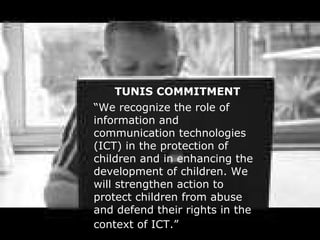
TUNIS COMMITMENT “ We recognize the role of information and communication technologies (ICT) in the protection of children and in enhancing the development of children. We will strengthen action to protect children from abuse and defend their rights in the context of ICT.”
World Telecommunication & Information Society Day   (WTISD) 2009 Theme:  “ Protecting children in cyberspace.”   2009-2010: Year Long Call for Action Countries and organizations have responded with  their own initiatives in: Creating public awareness Supporting the developments of the ITU  guidelines on COP Identifying risks and vulnerabilities Building resource depositories for general use Promoting capacity building  2010: Report on ITU, Member States,  and Partners Working Together to Improve  the Protection of Children Online  “ We must work  together like never before if we are to protect our children. In cyberspace, we really are only as strong as our weakest link; we are only as secure as our weakest hub. There's an old Swedish proverb that goes like this: "Fear less, hope more - Whine less, breathe more - Talk less, say more - Hate less, love more - And all good things are yours.“ H.M. Queen Silvia of Sweden,  Patron of WTISD 2009   http://www.itu.int/wtisd/2009/initiatives.html
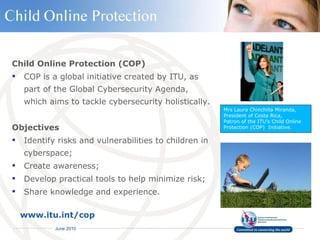
Child Online Protection (COP) COP is a global initiative created by ITU, as part of the Global Cybersecurity Agenda,  which aims to tackle cybersecurity holistically. Objectives Identify risks and vulnerabilities to children in cyberspace;  Create awareness;  Develop practical tools to help minimize risk;  Share knowledge and experience. www.itu.int/cop   Mrs Laura Chinchilla Miranda, President of Costa Rica, Patron of the ITU’s Child Online Protection (COP)  Initiative.
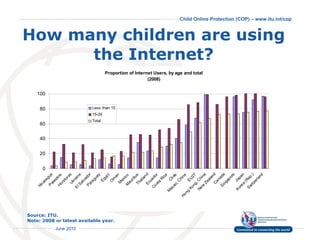
How many children are using the Internet? Source: ITU. Note: 2008 or latest available year.
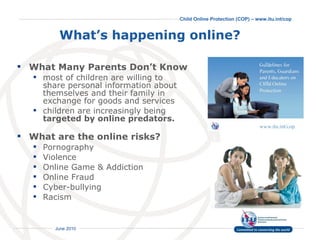
What Many Parents Don’t Know most of children are willing to  share personal information about  themselves and their family in  exchange for goods and services children are increasingly being targeted by online predators. What are the online risks? Pornography  Violence Online Game & Addiction Online Fraud Cyber-bullying Racism What’s happening online?
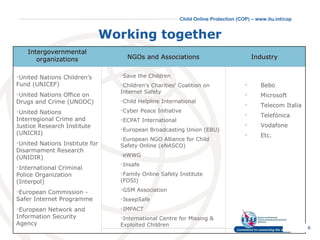
Working together Intergovernmental organizations NGOs and Associations Industry   United Nations Children’s Fund (UNICEF) United Nations Office on Drugs and Crime (UNODC)  United Nations Interregional Crime and Justice Research Institute (UNICRI) United Nations Institute for Disarmament Research (UNIDIR) International Criminal Police Organization (Interpol) European Commission - Safer Internet Programme European Network and Information Security Agency Save the Children Children's Charities' Coalition on Internet Safety  Child Helpline International Cyber Peace Initiative ECPAT International  European Broadcasting Union (EBU) European NGO Alliance for Child Safety Online (eNASCO) eWWG Insafe  Family Online Safety Institute (FOSI) GSM Association IkeepSafe IMPACT  International Centre for Missing & Exploited Children Bebo Microsoft  Telecom Italia Telefónica Vodafone  Etc.
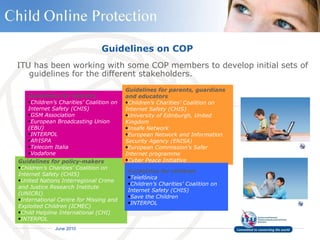
Guidelines on COP ITU has been working with some COP members to develop initial sets of guidelines for the different stakeholders.   Guidelines for policy-makers Children’s Charities’ Coalition on Internet Safety   (CHIS) United Nations Interregional Crime and Justice Research Institute   (UNICRI) International Centre for Missing and Exploited Children   (ICMEC) Child Helpline International (CHI)   INTERPOL Guidelines for industry Children’s Charities’ Coalition on Internet  Safety   (CHIS) GSM Association   European Broadcasting Union (EBU)   INTERPOL AfrISPA   Telecom Italia   Vodafone Guidelines for parents, guardians and educators Children’s Charities’ Coalition on Internet Safety (CHIS)   University of Edinburgh, United Kingdom   Insafe Network   European Network and Information Security Agency (ENISA)   European Commission’s Safer Internet programme   Cyber Peace Initiative   Guidelines for children Telefónica   Children’s Charities’ Coalition on Internet Safety   (CHIS) Save the Children   INTERPOL
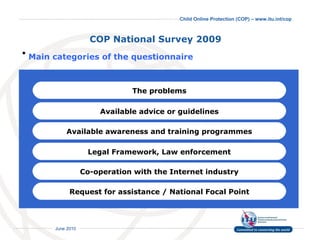
COP National Survey 2009   Main categories of the questionnaire   The problems Available advice or guidelines Legal Framework, Law enforcement Request for assistance / National Focal Point Available awareness and training programmes Co-operation with the Internet industry
COP National Survey 2009   The online questionnaire was carried out by BDT , distributed to each of the ITU’s 191 Member States in October-November, 2009  Responses from 50 countries so far Survey result presented at Internet Governance Forum in Egypt Still available on the COP website for other countries   www.itu.int/cop   The database is intended to be a planning tool and, over time, it will help to map what changes are taking place in all parts of the globe Summary of objective : To determine the current scope of online child safety  policy and legal frameworks across the world  To establish a database showing what is happening in the online child safety space around the world
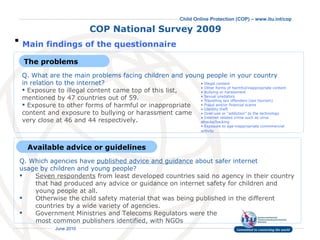
COP National Survey 2009   Main findings of the questionnaire   Q. Which agencies have  published advice and guidance  about safer internet usage by children and young people? Seven respondents  from least developed countries said no agency in their country that had produced any advice or guidance on internet safety for children and young people at all.  Otherwise the child safety material that was being published in the different countries by a wide variety of agencies.  Government Ministries and Telecoms Regulators were the  most common publishers identified, with NGOs Available advice or guidelines Q. What are the main problems facing children and young people in your country  in relation to the internet? Exposure to illegal content came top of this list,  mentioned by 47 countries out of 59.  Exposure to other forms of harmful or inappropriate  content and exposure to bullying or harassment came  very close at 46 and 44 respectively. The problems Illegal content  Other forms of harmful/inappropriate content Bullying or harassment Sexual predators Travelling sex offenders (sex tourism)  Fraud and/or financial scams Identity theft  Over-use or "addiction" to the technology  Internet related crime such as virus attacks/hacking Exposure to age-inappropriate commmercial activity
COP National Survey 2009   Q.  Are there any programmes/policies within schools/educational establishments/ youth  groups/other bodies, to promote the safe and responsible use of the Internet to children and young people?   Only 37 countries confirmed that such programmes exist 58% of Least Developed Countries either said there was nothing or they did not know of anything. Available awareness and training programmes Main findings of the questionnaire   Q. Does your country have law enforcement officers who have been trained to retrieve and analyze digital data taken from computers and the Internet?   Only 35 countries answered in the affirmative. 17 said no, and seven did not know Legal Framework, Law enforcement Q. Does your country have a hotline or other specific mechanism for reporting suspected illegal behaviour found or taking place on the Internet? 29 countries said yes, 30 said no or did not know. Co-operation with the Internet industry
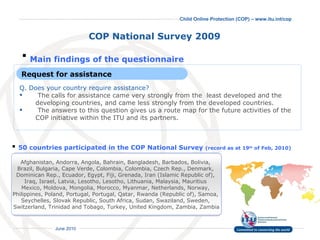
Afghanistan, Andorra, Angola, Bahrain, Bangladesh, Barbados, Bolivia,  Brazil, Bulgaria, Cape Verde, Colombia, Colombia, Czech Rep., Denmark,  Dominican Rep., Ecuador, Egypt, Fiji, Grenada, Iran (Islamic Republic of),  Iraq, Israel, Latvia, Lesotho, Lesotho, Lithuania, Malaysia, Mauritius  Mexico, Moldova, Mongolia, Morocco, Myanmar, Netherlands, Norway,  Philippines, Poland, Portugal, Portugal, Qatar, Rwanda (Republic of), Samoa,  Seychelles, Slovak Republic, South Africa, Sudan, Swaziland, Sweden,  Switzerland, Trinidad and Tobago, Turkey, United Kingdom, Zambia, Zambia 50 countries participated in the COP National Survey  (record as at 19 th  of Feb, 2010)   COP National Survey 2009   Main findings of the questionnaire   Q. Does your country require assistance? The calls for assistance came very strongly from the  least developed and the developing countries, and came less strongly from the developed countries. The answers to this question gives us a route map for the future activities of the COP initiative within the ITU and its partners. Request for assistance
Resources from the COP Survey 2009   National resources will be shared    with the public within a month •   Available advice or guidelines     - Name of the agency    - Internet link for the guidelines   •   Available awareness and training programmes   • Programmes/policies within schools    - Name of Child Safety Initiative   - Name of Organization • Programmes for parents • Programmes for teachers • Programmes provided by other agencies • Future planned programme/policy initiatives on Internet safety for children and young people   •   National Focal Point •National focal point or agency   •   Co-operation with the Internet industry  •Hotline or other specific mechanism for reporting suspected illegal content  •Hotline or other specific mechanism for reporting suspected illegal behavior found in the Internet •Main players in the Internet industry co-operate with your government at http://www.itu.int/cop
Measuring Child Online Protection Since this is a relatively new field, there is a lack of internationally comparable indicators to measure various aspects of COP  ITU-D/STAT began work to develop a statistical framework and indicators for COP, as an input to the COP initiative First results were presented to stakeholders at WSIS Forum & ITU Council Working Group on Child Online Protection for discussion http://www.itu.int/council/groups/wg-cop/index.html
Raising Awareness Raising Awareness on COP issues through the organization of workshops, events, strategic dialogues, regional forums… Thematic Workshop on  “Protecting Children in Cyberspace”,   12 May 2010, Geneva, Switzerland, organized during the WSIS Forum 2010 together with EBU, eNasco and Save The Children  Celebration of the  Safer Internet Day  together with Telecom Italia and Save The Children (February 2010) ITU Regional Cybersecurity Forum for Americas  held in the Dominican Republic (November 2009)  Open Forum on Child online Protection  held in Egypt during the 4th Internet Governance Forum Meeting (November 2009) ITU/MIC Strategic Dialogue on Safer Internet Environment for Children  held in Japan (June 2009) ITU Protecting Children from Cyber-exploitation @ WSIS Forum 2009  (May 2009) ITU Child Online Protection Initiative @ WSIS Forum 2009  (May 2009)
Ongoing and Future Activities Implementation of the ITU strategy on COP Child helpline (allocation of the number 116 111)  Providing assistance in drafting COP legislation to developing  countries (e.g. Republic of Mauritius, etc..) Roadmap for the implementation of COP at the national level  Implementation of the Guidelines at the national level  International Cooperation with Interpol, UNICEF, UNICRI and UNODC & many others…
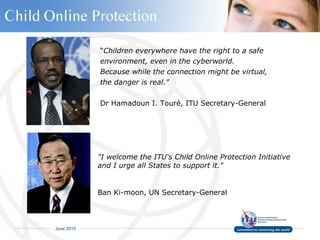
“ Children everywhere have the right to a safe  environment, even in the cyberworld.  Because while the connection might be virtual,  the danger is real.” Dr Hamadoun I. Touré, ITU Secretary-General "I welcome the ITU's Child Online Protection Initiative  and I urge all States to support it." Ban Ki-moon, UN Secretary-General
More information   Child Online Protection Initiative (COP)  http://www.itu.int/cop  World Telecommunication & Information Society Day  http://www.itu.int/wtisd/index.html Cybersecurity, Spam and Cybercrime: Confidence and security in the use of ICTs  http://www.itu.int/cybersecurity   ITU Global Cybersecurity Agenda http://www.itu.int/cybersecurity/gca
Thank you for your attention! Contact us:  cop@itu.int

CTO-Cybersecurity-Forum-2010-Cristina Buetti

  • 1.
    ITU’s Child OnlineProtection (COP) Initiative 17-18 June 2010, London, United Kingdom Cristina Bueti Programme Coordinator Telecommunication and Standardization Bureau [email_address]
  • 2.
    ITU & CybersecurityDr. H. I. Touré, ITU Secretary-General has identified C ybersecurity as a top priority. ITU provides the global perspective and expertise needed, promoting cybersecurity through a range of activities related to standardization, radiocommunication and technical assistance to developing countries tailored to their needs. Instigator of World Summit on Information Society (WSIS) ITU was entrusted by leaders of the international community with Action Line C5: “Building Confidence and Security in the Use of ICTs". In 2007, in answer to this responsibility, Dr Hamadoun Touré, ITU Secretary-General, launched the Global Cybersecurity Agenda (GCA)
  • 3.
    TUNIS COMMITMENT “We recognize the role of information and communication technologies (ICT) in the protection of children and in enhancing the development of children. We will strengthen action to protect children from abuse and defend their rights in the context of ICT.”
  • 4.
    World Telecommunication &Information Society Day (WTISD) 2009 Theme: “ Protecting children in cyberspace.” 2009-2010: Year Long Call for Action Countries and organizations have responded with their own initiatives in: Creating public awareness Supporting the developments of the ITU guidelines on COP Identifying risks and vulnerabilities Building resource depositories for general use Promoting capacity building 2010: Report on ITU, Member States, and Partners Working Together to Improve the Protection of Children Online “ We must work together like never before if we are to protect our children. In cyberspace, we really are only as strong as our weakest link; we are only as secure as our weakest hub. There's an old Swedish proverb that goes like this: "Fear less, hope more - Whine less, breathe more - Talk less, say more - Hate less, love more - And all good things are yours.“ H.M. Queen Silvia of Sweden, Patron of WTISD 2009 http://www.itu.int/wtisd/2009/initiatives.html
  • 5.
    Child Online Protection(COP) COP is a global initiative created by ITU, as part of the Global Cybersecurity Agenda, which aims to tackle cybersecurity holistically. Objectives Identify risks and vulnerabilities to children in cyberspace; Create awareness; Develop practical tools to help minimize risk; Share knowledge and experience. www.itu.int/cop Mrs Laura Chinchilla Miranda, President of Costa Rica, Patron of the ITU’s Child Online Protection (COP) Initiative.
  • 6.
    How many childrenare using the Internet? Source: ITU. Note: 2008 or latest available year.
  • 7.
    What Many ParentsDon’t Know most of children are willing to share personal information about themselves and their family in exchange for goods and services children are increasingly being targeted by online predators. What are the online risks? Pornography Violence Online Game & Addiction Online Fraud Cyber-bullying Racism What’s happening online?
  • 8.
    Working together Intergovernmentalorganizations NGOs and Associations Industry United Nations Children’s Fund (UNICEF) United Nations Office on Drugs and Crime (UNODC) United Nations Interregional Crime and Justice Research Institute (UNICRI) United Nations Institute for Disarmament Research (UNIDIR) International Criminal Police Organization (Interpol) European Commission - Safer Internet Programme European Network and Information Security Agency Save the Children Children's Charities' Coalition on Internet Safety Child Helpline International Cyber Peace Initiative ECPAT International European Broadcasting Union (EBU) European NGO Alliance for Child Safety Online (eNASCO) eWWG Insafe Family Online Safety Institute (FOSI) GSM Association IkeepSafe IMPACT International Centre for Missing & Exploited Children Bebo Microsoft Telecom Italia Telefónica Vodafone Etc.
  • 9.
    Guidelines on COPITU has been working with some COP members to develop initial sets of guidelines for the different stakeholders. Guidelines for policy-makers Children’s Charities’ Coalition on Internet Safety (CHIS) United Nations Interregional Crime and Justice Research Institute (UNICRI) International Centre for Missing and Exploited Children (ICMEC) Child Helpline International (CHI) INTERPOL Guidelines for industry Children’s Charities’ Coalition on Internet Safety (CHIS) GSM Association European Broadcasting Union (EBU) INTERPOL AfrISPA Telecom Italia Vodafone Guidelines for parents, guardians and educators Children’s Charities’ Coalition on Internet Safety (CHIS) University of Edinburgh, United Kingdom Insafe Network European Network and Information Security Agency (ENISA) European Commission’s Safer Internet programme Cyber Peace Initiative Guidelines for children Telefónica Children’s Charities’ Coalition on Internet Safety (CHIS) Save the Children INTERPOL
  • 10.
    COP National Survey2009 Main categories of the questionnaire The problems Available advice or guidelines Legal Framework, Law enforcement Request for assistance / National Focal Point Available awareness and training programmes Co-operation with the Internet industry
  • 11.
    COP National Survey2009 The online questionnaire was carried out by BDT , distributed to each of the ITU’s 191 Member States in October-November, 2009 Responses from 50 countries so far Survey result presented at Internet Governance Forum in Egypt Still available on the COP website for other countries www.itu.int/cop The database is intended to be a planning tool and, over time, it will help to map what changes are taking place in all parts of the globe Summary of objective : To determine the current scope of online child safety policy and legal frameworks across the world To establish a database showing what is happening in the online child safety space around the world
  • 12.
    COP National Survey2009 Main findings of the questionnaire Q. Which agencies have published advice and guidance about safer internet usage by children and young people? Seven respondents from least developed countries said no agency in their country that had produced any advice or guidance on internet safety for children and young people at all. Otherwise the child safety material that was being published in the different countries by a wide variety of agencies. Government Ministries and Telecoms Regulators were the most common publishers identified, with NGOs Available advice or guidelines Q. What are the main problems facing children and young people in your country in relation to the internet? Exposure to illegal content came top of this list, mentioned by 47 countries out of 59. Exposure to other forms of harmful or inappropriate content and exposure to bullying or harassment came very close at 46 and 44 respectively. The problems Illegal content Other forms of harmful/inappropriate content Bullying or harassment Sexual predators Travelling sex offenders (sex tourism) Fraud and/or financial scams Identity theft Over-use or "addiction" to the technology Internet related crime such as virus attacks/hacking Exposure to age-inappropriate commmercial activity
  • 13.
    COP National Survey2009 Q. Are there any programmes/policies within schools/educational establishments/ youth groups/other bodies, to promote the safe and responsible use of the Internet to children and young people? Only 37 countries confirmed that such programmes exist 58% of Least Developed Countries either said there was nothing or they did not know of anything. Available awareness and training programmes Main findings of the questionnaire Q. Does your country have law enforcement officers who have been trained to retrieve and analyze digital data taken from computers and the Internet? Only 35 countries answered in the affirmative. 17 said no, and seven did not know Legal Framework, Law enforcement Q. Does your country have a hotline or other specific mechanism for reporting suspected illegal behaviour found or taking place on the Internet? 29 countries said yes, 30 said no or did not know. Co-operation with the Internet industry
  • 14.
    Afghanistan, Andorra, Angola,Bahrain, Bangladesh, Barbados, Bolivia, Brazil, Bulgaria, Cape Verde, Colombia, Colombia, Czech Rep., Denmark, Dominican Rep., Ecuador, Egypt, Fiji, Grenada, Iran (Islamic Republic of), Iraq, Israel, Latvia, Lesotho, Lesotho, Lithuania, Malaysia, Mauritius Mexico, Moldova, Mongolia, Morocco, Myanmar, Netherlands, Norway, Philippines, Poland, Portugal, Portugal, Qatar, Rwanda (Republic of), Samoa, Seychelles, Slovak Republic, South Africa, Sudan, Swaziland, Sweden, Switzerland, Trinidad and Tobago, Turkey, United Kingdom, Zambia, Zambia 50 countries participated in the COP National Survey (record as at 19 th of Feb, 2010) COP National Survey 2009 Main findings of the questionnaire Q. Does your country require assistance? The calls for assistance came very strongly from the least developed and the developing countries, and came less strongly from the developed countries. The answers to this question gives us a route map for the future activities of the COP initiative within the ITU and its partners. Request for assistance
  • 15.
    Resources from theCOP Survey 2009 National resources will be shared with the public within a month • Available advice or guidelines - Name of the agency - Internet link for the guidelines • Available awareness and training programmes • Programmes/policies within schools - Name of Child Safety Initiative - Name of Organization • Programmes for parents • Programmes for teachers • Programmes provided by other agencies • Future planned programme/policy initiatives on Internet safety for children and young people • National Focal Point •National focal point or agency • Co-operation with the Internet industry •Hotline or other specific mechanism for reporting suspected illegal content •Hotline or other specific mechanism for reporting suspected illegal behavior found in the Internet •Main players in the Internet industry co-operate with your government at http://www.itu.int/cop
  • 16.
    Measuring Child OnlineProtection Since this is a relatively new field, there is a lack of internationally comparable indicators to measure various aspects of COP ITU-D/STAT began work to develop a statistical framework and indicators for COP, as an input to the COP initiative First results were presented to stakeholders at WSIS Forum & ITU Council Working Group on Child Online Protection for discussion http://www.itu.int/council/groups/wg-cop/index.html
  • 17.
    Raising Awareness RaisingAwareness on COP issues through the organization of workshops, events, strategic dialogues, regional forums… Thematic Workshop on “Protecting Children in Cyberspace”, 12 May 2010, Geneva, Switzerland, organized during the WSIS Forum 2010 together with EBU, eNasco and Save The Children Celebration of the Safer Internet Day together with Telecom Italia and Save The Children (February 2010) ITU Regional Cybersecurity Forum for Americas held in the Dominican Republic (November 2009) Open Forum on Child online Protection held in Egypt during the 4th Internet Governance Forum Meeting (November 2009) ITU/MIC Strategic Dialogue on Safer Internet Environment for Children held in Japan (June 2009) ITU Protecting Children from Cyber-exploitation @ WSIS Forum 2009 (May 2009) ITU Child Online Protection Initiative @ WSIS Forum 2009 (May 2009)
  • 18.
    Ongoing and FutureActivities Implementation of the ITU strategy on COP Child helpline (allocation of the number 116 111) Providing assistance in drafting COP legislation to developing countries (e.g. Republic of Mauritius, etc..) Roadmap for the implementation of COP at the national level Implementation of the Guidelines at the national level International Cooperation with Interpol, UNICEF, UNICRI and UNODC & many others…
  • 19.
    “ Children everywherehave the right to a safe environment, even in the cyberworld. Because while the connection might be virtual, the danger is real.” Dr Hamadoun I. Touré, ITU Secretary-General "I welcome the ITU's Child Online Protection Initiative and I urge all States to support it." Ban Ki-moon, UN Secretary-General
  • 20.
    More information Child Online Protection Initiative (COP) http://www.itu.int/cop World Telecommunication & Information Society Day http://www.itu.int/wtisd/index.html Cybersecurity, Spam and Cybercrime: Confidence and security in the use of ICTs http://www.itu.int/cybersecurity ITU Global Cybersecurity Agenda http://www.itu.int/cybersecurity/gca
  • 21.
    Thank you foryour attention! Contact us: cop@itu.int

Editor's Notes

  • #2 I am pleased to update you on the Child Online Protection Initiative.
  • #4 The WSIS outcomes also specifically recognized the needs of children and young people and their protection in cyberspace. The Tunis Commitment recognized "the role of information and communication technologies (ICT) in the protection of children and in enhancing the development of children" and the need to "strengthen action to protect children from abuse and defend their rights in the context of ICT". Children are our future. This universal fact, coupled with young people’s particular vulnerability in an online environment, made a specialized child focused initiative a necessity.  The Child Online Protection (COP) is located within the framework of the larger ITU Global Cybersecurity Agenda (GCA). The legal, technical and institutional challenges posed by the issue of cybersecurity are global and far-reaching and can only be addressed through a coherent strategy taking into account the role of different stakeholders and existing initiatives, within a framework of an international collaborative network.                        The COP initiative is in line with ITU ’ s mandate to establish the foundation for a safe and secure cyberworld for future generations.
  • #5 Our campaign is enhanced this year through the celebration of WTISD. The theme for 2009, as you know, was “Protecting Children in Cyberspace” and this year SG has invited Ministers from all Member States to launch year long campaigns on this theme. We have transmitted a call for action: calling upon all stakeholders (policy makers, regulators, operators and industry) to promote the adoption of policies and strategies that will protect children in cyberspace and promote their safe access to online resources . Create public awareness on the issues related to protecting children in cyberspace and to identify policies, best practices, tools and resources for adaptation/use in their countries. - promote ongoing work aimed at developing Guidelines on protecting children online for policy makers and regulators. - Identify risks and vulnerabilities to children in cyberspace as the Internet and other online resources continue to expand. - Build resource repositories for common use - Promote capacity building aimed at strengthening global response in protecting children as they venture into cyberspace.
  • #6 The COP initiative was presented on 13 November 2008 at the ITU Council’s High Level Segment, with top ministers attending from around the world. COP is a global initiative created by ITU together with other UN agencies and partners, as part of the Global Cybersecurity Agenda, which aims to tackle cybersecurity holistically. The key objectives of the initiative are to: Identify risks and vulnerabilities to children in cyberspace; Create awareness; Develop practical tools to help minimize risk; Share knowledge and experience.
  • #7 ITU data show that young people are currently the main users of the Internet, especially the age group 15-24. In some countries (especially in the developed world), more children under 15 are online compared to the total population. In Switzerland, for example, there are more children in the age group under 15 online than those in the age group 15-24.
  • #8 So why is there a need for such an initiative? Computers have brought untold benefits to children around the world, with the number of connected households increasing each year. But while the potential for good is undisputed, it has also raised new and disturbing issues, especially where children are concerned. Just look at the numbers: In 1998, there were just 182 million people using the Internet globally By early 2009, there were over 1.5 billion Internet users worldwide According to surveys: Most of children are willing to share personal information about themselves and their family in exchange for goods and services children are increasingly being targeted by online predators. What are the online risks? Pornography While filtering programs and parental controls are getting better, many children around the world are still at risk of viewing images that they aren’t mature enough to understand or appreciate. Violence While aggression is an unfortunate part of life, the sheer range and volume of online violence is something most of us don’t want our children exposed to: images of war, domestic abuse, bigotry, misogyny and other vicious attacks on others. Online Gaming & Addiction There is a growing body of evidence that many children are developing an unhealthy addiction to spending time online. Often, this addiction takes the form of internet gaming, but essentially any online activity can become addictive. The dangers of such an addiction are an increased risk of health and social problems. Online Fraud Many fraudsters like to specifically target children, as young people often don’t hae the experience and knowledge to distinguish legitimate requests from fraudulent ones. Fraudsters can use knowledge gained from children online to steal, blackmail, terrorize and even kidnap. Cyber-bullying With the invention of the Internet and mobile technology, children today are open to bullying and intimidation wherever they are – it’s no longer merely a playground event. Surfing the internet can have severe consequences for a child’s self-confidence and personal development. Racism The Internet has given us instantaneous global access. While this can promote greater communication, understanding and respect; in some cases, this global reach makes it easier to spread racial abuse and hate.  
  • #10 ITU has been working with some COP members to develop initial sets of guidelines for the different stakeholders. This is a unique exercise that no one before was able achieved. Having so many stakeholders working together on the production of guidelines and reaching an agreement on the main issues surrounding child online protection. We hope that you will find them useful and that you will use them in your country.
  • #17 This report considers the measurement aspects of child online protection, with the ultimate aim of reliably measuring the problem and monitoring the solutions. Content and structure of this publication Chapter 2 describes a proposed statistical framework for measuring child online protection. It covers scope, actors ( e.g. children, parents), definitions, classifications, indicators and data collection models. Chapter 3 looks at measuring the context in which online threats to children arise. An important element of the context is the Internet and the rapid growth in its content and use. Chapters 4, 5 and 6 consider measurement of aspects of the statistical framework as follows: awareness, concerns and attitudes; risk-prone behaviour of children; incidents and children’s responses; and, preventative actions. The chapters include recommendations for indicators and measurement approaches. Chapter 7 looks at the statistical challenges involved in measuring child online protection, while Chapter 8 presents conclusions and summarizes the recommendations presented in the report.
  • #18 ITU is lobbying telecommunications administrations around the world to consider the allocation of the number 116111 to give access to helplines run by organizations dedicated to the support and welfare of children. The universal use of this number would make it easier for children to access help when they need it, wherever they are.
  • #19 ITU is lobbying telecommunications administrations around the world to consider the allocation of the number 116111 to give access to helplines run by organizations dedicated to the support and welfare of children. The universal use of this number would make it easier for children to access help when they need it, wherever they are.
  • #20 As the ITU SG has said: Children everywhere have the right to a safe environment, even in the cyberworld. Because while the connection might be virtual, the danger is real.” If I can also quote Her Majesty Queen Sylvia of Sweden, Patron of the WTISD 2009: “ We must work together like never before if we are to protect our children. In cyberspace, we really are only as strong as our weakest link; we are only as secure as our weakest hub. There's an old Swedish proverb that goes like this: "Fear less, hope more - Whine less, breathe more - Talk less, say more - Hate less, love more - And all good things are yours.“
  • #21 For more information, please visit the websites shown on the screen
  • #22 Or contact us at cop@ itu.int Thank you very much for your attention.