
Machine Learning for
Decentralized and Flying Radio
Devices
January 29, 2018
Prof. David Gesbert
EURECOM – Sophia Antipolis, France
29/01/2018 - EURECOM GENERAL - p 2
EURECOM - Sophia Antipolis
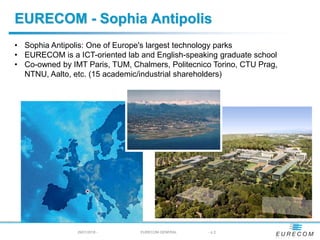
• Sophia Antipolis: One of Europe's largest technology parks
• EURECOM is a ICT-oriented lab and English-speaking graduate school
• Co-owned by IMT Paris, TUM, Chalmers, Politecnico Torino, CTU Prag,
NTNU, Aalto, etc. (15 academic/industrial shareholders)
AI For Wireless
29/01/2018 - - p 3
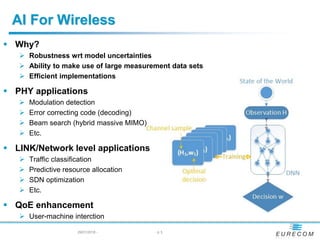
 Why?
 Robustness wrt model uncertainties
 Ability to make use of large measurement data sets
 Efficient implementations
 PHY applications
 Modulation detection
 Error correcting code (decoding)
 Beam search (hybrid massive MIMO)
 Etc.
 LINK/Network level applications
 Traffic classification
 Predictive resource allocation
 SDN optimization
 Etc.
 QoE enhancement
 User-machine interction
AI For Wireless: New perspectives
29/01/2018 - - p 4
 Autonomous radio devices
 Dealing with measurements uncertainties
 Dealing with decentralized decision scenarios
 Case 1: Team DNN for cooperative decentralized
communications
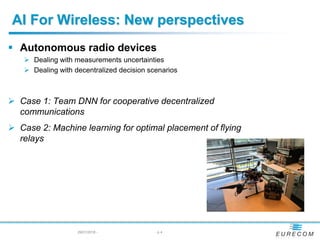
 Case 2: Machine learning for optimal placement of flying
relays
Team Learning for decentralized wireless networks
29/01/2018 - - p 5
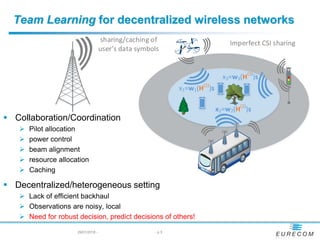
sharing/caching of
user’s data symbols
Imperfect CSI sharing
x2=w2(H(2)
)s
x3=w3(H(3)
)s
x1=w1(H(1)
)s
 Collaboration/Coordination
 Pilot allocation
 power control
 beam alignment
 resource allocation
 Caching
 Decentralized/heterogeneous setting
 Lack of efficient backhaul
 Observations are noisy, local
 Need for robust decision, predict decisions of others!
Introducing Team DNNs
29/01/2018 - - p 6
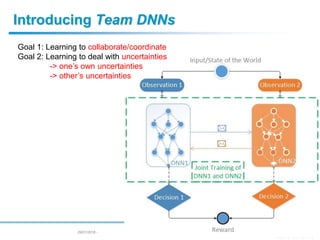
Goal 1: Learning to collaborate/coordinate
Goal 2: Learning to deal with uncertainties
-> one’s own uncertainties
-> other’s uncertainties
Team DNN example: Power Control under arbitrary noisy
feedback
29/01/2018 - - p 7
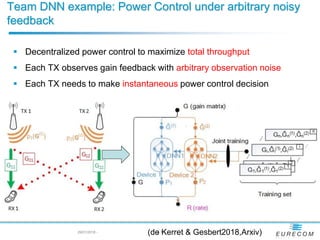
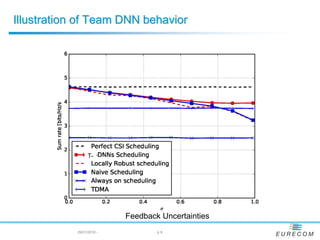
 Decentralized power control to maximize total throughput
 Each TX observes gain feedback with arbitrary observation noise
 Each TX needs to make instantaneous power control decision
(de Kerret & Gesbert2018,Arxiv)
Illustration of Team DNN behavior
29/01/2018 - - p 8
Feedback Uncertainties
T-
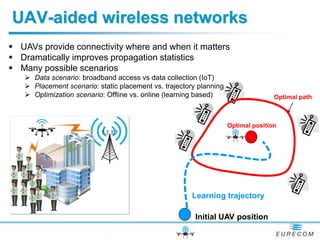
UAV-aided wireless networks
 UAVs provide connectivity where and when it matters
 Dramatically improves propagation statistics
 Many possible scenarios
 Data scenario: broadband access vs data collection (IoT)
 Placement scenario: static placement vs. trajectory planning
 Optimization scenario: Offline vs. online (learning based)
-
Initial UAV position
Optimal position
Learning trajectory
Optimal path
Offline path planning
-
[1] R.Gangula, D.Gesbert, et.al “Trajectory Optimization for Mobile Access Point” Accepted in Asilomar 2017.
[2]A. T. Klesh, P. T. Kabamba, and A. R. Girard, “Path planning for cooperative time-optimal information collection,” in American
Control Conference, June 2008, pp. 1991–1996.
[3] Q. Wu, Y. Zeng, and R. Zhang, “Joint Trajectory and Communication Design for UAV-Enabled Multiple Access,” , Apr. 2017.
Small/Moderate flying budget Large flying budget
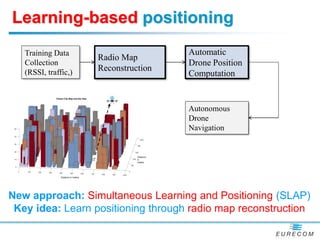
Learning-based positioning
Training Data
Collection
(RSSI, traffic,)
Radio Map
Reconstruction
Automatic
Drone Position
Computation
Autonomous
Drone
Navigation
New approach: Simultaneous Learning and Positioning (SLAP)
Key idea: Learn positioning through radio map reconstruction
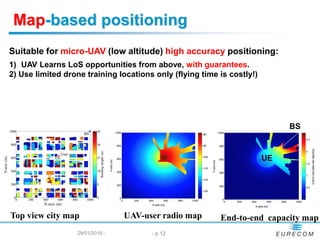
Map-based positioning
29/01/2018 - - p 12
1) UAV Learns LoS opportunities from above, with guarantees.
2) Use limited drone training locations only (flying time is costly!)
Suitable for micro-UAV (low altitude) high accuracy positioning:
Top view city map UAV-user radio map End-to-end capacity map
BS
UE
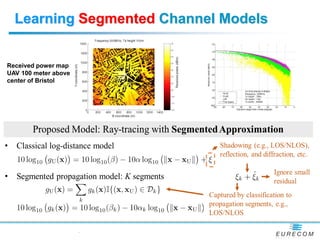
Learning Segmented Channel Models
-
Received power map
UAV 100 meter above
center of Bristol
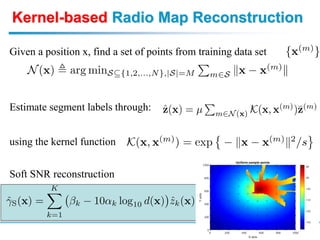
Kernel-based Radio Map Reconstruction
Given a position x, find a set of points from training data set
Estimate segment labels through:
using the kernel function
Soft SNR reconstruction
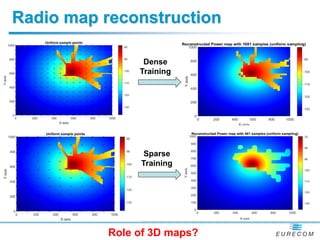
Radio map reconstruction
Dense
Training
Sparse
Training
Role of 3D maps?
Machine Learning for 3D map reconstruction
Proposed concept:
1- Learn propagation parameters using previous EM algorithm
2- Soft-classify users into LoS/NLoS
3- Reconstruct 3D map from “radio shadow” data
Connections with
-3D Imaging with WiFi [Y. Mostofi et al. @ UCSB]
-GPS based 3D imaging [Madhow et al @ UCSB]
[Esrafilian, Gesbert, Globecom 2017]
Joint 3D and radio map reconstruction
17
An orthoimagery of
an area at center
Washington DC, USA
[Chen, Esrafilian, Gesbert, Mitra, Robotics, Science and Systems, MIT, 2017]
Radio map
reconstruction
SNR/Radio map estimate
3D city map estimate
Joint approach
DroneFor5GLab @ EURECOM
 Live video demo
 Please contact David G to watch it again!
-

Machine learning for decentralized and flying radio devices

  • 1.
    Machine Learning for Decentralizedand Flying Radio Devices January 29, 2018 Prof. David Gesbert EURECOM – Sophia Antipolis, France
  • 2.
    29/01/2018 - EURECOMGENERAL - p 2 EURECOM - Sophia Antipolis • Sophia Antipolis: One of Europe's largest technology parks • EURECOM is a ICT-oriented lab and English-speaking graduate school • Co-owned by IMT Paris, TUM, Chalmers, Politecnico Torino, CTU Prag, NTNU, Aalto, etc. (15 academic/industrial shareholders)
  • 3.
    AI For Wireless 29/01/2018- - p 3  Why?  Robustness wrt model uncertainties  Ability to make use of large measurement data sets  Efficient implementations  PHY applications  Modulation detection  Error correcting code (decoding)  Beam search (hybrid massive MIMO)  Etc.  LINK/Network level applications  Traffic classification  Predictive resource allocation  SDN optimization  Etc.  QoE enhancement  User-machine interction
  • 4.
    AI For Wireless:New perspectives 29/01/2018 - - p 4  Autonomous radio devices  Dealing with measurements uncertainties  Dealing with decentralized decision scenarios  Case 1: Team DNN for cooperative decentralized communications  Case 2: Machine learning for optimal placement of flying relays
  • 5.
    Team Learning fordecentralized wireless networks 29/01/2018 - - p 5 sharing/caching of user’s data symbols Imperfect CSI sharing x2=w2(H(2) )s x3=w3(H(3) )s x1=w1(H(1) )s  Collaboration/Coordination  Pilot allocation  power control  beam alignment  resource allocation  Caching  Decentralized/heterogeneous setting  Lack of efficient backhaul  Observations are noisy, local  Need for robust decision, predict decisions of others!
  • 6.
    Introducing Team DNNs 29/01/2018- - p 6 Goal 1: Learning to collaborate/coordinate Goal 2: Learning to deal with uncertainties -> one’s own uncertainties -> other’s uncertainties
  • 7.
    Team DNN example:Power Control under arbitrary noisy feedback 29/01/2018 - - p 7  Decentralized power control to maximize total throughput  Each TX observes gain feedback with arbitrary observation noise  Each TX needs to make instantaneous power control decision (de Kerret & Gesbert2018,Arxiv)
  • 8.
    Illustration of TeamDNN behavior 29/01/2018 - - p 8 Feedback Uncertainties T-
  • 9.
    UAV-aided wireless networks UAVs provide connectivity where and when it matters  Dramatically improves propagation statistics  Many possible scenarios  Data scenario: broadband access vs data collection (IoT)  Placement scenario: static placement vs. trajectory planning  Optimization scenario: Offline vs. online (learning based) - Initial UAV position Optimal position Learning trajectory Optimal path
  • 10.
    Offline path planning - [1]R.Gangula, D.Gesbert, et.al “Trajectory Optimization for Mobile Access Point” Accepted in Asilomar 2017. [2]A. T. Klesh, P. T. Kabamba, and A. R. Girard, “Path planning for cooperative time-optimal information collection,” in American Control Conference, June 2008, pp. 1991–1996. [3] Q. Wu, Y. Zeng, and R. Zhang, “Joint Trajectory and Communication Design for UAV-Enabled Multiple Access,” , Apr. 2017. Small/Moderate flying budget Large flying budget
  • 11.
    Learning-based positioning Training Data Collection (RSSI,traffic,) Radio Map Reconstruction Automatic Drone Position Computation Autonomous Drone Navigation New approach: Simultaneous Learning and Positioning (SLAP) Key idea: Learn positioning through radio map reconstruction
  • 12.
    Map-based positioning 29/01/2018 -- p 12 1) UAV Learns LoS opportunities from above, with guarantees. 2) Use limited drone training locations only (flying time is costly!) Suitable for micro-UAV (low altitude) high accuracy positioning: Top view city map UAV-user radio map End-to-end capacity map BS UE
  • 13.
    Learning Segmented ChannelModels - Received power map UAV 100 meter above center of Bristol
  • 14.
    Kernel-based Radio MapReconstruction Given a position x, find a set of points from training data set Estimate segment labels through: using the kernel function Soft SNR reconstruction
  • 15.
  • 16.
    Machine Learning for3D map reconstruction Proposed concept: 1- Learn propagation parameters using previous EM algorithm 2- Soft-classify users into LoS/NLoS 3- Reconstruct 3D map from “radio shadow” data Connections with -3D Imaging with WiFi [Y. Mostofi et al. @ UCSB] -GPS based 3D imaging [Madhow et al @ UCSB] [Esrafilian, Gesbert, Globecom 2017]
  • 17.
    Joint 3D andradio map reconstruction 17 An orthoimagery of an area at center Washington DC, USA [Chen, Esrafilian, Gesbert, Mitra, Robotics, Science and Systems, MIT, 2017] Radio map reconstruction SNR/Radio map estimate 3D city map estimate Joint approach
  • 18.
    DroneFor5GLab @ EURECOM Live video demo  Please contact David G to watch it again! -