IT’S A BALANCING ACT: TAKING CARE OF YOURSELF WHILE WORKING WITH TRAUMATIZED CHILDREN & TEENS NOVEMBER, 2014 
Rachel Freeman, LCSW 
Sexual Assault Center
Image credit: http://rpreschern.wordpress.com/2014/03/01/a-balancing-act/
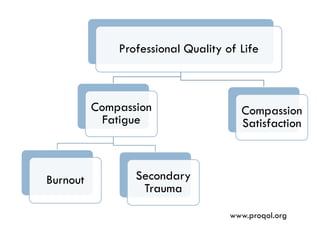
Professional Quality of Life 
Compassion Fatigue 
Burnout 
Secondary Trauma 
Compassion Satisfaction 
www.proqol.org
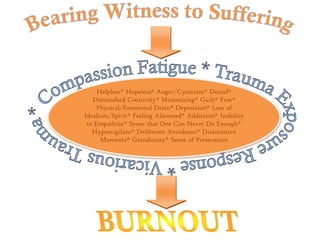
Helpless* Hopeless* Anger/Cynicism* Denial* Diminished Creativity* Minimizing* Guilt* Fear* Physical/Emotional Drain* Depression* Loss of Idealism/Spirit* Feeling Alienated* Addiction* Inability to Empathize* Sense that One Can Never Do Enough* Hypervigilant* Deliberate Avoidance* Dissociative Moments* Grandiosity* Sense of Persecution
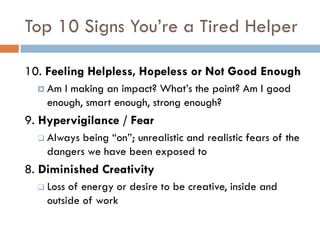
Top 10 Signs You’re a Tired Helper 
10. Feeling Helpless, Hopeless or Not Good Enough 
Am I making an impact? What’s the point? Am I good enough, smart enough, strong enough? 
9. Hypervigilance / Fear 
Always being “on”; unrealistic and realistic fears of the dangers we have been exposed to 
8. Diminished Creativity 
Loss of energy or desire to be creative, inside and outside of work
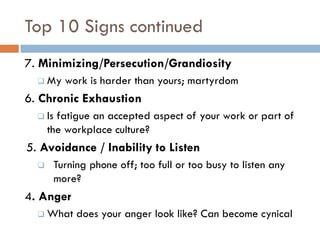
Top 10 Signs continued 
7. Minimizing/Persecution/Grandiosity 
My work is harder than yours; martyrdom 
6. Chronic Exhaustion 
Is fatigue an accepted aspect of your work or part of the workplace culture? 
5. Avoidance / Inability to Listen 
Turning phone off; too full or too busy to listen any more? 
4. Anger 
What does your anger look like? Can become cynical
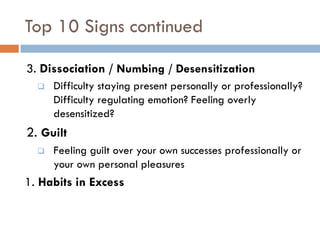
Top 10 Signs continued 
3. Dissociation / Numbing / Desensitization 
Difficulty staying present personally or professionally? Difficulty regulating emotion? Feeling overly desensitized? 
2. Guilt 
Feeling guilt over your own successes professionally or your own personal pleasures 
1. Habits in Excess
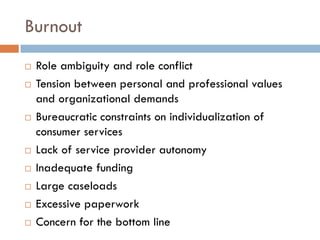
Burnout 
Role ambiguity and role conflict 
Tension between personal and professional values and organizational demands 
Bureaucratic constraints on individualization of consumer services 
Lack of service provider autonomy 
Inadequate funding 
Large caseloads 
Excessive paperwork 
Concern for the bottom line
Burnout Symptoms 
Emotional and/or physical exhaustion 
Excessive negative thoughts, especially about job 
Irritated or frustrated easily by small problems or co-workers 
Decreased feelings of sympathy 
Feeling alone 
Feeling unreasonable pressure to succeed 
Loss of meaning
The path to tranquility: “In dealing with those who are undergoing great suffering, if you feel ‘burn-out’ setting in, if you feel demoralized and exhausted, it is best, for the sake of everyone, to withdraw and restore yourself. The point is to have a long-term perspective”. – Dalai Lama
Image credit: www.lifehack.org
Compassion Satisfaction 
The Positive Aspects of Healing/Helping 
Pleasure and satisfaction derived from working in helping, care-giving systems 
Healing Involvement 
May be related to 
Providing care 
The system 
Work and colleagues 
Beliefs about self 
Altruism
Compassion Satisfaction 
When employees experience Compassion Satisfaction: 
Absentee rates are lower 
Employees are more productive 
Organizational health care costs are lower 
Greater physical and mental health of employees 
Staff retention rates are higher 
Happy and satisfied employees 
Quality of services can be greater 
Increased employee pride, trust and commitment
So…What are you willing to do?
“We cannot hold a torch to light another’s path without brightening our own.” ~Ben Sweetland
Daily Practice of Caring for Self 
Self-care Board 
Start a collection of self-care ideas at the office 
Creating realistic opportunities 
What are you REALLY willing to do? 
Creating spaciousness 
What are you grateful for? 
Make a list 
Awareness of triggers 
What are your triggers? Have you identified them? 
Reframe your response to triggers
Daily Practice of Caring for Self 
Attachment 
Who are your support people? Who takes care of you? 
What’s on your plate? 
What are the demands in your life? Be detailed. 
Cultivation of Plan B 
What would you be doing if you weren’t doing this job? What do you dream about? 
Reminders of life outside of work 
Pictures of family, nature, favorite artwork, etc.
Daily Practice of Caring for Self 
Leave work at work 
Know that it’s okay to do this 
Know you are not alone 
You aren’t! Look around the room  
Assess your trauma inputs 
Where all are you being impacted by trauma throughout your daily routine? 
Exercise 
Set realistic goals around physical activity
Daily Practice of Caring for Self 
Importance of celebrating 
Recognize and celebrate successes 
Take a break 
Take a deep breath. Feel your body. 
Constantly refill your love bucket 
In order to give to others, you have to take care of yourself
Best Practice Recommendations 
“There must be a recognition that the duty to perform as a helper cannot be fulfilled if there is not, at the same time, a duty to self-care.” 
Green Cross Academy of Traumatology 
It is unethical for helpers NOT to focus on self-care 
Sufficient self-care prevents us from harming those we serve 
Helpers require standards of self-care 
Necessary to make teaching about CF, VT and Trauma Exposure responses a priority for social service organizations
Agency-Wide Self-Care 
Self-Care Standards 
Set Policies around staffing difficult cases, debriefing, etc. 
Set guidelines and limits around workload 
Focus on the positive transformations in our clients 
Encourage employees to take adequate sick/vacation time 
Validate, normalize, and then respond to CF or VT
Agency-Wide Self-Care cont. 
Supervision for everyone 
Appropriate boundaries as policy 
Good health care plans with good mental health benefits/coverage 
Professional development funds and time 
Agency-wide fun activities 
Provide specific training to helpers on CF, VT, Trauma Exposure Responses AND Self-Care 
Multi-Level Leadership support 
Communication of Wellness Program / Self-Care Standards
“There is great power in understanding that we can change the way we interact with circumstances in our lives simply by being intentional about where we put our focus.” ~Laura van Dernoot Lipsky, 
Trauma Stewardship, p.175
Just Remember… 
It’s okay to put yourself first sometimes 
It’s okay to make mistakes 
It’s okay to negotiate for change 
It’s okay to ask for clarification 
It’s okay to ask for help or emotional support 
It’s normal and okay to feel and express emotions 
You deserve to receive recognition for your work and achievements 
It’s okay to say “no” 
Taken from The Relaxation and Stress Reduction Workbook by M.Davis, M.McKay & E.R.Eshelman
Image credit: www.fivecamels.blogspot.com
Love yourself first, and everything else falls in line. You really have to love yourself to get anything done in this world. 
~Lucille Ball
“Love doesn’t require that you ignore or suppress negativity. It simply requires that some element of kindness, empathy or appreciation be added to the mix. Compassion is the form love takes when suffering occurs.” ~Barbara Fredrickson
There is no need to go to India or anywhere else to find peace. You will find that deep place of silence right in your room, your garden or even your bathtub. ~Elisabeth Kubler-Ross
“It is one of the most beautiful compensations of life, that no man can sincerely try to help another without helping himself.” ~Ralph Waldo Emerson
Contact Information 
Sexual Assault Center 
101 French Landing Drive 
Nashville, TN 37228 
www.sacenter.org 
615-259-9055 ext. 338 
Rachel Freeman, LCSW, rfreeman@sacenter.org
Bibliography and Resources 
Babbel, S. (2008). Compassion Fatigue: The bodily symptoms of empathy. The Journal of the San Francisco Medical Society. 81(5). 
Berry, L.L, Mirabito, A.M. & Baun, W.B. (2010). What’s the Hard Return on Employee Wellness Programs? Harvard Business Review. 
Davis, M., et. al. (2008). The Relaxation and Stress Reduction Workbook. Oakland, CA: New Harbinger Publications, Inc. 
Duncan, B. (2011). What therapists want. Psychotherapy Networker. 35(3), 40-47. 
Elwood, L.S., Mott, J., Lohr, J.M. & Galovski, T.E. (2010). Secondary trauma symptoms in clinicians: A critical review of the construct, specificity, and implications for trauma-focused treatment. Clinical Psychology Review. 31, 25-36. 
Figley, C.R. (2004). Compassion Fatigue Educator Course Workbook. Florida State University and the Green Cross Foundation. http://www.gbgm-umc.org/shdis/CFEWorkbook_V2.pdf
Bibliography and Resources 
Green Cross Academy of Traumatology. Standards of Self Care. http://www.greencross.org/index.php?option=com_content&view=article&id=184&Itemid=124 
McKay, M. & Sutker, C. (2007). Leave Your Mind Behind: The everyday practice of finding stillness amid rushing thoughts. Oakland, CA: New Harbinger Publications, Inc. 
Lipsky, L.V. (2009). Trauma Stewardship: An everyday guide to caring for self while caring for others. San Francisco, CA: Berrett-Koehler Publishers, Inc. 
U.S. Department of Justice. Strategies for Preventing Compassion Fatigue and Burnout. Sexual Assault Advocate/Counselor Training. https://www.ovcttac.gov/saact/files/prev_comp_fatg.pdf 
Zellmer, D.D. Teaching to Prevent Burnout in the Helping Professions. Analytic Teaching. 24(1), 20-25.

Taking Care of Yourself While Working With Traumatized Children and Teens

  • 1.
    IT’S A BALANCINGACT: TAKING CARE OF YOURSELF WHILE WORKING WITH TRAUMATIZED CHILDREN & TEENS NOVEMBER, 2014 Rachel Freeman, LCSW Sexual Assault Center
  • 2.
  • 4.
    Professional Quality ofLife Compassion Fatigue Burnout Secondary Trauma Compassion Satisfaction www.proqol.org
  • 5.
    Helpless* Hopeless* Anger/Cynicism*Denial* Diminished Creativity* Minimizing* Guilt* Fear* Physical/Emotional Drain* Depression* Loss of Idealism/Spirit* Feeling Alienated* Addiction* Inability to Empathize* Sense that One Can Never Do Enough* Hypervigilant* Deliberate Avoidance* Dissociative Moments* Grandiosity* Sense of Persecution
  • 6.
    Top 10 SignsYou’re a Tired Helper 10. Feeling Helpless, Hopeless or Not Good Enough Am I making an impact? What’s the point? Am I good enough, smart enough, strong enough? 9. Hypervigilance / Fear Always being “on”; unrealistic and realistic fears of the dangers we have been exposed to 8. Diminished Creativity Loss of energy or desire to be creative, inside and outside of work
  • 7.
    Top 10 Signscontinued 7. Minimizing/Persecution/Grandiosity My work is harder than yours; martyrdom 6. Chronic Exhaustion Is fatigue an accepted aspect of your work or part of the workplace culture? 5. Avoidance / Inability to Listen Turning phone off; too full or too busy to listen any more? 4. Anger What does your anger look like? Can become cynical
  • 8.
    Top 10 Signscontinued 3. Dissociation / Numbing / Desensitization Difficulty staying present personally or professionally? Difficulty regulating emotion? Feeling overly desensitized? 2. Guilt Feeling guilt over your own successes professionally or your own personal pleasures 1. Habits in Excess
  • 9.
    Burnout Role ambiguityand role conflict Tension between personal and professional values and organizational demands Bureaucratic constraints on individualization of consumer services Lack of service provider autonomy Inadequate funding Large caseloads Excessive paperwork Concern for the bottom line
  • 10.
    Burnout Symptoms Emotionaland/or physical exhaustion Excessive negative thoughts, especially about job Irritated or frustrated easily by small problems or co-workers Decreased feelings of sympathy Feeling alone Feeling unreasonable pressure to succeed Loss of meaning
  • 11.
    The path totranquility: “In dealing with those who are undergoing great suffering, if you feel ‘burn-out’ setting in, if you feel demoralized and exhausted, it is best, for the sake of everyone, to withdraw and restore yourself. The point is to have a long-term perspective”. – Dalai Lama
  • 12.
  • 13.
    Compassion Satisfaction ThePositive Aspects of Healing/Helping Pleasure and satisfaction derived from working in helping, care-giving systems Healing Involvement May be related to Providing care The system Work and colleagues Beliefs about self Altruism
  • 14.
    Compassion Satisfaction Whenemployees experience Compassion Satisfaction: Absentee rates are lower Employees are more productive Organizational health care costs are lower Greater physical and mental health of employees Staff retention rates are higher Happy and satisfied employees Quality of services can be greater Increased employee pride, trust and commitment
  • 15.
    So…What are youwilling to do?
  • 17.
    “We cannot holda torch to light another’s path without brightening our own.” ~Ben Sweetland
  • 18.
    Daily Practice ofCaring for Self Self-care Board Start a collection of self-care ideas at the office Creating realistic opportunities What are you REALLY willing to do? Creating spaciousness What are you grateful for? Make a list Awareness of triggers What are your triggers? Have you identified them? Reframe your response to triggers
  • 19.
    Daily Practice ofCaring for Self Attachment Who are your support people? Who takes care of you? What’s on your plate? What are the demands in your life? Be detailed. Cultivation of Plan B What would you be doing if you weren’t doing this job? What do you dream about? Reminders of life outside of work Pictures of family, nature, favorite artwork, etc.
  • 20.
    Daily Practice ofCaring for Self Leave work at work Know that it’s okay to do this Know you are not alone You aren’t! Look around the room  Assess your trauma inputs Where all are you being impacted by trauma throughout your daily routine? Exercise Set realistic goals around physical activity
  • 21.
    Daily Practice ofCaring for Self Importance of celebrating Recognize and celebrate successes Take a break Take a deep breath. Feel your body. Constantly refill your love bucket In order to give to others, you have to take care of yourself
  • 22.
    Best Practice Recommendations “There must be a recognition that the duty to perform as a helper cannot be fulfilled if there is not, at the same time, a duty to self-care.” Green Cross Academy of Traumatology It is unethical for helpers NOT to focus on self-care Sufficient self-care prevents us from harming those we serve Helpers require standards of self-care Necessary to make teaching about CF, VT and Trauma Exposure responses a priority for social service organizations
  • 23.
    Agency-Wide Self-Care Self-CareStandards Set Policies around staffing difficult cases, debriefing, etc. Set guidelines and limits around workload Focus on the positive transformations in our clients Encourage employees to take adequate sick/vacation time Validate, normalize, and then respond to CF or VT
  • 24.
    Agency-Wide Self-Care cont. Supervision for everyone Appropriate boundaries as policy Good health care plans with good mental health benefits/coverage Professional development funds and time Agency-wide fun activities Provide specific training to helpers on CF, VT, Trauma Exposure Responses AND Self-Care Multi-Level Leadership support Communication of Wellness Program / Self-Care Standards
  • 25.
    “There is greatpower in understanding that we can change the way we interact with circumstances in our lives simply by being intentional about where we put our focus.” ~Laura van Dernoot Lipsky, Trauma Stewardship, p.175
  • 26.
    Just Remember… It’sokay to put yourself first sometimes It’s okay to make mistakes It’s okay to negotiate for change It’s okay to ask for clarification It’s okay to ask for help or emotional support It’s normal and okay to feel and express emotions You deserve to receive recognition for your work and achievements It’s okay to say “no” Taken from The Relaxation and Stress Reduction Workbook by M.Davis, M.McKay & E.R.Eshelman
  • 27.
  • 28.
    Love yourself first,and everything else falls in line. You really have to love yourself to get anything done in this world. ~Lucille Ball
  • 29.
    “Love doesn’t requirethat you ignore or suppress negativity. It simply requires that some element of kindness, empathy or appreciation be added to the mix. Compassion is the form love takes when suffering occurs.” ~Barbara Fredrickson
  • 30.
    There is noneed to go to India or anywhere else to find peace. You will find that deep place of silence right in your room, your garden or even your bathtub. ~Elisabeth Kubler-Ross
  • 31.
    “It is oneof the most beautiful compensations of life, that no man can sincerely try to help another without helping himself.” ~Ralph Waldo Emerson
  • 32.
    Contact Information SexualAssault Center 101 French Landing Drive Nashville, TN 37228 www.sacenter.org 615-259-9055 ext. 338 Rachel Freeman, LCSW, rfreeman@sacenter.org
  • 33.
    Bibliography and Resources Babbel, S. (2008). Compassion Fatigue: The bodily symptoms of empathy. The Journal of the San Francisco Medical Society. 81(5). Berry, L.L, Mirabito, A.M. & Baun, W.B. (2010). What’s the Hard Return on Employee Wellness Programs? Harvard Business Review. Davis, M., et. al. (2008). The Relaxation and Stress Reduction Workbook. Oakland, CA: New Harbinger Publications, Inc. Duncan, B. (2011). What therapists want. Psychotherapy Networker. 35(3), 40-47. Elwood, L.S., Mott, J., Lohr, J.M. & Galovski, T.E. (2010). Secondary trauma symptoms in clinicians: A critical review of the construct, specificity, and implications for trauma-focused treatment. Clinical Psychology Review. 31, 25-36. Figley, C.R. (2004). Compassion Fatigue Educator Course Workbook. Florida State University and the Green Cross Foundation. http://www.gbgm-umc.org/shdis/CFEWorkbook_V2.pdf
  • 34.
    Bibliography and Resources Green Cross Academy of Traumatology. Standards of Self Care. http://www.greencross.org/index.php?option=com_content&view=article&id=184&Itemid=124 McKay, M. & Sutker, C. (2007). Leave Your Mind Behind: The everyday practice of finding stillness amid rushing thoughts. Oakland, CA: New Harbinger Publications, Inc. Lipsky, L.V. (2009). Trauma Stewardship: An everyday guide to caring for self while caring for others. San Francisco, CA: Berrett-Koehler Publishers, Inc. U.S. Department of Justice. Strategies for Preventing Compassion Fatigue and Burnout. Sexual Assault Advocate/Counselor Training. https://www.ovcttac.gov/saact/files/prev_comp_fatg.pdf Zellmer, D.D. Teaching to Prevent Burnout in the Helping Professions. Analytic Teaching. 24(1), 20-25.