

GETTING UNDERWAY
WITH THE WIND
AT YOUR BACK
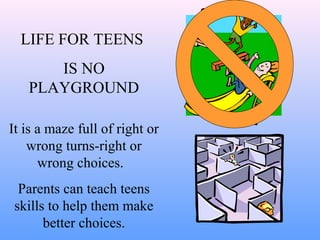
LIFE FOR TEENS
IS NO
PLAYGROUND
It is a maze full of right or
wrong turns-right or
wrong choices.
Parents can teach teens
skills to help them make
better choices.
“WE CAN’T MAKE THEIR DECISIONS
FOR THEM, BUT WE CAN GIVE THEM
THE RIGHT TOOLS THEY NEED TO
MAKE RIGHT DECISIONS.”
NAVIGATION NECESSITIES
What are Effective Teens Choices
Based on?
PRINCIPLESPRINCIPLES
1. Are they reactive or proactive?
2. Do they know where they are going?
3. Do they prioritize the things they have to do?
4. Do they see life as a competition?
5. Do they talk first and then pretend to listen or listen actively?
6. Do they cooperate with others or do they think they are
better off doing everything by themselves?
7. Are they so busy with life that they do not have time to:
• Spend quality time with family and friends
• To do their homework
• Read good books
• Exercise
• Take time for nature or other inspirational things?
What is an effective teen?What is an effective teen?
PARADIGM
The way you see
something,
your point of view,
frame of reference,
or belief.
What is a paradigm shift?
A paradigm shift is a way of looking at
something differently.
We are stepping “outside the box”.
When we make a paradigm shift we can see,
think, feel and behave differently.
Example:
Ptolemy thought the earth was the center of
the universe.
Copernicus believed the sun was the center
of the universe. (a paradigm shift occurred)
Frank Koch wrote:
Two battleships assigned to the training squadron
had been at sea on maneuvers in heavy weather for several days. I was
serving on the lead battleship and was on watch on the bridge as night
fell. Shortly after dark, the lookout on the wing of the bridge reported,
"Light, bearing on the starboard bow."
"Is it steady or moving astern?" the captain called out.
Lookout replied, "Steady, captain," which meant we were on a collision
course. The captain then called to the signalman, "Signal that ship: We
are on a collision course, advise you change course 20 degrees."
Back came the reply, "Advisable for you to change course 20 degrees."
The captain said, "Send, I'm a captain, change course 20 degrees."
"I am a seaman second class" came the reply. "You had better change
course 20 degrees."
By that time, the captain was furious. He spat out, "Send, I'm a
battleship. Change course 20 degrees."
Back came the reply, "I'm a lighthouse."
We changed course. Steven Covey (in “The 7 habits of Highly Effective People”) tells that story to teach that principles are
“like lighthouses.” They are natural laws that cannot be broken.”
To show regard or value for someone
or
something.
Emotional Bank Account
Like a checking or savings account,
you can make deposits or withdrawals.
Personal-How you feel about yourself.
(Amount of trust and confidence in yourself.)
Relationship-How you feel about others.
(Amount of trust and confidence you have in each
of your relationships)
Personal Bank Account
Deposits
• Keep promises to yourself
• Do small acts of kindness
• Be gentle with yourself
• Be honest in all your dealings
• Enhance your talents
• Take care of yourself
• Think positively and use positive self-talk
Personal Bank Account
Withdrawals
• Break promises to yourself
• Isolate yourself
• Put yourself down
• Think negatively and use negative self-talk
• Be dishonest with yourself
• Neglect your talents
• Wear yourself out
• Expect yourself to be perfect
Relationship Bank Account
Deposits
• Keep promises to others
• Do small acts of kindness
• Be loyal to those not present
• Listen actively
• Say you are sorry
• Set clear expectations
• Allow others to be different
Relationship Bank Account
Withdrawals
• Break promises
• Keep to yourself
• Gossip and break confidences
• Do not listen
• Be arrogant
• Set false expectations
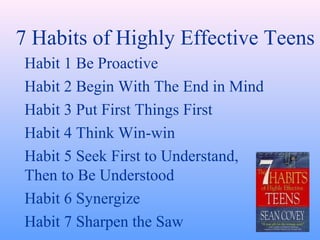
7 Habits of Highly Effective Teens
Habit 1 Be Proactive
Habit 2 Begin With The End in Mind
Habit 3 Put First Things First
Habit 4 Think Win-win
Habit 5 Seek First to Understand,
Then to Be Understood
Habit 6 Synergize
Habit 7 Sharpen the Saw
Habit 1 Be Proactive
Teenagers are the product of their environment,
upbringing, and choices. Are their choices
proactive or reactive? They need to take
responsibility for their choices
and their life.
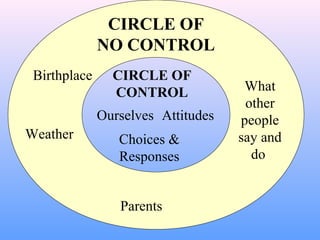
CIRCLE OF
NO CONTROL
CIRCLE OF
CONTROL
Attitudes
Weather
Birthplace
Parents
What
other
people
say and
do
Choices &
Responses
Ourselves
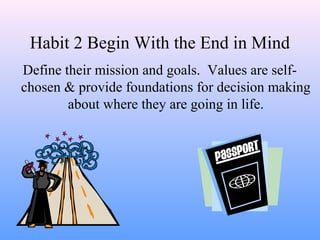
Habit 2 Begin With the End in Mind
Define their mission and goals. Values are self-
chosen & provide foundations for decision making
about where they are going in life.
Habit 3 Put First Things First
Prioritize
Actions flow from
that which is
important.
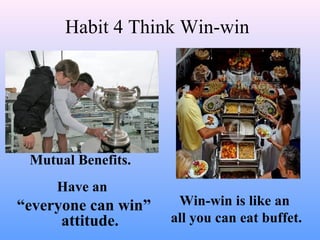
Habit 4 Think Win-win
Mutual Benefits.
Have an
“everyone can win”
attitude.
Win-win is like an
all you can eat buffet.
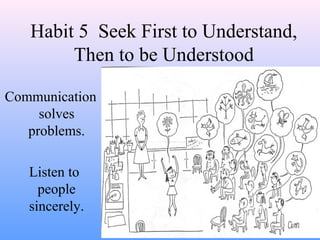
Habit 5 Seek First to Understand,
Then to be Understood
Communication
solves
problems.
Listen to
people
sincerely.
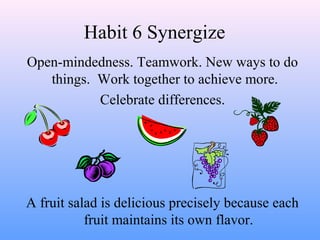
Habit 6 Synergize
Open-mindedness. Teamwork. New ways to do
things. Work together to achieve more.
Celebrate differences.
A fruit salad is delicious precisely because each
fruit maintains its own flavor.
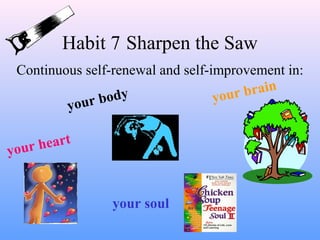
Habit 7 Sharpen the Saw
Continuous self-renewal and self-improvement in:
your brain
your heart
your body
your soul
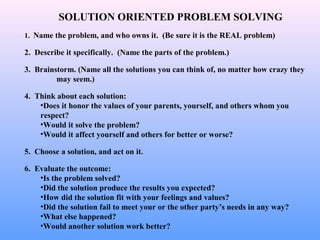
SOLUTION ORIENTED PROBLEM SOLVING
1. Name the problem, and who owns it. (Be sure it is the REAL problem)
2. Describe it specifically. (Name the parts of the problem.)
3. Brainstorm. (Name all the solutions you can think of, no matter how crazy they
may seem.)
4. Think about each solution:
•Does it honor the values of your parents, yourself, and others whom you
respect?
•Would it solve the problem?
•Would it affect yourself and others for better or worse?
5. Choose a solution, and act on it.
6. Evaluate the outcome:
•Is the problem solved?
•Did the solution produce the results you expected?
•How did the solution fit with your feelings and values?
•Did the solution fail to meet your or the other party’s needs in any way?
•What else happened?
•Would another solution work better?
Expected OutcomesExpected Outcomes
• Increased engagement and motivation
• Greater responsibility for learning
• Increased peer collaboration skills
• Greater confidence and self-esteem
• Increased listening skills
• Greater content mastery
• Better peer collaboration
• More time on task
• More skill in analyzing and solving problems
GETTINGGETTING UNDERWAY WITH THEUNDERWAY WITH THE
7 Habits of Highly Effective Teens7 Habits of Highly Effective Teens

7 habits-of-highly-effective-teens

  • 1.
    GETTING UNDERWAY WITH THEWIND AT YOUR BACK
  • 2.
    LIFE FOR TEENS ISNO PLAYGROUND It is a maze full of right or wrong turns-right or wrong choices. Parents can teach teens skills to help them make better choices.
  • 3.
    “WE CAN’T MAKETHEIR DECISIONS FOR THEM, BUT WE CAN GIVE THEM THE RIGHT TOOLS THEY NEED TO MAKE RIGHT DECISIONS.”
  • 4.
    NAVIGATION NECESSITIES What areEffective Teens Choices Based on? PRINCIPLESPRINCIPLES
  • 5.
    1. Are theyreactive or proactive? 2. Do they know where they are going? 3. Do they prioritize the things they have to do? 4. Do they see life as a competition? 5. Do they talk first and then pretend to listen or listen actively? 6. Do they cooperate with others or do they think they are better off doing everything by themselves? 7. Are they so busy with life that they do not have time to: • Spend quality time with family and friends • To do their homework • Read good books • Exercise • Take time for nature or other inspirational things? What is an effective teen?What is an effective teen?
  • 6.
    PARADIGM The way yousee something, your point of view, frame of reference, or belief.
  • 7.
    What is aparadigm shift? A paradigm shift is a way of looking at something differently. We are stepping “outside the box”. When we make a paradigm shift we can see, think, feel and behave differently. Example: Ptolemy thought the earth was the center of the universe. Copernicus believed the sun was the center of the universe. (a paradigm shift occurred)
  • 8.
    Frank Koch wrote: Twobattleships assigned to the training squadron had been at sea on maneuvers in heavy weather for several days. I was serving on the lead battleship and was on watch on the bridge as night fell. Shortly after dark, the lookout on the wing of the bridge reported, "Light, bearing on the starboard bow." "Is it steady or moving astern?" the captain called out. Lookout replied, "Steady, captain," which meant we were on a collision course. The captain then called to the signalman, "Signal that ship: We are on a collision course, advise you change course 20 degrees." Back came the reply, "Advisable for you to change course 20 degrees." The captain said, "Send, I'm a captain, change course 20 degrees." "I am a seaman second class" came the reply. "You had better change course 20 degrees." By that time, the captain was furious. He spat out, "Send, I'm a battleship. Change course 20 degrees." Back came the reply, "I'm a lighthouse." We changed course. Steven Covey (in “The 7 habits of Highly Effective People”) tells that story to teach that principles are “like lighthouses.” They are natural laws that cannot be broken.”
  • 9.
    To show regardor value for someone or something.
  • 10.
    Emotional Bank Account Likea checking or savings account, you can make deposits or withdrawals. Personal-How you feel about yourself. (Amount of trust and confidence in yourself.) Relationship-How you feel about others. (Amount of trust and confidence you have in each of your relationships)
  • 11.
    Personal Bank Account Deposits •Keep promises to yourself • Do small acts of kindness • Be gentle with yourself • Be honest in all your dealings • Enhance your talents • Take care of yourself • Think positively and use positive self-talk
  • 12.
    Personal Bank Account Withdrawals •Break promises to yourself • Isolate yourself • Put yourself down • Think negatively and use negative self-talk • Be dishonest with yourself • Neglect your talents • Wear yourself out • Expect yourself to be perfect
  • 13.
    Relationship Bank Account Deposits •Keep promises to others • Do small acts of kindness • Be loyal to those not present • Listen actively • Say you are sorry • Set clear expectations • Allow others to be different
  • 14.
    Relationship Bank Account Withdrawals •Break promises • Keep to yourself • Gossip and break confidences • Do not listen • Be arrogant • Set false expectations
  • 15.
    7 Habits ofHighly Effective Teens Habit 1 Be Proactive Habit 2 Begin With The End in Mind Habit 3 Put First Things First Habit 4 Think Win-win Habit 5 Seek First to Understand, Then to Be Understood Habit 6 Synergize Habit 7 Sharpen the Saw
  • 16.
    Habit 1 BeProactive Teenagers are the product of their environment, upbringing, and choices. Are their choices proactive or reactive? They need to take responsibility for their choices and their life.
  • 17.
    CIRCLE OF NO CONTROL CIRCLEOF CONTROL Attitudes Weather Birthplace Parents What other people say and do Choices & Responses Ourselves
  • 18.
    Habit 2 BeginWith the End in Mind Define their mission and goals. Values are self- chosen & provide foundations for decision making about where they are going in life.
  • 19.
    Habit 3 PutFirst Things First Prioritize Actions flow from that which is important.
  • 20.
    Habit 4 ThinkWin-win Mutual Benefits. Have an “everyone can win” attitude. Win-win is like an all you can eat buffet.
  • 21.
    Habit 5 SeekFirst to Understand, Then to be Understood Communication solves problems. Listen to people sincerely.
  • 22.
    Habit 6 Synergize Open-mindedness.Teamwork. New ways to do things. Work together to achieve more. Celebrate differences. A fruit salad is delicious precisely because each fruit maintains its own flavor.
  • 23.
    Habit 7 Sharpenthe Saw Continuous self-renewal and self-improvement in: your brain your heart your body your soul
  • 24.
    SOLUTION ORIENTED PROBLEMSOLVING 1. Name the problem, and who owns it. (Be sure it is the REAL problem) 2. Describe it specifically. (Name the parts of the problem.) 3. Brainstorm. (Name all the solutions you can think of, no matter how crazy they may seem.) 4. Think about each solution: •Does it honor the values of your parents, yourself, and others whom you respect? •Would it solve the problem? •Would it affect yourself and others for better or worse? 5. Choose a solution, and act on it. 6. Evaluate the outcome: •Is the problem solved? •Did the solution produce the results you expected? •How did the solution fit with your feelings and values? •Did the solution fail to meet your or the other party’s needs in any way? •What else happened? •Would another solution work better?
  • 25.
    Expected OutcomesExpected Outcomes •Increased engagement and motivation • Greater responsibility for learning • Increased peer collaboration skills • Greater confidence and self-esteem • Increased listening skills • Greater content mastery • Better peer collaboration • More time on task • More skill in analyzing and solving problems
  • 26.
    GETTINGGETTING UNDERWAY WITHTHEUNDERWAY WITH THE 7 Habits of Highly Effective Teens7 Habits of Highly Effective Teens