





Treating Explosive Kids 
Part 2 
The Collaborative 
Problem-Solving Approach 
Drew Burkley Psy.D. 
Center of Excellence 
Clinical Psychology Fellow 
Andrew.Burkley@Cherokeehealth.com
Authors 
 Ross W. Greene, PhD 
 Director of the Collaborative Problem Solving Institute 
 Associate Professor in the Department of Psychiatry, Harvard 
Medical School 
 J. Stuart Ablon, PhD 
 Director of Think:Kids, Department of Psychiatry, 
Massachusetts General Hospital, 
 Associate Professor in the Department of Psychiatry, Harvard 
Medical School
Location 
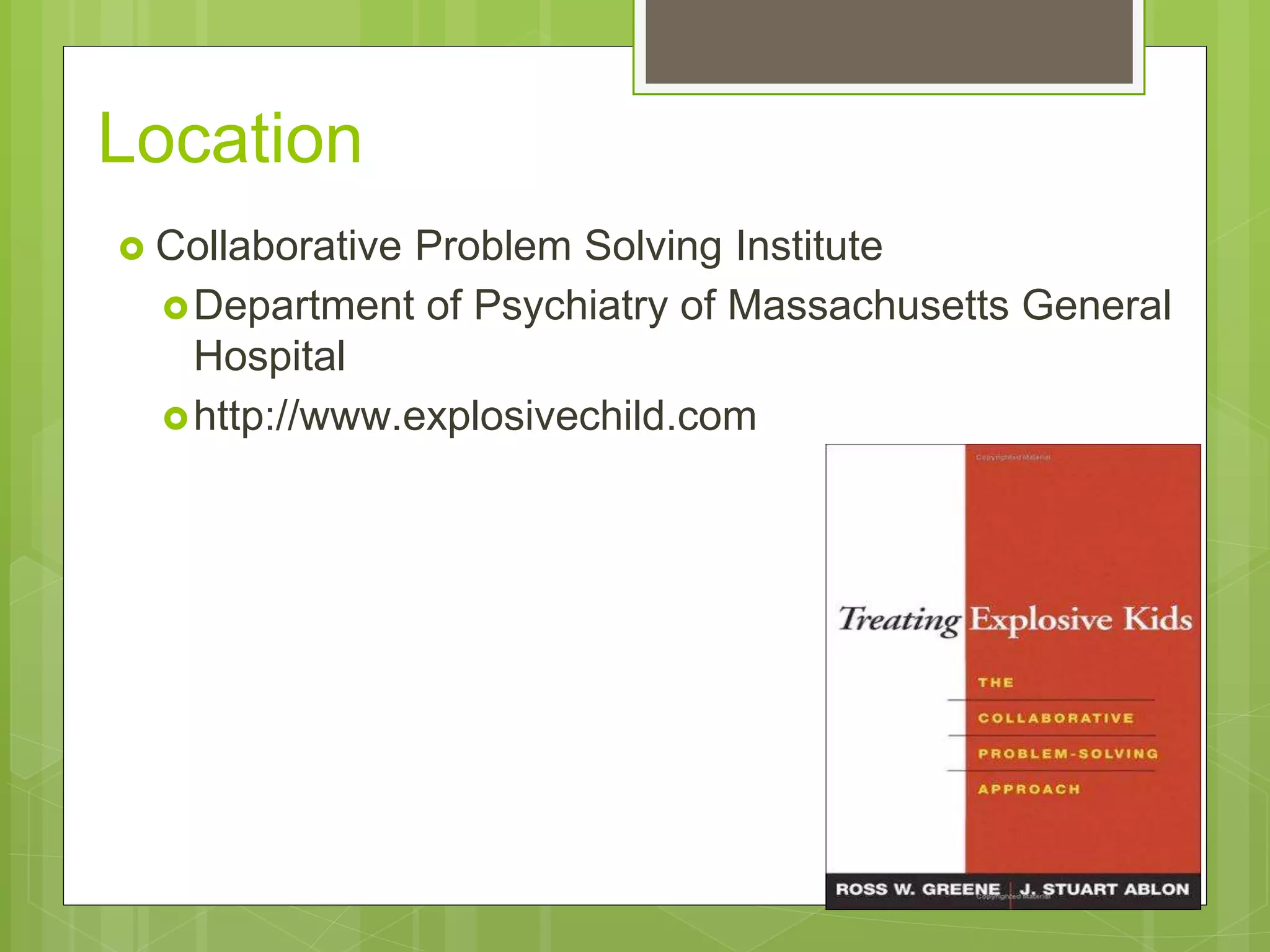
 Collaborative Problem Solving Institute 
Department of Psychiatry of Massachusetts General 
Hospital 
http://www.explosivechild.com
Thanks to... 
 Gloria Jones, Psy.D. 
 Sasha Ahmed, M.S. 
 Scott Browning, Ph.D.
Review
“Explosive” children and 
adolescents? 
 The term “explosive” will be used in this presentation 
because it is a common theme among all the 
descriptions and diagnoses
What makes CPS different? 
 Assumes that explosive children are poorly 
understood and are often poorly addressed by 
available therapies 
 For close to fifty years, conceptualization and 
treatment of explosive children have been 
significantly influenced by the coercion or social 
interactional model. 
 There has been a focus on patterns of parental 
discipline 
 Inconsistent discipline 
 Irritable explosive discipline 
 Low supervision and involvement 
 Inflexible rigid discipline
The Plans 
 When a problem arises, there are three ways 
to deal with it 
 Plan A: Imposing of parents Will 
 Plan C: Removing Expectations 
 Plan B: Collaborative Problem Solving.
Why Plan B? 
 Parents often chose Plan A. 
 Works for about 95% of children 
 Doesn’t account for lagging skills 
 Lagging skills, such as poor frustration 
tolerance, poor executive functioning, etc. 
may be influencing compliance 
 Typically seen in the “explosive” children 
 Plan B helps address skills and increase child 
compliance
Plan B Basics
Plan B Basics 
 Plans A and C do not help children learn 
needed skills 
 Developmentally, children are not equipped to 
handle explosive episodes alone. 
 Two types of Plan B: Proactive and 
Emergency 
 Parent does thinking for the child
Surrogate Frontal Lobe 
 Frontal lobes 
 Executive functioning 
 Impulse Control 
 Planning 
 Not fully developed until mid 20’s 
 Caregiver becomes surrogate frontal lobe 
 Thinks for child
Surrogate Frontal Lobe 
 The caregiver functions as a surrogate frontal 
lobe by: 
 Walking child through the situation 
 Precipitating explosive episodes 
 After multiple repetitions, child will increase their 
thinking-through ability 
 Something Caregivers already do 
 Teaching baseball or how to cross the street 
 Models creativity and flexibility
Rudimentary Plan B 
 Key Ingredients for a 
successful Plan B 
are 
 Both parties (are at 
a place at which 
they can begin 
calm and rational. 
 Ensure concerns 
of are clearly 
defined 
 Brainstorm 
 All Ideas considered 
 Creative problem 
solving for all concerns 
 Steps Necessary for 
Successful execution 
of Plan B 
 Empathy (plus 
reassurance) 
 “I’ve noticed you’ve 
had problems with 
X, what’s up?” 
 Define the problem 
 Invitation
Step 1: Empathy 
Empathy 
 Information Gathering to Understand 
 Acknowledges the concerns of the child and 
defines that concern 
 Starts with “I’ve noticed” 
Highly specific definition is essential for 
successful empathy 
Feeling heard helps people feel understood
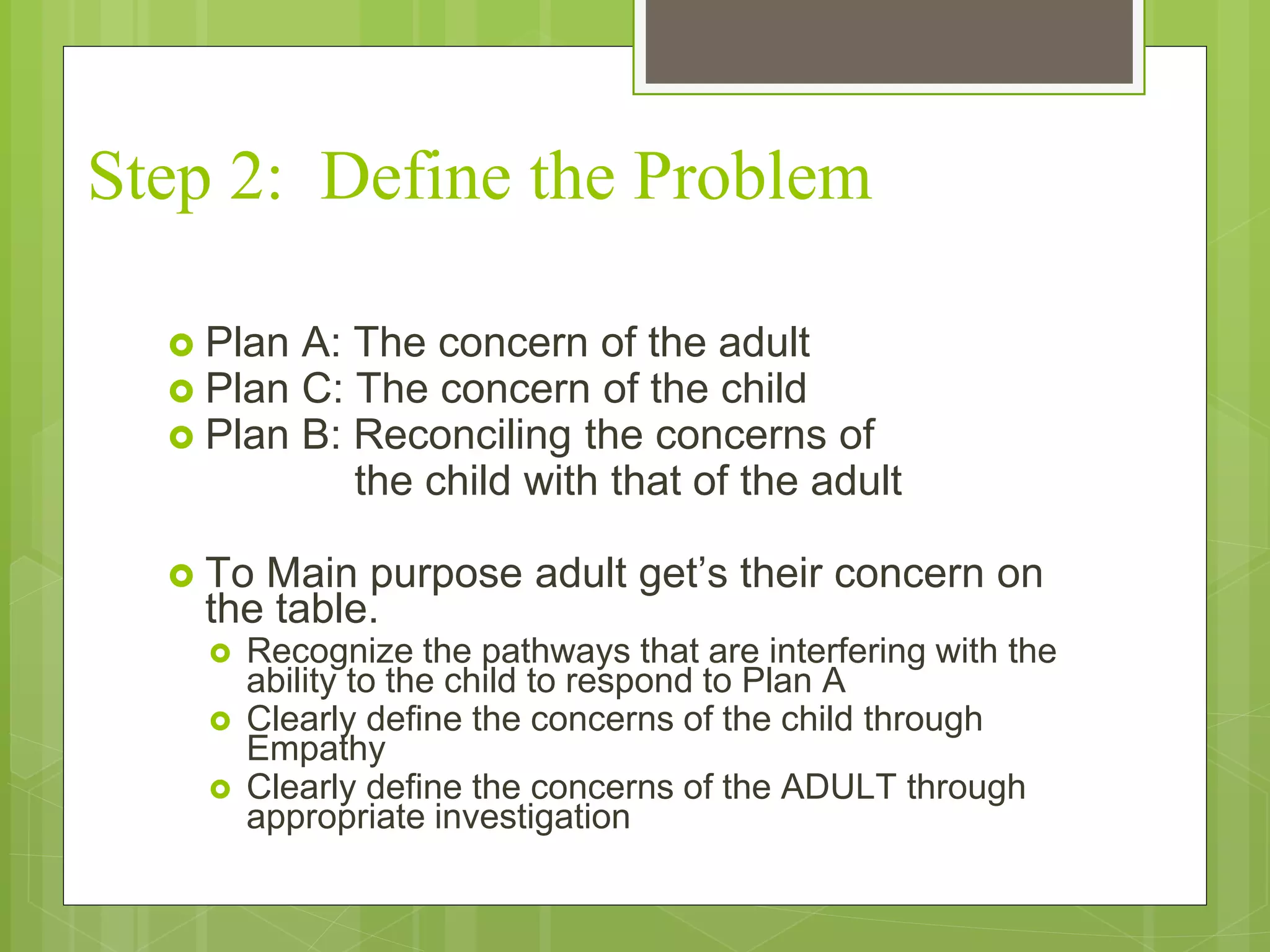
Step 2: Define the Problem 
 Plan A: The concern of the adult 
 Plan C: The concern of the child 
 Plan B: Reconciling the concerns of 
the child with that of the adult 
 To Main purpose adult get’s their concern on 
the table. 
 Recognize the pathways that are interfering with the 
ability to the child to respond to Plan A 
 Clearly define the concerns of the child through 
Empathy 
 Clearly define the concerns of the ADULT through 
appropriate investigation
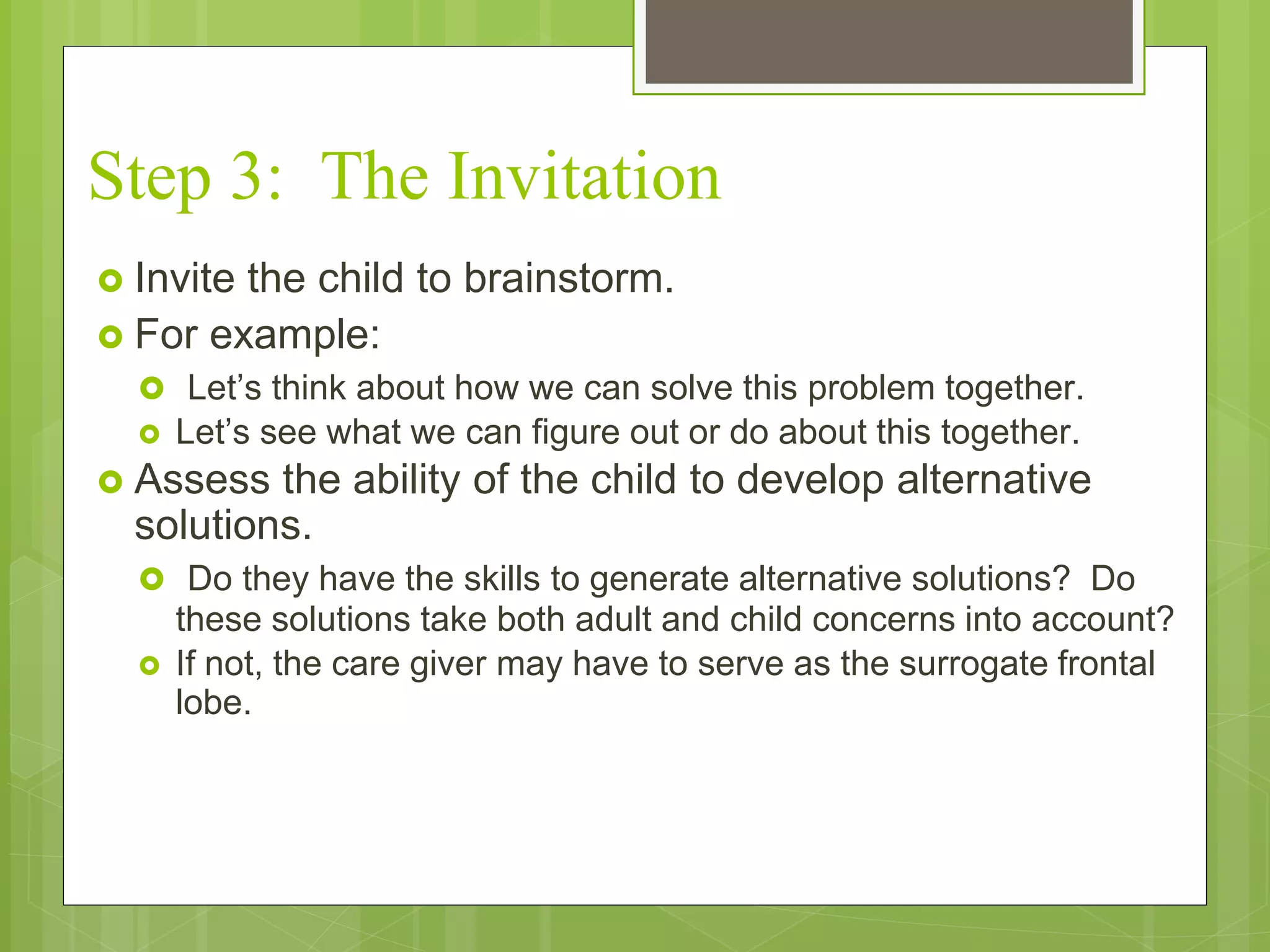
Step 3: The Invitation 
 Invite the child to brainstorm. 
 For example: 
 Let’s think about how we can solve this problem together. 
 Let’s see what we can figure out or do about this together. 
 Assess the ability of the child to develop alternative 
solutions. 
 Do they have the skills to generate alternative solutions? Do 
these solutions take both adult and child concerns into account? 
 If not, the care giver may have to serve as the surrogate frontal 
lobe.
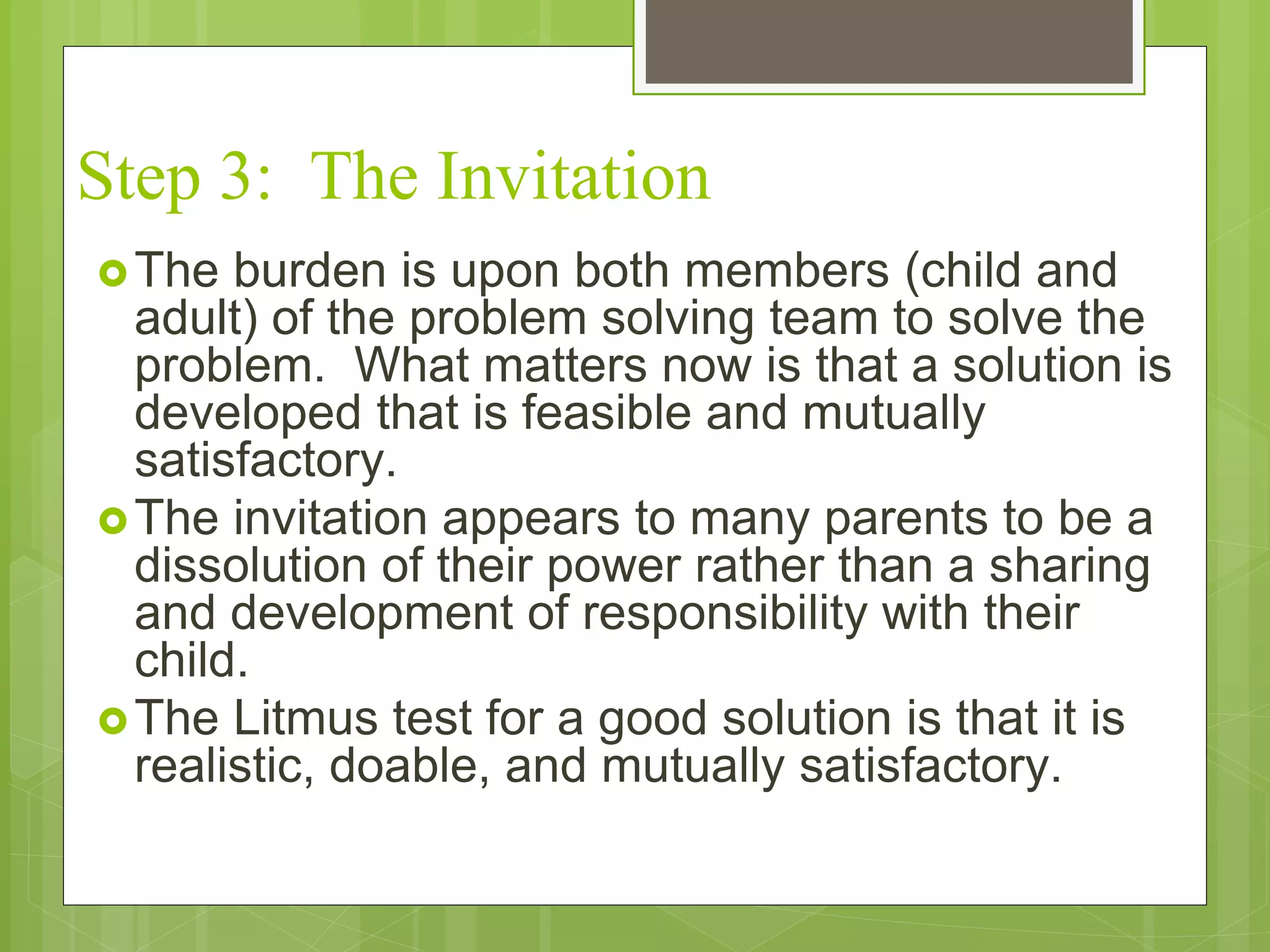
Step 3: The Invitation 
The burden is upon both members (child and 
adult) of the problem solving team to solve the 
problem. What matters now is that a solution is 
developed that is feasible and mutually 
satisfactory. 
The invitation appears to many parents to be a 
dissolution of their power rather than a sharing 
and development of responsibility with their 
child. 
The Litmus test for a good solution is that it is 
realistic, doable, and mutually satisfactory.
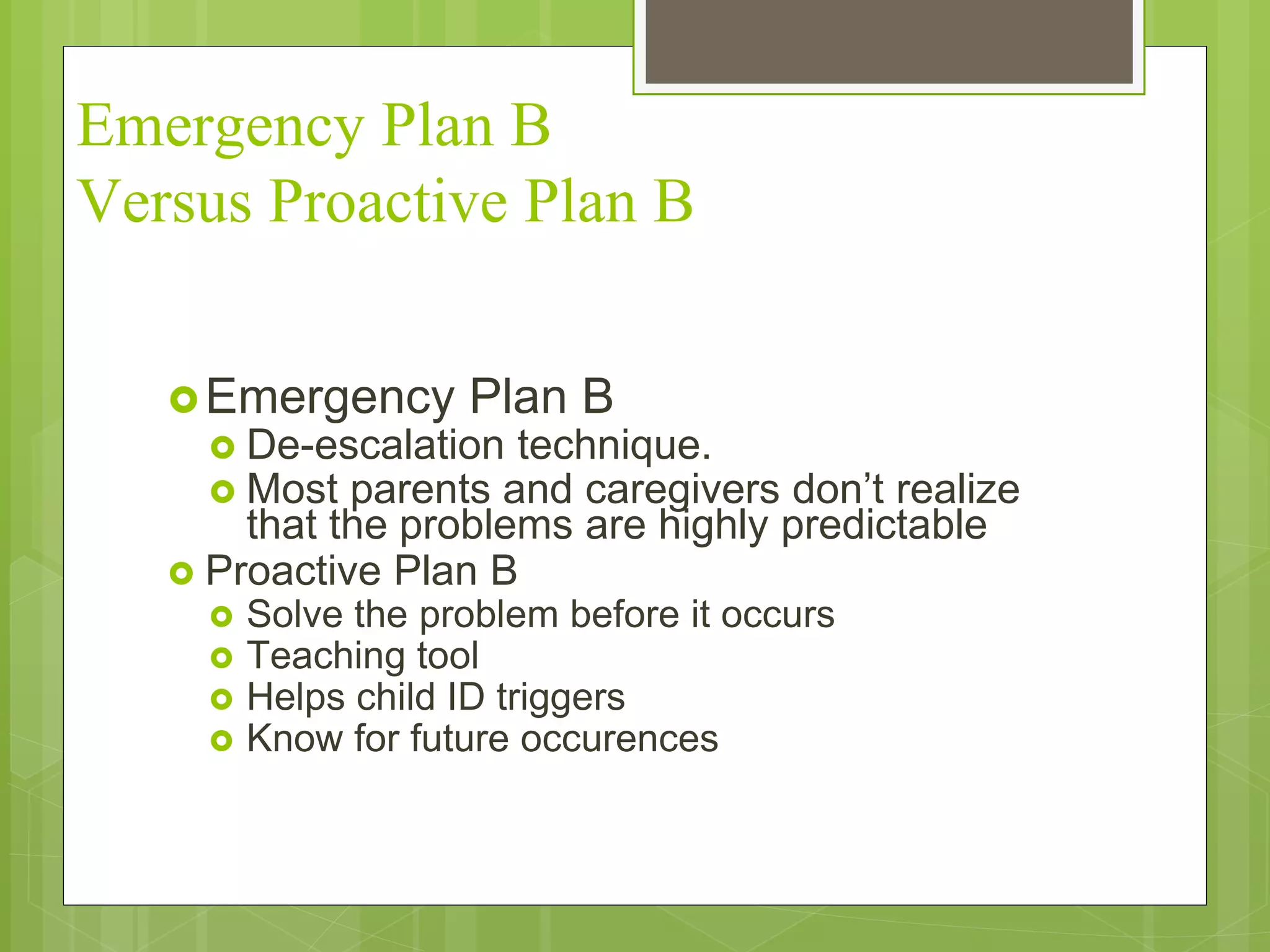
Emergency Plan B 
Versus Proactive Plan B 
Emergency Plan B 
 De-escalation technique. 
 Most parents and caregivers don’t realize 
that the problems are highly predictable 
 Proactive Plan B 
 Solve the problem before it occurs 
 Teaching tool 
 Helps child ID triggers 
 Know for future occurences
Easy Living Through Plan B 
 Prior to explaining Plan B to caregivers, we 
should: 
 Explain the pathways that are causing issues 
 identify the triggers (i.e., problems that have yet 
to be solved) that commonly precipitate 
explosive episodes.
Easy Living Through Plan B 
 Two forms of Plan B: 
 Focusing on resolving the triggers for the 
explosion (Problem-focused Plan B) 
 Focusing on developing the lagging skills that 
are causing the explosions (Skills-focused Plan 
B)
Common Mistakes 
Forgetting to Invite the child to problem 
solve 
Skipping steps 
Not clearly identifying the two concerns 
Providing alternative solutions (two 
Plan A’s or a Plan A and a Plan C)
Common Mistakes 
 As a clinician, forgetting to examine and 
identify ADULT pathway problems before 
entering this step. 
Caregivers trying to make Problem 
Solving Unilateral rather than 
collaborative. 
Caregivers trying to make Plan B a clever 
form of Plan A! 
Relying too much on Emergency Plan B 
and not using Proactive Plan B
Beyond the Basics
Skills Needed for Plan B 
 Identify and articulate concerns 
 Consider these generating alternative 
solutions 
 Anticipate outcomes of potential solutions
Therapist Roles 
 Identify lagging skills 
 Assist family in strengthening them 
 Facilitate therapeutic process
Therapist Roles 
 Establish alliances with each participant 
 Maintain neutrality 
 Prevent discussion from spinning out of 
control 
 Be vigilant to hindrances to full investment
Therapist Roles 
 Help participants stay on track during 
discussions 
 Identify any impediments to progress 
 Address within the family system
What is the single 
greatest predictor 
of therapeutic 
change?
Establishing the therapeutic alliance
Establishing Alliances 
 Therapeutic relationship is vital 
 Communication of empathy is key 
 Validate 
 Convey understanding
Establishing Alliances with Adults 
 Adults need: 
 To be heard and understood 
 To see the clinician as competent 
 To see the clinician has the capacity to help relieve 
distress
Establishing Alliances with Children 
 Children need to know: 
 Things may be better this time around 
 That the clinician does not believe that 
negative behaviors are intentional 
 That the clinician views the situation as a 
“family problem”
Maintaining Neutrality 
 Ensure that all participants’ concerns make it 
into the discussion 
 Remaining focused 
 Understanding 
 Clarifying
Maintaining Neutrality 
Remain focused on process vs. 
outcome 
***HOWEVER*** 
Solutions need to be“mutually 
satisfactory”
Taking Control of the Case 
 Therapist Roles 
 Mediate 
 Assess “temperature” 
 Remain vigilant
Taking Control of the Case 
 Therapist Roles (cont...) 
 Actively calculates the pace of therapy 
 Keeps the discussion on track 
 Remains mindful of other treatments being 
delivered
Pathways Extended 
The Therapist as a Salesperson 
 Beginning therapy focused on child skill deficits: 
 Maintains congruence with many parents’ expectations 
about the process of therapy 
 Helps alter/reframe parent perceptions of their child’s 
outbursts
Pathways Extended 
The Therapist as a Salesperson 
A Good “Pitch” 
 from original definition of the referral problem to more 
systemic perception. 
Address both child and parent skill deficits 
Feasible when therapeutic alliance is secure.
Pathways Extended 
 Defining the problem 
 Executive struggles 
 Generating alternative solutions 
 Disorganized/unsystematic approach 
 Language-processing issues 
 Emotional regulation deficits 
 Concrete thinkers
Skills Trained 
with Plan B
Identifying &Articulating Concerns and 
Problems 
 Language Processing Skills 
– Using and Practicing Adaptive Vocabulary 
– Using Reminders 
– Talking about the incident later, away from 
the heat of the moment. 
– Teach Pragmatic vocabulary with problem 
identification 
 Video Clip
Considering Possible Solutions 
Mutual process between parent and child 
 Some children have never been given the 
opportunity 
Repetition and exposure to adults showing 
this skill helps to build it in some cases 
 In other cases a structured model can help
Reflecting on Likely Outcomes and How 
Feasible/Satisfactory They Are 
 Therapist may express skepticism about 
solutions that may not be realistic/feasible 
 model for the family 
 Child may not develop a solution based on both 
concerns 
 difficulty with perceptive taking
Parent’s Execution of Plan B 
 Step 1- Empathy 
 Calming affect 
 Acknowledge their concern 
 Step 2 Defining Problem 
 Help child to take your concern into account when working toward a 
solution 
 State concern in a calm, tentative manner 
 Reminder of problems solved prior
Final Thoughts 
 Advantages of Plan B: 
 Training can occur in the environments in which the skills are to be utilized 
 Collaborative in nature 
 Child is more likely to think about a problem 
 More likely to take ownership of the problem and the solution 
 Teaching adaptive social functioning is built in
Questions and Wrap Up!

Treating Explosive Kids - Part 2

  • 1.
    Treating Explosive Kids Part 2 The Collaborative Problem-Solving Approach Drew Burkley Psy.D. Center of Excellence Clinical Psychology Fellow Andrew.Burkley@Cherokeehealth.com
  • 2.
    Authors  RossW. Greene, PhD  Director of the Collaborative Problem Solving Institute  Associate Professor in the Department of Psychiatry, Harvard Medical School  J. Stuart Ablon, PhD  Director of Think:Kids, Department of Psychiatry, Massachusetts General Hospital,  Associate Professor in the Department of Psychiatry, Harvard Medical School
  • 3.
    Location  CollaborativeProblem Solving Institute Department of Psychiatry of Massachusetts General Hospital http://www.explosivechild.com
  • 4.
    Thanks to... Gloria Jones, Psy.D.  Sasha Ahmed, M.S.  Scott Browning, Ph.D.
  • 5.
  • 6.
    “Explosive” children and adolescents?  The term “explosive” will be used in this presentation because it is a common theme among all the descriptions and diagnoses
  • 7.
    What makes CPSdifferent?  Assumes that explosive children are poorly understood and are often poorly addressed by available therapies  For close to fifty years, conceptualization and treatment of explosive children have been significantly influenced by the coercion or social interactional model.  There has been a focus on patterns of parental discipline  Inconsistent discipline  Irritable explosive discipline  Low supervision and involvement  Inflexible rigid discipline
  • 8.
    The Plans When a problem arises, there are three ways to deal with it  Plan A: Imposing of parents Will  Plan C: Removing Expectations  Plan B: Collaborative Problem Solving.
  • 9.
    Why Plan B?  Parents often chose Plan A.  Works for about 95% of children  Doesn’t account for lagging skills  Lagging skills, such as poor frustration tolerance, poor executive functioning, etc. may be influencing compliance  Typically seen in the “explosive” children  Plan B helps address skills and increase child compliance
  • 10.
  • 11.
    Plan B Basics  Plans A and C do not help children learn needed skills  Developmentally, children are not equipped to handle explosive episodes alone.  Two types of Plan B: Proactive and Emergency  Parent does thinking for the child
  • 12.
    Surrogate Frontal Lobe  Frontal lobes  Executive functioning  Impulse Control  Planning  Not fully developed until mid 20’s  Caregiver becomes surrogate frontal lobe  Thinks for child
  • 13.
    Surrogate Frontal Lobe  The caregiver functions as a surrogate frontal lobe by:  Walking child through the situation  Precipitating explosive episodes  After multiple repetitions, child will increase their thinking-through ability  Something Caregivers already do  Teaching baseball or how to cross the street  Models creativity and flexibility
  • 14.
    Rudimentary Plan B  Key Ingredients for a successful Plan B are  Both parties (are at a place at which they can begin calm and rational.  Ensure concerns of are clearly defined  Brainstorm  All Ideas considered  Creative problem solving for all concerns  Steps Necessary for Successful execution of Plan B  Empathy (plus reassurance)  “I’ve noticed you’ve had problems with X, what’s up?”  Define the problem  Invitation
  • 15.
    Step 1: Empathy Empathy  Information Gathering to Understand  Acknowledges the concerns of the child and defines that concern  Starts with “I’ve noticed” Highly specific definition is essential for successful empathy Feeling heard helps people feel understood
  • 16.
    Step 2: Definethe Problem  Plan A: The concern of the adult  Plan C: The concern of the child  Plan B: Reconciling the concerns of the child with that of the adult  To Main purpose adult get’s their concern on the table.  Recognize the pathways that are interfering with the ability to the child to respond to Plan A  Clearly define the concerns of the child through Empathy  Clearly define the concerns of the ADULT through appropriate investigation
  • 17.
    Step 3: TheInvitation  Invite the child to brainstorm.  For example:  Let’s think about how we can solve this problem together.  Let’s see what we can figure out or do about this together.  Assess the ability of the child to develop alternative solutions.  Do they have the skills to generate alternative solutions? Do these solutions take both adult and child concerns into account?  If not, the care giver may have to serve as the surrogate frontal lobe.
  • 18.
    Step 3: TheInvitation The burden is upon both members (child and adult) of the problem solving team to solve the problem. What matters now is that a solution is developed that is feasible and mutually satisfactory. The invitation appears to many parents to be a dissolution of their power rather than a sharing and development of responsibility with their child. The Litmus test for a good solution is that it is realistic, doable, and mutually satisfactory.
  • 19.
    Emergency Plan B Versus Proactive Plan B Emergency Plan B  De-escalation technique.  Most parents and caregivers don’t realize that the problems are highly predictable  Proactive Plan B  Solve the problem before it occurs  Teaching tool  Helps child ID triggers  Know for future occurences
  • 20.
    Easy Living ThroughPlan B  Prior to explaining Plan B to caregivers, we should:  Explain the pathways that are causing issues  identify the triggers (i.e., problems that have yet to be solved) that commonly precipitate explosive episodes.
  • 21.
    Easy Living ThroughPlan B  Two forms of Plan B:  Focusing on resolving the triggers for the explosion (Problem-focused Plan B)  Focusing on developing the lagging skills that are causing the explosions (Skills-focused Plan B)
  • 22.
    Common Mistakes Forgettingto Invite the child to problem solve Skipping steps Not clearly identifying the two concerns Providing alternative solutions (two Plan A’s or a Plan A and a Plan C)
  • 23.
    Common Mistakes As a clinician, forgetting to examine and identify ADULT pathway problems before entering this step. Caregivers trying to make Problem Solving Unilateral rather than collaborative. Caregivers trying to make Plan B a clever form of Plan A! Relying too much on Emergency Plan B and not using Proactive Plan B
  • 24.
  • 25.
    Skills Needed forPlan B  Identify and articulate concerns  Consider these generating alternative solutions  Anticipate outcomes of potential solutions
  • 26.
    Therapist Roles Identify lagging skills  Assist family in strengthening them  Facilitate therapeutic process
  • 27.
    Therapist Roles Establish alliances with each participant  Maintain neutrality  Prevent discussion from spinning out of control  Be vigilant to hindrances to full investment
  • 28.
    Therapist Roles Help participants stay on track during discussions  Identify any impediments to progress  Address within the family system
  • 29.
    What is thesingle greatest predictor of therapeutic change?
  • 30.
  • 31.
    Establishing Alliances Therapeutic relationship is vital  Communication of empathy is key  Validate  Convey understanding
  • 32.
    Establishing Alliances withAdults  Adults need:  To be heard and understood  To see the clinician as competent  To see the clinician has the capacity to help relieve distress
  • 33.
    Establishing Alliances withChildren  Children need to know:  Things may be better this time around  That the clinician does not believe that negative behaviors are intentional  That the clinician views the situation as a “family problem”
  • 34.
    Maintaining Neutrality Ensure that all participants’ concerns make it into the discussion  Remaining focused  Understanding  Clarifying
  • 35.
    Maintaining Neutrality Remainfocused on process vs. outcome ***HOWEVER*** Solutions need to be“mutually satisfactory”
  • 36.
    Taking Control ofthe Case  Therapist Roles  Mediate  Assess “temperature”  Remain vigilant
  • 37.
    Taking Control ofthe Case  Therapist Roles (cont...)  Actively calculates the pace of therapy  Keeps the discussion on track  Remains mindful of other treatments being delivered
  • 38.
    Pathways Extended TheTherapist as a Salesperson  Beginning therapy focused on child skill deficits:  Maintains congruence with many parents’ expectations about the process of therapy  Helps alter/reframe parent perceptions of their child’s outbursts
  • 39.
    Pathways Extended TheTherapist as a Salesperson A Good “Pitch”  from original definition of the referral problem to more systemic perception. Address both child and parent skill deficits Feasible when therapeutic alliance is secure.
  • 40.
    Pathways Extended Defining the problem  Executive struggles  Generating alternative solutions  Disorganized/unsystematic approach  Language-processing issues  Emotional regulation deficits  Concrete thinkers
  • 41.
  • 42.
    Identifying &Articulating Concernsand Problems  Language Processing Skills – Using and Practicing Adaptive Vocabulary – Using Reminders – Talking about the incident later, away from the heat of the moment. – Teach Pragmatic vocabulary with problem identification  Video Clip
  • 43.
    Considering Possible Solutions Mutual process between parent and child  Some children have never been given the opportunity Repetition and exposure to adults showing this skill helps to build it in some cases  In other cases a structured model can help
  • 44.
    Reflecting on LikelyOutcomes and How Feasible/Satisfactory They Are  Therapist may express skepticism about solutions that may not be realistic/feasible  model for the family  Child may not develop a solution based on both concerns  difficulty with perceptive taking
  • 45.
    Parent’s Execution ofPlan B  Step 1- Empathy  Calming affect  Acknowledge their concern  Step 2 Defining Problem  Help child to take your concern into account when working toward a solution  State concern in a calm, tentative manner  Reminder of problems solved prior
  • 46.
    Final Thoughts Advantages of Plan B:  Training can occur in the environments in which the skills are to be utilized  Collaborative in nature  Child is more likely to think about a problem  More likely to take ownership of the problem and the solution  Teaching adaptive social functioning is built in
  • 47.

Editor's Notes

  • #5 To be written by Dr. Browning
  • #9 Neither Plan A nor Plan C teaches the child how to negotiate their world using their lagging cognitive skills. Parents and clinicians must first recognize and be aware of the lagging cognitive skills of their child and how they are attributed to the explosive episodes before they are able to move from Plan A or C to Plan B.
  • #10 Neither Plan A nor Plan C teaches the child how to negotiate their world using their lagging cognitive skills. Parents and clinicians must first recognize and be aware of the lagging cognitive skills of their child and how they are attributed to the explosive episodes before they are able to move from Plan A or C to Plan B.
  • #12 Neither Plan A nor Plan C teaches the child how to negotiate their world using their lagging cognitive skills. Parents and clinicians must first recognize and be aware of the lagging cognitive skills of their child and how they are attributed to the explosive episodes before they are able to move from Plan A or C to Plan B.
  • #13 The Frontal Lobes of the brain are the areas in the brain that function to implement executive planning, motor planning, and impulse control. In Plan B, the parent or care giver is doing the thinking (i.e. frontal lobe activity) for the child due to lacking cognitive skills or relative inexperience in performing the acts. Similar to parents or care givers who teach their child or children how to ride a bike, hit a baseball, or learn to read (all frontal lobe activities), parents and care givers using Plan B will teach their child the crucial skills of flexibility, frustration tolerance, and problem solving.
  • #14  Walking a child through a frustrating situation in the present (thereby preventing explosive episodes in the present). Solving problems routinely precipitating explosive episodes in a durable way After multiple Plan B repetitions, training lacking thinking skills so that the child won’t need the surrogate frontal lobe for the rest of their life.
  • #15 Ensure concerns of are clearly defined and are at least considered Entertain the wide range of possibilities that could address BOTH sets of concerns.
  • #16  being aware of, and being sensitive to the feelings, thoughts, and experiences of another without actually sharing the feelings and experiences of another. Observations have to be neutral. Not “I’ve noticed your trying to ruin my life”. I”ve noticed you’ve been terrorizing your brother lately, what’s up? I’ve noticed you’re being disruptive lately, what’s up? Shuts kid up. Coming to a highly specific definition of the concern of the child is absolutely essential for this model and successful empathy. Many adults or care givers will need specific models of how to empathize and what is not empathy. Many caregivers make an educated guess at this stage, but need instead to patiently work with their child. Some parents have difficulty with the first step of Plan B (Empathy) because they fear that they are about to capitulate to the wishes of their child. In fact, what you are doing is clearly defining the problem.
  • #17 What are your concerns about this specific behavior? A common mistake at this step is that many caregivers attempt to provide TWO SOLUTIONS instead of defining TWO CONCERNS that Define the Problem. Both child and adult concerns must be clearly specified before we can define the problem and an effective collaboration can begin! Usually adult’s concern’s fit into 1 of 3 categories Learning, Safety, how beh affects themselves or others.
  • #18 The child must be invited in to a collaborative brainstorming session in a way that is feasible and mutually satisfying --End point help the child learn how to develop alternative solutions to their problems
  • #20 Most parents and caregivers do not think about outbursts in situational terms so they don’t realize that the problems are highly predictable and wait until they are in the throes of a problem before attempting Plan B. Emergency Plan B is when you are waiting until you are right in the middle of a disagreement or a problem to use Plan B. It is then a de-escalation technique. We find that most outbursts tend to occur repetitively in response to the same circumscribed set of problems or triggers. This is Emergency Plan B and it is the least opportune time to attempt a durable solution, but it can be a productive form of crisis intervention. Over-reliance on Plan B as a de-escalation technique will decrease its effectiveness as a teaching technique because repeated crises and explosions have now become associated with the steps of Plan B (e.g., Empathy, Defining the Problem, Invitation). Proactive Plan B is when you are trying to solve a predictable problem before it returns. Proactive Plan B is a teaching tool. Proactive Plan B serves to help the child identify triggers to their explosive behaviors without shame to help them learn to solve the problem before it happens again.
  • #21 explain the pathways (i.e., skills that need to be trained) that may be interfering with the capacity of the child for flexible frustration tolerance and problem solving We should also have achieved an informal sense of the ability of the caregiver to digest and absorb this alternative view toward their problem with their child. Care givers must agree that it is crucial to teach their child their lacking thinking skills through collaborative solutions to problems and that consequence based programs are unlikely to accomplish these goals. The level of hostility between the caregiver and the child must be at a SAFE level prior toward the implementation of any of these steps.
  • #22 If a majority of episodes deal with getting ready for school or doing homework, then therapist might consider a Problem focused Plan B If outbursts are due to lagging skills, then Plan B might focus on skill building.
  • #23 WARNING: IT IS VERY COMMON FOR ADULTS TO SUCCESSFULLY MAST ER THE FIRST TWO STEPS (EMPATHY AND DEFINING THE PROBLEM) BUT NEVER INVITE THEIR CHILD INTO THE PROBLEM SOLVING DEPARTMENT. like Assessing Pathways, Empathy, Defining the problem, or giving the Invitation along the way. Also, not buying in. (adult and child) and clearly defining the Problem but instead providing two Alternative solutions (e.g., Two Plan A’s or a Plan A and a Plan C).
  • #26 For Plan B to be utilized and implemented effectively both parents and their children need to possess certain skills. These are intricate skills that are not always developed in the families we serve. But Plan B discussions can provide us with meaningful (directly observable) information about each family member’s relational skills in these areas and others.
  • #27 (((Read Slide First!!!!))) The goal of facilitating is that Plan B can be modeled, practiced, fine-tuned, and eventually implemented by the family without assistance To achieve these goals, therapist must first [next slide]
  • #32 ((Read first two lines)) CPS requires hard work and a shift in mindset for participants Things often get worse before getting better Validate where the parent is coming from– ask questions that communicate an understanding of explosive children.
  • #34 vs. “child’s problem”
  • #36 Solutions eventually developed are not as important as the process (family interaction) by which they were developed. Solutions, or outcomes....Family decides what is “mutually satisfactory” not the therapist.
  • #37 Mediates between family members in conflict Can predict when family may not be capable of direct interactions with each other Remain vigilant during direct discussions of family members’ ability to remain emotionally regulated.
  • #38  especially if conflicting guidance is being offered.
  • #39 Child- primarily focused on up to now; while parent may interfere with the implementation of plan B
  • #41 The above are some potential parental pathway difficulties Exec- refers to anticipation of problems before they occur
  • #43 A.V.- using emotion words- happy sad angry, instead of saying “this sucks” identify emotion Reminder- When a child say’s I don’t want to, or has an outburst- it is helpful to remind them of the feeling that surfaces. EG. “you’re feeling frustated, or angry.” In this clip, we’ll see an example of a child with some difficulty with language processing and how the therapist approaches that. start at 3:35 End at 7:47 So at this point, the therapist is trying to work with the family to develop an outcome which addresses everyone’s concerns.
  • #44 never given..... and need parent/therapist to suggest solutions. Structured model --- Ask for help, Meet halfway/give a little, Do it a different way
  • #46 (((Watch clip from 8:30....)) parent’s try to work plan b with therapist as a support... (((Stop when needed for time!!))) probably around 12:00 minutes.... Isn’t easy. Realistically, kids are not going to immediately change their perspective and regulate, however; this approach truly improves family discussion, problem solving, and healthy approaches.....