Practical Parenting Sheila O’Malley
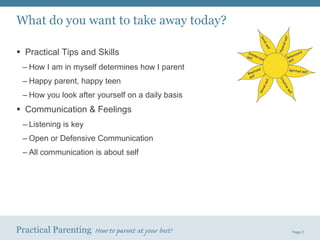
What do you want to take away today? Practical Tips and Skills How I am in myself determines how I parent Happy parent, happy teen How you look after yourself on a daily basis  Communication & Feelings Listening is key Open or Defensive Communication All communication is about self
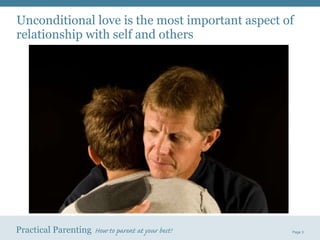
Unconditional love is the most important aspect of relationship with self and others
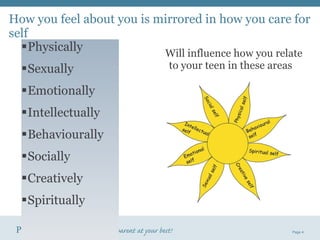
Physically  Sexually Emotionally Intellectually Behaviourally Socially Creatively Spiritually Will influence how you relate to your teen in these areas How you feel about you is mirrored in how you care for self
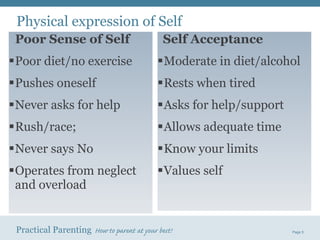
Physical expression of Self Poor Sense of Self Poor diet/no exercise Pushes oneself Never asks for help Rush/race;  Never says No Operates from neglect and overload  Self Acceptance Moderate in diet/alcohol Rests when tired Asks for help/support Allows adequate time Know your limits Values self
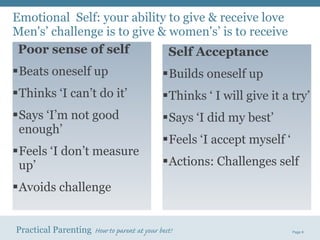
Emotional  Self: your ability to give & receive love Men's’ challenge is to give & women's’ is to receive Poor sense of self Beats oneself up Thinks ‘I can’t do it’ Says ‘I’m not good enough’ Feels ‘I don’t measure up’ Avoids challenge Self Acceptance Builds oneself up Thinks ‘ I will give it a try’ Says ‘I did my best’ Feels ‘I accept myself ‘ Actions: Challenges self
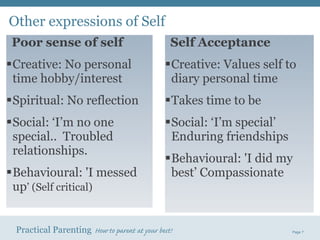
Other expressions of Self Poor sense of self Creative: No personal time hobby/interest Spiritual: No reflection Social: ‘I’m no one special..  Troubled relationships.  Behavioural: 'I messed up ’ (Self critical) Self Acceptance Creative: Values self to diary personal time Takes time to be Social: ‘I’m special’ Enduring friendships Behavioural: 'I did my best’ Compassionate
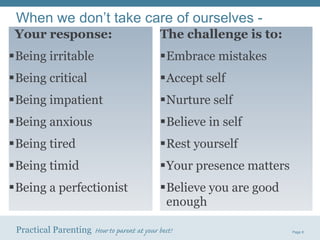
When we don’t take care of ourselves - Your response: Being irritable Being critical Being impatient Being anxious Being tired Being timid Being a perfectionist The challenge is to: Embrace mistakes Accept self Nurture self Believe in self Rest yourself Your presence matters Believe you are good enough
Parenting styles: Authoritarian: Dominant/controlling, Overprotective: Needs to be needed, the carer, gives gives gives Authoritative: Allows quite a bit of freedom; but clear standards of behaviour They listen & reason Warm relationship Clear in expectations “ I trust & believe”
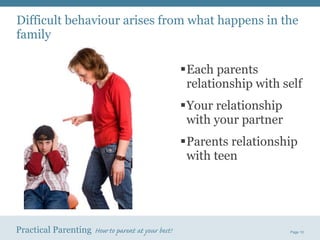
Each parents relationship with self Your relationship with your partner Parents relationship with teen Difficult behaviour arises from what happens in the family
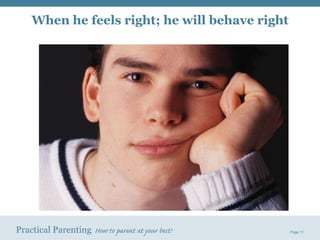
When he feels right; he will behave right
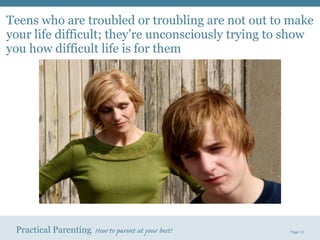
Teens who are troubled or troubling are not out to make your life difficult; they’re unconsciously trying to show you how difficult life is for them
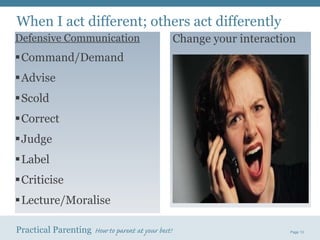
When I act different; others act differently Defensive Communication Command/Demand Advise Scold Correct Judge Label Criticise Lecture/Moralise Change your interaction
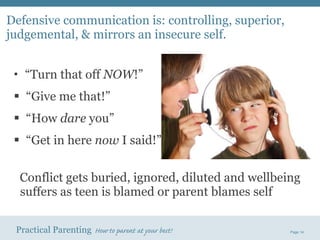
Defensive communication is: controlling, superior, judgemental, & mirrors an insecure self. “ Turn that off  NOW !” “ Give me that!” “ How  dare  you” “ Get in here  now  I said!” Conflict gets buried, ignored, diluted and wellbeing suffers as teen is blamed or parent blames self
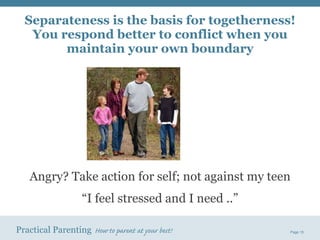
Angry? Take action for self; not against my teen “ I feel stressed and I need ..” Separateness is the basis for togetherness! You respond better to conflict when you maintain your own boundary
All behaviour mirror’s  relationship with self Challenging Behaviour Cross Criticise Punish Situation escalates No resolution Blame the teen or blame yourself Best Response Stay calm Stay Separate Don’t personalise Separate teen from the behaviour “ I love you, but I can’t accept this behaviour
Negative behaviour  decreases if ignored Don’t get into conflict Don’t break relationship Admit if you were wrong; and apologise  Settle for less  Stay Separate Separate his behaviour  from person: “ I’m happy to listen, but  no one shouts at me” Parent using love not  laws; be flexible Press the PAUSE button and catch them being good
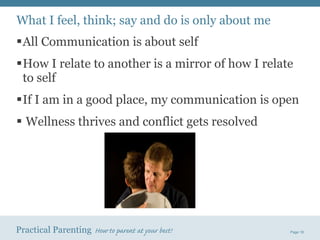
All Communication is about self How I relate to another is a mirror of how I relate to self If I am in a good place, my communication is open Wellness thrives and conflict gets resolved What I feel, think; say and do is only about me
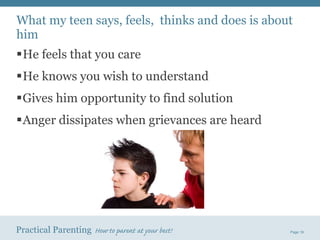
What my teen says, feels,  thinks and does is about him He feels that you care He knows you wish to understand Gives him opportunity to find solution Anger dissipates when grievances are heard
If what you are doing is not working;  try something different!  Keep connecting.. There’s a connection between how a teen feels , and how he behaves Highly disturbed behaviour is an inability to express emotion When your teen deserves your love the least, they need it the most..
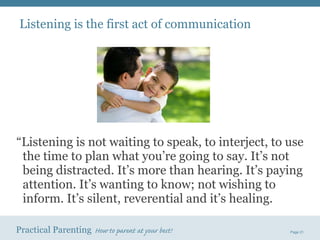
“ Listening is not waiting to speak, to interject, to use the time to plan what you’re going to say. It’s not being distracted. It’s more than hearing. It’s paying attention. It’s wanting to know; not wishing to inform. It’s silent, reverential and it’s healing.  Listening is the first act of communication
Good communication is: Emphatic, real, non judgemental Thanks for the help; you’re always so thoughtful” “ I noticed how punctual you always are” “ You made a great effort; I’m proud of you!” “ What do you think? I’m interested in your opinion?” “ You’re really good at the PC, what will I do?”
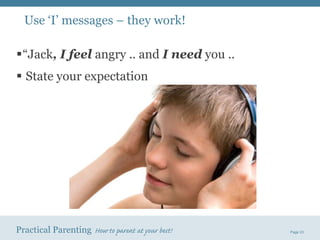
Use ‘I’ messages – they work! “ Jack , I feel  angry .. and  I need  you .. State your expectation
Top Tips to Take Care of You:  Plan/Diary/Schedule
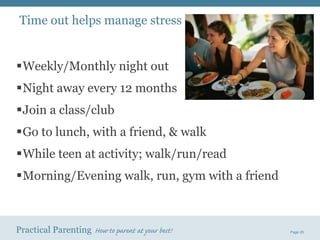
Time out helps manage stress Weekly/Monthly night out Night away every 12 months Join a class/club Go to lunch, with a friend, & walk While teen at activity; walk/run/read  Morning/Evening walk, run, gym with a friend
Identify 1 change you can make:  Happy Parent, Happy Teen Take Home Tips: You can’t take care of anyone; till you first take care of you Self  acceptance & self approval are key to change Stay Separate Hit the PAUSE button Use ‘I’ messages
One to One Parent Mentoring service available Parenting Talks to Companies & Organisations One Day Courses on Parenting Teens in Oct & Nov “ Fantastic course; just wish I’d done it sooner ” Book a Course: 6 evenings beginning Oct 4/5/6 Glenageary, Foxrock; Leopardstown & Goatstown
Thank you for your attention www.practicalparenting.ie

Parenting Teenagers 2010

  • 1.
  • 2.
    What do youwant to take away today? Practical Tips and Skills How I am in myself determines how I parent Happy parent, happy teen How you look after yourself on a daily basis Communication & Feelings Listening is key Open or Defensive Communication All communication is about self
  • 3.
    Unconditional love isthe most important aspect of relationship with self and others
  • 4.
    Physically SexuallyEmotionally Intellectually Behaviourally Socially Creatively Spiritually Will influence how you relate to your teen in these areas How you feel about you is mirrored in how you care for self
  • 5.
    Physical expression ofSelf Poor Sense of Self Poor diet/no exercise Pushes oneself Never asks for help Rush/race; Never says No Operates from neglect and overload Self Acceptance Moderate in diet/alcohol Rests when tired Asks for help/support Allows adequate time Know your limits Values self
  • 6.
    Emotional Self:your ability to give & receive love Men's’ challenge is to give & women's’ is to receive Poor sense of self Beats oneself up Thinks ‘I can’t do it’ Says ‘I’m not good enough’ Feels ‘I don’t measure up’ Avoids challenge Self Acceptance Builds oneself up Thinks ‘ I will give it a try’ Says ‘I did my best’ Feels ‘I accept myself ‘ Actions: Challenges self
  • 7.
    Other expressions ofSelf Poor sense of self Creative: No personal time hobby/interest Spiritual: No reflection Social: ‘I’m no one special.. Troubled relationships. Behavioural: 'I messed up ’ (Self critical) Self Acceptance Creative: Values self to diary personal time Takes time to be Social: ‘I’m special’ Enduring friendships Behavioural: 'I did my best’ Compassionate
  • 8.
    When we don’ttake care of ourselves - Your response: Being irritable Being critical Being impatient Being anxious Being tired Being timid Being a perfectionist The challenge is to: Embrace mistakes Accept self Nurture self Believe in self Rest yourself Your presence matters Believe you are good enough
  • 9.
    Parenting styles: Authoritarian:Dominant/controlling, Overprotective: Needs to be needed, the carer, gives gives gives Authoritative: Allows quite a bit of freedom; but clear standards of behaviour They listen & reason Warm relationship Clear in expectations “ I trust & believe”
  • 10.
    Each parents relationshipwith self Your relationship with your partner Parents relationship with teen Difficult behaviour arises from what happens in the family
  • 11.
    When he feelsright; he will behave right
  • 12.
    Teens who aretroubled or troubling are not out to make your life difficult; they’re unconsciously trying to show you how difficult life is for them
  • 13.
    When I actdifferent; others act differently Defensive Communication Command/Demand Advise Scold Correct Judge Label Criticise Lecture/Moralise Change your interaction
  • 14.
    Defensive communication is:controlling, superior, judgemental, & mirrors an insecure self. “ Turn that off NOW !” “ Give me that!” “ How dare you” “ Get in here now I said!” Conflict gets buried, ignored, diluted and wellbeing suffers as teen is blamed or parent blames self
  • 15.
    Angry? Take actionfor self; not against my teen “ I feel stressed and I need ..” Separateness is the basis for togetherness! You respond better to conflict when you maintain your own boundary
  • 16.
    All behaviour mirror’s relationship with self Challenging Behaviour Cross Criticise Punish Situation escalates No resolution Blame the teen or blame yourself Best Response Stay calm Stay Separate Don’t personalise Separate teen from the behaviour “ I love you, but I can’t accept this behaviour
  • 17.
    Negative behaviour decreases if ignored Don’t get into conflict Don’t break relationship Admit if you were wrong; and apologise Settle for less Stay Separate Separate his behaviour from person: “ I’m happy to listen, but no one shouts at me” Parent using love not laws; be flexible Press the PAUSE button and catch them being good
  • 18.
    All Communication isabout self How I relate to another is a mirror of how I relate to self If I am in a good place, my communication is open Wellness thrives and conflict gets resolved What I feel, think; say and do is only about me
  • 19.
    What my teensays, feels, thinks and does is about him He feels that you care He knows you wish to understand Gives him opportunity to find solution Anger dissipates when grievances are heard
  • 20.
    If what youare doing is not working; try something different! Keep connecting.. There’s a connection between how a teen feels , and how he behaves Highly disturbed behaviour is an inability to express emotion When your teen deserves your love the least, they need it the most..
  • 21.
    “ Listening isnot waiting to speak, to interject, to use the time to plan what you’re going to say. It’s not being distracted. It’s more than hearing. It’s paying attention. It’s wanting to know; not wishing to inform. It’s silent, reverential and it’s healing. Listening is the first act of communication
  • 22.
    Good communication is:Emphatic, real, non judgemental Thanks for the help; you’re always so thoughtful” “ I noticed how punctual you always are” “ You made a great effort; I’m proud of you!” “ What do you think? I’m interested in your opinion?” “ You’re really good at the PC, what will I do?”
  • 23.
    Use ‘I’ messages– they work! “ Jack , I feel angry .. and I need you .. State your expectation
  • 24.
    Top Tips toTake Care of You: Plan/Diary/Schedule
  • 25.
    Time out helpsmanage stress Weekly/Monthly night out Night away every 12 months Join a class/club Go to lunch, with a friend, & walk While teen at activity; walk/run/read Morning/Evening walk, run, gym with a friend
  • 26.
    Identify 1 changeyou can make: Happy Parent, Happy Teen Take Home Tips: You can’t take care of anyone; till you first take care of you Self acceptance & self approval are key to change Stay Separate Hit the PAUSE button Use ‘I’ messages
  • 27.
    One to OneParent Mentoring service available Parenting Talks to Companies & Organisations One Day Courses on Parenting Teens in Oct & Nov “ Fantastic course; just wish I’d done it sooner ” Book a Course: 6 evenings beginning Oct 4/5/6 Glenageary, Foxrock; Leopardstown & Goatstown
  • 28.
    Thank you foryour attention www.practicalparenting.ie