Stress Relief
for Counselors
Work Life Audit
As counselors you advise
self-care, but with the
built-in stressors of the
profession, it’s prudent to
consider how you are doing
with your own self-care.
Working in the mental
health profession has its
challenges and rewards,
but it can also be draining,
emotionally and physically.
It’s rewarding work,
but you are painfully
aware of the emotional
drain it can be.
It is difficult, even for
the most experienced
mental health providers,
not to “take work home.”
The lack of feedback can
be frustrating—not seeing
the results of your labor,
uncertainty whether you’re
making a difference in the
lives of your clients.
Do you agree with the following statement?
“To maintain a healthy sense of wellbeing,
counselors need to cultivate a lifestyle
with which you learn to manage stress,
make healthy decisions, and incorporate
behaviors that invite balanced living
on a daily basis.”	 —G. Miller, Learning the Language of Addiction Counseling
	www.wiley.com/buy/9781118721773
If you agree, read on. We’d like to help with that.
As mental health care
professionals you are most
likely well-versed in
mind, body, spirit care:
the importance of taking
time to rest, exercising,
and eating healthy.
It is also possible to apply
these self-care concepts to
work life, not just after-hours.
Here’s a simple way
to start: perform a
work life self-care audit.
Ask yourself 5 questions…
Where do I spend time at
work, and is that space
comfortable for me
physically, emotionally,
psychologically, and
spiritually?
1
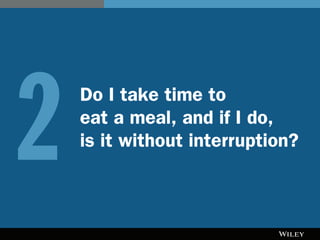
Do I take time to
eat a meal, and if I do,
is it without interruption?2
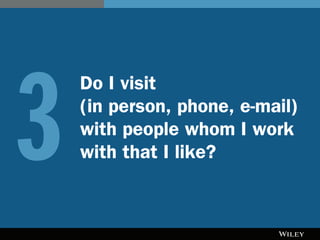
Do I visit
(in person, phone, e-mail)
with people whom I work
with that I like?3
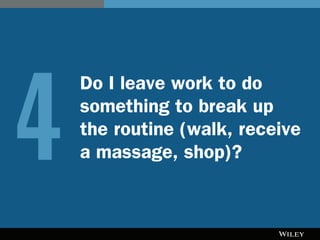
Do I leave work to do
something to break up
the routine (walk, receive
a massage, shop)?4
Can meetings be held
in a different location
that still invites
professional behavior
but is more relaxing?
5
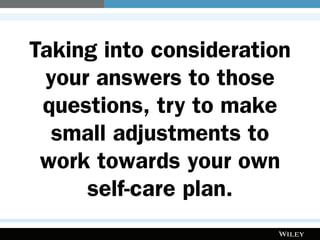
Taking into consideration
your answers to those
questions, try to make
small adjustments to
work towards your own
self-care plan.
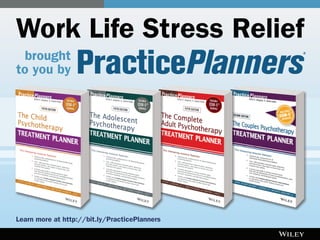
Work Life Stress Relief
brought
to you by
Learn more at http://bit.ly/PracticePlanners

Stress Relief for Counselors: Work Life Audit

  • 1.
  • 2.
    As counselors youadvise self-care, but with the built-in stressors of the profession, it’s prudent to consider how you are doing with your own self-care.
  • 3.
    Working in themental health profession has its challenges and rewards, but it can also be draining, emotionally and physically.
  • 4.
    It’s rewarding work, butyou are painfully aware of the emotional drain it can be.
  • 5.
    It is difficult,even for the most experienced mental health providers, not to “take work home.”
  • 6.
    The lack offeedback can be frustrating—not seeing the results of your labor, uncertainty whether you’re making a difference in the lives of your clients.
  • 7.
    Do you agreewith the following statement? “To maintain a healthy sense of wellbeing, counselors need to cultivate a lifestyle with which you learn to manage stress, make healthy decisions, and incorporate behaviors that invite balanced living on a daily basis.” —G. Miller, Learning the Language of Addiction Counseling www.wiley.com/buy/9781118721773 If you agree, read on. We’d like to help with that.
  • 8.
    As mental healthcare professionals you are most likely well-versed in mind, body, spirit care: the importance of taking time to rest, exercising, and eating healthy.
  • 9.
    It is alsopossible to apply these self-care concepts to work life, not just after-hours.
  • 10.
    Here’s a simpleway to start: perform a work life self-care audit. Ask yourself 5 questions…
  • 11.
    Where do Ispend time at work, and is that space comfortable for me physically, emotionally, psychologically, and spiritually? 1
  • 12.
    Do I taketime to eat a meal, and if I do, is it without interruption?2
  • 13.
    Do I visit (inperson, phone, e-mail) with people whom I work with that I like?3
  • 14.
    Do I leavework to do something to break up the routine (walk, receive a massage, shop)?4
  • 15.
    Can meetings beheld in a different location that still invites professional behavior but is more relaxing? 5
  • 16.
    Taking into consideration youranswers to those questions, try to make small adjustments to work towards your own self-care plan.
  • 17.
    Work Life StressRelief brought to you by Learn more at http://bit.ly/PracticePlanners