TRAINING
AND
DEVELOPMENT
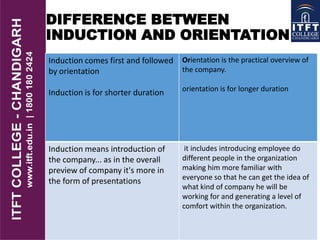
DIFFERENCE BETWEEN
INDUCTION AND ORIENTATION
Induction comes first and followed
by orientation
Induction is for shorter duration
Orientation is the practical overview of
the company.
orientation is for longer duration
Induction means introduction of
the company... as in the overall
preview of company it's more in
the form of presentations
it includes introducing employee do
different people in the organization
making him more familiar with
everyone so that he can get the idea of
what kind of company he will be
working for and generating a level of
comfort within the organization.
TRAINING
• Training is a process of learning a sequence of
programmed behavior. It tries to improve their
performance on the current job or prepare them
for an indented job.
NEED FOR BASIC PURPOSES OF
TRAINING
To Increase Productivity : Because of training ,
instruction can help employees increase their level of
performance on their present assignment.
To Improve quality : Better informed employees are less
likely to make operational mistakes.
To improve health & safety : Proper training can help
prevent industrial accidents.
Obsolescence (becoming outdated) Prevention : It foster
(promote growth) the & initiative creativity of employees &
help to prevent manpower obsolescence.
Personnel Growth : Employee on personal basis gain
individually from their exposure to educational experiences.
CONTI…
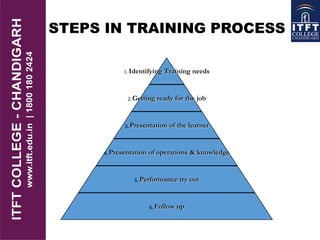
STEPS IN TRAINING PROCESS
1. Identifying Training needs
2. Getting ready for the job
3. Presentation of the learner
4. Presentation of operations & knowledge
5. Performance try out
6. Follow up
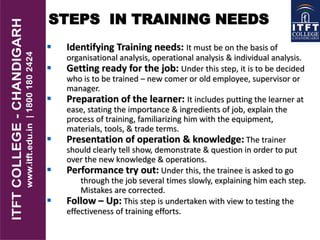
STEPS IN TRAINING NEEDS
 Identifying Training needs: It must be on the basis of
organisational analysis, operational analysis & individual analysis.
 Getting ready for the job: Under this step, it is to be decided
who is to be trained – new comer or old employee, supervisor or
manager.
 Preparation of the learner: It includes putting the learner at
ease, stating the importance & ingredients of job, explain the
process of training, familiarizing him with the equipment,
materials, tools, & trade terms.
 Presentation of operation & knowledge: The trainer
should clearly tell show, demonstrate & question in order to put
over the new knowledge & operations.
 Performance try out: Under this, the trainee is asked to go
through the job several times slowly, explaining him each step.
Mistakes are corrected.
 Follow – Up: This step is undertaken with view to testing the
effectiveness of training efforts.
METHODS OF
TRAINING
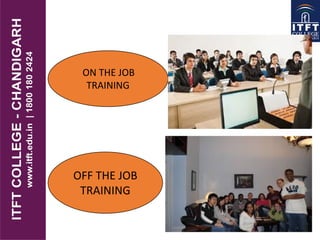
ON THE JOB
TRAINING
OFF THE JOB
TRAINING
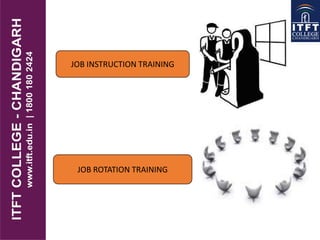
JOB INSTRUCTION TRAINING
JOB ROTATION TRAINING
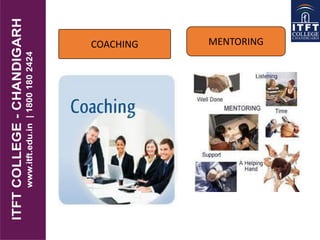
COACHING MENTORING
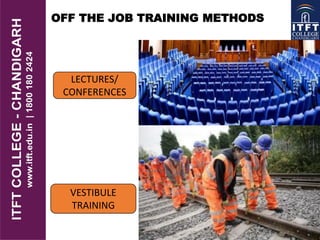
OFF THE JOB TRAINING METHODS
LECTURES/
CONFERENCES
VESTIBULE
TRAINING
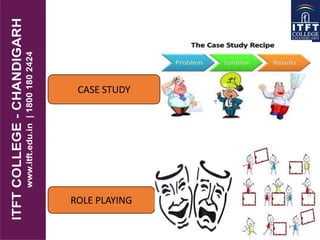
CASE STUDY
ROLE PLAYING
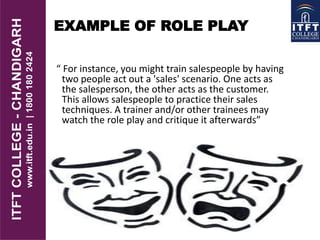
EXAMPLE OF ROLE PLAY
“ For instance, you might train salespeople by having
two people act out a 'sales' scenario. One acts as
the salesperson, the other acts as the customer.
This allows salespeople to practice their sales
techniques. A trainer and/or other trainees may
watch the role play and critique it afterwards”
EXAMPLE OF VESTIBULE TRAINING
• Vestibule training means to get the training from out
side the company or factory where the situation of
the work and factory is the same.
• Often used to train bank tellers, inspectors, machine
operators, typists.
• Vestibule method has been using widely for the
purpose of training Aero plane pilots on Aero plane
simulator to make them ready to handle an fly Aero
plane.
• work situation of the cabin crew of an airliner, hotel
kitchen workers, or high-tension-wire workers.
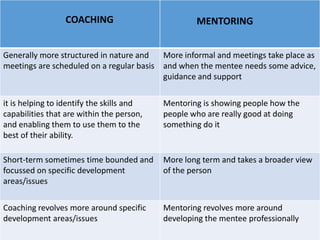
COACHING MENTORING
Generally more structured in nature and
meetings are scheduled on a regular basis
More informal and meetings take place as
and when the mentee needs some advice,
guidance and support
it is helping to identify the skills and
capabilities that are within the person,
and enabling them to use them to the
best of their ability.
Mentoring is showing people how the
people who are really good at doing
something do it
Short-term sometimes time bounded and
focussed on specific development
areas/issues
More long term and takes a broader view
of the person
Coaching revolves more around specific
development areas/issues
Mentoring revolves more around
developing the mentee professionally
DEVELOPMENT
Objective of employee
development
• Securing continued supply of competent working
force:
• Optimum utilization of human resources:
• Developing technical & administrative skill:
• Prevention of managerial obsolescence:
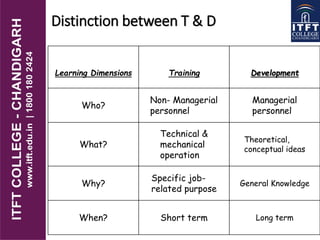
Distinction between T & D
Learning Dimensions Training Development
Who?
Non- Managerial
personnel
Managerial
personnel
What?
Technical &
mechanical
operation
Theoretical,
conceptual ideas
Why?
Specific job-
related purpose
General Knowledge
When? Short term Long term
NOW TIME

ITFT_Training and development

  • 1.
  • 2.
    DIFFERENCE BETWEEN INDUCTION ANDORIENTATION Induction comes first and followed by orientation Induction is for shorter duration Orientation is the practical overview of the company. orientation is for longer duration Induction means introduction of the company... as in the overall preview of company it's more in the form of presentations it includes introducing employee do different people in the organization making him more familiar with everyone so that he can get the idea of what kind of company he will be working for and generating a level of comfort within the organization.
  • 3.
    TRAINING • Training isa process of learning a sequence of programmed behavior. It tries to improve their performance on the current job or prepare them for an indented job.
  • 4.
    NEED FOR BASICPURPOSES OF TRAINING To Increase Productivity : Because of training , instruction can help employees increase their level of performance on their present assignment. To Improve quality : Better informed employees are less likely to make operational mistakes.
  • 5.
    To improve health& safety : Proper training can help prevent industrial accidents. Obsolescence (becoming outdated) Prevention : It foster (promote growth) the & initiative creativity of employees & help to prevent manpower obsolescence. Personnel Growth : Employee on personal basis gain individually from their exposure to educational experiences. CONTI…
  • 6.
    STEPS IN TRAININGPROCESS 1. Identifying Training needs 2. Getting ready for the job 3. Presentation of the learner 4. Presentation of operations & knowledge 5. Performance try out 6. Follow up
  • 7.
    STEPS IN TRAININGNEEDS  Identifying Training needs: It must be on the basis of organisational analysis, operational analysis & individual analysis.  Getting ready for the job: Under this step, it is to be decided who is to be trained – new comer or old employee, supervisor or manager.  Preparation of the learner: It includes putting the learner at ease, stating the importance & ingredients of job, explain the process of training, familiarizing him with the equipment, materials, tools, & trade terms.  Presentation of operation & knowledge: The trainer should clearly tell show, demonstrate & question in order to put over the new knowledge & operations.  Performance try out: Under this, the trainee is asked to go through the job several times slowly, explaining him each step. Mistakes are corrected.  Follow – Up: This step is undertaken with view to testing the effectiveness of training efforts.
  • 8.
  • 9.
    ON THE JOB TRAINING OFFTHE JOB TRAINING
  • 10.
  • 11.
  • 12.
    OFF THE JOBTRAINING METHODS LECTURES/ CONFERENCES VESTIBULE TRAINING
  • 13.
  • 14.
    EXAMPLE OF ROLEPLAY “ For instance, you might train salespeople by having two people act out a 'sales' scenario. One acts as the salesperson, the other acts as the customer. This allows salespeople to practice their sales techniques. A trainer and/or other trainees may watch the role play and critique it afterwards”
  • 15.
    EXAMPLE OF VESTIBULETRAINING • Vestibule training means to get the training from out side the company or factory where the situation of the work and factory is the same. • Often used to train bank tellers, inspectors, machine operators, typists. • Vestibule method has been using widely for the purpose of training Aero plane pilots on Aero plane simulator to make them ready to handle an fly Aero plane. • work situation of the cabin crew of an airliner, hotel kitchen workers, or high-tension-wire workers.
  • 16.
    COACHING MENTORING Generally morestructured in nature and meetings are scheduled on a regular basis More informal and meetings take place as and when the mentee needs some advice, guidance and support it is helping to identify the skills and capabilities that are within the person, and enabling them to use them to the best of their ability. Mentoring is showing people how the people who are really good at doing something do it Short-term sometimes time bounded and focussed on specific development areas/issues More long term and takes a broader view of the person Coaching revolves more around specific development areas/issues Mentoring revolves more around developing the mentee professionally
  • 17.
  • 18.
    Objective of employee development •Securing continued supply of competent working force: • Optimum utilization of human resources: • Developing technical & administrative skill: • Prevention of managerial obsolescence:
  • 19.
    Distinction between T& D Learning Dimensions Training Development Who? Non- Managerial personnel Managerial personnel What? Technical & mechanical operation Theoretical, conceptual ideas Why? Specific job- related purpose General Knowledge When? Short term Long term
  • 20.