TRAINING & DEVELOPMENT
OUTLINE
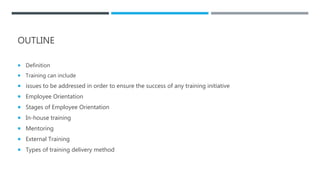
 Definition
 Training can include
 issues to be addressed in order to ensure the success of any training initiative
 Employee Orientation
 Stages of Employee Orientation
 In-house training
 Mentoring
 External Training
 Types of training delivery method
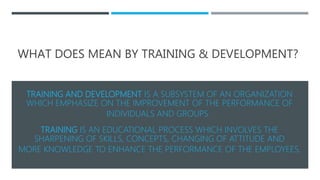
WHAT DOES MEAN BY TRAINING & DEVELOPMENT?
TRAINING AND DEVELOPMENT IS A SUBSYSTEM OF AN ORGANIZATION
WHICH EMPHASIZE ON THE IMPROVEMENT OF THE PERFORMANCE OF
INDIVIDUALS AND GROUPS.
TRAINING IS AN EDUCATIONAL PROCESS WHICH INVOLVES THE
SHARPENING OF SKILLS, CONCEPTS, CHANGING OF ATTITUDE AND
MORE KNOWLEDGE TO ENHANCE THE PERFORMANCE OF THE EMPLOYEES.
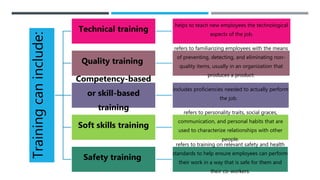
Trainingcaninclude:
Technical training
helps to teach new employees the technological
aspects of the job.
Quality training
refers to familiarizing employees with the means
of preventing, detecting, and eliminating non-
quality items, usually in an organization that
produces a product.
Competency-based
or skill-based
training
includes proficiencies needed to actually perform
the job.
Soft skills training
refers to personality traits, social graces,
communication, and personal habits that are
used to characterize relationships with other
people.
Safety training
refers to training on relevant safety and health
standards to help ensure employees can perform
their work in a way that is safe for them and
their co-workers.
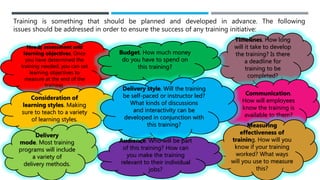
Training is something that should be planned and developed in advance. The following
issues should be addressed in order to ensure the success of any training initiative:
Needs assessment and
learning objectives. Once
you have determined the
training needed, you can set
learning objectives to
measure at the end of the
training.
Consideration of
learning styles. Making
sure to teach to a variety
of learning styles.
Delivery
mode. Most training
programs will include
a variety of
delivery methods.
Timelines. How long
will it take to develop
the training? Is there
a deadline for
training to be
completed?
Communication.
How will employees
know the training is
available to them?
Measuring
effectiveness of
training. How will you
know if your training
worked? What ways
will you use to measure
this?
Budget. How much money
do you have to spend on
this training?
Delivery style. Will the training
be self-paced or instructor led?
What kinds of discussions
and interactivity can be
developed in conjunction with
this training?
Audience. Who will be part
of this training? How can
you make the training
relevant to their individual
jobs?
The first step in training is employee
orientation.
Employee orientation/induction is a process
used to welcome new employees into the
company.
The purpose of the orientation process is
to help employees to gain an
understanding of the company policies
and learn how their specific job fits into
the big picture.
A mentor will be appointed and will take
responsibility for the orientation of new
staff.
The overall goals of employee orientation/induction are as follows:
To reduce start-up costs. If an
orientation is done right, it can
help get the employee up to
speed on various policies and
procedures, so the employee
can start working right away. It
can also help ensure that all
hiring paperwork is filled out
correctly, so the employee is
paid on time.
To reduce anxiety. Starting a
new job can be stressful. One
goal of an orientation is to
reduce the stress and anxiety
people feel when going into an
unknown situation.
To reduce employee
turnover. Employee turnover
tends to be higher when
employees don’t feel valued
or are not given the tools to
perform. An employee
orientation can show that the
organisation values
the employee and provides
tools necessary for a successful
entry.
To set expectations and
attitudes. If employees know
from the start what the
expectations and attitudes, they
tend to perform better.
stages of employee orientation/induction process:
Socialisation
This refers to the process of a new employee learning norms and
values of work roles within the organisation, as well as becoming
familiar with colleagues and their roles.
Information Sessions
These should relate to the organisation, its goals and rules and
the culture of corporate. Sessions can be tailored for specific
departments, on top of the general organisation-wide training.
Guided Tour
Tours of the facility or facilities are key to making new staff feel at
home, as well as allowing them to understand the work of the
organisation.
Training
Person/job specific skills training and development sessions are
essential. This includes outlining what the day-to-day duties of
the job will entail, which should be based on the job description.
Occupational health &
safety information
This refers to any information relevant to occupational health and
safety such as, evacuation and emergency procedures, etc.
Information on
performance review
This refers to detailed information regarding when performance
appraisals take place and how these will be conducted. This is
particularly important for new roles that are subject to a
probationary period.
In-
House
Trainin
g
• In-house training programs are typically developed by
the hiring organisation.
• This is usually the second step in the training process
and often is ongoing.
• In-house training programs can be training related to a
specific job, such as how to use a particular kind of
software.
• Training may be self-led learning or tiered,
competency-based training with a clear ladder of
progression.
• Many companies provide in-house training on various
HR topics as well, meaning it doesn’t always have to
relate to a specific job.
Mentorin
g
• After orientation and in-house training, companies offers
mentoring opportunities as the next step in training.
• This is usually the third step in employee training.
• Sometimes a mentor may be assigned during in-house
training.
• A mentor is a trusted, experienced advisor who has direct
investment in the development of an employee.
• A mentor may be a supervisor, but often a mentor is a
colleague who has the experience and personality to help
guide someone through processes.
• To work effectively, a mentoring program should become part
of the company culture; in other words, new mentors should
receive in-house training to be a mentor.
• While mentoring may occur informally, a mentorship program
can help ensure the new employee not only feels welcomed
but is paired up with someone who already knows the ropes
and can help guide the new employee through any on-the-
job challenges.
Externa
l
Trainin
g • External training includes any type of training that is not
performed in-house.
• This is usually the last step in training, and it can be
ongoing.
• It can include sending employees to conferences or
seminars for leadership development or even paying
tuition for a class or course they want to take.
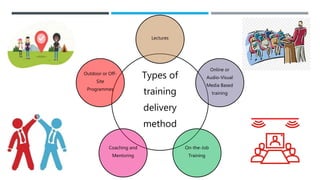
Types of
training
delivery
method
Lectures
Online or
Audio-Visual
Media Based
training
On-the-Job
Training
Coaching and
Mentoring
Outdoor or Off-
Site
Programmes
Types of
training
delivery
method
Lectures
Online or
Audio-Visual
Media Based
training
On-the-Job
Training
Coaching and
Mentoring
Outdoor or Off-
Site
Programmes
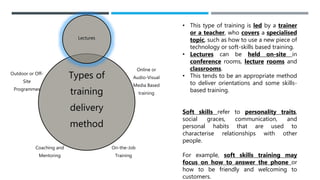
• This type of training is led by a trainer
or a teacher, who covers a specialised
topic, such as how to use a new piece of
technology or soft-skills based training.
• Lectures can be held on-site in
conference rooms, lecture rooms and
classrooms.
• This tends to be an appropriate method
to deliver orientations and some skills-
based training.
Soft skills refer to personality traits,
social graces, communication, and
personal habits that are used to
characterise relationships with other
people.
For example, soft skills training may
focus on how to answer the phone or
how to be friendly and welcoming to
customers.
Types of
training
delivery
method
Lectures
Online or
Audio-Visual
Media Based
training
On-the-Job
Training
Coaching and
Mentoring
Outdoor or
Off-Site
Programmes
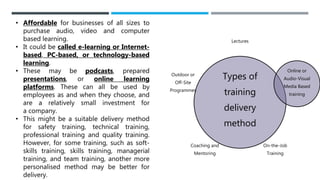
• Affordable for businesses of all sizes to
purchase audio, video and computer
based learning.
• It could be called e-learning or Internet-
based, PC-based, or technology-based
learning.
• These may be podcasts, prepared
presentations, or online learning
platforms. These can all be used by
employees as and when they choose, and
are a relatively small investment for
a company.
• This might be a suitable delivery method
for safety training, technical training,
professional training and quality training.
However, for some training, such as soft-
skills training, skills training, managerial
training, and team training, another more
personalised method may be better for
delivery.
Types of
training
delivery
method
Lectures
Online or
Audio-Visual
Media Based
training
On-the-Job
Training
Coaching and
Mentoring
Outdoor or
Off-Site
Programmes
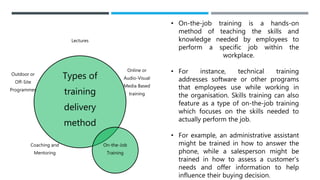
• On-the-job training is a hands-on
method of teaching the skills and
knowledge needed by employees to
perform a specific job within the
workplace.
• For instance, technical training
addresses software or other programs
that employees use while working in
the organisation. Skills training can also
feature as a type of on-the-job training
which focuses on the skills needed to
actually perform the job.
• For example, an administrative assistant
might be trained in how to answer the
phone, while a salesperson might be
trained in how to assess a customer's
needs and offer information to help
influence their buying decision.
Types of
training
delivery
method
Lectures
Online or
Audio-Visual
Media Based
training
On-the-Job
Training
Coaching and
Mentoring
Outdoor or
Off-Site
Programmes
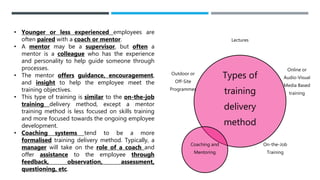
• Younger or less experienced employees are
often paired with a coach or mentor.
• A mentor may be a supervisor, but often a
mentor is a colleague who has the experience
and personality to help guide someone through
processes.
• The mentor offers guidance, encouragement,
and insight to help the employee meet the
training objectives.
• This type of training is similar to the on-the-job
training delivery method, except a mentor
training method is less focused on skills training
and more focused towards the ongoing employee
development.
• Coaching systems tend to be a more
formalised training delivery method. Typically, a
manager will take on the role of a coach and
offer assistance to the employee through
feedback, observation, assessment,
questioning, etc.
Types of
training
delivery
method
Lectures
Online or
Audio-Visual
Media Based
training
On-the-Job
Training
Coaching and
Mentoring
Outdoor or
Off-Site
Programmes
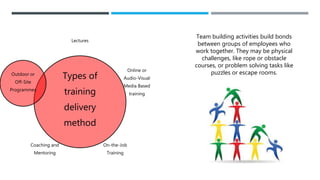
Team building activities build bonds
between groups of employees who
work together. They may be physical
challenges, like rope or obstacle
courses, or problem solving tasks like
puzzles or escape rooms.
Key
Points
When developing your training plan, there are a number of elements that should be taken into account
such as:
• Needs assessment and learning
objectives
• Consideration of learning styles
• Delivery mode
• Budget
• Delivery style
• Audience
• Timelines
• Measuring effectiveness of training
Training can be classified into four main categories which include:
• Employee Orientation - this includes socialisation, information sessions, guided tours and general
training to help new employees learn how their role fits within the organisation as a whole.
• In-House Training - may be self-led learning or tiered, competency-based training with a clear
ladder of progression. Many companies provide in-house training on various HR topics as well.
• Mentoring - after the employee has completed orientation and in-house training,
companies see the value in offering mentoring opportunities as the next step in
training. A mentor may be a supervisor, but often a mentor is a colleague who has
the experience and personality to help guide someone through processes.
• External Training - includes any type of training that is not performed in-house such
as attending conferences, seminars or even paying tuition for a course.
Key
Points
Most training programs will include a variety of training delivery methods, such as:
• Lecturers
• Online or Audio-Visual Media based
Training
• On-the –job Training
• Coaching & Mentoring
• Outdoor or offsite programmes
REFERENCES:
• Clip arts library official website / Steps Cliparts #272622 / Online Available: http://clipart-
library.com/clipart/382106.htm / Accessed on 15 April 2020
• YAWD official website / Transparent welcome namaste clipart / Online Available: https://ya-
webdesign.com/explore/transparent-welcome-namaste/ / Accessed on 15 April 2020
• Career research official website / Orientation / Online Available: http://career.iresearchnet.com/career-
development/orientation / Accessed on 15 April 2020
• Arthur, D. 1991. Recruiting, Interviewing, Selecting & Orienting New Employees. 2d ed. New York:
AMACOM
• Jerris, L. A. 1993. Effective Employee Orientation. New York: AMACOM.
• Stockard, J. G. 1977. Career Development and Job Training. New York: AMACOM.
• Chris Engel / Lecture Clip Art / Online Available: https://www.pinclipart.com/pindetail/bbTRoh_contact-
chris-engel-about-this-page-lecture-clip/ / Accessed on 15 April 2020
• Excell official webpage / Audio-visual clipart / Online Available: https://www.excellgroup.com// Accessed
on 15 April 2020
• WITS Team building Website / 30 m ay 2019 / Online Available: https://witsteambuilding.com/team-
building-and-collaborative-thinking/ Accessed on 15 April 2020
• Training and Development Definition, Importance, Advantages, Disadvantages, Process & Overview /
mbaskool official website / Online Available: https://www.mbaskool.com/business-concepts/human-
resources-hr-terms/8685-training-and-development.html / Accessed on 15 April 2020

Training & development

  • 1.
  • 2.
    OUTLINE  Definition  Trainingcan include  issues to be addressed in order to ensure the success of any training initiative  Employee Orientation  Stages of Employee Orientation  In-house training  Mentoring  External Training  Types of training delivery method
  • 3.
    WHAT DOES MEANBY TRAINING & DEVELOPMENT? TRAINING AND DEVELOPMENT IS A SUBSYSTEM OF AN ORGANIZATION WHICH EMPHASIZE ON THE IMPROVEMENT OF THE PERFORMANCE OF INDIVIDUALS AND GROUPS. TRAINING IS AN EDUCATIONAL PROCESS WHICH INVOLVES THE SHARPENING OF SKILLS, CONCEPTS, CHANGING OF ATTITUDE AND MORE KNOWLEDGE TO ENHANCE THE PERFORMANCE OF THE EMPLOYEES.
  • 4.
    Trainingcaninclude: Technical training helps toteach new employees the technological aspects of the job. Quality training refers to familiarizing employees with the means of preventing, detecting, and eliminating non- quality items, usually in an organization that produces a product. Competency-based or skill-based training includes proficiencies needed to actually perform the job. Soft skills training refers to personality traits, social graces, communication, and personal habits that are used to characterize relationships with other people. Safety training refers to training on relevant safety and health standards to help ensure employees can perform their work in a way that is safe for them and their co-workers.
  • 5.
    Training is somethingthat should be planned and developed in advance. The following issues should be addressed in order to ensure the success of any training initiative: Needs assessment and learning objectives. Once you have determined the training needed, you can set learning objectives to measure at the end of the training. Consideration of learning styles. Making sure to teach to a variety of learning styles. Delivery mode. Most training programs will include a variety of delivery methods. Timelines. How long will it take to develop the training? Is there a deadline for training to be completed? Communication. How will employees know the training is available to them? Measuring effectiveness of training. How will you know if your training worked? What ways will you use to measure this? Budget. How much money do you have to spend on this training? Delivery style. Will the training be self-paced or instructor led? What kinds of discussions and interactivity can be developed in conjunction with this training? Audience. Who will be part of this training? How can you make the training relevant to their individual jobs?
  • 6.
    The first stepin training is employee orientation. Employee orientation/induction is a process used to welcome new employees into the company. The purpose of the orientation process is to help employees to gain an understanding of the company policies and learn how their specific job fits into the big picture. A mentor will be appointed and will take responsibility for the orientation of new staff. The overall goals of employee orientation/induction are as follows: To reduce start-up costs. If an orientation is done right, it can help get the employee up to speed on various policies and procedures, so the employee can start working right away. It can also help ensure that all hiring paperwork is filled out correctly, so the employee is paid on time. To reduce anxiety. Starting a new job can be stressful. One goal of an orientation is to reduce the stress and anxiety people feel when going into an unknown situation. To reduce employee turnover. Employee turnover tends to be higher when employees don’t feel valued or are not given the tools to perform. An employee orientation can show that the organisation values the employee and provides tools necessary for a successful entry. To set expectations and attitudes. If employees know from the start what the expectations and attitudes, they tend to perform better.
  • 7.
    stages of employeeorientation/induction process: Socialisation This refers to the process of a new employee learning norms and values of work roles within the organisation, as well as becoming familiar with colleagues and their roles. Information Sessions These should relate to the organisation, its goals and rules and the culture of corporate. Sessions can be tailored for specific departments, on top of the general organisation-wide training. Guided Tour Tours of the facility or facilities are key to making new staff feel at home, as well as allowing them to understand the work of the organisation. Training Person/job specific skills training and development sessions are essential. This includes outlining what the day-to-day duties of the job will entail, which should be based on the job description. Occupational health & safety information This refers to any information relevant to occupational health and safety such as, evacuation and emergency procedures, etc. Information on performance review This refers to detailed information regarding when performance appraisals take place and how these will be conducted. This is particularly important for new roles that are subject to a probationary period.
  • 8.
    In- House Trainin g • In-house trainingprograms are typically developed by the hiring organisation. • This is usually the second step in the training process and often is ongoing. • In-house training programs can be training related to a specific job, such as how to use a particular kind of software. • Training may be self-led learning or tiered, competency-based training with a clear ladder of progression. • Many companies provide in-house training on various HR topics as well, meaning it doesn’t always have to relate to a specific job.
  • 9.
    Mentorin g • After orientationand in-house training, companies offers mentoring opportunities as the next step in training. • This is usually the third step in employee training. • Sometimes a mentor may be assigned during in-house training. • A mentor is a trusted, experienced advisor who has direct investment in the development of an employee. • A mentor may be a supervisor, but often a mentor is a colleague who has the experience and personality to help guide someone through processes. • To work effectively, a mentoring program should become part of the company culture; in other words, new mentors should receive in-house training to be a mentor. • While mentoring may occur informally, a mentorship program can help ensure the new employee not only feels welcomed but is paired up with someone who already knows the ropes and can help guide the new employee through any on-the- job challenges.
  • 10.
    Externa l Trainin g • Externaltraining includes any type of training that is not performed in-house. • This is usually the last step in training, and it can be ongoing. • It can include sending employees to conferences or seminars for leadership development or even paying tuition for a class or course they want to take.
  • 11.
    Types of training delivery method Lectures Online or Audio-Visual MediaBased training On-the-Job Training Coaching and Mentoring Outdoor or Off- Site Programmes
  • 12.
    Types of training delivery method Lectures Online or Audio-Visual MediaBased training On-the-Job Training Coaching and Mentoring Outdoor or Off- Site Programmes • This type of training is led by a trainer or a teacher, who covers a specialised topic, such as how to use a new piece of technology or soft-skills based training. • Lectures can be held on-site in conference rooms, lecture rooms and classrooms. • This tends to be an appropriate method to deliver orientations and some skills- based training. Soft skills refer to personality traits, social graces, communication, and personal habits that are used to characterise relationships with other people. For example, soft skills training may focus on how to answer the phone or how to be friendly and welcoming to customers.
  • 13.
    Types of training delivery method Lectures Online or Audio-Visual MediaBased training On-the-Job Training Coaching and Mentoring Outdoor or Off-Site Programmes • Affordable for businesses of all sizes to purchase audio, video and computer based learning. • It could be called e-learning or Internet- based, PC-based, or technology-based learning. • These may be podcasts, prepared presentations, or online learning platforms. These can all be used by employees as and when they choose, and are a relatively small investment for a company. • This might be a suitable delivery method for safety training, technical training, professional training and quality training. However, for some training, such as soft- skills training, skills training, managerial training, and team training, another more personalised method may be better for delivery.
  • 14.
    Types of training delivery method Lectures Online or Audio-Visual MediaBased training On-the-Job Training Coaching and Mentoring Outdoor or Off-Site Programmes • On-the-job training is a hands-on method of teaching the skills and knowledge needed by employees to perform a specific job within the workplace. • For instance, technical training addresses software or other programs that employees use while working in the organisation. Skills training can also feature as a type of on-the-job training which focuses on the skills needed to actually perform the job. • For example, an administrative assistant might be trained in how to answer the phone, while a salesperson might be trained in how to assess a customer's needs and offer information to help influence their buying decision.
  • 15.
    Types of training delivery method Lectures Online or Audio-Visual MediaBased training On-the-Job Training Coaching and Mentoring Outdoor or Off-Site Programmes • Younger or less experienced employees are often paired with a coach or mentor. • A mentor may be a supervisor, but often a mentor is a colleague who has the experience and personality to help guide someone through processes. • The mentor offers guidance, encouragement, and insight to help the employee meet the training objectives. • This type of training is similar to the on-the-job training delivery method, except a mentor training method is less focused on skills training and more focused towards the ongoing employee development. • Coaching systems tend to be a more formalised training delivery method. Typically, a manager will take on the role of a coach and offer assistance to the employee through feedback, observation, assessment, questioning, etc.
  • 16.
    Types of training delivery method Lectures Online or Audio-Visual MediaBased training On-the-Job Training Coaching and Mentoring Outdoor or Off-Site Programmes Team building activities build bonds between groups of employees who work together. They may be physical challenges, like rope or obstacle courses, or problem solving tasks like puzzles or escape rooms.
  • 17.
    Key Points When developing yourtraining plan, there are a number of elements that should be taken into account such as: • Needs assessment and learning objectives • Consideration of learning styles • Delivery mode • Budget • Delivery style • Audience • Timelines • Measuring effectiveness of training Training can be classified into four main categories which include: • Employee Orientation - this includes socialisation, information sessions, guided tours and general training to help new employees learn how their role fits within the organisation as a whole. • In-House Training - may be self-led learning or tiered, competency-based training with a clear ladder of progression. Many companies provide in-house training on various HR topics as well. • Mentoring - after the employee has completed orientation and in-house training, companies see the value in offering mentoring opportunities as the next step in training. A mentor may be a supervisor, but often a mentor is a colleague who has the experience and personality to help guide someone through processes. • External Training - includes any type of training that is not performed in-house such as attending conferences, seminars or even paying tuition for a course.
  • 18.
    Key Points Most training programswill include a variety of training delivery methods, such as: • Lecturers • Online or Audio-Visual Media based Training • On-the –job Training • Coaching & Mentoring • Outdoor or offsite programmes
  • 19.
    REFERENCES: • Clip artslibrary official website / Steps Cliparts #272622 / Online Available: http://clipart- library.com/clipart/382106.htm / Accessed on 15 April 2020 • YAWD official website / Transparent welcome namaste clipart / Online Available: https://ya- webdesign.com/explore/transparent-welcome-namaste/ / Accessed on 15 April 2020 • Career research official website / Orientation / Online Available: http://career.iresearchnet.com/career- development/orientation / Accessed on 15 April 2020 • Arthur, D. 1991. Recruiting, Interviewing, Selecting & Orienting New Employees. 2d ed. New York: AMACOM • Jerris, L. A. 1993. Effective Employee Orientation. New York: AMACOM. • Stockard, J. G. 1977. Career Development and Job Training. New York: AMACOM. • Chris Engel / Lecture Clip Art / Online Available: https://www.pinclipart.com/pindetail/bbTRoh_contact- chris-engel-about-this-page-lecture-clip/ / Accessed on 15 April 2020 • Excell official webpage / Audio-visual clipart / Online Available: https://www.excellgroup.com// Accessed on 15 April 2020 • WITS Team building Website / 30 m ay 2019 / Online Available: https://witsteambuilding.com/team- building-and-collaborative-thinking/ Accessed on 15 April 2020 • Training and Development Definition, Importance, Advantages, Disadvantages, Process & Overview / mbaskool official website / Online Available: https://www.mbaskool.com/business-concepts/human- resources-hr-terms/8685-training-and-development.html / Accessed on 15 April 2020