What is Training
Create by: Theunis Venter
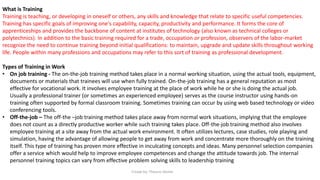
What is Training
Training is teaching, or developing in oneself or others, any skills and knowledge that relate to specific useful competencies.
Training has specific goals of improving one's capability, capacity, productivity and performance. It forms the core of
apprenticeships and provides the backbone of content at institutes of technology (also known as technical colleges or
polytechnics). In addition to the basic training required for a trade, occupation or profession, observers of the labor-market
recognize the need to continue training beyond initial qualifications: to maintain, upgrade and update skills throughout working
life. People within many professions and occupations may refer to this sort of training as professional development.
Types of Training in Work
• On job training - The on-the-job training method takes place in a normal working situation, using the actual tools, equipment,
documents or materials that trainees will use when fully trained. On-the-job training has a general reputation as most
effective for vocational work. It involves employee training at the place of work while he or she is doing the actual job.
Usually a professional trainer (or sometimes an experienced employee) serves as the course instructor using hands-on
training often supported by formal classroom training. Sometimes training can occur by using web based technology or video
conferencing tools.
• Off-the-job – The off-the –job training method takes place away from normal work situations, implying that the employee
does not count as a directly productive worker while such training takes place. Off-the-job training method also involves
employee training at a site away from the actual work environment. It often utilizes lectures, case studies, role playing and
simulation, having the advantage of allowing people to get away from work and concentrate more thoroughly on the training
itself. This type of training has proven more effective in inculcating concepts and ideas. Many personnel selection companies
offer a service which would help to improve employee competences and change the attitude towards job. The internal
personnel training topics can vary from effective problem solving skills to leadership training
Create by: Theunis Venter
• Organizational Training - Organizations use training in order to achieve human resources desired levels of skills, motivation
and decision making ability. Operational training develops, maintains or improves the operational readiness of individuals or
units, while strategic training planning involves the practice of focusing on upcoming challenges that can determine the
possibility of a skills-gap, and design specific training interventions on groups, individuals, teams or leaders.
Training takes place at various points and places in a business. Commonly, training is required to:
• Support new employees (“induction training”)
• Improve productivity
• Increase marketing effectiveness
• Support higher standards of customer service and production quality
• Introduction of new technology, systems or other change
• Address changes in legislation
• Support employee progression and promotion
Effective training has the potential to provide a range of benefits for a business:
• Higher quality
• Better productivity
• Improved motivation - through greater empowerment
• More flexibility through better skills
• Less supervision required (cost saving in supervision)
• Better recruitment and employee retention
• Easier to implement change in the business
Create by: Theunis Venter
IT IS RESPONSIBILTY TO WALK THE EXTRA MILE
AND LEARN EVERYTHING THAT IS GIVEN TO YOU.
ASK QUESTIONS, BECAUSE IF DON’T DO IT, THE
QUESTION WILL NEVER BE ANSWERED.

What is Basic Training

  • 1.
    What is Training Createby: Theunis Venter
  • 2.
  • 3.
  • 4.
  • 5.
  • 6.
    Create by: TheunisVenter What is Training Training is teaching, or developing in oneself or others, any skills and knowledge that relate to specific useful competencies. Training has specific goals of improving one's capability, capacity, productivity and performance. It forms the core of apprenticeships and provides the backbone of content at institutes of technology (also known as technical colleges or polytechnics). In addition to the basic training required for a trade, occupation or profession, observers of the labor-market recognize the need to continue training beyond initial qualifications: to maintain, upgrade and update skills throughout working life. People within many professions and occupations may refer to this sort of training as professional development. Types of Training in Work • On job training - The on-the-job training method takes place in a normal working situation, using the actual tools, equipment, documents or materials that trainees will use when fully trained. On-the-job training has a general reputation as most effective for vocational work. It involves employee training at the place of work while he or she is doing the actual job. Usually a professional trainer (or sometimes an experienced employee) serves as the course instructor using hands-on training often supported by formal classroom training. Sometimes training can occur by using web based technology or video conferencing tools. • Off-the-job – The off-the –job training method takes place away from normal work situations, implying that the employee does not count as a directly productive worker while such training takes place. Off-the-job training method also involves employee training at a site away from the actual work environment. It often utilizes lectures, case studies, role playing and simulation, having the advantage of allowing people to get away from work and concentrate more thoroughly on the training itself. This type of training has proven more effective in inculcating concepts and ideas. Many personnel selection companies offer a service which would help to improve employee competences and change the attitude towards job. The internal personnel training topics can vary from effective problem solving skills to leadership training
  • 7.
    Create by: TheunisVenter • Organizational Training - Organizations use training in order to achieve human resources desired levels of skills, motivation and decision making ability. Operational training develops, maintains or improves the operational readiness of individuals or units, while strategic training planning involves the practice of focusing on upcoming challenges that can determine the possibility of a skills-gap, and design specific training interventions on groups, individuals, teams or leaders. Training takes place at various points and places in a business. Commonly, training is required to: • Support new employees (“induction training”) • Improve productivity • Increase marketing effectiveness • Support higher standards of customer service and production quality • Introduction of new technology, systems or other change • Address changes in legislation • Support employee progression and promotion Effective training has the potential to provide a range of benefits for a business: • Higher quality • Better productivity • Improved motivation - through greater empowerment • More flexibility through better skills • Less supervision required (cost saving in supervision) • Better recruitment and employee retention • Easier to implement change in the business
  • 8.
    Create by: TheunisVenter IT IS RESPONSIBILTY TO WALK THE EXTRA MILE AND LEARN EVERYTHING THAT IS GIVEN TO YOU. ASK QUESTIONS, BECAUSE IF DON’T DO IT, THE QUESTION WILL NEVER BE ANSWERED.