



Management of
Tourism Marketing
Market Segmentation
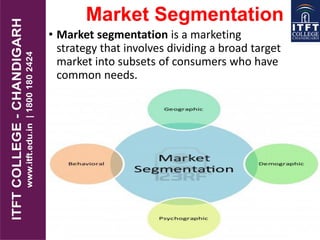
• Market segmentation is a marketing
strategy that involves dividing a broad target
market into subsets of consumers who have
common needs.
Market Segmentation
 Is the process of dividing a totally heterogeneous
market for a product into several segments.
Each segment is a homogeneous market in all the
significant aspects.
One or more of those segments is selected as the
organisation targeted market
Finally a separate marketing mix is developed for
each segment
Bases for Market
Segmentation
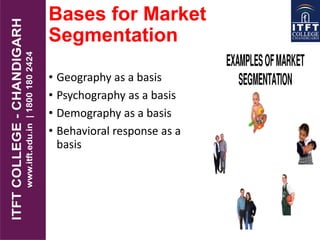
• Geography as a basis
• Psychography as a basis
• Demography as a basis
• Behavioral response as a
basis
Geography as a
Basis
• Region
• City size
• Urban/rural
characteristics
• Climate
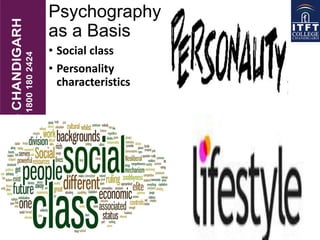
Psychography
as a Basis
• Social class
• Personality
characteristics
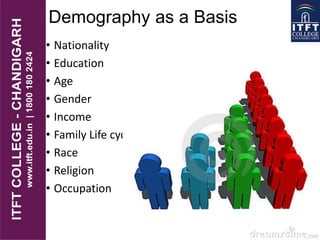
Demography as a Basis
• Nationality
• Education
• Age
• Gender
• Income
• Family Life cycle
• Race
• Religion
• Occupation
Behavioral Response as a
Basis
• Usage Rate
• Type of Buying
Situation
• User Status
• Occasions
• Loyalty Status
Why use Market Segmentation
• The information will allow more sales to be made
• To gain greater knowledge about customers so that
it can vary the products
• Prevent promoting product to wrong people
• To target particular groups
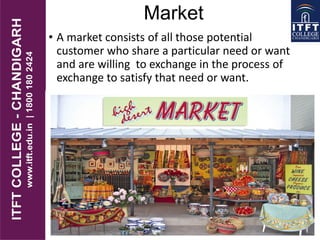
Market
• A market consists of all those potential
customer who share a particular need or want
and are willing to exchange in the process of
exchange to satisfy that need or want.
Marketing According to
Phillip Kotler
• “the process of marketing deals with working
with the (previously defined ) markets to
actualize potential exchanges for satisfying
human needs and wants.”
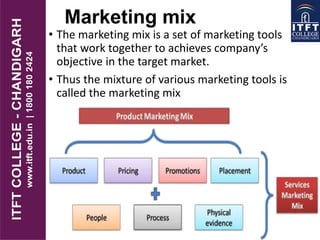
Marketing mix
• The marketing mix is a set of marketing tools
that work together to achieves company’s
objective in the target market.
• Thus the mixture of various marketing tools is
called the marketing mix
When marketing their
products firms need to create
a successful mix of:
• the right product
• sold at the right price
• in the right place
• Using the most suitable promotion.
• Putting the right product in the right place, at the
right price, at the right time.
To create the right marketing
mix, businesses have to meet
the following conditions:
• The product has to have the right features - for
example, it must look good and work well.
• The price must be right. Consumer will need to buy
in large numbers to produce a healthy profit.
• The goods must be in the right place at the right
time. Making sure that the goods arrive when and
where they are wanted is an important operation.
• The target group needs to be made aware of the
existence and availability of the product through
promotion. Successful promotion helps a firm to
spread costs over a larger output.
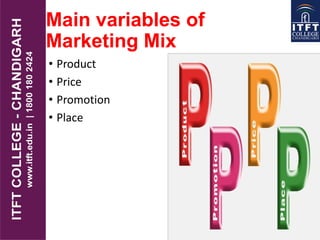
Main variables of
Marketing Mix
• Product
• Price
• Promotion
• Place
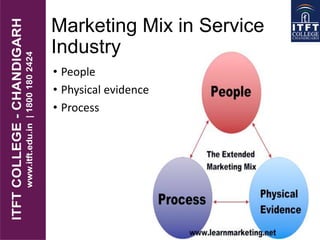
Marketing Mix in Service
Industry
• People
• Physical evidence
• Process
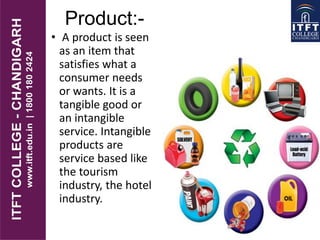
Product:-
• A product is seen
as an item that
satisfies what a
consumer needs
or wants. It is a
tangible good or
an intangible
service. Intangible
products are
service based like
the tourism
industry, the hotel
industry.
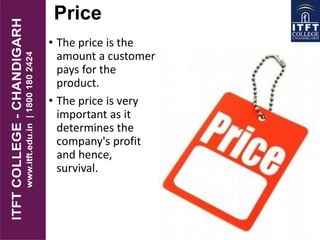
Price
• The price is the
amount a customer
pays for the
product.
• The price is very
important as it
determines the
company's profit
and hence,
survival.
Promotion
• Represents all of the methods of communication
that a marketer may use to provide information
to different parties about the product.
• Promotion comprises elements such
as: advertising, public relations, personal
selling and sales promotion.
Advertising
• Advertising covers any communication that is
paid for, from cinema commercials, radio and
Internet advertisements through print media
and billboards.
• Public relations is where the communication
is not directly paid for and includes press
releases, sponsorship deals, exhibitions,
conferences, seminars or trade fairs and
events.
• Word-of-mouth is any apparently informal
communication about the product by
ordinary individuals, satisfied customers or
people specifically engaged to create word of
mouth momentum. Sales staff often plays an
important role in word of mouth and public
relations
• · Where and when can you get across your
marketing messages to your target market?
• · Will you reach your audience by advertising
in the press, or on TV, or radio, or on
billboards? Through PR? On the Internet?
• · When is the best time to promote? Is there
seasonality in the market·
• How do your competitors do their
promotions? And how does that influence
your choice of promotional activity
Place
• Refers to providing the product at a place
which is convenient for consumers to access.
Place is synonymous with distribution.
• Place is the location at which prospective
customers may be induced to purchase a
service-the point of sale(e.g. Travel Agent)
• Where do buyers look for your product or
service?
• · If they look in a store, what kind? A
specialist boutique or in a supermarket, or
both? Or online? Or direct, via a catalogue?
• · How can you access the right distribution
channels?
• Do you need to use a sales force? Or attend
trade fairs? Or make online submissions?
• What do your competitors do, and how can
you learn from that and/or differentiate?
Marketing Mix in Service
Industry:-
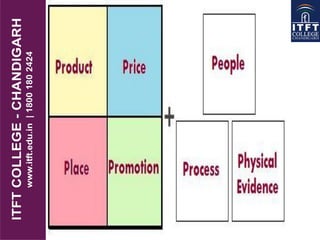
• The traditional marketing mix model was primarily
directed and useful for tangible products. The 7 Ps
model is more useful for service industries. The
other Ps in Service industry is:
• People
• Process
• Physical Evidence
People
• 'People' refers to the employees of the
organization with whom customers come into
contact.
• Recruiting the right staff and training them
appropriately in the delivery of their service is
essential if the organization wants to obtain a
form of competitive advantage. Consumers make
judgments and deliver perceptions of the service
based on the employees they interact with. Staff
should have the appropriate interpersonal skills,
attitude, and service knowledge to provide the
service that consumers are paying for.
People:-
• These refer to all human actors who will
participate in the delivery of the service
• This refers to the company employees who
directly and indirectly interact with the
customers. The customers will judge the
company services on the how the employee
dresses and their behavior in front of the
customers.
Physical Evidence
• Services are intangible in nature most service
providers strive to incorporate certain tangible
elements into their offering to enhance customer
experience.
• Similarly, restaurants invest heavily in their interior
design and decorations to offer a tangible and
unique experience to their guests.
• This refers to the tangible components needed in
the execution of the service like calling cards,
signage, brochures, equipment’s, and letterheads.
It also refers to the venue where the service will be
executed; an example is the branch office of the
bank or fast food chain. Elements within the
store—the store front, the uniforms employees
wear, signboards, etc
Process
• This is the flow of activities that the company
will follow in the execution of the service.
• This is also the actual procedures or processes
flow used by service companies.
• The Process of giving a service, and behavior
of those who deliver are crucial to customer
satisfaction.
Thank you

ITFT - Market Segmentation

  • 1.
  • 2.
    Market Segmentation • Marketsegmentation is a marketing strategy that involves dividing a broad target market into subsets of consumers who have common needs.
  • 3.
    Market Segmentation  Isthe process of dividing a totally heterogeneous market for a product into several segments. Each segment is a homogeneous market in all the significant aspects. One or more of those segments is selected as the organisation targeted market Finally a separate marketing mix is developed for each segment
  • 4.
    Bases for Market Segmentation •Geography as a basis • Psychography as a basis • Demography as a basis • Behavioral response as a basis
  • 5.
    Geography as a Basis •Region • City size • Urban/rural characteristics • Climate
  • 6.
    Psychography as a Basis •Social class • Personality characteristics
  • 7.
    Demography as aBasis • Nationality • Education • Age • Gender • Income • Family Life cycle • Race • Religion • Occupation
  • 8.
    Behavioral Response asa Basis • Usage Rate • Type of Buying Situation • User Status • Occasions • Loyalty Status
  • 9.
    Why use MarketSegmentation • The information will allow more sales to be made • To gain greater knowledge about customers so that it can vary the products • Prevent promoting product to wrong people • To target particular groups
  • 10.
    Market • A marketconsists of all those potential customer who share a particular need or want and are willing to exchange in the process of exchange to satisfy that need or want.
  • 11.
    Marketing According to PhillipKotler • “the process of marketing deals with working with the (previously defined ) markets to actualize potential exchanges for satisfying human needs and wants.”
  • 12.
    Marketing mix • Themarketing mix is a set of marketing tools that work together to achieves company’s objective in the target market. • Thus the mixture of various marketing tools is called the marketing mix
  • 13.
    When marketing their productsfirms need to create a successful mix of: • the right product • sold at the right price • in the right place • Using the most suitable promotion. • Putting the right product in the right place, at the right price, at the right time.
  • 14.
    To create theright marketing mix, businesses have to meet the following conditions: • The product has to have the right features - for example, it must look good and work well. • The price must be right. Consumer will need to buy in large numbers to produce a healthy profit. • The goods must be in the right place at the right time. Making sure that the goods arrive when and where they are wanted is an important operation. • The target group needs to be made aware of the existence and availability of the product through promotion. Successful promotion helps a firm to spread costs over a larger output.
  • 15.
    Main variables of MarketingMix • Product • Price • Promotion • Place
  • 16.
    Marketing Mix inService Industry • People • Physical evidence • Process
  • 18.
    Product:- • A productis seen as an item that satisfies what a consumer needs or wants. It is a tangible good or an intangible service. Intangible products are service based like the tourism industry, the hotel industry.
  • 19.
    Price • The priceis the amount a customer pays for the product. • The price is very important as it determines the company's profit and hence, survival.
  • 20.
    Promotion • Represents allof the methods of communication that a marketer may use to provide information to different parties about the product. • Promotion comprises elements such as: advertising, public relations, personal selling and sales promotion.
  • 21.
    Advertising • Advertising coversany communication that is paid for, from cinema commercials, radio and Internet advertisements through print media and billboards. • Public relations is where the communication is not directly paid for and includes press releases, sponsorship deals, exhibitions, conferences, seminars or trade fairs and events.
  • 22.
    • Word-of-mouth isany apparently informal communication about the product by ordinary individuals, satisfied customers or people specifically engaged to create word of mouth momentum. Sales staff often plays an important role in word of mouth and public relations
  • 23.
    • · Whereand when can you get across your marketing messages to your target market? • · Will you reach your audience by advertising in the press, or on TV, or radio, or on billboards? Through PR? On the Internet? • · When is the best time to promote? Is there seasonality in the market· • How do your competitors do their promotions? And how does that influence your choice of promotional activity
  • 24.
    Place • Refers toproviding the product at a place which is convenient for consumers to access. Place is synonymous with distribution. • Place is the location at which prospective customers may be induced to purchase a service-the point of sale(e.g. Travel Agent)
  • 25.
    • Where dobuyers look for your product or service? • · If they look in a store, what kind? A specialist boutique or in a supermarket, or both? Or online? Or direct, via a catalogue? • · How can you access the right distribution channels? • Do you need to use a sales force? Or attend trade fairs? Or make online submissions? • What do your competitors do, and how can you learn from that and/or differentiate?
  • 26.
    Marketing Mix inService Industry:- • The traditional marketing mix model was primarily directed and useful for tangible products. The 7 Ps model is more useful for service industries. The other Ps in Service industry is: • People • Process • Physical Evidence
  • 27.
    People • 'People' refersto the employees of the organization with whom customers come into contact. • Recruiting the right staff and training them appropriately in the delivery of their service is essential if the organization wants to obtain a form of competitive advantage. Consumers make judgments and deliver perceptions of the service based on the employees they interact with. Staff should have the appropriate interpersonal skills, attitude, and service knowledge to provide the service that consumers are paying for.
  • 28.
    People:- • These referto all human actors who will participate in the delivery of the service • This refers to the company employees who directly and indirectly interact with the customers. The customers will judge the company services on the how the employee dresses and their behavior in front of the customers.
  • 29.
    Physical Evidence • Servicesare intangible in nature most service providers strive to incorporate certain tangible elements into their offering to enhance customer experience. • Similarly, restaurants invest heavily in their interior design and decorations to offer a tangible and unique experience to their guests.
  • 30.
    • This refersto the tangible components needed in the execution of the service like calling cards, signage, brochures, equipment’s, and letterheads. It also refers to the venue where the service will be executed; an example is the branch office of the bank or fast food chain. Elements within the store—the store front, the uniforms employees wear, signboards, etc
  • 31.
    Process • This isthe flow of activities that the company will follow in the execution of the service. • This is also the actual procedures or processes flow used by service companies. • The Process of giving a service, and behavior of those who deliver are crucial to customer satisfaction.
  • 32.