Marketing Tourism Hillary Jenkins, Otago Polytechnic
Marketing Concept ‘ Marketing is the management process responsible for identifying, anticipating and satisfying customer requirements profitably.’  (Chartered Institute of Marketing, UK)
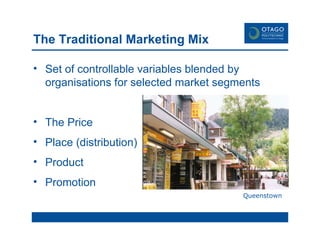
The Traditional Marketing Mix Set of controllable variables blended by organisations for selected market segments The Price Place (distribution) Product Promotion Queenstown
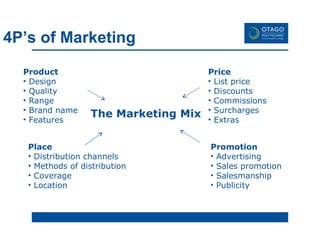
4P’s of Marketing Product Design Quality Range Brand name Features Price List price Discounts Commissions Surcharges Extras Place Distribution channels Methods of distribution Coverage Location Promotion Advertising Sales promotion Salesmanship Publicity The Marketing Mix
Product Tourism products and services are designed for and continuously adapted to match changing needs, expectations and budget of the target market
Place Not only the location of the tourist attraction or facility but the location of  points of sale  that provide customers with access to tourist products eg. I-site, accommodation, cafe
Price Used to achieve predetermined sales volume and revenue objectives Price gives a product or service a perceived value in the eyes of the consumer How would you use price to counteract demand exceeding supply?
Promotion The most visible of the 4p’s Promotional techniques aim to increase awareness and demand for products http://nz.youtube.com/watch?v=gwTpijLCfrc&feature=related
Marketing Services Tourism is a service.  Services differ from physical products,  This needs to be taken into account when marketing them
Characteristics of Services  Intangibility Heterogeneity Temporary ownership Perishability Inseparability
Intangibility Not the physical portion (tangible) of the product Performance or experience rendered by the service provider to the service consumer Most tourism products are a mixture of tangible and intangible
Inseparability Services are usually produced and consumed at the same time Think of a restaurant meal This can make it difficult to separate the provider of the service from the service itself.
Perishability Services cannot be saved or stored as they expire during the simultaneous production and consumption process Aircraft seat Restaurant meal Amusement park ride
Heterogeneity Standardisation Difficult to achieve in a people based service industry Quality control plays an important part What forms of standardization can you think of?
Ownership Service customers usually only have access to or use a facility where a service is performed Use of a hotel room for a holiday – you occupy the space only and have temporary use of the facilities
How Tourism Differs Tourism is more supply-led than other services All ready have the product then research which market might be interested in purchasing it.   Dunedin the destination is already here who wants to visit. Tourism product might involve the co-operation of several suppliers . e.g. Package holiday
How Tourism Differs Tourism is a complex, extended product experience with no predictable critical evaluation point. Pre trip anticipation and post trip reflection While trips to the same destination may be the same different variables can make the trip  different – and hard to evaluate against
How Tourism Differs Tourism is a high-involvement, high-risk product to its consumers Involves committing large sums of money to something reasonably unknown Tourism is a product partly constituted by the dreams and fantasies of its customers . Unlike banking and car repair, tourism is not consumed for rational, functional purposes.
How Tourism Differs Tourism is a fragile industry susceptible to external forces beyond the control of its suppliers Tourism organisations sometimes have to make rapid responses to crises in the form of product redesign, price reductions or promotional damage limitation.
7 P’s of Tourism Marketing Price Place Product Promotion People Process Physical Evidence
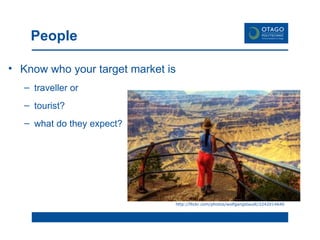
People  Know who your target market is traveller or tourist? what do they expect? http://flickr.com/photos/wolfgangstaudt/2242014640
People -  Employees A tourism organisations most valuable resource Physical appearance, behaviour, knowledge and attitude has a powerful impact on customers perception of the tourism product Ensure uniform, grooming etc. conform to branding and target market
People -  Employees Ensure staff are trained to ensure the product is delivered in accordance with the marketing strategic plan. Employees  physically embody the product and are walking billboards from a promotional point of view  –  Zeithaml & Bitner (1996)
Process Process is inseparable product If any part of the process is found to be unsuitable by the consumer, it could result in a negative evaluation of the whole product.
Physical Evidence Defined as the built environment owned and controlled by a tourism organisation The tangible aspect of the tourism product May be used to facilitate the service delivery process e.g. layout and signage Communicates messages about quality, positioning and differentiation
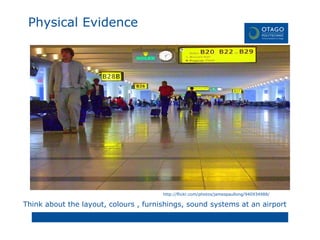
Think about the layout, colours , furnishings, sound systems at an airport http://flickr.com/photos/jamespaullong/940934988/ Physical Evidence
Marketing Tourism Product and service Tangible and intangible People led and operated Market orientated

Marketing Tourism

  • 1.
    Marketing Tourism HillaryJenkins, Otago Polytechnic
  • 2.
    Marketing Concept ‘Marketing is the management process responsible for identifying, anticipating and satisfying customer requirements profitably.’ (Chartered Institute of Marketing, UK)
  • 3.
    The Traditional MarketingMix Set of controllable variables blended by organisations for selected market segments The Price Place (distribution) Product Promotion Queenstown
  • 4.
    4P’s of MarketingProduct Design Quality Range Brand name Features Price List price Discounts Commissions Surcharges Extras Place Distribution channels Methods of distribution Coverage Location Promotion Advertising Sales promotion Salesmanship Publicity The Marketing Mix
  • 5.
    Product Tourism productsand services are designed for and continuously adapted to match changing needs, expectations and budget of the target market
  • 6.
    Place Not onlythe location of the tourist attraction or facility but the location of points of sale that provide customers with access to tourist products eg. I-site, accommodation, cafe
  • 7.
    Price Used toachieve predetermined sales volume and revenue objectives Price gives a product or service a perceived value in the eyes of the consumer How would you use price to counteract demand exceeding supply?
  • 8.
    Promotion The mostvisible of the 4p’s Promotional techniques aim to increase awareness and demand for products http://nz.youtube.com/watch?v=gwTpijLCfrc&feature=related
  • 9.
    Marketing Services Tourismis a service. Services differ from physical products, This needs to be taken into account when marketing them
  • 10.
    Characteristics of Services Intangibility Heterogeneity Temporary ownership Perishability Inseparability
  • 11.
    Intangibility Not thephysical portion (tangible) of the product Performance or experience rendered by the service provider to the service consumer Most tourism products are a mixture of tangible and intangible
  • 12.
    Inseparability Services areusually produced and consumed at the same time Think of a restaurant meal This can make it difficult to separate the provider of the service from the service itself.
  • 13.
    Perishability Services cannotbe saved or stored as they expire during the simultaneous production and consumption process Aircraft seat Restaurant meal Amusement park ride
  • 14.
    Heterogeneity Standardisation Difficultto achieve in a people based service industry Quality control plays an important part What forms of standardization can you think of?
  • 15.
    Ownership Service customersusually only have access to or use a facility where a service is performed Use of a hotel room for a holiday – you occupy the space only and have temporary use of the facilities
  • 16.
    How Tourism DiffersTourism is more supply-led than other services All ready have the product then research which market might be interested in purchasing it. Dunedin the destination is already here who wants to visit. Tourism product might involve the co-operation of several suppliers . e.g. Package holiday
  • 17.
    How Tourism DiffersTourism is a complex, extended product experience with no predictable critical evaluation point. Pre trip anticipation and post trip reflection While trips to the same destination may be the same different variables can make the trip different – and hard to evaluate against
  • 18.
    How Tourism DiffersTourism is a high-involvement, high-risk product to its consumers Involves committing large sums of money to something reasonably unknown Tourism is a product partly constituted by the dreams and fantasies of its customers . Unlike banking and car repair, tourism is not consumed for rational, functional purposes.
  • 19.
    How Tourism DiffersTourism is a fragile industry susceptible to external forces beyond the control of its suppliers Tourism organisations sometimes have to make rapid responses to crises in the form of product redesign, price reductions or promotional damage limitation.
  • 20.
    7 P’s ofTourism Marketing Price Place Product Promotion People Process Physical Evidence
  • 21.
    People Knowwho your target market is traveller or tourist? what do they expect? http://flickr.com/photos/wolfgangstaudt/2242014640
  • 22.
    People - Employees A tourism organisations most valuable resource Physical appearance, behaviour, knowledge and attitude has a powerful impact on customers perception of the tourism product Ensure uniform, grooming etc. conform to branding and target market
  • 23.
    People - Employees Ensure staff are trained to ensure the product is delivered in accordance with the marketing strategic plan. Employees physically embody the product and are walking billboards from a promotional point of view – Zeithaml & Bitner (1996)
  • 24.
    Process Process isinseparable product If any part of the process is found to be unsuitable by the consumer, it could result in a negative evaluation of the whole product.
  • 25.
    Physical Evidence Definedas the built environment owned and controlled by a tourism organisation The tangible aspect of the tourism product May be used to facilitate the service delivery process e.g. layout and signage Communicates messages about quality, positioning and differentiation
  • 26.
    Think about thelayout, colours , furnishings, sound systems at an airport http://flickr.com/photos/jamespaullong/940934988/ Physical Evidence
  • 27.
    Marketing Tourism Productand service Tangible and intangible People led and operated Market orientated