The Message: Structure
Presented By:
Raja Muhammad Noman
“A message prepared in the mind reaches a
mind; a message prepared in a life reaches a
life.”
Bill Gothard
Outline
• Thinking versus Structuring
• Thinking Process
• Be aware of your assumption
• Draw valid conclusion
 Induction
 Deduction
• Provide logical defects
 Don’t jump too fast to conclusion
 Don’t hide your ideas
 Don’t oversimplify
• Structuring Process
• Provide a hierarchy for your ideas
• Put your ideas in order
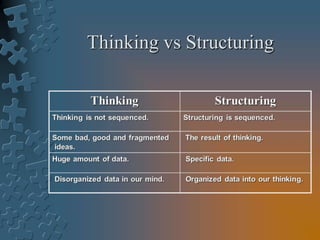
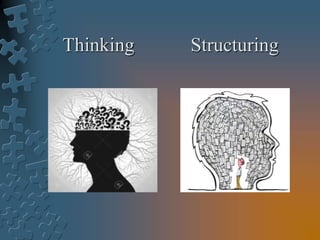
Thinking vs Structuring
Thinking Structuring
Thinking Process
• The process of considering or reasoning about
something.
• Your assumptions, which form the basis for your
thinking, are like assumptions about what will be
produced.
• Thinking Process has three steps:
1. Beware of your assumptions
2. Draw valid conclusions
3. Avoid logical defects
1. Beware of your assumptions
• Assumptions are the basis for all the your thinking
• In business communication you make assumptions
Example:
“This program will increase our profits”.
Assumption: You want to make a profit.
“I better finish this report tonight or I'll get fired”.
Assumption: You want to keep your job.
2. Draw valid conclusions
• Assumption and facts are what you start out with when you
are thinking; conclusions are what you end up with.
• It has two valid methods:
 Deduction
 Induction
Continued…
Deduction
• Deduction means to start with a general statement or
assumption and proceed towards a guaranteed
specific conclusion.
• For example “It's sunny in Singapore. If it's sunny in
Singapore, he won't be carrying an umbrella. So, he
won't be carrying an umbrella.”
Induction
• Induction begins with observations that are specific
and limited in scope, and proceeds to a generalized
conclusion that is likely, but not certain, in light of
accumulated evidence.
• You could say that inductive argument moves from
specific to general.
• For example “Every time I've walked by that dog, he
hasn't tried to bite me. So, the next time I walk by that
dog he won't try to bite me..”
3.Avoid logical defects
You can avoid defects by remembering the three main
rules:
• Do not jump at conclusions too fast
• Do not hide your ideas :
o by focusing on less important issues
o behind exaggeration
o behind irrelevant events
• Do not over simplify
Structuring
Structuring is defined as to construct or arrange
according to a plan; give a pattern or organize
something.
Structuring a message:
• Providing a hierarchy of ideas
• Choosing the appropriate order for those ideas
Hierarchy of Ideas
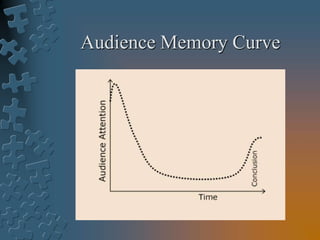
• Stress your Conclusion or top level idea (audience memory
curve).
• Divide your writing or speaking into main points or
Second level ideas
• Subdivide these into supporting points
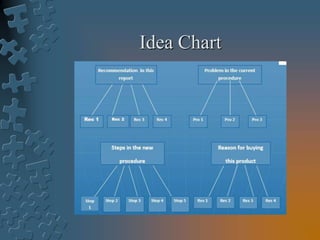
Idea Chart
Audience Memory Curve
Put Your Ideas In Order
• Explanatory Ideas
 You can order by time.
 You can order by components.
 You might order by importance.
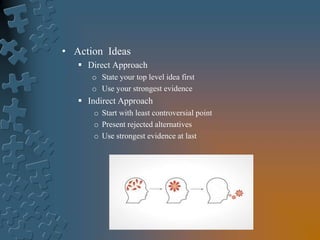
• Action Ideas
 Direct Approach
o State your top level idea first
o Use your strongest evidence
 Indirect Approach
o Start with least controversial point
o Present rejected alternatives
o Use strongest evidence at last
Conclusion
Thank You

The message

  • 1.
    The Message: Structure PresentedBy: Raja Muhammad Noman
  • 2.
    “A message preparedin the mind reaches a mind; a message prepared in a life reaches a life.” Bill Gothard
  • 3.
    Outline • Thinking versusStructuring • Thinking Process • Be aware of your assumption • Draw valid conclusion  Induction  Deduction • Provide logical defects  Don’t jump too fast to conclusion  Don’t hide your ideas  Don’t oversimplify • Structuring Process • Provide a hierarchy for your ideas • Put your ideas in order
  • 4.
  • 5.
  • 6.
    Thinking Process • Theprocess of considering or reasoning about something. • Your assumptions, which form the basis for your thinking, are like assumptions about what will be produced. • Thinking Process has three steps: 1. Beware of your assumptions 2. Draw valid conclusions 3. Avoid logical defects
  • 7.
    1. Beware ofyour assumptions • Assumptions are the basis for all the your thinking • In business communication you make assumptions Example: “This program will increase our profits”. Assumption: You want to make a profit. “I better finish this report tonight or I'll get fired”. Assumption: You want to keep your job.
  • 8.
    2. Draw validconclusions • Assumption and facts are what you start out with when you are thinking; conclusions are what you end up with. • It has two valid methods:  Deduction  Induction Continued…
  • 9.
    Deduction • Deduction meansto start with a general statement or assumption and proceed towards a guaranteed specific conclusion. • For example “It's sunny in Singapore. If it's sunny in Singapore, he won't be carrying an umbrella. So, he won't be carrying an umbrella.”
  • 10.
    Induction • Induction beginswith observations that are specific and limited in scope, and proceeds to a generalized conclusion that is likely, but not certain, in light of accumulated evidence. • You could say that inductive argument moves from specific to general. • For example “Every time I've walked by that dog, he hasn't tried to bite me. So, the next time I walk by that dog he won't try to bite me..”
  • 11.
    3.Avoid logical defects Youcan avoid defects by remembering the three main rules: • Do not jump at conclusions too fast • Do not hide your ideas : o by focusing on less important issues o behind exaggeration o behind irrelevant events • Do not over simplify
  • 12.
    Structuring Structuring is definedas to construct or arrange according to a plan; give a pattern or organize something. Structuring a message: • Providing a hierarchy of ideas • Choosing the appropriate order for those ideas
  • 13.
    Hierarchy of Ideas •Stress your Conclusion or top level idea (audience memory curve). • Divide your writing or speaking into main points or Second level ideas • Subdivide these into supporting points
  • 14.
  • 15.
  • 16.
    Put Your IdeasIn Order • Explanatory Ideas  You can order by time.  You can order by components.  You might order by importance.
  • 17.
    • Action Ideas Direct Approach o State your top level idea first o Use your strongest evidence  Indirect Approach o Start with least controversial point o Present rejected alternatives o Use strongest evidence at last
  • 18.
  • 19.