Outsourcing Evaluation Process
Objective Propose a formal methodology based on value analysis to: Choose between outsourcing or insourcing If outsourcing is chosen, select the vendor, and... Develop contracts that will ensure that vendor complies with promised results
Possible reasons to outsource Improve efficiency Need to acquire new resources Bandwagon effect Reduce uncertainity Eliminate a troublesome function Enhance credibility
Improve efficiency Efficiency can be improved when vendor has specific advantages over the internal organization, such as Scale economy Improved service Special know how or resources More “relaxed” requirements in HR administration Issues If the vendor does not have specific advantages, either the outsourcing cost will be higher than internal cost, or... The internal organization performing inefficiently, and there is an opportunity for more savings correcting this situation The performance of the internal organization is in general evaluated through perception rather than measurement Should the Company support others in “relaxed” HR practices?.
Need to acquire new resources Outsourcing has some advantages when the company has resources limitations for  Capital: Outsource the service instead of acquiring the resources to do it internally Labor: For very specific skills that could not be nurtured inside the organization Convenience of outsourcing to overcome capital limitation is easy to analyze Labor issues Premium price to be paid for highly skilled specialists Does the work really get done by those specialists?
The bandwagon effect Trend to duplicate success stories Issues Press reports proved to be overly optimistic Additional work beyond the scope of the contract is never shown Many cases used as examples are far from finished Do not jump blindly into outsourcing In some cases, costs have been reduced by returning to in house processing
Reduce uncertainity Requirements varying significantly without a fixed trend Issues: Outsourced resources in the form of body shopping are more expensive than internal resources if they are hired for long term Determine what is the base level staff that the Company should have to avoid overpaying
Eliminate a burdensome function By paying some premium the management gets rid of some functions allowing to focus on the most important areas Issues: Management never gets rid of the responsibility, and if he/she does, somebody else is to take over or the company suffers the consequences
Enhance Credibility Personal credibility must precede departamental credibility  Serious outsourcing analysis allows I/T managers to demonstrate that they are business men committed with corporate goals rather than technicians Issues: The I/T staff may consider this approach as a self interest move from the management
Risks associated with outsourcing Outsourcing seems to be a symptom of the failure to demonstrate the value of IT Outsourcing is initiated in many cases for reasons other than cost efficiency or valid strategic moves The IT dept may be able to achieve similar or better results without vendor assistance  The metaphor that IT is merely a utility is misguided Loosing the people knowledgeable in business and technology simultaneously, who are sources of ideas generating value from IT Outsourcing may be difficult to revert once decision is taken and we lost the people and knowledge Outsourcing may cause loose of exclusivity in usage of IT as competitive advantage Outsourcing may difficult to control technical standards and principles compliance
Conclusion Outsourcing is not a “silver bullet”, but a tool to be applied selectively It should not be applied in some cases, even if it has positive payback Where it may be applied, a formal analysis covering economic and strategic impacts on the business, in short and long term should be required Internal service should be considered another alternative, and thoroughly evaluated before discarding Analyzing outsourcing initiatives may be used as a benchmarking process to improve our internal organization
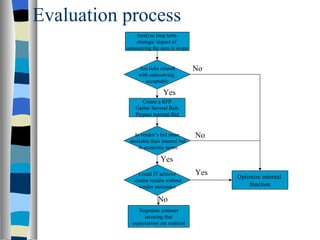
Evaluation process Create a RFP Gather Several Bids Prepare Internal Bid Negotiate contract ensuring that expectations are realized Optimize internal  function Is vendor’s bid more desirable than internal bid in economic terms Could IT achieve similar results without vendor assistance  No Yes Yes No Analyze long term  strategic impact of  outsourcing the area in scope Are risks related with outsourcing  acceptable Yes No
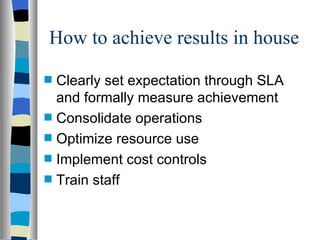
How to achieve results in house Clearly set expectation through SLA and formally measure achievement Consolidate operations Optimize resource use Implement cost controls Train staff
Issues in contract negotiation Outsourcing vendors are not partners because profit motives are not shared The contract is the only mechanism that establishes a balance of power in an outsourcing relationship
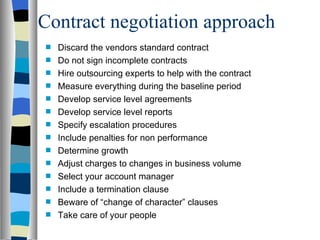
Contract negotiation approach Discard the vendors standard contract Do not sign incomplete contracts Hire outsourcing experts to help with the contract Measure everything during the baseline period Develop service level agreements Develop service level reports Specify escalation procedures Include penalties for non performance Determine growth Adjust charges to changes in business volume Select your account manager Include a termination clause Beware of “change of character” clauses Take care of your people

IT Outsourcing

  • 1.
  • 2.
    Objective Propose aformal methodology based on value analysis to: Choose between outsourcing or insourcing If outsourcing is chosen, select the vendor, and... Develop contracts that will ensure that vendor complies with promised results
  • 3.
    Possible reasons tooutsource Improve efficiency Need to acquire new resources Bandwagon effect Reduce uncertainity Eliminate a troublesome function Enhance credibility
  • 4.
    Improve efficiency Efficiencycan be improved when vendor has specific advantages over the internal organization, such as Scale economy Improved service Special know how or resources More “relaxed” requirements in HR administration Issues If the vendor does not have specific advantages, either the outsourcing cost will be higher than internal cost, or... The internal organization performing inefficiently, and there is an opportunity for more savings correcting this situation The performance of the internal organization is in general evaluated through perception rather than measurement Should the Company support others in “relaxed” HR practices?.
  • 5.
    Need to acquirenew resources Outsourcing has some advantages when the company has resources limitations for Capital: Outsource the service instead of acquiring the resources to do it internally Labor: For very specific skills that could not be nurtured inside the organization Convenience of outsourcing to overcome capital limitation is easy to analyze Labor issues Premium price to be paid for highly skilled specialists Does the work really get done by those specialists?
  • 6.
    The bandwagon effectTrend to duplicate success stories Issues Press reports proved to be overly optimistic Additional work beyond the scope of the contract is never shown Many cases used as examples are far from finished Do not jump blindly into outsourcing In some cases, costs have been reduced by returning to in house processing
  • 7.
    Reduce uncertainity Requirementsvarying significantly without a fixed trend Issues: Outsourced resources in the form of body shopping are more expensive than internal resources if they are hired for long term Determine what is the base level staff that the Company should have to avoid overpaying
  • 8.
    Eliminate a burdensomefunction By paying some premium the management gets rid of some functions allowing to focus on the most important areas Issues: Management never gets rid of the responsibility, and if he/she does, somebody else is to take over or the company suffers the consequences
  • 9.
    Enhance Credibility Personalcredibility must precede departamental credibility Serious outsourcing analysis allows I/T managers to demonstrate that they are business men committed with corporate goals rather than technicians Issues: The I/T staff may consider this approach as a self interest move from the management
  • 10.
    Risks associated withoutsourcing Outsourcing seems to be a symptom of the failure to demonstrate the value of IT Outsourcing is initiated in many cases for reasons other than cost efficiency or valid strategic moves The IT dept may be able to achieve similar or better results without vendor assistance The metaphor that IT is merely a utility is misguided Loosing the people knowledgeable in business and technology simultaneously, who are sources of ideas generating value from IT Outsourcing may be difficult to revert once decision is taken and we lost the people and knowledge Outsourcing may cause loose of exclusivity in usage of IT as competitive advantage Outsourcing may difficult to control technical standards and principles compliance
  • 11.
    Conclusion Outsourcing isnot a “silver bullet”, but a tool to be applied selectively It should not be applied in some cases, even if it has positive payback Where it may be applied, a formal analysis covering economic and strategic impacts on the business, in short and long term should be required Internal service should be considered another alternative, and thoroughly evaluated before discarding Analyzing outsourcing initiatives may be used as a benchmarking process to improve our internal organization
  • 12.
    Evaluation process Createa RFP Gather Several Bids Prepare Internal Bid Negotiate contract ensuring that expectations are realized Optimize internal function Is vendor’s bid more desirable than internal bid in economic terms Could IT achieve similar results without vendor assistance No Yes Yes No Analyze long term strategic impact of outsourcing the area in scope Are risks related with outsourcing acceptable Yes No
  • 13.
    How to achieveresults in house Clearly set expectation through SLA and formally measure achievement Consolidate operations Optimize resource use Implement cost controls Train staff
  • 14.
    Issues in contractnegotiation Outsourcing vendors are not partners because profit motives are not shared The contract is the only mechanism that establishes a balance of power in an outsourcing relationship
  • 15.
    Contract negotiation approachDiscard the vendors standard contract Do not sign incomplete contracts Hire outsourcing experts to help with the contract Measure everything during the baseline period Develop service level agreements Develop service level reports Specify escalation procedures Include penalties for non performance Determine growth Adjust charges to changes in business volume Select your account manager Include a termination clause Beware of “change of character” clauses Take care of your people