


ATTORNEY DEVELOPMENT PLAN
WHAT IS THIS ALL ABOUT?
✓ Developing talented and motivated lawyers
✓ Ensure the best attorneys stay with the firm
✓ Building a high performance culture
ATTORNEY DEVELOPMENT PLAN
WHAT DOES IT TAKE?
✓ Equity member commitment
✓ Associates and Income Members have to perform
✓ Honestly evaluate performance
ATTORNEY DEVELOPMENT PLAN
HOW IS IT ACCOMPLISHED?
✓ The right recruiting strategy
✓ The right evaluation and feedback systems
✓ Priority training and development (the best and the rest)
ATTORNEY DEVELOPMENT PLAN
HOW IS IT ACCOMPLISHED?
✓ Short and long term incentives
✓ Placing the right people in the right roles
✓ Advancement criteria
33%
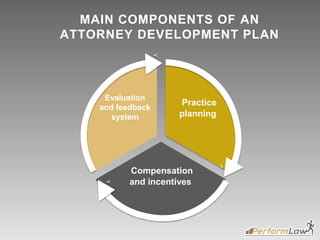
Evaluation
and feedback
system
Practice
planning
Compensation
and incentives
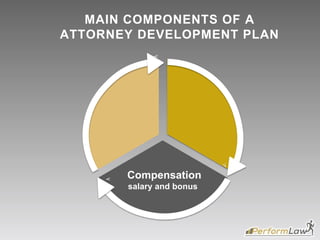
MAIN COMPONENTS OF AN
ATTORNEY DEVELOPMENT PLAN
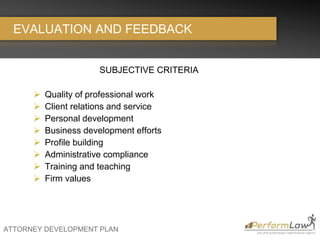
EVALUATION AND FEEDBACK
SUBJECTIVE CRITERIA
 Quality of professional work
 Client relations and service
 Personal development
 Business development efforts
 Profile building
 Administrative compliance
 Training and teaching
 Firm values
ATTORNEY DEVELOPMENT PLAN
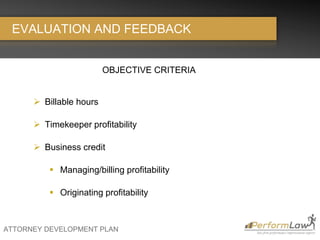
EVALUATION AND FEEDBACK
OBJECTIVE CRITERIA
 Billable hours
 Timekeeper profitability
 Business credit
 Managing/billing profitability
 Originating profitability
ATTORNEY DEVELOPMENT PLAN
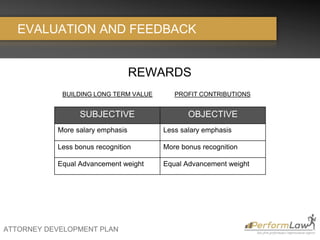
EVALUATION AND FEEDBACK
REWARDS
SUBJECTIVE OBJECTIVE
More salary emphasis Less salary emphasis
Less bonus recognition More bonus recognition
Equal Advancement weight Equal Advancement weight
BUILDING LONG TERM VALUE PROFIT CONTRIBUTIONS
ATTORNEY DEVELOPMENT PLAN
EVALUATION AND FEEDBACK
DATA COLLECTION AND ANALYSIS
 Online Form - demonstration
 Grading Scale
 Practice Level
 Performance Measures
ATTORNEY DEVELOPMENT PLAN
EVALUATION AND FEEDBACK
ANALYTICS
 Evaluation score summaries
 Peer comparisons
 Progression measurements
ATTORNEY DEVELOPMENT PLAN
EVALUATION AND FEEDBACK
FEEDBACK
 Sharing results – view graphics
 Progression toward partnership (based on criteria)
 Performance improvement plans
 Individual meetings
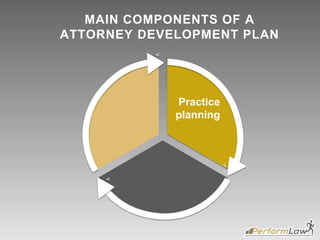
33%
Practice
planning
MAIN COMPONENTS OF A
ATTORNEY DEVELOPMENT PLAN
PRACTICE PLANNING PROCESS
WHAT IS A PRACTICE PLAN?
 Non billable time investments
 General investments
 Firm specific investments
ATTORNEY DEVELOPMENT PLAN
PLAN DEVELOPMENT CONTEXT
 Years 1 – 5 heavily influenced by the members
 After year 5
 Attorney choices aligned with the firm’s opportunities
 Personal choices balanced with the firm’s needs
 As a lawyer matures, more latitude is afforded
PRACTICE PLANNING PROCESS
ATTORNEY DEVELOPMENT PLAN
PLAN DEVELOPMENT CONCEPTS
 Shared vision of success
 Train associates to view career strategically
 Focus efforts according to potential
PRACTICE PLANNING PROCESS
ATTORNEY DEVELOPMENT PLAN
SAMPLE PLAN REVIEW
 Economic summary – sample plan
 Plan detail
 Frequency
PRACTICE PLANNING PROCESS
ATTORNEY DEVELOPMENT PLAN
PRACTICE PLANNING PROCESS
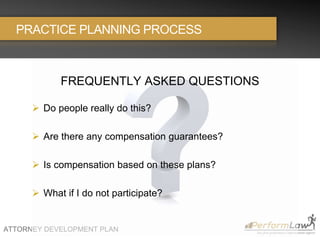
FREQUENTLY ASKED QUESTIONS
 Do people really do this?
 Are there any compensation guarantees?
 Is compensation based on these plans?
 What if I do not participate?
33%Compensation
salary and bonus
MAIN COMPONENTS OF A
ATTORNEY DEVELOPMENT PLAN
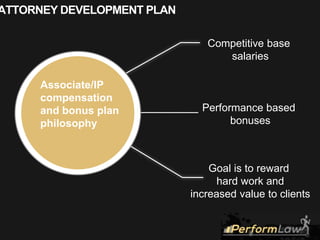
Associate/IP
compensation
and bonus plan
philosophy
Competitive base
salaries
Performance based
bonuses
Goal is to reward
hard work and
increased value to clients
ATTORNEY DEVELOPMENT PLAN
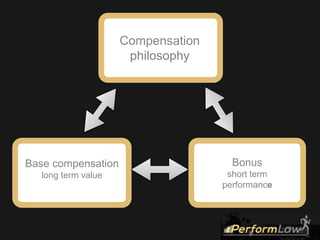
Compensation
philosophy
Base compensation
long term value
Bonus
short term
performance
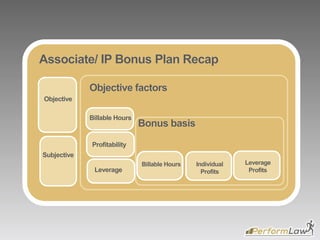
Objective
Subjective
Billable Hours
Profitability
Leverage
Billable Hours Individual
Profits
Leverage
Profits
Bonus basis
Objective factors
Associate/ IP Bonus Plan Recap
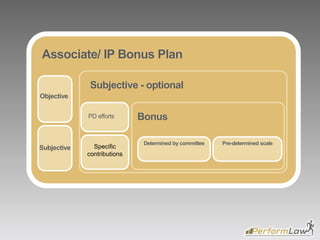
Objective
Subjective
PD efforts
Specific
contributions
Determined by committee Pre-determined scale
Bonus
Subjective - optional
Associate/ IP Bonus Plan
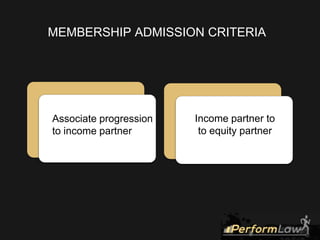
MEMBERSHIP ADMISSION CRITERIA
Associate progression
to income partner
Income partner to
to equity partner
ATTORNEY DEVELOPMENT PLAN
PROMOTION TO INCOME PARTNER
COMMON CRITERIA
 Minimum of 5 years with the firm
 Ability to grow existing firm business
 Bar or civic association leadership
 Speaking and publishing success
ATTORNEY DEVELOPMENT PLAN
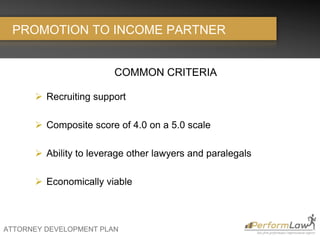
PROMOTION TO INCOME PARTNER
COMMON CRITERIA
 Recruiting support
 Composite score of 4.0 on a 5.0 scale
 Ability to leverage other lawyers and paralegals
 Economically viable
ATTORNEY DEVELOPMENT PLAN
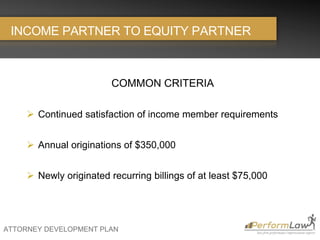
INCOME PARTNER TO EQUITY PARTNER
COMMON CRITERIA
 Continued satisfaction of income member requirements
 Annual originations of $350,000
 Newly originated recurring billings of at least $75,000
ATTORNEY DEVELOPMENT PLAN
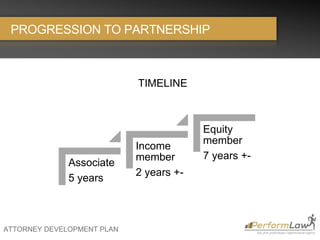
PROGRESSION TO PARTNERSHIP
Associate
5 years
Income
member
2 years +-
Equity
member
7 years +-
TIMELINE
ATTORNEY DEVELOPMENT PLAN
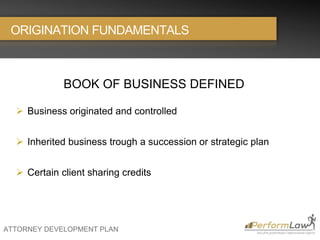
ORIGINATION FUNDAMENTALS
BOOK OF BUSINESS DEFINED
 Business originated and controlled
 Inherited business trough a succession or strategic plan
 Certain client sharing credits
ATTORNEY DEVELOPMENT PLAN
BOOK OF BUSINESS DOES NOT INCLUDE
 Business without opportunity cost
ORIGINATION FUNDAMENTALS
ATTORNEY DEVELOPMENT PLAN
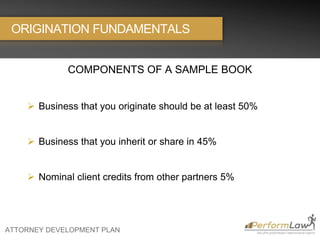
COMPONENTS OF A SAMPLE BOOK
 Business that you originate should be at least 50%
 Business that you inherit or share in 45%
 Nominal client credits from other partners 5%
ORIGINATION FUNDAMENTALS
b r i a n @ p e f o r m l a w . c o m
PerformLaw.com

Attorney Development Plan

Editor's Notes

  • #4 What do we have to do together? The members of the firm are committed to providing each attorney with the training, feedback, mentoring and incentives to perform at a very high level The associates in turn will be expected to perform at very high levels and to prepare themselves for increased responsibility
  • #11 The evaluation and feedback system Please review the evaluation form being passed out Grading scale Excellent Exceeds expectations Meeting expectations Below expectations Unacceptable Overall practice level Overall practice level Novice Intermediate Advanced Expert Specific performance measures – all Quality of professional work Client relations and service Personal development Business development efforts Profile building Training and teaching Administrative compliance Firm Values
  • #12 The evaluation and feedback system Each attorney will have be given a summary of their evaluation scores in each area Each attorney will be given the opportunity to review the actual evaluation forms complete with written comments Each attorney will participate in at least an annual detailed evaluation meeting with one or more of the equity members These evaluation meetings will provide an opportunity for structured feedback
  • #13 The evaluation and feedback system Important points Scores lower than a 3 are an issue As you will see later, to progress to Junior Membership, you must have a composite score of 4.0 of a 5.0 scale, with no grades lower than 3.0 As you become more experienced, the tougher and more comprehensive the evaluation scope For example, in the beginning years of your practice several areas will be graded as NA, which has no effect on the evaluation
  • #15 What is a practice plan? A plan to focus investments of non billable time on those activities that will create the most value for the associate General investments Time investments that are good for all lawyers Firm specific investments Time investments of particular value to the firm
  • #16 How is a practice plan prepared? In the early years of an attorney’s ATTORNEY, the plan is guided mostly by the members of the firm As an associate becomes more experienced, the substance of the plan is more heavily influenced by the associate ATTORNEY choices based on the firm’s opportunities Personal choices balanced with the firm’s needs
  • #17 How is a practice plan prepared? In the early years of an attorney’s ATTORNEY, the plan is guided mostly by the members of the firm As an associate becomes more experienced, the substance of the plan is more heavily influenced by the associate ATTORNEY choices based on the firm’s opportunities Personal choices balanced with the firm’s needs
  • #18 What is the practice planning process? Review sample practice plan Economic summary Planned billable expectations Hours Billings and realization Collections Other firm specific economic measures Review sample practice plan Review at meeting General notes Not all of the activities will be priorities at all times in your ATTORNEY and may vary among associates depending upon individual talents and firm needs Generally, as you become more experienced, you plan contains more priorities
  • #19 Frequently asked questions Do people really do this? Are there any guarantees? Do I do this even after I have my own clients and become a member? What if I do not participate?
  • #23 Bonus
  • #26 A minimum of X years with the firm An ability to grow existing firm business Leadership in bar or civic associations, for example: Attorney will have been published in an accredited bar journal or other publication at least once during the 5 year evaluation period Active member of at least 1 professional organization Conducted professional speaking engagements
  • #27 Support the firm’s recruiting efforts, as appropriate Have a composite score of 4.0 on a 5.0 scale on the previous two attorney evaluations No grade lower than a 3 in any one area. Managing enough business to demonstrate an ability to leverage other lawyers and paralegals Annual billings of at least $25,000 as a billing timekeeper
  • #28 Continued satisfaction of requirements of junior membership Attainment of $350,000 in annual billings credit as originator, billing timekeeper, or as a part of client credit sharing agreement with another member, for the two years preceding advancement. Newly originated or developed business of $75,000 (counts toward the $350,000 requirement), such new business must be recurring in nature and been attained in each of the immediate 2 years preceding advancement
  • #29 Achieve consistent (2 years or more) leveraged billings of at least $100,000 Receive the affirmative vote of the Equity Members holding at least 70% of firm membership interests
  • #30 What is a book of business and why is it important? Your book includes: Business that you originate and control Business that you have inherited and control through a succession or strategic plan- or by accident Business that you receive credit for within the firm’s client credit sharing system Your book does not include: Business that you operationally help manage for another partner who is significantly involved in the client relationship and/or cases You may receive nominal client credit for this service
  • #31 What is a book of business and why is it important? Your book includes: Business that you originate and control Business that you have inherited and control through a succession or strategic plan- or by accident Business that you receive credit for within the firm’s client credit sharing system Your book does not include: Business that you operationally help manage for another partner who is significantly involved in the client relationship and/or cases You may receive nominal client credit for this service
  • #32 How much business should come from each component of a book? Difficult to answer but let’s try this: Business that you originate should be at least 50% Business that you receive trough a client sharing program in which another partner is active and controls the relationship should not exceed 5% of your total book (good citizen credits) Business that you inherit or are given strategically (client or case significance) would make up the difference 45%