ISOTOPES
ISOTOPES OF HYDROGEN
ISOTOPES OF CARBON
ISOTOPES OF CHLORINE
ISOTOPES OF OXYGEN
ISOTOPES OF URANIUM
ISOTOPES OF NEON
PROPERTIES OF ISOTOPES
A chemical element may be represented by atoms with
the same number of protons but a different number of
neutrons. These variations are different isotopes of the
same element is called isotopes.
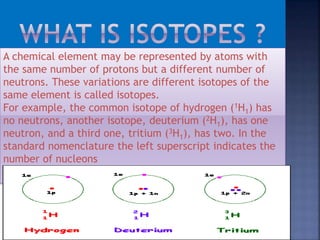
For example, the common isotope of hydrogen (1H1) has
no neutrons, another isotope, deuterium (2H1), has one
neutron, and a third one, tritium (3H1), has two. In the
standard nomenclature the left superscript indicates the
number of nucleons
EX:
Isotopes of hydrogen
ISOTROPES OF HYDROGEN ARE DIVIDED INTO
THREE PARTS
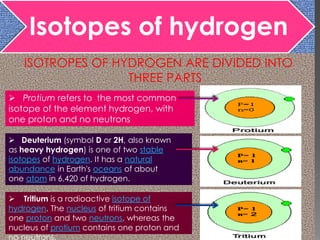
 Protium refers to the most common
isotope of the element hydrogen, with
one proton and no neutrons
 Deuterium (symbol D or 2H, also known
as heavy hydrogen) is one of two stable
isotopes of hydrogen. It has a natural
abundance in Earth's oceans of about
one atom in 6,420 of hydrogen.
 Tritium is a radioactive isotope of
hydrogen. The nucleus of tritium contains
one proton and two neutrons, whereas the
nucleus of protium contains one proton and
no neutrons.
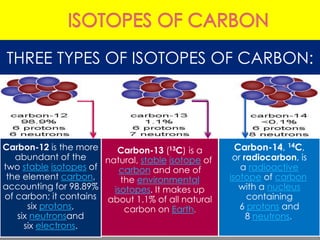
THREE TYPES OF ISOTOPES OF CARBON:
Carbon-12 is the more
abundant of the
two stable isotopes of
the element carbon,
accounting for 98.89%
of carbon; it contains
six protons,
six neutronsand
six electrons.
Carbon-13 (13C) is a
natural, stable isotope of
carbon and one of
the environmental
isotopes. It makes up
about 1.1% of all natural
carbon on Earth.
Carbon-14, 14C,
or radiocarbon, is
a radioactive
isotope of carbon
with a nucleus
containing
6 protons and
8 neutrons.
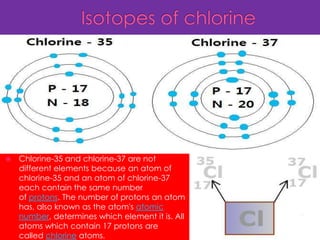
 Chlorine-35 and chlorine-37 are not
different elements because an atom of
chlorine-35 and an atom of chlorine-37
each contain the same number
of protons. The number of protons an atom
has, also known as the atom's atomic
number, determines which element it is. All
atoms which contain 17 protons are
called chlorine atoms.
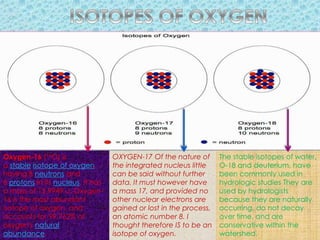
Oxygen-16 (16O) is
a stable isotope of oxygen,
having 8 neutrons and
8 protons in its nucleus. It has
a mass of 15.9949 u. Oxygen-
16 is the most abundant
isotope of oxygen, and
accounts for 99.762% of
oxygen's natural
abundance.
OXYGEN-17 Of the nature of
the integrated nucleus little
can be said without further
data. It must however have
a mass 17, and provided no
other nuclear electrons are
gained or lost in the process,
an atomic number 8. I
thought therefore IS to be an
isotope of oxygen.
The stable isotopes of water,
O-18 and deuterium, have
been commonly used in
hydrologic studies They are
used by hydrologists
because they are naturally
occurring, do not decay
over time, and are
conservative within the
watershed.
ISOTOPES OF URANIUM
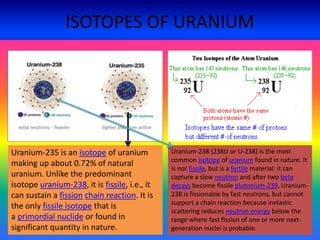
Uranium-235 is an isotope of uranium
making up about 0.72% of natural
uranium. Unlike the predominant
isotope uranium-238, it is fissile, i.e., it
can sustain a fission chain reaction. It is
the only fissile isotope that is
a primordial nuclide or found in
significant quantity in nature.
Uranium-238 (238U or U-238) is the most
common isotope of uranium found in nature. It
is not fissile, but is a fertile material: it can
capture a slow neutron and after two beta
decays become fissile plutonium-239. Uranium-
238 is fissionable by fast neutrons, but cannot
support a chain reaction because inelastic
scattering reduces neutron energy below the
range where fast fission of one or more next-
generation nuclei is probable.
ISOTOPES OF NEON
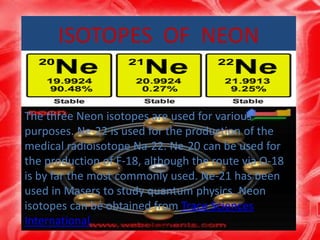
The three Neon isotopes are used for various
purposes. Ne-22 is used for the production of the
medical radioisotope Na-22. Ne-20 can be used for
the production of F-18, although the route via O-18
is by far the most commonly used. Ne-21 has been
used in Masers to study quantum physics. Neon
isotopes can be obtained from Trace Sciences
International.
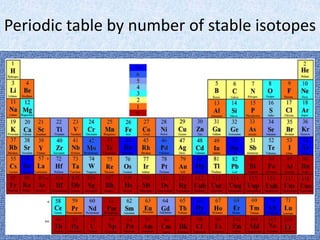
Periodic table by number of stable isotopes
1.The atomic number i.e., the number
protons in all the isotopes of an element
is the same. Thus , they are likely to
have same chemical properties
2.The electrons configuration of all the
isotopes of same element is same.
3.The physical properties such as mass.
density, melting point. Boiling point,
etc., of isotopes of same element are
different.
Isotropes

Isotropes

  • 3.
    ISOTOPES ISOTOPES OF HYDROGEN ISOTOPESOF CARBON ISOTOPES OF CHLORINE ISOTOPES OF OXYGEN ISOTOPES OF URANIUM ISOTOPES OF NEON PROPERTIES OF ISOTOPES
  • 4.
    A chemical elementmay be represented by atoms with the same number of protons but a different number of neutrons. These variations are different isotopes of the same element is called isotopes. For example, the common isotope of hydrogen (1H1) has no neutrons, another isotope, deuterium (2H1), has one neutron, and a third one, tritium (3H1), has two. In the standard nomenclature the left superscript indicates the number of nucleons EX:
  • 5.
    Isotopes of hydrogen ISOTROPESOF HYDROGEN ARE DIVIDED INTO THREE PARTS  Protium refers to the most common isotope of the element hydrogen, with one proton and no neutrons  Deuterium (symbol D or 2H, also known as heavy hydrogen) is one of two stable isotopes of hydrogen. It has a natural abundance in Earth's oceans of about one atom in 6,420 of hydrogen.  Tritium is a radioactive isotope of hydrogen. The nucleus of tritium contains one proton and two neutrons, whereas the nucleus of protium contains one proton and no neutrons.
  • 6.
    THREE TYPES OFISOTOPES OF CARBON: Carbon-12 is the more abundant of the two stable isotopes of the element carbon, accounting for 98.89% of carbon; it contains six protons, six neutronsand six electrons. Carbon-13 (13C) is a natural, stable isotope of carbon and one of the environmental isotopes. It makes up about 1.1% of all natural carbon on Earth. Carbon-14, 14C, or radiocarbon, is a radioactive isotope of carbon with a nucleus containing 6 protons and 8 neutrons.
  • 7.
     Chlorine-35 andchlorine-37 are not different elements because an atom of chlorine-35 and an atom of chlorine-37 each contain the same number of protons. The number of protons an atom has, also known as the atom's atomic number, determines which element it is. All atoms which contain 17 protons are called chlorine atoms.
  • 8.
    Oxygen-16 (16O) is astable isotope of oxygen, having 8 neutrons and 8 protons in its nucleus. It has a mass of 15.9949 u. Oxygen- 16 is the most abundant isotope of oxygen, and accounts for 99.762% of oxygen's natural abundance. OXYGEN-17 Of the nature of the integrated nucleus little can be said without further data. It must however have a mass 17, and provided no other nuclear electrons are gained or lost in the process, an atomic number 8. I thought therefore IS to be an isotope of oxygen. The stable isotopes of water, O-18 and deuterium, have been commonly used in hydrologic studies They are used by hydrologists because they are naturally occurring, do not decay over time, and are conservative within the watershed.
  • 9.
    ISOTOPES OF URANIUM Uranium-235is an isotope of uranium making up about 0.72% of natural uranium. Unlike the predominant isotope uranium-238, it is fissile, i.e., it can sustain a fission chain reaction. It is the only fissile isotope that is a primordial nuclide or found in significant quantity in nature. Uranium-238 (238U or U-238) is the most common isotope of uranium found in nature. It is not fissile, but is a fertile material: it can capture a slow neutron and after two beta decays become fissile plutonium-239. Uranium- 238 is fissionable by fast neutrons, but cannot support a chain reaction because inelastic scattering reduces neutron energy below the range where fast fission of one or more next- generation nuclei is probable.
  • 10.
    ISOTOPES OF NEON Thethree Neon isotopes are used for various purposes. Ne-22 is used for the production of the medical radioisotope Na-22. Ne-20 can be used for the production of F-18, although the route via O-18 is by far the most commonly used. Ne-21 has been used in Masers to study quantum physics. Neon isotopes can be obtained from Trace Sciences International.
  • 11.
    Periodic table bynumber of stable isotopes
  • 12.
    1.The atomic numberi.e., the number protons in all the isotopes of an element is the same. Thus , they are likely to have same chemical properties 2.The electrons configuration of all the isotopes of same element is same. 3.The physical properties such as mass. density, melting point. Boiling point, etc., of isotopes of same element are different.