Introduction to AtomsThe Fundamental particles of Atoms
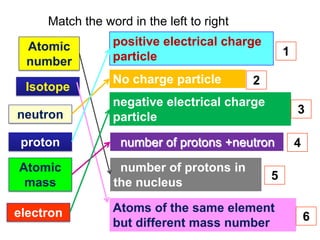
Match the word in the left to rightpositive electrical charge particleAtomic number1No charge particle 2Isotopenegative electrical charge particle3neutronproton  number of protons +neutron      4Atomic mass  number of protons in the nucleus5Atoms of the same element  but different mass numberelectron6
atomAn _____is the smallest particle of an element that has the chemical properties of the element.Copper atoms on silica surface.Distance across = 1.8 nanometer (1.8 x 10⁻⁹ m)
The AtomDid  you  know  an  atom consists  of  a …..nucleuselectronsElectron cloudNucleus
ATOM COMPOSITIONThe atom is mostly empty spaceThere are protonsand neutrons in   the nucleus.
electronsin space around the   nucleus.the number of electrons is equal to the number of protons.
ATOMIC COMPOSITIONProtons (p+)  + ve electrical charge
 mass =  1.672623 x 10⁻²⁴ g
 relative mass  =  1.007 atomic 		mass units (amu) but we can round to 1Electrons (e-)−veelectrical charge
	relative mass  =  0.0005 amubut we can round to 0Neutrons (no)no electrical charge
mass  =  1.009 amubut we can round to 1Atomic Number, ZAll atoms of the same element have the same number of protons in the nucleus, Z
Mass Number, AC atom with 6 protons and 6 neutrons is   12 atomic mass unitsB atom with 5 protons and 5 neutrons is   10 atomic mass unitsWhat is mass number?Mass Number(A)= # protons  +  # neutrons
Atomic numberAtomic symbolAtomic Mass(AVERAGE)Nuclear symbolAXZ(or  Mass number)
Atomic numberAtomic symbolNuclear symbolC atom with 6 protons and 6 neutrons.  Write the nuclear symbol of C atom ……Mass number
11B10BIsotopesAtoms of the same element (same Z) but different mass number (A).Boron-10 (10B) has 5 p and 5 n	Boron-11 (11B) has 5 p and 6 n
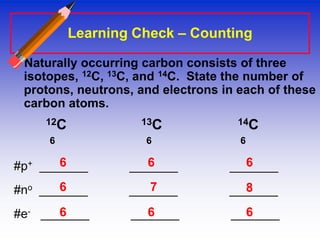
Learning Check – Counting   Naturally occurring carbon consists of three isotopes, 12C, 13C, and 14C.  State the number of protons, neutrons, and electrons in each of these carbon atoms. 12C		        13C			14C6		              6                       	 6	#p+  _______            _______               _______     #no  _______            _______               _______     #e-   _______            _______               _______666678666
Answers12C		        13C			14C6		              6                       	  6#p+666#no678#e-   6              		66

Atom 2

  • 1.
    Introduction to AtomsTheFundamental particles of Atoms
  • 2.
    Match the wordin the left to rightpositive electrical charge particleAtomic number1No charge particle 2Isotopenegative electrical charge particle3neutronproton number of protons +neutron 4Atomic mass number of protons in the nucleus5Atoms of the same element but different mass numberelectron6
  • 3.
    atomAn _____is thesmallest particle of an element that has the chemical properties of the element.Copper atoms on silica surface.Distance across = 1.8 nanometer (1.8 x 10⁻⁹ m)
  • 4.
    The AtomDid you know an atom consists of a …..nucleuselectronsElectron cloudNucleus
  • 5.
    ATOM COMPOSITIONThe atomis mostly empty spaceThere are protonsand neutrons in the nucleus.
  • 6.
    electronsin space aroundthe nucleus.the number of electrons is equal to the number of protons.
  • 7.
    ATOMIC COMPOSITIONProtons (p+) + ve electrical charge
  • 8.
    mass = 1.672623 x 10⁻²⁴ g
  • 9.
    relative mass = 1.007 atomic mass units (amu) but we can round to 1Electrons (e-)−veelectrical charge
  • 10.
    relative mass = 0.0005 amubut we can round to 0Neutrons (no)no electrical charge
  • 11.
    mass = 1.009 amubut we can round to 1Atomic Number, ZAll atoms of the same element have the same number of protons in the nucleus, Z
  • 12.
    Mass Number, ACatom with 6 protons and 6 neutrons is 12 atomic mass unitsB atom with 5 protons and 5 neutrons is 10 atomic mass unitsWhat is mass number?Mass Number(A)= # protons + # neutrons
  • 13.
    Atomic numberAtomic symbolAtomicMass(AVERAGE)Nuclear symbolAXZ(or Mass number)
  • 14.
    Atomic numberAtomic symbolNuclearsymbolC atom with 6 protons and 6 neutrons. Write the nuclear symbol of C atom ……Mass number
  • 15.
    11B10BIsotopesAtoms of thesame element (same Z) but different mass number (A).Boron-10 (10B) has 5 p and 5 n Boron-11 (11B) has 5 p and 6 n
  • 16.
    Learning Check –Counting Naturally occurring carbon consists of three isotopes, 12C, 13C, and 14C. State the number of protons, neutrons, and electrons in each of these carbon atoms. 12C 13C 14C6 6 6 #p+ _______ _______ _______ #no _______ _______ _______ #e- _______ _______ _______666678666
  • 17.
    Answers12C 13C 14C6 6 6#p+666#no678#e- 6 66