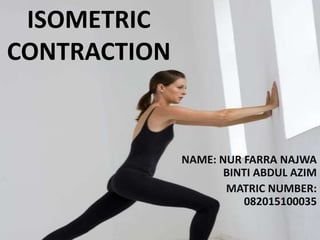
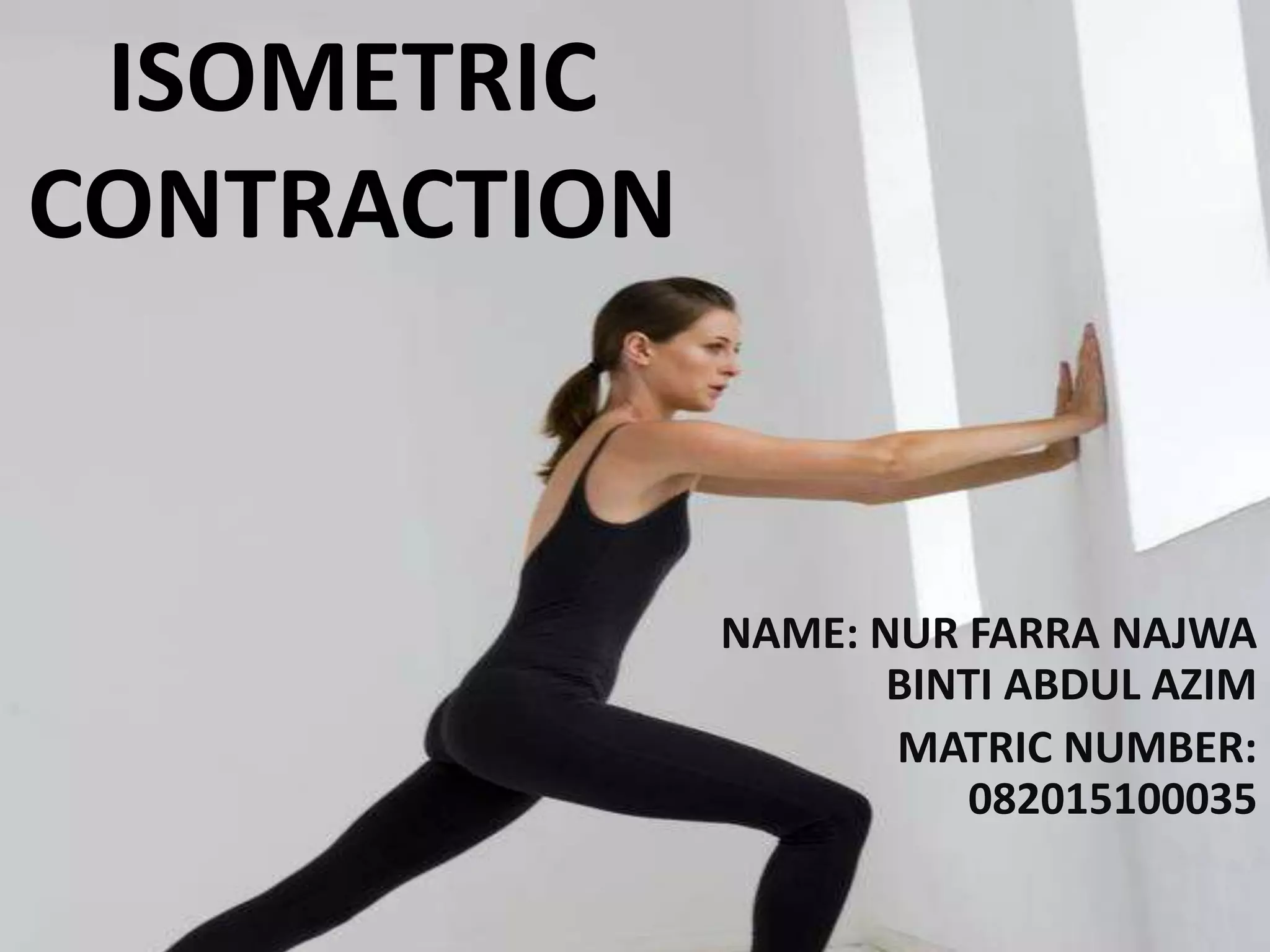

ISOMETRIC
CONTRACTION
NAME: NUR FARRA NAJWA
BINTI ABDUL AZIM
MATRIC NUMBER:
082015100035
OBJECTIVE
• Define isometric contraction
• Give example on isometric contraction
• List similarities between isotonic and
isometric contraction
• List comparison on isotonic and isometric
contraction
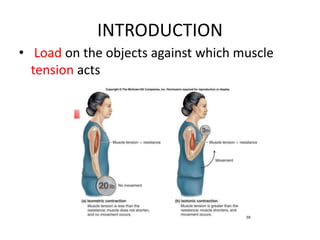
• Load on the objects against which muscle
tension acts
INTRODUCTION
INTRODUCTION
• Contraction are of two type
I. Isometric contraction
II. Isotonic contraction
• Muscular contraction involve shortening of
contractile elements
• Tension is the force of the contraction muscle
acting on the objects
• Load is the force exerted on the muscle by an
objects.
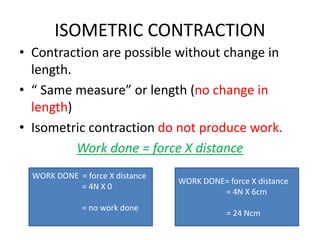
ISOMETRIC CONTRACTION
• Contraction are possible without change in
length.
• “ Same measure” or length (no change in
length)
• Isometric contraction do not produce work.
Work done = force X distance
WORK DONE = force X distance
= 4N X 0
= no work done
WORK DONE= force X distance
= 4N X 6cm
= 24 Ncm
• Cross bridge bind with actin molecule and
attempt to pull them
• Load is greater than the tension muscle fibre
exerted.
Isometric tension = force exerted on thin
filaments
SIMILARITIES
• The same internal events occur in both:
a) Muscle excitation
b) The cross bridge
c) The filaments sliding shortens the sarcomeres
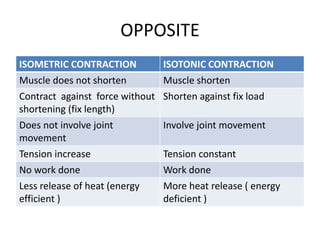
ISOMETRIC CONTRACTION ISOTONIC CONTRACTION
Muscle does not shorten Muscle shorten
Contract against force without
shortening (fix length)
Shorten against fix load
Does not involve joint
movement
Involve joint movement
Tension increase Tension constant
No work done Work done
Less release of heat (energy
efficient )
More heat release ( energy
deficient )
OPPOSITE
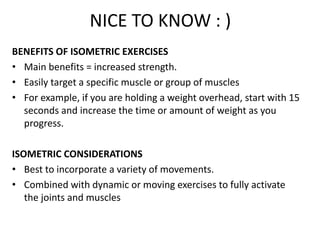
NICE TO KNOW : )
BENEFITS OF ISOMETRIC EXERCISES
• Main benefits = increased strength.
• Easily target a specific muscle or group of muscles
• For example, if you are holding a weight overhead, start with 15
seconds and increase the time or amount of weight as you
progress.
ISOMETRIC CONSIDERATIONS
• Best to incorporate a variety of movements.
• Combined with dynamic or moving exercises to fully activate
the joints and muscles
REFERENCE
• Gk Pal, Textbook Of Medical Physiology
Ms187
• Textbook Of Medical Physiology, 11th Edition,
Guyton & Hall
• Ganong’s Review Of Medical Physiology, 25th
Edition
• Human Physiology, From Cell To System, 7th
Edition, L. Sherwood
THANK YOU

Isometric contraction

  • 1.
    ISOMETRIC CONTRACTION NAME: NUR FARRANAJWA BINTI ABDUL AZIM MATRIC NUMBER: 082015100035
  • 2.
    OBJECTIVE • Define isometriccontraction • Give example on isometric contraction • List similarities between isotonic and isometric contraction • List comparison on isotonic and isometric contraction
  • 3.
    • Load onthe objects against which muscle tension acts INTRODUCTION
  • 4.
    INTRODUCTION • Contraction areof two type I. Isometric contraction II. Isotonic contraction • Muscular contraction involve shortening of contractile elements • Tension is the force of the contraction muscle acting on the objects • Load is the force exerted on the muscle by an objects.
  • 5.
    ISOMETRIC CONTRACTION • Contractionare possible without change in length. • “ Same measure” or length (no change in length) • Isometric contraction do not produce work. Work done = force X distance WORK DONE = force X distance = 4N X 0 = no work done WORK DONE= force X distance = 4N X 6cm = 24 Ncm
  • 6.
    • Cross bridgebind with actin molecule and attempt to pull them • Load is greater than the tension muscle fibre exerted. Isometric tension = force exerted on thin filaments
  • 7.
    SIMILARITIES • The sameinternal events occur in both: a) Muscle excitation b) The cross bridge c) The filaments sliding shortens the sarcomeres
  • 8.
    ISOMETRIC CONTRACTION ISOTONICCONTRACTION Muscle does not shorten Muscle shorten Contract against force without shortening (fix length) Shorten against fix load Does not involve joint movement Involve joint movement Tension increase Tension constant No work done Work done Less release of heat (energy efficient ) More heat release ( energy deficient ) OPPOSITE
  • 9.
    NICE TO KNOW: ) BENEFITS OF ISOMETRIC EXERCISES • Main benefits = increased strength. • Easily target a specific muscle or group of muscles • For example, if you are holding a weight overhead, start with 15 seconds and increase the time or amount of weight as you progress. ISOMETRIC CONSIDERATIONS • Best to incorporate a variety of movements. • Combined with dynamic or moving exercises to fully activate the joints and muscles
  • 10.
    REFERENCE • Gk Pal,Textbook Of Medical Physiology Ms187 • Textbook Of Medical Physiology, 11th Edition, Guyton & Hall • Ganong’s Review Of Medical Physiology, 25th Edition • Human Physiology, From Cell To System, 7th Edition, L. Sherwood
  • 11.