MUSCLE
CONTRACTION PRESENTED BY:-
Jean Melanie Vincent Haymo
Physical Education Teacher
MPhil Scholar Punjabi University ,Patiala
MPED L.N.I.P.E , Gwalior
Muscle Contraction
– Muscle fiber generates tension through the action
of actin and myosin cross-bridge cycling. While under
tension, the muscle may lengthen, shorten or remain the
same. Though the term 'contraction' implies shortening,
when referring to the muscular system it means muscle
fibers generating tension with the help of motor neurons
(the terms twitch tension, twitch force and fiber
contraction are also used).
Classification of Muscular
Contractions
 In concentric contraction, the force generated is sufficient to overcome the resistance,
and the muscle shortens as it contracts. This is what most people think of as a muscle
contraction.
 In eccentric contraction, the force generated is insufficient to overcome the external
load on the muscle and the muscle fibers lengthen as they contract. An eccentric
contraction is used as a means of decelerating a body part or object, or lowering a
load gently rather than letting it drop.
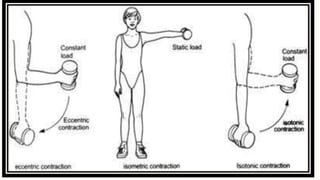
 In isometric contraction, the muscle remains the same length. An example would be
holding an object up without moving it; the muscular force precisely matches the
load, and no movement results.
– In isotonic contraction, the tension in the muscle remains constant despite a
change in muscle length. This can occur only when a muscle's maximal force
of contraction exceeds the total load on the muscle.
– In iso-velocity contraction (sometimes called "isokinetic"), the muscle
contraction velocity remains constant, while force is allowed to vary. True
iso-velocity contractions are rare in the body, and are primarily an analysis
method used in experiments on isolated muscles which have been dissected
out of the organism.
– In an isotonic contraction, tension remains unchanged and the muscle's length
changes. Lifting an object off a desk is an example of isotonic contractions. A
near isotonic contraction is known as Auxotonic contraction.
– There are two types of isotonic contractions: (1) concentric and (2) eccentric.
In a concentric contraction, the muscle tension rises to meet the resistance,
then remains the same as the muscle shortens. In eccentric, the muscle
lengthens due to the resistance being greater than the force the muscle is
producing.
Eccentric Contraction
– During an eccentric contraction, the muscle elongates while under tension due to an
opposing force being greater than the force generated by the muscle.[3] Rather than
working to pull a joint in the direction of the muscle contraction, the muscle acts
to decelerate the joint at the end of a movement or otherwise control the repositioning
of a load.
– During an eccentric contraction of the biceps muscle, the elbow starts the movement
while bent and then straightens as the hand moves away from the shoulder. During an
eccentric contraction of the triceps muscle, the elbow starts the movement straight
and then bends as the hand moves towards the shoulder
Concentric Contraction
 A concentric contraction is a type of muscle contraction in which the muscles shorten while
generating force.
 During a concentric contraction, a muscle is stimulated to contract according to the sliding
filament mechanism. This occurs throughout the length of the muscle, generating force at
the musculo-tendinous junction, causing the muscle to shorten and changing the angle of the
joint. In relation to the elbow, a concentric contraction of the biceps would cause the arm to
bend at the elbow and hand to move from near to the leg, to close to the shoulder (a biceps
curl). A concentric contraction of the triceps would change the angle of the joint in the
opposite direction, straightening the arm and moving the hand towards the leg.
Isometric Contraction
– An isometric contraction of a muscle generates force without changing length.
An example can be found when the muscles of the hand andforearm grip an
object; the joints of the hand do not move, but muscles generate sufficient force
to prevent the object from being dropped.
Isokinetic Contraction
– An isokinetic muscle contraction is one in which the muscle contracts and
shortens at constant rate of speed. This type of muscle contraction usually
requires special, expensive training equipment that increases the load as it senses
that the muscle contraction is speeding up.

Muscle Contraction

  • 1.
    MUSCLE CONTRACTION PRESENTED BY:- JeanMelanie Vincent Haymo Physical Education Teacher MPhil Scholar Punjabi University ,Patiala MPED L.N.I.P.E , Gwalior
  • 2.
    Muscle Contraction – Musclefiber generates tension through the action of actin and myosin cross-bridge cycling. While under tension, the muscle may lengthen, shorten or remain the same. Though the term 'contraction' implies shortening, when referring to the muscular system it means muscle fibers generating tension with the help of motor neurons (the terms twitch tension, twitch force and fiber contraction are also used).
  • 3.
    Classification of Muscular Contractions In concentric contraction, the force generated is sufficient to overcome the resistance, and the muscle shortens as it contracts. This is what most people think of as a muscle contraction.  In eccentric contraction, the force generated is insufficient to overcome the external load on the muscle and the muscle fibers lengthen as they contract. An eccentric contraction is used as a means of decelerating a body part or object, or lowering a load gently rather than letting it drop.  In isometric contraction, the muscle remains the same length. An example would be holding an object up without moving it; the muscular force precisely matches the load, and no movement results.
  • 4.
    – In isotoniccontraction, the tension in the muscle remains constant despite a change in muscle length. This can occur only when a muscle's maximal force of contraction exceeds the total load on the muscle. – In iso-velocity contraction (sometimes called "isokinetic"), the muscle contraction velocity remains constant, while force is allowed to vary. True iso-velocity contractions are rare in the body, and are primarily an analysis method used in experiments on isolated muscles which have been dissected out of the organism.
  • 5.
    – In anisotonic contraction, tension remains unchanged and the muscle's length changes. Lifting an object off a desk is an example of isotonic contractions. A near isotonic contraction is known as Auxotonic contraction. – There are two types of isotonic contractions: (1) concentric and (2) eccentric. In a concentric contraction, the muscle tension rises to meet the resistance, then remains the same as the muscle shortens. In eccentric, the muscle lengthens due to the resistance being greater than the force the muscle is producing.
  • 6.
    Eccentric Contraction – Duringan eccentric contraction, the muscle elongates while under tension due to an opposing force being greater than the force generated by the muscle.[3] Rather than working to pull a joint in the direction of the muscle contraction, the muscle acts to decelerate the joint at the end of a movement or otherwise control the repositioning of a load. – During an eccentric contraction of the biceps muscle, the elbow starts the movement while bent and then straightens as the hand moves away from the shoulder. During an eccentric contraction of the triceps muscle, the elbow starts the movement straight and then bends as the hand moves towards the shoulder
  • 7.
    Concentric Contraction  Aconcentric contraction is a type of muscle contraction in which the muscles shorten while generating force.  During a concentric contraction, a muscle is stimulated to contract according to the sliding filament mechanism. This occurs throughout the length of the muscle, generating force at the musculo-tendinous junction, causing the muscle to shorten and changing the angle of the joint. In relation to the elbow, a concentric contraction of the biceps would cause the arm to bend at the elbow and hand to move from near to the leg, to close to the shoulder (a biceps curl). A concentric contraction of the triceps would change the angle of the joint in the opposite direction, straightening the arm and moving the hand towards the leg.
  • 8.
    Isometric Contraction – Anisometric contraction of a muscle generates force without changing length. An example can be found when the muscles of the hand andforearm grip an object; the joints of the hand do not move, but muscles generate sufficient force to prevent the object from being dropped.
  • 10.
    Isokinetic Contraction – Anisokinetic muscle contraction is one in which the muscle contracts and shortens at constant rate of speed. This type of muscle contraction usually requires special, expensive training equipment that increases the load as it senses that the muscle contraction is speeding up.